Jeff Bezos Embodies the Cruel Autocracy of Neoliberal Capitalism

Amazon CEO and richest-man-in-the-world Jeff Bezos wants you to work as much as he does—for one millionth of the pay

By Branko Marcetic

Source: In These Times

“Is Jeff Bezos a horrible boss and is that good?” That was the question posed by Forbes magazine in 2013, a sentiment that helps explain why Amazon’s founder and CEO is detested by the Left for his oligarchic ambitions, while simultaneously admired by America’s capitalist class for his business success. Ironically, Bezos is also loathed by former President Donald Trump, while celebrated by many liberals for so-called resistance.

But with Bezos and his $115 billion fortune laying claim to the title of richest man on Earth, and with Amazon playing an increasingly influential role in public life, it is worth asking: What does Jeff Bezos stand for?

A gifted child born to a teen mom, Bezos grew up not knowing his biological father, who was once one of the top-rated unicyclists in Albuquerque, N.M. Instead, Bezos was raised by the man his mother soon married: Miguel Bezos, who had fled Cuba and the Communist revolution, which had shuttered the elite private Jesuit school he attended, as well as his family’s lumberyard.

Journalists have speculated whether Bezos’ near-pathological competitiveness is a product of his early abandonment, similar to that of fellow tech overlord Steve Jobs. No doubt equally formative was Bezos’ adoptive father, who told Brad Stone, author of The Everything Store: Jeff Bezos and the Age of Amazon, that their home life was ​“permeated” by complaints about totalitarian governments of both the Right and the Left.

Bezos envisioned the concept of an ​“everything store” while working for a Wall Street hedge fund in the 1990s. He opened Amazon in 1994 as an online bookshop, a pragmatic starting point. Bezos gave the company his own $10,000 cash injection, took out interest-free loans, and received $245,000 from his parents and family trust.

Many of Amazon’s controversial labor practices can be traced to these early years as a plucky start-up. Amazon’s small team ran on tireless ambition to live up to the company’s customer-focused promise — key to its eventual market domination. Stone reports that, to meet Bezos’ ​“get big fast” directive, employees devoted themselves completely, working long, unusual, frenzied hours. One early warehouse worker who biked to work simply forgot about his improperly parked car, eventually discovering it had been ticketed, towed and sold at auction.

Such a relentless pace is one thing for a small group of true believers but is quite another when applied to low-wage workers just making ends meet. By 2011, Amazon’s workplace culture became known through a series of headline-grabbing reports that have come to define its public image: badly paid, ceaselessly surveilled, overworked workers, struggling to maintain a breakneck pace.

Bezos created a culture in which everyone from the lowest peon to the highest-ranking executive is expected to match his own devotion, an approach that resulted in spectacular levels of staff turnover by the early 2000s. A declared enemy of ​“social cohesion,” Bezos pushed his underlings to reject compromise and instead fiercely debate and criticize colleagues when they disagreed. One former employee described it as ​“purposeful Darwinism.” Known for withering put-downs — ​“Are you lazy or just incompetent?” ​“Did I take my stupid pills today?”—Bezos also isn’t above pulling out his phone or, in some cases, simply leaving the room when an employee fails to impress.

The flipside of Bezos’ intellect is a cold, clinical approach to human relations. Bezos described himself as a ​“professional dater” during his Wall Street days, trying to improve what he called his ​“women flow” — a riff on the Wall Street term ​“deal flow.”

“He was not warm,” one person who knew Bezos during his Wall Street days told the East Bay Express in 2014. ​“It was like he could be a Martian for all I knew.”

Bezos’ pitiless leadership style bled out beyond the Amazon boardroom as he used the company’s growing market share to bully book publishers into his terms. The company launched the ​“Gazelle Project”—as in, go after publishers ​“the way a cheetah would pursue a sickly gazelle” — allowing Amazon to undercut its competition at the cost of little to no profit for smaller publishers.

As Amazon inched closer to Bezos’ original vision, it began lobbying efforts in 2000 and became more transparently political by 2011, spending millions to defeat an internet sales tax and playing hardball with state governments, threatening to shutter Amazon facilities if its wishes went unfulfilled. In 2013, Amazon began lobbying Congress to cut corporate taxes.

The same year, Bezos bought the Washington Post, invested in Business Insider and donated to the publisher of the libertarian magazine Reason. Though Bezos argues his purchase of the Post was motivated by ​“a love affair [with] the printed word” and a desire to support American democracy, others suspect Bezos’ interest in media is related to bad press following a scathing Lehman Brothers report in 2000, which sent Amazon’s stock price tumbling.

Leading up to the Post purchase, Bezos was increasingly displaying what early Amazon investor Nick Hanauer called his ​“libertarian politics.” In addition to spending $100,000 in 2010 on a campaign to defeat a proposed Washington state tax on high-income earners, Bezos put hundreds of thousands of dollars toward boosting charter schools and other neoliberal education reforms.

Bezos’ political involvement reached a new apogee in 2019 during the re-election bid of Seattle’s socialist city councilwoman, Kshama Sawant, who called Bezos ​“our enemy” and tried to pass a head tax to fund housing for those displaced by Amazon’s Seattle footprint. Amazon spent $1.5 million against Sawant and other progressive candidates, a record at the local level, with more than a dozen of the company’s executives contributing to Sawant’s opponent. (Sawant won re-election anyway.)

As for Bezos’ endgame? A Trekkie since childhood, he has long dreamed of funding space exploration, a mission pursued by other superrich moguls (such as Elon Musk) in the face of the climate emergency. Opening the doors of his secretive Blue Origin aerospace company to journalists for the first time in 2016, Bezos told the New York Times he envisioned a future of ​“millions of people living and working in space,” exploiting the natural resources of surrounding planets and rezoning Earth ​“as light industrial and residential.”

Ironically, as Bezos pours the wealth he wrung out of exhausted, low-wage Amazon workers into space exploration, Amazon is busy hastening the very planetary collapse Bezos claims he’s trying to prevent — by silencing workers who speak out against Amazon’s assistance to oil and gas companies.

Let’s imagine, however, that Bezos, who accumulates $9 million an hour, lived in a world with Bernie Sanders’ 8% wealth tax (just on fortunes over $10 billion). A single year would see $9 billion flow from Bezos’ treasure trove into government coffers, more than enough to cover the 10-year cost of Elizabeth Warren’s universal child care plan ($1.7 billion) and maintain safe drinking water under Sanders’ plan ($6 billion).

Bezos’ career is a testament to the cruel autocracy and senseless misallocation of resources that our neoliberal capitalist system enables. But his opulence also reveals that the wealth exists to build a fairer and more equitable society — if redistributed. Bezos may loathe social cohesion, but in a world organized around democracy rather than the whims of space-billionaires, it’s something we may well be able to achieve.

On Capitalism and the Machine

By Megan Sherman

Source: Global Research

In 1935, reflecting on the creed of productivity which prevailed in modern technological societies, Bertrand Russell, philosopher, pacifist and devout humanist wrote that:

I think that there is far too much work done in the world, that immense harm is caused by the belief that work is virtuous, and that what needs to be preached in modern industrial countries is quite different from what always has been preached.”

‘In Praise of Idleness and other essays’ is a collection of striking power and originality. Whereas the receieved wisdom of his era held that virtue consisted in yielding to work, monotony and routine, Russell maintained it was not the sole end of life, that beyond work, people needed leisure and pleasure in order to fully live, that what was sought to truly advance society and fortify the human condition was the “organized diminution of work.”

Through the 1920s and 30s Fordism advocated the exact opposite and the cult of productivity began to exert a strong hold on economic and social organization in Europe, the USA and Soviet Union. In the story Brave New World, Aldous Huxley envisioned a society of tyrannical collectivism which raised hell on Earth. In this dehumanizing, nihilistic oblivion, Henry Ford was worshipped as a deity and the fundamentalism of mass production crept in to all spheres of life, rigidly classifying people whose whole lives were planned out on a callow basis of crude economic worth. It was a study in how powerful forces of sublimation and repression incarnate in the edifice of the modern world mutilate our most vital, human instincts and wrench us from our roots.

Huxley’s main belief was that technological ‘progress’ had empowered the worst bureaucrats to assimilate citizens in to a sophisticated machine of repression and control which blocked and frustrated their freedom. Although, as Russell observes, in truth “with modern technique it would be possible to distribute leisure justly without injury to civilization“, the owners of the means of production in the capitalist economy absorb modern technique in to their arsenal against collective liberation. It is not in their interests to free us from bonds.

Of the proprietary class, Russell says:

their desire for comfortable idleness is historically the source of the whole gospel of work. The last thing they have ever wished is that others should follow their example. “

That is to say that freedom and unfreedom aren’t opposites. The affluence and freedom of the proprietors actively depends on the subjugation of workers who create value.

Throughout his life Bertrand Russell was keenly involved with communities of students, activists and workers who organized against imperialism and the war machine. His belief that people could work less and live more was part of his belief that the economic system could be harnessed to more altruistic ends, justified more reasonably, attuned to satisfy people’s needs and fit to unleash their inherent creative power, instead of conforming to bourgeois imperatives.

Lately Professor Stephen Hawking has weighed in on the question of modern social organization and proffered the view that people need not be scared of machines, but ought to be wary of the systems and people who wield them. Why be scared of the unknown power of machines when what we know about the people who own them is far, far scarier?

Hawking said:

If machines produce everything we need, the outcome will depend on how things are distributed. Everyone can enjoy a life of luxurious leisure if the machine-produced wealth is shared, or most people can end up miserably poor if the machine-owners successfully lobby against wealth redistribution. So far, the trend seems to be toward the second option, with technology driving ever-increasing inequality.”

Hawking’s view is much like Russell’s and would be called post-scarcity economics. The crux of this view is that competition for resources is not a necessary feature of an economy, that material abundance may be universal instead of there being a socially imposed monopoly of access, regulated by money and work. Like trickle-down theory, scarcity economics is not necessarily based in reality. It goes without saying that obviously we need to find a way reach this economy and mode of production in accordance with environmental protection, which models after the Industrial Revolution got disastrously wrong.

The challenge of the future is to make machines our allies and not our jailers.

Costs Are Spiraling Out of Control

By Charles Hugh Smith

Source: Of Two Minds

And how do we pay for these spiraling out of control costs? By borrowing more, of course.

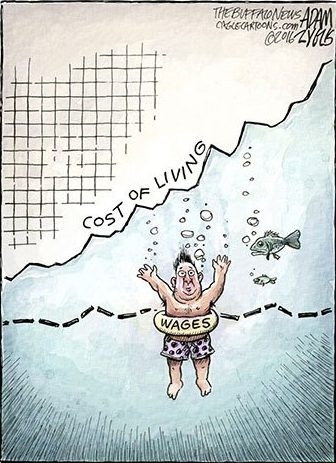
If we had to choose one “big picture” reason why the vast majority of households are losing ground, it would be: the costs of essentials are spiraling out of control. I’ve often covered the dynamics of stagnating income for the bottom 90%, and real-world inflation, i.e. a decline in purchasing power.

But neither of these dynamics fully describes the relentless upward spiral of the cost basis of our economy, that is, the cost of big-ticket essentials: housing, education and healthcare.

The costs of education are spiraling out of control, stripping households of income as an entire generation is transformed into debt-serfs by student loan debt. The soaring costs of healthcare are a core driver of higher costs in the education complex (and government in general), and to cover these higher costs, counties raise property taxes, which add additional cost burdens to households and enterprises as rents rise.

Rising rents push the cost structure of almost every enterprise and agency higher.

Then there’s the asset inflation created by central bank ZIRP (zero interest rate policy) which has inflated a second echo-bubble in housing that has pushed home ownership out of reach of many, adding demand for rental housing that has pushed rents into the stratosphere in Left and Right Coast cities.

The increasing dominance of monopolies and cartels has eliminated competition in sector after sector. Monopolies and cartels skim immense profits even as the value, quality and quantity of their products and services decline: The U.S. Only Pretends to Have Free Markets From plane tickets to cellphone bills, monopoly power costs American consumers billions of dollars a year.

Thanks to their political influence, monopolies and cartels have legalized looting, raising prices and evading anti-trust regulations because they can pay whatever it takes in our pay-to-play political system.

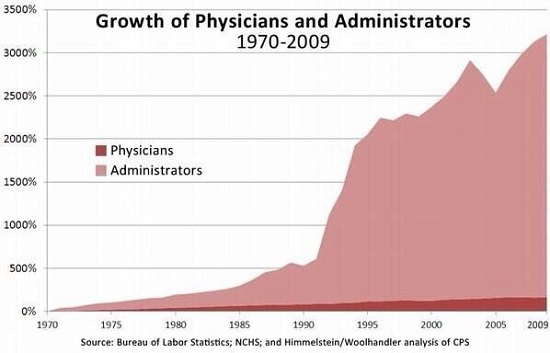
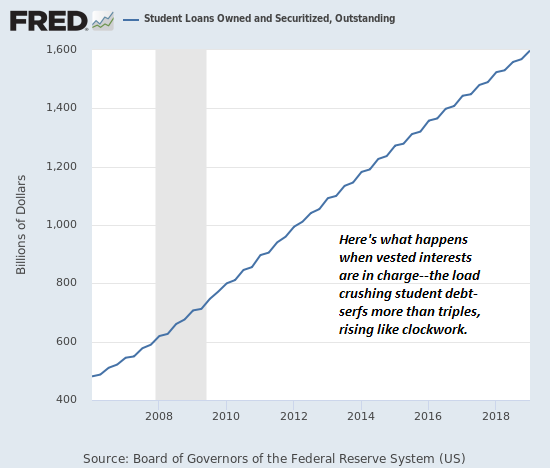
Let’s look at a few charts that illustrate the relentless rise in costs:

Do you reckon these two charts are connected–soaring costs and ballooning administrative payrolls?

Student loan debt is soaring above $1.5 trillion, guaranteeing profits to lenders and debt-serfdom to the students exiting with degrees that are in over-supply, i.e. possessing little scarcity value in an over-credentialed economy:

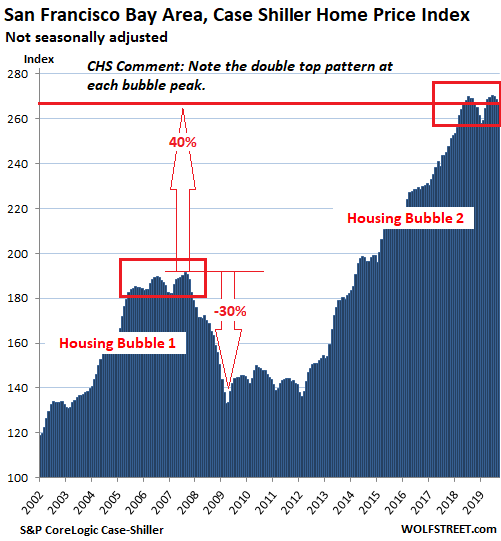
The echo housing bubbles in many locales exceed the nosebleed valuations of the previous bubble:

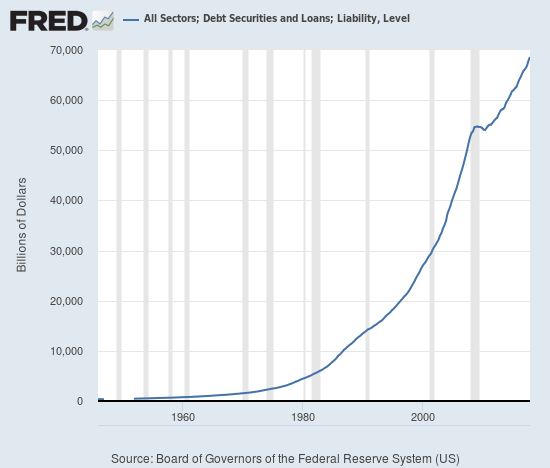
And how do we pay for these spiraling out of control costs? By borrowing more, of course:

Even at low rates of interest, the cost of servicing skyrocketing debt increases, leaving less net income to support additional borrowing.

What will it take to radically reduce the cost basis of our economy? A fundamental re-ordering that breaks up all the cartels and monopolies that push prices higher even as they deliver lower quality goods and services would be a good start.

The Economic Crash So Far: A Look At The Real Numbers

By Brandon Smith

Source: Alt-Market.com

There are many problems when attempting to track a faltering economy. For one, the people in government generally do not want the public to know when the system is in decline because this looks bad for them. They prefer to rig statistical indicators as much as possible and hope that no one notices. When the crash occurs, they then claim that “no one saw it coming” and the disaster “came out of nowhere”, so how could they be to blame?

I have even heard it argued that political leaders, including the president, have a “duty” to lie about the state of the economy because once they admit to the decline they will cause a panic and perpetuate the crisis. This is stupidity. If an economic system is in disrepair and is built on a faulty foundation, then the problems should be identified and fixed immediately. The weak businesses should be culled, not bailed out. The wasteful government spending should be cut, not increased. The downturn should not be hidden and prolonged for years or decades. In most cases, this only makes the inevitable crash far worse and more damaging.

Another factor, which some people might call “conspiracy theory” – but it has been proven time and time again in history – is that the money elites have a tendency to engineer economic disasters while deliberately hiding the real statistics from the public. Why? Well, if the real data was widely disseminated, then a crash would not be much of a surprise and the populace could be prepared for it. I suspect the elites hide the data because they WANT the crash to be a surprise. The bigger the shock, the bigger the psychological effect on the masses. This fear and confusion allows them to make changes in the power structure of a nation or of the entire world that they would not be able to accomplish otherwise.

The most rigged statistics tend to be the least important overall in analysis, but this does not stop the mainstream media and investors from hyper focusing on them. How many times have you told friends and family about the collapse in manufacturing or the explosion in consumer and corporate debt, only to hear them say, “But the stock market is at all-time highs!” Yes, even though stock markets are a meaningless trailing indicator, even though GDP stats are a complete fallacy, and even though jobless numbers do not include tens of millions of people out of work, these are the stats that the average person takes mental note of when consuming their standard 15 minutes of news per day.

While the issue of rigged statistics makes analysis of a crash difficult, a willfully ignorant citizenry makes reporting on the real data almost impossible. It’s sad to say, but a large number of people do not want to hear about negative information. They want to believe that all is well, and will delude themselves with fantasies of blind optimism and endless summers. Like the tale of “The Ant And The Grasshopper”, they are grasshoppers and they see anyone who focuses on the negative as “chicken littles” and “doom mongers”. In their minds they have all the time in the world, until they freeze and starve when winter comes.

When I encounter people who actually believe the manipulated numbers or buy into the stock market farce or simply don’t want to accept that a crash could happen in their lifetime, I always ask them to consider these questions: If the global economy is not on the verge of collapse, then why did central banks keep propping it up for the past ten years? And if central banks have been propping up the system, how much longer do you think they can do this? How much longer do you think they want to do it? What if one day they decide to let the entire house of cards tumble? What if such an event actually benefits them?

We’ve seen that a broken economy can be technically held together for a decade, but under the surface, the structure continues to rot. The bottom line is that even if the elites wanted to keep the system going for another ten years, and even if politicians continued to help them by pumping out false statistics, there is no way to hide the effects of crumbling fundamentals. We saw this during the crash of 2008, and now we’re seeing it again.

After nearly ten years of stimulus inflated the largest financial bubble in history (the Everything Bubble), the Federal Reserve and other central banks halted stimulus measures and tightened global liquidity. By the end of 2018, a new crash began, the implosion of the Everything Bubble had been triggered. All of this is still just an extension of the crash of 2008, which never really subsided; it was only slowed down through tens of trillions of dollars in central bank intervention. Now, the central banks have started an avalanche that cannot be stopped. But the fact of the matter is, they don’t really want to stop it.

Here are the indicators so far that prove a crash is happening in the U.S. while a majority of the public is oblivious:

GDP numbers are completely manipulated. Government spending of taxpayer dollars on a number of inflated programs, including continued spending on Obamacare, is added to GDP calculations. Without this fancy accounting, U.S. GDP growth would actually be negative, according to ShadowStats. But even with the juiced data, official GDP growth is still in decline, falling to 1.9% and well below the 3% growth we were supposed to see this year.

Official unemployment stats remain at all-time lows, which is commonly cited by the mainstream media, Donald Trump (he used to argue the opposite three years ago), and even the Federal Reserve in reference to the health and stability of the economy. What they do not mention much is the 95 million people not in the labor force and not counted because they have been unemployed for so long. When the media does mention this fact, they claim the number is “misleading”, that most of these people are students or retired, that the retirement age is decreasing and Baby Boomers are leaving the workforce sooner, and that the people who don’t have jobs are simply “not interested” in working. None of this is true.

The retirement age is increasing in the U.S., not decreasing, according the SS Administration. Current average retirement age is now 67, up from 65, almost the same as it was during the Great Depression.

Baby Boomers are not retiring at rates similar to ten years ago, and are in fact attempting to stay in the workforce due to the poor economy. Many of them are trying to come OUT of retirement just to make ends meet.

The labor participation rate remains near record lows.

Interestingly, the Bureau of Labor Statistics (BLS) house survey that is used to determine if people “want a job” assumes that if you are near retirement age and do not have a job, you are simply not interested in a job, and they count you as “non-participating”. However, if you DO have a job and you are near retirement age, they count you as participating. It’s a rather convenient assumption on the government’s part to claim that just because an unemployed person is near retirement age, that means they “don’t want a job”.

While there is surely a small percentage of the 95 million people not counted in the labor force that do not want a job, if unemployment stats counted U-6 measurements as they used to, the unemployment rate would be closer to 20%.

Another problem is the quality of jobs being created. U.S. manufacturing jobs, as well as higher wage jobs, are in steep decline. They have been replaced with low paying jobs in the service sector.

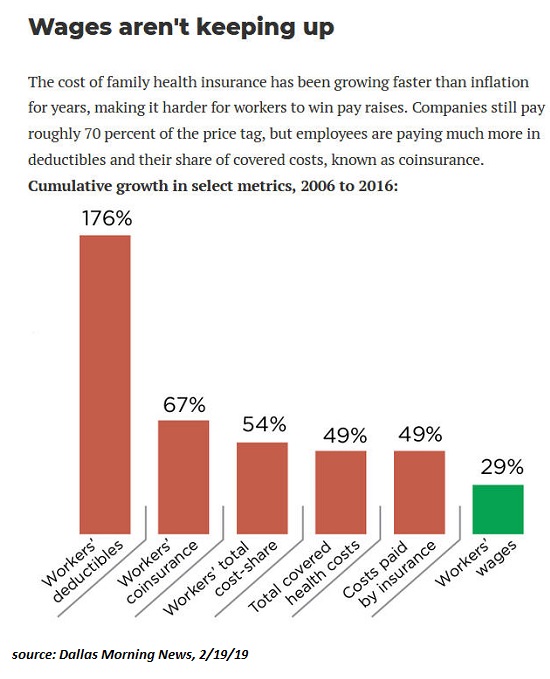
Real wages in the U.S. have not kept up with inflation. The average worker is now losing money overall as prices rise beyond the pace of their incomes.

As more and more Millennials say they cannot afford to buy a home, rental prices have skyrocketed in the past several years. The home ownership rate plunged starting in 2006 and has not recovered since.

U.S. manufacturing has fallen to levels not seen since the crash of 2008. U.S. factory orders have slumped in 2019.

U.S. Services PMI continues to falter since spring of this year. Job growth is now slowing and over 8,500 retail stores have been closed down already in 2019. Web-based retail is not picking up the slack, as online sellers like Amazon are suffering from falling profits.

Corporate profits overall have tumbled this year and projected future profits have been drastically adjusted to the downside.

Corporate debt, consumer debt and national debt are all at historic highs. Corporate cash flow is so tight that Federal Reserve repo purchases continue to run into high demand. This debt signal is one we saw in 2007, just before the credit crisis.

U.S. trucking and railroad freight continue to log steep declines in traffic and goods. This tells us what we already know: Even though consumer spending has increased recently, this does not mean people are buying more stuff or have more disposable income. What is really happening is inflation, or stagflation. Cost of living is going up. Debt payments are going up. Consumers are spending more on the same amount of stuff, or less stuff, and have less expendable income. U.S. consumers are being bled dry.

All of these factors and more show an economy in recession or depression (depending on what historic standards you use). In the darker corners of the investment world, the great hope is that the central banks will return to pumping trillions into the banking sector ($16 trillion during the TARP bailout dwarfs the $250 billion the Fed has recently pumped out in their repo markets). They hope that this will free up even more credit. Meaning, they believe only more debt will save the system from suffering.

I say, time is up on the debt party. More stimulus will not stall the crash that is already happening, and the Fed does not appear poised to print anywhere near what it did during the credit crisis, at least not in time to change the trend. The can has been kicked for the last time. The grasshopper mentality will not save people from the clear reality. Only preparation and planning will.

What globalism did was to transfer the US economy to China

By Paul Craig Roberts

Source: Intrepid Report

The main problem with the US economy is that globalism has been deconstructing it. The offshoring of US jobs has reduced US manufacturing and industrial capability and associated innovation, research, development, supply chains, consumer purchasing power, and tax base of state and local governments. Corporations have increased short-term profits at the expense of these long-term costs. In effect, the US economy is being moved out of the First World into the Third World.

Tariffs are not a solution. The Trump administration says that the tariffs are paid by China, but unless Apple, Nike, Levi, and all of the offshoring companies got an exemption from the tariffs, the tariffs fall on the offshored production of US firms that are sold to US consumers. The tariffs will either reduce the profits of the US firms or be paid by US purchasers of the products in higher prices. The tariffs will hurt China only by reducing Chinese employment in the production of US goods for US markets.

The financial media is full of dire predictions of the consequences of a US/China “trade war.” There is no trade war. A trade war is when countries try to protect their industries by placing tariff barriers on the import of cheaper products from foreign countries. But half or more of the imports from China are imports from US companies. Trump’s tariffs, or a large part of them, fall on US corporations or US consumers.

One has to wonder that there is not a single economist anywhere in the Trump administration, the Federal Reserve, or anywhere else in Washington capable of comprehending the situation and conveying an understanding to President Trump.

One consequence of Washington’s universal economic ignorance is that the financial media has concocted the story that “Trump’s tariffs” are not only driving Americans into recession but also the entire world. Somehow tariffs on Apple computers and iPhones, Nike footwear, and Levi jeans are sending the world into recession or worse. This is an extraordinary economic conclusion, but the capacity for thought has pretty much disappeared in the United States.

In the financial media the question is: Will the Trump tariffs cause a US/world recession that costs Trump his reelection? This is a very stupid question. The US has been in a recession for two or more decades as its manufacturing/industrial/engineering capability has been transferred abroad. The US recession has been very good for the Asian part of the world. Indeed, China owes its faster than expected rise as a world power to the transfer of American jobs, capital, technology, and business know-how to China simply in order that US shareholders could receive capital gains and US executives could receive bonus pay for producing them by lowering labor costs.

Apparently, neoliberal economists, an oxymoron, cannot comprehend that if US corporations produce the goods and services offshore that they market to Americans, it is the offshore locations that benefit from the economic activity.

Offshore production started in earnest with the Soviet collapse as India and China opened their economies to the West. Globalism means that US corporations can make more money by abandoning their American work force. But what is true for the individual company is not true for the aggregate. Why? The answer is that when many corporations move their production for US markets offshore, Americans, unemployed or employed in lower paying jobs, lose the power to purchase the offshored goods.

I have reported for years that US jobs are no longer middle-class jobs. The jobs have been declining for years in terms of value-added and pay. With this decline, aggregate demand declines. We have proof of this in the fact that for years US corporations have been using their profits not for investment in new plant and equipment, but to buy back their own shares. Any economist worthy of the name should instantly recognize that when corporations repurchase their shares rather than invest, they see no demand for increased output. Therefore, they loot their corporations for bonuses, decapitalizing the companies in the process. There is perfect knowledge that this is what is going on, and it is totally inconsistent with a growing economy.

As is the labor force participation rate. Normally, economic growth results in a rising labor force participation rate as people enter the work force to take advantage of the jobs. But throughout the alleged economic boom, the participation rate has been falling, because there are no jobs to be had.

In the 21st century, the US has been decapitalized and living standards have declined. For a while the process was kept going by the expansion of debt, but consumer income has not kept place and consumer debt expansion has reached its limits.

The Fed/Treasury “plunge protection team” can keep the stock market up by purchasing S&P futures. The Fed can pump out more money to drive up financial asset prices. But the money doesn’t drive up production, because the jobs and the economic activity that jobs represent have been sent abroad. What globalism did was to transfer the US economy to China.

Real statistical analysis, as contrasted with the official propaganda, shows that the happy picture of a booming economy is an illusion created by statistical deception. Inflation is undermeasured, so when nominal GDP is deflated, the result is to count higher prices as an increase in real output, that is, inflation becomes real economic growth. Unemployment is not counted. If you have not searched for a job in the past 4 weeks, you are officially not a part of the work force and your unemployment is not counted. The way the government counts unemployment is so extraordinary that I am surpised the US does not have a zero rate of unemployment.

How does a country recover when it has given its economy away to a foreign country that it now demonizes as an enemy? What better example is there of a ruling class that is totally incompetent than one that gives its economy bound and gagged to an enemy so that its corporate friends can pocket short-term riches?

We can’t blame this on Trump. He inherited the problem, and he has no advisers who can help him understand the problem and find a solution. No such advisers exist among neoliberal economists. I can only think of four economists who could help Trump, and one of them is a Russian.

The conclusion is that the United States is locked on a path that leads directly to the Third World of 60 years ago. President Trump is helpless to do anything about it.

‘Deaths of despair’ soaring among Gen Z & millennials: ‘It’s the economy, stupid’

By Helen Buyniski

Source: RT.com

Young Americans are killing themselves in record numbers, the victims of a confluence of economic and sociological factors that have singled them out – even above a nationwide surge in so-called “deaths of despair.”

Suicide rates among teens and young adults aged 15 to 24 – the older end of “Generation Z” – spiked in 2017, reaching their highest point since 2000, according to a study published Tuesday in the Journal of the American Medical Association (JAMA). They’ve risen 51 percent in the past 10 years, buoyed by rising rates of anxiety and depression along with social media and drug use, and the figures may be even higher, since some intentional overdoses are not counted as suicides.

Young men saw the steepest rise in deaths, according to the JAMA study, though women are catching up to them at an alarming pace. Teens and young adults report higher rates of anxiety and depression than previous generations, and multiple studies in recent years have shown that social media use exacerbates both conditions, creating a self-perpetuating feedback loop that can have tragic consequences.

But Generation Z is simply following in the footsteps of its predecessors. The much-maligned millennial generation, defined by the Census Bureau as those born between 1982 and 2000 (meaning some are included in the JAMA study), are also killing themselves in record numbers. Drug-related deaths among ages 18 to 34 have increased 108 percent since 2007, while alcohol-related deaths are up 69 percent and suicides are up 35 percent, according to a report published last week by Trust for America’s Health. While millennials have long been written off as entitled, spoiled snowflakes, the media and society are belatedly realizing that they aren’t just layabouts unmotivated to exit their parents’ basement – this “despair” has a cause, and it’s primarily economic.

The rise of millennial and Gen Z “deaths of despair” can be traced to the yawning gap between reality and expectations. Raised on the myths of the American Dream, these are the first Americans to experience a markedly lower standard of living than their parents, the Baby Boomers who grew prosperous on the fruits of the postwar economic boom. The national debt has ballooned, driven by two decades of an unwinnable war whose cost is poised to top $6 trillion, and the Pentagon’s budget has swollen to an unprecedented size even as cuts to social services have decimated what little social safety net Americans could once count on. Multiple rounds of tax cuts for the wealthy and corporations destroyed the government’s revenue base, and perhaps unsurprisingly, economic inequality has grown to exceed even the rates seen during the Great Depression.

And even these concerns are beside the point for a generation that left college already shackled with student loan debt that can run into the hundreds of thousands of dollars and cannot be canceled even by declaring bankruptcy. Millennials who graduated in the aftermath of the 2008 crash entered the “real world” to find no jobs waiting for them. Lucky if they could find an unpaid internship or a waitressing gig, they were forced to retreat back into their parents’ basements, a crushing blow for anyone but particularly for a generation told since birth that they were special, that they could do anything they wanted, that the world was their oyster.

The US, perhaps uniquely in the developed world, views poverty as a sin, and many millennials suffer in silence, believing they are the only ones in their peer group to “flunk out” of the “real world.” Instead of finding support from friends and family, they take advantage of the ready availability of alcohol and opioids, a factor that has caused the number of “deaths of despair” to skyrocket. Some economically-depressed states, like West Virginia, have seen drug overdoses increase more than fivefold in the last 12 years, according to a report published earlier this month by the Commonwealth Fund, and many more have seen their number double and triple. That pharmaceutical companies flooded the market with opioids at the same time the rise of social media devastated the quality and complexity of human relationships is a particularly deadly coincidence.

Since 1996, the average net worth of “consumers” under 35 has declined 35 percent, according to management consultancy Deloitte. Advertisers are starting to realize that targeting this group, while it may seem like a savvy marketing decision – they constitute a quarter of the US population, after all – doesn’t make sense, since they can’t afford to buy anything. Student debt is up 160 percent since 2004 for the under-30 population, and the home-ownership rate for millennials is only 37 percent – fully eight percentage points lower than their parents. Fully 89 percent would like to own a home, according to a survey conducted last year, but nearly half have zero dollars in savings – let alone the 20 percent most mortgages require for a down payment.

Young people aren’t the only ones afflicted by the “deaths of despair” phenomenon. Life expectancy nationwide is down for the third year in a row, and a report from Trust for America’s Health published last year projects that this “epidemic” – which they define as drug and alcohol deaths plus suicide – is on track to kill more than 1.6 million people by 2025 if it continues to grow at its current rate. As the Baby Boomers start to retire only to find they cannot live on their meager savings – assuming they still have any – they, too, are killing themselves more often, with suicide rates up 40 percent from 2007 to 2015.

This is not only a young people’s problem, nor is it an easy one to solve, but acknowledging the systemic poverty afflicting the “richest country in the world” – where two-thirds of the population doesn’t have enough saved to cover a $500 crisis – is a good place to start.

The ‘Hidden Mechanisms’ That Help Those Born Rich to Excel in Elite Jobs

When two sociologists interviewed highly paid architects, TV producers, actors, and accountants, they encountered work cultures that favor the already affluent.

By Joe Pinsker

Source: The Atlantic

Over the past five years, the sociologists Daniel Laurison and Sam Friedman have uncovered a striking, consistent pattern in data about England’s workforce: Not only are people born into working-class families far less likely than those born wealthy to get an elite job—but they also, on average, earn 16 percent less in the same fields of work.

Laurison and Friedman dug further into the data, but statistical analyses could only get them so far. So they immersed themselves in the cultures of modern workplaces, speaking with workers—around 175 in all—in four prestigious professional settings: a TV-broadcasting company, a multinational accounting firm, an architecture firm, and the world of self-employed actors.

The result of this research is Laurison and Friedman’s new book, The Class Ceiling: Why It Pays to Be Privileged, which shows how the customs of elite workplaces can favor those who grew up wealthier. The authors describe a series of “hidden mechanisms”—such as unwritten codes of office behavior and informal systems of professional advancement—that benefit the already affluent while disadvantaging those with working-class backgrounds.

In January, shortly before the book’s U.K. release, I interviewed Laurison, a professor at Swarthmore College, who told me that while England’s class politics do differ from those of the U.S., his and Friedman’s findings about “money, connections, and culture” broadly apply to Americans as well. This conversation has been edited for length and clarity.

Joe Pinsker: In the book, you write about a financial cushion available to certain college graduates that you refer to as “the bank of mom and dad.” How does this work, and what are its consequences for who gets a chance at certain jobs?

Daniel Laurison: I think the image that we have—or the ideology, if you want to be political about it—is once you’re 18 or so, you make your own way and your class origin is not an important part of how your career goes from there. But what my co-author Sam and I found was, that’s not at all true.

In the book, we talked about people pursuing acting, which is a very contingent, hard path to pursue. Most people, when they start, aren’t making most of their money from acting, and so people who are able to rely on their parents to help them are much more able to pursue acting fully, because they don’t have to worry about maintaining a regular, full-time job just to eat and live.

That’s the starkest example in the book, but there are lots of other ways that having money from your parents can make a difference in your career. In the U.K., if you work in London, you’re likely to earn a lot more, and you’re more likely to be at the center of your field. And living in London is very expensive. So a lot of people who are living in London got some help from their parents to make a down payment on a house or some help with the rent, which was the case in fields other than acting, too. And the other place I think parents’ help makes a big difference is in who can take unpaid or very low-paid internships, which are the entry points for lots of high-status, high-paid careers.

Pinsker: And once people get these sorts of jobs, you write about the importance of “sponsorship”—basically, when some senior employee informally takes someone younger under their wing and helps them advance through the company. What did you notice about how those systems of sponsorship worked?

Laurison: I think that a lot of people, on some level what they think they’re doing when they sponsor young co-workers is spotting talent—they called it “talent-mapping” in the accounting firm we studied. But a lot of people we talked to were also able to reflect and say, “Part of why I was excited about that person, probably, is because they reminded me of a younger version of myself.” The word we use in sociology is homophily—people like people who are like themselves.

One of the big ideas of the book, for me, is it’s really hard for any given individual in any given situation to fully parse what’s actual talent or intelligence or merit, and what’s, Gosh, that person reminds me of me, or I feel an affinity for them because we can talk about skiing or our trips to the Bahamas. Part of it is also that what your criteria are for a good worker often comes from what you think makes you a good worker.

Pinsker: In the workplaces you studied, who tended to lose out in these systems of sponsorship?

Laurison: In three of the four fields we studied, it was poor and working-class people, and also women and people of color. There are lots of axes along which homophily can cloud senior people’s judgment about who’s meritorious.

Pinsker: You also talk a lot about the unwritten codes of behavior that can shape who advances and who doesn’t at certain workplaces. What’s an example of how that played out?

Laurison: Probably the best example of this is the television-production firm we studied. The name that we gave to the culture there was “studied informality”—nobody wore suits and ties, nobody even wore standard business casual. People were wearing sneakers and all kinds of casual, fashionable clothes. There was a sort of “right” way to do it and a “wrong” way to do it: A number of people talked about this one man—who was black and from a working-class background—who just stood out. He worked there for a while and eventually left. He wore tracksuits, and the ways he chose to be casual and fashionable were not the ways that everybody else did.

There were all kinds of things, like who puts their feet up on the table and when they do it, when they swear—things that don’t seem like what you might expect from a place full of high-prestige, powerful television producers. But that was in some ways, I think, more off-putting and harder to navigate for some of our working-class respondents than hearing “just wear a suit and tie every day” might have been. The rules weren’t obvious, but everybody else seemed to know them.

Pinsker: And trying to figure that out comes at an emotional and psychological cost, no?

Laurison: For a lot of people from poor and working-class or lower-middle-class backgrounds, being in these environments felt like you had to put on a performance all day. They didn’t feel at home and comfortable in their work environment—even people who had been quite successful, who had gotten toward the top of their occupations.

Part of that is because folks are comfortable in the culture, the class, the location, the people who they grew up with. And working in an occupation or professional culture that is radically different in some ways than what your family knows and does is challenging. But one way to address this is to change workplace cultures to be closer to what poor and working-class people—and women, racial and ethnic minorities, and other historically excluded groups—bring rather than just trying to teach those “others” how to adapt.

Pinsker: In the book, it was jarring to see over and over how invisible all of these processes tend to be, and how this obscures the way that people actually get and then excel in elite jobs. Some people you talked to clearly downplayed the help they’d gotten—what do you think was behind that?

Laurison: In both the U.S. and the U.K., there’s a really strong, widely shared implicit belief—in the U.S., it’s the American dream—that success and worth are nearly identical, that if you are really rich, you must be really smart and hardworking, and if you are poor, you must have messed up in some really big way. People want to believe that they got where they are because they’re smart and talented. And that’s often true to some extent, but it’s also true that there’s any number of people who are probably equally smart and talented who are not in their positions, because of the barriers that are erected. It’s hard to sit with the idea that maybe somebody else deserves to be where they are more than they do, and I think almost everybody wants to be able to tell a story of making it on their own.

A lot of the book is about the barriers that exist, but you can take that argument too far. I wouldn’t say that most of the really successful people we interviewed were bad at their jobs. But I think, for a lot of people, examining the ways that privileges you have are unearned is the same thing as saying “You are bad” or “You don’t deserve anything,” because we’ve got this deep connection between ideas of worth and ideas of success.

Pinsker: Having finished a research project like this, what do you think needs to change about the way these workplaces function? Do you think there are things that companies could do better?

Laurison: On one level, as long as access to education and jobs is unequal in terms of race, in terms of class, you’re not going to have equal representation of all the parts of society in many prestigious or exclusive occupations. So in a way, it’s about much bigger questions than a single company can deal with.

At the same time, I think there really are things that companies can do. You can affirmatively try to hire the people who don’t look like the people who are already there in terms of their race, gender, class origin, and other statuses. And you can try to think about what expectations or cultures at your firm are not really about the outcomes your firm needs to pay the most attention to.

To give an example from my own work, I know that in colleges and universities, students from poor and working-class backgrounds are much less likely to feel comfortable going to office hours than everybody else. So I require everybody, of any class background, to come talk to me, in an effort to make office hours open to everybody. I think there are analogies in other fields—there are unwritten rules where we can figure out what the norms are and then be explicit about them.

But still, there’s this larger question of how much inequality there is in the first place. If it wasn’t possible for somebody to make 10 times, 15 times what someone else does at the same organization, then it would matter a lot less how far people got in different organizations in terms of their earnings. And the broader context of the book is that part of what legitimizes big inequalities is the belief that outcomes are meritocratic.

A belief in meritocracy is not only false: it’s bad for you

By Clifton Mark

Source: Aeon

‘We are true to our creed when a little girl born into the bleakest poverty knows that she has the same chance to succeed as anybody else …’ Barack Obama, inaugural address, 2013

‘We must create a level playing field for American companies and workers.’ Donald Trump, inaugural address, 2017

Meritocracy has become a leading social ideal. Politicians across the ideological spectrum continually return to the theme that the rewards of life – money, power, jobs, university admission – should be distributed according to skill and effort. The most common metaphor is the ‘even playing field’ upon which players can rise to the position that fits their merit. Conceptually and morally, meritocracy is presented as the opposite of systems such as hereditary aristocracy, in which one’s social position is determined by the lottery of birth. Under meritocracy, wealth and advantage are merit’s rightful compensation, not the fortuitous windfall of external events.

Most people don’t just think the world should be run meritocratically, they think it is meritocratic. In the UK, 84 per cent of respondents to the 2009 British Social Attitudes survey stated that hard work is either ‘essential’ or ‘very important’ when it comes to getting ahead, and in 2016 the Brookings Institute found that 69 per cent of Americans believe that people are rewarded for intelligence and skill. Respondents in both countries believe that external factors, such as luck and coming from a wealthy family, are much less important. While these ideas are most pronounced in these two countries, they are popular across the globe.

Although widely held, the belief that merit rather than luck determines success or failure in the world is demonstrably false. This is not least because merit itself is, in large part, the result of luck. Talent and the capacity for determined effort, sometimes called ‘grit’, depend a great deal on one’s genetic endowments and upbringing.

This is to say nothing of the fortuitous circumstances that figure into every success story. In his book Success and Luck (2016), the US economist Robert Frank recounts the long-shots and coincidences that led to Bill Gates’s stellar rise as Microsoft’s founder, as well as to Frank’s own success as an academic. Luck intervenes by granting people merit, and again by furnishing circumstances in which merit can translate into success. This is not to deny the industry and talent of successful people. However, it does demonstrate that the link between merit and outcome is tenuous and indirect at best.

According to Frank, this is especially true where the success in question is great, and where the context in which it is achieved is competitive. There are certainly programmers nearly as skilful as Gates who nonetheless failed to become the richest person on Earth. In competitive contexts, many have merit, but few succeed. What separates the two is luck.

In addition to being false, a growing body of research in psychology and neuroscience suggests that believing in meritocracy makes people more selfish, less self-critical and even more prone to acting in discriminatory ways. Meritocracy is not only wrong; it’s bad.

The ‘ultimatum game’ is an experiment, common in psychological labs, in which one player (the proposer) is given a sum of money and told to propose a division between him and another player (the responder), who may accept the offer or reject it. If the responder rejects the offer, neither player gets anything. The experiment has been replicated thousands of times, and usually the proposer offers a relatively even split. If the amount to be shared is $100, most offers fall between $40-$50.

One variation on this game shows that believing one is more skilled leads to more selfish behaviour. In research at Beijing Normal University, participants played a fake game of skill before making offers in the ultimatum game. Players who were (falsely) led to believe they had ‘won’ claimed more for themselves than those who did not play the skill game. Other studies confirm this finding. The economists Aldo Rustichini at the University of Minnesota and Alexander Vostroknutov at Maastricht University in the Netherlands found that subjects who first engaged in a game of skill were much less likely to support the redistribution of prizes than those who engaged in games of chance. Just having the idea of skill in mind makes people more tolerant of unequal outcomes. While this was found to be true of all participants, the effect was much more pronounced among the ‘winners’.

By contrast, research on gratitude indicates that remembering the role of luck increases generosity. Frank cites a study in which simply asking subjects to recall the external factors (luck, help from others) that had contributed to their successes in life made them much more likely to give to charity than those who were asked to remember the internal factors (effort, skill).

Perhaps more disturbing, simply holding meritocracy as a value seems to promote discriminatory behaviour. The management scholar Emilio Castilla at the Massachusetts Institute of Technology and the sociologist Stephen Benard at Indiana University studied attempts to implement meritocratic practices, such as performance-based compensation in private companies. They found that, in companies that explicitly held meritocracy as a core value, managers assigned greater rewards to male employees over female employees with identical performance evaluations. This preference disappeared where meritocracy was not explicitly adopted as a value.

This is surprising because impartiality is the core of meritocracy’s moral appeal. The ‘even playing field’ is intended to avoid unfair inequalities based on gender, race and the like. Yet Castilla and Benard found that, ironically, attempts to implement meritocracy leads to just the kinds of inequalities that it aims to eliminate. They suggest that this ‘paradox of meritocracy’ occurs because explicitly adopting meritocracy as a value convinces subjects of their own moral bona fides. Satisfied that they are just, they become less inclined to examine their own behaviour for signs of prejudice.

Meritocracy is a false and not very salutary belief. As with any ideology, part of its draw is that it justifies the status quo, explaining why people belong where they happen to be in the social order. It is a well-established psychological principle that people prefer to believe that the world is just.

However, in addition to legitimation, meritocracy also offers flattery. Where success is determined by merit, each win can be viewed as a reflection of one’s own virtue and worth. Meritocracy is the most self-congratulatory of distribution principles. Its ideological alchemy transmutes property into praise, material inequality into personal superiority. It licenses the rich and powerful to view themselves as productive geniuses. While this effect is most spectacular among the elite, nearly any accomplishment can be viewed through meritocratic eyes. Graduating from high school, artistic success or simply having money can all be seen as evidence of talent and effort. By the same token, worldly failures becomes signs of personal defects, providing a reason why those at the bottom of the social hierarchy deserve to remain there.

This is why debates over the extent to which particular individuals are ‘self-made’ and over the effects of various forms of ‘privilege’ can get so hot-tempered. These arguments are not just about who gets to have what; it’s about how much ‘credit’ people can take for what they have, about what their successes allow them to believe about their inner qualities. That is why, under the assumption of meritocracy, the very notion that personal success is the result of ‘luck’ can be insulting. To acknowledge the influence of external factors seems to downplay or deny the existence of individual merit.

Despite the moral assurance and personal flattery that meritocracy offers to the successful, it ought to be abandoned both as a belief about how the world works and as a general social ideal. It’s false, and believing in it encourages selfishness, discrimination and indifference to the plight of the unfortunate.