Is It Joe Biden’s New World Order?

By Iain Davis

Source: In This Together

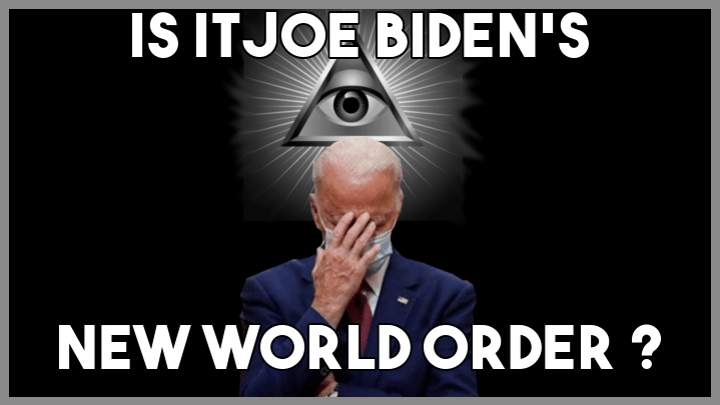
Speaking at a White House business convention on 21st March 2022 the US President, Joe Biden, said:

We are at an inflection point, I believe, in the world economy [. . .] it occurs every three of four generations. [. . .] Now is a time when things are shifting, there’s going to be a new world order out there, and we’ve got to lead it and we’ve got to unite the rest of the free world in doing it.

This caused a bit of a storm because Biden, once again, used the term “New World Order” (NWO). We are told that there is no identifiable globalist project called the NWO. Apparently, the only people who think such a project exists are “conspiracy theorists.” These people are all antesemites, can’t be trusted and absolutely must not be heard, or something like that.

In his 1992 article for the Wall Street Journal titled, How I Learned To Love The New World Order, Biden spoke about “America’s proper role in the new world order.” His latest statement indicates that his concern lingers, on this occasion with good reason. The US position as nominal leaders of the NWO is under threat from Russia and China.

Politicians, oligarchs and other alleged “leading voices” keep talking about the NWO. Every time they mention it the mainstream media (MSM) immediately spring into action, eager to “dispel the myths” or “set the record straight”, defining the term for us. Why do they feel the need to keep doing this? Why are the establishment and their media so sensitive about the term “new world order?”

The NWO Is Not an Antisemitic Trope

The “new world order” is a phrase that gets flung around by all sorts of people for a variety of reasons. It is occasionally expressed in distinctly antisemitic terms.

Some people believe that the NWO is a “Jewish plot to enslave humanity.” Very few people, who have researched and studied the NWO, share this view. It is not supported by the evidence.

Nonetheless, the false allegations of antisemitism applied to anyone who talks about the NWO provides a very useful canard which “debunkers” consistently deploy. As the historian Prof. Antony C. Sutton pointed out in his exploration of Wall Street and The Bolshevik Revolution:

The persistence with which the Jewish-conspiracy myth has been pushed suggests that it may well be a deliberate device to divert attention from the real issues and the real causes. [. . .] What better way to divert attention from the real operators than by the medieval bogeyman of anti-Semitism?

The mainstream media (MSM) role is to confuse and mislead the public. They do not want the people to know what the NWO really is. They hide its history and generally deny its existence, but if that fails they will exploit the Holocaust to bolster their disinformation.

Antisemitism means “hostility to or prejudice against Jewish people.” That hostility and prejudice led to the Holocaust. Falsely accusing people of antisemitism, simply to undermine their arguments, dilutes its true meaning. Doing so shows a lack of respect for the victims of the Holocaust and a casual disregard for Jewish people and their history.

The MSM insist that when US Presidents talk about the NWO they are simply referring to changes in the behavioural norms, regulations and laws that broadly shape international relations. This may be the case, but that doesn’t alter the fact that the NWO has a precise historical meaning.

Given that it is a heavily charged term, is it likely that senior politicians, foreign policy strategists and national leaders would routinely use it unwittingly, without understanding what it means? Perhaps so in some cases but not in all. It is clear than many presidents, prime ministers and geoplitical experts have referred to the NWO in its proper context.

The Term “New World Order” As Propaganda

In a typical example of MSM disinformation, the UK’s Independent newspaper attempted to cover up Biden’s slip by trotting-out the usual denials and obfuscations. They claimed that Biden was simply referring to the “shifting sands of geopolitical relations.”

The Independent did not divulge the reality of the NWO to their readers. Instead it relied upon the tired slurs and allegations traditionally used to discredit those who discuss the NWO. The Independent alleged:

[P]ost-war paranoia tapped into much more ancient social anxieties about the possibility of shadowy secret covens engaging in evil [. . .] The Illuminati, the model for all subsequent sinister behind-closed-doors cabals feared by conspiracy theorist [. . .] traces its origins to the German Enlightenment of the 18th century. Belief in such a group plotting insurrection to realise its “new world order” first gained real prominence in the US among anti-government extremists in the 1990s. [. . .] The movement brings together American right-wing militant instincts with Christian fundamentalist doom prophecies [. . .] and has exploded over the last three decades in tandem with the growth of the internet. [. . .] Conspiracy theories have now become a form of mass entertainment on social media. [. . .] [Z]ealots, bored in lockdown during the pandemic, blended ancient anti-Semitic smears with quest narrative mythologies and pop cultural borrowings to worrying ends.

The so-called “newspaper” followed all of the state approved propaganda to the letter. Mixing genuine history—yes, the Illuminati really did exist—with total gibberish—there is no “movement” of NWO-exposing “extremists”—the Independent managed to fuse “conspiracy theory” with “right-wing” extremism and antisemitism. This is the standard approach to NWO denialism.

By linking the whole hodgepodge together, in a word-salad of misdirection and innuendo, the Independent were able to deliver their essential message: people who talk about the NWO do not trust government and questioning government can only lead to “worrying ends.”

The Independent didn’t offer any evidence to substantiate its conclusion, but informing readers wasn’t the point of the article. Claiming that NWO investigators are all antisemites who believe in “lizard men” allows the reader to safely discount the historians and geopolitical analysts, who have published NWO research, as crazy people.

According to the Independent, no one would even bother talking about the NWO were it not for the Internet. By claiming that questioning government policy online is “extremism,” the Independent offered its support for the government’s proposed censorship of the Internet.

Ironically, the best NWO historians published their work long before the Internet was invented. As pointed out, in one of the many contradictions in the Independent’s article, the NWO was a hot topic of conversation decades before we took to our keyboards and devices.

Introducing The New World Order

Contrary to the opinions of propagandists and debunkers, the NWO is a defined globalist project. The objective is to establish global governance. It was inaugurated more than 100 years ago and it has undergone numerous changes over subsequent generations.

While it wields immense political influence it is not “all powerful.” The NWO is tyrannical and oppressive by nature, hence the need for subterfuge and concealment. Its architects cannot simply enforce their dictatorship and expect to get away with it. We would resist, and if we did so in sufficient numbers there’s not much the NWO could do about it.

Therefore we need to be controlled by other means. Education, society, culture, economics, party politics, finance, applied psychology, behaviour modification, censorship, propaganda, war and crisis management are all used to manoeuvre us into accepting the NWO’s policy agendas. We persistently fall into this trap because we imagine our “elected” leaders are making the ‘big’ decisions: they’re not.

The New World Order (NWO) is an idea that was first proposed by Cecil Rhodes’ Round Table Movement. It was envisaged as a secret system of global governance led by an anglo trans-Atlantic alliance. It didn’t stay “secret” for very long.

Not only have politicians and the leaders of industry, commerce and finance frequently spoken about it, it has also been thoroughly exposed by historians and researchers. Perhaps most notably by Professors Carroll Quigley and Antony C. Sutton.

Even in the early 20th Century, when it was first devised, the concept of the NWO wasn’t a particularly novel idea. It was simply an attempt, by a Western hegemonic power-bloc, to establish global dominion. It is an extension of the age-old game of empires.

Rhodes’ NWO project was itself built upon pre-existing global power structures. The Venetian bankers and the other private enterprises, such as the British East India Company, had already surpassed nation states in terms of their resources, wealth and global political control. Rhodes’ vision was to convert this private financial power, which he possessed in abundance, into one, cohesive system of global rule.

The NWO model, which emerged after Rhodes’ death in 1902, immediately came unstuck. Rhodes was a British imperialist who, alongside his fellow Brits, bemoaned the loss of “their” American colony. The NWO was supposed to re-assert British control in the US, with the city of London ruling Wall Street. This is not how the US contingent viewed the burgeoning trans-Atlantic alliance and it is they who would soon come to the fore. Internecine struggles have been a consistent feature of the NWO throughout its history.

The NWO that Rhodes and his subsequent movement proposed was a hierarchical, compartmentalised, authoritarian structure. It was designed as a system of rings-within-rings.

It was led from the centre by “the Society of the Elect” who would oversee, and be protected, by the first ring of power called “the Association of Helpers.” Consecutive rings were then established, affording NWO control of financial institutions, multinational corporations, governments, intelligence agencies and militaries, etc.

Only the members of the “Society” and the “Association” had a full grasp of the entire NWO project. Conceptualisation of the whole system, among the members of each subsequent ring, progressively diminished as their positions moved away from the centre of power. NWO controlled assets, placed in key administrative, academic, military, media or political roles, only knew enough to be able to perform their required tasks and report accurately back to their handlers.

There’s Nothing “New” about the NWO

Tyrants have always sought to impose their authority upon as many people as possible. Just like Sumerian kings or Roman emperors, the leaders of the NWO sought exactly the same despotism, though on a grander scale. As technology has advanced the goal of centralised authority over a global governance structure has become more attainable.

While the manipulation and control techniques have advanced, the goal hasn’t changed. This ambition is as old as civilisation itself. There have always been people who wish to rule and many more who are content to be ruled.

Our collective obedience to authority guarantees tyranny. The NWO is by no means the first kleptocracy to have cultivated and exploited our compliance.

Like all the empires that preceded it, from its inception the proposed NWO was designed to take the form of a public-private partnership between government and an immensely wealthy “Superclass.” Often these individuals and family dynasties came from the world of international finance or banking, but leading industrialists and media moguls were also prominent.

They formed the hand behind the throne. As Prof. Quigley noted in 1966:

There really is a “world system of financial control in private hands” that is “able to dominate the political system of each country and the economy of the world.” [. . .] They now control every major international institution, every major multinational and transnational corporation both public and private, every major domestic and international banking institution, every central bank, every nation-state on earth, the natural resources on every continent and the people around the world through complicated inter-locking networks that resemble giant spider webs. [. . .] They were responsible for World War I, World War II, [. . .] They have created periods of inflation and deflation in order to confiscate and consolidate the wealth of the world. [. . .] This wealth is now being used to construct and maintain the World Empire that is in the last stages of development. [. . .] The chief architects of this new World Empire are planning another war—World War III—to eliminate any vestiges of political, economic or religious freedom from the face of the earth. They will then completely control the earth and its natural resources.

Elected politicians, and the governments they formed, were always the junior partners in this network. Many were hand picked for their malleability, predisposition to corruption or loyalty to the NWO project. With the intelligence and security agencies thoroughly co-opted, the deep state—the “state within the state” or “shadow state”—flourished.

The Party Political system was permitted because it ensured that electorates could never derail the NWO project. They could be placated with a misplaced sense of democratic oversight. Party politics also kept the masses occupied and distracted, leaving the NWO to get on with business unhindered .

Policy agendas were set and then political puppets were installed to sell the desired policies to the people, no matter who they voted for. Quigley explained the NWO’s approach to party based, representative democracy:

The argument that the two parties should represent opposed ideals and policies, one, perhaps, of the Right and the other of the Left, is [. . .] a foolish idea acceptable only to the doctrinaire and academic thinkers. Instead, the two parties should be almost identical, so the American people can ‘throw the rascals out’ at any election without leading to any profound or extreme shifts in policy.

The Leaders of the New World Order

The self-proclaimed leaders of the NWO are drawn from the so-called “Superclass.” Their only distinguishing attributes are immense private wealth, a ruthless willingness to act and an unshakeable belief in their divine right to rule.

The “old money” dynasties, sometimes referred to as the Black Nobility, have maintained their financial and monetary control for nearly a thousand years. They have been joined, in recent centuries, by banking families, industrialists and latterly the “new money” from the post WWII entrepreneurial, billionaire set.

The notion of a “Superclass” was proposed by Prof. David Rothkopf. As a member of the deep state think-tanks the Council on Foreign Relations (CFR) and the Carnegie Endowment for International Peace (CEIP), among others, Rothkopf was well positioned to be personally acquainted with the robber barons he eulogised:

We’re not looking at just the wealthy; we’re looking at power. And so, the definition that we used was people who influence the lives of millions across borders on a regular basis. [. . .] It’s a tiny, tiny fraction of the people of the planet Earth. [. . .] [T]he really defining characteristics of this group is the nature of the networks, that networking is the force multiplier in any kind of power structure[.]

The “people who influence the lives of millions across borders on a regular basis” have gone by many names. “The Rhodes Crowd,” “All Souls Group,” “the Cliveden set,” “the Pilgrims” and many more. Today we often refer to them as oligarchs, thought leaders or stakeholders. No one elected Rothkopf’s “Superclass” to power.

Their wealth is often inherited from their forefathers’ war profits, often it’s the product of nepotism or profits accrued from more recent military interventions. Others have enriched themsleves from the exploitation of slave labour, rigged markets, resource theft, the drug trade, financial crime or usury, etc. The “parasite class” is a more accurate description.

The New World Order Today

It isn’t clear if the “Society of the Elect” or the “Association of Helpers” still remain. What can be said is that the current global management network is a compartmentalised, authoritarian structures. Everything first proposed by Rhodes’ pilgrims remains on track and appears to be nearing completion.

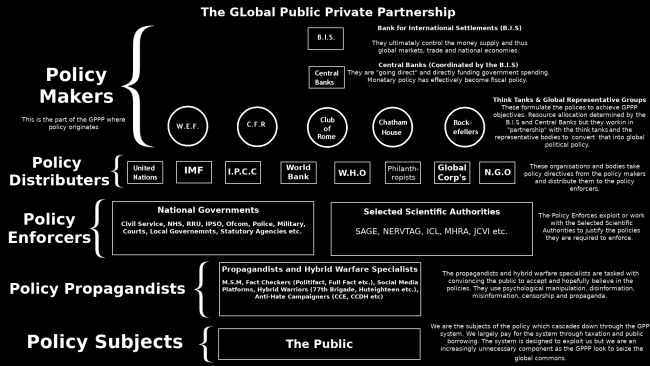
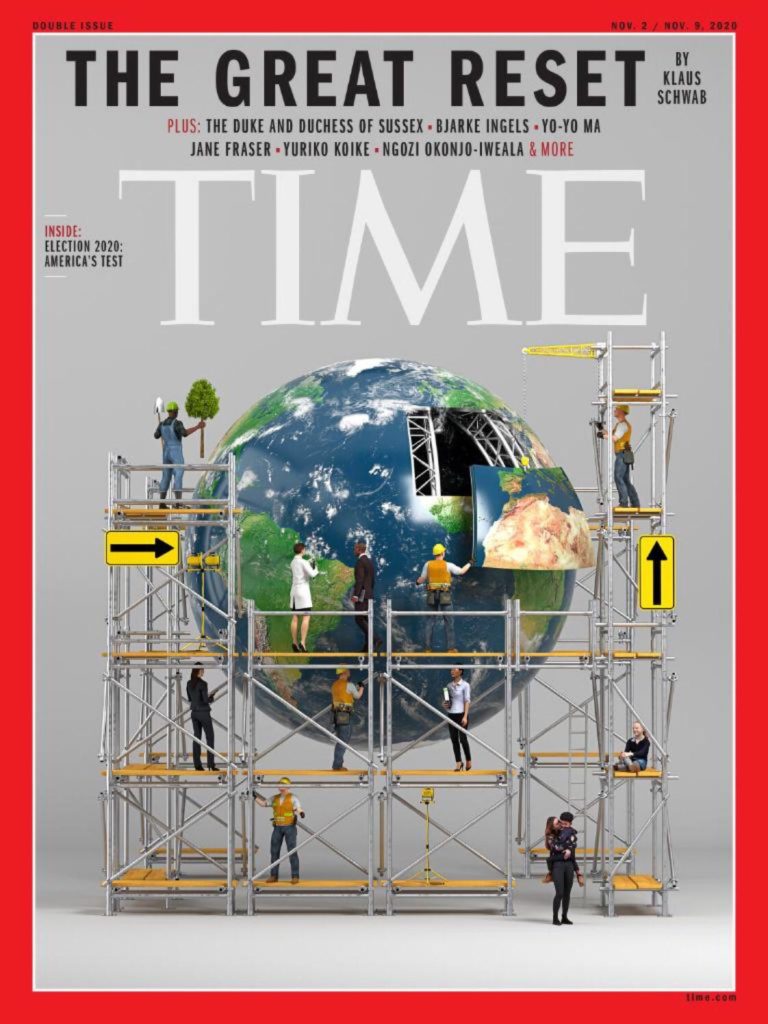
The NWO has been through several iterations and has been re-marketed in different forms. The COVID-19 pseudopandemic has seen the World Economic Forum’s Great Reset come to public attention. This is simply a new brand for the NWO as the WEF makes its bid to be the central pillar of the Global Public-Private-Partnership (G3P). The G3P represents the current management structure of the NWO.

The proposed operating system for NWO global governance is Technocracy. There are a number of key elements which, once installed, will end the last vestiges of human freedom and place the world’s population under the totalitarian control of the technocrats. In turn, the technocrats will serve the interests of the parasite class, not humanity.

Democracy will continue in name only, reassuring the masses for a while, in the form of a communitarian “civil society.” Government, working in partnership with private corporations, will encourage civil society groups to “debate” policies. Every single one of those policies will be pre-selected by the technocratic state (Technate). The apparent political choice will remain an illusion.

The global economy is currently being transformed as new markets are created. As outlined in the 1992 UN Agenda 21 document (section 8.41), the “basis for action” has already been established. A global accountancy system for all business will use stakeholder capitalism metrics to rate assets, ensuring “the integration of sustainability into economic management.”

The rating mechanisms, such as environmental, social and governance ratings (ESG’s), will enable centralised global economic planning. It will determine which ventures receive or do not receive investment. Favoured corporate partners within the G3P will do very well, as long as they promote G3P goals. Those who don’t will go bankrupt without question.

The ratings system provides a “better measurement of the crucial role of the environment as a source of natural capital.” Natural Asset Companies will transform forests into ‘carbon sequestration services’ and natural water sources into ‘human settlement resource services,’ or some such thing.

By claiming that they own nature, the G3P will create new markets worth a projected $4 quadrillion. Thereby removing oil, as the base commodity of value, and replacing it with nature (natural assets). This transformation is called “sustainable development.” It has nothing to do with environmentalism or combatting “climate change.”

The notion of uniting all of humanity to work together to solve the “climate crisis” is a contrivance to facilitate global governance. It was fabricated in the late 1980’s and early 1990’s by the globalist think-tanks that set the world’s policy agendas.

The Club of Rome, the think-tank which greatly influenced the nascent WEF, took credit for imagining the perfect global crisis. In their 1991 publications The First Global Revolution, on page 75 under the heading “the common enemy of humanity is Man,” the Club of Rome wrote:

In searching for a common enemy against whom we can unite, we came up with the idea that pollution, the threat of global warming, water shortages, famine and the like, would fit the bill. [. . .] All these dangers are caused by human intervention in natural processes, and it is only through changed attitudes and behaviour that they can be overcome. The real enemy then is humanity itself.

This statement expresses two of the parasite class’ core beliefs. The assumed legitimacy of their claim to rule, which enables them to imagine they have the right to “designate” a global enemy, and their shared commitment to population control. They herd us like cattle, as they decide how to change our attitudes and behaviour to suit their objectives.

The International Monetary and Financial System (IMFS) has also undergone a transformation. With the introduction of Central Bank Digital Currency (CBDC) it will be revolutionised. CBDC currency will be issued by central banks as their liability. They are solely responsible for that liability. CBDC will always be their money.

CBDC is electronic money, it is therefore programmable money. This means the central banks will have complete control over every unit of CBDC currency. Whether it is in your wallet or not, it is the central bank’s money and they will permit or deny every transaction you make with it.

For example, the decisions you currently make about where you travel have already been restricted by the global policy response to a fake pandemic. If CBDC is fully adopted, you will no longer have any choice at all.

CBDC will enable your central bank’s AI algorithm to decide where you can go and when. If CBDC becomes the only form of currency available to us, none of us, no matter how much money we think we have, will have any financial freedom.

In order for Technocracy to operate, every citizen must be continually surveilled and controlled by the state (Technate). The technology capable of doing this is already being distributed globally as part of the so-called Fourth Industrial Revolution (4ID).

The Internet of Things (IoT) will see every device that we use report that use back to the Technate’s data centres. The Internet of Bodies (IoB) will enhance the Technates ability to monitor us in real time. Combined with the Digital-ID, that every nation is rushing towards, the surveillance and control of every individual “global citizen” will be centrally managed at the global governance level.

The New World Order, under the current management structure of the Global Public-Private Partnership, is nearing completion. It is a truly global system of governance. There are no leading governments anywhere on Earth opposed to it. All are racing ahead to adopt it with equal enthusiasm.

The Way Forward For The NWO

With Russia’s recent military operation in Ukraine, it has been suggested by some that the Russian and Chinese governments are not prepared to accept the imposition of the NWO. We can only be guided by their major policy statements and their actions. If these are anything to go by, both governments are fully on-board with the NWO agenda.

Both Russia and China are absolutely committed to sustainable development, Digital ID, 4ID, COVID biosecurity and vaccine-passports. Russia is ahead of most Western nations with regards to CBDC and China has surpassed Russia, having already started to use CBDC on a significant scale.

On 4th February Presidents Vladimir Putin and Xi Jinping issued a joint statement on the future relationship between Russia and China. It read, in part:

Today, the world is going through momentous changes, and humanity is entering a new era of rapid development and profound transformation. [. . .] of the global governance architecture and world order. [. . .] The ongoing pandemic of the new coronavirus infection poses a serious challenge to the fulfilment of the UN 2030 Agenda for Sustainable Development. [. . .] In order to accelerate the implementation of the UN 2030 Agenda for Sustainable Development, the sides call on the international community to take practical steps in key areas of cooperation such as poverty reduction, food security, vaccines and epidemics control, financing for development, climate change, sustainable development, including green development, industrialization, digital economy, and infrastructure connectivity. [. . .] [We] will further increase cooperation in the development and manufacture of vaccines. [. . .] Russia and China intend to encourage interaction in the fields of public health, digital economy, science, innovation and technology, including artificial intelligence technologies [. . .] Particular emphasis will be placed on the fight against the novel coronavirus infection pandemic and economic recovery, digitalization of a wide range of different spheres of life.

There is no evidence to suggest that either Russia or China wish to derail the objectives of the WEF’s Great Reset. On the contrary, the evidence points towards Russia and China as perhaps the most enthusiastic and aggressive advocates for the NWO agenda. China is the world’s first Technate and Russia is a major WEF partner, most notably on cybersecurity.

Much has been made of the WEF’s decision to distance itself from Russia and sanctioned individuals. Notably this is a “temporary” freeze and smacks more of political expediency and PR, rather than any genuine severance.

There is no aspect of the NWO, G3P managed agenda that either Russia or China stand against. Their joint statement read like a Great Reset checklist.

Perhaps this is all a cunning deception. Part of a “secret plot” by Russia and China to fight the NWO. However, it looks far more like a pact between two powers bidding for political leadership of the NWO.

There is no doubt that the NWO was conceived as a project of Western based oligarchs. In the post WWII era it has bared its teeth on the geopolitical stage as the “international rules-based order.” This unipolar order, centred around the G7 group of nations, with the US led NATO alliance providing the muscle, has been dominant within the Global Public-Private Partnership (G3P).

Russia’s military intervention in Ukraine, and the G7/NATO alliance response to it, appears to be a watershed moment. Together, Russia and China are challenging the G7 clique with a BRICS based, G20 focused, multipolar model. It seems they are determined to seize primacy within the G3P management structure.

As a paid spokesperson for the G7 rules-based order, Joe Biden anxiously observed “there’s going to be a new world order out there, and we’ve got to lead it.” The US-led alliance’s problem is that Russia and China, in league with their BRICS partners, are pursuing exactly the same objective.

Reflections on War, Injections, and Terror at This Crossroads in History (part 1)

By Prof. Anthony J. Hall

Source: Global Research

In late February the international news cycle moved between two very important focuses. One addressed controversies in Canada. The other continues to highlight events unfolding primarily in Russia, Ukraine, and the USA. While different in many ways, both stories have many-faceted worldwide implications.  

Both involve configurations of power and intrigue that overlap in crucial ways. Both involve conflicts with profound life-and-death implications. Both conflicts highlight that humanity and our civilizational inheritances are at a crossroads.

At this parting of the ways, the most well-travelled autobahn looming up ahead points towards tyrannies far more extreme than anything we have known in history so far.

Whatever highway we follow, it seems there is no escaping the onslaught of new forms of aggressive warfare that are fast pushing humanity into a jagged collision with high-tech weaponry capable of unprecedented destruction.  To say we are living in dangerous times is a gross understatement.

Will humanity be subjected to even greater extremes of outright militarization? Will we continue to be assaulted by a novel array of overt and covert tactics aimed at radically re-engineering society as well as the very genetic attributes of the human genome? Will human beings continue to be reconfigured to advance the conditions of our decline into submissive enslavement? Will we continue to be subject to litanies of media lies, strategies of behavior modification, and unregulated medical experiments aimed at merging our biological persons with aspects of digital technology?

See this and this.

Some common themes wind through the convoluted array of unregulated assaults that menace humanity’s very survival in anything like the God-given form we inherited from nature. Powerful enemy forces are exploiting for their own self-interested advantage, our credulousness, naivety, and susceptibility to programs of mind control. The goal of the master class, it seems, is to modify our behavior so we can be better integrated into a world of pervasive robotization.

Enslavement With the Help of Digital IDs Combined with Cashless Transactions

Right now in the Western countries’ onslaughts of psychological warfare are integral to the military showdown initiated in Eurasia.

While experts in “perception management” are using the media to lure the public into single-minded condemnation of Russia, our attention is being drawn away from stunning revelations coming to light in our midst.

The disclosures underway illuminate the role of COVID Officialdom in forcing on us through mandates and other coercive techniques, highly lethal and injurious medical procedures. These procedures have been purposely designed to induce pathogenic outcomes and depopulation agendas. Throughout Europe and North America, dramatic increases in all-cause rates of death are being reported especially by life insurance companies and funeral homes.

France’s Finance Minister: “We’re waging an all-out economic and financial war on Russia”

One result is that Pfizer and Moderna investors are “running for the exit.” Former BlackRock investment advisor, Edward Dowd, has sounded the alarm on Moderna and Pfizer “as sinking ships that investors need to abandon.”

See this.

The bad news for the vaccine companies and their notoriously negligent regulators is compounded by the fact that their indemnification is threatened.

The companies and their regulators can be sued if it can be demonstrated that they have lied about their products. Indeed, they have lied on an epic scale and continue to do so. The evidence is clear that the inadequately-tested medical injections advertised as “safe and effective” are no such thing. Now there are headlines proclaiming, “Pfizer and Moderna are modern versions of Enron.”

See this and this

As blanket coverage of the Ukrainian conflict dominates the media, the next stage in the insidious COVID con is being executed with blitzkrieg speed. The objective is to rush humanity into a privatized system of universalized and standardized Digital ID before most people have an opportunity to get informed on the fuller implications.

The growing contingent of people devoted to principled non-compliance to the myriad COVID frauds must resist allowing the COVID hucksters to advance their diabolical agenda. The COVID con men and women must be forced to back away from their attempt at making sweeping appropriations and instrumentalizations of yet more elements of our private information. We need to hold the line against slick kleptocrats seeking total control of everything through digital invasion and theft of the little that remains of our personal realms.

Included in the Digital ID con job is the creation of a new type of One World digital currency presently being rushed into existence by the private central banks holding membership in the Swiss-based Bank of International Settlements (BIS). This process is being pushed ahead in partnership with the dystopian World Economic Forum (WEF).

Recently Klaus Schwab, the WEF’s founder, bragged that more than one-half of Prime Minister Justin Trudeau’s Canadian cabinet is infiltrated with WEF insiders. Chrystia Freeland, the Deputy Prime Minister of Canada, is one of them.

In fact Freeland is currently a prominent member of the WEF’s governing body of trustees. As shall become clear, Freeland is emblematic of the abundant conflicts-of-interest and round-the-clock lies that have come to characterize the Liberal Party during the time of Trudeau’s denigration of public office in Canada.

See thisthisthis and this

A pervasive system of social credit scoring is taking shape with the rush to entrench in many jurisdictions a transnational system of Digital IDs. The other necessary element is our willingness to go along with the creation of a single digital currency. The new system requires the consolidation of a One World megabank that is meant as a key element in the so-called Great Reset.

The advancement of a system of total surveillance and total control requires the termination of all cash transactions. Hence our insistence on continuing the conduct of business through the circulation of cash must be an expression of our principled non-compliance.

The merger of Digital ID together with the replacement of cash transactions would give central authorities the ability to cut off our “freedoms,” including, for instance, even our capacity to buy food. The entrapment of people in digital enclosures would put the vast majority of humans in a virtual penitentiary of unmitigated top-down authority.

See this.

A Matter of Life or Death for Russia

The creation of a social credit dystopia is being pushed rapidly forward under the cover of wall-to-wall coverage devoted to Russia’s intervention in Ukraine. According to Russian President Vladimir Putin, Russian troops are intervening with the goal of “demilitarizing and denazifying Ukraine.”

It is also thought that Putin intends to dismantle about fifteen US biological warfare labs. The Pentagon sponsors of these “research facilities” for mass murder would have us believe they are engaged in a “Biologic Threat Reduction Program.”

In his memorable speech of 24 Feb., Putin claims that the Russian mission in Ukraine, “is not a plan to occupy the Ukrainian territory.” The Russian government asserts that its actions in Ukraine are necessary for the protection of the Russian Mother Country. Over many years Putin has been stressing the themes that the Russian Armed Forces are now acting upon.

The explanation of this military operation as an act of self-defense depends on a historical analysis highlighting the decades-long campaign to strangle Russia in a boa constrictor’s grip of NATO’s aggressive militarism. The core agreements enabling the end of the Cold War have been violated by the patterns of NATO’s expansion since 1991.

NATO has been ingesting former Soviet republics into a US-backed militarized zone of organized anti-Russia zealotry. As Putin warned again and again over recent years, the US goal of transforming Ukraine into yet another militarized enemy of Moscow established a “red line,” a “matter of life or death” for Russia.

See this.

Note to readers: Please click the share buttons above or below. Follow us on Instagram, @globalresearch_crg and Twitter at @crglobalization. Forward this article to your email lists. Crosspost on your blog site, internet forums, etc.

Dr. Anthony Hallis editor in chief of the American Herald Tribune. He is currently Professor of Globalization Studies at University of Lethbridge in Alberta Canada. He has been a teacher in the Canadian university system since 1982. Dr. Hall, has recently finished a big two-volume publishing project at McGill-Queen’s University Press entitled “The Bowl with One Spoon”.

He is a regular contributor to Global Research.

Global Technocrat Cabal Exposed Through Network Analysis

“…A very small group of criminal collaborators are at the top of the Great Panic of 2020. Using disciplined network analysis, the players and patterns emerge right before your eyes…According to the anonymous IT specialist who created the document, the core of this “COVID criminal network,” around whom most everything revolves, is no larger than 20 or 30 people”

By Patrick Wood

Source: Technocracy News and Trends

The video above is in German. Click on “Settings” to change the subtitles to English via auto-translate feature.

STORY AT-A-GLANCE

> The German Club of Clear Words takes a deep dive into the network of individuals and organizations responsible for the COVID scam

> Whether blatantly visible or not, you can identify just about any network by connecting dots between individuals and organizations. Who’s working with whom, where, and why? Who’s paying whom? And once you’ve done that, you can more clearly identify the motivations behind various decisions

> The Bill & Melinda Gates Foundation appears to be near the top, or the center, of this COVID plandemic network. Gates is also a major funder of mainstream media, and his network extends into global food and climate change policy

> The Gates Foundation, through its funding of the WEF, also plays an important role in The Great Reset, which was officially unveiled during a WEF summit in May 2020

> Every conceivable aspect of life and society is scheduled to be “reset” according to their plan. Ultimately, that’s where this criminal COVID enterprise is trying to take us

The video above, by the German Club Der Klaren Worte, or the Club of Clear Words, takes a deep dive into the network of individuals and organizations responsible for the COVID scam. The audio is in German but there is a captioned translation at the bottom of the video.

The review is led by journalist and filmmaker Markus Langemann. As noted by Langemann, it’s not necessarily the people with the best ideas who win in life. Rather, the winners are those who are in the “right” network — a network with people in the right places. Never underestimate the power of a network.

Some networks are visible. One example would be an alumni network that you can join and use to promote your career. Other networks are more hidden, secretive and exclusive, and can only be entered into by select invitation by another member.

Whether blatantly visible or not, you can identify just about any network by connecting dots between individuals and organizations. Who’s working with whom, where, and why? Who’s paying whom? And once you’ve done that, you can more clearly identify the motivations behind various decisions.

A Global Network Revealed

In this video, Langemann presents “a network document that is unique in the world and which for the first time shows you the complex network of relationships, from non-governmental organizations (NGOs), companies, documents and people.”

The 170-page document details more than 7,200 links between 6,500 entities and objects, including payment flows and investments.

“In the case of the Bill & Melinda Gates Foundation, already on page 4 of the document, you see that this foundation spent $43 billion [note that is billion with a “b”] in the U.S. alone in the period from 1994 to 2001, and distributed around half a billion dollars in Germany during this period,” Langemann says.

You can review and download the document here.1 The document is mostly in English. It’s incredibly comprehensive in scope, detailing a global network that is working behind the scenes to influence global health, finance and governance.

Download Network Analysis Document

As an interesting aside, the document was actually created using software that investigators and detectives use to help them identify hidden connections between potential suspects. All of the data points, documents, payment data and so on, are publicly available.

Red arrows are used throughout the document to indicate money flows, such as grants, donations and other payments. As one example, as shown on page 3 of the document, at least 21 U.S. universities are financed by and through just three key organizations:

  1. The Bill & Melinda Gates Foundation
  2. The Open Philanthropy project, a research and grantmaking foundation, which is linked to the WEF
  3. The Wellcome Trust, the world’s second-largest health foundation, located in the U.K.

A Small Tight-Knit Group

According to the anonymous IT specialist who created the document, the core of this “COVID criminal network,” around whom most everything revolves, is no larger than 20 or 30 people. Several of them appear on page 36.

They got together May 8, 2019, at a CDU/CSU event where they discussed how to strengthen global health and implement the United Nations Sustainable Development Goals. The CDU/CSU is a political alliance of two German political parties, the Christian Democratic Union of Germany (CDU) and the Christian Social Union in Bavaria (CSU). Attendees included:

Hermann Gröhe, Christian Democration Union (CDU) member and former Minister of Health
Ralph Brinkhaus, Parliamentary leader of the CDU
Dr. Angela Merkel, former Chancellor of Germany and a CDU member
Ilona Kickbush, Ph.D., Graduate Institute of International and Development Studies, Geneva
Tedros Adhanom Ghebreyesus, Director-General of the WHO
Dr. Christian Drosten, a German virologist who in early 2020 created the COVID PCR test
Dr. Clarissa Prazeres da Costa, microbiologist and infectious disease specialist
Joe Cerrell, managing director for Europe, the Middle East and East Asia for The Gates Foundation
Professor Jeremy Farrar, director of the Wellcome Trust
Dr. Georg Kippels, CDU member
Jens Spahn, CDU member and a former Minister of Health

From that May 2019 meeting onward, these individuals are found again and again, in overlapping working groups. You also find them rubbing elbows in the past.

For example, Farrar, Drosten and Kickbush were all present at a February 14, 2019, tabletop exercise on International Response to Deliberate Biological Events, held at the Munich Security Conference, as shown on page 124. Individuals from the Robert Koch Institute, the Chinese CDC and the Gates Foundation were also present.

In 2017 and 2018, Kickbush, Drosten and Farrar were added as members to the International Advisory Board on Global Health. Farrar and Kickbush also joined the Global Preparedness Monitoring Board, a joint arm of the WHO and the World Bank, formally launched in May 2018. (Dr. Anthony Fauci is another member of this board.) Two other key persons within this network are:

  • Dr. Chris Elias, president of the Global Development Program at the Gates Foundation. He too is on both the Global Preparedness Monitoring Board and the International Advisory Board on Global Health, together with Kickbush, Drosten and Farrar.
  • Dr. Peter Piot, a Belgian-British microbiologist known for his research into Ebola and AIDS, a professor of global health, director of the London School of Hygiene and Tropical Medicine, a senior fellow with the Gates Foundation’s Global Health Program, and former undersecretary-general with the United Nations.

Key Organizations

Due to the complexity of the network connections, there’s really no easy way to summarize them here. You simply have to go through the document, page by page. That said, key organizations, whose networking connections are detailed, include:

The Bill & Melinda Gates FoundationThe Wellcome Trust, an organization funded by and strategically linked to GlaxoSmithKline (a vaccine maker in which Bill Gates is financially invested)
The World Health OrganizationThe Rockefeller Foundation
The World Bank GroupThe World Economic Forum (WEF)
GAVI, the Vaccine Alliance, founded by the Gates FoundationCoalition for Epidemic Preparedness Innovations (CEPI), founded by the governments of Norway and India, the Gates Foundation, the Wellcome Trust and WEF
The Global FundForum of Young Global Leaders, founded by WEF in 2004
FIND, the global alliance for diagnostics, seeks to ensure equitable access to reliable diagnosis around the worldBig Pharma
Johns Hopkins UniversityCharité, Universitätsmedizin Berlin
The Robert Koch InstituteThe European Commission
The European Medicines and Healthcare Products Regulatory Agency (MHRA)The Swiss Agency for Therapeutic Products
The German Global Health Hub

Of these, The Bill & Melinda Gates Foundation appears to be near the top, or the center, of this criminal network, depending on how you visualize it. Gates is also a major funder of mainstream media which, of course, is important if you want to ensure one-sidedly good press.

Gates’ Media Control

In the past, the Bill & Melinda Gates Foundation funded the placement of “educational” messages in popular TV shows such as “ER,” “Law & Order: SVU” and “Private Practice,” including topics such as HIV prevention, surgical safety and the spread of infectious diseases, i.e., vaccinations.2 But that was only the beginning.

Via more than 30,000 grants, Gates has contributed at least $319 million to the media, including CNN, NBC, NPR, PBS, The Atlantic, Texas Tribune (U.S.), the BBC, The Guardian, The Financial Times, The Daily Telegraph (U.K.), Le Monde (France), Der Spiegel (Germany), El País (Spain) and global broadcasters like Al-Jazeera.3

More than $38 million of Gates’ money has also been funneled to investigative journalism centers. The majority of that money has gone into developing and expanding media in Africa.4 As you might suspect, Gates’ donations come with strings attached. As reported by Columbia Journalism Review:5

“When Gates gives money to newsrooms, it restricts how the money is used — often for topics, like global health and education, on which the foundation works — which can help elevate its agenda in the news media.

For example, in 2015 Gates gave $383,000 to the Poynter Institute, a widely-cited authority on journalism ethics … earmarking the funds ‘to improve the accuracy in worldwide media of claims related to global health and development.’ Poynter senior vice president Kelly McBride said Gates’s money was passed on to media fact-checking sites …

Since 2000, the Gates Foundation has given NPR $17.5 million [now up to $24.6 million6] through 10 charitable grants — all of them earmarked for coverage of global health and education, specific issues on which Gates works.”

Who Else Controls the Media?

Gates’ power over the media is immense, but he’s a not a sole actor. Other players in media control include BlackRock and the Vanguard Group, the two largest asset management firms in the world, which also control Big Pharma.7 They’re at the top of a pyramid that controls basically everything, but you don’t hear about their terrifying monopoly because they also own the media. As noted in the video, “The Puppet Masters Portfolios,” Vanguard and Blackrock:8

“… own the news that’s been created, they own the distribution of the news that’s been created, they own the lives of the reporters that are reporting the news that’s being distributed that’s being created on your TV screen. CBS, FOX, ABC, it doesn’t matter which you’re watching.”

As it stands, it’s important to be aware that conventional media are under the control of powerful influences — be it Bill Gates, BlackRock or Vanguard — and their primary intent isn’t to give you objective information but, rather, to further the agendas of those influences.

Who Really Owns the World?

BlackRock and Vanguard also own shares in an impossibly long list of virtually every major company in the world. Aside from world media, the companies controlled by Blackrock and Vanguard span everything from entertainment and airlines to social media and communications9 — quite literally everything you can think of, and much that you can’t.

Together, they form a hidden monopoly on global asset holdings, and through their influence over our centralized media, they have the power to manipulate and control a great deal of the world’s economy and events, and how the world views it all.

In all, BlackRock and Vanguard have ownership in some 1,600 American firms, which in 2015 had combined revenues of $9.1 trillion. When you add in the third-largest global owner, State Street, their combined ownership encompasses nearly 90% of all S&P 500 firms.10

Interestingly, Vanguard also holds a large share of Blackrock. In turn, Blackrock has been called the “fourth branch of government” by Bloomberg as they are the only private firm that has financial agreements to lend money to the central banking system.11

Owners and stockholders of Vanguard include Rothschild Investment Corp,12 Edmond De Rothschild Holding,13 the Italian Orsini family, the American Bush family, the British Royal family, and the du Pont family, the Morgan, Vanderbilt and Rockefeller families.14,15

Gates Dictates Global Food Policy Too

In addition to his grip on global health and media, Bill Gates’ network also includes global food and agricultural policy. He’s even one of the largest farmland owners in the U.S.16 Were Gates a proponent of organics, his land ownership would probably be seen as a good thing, but he’s anything but.

On the contrary, not only is he a longtime proponent of GMOs and toxic agricultural chemicals, he’s also gone on record urging Western nations to switch to 100% synthetic lab-grown imitation beef, and has railed against legislative attempts to make sure fake meats are properly labeled, since that will slow down public acceptance.17

Not surprisingly, Gates is financially invested in most of his proposed “solutions” to the world’s problems, be it hunger, disease, viral pandemics or climate change.18

It’s these kinds of self-serving endeavors that have earned Gates the unofficial title of the most dangerous philanthropist in the world. As noted by AGRA Watch,19 Vandana Shiva, Ph.D., and others, Gates’ philanthropy creates several new problems for each one he promises to solve, and can best be described as “philanthrocapitalism.”

Again and again, Gates’ globalist approach to farming has had devastating consequences for food and environmental sustainability in general and local food security in particular. It is profitable for Gates and his corporate allies, though, and furthers the technocratic plan to control the world by owning all the world’s resources.

The WEF, founded by technocrat figurehead Klaus Schwab, is just one of the global nongovernmental agencies that help promote Gates’ destructive agricultural and fake food agenda.

The Great Reset of Life as We Know It

The Gates Foundation, through its funding of the WEF, also plays an important role in The Great Reset, which was officially unveiled during a WEF summit in May 2020. As reported by The Defender, the Great Reset:20

“… is a vision for transferring the world into a totalitarian and authoritarian surveillance state manipulated by technocrats to manage traumatized populations, to shift wealth upward, and serve the interests of elite billionaire oligarchs.”

Every conceivable aspect of life and society is scheduled to be “reset” according to their plan — including global food policies. Leading that specific charge is an organization called the EAT Forum, cofounded by the Wellcome Trust, which describes itself as the “Davos for food.”

The EAT Forum’s largest initiative is called FReSH, which aims to transform the food system as a whole. Project partners in this venture include Bayer, Cargill, Syngenta, Unilever and Google. EAT also collaborates with nearly 40 city governments in Europe, Africa, Asia, North America, South America and Australia, and helps the Gates-funded United Nations Children’s Fund (UNICEF) create updated dietary guidelines.

As you can see, no matter what network you’re looking at, be it global health, finance, media, environmental policy or food, the Gates Foundation, WEF and Wellcome Trust are there, and tying it all together is The Great Reset plan, with its Fourth Industrial Revolution (another Schwab concoction), which is the transformation of humanity itself into internet-connected cyborgs.

Ultimately, that’s where this criminal COVID enterprise is trying to take us. To prevent that dystopian nightmare from becoming our lot, we need to see the hidden networks working behind the scenes.

We need to recognize that decisions are not made by chance. There’s a plan, and decisions in seemingly disparate areas actually have the identical aim. You can’t see that if you’re thinking that people, organizations and even countries are working independently.

They are in fact networked, which is what makes them so powerful. The thing that can interrupt or break that power is public insight into these networks, and understanding that the ultimate goal of all of them is to “reset” and “rebuild” civilization (“Build Back Better”) into one of their own making.

Sources and References

1 Club Klaren Worte, Public-Private Partnership (PDF)

2 Philanthropy News Digest April 3, 2009

3, 4, 6 MintPress News November 15, 2021

5 Columbia Journalism Review August 21, 2020

7, 11 Humans Are Free May 5, 2021

8, 9 The Puppet Masters Portfolios July 31, 2021

10 The Conversation May 10, 2017

12 Fintel Rothschild

13 Fintel Edmond De Rothschild

14 SGT Report May 6, 2021

15 Lew Rockwell April 21, 2021

16 New York Post February 27, 2021

17 Technology Review February 15, 2021

18, 20 The Defender February 4, 2021

19 Third World Network, Philanthrocapitalism: The Gates Foundation’s African Programs Are Not Charity

Patrick Wood is a leading and critical expert on Sustainable Development, Green Economy, Agenda 21, 2030 Agenda and historic Technocracy. He is the author of Technocracy Rising: The Trojan Horse of Global Transformation (2015) and co-author of Trilaterals Over Washington, Volumes I and II (1978-1980) with the late Antony C. Sutton.

The “New Normal” & the Civil Society Deception

A global network of stakeholder capitalist partners are collaborating to usher in what they claim to be a new model of enhanced democratic accountability that includes “civil society”. However, beneath their deceptive use of the term civil society lies an ideology which offers this network an unprecedented degree of political control that threatens to extinguish representative democracy entirely.

By Iian Davis

Source: Unlimited Hangout

Representative democracy is quietly being phased out to be replaced with a “new normal.” This “new normal” is a nascent form of governance being referred to as “civil society.” It is founded upon the principles of communitarianism and it is being offered to us as an illusory replacement for representative democracy.

The Global Public-Private Partnership (G3P), who set the worldwide policy agenda, have long-seen the manipulation of the concept of civil society as a means to achieve their ambitions. This is at odds with how many emergent “civil society” groups understand their allocated roll.

Set against the background of a corporate, global state, in this article, we will explore the exploitation of communitarian civil society and consider the evidence that, despite possibly good intentions, civil society is very far from the system of increased democratic accountability that communitarians had hoped for. In the hands of the G3P, what they refer to as “civil society” is a tyranny.

Shaping the Global Public-Private Partnership

Speaking at the World Economic Forum (WEF) annual Davos meeting in 1998, then United Nations (UN) Secretary General Kofi Annan, described the transformation of the United Nations. He signalled the transition to the G3P model of global governance:

“The United Nations has been transformed since we last met here in Davos. The Organization has undergone a complete overhaul that I have described as a ‘quiet revolution’ […] A fundamental shift has occurred. The United Nations once dealt only with governments. By now we know that peace and prosperity cannot be achieved without partnerships involving governments, international organizations, the business community and civil society […] The business of the United Nations involves the businesses of the world.”

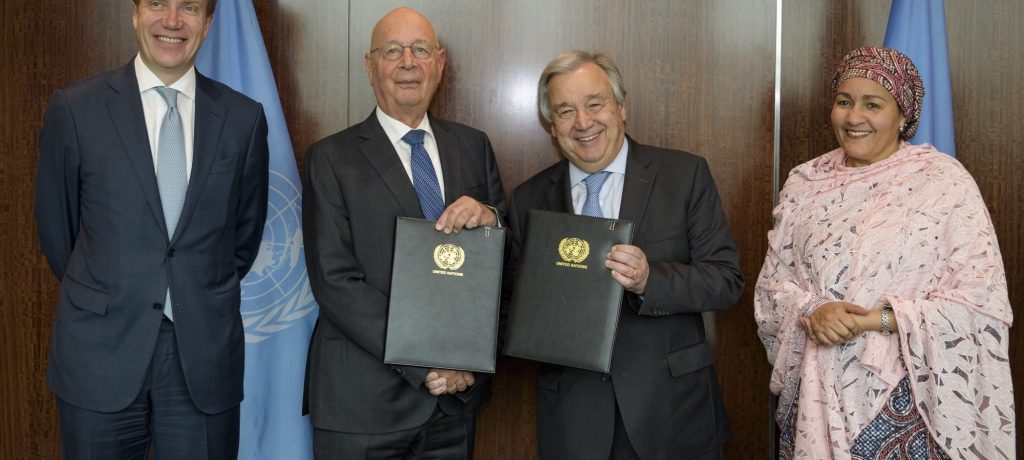
The WEF describes itself as the “International Organization for Public-Private Cooperation.” It represents the interests of more than 1000 global corporations and, in June 2019, it signed a Strategic Partnership Framework agreement with the United Nations. The WEF and the UN agreed to work together to “accelerate implementation of the 2030 Agenda for Sustainable Development.”

Agenda 2030 establishes the initial waypoints along the path to completion of the plan for the 21st century, also known as Agenda 21. The policies required to achieve these goals will be developed by the multi-stakeholder partnership. The UN explain how this is envisaged to operate:

“Cross sectorial and innovative multi-stakeholder partnerships will play a crucial role for getting us to where we need by the year 2030. Partnerships for sustainable development are multi-stakeholder initiatives voluntarily undertaken by Governments, intergovernmental organizations, major groups and others stakeholders, which efforts are contributing to the implementation of inter-governmentally agreed development goals and commitments, as included in Agenda 21.”

For its part, the UN describes itself as the “place where the world’s nations can gather together, discuss common problems and find shared solutions.” Currently 193 sovereign states are signed up to the UN Charter

National governments commit to abide by the principles of the Charter and the ruling arbitration of the International Court of Justice. While UN General Assembly recommendations are non-binding on member states, the UN provides a mechanism by which governments can take collective action.

With the Strategic Partnership in place, the WEF and the corporations they represent are now engaged in “effective collaboration” with the 193 national governments represented at the UN. They are directly partnering with government in the development of global policy agendas.

The partnership will guide the formation of policies and regulations related to international finance and the global financial system; the transition to a new, low carbon global economy; international public health policy, disaster preparedness and global health security; the technological development deemed necessary to bring about the Fourth Industrial Revolution; policies on diversity, inclusion and equality; oversight of the global education systems and more.

In an attempt to add a veneer of democratic accountability to this Strategic Partnership Framework, as the world uniformly moves towards Agenda 2030 Sustainable Development Goals (SDGs), the UN strongly advocates collaboration with “civil society.” Indeed, SDG 17 specifically refers to this arrangement: “Goal 17 further seek to encourage and promote effective public, public-private and civil society partnerships”

Civil society will be engaged by utilising the WEF concept of the “multistakeholder platform.” This is a core element of the WEF’s definition of stakeholder capitalism. 

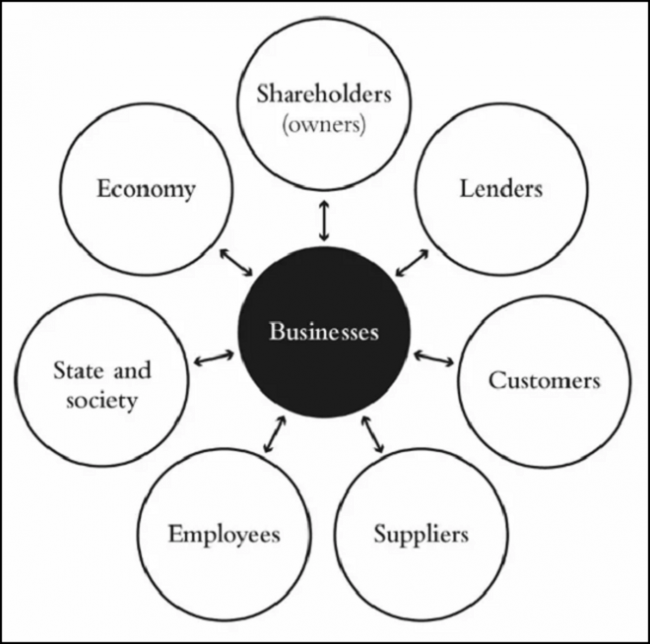
The communitarian model of civil society is based upon a triumvirate power sharing structure between state (public sector), market (private sector) and community (social or third sector.) However, the WEF’s interpretation of stakeholder capitalism assumes that the public-private partnership stakeholders (state-market) select the civil society communities (social or third sector) they wish to engage with. 

Selection bias is a concern, as it obviously excludes the communities the public-private partnership does not wish to engage with. In part, this contradicts the communitarian view of civil society. 

The WEF’s multistakeholder platform appears to exploit, rather than embrace, communitarian civil society. Understandably, the WEF’s partnership with the UN drew strong criticism from many civil society groups. The Transnational Institute (TNI) encapsulated their concerns as follows: 

“This public-private partnership will permanently associate the UN with transnational corporations […] This is a form of corporate capture […] The provisions of the strategic partnership effectively provide that corporate leaders will become ‘whisper advisors’ to the heads of UN system departments, using their private access to advocate market-based profit-making ‘solutions’ to global problems while undermining real solutions […] The UN’s acceptance of this partnership agreement moves the world toward WEF’s aspirations for multistakeholderism becoming the effective replacement of multilateralism […] The goal was to weaken the role of states in global decision-making and to elevate the role of a new set of ‘stakeholders’, turning our multilateral system into a multistakeholder system, in which companies are part of the governing mechanisms. This would bring transnational corporations, selected civil society representatives, states and other non-state actors together to make global decisions, discarding or ignoring critical concerns around conflicts of interest, accountability and democracy.”

Less than six months after the Strategic Partnership Framework was signed the pseudopandemic allegedly began in Wuhan, China. Resulting world events have somewhat obscured the corporate capture of global governance from public attention, but it remains in place. 

The Civil Society Tradition

Representative democracies have a long tradition of civil society. Between 1835 and 1840 the French aristocrat, Alexis de Tocqueville, wrote and published two volumes of “Democracy in America.” He noted that, for the representative democracy of the “new world,” the voluntary institutions of civil society promoted active engagement in decision making and acted as a bulwark against the excesses of centralised, governmental authority:

“Americans of all ages, all conditions, and all dispositions, constantly form associations. They have not only commercial and manufacturing companies, in which all take part, but associations of a thousand other kinds -religious, moral, serious, futile, extensive, or restricted, enormous or diminutive. The Americans make associations to give entertainments, to found establishments for education, to build inns, to construct churches, to diffuse books […] and in this manner they found hospitals, prisons, and schools […] they form a society.”

While he found that American civil society empowered the citizenry, de Tocqueville also identified some of the apparent risks:

“When several members of an aristocracy agree to combine, they easily succeed in doing so; as each of them brings great strength to the partnership, the number of its members may be very limited; and when the members of an association are limited in number, they may easily become mutually acquainted, understand each other, and establish fixed regulations. The same opportunities do not occur amongst democratic nations, where the associated members must always be very numerous for their association to have any power.”

There is nothing intrinsically wrong with concept of civil society, but even in the 19th century the potential for it to be exploited by powerful interest groups was apparent.

Today, civil society is sold to us as a way to fix what many people see as the “democratic deficit”. First coined in the late 70’s by the Congress of Young European Federalists (JEF), the “deficit” was conceived to explain the observed failings in representative democracy.

The JEF held that the ponderous, centralised bureaucracy of national government was unable to adapt to rapidly changing economic and social conditions. Further, that the interdependent, international nature of modern, technologically advanced industrial societies created conditions that no single nation could address in isolation.

This left the electorate unable to affect the policy changes they needed, as government became unresponsive to social and economic realities. Civil society was suggested as a way to bridge the gap between governance, government and community. Unfortunately, the inherent credulity of the communitarian theory driving it rendered civil society vulnerable to manipulation by more Machiavellian global forces.

Communitarian Civil Society Model

In 1848, Karl Marx and Frederick Engels published the first edition of the Communist Manifesto. In it they criticised their intellectual forebears, Henri de Saint-Simon, Charles Fourier and others, for their utopian naivety. In particular they decried the “utopian socialist” rejection of the class struggle, pointing out that, in their opinion, the proletariat needed an independent political movement in order to overturn the rule of the bourgeoisie.

In 1841, John Goodwyn Barmby coined the term “communitarian.” He was among those who Marx would subsequently label as utopian socialists. Communitarianism elucidated their theory that individual identity was a product of familial, social and community interactions. Communitarianism wasn’t widely referenced until, in 1996, the Canadian philosopher Charles Taylor highlighted that a new form of political communitarianism was building in the US:

“The term has been taken up by a group under the leadership of Amitai Etzioni in the US. This group has a political agenda. One might say that they are concerned social democrats who are worried about the way that various forms of individualism are undermining the welfare state. They see the need for solidarity, and hence for ‘community’ on a number of levels, from the family to the state.”

Amitai Etzioni, an Israeli-American dual citizen, is the director of the Center for Communitarian Policy Studies at George Washington University. A former advisor to the Carter administration, he formed an association of like minded sociologists and other scholars called the Communitarian Network.

In 1991, the Network produced its manifesto in the form of the Responsive Communitarian Platform. Etzioni et al. defined civil society as the moral and political space between community and state. They suggested that global problems could only be tackled with the participation of civil society:

“A communitarian perspective must be brought to bear on the great moral, legal and social issues of our time […] Moral voices achieve their effect mainly through education and persuasion, rather than through coercion […] they exhort, admonish, and appeal to what Lincoln called the better angels of our nature […] this important moral realm, which is neither one of random individual choice nor of government control, has been much neglected […] we see an urgent need for a communitarian social movement to accord these voices their essential place […] civil society is a constant, ongoing enterprise.”

Communitarianism is opposed to authoritarian control. It specifies “community” as representative of the people. Accordingly, in order for government to be genuinely responsive to the changing needs of the electorate, it must engage with communities:

“We seek to find ways to accord citizens more information, and more say, more often. We seek to curb the role of private money, special interests, and corruption in government. Similarly, we ask how ‘private governments,’ whether corporations, labor unions, or voluntary associations, can become more responsive to their members and to the needs of the community.”

Etzioni and other communitarians, like the utopian socialists before them, believe that the community represents the individual. Therefore, the community can speak for the individual. Further, they believe that governments and “private governments” can engage with the people via consultation with the communities. In combination, these communities form civil society.

Communitarian Assumptions

In his 2000 commissioned treatise for the UK-based, privately funded think tank DEMOS, titled The Third Way To A Good Society, Etzioni argued that civil society could remedy public disillusionment in democratic institutions. He noted the dwindling public trust in government and increasing sense of disenfranchisement. The remedy he proposed for this democratic deficit has since proven disastrous:

“We aspire to a society that is not merely civil but is good […] When we bond with family, friends or community members we live up to the basic principle of the good society […] The good society is one that balances three often partially incompatible elements: the state, the market and the community. […] Communities, in my understanding, are based on two foundations […] First, communities provide bonds of affection that turn groups of people into social entities resembling extended families. Second, they transmit a shared moral culture (a set of shared social meanings and values that characterise what the community considers virtuous verses unacceptable behaviour) […] These traits differentiate communities from other social groups […] Contemporary communities evolve among members of one profession working for the same institution […] members of an ethnic or racial group even if dispersed among others; people who share a sexual orientation; or intellectuals of the same political or cultural feather […]Groups that merely share specific interests – to prevent the Internet from being taxed or to reduce the costs of postage – are solely an interest group or lobby. They lack the affective bonds and shared culture that make communities.”

For communitarians shared morality defines the “good society” which manifests in the exercise of power sharing between “the state, the market and the community.” Communities, as defined, stand apart from mere “interest groups” because they have “affective bonds” whereas interest groups don’t, in the communitarian’s view.

Community is, according to the communitarians, held together because people have affection for each other. They suggest that interest groups lack cohesion by comparison.

Community is “good” and therefore the power-sharing triangle is “good” for society. Certainly the vast majority of us want to live in a peaceful society, where families of every shape and size can thrive, where children have the opportunity to reach their full potential and conflict is resolved without resorting to violence. Nonetheless, communitarianism poses some questions.

Absent a shared “specific interest,” it is not easy to define community. Which “communities” will be chosen to form civil society, how is this decision made and who makes it? Who represents the local community? Is it the church, if so which church? Is it a local charity or an environmentalist group? Does the local cyclist community represent the interests of the local road hauliers community? What “good” values do these selected communities promote, who among us agree with them and how many of us share their aims and objectives?

Who is selected from each alleged community to represent the opinions of all of its constituent members? Do the community members share the views of their representatives? Are they happy for these community leaders to speak for them?

In the multistakeholder platform-based model of civil society it appears that these judgments fall to the public-private partnership. How confident can the rest of us be in their rationale? Even the notion of the local community is a nebulous concept. Where are the boundaries of local? Is it our street, our town, city or nation state? Does everyone who lives in whatever is prescribed as the local community agree? Do we all share the same opinions, do we even want to be part of a community?

Communitarians offer few, if any, answers to these questions. It is an implicit assumption of communitarianism that this thing they call community is capable of acting as a voice for the individual. This is not evident.

Communitarian “New Normal” Intolerance

An oft quoted sound-bite during the 2020 iteration of the pseudopandemic was the phrase the “new normal.” Many of us probably believed that the prospect of a new normal referred to little more than the introduction of stringent public health measures following an unprecedented global pandemic. However, this is not what “new normal” means.

While he was far from the first to use it, the “new normal” was a phrase offered by Amitai Etzioni in his 2011 book of the same name. He accompanied his book with an essay, titled The New Normal, also written in 2011. In both the book and the essay, Etzioni explored the communitarian view on the new, post global economic collapse world. The “new normal” was the name Etzioni gave to a society of “diminished economic condition.”

He suggested that people must accept that continual growth was unlikely and should, in any case, eschew consumerism as a measure of success. He welcomed this envisaged change to a society that valued relationships as well as emotional, intellectual and spiritual growth beyond material acquisition. He claimed that a reduction in consumption was required to save the planet. We all needed to reduce our carbon footprints, he asserted.

As people have come to question the often dispiriting pursuit of modern materialism, Etzioni’s perspective was welcome perhaps. However, it is in Etzioni’s exploration of the balance between individual rights and the “common good” where doubts arise. Etzioni, alongside most communitarians, considers that balance to be fluid. Neither individual rights nor the common good take precedent in a sociological concept Etzioni called “libertarian communitarianism.” 

As new situations arise and technologies emerge, what is good for the community today may not be good for the community tomorrow. Therefore, the point at which the common good does override individual rights—as it must—is constantly shifting, according to libertarian communitarianism.

However, one value which communitarianism does not espouse is diversity of opinion. In the communitarian model, the power to define the common good is absolute. The traditional democratic values of freedom of speech and expression are distinctly unwelcome in communitarian philosophy. This is not admitted, but it is implicit to their theory. For communitarians, dissent from the community or disagreement with the stated “common good” is not tolerated.

For example, the Responsive Communitarian Platform states:

“We should not hesitate to speak up and express our moral concerns to others when it comes to issues we care about deeply […] Those who neglect these duties, should be explicitly considered poor members of the community […] A good citizen is involved in a community or communities. We know that enduring responsive communities cannot be created through fiat or coercion, but only through genuine public conviction […] Although it may seem utopian, we believe that in the multiplication of strongly democratic communities around the world lies our best hope for the emergence of a global community that can deal concertedly with matters of general concern to our species as a whole.”

Communitarians are ambitious. They see their civil society as a global project where everyone involved has a “genuine public conviction” to communitarian principles. This ambition is shared by the G3P, but for very different reasons.

What if we are not convinced? What if we believe individual sovereignty is sacrosanct and that freedom of speech and expression, of organic public protest and freedom of choice are more important than a commitment to any prescribed community or the community’s authorised version of the common good?

According to communitarians, like Etzioni, this makes us poor members of the community. We are not “good citizens” and they suggest how we should be dealt with:

“Responsibilities are anchored in community […] communities define what is expected of people; they educate their members to accept these values; and they praise them when they do and frown upon them when they do not […] Whenever individuals or members of a group are harassed, many non-legal measures are appropriate to express disapproval of hateful expressions and to promote tolerance among the members of the polity.”

This is community as a control mechanism, not as an extension of any egalitarian meritocracy where individuals can flourish. The community will define our responsibilities and spell out what is expected of us. The community will instill its values and we must agree with them. If we don’t, we will be “educated” to accept them.

If we strongly express disagreement with community values this could constitute “hate” and “harassment” of community members. Those of us outside of the community, for any reason, will be receive its disapproval and efforts will be made to make us more tolerant of the community’s beliefs. Whatever they may be.

Therefore, uniformity of opinion within these communities is enforced. Debate will be welcome as long as it doesn’t challenge the community’s precepts. These are off limits. Members will probably have to leave independent thought at the door before entering the community and certainly before being accepted by it.

There is a significant risk that groupthink will develop. The roots of communitarianism are in the utopian socialist view that identity is formed by the community. In turn, this also suggests that community identity becomes individual identity.

An individual suffering from groupthink possesses unquestioned certainty, intolerance for any opposing views and an inability to engage in logical discourse. Their critical thinking skills are impaired, because to question the community is to question their own identity. 

Those who do not share the ordained group ethos, or those who question the evidence base underpinning the group’s certainty, are not part of the community. They are “other.”

Etzioni describes anyone who doesn’t embrace vaccine passports as Individual Rights Luddites. Having thought about vaccine passports, he concluded:

“These passports could enable scores of millions of people to leave their depressing quarantines, to go to work, to attend school, and to be socially active again, all of which would help revive the economy and reduce social tensions.”

He accepts that lockdowns and the closure of the global economy was an unavoidable response to a global pandemic and not a policy choice. He believes that school closures make sense and that the economy will be revived once the vaccine passport system is established. He believes that the mRNA and viral vector injections are vaccines and that they work as described by the manufacturers.

In other words Etzioni accepts a whole raft of assumptions. Based upon them, he insists that denying access to society to those who don’t want to be injected is not “discrimination” but rather “differentiation.” Applying his communitarian principles he wrote:

“Differentiation will exert some pressure on those who refuse to be vaccinated, as they will be unable to reap the benefits of the passports unless they reconsider their position.”

Etzioni has defined the common good. Or rather, he accepts the common good as defined for him. Freedom of choice or principles such as bodily autonomy are overridden by the “common good.” 

Etzioni disagrees with the philosopher Giorgio Agamben who pointed out the horrific ramifications of a biosecurity state. This is fine, disagreement and debate are welcome in any free society.

Unfortunately, unlike Agamben, Etzioni doesn’t advocate a free society. He suggests a communitarian civil society based upon the consensus view of what does or does not constitute the common good. As did Hitler’s National Socialists in 1930s Germany, a society from which Etzioni fled as a child to what is now the state of Israel.

Communitarians oppose the abuse of power and it is unfair to describe them as fascists. Nonetheless, it is entirely reasonable to point out the parallels. Both political ideologies accept authoritarian diktat. That is what enforcement of the “common good” is. 

However, this is not the most worrying aspect of the communitarianism. It is communitarians’ naive grasp of the global realpolitik, which renders communitarian civil society the perfect policy vehicle for the G3P. This is what should concern us most. Unlike communitarians, the G3P definitely wants to enforce dictatorial control.

The Political Class Embraces Communitarian Civil Society

In one sense, the global political class’ apparent enthusiasm for communitarian civil society seems surprising. It is unusual for them to seek ways to increase public scrutiny of state and corporate power or public involvement in their policy development. 

While public consultation is nothing new, policy is typically designed via internal party political processes, set at party conferences and so-forth. The parties then produce manifestos that the people are invited to select in elections, once every 4 or 5 years.

Civil society, as envisioned by communitarians, suggests a permanent power sharing structure that affords individual voters “more say, more often” in an effort to “curb the role of private money, special interests, and corruption in government.” It is rare that governments, and the political parties that form them, willingly diminish their own power and authority. 

That this seeming diminution of party political power should be embraced both simultaneously and globally is unprecedented. Yet, that is what we have seen, as Western representative democracies have advocated, what appears to be, increasing political power for civil society groups.

The recent COP26 summit, which established the basis for action for the new global economy, invited representatives from “governments, businesses, NGOs, and civil society groups.” The US State Department brought together “leaders from government, civil society, and the private sector” for their Summit For Democracy to deliberate on US foreign policy.

The German government has appointed a National Civil Society Body to monitor the site selection for potential nuclear waste storage facilities. The UK government has created the Office for Civil Society within the Department for Digital, Culture, Media & Sport. On the surface, it seems democracy is exploding everywhere.

Communitarian Civil Society Is A G3P Project

The Communitarian Network’s ideas certainly enthralled the western political class. During the 1990s, US president Clinton and then UK Prime Minister Tony Blair, with German Chancellor Gerhard Schröder leading the mainland European charge, embraced what they called “the Third Way.”

In New Labour’s Third Way: pragmatism and governance, Dr. Michael Temple outlined how this new form of communitarianism was interpreted in the polity of the 1990s:

“Elements of both stakeholding and communitarianism can be found in the Third Way […] communitarian ideas have undoubtedly influenced New Labour [..] Outputs and not ideology are driving the new agenda of governance under New Labour. This is seen to have its roots in the new ways of working the party has embraced in local governance, where public–private partnerships have become the norm and a new ethos of public service has emerged.”

This transformation in governance was not solely a political shift of the “progressive left.” Following the demise of the UK Labour government, the Conservative-led coalition, under David Cameron, advocated the “Big Society.” Today, under another Conservative government, virtually no UK policy initiative or announcement is complete unless it speaks of engagement with “civil society.”

“Public-private partnerships” became prevalent in UK local government decision-making during the 1980s & 90s. This was an aspect of the forerunner of the Third Way, named by the UK Labour party as the “stakeholder society.”

The idea of the stakeholder society owed much to the reforms introduced by former UK Conservative Prime Minster, Margaret Thatcher. Under her leadership in the 1980s the pursuit of “Reagonomics” led the introduction of compulsory competitive tendering (CCT) for all local authority contracts.

Hitherto, standard local government practice had been to allocate infrastructure projects to private contractors while the regional government provided many local services. With CCT, all contracts were opened up to the private sector. This meant that multinational corporations had access to new taxpayer-funded markets.

Prof. Andrew Gamble and Gavin Kelly, who formed the Resolution Foundation policy think tank, welcomed Tony Blair’s 1996 speech in Singapore. They emphasised the stakeholder society as a crucial element of Blair’s vision of “one nation socialism”:

“The key idea behind one nation socialism is the stakeholder society, a society in which all individuals and interests have a stake through democratic representation, and through the adoption by political parties like the Labour Party of a conception of the public interest.”

However, the stakeholder society redefined who would determine the public interest? Traditionally, this had primarily been an undertaking for elected governments. They could be kicked out of office if the public disagreed with their policies. However, the stakeholder society gave a formal policymaking role to both the third (social) and the private sector. No one voted for them, nor could they be removed through any electoral process.

Nor was the Third Way simply a European project. In the US, the Third Way policy think tank was formed in Washington in 2005. Supposedly a think tank of the “progressive left”, the Third Way was heavily backed by global corporations and lobbied Congress intensively to adopt multinational trade deals, such as the Trans-Pacific Partnership (TPP). 

Initially, it seems difficult to understand why global corporations and governments would be eager to promote an idea like the Third Way or civil society. For global corporations, the ability to focus their lobbying efforts on a handful of elected officials would appear preferable, and easier, than trying to influence the communities forming civil society. Centralised authority benefits them, so why would they seek to to dilute it?

The “key idea” of the stakeholder society did not originate in centre-left think tanks like the Resolution Foundation or the Third Way. It sprang from the heart of the global capitalist network forming the Global Public Private Partnership (G3P).

Stakeholder capitalism is supposedly a new model of so-called responsible capitalism which the founder and current executive chairman of the World Economic Forum (WEF), Klaus Schwab, pioneered in the 1970s. The G3P he represents claims the right to act as trustees of society. In December 2019, Schwab wrote “What Kind of Capitalism Do We Want”, where he outlined the stakeholder capitalism concept:

“Stakeholder capitalism, a model I first proposed a half-century ago, positions private corporations as trustees of society, and is clearly the best response to today’s social and environmental challenges.”

“Trustee” has a specific legal definition:

“The person appointed, or required by law, to execute a trust; one in whom an estate, interest, or power is vested, under an express or implied agreement to administer or exercise it for the benefit or to the use of another.”

The referenced “other” is us, the population. We all apparently agree that private corporations should be invested with the power to administer the global estate. Or at least that is the assumption at the heart of stakeholder capitalism.

Communitarianism and stakeholder capitalism merge to form what is now being referred to as “civil society.” This then is the proposed model of representative democracy that will ostensibly enable us to have a say in the policy formation process. If we examine this claim, however, it is resoundingly hollow.

In the hands of the global stakeholder capitalists, with the connivance of a power hungry “progressive” left, Etzioni’s dream of a communitarian civil society has metastasised into a global control mechanism for the G3P. Civil society, as the term is now being used, is a threat to every democratic principle we value.

The Tyranny of the New Normal Communitarian Civil Society

Etzioni, Michael Sandel, Charles Taylor and other proponents of communitarianism, who advocate local and national governance via civil society, offer a model ripe for exploitation. Governments across the world have enthusiastically seized the opportunity presented by this rendering of civil society, typically in the form of people’s or citizen’s assemblies.

Many assemblies have formed their consultative community through the drawing of lots. So-called sortition is a governance model that invites members of the local community to deliberate on important policy issues. For example, the UK Government commissioned the Climate Assembly to look at policy enabling the UK to achieve “net zero” carbon emissions by 2050.

Selected delegates were able to debate what the net zero policy priorities should be. They considered how fast net zero policies should be implemented and looked at how net zero policies could impact their communities, considering what mitigation measures may be required. What they could not do is question net zero policy nor the underlying assumptions it is based upon.

The World Economic Forum (WEF) succinctly explains how they interpret the communitarian civil society:

“Civil society actors from a wide range of fields come together to collaborate with government and business leaders on finding and advocating solutions to global challenges. They also focus on how to best leverage the transformation brought by the Fourth Industrial Revolution and partner with industry, philanthropy, government and academia to take action and engage in the development, deployment, use and governance of technology. Non-governmental organizations (NGOs), labour and religious leaders, faith-based organizations and other civil society stakeholders are key members of the World Economic Forum’s multistakeholder platform.”

There is no questioning of either government or business. No opportunity is provided for the people, the subjects of the policy agenda under debate, to explore alternatives.

The necessity for the WEF model of the Fourth Industrial Revolution is assumed, as is the partnership with industry to achieve it. The problems are predetermined and the “solutions” have already been decided before civil society has the opportunity to “collaborate with government and business.”

The civil society stakeholders are chosen. Representatives from NGOs, religious communities, unions and philanthropic foundations are the selected stakeholders whose only role is to agree with the policies placed on the table by the public-private partnership. Their consent is deemed to be public consent.

As previously stated, the communitarian civil society creates a power sharing structure between state (public sector), market (private sector) and community (social or third sector.) It assumes that all three sectors are independent of each other and therefore governance, the setting of policy agendas, is achieved through equal compromise of all three parties.

This fatal naivety effectively extinguishes, rather than enhances, democratic accountability. In truth, the public and private sector are not independent of each other. They are working as equals in partnership. 

Between them, they have all the money, all the legal authority, all the resources. Via the public sector (government), they also possess a monopoly on the use of force to compel communities to comply.

On the other side of the civil society equation sits some abstract form of “community” that is invited by the public-private partnership to collaborate. The public-private partnership selects the community or communities they want to rubber stamp their policies. The community has neither power, nor access to resources. Unlike their civil society “partners”, the community can’t force anyone to do anything.

The parameters of the alleged debate are set before the community joins and it will only be allowed to select from whatever “solutions” are put in front of it. All of this fulfills the immediate objectives of the G3P.

At the same time, this allows the G3P to address an issue that has plagued it for years: the democratic deficit or the public’s loss of trust in the institutions of government.

Within the G3P, governments don’t necessarily devise policy. Instead, their primary role is to market the policy and then enforce it. 

Governments also provide the enabling environment for G3P policy agendas. They provide this environment both in terms of investment, via the taxpayer, and perhaps more importantly because the population is more likely to accept the rule of an allegedly democratic government rather than a dictatorship composed of a network of global corporations, NGOs and philanthropic foundations.  

Consequently, a democratic deficit that erodes that trust is a problem. If you want to convert your policy agenda into legislation and regulation that impacts people’s lives, then you need to make them believe they still have some way of holding decision makers to account. Otherwise, they might resist your undemocratic rule. 

The communitarian model of civil society is a gift for the G3P. Not only can they use it to continue maintaining the illusion of democracy, they can exploit claimed engagement with the community and build trust. Building trust is a current, major goal fo the G3P. For example, a “Crucial Year to Rebuild Trust” was the central theme of the 2021 Davos summit, hosted largely virtually by the WEF, and their planned theme for 2022 is “Working Together, Restoring Trust.”

Our continued “trust” in their institutions is vital for the G3P and the stability of their rule. The constant reference to civil society is intended to convince us that we too are stakeholders in the G3P’s multistakeholder platform. In reality, we aren’t. This is a deceit. 

Instead, we are the subjects of the predetermined policy agendas that civil society will be invited to approve on our behalf. If we question the selected representative civil society groups, their communitarian beliefs or their assumed right to speak for us, we will be castigated as “bad citizens.” 

Being in a community of like-minded souls, with whom we feel a bond, is nice but such a community has no chance against against a committed “interest group.” Such groups have a shared goal and often the will and the resources to attain it. Throughout history, communities have been ruthlessly oppressed by such “interest groups.”

Interest groups’ big advantage is that their members don’t have to feel any affection for each other or even agree on anything other than their objective. Its constituent members simply need to settle their purpose and they do so because each recognises how it benefits them. They are committed to the cause, not to each other.

In the case of the G3P, their cause is the creation and control of new markets and, in doing so, the establishment of a new global economic model. Civil society has helped to set this process in motion.

One of the G3P objectives is the global roll-out of Central Bank Digital Currencies (CBDCs). This offers the G3P the ability to individually monitor and control every financial transaction on Earth. We have every reason to fiercely oppose its introduction. It represents nothing less than absolute economic enslavement.  

Yet, the civil society deception is being used to convince us that we are somehow stakeholders in its development. This will undoubtedly be exploited to persuade us to accept its imminent introduction.

The Bank of England (BoE), who claim they have yet to make a decisions on CBDC, has committed its CBDC Taskforce to “engage widely with stakeholders on the benefits, risks and practicalities.”

To this end, they have set up the CBDC Engagement Forum (EF). The BoE states that the EF will:

“Provide a forum to engage senior stakeholders and gather strategic input on all non-technology aspects of CBDC from a diverse cross-section of expertise and perspectives […] The EF will inform the Bank’s further exploration of the challenges and opportunities of potentially implementing CBDC […] Participation in the EF is at the invitation of the Bank and HMT (Her Majesty’s Treasury.) Members will be drawn from the relevant range of CBDC stakeholders: from financial institutions, to civil society groups, to merchants, business users and consumers.”

Given that the introduction of CBDC will radically transform all our lives, it would be good to know who the civil society groups are that will supposedly be representing the public interest. The BoE explains that representatives will be invited to join, following their application, from any of the following organisations:

“Organisation active in retail or the digital economy, a university, a trade or consumer representative body, a think-tank, a registered charity or non-government organisation.”

It is not clear how any of these hand-picked delegates will actually advocate in the public’s interest. However, the BoE assures us that they will:

“On an individual level, the EF will be representative of the gender and ethnic diversity of the UK population, and seek to incorporate members of different backgrounds to support diversity of thought.”

This is what the BoE call engaging widely with stakeholders. In many respects, it is the epitome of communitarian ideology. 

The community (in this case, the British public) will be represented because the EF will reflect the right gender and ethnic balance. This is appropriate, but it is missing one vital aspect of diversity: Class.

Just like the utopian socialists who inspired Etzioni and other communitarian thinkers, the BoE does not think that economic power matters when it comes to defining civil society. As long as they tick the right diversity boxes, class is not an issue. However, when they decide to introduce CBDC, it is the working and middle class who will suffer most as a result.

This may not be the model of civil society that the communitarians intended, but it is the model that the rest of us are going to get. A powerful interest group, the G3P, has seized upon the opportunity of communitarianism to construct a form of fake democratic accountability that consolidates their power and authority.

In one sense, it does fix the democratic deficit. By cutting out the electorate, the “new normal” communitarian civil society effectively ends representative democracy.

Strategic Resistance to the World Economic Forum’s “Great Reset” Gathers Pace

By Robert J. Burrowes and Anita McKone

The ‘We Are Human, We Are Free’ campaign was launched earlier this year. It is designed to enable people to participate in a grassroots nonviolent campaign to strategically resist the World Economic Forum’s ‘Great Reset’ and related initiatives of the Global Elite including the transhumanist, eugenics and Cyber Polygon agendas.

Since being launched, people have been joining from all over the world.

A key initiative of the campaign was to prepare and design a one-page flyer so that people could be given, by various means, a short list of nonviolent actions that offered a series of simple but powerfully effective ways in which anyone could participate in the strategy to defeat the elite agenda.

With the invaluable assistance of members of the campaign from around the world, translations of this one-page flyer are now available in English, Finnish, French, German, Greek, Hungarian, Italian and Spanish with other languages imminent or in the pipeline.

If this campaign interests you, the website is above and our Telegram group is here.

Each of the posters is available on the website or below.

You are welcome to join us!

Biodata:

Robert Burrowes, Ph.D. is a member of the TRANSCEND Network for Peace Development Environment and has a lifetime commitment to understanding and ending human violence. He has done extensive research since 1966 in an effort to understand why human beings are violent and has been a nonviolent activist since 1981. He is the author of Why Violence? Websites: (We Are Human, We Are Free) (Charter)  (Flame Tree Project)  (Songs of Nonviolence) (Nonviolent Campaign Strategy) (Nonviolent Defense/Liberation Strategy(Robert J. Burrowes) (Feelings First) Email: flametree@riseup.net

Anita McKone is a member of the TRANSCEND Network for Peace Development Environment and has been a nonviolent activist since 1993. She has been arrested and imprisoned on a number of occasions for her activism. Anita has written many articles on different aspects of nonviolent activism, psychology and philosophy including Fearless Psychology and Fearful Psychology: Principles and Practice. She has also written and recorded eight ‘Songs of Nonviolence’.

What is the “Global Public-Private Partnership”?

Heads of UN and WEF signing “strategic partnership framework”, New York 2019

By Iain Davis

Source: Off-Guardian


The Global Public-Private Partnership (GPPP) is a world-wide network of stakeholder capitalists and their partners.

This collective of stakeholders (the capitalists and their partners) comprises global corporations (including central banks), philanthropic foundations (multi-billionaire philanthropists), policy think-tanks, governments (and their agencies), non-governmental organisations, selected academic & scientific institutions, global charities, the labour unions and other chosen “thought leaders.”

The GPPP controls global finance and the world’s economy. It sets world, national and local policy (via global governance) and then promotes those policies using the mainstream media (MSM) corporations who are also “partners” within the GPPP.

Often those policies are devised by the think-tanks before being adopted by governments, who are also GPPP partners. Government is the process of transforming GPPP global governance into hard policy, legislation and law.

Under our current model of Westphalian national sovereignty, the government of one nation cannot make legislation or law in another. However, through global governance, the GPPP create policy initiatives at the global level which then cascade down to people in every nation. This typically occurs via an intermediary policy distributor, such as the IMF or IPCC, and national government then enact the recommended policies.

The policy trajectory is set internationally by the authorised definition of problems and their prescribed solutions. Once the GPPP enforce the consensus internationally, the policy framework is set. The GPPP stakeholder partners then collaborate to ensure the desired policies are developed, implemented and enforced. This is the oft quoted “international rules based system.”  

In this way the GPPP control many nations at once without having to resort to legislation. This has the added advantage of making any legal challenge to the decisions made by the most senior partners in the GPPP (it is an authoritarian hierarchy) extremely difficult.

The GPPP has traditionally been referenced in the context of public health and specifically in a number of United Nation’s (UN) documents, including those from their agencies such as the World Health Organisation (WHO).

In their 2005 document Connecting For Health, the WHO, in noting what the Millennium Development Goals meant for global health, revealed the emerging GPPP:

These changes occurred in a world of revised expectations about the role of government: that the public sector has neither the financial nor the institutional resources to meet their challenges, and that a mix of public and private resources is required……Building a global culture of security and cooperation is vital….The beginnings of a global health infrastructure are already in place. Information and communication technologies have opened opportunities for change in health, with or without policy-makers leading the way…….Governments can create an enabling environment, and invest in equity, access and innovation.”

The revised role of governments meant that they were no longer leading the way. The traditional policymakers weren’t making policy anymore, other GPPP partners were. National government had been relegated to creating the GPPP’s enabling environment by taxing the public and increasing government borrowing debt.

This is a debt owed to the senior partners in the GPPP. They are also the beneficiaries of the loans and use this comically misnamed “public investment” to create markets for themselves and the wider the GPPP.

The researchers Buse & Walt 2000 offers a good official history of the development of the GPPP concept. They suggest it was a response to the growing disillusionment in the UN project as a whole and the emerging realisation that global corporations were increasingly key to policy implementation. This correlates to the development of the stakeholder capitalism concept, first popularised in the 1970s.

Buse & Walt outlined how GPPP’s were designed to facilitate the participation of new breed of corporations. These entities had recognised the folly of their previously destructive business practices. They were ready to own their mistakes and make amends. They decided they would achieve this by partnering with government to solve global problems. These existential threats were defined by the GPPP and the selected scientists, academics and economists they funded.

The two researchers identified a key Davos address, delivered by then UN Secretary General Kofi Annan to the WEF in 1998, as marking the transition to a GPPP based global governance model:

The United Nations has been transformed since we last met here in Davos. The Organization has undergone a complete overhaul that I have described as a ‘quiet revolution’…A fundamental shift has occurred. The United Nations once dealt only with governments. By now we know that peace and prosperity cannot be achieved without partnerships involving governments, international organizations, the business community and civil society…The business of the United Nations involves the businesses of the world.”

Buse & Walt claimed that this signified the arrival of a new type of responsible global capitalism. As we shall see, that is not how the corporations viewed this arrangement. Indeed, Buse and Walt acknowledged why the GPPP was such an enticing prospect for the global giants of banking, industry, finance and commerce:

Shifting ideologies and trends in globalization have highlighted the need for closer global governance, an issue for both private and public sectors. We suggest that at least some of the support for GPPPs stems from this recognition, and a desire on the part of the private sector to be part of global regulatory decision-making processes.”

The conflict of interest is obvious. We are simply expected to accept, without question, that global corporations are committed to putting humanitarian and environmental causes before profit. Supposedly, a GPPP led system of global governance is somehow beneficial for us.

Believing this requires a considerable degree of naivety. Many of the stakeholder corporations have been convicted, or publicly held accountable, for the crimes they have commited. These include war crimes. The apparent passive agreement of the political class that these “partners” should effectively set global policy, regulations and spending priorities seems like infantile credulity.

This naivety is, in itself, a charade. As many academics, economists, historians and researchers have pointed out, corporate influence, even dominance of the political system had been increasing for generations. Elected politicians have long-been the junior partners in this arrangement.

With the arrival of GPPP’s we were witnessing the birth of the process to formalise this relationship, the creation of a cohesive world order. The politicians have simply stuck to the script ever since. They didn’t write it.

It is important to understand the difference between government and governance in the global context. Government claims the right, perhaps through a quasi-democratic mandate, to set policy and decree legislation (law.)

The alleged western representative democracies, which aren’t democracies at all, are a model of national government where elected representatives form the executive who enact legislation. For example, in the UK this is achieved through the parliamentary process.

Perhaps the closest thing to this form of national government on an international scale is the United Nations General Assembly. It has a tenuous claim to democratic accountability and can pass resolutions which, while they don’t bind member states, can create “new principles” which may become international law when later applied by the International Court of Justice.

However, this isn’t really world “government.” The UN lacks the authority to decree legislation and form law. The only way its “principles” can become law is via judicial ruling. The non-judicial power to create law is reserved for governments and their legislative reach only extends to their own national borders.

Due to the often fraught relationships between national governments, world government starts to become impractical. With both the non-binding nature of UN resolutions and the international jockeying for geopolitical and economic advantage, there isn’t currently anything we could call a world government.

There is the additional problem of national and cultural identity. Most populations aren’t ready for a distant, unelected world government. People generally want the political class to have more democratic accountability, not less.

The GPPP would certainly like to run a world government, but imposition by overt force is beyond their capability. Therefore, they have employed other means, such as deception and propaganda, to promote the notion of global governance.

Former Carter administration advisor and Trilateral Commission founder Zbigniew Brzezinski recognised how this approach would be easier to implement. In his 1970 book Between Two Ages: Americas Role In The Technetronic Era, he wrote:

Though the objective of shaping a community of the developed nations is less ambitious than the goal of world government, it is more attainable.”

The last 30 years have seen numerous GPPP’s form as the concept of global governance has evolved. A major turning point was the WEF’s conspectus of multistakeholder governance. With their 2010 publication of Everybody’s Business: Strengthening International Cooperation in a More Interdependent World, the WEF outlined the elements of GPPP stakeholder’s form of global governance.

They established their Global Agenda Councils to deliberate and suggest policy covering practically every aspect of our existence. The WEF created a corresponding global governance body for every aspect of our society. From our values and economy, through to our security and public health, our welfare systems, consumption, access to water, food security, crime, our rights, sustainable development and the global financial and monetary system, nothing was left untouched.

The executive chairman of the WEF, Klaus Schwab, spelled out what the objective of global governance was:

Our purpose has been to stimulate a strategic thought process among all stakeholders about ways in which international institutions and arrangements should be adapted to contemporary challenges…the world’s leading authorities have been working in interdisciplinary, multistakeholder Global Agenda Councils to identify gaps and deficiencies in international cooperation and to formulate specific proposals for improvement…

These discussions have run through the Forum’s Regional Summits during 2009 as well as the Forum’s recent Annual Meeting 2010 in Davos-Klosters, where many of the emerging proposals were tested with ministers, CEOs, heads of NGOs and trade unions, leading academics and other members of the Davos community…

The Global Redesign process has provided an informal working laboratory or marketplace for a number of good policy ideas and partnership opportunities…We have sought to expand international governance discussions…to take more pre-emptive and coordinated action on the full range of risks that have been accumulating in the international system.

By 2010 the WEF had taken it upon themselves to begin the  Global Redesign process. They defined the international challenges and they proposed the solutions. Fortunately for the GPPP, their proposals meant more control and partnership opportunities for them. The WEF sought to spearhead the expansion of this international governance.

In just one example, in 2019 the UK Government announced its partnership with the WEF to develop future business, economic and industrial regulations. The UK government were committed to supporting a regulatory environment created by the global corporations who would then be regulated by the same regulations they had designed.

The WEF do not have an electoral mandate of any kind. None of us have any opportunity to influence or even question their judgments and yet they are working in partnership with our supposedly democratically elected governments, and other GPPP stakeholders, to redesign the planet we all live on.

Stakeholder capitalism lies at the heart of the GPPP. Essentially it usurps democratic government (or indeed government of any kind) by placing global corporations at the centre of decision making. Despite deriving authority from no one but themselves, the leaders of the GPPP assume their own modern interpretation of the “divine right of kings” and rule absolutely.

In January 2021 The WEF spoke about how they viewed Stakeholder Capitalism:

The most important characteristic of the stakeholder model today is that the stakes of our system are now more clearly global.. What was once seen as externalities in national economic policy making and individual corporate decision making will now need to be incorporated or internalized in the operations of every government, company, community, and individual. The planet is.. the center of the global economic system, and its health should be optimized in the decisions made by all other stakeholders.”

The GPPP will oversee everything. Every government, all business, our so-called communities (where we live) and each of us individually. We are not the priority. The priority is the planet. Or so the WEF claim.

Centralised control of the entire planet, all its resources and everyone that lives on it is the core ethos of the GPPP. There is no need to interpret GPPP intentions, we don’t have to read between the lines. It is stated plainly in the introduction to the WEF’s Great Reset initiative:

To improve the state of the world, the World Economic Forum is starting The Great Reset initiative.. The Covid-19 crisis.. is fundamentally changing the traditional context for decision-making. The inconsistencies, inadequacies and contradictions of multiple systems –from health and financial to energy and education – are more exposed than ever.. Leaders find themselves at a historic crossroads.. As we enter a unique window of opportunity to shape the recovery, this initiative will offer insights to help inform all those determining the future state of global relations, the direction of national economies, the priorities of societies, the nature of business models and the management of a global commons.”

It should be noted that the WEF are just one partner organisation among many in the GPPP. However, they have been perhaps the most influential in terms of public relations throughout the pseudopandemic. Contrary to the hopes of Buse & Walt, we see an emergent global, corporate dictatorship, not caring stewardship of the planet.

The GPPP will determine the future state of global relations, the direction of national economies, the priorities of societies, the nature of business models and the management of a global commons. There is no opportunity for any of us to participate in either their project or the subsequent formation of policy.

While, in theory, governments do not have to implement GPPP policy, the reality is that they do. Global policies have been an increasing facet of our lives in the post WW2 era. The mechanism of translating GPPP policy initiatives, first into national and then regional and eventually local policy, can be clearly identified by looking at sustainable development.

In 1972 the privately funded, independent policy think-tank the Club of Rome (CoR) published the Limits of Growth. As we saw with the roll-out out of the pseudopandemic, the CoR used computer models to predict what they decreed were the complex problems faced by the entire planet: the “world problematique.”

Their offered opinions derived from the commissioned work of the Massachusetts Institute of Technology’s (MIT’s) system dynamic “World3 model.” This assumed global population would deplete natural resources and pollute the environment to the point where “overshoot and collapse” would inevitably occur.

This is not a scientific “fact” but rather a suggested scenario. So far, none of the predictions made have come to pass.

The scientific and statistical to-and-fro on the claims made in the Limits to Growth has been prolific. However, ignoring all doubts, the World3 model was firmly planted at the centre of the sustainable development policy environment.

In 1983 the Brundtland Commission was convened by former Norwegian Prime Minister Gro Harland Brundlandt and then Secretary General of the UN Javier Pérez de Cuéllar. Both were Club of Rome members. Based upon the highly questionable assumptions in the World3 model, they set about uniting governments from around the world to pursue sustainable development policies.

In 1987 the Commission published the Brundtland Report, also known as Our Common Future. Central to the idea of sustainable development, outlined in the report, was population control (reduction.)  This policy decision, to get rid of people, won international acclaim and awards for the authors.

The underlying assumptions for these policy proposals weren’t publicly challenged at all. The academic and scientific debate raged but remained almost completely unreported. As far as the public knew, scientific assumption and speculation was a proven fact. It is now impossible to question these unproven assumptions and obviously inaccurate models without being accused of “climate denial.”

This resulted in the Millenium Development Goals and eventually, in 2015, they gave way to the United Nation’s full adoption of Sustainable Development Goals (SDGs), In turn, these have been translated into government policy. For example, the UK government proudly announced their Net Zero policy commitment to sustainable development goals in 2019.

SDGs were already making an impact at the regional and local level in counties, cities, towns and boroughs across the UK. Nearly every council across the country has a “sustainable development plan.”

Regardless of what you think about the global threats we may or may not face, the origin and the distribution pathway of the resultant policy is clear. A privately funded, globalist think-tank was the driver of a policy agenda which led to the creation of a global policy framework, adopted by governments the world over, which has impacted communities in nearly every corner of the Earth.

SDGs are just one among numerous examples of GPPP global governance in action. The elected politician’s role in this process is negligible. They merely serve to implement and sell the policy to the public.

It doesn’t matter who you elect, the policy trajectory is set at the global governance level. This is the dictatorial nature of the GPPP and nothing could be less democratic.

The War on COVID-19: Man’s Final Conquest of Nature. The Great Reset Requires “Merging Humans with the Machine”

By Dr. Nozomi Hayase

Source: Global Research

In 1943, the writer and literature professor C.S. Lewis delivered a series of three evening lectures at King’s College, Newcastle. In the third and final part of his lecture series titled “The Abolition of Man,” he spoke of how science can be misused. A literary giant who is known for his pro-Christian texts linked the progress of science to man’s aspiration to dominate nature. Lewis stated, “Man’s conquest of nature, if the dreams of some scientific planners are realized, means the rule of a few hundreds of men over billions upon billions of men.”

Over half a century later, we are seeing “science”, in the hands of the few, being used to reshape the world.

The COVID-19 pandemic has exacerbated the disintegration of the global economy which began unraveling in the aftermath of the 2008 financial crisis. In mid 2020, as the economy had yet to recover, the World Economic Forum (WEF) announced its plan for a “Great Reset” to re-engineer the global economy as the world emerged from the pandemic.

Participants in the initiative include international governmental organizations such as the United Nations and its specialized agency the World Health Organization (WHO) and the International Monetary Fund (IMF) as well as leading global corporations.

Klaus Schwab, founder and executive chairman of WEF, called the initiative of the Great Reset “The Fourth Industrial Revolution” that opens up a new chapter for human development. Using science and advanced technology such as artificial intelligence (AI), robotics and genetic engineering, its stated goal is said to create a “fusion of our physical, digital and biological identity.”

Merging humans with the machine

Steps toward the merging of digital technologies and biological systems are already taking place with the idea of the immunity passport – a form of documentation that could prove a person has received the required number of shots of an approved Covid-19 vaccine. On August 27, 2021, the WHO released a guiding document for a digital certificate for COVID-19 vaccination status. Funded by organizations such as the Bill and Melinda Gates Foundation and the Rockefeller Foundation, it is intended that this digital information system be used to implement a vaccine passport in every country.

A COVID vaccination certificate system has been already rolled out in Israel, some European countries, and in US cities such as New York and San Francisco. Current uses for the vaccine passport include denying those who are unvaccinated access to restaurants, bars, gyms and trains. This program separates people based on health status and creates a system of medical and socio-economic apartheid.

Government issued QR-code health passes could be used to launch a China style authoritarian government program. With the use of big data, face recognition technology and machine learning, China’s social credit system monitors and regulates people’s behavior. It ranks them based on their ‘social credit’, rewarding ‘good’ citizens, while punishing ‘bad’ citizens.

Klaus Schwab, founder and executive chairman of WEF, called the initiative of the Great Reset “The Fourth Industrial Revolution” that opens up a new chapter for human development. Using science and advanced technology such as artificial intelligence (AI), robotics and genetic engineering, its stated goal is said to create a “fusion of our physical, digital and biological identity.”

Merging humans with the machine

Steps toward the merging of digital technologies and biological systems are already taking place with the idea of the immunity passport – a form of documentation that could prove a person has received the required number of shots of an approved Covid-19 vaccine. On August 27, 2021, the WHO released a guiding document for a digital certificate for COVID-19 vaccination status. Funded by organizations such as the Bill and Melinda Gates Foundation and the Rockefeller Foundation, it is intended that this digital information system be used to implement a vaccine passport in every country.

A COVID vaccination certificate system has been already rolled out in Israel, some European countries, and in US cities such as New York and San Francisco. Current uses for the vaccine passport include denying those who are unvaccinated access to restaurants, bars, gyms and trains. This program separates people based on health status and creates a system of medical and socio-economic apartheid.

Government issued QR-code health passes could be used to launch a China style authoritarian government program. With the use of big data, face recognition technology and machine learning, China’s social credit system monitors and regulates people’s behavior. It ranks them based on their ‘social credit’, rewarding ‘good’ citizens, while punishing ‘bad’ citizens.

Now, it looks like  China’s social scoring technocracy is coming to the West. Under algorithmic governance that enforces obedience and conformity, human beings will become automatons, not being able to make independent decisions about their own actions.

Internet of bodies

The enslavement of humanity in cyberspace is not the end goal. The convergence of biological and digital identity will bring about a radical transformation of human beings. Lewis recognized man’s aspiration to control nature would lead to the abolition of our humanity, and that the timing of this change was not far off:

“The final stage is come when Man by eugenics, by prenatal conditioning, and by an education and propaganda based on a perfect applied psychology, has obtained full control over himself. Human nature will be the last part of nature to surrender to Man. The battle will then be won.”

In the digital age, the advancement of technology is opening up many possibilities for human beings to transform themselves. By experimenting with a range of high-tech innovations, teams behind the Great Reset are now seeking to exploit this uncharted territory.

In July 2020, WEF published the white paper titled, “Shaping the Future of the Internet of Bodies: New Challenges of Technology Governance.” A 28-page document introduced the concept of the internet of bodies (IoB) as “the network of human bodies and data through connected sensors”. It explained how these sensors can be attached to human bodies through consumer wearable devices or “implanted within or ingested into human bodies to monitor, analyse and even modify human bodies and behavior.”

Those who are working to bring related products to market claim that the application of IoB could change human beings as a natural concept. Seizing the power of this technology, this can be viewed as an attempt to claim ownership of human bodies, to gain access to the thoughts, emotions and biorhythmic data of individuals. Their vision seeks to create a post-human society by transforming “the human body into a new technology platform.”

Politicization of public health

Capitalising on the ongoing pandemic, while people are kept in fear and uncertainty, the end game is being played out for man’s final conquest of nature. Those who aspire to eradicate the human race in its natural state steer the societal narrative in order to ensnare the population in their web of control.

Since it declared a global pandemic on March 11, 2020, the WHO has quickly positioned itself as the preeminent global health authority. With its own process of gathering data, research and evaluation, the organization has spearheaded global public health efforts, advising countries on how to respond to the COVID-19 crisis. They have published guidance as to how to minimize the risk of spreading, or catching the virus, together with its own website ‘myth-buster’, which purports to debunk what they deem to be unsubstantiated information or “medical misinformation” online.

In the United States, the Centers for Disease Control and Prevention (CDC), a branch of the Department of Health and Human Services (HHS), working in partnership with the WHO, began to set guidelines and give recommendations. As new rules and restrictions have been put into place, the concept of ‘public health’ has become politicized.

From face mask policies to “lockdown” measures, corporate media framed the issues in a false dichotomy of liberal and conservative talking points. First, major media networks have dismissed anyone questioning the official pandemic narrative as “conspiracy theorists” and accused them of spreading harmful misinformation to the public. Then they indiscriminately labeled them as “Covid deniers,” and branded them as “far right,” or “Trumpers,” and “anti-science.”

Concerted efforts of the legacy media have been used to suppress information on early treatment that could be beneficial to the public, paving the way for the perception that a vaccine is the only way to end the pandemic. With a message of “we are all in this together,” we were told we need to accept the government’s mandate “for the public good.”

Discourse that is not founded on medical facts and is wrapped up with the concept of public duty seems to have affected prominent liberal intellectuals like Noam Chomsky, and institutions such as the American Civil Liberties Union (ACLU) which recently issued a puzzling statement saying that the vaccine mandates further civil liberty.

Their virtue-signalling has influenced public opinion on the political left. Organized networks of self-righteous social justice activists have been quickly formed online to engage in the shaming and guilt-tripping of fellow citizens who dare to question or comment negatively on official policies, or who refuse to take the vaccine.

For instance, comedian and political commentator Jimmy Dore faced backlash on social media when he shared his own experience of adverse side effects after receiving his second dose of the Moderna Covid vaccine. In an interview with podcaster Joe Rogan, he said that people started to call him an ‘anti-vaxxer,’ and that he was pressured not to share any more information about his reactions.

Demonization of unvaccinated

The moral battle that has been engineered maintains its structure through marginalizing a certain population and assigning them negative attributes. From black, indigenous, and people of color, and other immigrants, governments have often used minority groups as a means of social control and source of blame for a country’s domestic problems. In the wake of 9/11, American Muslims were scapegoated for the terrifying reality of terrorism on U.S. soil. Now, in this Covid crisis, the unvaccinated have become a target for demonization. By using the phrase “pandemic of the unvaccinated,” President Joe Biden has portrayed unvaccinated people as those who pose a threat to public health, stopping society from moving forward.

Placing blame on the unvaccinated has helped spread a new type of discrimination. In some hospitals, doctors have begun to refuse to treat the unvaccinated, making those who are vaccinated a priority when resources are scarce. Vilification of those who have not gotten a shot has increased, such as when The Atlantic published an article from former Obama Homeland Security official Juliette Kayyem calling for unvaccinated people to be put on the No Fly List.

This type of discrimination can escalate quickly. Arne Duncan, who served as former President Obama’s Education Secretary for seven years, compared unvaccinated Americans to suicide bombers at the Kabul airport. In his tweet, he noted that anti-mask and anti-vax people “blow themselves up, inflict harm on those around them, and are convinced they are fighting for freedom.”

These wild imaginations have been acted out in other Western countries. In France, a woman who tried to enter a shopping mall without proof of vaccine passport was violently beaten by the security forces.

On the streets of Paris, police are using teargas during their confrontation with the protesters opposing the vaccine passport. Similar scenes can be seen in other countries.

New domestic terrorism

Now, with the rise of the allegedly highly contagious Delta variant, governments are intensifying their fight against the coronavirus. Accompanied by media fear mongering, the drumbeat for ‘the war on Covid-19’ is getting louder.

Earlier this month, on September 9, President Biden announced his intention to expand the executive branch’s power to require all federal workers to get vaccinated, while this mandate does not extend to members of Congress. He also stated his intention to force all private businesses with over 100 employees to get COVID vaccinations or be tested for coronavirus at least once a week.

During his announcement the President heaped even more disdain on the unvaccinated, saying they are “keeping us from turning the corner” and “making people sick, causing unvaccinated people to die.” He then said that the fight against the virus requires defeating those who are reluctant to get a shot, and that he intended to make them roll up their sleeves.

Biden’s forceful Covid-19 vaccine speech came at a time when his administration introduced the government’s new strategy to confront domestic terrorism. Journalist Whitney Webb reported that despite its stated aim of tackling “right-wing white supremacists”, the policy targets anyone who criticizes the government’s authority.

But who are the unvaccinated, now being treated like a dangerous virus that needs to be dispatched? In reality, they are not confined to some fringe element of society. They represent a broad range of professionals including police officers, military members, firefighters, teachers and students. They are physicians, nurses and other ‘essential’ workers who put their lives on the frontline during the pandemic – and are now told to take a jab or lose a job.

Silenced majority

The politicians and media pundits call those who are refusing to take doses “anti-vaxxers.” But many of them are not strictly anti-vaccine. Rather, they are anti government (or corporate) mandating of the vaccine. Most have had other vaccines previously, and vaccinated their children. Many have even taken the Covid vaccine. They are also those who came to a decision that a Covid-19 vaccine is not right for them, whether it is for medical, personal health or religious reasons. They believe in medical freedom and choose natural remedies; to eat wholesome food and work with the body’s innate capacity for healing. They are individuals who are standing up for bodily autonomy with the conviction that the government has no right to inject things that they don’t want into their body.

Mass media depict them as right-wing extremists, but they do not belong to either the left or the right. They are a silenced majority, being betrayed and abandoned by elected leaders and now being pushed into political exile.

Despite health officials calling them anti-science, many of them believe in science and hold a view that science requires rigorous studies and open debate. They are those who have acquired natural immunity because they already had the virus. They are people who were injured after the first dose and the doctor advised not to take a second dose. They are people whose immune systems are compromised and who cannot take a shot, even if they want to. They are parents who are concerned that their little children are categorized as disease reservoirs and do not want to accept medical treatment from manufacturers and healthcare providers that are shielded from legal liability.

While the vaccinated represent a largely privileged class in a society, among the majority of unvaccinated are poor and people of color from marginalized communities. Black people have been showing hesitancy because they distrust the government based on historic injustices like the Tuskegee experiment and other past experience of abuse at the hands of the government.

Awakening human heart

The war on Covid is a war on humanity. In this pandemic crisis, we have been made to be afraid of an invisible virus. The fear has frozen our hearts, making us afraid of our own neighbors. With the practice of social distancing, we have been conditioned to see each other as a threat from which we need to protect ourselves. Now, career politicians who have never once cared about public health are telling us that we have to sacrifice our freedom to bring society back to normal. They are now further dividing us into a new class of ‘vaxxed’ or ‘non-vaxxed’ to make us fight against one another.

With the vaccine mandate and digital ID, the movers of the Great Reset aim to open a new chapter for a society without humanity. Under the slogan “Build Back Better,” political leaders and activists around the world engage in a campaign, promising to create a fairer and greener future. Yet, the system that is built on exclusion of some brothers and sisters, separation and hatred can’t create a truly sustainable world that acknowledges the sacredness of all living beings.

Unvaccinated + Vaccinated = United against Tyranny 💪🏾🤜🏽🤛🏽#NoVaccinePassportsAnywhere pic.twitter.com/agkb2W48DQ

— Sean Hackman (@SeanHackman3) September 4, 2021

In his book, Mere Christianity, C.S. Lewis talked about the concept of progress, saying, “If you are on the wrong road, progress means doing an about-turn and walking back to the right road.”

Hence, we can best evolve as a species through each of us returning to a path of nature and choosing to abide by the laws of human nature.

The future of civil society requires human beings who freely lay claim to their responsibility as stewards of this planet. Our willingness to confront our fears with courage can awaken our sense of shared humanity. This is the heart of our democracy that accepts diverse opinions and remains open to our radical differences. Through ordinary people, heart to heart in solidarity, a new network is being created that can bring a triumph of the human spirit.

Author Nozomi Hayase, Ph.D., is an essayist and author of WikiLeaks, the Global Fourth Estate: History is Happening. Follow her on Twitter: @nozomimagine

Smart Dust: A Tiny Part of What They’ve Got Planned For You

By Mickey Z.

Source: Dissident Voice

Thanks to corporate media, anything outside the accepted parameters of debate (e.g. CNN vs. Fox, NY Times vs. Wall Street Journal) is considered beyond the pale. Thus, when I wish to introduce you to what the transhumanists in charge have planned for you, by default, I sound like a fringe weirdo in a tinfoil hat. This highly efficient system keeps the rabble in line by encouraging each of us to do the enforcing of such censorship. We willingly limit our own access to information — in the name of “justice” or “science,” of course.

With that in mind, I offer you a 2-minute video on “smart dust” in the hope you have enough attention span and open-mindedness to focus that long:

Keep in mind that the above video is already five years old. In tech years, that might as well be a century. As far back as 2013, MIT was talking about “How Smart Dust Could Spy On Your Brain.” Smart dust (or “neural dust”) is already here, already in use, and will soon be a daily part of your life — whether you ask for it or not. Are you okay with that?

Smart Dust is comprised of “many small wireless microelectromechanical systems (MEMS). MEMS are tiny devices that have cameras, sensors, and communication mechanisms to transmit the data to be stored and processed further. They generally range from 20 micrometers up to a millimeter in size. They are usually connected to a computer network wirelessly and are distributed over a specific area to accomplish tasks, usually sensing through RFID (radio-frequency identification) technology.”

You can probably see what they’ve been given the nickname of “dust.” In fact, they can even be distributed via tiny, unmanned aircraft that would serve as crop dusters of sorts. Without being detected, they’d spray the virtually invisible motes over a large area and collect information that way. They are so small, you’d never know they were there — perhaps gathering info on you. How small? The prototype smart dust currently measures 0.8 millimeters x 3 millimeters x 1 millimeter can be only 1 cubic millimeter or less in size — possibly as small as 100 microns per side. 

Some of you, I’m certain, are already embracing this sci-fi kind of idea as yet another fine example of  “science.” Before you get too misty-eyed about such “progress,” please allow me to remind you that smart dust was developed by (surprise, surprise) the U.S. military. More specifically, it is the brainchild of the notorious DARPA — Defense Advanced Research Projects Agency. These are the same folks who brought you mind-control weapons, cyborg insects, synthetic blood, mechanical elephants, programmable shape-shifting matter, and so much more.

So, go back and re-read the details above and recognize how easily smart dust could be weaponized. Even better, accept the reality that step one (as always) was weaponizing smart dust. And now, digest the fact that those well-intentioned and good-hearted souls in the military want to implant smart dust inside you… for your own good, of course.

“Neural dust represents a radical departure from the traditional approach of using radio waves for wireless communication with implanted devices,” said Doug Weber, a DARPA program manager. “The soft tissues of our body consist mostly of saltwater. Sound waves pass freely through these tissues and can be focused with pinpoint accuracy at nerve targets deep inside our body, while radio waves cannot. Indeed, this is why sonar is used to image objects in the ocean, while radar is used to detect objects in the air. By using ultrasound to communicate with the neural dust, the sensors can be made smaller and placed deeper inside the body, by needle injection or other non-surgical approaches.”

I’ve already told you about the Internet of Bodies. And I’ve also already told you about the Pentagon’s openly-discussed plan to insert microchips inside us to “protect” us. With smart dust, they could just let the technology waft down from the sky and have you unknowingly inhale it. Why is no one talking about this? I ask you to re-visit my opening paragraph for that answer. To even talk about smart dust is to be dismissed as a “conspiracy theorist.” Once again, those in power have trained the public to do the policing for them. Somewhere, Goebbels is drooling.

All of the above has become easier to employ thanks to the pandemic. To explain that, we need to meet Klaus Schwab — the founder and Executive Chairman of the World Economic Forum (WEF), and author of a book called The Fourth Industrial Revolution. Here’s how the WEF explains this concept

The First Industrial Revolution used water and steam power to mechanize production. The Second used electric power to create mass production. The Third used electronics and information technology to automate production. Now a Fourth Industrial Revolution is building on the Third, the digital revolution that has been occurring since the middle of the last century. It is characterized by a fusion of technologies that is blurring the lines between the physical, digital, and biological spheres.

To repeat: “a fusion of technologies that is blurring the lines between the physical, digital, and biological spheres.” This is transhumanism. It’s an ideology that proposes that technology can and must “enhance” the human mind and body and they are already working to “prove” this theory. Men like Schwab believe we must connect the physical, digital, and biological domains via steps like “implantable technologies such as smart tattoos, smart dust, smart pills, and other implantable smart functionalities.” They want to turn your heartbeat into your digital ID. Schwab and his ilk also support work going on in areas like designing human genomes, and simulating, monitoring, or even influencing brain activity, both in medical and non-medical applications. (P.S. Elon Musk is also currently setting up a company that links brains and computers.) Click here to watch Schwab telling Charlie Rose about his plans to edit your genes. 

Most people would’ve probably cast a wary side-eye at such suggestions — until Covid-19. For 18 months, the powers-that-be have successfully scared the population into believing anything they decree. They’ve also coerced and manipulated billions into allowing novel nanotechnology to be injected into them without a second thought. Never mind thinking, the masses are lining up to serve as unpaid PR people for the experimental jab.

With such widespread and enthusiastic compliance, there seems to be little to stand in the way of Schwab, the World Economic Forum, DARPA, Big Pharma, and the transhumanist agenda. They are counting on you going along without asking too many questions. But there’s the catch. You still can demand and reclaim autonomy over your mind and body. For starters, all you need to do is a little self-loving homework to see what they have planned for you and then… just say no. Unless, of course, you’d prefer having your consciousness uploaded to the cloud