How to Navigate Our Low-Trust, Increasingly Dysfunctional Society and Economy

By Charles Hugh Smith

Source: Of Two Minds

Politicians and corporate managers have an enviable record of self-enrichment but very little to show in terms of putting the long-term interests of the citizenry above their own short-term gains.

This week’s focus is on self-reliance, a topic of increasing relevance than is more complex that it may seem.

Sociologists differentiate between high-trust and low-trust societies: in high-trust social orders, citizens tend to trust institutions and each other to conform to social norms, enabling strangers to trust a vast circle of transactions and socio-economic ties. Low-trust societies are plagued with distrust of authority and institutions and fear of getting taken advantage of by strangers, so the circles of trust are small, inhibiting social mobility and economic growth.

Economies and political systems can also be understood as high-trust or low-trust. If the political system excels at rewarding insiders and incumbents while leaving critical problems unsolved, citizens have little reason to trust the system.

The same is true of economies that greatly enrich insiders and incumbents at the expense of the citizenry via monopoly/cartel price-gouging, shrinkflation, degrading the quality of goods and services and the immiseration of standard services, forcing customers to “upgrade” from wretched to merely dismal.

Conventional pundits and economists are constantly whining that Americans “just don’t get it”: they tout our soaring per capita wealth, i.e. we’re getting richer, so everyone should be delighted, yet only 20% of the public are “satisfied with the way things are going.”

What the well-compensated pundits and economists are ignoring (or are paid to ignore) is the decay of the U.S. from a high-trust-functional to a low-trust-dysfunctional society and economy: Americans will still go out of their way to aid strangers, but their trust in institutions has plummeted to lows, as has their trust in the political-corporate elites’ leadership: politicians and corporate managers have an enviable record of self-enrichment but very little to show in terms of putting the long-term interests of the citizenry above their own short-term gains.

People understand the name of the game now is to spout all the expected optimistic PR of “innovation” and “serving the public” while maximizing their private gain at the expense of the nation. Offshoring America’s essential industrial supply chains wasn’t done to serve the nation; it was done to maximize profits, 90% of which flow to the top 10%. Pushing us into debt servitude is highly profitable, but it isn’t benefiting us or the nation.

Americans were told to trust long, hyper-globalized single-source supply chains as “efficient” (i.e. profitable) and trustworthy, yet they’ve discovered these supply chains are vulnerable and fragile. Americans were told that corporate monopolies were selling them “innovations” when in fact they were being sold highly addictive (and therefore highly profitable) goods and services.

Americans were told that their financial security was increasing even as the U.S. economy became increasingly dependent on hyper-financialized asset bubbles and central bank bailouts, the precise opposite of stability. Rather than producing more financial security for the bottom 80%, these “innovations” greatly expanded the gulf between the wealthy and the increasingly precarious bottom 80%.

Americans were told to trust that the hyper-centralization of political and financial power would benefit them, when the evidence is piling up that this hyper-centralization has increased the dysfunction of core institutions and the fragility of essential systems.

Doesn’t it ring hollow to glorify our soaring wealth while households declare bankruptcy due to medical bills, college students sign up for a lifetime of debt servitude to pay tuition and inflation has destroyed 20% of every wage earner’s paycheck just since January 2020? All that “soaring wealth” is asymmetrically distributed, but let’s not talk about that, let’s talk about statistics that mask that asymmetry.

What the well-compensated pundits and economists are paid to ignore is the concentration of the vast majority of all this new wealth and income in the top 10%. Soaring wealth only widens wealth inequality; it doesn’t benefit the nation, it weakens its foundations by accelerating the decay of trust in core institutions and systems.

What happens when high-trust decays to low-trust is the circle of reliable, trustworthy sources and people shrinks to the local, decentralized level. Rather than trust Big Ag, Big Fast-Food and supply chains of highly processed glop to feed us, we start turning to local sources of real food.

In the same way, we rediscover the value of thinking for ourselves rather than accepting self-serving memes-of-the-day. We rediscover the value of what Ralph Waldo Emerson wrote about in his 1841 essay Self-Reliance (free text, Project Gutenberg).

Emerson counsels us to “be our best selves,” and not to count property wealth above all else. (“They measure their esteem of each other by what each has, and not by what each is.”)

Emerson understood that the values of a society are the foundation of its economic order. A system lacking any principles and values other than greed and self-enrichment is a rotten structure doomed to collapse. It is not just the larger socio-economic order that needs a rock-solid value system; each individual must ground their choices and actions in a value system they have embraced on their own. (“Nothing can bring you peace but yourself. Nothing can bring you peace but the triumph of principles.”)

What Emerson is espousing is self-reliance, in thought, in values, and in economic and financial matters. In today’s world of crumbling hyper-globalization, self-reliance extends to the practical world of where our essential goods and services are coming from.

Gordon Long and I discuss these and many other aspects of Self-Reliance in the 21st Century in our wide-ranging podcast Self Reliance (45 min).

We discuss how the American economy has changed over the past 40 years, to the detriment of the nation’s values and the security of its citizenry, and what self-reliance means today– the topic of my book Self-Reliance in the 21st Century. (Read the first chapter for free.)

How can we best navigate our low-trust, increasingly dysfunctional society and economy? By strengthening our own self-reliance.

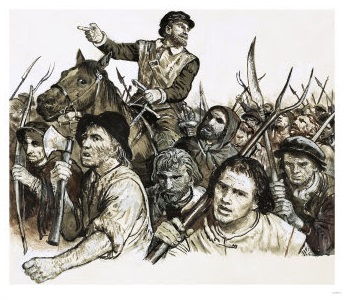
Could America Have a French-Style Revolution?

By Charles Hugh Smith

Source: Of Two Minds

Combine all these factors and the result is a potentially volatile mixture awaiting a catalyst.

In the past, I reckoned the odds of America experiencing a revolution akin to France 1789 were low due to the different political, economic and cultural conditions present then and now, but recently I’ve considered the possibility that America’s extremes of wealth, income and power inequality are a powder keg awaiting ignition.

By French-Style Revolution I don’t mean a violent overthrow of the ruling elite as much as a tumultuous reset of how resources and power are distributed. Systems become vulnerable to such resets when they become highly asymmetrical in how they distribute resources and power, and rigid in their defense of the extreme inequality of the distribution.

The fundamental source of democracy’s stability is the dynamic competition of various interests and the dynamic equilibrium of the three branches of the state each balancing the others by restraining the dominance of any one branch or interest.

But extremes of inequality undermine this stability, as the wealthiest elites now bring such a preponderance of wealth to bear that each of the three branches of the state are now beholden to the interests of the few, leaving little recourse to the many.

When the agenda and narratives have been shaped by the wealthiest elites’ foundations, think tanks, corporate PR and lobbyists, then electing different representatives has little effect on the power structure.

The masses can still influence cultural / social policies by voting in a liberal or conservative slate, but the distribution of wealth, power and resources remains unchanged.

As wealth and power are concentrated into ever fewer hands, the mythology of broad-based access to prosperity has vastly expanded the pool of second-tier elites who feel entitled (via implicit promises made by the system) to their fair share of income, wealth and power–financial security and political agency, i.e. a say in public decisions.

These second-tier elites are primarily university graduates and the offspring of upper-middle class households who have been led to expect a secure slot in the upper reaches of the economy or state is a birthright gained by their education and class.

That there are no longer enough slots for this class means those left out constitute the raw material of a potently dissatisfied and potentially angry political class. Historian Peter Turchin presents this as the result of the overproduction of elites, a dynamic he has traced back to previous eras of tumultuous upheaval.

Another common factor driving the masses to revolt is when the essentials of life are no longer affordable or available in sufficient quantity. Historian David Hackett Fischer has documented the perilous impact of inflation, i.e. the collapse of the purchasing power of wages.

Yet another potentially explosive factor is the supreme confidence of the wealthiest elites that the system they rule could ever turn against them or crumble beneath their feet–in a word, a hubris as extreme as their wealth and power. The resignation of the masses and the ease of distracting them with ginned-up controversies and crises and consumerist novelties has fed elite confidence that their supremacy is unassailable.

This hubris leads to the elite becoming tone-deaf to their own excesses and the instability their excesses are generating within the system, an instability that’s currently hidden beneath the resignation and distraction of the masses and the mute frustration of the second-tier elites facing lifetimes of insecurity.

Another factor is the promises made by the state generations ago can no longer be met without creating new money on a scale that guarantees destabilizing inflation. This new money is issued as Treasury bonds which are purchased for income by the wealthy, further exacerbating wealth and income inequality.

The power elite are incapable of demanding sacrifices of the wealthy as the prime directive of the status quo is to defend the current asymmetry of wealth and power. This undermines the collective consensus needed to take the collective action needed to reset the system.

Combine all these factors and the result is a potentially volatile mixture awaiting a catalyst. The confidence of the status quo that it is essentially omnipotent (the Federal Reserve will always save us, etc.) and eternal is itself a factor in the mix.

The key factor is the rigidity or flexibility of the power structure. If the structure is incapable of resetting to a more flexible, symmetric distribution of power as resources, it will come apart as pressures mount.

I Used To Be Disgusted, Now I’m Disabused

By Charles Hugh Smith

Source: Of Two Minds

It’s certainly possible to be disgusted, but being disabused of the fantasy that the system is self-correcting is the healthier perspective.

I used to be disgusted, now I’m disabused: beneath all the self-serving narratives, fad-memes and over-simplifications regurgitated as serious analysis, these are the core dynamics I see:

1. Imperial corruption of democracy and open markets. I described this in Regardless of Who’s Elected, Imperial Corruption Rules the Nation: the dynamic adaptive churn of unfettered representative democracy and open markets are anathema to insiders, vested interests and elites, each of which has gained asymmetric power by subverting democracy and markets to serve their private interests rather than the public interest / common good–phrases that are meaningless to insiders, vested interests and elites except as simulacra used for PR.

2. The Deep State, the unelected and unaccountable Administrative State. I’ve been discussing the Deep State before it entered common use–for example:

Going to War with the Political Elite You Have (May 14, 2007)

The Dollar and the Deep State (February 24, 2014)

Is the Deep State Fracturing into Disunity? (March 14, 2014)

The Administrative State has existed in some form in every nation-state / empire, but the U.S. Deep State only gained its vast global powers in World War II and the Cold War, where the lesson learned was the public may choose unwisely (for example, choosing appeasement over preparation) and so the really important decisions needed to preserve the nation cannot be left to parochial politicos in elected office–those decisions must be in the hands of those who know what has to be done.

Democracy is the rubber stamp for doing what’s necessary. Beyond that, it’s a potentially fatal hindrance. That’s the mindset of the Deep State, and if you and I were in upper-echelon positions in the Administrative State, we’d agree with this mindset when things get serious.

This mindset is a self-reinforcing group-think feedback loop: those who believe the public should set policy are weeded out, either by self-selection or via being sent to bureaucratic Siberia.

We’re protecting you. That’s all you need to know.

This opens the door to functionaries who came to do good but stayed to do well, i.e. those with the right credentials and connections to enter the Power Circle to “serve the public” but soon become insiders maximizing their own private gains. That’s the problem with the Administrative State: it’s ultimately unaccountable, not just to the public or elected officials but to itself.

3. Vested interests block adaptions that threaten their share of the spoils. Any advance that increases efficiency and productivity and furthers the public good is squelched, suppressed or co-opted by vested interests who rightly fear their share of the spoils might be diminished by advances that obsolete their particular cartel, monopoly or other embedded skim, scam, fraud, embezzlement or simply unproductive dead weight.

The status quo is thus locked into a death spiral as gatekeepers, insiders, vested interests and sold to the highest bidder politicos will protect vested interests even as the engines flood and the ship begins its long descent into the void.

How do otherwise smart people become so blind to what’s going on? They believe the status quo is so wealthy, so powerful, so clever, etc., that it will overcome any obstacles or crises because it’s always done so in the past, and so it is permanent, immutable, forever, and our supping at the trough of free money couldn’t possibly weaken such an enduring Leviathan.

This is the fatal fantasy of every empire. We’re too successful to fail and collapse. But oddly enough, faith in the permanence of success leads to the very collapse that’s deemed “impossible.”

4. Concentrations of wealth, power, capital and production fatally distort the economy and the social order. When “competition” has been reduced to two telecoms, two healthcare insurers, two pork processors, etc., the system has been stripped of adaptability and resilience.

When 10,000 small farmers each have 100 chickens, the stock of 1 million chickens is spread over a wide geography and entrepreneurial network of suppliers, wholesalers, etc. Bird flu may spread widely but it’s far more difficult to wipe out 10,000 small farms’ poultry compared to the ease of bird flu spreading in one giant factory that concentrates 1 million chickens in one facility. Supply chains stripped of network resilience are equally fragile and prone to disruption and collapse.

Concentrating any form of capital, production and power renders the system vulnerable to collapse due to the inherent weaknesses generated by replacing complex networks with vertical-integration under the control of a few cartels, monopolies, autocrats, gatekeepers or regulators–the latter two being easily influenced by political pressure and/or private gain.

It’s certainly possible to be disgusted, but being disabused of the fantasy that the system is self-correcting is the healthier perspective. Everything is forever until systemic weaknesses reveal themselves, typically at the most inopportune junctures.

Without admitting it, we are already converted to transhumanism

On October 18, 2019, i.e. before the alert was issued against Covid-19, a few personalities participated in a role-playing game simulating this epidemic. This event was funded by the Bill & Melinda Gates Foundation.

By Thierry Meyssan

Source: Voltairenet.org

The world is changing very fast. During the Covid epidemic, money has been concentrated in a few hands. The new oligarchs are transhumanists. Without realising it, we have already accepted their ideology and are beginning to put it into practice. Western doctors have given up trying to cure this disease and it seems obvious to us to bet everything on messenger RNA. It does not matter that this strategy is fatal. Henceforth, this is how we think.

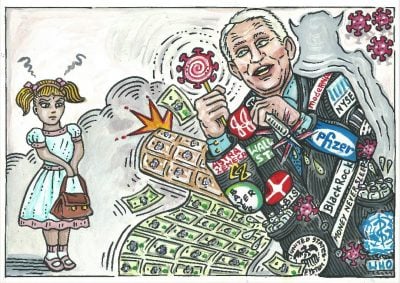
The containment, due to the political reaction to Covid-19, favoured a global redistribution of wealth in favour of a few Internet players (Microsoft, Alphabet…). At the same time, investment funds (Vanguard, Blackrock, etc.), which were already managing astronomical sums and could impose their interests on states, became the property of a few families. There are now stratospheric wealth gaps between a few super-billionaires and the people.

The middle classes, which had been slowly eroding since the fall of the USSR and the beginning of economic globalisation, are gradually disappearing. In practice, democratic systems cannot withstand these sudden and gigantic wealth gaps.

As always in periods of change in political systems, the social class that aspires to power imposes its point of view. In this case, transhumanism. The idea that scientific progress will enable a transformation of human biology to the point of overcoming death. Almost all of the world’s fifty largest fortunes seem to subscribe to this fantasy. For them, technology will replace many people in the same way that science has replaced superstition.

In order to impose their new Doxa, these very large fortunes are starting to control what we think and to force us to act according to this new ideology. The most recent phenomenon is precisely our reaction to the Covid-19 pandemic. Historically, in all previous epidemics without exception, doctors sought to cure the sick. That was the old world. In the new transhumanist world, no one is to be cured, all are to be protected with a new technology, messenger RNA. Most developed states forbid their doctors to treat their patients and their pharmacists to sell drugs that might help them (hydroxychloroquine, ivermectin, etc.). A leading medical journal, The Lancet, even published an article claiming that an old drug used by millions of people was killing Covid patients who took it. The Internet giants censor accounts that promote it. Everything must be done to make messenger RNA the one and only option.

I am not a doctor. I don’t know what these products are worth. I’m just a man who observes the way in which a debate is closed before it has begun. I am not interfering in the scientific debate, but I am observing the closure of the debate.

The messenger RNA case against doctors is not over, however. President Joe Biden held a virtual global summit on September 22, 2021 to distribute 500 million packets of messenger RNA ’vaccine’. To everyone’s surprise, the states that were to be the recipients of this gift boycotted the summit. They do not believe that messenger RNA is a solution for them [1].

To understand them, all you need is a calculator: the states that went all in on messenger RNA had 20 to 25 times more deaths per million population than those that allowed care by doctors.

Transhumanism already fascinates us because we don’t ask about the ban on Covid care. It does not have the same influence outside the West.

In the past, vaccination consisted of inoculating a small portion of a disease so that the body learns to defend itself against it. Since Covid-19, messenger RNA has been equated with vaccination, yet it is not a vaccine in the classical sense.

PROPAGANDA

History has shown us that in order to impose a new regime, you must first get people to act in accordance with a new ideology. Once the subjects have started to comply, it becomes very difficult for them to back down. The game is up. This is called propaganda. Propaganda is not about controlling discourse, but about using it to change behaviour [2].

As we have all given up on experimenting with Covid care, we have all signed up to messenger RNA and now the health pass. We are ripe to enter this new regime. It is absurd to call it a “dictatorship”; an old world concept. We do not yet know what this new regime will be, yet we are already building it.

States are threatened by the very large fortunes mentioned above, which are generally much more powerful than they are. States have mainly fixed costs and very little room for manoeuvre. On the contrary, the new very large fortunes can withdraw their investments here at any time and take them there. Very few Sovereign Wealth Funds can compete with them and thus still be independent of them.

The corporate media refuse to question the ban on care for Covid-19. They devote all their energy to promoting messenger RNA.

THE CORPORATE MEDIA

The corporate media have been very active in this project. For a long time, but especially since the end of the Cold War, journalism has defined itself as a search for ’objectivity’, even though it is known to be impossible.

In court, witnesses are not asked to be ’objective’. But they are required to “tell the Truth, the whole Truth and nothing but the Truth”. It is known that each person has only perceived a part of the Truth according to his or her own condition. Thus, in an accident involving a pedestrian and a car, most of the pedestrian witnesses agree with the pedestrian, while most of the motorist witnesses say that the car was in the right. It is only the sum of the evidence that tells us what happened.

The corporate media reacted to the influx of new actors into their profession (blogs and social networks) first by trying to disqualify them: these people are touching, but they are not trained enough to compare themselves to us. Professional journalists have made a distinction between freedom of expression (for all) and freedom of the press (for them alone). One thing leading to another, they have set themselves up as schoolmasters, the only ones capable of giving good and bad marks to those who try to imitate them. To do this, they imagined that they would check their assertions (fact check) as if their work were comparable to a television game show.

Worried that politicians would side with their constituents rather than the very rich, the corporate media have extended fact checking to their political guests. There are countless programmes where a leader is subjected to editorial fact-checking. Political discourse, which should be an analysis of society’s problems and how to solve them, is reduced to a series of figures that can be checked against statistical yearbooks.

The corporate media have asserted themselves first as a ’Fourth Estate’ and then, after absorbing the others, as the main Estate. This notion comes from the 18th century British politician and philosopher, Edmund Burke. The ’Fourth Estate’ was constituted alongside the Spiritual, the Temporal and the Commons (the simple people). Burke, in the name of his liberal conservatism, did not dispute its legitimacy. Today everyone can see that it is not based on a value, but on the money of its owners.

The choice of subjects covered by the corporate media is constantly shrinking. It is slowly moving away from analysis and concentrating on verifiable data only.

Twenty years ago, for example, newspapers that challenged my work would present it summarily and then immediately disqualify it as ’conspiratorial’. Today, they no longer dare to summarise my theses, because they have no way of ’fact-checking’ them. So they just classify me as ’unreliable’. Faced with younger, non-professional journalists, the corporate media limit themselves to insults. As a result, there is a growing gap between them.

This phenomenon is particularly evident with the ’yellow vests’, ordinary citizens who were protesting against this sociological evolution of the world even before containment allowed it to triumph. I remember a debate on a 24-hour news channel where a member of parliament asked a yellow vest what allowance would satisfy the protesters, while the yellow vest replied, “We don’t need allowances, we want a fairer system.” The corporate media quickly removed individuals who, like this lady, were thinking about the problems of society and replaced them with others who were making concrete and immediate demands. They did everything to censor their thinking.

In the past, the Church published a list of books that were forbidden to the faithful. Today, on the contrary, they try to publish a list of reliable sources, even to determine a priori the Truth.

GOOD AND BAD GRADES

Another solution envisaged by the new ruling elite is to re-establish the Index librorum prohibitorum. In the past, the Church – which was not only a community of believers but also a political power – published a list of books that were censored for all but its clerics. It wanted to protect the People from the errors and lies of the protesters. This only lasted for a while. In the backlash, the believers deprived the Church of its political power.

Former Nato and Bush Administration officials set up a New York-based company, NewsGuard, to compile a list of unreliable websites (including ours) [3]. Or NATO, the European Union, Bill Gates and a few others have created CrossCheck, which finances, among other things, Les Décodeurs du Monde [4]. It seems that the exponential multiplication of information sources has ruined this project.

A more recent method consists in defining a priori, not who is reliable, but what the Truth is.

The French president, Emmanuel Macron, has just set up a “Mission against disinformation and conspiracy”, its president, the sociologist Gérald Bronner, considers that the State should set up a body to establish the Truth on the basis of “scientific consensus”. He considers it unacceptable that the word of “a university professor is equivalent to that of a yellow vest” [5].

This method is not new. In the 17th century, Galileo claimed that the Earth revolved around the Sun and not the other way round. Gérald Bronner’s predecessors opposed him with various passages from the Holy Scriptures, which were then considered a revealed source of knowledge. Then the ’scientific consensus’ led to his condemnation by the Church.

The history of science is full of examples of this type: almost all the great discoverers were opposed by the ’scientific consensus’ of their time. Most of the time their ideas were not able to triumph with demonstrations, but with the death of their opponents: the leaders of the “scientific consensus”.

Translation:
Roger Lagassé

The Fear Pandemic and the Crisis of Capitalism. Sleepwalking Towards A Global Economic Crisis?

By Colin Todhunter

Source: Global Research

In October 2019, in a speech at an International Monetary Fund conference, former Bank of England governor Mervyn King warned that the world was sleepwalking towards a fresh economic and financial crisis that would have devastating consequences for what he called the “democratic market system”.

According to King, the global economy was stuck in a low growth trap and recovery from the crisis of 2008 was weaker than that after the Great Depression. He concluded that it was time for the Federal Reserve and other central banks to begin talks behind closed doors with politicians.

In the repurchase agreement (repo) market, interest rates soared on 16 September. The Federal Reserve stepped in by intervening to the tune of $75 billion per day over four days, a sum not seen since the 2008 crisis.

At that time, according to Fabio Vighi, professor of critical theory at Cardiff University, the Fed began an emergency monetary programme that saw hundreds of billions of dollars per week pumped into Wall Street.

Over the last 18 months or so, under the guise of a ‘pandemic’, we have seen economies closed down, small businesses being crushed, workers being made unemployed and people’s rights being destroyed. Lockdowns and restrictions have facilitated this process. The purpose of these so-called ‘public health measures’ has little to do with public health and much to do with managing a crisis of capitalism and ultimately the restructuring of the economy.

Neoliberalism has squeezed workers income and benefits, offshored key sectors of economies and has used every tool at its disposal to maintain demand and create financial Ponzi schemes in which the rich can still invest in and profit from. The bailouts to the banking sector following the 2008 crash provided only temporary respite. The crash returned with a much bigger bang pre-Covid along with multi-billion-dollar bailouts.

The dystopian ‘great reset’ that we are currently witnessing is a response to this crisis. This reset envisages a transformation of capitalism.

Fabio Vighi sheds light on the role of the ‘pandemic’ in all of this:

“… some may have started wondering why the usually unscrupulous ruling elites decided to freeze the global profit-making machine in the face of a pathogen that targets almost exclusively the unproductive (over 80s).”

Vighi describes how, in pre-Covid times, the world economy was on the verge of another colossal meltdown and chronicles how the Swiss Bank of International Settlements, BlackRock (the world’s most powerful investment fund), G7 central bankers and others worked to avert a massive impending financial meltdown.

The world economy was suffocating under an unsustainable mountain of debt. Many companies could not generate enough profit to cover interest payments on their own debts and were staying afloat only by taking on new loans. Falling turnover, squeezed margins, limited cashflows and highly leveraged balance sheets were rising everywhere.

Lockdowns and the global suspension of economic transactions were intended to allow the Fed to flood the ailing financial markets (under the guise of COVID) with freshly printed money while shutting down the real economy to avoid hyperinflation.

Vighi says:

“… the stock market did not collapse (in March 2020) because lockdowns had to be imposed; rather, lockdowns had to be imposed because financial markets were collapsing. With lockdowns came the suspension of business transactions, which drained the demand for credit and stopped the contagion. In other words, restructuring the financial architecture through extraordinary monetary policy was contingent on the economy’s engine being turned off.”

It all amounted to a multi-trillion bailout for Wall Street under the guise of COVID ‘relief’ followed by an ongoing plan to fundamentally restructure capitalism that involves smaller enterprises being driven to bankruptcy or bought up by monopolies and global chains, thereby ensuring continued viable profits for these predatory corporations, and the eradication of millions of jobs resulting from lockdowns and accelerated automation.

Author and journalist Matt Taibbi noted in 2020:

“It retains all the cruelties of the free market for those who live and work in the real world, but turns the paper economy into a state protectorate, surrounded by a kind of Trumpian Money Wall that is designed to keep the investor class safe from fear of loss. This financial economy is a fantasy casino, where the winnings are real but free chips cover the losses. For a rarefied segment of society, failure is being written out of the capitalist bargain.”

The World Economic Forum says that by 2030 the public will ‘rent’ everything they require. This means undermining the right of ownership (or possibly seizing personal assets) and restricting consumer choice underpinned by the rhetoric of reducing public debt or ‘sustainable consumption’, which will be used to legitimise impending austerity as a result of the economic meltdown. Ordinary people will foot the bill for the ‘COVID relief’ packages.

If the financial bailouts do not go according to plan, we could see further lockdowns imposed, perhaps justified under the pretext of  ‘the virus’ but also ‘climate emergency’.

It is not only Big Finance that has been saved. A previously ailing pharmaceuticals industry has also received a massive bailout (public funds to develop and purchase the vaccines) and lifeline thanks to the money-making COVID jabs.

The lockdowns and restrictions we have seen since March 2020 have helped boost the bottom line of global chains and the e-commerce giants as well and have cemented their dominance. At the same time, fundamental rights have been eradicated under COVID government measures.

Capitalism and labour

Essential to this ‘new normal’ is the compulsion to remove individual liberties and personal freedoms. A significant part of the working class has long been deemed ‘surplus to requirements’ – such people were sacrificed on the altar of neo-liberalism. They lost their jobs due to automation and offshoring. Since then, this section of the population has had to rely on meagre state welfare and run-down public services or, if ‘lucky’, insecure low-paid service sector jobs.

What we saw following the 2008 crash was ordinary people being pushed further to the edge. After a decade of ‘austerity’ in the UK – a neoliberal assault on the living conditions of ordinary people carried out under the guise of reining in public debt following the bank bail outs – a leading UN poverty expert compared Conservative welfare policies to the creation of 19th-century workhouses and warned that, unless austerity is ended, the UK’s poorest people face lives that are “solitary, poor, nasty, brutish, and short”.

Philip Alston, the UN rapporteur on extreme poverty, accused ministers of being in a state of denial about the impact of policies. He accused them of the “systematic immiseration of a significant part of the British population”.

In another 2019 report, the Institute for Public Policy Research think tank laid the blame for more than 130,000 deaths in the UK since 2012 at the door of government policies. It claimed that these deaths could have been prevented if improvements in public health policy had not stalled as a direct result of austerity cuts.

Over the past 10 years in the UK, according to the Trussell Group, there has been rising food poverty and increasing reliance on food banks.

And in a damning report on poverty in the UK by Professor David Gordon of the University of Bristol, it was found that almost 18 million cannot afford adequate housing conditions, 12 million are too poor to engage in common social activities, one in three cannot afford to heat their homes adequately in winter and four million children and adults are not properly fed (Britain’s population is estimated at around 66 million).

Moreover, a 2015 report by the New Policy Institute noted that the total number of people in poverty in the UK had increased by 800,000, from 13.2 to 14.0 million in just two to three years.

Meanwhile, The Equality Trust in 2018 reported that the ‘austerity’ years were anything but austere for the richest 1,000 people in the UK. They had increased their wealth by £66 billion in one year alone (2017-2018), by £274 billion in five years (2013-2018) and had increased their total wealth to £724 billion – significantly more than the poorest 40% of households combined (£567 billion).

Just some of the cruelties of the ‘free market’ for those who live and work in the real world. And all of this hardship prior to lockdowns that have subsequently devastated lives, livelihoods and health, with cancer diagnoses and treatments and other conditions having been neglected due to the shutdown of health services.

During the current economic crisis, what we are seeing is many millions around the world being robbed of their livelihoods. With AI and advanced automation of production, distribution and service provision on the immediate horizon, a mass labour force will no longer be required.

It raises fundamental questions about the need for and the future of mass education, welfare and healthcare provision and systems that have traditionally served to reproduce and maintain labour that capitalist economic activity has required.

As the economic is restructured, labour’s relationship to capital is being transformed. If work is a condition of the existence of the labouring classes, then, in the eyes of capitalists, why maintain a pool of (surplus) labour that is no longer needed?

A concentration of wealth power and ownership is taking place as a result of COVID-related policies: according to research by Oxfam, the world’s billionaires gained $3.9 trillion while working people lost $3.7 trillion in 2020. At the same time, as large sections of the population head into a state of permanent unemployment, the rulers are weary of mass dissent and resistance. We are witnessing an emerging biosecurity surveillance state designed to curtail liberties ranging from freedom of movement and assembly to political protest and free speech.

The global implications are immense too. Barely a month into the COVID agenda, the IMF and World Bank were already facing a deluge of aid requests from developing countries that were asking for bailouts and loans. Ideal cover for rebooting the global economy via a massive debt crisis and the subsequent privatisation of national assets.

In 2020, World Bank Group President David Malpass stated that poorer countries will be ‘helped’ to get back on their feet after the various lockdowns but such ‘help’ would be on condition that neoliberal reforms become further embedded. In other words, the de facto privatisation of states (affecting all nations, rich and poor alike), the (complete) erosion of national sovereignty and dollar-denominated debt leading to a further strengthening of US leverage and power.

In a system of top-down surveillance capitalism with an increasing section of the population deemed ‘unproductive’ and ‘useless eaters’, notions of individualism, liberal democracy and the ideology of free choice and consumerism are regarded by the elite as ‘unnecessary luxuries’ along with political and civil rights and freedoms.

We need only look at the ongoing tyranny in Australia to see where other countries could be heading. How quickly Australia was transformed from a ‘liberal democracy’ to a brutal totalitarian police state of endless lockdowns where gathering and protests are not to be tolerated.

Being beaten and thrown to the ground and fired at with rubber bullets in the name of protecting health makes as much sense as devastating entire societies through socially and economically destructive lockdowns to ‘save lives’.

It makes as much sense as mask-wearing and social-distancing mandates unsupported by science, misused and flawed PCR tests, perfectly healthy people being labelled as ‘cases’, deliberately inflated COVID death figures, pushing dangerous experimental vaccines in the name of health, ramping up fear, relying on Neil Ferguson’s bogus modelling, censoring debate about any of this and the WHO declaring a worldwide ‘pandemic’ based on a very low number of global ‘cases’ back in early 2020 (44,279 ‘cases’ and 1,440 supposed COVID deaths outside China out of a population of 6.4 billion).

There is little if any logic to this. But of course, If we view what is happening in terms of a crisis of capitalism, it might begin to make a lot more sense.

The austerity measures that followed the 2008 crash were bad enough for ordinary people who were still reeling from the impacts when the first lockdown was imposed.

The authorities are aware that deeper, harsher impacts as well as much more wide-ranging changes will be experienced this time around and seem adamant that the masses must become more tightly controlled and conditioned to their coming servitude.

Which Is Worse, the Tech Giant Censors or the Stuff You Want Censored?

By David Swanson

Source: War is a Crime

The communications system we live in is highly complex, mostly driven by greed and profit, in part semi-public, full of filth I know we’d be better off without, and increasingly openly censored and monitored by defenders of accepted good thinking.

Fascist nutcases are spreading dangerous nonsense, while billionaire monopolists are virtually disappearing critics and protesters. It’s easy to get confused about what ought to be done. It’s difficult to find any recommendation that isn’t confused. Different people want different outrages censored and censored by different entities; what they all have in common is a failure to think through the threats they are creating to the things they don’t want censored.

A 1975 Canadian government commission recommended censoring “libel, obscenity, breach of the Official Secrets Act, matters affecting the defense of Canada, treason, sedition, or promulgating information that leads to incitement of crime or violence.” This is a typical muddle. Half of those things were almost certainly already banned, as suggested by their identification through legal terminology. A few of those things probably should be banned, such as incitement of violence (though not promulgating information that “leads” to incitement of any crime or violence). Of course I would include as incitement of violence a speech by the Prime Minister advocating the shipping of Canadian “Peace Keepers” to Africa, but the Prime Minister (who would have more say than I) would no doubt have just identified me as commenting on a matter affecting the defense of Canada — plus, if he or she were in the mood, I’ve probably just promulgated something that will lead to inciting some crime or other, even if it’s just the crime of more people speaking on matters affecting the “defense” of Canada. (And it shouldn’t matter that I’m not Canadian, since Julian Assange is not from the United States.)

Well, what’s the solution? A simplistic and surprisingly popular one is to blame philosophers. Those idiot postmodernists said there was no such thing as truth, which allowed that great student of philosophy Donald Trump to declare news about him “fake” — which he never could have thought of doing without a bunch of leftist academics inspiring him; and the endless blatant lies about wars and economies and environmental collapse and straight-faced reporting of campaign promises can’t have anything at all to do with the ease people have in distrusting news reporting. So, now we need to swing the pendulum back in the direction of tattooing the Ten Commandments on our foreheads before morality perishes at the hands of the monster relativism. We can’t do that without censoring the numbskulls, regrettably of course.

This line of thinking is dependent on failing to appreciate the point of postmodern criticism. That the greater level of consensus that exists on chemistry or physics as opposed to on what should be banned as “obscenity” is a matter of degree, not of essential or metaphysical substance, is an interesting point for philosophy students, and a correct one, but not a guide to life for politicians or school teachers. That there is no possible basis for declaring some law of physics permanent and incapable of being replaced by a better one is not a reason for treating a law of physics as a matter of opinion or susceptible to alteration via fairy dust. If Isaac Newton not being God, and God also not being God, disturbs you and you’re mad at philosophers for saying it, you should notice what follows from it: the need for everyone to support your right to try to persuade them of their error. And what does not follow from it: the elimination of chemistry or physics because some nitwit claims he can fly or kill a hurricane with his gun. If that idiot has 100,000 followers on social media, your concern is not with philosophy but with stupidity.

The tech-giant censors’ concern is — in part — also with stupidity, but it’s not clear they have the tools to address it. For one thing, they just cannot help themselves. They have other concerns too. They are concerned with their profits. They are concerned with any challenges to power — their power and the power of those who empower them. They are concerned, therefore, with the demands and national bigotry of national governments. They are concerned — whether they know it or not — with creative thinking. Every time they censor an idea they believe crazy, they risk censoring one of those ideas that proves superior to existing ones. Their combination of interests appears to be self-defeating. Rather than persuade people of the benefits of their censorship, they persuade more and more people of the rightness of what was censored and of the arbitrary power-interests of those doing the censoring.

Our problem is not too many voices on the internet. It is too much concentration of wealth and power in too few media outlets that are too narrowly restricted to too few voices, relegating other voices to marginal and ghettoized corners of the internet. Nobody gets to find out they’re mistaken through respectful discourse. Nobody gets to show someone else they’re right. We need to prioritize that sort of exchange, before a flood of misguided good intentions drowns us all.

The “promulgating information that leads to incitement of crime or violence” bit of that proposed law seems to have had a surprisingly good intention, namely benevolent parental concern with all the “action-filled” (violence-filled) children’s entertainment on television, the violence-normalizing enter/info-tainment programming for all ages that studies and commonsense suggest increase violence. But can we ban all that garbage, or do we have to empower people who actually give a damn to produce and select programming, and empower families to turn it all off, and schools to be more engaging than cartoons?

The difficulty of censoring such content should be clear from the fact that discussions of it tend to stray into numerous unrelated topics, including the supposed need to censor wars for the protection of, not children, but weapons dealers. Once you allow a corporation to censor damaging news — poof! — there go all negative reports on its products. Once you tell it to put warning labels over recommendations to drink bleach as medicine, it starts putting warning labels on anything related to climate collapse or originating outside the United States of Goddamn Righteousness. You can imagine whether that ends up helping or hurting the supposed target, stupidity.

Censoring news, and labeling news as “factual,” seems to me a cheap fix that doesn’t fix. It’s a bit like legalizing bribery and gerrymandering and limited ballot access and corporate airwaves domination and then declaring that you’ll institute term limits so that every rotten candidate has to be quickly replaced by an even more rotten one. It’s a lovely sounding solution until you try it. Look at the “fact-checker” sections of corporate media outlets. They’re as wrong and inconsistent as any other sections; they’re just labeled differently.

The solutions that will work are not easy, and I’m no expert on them, but they’re not new or mysterious either. We should democratize and legitimize government. We should use government to break up media monopolies. We should publicly and privately facilitate and support numerous independent media outlets. We should invest in publicly funded but independent media dedicated to allowing a wide range of people to discuss issues without the overarching control of the profit interest or the immediate interests of the government.

We should not be simplistic about banning or allowing censorship, but highly wary of opening up any new types of censorship and imagining they won’t be abused. We should stick to what is already illegal outside of communications (such as violence) and censor communications only when it is actually directly a part of those crimes (such as instigating particular violence). We should be open to some limits on the forces empowered by our choice through our public dollars to shape our communications; I’d be happy to ban militaries from having any role in producing movies and video games (if they’re going to bomb children in the name of “democracy,” well, then, that’s my vote for the use of my dollars).

At the same time, we need — through schools and outside of them — radically better education that includes education in the skills of media consumption, BS-spotting, propaganda deciphering, fact-verification, respect, civility, decency, and honesty. I hardly think it’s entirely the fault of youtube that kids get less of their education from their classrooms — part of the fault lies with the classrooms. But I hardly think the eternal project of learning, and of learning how to learn, can be restricted to classrooms.

Is Inflation “Transitory”? Here’s Your Simple Test

By Charles Hugh Smith

Source: Of Two Minds

Is inflation “transitory” in your household budget? Really? Where?

The Federal Reserve has been bleating that inflation is “transitory”–but what about the real world that we live in, as opposed to the abstract funhouse of rigged statistics? Here’s a simple test to help you decide if inflation is “transitory” in the real world.

Let’s start with some simple stipulations: price is price, there are no tricks like hedonics or substitution. Nobody cares if the truck stereo is better than it was 40 years ago, the price of the truck is the price we pay today, and that’s all that matters.

(Funny, the funhouse statistical adjustments never consider that appliances that used to last 30 years now break down and are junked after 3 years–if we adjusted for that, the $500 washer would be tagged at $5,000 today because it has lost 90% of its durability over the past 30 years.)

Second, inflation must be weighted to “big ticket” nondiscretionary items. The funhouse statistical trickery counts a $10 drop in the price of a TV (which you buy every few years at best) as equal to a $100 rise in childcare, which you pay monthly. No, no, no: a 10% rise in rent, healthcare insurance and childcare is $400 a month or roughly $5,000 a year. A 10% decline in a TV you buy every three years is $50. Even a 50% drop in the price of a TV ($250) is $83 per year–absolutely trivial, absolutely meaningless compared to $5,000 in higher big-ticket expenses.

You can forego the new TV but not the rent, childcare or healthcare. That’s the difference between “big ticket” nondiscretionary and discretionary (meals out, 3rd TV, etc.).

Third, we jettison the painfully obvious manipulation of “owners equivalent rent” for housing costs. Housing costs are the prices we pay for rent, owning a home and paying property taxes, insurance and maintenance costs to own the home. (Have you priced having a new roof put on your house by a licensed, reputable contractor? No? Well, it’s become a lot more expensive than it was a few years ago. Where is that enormous price leap in “owners equivalent rent”? Just how stupid does the Fed reckon we are?)

OK, here’s the test: let’s say markets finally take a deflationary dive from overvalued heights. Housing, stocks and other risk assets fall 30%. Trillions of dollars in “wealth” (that didn’t exist prior to the Everything Bubble inflating) has vanished, generating a reverse wealth effect as all the owners of these assets feel poorer and less inclined to borrow and spend. This is classically considered highly deflationary: demand drops, prices drop.

The three billionaires who own more assets than the bottom 50% of Americans (165 million Americans) will be crying, but how does life change for the 165 million Americans who own a vanishingly thin slice of these assets? Does their rent drop? No, for the reasons I explained in The Fed Is Wrong: Inflation Is Sticky: the big corporate landlords have to keep rents high to placate their lenders. (And let’s not forget greed: the greedy never want to lower prices, preferring to cling to the Fed’s fantasy of “transitory” trouble.)

Now let’s ask about the higher-income 150 million Americans who own homes and pay property taxes, who pay healthcare insurance, college tuition and fees, childcare and elderly care. Even if there is a deflationary crash in stocks and housing, what are the odds the overall costs of owning and maintaining your home will drop significantly?

What are the odds that local government will let property taxes drop with valuations? Shall we be honest and say zero? If real estate valuations plummet, then property tax rates will rise to compensate. Or other “creative” fees will be imposed to make up the shortfall in tax revenues.

What about childcare? What are the odds that childcare costs will drop 30%? Shall we be honest and say zero? The costs paid by childcare providers only go up, and so those who don’t charge enough (marginal providers) will close down, generating a shortage of supply that elevates prices.

What about elderly care? Will assisted living facilities suddenly drop 30% just because asset bubbles pop? No. The costs of assisted living march higher regardless of what asset valuations and interest rates do.

What about healthcare? Will all those costs drop 30% because assets declined? No. Everyone exposed to real-world pricing of healthcare will be paying more.

But what about the roofing contractor? Won’t they charge 30% less? The biggest expenses for the contractor are workers compensation insurance, liability insurance, disability insurance, FICA (Social Security and Medicare) and healthcare insurance, and none of those will drop a single dollar even if stocks drop 30%.

Just as 85% of local government expenses are labor-related, most of the expenses of the roofing contractor are labor-related. The roofing materials dropping a few bucks might lower the cost by a few percentage points, but the material costs are based on the costs of the manufacturers, distributors, truckers, etc., and these are also based on labor-related expenses, taxes, insurance and healthcare–none of which will drop a dime, regardless of what asset prices do.

Economist Michael Spence elucidated the difference between tradable and untradable goods and services. If you want your washer repaired, that service in untradable, as shipping your broken washer to China for repair is not financially viable. As labor costs rise in China and other offshore economies, that raises costs even for tradable goods.

The majority of essential services are untradable and the costs are dependent on “big ticket” expenses which cannot go down without imploding the economy and government: taxes, insurance, healthcare, childcare, elderly care, etc. cannot drop 30% because they’re based on labor costs, highly profitable systemic friction (Big Pharma, the Higher Education Cartel, Big Ag, healthcare and other quasi-monopolies) and the need for ever-higher tax revenues to provide services which the public demands.

Let’s also ponder the consequences of the extreme concentration of wealth and income in the top 5% of U.S. households. The top 10% own roughly 85% of all wealth, and the top 1% own more than half the financial wealth.

Any significant drop in financial assets will have almost no effect on the bottom 90% because they don’t own enough of these assets to be consequential. So the deflationary effect of the reverse wealth effect will be concentrated in the discretionary spending of the top 10%: the luxury imported vehicles, the $100 per plate dinners (those $60 bottles of wine add up), the $500/day resort vacation, the $2,500/week AirBnB rental, etc.

The declines in the cost of these discretionary luxuries may well be noteworthy, but there are thresholds below which prices cannot drop. The high-end restaurant has equally high-end expenses, and so marginal providers will close, leaving only those few who can maintain profitability as demand for luxury dining craters.

The resort has high expenses as well, and once profitability has been lost, resorts will close just like other marginal providers. Supply shrinks along with demand, and the survivors keep prices high enough or they too will close.

So the essential “big ticket” costs will keep rising and the discretionary luxuries only the top 10% can afford will drop–but not by much as all those luxury providers have the same high fixed costs.

So to recap the test: what are the odds of these “big ticket” expenses dropping 30% if asset prices drop 30%?

Taxes: zero.

Healthcare: zero.

Childcare: zero.

Elderly care: zero.

Costs of doing business: zero.

As for housing: the mortgage doesn’t drop if the market value of the house drops 30%, and any declines in insurance will be modest. The costs of maintenance won’t drop much, either, and might actually increase as the supply of skilled workers declines. (Nothing is more expensive than the “cheap” repair that has to be redone correctly.)

Rents may drop in areas nobody wants to live anymore, but rents will rise in places people do want to live.

The larger point here is the long economic cycles have turned. The 40-year decline in interest rates has turned, whether we admit it or not. The 40-year decline in the prices of goods due to financialization (lower interest rates, higher speculative assets) and globalization has turned. The 40-year expansion of the workforce has turned. The 40-year decline of oil/fuel/resources prices has turned. The 40-year fantasy that we can depend on other nations for our essential resources and components is drawing to a close.

Untradable goods and services, cost thresholds, resource security, the end of financialization / globalization and declining interest rates matter. The fantasy that the top 10% can prop up the economy by borrowing and spending the phantom wealth of insanely overvalued asset bubbles is drawing to a close.

Is inflation “transitory” in your household budget? Really? Where?

America’s Fatal Synergies

By Charles Hugh Smith

Source: Of Two Minds

America’s financial system and state are themselves the problems, yet neither system is capable of recognizing this or unwinding their fatal synergies.

why do some systems/states emerge from crises stronger while similar systems/states collapse? Put another way: take two very similar political-social-economic systems/nation-states and two very similar crises, and why does one system not just survive but emerge better adapted while the other system/state fails?

The answer lies in what author Geoffrey Parker termed Fatal Synergies and Benign Synergies in his book Global Crisis: War, Climate Change, & Catastrophe in the Seventeenth Century. Synergy results from “interactions that produce a combined effect greater than the sum of their separate effects.” In other words, 2 + 2 + 2 + 2 = 8 is linear, while synergy is 2 X 2 X 2 X 2 = 16.

Given that the core function of states is the distribution of resources, capital and agencywe can distill the difference between Fatal Synergies and Benign Synergies into two questions:

1. What problems cannot be resolved by the financial system/state, no matter how many reforms are thrown at them?

2. Which groups have a meaningful voice in decision-making / governance and which groups are effectively voiceless / powerless?

The first question identifies the structural weak points in the system. These weak points could have any number of sources: they could be perverse incentives embedded in the system, elites caught up in their own enrichment, or even a willful blindness to the nature of the crisis threatening the system.

Here’s an example in the U.S. system: corporations reap $2.4 trillion in profits annually, roughly 15% of the nation’s entire output. Politicians need millions of dollars in campaign contributions to win elections. Those seeking political influence have not just billions but tens of billions. Those needing to distribute political favors will do so for mere millions.

Testing Theories of American Politics: Elites, Interest Groups, and Average Citizens:

“I’d say that contrary to what decades of political science research might lead you to believe, ordinary citizens have virtually no influence over what their government does in the United States. And economic elites and interest groups, especially those representing business, have a substantial degree of influence. Government policy-making over the last few decades reflects the preferences of those groups — of economic elites and of organized interests.”

This asymmetry cannot be overcome. Indeed, the past 40 years have witnessed an increasing concentration of wealth and power in corporations and their lobbyists and a decline of political influence of the masses to near-zero. Every reform has failed to slow this momentum, which is constructed of incentives to maximize profits, gain political favors and win elections.

In a similar fashion, the Imperial Presidency has gained power at the expense of Congress for decades–a reality that scholars bemoan but the reforms allowed by the system are unable to stop. So we have endless wars of choice without a declaration of war by Congress, one of the core powers of the elected body.

An analogy to these systemic weak points is the synergies of an organism’s essential organs: if any one organ fails, the organism dies even though the other organs are working just fine. In other words, any system is only as robust as its weakest essential component/process.

Whatever problems the system is incapable of resolving have the potential to bring down the system once they interact synergistically.

The second question identifies how many groups have been suppressed, silenced or ignored by those at the top of the heap. If these groups have an essential role in the system as producers, consumers and taxpayers, their demand to have a say in decisions that directly affect them is natural.

Another group with understandable frustrations at being left out of the decision-making are those in the educated upper classes whose expectations of roles in the top tier were encouraged by their families, society and training. When these expectations are not met because there are no longer enough slots in the top tier for the rapidly proliferating upper classes, the group left out in the cold has the time, education and motivation to demand a voice.

In other words, those denied access to resources, capital and agency who felt entitled to this access will not be as easily silenced as those who accept their low status and restricted access to resources, capital and agency as “the natural order of things.”

All the groups that are denied a voice and access to resources, capital and agency are in effect a sealed pressure cooker atop a flame. The pressure builds and builds without any apparent consequence until it explodes.

The more that power is concentrated in the hands of the few, the greater the desperation of the groups who are locked out of power. As their desperation rises, some of these groups are willing to go to whatever lengths are necessary to effect change.

The process of explosive demands for change erupting is difficult to manage once released. The system’s essential subsystems may be destabilized–the equivalent of organ failure–and once destabilized, it’s often no longer possible to restore the previous stability.

In this environment, the common good falls by the wayside and the system collapses.

In the context I’ve laid out, Fatal Synergies arise when access to resources, capital and agency are limited by elite hoarding or massive declines in available resources and capital.

Beneficial Synergies arise when whatever resources and capital are available are shared, if not equitably, at least in a process in which every group affected by the distribution has a voice in public decision-making.

Fatal Synergies arise when the identity of each group is based not on shared values and cooperation but on unyielding resistance to competing claims on the nation’s wealth and income.

Beneficial Synergies arise when all groups have a voice and a say in the process of distribution, even if it is limited.

Crises reveal the problems the system is incapable of resolving. How we respond to those constraints and weak points is the difference between Fatal Synergies and collapse and Beneficial Synergies that generate successful evolutionary responses to pressing selective pressures: simply put, “adapt or die.”

America’s financial system and state are themselves the problems, yet neither system is capable of recognizing this or unwinding their fatal synergies.