The USA Is Now a 3rd World Nation

By Charles Hugh Smith

Source: Of Two Minds

I know it hurts, but the reality is painfully obvious: the USA is now a 3rd World nation.

Dividing the Earth’s nations into 1st, 2nd and 3rd world has fallen out of favor; apparently it offended sensibilities. It has been replaced by the politically correctdeveloped and developing nations, a terminology which suggests all developing nations are on the pathway to developed-nation status.

What’s been lost in jettisoning the 1st, 2nd and 3rd world categories is the distinction between developing (2nd world) and dysfunctional states (3rd world), states we now label “failed states.”

But 3rd World implied something quite different from “failed state”: failed state refers to a failed government of a nation-state, i.e. a government which no longer fulfills the minimum duties of a functional state: basic security, rule of law, etc.

3rd World referred to a nation-state which was dysfunctional and parasitic for the vast majority of its residents but that worked extremely well for entrenched elites who controlled most of the wealth and political power. Unlike failed states, which by definition are unstable, 3rd World nations are stable, for the reason that they work just fine for the elites who dominate the wealth, power and machinery of governance.

Here are the core characteristics of dysfunctional but stable states that benefit the entrenched few at the expense of the many, i.e. 3rd Worldnations:

1. Ownership of stocks and other assets is highly concentrated in entrenched elites. The average household is disconnected from the stock market and other measures of wealth; only a thin sliver of households own enough financial/speculative wealth to make an actual difference in their lives.

2. The infrastructure of the nation used by the many is poorly maintained and costly to operate as entrenched elites plunder the funding to pad their payrolls, pensions and sweetheart/insider contracts.

3. The financial/political elites have exclusive access to parallel systems of transport, healthcare, education, etc. The elites avoid trains, subways, lenders, coach-class air transport, standard healthcare and the rest of the decaying, dysfunctional systems they own that extract wealth from the debt-serfs.

They fly on private aircraft, have their own healthcare and legal services, use their privileges to get their offspring into elite universities and institutions and have access to elite banking and lending services that are unavailable to their technocrat lackeys and enforcers.

4. The elites fund lavish monuments to their own glory disguised as “civic or national pride.” These monuments take the form of stadiums, palatial art museums, immense government buildings, etc. Meanwhile the rest of the day-to-day infrastructure decays in various states of dysfunction.

5. There are two classes that only interact in strictly controlled ways: the wealthy, who live in gated, guarded communities and who rule all the institutions, public and private, and the debt-serfs, who are divided into well-paid factotums, technocrat lackeys and enforcers who serve the interests of the entrenched elites and rest of the populace who own virtually nothing and have zero power.

The elites make a PR show of being a commoner only to burnish the absurd illusion that debt-serf votes actually matter. (They don’t.)

6. Cartels and quasi-monopolies are parasitically extracting the wealth of the nation for their elite owners and managers. Google: quasi-monopoly. Facebook: quasi-monopoly. Healthcare: cartel. Banking: cartel. National defense: cartel. National Security: cartel. Corporate mainstream media: cartel. Higher education: cartel. Student loans: cartel. I think you get the point: every key institution or function is controlled by cartels or quasi-monopolies that serve the interests of the few via parasitic exploitation of the powerless.

7. The elites use the extreme violence and repressive powers of the government to suppress, marginalize and/or destroy any dissent. There are two systems of “law”: one for the elites ($10 million penalties for ripping off the public for $10 billion, no personal liability for outright fraud) and one for the unprotected-unprivileged: “tenners” (10-year prison sentences) for minor drug infractions, renditions or assassinations (all “legal,” of course) and institutional forces of violence (bust down your door on the rumor you’ve got drugs, confiscate your car because we caught you with cash, so you must be a drug dealer, and so on, in sickening profusion).

8. Dysfunctional institutions with unlimited power to extract money via junk fees, licensing fees, parking tickets, penalties, late fees, etc., all without recourse. Mess with the extractive, parasitic bureaucracy and you’ll regret it: there’s no recourse other than another layer of well-paid self-serving functionaries that would make Kafka weep.

9. The well-paid factotums, bureaucrats, technocrat lackeys and enforcers who fatten their own skims and pensions at the expense of the public and slavishly serve the interests of the entrenched elites embrace the delusion that they’re “wealthy” and “the system is working great.” These deluded servants of the elites will defend the dysfunctional system because it serves their interests to do so.

The more dysfunctional the institution, the greater their power, so they actively increase the dysfunction at every opportunity.

The USA is definitively a 3rd World nation. Read the list above and then try to argue the USA is not a 3rd World nation. Try arguing against the facts displayed in this chart:

I know it hurts, but the reality is painfully obvious: the USA is now a 3rd World nation.


Amazon and Apple: Wall Street’s Trillion Dollar Babies

By Dean Baker

Source: CounterPunch

Last month Amazon joined Apple, becoming the second company in the world to have a $1 trillion market capitalization. Amazon’s accomplishment didn’t cause quite as much celebration as Apple’s – it pays to be number one – nonetheless this was treated as a milestone that all of us should view as good news.

Actually, the celebratory coverage of both events demonstrated the incredibly ill-informed nature of much economic reporting in the United States. A big run-up in share prices is good news for the people who own lots of stock in the company; it is not especially good news for anyone else.

In principle, the value of a stock is supposed to represent the expected future earnings of the company. I said “supposed” because stock prices fluctuate wildly in response to all sorts of things that are not obviously connected to future earnings, but in the textbook definition, it is the discounted value of future earnings that determine stock prices. To be clear, this is not the socialist textbook, this is the capitalist textbook that is taught in business schools.

What does it mean that Amazon and Apple have market valuations of more $1 trillion? Presumably, it means that investors are now more optimistic about the companies’ future profit potential. It’s difficult to see why the rest of us should celebrate this outcome.

Apple obviously makes products that consumers value, and in that sense, it is contributing to the economy and generating wealth. But, suppose instead of one huge company we had 10 little (or littler) Apples that sold iPhones, computers, and the other items that comprise Apple’s product line? Would we be any poorer as a society in that case, even if the market cap of our leading tech company was just $100 billion?

Or, even with Apple as our dominant tech company, suppose the surge over the $1 trillion barrier was due to a victory in an antitrust case, which would allow Apple to charge higher prices going forward. That’s great for Apple’s stockholders, but what exactly would the rest of us be celebrating? Paying more money for our iPhones?

In the same vein, in the past, Apple has been caught conspiring with other Silicon Valley companies, agreeing not to compete for workers. Apple, along with its co-conspirators, ended up paying a substantial settlement as a result.

Suppose Apple found a legal way to fix wages or bought a judge to make it legal. The prospect of a lower wage bill would also be good for Apple’s stock price, but not especially good news for those of us who are more likely to make our living from working than owning Apple stock. Again, there is not much in this story for most of us to celebrate.

The celebration for Amazon is even more peculiar. Amazon is clearly an innovative company that has sped the development of Internet retailing. It also has specialized in tax avoidance, eliciting investment incentives from state and local governments, and abusive labor practices.

Perhaps the crossing of the $1 trillion threshold was associated with investors’ confidence that Amazon’s CEO had developed a new and more effective tax avoidance scheme. Again, great news for Amazon stockholders, but pretty bad news for the folks who will have to make up the revenue shortfall.

What is notably different about Amazon is that, unlike Apple, the company does not have huge profits. While Apple earned $48.4 billion in after-tax profits in 2017, Amazon’s profit was just over $3 billion. That gives the company an incredible price-to-earnings ratio of more than 300-to-1.

There are two stories we can tell here. One is that investors expect Amazon’s profits to increase enormously. This would be a case where it takes advantage of its market power to increase its profit margins hugely. Ordinarily, this would be the basis for antitrust action, but given the corruption of the political system, it is certainly possible the company could get away with it. Again, is a future of higher prices something the rest of us should really be celebrating?

The other possibility is that Amazon’s stock price is driven by fantasy, like the Internet stocks of the late 1990s or Bitcoin today. Presumably, at some point reality will reassert itself, but should the rest of us celebrate ill-informed investors being taken for ride?

It is striking that so many would see economic or social progress as being in some way captured by stock valuations. In 1953 Jonas Salk developed the polio vaccine. This eventually led to the near eradication of a disease that had killed or crippled tens of millions of people.

Salk didn’t try to patent his invention. A private charity funded the research. But, what if there had been a Salk Inc. that had the patent on a vaccine that could save tens of millions of lives? Surely the market cap would be an order of magnitude larger than either Apple’s or Amazon’s. Was it a loss to society that the vaccine was made available for pennies rather than tens of thousands of dollars a shot?

If we want to talk about value to society, the anti-smoking crusaders of the last four decades have saved tens of thousands of lives and improved the health of millions more by reducing smoking in the United States and around the world. The people who led this fight, most of whom were women, won’t be featured on the covers of business magazines, but they did much more to enhance society’s wealth than Jeff Bezos.

Anyhow, congratulations to Apple and Amazon’s stockholders on their stock gains. They have been fortunate. The rest of us, not so much.

What’s Wrong with the Economy: 9 Toxic Dynamics

By Charles Hugh Smith

Source: Of Two Minds

These nine dynamics are mutually reinforcing.

Beneath the surface signals of an eternally rising stock market and expanding GDP, we all sense something is deeply, systemically wrong with the U.S. economy. These nine structural dynamics generate secondary dynamics, all of which are toxic to social mobility, sustainable prosperity, accountability and democracy:

1. The financialization of the economy, which transformed services, credit, risk and labor into commodities that could be traded globally. Financialization generates enormously asymmetric returns: those with access to low-cost credit, global markets and expertise in finance collect the lion’s share of gains in income and wealth.

2. The technological transformation of the economy, which has placed a substantial scarcity premium on specific tech/managerial/communication skills and devalued ordinary labor and capital. As a result, the majority of gains in wealth and income flow to those with the scarce skills and forms of capital, leaving little for ordinary labor and capital.

3. The end of cheap fossil fuels. The fracking boom/bubble has obscured the long-term secular trend: the depletion of cheap-to-access and process oil. As many analysts have observed (Nate Hagens, Gail Tverberg, Richard Heinberg, Chris Martenson et al.), the global economy only grows if energy and credit are both cheap.

4. Globalization, which transformed the developing world into the environmental dumping ground of the wealthy nations and enabled the owners of capital to offshore waste and labor.

5. The destructive consequences of “growth at any cost” are piling up. “Growth” is the one constant of all existing political-economic systems, and none of the current Modes of Production (i.e. the structures that organize production, consumption, the economy and society) recognize that “growth” is not sustainable.

The first two dynamics drive three other dynamics that have hollowed out the productive economy:

6. The dominance of debt-funded speculation as the means of “getting ahead” as opposed to producing products and services of intrinsic value that serve the core needs of communities.

7. The economy’s gains in income and wealth are concentrated in the very top of the wealth-power pyramid: the top 5%–entrepreneurs, professionals and technocrats, etc., and within this class, most of the gains go to the top 1/10th of 1% –the existing owners of wealth, and financiers/speculators with access to cheap credit.

The net result is the bottom 95% have few opportunities to “get ahead” outside of gambling in the asset bubbles du jour: the stock and housing market. While the average middle class household may be able to borrow enough to speculate in the housing bubble, two factors limit the odds of success for ordinary investors/gamblers:

A. The gains in housing are concentrated in specific markets; outside these hot markets, gains are modest.

B. Asset bubbles eventually pop, leaving those still owning the assets with losses. The risks are thus intrinsic and high. The average investor/gambler lacks the experience needed to recognize the bubble has stopped expanding and exit the market before ll the other speculators rush for the narrowing exit.

8. The devaluation of ordinary labor and capital means the bottom 60% of the economy that lacks the requisite skills with a scarcity premium in the Emerging Economy have lost easy access to the ladder of social mobility.

9. The concentration of wealth and power in the hands of the self-serving few corrupts the economy and democracy. The U.S. economy is dominated by insider and elite rackets, skims, scams and cartels/quasi-monopolies, all of which corrupt the economy by creating perverse incentives for exploitation and gaming the system to benefit the few at the expense of the many.

This corruption in service of maximizing private/personal gains at the expense of the system itself also corrupts the mechanisms of governance, which are now little more than cloaking devices that protect insiders and elites from scrutiny and consequences.

The 20% above the bottom 60% may appear to have some access to social/economic mobility, but this is largely an artifact of the bubble economy since 2009. Once the bubble deflates, the illusion of social mobility for the “middle class” between the bottom 60% and the upper 20% vanishes.

The “upper middle class” between the bottom 80% and the top 5% is being squeezed by the over-production of elites, i.e. the over-abundance of those with college degrees and the relative scarcity of secure jobs within the top 5%. As a result, credential inflation is rampant, with Masters Degrees replacing Bachelors Degrees as the default for a white-collar job, and PhDs replacing Masters diplomas as the new default for positions that lack security and upward mobility.

In other words, the number of people who qualify for and desire a slot in the elite class (top 5%) far exceeds the number of slots available. As Peter Turchin has explained, this competition generates social disorder at the top of economic heap as the top 20% fight over the few positions open in the top 5%. The disgruntled, frustrated losers far outnumber the relatively few winners.

These nine dynamics are mutually reinforcing, meaning that each dynamic strengthens one or more of the others, reinforcing each other so the sum of the nine is far more powerful than a mere addition might suggest.

The New Aristocracy (the top 9.9%) (The Atlantic)


USA in a Debt Trap Death Spiral

By F. William Engdahl

Source: New Eastern Outlook

The US economy and its financial structures have never recovered from the great financial meltdown of 2008 despite the passage of ten years. Little discussion has been given to the fact that the Republican Congress last year abandoned the process of mandatory budget cuts or automatic sequestration that had been voted in a feeble attempt to rein in the dramatic rise in US government debt. That was merely an added factor in what soon will be recognized as a classic debt trap. What is now looming over not just the US economy but also the global financial system is a crisis that could spell the end of the post-1944 dollar system.

First some basic background. When President Nixon, on advice of Paul Volcker, then at US Treasury, announced on August 15, 1971 the unilateral end of the Bretton Woods gold-dollar system, to replace it with a floating dollar, Washington economists and Wall Street bankers realized that the unique role of the US dollar as leading reserve currency held by all central banks and the currency for world commodity and other trade, especially oil, gave them something that appeared to be a gift from monetary heaven.

So long as the world needed US dollars, Washington could run government deficits without end. Foreign central banks, especially the Bank of Japan in the 1980’s and since the turn of the century, the Peoples’ Bank of China, would have little choice but to reinvest their surplus trade dollar earnings in interest-bearing AAA-rated US Treasury securities. This perverse dollar system allowed Washington to finance its wars in faraway places like Afghanistan or Iraq with other peoples’ money. During the Administration of George W. Bush, when Washington’s annual budget deficit exceeded annually one trillion dollars, Vice President Dick Cheney cynically quipped, “debt doesn’t matter; Reagan proved that.” Up to a point that appeared so. Now we are getting dangerously near to that “point” where debt does matter.

Federal Debt Rise

There are generally speaking three major divisions of debt measured in the US economy: Federal debt of Washington, corporate debt and private household debt. Today, owing in large part to ten years of historic low interest rates following the largest financial crisis in history–the 2007-2008 sub-prime crisis that became a global systemic crisis after September 2008–all three sectors have borrowed as if there was no tomorrow because of the near-zero Federal Reserve interest rates and their various Quantitative Easings. Nothing so radical can last forever.

Since the financial crisis erupted in 2008 US Federal debt has more than doubled from $10 trillion to over $21 trillion today. Yet conditions were made manageable by a Federal Reserve emergency policy that dealt with the financial and banking crisis by buying almost $500 billion annually of that debt. Much of the remainder was bought by China, Japan and even Russia and Saudi Arabia. Further debt levels were restrained by the bipartisan spending caps established in the Budget Control Act of 2011 that had kept recent deficits partially in check.

Now conditions of future US Federal debt and deficit growth are pre-programmed for systemic crisis over the next several years.

‘Trumponomics’ Disaster

The economics of the Trump Tax Cuts Act of 2017, signed in December, dramatically cut certain taxes on business corporations from 35% to 21%, but did not offset that with revenue increases elsewhere. The promise is that cheaper taxes will spur economic growth. This is a myth under present economic conditions and overall public and private debt burdens. Instead, the new tax law, assuming ideal economic conditions, will decrease expected revenues by a total of $1 trillion over the next 10 years. If the economy goes into severe recession, highly likely, tax revenues will plunge and the deficits will explode even more.

What the new Trump tax cut act will do is dramatically increase the size of the US annual budget deficit. The Congressional Budget Office estimates that as early as Fiscal Year 2019 the annual deficit that must be financed by debt will reach $1 trillion. Then the Treasury Borrowing Advisory Committee expects government debt issues of $ 955 billion for FY2018, compared with $ 519 billion in FY 2017. Then for FY 2019 and 2020 the deficit will exceed $1 trillion. By 2028, ten years from now, under mild economic assumptions, the size of the USA Federal debt will rise to an untenable $34 trillion from roughly $21 trillion today, and the deficit in 2028 will exceed $1.5 trillion. And this year 2018 alone, with historically low interest rates the cost of interest only on the total Federal debt will reach $500 billion.

Zombie borrowers…time bombs

Now after almost a decade of unprecedented low interest rates to bail out Wall Street and create new asset inflation in stocks, bonds and housing, the Fed is in the early stages of what some call QT or Quantitative Tightening. Interest rates are rising and have been for the past year, so far very gradually as the Fed is being cautious. The Fed however is continuing to raise rates, and now the Fed Funds stands at 1.75% after nearly ten years at effectively zero. Were they to stop now it would signal a market panic that the Fed knew something far worse than they say.

Because never in its history has the Federal Reserve indulged in such a monetary experiment with so low rates so long, the effects of reversing are going to be as well unprecedented. At the onset of the 2008 financial crisis the Fed rates were around 5%. That is what the Fed is aiming at to return to “normal.” However, with rising interest rates, the lowest credit sector, so-called non-investment grade or “junk bonds” face domino style defaults.

Moody’s Credit Rating has just issued a warning that, barring some sort of miracle, as US interest rates rise, and they are, as much as 22% of US corporations that are being kept alive borrowing at historically low interest, not only in shale oil but in construction and utilities, so-called “zombie” corporations, will face an avalanche of mass defaults on their debt. Moody’s writes that, “low interest rates and investor appetite for yield has pushed companies into issuing mounds of debt that offer comparatively low levels of protection for investors.” The Moody’s report goes on to state some alarming numbers: since 2009, the level of global non-financial junk-rated companies has soared by 58%, representing $3.7 trillion in outstanding debt, the highest ever. Some 40%, or $2 trillion, are rated B1 or lower. Since 2009, US corporate debt has increased by 49%, hitting a record total of $8.8 trillion. Much of that debt has been used to fund stock repurchases by the companies to boost their stock price, the main reason for the unprecedented Wall Street stock market bubble.

Fully 75% of federal spending is economically non-productive including military, debt service, social security. Unlike during the 1930s Great Depression when levels of Federal debt were almost nil, today the debt is 105% of GDP and rising. Spending on national economic infrastructure including the Tennessee Valley Authority and a network of federally-build dams and other infrastructure resulted in the great economic boom of the 1950s. Spending $1.5 trillion on a dysfunctional F-35 all-purpose fighter jet program won’t do it.

Into this precarious situation Washington is doing its very best to antagonize the very countries that it needs to finance these deficits and buy the US debt—China, Russia and even Japan. As financial investors demand more interest to invest in US debt, the higher rates will trigger the default avalanche Moody’s warns. This is the real backdrop to the dangerous US foreign policy actions of the recent period. No one in Washington seems to care and that’s the alarming fact.

The Coming Collapse

By Chris Hedges

Source: Occupy.com

The Trump administration did not rise, prima facie, like Venus on a half shell from the sea. Donald Trump is the result of a long process of political, cultural and social decay. He is a product of our failed democracy. The longer we perpetuate the fiction that we live in a functioning democracy, that Trump and the political mutations around him are somehow an aberrant deviation that can be vanquished in the next election, the more we will hurtle toward tyranny. The problem is not Trump. It is a political system, dominated by corporate power and the mandarins of the two major political parties, in which we don’t count. We will wrest back political control by dismantling the corporate state, and this means massive and sustained civil disobedience, like that demonstrated by teachers around the country this year. If we do not stand up we will enter a new dark age.

The Democratic Party, which helped build our system of inverted totalitarianism, is once again held up by many on the left as the savior. Yet the party steadfastly refuses to address the social inequality that led to the election of Trump and the insurgency by Bernie Sanders. It is deaf, dumb and blind to the very real economic suffering that plagues over half the country. It will not fight to pay workers a living wage. It will not defy the pharmaceutical and insurance industries to provide Medicare for all. It will not curb the voracious appetite of the military that is disemboweling the country and promoting the prosecution of futile and costly foreign wars.

It will not restore our lost civil liberties, including the right to privacy, freedom from government surveillance, and due process. It will not get corporate and dark money out of politics. It will not demilitarize our police and reform a prison system that has 25 percent of the world’s prisoners although the United States has only 5 percent of the world’s population. It plays to the margins, especially in election seasons, refusing to address substantive political and social problems and instead focusing on narrow cultural issues like gay rights, abortion and gun control in our peculiar species of anti-politics.

This is a doomed tactic, but one that is understandable. The leadership of the party, the Clintons, Nancy Pelosi, Chuck Schumer, Tom Perez, are creations of corporate America. In an open and democratic political process, one not dominated by party elites and corporate money, these people would not hold political power. They know this. They would rather implode the entire system than give up their positions of privilege. And that, I fear, is what will happen. The idea that the Democratic Party is in any way a bulwark against despotism defies the last three decades of its political activity. It is the guarantor of despotism.

Trump has tapped into the hatred that huge segments of the American public have for a political and economic system that has betrayed them. He may be inept, degenerate, dishonest and a narcissist, but he adeptly ridicules the system they despise. His cruel and demeaning taunts directed at government agencies, laws and the established elites resonate with people for whom these agencies, laws and elites have become hostile forces. And for many who see no shift in the political landscape to alleviate their suffering, Trump’s cruelty and invective are at least cathartic.

Trump, like all despots, has no ethical core. He chooses his allies and appointees based on their personal loyalty and fawning obsequiousness to him. He will sell anyone out. He is corrupt, amassing money for himself—he made $40 million from his Washington, D.C., hotel alone last year—and his corporate allies. He is dismantling government institutions that once provided some regulation and oversight. He is an enemy of the open society. This makes him dangerous. His turbocharged assault on the last vestiges of democratic institutions and norms means there will soon be nothing, even in name, to protect us from corporate totalitarianism.

But the warnings from the architects of our failed democracy against creeping fascism, Madeleine Albright among them, are risible. They show how disconnected the elites have become from the zeitgeist. None of these elites have credibility. They built the edifice of lies, deceit and corporate pillage that made Trump possible. And the more Trump demeans these elites, and the more they cry out like Cassandras, the more he salvages his disastrous presidency and enables the kleptocrats pillaging the country as it swiftly disintegrates.

The press is one of the principal pillars of Trump’s despotism. It chatters endlessly like 18th-century courtiers at the court of Versailles about the foibles of the monarch while the peasants lack bread. It drones on and on and on about empty topics such as Russian meddling and a payoff to a porn actress that have nothing to do with the daily hell that, for many, defines life in America. It refuses to critique or investigate the abuses by corporate power, which has destroyed our democracy and economy and orchestrated the largest transfer of wealth upward in American history.

The corporate press is a decayed relic that, in exchange for money and access, committed cultural suicide. And when Trump attacks it over “fake news,” he expresses, once again, the deep hatred of all those the press ignores. The press worships the idol of Mammon as slavishly as Trump does. It loves the reality-show presidency. The press, especially the cable news shows, keeps the lights on and the cameras rolling so viewers will be glued to a 21st-century version of “The Cabinet of Dr. Caligari.” It is good for ratings. It is good for profits. But it accelerates the decline.

All this will soon be compounded by financial collapse. Wall Street banks have been handed $16 trillion in bailouts and other subsidies by the Federal Reserve and Congress at nearly zero percent interest since the 2008 financial collapse. They have used this money, as well as the money saved through the huge tax cuts imposed last year, to buy back their own stock, raising the compensation and bonuses of their managers and thrusting the society deeper into untenable debt peonage. Sheldon Adelson’s casino operations alone got a $670 million tax break under the 2017 legislation. The ratio of CEO to worker pay now averages 339 to 1, with the highest gap approaching 5,000 to 1.

This circular use of money to make and hoard money is what Karl Marx called “fictitious capital.” The steady increase in public debt, corporate debt, credit card debt and student loan debt will ultimately lead, as Nomi Prins writes, to “a tipping point—when money coming in to furnish that debt, or available to borrow, simply won’t cover the interest payments. Then debt bubbles will pop, beginning with higher yielding bonds.”

An economy reliant on debt for its growth causes our interest rate to jump to 28 percent when we are late on a credit card payment. It is why our wages are stagnant or have declined in real terms—if we earned a sustainable income we would not have to borrow money to survive. It is why a university education, houses, medical bills and utilities cost so much. The system is designed so we can never free ourselves from debt.

However, the next financial crash, as Prins points out in her book “Collusion: How Central Bankers Rigged the World,” won’t be like the last one. This is because, as she says, “there is no Plan B.” Interest rates can’t go any lower. There has been no growth in the real economy. The next time, there will be no way out. Once the economy crashes and the rage across the country explodes into a firestorm, the political freaks will appear, ones that will make Trump look sagacious and benign.

And so, to quote Vladimir Lenin, what must be done?

We must invest our energy in building parallel, popular institutions to protect ourselves and to pit power against power. These parallel institutions, including unions, community development organizations, local currencies, alternative political parties and food cooperatives, will have to be constructed town by town. The elites in a time of distress will retreat to their gated compounds and leave us to fend for ourselves. Basic services, from garbage collection to public transportation, food distribution and health care, will collapse. Massive unemployment and underemployment, triggering social unrest, will be dealt with not through government job creation but the brutality of militarized police and a complete suspension of civil liberties.

Critics of the system, already pushed to the margins, will be silenced and attacked as enemies of the state. The last vestiges of labor unions will be targeted for abolition, a process that will soon be accelerated given the expected ruling in a case before the Supreme Court that will cripple the ability of public-sector unions to represent workers. The dollar will stop being the world’s reserve currency, causing a steep devaluation. Banks will close. Global warming will extract heavier and heavier costs, especially on the coastal populations, farming and the infrastructure, costs that the depleted state will be unable to address. The corporate press, like the ruling elites, will go from burlesque to absurdism, its rhetoric so patently fictitious it will, as in all totalitarian states, be unmoored from reality. The media outlets will all sound as fatuous as Trump. And, to quote W.H. Auden, “the little children will die in the streets.”

As a foreign correspondent I covered collapsed societies, including the former Yugoslavia. It is impossible for any doomed population to grasp how fragile the decayed financial, social and political system is on the eve of implosion. All the harbingers of collapse are visible: crumbling infrastructure; chronic underemployment and unemployment; the indiscriminate use of lethal force by police; political paralysis and stagnation; an economy built on the scaffolding of debt; nihilistic mass shootings in schools, universities, workplaces, malls, concert venues and movie theaters; opioid overdoses that kill some 64,000 people a year; an epidemic of suicides; unsustainable military expansion; gambling as a desperate tool of economic development and government revenue; the capture of power by a tiny, corrupt clique; censorship; the physical diminishing of public institutions ranging from schools and libraries to courts and medical facilities; the incessant bombardment by electronic hallucinations to divert us from the depressing sight that has become America and keep us trapped in illusions. We suffer the usual pathologies of impending death. I would be happy to be wrong. But I have seen this before. I know the warning signs. All I can say is get ready.

Assets of world’s “high net wealth” millionaires surged to $70 trillion in 2017

By Barry Grey

Source: WSWS.org

The concentration of the planet’s wealth in the hands of a narrow financial elite is growing by leaps and bounds. A new report published Tuesday reveals that the wealth of the world’s 18.1 million “high net worth individuals”—those having investable assets of $1 million or more—shot up by 10.6 percent last year to top $70 trillion for the first time ever.

The “World Wealth Report 2018,” issued by the consulting firm Capgemini, revealed that the combined wealth of the world’s millionaires rose for the sixth consecutive year in 2017 to reach $70.2 trillion. It is on target to surpass $100 trillion by 2025.

Capgemini defines a high net wealth individual (HNWI) as someone with assets above $1 million, excluding his or her primary residence, collectibles, consumables and consumer durables. This defines a wealthy elite that owns more than $1 million in stocks, bonds, real estate or other investments.

The number of HNWIs grew almost 10 percent, or 1.6 million. The United States, Japan, Germany and China are the four largest markets for millionaires, accounting for 61 percent of the world’s HNWIs. The US tops the list with 5.3 million HNWIs, a 10 percent increase from 2016.

However, the Asia-Pacific region has most of these millionaires overall and accounted for the bulk of the increase in both the number of HNWIs (74.9 percent of the total) and the rise in their global wealth (68.8 percent). Economic inequality appears to be rising faster in this region than any other. Japan saw a 9 percent increase in HNWI millionaires, China an 11 percent rise and India a stunning 20 percent increase.

The financial oligarchy itself resides within what the report calls “ultra-high net wealth individuals,” those with $30 million or more in investable assets. They comprise only 1 percent of HNWIs, or 174,000 individuals, but they account for a vastly disproportionate share of the overall wealth of HNWI millionaires, as well as the increase in HNWI wealth. These ultra-HNWIs own some 35 percent of total NHWI wealth. In 2017, their ranks grew by 11.2 percent and their wealth by 12 percent, reaching $24.5 trillion.

The main factor driving the rapid enrichment of the financial aristocracy is the record rise in stock prices. “High net worth individuals around the world enjoyed investment returns above 20 percent for the second year in a row,” Anirban Bose, head of Capgemini’s financial services global strategic business unit, wrote in the report’s preface. The report noted that global market capitalization grew 21.8 percent in 2017.

The stock market has served as the primary mechanism for central banks and governments around the world to increase the wealth of the financial oligarchy, which dominates the world economy and all of the official institutions of society and dictates the policies of governments. For decades, the central banks, led by the US Federal Reserve, working in tandem with governments of the nominal “left” no less than the right, have deliberately engineered a vast transfer of wealth from the working class to the ruling elite by pursuing policies designed to pump up the financial markets.

These polices have been intensified since the 2008 financial crash. The Fed and the US government, first under Bush and then Obama, responded to the Wall Street meltdown by enacting measures to ensure that the oligarchs recouped all of their losses and were able to exploit the crisis to further enrich themselves. In addition to bailing out the banks and hedge funds with trillions of dollars in tax-payer money, they provided virtually free credit to Wall Street by means of near-zero interest rates and used “quantitative easing”—a euphemism for money-printing—to offload the banks’ bad loans onto the Fed’s balance sheet.

From the low-point of the post-crash recession in March 2009 to the present, US stock prices have risen four-fold, stoking a similar stock bonanza internationally.

This stock market boom and the entire process of social plunder have depended on the suppression of working class opposition and a savage attack on workers’ living standards by means of austerity and wage-cutting. The throttling of the class struggle has been contracted out to the trade unions, the industrial police agencies of the ruling class.

One of the most significant findings in the Capgemini report is that the total financial wealth of the world’s HNWIs more than doubled between 2008 and 2017, rising from $32.8 trillion to $70.2 trillion. This same period has seen, in the world inhabited by the vast majority of humans, a growth of poverty, hunger, homelessness, disease and, in the United States, a decline in life expectancy, a surge in infant and maternal mortality, and record rates of suicide and drug addiction.

This attack has continued and intensified under Trump, as well as governments in Europe, Latin America and Asia. Just last week the Federal Reserve raised interest rates and announced a tightening of monetary policy in response to the growth of workers’ strikes and protests. The oligarchy is petrified that lower unemployment and a tight labor market will encourage a militant wages movement that would undercut the entire basis of the stock market surge. It is moving to slow the economy and drive up unemployment.

To place the wealth of the world’s multi-millionaires and billionaires in perspective, the total of $24.5 trillion owned by “ultra-high net wealth individuals” is almost one-fifth of the world gross domestic product of $135 trillion.

$24.5 trillion is more than the GDP of the United States. It is more than the combined GDPs of the next three countries—China, Japan and Germany.

Just the global increase in ultra-HNWI wealth in 2017, $2.6 trillion, is larger than the GDPs of countries such as Italy, Brazil, Canada and Russia.

What could this money be used for were it not squandered to satisfy the demands of the rich and the super-rich for mansions, private jets and yachts? To give an example, the United Nations estimates it would cost $30 billion a year to eradicate world hunger. That means the money currently controlled by the world’s ultra-HNWIs could eliminate world hunger for 817 years.

The “World Wealth Report 2018” is only the latest in a wave of studies documenting the ever tightening grip of a tiny financial oligarchy and its ultra-wealthy periphery over the world’s resources. Wealth concentration on such a scale makes it impossible to seriously address a single social issue. The staggering diversion of resources into private wealth accumulation by the financial oligarchy starves society of the resources it needs to deal with the most basic problems.

The working class has no choice but to confront head-on the problem of economic inequality. The financial elite enforces its social interests through the wholesale buying of political parties and politicians, making democracy under capitalism nothing but a hollow shell. Any attempt within the framework of the profit system to carry out a modest reallocation of resources to ensure that all people had the basic rudiments of nutrition, health care and education would provoke a furious response from the oligarchy, which has at its disposal not only the courts, politicians and mass media, but, even more decisively, the police and the army.

When social reform becomes impossible, social revolution becomes inevitable. There is no avoiding the conclusion that it is necessary to expropriate the wealth of the financial oligarchs.

America is Disneyland

By Chris Kanthan

Source: Activist Post

Disneyland is the Happiest Place on Earth! Millions of families visit the theme park every year to enjoy the magical place of rides, spectacular shows and cheerful cartoon figures. Everything is clean, perfect and joyful. Unless … you realize that Cinderella might actually be homeless. That’s right, 10% of Disneyland’s employees are actually homeless, many more are on food stamps, and 75% struggle to make ends meet.

Does this ring familiar? Think of America. Behind the façade of being the greatest country on Earth with the largest GDP and the wealthiest billionaires, there are tens of millions of Americans who are left behind just like Disney’s employees.

This neo-feudalistic model isn’t isolated to Disney or Walmart, it’s systemic. For example, the bus driver at Apple – which has $280 billion in cash – is forced to sleep in a van because he can’t afford the Silicon Valley rent; Facebook’s cafeteria workers live in a garage; and thousands of American Airlines’ employees are forced to depend on food stamps.

America is being eaten alive by corporate greed; and Disneyland has been taken over by Scrooge.

Let’s look at some Disney Inc. statistics.

Total profit per year: $9 billion

Total employees: 200,000

Notice that the profit reflects what’s left after all the expenses, including the salaries, have been paid. So, in a utopian world, the Disney management will do the math ($9 billion / 200,000 = $45,000) and send a check for $45K to every employee, Mickey included. That kind of profit-sharing would really make Disneyland the happiest place on Earth. Does that happen? No way!

Does Cinderella get a check for perhaps $20K, $10K, $5K or even $1K? Nope, nope, nope, nope. Cinderella gets nada, zero, zilch. She should be content with the $12/hour salary and must smile happily for the kids.

In Disneyland, Cinderella never gets to meet her prince.

Disney’s CEO gets paid $46 million a year, which translates to $23,000 an hour. Imagine Disney’s CEO coming to work on Jan 2nd. He wishes a few people “happy new year,” orders coffee, sits on his desk, makes a few phone calls … and he has already made more money than what Ariel would make during the rest of the year.

Of course, the CEO should get paid more, but does he deserve a salary that’s equivalent to 2,000 Disney employees? If the CEO doesn’t show up for work for a day, Disneyland will continue running. If 2,000 employees take a day off, the park would be shut down.

In the 1960s, the CEO-to-worker salary ratio was 25. Today it’s often 600 or more, sometimes even more than 1000 (for example, at Walmart). Much of the executive compensation comes in the form of stock options and bonuses based on stock performance. In a rational and unrigged world, the CEOs would increase their revenues and profits to get bonuses. Not anymore.

Now, the CEOs simply use a no-brainer solution to boost the stock prices – it’s called stock buybacks or share repurchases. This involves a firm using corporate profits (or even borrowed money) to buy its own stocks. BTW, this used to be illegal until the 1980s.

Since 2007, US corporations have spent trillions of dollars on stock buybacks. In 2018 alone, they will spend $800 billion on this financial engineering tool (which has also led to a massive stock market bubble). They won’t use the billions to hire Americans, boost wages or innovate new products. Instead, the CEOs will buy yachts and tell you that Chinese or Mexicans stole your jobs.

Do the low-wage employees of Disneyland get any shares or stock options? A silly question, indeed.

Thus we have a situation where American employers ruthlessly exploit American workers. This isn’t a good model for a country. China and Mexico don’t make us poor; predatory capitalism does.

Paying good wages to hardworking employees is not socialism or communism. Henry Ford understood this when he more than doubled the wages of his workers in 1914.

However, hundred years later, maximizing profit has become a fundamentalist dogma. You can imagine a conversation among the factory-farming executives:

Guy #1: Why the heck are these chickens roaming out in the farms? We would save so much money if we lock them up in cages.

Guy #2: Brilliant idea! Let’s lock up five chickens in a cage. We will save more. More is always better.

Guy #3: I really don’t understand why we feed them expensive salads and healthy stuff. Let’s feed them cheap GMO corn and GMO soy from my friends at Monsanto.

Guy #4: Experts tell me that if we give them caffeine and anti-depressants, the chickens will stay awake longer, eat more, and get fatter.

Guy #5: And when they get sick, load them up with antibiotics and steroids.

Guy #5: These stupid chickens are also so small. Let’s drug them with some growth hormones. I am getting a lot of pressure from the private equity funds about profits per chicken.

Apart from being inhumane and psychopathic, this system forgets or ignores the fact that we have to eat these chickens. Sick chicken = sick people. Call it Karma or “revenge of the chickens.”

Similarly, poor workers = poor country. And you can imagine a similar conversation among corporate executives regarding workers – “cut their wages and benefits”, “make them work overtime”, “hire part-time employees rather than full-time” and so on.

You can’t grow the economy if American workers don’t get paid enough, especially by profitable multi-billion dollar corporations. 2/3rd of our GDP is based on consumer spending. It’s no wonder that in the last ten years, the US economy cumulatively grew only by a dismal 35%. Compare that to China, which grew by an astounding 200% during that same period.

And it’s not a coincidence that China’s average wages have more than doubled in the same period:

The solution for low wages primarily lies in the hands of corporate elites. Labor unions are almost non-existent in the private sector these days; and the government doesn’t have much control over corporate America – in fact, corporations control the U.S. political system. Free market doesn’t have to translate to cancerous greed and extreme exploitation. Free market also means that corporations are free to share their profits with their employees. Finally, free market can and must also incorporate patriotism, responsibility to the society and strategies for sustainable prosperity.


Chris Kanthan is the author of a new book, Deconstructing the Syrian War. Chris lives in the San Francisco Bay Area, has traveled to 35 countries, and writes about world affairs, politics, economy and health. His other book is Deconstructing Monsanto. Follow him on Twitter: @GMOChannel


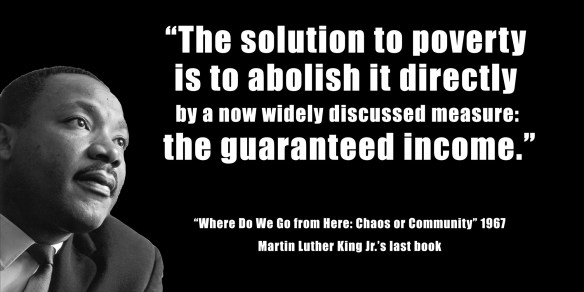
A 2% Financial Wealth Tax Would Provide A $12,000 Annual Stipend To Every American Household

Careful analysis reveals a number of excellent arguments for the implementation of a Universal Basic Income.

By Paul Buchheit

Source: Nation of Change

It’s not hard to envision the benefits in work opportunities, stress reduction, child care, entrepreneurial activity, and artistic pursuits for American households with an extra $1,000 per month. It’s also very easy to justify a financial wealth tax, given that the dramatic stock market surge in recent years is largely due to an unprecedented degree of technological and financial productivity that derives from the work efforts and taxes of ALL Americans. A 2% annual tax on financial wealth is a small price to pay for the great fortunes bestowed on the most fortunate Americans.

The REASONS? Careful analysis reveals a number of excellent arguments for the implementation of a Universal Basic Income (UBI).

(1) Our Jobs are Disappearing

A 2013 Oxford study determined that nearly HALF of American jobs are at risk of being replaced by computers, AI, and robots. Society simply can’t keep up with technology. As for the skeptics who cite the Industrial Revolution and its job-enhancing aftermath (which actually took 60 years to develop), the McKinsey Global Institute says that society is being transformed at a pace “ten times faster and at 300 times the scale” of the radical changes of two hundred years ago.

(2) Half of America is Stressed Out or Sick

Half of Americans are in or near poverty, unable to meet emergency expenses, living from paycheck to paycheck, and getting physically and emotionally ill because of it. Numerous UBI experiments have led to increased well-being for their participants. A guaranteed income reduces the debilitating effects of inequality. As one recipient put it, “It takes me out of depression…I feel more sociable.”

(3) Children Need Our Help

This could be the best reason for monthly household stipends. Parents, especially mothers, are unable to work outside the home because of the all-important need to care for their children. Because we currently lack a UBI, more and more children are facing hunger and health problems and educational disadvantages.

(4) We Need More Entrepreneurs

A sudden influx of $12,000 per year for 126 million households will greatly stimulate the economy, potentially allowing millions of Americans to TAKE RISKS that could lead to new forms of innovation and productivity.

Perhaps most significantly, a guaranteed income could relieve some of the pressure on our newest generation of young adults, who are deep in debt, underemployed, increasingly unable to live on their own, and ill-positioned to take the entrepreneurial chances that are needed to spur innovative business growth. No other group of Americans could make more productive use of an immediate boost in income.

(5) We Need the Arts & Sciences

A recent Gallup poll found that nearly 70% of workers don’t feel ‘engaged’ (enthusiastic and committed) in their jobs. The work chosen by UBI recipients could unleash artistic talents and creative impulses that have been suppressed by personal financial concerns, leading, very possibly, to a repeat of the 1930s, when the Works Progress Administration hired thousands of artists and actors and musicians to help sustain the cultural needs of the nation.

Arguments against

The usual uninformed and condescending opposing argument is that UBI recipients will waste the money, spending it on alcohol and drugs and other ‘temptation’ goods. Not true. Studies from the World Bank and the Brooks World Poverty Institute found that money going to poor families is used primarily for essential needs, and that the recipients experience greater physical and mental well-being as a result of their increased incomes. Other arguments against the workability of the UBI are countered by the many successful experiments conducted in the present and recent past: FinlandCanada, Netherlands, Kenya, IndiaGreat Britain, Uganda, Namibia, and in the U.S. in Alaska and California.

How to pay for it

Largely because of the stock market, U.S. financial wealth has surged to $77 trillion, with the richest 10% owning over three-quarters of it. Just a 2 percent tax on total financial wealth would generate enough revenue to provide a $12,000 annual stipend to every American household (including those of the richest families).

It’s easy to justify a wealth tax. Over half of all basic research is paid for by our tax dollars. All the technology in our phones and computers started with government research and funding. Pharmaceutical companies wouldn’t exist without decades of support from the National Institutes of Health. Yet the tech and pharmaceutical companies claim patents on the products paid for and developed by the American people.

The collection of a wealth tax would not be simple, since only about half of U.S. financial wealth is held directly in equities and liquid assets (Table 5-2). But it’s doable. As Thomas Piketty notes, “A progressive tax on net wealth is better than a progressive tax on consumption because first, net wealth is better defined for very wealthy individuals..”

And certainly a financial industry that knows how to package worthless loans into A-rated mortgage-backed securities should be able to figure out how to tax the investment companies that manage the rest of our ever-increasing national wealth.