Costs Are Spiraling Out of Control

By Charles Hugh Smith

Source: Of Two Minds

And how do we pay for these spiraling out of control costs? By borrowing more, of course.

If we had to choose one “big picture” reason why the vast majority of households are losing ground, it would be: the costs of essentials are spiraling out of control. I’ve often covered the dynamics of stagnating income for the bottom 90%, and real-world inflation, i.e. a decline in purchasing power.

But neither of these dynamics fully describes the relentless upward spiral of the cost basis of our economy, that is, the cost of big-ticket essentials: housing, education and healthcare.

The costs of education are spiraling out of control, stripping households of income as an entire generation is transformed into debt-serfs by student loan debt. The soaring costs of healthcare are a core driver of higher costs in the education complex (and government in general), and to cover these higher costs, counties raise property taxes, which add additional cost burdens to households and enterprises as rents rise.

Rising rents push the cost structure of almost every enterprise and agency higher.

Then there’s the asset inflation created by central bank ZIRP (zero interest rate policy) which has inflated a second echo-bubble in housing that has pushed home ownership out of reach of many, adding demand for rental housing that has pushed rents into the stratosphere in Left and Right Coast cities.

The increasing dominance of monopolies and cartels has eliminated competition in sector after sector. Monopolies and cartels skim immense profits even as the value, quality and quantity of their products and services decline: The U.S. Only Pretends to Have Free Markets From plane tickets to cellphone bills, monopoly power costs American consumers billions of dollars a year.

Thanks to their political influence, monopolies and cartels have legalized looting, raising prices and evading anti-trust regulations because they can pay whatever it takes in our pay-to-play political system.

Let’s look at a few charts that illustrate the relentless rise in costs:

Do you reckon these two charts are connected–soaring costs and ballooning administrative payrolls?

Student loan debt is soaring above $1.5 trillion, guaranteeing profits to lenders and debt-serfdom to the students exiting with degrees that are in over-supply, i.e. possessing little scarcity value in an over-credentialed economy:

The echo housing bubbles in many locales exceed the nosebleed valuations of the previous bubble:

And how do we pay for these spiraling out of control costs? By borrowing more, of course:

Even at low rates of interest, the cost of servicing skyrocketing debt increases, leaving less net income to support additional borrowing.

What will it take to radically reduce the cost basis of our economy? A fundamental re-ordering that breaks up all the cartels and monopolies that push prices higher even as they deliver lower quality goods and services would be a good start.

The Unraveling Quickens

By Charles Hugh Smith

Source: Of Two Minds

Even if we don’t measure the erosion of intangible capital, the social and political consequences of this impoverishment are manifesting in all sorts of ways.

The central thesis of my new book Will You Be Richer or Poorer? is the financial “wealth” we’ve supposedly gained (or at least a few of us have gained) in the past 20 years has masked the unraveling of our intangible capital: the resilience of our economy, our social capital, i.e. our ability to find common ground and solve real-world problems, our sense that the playing field, while not entirely level, is not two-tiered, and our sense of economic security–have all been shredded.

The unraveling of everything that actually matters is quickening. While every “news” outlet cheerleads the stock market (“The Dow soared today as investor optimism rose… blah blah blah”), our “leadership” and our media don’t even attempt to measure what’s unraveling, much less address the underlying causes.

The hope is that if we ignore what’s unraveling, it will magically go away. But that’s not how reality works.

The unraveling is gathering momentum because prices have been pushing higher while wages lag, feeding the rising precariousness and inequality of our economy. The connection between people losing ground and social disorder/disunity has been well established by historians such as Peter Turchin Ages of Discord and David Hackett Fischer The Great Wave: Price Revolutions and the Rhythm of History.

In our era, trust in the legitimacy of our institutions is unraveling because the statistics presented as “facts” are so clearly designed to support the status quo narrative that everything’s getting better every day in every way rather than the politically unwelcome reality that the bottom 95% are losing ground and whatever they do earn and own is increasingly at risk from forces outside their control.

Economic decay leads to social and political disorder / disunity. The sudden rise of vast homeless encampments is one manifestation of the social fabric unraveling. In the political realm, the insanity of accusing Democratic candidates of being “Russian agents” matches the hysterical destructiveness of the McCarthy era in the 1950s.

It all starts with economic decay, so let’s look at some charts. Here’s a chart of income inequality which helps drive wealth inequality.

Note that the only group that benefited from the past 20 years of speculative bubbles is the top 1%. The whole idea that inflating bubbles creates a “wealth effect” that “trickles down” is preposterous, as evidenced by the decline of the middle 60% of households while the speculators and owners of bubble-assets skimmed the vast majority of income gains.

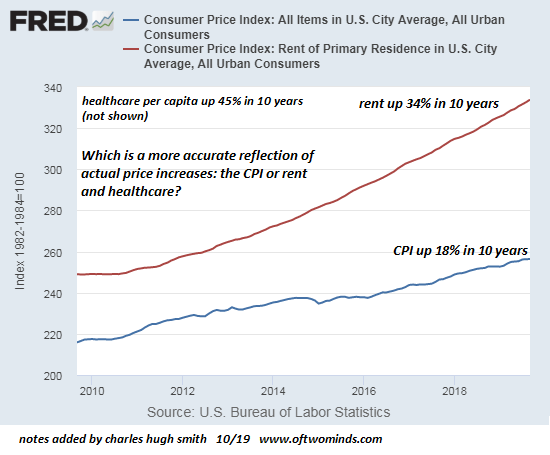
Meanwhile, we’re told inflation is less than 2% annually while rising costs have outpaced meager wage increases. What’s a more realistic measure of real-world inflation–the official Consumer Price Index (CPI) at 18% over ten years or rent and healthcare at 34% and 45%?

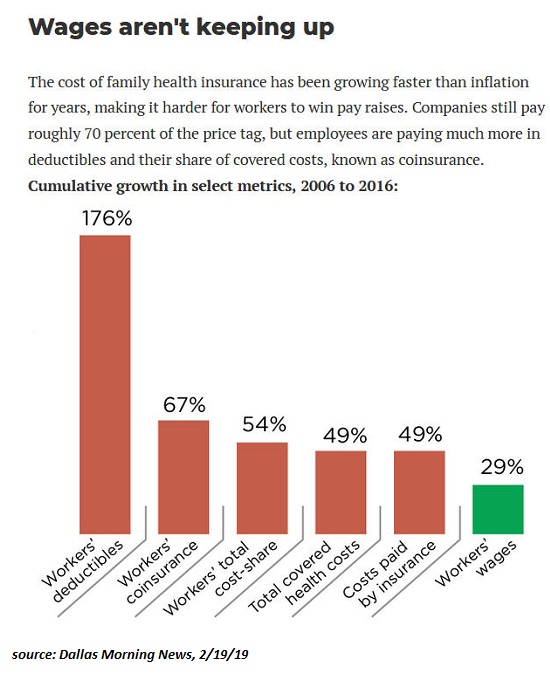
According to the Chapwood Index, real-world inflation in urban America is running 9% to 13% annually. This is more in line with reality than the bogus CPI, as evidenced by this chart of wages and healthcare costs:

Even if we don’t measure the erosion of intangible capital, the social and political consequences of this impoverishment are manifesting in all sorts of ways: large-scale social disorder is breaking out around the globe, and the political middle ground has completely vanished: no matter which way an issue is decided, one camp will refuse to accept the outcome.

The only way forward with any chance of success is to start by acknowledging the decay of our economy due to rampant financialization, legalized looting, the pathologies of “winner take most” speculation and the realities of a two-tiered system in which entrenched elites are “more equal” than the rest of us, economically, socially and politically. We have to accept the limits of technology to reverse the unraveling and assess the damage that’s already been done to our shared capital.

Acting as if the system is working just fine and the problem is perception/optics is accelerating the unraveling.

The Erosion of the Middle Class — Why Americans Are Working Harder and Earning Less

By John Liberty

Source: The Mind Unleashed

“I don’t have to tell you things are bad. Everybody knows things are bad. It’s a depression. Everybody’s out of work or scared of losing their job. The dollar buys a nickel’s worth, banks are going bust, shopkeepers keep a gun under the counter. Punks are running wild in the street and there’s nobody anywhere who seems to know what to do, and there’s no end to it.” — Howard Beale

Howard Beale, the main character in the 1976 film Network, became a part of cinematic history when he uttered the line “I’m mad as hell and I’m not gonna take it anymore.” That one line expressed a growing rage among America’s shrinking middle class at a time when Americans were reeling from years of war, political scandals and economic downturn.

In the four decades that have followed, little has improved for the average American. We’re still ‘mad as hell’ and the middle class is being eroded right in front of our eyes. When adjusted for inflation, many Americans are working longer hours and earning less than they did in 1976. So, how have we gone from vibrant middle class to the working poor in a matter of decades?

Median Incomes Are Stagnant

Despite increases in the national income over the past fifty years, middle class families have experienced little income growth over the past few decades. According to U.S. Census datamiddle class incomes have grown by only 28 percent from 1979 – 2014. Meanwhile, a report from the Congressional Budget Office (CBO) shows that the top 20 percent of earners has seen their incomes rise by 95 percent over that same period of time.

Contributing to the stagnation of wages is a notable decrease in the workforce participation rate. According to the Brookings institute, “One reason for these declines in employment and labor force participation is that work is less rewarding. Wages for those at the bottom and middle of the skill and wage distribution have declined or stagnated.” Historical data from the Bureau of Labor Statistics backs up these findings, showing a steady decrease in workforce participation over the last two decades.

The Erosion of the Minimum Wage & America’s Purchasing Power

Anyone who has read a comment thread on the internet about minimum wage laws knows the debate is currently one of the most highly contentious political topics in America. In the halls of Congress, the debate has turned into a nearly decade long impasse. As a result, workers at the low end of the wage scale have watched the purchasing power of their wages decrease from $7.25 in 2009, to $6.19 in 2018 due to inflation. In 2018, you need to perform 47 hours of minimum wage work to achieve the same amount of purchasing power as 40 hours of work in 2009.

The inflation-adjusted minimum wage value has been in steady decline since 1968, when the $1.60 minimum wage was equal to $11.39 (in 2018 dollars). Since then, lawmakers have reduced minimum wage increases relative to the rate of inflation. As Christopher Ingraham reports:

“Recent research shows that the reason politicians — Democrats and Republicans alike — are dragging their feet on popular policies such as the minimum wage is that they pay a lot more attention to the needs and desires of deep-pocketed business groups than they do to regular voters. Those groups tend to oppose minimum wage increases for the simple reason that they eat into their profit margins.”

To be clear, the erosion of the purchasing power of everyday Americans is hardly a new phenomenon. According to data from the U.S. Bureau of Labor Statistics, the purchasing power of the U.S. Dollar has plummeted by over 95 percent since 1913, the year the Federal Reserve was created. The Bureau’s Consumer Price Index indicates that prices in 2018 are 2,436.33% higher than prices in 1913 and that the dollar has experienced an average inflation rate of 3.13% per year during this period.

The Rich Get Richer

While the outlook may be grim for low-wage workers, this is fantastic news for large corporations. Data from the U.S. Bureau of Economics shows that corporate profits are approaching all-time highs. But it’s not just workers who are feeling the effect of growing income inequality. The contrast is also being felt on Main Street. An analysis of the S & P 500 and the Russell 1,000 & 2,000 indexes by Bloomberg revealed a growing gap between America’s largest employers and smaller businesses.

A report from the Institute for Policy Studies entitled Billionaire Bonanza: The Forbes 400 and the Rest of Us echoed these findings when it revealed that America’s 20 wealthiest people — a group that could fit comfortably in one single Gulfstream G650 luxury jet –­ now own more wealth than the bottom half of the American population combined.

Although the Trump administration continues to tout stock market and labor force increases as signs of economic prosperity, numbers show that the wealthiest 10 percent of Americans own 84 percent of all stock. A study conducted by the Economic Policy Institute found that wage growth remains too weak to consider the economy at full employment and that stagnant wage growth has contributed to the growing level of income inequality in America. The study noted that while wages have recovered from the 2008 recession, the gap between those at the top and those at the middle and bottom has continued to increase since 2000. As the study’s author, Elise Gould writes:

“We’re looking at nominal wage growth that is still slower than you would expect in a full employment economy, slower than you would expect if you thought there were any sort of inflation pressures from wage growth.”

The Decimation of the American Dream

Comedian George Carlin once said, “The reason they call it the American Dream is because you have to be asleep to believe it.” For millions of middle class Americans Carlin’s statement has proven eerily accurate. Stagnant wages and decreased purchasing power has put the prospects for middle class children in a tailspin as upward mobility trends have reportedly fallen by over 40 percent since 1950.

A poll conducted by the Pew Research Institute corroborates this claim. According to Pew, only 37 percent of Americans believe that today’s children will grow up to be better off financially than their parents. That means more Americans think that today’s children will be financially worse off than their parents than those who believe they will be better off.

The sentiments expressed by millions of middle class Americans appear to be wholly justified due to the fact that middle class families are becoming more fragile and dependent on two incomes. A report from the Council of Economic Advisors found the majority of the income gains made by the middle class from 1979 to 2013 were a result of increased participation in the workplace by women. The report also noted the fragility of two income families amidst a decline in marriage and a drastic rise in single parent homes in recent years.

As a result of the slow growth in wages, over half of Americans now receive more in Government transfer payments (Medicare, Medicaid, food stamps, Social Security) than they pay in federal taxes. An analysis of all 50 states also found that in 42 states the cost of living is higher than the median income.

The rising cost of healthcare is also putting the pinch on the wallets of many Americans. As Jeffrey Pfeffer noted in his book Dying for a Paycheck, healthcare spending—per capita—has increased 29 fold over the past 40 years, outpacing the growth of the American economy.

While many Americans continue to look to the government to fix problems like wage stagnation, income inequality and rising healthcare costs, the sad truth is that we live in a time when 1 in 3 households has trouble paying energy bills and 40 percent of Americans face poverty in retirement at the exact same time the Federal Government has admitted that they lost $21 trillion. Not only did they lose $21 trillion (yes that’s TRILLION with a T), but the Department of Defense indicated in a press conference that they “never expected to pass” the audit to locate the missing taxpayer money.

John Emerich Edward Dalberg Acton famously proclaimed in 1887:

“Power tends to corrupt, and absolute power corrupts absolutely. Great men are almost always bad men.”

Perhaps it’s time for the millions of Americans who are quietly ‘mad as hell’ to start expressing their rage at the corrupt institutions of power that are decimating their livelihoods rather than expecting those very same institutions to fix the problems they created.


Will Robots Take Your Job?

Walmart Robots

By Nick Srnicek and Alex Williams

Source: ROAR

In recent months, a range of studies has warned of an imminent job apocalypse. The most famous of these—a study from Oxford—suggests that up to 47 percent of US jobs are at high-risk of automation over the next two decades. Its methodology—assessing likely developments in technology, and matching them up to the tasks typically deployed in jobs—has been replicated since then for a number of other countries. One study finds that 54 percent of EU jobs are likely automatable, while the chief economist of the Bank of England has argued that 45 percent of UK jobs are similarly under threat.

This is not simply a rich-country problem, either: low-income economies look set to be hit even harder by automation. As low-skill, low-wage and routine jobs have been outsourced from rich capitalist countries to poorer economies, these jobs are also highly susceptible to automation. Research by Citi suggests that for India 69 percent of jobs are at risk, for China 77 percent, and for Ethiopia a full 85 percent of current jobs. It would seem that we are on the verge of a mass job extinction.

Nothing New?

For many economists however, there is nothing to worry about. If we look at the history of technology and the labor market, past experiences would suggest that automation has not caused mass unemployment. Automation has always changed the labor market. Indeed, one of the primary characteristics of the capitalist mode of production has been to revolutionize the means of production—to really subsume the labor process and reorganize it in ways that more efficiently generate value. The mechanization of agriculture is an early example, as is the use of the cotton gin and spinning jenny. With Fordism, the assembly line turned complex manufacturing jobs into a series of simple and efficient tasks. And with the era of lean production, we have had the computerized management of long commodity chains turn the production process into a more and more heavily automated system.

In every case, we have not seen mass unemployment. Instead we have seen some jobs disappear, while others have been created to replace not only the lost jobs but also the new jobs necessary for a growing population. The only times we see massive unemployment tend to be the result of cyclical factors, as in the Great Depression, rather than some secular trend towards higher unemployment resulting from automation. On the basis of these considerations, most economists believe that the future of work will likely be the same as the past: some jobs will disappear, but others will be created to replace them.

In typical economist fashion, however, these thoughts neglect the broader social context of earlier historical periods. Capitalism may not have seen a massive upsurge in unemployment, but this is not a necessary outcome. Rather, it was dependent upon unique circumstances of earlier moments—circumstances that are missing today. In the earliest periods of automation, there was a major effort by the labor movement to reduce the working week. It was a successful project that reduced the week from around 60 hours at the turn of the century, down to 40 hours during the 1930s, and very nearly even down to 30 hours. In this context, it was no surprise that Keynes would famously extrapolate to a future where we all worked 15 hours. He was simply looking at the existing labor movement. With reduced work per person, however, this meant that the remaining work would be spread around more evenly. The impact of technology at that time was therefore heavily muted by a 33 percent reduction in the amount of work per person.

Today, by contrast, we have no such movement pushing for a reduced working week, and the effects of automation are likely to be much more serious. Similar issues hold for the postwar era. With most Western economies left in ruins, and massive American support for the revitalization of these economies, the postwar era saw incredibly high levels of economic growth. With the further addition of full employment policies, this period also saw incredibly high levels of job growth and a compact between trade unions and capital to maintain a sufficient amount of good jobs. This led to healthy wage growth and, subsequently, healthy growth in aggregate demand to stimulate the economy and keep jobs coming. Moreover, this was a period where nearly 50 percent of the potential labor force was constrained to the household.

Under these unique circumstances, it is no wonder that capitalism was able to create enough jobs even as automation continued to transform for the labor process. Today, we have sluggish economic growth, no commitments to full employment (even as we have commitments to harsh welfare policies), stagnant wage growth, and a major influx of women into the labor force. The context for a wave of automation is drastically different from the way it was before.

Likewise, the types of technology that are being developed and potentially introduced into the labor process are significantly different from earlier technologies. Whereas earlier waves of automation affected what economists call “routine work” (work that can be laid out in a series of explicit steps), today’s technology is beginning to affect non-routine work. The difference is between a factory job on an assembly line and driving a car in the chaotic atmosphere of the modern urban environment. Research from economists like David Autor and Maarten Goos shows that the decline of routine jobs in the past 40 years has played a significant role in increased job polarization and rising inequality. While these jobs are gone, and highly unlikely to come back, the next wave of automation will affect the remaining sphere of human labor. An entire range of low-wage jobs are now potentially automatable, involving both physical and mental labor.

Given that it is quite likely that new technologies will have a larger impact on the labor market than earlier waves of technological change, what is likely to happen? Will robots take your job? While one side of the debate warns of imminent apocalypse and the other yawns from the historical repetition, both tend to neglect the political economy of automation—particularly the role of labor. Put simply, if the labor movement is strong, we are likely to see more automation; if the labor movement is weak, we are likely to see less automation.

Workers Fight Back

In the first scenario, a strong labor movement is able to push for higher and higher wages (particularly relative to globally stagnant productivity growth). But the rising cost of labor means that machines become relatively cheap in comparison. We can already see this in China, where real wages have been surging for more than 10 years, thereby making Chinese labor increasingly less cheap. The result is that China has become the world’s biggest investor in industrial robots, and numerous companies—most famously Foxconn—have all stated their intentions to move towards increasingly automated factories.

This is the archetype of a highly automated world, but in order to be achievable under capitalism it requires that the power of labor be strong, given that the relative costs of labor and machines are key determinants for investment. What then happens under these circumstances? Do we get mass unemployment as robots take all the jobs? The simple answer is no. Rather than mass decimation of jobs, most workers who have their jobs automated end up moving into new sectors.

In the advanced capitalist economies this has been happening over the past 40 years, as workers move from routine jobs to non-routine jobs. As we saw earlier, the next wave of automation is different, and therefore its effects on the labor market are also different. Some job sectors are likely to take heavy hits under this scenario. Jobs in retail and transport, for instance, will likely be heavily affected. In the UK, there are currently 3 million retail workers, but estimates by the British Retail Consortium suggest this may decrease by a million over the next decade. In the US, there are 3.4 million cashiers alone—nearly all of whose work could be automated. The transport sector is similarly large, with 3.7 million truck drivers in the US, most of whose jobs could be incrementally automated as self-driving trucks become viable on public roads. Large numbers of workers in such sectors are likely to be pushed out of their jobs if mass automation takes place.

Where will they go? The story that Silicon Valley likes to tell us is that we will all become freelance programmers and software developers and that we should all learn how to code to succeed in their future utopia. Unfortunately they seem to have bought into their own hype and missed the facts. In the US, 1.8 percent of all jobs require knowledge of programming. This compares to the agricultural sector, which creates about 1.5 percent of all American jobs, and to the manufacturing sector, which employs 8.1 percent of workers in this deindustrialized country. Perhaps programming will grow? The facts here are little better. The Bureau of Labor Statistics (BLS) projects that by 2024 jobs involving programming will be responsible for a tiny 2.2 percent of the jobs available. If we look at the IT sector as a whole, according to Citi, it is expected to take up less than 3 percent of all jobs.

What about the people needed to take care of the robots? Will we see a massive surge in jobs here? Presently, robot technicians and engineers take up less than 0.1 percent of the job market—by 2024, this will dwindle even further. We will not see a major increase in jobs taking care of robots or in jobs involving coding, despite Silicon Valley’s best efforts to remake the world in its image.

This continues a long trend of new industries being very poor job creators. We all know about how few employees worked at Instagram and WhatsApp when they were sold for billions to Facebook. But the low levels of employment are a widespread sectoral problem. Research from Oxford has found that in the US, only 0.5 percent of the labor force moved into new industries (like streaming sites, web design and e-commerce) during the 2000s. The future of work does not look like a bunch of programmers or YouTubers.

In fact, the fastest growing job sectors are not for jobs that require high levels of education at all. The belief that we will all become high-skilled and well-paid workers is ideological mystification at its purest. The fastest growing job sector, by far, is the healthcare industry. In the US, the BLS estimates this sector to create 3.8 million new jobs between 2014 and 2024. This will increase its share of employment from 12 percent to 13.6 percent, making it the biggest employing sector in the country. The jobs of “healthcare support” and “healthcare practitioner” alone will contribute 2.3 million jobs—or 25 percent of all new jobs expected to be created.

There are two main reasons for why this sector will be such a magnet for workers forced out of other sectors. In the first place, the demographics of high-income economies all point towards a significantly growing elderly population. Fewer births and longer lives (typically with chronic conditions rather than infectious diseases) will put more and more pressure on our societies to take care of elderly, and force more and more people into care work. Yet this sector is not amenable to automation; it is one of the last bastions of human-centric skills like creativity, knowledge of social context and flexibility. This means the demand for labor is unlikely to decrease in this sector, as productivity remains low, skills remain human-centric, and demographics make it grow.

In the end, under the scenario of a strong labor movement, we are likely to see wages rise, which will cause automation to rapidly proceed in certain sectors, while workers are forced to struggle for jobs in a low-paying healthcare sector. The result is the continued elimination of middle-wage jobs and the increased polarization of the labor market as more and more are pushed into the low-wage sectors. On top of this, a highly educated generation that was promised secure and well-paying jobs will be forced to find lower-skilled jobs, putting downward pressure on wages—generating a “reserve army of the employed”, as Robert Brenner has put it.

Workers Fall Back

Yet what happens if the labor movement remains weak? Here we have an entirely different future of work awaiting us. In this case, we end up with stagnant wages, and workers remain relatively cheap compared to investment in new equipment. The consequences of this are low levels of business investment, and subsequently, low levels of productivity growth. Absent any economic reason to invest in automation, businesses fail to increase the productivity of the labor process. Perhaps unexpectedly, under this scenario we should expect high levels of employment as businesses seek to maximize the use of cheap labor rather than investing in new technology.

This is more than a hypothetical scenario, as it rather accurately describes the situation in the UK today. Since the 2008 crisis, real wages have stagnated and even fallen. Real average weekly earnings have started to rise since 2014, but even after eight years they have yet to return to their pre-crisis levels. This has meant that businesses have had incentives to hire cheap workers rather than invest in machines—and the low levels of investment in the UK bear this out. Since the crisis, the UK has seen long periods of decline in business investment—the most recent being a 0.4 percent decline between Q12015 and Q12016. The result of low levels of investment has been virtually zero growth in productivity: from 2008 to 2015, growth in output per worker has averaged 0.1 percent per year. Almost all of the UK’s recent growth has come from throwing more bodies into the economic machine, rather than improving the efficiency of the economy. Even relative to slow productivity growth across the world, the UK is particularly struggling.

With cheap wages, low investment and low productivity, we see that companies have instead been hiring workers. Indeed, employment levels in the UK have reached the highest levels on record—74.2 percent as of May 2016. Likewise, unemployment is low at 5.1 percent, especially when compared to their neighbors in Europe who average nearly double that level. So, somewhat surprisingly, an environment with a weak labor movement leads here to high levels of employment.

What is the quality of these jobs, however? We have already seen that wages have been stagnant, and that two-thirds of net job creation since 2008 has been in self-employed jobs. Yet there has also been a major increase in zero-hour contracts (employment situations that do not guarantee any hours to workers). Estimates are that up to 5 percent of the labor force is in such situations, with over 1.7 million zero-hour contracts out. Full-time employment is down as well: as a percentage of all jobs, its pre-crisis levels of 65 percent have been cut to 63 percent and refused to budge even as the economy grows (slowly). The percentage of involuntary part-time workers—those who would prefer a full-time job but cannot find one—more than doubled after the crisis, and has barely begun to recover since.

Likewise with temporary employees: involuntary temporary workers as a percentage of all temporary workers rose from below 25 percent to over 40 percent during the crisis, only partly recovering to around 35 percent today. There is a vast number of workers who would prefer to work in more permanent and full-time jobs, but who can no longer find them. The UK is increasingly becoming a low-wage and precarious labor market—or, in the Tories’ view, a competitive and flexible labor market. This, we would argue, is the future that obtains with a weak labor movement: low levels of automation, perhaps, but at the expense of wages (and aggregate demand), permanent jobs and full-time work. We may not get a fully automated future, but the alternative looks just as problematic.

These are therefore the two poles of possibility for the future of work. On the one hand, a highly automated world where workers are pushed out of much low-wage non-routine work and into lower-wage care work. On the other hand, a world where humans beat robots but only through lower wages and more precarious work. In either case, we need to build up the social systems that will enable people to survive and flourish in the midst of these significant changes. We need to explore ideas like a Universal Basic Income, we need to foster investment in automation that could eliminate the worst jobs in society, and we need to recover that initial desire of the labor movement for a shorter working week.

We must reclaim the right to be lazy—which is neither a demand to be lazy nor a belief in the natural laziness of humanity, but rather the right to refuse domination by a boss, by a manager, or by a capitalist. Will robots take our jobs? We can only hope so.

Note: All uncited figures either come directly from, or are based on authors’ calculations of, data from the Bureau of Labor Statistics, O*NET and the Office for National Statistics.

In a highly indebted world, austerity is a permanent state of affairs

images

By Mark Blyth

Source: Aeon

By 2010, everyone had heard the ‘austerity’ rallying cry. Immediately following the 2008 financial crisis, especially in Europe, it resounded: ‘Stimulate no more, now is the time for all to tighten!’ And tighten governments did, cutting public expenditure across continental Europe, and in the United Kingdom and the United States.

The logic behind ‘austerity’ holds that ‘the market’ – which the public had just bailed out – did not like the debt incurred when states everywhere rescued and recapitalised their banking systems. Unsurprisingly, tax revenues fell as the economy slowed and state expenditures rose. And what were once private debts on the balance sheets of banks became public debt on the balance sheet of states. Given this sorry state of affairs, states (policymakers and business leaders argued) had to take action to restore ‘business confidence’ – which is apparently always and everywhere created by cutting government spending. So governments cut.

Public debt, however, grew, because economies got smaller and grew slower the more they cut. The ‘confidence fairy’ as Paul Krugman named the expected effect, simply failed to show up. Why?

The reason is simple – and it is surprising anyone thought that anything else would happen. Imagine an economy as a sum, with a numerator and a denominator. Make total debt 100 and stick that on the top (the numerator). Make Gross Domestic Product (GDP) 100 and stick that on the bottom (the denominator) to give us a 100 per cent debt-to-GDP ratio. If you cut total spending by 20 per cent to restore ‘confidence’, the economy is ‘balanced’ at 100/80. That means the debt-to-GDP ratio of the country just went up to 120 per cent, all without the government issuing a single cent of new debt.

In short, cuts to spending in a recession make the underlying economy contract. After all, government workers have lost jobs or income, and government workers not shopping has the same effect as private sector workers not shopping. So the debt goes up as the economy shrinks further. States respond by cutting spending further. The pattern continues.

Having a common currency among different countries actually aggravates the problem because cuts in one state reverberate through many states, depressing them all. In 2008, euro area government debt as a share of the economy, including the already profligate Greeks, averaged around 65 per cent of GDP. Following budget cuts and monetary tightening (the European Central Bank twice pushed up interest rates in 2011) Euro Area government debt, by 2014, had risen to 92 per cent of GDP.

Greece is the poster child for this ‘denominator effect’. Under the auspices of ‘bailouts’ from the IMF and the EU, Greece cut more than 20 per cent of GDP in spending. It lost nearly 30 per cent in final consumption. Yet its debt increased from 103 per cent in 2006 to more than 180 per cent by 2014. That’s a 57 per cent increase in debt while spending is being cut.

Let’s look at the originating question again: how is destroying a third of the economy supposed to inspire consumer and business confidence? It won’t – unless you are a creditor – and that’s where the politics comes in.

If you are a holder of government debt (a creditor), three things hurt the value of your asset: if the inflation rate goes above the interest rate on your bond; if the exchange rate moves against you so that what the bond is worth vis-à-vis other currencies falls; and, of course, default – if the government takes the money and runs.

In the post-crisis world, despite major central banks putting trillions of dollars into the global money supply, there is almost no inflation anywhere in the developed world. Exchange rates (Brexit effects apart) are comparatively stable and ultimately move against each other relatively, so that’s not a huge worry. If the country whose debt you hold can have elections, and the public dares to vote against more budget cuts, the European Central Bank will shut down their banking system to make them revisit their choices. That’s what they did to Greece in the summer of 2015.

In this world, our present world, creditors will get paid and debtors will get squeezed. Budgets will be cut to make sure that bondholders get their money. And, in a highly indebted world, austerity – introduced as an ‘emergency’ measure to save the economy, to right the fiscal ship – becomes a permanent state of affairs.

As Britain’s former prime minister David Cameron said (standing beside a throne in a white bow-tie and tails) in 2013: ‘We need to do more with less. Not just now, but permanently.’ But here’s the question hidden in that blithe statement – are you and me part of the ‘we’ here?

Let’s go back to the huge jump in public debt that occurred when governments, ie the people, bailed out the banks. That debt was not, and is not, a liability. As difficult as it can be to make this reality part of the political conversation, public debt is an asset. Even at today’s low rates, it earns interest and retains value. No one is forced to invest in public debt, but every time bonds are issued investors show up and buy them by the truckload. By market criteria, public debt is a great investment.

But who pays for it? That would be the taxpayer. More generally, those who contribute to the payment of debts by not consuming government-produced services that have been cut. Basically, in most countries, this means that the bottom 70 per cent of the income distribution bears the cost of paying for public debt.

Over the past 25 years, to make up for chronically low wage growth, that same 70 per cent of the population has increased its personal indebtedness. Massively. Which means that in an economy deformed by austerity, they are the ones paying out – twice. With stagnant or declining wages, they have to service both the massive private debt they have accumulated to live and the public debt issued in their name.

Meanwhile, those whose assets the public bailed out – those with investible wealth, those who hold ‘all that debt’ and make money from it – do not suffer from the decline in public spending. Since they are net lenders, the hike in personal indebtedness does not trouble them either.

The result, and the situation in which we find ourselves, is a classic bad equilibrium. Those who can’t pay, and don’t earn enough, are being asked to pay the most to service debt, from which they do not and will not benefit. Those who can pay, and earn almost all the income, both contribute the least and benefit the most from ‘all that debt’.

Strip away all the electoral politics at the moment in the US, the UK, Italy, Spain and elsewhere, and that’s the underlying political economy. It’s a creditor/debtor stand-off where the creditors have the whip hand.

And yet, the more they crack the whip, the more the backlash against austerity, in all its forms, gains strength. Donald Trump, Jeremy Corbyn, Marine Le Pen, Pablo Iglesias: Left or Right, they are all riding debtor anger against creditor strength. It might be expressed as anger against, variously, ‘trade’ or ‘the elite’ or the ‘EU’. But what’s underneath all that is the politics of debt.

This is the ‘new normal’. It’s not about flat interest rates or anaemic growth rates. They are the consequences of austerity, not its causes. The new normal is the new politics of debtors versus creditors. It’s here to stay. As we already can see, it’s going to be anything but normal.

Thomas Frank on How Democrats Went From Being the ‘Party of the People’ to the Party of Rich Elites

download

Democrats have gone from the party of the New Deal to a party that is defending mass inequality.

By Tobita Chow

Source: In These Times

The Democratic Party was once the party of the New Deal and the ally of organized labor. But by the time of Bill Clinton’s presidency, it had become the enemy of New Deal programs like welfare and Social Security and the champion of free trade deals. What explains this apparent reversal? Thomas Frank—best known for his analysis of the Republican Party base in What’s the Matter with Kansas?attempts to answer this question in his latest book, Listen Liberal: Or, What Ever Happened to the Party of the People?

According to Frank, popular explanations which blame corporate lobby groups and the growing power of money in politics are insufficient. Frank instead points to a decision by Democratic Party elites in the 1970s to marginalize labor unions and transform from the party of the working class to the party of the professional class. In so doing, the Democratic Party radically changed the way it understood social problems and how to solve them, trading in the principle of solidarity for the principle of competitive individualism and meritocracy. The end result is that the party which created the New Deal and helped create the middle class has now become “the party of mass inequality.” In These Times spoke with Frank recently about the book via telephone.

The book is about how the Democratic Party turned its back on working people and now pursues policies that actually increase inequality. What are the policies or ideological commitments in the Democratic Party that make you think this?

The first piece of evidence is what’s happened since the financial crisis. This is the great story of our time. Inequality has actually gotten worse since then, which is a remarkable thing. This is under a Democratic president who we were assured (or warned) was the most liberal or radical president we would ever see.  Yet inequality has gotten worse, and the gains since the financial crisis, since the recovery began, have gone entirely to the top 10 percent of the income distribution.

This is not only because of those evil Republicans, but because Obama played it the way he wanted to. Even when he had a majority in both houses of Congress and could choose whoever he wanted to be in his administration, he consistently made policies that favored the top 10 percent over everybody else. He helped out Wall Street in an enormous way when they were entirely at his mercy.

He could have done anything he wanted with them, in the way that Franklin Roosevelt did in the ‘30s. But he chose not to.

Why is that? This is supposed to be the Democratic Party, the party that’s interested in working people, average Americans. Why would they react to a financial crisis in this way? Once you start digging into this story, it goes very deep. You find that there was a transition in the Democratic Party in the ‘70s, 80’s and ‘90s where they convinced themselves that they needed to abandon working people in order to serve a different constituency: a constituency essentially of white-collar professionals.

That’s the most important group in their coalition. That’s who they won over in the ’70s, ’80s and ’90s. That’s who they serve, and that’s where they draw from. The leaders of the Democratic Party are always from this particular stratum of society.

A lot of progressives that I talk to are pretty familiar with the idea that the Democratic Party is no longer protecting the interests of workers, but it’s pretty common for us to blame it on mainly the power of money in politics. But you start the book in chapter one by arguing there’s actually something much deeper going on. Can you say something about that?

Money in politics is a big part of the story, but social class goes deeper than that. The Democrats have basically made their commitment [to white-collar professionals] already before money and politics became such a big deal. It worked out well for them because of money in politics. So when they chose essentially the top 10 percent of the income distribution as their most important constituents, that is the story of money.

It wasn’t apparent at the time in the ‘70s and ‘80s when they made that choice. But over the years, it has become clear that that was a smart choice in terms of their ability to raise money. Organized labor, of course, is no slouch in terms of money. They have a lot of clout in dollar terms. However, they contribute and contribute to the Democrats and they almost never get their way—they don’t get, say, the Employee Free Choice Act, or Bill Clinton passes NAFTA. They do have a lot of money, but their money doesn’t count.

All of this happened because of the civil war within the Democratic Party. They fought with each other all the time in the ‘70s and the ‘80s. One side hadn’t completely captured the party until Bill Clinton came along in the ‘90s. That was a moment of victory for them.

Bill Clinton’s presidency is what progressives usually cite as the time when things went bad. But there’s a trend that goes back to the ’70s, right?

Historians always cite the ’68 election as the turning point. The party was torn apart by the controversy over the Vietnam war, protesters were in the streets in Chicago and the Democratic candidate Hubert Humphrey went on to lose. Democrats thought this was terrible, and it was. So they set up a commission to reorganize the party, the McGovern Commission.

The McGovern Commission basically set up our modern system of primaries. Before the commission, we didn’t have these long primary contests in state after state after state. Primaries are a good thing, as were most things the McGovern Commission did.

But they also removed organized labor from its structural position of power in the Democratic Party. There was a lot of resentment towards labor during the Vietnam War. A lot of unions took President Johnson’s side on Vietnam. There was also this sense—which I think was correct at the time—that labor was a dinosaur, that it was out of touch and undemocratic and very white.

There were a lot of reasonable objections to organized labor at the time. The problem is, when you get rid of labor in your party, you also get rid of issues that matter to working people. That’s the basic mistake that Democrats made in the ’70s. Of course, labor still is a big part of the Democratic coalition—it gives them their money, it helps out at election time in a huge way. But unions no longer have the presence in party councils that they used to. That disappeared.

One of the most shocking quotes in the book is from Alfred Kahn, an advisor to Jimmy Carter, who said, “I’d love the Teamsters to be worse off. I’d love the automobile workers to be worse off.” He then basically says that unionized workers are exploiting other workers.

Isn’t that amazing? He’s describing a situation in the 1970s. There was all this controversy in the 1970s about labor versus management—this was the last decade where those fights were front and center in our national politics. And he’s coming down squarely on the side of management in those fights.

And remember, Kahn was a very important figure in the Carter administration. The way that he describes unions is incorrect—he’s actually describing professionals. Professionals are a protected class that you can’t do anything about—they’re protected by the laws of every state that dictate who can practice in these fields. It’s funny that he projects that onto organized labor and holds them responsible for the sins of another group.

This is a Democrat in an administration that is actually not very liberal. This is the administration that carried out the first of the big deregulations. This is the administration that had the great big capital gains tax cuts, that carried out the austerity plan that saw the Federal Reserve jack its interest rates sky high. They clubbed the economy to the ground in order to stop “wage inflation,” in which workers, if they have enough power, can keep demanding higher wages. It was incredible.

What’s the content of the ideology of the professional class and how does it hurt working people? What are their guiding principles?

The first commandment of the professional class is the idea of meritocracy, which allows people to think that those on top are there because they deserve to be. With the professional class, it’s always associated with education. They deserve to be there because they worked really hard and went to a good college and to a good graduate school. They’re high achievers. Democrats are really given to credentialism in a way that Republicans aren’t.

If you look at the last few Democratic presidents, Bill Clinton and Obama, and Hillary Clinton as well, their lives are a tale of educational achievement. This is what opened up the doors of the world to them. It’s a party of who people who have gotten where they are by dint of educational accomplishment.

This produces a set of related ideas. When the Democrats, the party of the professionals, look at the economic problems of working-class people, they always see an educational problem, because they look at working class people and say, “Those people didn’t do what I did”: go and get advanced degrees, go to the right college, get the high SAT scores and study STEM or whatever.

There’s another interesting part of this ideology: this endless search for consensus. Washington is a city of professionals with advanced degrees, and Democrats look around them there and say, “We’re all intelligent people. We all went to good schools. We know what the problems are and we know what the answers are, and politics just get in the way.”

This is a very typical way of thinking for the professional class: reaching for consensus, because politics is this ugly thing that you don’t really need. You see this in Obama’s endless efforts to negotiate a grand bargain with Republicans because everybody in Washington knows the answers to the problems—we just have to get together, sit down and make an agreement. The same with Obamacare: He spent so many months trying to get Republicans to sign on, even just one or two, so that he could say it was bipartisan. It was an act of consensus. And the Republicans really played him, because they knew that’s what he’d do.

To go back to your point about education: At one point you quote Arne Duncan, who was Obama’s secretary of education, saying that the only way to end poverty is through education. Why can’t that work?

The big overarching problem of our time is inequality. If you look at historical charts of productivity and wage growth, these two things went hand in hand for decades after World War II, which we think of as a prosperous, middle-class time when even people with a high school degree, blue-collar workers, could lead a middle class life. And then everything went wrong in the 1970s. Productivity continued to go up and wage growth stopped. Wage growth has basically been flat ever since then. But productivity goes up by leaps and bounds all the time. We have all of these wonderful technological advances. Workers are more productive than ever but they haven’t benefited from it. That’s the core problem of inequality.

Now, if the problem was that workers weren’t educated enough, weren’t smart enough, productivity would not be going up. But that productivity line is still going up. So we can see that education is not the issue.

It’s important that people get an education, of course. I spent 25 years of my life getting an education. It’s basic to me. It’s a fundamental human right that people should have the right to pursue whatever they want to the maximum extent of their individual potential. But the idea that this is what is holding them back is simply incorrect as a matter of fact. What’s holding them back is that they don’t have the power to demand higher wages.

If we talk about the problem as one of education rather than power, then the blame goes back to these workers. They just didn’t go out and work hard and do their homework and get a gold star from their teacher. If you take the education explanation for inequality, ultimately you’re blaming the victims themselves.

Unfortunately, that is the Democratic view. That’s why Democrats have essentially become the party of mass inequality. They don’t really have a problem with it.

So really, the solution would have to be solidarity and organized power.

That was an essential point that I try to make in Listen Liberal: that there is no solidarity in a meritocracy. A meritocracy really is every man for himself.

Don’t get me wrong. People at the top of the meritocracy, professionals, obviously have enormous respect for one another. That is the nature of professional meritocracy. They have enormous respect for the people at the top, but they feel very little solidarity for people beneath them who don’t rise in the meritocracy.

Look at the white-collar workplace. If some professional gets fired, the other professionals don’t rally around and go on strike or protest or something like that. They just don’t do that. They feel no solidarity because everything goes back to you and whether or not you’ve made the grade. If somebody gets fired, they must’ve deserved it somehow.

I have my own personal experience. Look at academia over the last 20 years. They’re cranking out these Ph.D.s in the humanities who can’t get jobs on tenure track and instead have to work as adjuncts for very low pay, no benefits. One of the fascinating parts about this is that, with a few exceptions, the people who do have tenure-track jobs and are at the top of their fields, do very little about what’s happened to their colleagues who work as adjuncts. Essentially this is the Uberizing of higher education. The professionals who are in a position of authority have done almost nothing about it. There are academics here and there who feel bad about what’s happened to adjuncts and do say things about it, but by and large, overall, there is no solidarity in that meritocracy. They just don’t care.

Do you think there’s a connection between the fact that the Democratic Party has turned against workers and the rise of Donald Trump?

Yes. Because if you look at the polling, Trump is winning the votes of a lot of people who used to be Democrats. These white, working-class people are his main base of support. As a group, these people were once Democrats all over the country. These are Franklin Roosevelt’s people. These are the people that the Democrats essentially decided to turn their backs on back in the 1970s. They call them the legatees of the New Deal. They were done with these guys, and now look what’s happened—they’ve gone with Donald Trump. That’s frightening and horrifying.

But Trump talks about their issues in a way that they find compelling, especially the trade issue. When he talks about trade, they believe him. Ironically, he’s saying the same things that Hillary Clinton and Bernie Sanders are saying about trade, but for whatever reason people find him more believable on this subject than they do Hillary Clinton.

Do you think that the rise of the Bernie campaign could herald a new era in the history of the Democratic Party?

I hope so. Both Trump and Bernie are turning their respective parties upside down. What Bernie is doing is very impressive. I interviewed him a few years ago and have always admired him. I think he’s a great man. To think that he could beat a Clinton in a Democratic primary anywhere in this country, let alone many primaries, was unthinkable a short time ago. And he’s done it without any Wall Street or big-business backing. That is extraordinary. It shows the kind of desperation that’s out there.

He has shown the way, and whether he gets the nomination or not (he probably won’t), there’ll be another Bernie four years from now. And there’ll also be another Trump. The Republican Party is being turned on its head much more violently than the Democrats. Hillary will probably get the nomination. I live in Washington, D.C., and I spend time around Hillary-style Democrats. They really think that they’ve got this thing in the bag. And I don’t just mean her versus Bernie. I mean the Democratic Party winning the presidency for the rest of our lives. From here to eternity. They can choose whoever they want. They could nominate anybody and they would win. They think they’re in charge.

One of your villains from the ’70s is Frederick Dutton, who wrote a book about how the Democratic Party needed to realign itself. You have a quote from him saying, “Every major realignment in U.S. political history has been accompanied by the coming of a large new group into the electorate.” You’re very critical of how he uses that idea in the ‘70s. But if you look at the newer voters attached to the Bernie campaign, it looks like the Democratic Party is experiencing something like that now.

Yes, in both cases you’re talking about a generational shift. That’s what he meant in 1971. He was talking about the counterculture and the “Now Generation” and the idea that they would come into the electorate and demand a different kind of politics—specifically his kind of politics.

Everybody always sees this new group that’s coming in as supporting what they want. That’s what he thought. I have a certain amount of contempt for that. Many years ago I wrote a book about the counterculture and how it was used for this purpose—specifically by the advertising industry. But Bernie’s doing the same thing. He’s using it for his own purposes.

Millenials’ take on the world is fascinating. Just a few years ago, people thought of them as very different. But now they’re coming out of college with enormous student debt, and they’re discovering that the job market is casualized and Uberized. The work that they do is completely casual. The idea of having a middle-class lifestyle in that situation is completely off the table for them.

Every time I think about these people, it burns me up. It makes me so angry what we’ve done to them as a society. It really gives the lie to Democratic Party platitudes about the world an education will open up for you. That path just doesn’t work anymore. Millenials can see that in their own lives very plainly.

So I’m very excited that they’re pro-Bernie. They really are the future.


Tobita Chow is chair of The People’s Lobby, an independent political organization based in Chicago, and co-author of “The Movement We Need,” a pamphlet on analysis and strategy for the progressive movement. He has been involved in faith-based community organizing on the South Side of Chicago since 2009, and is a leader in the “Moral Mondays Illinois” campaign against state budget cuts. He is an MDiv student at the Lutheran School of Theology at Chicago.

Mainstream Economics Warns Out-of-Control Inequality Harms the Economy…But Corrupt Government Policy Keeps Increasing Inequality

land grap

Who’s Who of Prominent Economists Agree: Inequality Harms Economic Growth

By WashingtonsBlog

A who’s who of prominent liberal and conservative economists in government and academia have now said that runaway inequality harms economic growth, including:

  • Former U.S. Secretary of Labor and UC Berkeley professor Robert Reich
  • Global economy and development division director at Brookings and former economy minister for Turkey, Kemal Dervi
  • Societe Generale investment strategist and former economist for the Bank of England, Albert Edwards
  • Michael Niemira, chief economist at the International Council of Shopping Centers
  • Former executive director of the Joint Economic Committee of Congress, senior policy analyst in the White House Office of Policy Development, and deputy assistant secretary for economic policy at the Treasury Department, Bruce Bartlett
  • Deputy Division Chief of the Modeling Unit in the Research Department of the IMF, Michael Kumhof

Even the father of free market economics – Adam Smith – didn’t believe that inequality should be a taboo subject.

Numerous investors and entrepreneurs agree that runaway inequality hurts the economy, including:

How Bad Is It?

So how bad is it, really?

Inequality in America today is twice as bad as in ancient Rome, worse than it was in Tsarist Russia, Gilded Age America, modern Egypt, Tunisia or Yemen, many banana republics in Latin America, and worse than experienced by slaves in 1774 colonial America. (More stunning facts.)

It’s Not an Accident … It’s Policy

Extreme inequality helped cause the Great Depression, the current financial crisis … and the fall of the Roman Empire . Bad government policy – which favors the fatcats at the expense of the average American – is largely responsible for our runaway inequality.

And yet the powers-that-be in Washington and Wall Street are accelerating the redistribution of wealth from the lower, middle and more modest members of the upper classes to the super-elite.

Defenders of the status quo pretend that this inequality is something outside of our control … like a force of nature. They argue that it’s due to technological innovation or something else outside of policy-makers’ control.

In reality, inequality is rising due to bad policy.

Nobel prize winning economist Joe Stiglitz said recently:

Inequality is not inevitable. It is not … like the weather, something that just happens to us. It is not the result of the laws of nature or the laws of economics. Rather, it is something that we create, by our policies, by what we do.

We created this inequality—chose it, really—with [bad] laws …

Gaming the System to Pillage and Loot

The world’s top economic leaders have said for years that inequality is spiraling out of control and needs to be reduced. Why is inequality soaring even though world economic leaders have talked for years about the urgent need to reduce it?

Because they’re saying one thing but doing something very different. And both mainstream Democrats and mainstream Republicans are using smoke and mirrors to hide what’s really going on.

And it’s not surprising … Nobel winner Stiglitz says that inequality is caused by the use of money to shape government policies to benefit those with money. As Wikipedia notes:

A better explainer of growing inequality, according to Stiglitz, is the use of political power generated by wealth by certain groups to shape government policies financially beneficial to them. This process, known to economists as rent-seeking, brings income not from creation of wealth but from “grabbing a larger share of the wealth that would otherwise have been produced without their effort”

Rent seeking is often thought to be the province of societies with weak institutions and weak rule of law, but Stiglitz believes there is no shortage of it in developed societies such as the United States. Examples of rent seeking leading to inequality include

  • the obtaining of public resources by “rent-collectors” at below market prices (such as granting public land to railroads, or selling mineral resources for a nominal price in the US),
  • selling services and products to the public at above market prices (medicare drug benefit in the US that prohibits government from negotiating prices of drugs with the drug companies, costing the US government an estimated $50 billion or more per year),
  • securing government tolerance of monopoly power (The richest person in the world in 2011, Carlos Slim, controlled Mexico’s newly privatized telecommunication industry).

(Background here, here and here.)

Stiglitz says:

One big part of the reason we have so much inequality is that the top 1 percent want it that way. The most obvious example involves tax policy …. Monopolies and near monopolies have always been a source of economic power—from John D. Rockefeller at the beginning of the last century to Bill Gates at the end. Lax enforcement of anti-trust laws, especially during Republican administrations, has been a godsend to the top 1 percent. Much of today’s inequality is due to manipulation of the financial system, enabled by changes in the rules that have been bought and paid for by the financial industry itself—one of its best investments ever. The government lent money to financial institutions at close to 0 percent interest and provided generous bailouts on favorable terms when all else failed. Regulators turned a blind eye to a lack of transparency and to conflicts of interest.

***

Wealth begets power, which begets more wealth …. Virtually all U.S. senators, and most of the representatives in the House, are members of the top 1 percent when they arrive, are kept in office by money from the top 1 percent, and know that if they serve the top 1 percent well they will be rewarded by the top 1 percent when they leave office. By and large, the key executive-branch policymakers on trade and economic policy also come from the top 1 percent. When pharmaceutical companies receive a trillion-dollar gift—through legislation prohibiting the government, the largest buyer of drugs, from bargaining over price—it should not come as cause for wonder. It should not make jaws drop that a tax bill cannot emerge from Congress unless big tax cuts are put in place for the wealthy. Given the power of the top 1 percent, this is the way you would expect the system to work.

Former Sectretary of Labor Robert Reich recently noted:

When so much wealth accumulates at the top, with money comes the capacity to control politics… It’s not that people are rich, it’s that they abuse their wealth … The wealthy contribute to political candidates and the access that their contributions buy entrenches inequality by securing subsidies, bailouts and policies that lead to even greater inequality.

Bloomberg reports:

The financial industry spends hundreds of millions of dollars every election cycle on campaign donations and lobbying, much of which is aimed at maintaining the subsidy [to the banks by the public]. The result is a bloated financial sector and recurring credit gluts.

Indeed, the big banks literally own the Federal Reserve. And they own Washington D.C. politicians, lock stock and barrel. See this, this, this and this.

Two leading IMF officials, the former Vice President of the Dallas Federal Reserve, and the the head of the Federal Reserve Bank of Kansas City, Moody’s chief economist and many others have all said that the United States is controlled by an “oligarchy” or “oligopoly”, and the big banks and giant financial institutions are key players in that oligarchy.

The chairman of the Department of Economics at George Mason University says that it is inaccurate to call politicians prostitutes. Specifically, he says that they are more correct to call them “pimps”, since they are pimping out the American people to the financial giants.

Economics professor Randall Wray writes:

Thieves … took over the whole economy and the political system lock, stock, and barrel.

No wonder the government has saved the big banks at taxpayer expense, chosen the banks over the little guy, and

No wonder crony capitalism has gotten even worse under Obama than under Bush.

No wonder big Wall Street players are continuing to loot taxpayer money and public resources.

No wonder the big banks continue to manipulate every market and commit crime after crime and … and profit handsomely from it, while law-abiding citizens slide further and further behind.

Yet Obama is prosecuting fewer financial crimes than Bush, or his father, or Ronald Reagan.

No wonder:

All of the monetary and economic policy of the last 3 years has helped the wealthiest and penalized everyone else. See this, this and this.

***

Economist Steve Keen says:

“This is the biggest transfer of wealth in history”, as the giant banks have handed their toxic debts from fraudulent activities to the countries and their people.

Stiglitz said in 2009 that Geithner’s toxic asset plan “amounts to robbery of the American people”.

And economist Dean Baker said in 2009 that the true purpose of the bank rescue plans is “a massive redistribution of wealth to the bank shareholders and their top executives”.

Without the government’s creation of the too big to fail banks (they’ve gotten much bigger under Obama), the Fed’s intervention in interest rates and the markets (most of the quantitative easing has occurred under Obama), and government-created moral hazard emboldening casino-style speculation (there’s now more moral hazard than ever before) … things wouldn’t have gotten nearly as bad.

As we wrote in March 2009:

The bailout money is just going to line the pockets of the wealthy, instead of helping to stabilize the economy or even the companies receiving the bailouts:

  • A lot of the bailout money is going to the failing companies’ shareholders
  • Indeed, a leading progressive economist says that the true purpose of the bank rescue plans is “a massive redistribution of wealth to the bank shareholders and their top executives”
  • The Treasury Department encouraged banks to use the bailout money to buy their competitors, and pushed through an amendment to the tax laws which rewards mergers in the banking industry (this has caused a lot of companies to bite off more than they can chew, destabilizing the acquiring companies)

As we pointed out in 2008:

The game of capitalism only continues as long as everyone has some money to play with. If the government and corporations take everyone’s money, the game ends.The fed and Treasury are not giving more chips to those who need them: the American consumer. Instead, they are giving chips to the 800-pound gorillas at the poker table, such as Wall Street investment banks. Indeed, a good chunk of the money used by surviving mammoth players to buy the failing behemoths actually comes from the Fed.

Quantitative Easing

It is well-documented that quantitative easing increases inequality (and see this and this.)

Quantitative easing doesn’t help Main Street or the average American. It only helps big banks, giant corporations, and big investors.

The Federal Reserve has been doing quantitative easing for 5 years … and inequality has shot up over the last 5 years. It’s not a coincidence.

Subsidies to Giant, Wealthy Corporations

Massive subsidies to big corporations is also part of the problem. Indeed, some financial analysts say that the taxpayer subsidy to the giant banks alone is $780 billion per year.

The average American family pays $6,000/year in subsidies to giant corporations.

This is a direct transfer of wealth from the little guy to the big guy … which increases inequality.

Goosing the Stock Market

Moreover, the Fed has more or less admitted that it is putting almost all of its efforts into boosting the stock market.

Robert Reich has noted:

Some cheerleaders say rising stock prices make consumers feel wealthier and therefore readier to spend. But to the extent most Americans have any assets at all their net worth is mostly in their homes, and those homes are still worth less than they were in 2007. The “wealth effect” is relevant mainly to the richest 10 percent of Americans, most of whose net worth is in stocks and bonds.

AP writes:

The recovery has been the weakest and most lopsided of any since the 1930s.After previous recessions, people in all income groups tended to benefit. This time, ordinary Americans are struggling with job insecurity, too much debt and pay raises that haven’t kept up with prices at the grocery store and gas station. The economy’s meager gains are going mostly to the wealthiest.

Workers’ wages and benefits make up 57.5 percent of the economy, an all-time low. Until the mid-2000s, that figure had been remarkably stable — about 64 percent through boom and bust alike.

David Rosenberg points out:

The “labor share of national income has fallen to its lower level in modern history … some recovery it has been – a recovery in which labor’s share of the spoils has declined to unprecedented levels.”

The above-quoted AP article further notes:

Stock market gains go disproportionately to the wealthiest 10 percent of Americans, who own more than 80 percent of outstanding stock, according to an analysis by Edward Wolff, an economist at Bard College.

Indeed, as we reported in 2010:

As of 2007, the bottom 50% of the U.S. population owned only one-half of one percent of all stocks, bonds and mutual funds in the U.S. On the other hand, the top 1% owned owned 50.9%.***

(Of course, the divergence between the wealthiest and the rest has only increased since 2007.)

Professor G. William Domhoff demonstrated that the richest 10% own 98.5% of all financial securities, and that:

The top 10% have 80% to 90% of stocks, bonds, trust funds, and business equity, and over 75% of non-home real estate. Since financial wealth is what counts as far as the control of income-producing assets, we can say that just 10% of the people own the United States of America.

Tyler Durden notes:

In today’s edition of Bloomberg Brief, the firm’s economist Richard Yamarone looks at one of the more unpleasant consequences of Federal monetary policy: the increasing schism in wealth distribution between the wealthiest percentile and everyone else. … “To the extent that Federal Reserve policy is driving equity prices higher, it is also likely widening the gap between the haves and the have-nots….The disparity between the net worth of those on the top rung of the income ladder and those on lower rungs has been growing. According to the latest data from the Federal Reserve’s Survey of Consumer Finances, the total wealth of the top 10 percent income bracket is larger in 2009 than it was in 1995. Those further down have on average barely made any gains. It is likely that data for 2010 and 2011 will reveal an even higher percentage going to the top earners, given recent increases in stocks.” Alas, this is nothing new, and merely confirms speculation that the Fed is arguably the most efficient wealth redistibution, or rather focusing, mechanism available to the status quo. This is best summarized in the chart below comparing net worth by income distribution for various percentiles among the population, based on the Fed’s own data. In short: the richest 20% have gotten richer in the past 14 years, entirely at the expense of everyone else.

***

Lastly, nowhere is the schism more evident, at least in market terms, than in the performance of retail stocks:

Saks chairman Steve Sadove recently remarked, “I’ve been saying for several years now the single biggest determinant of our business overall, is how’s the stock market doing.” Privately-owned Neiman- Marcus reported “In New York City, business at Bergdorf Goodman continues to be extremely strong.”

In contrast, retail giant Wal-Mart talks of its “busiest hours” coming at midnight when food stamps are activated and consumers proceed through the check-outs lines with baby formula, diapers, and other groceries. Wal-Mart has posted a decline in same-store sales for eight consecutive quarters.

As CNN Money pointed out in 2011, “Wal-Mart’s core shoppers are running out of money much faster than a year ago …” This trend has only gotten worse: The wealthy are doing great … but common folks can no longer afford to shop even at Wal-Mart, Sears, JC Penney or other low-price stores.

Durden also notes:

Another indication of the increasing polarity of US society is the disparity among consumer confidence cohorts by income as shown below, and summarized as follows: “The increase in equity prices has raised consumer spirits, particularly among higher-income consumers. The Conference Board’s Consumer Confidence index for all income levels bottomed in February/March of 2009. The recovery since then has been notable across the board, but nowhere as much as for those making $50,000 or more.”

Business Week notes:

Barry Ritholtz, [CIO of Ritholtz Wealth, and popular financial blogger], says millions of potential investors may conclude, as they did after the Great Depression, that the market is a rigged game for insiders. Such seismic shifts in popular sentiment can have lasting effects. The Dow Jones industrial average didn’t regain its September 1929 peak of 355.95 until 1954. “You’re going to lose a generation of investors,” says Ritholtz. “And that’s how you end up with a 25-year bear market. That’s the risk if people start to think there is no economic justice.”

Americans know that the system is rigged against them. See this. We know that the government is giving Wall Street crooks a pass. 70% of Americans know that the government’s economic policies have thrown money at the banks and hosed the people.

In such an environment, the average American has largely gotten out of stocks and other investments.

Over-Financialization

When a country’s finance sector becomes too large finance, inequality rises. As Wikipedia notes:

[Economics professor] Jamie Galbraith argues that countries with larger financial sectors have greater inequality, and the link is not an accident.

Government policy has been encouraging the growth of the financial sector for decades:

https://desultoryheroics.com/wp-content/uploads/2014/03/71000-financialandnonfinancialsectors-compensationlesleopold.jpg

(Economist Steve Keen has also shown that “a sustainable level of bank profits appears to be about 1% of GDP”, and that higher bank profits leads to a ponzi economy and a depression).

Unemployment and Underemployment

A major source of inequality is unemployment, underemployment and low wages.

Corporate Profits v. Jobs

Government policy has created these conditions. And the pretend populist Obama – who talks non-stop about the importance of job-creation – actually doesn’t mind such conditions at all.

The“jobless recovery” that the Bush and Obama governments have engineered is a redistribution of wealth from the little guy to the big boys.

The New York Times notes:

Economists at Northeastern University have found that the current economic recovery in the United States has been unusually skewed in favor of corporate profits and against increased wages for workers.

In their newly released study, the Northeastern economists found that since the recovery began in June 2009 following a deep 18-month recession, “corporate profits captured 88 percent of the growth in real national income while aggregate wages and salaries accounted for only slightly more than 1 percent” of that growth.

The study, “The ‘Jobless and Wageless Recovery’ From the Great Recession of 2007-2009,” said it was “unprecedented” for American workers to receive such a tiny share of national income growth during a recovery.

***

The share of income growth going to employee compensation was far lower than in the four other economic recoveries that have occurred over the last three decades, the study found.

Obama apologists say Obama has created jobs. But the number of people who have given up and dropped out of the labor force has skyrocketed under Obama (and see this).

And the jobs that have been created have been low-wage jobs.

Low Wage Jobs

For example, the New York Times noted in 2011:

The median pay for top executives at 200 big companies last year was $10.8 million. That works out to a 23 percent gain from 2009.

***

Most ordinary Americans aren’t getting raises anywhere close to those of these chief executives. Many aren’t getting raises at all — or even regular paychecks. Unemployment is still stuck at more than 9 percent.

***

“What is of more concern to shareholders is that it looks like C.E.O. pay is recovering faster than company fortunes,” says Paul Hodgson, chief communications officer for GovernanceMetrics International, a ratings and research firm.

According to a report released by GovernanceMetrics in June, the good times for chief executives just keep getting better. Many executives received stock options that were granted in 2008 and 2009, when the stock market was sinking.

Now that the market has recovered from its lows of the financial crisis, many executives are sitting on windfall profits, at least on paper. In addition, cash bonuses for the highest-paid C.E.O.’s are at three times prerecession levels, the report said.

***

The average American worker was taking home $752 a week in late 2010, up a mere 0.5 percent from a year earlier. After inflation, workers were actually making less.

AP pointed out that the average worker is not doing so well:

Unemployment has never been so high — 9.1 percent — this long after any recession since World War II. At the same point after the previous three recessions, unemployment averaged just 6.8 percent.

– The average worker’s hourly wages, after accounting for inflation, were 1.6 percent lower in May than a year earlier. Rising gasoline and food prices have devoured any pay raises for most Americans.

– The jobs that are being created pay less than the ones that vanished in the recession. Higher-paying jobs in the private sector, the ones that pay roughly $19 to $31 an hour, made up 40 percent of the jobs lost from January 2008 to February 2010 but only 27 percent of the jobs created since then.

Alan Greenspan noted:

Large banks, who are doing much better and large corporations, whom you point out and everyone is pointing out, are in excellent shape. The rest of the economy, small business, small banks, and a very significant amount of the labour force, which is in tragic unemployment, long-term unemployment – that is pulling the economy apart.

Money Being Sucked Out of the U.S. Economy … But Big Bucks Are Being Made Abroad

Part of the widening gap is due to the fact that most American companies’ profits are driven by foreign sales and foreign workers. As AP noted in 2010:

Corporate profits are up. Stock prices are up. So why isn’t anyone hiring?

Actually, many American companies are — just maybe not in your town. They’re hiring overseas, where sales are surging and the pipeline of orders is fat.

***

The trend helps explain why unemployment remains high in the United States, edging up to 9.8% last month, even though companies are performing well: All but 4% of the top 500 U.S. corporations reported profits this year, and the stock market is close to its highest point since the 2008 financial meltdown.

But the jobs are going elsewhere. The Economic Policy Institute, a Washington think tank, says American companies have created 1.4 million jobs overseas this year, compared with less than 1 million in the U.S. The additional 1.4 million jobs would have lowered the U.S. unemployment rate to 8.9%, says Robert Scott, the institute’s senior international economist.

“There’s a huge difference between what is good for American companies versus what is good for the American economy,” says Scott.

***

Many of the products being made overseas aren’t coming back to the United States. Demand has grown dramatically this year in emerging markets like India, China and Brazil.

Government policy has accelerated the growing inequality. It has encouraged American companies to move their facilities, resources and paychecks abroad. And some of the biggest companies in America have a negative tax rate … that is, not only do they pay no taxes, but they actually get tax refunds.

And a large percentage of the bailouts went to foreign banks (and see this). And so did a huge portion of the money from quantitative easing. More here and here.

Capital Gains and Dividends

According to a 2013 study published by a researcher at the U.S. Congressional Research Service:

The largest contributor to increasing income inequality…was changes in income from capital gains and dividends.

Business Insider explains:

Drastic income inequality growth in the United States is largely derived from changes in the way the U.S. government taxes income from capital gains and dividends, according to a new study by Thomas Hungerford of the non-partisan Congressional Research Service.

Essentially, what Democrats have been saying about income inequality — that it’s in a large part due to favorable taxation and deduction policies for high income Americans — is largely right

***

The study … conclusively found that the wealthy benefitted from low tax rates on investment income, which in turn caused their wealth to grow faster.

Essentially, taxing capital gains as ordinary income would make the playing field more fair, and reduce over time income inequality.

Joseph Stiglitz noted in 2011:

Lowering tax rates on capital gains, which is how the rich receive a large portion of their income, has given the wealthiest Americans close to a free ride.

Indeed, the Tax Policy center reports that the top 1% took home 71% of all capital gains in 2012.

Ronald Reagan’s budget director, assistant secretary of treasury, and domestic policy director all say that the Bush tax cuts were a huge mistake. See this and this.