America’s Domestic Party Politics Fuel the Ukraine Catastrophe

The war can only end when it helps Biden reelection
By Philip Giraldi

Source: The Unz Review

I am surely not the only one who has noticed that the defensive propaganda lines that are flowing out the Democratic Administration have become more than ordinarily ridiculous of late. One is astonished at the melding of fact and fiction to create narratives that depict the White House and all that pertains to it as forging a new and more wonderful country. Wasn’t “Build Back Better” the battle cry, whatever that is supposed to mean? And the spin is endless, even when a clueless Joe Biden belatedly winds up in Maui to relate to the tragedy in which at least 1,000 died, only to be greeted by surviving local residents saluting the president with their middle fingers upraised. As the president looked out over the destruction of an entire city by fire he reminisced by recalling his long ago “almost” encounter with a fire in his kitchen. Locals who were screaming for help from government were, in fact, getting almost nothing while the nation’s Chief Executive was in the Oval Office gloating over sending another $23 billion to the arch crook Volodymyr Zelensky of Ukraine, money to fight a war that Biden encouraged and has blithely entered into.

Washington politicians characteristically have no morals and are driven only by their desire to perpetuate their party’s dominance so that the corruption that makes so many of those who adhere to the process rich, including Joe Biden. How do 500,000 dead Ukrainians and Russians matter if a myth about the United States and its values can be exploited to obtain electoral victory for Biden in 2024? As the greatly esteemed monster Madeleine Albright once put it, “I think it is worth it!”

I would suggest that our political class and the parasites that surround it are approaching depths not yet plumbed when I occasionally peruse articles or listen to speeches produced by the Washington DC spin machine. But even by that measure, I was appalled by a recent article that appeared in Politico and which immediately received considerable replay in other publications frequented by the inside-the-Beltway crowd.

Politico was acquired by Axel Springer, a German publisher in 2021, Europe’s largest newspaper and magazine conglomerate. Ideologically, some have described Springer publications’ political bias “as leaning left of center or moderate” but my personal exposure to the group since my army days in Germany has led me to believe that it is actually much more conservative than that. All employees at Springer, to include Politico, are expected to support the European Union, NATO, Israel, the war against Ukraine, the open society, and free market policies.

The article is entitled “Here Are 3 Ways to End the War in Ukraine. One Might Actually Work” with a subtitle “Putin has a veto over two endgames for Ukraine. But there’s a third that would bypass him.” The piece was penned by one Tom Malinowski, an assistant secretary of State for democracy, human rights and labor in the Obama administration before serving as a Democratic Party congressman from New Jersey’s 7th district between 2019 and 2023. He is currently under investigation by the Office of Congressional Ethics over “substantial reason to believe” that he had violated federal laws relating to conflicts of interest. He had reportedly traded and failed to disclose approximately $1 million of stock in medical and technical companies that would be receiving taxpayer assistance as part of the COVID-19 pandemic response, which would inevitably result in a large surge in stock values.

Malinowski is currently a senior fellow at the McCain Institute, one of those foundations funded by defense industries where politicians go to hide and get rich between terms in elected office. The Institute is a Washington DC based allegedly “nonpartisan think tank established in cooperation with Arizona State University.” Its declared mission is to “fight for democracy, human dignity, and security for a world that is free, safe, and just for all people.” Inevitably, it is rather selective in terms of who exactly benefits from its largesse and one might recall that its eponymous founder Senator John McCain hardly ever saw a war he didn’t like and once dismissed Vladimir Putin’s Russia as a “gasoline station pretending to be a real country.” McCain was also a major player in the “regime change” operation in Ukraine in 2014, suggesting that his judgement about America’s relationship with the rest of the world just might be a little flawed.

Malinowski is inevitably fully on board with the White House view of why the United States has gone whole hog in a proxy war against Russia that uses Ukraine as its instrument of choice He says in his first paragraph that “’Ukraine will never be a victory for Russia — never,’ President Joe Biden said in a speech in Poland this year, and rightly so. For the war in Ukraine to end on terms consistent with American interests and ideals, Ukraine must be seen to have won, and Russia’s invasion must go down in history as a decisive failure, enough to deter other authoritarian powers from launching similar wars of aggression in the future.”

Malinowski poses his “3 Ways” as follows: first, for “its armed forces to take back all the territory Russia has unlawfully seized since its first invasion in 2014 — including Crimea. This would be a fantastic outcome. It is still possible. And the United States should do everything possible to support it, including, if Congress approves more funding, by providing the more advanced weapons Ukraine has requested.”

If Malinowski thinks armed victory by Ukraine is “still possible” he is delusional, but he does not seriously expect that outcome, except for the “more funding” part. His Second Way, also a “red herring” to disguise where he really wants to go, would be “through a diplomatic agreement. Earlier this month, 40 countries, including China and the United States, met in Saudi Arabia to discuss President Volodymyr Zelensky’s 10-point plan for peace, which would require the withdrawal of all Russian troops from Ukraine, the return of abducted children and justice for war crimes. Any settlement based on that plan would, of course, be wonderful. But Russia under Putin has never ended its wars at the negotiating table; at best it has frozen them, keeping its options open. Russia has shown zero interest in making concessions that would come close to the minimal requirements of Ukraine and its allies. As long as his military avoids total collapse, and he believes there is a chance of political change in the West, Putin will likely keep sacrificing Russians to stay in the fight.”

So Malinowski’s Second Way is a deliberately designed dead end and he, of course, blames it all on Putin. His actual “solution” would be the Third Way: “So if Russia manages to stymie plans A and B, where would that leave us by, say this time next year? Should Ukraine and its allies simply carry on, hoping for a breakthrough in 2025 or beyond? Given what’s at stake — not just the survival of Ukraine but of the whole international order — that would be risky. It would make success dependent on events we cannot predict or control, including on the outcome of elections in Western countries, including the United States. And while we have no right to tell Ukrainians to stop fighting before their country is whole, we also have no right to expect them to keep fighting at any cost. Fortunately, there is a third possible way to satisfy the need for Ukrainian success and Russian failure, over which Putin would have no veto.”

Malinowski requires that “the United States would give the Ukrainian military whatever it needs to advance as far as possible in its counteroffensive. At an appropriate point next year, Ukraine would declare a pause in offensive military operations and shift its primary focus to defending and rebuilding liberated areas while integrating with Western institutions. Then, at its July, 2024 summit in Washington, NATO would invite Ukraine to join the Western alliance, guaranteeing the security of all territory controlled by the Ukrainian government at that point under Article 5 of the NATO treaty… This would be a defensive pact, but not a commitment to take direct part in any future offensive operations Ukraine might choose to undertake. Ukraine joining NATO could itself be how the war ends, consistent with Biden’s current policy — and at a time and on terms set by Ukraine and its allies, not by Russia. Gaining security within NATO as a strong, pluralistic, democratic state would absolutely count as a victory for Ukraine — arguably as big as quickly regaining Crimea. It might make it politically possible for Zelensky, if he so chooses, to emphasize nonmilitary strategies for reclaiming any parts of his country still under Russian occupation, which Ukraine’s allies would also continue to support — potentially including anything from diplomacy and sanctions to blockade and sabotage… Adding a democratic Ukraine in NATO would mark the utter and permanent defeat of Putin’s crusade to absorb it into a Russian empire… Yes, Russian forces could try to go on the offensive again, but the likely futility of attacking fortified Ukrainian positions now backed by the threat of NATO firepower would be a strong deterrent. Meanwhile, sanctions on Russia would remain; its economic and military strength would continue to erode; and Putin could only watch as his frozen assets abroad are drawn down to pay for Ukraine’s reconstruction.”

It is easy to see what is wrong with the Malinowski Third Way apart from it being an open door to initiating a nuclear World War III. And one might suggest that it is also possible to discern the US domestic politics that are driving it. How the war in Ukraine ends all depends on Zelensky behaving rationally, which he is not renowned for, and he is quite capable of joining NATO before using a false flag or otherwise provoking an incident with Russia that would require NATO Article 5 intervention. Also, all the other parties involved would have to act predictably and sanely, including the US, which is unlikely. Zelensky in particular is desperate to draw the US and NATO into his war and will do whatever it takes to arrive at that point and his non-negotiable demand for full restoration of all Ukrainian territory including Crimea, endorsed by Malinowski, is a deal breaker that in any event Russia could not accept.

Even the up-until-now supportive US mainstream media is beginning to see the light and is admitting both that the highly touted Ukrainian counteroffensive has been a failure and that Ukraine has no ability to defeat Russia no matter how many weapons are put in the pipeline at great cost to sustain it. And there is also the fraud from the Biden regime that is taking place with reports that even the normally biddable CIA has been warning to no avail that the war is unwinnable. The fact that as many as half a million Ukrainians and Russians have already been killed or wounded is starting to hit home with both Americans and Europeans and will increase demands to end the fighting as unconditionally as necessary.

A final but very important point that must be made is the deliberate timing of Malinowski’s “3rd Way” which very conveniently presents Joe Biden with a great military victory just before the US presidential election, erasing all memories of the disgraceful withdrawal from Afghanistan. It apparently matters not that in doing so it continues a bloody and pointless war and destroys Ukraine as a state and as a people. Online substack observer Simplicius the Thinker describes how “Democrats will need all the help they can get. If a plan could be designed and packaged in a way where it can be sold as a major ‘victory’ then certainly Democrats will attempt to drag it out until the eve of the election to try to use ‘Biden’s major Ukrainian victory’ as a huge final hour boost.” Joe and Malinowski apparently believe that victory in an election is more important that finding the sanity to take steps to save hundreds of thousands of lives and they will continue to do whatever it takes to “win.” Sickening.
Summer of the Hawks

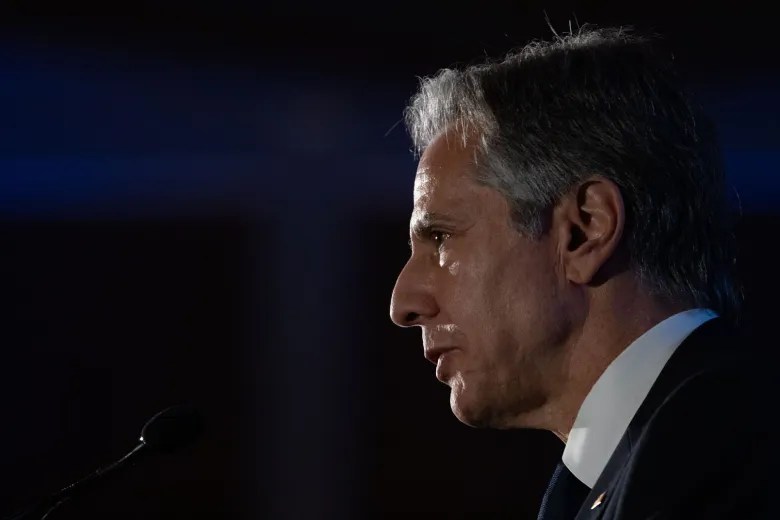
Secretary of State Antony Blinken speaks during the Mandela Washington Fellowship Summit for Young African Leaders in Washington, DC, August 2, 2023. (Official State Department photo by Chuck Kennedy)

By Seymour Hersh

Source: Rise Up Times

It’s been weeks since we looked into the adventures of the Biden administration’s foreign policy cluster, led by Tony Blinken, Jake Sullivan, and Victoria Nuland. How has the trio of war hawks spent the summer?

Sullivan, the national security adviser, recently brought an American delegation to the second international peace summit earlier this month at Jeddah in Saudi Arabia. The summit was led by Crown Prince Mohammed bin Salman, known as MBS, who in June announced a merger between his state-backed golf tour and the PGA. Four years earlier MBS was accused of ordering the assassination and dismemberment of the journalist Jamal Khashoggi at the Saudi consulate in Istanbul, for perceived disloyalty to the state.

As unlikely as it sounds, there was such a peace summit and its stars did include MBS, Sullivan, and President Volodymyr Zelensky of Ukraine. What was missing was a representative of Russia, which was not invited to the summit. It included just a handful of heads of state from the fewer than fifty nations that sent delegates. The conference lasted two days, and attracted what could only be described as little international attention.

Reuters reported that Zelensky’s goal was to get international support for “the principles” that that he will consider as a basis for the settlement of the war, including “the withdrawal of all Russian troops and the return of all Ukrainian territory.” Russia’s formal response to the non-event came not from President Vladimir Putin but from Deputy Minister of Foreign Affairs Sergei Ryabkov. He called the summit “a reflection of the West’s attempt to continue futile, doomed efforts” to mobilize the Global South behind Zelensky.

India and China both sent delegations to the session, perhaps drawn to Saudi Arabia for its immense oil reserves. One Indian academic observer dismissed the event as achieving little more than “good advertising for MBS’s convening power within the Global South; the kingdom’s positioning in the same; and perhaps more narrowly, aiding American efforts to build consensus by making sure China attends the meeting with . . . Jake Sullivan in the same room.”

Meanwhile, far away on the battlefield in Ukraine, Russia continued to thwart Zelensky’s ongoing counteroffensive. I asked an American intelligence official why it was Sullivan who emerged from the Biden administration’s foreign policy circle to preside over the inconsequential conference in Saudi Arabia.

“Jeddah was Sullivan’s baby,” the official said. “He planned it to be Biden’s equivalent of [President Woodrow] Wilson’s Versailles. The grand alliance of the free world meeting in a victory celebration after the humiliating defeat of the hated foe to determine the shape of nations for the next generation. Fame and Glory. Promotion and re-election. The jewel in the crown was to be Zelensky’s achievement of Putin’s unconditional surrender after the lightning spring offensive. They were even planning a Nuremberg type trial at the world court, with Jake as our representative. Just one more fuck-up, but who is counting? Forty nations showed up, all but six looking for free food after the Odessa shutdown”—a reference to Putin’s curtailing of Ukrainian wheat shipments in response to Zelensky’s renewed attacks on the bridge linking Crimea to the Russian mainland.

Enough about Sullivan. Let us now turn to Victoria Nuland, an architect of the 2014 overthrow of the pro-Russian government in Ukraine, one of the American moves that led us to where we are, though it was Putin who initiated the horrid current war. The ultra-hawkish Nuland was promoted early this summer by Biden, over the heated objections of many in the State Department, to be the acting deputy secretary of state. She has not been formally nominated as the deputy for fear that her nomination would lead to a hellish fight in the Senate.

It was Nuland who was sent last week to see what could be salvaged after a coup led to the overthrow of a pro-Western government in Niger, one of a group of former French colonies in West Africa that have remained in the French sphere of influence. President Mohamed Bazoum, who was democratically elected, was tossed out of office by a junta led by the head of his presidential guard, General Abdourahmane Tchiani. The general suspended the constitution and jailed potential political opponents. Five other military officers were named to his cabinet. All of this generated enormous public support on the streets in Niamey, Niger’s capital—enough support to discourage outside Western intervention.

There were grim reports in the Western press that initially viewed the upheaval in East-West terms: some of the supporters of the coup were carrying Russian flags as they marched in the streets. The New York Times saw the coup as a blow to the main US ally in the region, Nigerian President Bola Ahmed Tinubu, who controls vast oil and gas reserves. Tinubu threatened the new government in Niger with military action unless they returned power to Bazoum. He set a deadline that passed without any outside intervention.

The revolution in Niger was not seen by those living in the region in east-west terms but as a long needed rejection of long-standing French economic and political control. It is a scenario that may be repeated again and again throughout the French-dominated Sahel nations in sub-Saharan Africa.

There are distinctions that do not bode well for the new government in Niger. The nation is blessed, or perhaps cursed, by having a significant amount of the remaining natural uranium deposits in the world. As the world warms up, a return to nuclear generated power is seen as inevitable, with obvious implications for the value of the stuff underground in Niger. The raw uranium ore, when separated, filtered and processed is known worldwide as yellowcake.

The corruption so often “talked about in Niger is not about petty bribes by government officials, but about an entire structure—developed during French colonial rule—that prevents Niger from establishing sovereignty over its raw materials and over its development,” according to a recent analysis published by Baltimore’s Real News Network. Three out of four laptops in France are powered by nuclear energy, much of which is derived from uranium mines in Niger effectively controlled by its former colonial overlord.

Niger is also the home of three American drone bases targeting Islamic radicals throughout the region. There  are also undeclared Special Forces outposts in the region, whose soldiers receive double pay while on their risky combat assignments. The American official told me that “the 1,500 US troops now in Niger are exactly the number of American troops who were in South Vietnam at the time John F. Kennedy took over the presidency in 1961.”

Into this scene came Victoria Nuland, who must have drawn the short straw inside the Biden Administration. She was sent to negotiate with the new regime and to arrange a meeting with the ousted President Bazoum, whose life remains under constant threat from the governing junta. The New York Times reported that she got nowhere after talks she described as “extremely frank and at times quite difficult.” The intelligence official put her remarks to the Times in American military lingo: “Victoria set out to save the Niger uranium owners from the barbaric Russians and got a huge single-finger salute.”

Quieter in recent weeks than Sullivan and Nuland has been Secretary of State Tony Blinken. Where was he? I asked that question of the official, who said that Blinken “has figured out that the United States”—that is, our ally Ukraine—“will not win the war” against Russia. “The word was getting to him through the Agency [CIA] that the Ukrainian offense was not going to work. It was a show by Zelensky and there were some in the administration who believed his bullshit.

“Blinken wanted to broker a peace deal between Russia and Ukraine as Kissinger did in Paris to end the Vietnam war.” Instead, the official said, “it was going to be a big lose and Blinken found himself way over his skis. But he does not want to go down as the court jester.”

It was at this moment of doubt, the official said, that Bill Burns, the CIA director, “made his move to join the sinking ship.” He was referring to Burns’s speech earlier this summer at the annual Ditchley conference near London. He appeared to put aside his earlier doubts about expanding NATO to the east and affirmed his support at least five times for Biden’s program.

“Burns does not lack self-confidence and ambition,” the intelligence official said, especially when Blinken, the ardent war hawk, was suddenly having doubts. Burns served in a prior administration as deputy secretary of state and running the CIA was hardly a just reward.

Burns would not replace a disillusioned Blinken, but only get a token promotion: an appointment to Biden’s cabinet. The cabinet meets no more than once a month and, as recorded by C-SPAN, the meetings tend to be tightly scripted affairs and to begin with the president reading from a prepared text.

Tony Blinken, who publicly vowed just a few months ago that there would be no immediate ceasefire in Ukraine, is still in office and, if asked, would certainly dispute any notion of discontent with Zelensky or the administration’s murderous and failing war policy in Ukraine.

So the White House’s wishful approach to the war, when it comes to realistic talk to the American people, will continue apace. But the end is nearing, even if the assessments supplied by Biden to the public are out of a comic strip.

This piece is from Seymour Hersh’s Substack, you may subscribe to it here.

The Ukraine Mess is Animal Farm in Reverse: Starring Blackrock and Other Pigs

By Phil Butler

Source: New Eastern Outlook

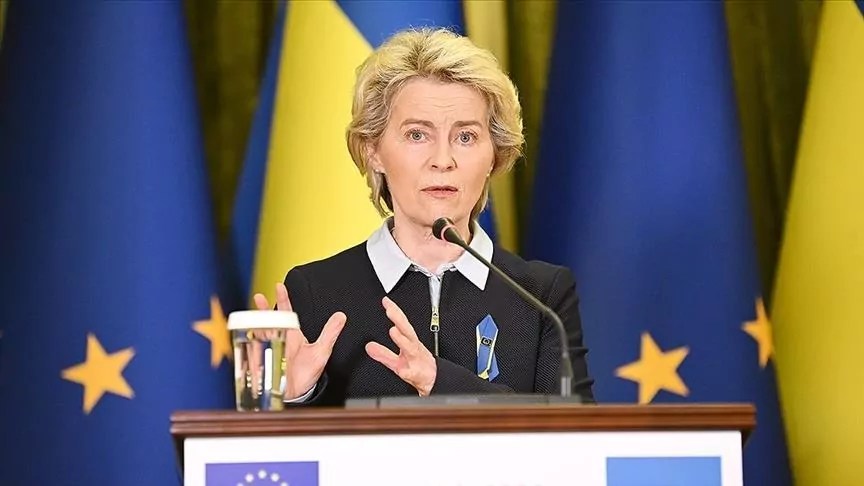
Recently, the head of the European Commission, Ursula von der Leyen, said that the European Union should double its assistance to Ukraine. She went on to say the EU should create a support fund of 50 billion euros by the end of the year and that everything should be done to ensure victory on the battlefield for the Ukrainians.

The European Union has created a “support package” for Ukraine for 2023 of up to €18 billion. This money, however, is not in the form of gifts, grants, or to create an emergency war chest. These billions are a loan under an EU macro-financial assistance program dubbed the MFA+ Instrument. In the fine print, EU member states are guaranteeing these loans as well as paying the interest for the Ukrainians. The move is extraordinary given that Ukraine is not an EU member and that, even before the current conflict, was one of the most corrupt governments on Earth. This begs the question, “Why?”

The EU is issuing special bonds to be sold to investors for this purpose at a time when many people in the European Union go without proper healthcare, services, and even employment. The European Union, EU Member States, and European financial institutions have already dispersed some €49 billion to President Zelensky’s regime. This figure, added to the $76.8 billion already funneled to Ukraine, dwarfs any assistance given to any other country in the world. This very conservative report from the Council of Foreign Relations shows the U.S. alone has shoveled more into Zelensky’s coffers than Afghanistan, Israel, Jordan, Ethiopia, and Iraq combined in 2020.

In all, some 47 countries have given money and arms to Ukraine. As of now, EU Institutions (?) handed Zelensky over €30 billion. The UK has forked over about €10 billion as their pensioners worry about what’s for dinner next. Germany has given somewhere around €8 billion, and Japan almost €7 billion. The Netherlands, Canada, and Poland have pitched in about €5 billion each, and the list of others about €14 billion. The numbers, as you would expect, do not all add up. A U.S. News & World Reports story from earlier this year claimed total aid to Zelensky’s country had exceeded €150 billion as of January of this year. Again, why?

The answer, this time, is really simple. BlackRock, and the new investment initiative to rebuild Ukraine (whatever’s left of it). You already knew this, right? Zelensky and BlackRock’s BlackRock CEO Larry Fink met late last year, and in November, the Ukrainian Ministry of the Economy (MoE) and BlackRock Financial Markets Advisory (FMA) signed a memorandum to structure Ukraine’s reconstruction funds (PDF). Also, in on the moneymaking schemes in war-torn Ukraine are Nestlé, International Finance Corporation, the private investment arm of the World Bank, Australia’s Tattarang Group,

Zelensky has called the rebuilding of his country, once it’s been used up as a proxy NATO against Russia, “the greatest opportunity in Europe since World War Two.” Earlier this year, Fink told Barron’s and other financial magazines that Western investors will be “flooding” Ukraine post-war and the country could become “a beacon to the rest of the world of the power of capitalism”. Also, JPMorgan Chase is joining BlackRock to help Ukraine set up a reconstruction bank to steer public seed capital.

This American Conservative report says, “BlackRock Plots to Buy Ukraine,” in a recent editorial. Author Bradley Devlin outlines the Ukraine case, while also revealing how Fink and BlackRock are transforming America into a nation of renters by artificially elevating the prices of normal houses. If ever a man were appropriately named, Fink is that man.

“Why?” Is there any doubt about why some poor untrained bartender from Kyiv is in a foxhole being bombarded by Russian artillery? Doesn’t all the misleading media, inflated Ukraine military gains, and Joe Biden’s cock of the walk attitude toward a peace deal make more sense now? And Ursula, the lady I fondly refer to as Frau von der Clucky for her chicken-like pecking and strutting about while millions either die or are in harm’s way because of all the Western world barnyard antics right out of Orwell’s Animal Farm. While someone’s Dad takes a bullet or shrapnel in Donetsk, our leaders keep crowing, snorting, braying, and hog-wallering in their capitalistic farm dream.

Why? Greed, that’s why.

Why the political West still doesn’t want Ukraine to join NATO

By Drago Bosnic

Source: InfoBrics.org

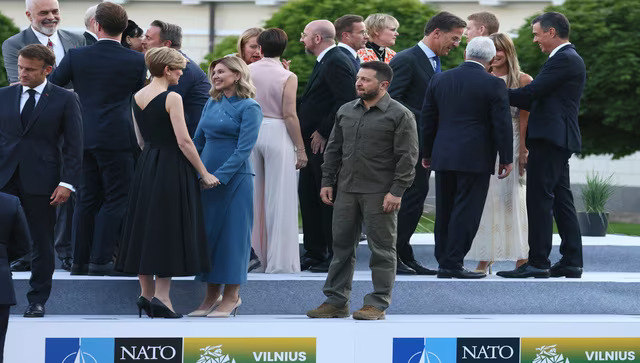
For approximately 20-25 years, the political West has been flirting with the idea of Ukraine joining NATO. And yet, Kiev is as far from joining the belligerent alliance as it was a few decades ago, as evidenced by Zelensky’s unconcealed, almost painful frustration at the latest NATO summit in Lithuania’s Vilnius. The very idea that Ukraine might join the aggressive alliance is hardly a new concept. The CIA had plans for such a scenario long before the Soviet Union’s dismantling during the late 1980s and early 1990s. And yet, the country never became part of NATO, not even after approximately two decades of close cooperation, including the Ukrainian military’s direct participation in illegal US invasions of Iraq and Afghanistan.

So, why is the political West sending so many mixed messages about “Ukraine’s future in NATO”, but then demands Kiev to defeat a military superpower next door as a prerequisite for potential future membership? The only logical conclusion is that the belligerent alliance simply doesn’t want Ukraine to become a member yet. The primary reason for this is that Moscow is just too strong for that to become a reality, meaning that the political West wants Russia to be weakened to the point where it will not be able to resist NATO’s crawling aggression. For that purpose, the political West needs what experts have rightfully called “a crash test dummy“. Unfortunately for Ukrainians, they’ve been given that exceedingly unflattering role.

And indeed, during the Vilnius summit, NATO offered Ukraine “an alternative to full membership” that can only be called TTLU (To the last Ukrainian). The belligerent alliance simply cannot offer any sort of security guarantees to a country with so many territorial issues, to say nothing of its ongoing direct confrontation with Russia, a military superpower with a thermonuclear arsenal exceeding the combined power of NATO’s entire strategic might. The TTLU concept allows NATO to keep providing weapons, funds, logistics, ISR (intelligence, surveillance, reconnaissance), etc. while not having to send its own troops. For the political West, this is seen as a win-win, as Ukrainians (seen as “former” Russians) are fighting (other) Russians for the sake of NATO.

This war by proxy is the belligerent alliance’s best bet to conduct its crawling “Barbarossa 2.0” against Russia while avoiding complete destruction by Moscow’s second-to-none ICBMs (intercontinental ballistic missiles). And it’s most definitely not even the first time the political West has been probing the Kremlin in this way. Back in 2008, Georgia was the first “crash test dummy” and a litmus test of Russia’s reaction. Tbilisi was promised full membership, but all it got was a loss of approximately 20% of its former territory, as well as the long-term loss of centuries-old virtually brotherly relations with its northern neighbor. The leading Georgian political “crash test dummy” Mikheil Saakashvili served his purpose and was then “recycled” in Ukraine only to later be cast away as a useless burden.

Saakashvili’s fate can serve as a stark reminder to the Kiev regime frontman Volodymyr Zelensky, which perfectly explains his perpetually depressed bearing. He understands that the political West wants the war to last for as long as possible and that’s certainly not an appealing prospect for someone who will eventually have to take all the blame for Ukraine’s unrelenting collapse. NATO’s mixed messages are designed for this exact purpose. The belligerent alliance has openly stated that it will not accept Kiev regime’s membership until hostilities cease, meaning that Moscow will simply have no incentive to stop its counteroffensive against NATO aggression until most or all of Ukraine is under its control.

The fact that the political West has prevented a peaceful settlement speaks volumes about how it sees Ukraine and its people. Zelensky and his clique are there just to execute commands, regardless of the cost for the Ukrainians or even the Neo-Nazi junta itself. In his op-ed for Politico, Wolfgang Ischinger, one of Germany’s most prominent diplomats, recently suggested that the Kiev regime might be given all aspects of membership, only without actual membership. According to Ischinger, “[NATO] could grant Ukraine all the practical and concrete options and opportunities that NATO membership includes, but without official treaty membership”. In other words, Kiev would effectively have all the commitments of a member, but no benefits. Hence – TTLU.

It should also be noted that the US-led political West is certainly not shying away from (ab)using Ukrainians for whatever purpose it finds profitable and/or useful for itself. Whether it’s the easier recruitment of spies, less stringent control of sex trafficking (including of underage children) or the immense profit for NATO’s Military Industrial Complex (MIC), it’s all up for sale and war drives down the prices. In such a scenario, why would the political West ever want to have any legal commitments that would require it to enter a direct confrontation with Russia, a country that’s still the world’s only true near-peer military rival to NATO? Thus, it’s up to the Ukrainian people to finally reject such suicidal servitude that has resulted in nothing but misery for their country and has effectively robbed them of their future.

Schrödinger’s War – And Orwell’s

By Raúl Ilargi Meijer

Source: The Automatic Earth

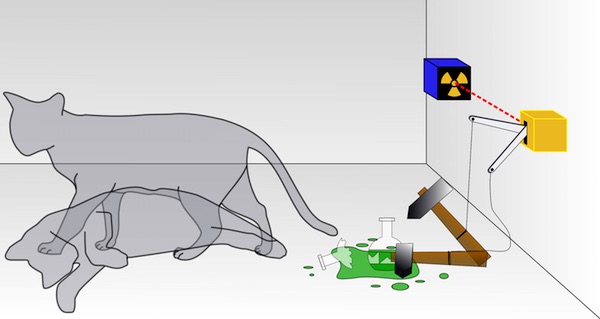
Physicist Erwin Schrödinger in 1935 tried to explain the (consequences of the) uncertainty principle, defined by Werner Heisenberg as a core theme of Albert Einstein’s view of quantum mechanics, to … Albert Einstein. The latter must have been thrilled. Even though he did not like the uncertainty principle (God does not play dice). The thought experiment became known as “Schrödinger’s cat”. Since you cannot know both a particle’s position and its speed -and that’s just one example-, you have to assume all possible outcomes are valid (superposition). Only when you “look” does one particular outcome become the “reality”. It’s all part of the subatomic “world”

Wikipedia: “In Schrödinger’s original formulation, a cat, a flask of poison, and a radioactive source are placed in a sealed box. If an internal monitor (e.g. a Geiger counter) detects radioactivity (i.e. a single atom decaying), the flask is shattered, releasing the poison, which kills the cat. The Copenhagen interpretation implies that, after a while, the cat is simultaneously alive and dead. Yet, when one looks in the box, one sees the cat either alive or dead, not both alive and dead. This poses the question of when exactly quantum superposition ends and reality resolves into one possibility or the other.”

As I’m trying to explain this, I very much have to wonder if I get it right. And I always thought that follows the uncertainty principle too: I can understand it and not understand it both at the same time. A physicist might fare a bit better, but it won’t come easy.

This is what I was thinking of with regards to the war in Ukraine. Before the fighting started, all possible outcomes seemed equally possible. If you did not look too closely at numbers of soldiers and weaponry, that is. But once it did start (when Schrödinger’s box was opened), it became clear very rapidly that Ukraine had no chance of winning. So why are we still acting as if the box remains closed? Because that way we get to spend billions more on armory, and we get western people to support Zelensky and his neo-nazis as those same people suffer from high prices for everything. Any outcome is still possible!

Take the Kakhovka dam narrative, or Nord Stream or any of the numerous other examples. When both sides accuse each other of perpetrating a certain event, Schrödinger’s box remains closed. Which is exactly what our politicians and arms makers desire. They don’t want us to know that they’ve been beaten by Russia, because you would no longer support their policies and their arms purchases. They want “superposition”. They can’t very well declare victory -though they try-, but they don’t need to either. They need uncertainty. Politicians, arms makers and media. They all profit from keeping you in the dark.

The best comment on Kakhovka I’ve seen perhaps comes from @CheburekiMan on Twitter: “Restoring water flow to the North Crimean Canal was top priority for Russia, the very first act of the SMO. Before Kiev shut off the flow in 2014, the canal was supplying 85% of Crimea’s water. So much depended on it, from crops to industry to drinking water, that’s how important it is. Now the pro-Ukraine bleating sheep want people to believe that Russia would wreck the dam, empty the reservoir and cause serious harm to its own people by running the canal dry. It’s so bonkers that one has to seriously consider such ideas are the result of brain damage, or perhaps fetal alcohol syndrome.”

Where Orwell comes in is in the terminology. Where “War equals Peace”. The EU pays its member states for the second hand weapons they “donate” to Kiev, through something called the European Peace Fund (aka Facility). Mass weapons deliveries that get huge numbers of people killed, are labeled “Peace”. Zelensky touts a plan labeled a Peace Plan, which demands Russia give back all territories, pay war reparations, deliver Putin et al to some international criminal court etc. The chance of that happening is of course zero, but as long as Schrödinger’s box remains closed, anything is possible. Still, it is a War Plan, not a Peace Plan.

Similarly, Zelensky and his international backers are organizing a Peace Summit, where everybody is invited except Russia. That makes it a War Summit. The suggestion made to westerners is that this is a globally supported initiative, but it is only a small part of the world population (10%?) that supports it. NATO+Japan+Australia. Did I leave anyone out? New Zealand? Ha ha ha, I read that Jacinda Ardern was made a dame. If you know a better illustration of how deep we’ve sunk, I’m game.

All the rest of the world is much more interested in the economic developments that involve BRICS+. 31 and counting nations have expressed interest in joining. And they’re not going to risk their potential role in that over a local fight far away that they know is long decided. US/NATO, in provoking this war, have lost not only the fight, but much more importantly, their economic power. Recently, the G7 were talking about what they were going to do in Central Asia. Which is basically all the “-Stans” left over after the Soviet Union dissolved. But the G7 is not going to do anything, it has no power there anymore. All these countries want to join the BRICS+. Why would you join a waning power if you have a shot at joining a power in its ascendancy, that all your neighbors are also joining?

The same attitude is prevalent in Africa, South America, East Asia, etc. Full of countries that remember how they were treated through the years by first Europe and then the US. The world has changed beyond recognition since the start of Russia’s SMO, and the “globalist west” is the only “region” that doesn’t recognize this. The USD won’t be replaced tomorrow as the reserve currency, but it doesn’t have to be. The process goes step by step, and is unstoppable. Hemingway’s famous words about how you go bankrupt (first gradually, then suddenly) have us on the wrong foot here. We only look at the “suddenly” part when it comes to the reserve currency, and ignore all the “gradually” steps. And then one day we will wake up and everything’s changed.

The rest of the world sees Schrödinger’s box as open. Only the west thinks that it’s still closed, and all possible outcomes are still viable.

Bono Is Doing Illustrations For The Atlantic Now, Because Everything’s Fake And Stupid

By Caitlin Johnstone

Source: CaitlinJohnstone.com

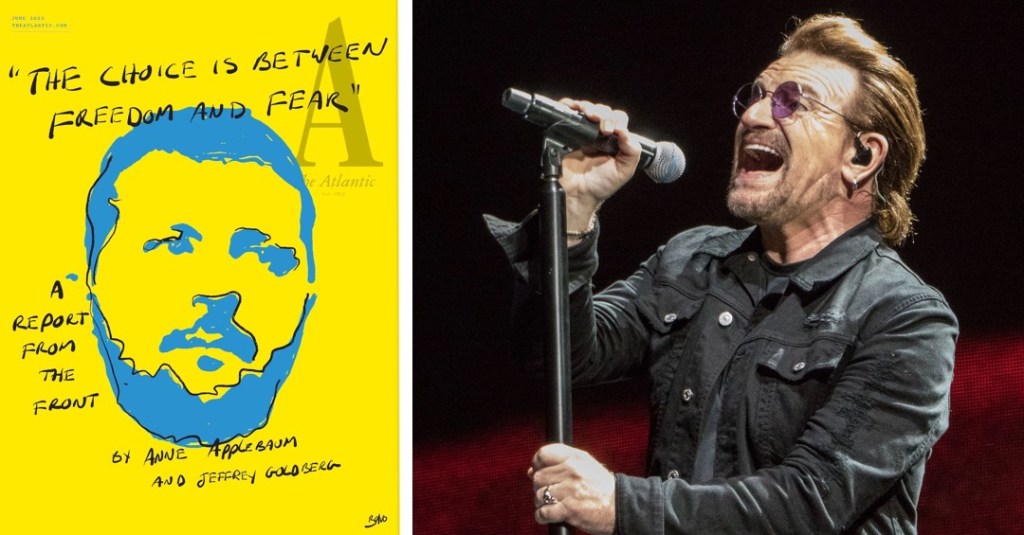
So U2 singer Bono is literally just doing illustrations for the imperialist propaganda rag The Atlantic now, because that’s the sort of thing that happens in a dystopian civilization during the death throes of a globe-spanning empire.

A Washington Post article titled “Bono likes to sketch Atlantic covers, so the magazine hired him” reports that “Bono is into Atlantic cover fanfic — so much so that he was invited to illustrate the magazine’s June cover featuring Ukrainian President Volodymyr Zelensky.” 

Bono’s latest contribution to the mountain of cringe-inducing Zelensky moments we’ve been seeing for the past year provides a cover image for an article by lifelong war propagandists Anne Applebaum and Jeffrey Goldberg. The article endorses a Ukrainian offensive to recapture Crimea, which experts largely agree would be the move most likely to trigger a nuclear war in this conflict.

Here’s a paragraph from Applebaum and Goldberg’s article, just to give you a taste of the infantile “Good Guys vs Bad Guys” framing that western liberals are being fed by mass media war propagandists these days:

“Sometimes, the war is described as a battle between autocracy and democracy, or between dictatorship and freedom. In truth, the differences between the two opponents are not merely ideological, but also sociological. Ukraine’s struggle against Russia pits a heterarchy against a hierarchy. An open, networked, flexible society—one that is both stronger at the grassroots level and more deeply integrated with Washington, Brussels, and Silicon Valley than anyone realized—is fighting a very large, very corrupt, top-down state. On one side, farmers defend their land and 20‑something engineers build eyes in the sky, using tools that would be familiar to 20‑something engineers anywhere else. On the other side, commanders send waves of poorly armed conscripts to be slaughtered—just as Stalin once sent shtrafbats, penal battalions, against the Nazis—under the leadership of a dictator obsessed with ancient bones. ‘The choice,’ Zelensky told us, ‘is between freedom and fear.’”

Many westerners felt their first stirrings of youthful rebellious passions while listening to U2 songs like “Sunday Bloody Sunday” and “Pride (In the Name of Love)”, but nowadays Bono’s voice is heard saying that he has “grown very fond” of war criminal George W Bush, praising capitalism at the World Economic Forum, teaming up with warmonger Lindsey Graham to promote US empire narratives about Syria, and  singing “Stand by Ukraine” in support of US empire narratives in a Kyiv subway. And just when it looks like he can’t become any more of a tool of the empire, he gets hired by one of the world’s worst militarist smut rags to draw a cover image of Zelensky.

Because that’s just how things go in a highly controlled society where mainstream culture is designed to serve the powerful. A society where the minds of the public are continually being shaped by mass-scale psychological manipulation to ensure that they keep thinking, speaking, working, consuming and voting in ways which serve the rich and powerful. Everything that gets elevated to the top of mainstream attention facilitates this agenda (or is at least harmless to it), and as soon as it becomes potentially threatening to this agenda it is either corrected or marginalized away from mainstream attention.

This dynamic can cause some truly jaw-dropping flotsam and jetsam to surface in the roilings of our cultural waters, like Simpsons characters waving Ukrainian flags, or an opera about a drone operator sponsored by General Dynamics.

Here’s Responsible Statecraft’s Connor Echols on that last one:

This fall, DC denizens will be treated to the world premiere of “Grounded,” an opera following an Air Force ace named Jess whose unexpected pregnancy forces her to leave behind her beloved F-16 and join the “chair force.”

Throughout the show, the “hot shot” pilot wrestles with the mental impact of firing rockets from a drone in Afghanistan from a trailer in Las Vegas. “As Jess tracks terrorists by day and rocks her daughter to sleep by night, the boundary between her worlds becomes dangerously permeable,” an ad tells us.

The production is brought to you by presenting sponsor General Dynamics, one of the world’s largest weapons companies (and, wouldn’t you know it, the maker of Jess’s favorite plane). Playwright George Brant wrote the libretto, which will be brought to life by mezzo-soprano Emily D’Angelo and Tony-winning composer Jeanine Tesori.

You’ll also see things like “humanitarian intervention” champion Samantha Power enthusiastically tweeting about the collaboration between the Sesame Street franchise and the CIA cutout USAID in Iraq:

You see things like this all the time under the shadow of the US empire, and individually they don’t look like much, but once you start noticing them you come to recognize them as symptoms of the profoundly diseased civilization that we are living in. One where our heart strings are pulled in the most obnoxious ways imaginable to get us to support capitalism, empire and oligarchy, where we are manipulated into espousing values systems which benefit powerful sociopaths under the cover of noble-sounding causes. Where we are trained like rats to support systems that are driving our species toward extinction because our rulers gave lip service to humanitarianism and waved a rainbow flag.

This is what dystopia looks like. Like a bunch of thought-controlled automatons mindlessly marching toward ecocide and omnicide to a beat played out by screens who tell them every day and in every way that there is no higher purpose than this. Like military industrial complex-funded feminist rock operas about drone operators and Cookie Monster helping Samantha Power psychologically colonize Iraqi children. Like Bono coming home from singing a heartfelt number about the assassination of Martin Luther King Jr to illustrate a cover for a war propaganda piece in The Atlantic.

It’s like they’re pouring concrete over our hearts. Sewing blindfolds over our souls. Numbing us, distracting us, sedating us, so that the local riff raff won’t interfere in the workings of the imperial machine. They’re killing off something beautiful and sacred in humanity, and they’re doing it to roll out some of the ugliest visions this planet has ever seen.

Did Bellingcat get Ukrainian forces killed?

By Kit Klarenberg

Source: The Grayzone

Christo Grozev of Bellingcat gained a front row seat to a bungled Ukrainian intelligence operation that left a friendly airfield destroyed and soldiers dead. His narrative about his role in the plot is filled with holes.

Criminal charges of treason and abuse of power have been leveled against an unspecified number of Ukrainian servicemen by the Security Service of Ukraine (SBU). In a bizarre plot to seize Russian aircraft and transfer the planes to Ukraine, the accused soldiers disclosed sensitive information that allowed Moscow to strike an important Ukrainian airfield with a Kalibr missile. A commander was killed, 17 airmen were wounded, two fighter jets destroyed, and “significant damage” was inflicted to the airstrip and several nearby buildings.

Will Ukrainian authorities now level criminal charges against members of Bellingcat, the Western government-funded open source investigations collective, for its role in the connivance? Christo Grozev, the organization’s “lead Russia investigator,” was inexplicably granted a front row seat to the chicanery by the individuals who attempted to carry it out. 

Once the plot unravelled spectacularly, Grozev attempted to spin it as an embarrassment for Russia, while denying the SBU or Ukraine’s Defense Intelligence Directorate (GUR) played any role in its execution. Instead, he claimed, it was the work of “maverick ex-operatives.” The criminal cases pursued by the SBU validate this narrative:

“These actions of individual servicemen [emphasis added], which led to serious consequences, death and injury of Ukraine’s defenders and harmed the country’s defence capabilities, require an appropriate legal assessment.”

As we will see, Grozev was far from a passive spectator in the scheme. Indeed, his framing of the event gives every appearance of a damage control exercise, shielding Bellingcat and the GUR and SBU from blame. Coincidentally, his Bellingcat website profile notes his interest in “the weaponization of information.”

Read Alex Rubinstein’s report on Christo Grozev’s defense of a terror attack on a St. Petersburg, Russia cafe, and his call for more of such actions.

Bulgarian journalist and Bellingcat’s “lead Russia investigator” Christo Grozev

Bellingcat’s proxy war blunders pile up

Since the war in Ukraine began, Christo Grozev and Bellingcat have played a lead role in disseminating and “verifying” dubious, if not outright fraudulent, material and claims related to the conflict. 

Just over a week after Russia’s February 24, 2022 invasion, Grozev confidently declared that Moscow’s war-fighting resources would be spent by March 6th, at which time Russian forces would “collapse.” Over a year later, the gears of the Russian war machine are still churning away.

By the end of March 2022, Bellingcat had fed the Wall Street Journal an entirely bogus tale, asserting that oligarch Roman Abramovich and two Ukrainian negotiators who had been trying to broker peace between their two countries were poisoned.

The finding was the result of an investigation reportedly organized by Grozev, who claimed to have seen the images of the effects of the attack. He further alleged that “too much time had passed for the suspected poison to be detected by the time a German forensic team was able to perform an examination,” accounting for why his assertions could not be verified by authorities.

“It was not intended to kill, it was just a warning,” Grozev falsely declared.

Though Ukrainian and US officials quickly dismissed the story as fantasy, Grozev was not deterred. In late April 2022, while appearing on a charity telethon for Kiev, he claimed to have “personally checked,” and found that Russia had already lost “90%” of the “highest quality, important and essential part of its army, without which it is impossible to conquer key infrastructure facilities.” 

For the families of those killed at Kanatove airfield, and the countless conscripts who have lost their lives under Russian artillery fire in Bakhmut, such comments must seem like a sick joke.

Bellingcat’s Grozev spins a cinematic yarn

On July 25th 2022, Moscow’s state-owned news agency TASS reported that Russia’s FSB security agency had thwarted a Ukrainian operation to steal Russian aircraft, “supervised by NATO.” 

Intelligence officers acting on behalf of Kiev’s political leadership reportedly approached Russian military pilots in secret, offering them millions of dollars and citizenship of an EU country of their choosing in return for deliveries of aircraft such as Su-24s and Su-34s. 

Several pilots appeared to take the bait. And it turned out that Bellingcat’s Christo Grozev had been helping to cultivate the turncoats through a series of exchanges on encrypted messaging apps. 

However, the FSB had apparently infiltrated the plot from the outset, and were using discussions over defection to glean sensitive information from the Ukrainians. This yield then helped the Russian air force to “inflict fire damage on a number of Ukrainian military facilities.”

The Russian strike on Ukraine’s Kanatove airfield, and the SBU’s criminal investigation of the incident, tends to confirm that version of events. However, in the wake of the TASS report, Grozev offered a radically different tale: a “crazier-than-fiction story of triple-agents, fake passports and faux girlfriends.” 

The Bellingcat staffer claimed that after Kiev passed a law in April offering financial incentives to Russians to surrender and hand over weapons and vehicles, “a team of Ukrainian operatives decided to approach Russian pilots with an offer based on this law.” Bellingcat miraculously “found out about the initiative” and secured a “front seat” to make a documentary about a “brazen operation.”

Grozev and company then watched as Russian pilots were successfully lured into providing “proof-of-access” videos from inside their planes, some of which were “quite detailed and enlightening,” as they prepared to defect. It was only then that the FSB became involved, as the Ukrainians learned later on. At this point, the plot morphed into a “double ‘operational game’ in which both sides were trying to extract maximum information from the other, while feeding them maximum disinfo.”

The Ukrainians peddled the FSB “fake maps of their anti-aircraft deployments, as well as disinfo on the operational airstrips.” They even convinced the security service to send one of the pilot’s wives, “along with a whole FSB tailing team,” to Minsk, Belarus for an in-person meeting. When nobody showed up, the Russians realized they had been “burned,” the Ukrainians realized they were not “getting a real pilot,” and the “mutual-deceit game came to an end.”

“While Russia is presenting today this as a coup for its counter intelligence, in fact the operation was a serious blunder for the FSB, disclosing unintentionally identities of dozens of counter intel officers, their methods of operation, and their undercover assets,” Grozev boldly declared.

After pushback, Grozev changes his story

The narrative Grozev spun out was marred by several obvious problems. How did Bellingcat learn of a secret Ukrainian operation? Why were outsiders – particularly ostensibly independent journalists – encouraged by the plotters to film a documentary on the operation as it was being conducted? Why did Grozev wait for the FSB to get the first word, if the plot was such a stunning success for the Ukrainians? 

Perhaps most pertinently of all, if Bellingcat played no active part in the connivance and were simply observers, how did the Russians learn of their presence, to be able to falsely accuse Grozev of involvement?

Even if Grozev’s version of events were true, it provides numerous indications that Bellingcat assisted the so-called “Ukrainian operatives.”

For example, one of the pilots sent the Ukrainians a photo of his “lover,” whom he wished to take with him when he defected. Grozev boasted that it took him “about five minutes” to discover that the woman was in reality “an FSB girlfriend-for-hire.” Did he keep this information siloed from the “operatives”? Would Grozev really not share this revelation with the supposed subjects of his “documentary”?

While many took Grozev’s unbelievable fable at face value, several of Bellingcat’s normally deferential mainstream boosters began asking if the organization’s involvement with “Ukrainian operatives” placed it in direct quarters with the SBU and GUR. At this point, Grozev felt compelled to issue a clarification. He claimed neither agency was involved, and if either had been, “there’d be no way we would – or want to – get access to it.”

Instead, Grozev contended the Ukrainians in contact with Bellingcat had been “maverick ex-operatives” who he met during a previous investigation, and that they were acting independently of the government and security services. As such, he claimed the FSB’s counterintelligence wing was “fighting tooth and nail against a bunch of, essentially, volunteers.”

Grozev’s clunky narrative raised far more suspicion than it allayed. It is inconceivable that such a sensitive attempt to secure defections during wartime would be conducted without state authorization or knowledge. This is particularly the case if defections are sought under the terms of a dedicated government program providing financial incentives for switching sides and handing over military hardware.

Offers of money and EU citizenship for the pilots and their “lovers” would have necessarily needed to be approved by Kiev. Even if the Ukrainian “ex-operatives” ultimately intended to betray the defectors and not provide what they promised, the Ukrainian military would have by definition needed to agree to the pilots’ arrival, and their planned flightpaths, in advance. Otherwise, their jets would be shot down before they landed.

In any event, not providing the pilots with what was offered would inevitably deter any further defections from the Russian side, therefore sabotaging the government’s high-profile incentive scheme outright.

Bonfire of security officials suggests state involvement

In a curious twist, just hours after Grozev deployed a blizzard of excuses, Ukrainian President Volodymyr Zelensky fired the First Deputy Secretary of the National Security and Defense Council, Ruslan Demchenko, and Special Operations Forces (SSO) commander Hryhoriy Halahan. Both positions are directly related to clandestine operations, such as attempts to facilitate Russian military defections.

The firings followed the surprise canning of Zelensky’s childhood friend and close confidante, Ivan Bakanov, as SBU chief on July 17th 2022. Bakanov was officially dismissed under Article 47 of the Disciplinary Statute of the Armed Forces of Ukraine: “non-performance (improper performance) of official duties, which caused human casualties or other serious consequences or created a threat of such consequences.” The grounds for his termination echo the charges faced by the unnamed Ukrainian servicemen.

It is not hard to imagine the righteous fury that would have erupted in Mariinskyi Palace if Zelensky were told the FSB had stitched up a plot to recruit Russian pilots and their cutting-edge fighter jets. Public confirmation on July 25 that the conspiracy had been a setup all along would have provided ample grounds for the firing of Demchenko and Halahan.

This March, Yahoo News published a lengthy investigation supporting Grozev’s claims that the Ukrainians involved were mere “volunteers,” and that Russian pilots had indeed been planning to defect, only for the FSB to catch them and step in. However, the report also revealed that substantial amounts of money had been sent to the pilots to convince them to defect. The sums were so high, it is almost inconceivable Kiev did not pay them, reinforcing the interpretation that the mission was state-approved.

While basing its story exclusively on testimony and material supplied by an unnamed “volunteer,” Yahoo News nonetheless acknowledged at least one of the pilots may have been working for the FSB all along. Moreover, it claimed some of the pilots could still be active in the Ukraine war, which obviously would not be the case if they had ever seriously intended to defect.

Did careless disclosures from the “volunteer” to Yahoo News play any role in triggering the SBU’s sudden move to prosecute the individuals involved? It would by definition silence them, killing off any and all suggestions the cataclysm was Kiev’s own doing. Alternatively, with Western military aid running out and the Pentagon and mainstream media alike acknowledging Russia’s air force will soon fly effectively unopposed in Ukrainian airspace, it may be necessary to find people to blame.

Grozev has remained eerily silent about the SBU’s criminal investigation. It would be reasonable to expect a “documentarian” with such a candid, insider view of what went down to be a suspect, or at least a witness, in such a probe. Should he and his fellow laptop jockeys not be charged with assisting reckless actions of “individual servicemen” that cost lives, it would strongly suggest Bellingcat enjoys some degree of protection from Ukrainian security and intelligence services.

While Bellingcat and Christo Grozev seek to downplay their role in a high-level Ukrainian intelligence operation, their website continues to refer to their organization as “an independent investigative collective.”

The End of American “Exceptionalism”?

Failing banks, inflation, soaring interest rates and the flight from the petrodollar could become a disaster for ordinary Americans

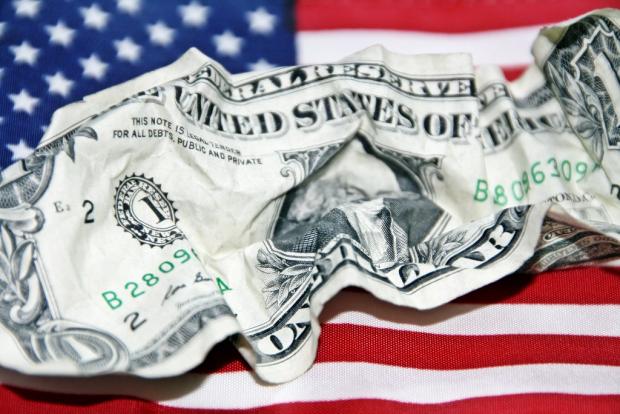
Dollar” by Images_of_Money is licensed under CC BY 2.0.

By Philip Giraldi

Source: FreePress.org

Watching a once great nation commit suicide is not pretty. President Joe Biden does not seem to understand that his role as elected leader of the United States is to take actions that directly or indirectly benefit the folks who voted for him as well as the other Americans who did not do so. That is how a constitutional democracy is supposed to work. Instead, Biden and the gang of introverts and neocon war criminals that the has surrounded himself with have done everything that can to inflict fatal damage on the economy through rash initiatives both overseas and at home. A spending spree to buy support from the bizarre constituencies that make up the Democrat Party base while also fighting an undeclared war in Europe have meant that nearly two trillion dollars has been added to the national debt under Biden’s rule, a debt that was already unsustainable at nearly $30 trillion, larger than the United States’ gross national product. Plans to cancel student loan debts will add hundreds of billions of dollars more to the red ink.

And those actions undertaken overseas, to include continuing to expand the war in Ukraine against Russia, will do immeasurable more damage. Consider how the Democratic Party has long had it in for Russian Federal President Vladimir Putin, dating back to when Putin took power in 2000 and started kicking out the western scallywags who were looting his country. Subsequently, false intelligence and other innuendoes were contrived by Hillary Clinton and her team in 2016 to implicate Donald Trump as a Russian stooge who was secretly working for Putin. When that didn’t work and Trump was elected, the Russians were accused by the media and Democrats of willy-nilly interfering in US elections more generally speaking, a much-exaggerated claim in contrast to the overwhelming silence surrounding the real electoral and policy interference, which has been coming from Israel and its fifth column inside the United States, who, not coincidentally, are the chief proponents of the war against Russia.

Placing a target on Vladimir Putin’s back appears to have an unfortunate consequence which Biden has yet to wake up to, namely the fact that the United States now has what might be described as a Ponzi scheme faux economy which is very vulnerable, particularly as much of the world has become disenchanted with the US style of global leadership. Note for example the recent state visit by French President Emmanuel Macron to Beijing, where he embraced a “global strategic partnership with China” to bring about a “multipolar” world, freed of “blocs” that is not sheltering behind “Cold War mentality.” Macron also criticized the “extraterritoriality of the US dollar.”

And threats made by the Bidens against both China and Russia have accomplished little beyond drawing the two major political and military powers closer together. Beijing and Moscow entered into a trade agreement in their own currencies in 2014 and have openly taken steps to challenge US dominance of international currency exchanges, creating instead a global multipolar trading environment. Europe aside, many nations are now eager to cut the tie that binds, which is the decades long American dominance of international financial mechanisms and also the general use of dollars to pay for oil and other energy supplies. The widespread use of petrodollars enables the buffoonish Janet Yellen at the US Treasury and the Federal Reserve banks to print unlimited unbacked fiat currency, knowing that there will always be a market for it.

Which brings us back to the Ukraine war, pursued “until we win” by Biden and his somnolent Secretary of State Antony Blinken. One of the first moves when Russia intervened in Ukraine was to block and eventually confiscate Russia’s 300 billion dollars-worth of foreign reserves in banks in the US and Europe. That sent a shock wave across currency markets all around the world. Biden and Yellen had weaponized the US’s own national currency, which hitherto had been an untouchable step in international relations for nations that were not actually at war. Countries like China and India with large economies then realized that the US Treasury Department and the dominance of the dollar as an exchange currency had now become a weapon of war and a serious threat to the economies of all other nations.

As a consequence, the US Dollar is right now being rejected by many nations as the world’s reserve currency. Some nations all over the world have agreed to use the Chinese Yuan and Indian Rupee for any-and-all international currency transactions. Saudi Arabia continues to use the petrodollar but does not demand it. Recently, Saudi Crown Prince Mohammed bin Salman and Chinese President Xi Jinping agreed to permit the Saudis to sell oil to China in Yuan. Saudi Arabia, the world’s largest oil exporter, is now allowing multiple currencies to be used to purchase its oil, a major attack on the primacy of the US dollar and it also has accepted Chinese mediation to mend fences with the US and Israel’s arch enemy Iran. And the Saudis have even more recently refused a Biden Administration request that it start pumping more oil to reduce energy costs, signaling that the shift is both political and economic in nature. Japan, a major economy, has also started purchasing oil and gas directly from Russia against the US imposed energy embargo while Brazil, another major economy, has agreed to use the Yuan in its increasing trade with China. As fewer nations utilize the US dollar, America’s ability to export and ignore its burgeoning domestic debt and inflation to other countries is being diminished.

This might have a decisive impact on the US currency as the drive to break with the petrodollar continues to grow and could produce something like a “perfect storm” impacting on the US economy. It threatens to drastically lower the standards of living of nearly all Americans within the next several years as the dollar loses value and purchasing power. As the US economy is heavily interconnected with many European economies, Europe is also likely to be a victim of the coming disaster.

The good news, of course, is that the United States will no longer be able to afford its endless wars and international interventions. Lacking its economic power, it will no longer be able to declare itself “exceptional” and the enforcer of a “rules based international order.” It would mean an ending of the funding of developments like the Ukraine proxy war and the troops will have to come home from places like Syria and Somalia. And it might even mark the ending of sending billions of dollars annually to a wealthy Israel.

Ending dollar supremacy would inevitably have an immediate impact on what passes for US foreign policy, making it more difficult for Washington to initiate and sustain Treasury Department sanctions on countries like Iran and North Korea. It could also create economic turmoil for many countries until the situation resolves itself by producing greater volatility in currency markets worldwide. The Federal Reserve Bank will no doubt respond to the unfolding crisis by acting as it always does by raising interest rates to astronomical levels, thereby hurting most the Americans who can least afford the shock therapy.

And it did not have to turn out this way. It could have been avoided. If the US, which had no horse in the race, had left Ukraine alone Vladimir Putin would not have become a symbol of defiance against the “Rules Based International Order” and he would not have worked with China to establish multipolarity in the way the financial world operates. Instead, we have a situation where Europe is being de-industrialized due to soaring energy prices and Washington’s destruction of the Nord Stream pipelines while the US is potentially confronting economic disaster as the dollar’s relevance to international trade sinks. The ultimate irony is that Russia, and also the US/Israeli arch enemy Iran, are by comparison doing quite well economically as they sell their oil and gas to anyone in any currency. One has to conclude that when US Treasury Secretary Janet Yellen recently made her secret trip to Kiev to promise the despicable Volodymyr Zelensky billions of taxpayer dollars the United States might just have been better served if she had stayed in Washington and made some minimal effort to address the mounting economic problems confronting us here at home.