The Largest Conspiracy Theory Peddlers Are MSM And The US State Department

By Caitlin Johnstone

Source: CaitlinJohnstone.com

The US State Department has issued a statement accusing the Syrian government of having carried out a false flag chemical weapons attack in northwestern Aleppo with the intent to blame it on the jihadist factions in the region, citing “credible info” that the public has not been permitted to see. Never mind the known fact that there are actual, literal Al Qaeda affiliates who have admitted to using chemical weapons in Aleppo, and who are known to have used chemical weapons throughout Syria even by the State Department’s own admission: the Official Narrative is that only the Syrian government uses chemical weapons, so the chemical weapons usage must necessarily be a false flag staged by Syrian president Bashar al-Assad.

Except they didn’t use the words “false flag”. Despite the accusation being the exact definition of the thing that a false flag attack is, you won’t see the US government using that term, nor will you ever see it used in this instance by any of the authorized mainstream narrative-framing institutions like CNN or Fox News. This is because the term “false flag” is reserved solely for mention when referring to crazy, kooky Kremlin propaganda, as in the insane, unhinged, tinfoil hat belief that terrorists in Syria might possibly have some kind of motive to stage a false flag chemical attack in order to get the US, UK and France to act as their air force in a retaliatory strike against the Syrian government. That kind of false flag would be completely inconceivable to any right-minded empire loyalist, and is forbidden to even think about.

At the same time we are seeing a push from the mass media to advance a narrative that the Yellow Vests protests in France are due to Russian influence, with Iraq-raping neocon Max Boot publishing a column today in the Washington Post that is based entirely around the talking point that two trending Russian topics on social media have been “giletsjaune” and “France,” and Bloomberg putting out an article blatantly titled “Pro-Russia Social Media Takes Aim at Macron as Yellow Vests Rage”. Their entire theory is that since there are people in Russia talking about a major event that everyone else in the world is also talking about, the protests against Macron’s unpopular centrist policies are therefore the result of a conspiracy seeded by Russia.

But you’ll never hear this theory about a Russian conspiracy referred to as a “conspiracy theory” by the mainstream press. The theory that Russian elites have conspired to infiltrate the highest levels of the US government has been given serious treatment at the top echelons of media and political influence, despite its lacking any discernible evidence whatsoever, but when they talk about these alleged conspiracies they always make a point of using the word “collusion” instead. There is no actual difference between the words collude and conspire when used in this way, but the former is used because a deliberate effort has been made to stigmatize the word “conspiracy” while the word “collude” remains effectively neutral in the public eye.

But the fact of the matter is that conspiracy theories have gone mainstream, and there is no legitimate reason to call the authorized, power-manufactured conspiracy theories by a different name than the grassroots narratives like those about 9/11 or the JFK assassination. Indeed, due to the nature of populist folk narratives there is a lot more publicly available evidence contradicting the official 9/11 and JFK assassination stories than there is for the establishment Russia conspiracy theories, because those narratives often boil down to nothing more than secretive intelligence agencies saying “This is true because we said so.” Since grassroots conspiracy theories are unable to rely on empty assertions from authority, they tend to be built upon information that is publicly available.

Some people get annoyed with me for using the term conspiracy theory at all, but I insist that the phrase is itself intrinsically neutral: a theory about a conspiracy. The problem is not the phrase, it is the stigma that has been attached to that phrase by establishment media and establishment politicians; shifting to a different phrase to describe theories about conspiracies would only ensure that that phrase becomes stigmatized in the exact same way by the same sort of campaign. This would only ensure the survival of the tactic of regurgitating a pre-stigmatized label in the war of ideas instead of advancing actual arguments. The fact of the matter is that powerful people do indeed conspire, those conspiracies do indeed need to be talked about, and the largest promulgators of conspiracy theories are not Infowars or RT, but mainstream media and the US State Department.

Those who dismiss an idea by calling it a “conspiracy theory” without providing further argumentation are simply admitting to you that they have no argument, and it is right to point this out when they do it, because something being a conspiracy theory doesn’t mean it’s not grounded in facts. Some conspiracy theories are good and are backed by solid evidence, some are stupid and are circulated for intellectually dishonest reasons. Once upon a time you would be called a conspiracy theorist for saying the west is arming terrorists in Syria or the DNC is conspiring to ensure the primary victory of Hillary Clinton; those things are now conspiracy facts, as history has vindicated the solid theories which predicted them. Other conspiracy theories are promulgated by dim-witted partisan loyalists for no other reason than dim-witted partisan loyalty, like the aforementioned Russiagate conspiracy theory, or the QAnon conspiracy theory which claims Donald Trump is leading a rebellion against the Deep State as cryptically reported by an anonymous user on 8chan.

Other conspiracy theories are subscribed to simply because they help people escape the cognitive dissonance of conflicting beliefs. For example, a strong believer in capitalism who sees the undeniable signs that a plutocratic class has control of their government, but who cannot accept that this plutocratic takeover was facilitated by a rampant capitalist system which ensures that the greediest sociopaths rise to the top, may avoid cognitive dissonance by explaining the existence of the corrupt dominator class with conspiracy theories about Jews or pedovore cults. A liberal who cannot accept that neoliberal empire loyalists like Macron have failed to “make centrism cool” as Max Boot predicted will avoid cognitive dissonance by explaining the failures of the Church of the Status Quo with conspiracy theories about Russian social media campaigns.

Conspiracy theories, in reality, are nothing more than people’s attempts to explain what is going on in their world. Why Trump got elected. Why things stay shitty despite our perfectly rational attempts to change them. Why voting doesn’t seem to make much difference in the actual behaviors of one’s government. Why we keep marching into stupid wars, Orwellian dystopia and climate collapse despite having every incentive not to. Why the wealthiest of the wealthy keep getting wealthier while everyone else gets poorer and poorer. Some attempts to explain these things will come from a well-informed and intellectually honest place, and some will come from a myopic and intellectually dishonest place. Their individual merits can only be assessed on a case-by-case basis.

And in my opinion the conspiracy theories coming from the world’s most powerful institutions are the most dishonest by far. I saw a recent post by the WikiLeaks Twitter account which referred to the corporate media as “the narrative business pretending to be in the news business,” which is in my opinion a perfect way to phrase it. The real currency of the world is not gold, nor is it bureaucratic fiat, nor even raw military force; it’s narrative control. The ability to control the stories people tell about what’s going on in their world means the ability to control how they think, how they vote, how they behave, and how they all agree money and power itself operates within our society. Since society is made of narrative, controlling the narrative is controlling that society.

Conspiracy theories are a way for those in power to manipulate the narrative without actually giving the public any hard facts and evidence, and the world’s most powerful institutions are increasingly relying on conspiracy theories because they don’t have facts and evidence on their side. And why would they? The same power establishment which deceived the world into destroying Iraq is obviously far too depraved to be able to justify its global hegemony with factual evidence. All they have is narrative control, and they’re starting to lose even that.

‘New World Order’ is falling apart

By Wayne Madsen

Source: Intrepid Report

One of the more welcomed outcomes of the paring back of the U.S. State Department bureaucracy is the elimination of scores of “status quo enthusiasts.” Since the end of World War II, the State Department’s ranks have been populated by foreign service officers and career diplomats who have championed the international status quo.

These minions of Foggy Bottom received encouragement for their protective stance on post-World War II and the Cold War in President George H. W. Bush’s speech on September 11, 1990, which was titled, “Toward a New World Order.” Under the “new world order,” regional and global security concerns would supplant democratic independence movements. The immediate effect of this “order” was brutal crackdowns on secession in the periphery of the former Soviet Union, including Abkhazia, South Ossetia, Nagorno-Karabakh, Transnistria, as well as in Somalia, the Kurdish regions of Iraq and Turkey, East Timor, Sudan, and Ethiopia. However, in Yugoslavia, which the United States and European Union wanted to see dissolved, secessionists in seven constituent states were encouraged to secede from the federation. That resulted in the bloodiest military conflicts in Europe since World War II.

Leaders of secessionist groups visiting Washington were traditionally shunned by the State Department. These hapless would-be presidents and prime ministers would be lucky to meet with a low-ranking State Department employee. However, if their independence movements were championed by the Central Intelligence Agency, they would get red carpet treatment. Such was the case with Secretary of State Madeleine Albright’s favorite Balkans “toy boy,” Hashim Thaci, the leader of the terrorist Kosovo Liberation Army and now president of the Republic of Kosovo, which was carved out of Serbia but is still unrecognized by many of the world’s most important nations, including China and Russia.

Today, one of the most-commonly seen words in State Department Country Desk reports is “secession.” In the past, State Department senior bureaucrats would be raising this development with the secretary of state as a major threat to U.S. interests. The CIA would then be instructed to remedy the situation by providing intelligence support to the countries where secessionist activity was a rising problem. “Support” would range from intelligence assistance to full-blown military aid.

As the United States recedes from the “world’s only superpower” status, to the chagrin of neoconservatives who are pouring into the Donald Trump administration in order to right the capsizing ship-of-state, secessionist activity is seen from the streets of Catalonia, which recently re-elected a pro-independence parliament, to virtual city-states in Mexico, which are increasingly going it alone to offset the breakdown in federal security and law enforcement support.

In the secessionist-minded Republika Srpska, a restive constituent region of the Bosnia-Herzegovina federation, Serbian nationalists have held a banned “statehood” celebration in the regional capital of Banja Luka. Srpska President Milorad Dodik demanded more autonomy for his region, declaring there were two Serbian states, Serbia and Republika Srpska. Present at the banned event were Serbian Defense Minister Aleksandar Vulin, Interior Minister Nebojsa Stefanovic, and former Serbian President Tomislav Nikolic. Joining them was Anatoly Bibilov, the president of the breakaway Republic of the Republic of South Ossetia–the State of Alania in the Caucasus region.

To the consternation of Eurocrats in Brussels and in the Balkans, also in attendance was Aleksandar Karadjordjevic and his wife, the heirs presumptive to the throne of the former Yugoslavia, and Johann Gudenus, the chairman of the Austrian Freedom Party (FPO), which makes up half of the governing coalition of Austria. Dodik awarded a Republika Srpska medal to Austrian Vice-Chancellor Hans Christian Strache, the leader of the FPO faction in the Austrian government. In the past, such an international outpouring of support for a secessionist-minded republic would have resulted in a flurry of diplomatic protests and démarches from the State Department.

After a recent election returned a coalition of pro-independence Catalonian parties to a majority of 70 seats in the Catalonian 135-seat parliament, the neofascist Madrid government of Mariano Rajoy has been put into a quandary. The Catalonian parliament has re-elected former Catalonian President Carles Puigdemont, who was removed by Rajoy after an October 1, 2017, referendum that favored independence. Puigdemont, who is in self-exile in Belgium, where he has the support of the powerful Flemish pro-independence party, faces arrest by the Madrid regime if he returns to Catalonia. The thuggish reaction by the Rajoy regime has engendered sympathy for the Catalonian cause in other secessionist-minded regions of Spain, including the Basque region, Valencia, and Galicia, and around the world.

The case of Catalonia has resulted in popular blowback against Spain from other parts of Europe, including Scotland, which is demanding a second referendum on independence upon Britain’s exit from the European Union. Support for continued membership in the EU has also increased demands for independence from Wales and Northern Ireland in the United Kingdom.

Taking a cue from the Madrid government, Nigerian authorities recently arrested Cameroonian Anglophone secessionist movement leader Sessekou Julius Ayuk Tabe, along with some of his aides, in the Nigerian capital of Abuja. The arrests came after Cameroon accused Nigeria of harboring supporters of the breakaway region of Ambazonia on the Nigerian side of the border. French-speaking Cameroon considers the English-speaking secessionist movement to be a “terrorist” organization, the usual appellation assigned by Third World dictatorships to pro-democracy groups and movements.

The newly-inaugurated president of Somaliland, Muse Bihi Abdi, was received with full diplomatic honors on his first trip abroad to neighboring Djibouti. What makes this newsworthy is that no country has formally recognized Somaliland’s self-declared independence from Somalia, even though the country has been independent for 19 years. Somaliland, which has its own currency and issues its own passports, maintains an effective government as compared to that of Somalia’s. In the past, Djibouti’s full honors for the Somaliland president would have resulted in a curt diplomatic note from the U.S. embassy in Djibouti for extending de facto recognition of Somaliland. There is now a scramble for military and political influence in the Horn of Africa by the United States, China, France, Turkey, Germany, Russia, Japan, Britain, the United Arab Emirates, Iran, Saudi Arabia, Egypt, and Qatar.

The UAE sees Somaliland and a restored independent South Yemen as in its national interests, hence, the oil-rich federation is establishing de facto bases in Somaliland’s port of Berbera, the Yemeni island of Socotra in the Gulf of Aden, and two key Yemeni islands in the Red Sea: Perim and Kamaran. In the past, the United States, which always wanted Socotra for its own military use, merely because it was once a Soviet intelligence base, would have threatened Yemen and the UAE with reprisals. However, Yemen is a failed state and the UAE is now overshadowing American influence in the Red Sea/Gulf of Aden region.

In Mexico, the town of Tancítaro, which lies deep within the drug cartel-controlled state of Michoacán, has decided to establish a de facto city-state. The “avocado capital of the world” is now governed by a “junta,” which is backed by wealthy avocado growers who have hired their own security force to contend with the narco-gangs. Similar quasi-city states have been established in Monterrey, where local businesses have taken over security duties from corrupt police, and Ciudad Nezahualcóуotl (or “Neza”), outside of Mexico City, where the local leftist administration has established its control over the local police, monitoring their every activity for corruption or human rights abuses.

The Algerian government has decided, after years of opposition, to acceding to some of the demands of the minority Berber Kabylie Independence Movement. Amazigh, the Berber language, is now an official language of Algeria. Algeria now celebrates January 12 as Yennayer, the Amazigh New Year. An Amazigh language academy is now planned in Algeria. In the past, the U.S. State Department, influenced by U.S. oil and gas firms active in southern Algeria, would have been aghast at concessions by the Algerian government to Berber nationalists. In what worries Spain, Amazigh is now the third most widely spoken language in Catalonia, after Spanish and Catalan. The Catalans and Amazigh share common ancient roots that have manifested themselves in modern cooperation to advance their statehood goals.

In India, some “scheduled tribals,” the name assigned by the government to indigenous tribal groups, are examining historical documents between British colonial officials and their own past leaders and are discovering they have every right to independence from India. Indian police recently arrested for “sedition” the 83-year-old Ramo Birua, from a village in Jharkhand state, because he called for the raising of the flag of an independent Kolhan state. Birua and his followers cited the rule imposed in 1837 by the British Agent for Kolhan region, Sir Thomas Wilkinson. The “Wilkinson Rule” stipulated that the existing civil and criminal laws of tribal states would be recognized by the British authorities. India’s independence did nothing to change the Wilkinson Rule, thus, “scheduled tribes” across India have a legal right to go their own way. In the case of Mr. Birua, he claims his tribe’s right to sovereignty is ensured by British Queen Elizabeth II, as the heir to Queen Victoria, the British monarch whose royal imprimatur was conferred upon the Wilkinson Rule.

Even within the United States, there is talk of “autonomy” by states from federal intrusions. Colorado is prepared to fight the Trump administration’s stated crack down on marijuana sales. In Colorado and other states that have legalized marijuana, Democratic and Republican officials are prepared to fight the Drug Enforcement Administration in any moves against their legalized medical and recreational marijuana industries. The same applies to federal authority to conduct offshore oil exploration and drilling. California, which has also declared its independence from Trump’s withdrawal from the Paris Climate Accord, is standing opposed to drilling in its Pacific waters. Florida successfully persuaded Trump to exempt it from the drilling order, however, Virginia, North Carolina, and other states are seeking similar exemptions. Other matters that are driving states’ rights rebellions against Washington are in the areas of immigration, federal land use, engine emissions standards, voting rights, health care, and public education. Puerto Rico and the U.S. Virgin Islands, abandoned by Washington after repeated hurricane disasters, are subtly re-evaluating their previous opposition to independence.

The demise of neo-colonialist busybody diplomats at the State Department has ushered a “global spring,” where both active and long-dormant independence movements are seeing glimmers of hope for their own nation-states.

The attack on “fake news” is really an attack on alternative media

As the author of an article labeled “pro-Russia propaganda,” I can testify that unorthodox views are under attack

By Dave Lindorff

Source: Salon.com

These are tough days to be a serious journalist. Report a story now, with your facts all lined up nicely, and you’re still likely to have it labeled “fake news” by anyone whose ox you’ve gored — and even by friends who don’t share your political perspective. For good measure, they’ll say you’ve based it on “alternative facts.”

Historians say the term “fake news” dates from the late 19th-century era of “yellow journalism,” but the term really took off in 2016, a little over a year ago, during Donald Trump’s run for the presidency. It described several different things, from fact-free, pro-Trump online media to sensationalistic and largely untrue stories whose only goal was eyeballs and dollars. During the primary season, Trump himself began labeling all mainstream media stories about him as “fake news.” The idea that there could be different truths, while dating at least back to the administration of President George W. Bush, when his consigliere Karl Rove claimed that the administration “made its own” reality, gained currency when Trump adviser Kellyanne Conway, caught making stuff up in a TV interview, claimed that she was relying on “alternative facts.”

That dodge would be fine, on its own. Most people are primed to believe that politicians lie — whatever party or persuasion they represent — so their attempts to deny it when called a conjurer of falsehoods posing tend to be recognized as such.

The corporate media — The New York Times, The Washington Post, the network news programs and even National Public Radio — have all responded to being called liars and “fake news” fabricators of by promoting themselves as “the reality-based community” (NPR), or claiming they are fighting the good fight against ignorance, as demonstrated by the Post’s new masthead slogan “Democracy dies in darkness.” The Times has stuck with its hoary “All the news that’s fit to print”slogan, but has added a page-three daily feature listing “noteworthy facts from today’s paper” and has taken to calling out Trump administration whoppers as “lies.”

Last December Congress passed a new law, promptly signed by then-President Barack Obama, that enacted an Orwellian amendment to the Defense Authorization Act of 2017. Called the Countering Disinformation and Propaganda Act, this measure tasks the State Department, in consultation with the Department of Defense, the director of national intelligence and an obscure government propaganda organization called the Broadcasting Board of Governors, to establish a “Center for Information Analysis and Response.” The job of this new center, funded by a $160 million, two-year budget allocation, would be to collect information on “foreign propaganda and disinformation efforts” and “proactively advance fact-based narratives that support United States allies and interests.”

What is “fake news”? The target keeps moving

This might all seem laughable, but as a journalist who has worked in this field for 45 years, in both mainstream newspapers and television and in the alternative media, and as a long-time freelancer who has written for publications as widely varied as Business Week, the Nation, the Village Voice and a collectively run news site called ThisCantBeHappening.net, I have watched as this obsession with “fake news” has turned into an attack on alternative news and alternative news organizations.

Last Nov. 24, The Washington Post published a McCarthyite-style front-page article declaring that some 200 news sites on the web were actually witting or unwitting “purveyors of pro-Russian propaganda.” The article, by Post National Security Reporter Craig Timberg, was based on the work of a shady outfit called PropOrNot, whose owner-organizers were kept anonymous by Timberg and whose source of funding was left unexplained. PropOrNot, Timberg wrote, had developed a list of sites which it had determined to be peddling “pro-Russia propaganda.”

For one of the sites on the list, the prominent left-wing journal Counterpunch, founded decades ago by former Village Voice and Nation columnist Alexander Cockburn, PropOrNot offered up two articles as justification for its designation. One of those articles was by me. It was a piece I’d actually written for ThisCantBeHappening, which had been republished with credit by Counterpunch. The reviewer, a retired military intelligence officer named Joel Harding (who I discovered is linked to Fort Belvoir outside Washington, home to the U.S. Army’s Information Operations Command, or INSCOM), labeled my article “absurdly pro-Russian propaganda.”

In fact, the article was a pretty straightforward report on the Sept. 29, 2016 findings by the joint Dutch-Australian investigation into the July 2014 shoot-down of a Malaysian jumbo passenger jet over Ukraine, which concluded that Russia was the culprit. I noted in the article that this investigation was not legitimate, because two nations — Russia and Ukraine — were known to possess the Buk missiles and launchers that had brought down the plane, but only one of them, Ukraine, was permitted to offer evidence. Russian offers of evidence in the case were repeatedly rebuffed. The report also failed to mention that the Ukrainian government had received veto power over any conclusions reached by the investigators.

Was my report “fake news” or propaganda? Not at all.

The fake news in this case has been what has been written and aired by virtually all of the U.S. media, including the Times, the Post and all the major networks, about that horrific tragedy. They all continue to state as fact that a Russian Buk missile downed that plane, though no honest investigation has been conducted. (Technically it is true that the Buk missiles are all “Russian,” in that they were all manufactured in Russia. Left unsaid is that Ukraine’s military had Buk launchers since their nation was part of the Soviet Union and continued to purchase them after independence.)

 Laziest form of media criticism

“Labeling news reports that you don’t like as ’fake news’ is the laziest form of media criticism,” says Jim Naureckas, editor of Fairness and Accuracy In Reporting, a New York-based journalism review. “It’s like putting your fingers in your ears and going ‘la la la’ really loudly. Both the government and the corporate media have reasons for not wanting the public to hear points of view that are threats to their power.”

While Kellyanne Conway claimed her right to offer “alternative facts” as a way to justify getting caught in a lie, there are also alternative facts which are real but don’t get reported in the corporate media. A classic example was in the run-up to the U.S. invasion of Iraq, when the entire corporate media reported as fact that Saddam Hussein had weapons of mass destruction and was attempting to develop a nuclear bomb.

There were plenty of alternative news organizations who quoted UN inspectors saying that none of that was true and there were no WMDs or WMD programs in Iraq, but they were simply blacked out by the corporate media like the Times, the Post and the major news networks.

These days another dubious story is that the Russians “hacked” the server of the Democratic National Committee. It may have happened that way, but in fact, the vast intelligence system the U.S. has constructed to monitor all domestic and foreign telecommunications has offered up no hard evidence of such a hack. National Security Agency whistleblower William Binney and retired CIA analyst Ray McGovern have suggested that some evidence indicates a DNC insider must have been involved.

There is certainly fake news all over the internet, and baseless conspiracies run rampant on both the left and the right. But all too often, articles like mine cited by PropOrNot (a genuine purveyor of fake news!) are being labeled as propaganda in what Naureckas says is simply “the use of irony as a defense mechanism” by news organizations that themselves are actually guilty of publishing really fake news, as the Post did with its PropOrNot blacklist “scoop.”

“What the government and the corporate media are trying to do, with the help of the big internet corporations,” argues Mickey Huff, director of the Project Censored organization in California, “is basically to shut down alternative news sites that question the media consensus position on issues.”

A wide threat to online media

That’s a threat to any online news organization, including this one, that depend upon equal access to the internet and to fast download speeds. Already, Huff charges, there are reports that Facebook is slowing down certain sites that have links on its platform, in a misguided response to charges that it sold ad space to Russian government-linked organizations accused of trying to influence last November’s presidential election.

An end to internet neutrality, the equal access to high-speed internet for surfing and downloading that has been guaranteed to all users — but that is now under attack by the Trump administration, its Federal Communications Commission and a Republican-led Congress — would make it that much easier for such a shutdown of alternative media to happen.

The real answer, of course, is for readers and viewers of all media, mainstream or alternative, to become critical consumers of news. This means not just looking at articles critically, including this one, but going to multiple sources for information on important issues. Relying on just the Times or the Post, or on Fox News or NPR, will leave you informationally malnourished — not just uninformed but misinformed. Even if you were to read both those papers and watch both those networks, you’d often be left with an incomplete version of the truth.

To get to the truth, we need to also check out alternative news sources, whether of the left, right or center — and we need to maintain the critical distinction between unpopular or unorthodox points of view and blatant lies or propaganda. Without such a distinction, and the freedom to make such decisions for ourselves, maintaining democracy will be impossible.

US Seeks to Monopolize Cyberwarfare

By Ulson Gunnar

Source: New Eastern Outlook

The use of information to enhance martial power goes back to the beginning of human civilization itself, where propaganda and psychological warfare went hand-in-hand with slings, arrows, swords and shields.

The most recent iteration of this takes the form of social media and cyberwarfare where tools are being developed and deployed to influence populations at home and abroad, to manipulate political processes of foreign states and even tap into and exploit global economic forces.

In the beginning of the 21st century, the United States held an uncontested monopoly over the tools of cyberwarfare. Today, this is changing quickly, presenting an increasingly balanced cyberscape where nations are able to defend themselves on near parity with America’s ability to attack them.

To reassert America’s control over information and the technology used to broker it, Jared Cohen, current Google employee and former US State Department staff, has proposed a US-created and dominated “international” framework regarding cyberconflict.

His op-ed in the New York Times titled, “How to Prevent a Cyberwar,” begins by admitting the very pretext the US is using to expand its control over cyberwarfare is baseless, noting that “specifics of Russia’s interference in the 2016 America election remain unclear.”

Regardless, Cohen continues by laying out a plan for reasserting American control over cyberwarfare anyway, by claiming:

Cyberweapons won’t go away and their spread can’t be controlled. Instead, as we’ve done for other destructive technologies, the world needs to establish a set of principles to determine the proper conduct of governments regarding cyberconflict. They would dictate how to properly attribute cyberattacks, so that we know with confidence who is responsible, and they would guide how countries should respond.

Cohen, unsurprisingly, nominates the US to lead and direct these efforts:

The United States is uniquely positioned to lead this effort and point the world toward a goal of an enforceable cyberwarfare treaty. Many of the institutions that would be instrumental in informing these principles are based in the United States, including research universities and the technology industry. Part of this effort would involve leading by example, and the United States can and should establish itself as a defender of a free and open internet everywhere.

Cohen never explains how this US-dominated framework will differ from existing “international” frameworks regarding conventional warfare the US regularly abuses to justify a growing collection of devastating conflicts it is waging worldwide.

And as has been repeatedly documented, the United States’ definition of a “free and open internet everywhere” is an Internet dominated by US tech companies seeking to enhance and expand US interests globally.

Cohen ironically notes that:

Cyberweapons have already been used by governments to interfere with elections, steal billions of dollars, harm critical infrastructure, censor the press, manipulate public conversations about crucial issues and harass dissidents and journalists. The intensity of cyberconflict around the world is increasing, and the tools are becoming cheaper and more readily available.

Indeed, cyberweapons have already been used, primarily by the United States.

Jared Cohen himself was directly involved in joint operations between Google, Facebook, the US State Department and a number of other US tech and media enterprises which before and during 2011 set the stage for the so-called “Arab Spring.”

It included the training, funding and equipping of activists years ahead of the the uprisings as well as active participation in the uprisings themselves, including providing assistance to both protesters and militants everywhere from Libya to Syria in overthrowing governments targeted by Washington for regime change.

One such tool used in these efforts was described in a UK Independent article titled, “Google planned to help Syrian rebels bring down Assad regime, leaked Hillary Clinton emails claim,” which would report that:

An interactive tool created by Google was designed to encourage Syrian rebels and help bring down the Assad regime, Hillary Clinton’s leaked emails have reportedly revealed.

By tracking and mapping defections within the Syrian leadership, it was reportedly designed to encourage more people to defect and ‘give confidence’ to the rebel opposition.

The article would continue, mentioning Jared Cohen by name:

The email detailing Google’s defection tracker purportedly came from Jared Cohen, a Clinton advisor until 2010 and now-President of Jigsaw, formerly known as Google Ideas, the company’s New York-based policy think tank.

In a July 2012 email to members of Clinton’s team, which the WikiLeaks release alleges was later forwarded to the Secretary of State herself, Cohen reportedly said: “My team is planning to launch a tool on Sunday that will publicly track and map the defections in Syria and which parts of the government they are coming from.”

Would Cohen’s more recently proposed “framework” have prevented the United States’ use of these cyberweapons against sovereign states to undermine sociopolitical stability, overturn entire governments and plunge them into enduring chaos many still remain in 6 years later? Most likely not.

What Cohen and the interests he represents are truly concerned with is that nations are now not only able to recognize, prepare for and defend against US cyberwarfare, they may be capable of retaliating against the US.

Cohen’s proposal for an international framework to govern cyberwarfare simply seeks to define it in terms that leaves the US with both an uncontested monopoly over cyberwarfare as well as the means to wield it globally with absolute impunity.

It would be not unlike current “international” frameworks used to govern conflicts between nations which the US has used to justify an expansive, global campaign of extraterritorial war stretching from North Africa to Central Asia and beyond.

Such frameworks have become enablers of injustice, not a deterrence to it.

As nations from Iran to North Korea are discovering, the only true means of defending oneself from foreign military aggression is creating a plausible deterrence to dissuade foreign nations from attacking. This is done by creating a price for attacking and invading that is higher than the perceived benefits of doing so.

Nations like Russia and China have already achieved this balance with the United States in terms of conventional and nuclear warfare, and have now nearly established a similar deterrence in terms of cyber and information warfare. For the rest of the world, developing cyberdefense is not as costly as conventional military or nuclear arsenals, making cyberwarfare a corner of the battlefield unlikely to be monopolized by the US as it had done at the turn of the century.

Ensuring that no single nation ever has the opportunity to abuse such a monopoly again means exposing and confronting efforts by those like Google’s Jared Cohen and his proposal for an “international framework” for cyberwarfare that resembles the same sort of enabling the United Nations provides the US in terms of proliferating conventional conflicts across the globe.

Washington moves to silence WikiLeaks

germanywikileaks-12d90

By Bill Van Auken

Source: WSWS.org

The cutting off of Internet access for Julian Assange, the founder of WikiLeaks, is one more ugly episode in a US presidential election campaign that has plumbed the depths of political degradation.

Effectively imprisoned in the Ecuadorian embassy in London for over four years, Assange now is faced with a further limitation on his contact with the outside world.

On Tuesday, the Foreign Ministry of Ecuador confirmed WikiLeaks’ charge that Ecuador itself had ordered the severing of Assange’s Internet connection under pressure from the US government. In a statement, the ministry said that WikiLeaks had “published a wealth of documents impacting on the US election campaign,” adding that the government of Ecuador “respects the principle of non-intervention in the internal affairs of other states” and “does not interfere in external electoral processes.” On that grounds, the statement claimed, the Ecuadorian government decided to “restrict access” to the communications network at its London embassy.

This statement from the bourgeois government of Ecuadorian President Rafael Correa is a study in hypocrisy and cowardice. By abetting the US government’s suppression of WikiLeaks, Quito has intervened in the US elections on the side of the ruling establishment and against the rights of the American people. If Correa expects that his professed sensitivity toward the “principle of non-intervention” will be reciprocated, he should recall the fate of Honduran President Manuel Zelaya, who was toppled in a coup orchestrated by then-Secretary of State Hillary Clinton in 2009.

WikiLeaks cited reports that Secretary of State John Kerry had demanded that the government of Ecuador carry out the action “on the sidelines of the negotiations” surrounding the abortive Colombian peace accord last month in Bogota. The US government intervened to prevent any further exposures that could damage the campaign of Clinton, who has emerged as the clear favorite of the US military and intelligence complex as well as the Wall Street banks.

Whether the State Department was the only entity placing pressure on Ecuador on behalf of the Clinton campaign, or whether Wall Street also intervened directly, is unclear. The timing of the Internet cutoff, in the immediate aftermath of the release of Clinton’s Goldman Sachs speeches, may be more than coincidental.

In the spring of 2014, the government of Ecuador agreed to transfer more than half of its gold reserves to Goldman Sachs Group Inc. for three years, in an attempt to raise cash to cover a growing deficit brought on by the collapse in oil prices. It reportedly sent 466,000 ounces of gold to Goldman Sachs, worth about $580 million at the time, in return for “high security” financial instruments and an anticipated profit on its investment. It is hardly a stretch of the imagination to believe that such a relationship would give Goldman Sachs considerable leverage in relation to the Ecuadorian government.

In any case, it is evident that the US ruling establishment is growing increasingly desperate to stanch the flow of previously secret emails and documents that are exposing the real character not only of Clinton, but of capitalist politics as a whole. While WikiLeaks has released over 17,000 emails from the account of Clinton campaign manager and top establishment Democrat John Podesta, it is believed that there are more than 33,000 still to come.

The transcripts of Clinton’s speeches to Goldman Sachs and other top banks and employers’ groups, for which she was paid on average $200,000 per appearance, are the most incriminating. They expose the workings of the oligarchy that rules America and the thinking and actions of a politician prepared to do anything to advance the interests of this ruling stratum, while simultaneously accruing ever greater riches and power for herself.

While on the campaign trail, Clinton has postured as a “progressive,” determined to hold Wall Street’s feet to the fire. But in her speeches to Goldman Sachs, she made clear her unconditional defense of the banks and financial houses. Under conditions of popular outrage against the bankers and their role in dragging millions into crisis in the financial meltdown of 2008, Clinton gave speeches praising the Wall Street financiers and insisting that they were best equipped to regulate themselves. She apologized to them for supporting the toothless Dodd-Frank financial regulatory law, saying that it had to be enacted for “political reasons.”

In front of her Wall Street audiences, Clinton made clear she had no inhibitions about ordering mass slaughter abroad. While telling her public audiences that she supports a “no-fly zone” in Syria as a humanitarian measure to save lives, she confidentially acknowledged to her Goldman Sachs audience that such an action is “going to kill a lot of Syrians” and become “an American and NATO involvement where you take a lot of civilians.” In the same speech she declared her willingness to bomb Iran.

The emails have laid bare the nexus of corrupt connections between the State Department, the Clinton Foundation, her various campaigns and her network of financial and corporate donors, which together constitute a quasi-criminal influence-peddling enterprise that could best be described as “Clinton, Inc.”

The revelations contained in the WikiLeaks material have been ignored or downplayed by the corporate media, which instead has focused unrelentingly on the charges of sexual misconduct leveled against Clinton’s Republican rival, Donald Trump.

The Clinton camp itself has sought to deflect any questions regarding what the candidate said in her speeches or the corrupt operations of her campaign by claiming, with no evidence whatsoever, that the material released by WikiLeaks had been hacked by the Russian government and therefore cannot be trusted.

This line of argumentation serves not only to divert attention from the WikiLeaks material, but also to further the Clinton campaign’s neo-McCarthyite claims of Kremlin intervention on behalf of Trump and advance a propaganda campaign aimed at preparing popular opinion for a direct military confrontation with Russia.

There is an air of desperation in the attempt to quash the WikiLeaks material. CNN news anchor Chris Cuomo, an open supporter of Clinton, went so far as to lie to his audience, claiming it was illegal for them to access the emails and insisting they could obtain any information on them only through the filter of the corporate media.

Well before the release of documents related to the Democratic Party, the determination of ruling circles to suppress WikiLeaks had found repeated and violent expression. State Department officials have come forward with a report that in 2010, in the midst of WikiLeaks’ mass release of State Department cables exposing US imperialist operations around the world, Clinton, then secretary of state, asked subordinates, “Can’t we just drone this guy?” She recently said she could not remember the remark, but if she made it, it was a joke.

During the same period, however, Clinton supporter and longtime Democratic campaign operative Bob Beckel declared in a television interview in relation to Assange: “A dead man can’t leak stuff. This guy’s a traitor, he’s treasonous, and he has broken every law of the United States… there’s only one way to do it: illegally shoot the son of a bitch.”

To this point, the American ruling class has limited itself to judicial frame-ups and character assassination, counting on the help of its servants within both the media and the pseudo-left, large sections of which have either joined the witch-hunt against Assange or downplayed his victimization.

The principal vehicle for this campaign of persecution had been fabricated allegations of sexual misconduct pursued by Swedish authorities acting in league with the US and British governments. Earlier this year, the UN’s Working Group on Arbitrary Detention issued findings that Assange had been “deprived of his liberty in an arbitrary manner,” meaning the body had reached the conclusion that the Swedish case constituted a politically motivated frame-up.

In the midst of the current attempt to silence Assange, an even more bizarre and filthy frame-up has been concocted, attempting to smear the WikiLeaks founder with charges of taking Russian money as well as pedophilia.

At the center of these allegations is a little known online dating service, Toddandclare.com, which first attempted to lure Assange into a supposed deal to film an ad for the site, for which he supposedly would be paid $1 million, to be provided by the Russian government. When WikiLeaks rejected this preposterous provocation, the same site claimed that Assange had been charged with inappropriate contact through the site with an eight-year-old Canadian child visiting the Bahamas. This accusation was then invoked in an attempt to pressure the UN to drop its demand for an end to the persecution of Assange.

Even a cursory investigation makes clear that these allegations constitute a grotesque fabrication. Bahamian police have stated that there are no charges or any case whatsoever against Assange. The dating service has no business address, working phone number or corporate presence anywhere in the US, having all the earmarks of a dummy company created by US intelligence for the purpose of hounding Assange.

The use of such tactics is a measure of how terrified the US ruling class has become in the face of growing mass hostility to both major political parties and their two abhorrent candidates. Their fear is that the relentless exposure of the inner workings of a government of the rich, by the rich and for the rich is robbing the existing political setup of what little legitimacy it had left within the population, and creating the conditions for a political radicalization within the working class and social upheavals, whoever is elected on November 8.


Related Article:

Real Reason Trump’s Being Treated Like He’s Crazy for Refusing to Accept Election Results by Rob Kall

Hillary Clinton’s war crimes are unforgivable. No real progressive could ever support her.

clinton-kissinger-2-article-header

By Zach Cartwright

Source: U.S. Uncut

Hillary Clinton made headlines with a speech in San Diego casting Donald Trump as unfit for the presidency due to the damage his incendiary rhetoric could cause. Simultaneously, the former Secretary of State sought to convince the California audience that she was the safer choice in foreign policy matters.

But when taking a closer look at US foreign policy under her leadership as the nation’s top diplomat, it’s obvious that Clinton could potentially be as disastrous as Trump if given the position of Commander-in-Chief.

Here are a few examples of countries where conditions are tremendously worse as a result of Hillary Clinton’s policies.

Hillary Clinton made Libya a failed state

In an April interview with Fox News, President Barack Obama, reflecting on his 7 years as Commander-in-Chief, admitted that ousting Libyan dictator Muammar Gaddafi was the biggest mistake of his presidency. While Obama took responsibility for the failure of Libya in that interview, he relied on the input of Hillary Clinton, his Secretary of State at the time.

In March of 2011, Clinton met with Mahmoud Jibril, who was leading the opposition to Gaddafi. As the New York Times reported, Clinton asked Jibril a series of questions about how his coalition planned to fill the power vacuum that would be created by Gaddafi’s ouster. And in the end, it was Clinton who convinced the White House that deposing Gaddafi was the right thing to do:

Her conviction would be critical in persuading Mr. Obama to join allies in bombing Colonel Qaddafi’s forces. In fact, Mr. Obama’s defense secretary, Robert M. Gates, would later say that in a “51-49” decision, it was Mrs. Clinton’s support that put the ambivalent president over the line.

The 2011 NATO-led invasion of Libya that took place after Clinton’s visit has since allowed extremist groups to seize power in an unprecedented takeover of much of the country over the last five years.

In 2014, the US State Department shut down the US embassy in Libya and issued a travel warning urging all Americans to stay away from the country. Roughly one year ago, Libya’s central bank, the last remaining institution in the failed state, was forced to flee to a city in the Eastern region of the country due to rebel forces encroaching on the bank’s facility in Tripoli, the capital. Libya is now a haven for terrorists, with thousands of ISIS soldiers using the country as a staging ground.

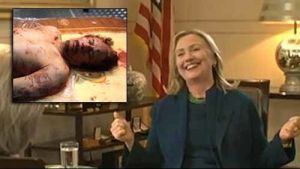
In an interview on CBS, Clinton laughed about Gaddafi’s slaying, proudly exclaiming, “We came, we saw, he died.”

Hillary Clinton deserves credit for poverty and instability in Haiti

In Haiti, the first state ever founded by freed black slaves, citizens are still fighting for political and economic freedom today, largely due to the influence of Bill and Hillary Clinton.

In 2011, Wikileaks published US State Department cables from 2008 and 2009 confirming that State Department officials were meeting behind closed doors with Haitian business leaders, plotting on how to stop the Haitian government from implementing a 37-cent hike in the minimum wage from $0.24 an hour to $0.61 cents an hour.

While Haitian President René Préval was initially neutral on the proposal of raising the minimum wage, he went on the record opposing the wage hike after consistent efforts from within the US Embassy in Haiti and the Haitian business lobby by July of 2009. Politifact rated the claim that Clinton’s State Department tried to suppress the wage hike as half-true, since there’s no link proving that Clinton directly played a role.

However, Clinton’s influence on Haiti didn’t stop there. As US Uncut previously reported, the former Secretary of State took an active role in swinging Haitian’s presidential elections in favor of corporate special interests. In the first round of Haiti’s presidential elections, thousands of citizens took to the streets demanding an annulment of election results, alleging that then-Haitian president Michel Martelly committed election fraud.

Martelly, who succeeded René Préval, is a close confidant of the Clinton family. In 2011, Martelly appointed Bill Clinton to an advisory board whose stated goal was to court foreign investors.

And in one of Hillary Clinton’s State Department emails made public, Clinton’s chief of staff received an email from another staffer openly boasting about using connections within the Haitian business elite to lobby for the withdrawal of Jude Célestin, Martelly’s political rival, from an upcoming runoff election. The aide, Kenneth Merten, predicted the news of the US interfering in election results would create widespread protests, and said he had called Martelly, asking him to plead with Haitians “to not pillage.”

While Martelly is no longer in power, his hand-picked successor, Jovenel Moïse, won the most recent election. However, watchdogs are calling the results fraudulent and demanding a new election. Ricardo Seitenfus, who has served as representative of the Organization of American States (OAS) for the last eight years, admitted that Haiti’s government is essentially a puppet of US interests, saying the Haitian election schedule is “subject to the U.S. schedule.” Hillary Clinton deserves to be closely scrutinized when touting her diplomacy record, as Haiti’s political instability is a result of her policies.

Honduras’ downfall resulted from a coup Clinton supported

In 2009, shortly after Obama took office and appointed Hillary Clinton as his Secretary of State, Honduran president Manuel Zelaya was arrested at gunpoint by the military and forced onto a plane to Costa Rica while a new government took power. While the US State Department didn’t directly oust Zelaya, it refused to call his ouster a coup, despite calls from the U.S. ambassador to Honduras and from Congress to do so. In her interview with the New York Daily News editorial board, Clinton defended her decision to keep sending aid to Honduras despite the violent overthrow of Zelaya:

I think, in retrospect, we managed a very difficult situation, without bloodshed, without a civil war, that led to a new election. And I think that was better for the Honduran people. But we have a lot of work to do to try to help stabilize that and deal with corruption, deal with the violence and the gangs and so much else.

However, the result of the coup was a massive amount of bloodshed, as gangs and drug cartels began to take more power in the absence of a stable government. In the year following the coup, Clinton’s State Department published a list of human rights abuses prevalent in Honduras:

“…unlawful killings by police and government agents, which the government took some steps to prosecute; arbitrary and summary killings committed by vigilantes and former members of the security forces; harsh prison conditions; violence against detainees; corruption and impunity within the security forces; lengthy pretrial detention and failure to provide due process of law; politicization, corruption, and institutional weakness of the judiciary; corruption in the legislative and executive branches; government restrictions on the recognition of some civil society groups; violence and discrimination against women; child prostitution and abuse; trafficking in persons; discrimination against indigenous communities; violence and discrimination against persons based on sexual orientation; ineffective enforcement of labor laws; and child labor.”

The horrific conditions in Honduras triggered a mass exodus of migrants to the US. As Telesur reported, approximately 9,000 child refugees fled Honduras in 2015. Also in 2015, Clinton defended the deportation of children back to the Central American countries they’re fleeing in order “send a message.” However, Clinton has since walked back that statement as her Democratic presidential primary battle with Bernie Sanders became more competitive.

Honduras-Activists-Berta-Cáceres-and-Nelson-Garcia-Assassinated-Called-Out-Hillary-Clinton-for-Backing-Honduran-Coup

This March, the violence in Honduras became a subject of international scrutiny when 44-year-old environmental activist Berta Caceres was assassinated in her home. Caceres had been an outspoken opponent of a proposed hydroelectric plant on indigenous land, and had recently gotten in an altercation with soldiers, police, and employees of a private power company while protesting the project just weeks before she was killed.

Clinton is responsible for the fall of Iraq and Syria (and the rise of ISIS)

In late 2011, after months of sustained anti-government protests inspired by the “Arab Spring” movement, Hillary Clinton called for the resignation of Syrian president Bashar al-Assad. Then, in April 2012, Clinton gave a speech in Turkey more forcefully calling specifically for regime change, saying, “Assad must go.” Those three words created the policies that led to both the rise of ISIS in Syria and the European refugee crisis of 2015.

One of Clinton’s last actions as Secretary of State was to call for the arming of Syrian rebels fighting Assad. As the London Telegraph reported, Clinton’s plan to give weapons to Assad’s enemies was backed by not only former Defense Secretary Leon Panetta, but also by former CIA director David Petraeus and General Martin Dempsey, chairman of the Joint Chiefs of Staff. While Obama initially rejected his Secretary of State’s plan, he eventually agreed to arm Syrian rebels in the goal of ousting Assad.

However, as ISIS began to get a foothold into Syria and Iraq, the “moderates” that received weapons from the US were eventually overtaken by ISIS fighters, who suddenly found themselves in the possession of military-grade weapons paid for with US tax dollars. In a study conducted by Conflict Armament Research, which tracks the movement of arms in war-torn regions, researchers found that ISIS has weapons and ammunition not just from the US, but also from coalition forces that are funded by the US government. The access to advanced weaponry was likely the reason for ISIS’ rapid expansion into Libya, Egypt, and elsewhere.

The consequences of destabilizing Syria and Iraq are apparent. Over one million refugees, largely from countries where the US intervened militarily, fled to Europe between 2015 and 2016, creating the world’s largest refugee crisis since World War II. In this chart compiled by Eurostat, the top three countries people are fleeing are Syria, Afghanistan, and Iraq:

refugeechart

Yemeni blood is on Hillary Clinton’s hands

Saudi Arabia’s invasion of Yemen, which started in 2015 and continues today, was made possible with arms purchased by the US government. Since Obama’s presidency, the US has sold approximately $46 billion in arms to the Saudis, with many of those weapons sales greenlighted by Hillary Clinton’s State Department. As US Uncut reported in April, Clinton was particularly focused on making sure the US came through for Saudi Arabia in a 2011 weapons deal. David Sirota of the International Business Times reported that Clinton argued the arms deal was “in the national interest.”

At press conferences in Washington to announce the department’s approval, an assistant secretary of state, Andrew Shapiro, declared that the deal had been “a top priority” for Clinton personally. Shapiro, a longtime aide to Clinton since her Senate days, added that the “U.S. Air Force and U.S. Army have excellent relationships in Saudi Arabia.”

Saudi Arabia is very likely using the weapons acquired from that 2011 exchange to wage brutal bombing campaigns in Yemen. In March, Foreign Policy magazine accused the US and its allies of complicity in war crimes by funding and arming the Saudi regime:

Hundreds of civilians have been killed in airstrikes while asleep in their homes, when going about their daily activities, or in the very places where they had sought refuge from the conflict. The United States, Britain, and others, meanwhile, have continued to supply a steady stream of weaponry and logistical support to Saudi Arabia and its coalition.

This week, the United Nations added the Saudi-led coalition to a blacklist of states and armed groups that violate children’s human rights during conflicts, with UN Secretary General Ban Ki-moon personally slamming the coalition for killing and maiming Yemeni children.

Hillary Clinton is completely right that Donald Trump is woefully unprepared to take on the responsibilities of Commander-in-Chief. But voters should also be leery of Clinton, who, despite having met with more world leaders than any presidential candidate in US history, is responsible for some of the worst foreign policy blunders of the 21st century.


Zach Cartwright is an activist and author from Richmond, Virginia. He enjoys writing about politics, government, and the media. Send him an email: zachcartwright88@gmail.com. 

Blood Money: Four More Years of Drug War Horror with HRC

hillary-clinton-winking-AP-640x480

By Chris Floyd

(Empire Burlesque)

The Drug War, like the Terror War, is essentially a vast machine for profiteering by the purveyors of weapons and tools of repression. Like the Terror War, the Drug War demonstrably exacerbates the problems it purports to address, and has led to widespread chaos, death and state corruption of almost unfathomable levels. And Hillary Clinton, almost certain to be the next president, is deeply complicit in both of these malevolent enterprises.

Clinton’s extensive and eager involvement in the genuinely insane hyper-militarizataion of American policy in the so-called War on Terror is well-attested. Indeed, she boasts of it, trumpeting how she urged a reluctant Obama into destroying Libya, for example: a “great victory” which she famously celebrated by crowing over the rape and murder of Libyan leader Moamar Gaddafi: “We came, we saw, he died!” The neocons who pressed for the war of aggression against Iraq — which Clinton supported — are now flocking to her banner, as are the war profiteers and their Wall Street allies. And why not? Clinton is the most hawkish Democratic candidate since Henry Jackson. The blood money will continue to flow like the Nile in flood under her watch.

But Clinton’s role in the Drug War is perhaps less well-known. Jesse Franzblau remedies this with an excellent article at CounterPunch, noting her instrumental role in the slaughterfest and corruption feast that the Drug War has spawned in Mexico. Franzblau writes of the $2.5 billion Merida Initiative:

Negotiated behind closed doors in the last years of the Bush administration, the plan was originally proposed as a three-year program. Yet Hillary Clinton’s State Department pushed aggressively to extend it, overseeing a drastic increase of the initiative that continues today.

Much of this aid goes to U.S.-based security, information, and technology contracting firms, who make millions peddling everything from helicopter training to communications equipment to night-vision goggles, surveillance aircrafts, and satellites.

This aid comes in addition to the direct sales of arms and other equipment to Mexico authorized by the State Department, as Christy Thorton pointed out in a 2014 New York Times op-ed. Those sales reached $1.2 billion in 2012 alone, the last full year of Clinton’s tenure. Indeed, as the Mérida Initiative has grown, Mexico has become one of the world’s biggest purchasers of U.S. military arms and equipment.

But while sales have boomed for U.S.-based contractors, the situation in Mexico has badly deteriorated. The escalation of U.S. counter-drug assistance in the country has paralleled a drastic increase in violence, fueling a drug war that’s killed more than 100,000 people since 2006.

Turning Mexico into a major fountain of war profits: quite another accomplishment for a secretary of state whose skills have been lavishly praised by no less than Henry Kissinger, her close friend and advisor. Franzblau goes on to lay out, in grim detail, how Clinton’s State Department, openly flouting U.S. law, increased its cooperation with Mexican military and law enforcement units known to be perpetrating horrific human rights abuses:

Human Rights Watch reported in 2011, for example, on widespread cases of torture in Guerrero going back to 1994. The group noted regular abuses by police and military forces, including “cases of homicide, torture, and extortion” overseen by the judicial police chief in the northern part of the state. The same report highlighted strong evidence of the involvement of military officials from Chilpancingo in cases of kidnapping and disappearances in 2010, as the U.S. embassy was clearing officials for training from the same military base.

The payoff for these illegalities has been sweet for the future president:

Notably, several of the contractors that profited from U.S. security assistance in Mexico — such as General Electric, Lockheed Martin, and United Technologies Corporation, which owns Sikorsky — reportedly contributed to the Clinton Foundation. And according to the transparency group Open Secrets, Clinton currently tops the list of all 2016 presidential candidates in campaign contributions from the military contracting industry.

By the end of Clinton’s first term in 2021, we will be in the 20th year of the Terror War — and the 50th year of the Drug War. How many more lives, how many more communities, how many more countries will be laid waste by these inhuman engines of greed and power — and their “progressive” champions — in that time?

Exposing the Libyan Agenda: A Closer Look at Hillary’s Emails

hilary_clinton_laughs_gaddafi_

By Ellen Brown

Source: Web of Debt

Critics have long questioned why violent intervention was necessary in Libya. Hillary Clinton’s recently published emails confirm that it was less about protecting the people from a dictator than about money, banking, and preventing African economic sovereignty.

The brief visit of then-Secretary of State Hillary Clinton to Libya in October 2011 was referred to by the media as a “victory lap.” “We came, we saw, he died!” she crowed in a CBS video interview on hearing of the capture and brutal murder of Libyan leader Muammar el-Qaddafi.

But the victory lap, write Scott Shane and Jo Becker in the New York Times, was premature. Libya was relegated to the back burner by the State Department, “as the country dissolved into chaos, leading to a civil war that would destabilize the region, fueling the refugee crisis in Europe and allowing the Islamic State to establish a Libyan haven that the United States is now desperately trying to contain.”

US-NATO intervention was allegedly undertaken on humanitarian grounds, after reports of mass atrocities; but human rights organizations questioned the claims after finding a lack of evidence. Today, however, verifiable atrocities are occurring. As Dan Kovalik wrote in the Huffington Post, “the human rights situation in Libya is a disaster, as ‘thousands of detainees [including children] languish in prisons without proper judicial review,’ and ‘kidnappings and targeted killings are rampant’.”

Before 2011, Libya had achieved economic independence, with its own water, its own food, its own oil, its own money, and its own state-owned bank. It had arisen under Qaddafi from one of the poorest of countries to the richest in Africa. Education and medical treatment were free; having a home was considered a human right; and Libyans participated in an original system of local democracy. The country boasted the world’s largest irrigation system, the Great Man-made River project, which brought water from the desert to the cities and coastal areas; and Qaddafi was embarking on a program to spread this model throughout Africa.

But that was before US-NATO forces bombed the irrigation system and wreaked havoc on the country. Today the situation is so dire that President Obama has asked his advisors to draw up options including a new military front in Libya, and the Defense Department is reportedly standing ready with “the full spectrum of military operations required.”

The Secretary of State’s victory lap was indeed premature, if what we’re talking about is the officially stated goal of humanitarian intervention. But her newly-released emails reveal another agenda behind the Libyan war; and this one, it seems, was achieved.

Mission Accomplished?

Of the 3,000 emails released from Hillary Clinton’s private email server in late December 2015, nearly a third were from her close confidante Sidney Blumenthal, the Clinton aide who gained notoriety when he testified against Monica Lewinsky. One of these emails, dated April 2, 2011, reads in part:

Qaddafi’s government holds 143 tons of gold, and a similar amount in silver . . . . This gold was accumulated prior to the current rebellion and was intended to be used to establish a pan-African currency based on the Libyan golden Dinar. This plan was designed to provide the Francophone African Countries with an alternative to the French franc (CFA).

In a “source comment,” the original declassified email adds:

According to knowledgeable individuals this quantity of gold and silver is valued at more than $7 billion. French intelligence officers discovered this plan shortly after the current rebellion began, and this was one of the factors that influenced President Nicolas Sarkozy’s decision to commit France to the attack on Libya. According to these individuals Sarkozy’s plans are driven by the following issues:

  1. A desire to gain a greater share of Libya oil production,
  2. Increase French influence in North Africa,
  3. Improve his internal political situation in France,
  4. Provide the French military with an opportunity to reassert its position in the world,
  5. Address the concern of his advisors over Qaddafi’s long term plans to supplant France as the dominant power in Francophone Africa

Conspicuously absent is any mention of humanitarian concerns. The objectives are money, power and oil.

Other explosive confirmations in the newly-published emails are detailed by investigative journalist Robert Parry. They include admissions of rebel war crimes, of special ops trainers inside Libya from nearly the start of protests, and of Al Qaeda embedded in the US-backed opposition. Key propaganda themes for violent intervention are acknowledged to be mere rumors. Parry suggests they may have originated with Blumenthal himself. They include the bizarre claim that Qaddafi had a “rape policy” involving passing Viagra out to his troops, a charge later raised by UN Ambassador Susan Rice in a UN presentation. Parry asks rhetorically:

So do you think it would it be easier for the Obama administration to rally American support behind this “regime change” by explaining how the French wanted to steal Libya’s wealth and maintain French neocolonial influence over Africa – or would Americans respond better to propaganda themes about Gaddafi passing out Viagra to his troops so they could rape more women while his snipers targeted innocent children? Bingo!

Toppling the Global Financial Scheme

Qaddafi’s threatened attempt to establish an independent African currency was not taken lightly by Western interests. In 2011, Sarkozy reportedly called the Libyan leader a threat to the financial security of the world. How could this tiny country of six million people pose such a threat? First some background.

It is banks, not governments, that create most of the money in Western economies, as the Bank of England recently acknowledged. This has been going on for centuries, through the process called “fractional reserve” lending. Originally, the reserves were in gold.  In 1933, President Franklin Roosevelt replaced gold domestically with central bank-created reserves, but gold remained the reserve currency internationally.

In 1944, the International Monetary Fund and the World Bank were created in Bretton Woods, New Hampshire, to unify this bank-created money system globally. An IMF ruling said that no paper money could have gold backing. A money supply created privately as debt at interest requires a continual supply of debtors; and over the next half century, most developing countries wound up in debt to the IMF. The loans came with strings attached, including “structural adjustment” policies involving austerity measures and privatization of public assets.

After 1944, the US dollar traded interchangeably with gold as global reserve currency. When the US was no longer able to maintain the dollar’s gold backing, in the 1970s it made a deal with OPEC to “back” the dollar with oil, creating the “petro-dollar.”  Oil would be sold only in US dollars, which would be deposited in Wall Street and other international banks.

In 2001, dissatisfied with the shrinking value of the dollars that OPEC was getting for its oil, Iraq’s Saddam Hussein broke the pact and sold oil in euros. Regime change swiftly followed, accompanied by widespread destruction of the country.

In Libya, Qaddafi also broke the pact; but he did more than just sell his oil in another currency.

As these developments are detailed by blogger Denise Rhyne:

For decades, Libya and other African countries had been attempting to create a pan-African gold standard.  Libya’s al-Qadhafi and other heads of African States had wanted an independent, pan-African, “hard currency.”

Under al-Qadhafi’s leadership, African nations had convened at least twice for monetary unification.  The countries discussed the possibility of using the Libyan dinar and the silver dirham as the only possible money to buy African oil.

Until the recent US/NATO invasion, the gold dinar was issued by the Central Bank of Libya (CBL).  The Libyan bank was 100% state owned and independent.  Foreigners had to go through the CBL to do business with Libya.  The Central Bank of Libya issued the dinar, using the country’s 143.8 tons of gold.

Libya’s Qadhafi (African Union 2009 Chair) conceived and financed a plan to unify the sovereign States of Africa with one gold currency (United States of Africa).  In 2004, a pan-African Parliament (53 nations) laid plans for the African Economic Community – with a single gold currency by 2023.

African oil-producing nations were planning to abandon the petro-dollar, and demand gold payment for oil/gas.

Showing What Is Possible

Qaddafi had done more than organize an African monetary coup. He had demonstrated that financial independence could be achieved. His greatest infrastructure project, the Great Man-made River, was turning arid regions into a breadbasket for Libya; and the $33 billion project was being funded interest-free without foreign debt, through Libya’s own state-owned bank.

That could explain why this critical piece of infrastructure was destroyed in 2011. NATO not only bombed the pipeline but finished off the project by bombing the factory producing the pipes necessary to repair it. Crippling a civilian irrigation system serving up to 70% of the population hardly looks like humanitarian intervention. Rather, as Canadian Professor Maximilian Forte put it in his heavily researched book Slouching Towards Sirte: NATO’s War on Libya and Africa:

[T]he goal of US military intervention was to disrupt an emerging pattern of independence and a network of collaboration within Africa that would facilitate increased African self-reliance. This is at odds with the geostrategic and political economic ambitions of extra-continental European powers, namely the US.

Mystery Solved

Hillary Clinton’s emails shed light on another enigma remarked on by early commentators. Why, within weeks of initiating fighting, did the rebels set up their own central bank? Robert Wenzel wrote in The Economic Policy Journal in 2011:

This suggests we have a bit more than a rag tag bunch of rebels running around and that there are some pretty sophisticated influences. I have never before heard of a central bank being created in just a matter of weeks out of a popular uprising.

It was all highly suspicious, but as Alex Newman concluded in a November 2011 article:

Whether salvaging central banking and the corrupt global monetary system were truly among the reasons for Gadhafi’s overthrow . . . may never be known for certain – at least not publicly.

There the matter would have remained – suspicious but unverified like so many stories of fraud and corruption – but for the publication of Hillary Clinton’s emails after an FBI probe. They add substantial weight to Newman’s suspicions: violent intervention was not chiefly about the security of the people. It was about the security of global banking, money and oil.

Errata: Sidney Blumenthal is not an attorney, as originally stated in this article. When he earned notoriety as Bill Clinton’s defender against Monica Lewinsky, it was as special adviser for the Clintons.

__________________

Ellen Brown is an attorney and author of twelve books, including the best-selling Web of Debt. Her latest book, The Public Bank Solution, explores successful public banking models historically and globally. Her 300+ blog articles are at EllenBrown.com. Listen to “It’s Our Money with Ellen Brown” on PRN.FM.


Related Podcast:  Progressive Commentary Hour – 03.15.16 James and Joanne Moriarty on the real motives behind the 2011 invasion of Libya.