Sandy Hook One Year After

By James F. Tracy

Originally published at the Memory Hole

As the nation approaches the first anniversary of the Sandy Hook Elementary School massacre, mainstream media are predictably excluding from their tragedy porn any substantive analysis of the idiosyncratic, misleading, and in some cases flagrantly propagandistic reportage of the event that might call the official story into question.

As with a majority of scandals and coverups over the past several decades where powerful interests are implicated, American journalism has become more and more complicit if not actively involved in delivering dubious information that establishes a dominant narrative, while thereafter failing to vigorously interrogate and amend faulty coverage that leads to vast public misconceptions.

The assassination of JFK, the falsely-reported Tonkin Gulf incident that sparked the costly Vietnam War, and the similarly questionable events of 9/11 that have together brought the US to the present national and geopolitical impasse all come to mind. One is left to ponder how the behavior of a wholly government-controlled media system would differ from our corporate-run consciousness industry that routinely and shamelessly showboats its First Amendment protections.

The consequences of such a communication breakdown are vast, with countless lives and entire nations having been undermined and destroyed. Moreover, the “first drafts of history” become plagued by myth and distortion that eventually cohere as collective memory, thus robbing a people of their self-determination, nullifying their humanity, and ensuring that the cycle repeats interminably.

Those rationally dissenting from the official record and who occupy positions to alter public opinion are usually written off by establishment-controlled media outlets as “conspiracy theorists,” “wackos,” and so on. If such individuals cannot be neutralized through defamation or blackmail, and if they possess information or occupy positions where they are capable of posing a serious and immediate threat to official fictions and thus the power structure itself, they are prone to becoming oddly “suicidal,” (see, for example, here, here, here, here, here, here, and here), or are simply killed outright (e.g. here, here, here, here, here, here, and here and here).

What else won’t we see in the corporate media’s series of heart-tugging memorials devoted to the anniversary of Sandy Hook? The two most recent and obvious indications that the event itself is at the very least a coverup include, first, the wholly unreported story of the Obama administration’s $2.5 million payout (read: bribe) to state and local law enforcement agencies directly involved in responding to the incident, and second, what is by almost any measure the entirely illegal destruction of pertinent evidence in the demolition of the crime scene itself.

Empowered by the internet as their primary means of communication, a broad array of independent researchers have conduced an impromptu “truth commission” that together calls the Sandy Hook narrative presented by corporate news media into serious question. For those with eyes to see and the ability to think critically they have also shamed the mainstream journalists directly involved in (mis)representing the event to the American public.

Yet without a genuinely independent investigation of the incident apart from the oversight and influence of the [Governor Dannel] Malloy and Obama administrations, the broader public will likely never know what actually took place on December 14, 2012 in Newtown Connecticut. As has too often been the case throughout the last half century, the prospects are high that yet another “big lie” has again taken root in the ever-malleable and somnambulent public mind.

SandyHookActorsObama

“Economic Recovery” is Just Deceptive Statistics

images

Whenever there’s a cheerful jobs report propagated by corporate news, many of us know they’re lying (because it just doesn’t correspond to reality) though we might not know exactly how the numbers they use decieve us. At Counterpunch.org, Paul Craig Roberts dissects some of the figures cited by the Bureau of Labor Statistics as support for claims of an economic recovery. For example, their payroll jobs report says that the US economy created 203,000 jobs in November. Since it takes about 130,000 new jobs each month to keep up with population growth, the remaining 70,000 of the jobs would have only slightly reduced the unemployment rate yet it supposedly fell from 7.3 to 7.0 which is too much. It turns out the payroll survey counts a person holding two jobs as if it were two employed persons, while the unemployment rate is calculated from the household survey, which counts a person holding two or more jobs as one job. Though the two figures are often reported together, they actually have no connection.

Payroll numbers can be skewed by seasonal hiring and because the birth-death model used to estimate the numbers of unreported business shutdowns and startups often underestimate the former and overestimate the latter. The unemployment rate figures are innacurate because it leaves out people who have given up on looking for work. The greater the number of discouraged workers there are, the lower the rate of unemployment, according to the BLS.

So exactly where and what are the 203,000 new payroll jobs created in November? Paul Craig Roberts breaks down the figures as reported by the BLS and discovered that the majority are lowly-paid, part-time, nontradable (non exportable) domestic service jobs including:

…retail trade with 22,300 jobs, transportation and warehousing with 30,500 jobs, temporary help services with 16,400 jobs, ambulatory health care services with 26,300 jobs, home health care services with 11,800 jobs, and the old reliable waitresses and bartenders with 17,900 jobs.

This is the jobs profile of the American super economy. It is the profile of India 30 or 40 years ago.

PCR continues his analysis by citing the work of statistician John Williams (shadowstats.com), who found more misstated jobs that could be attributed to the government shutdown and reopening, the birth-death model, and concurrent-seasonal-adjustment errors. According to Williams, whose figures include long-term discouraged workers who cannot find a job, the US unemployment rate is actually 23.2%.

Of course there’s no recovery with a 23.2% unemployment rate, but to keep stocks and bonds at all-time record high levels, the Federal Reserve is printing $1,000 billion new dollars annually, potentially creating an economic bubble. Despite these issues, the BLS estimated a third quarter GDP growth of 3.6%. Paul Craig Roberts challenges this claim with the following figures:

US real median household income has declined from $56,189 in 2007 to $51,371 in 2012, a decline of $4,818 or 8.6%. http://www.deptofnumbers.com/income/us/

US real per capita income has declined from $29,554 in 2007 to $27,319 in 2012, a drop of $2,235 or 7.5%.

According to the Bureau of Labor Statistics, there are 1,277,000 fewer seasonally adjusted payroll jobs in November 2013 than in December 2007.

He concludes by asking:

How it is possible for the economy to have been in recovery since June 2009 (according to the National Bureau of Economic Research) and there are 1,277,000 fewer jobs today than existed six years ago prior to the recession?

How has real Gross Domestic Product recovered when jobs and real consumer incomes have not?

Talking About Mandela

NelsonMandela42yo_681489n

By Margaret Kimberley

Originally published at Black Agenda Report

Nelson Mandela belongs to history now. We should be able to look at his whole life, his whole record in perspective. That perspective ought to include who is praising Nelson Mandela nowadays and why.

Freedom Rider: Talking About Mandela

Nelson Mandela’s passing provides an important and rare opportunity for discussion of some very serious issues. We should not fear principled critique of people we admire but instead we have been treated to maudlin self-indulgence, useless idol worship and wrongheaded defense of Mandela’s memory.

Everyone looms large in death, and it is especially difficult to be truthful when a person of Mandela’s stature passes away. South Africa’s apartheid system was an international pariah, reviled by most of humanity and Mandela was the icon who it was hoped would bring it down forever.

Black Americans saw themselves in images of Sharpeville and Soweto. Mandela stood in for our assassinated leaders, political prisoners and victims of COINTELPRO. The South African struggle became our struggle and our chance to achieve what we were denied here at home. Of course Mandela’s release from 27 years of imprisonment brought near universal joy but it should have also raised more questions.

Mandela was one of the signatories of the Freedom Charter, which among other things demanded the nationalization of South Africa’s resources and reparations for the theft of African land by the Europeans. He was a member of the South African communist party, as were other leaders of the African National Congress. We should have known that the South African government wasn’t letting him go free without exacting a huge price. It is difficult to look the gift horse in the mouth, but the silence created a vacuum which made it easier for the rule of international capitalists to stay in place, even as they appeared to give up political control.

Mandela’s early history is something to honor and remember but now his memory comes wrapped in the poison pill of acceptance by the corporate media and disreputable democratic and republican politicians. Now when right wingers condemn Mandela as a communist, his admirers cringe and deny what is true. Instead of examining what a communist is and why the party was supported by the movement, we see black people instead take the position of our enemies and use the word as a slur. We must remember that scorn from certain quarters is a badge of honor.

Contrast the reaction to Mandela’s death with that of the late Venezuelan president Hugo Chavez. While Chavez was equally beloved around the world, the American government gave no glowing tributes and sent no high level delegation. Chavez was every bit as deserving of praise and honor but unlike Mandela he succeeded in standing up to empire. He personally protested against George W. Bush and even called him the devil at the United Nations. Hugo Chavez prevailed when American presidents wanted him out of office. He won re-election and shamed this country when he donated Venezuelan oil to help poor Americans stay warm in the winter. Of course Barack Obama, George W. Bush, Jimmy Carter, and Bill Clinton were absent from his funeral.

Nelson Mandela had difficult choices to make. He chose to accept an IMF loan with strings attached that kept millions in poverty. He and his successors turned their backs on the Freedom Charter. No one can know his intentions but the results of those decisions were disastrous for the masses of black people in South Africa.

Mandela’s release from prison should have been seen as a new stage in the struggle and not the end of it. Those of us who came of age during the anti-apartheid movement and who truly loved the man have to admit the short comings of love when liberation is at stake.

There are many lessons to be learned during this time of mourning. Our emotions play an important role in inspiring us to take action against injustice but they can also betray us when we lack an understanding of what liberation really is.

Liberation may or may not come with a presidential inauguration. It certainly hasn’t come if the usual suspects in the corporate media, Pennsylvania Avenue and Downing Street suddenly give words of praise. The success of certain individuals is not liberation either. There are now black millionaires in South Africa but that does little good to the impoverished masses.

Liberated people don’t live in squalor. They earn more than a living wage. They need not fear loss of job or life if they protest their salaries or working conditions. They have free health care and education. They don’t fear incarceration and they don’t live in stratified societies. They live in safety and the law treats them all as equals to one another. They can protest and oppose the power structure without fear of repercussion. South Africa doesn’t fit these criteria, neither does the United States, and we who love freedom and justice shouldn’t spare anyone when we express these simple and obvious truths.

Margaret Kimberley’s Freedom Rider column appears weekly in BAR, and is widely reprinted elsewhere. She maintains a frequently updated blog as well as at http://freedomrider.blogspot.com. Ms. Kimberley lives in New York City, and can be reached via e-Mail at Margaret.Kimberley(at)BlackAgendaReport.com.

Editor’s note: In contrast to the insightful and honest reporting from Black Agenda Report and other independent news sources, corporate news has predictably been downplaying “controversial” aspects of Mandela’s life that threaten the status quo. In some cases, their coverage reveals surprising negligence, insensitivity and/or stupidity.

Pearl Harbor: The Original 9/11

pearl-harbor

Yesterday marked the 72nd anniversary of the Pearl Harbor attack, which from today’s perspective can be viewed as the template on which 9/11 was modeled after. In both cases, documentation exists implicating the U.S. government. In the case of Pearl Harbor, there’s the McCollum Memo which describes in detail the strategy used to successfully provoke the Japanese government into attacking. Shortly before the Pearl Harbor attack, Secretary of State Hull presented “peace terms” to the Japanese government that all but guaranteed an inevitable attack.

In the case of 9/11, there’s a policy document from Project for a New American Century called Rebuilding America’s Defenses, which provides a clear motive to create a “catastrophic and catalyzing event – like a new Pearl Harbor”. It’s not conclusive proof they were behind the attacks, but it’s suspicious to say the least that the people with established motives for conducting an event like 9/11 were responsible for national security at the time multiple unlikely and implausible coincidences made such a successful attack possible.

A number of other dubious aspects of the Pearl Harbor attack were compiled at Washington’s Blog last year, including:

Active Interference with Military’s Ability to Defend

It has also recently been discovered that the FDR administration took numerous affirmative steps to ensure that the Japanese attack would be successful. These steps included taking extraordinary measures to hide information from the commanders in Hawaii about the location of Japanese war ships (information of which they would normally be informed), denying their requests to allow them to scout for Japanese ships, and other actions to blind the commanders in Hawaii so that the attacks would succeed. See, for example, this book (page 186).

Key Military Players Incommunicado

In addition, the heads of the Army and Navy suddenly disappeared and remained unreachable on the night before Pearl Harbor. And they would later testify over and over that they “couldn’t remember” where they were (pages 320 and 335).

Gagging Whistleblowers

Two weeks after Pearl Harbor, the Navy classified all documents top secret, and the Navy Director of Communications sent a memo ordering all commanders to “destroy all notes or anything in writing” related to the attacks. More importantly, all radio operators and cryptographers were gagged on threat of imprisonment and loss of all benefits. (page 256).

Media Complicity

Amazingly, the Army’s Chief of Staff informed the Washington bureau chiefs of the major newspapers and magazines of the impending attacks before they occurred, and swore them to an oath of secrecy, which the media honored (page 361); and listen to interview here (we personally spent an hour speaking with Stinnett, and find him to be a highly credible and patriotic American.)

Postscript: Coincidentally, Philip Zelikow – the Executive Director of the 9/11 Commission, the administration insider whose area of expertise is the creation and maintenance of “public myths” thought to be true, even if not actually true, who controlled what the 9/11 Commission did and did not analyze, then limited the scope of the Commission’s inquiry so that the overwhelming majority of questions about 9/11 remained unasked – also happened to be the main guy defending the alleged unforeseeablity of the Pearl Harbor attack, who wrote a hit piece on Pearl Harbor historians like Stinnett.

Just like 9/11, Pearl Harbor was used as a tool to focus mass hatred on a race demonized by propaganda. The attack created a culture of fear allowing for suspension of civil liberties while crushing opposition to the war. Most importantly (for powerful interests pushing for war) the attacks were a pretense for pursuing and expanding global political and economic hegemony.

For a comprehensive compilation of evidence of U.S. government involvement in the Pearl Harbor conspiracy, see: http://whatreallyhappened.com/WRHARTICLES/pearl/www.geocities.com/Pentagon/6315/pearl.html

TPP: NAFTA on Steroids

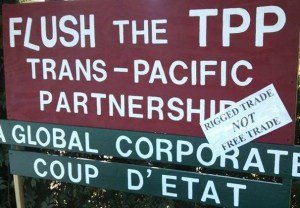
TPP-protest-sign-from-Petrovich-lawn1-e1384352291139

by Stephen Lendman

The Trans-Pacific Partnership (TPP) is a trade deal from hell. It’s a stealth corporate coup d’etat.

It’s a giveaway to banksters. It’s a global neoliberal ripoff. It’s a business empowering Trojan horse. It’s a freedom and ecosystem destroying nightmare.

The Electronic Frontier Foundation (EFF) calls it “a secretive, multi-national trade agreement that threatens to extend restrictive intellectual property (IP) laws across the globe and rewrite international rules on its enforcement.”

More on TPP below. New York Times editors support it. Two decades ago, they endorsed NAFTA.


On January 1, 1994, its destructive life began. It’s anti-labor, anti-environment, anti-consumer and anti-democratic.

Corporate giants love it. Why not? They wrote it. Hundreds of pages of one-size-fits-all rules benefit them.

They override domestic laws. A race to the bottom followed. NAFTA was a disastrous experiment. In November 1993, New York editors headlined “The ‘Great Debate’ Over NAFTA,” saying:

“The laboriously constructed agreement to phase out trade barriers among the US, Mexico and Canada, which this page has strongly supported, is likely to have a positive, though small, impact on US living standards and provide a modest boost to the Mexican economy.”

“Some American jobs would be lost to cheaper Mexican labor, other jobs would be gained because American exports would increase as Mexico’s high tariffs gradually disappeared.”

“Economics aside, Nafta’s defeat would suggest that the US had abandoned its historical commitment to free trade and would thus discourage other Latin and South American countries thathave moved toward more market-oriented economies in the expectation of freer world trade.”So-called “free trade” is one-sided. It isn’t fair. NAFTA proponents promised tens of thousands of newly created US jobs.

Ordinary famers would export their way to wealth. Mexican living standards would rise. Economic opportunities would reduce regional immigration to America.

NAFTA’s promises never materialized. Reality proved polar opposite hype. A decade later, about a million US jobs were lost.

America’s Mexican trade deficit alone cost around 700,000 jobs by 2010.

Official government data show nearly five million US manufacturing disappeared since 1994.

NAFTA alone wasn’t responsible. It reflected broken promises, lost futures, and other trade deals from hell to follow. TPP stands out. It’s NAFTA on steroids.

Since 2008, multiple negotiating rounds were held. They continue secretly. Twelve nations are involved.

They include America, Australia, Brunei, Canada, Chile, Japan, Malaysia, Mexico, New Zealand, Peru, Singapore, and Vietnam. Others are invited to join.

At issue is agreeing on unrestricted trade in goods, services, rules of origin, trade remedies, sanitary and phytosanitary measures, technical barriers, government procurement and competition policies, and intellectual property (IP).

It’s about eliminating fundamental freedoms. It’s circumventing sovereign independent rights. Corporate power brokers want unchallenged control.

They want global rules and standards rewritten. They want supranational powers. They want them overriding national sovereignty. They want investor rights prioritized over public ones.

They already rule the world. Imagine giving them more power. Imagine no way to stop them.

Imagine a duplicitous president. Obama’s in lockstep with their wish list. He intends giving them everything they want.

Public Citizen is independent. It’s our voice. Its work entails “ensur(ing) that all citizens are represented in the halls of power.”

Its Global Trade Watch (GTW) monitors TPP developments. It calls it “a stealthy policy being pressed by corporate America. (It’s) a dream of the 1%.” It’ll:

• “offshore millions of American jobs,

• free the banksters from oversight,

• ban Buy America policies needed to create green (and many other) jobs (as well as) rebuild out economy,

• decrease access to medicine,

• flood the US with unsafe food and products,

• and empower corporations to attack our environment and health safeguards.”

Hyped benefits are fake. Reality is polar opposite what corporate shysters claim. Everything accruing from TPP benefits them. It does so by undermining what matters most to ordinary people.

Lori Wallach heads GTW. Ben Beachy is research director. Last June, they headlined their New York Times op-ed “Obama’s Covert Trade Deal.”

He’s committed to open government, he claims. His policies reflect otherwise. He’s negotiating TPP secretly.

It’s “the most significant international commercial agreement since the” World Trade Organization’s 1995 creation, said Wallach and Beachy.

Congress has exclusive “terms of trade” authority. Obama systematically refuses repeated congressional requests to release the entire draft agreement being negotiated.

He “denied requests from members to attend (sessions) as observers.” He “revers(ed) past practice” snubbing them.

He “rejected demands by outside groups” to release the draft text. George Bush never went that far.

Obama’s “wall of secrecy” had one exception. About “600 trade ‘advisors,’ dominated by representatives of big business,” got access to what Congress was denied.

TPP overrides American laws. It requires changing them. Otherwise trade sanctions on US exports can be imposed.

Wall Street loves TPP. It prohibits banning risky financial products. It lets banksters operate any way they want without oversight.

Congress has final say. Both houses will vote on TPP. Ahead of doing so, they’ll have access to its full text.

Why later? Why not now? Why not earlier? Why not without enough time for discussion and public debate?

Members won’t get enough time to examine TPP carefully. Maintaining secrecy as long as possible prevents public debate.

Obama wants TPP fast-tracked. He wants it approved by yearend. Until March, Ron Kirk was Obama’s trade representative.

He was remarkably candid. He said revealing TPP’s text would raise enormous opposition. Doing so might make adopting it impossible.

According to Wallach and Beachy:

“Whatever one thinks about ‘free trade,’ (TPP secrecy) represents a huge assault on the principles and practice of democratic governance.”

“That is untenable in the age of transparency, especially coming from an administration that is otherwise so quick to trumpet its commitment to open government.”

On October 30, a newly formed Friends of TPP caucus was formed. Four House co-chairman head it. They include Reps. David Reichert (R. WA), Charles Boustany (R. LA), Ron Kind (D. WI) and Gregory Meeks (D. NY).

They sound like earlier NAFTA supporters. They claim TPP is important for US jobs, exports and economic growth. They lied saying so.

Wallach commented separately. TPP is hugely hugely destructive, she said. It’s more than about trade. It’s a “corporate Trojan horse.” It has 29 chapters. Only five relate to trade.

The others “either handcuff our domestic governments, limit food safety, environmental standards, financial regulation, energy and climate policy, or establish new powers for corporations.”

They promote offshoring jobs to low-wage countries. They ban Buy America. Corporations can do whatever they please. Instead of investing domestically, they can use “our tax dollars” to operate abroad.

They can exploit national resources freely. They’ll have “rights for min(ed) (commodities), oil, gas” and others “without approval.”

TPP includes all sorts of “worrisome issues relating to Internet freedom.”

It provides a back door to earlier failed legislation. It resurrects SOPA, PIPA, ACTA and CISPA provisions. It tramples on fundamental freedoms and national sovereignty.

“Think about all the things that would be really hard to get into effect as a corporation in public, a lot of them rejected here and in the other 11 countries, and that is what’s bundled in to the TPP,” said Wallach.

“And every country would be required to change its laws domestically to meet these rules.”

“The binding provision is each country shall ensure the conformity of domestic laws, regulations and procedures.”

Negotiations are secret. Nothing is discussed publicly. Details leaked out. TPP includes hugely unpopular policies. It forces them on member countries.

It overrides domestic laws protecting people and ecosystems. It’s predatory capitalism at its worst writ large. Obama fully supports it. Lawmakers hadn’t seen it until last year.

They got access to a single chapter. Examining it is severely restricted. Their office is denied a copy. They alone can read it. Their staff is denied permission.

They can’t take detailed notes. They can’t publicly discuss what’s in it. Technical language makes it hard to understand what they read.

Congressional approval is likely. Lobby pressure is intense. “Everything is bought and sold,” said Wallach. “Honor is no exception.”

The reason there’s no deal so far “is because a lot of other countries are standing up to the worst of US corporate demands,” Wallach explained.

For how long remains to be seen. If TPP is adopted, public interest no longer will matter. The worst of all possible worlds will replace it. Corporate rights will supersede human ones. A global race to the bottom will intensify.

Signatory countries will be legally bound to support loss of personal freedoms. Sovereign laws won’t protect against poisoned food, water and air.

Ecosystems will be destroyed. Millions more jobs will shift from developed to under or less developed nations.

Corporate power will grow more exponentially. Fundamental human and civil rights may erode altogether. Not according to Times editors.

On November 5, they headlined “A Pacific Trade Deal.”

A dozen nations want a deal by yearend, they said. They want it to “help all of our economies and strengthen relations between the United States and several important Asian allies.”

It bears repeating. TPP is a trade deal from hell. It’s a stealth corporate coup d’etat. It’s a freedom and ecosystem destroying nightmare. Times editors didn’t explain.

They lied to readers. They betrayed them. They repeated their 1993 duplicity. Millions affected understand best.

An October 8 White House press release lied. It called TPP “a comprehensive, next-generation model for addressing both new and traditional trade and investment issues, supporting the creation and retention of jobs and promoting economic development in our countries.”

“The deepest and broadest possible liberalization of trade and investment will ensure the greatest benefits for countries’ large and small manufacturers, service providers, farmers, and ranchers, as well as workers, innovators, investors, and consumers.”

Times editors endorsed what they haven’t read. TPP provisions remain secret. Leaked information alone is known.

Times editors willingly accept Obama misinformation as fact. Twenty years ago, they got NAFTA wrong. Here they go again.

They’re mindless about secret negotiations. Public concerns don’t matter. Corporate interests alone count.

Subverting national sovereignty is OK. So is empowering transnational giants without oversight. They’ll be able sue countries for potentially undermining future profits.

Times editors support the worst of corporate excess. Doing so shows which side they’re on.

Fundamental freedoms aren’t important. Corporate rights drive The Times’ agenda. Its editors explained nothing about fast-track authority.

Max Baucus (D. MT) chairs the Senate Finance Committee. He supports fast-tracking. Doing so hands congressional authority to Obama.

Proper hearings are restricted. Debate is limited. Amendments can’t be introduced. The Senate can’t filibuster. Congress can only vote up or down.

It can happen virtually out of sight and mind. It can happen with scant media coverage. It can happen with none at all. It can become law with practically no public awareness.

Imagine corporate America getting coup d’etat authority with hardly anyone knowing what happened. Imagine the consequences if it does. Imagine today’s America becoming worse than ever.

Times editors stressed how Obama wants TPP to be “an example for the rest of the world to follow.”

Imagine one more than ever unfit to live in. Imagine a president promising change to believe in promoting it.

Imagine Times editors endorsing what demands condemnation. Imagine not explaining what readers most need to know.

Imagine substituting misinformation for truth and full disclosure. Imagine all the news they call fit to print not fit to read.

A Final Comment

On November 13, Public Citizen headlined “Leaked Documents Reveal Obama Administration Push for Internet Freedom Limits, Terms That Raise Drug Prices in Closed-Door Trade Talks.”

“US Demands in Trans-Pacific Partnership Agreement Text, Published Today by WikiLeaks, Contradict Obama Policy and Public Opinion at Home and Abroad.”

TPP’s leaked text reveals Obama demands limiting Internet freedom. He wants restricted access to lifesaving medicines.

He wants all TPP signatory countries bound the the same deplorable rules.

He lied claiming TPP reduces health care costs. It has nothing to do with advancing online freedom as he promised. It’s polar opposite on both counts.

According to Public Citizen:

“It is clear from the text obtained by WikiLeaks that the US government is isolated and has lost this debate.”

“Our partners don’t want to trade away their people’s health. Americans don’t want these measures either.”

Obama’s in the pocket of Big Pharma. He’s a Wall Street tool. He represents other corporate interests. He spurns popular ones. He lies claiming otherwise. He repeatedly avoids truth and full disclosure.

He lied about Obamacare. It’s an abomination. It’s a scam. It’s a scheme to enrich insurers and other healthcare giants.

TPP is a global scam. It’s an assault on fundamental freedoms.

Reports indicate around half the House members strongly oppose it. Others lean that way. According to Lori Wallach:

“This could be the end of TPP.”

“All these other countries are like, ‘Wait, you have no trade authority and nothing you’ve promised us means anything. Why would we give you our best deal?’ Why would you be making concessions to the emperor who has no clothes?”

It bears repeating. TPP is a trade bill from hell. It’s a stealth corporate coup d’ etat. Killing it is essential.

The alternative is losing fundamental freedoms. It’s destroying national sovereignty. It’s making healthcare less affordable. It’s undermining what ordinary people value most.

Stephen Lendman lives in Chicago.

He can be reached at lendmanstephen@sbcglobal.net.

His new book is titled “Banker Occupation: Waging Financial War on Humanity.”

http://www.claritypress.com/LendmanII.html

Visit his blog site at sjlendman.blogspot.com.

Listen to cutting-edge discussions with distinguished guests on the Progressive Radio News Hour on the Progressive Radio Network.

It airs Fridays at 10AM US Central time and Saturdays and Sundays at noon. All programs are archived for easy listening.

http://www.progressiveradionetwork.com/the-progressive-news-hour

 

On Typhoon Haiyan and Veterans Day

View of Typhoon Haiyan from the International Space Station. PHOTO: AP

View of Typhoon Haiyan from the International Space Station. PHOTO: AP

While I mean no disrespect towards veterans, I feel Veterans Day has become so archaic and obsolete it should no longer be observed. Veterans Day is an artifact of simpler times, when America was seen by the world as an honorable and benevolent country and when many still believed in “good wars”. However, the more historical truths are revealed over time, the more apparent it becomes that all wars are based on deception. This fact in no way diminishes the sacrifice and courage of those who enlisted and fought, though it adds a dimension of tragedy to realize the ideals many believed in were not necessarily those of the government and corporate interests that put them in jeopardy.

Because of the National Defense Authorization Act (NDAA), anyone including U.S. citizens can potentially be declared an “enemy combatant”, tortured, detained indefinitely or killed. Everyone is now spied on by intelligence agencies such as the FBI, CIA and NSA. Because we are all treated by government as potential “enemy combatants” does that not also make everyone of a certain age “veterans” of a perpetual war?

The main reason I don’t feel a need to celebrate Veterans Day nor Memorial Day and the Fourth of July, is because I don’t believe in American exceptionalism. Every government would like their people to believe their country is exceptional in some way. Some might be better in some respects than others, but the danger of believing one’s country to be exceptional and superior is that it often misleads people to believe the lives of citizens of one particular nation to be of more inherent value than others. In this day and age, we need to understand that those who facilitate military-industrial agendas by killing or dominating others are objectively no better than armies and civilians of other countries. It’s true that veterans do deserve more appreciation from systems that benefit most from their actions (ie. government and corporations), but it makes little sense for average Americans, who are in many ways oppressed by those systems and treated similarly to enemies of the state, to applaud and celebrate the military. The true heroes are those who value all life and do the most to put a stop to the insanity: war resisters (including some current and former soldiers), whistleblowers, activists, independent journalists, freethinkers, etc.

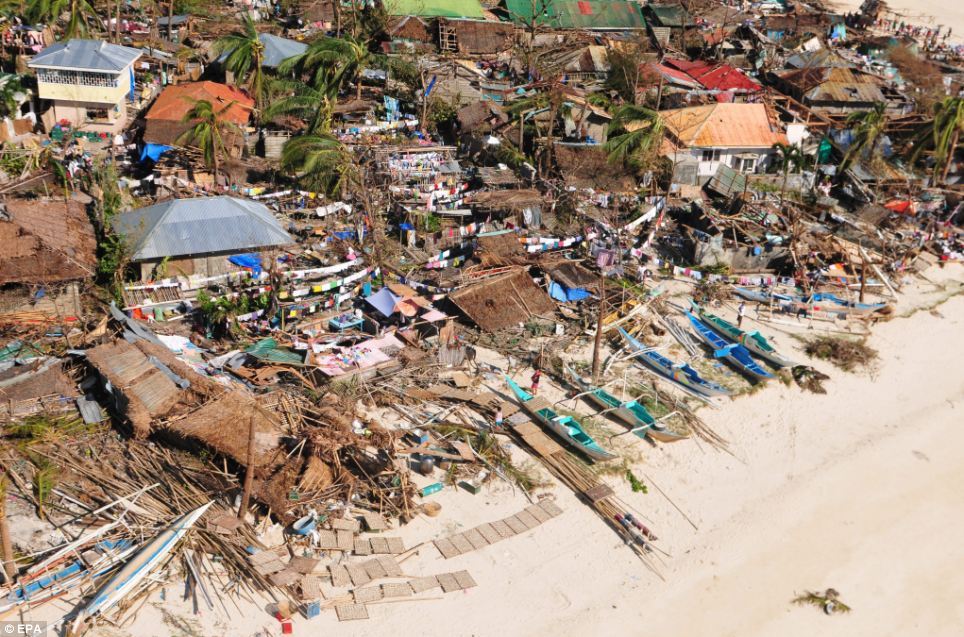
That being said, the people we should be paying our respects to today are the ~10,000 dead and hundreds of thousands displaced by Typhoon Haiyan. When Haiyan first hit the Philippines last Friday it was a maximum category 5 storm. Fortunately it has been weakening as it went over Vietnam earlier today and continues towards China. The following images from the UK’s Daily Mail online convey the scope of the devastation and suffering:

City of the dead: Dazed survivors survey the damaged houses in Tacloban city, Leyte province. At least 10,000 people are believed to have died there

City of the dead: Dazed survivors survey the damaged houses in Tacloban city, Leyte province. At least 10,000 people are believed to have died there

Force of nature: One of the many ships which have been swept into the Tacloban by the power of the typhoon

Force of nature: One of the many ships which have been swept into the Tacloban by the power of the typhoon

A Filipino father and his children wait for food relief outside their makeshift tent.

Desperate measures: A Filipino father and his children wait for food relief outside their makeshift tent. Survivors have foraged for food as supplies dwindled, with some uncovering the bodies of the dead

Trail of destruction: Those who escaped the awesome power of Haiyan now face a grim battle to rebuild their lives among the sprawling wreckages

Trail of destruction: Those who escaped the awesome power of Haiyan now face a grim battle to rebuild their lives among the sprawling wreckages

Survivors in Tacloban told reporters they are so desperate for food that they have been forced to loot shops and steal from the dead

Survivors in Tacloban told reporters they are so desperate for food that they have been forced to loot shops and steal from the dead

Action: President Benigno Aquino has deployed troops to the area in a bid to restore calm after Philipine Red Cross aid trucks were attacked by hungry mobs

Action: President Benigno Aquino has deployed troops to the area in a bid to restore calm after Philipine Red Cross aid trucks were attacked by hungry mobs

Aftermath: Resident gather in the remains of a structure in Tacloban. Those left homeless have been forced to plunder the houses belonging to the dead. One local councillor admitted he has stepped on corpses in a desperate bid to find food

Aftermath: Resident gather in the remains of a structure in Tacloban. Those left homeless have been forced to plunder the houses belonging to the dead. One local councillor admitted he has stepped on corpses in a desperate bid to find food saying: ‘If you have not eaten in three days, you do shameful things to survive’

Remains: Survivors have begun to rummage through the wreckages of houses in a bid to find food to feed their families

Remains: Survivors have begun find corpses as they rummage through the wreckages of houses in a bid to find food to feed their starving families

Making do: Survivors have been forced to forage for food and supplies after many homes were submerged by flood water and landslides

Making do: Survivors have been forced to forage for food and supplies after many homes were submerged by flood water and landslides

The Philippines president is considering introducing martial law in Tacloban city (pictured), where up to 10,000 people are feared dead, to enforce security after serious looting

The Philippines president is considering introducing martial law in Tacloban city (pictured), where up to 10,000 people are feared dead

Holy house: Churches in the storm torn city have become temporary aid centres offering washing facilities and handing out emergency food supplies

Holy house: Churches in the storm torn city have become temporary aid centres offering washing facilities and handing out emergency food supplies

Shelter from the storm: While the Catholic church in Tacloban has welcomed victims, many buildings have been broken into by desperate looters

Shelter from the storm: While the Catholic church in Tacloban has welcomed victims, many buildings have been broken into by desperate looters

This image taken by astronaut Karen L. Nyberg and released by NASA shows Super Typhoon Haiyan from the International Space Station yesterday

This image taken by astronaut Karen L. Nyberg and released by NASA shows Super Typhoon Haiyan from the International Space Station yesterday

Washing still hangs on the lines but dozens of bamboo houses have been flattened by the storm in Baladian in the municipality of Concepcion, Iloilo Province

Washing still hangs on the lines but dozens of bamboo houses have been flattened by the storm in Baladian in the municipality of Concepcion, Iloilo Province

Loss: A mother weeps beside the dead body of her son at a chapel in the aftermath of Typhoon Haiyan in Tacloban

Loss: A mother weeps beside the dead body of her son at a chapel in the aftermath of Typhoon Haiyan in Tacloban

A ship was washed ashore in the huge storm. Surging sea water strewed debris for miles and survivors said the devastation was like a tsunami

A ship was washed ashore in the huge storm. Surging sea water strewed debris for miles and survivors said the devastation was like a tsunami

The storm is one of the most powerful ever recorded

The storm is one of the most powerful ever recorded and huge waves swept away entire coastal villages and destroyed up to 80 per cent of the area in its path

More than 330,900 people were displaced and 4.3million 'affected' by the typhoon in 36 provinces, the U.N. has said

More than 330,900 people were displaced and 4.3million ‘affected’ by the typhoon in 36 provinces, the U.N. has said

Residents try to salvage belongings in Tacloban city, Leyte province.

Residents try to salvage belongings in Tacloban city, Leyte province. Rescuers have not even been able to contact some towns on the coast where the storm first hit

Villagers walk past a body of victim laying on a pier in the super typhoon devastated city of Tacloban, Leyte province

Villagers walk past a body of victim laying on a pier in the super typhoon devastated city of Tacloban, Leyte province

This afternoon, the Typhoon Haiyan - believed to be the strongest storm to ever hit land - made landfall in Sanya in south China's Hainan province.

This afternoon, Typhoon Haiyan – believed to be the strongest storm to ever hit land – made landfall in Sanya in south China’s Hainan province

Workers remove a tree that has fallen onto a car in the aftermath of Typhoon Haiyan after it struck Sanya

Workers remove a tree that fell onto a car during the deadly storm, which is the 30th typhoon to strike China this year

Vehicles move slowly by a fallen billboard in Sanya in south China's Hainan province

The typhoon is now making its way towards Vietnam and mainland China – with locals bracing themselves for the onslaught of the deadly typhoon

Heavy winds had already caused damage to China's Hainan island before the super typhoon made landfall this afternoon. Above, a billboard is blown over by the strong winds

Heavy winds had already caused damage to China’s Hainan island before the super typhoon made landfall. Above, a billboard is blown over by the strong winds

A man carries boxes of milk as he passes by ships washed ashore by enormous waves in Tacloban city, Leyte province

A man carries boxes of milk as he passes by ships washed ashore by enormous waves in Tacloban city, Leyte province

One survivor said the scenes of utter devastation caused by the typhoon was 'like the end of the world'

One survivor said the scenes of utter devastation caused by the typhoon was ‘like the end of the world’

Aid agencies have made emergency appeals for funds and are trying to reach survivors who are in desperate need of clean water and shelter

Aid agencies have made emergency appeals for funds and are trying to reach survivors who are in desperate need of clean water and shelter

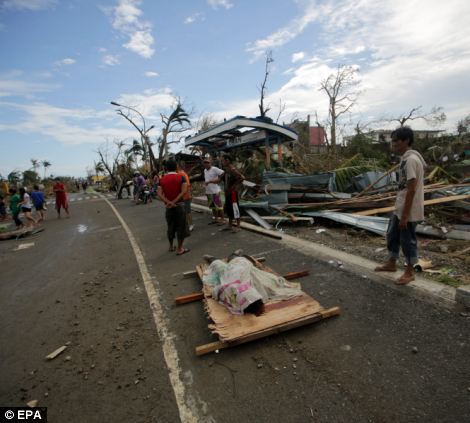
Bodies still lie in the roads and thousands of homes lie destroyed near the fish port after super Typhoon Haiyan battered Tacloban city

Bodies still lie in the roads and thousands of homes lie destroyed near the fish port after super Typhoon Haiyan battered Tacloban city

This NASA MODIS Aqua satellite image shows what is possibly the strongest storm ever - Super Typhoon Haiyan

This NASA MODIS Aqua satellite image shows what is possibly the strongest storm ever – Super Typhoon Haiyan

Local and foreign medical teams prepare to board a Philippines air force C-130 transport plane in Manila

Local and foreign medical teams prepare to board a Philippines air force C-130 transport plane in Manila

Survivors walk towards the evacuation center to get relief goods after super Typhoon Haiyan battered Tacloban city, central Philippines

Survivors walk towards the evacuation center to get relief goods after super Typhoon Haiyan battered Tacloban city, central Philippines

City administrators in Tacloban said about 400 bodies have been collected so far but said the death toll in the city alone could be 10,000

City administrators in Tacloban said about 400 bodies have been collected so far but said the death toll in the city alone could be 10,000

A girl looks out from a makeshift shelter in Tacloban.

A girl looks out from a makeshift shelter in Tacloban. The World Food Programme said it was airlifting 40 tonnes of high-energy biscuits to the region

A woman holds her umbrella stands on debris of houses in Tacloban

A woman holds her umbrella stands on debris of houses in Tacloban. Millions of people are believed to have been ‘affected’ by the storm, including hundreds of thousands who have lost their homes

Children pull sacks of goods they recovered from abandoned stores as they go past the rubble of houses in Tacloban

Children pull sacks of goods they recovered from abandoned stores as they go past the rubble of houses in Tacloban

A woman mourns in front of her husband's dead body, which lies no the street under tarpaulin alongside other bodies

A woman mourns in front of her husband’s dead body, which lies no the street under tarpaulin alongside other bodies

An injured Filipino boy stand in front of the rubble of houses in Tacloban - destroyed by the typhoon that has left thousands of people dead

An injured Filipino boy stand in front of the rubble of houses in Tacloban – destroyed by the typhoon that has left thousands of people dead

A man with an injured leg is carried through the devastation of former residential roads in Tacloban

A man with an injured leg is carried through the devastation of former residential roads in Tacloban

Operation: A Vietnamese soldier carries a young girl from a lorry as villagers are evacuated to a safe place by the military

Operation: A Vietnamese soldier carries a young girl from a lorry as villagers are evacuated to a safe place by the military


Desolation: This heartbreaking picture shows an flattened area of Tacloban city covered by debris and flood water

Desolation: This picture shows an flattened area of the destroyed Tacloban city covered by debris and flood water

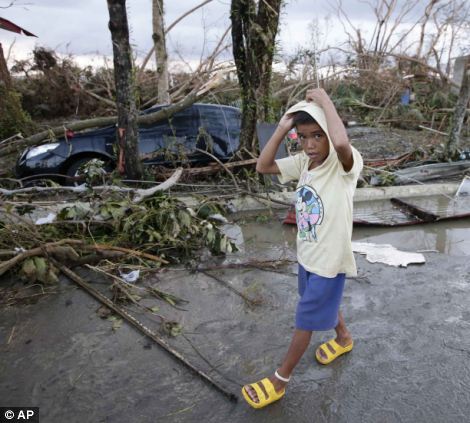
Flattened: A Filipino boy stands among the debris in Tacloban, Leyte province - one of the worst hit areas of Typhoon Haiyan

Flattened: A Filipino boy stands among the debris in Tacloban, Leyte – one of the worst areas hit by category five storm Typhoon Haiyan

Death: It has been estimated by the Red Cross that 1,000 of the 1,200 people killed by the typhoon were residents of Tacloban

Death: It has been estimated by the Red Cross that 1,000 of the 1,200 people killed by the typhoon were residents of Tacloban

Widespread: This picture shows acres of flooded rice fields in the Iloilo Province

Widespread: This picture shows acres of flooded rice fields in the Iloilo Province, another area devastated by the typhoon

Assistance: An elderly woman is evacuated from her home by Red Cross staff in Vietnam
Plans: The Vietnamese Government has started to evacuate more than 100,000 people from the path of Typhoon Haiyan, according to state media

Plans: An elderly woman is taken from her home in Danang, Vietnam, as the government begins to evacuate 100,000 people lying in the path of typhoon Haiyan

From above: An aerial view shows badly damaged houses, including many without a roof, and blocked roads in the Philippine province of Iloilo

From above: An aerial view shows badly damaged houses, including many without a roof, and blocked roads in the Philippine province of Iloilo

Residents return to their houses after leaving an evacuation site in the aftermath of Super Typhoon Haiyan
Residents sit outside their damaged house

Recovery: A child is lifted to safety from a house in Tacloban, left, and two residents sit on the pavement in front of their home in the same city, right

Flattened: The typhoon has ravaged most of the city of Tacloban and destroyed the airport

Flattened: The typhoon has ravaged most of the city of Tacloban and destroyed the airport

Ruins: A resident sifts through rubbish inside his home that has been flattened by 235mph winds in the devastated city of Tacloban

Ruins: A resident sifts through rubbish inside his ruined home, flattened by 235mph winds in the devastated city of Tacloban

Scale: This image shows Typhoon Haiyan taken by Astronaut Karen L. Nyberg aboard the Internatioal Space Station

Scale: This image shows the enormous Typhoon Haiyan taken by Astronaut Karen L. Nyberg aboard the Internatioal Space Station

Satellite: A picture posted on Twitter by NASA at 8.00pm GMT shows the centre of the moving across the South China Sea towards the coast of Vietnam

Satellite: A picture posted on Twitter by NASA at 8.00pm GMT shows the centre of the moving across the South China Sea towards the coast of Vietnam

Path: Once the typhoon has reached the coast of Vietnam it is expected to moved towards the capital, Hanoi, with parts of Laos and Cambodia also likely to be affected

Path: Once the typhoon has reached the coast of Vietnam it is expected to moved towards the capital, Hanoi, with parts of Laos and Cambodia also likely to be affected

 Typhoon Haiyan
A boy walks past the devastation brought about by powerful typhoon Haiyan at Tacloban city

Loss: A pregnant woman, left, walks around the remains of her home while a young boy, right, walks past a crushed car in the destroyed town of Tacloban

Biggest storm in history Typhoon Haiyan flattens Philippines

Bodies wrapped in blankets are placed inside a damaged chapel
A Filipino elderly woman views the recovered victims in the typhoon

Temporary: Bodies of victims lay in a deserted chapel in Tacloban. A woman and child, right, view the distressing scene

Flooding: Locals in Coron, Palawan walk among damaged buildings after the typhoon - the most powerful in three decades

Flooding: Locals in Coron, Palawan, walk among damaged buildings and flooded streets after the typhoon – one of the most powerful to ever hit land

Terrifying: Filipino children are seen in the city of Tacloban, Leyte. Behind them is a scene of devastation with homes flattened and debris lying in the street

Terrifying: Filipino children are seen in the city of Tacloban, Leyte. Behind them is a scene of devastation with homes flattened and debris lying in the street

Picking up the pieces: Some residents try to go about their daily business despite the large-scale destruction

Picking up the pieces: Some residents try to go about their daily business despite the large-scale destruction

Victim
 resident recover a body of a victim

Tragedy: Bodies of residents can be seen in the streets of Tacloban, while one local is forced to transport a body in a wheelbarrow

Collapsed: A resident walks past her destroyed home - flattened by piles of wood and branches from nearby trees - in Tacloban city

Collapsed: A resident walks past her destroyed home – flattened by piles of wood and branches from nearby trees – in Tacloban city

Workers: Local Red Cross staff place sand bags on the roof of a house in Danang, Vietnam

Workers: Local Red Cross staff place sand bags on the roof of a house in Danang, Vietnam

Debris: Helicopters hover over the damaged area of Tacloban city, which was battered with strong winds yesterday

Debris: Helicopters hover over the damaged area of Tacloban city, which was battered with strong winds yesterday

Victim: A resident walks past dead bodies that lie on the street in Tacloban city, Leyte province

Victim: A resident walks past dead bodies that lie on the street in Tacloban city, Leyte province

Under water: Residents wade through a flooded street in Mindoro, Philippines this morning following the typoon

Under water: Residents wade through a flooded street in Mindoro, Philippines this morning following the typoon

Pile up: Vehicles and rubbish are pictured strewn across a flooded street in Tacloban, Leyte

Pile up: Vehicles and rubbish are pictured strewn across a flooded street in Tacloban, Leyte

Upside down: A devastated airport in Tacloban city, Leyte province - where roofs were ripped on hundreds of houses

Upside down: A devastated airport in Tacloban city, Leyte province – where roofs were ripped on hundreds of houses

 Coron, Palawan
 Coron, Palawan

Shock: These two pictures show the devastation in Coron, Palawan where buildings have been flattened, left and right, leaving residents helplessly walking the streets.

‘We thought is was a Tsunami’ – panic as storm lashes Philippines

Space: A digital composite of Typhoon Haiyan approaching the Philippines, made using images captured at 1pm

Space: A digital composite of Typhoon Haiyan approaching the Philippines, made using images captured geostationary satellites of the Japan Meteorological Agency

Rebuilding their lives: Two men in Iloilo move some of their belongings through flood waters covering the streets

Rebuilding their lives: Two men in Iloilo move some of their belongings through flood waters covering the streets

Devastation: Debris which was washed in by the storm litters the road by the coastal village in Legazpi city. Residents now face a long clean up operation to repair the damage to their homes

Devastation: Debris which was washed in by the storm litters the road by the coastal village in Legazpi city. Residents now face a long clean up operation

No chance: A house is engulfed by the storm surge brought about by powerful typhoon Haiyan, many homes like it could not stand up to the force of the gales
A fisherman secures his wooden fishing boat along the sea wall amidst strong winds as Typhoon Haiyan hit the city of Legaspi, Albay province, south of Manila

Hanging on: A fisherman in Manila is forced to cling on to his equipment, left, while there was little hope for other less stable buildings in the storm’s path, right

Higher ground: Residents of Legaspi, Albay province, south of Manila resident, were forced to flee the coast as Haiyan continued to pound the sea wall today

Higher ground: Residents of Legaspi, Albay province, south of Manila resident, were forced to flee the coast as Haiyan continued to pound the sea wall today

Downpour: As well as strong winds, the typhoon brought with it torrential rain which caused landslides in rural parts of the country

Downpour: As well as strong winds, the typhoon brought with it torrential rain which caused landslides in rural parts of the country

Terrifying: Residents run for their lives as the terrible gusts of the typhoon rush buffet the popular tourist city of Cebu

Terrifying: Residents run for their lives as the terrible gusts of the typhoon buffet the popular tourist city of Cebu. Trees and roofs were torn off by the storm

Blocked: Residents clear the road in the island province of Cebu after a tree was toppled by strong winds during typhoon Haiyan

Blocked: Residents clear the road in the island province of Cebu after a tree was toppled by strong winds during typhoon Haiyan

TYPHOON HAIYAN aftermath: Two dead, thousands displaced

Aid effort: Volunteers pack relief goods inside a Department of Social Welfare and Development warehouse before shipping out to devastated provinces

Aid effort: Volunteers pack relief goods inside a Department of Social Welfare and Development warehouse before shipping out to devastated provinces

Shelter: Filipino residents sleep on the floor of a gymnasium turned into an evacuation center in Sorsogon City in the Bicol region

Shelter: Filipino residents sleep on the floor of a gymnasium turned into an evacuation center in Sorsogon City in the Bicol region

If you would like to help: Médecins Sans Frontières (MSF)

Remember, Remember, the 5th of November

v-for-vendetta-5-11-10-kc

In honor of Guy Fawkes Day I’d like to bring attention to a few intriguing statements from Alan Moore (writer of the graphic novel V for Vendetta) on the connections between his fictions and reality from an interview he did shortly after the start of the Occupy Movement.

Via The Guardian:

I suppose I’ve gotten used to the fact that some of my fictions percolate out into the material world.

…I suppose when I was writing V for Vendetta I would in my secret heart of hearts have thought: wouldn’t it be great if these ideas actually made an impact? So when you start to see that idle fantasy intrude on the regular world… It’s peculiar. It feels like a character I created 30 years ago has somehow escaped the realm of fiction.

…And when you’ve got a sea of V masks, I suppose it makes the protesters appear to be almost a single organism – this “99%” we hear so much about. That in itself is formidable. I can see why the protesters have taken to it. It turns protests into performances.

The mask is very operatic; it creates a sense of romance and drama. I mean, protesting, protest marches, they can be very demanding, very grueling. They can be quite dismal. They’re things that have to be done, but that doesn’t necessarily mean that they’re tremendously enjoyable – whereas actually, they should be.

I think it’s appropriate that this generation of protesters have made their rebellion into something the public at large can engage with more readily than with half-hearted chants, with that traditional, downtrodden sort of British protest. These people look like they’re having a good time. And that sends out a tremendous message.

The reason V’s fictional crusade against the state is ultimately successful is that the state, in V for Vendetta, relies upon a centralised computer network which he has been able to hack. Not an obvious idea in 1981, but it struck me as the sort of thing that might be down the line. This was just something I made up because I thought it would make an interesting adventure story. Thirty years go by and you find yourself living it.

I have no particular connection or claim to what [the protesters] are doing, nor am I suggesting that these people are fans of mine, or of V for Vendetta…So there’s always… Now I didn’t feel responsible, but…at the moment, the demonstrators seem to me to be making clearly moral moves, protesting against the ridiculous state that our banks and corporations and political leaders have brought us to.

…It would probably be better if the authorities accepted this is a new situation, that this is history happening. History is a thing that happens in waves. Generally it is best to go with these waves, not try to make them turn back – the Canute option. I’m hoping that the world’s leaders will realise this.

Vox populi, Voice of the people. And I think that if the mask stands for anything, in the current context, that is what it stands for. This is the people. That mysterious entity that is evoked so often – this is the people.

Read the full article here: http://www.theguardian.com/books/2011/nov/27/alan-moore-v-vendetta-mask-protest

Last July Moore was interviewed by Salon.com to talk about his new Kickstarter project, Jimmy’s End, but he also shared the following relevant observations about emerging NSA revelations, the surveillance state and technology:

There seems to be something going on, even from the briefest appraisal of the news, with the amount of events transpiring. This is such a connected world, it’s useless to isolate any part of it as a discrete phenomenon. You can’t really talk about the problems in Syria, because its problems are global. The waves of discontent and outrage — whether in the Arab countries, or in Brazil, or in America and Europe over the degrees to which its citizens are being monitored — are not separate phenomena. They are phenomena of an emergent world, and the existence of the Internet is one of its major drivers. We have got no idea how it’s going to turn out, because the nature of our society is such that if anything can be invented, then we will invent it. Sooner or later, if it is possible.

So the Internet is changing everything, but I wouldn’t yet want to say for good or ill. I suspect, as ever, that it will be an admixture of both. But we are all along for the ride, even those people like me who do not have Internet connections, mobile phones or even functioning televisions. I’m slowly disconnecting myself. Basically, it’s a feeling that if we are going to subject our entire culture to what is an unpredictable experiment, then I’d like to try to remain outside the petri dish. [Laughs] It’s only sensible to have somebody as a control.

To me, one of the biggest surprises of these recent surveillance revelations is how surprised people are. The level of surveillance we’ve had over here for the past 20 years now is ridiculous — and useless, I would add. Eerily enough, the security cameras on every street corner of Britain was instigated by the incoming Blair government in 1997, which was when I decided, back in 1982 or so, to set the first episode of “V for Vendetta,” which had cameras on every street corner. So yeah, we’ve had those for awhile; they’ve proliferated and multiplied for decades. More recently, there have been troops of police who have said that all these things are useful for is alienating the public. [Laughs] They are not actually useful in the prevention of crimes, or even actually apprehending their suspects.

Here’s the thing: If you’re monitoring every single thing that goes on in a given culture, if you have all the information that is there to be had, then that is the equivalent of having none of it. [Laughs] How are you going to process that amount of information? That’s when you get all these wonderful emerging paradoxes. Recently over here, there was a case where it was suspected that the people who monitor security screens were taking unnecessary toilet breaks and gossiping when they should be watching us. So it was decided that the only sensible thing to do was to put a security camera in the monitor room. [Laughs] This is answering the question that Juvenal asked so succinctly all those years ago: Who watches the watchmen? The answer is more watchmen! And yet more watchmen watch them, and of course it will eventually occur to them to ask: Can those people who are watching the people doing the watching really be trusted? Much better if they were under surveillance.

That’s the level of absurdity these Orwellian solutions bring to our increasingly complex world. George Orwell’s vision was 1947. Yes, the world was more complex than it had been, but nowhere near as complex as it was going to get. We currently have in Northampton — and I think we might be the first to have it — security cameras in some places that actually talk to you. “Pick that cigarette end up! Yes, you!” [Laughs] Which is so much like Patrick McGoohan’s vision for the Village in “The Prisoner,” all those years ago.

…Technology is always a two-edged sword. It will bring in many benefits, but also many disasters. Because of the complexity of our situation, we cannot predict what things will be until they happen. It’s just part of our responsibility as people in the modern world to do our very, very best to deal with them, and think them through, as they occur. While I’m remote from most technology to the point that I’m kind of Amish, I have played a couple of computer games — until I realized I was being bloodied with adrenalin over something that wasn’t real. At the end of a couple of hours of very addictive play, I may have procured the necessary amount of mushrooms to save a princess, but I also wasted hours of my life that I’ll never be able to get back. This is the reason I am not on the Internet. I am aware of its power as a distraction, and I don’t have the time for that.

Despite the constant clamor for attention from the modern world, I do believe we need to procure a psychological space for ourselves. I apparently know some people who try to achieve this by logging off, or going without their Twitter or Facebook for a limited period. Which I suppose is encouraging, although it doesn’t seem that remarkable from my perspective. I think that people need to establish their own psychological territory in face of the encroaching world.

Read the full interview here: http://www.salon.com/2013/07/07/alan_moore_the_revolution_will_be_crowd_funded/

Despite the fact that Moore said he disowned all Hollywood adaptations of his works, in my opinion the quality of his writing can transcend limitations inherent in such attempts, retaining power and resonance even in “watered down” form. Though I was disappointed by the film version of V for Vendetta overall, many who would not have otherwise been exposed to Moore’s work were able to absorb important aspects of his message through it and viral clips such as this:

Are Feds Investigating “Boston Bomber” Trail, or Covering It Up?

Feds Accused Of Harassing “Boston Bomber” Friends, And Friends Of Friends

(This story originally ran in Who What Why News)

In the six months since the Boston Marathon bombing, the FBI has by all appearances been relentlessly intimidating, punishing, deporting and, in one case, shooting to death, persons connected, sometimes only tangentially, with the alleged bombers.

All of these individuals have something in common: If afforded constitutional protections and treated as witnesses instead of perpetrators, they could potentially help clear up questions about the violence of April 15. And they might also be able to help clarify the methods and extent of the FBI’s recruitment of immigrants and others for undercover work, and how that could relate to the Bureau’s prior relationship with the bombing suspects—a relationship the Bureau has variously hidden or downplayed.

Who Cares? We Do

The Boston tragedy may seem like a remote, distant memory, yet the bombing warrants continued scrutiny as a seminal event of our times. It was, after all, the only major terror attack in the United States since 9/11. With its grisly scenes of severed limbs and dead bodies, including that of a child, it shook Americans profoundly.

As importantly, in its aftermath we’ve seen public acquiescence in an ongoing erosion of civil liberties and privacy rights that began with 9/11—and to an unprecedented expansion of federal authority in the form of a unique military/law enforcement “lockdown” of a major metropolitan area.

 Ashur Miraliev and Tatian Gruzdeva, threatened with deportation or deported, and Ibragim Todashev, killed during an

FBI victims: Ashur Miraliev and Tatian Gruzdeva, threatened with deportation or deported, and Ibragim Todashev, killed during an interrogation

Nonetheless, at the time, most news organizations simply accepted at face value the shifting and thin official accounts of the strange events. Today few give the still-unfolding saga even the most minimal attention. And it is most certainly still unfolding, as we shall see.

The Little-Noticed Post-Marathon Hunt

The FBI’s strange obsession with marginal figures loosely connected to the bombing story began last May, with the daily questioning of a Chechen immigrant, Ibragim Todashev, and of his girlfriend and fellow immigrant, Tatiana Gruzdeva. Todashev had been a friend of the alleged lead Boston Marathon bomber, Tamerlan Tsarnaev, who died in a hail of police gunfire four days after the bombing. Tsarnaev’s younger brother Dzhokhar barely survived a massive police strafing of a trailered boat in which he was hiding, trapped and unarmed.

During one interrogation in Orlando, Florida, where Todashev was living, something went awry and he ended up dead from gunshots. Although to date the FBI has provided only hazy and inconsistent accounts of that incident, the killing of a suspect and potential witness in custody was clearly a highly irregular and problematical occurrence, replete with apparent violations of Bureau and standard law-enforcement procedure.

On the heels of those two deaths and the one near-death has followed what appears to be a concerted effort directed against a larger circle of people connected, if not to the Tsarnaevs, then to Todashev.

The purpose of this campaign is not clear, but it has raised some eyebrows.

In an interview with WhoWhatWhy, Hassan Shibly, executive director of the Florida chapter of the Center for American Islamic Relations (CAIR), described aggressive behavior directed by FBI agents at vocal friends of the dead Todashev: using suspected informants to monitor their press conferences, following targeted individuals around, interrogating them for hours—often without an attorney, and jailing them on what he says are trumped-up charges.

Shibly further claims that government agents are threatening these immigrants with deportation unless they agree to “cooperate”—a tactic which he portrays as seeking to enroll these people as de facto spies for the federal government.

Two people have left the country to escape further harassment. Another has been deported, while a fourth is currently facing deportation; none  of them has a criminal record. The bulk of this group were at most friends of a friend of Tamerlan Tsarnaev—and apparently didn’t personally know either of the Tsarnaevs.
For the rest of this article, please go to: Who What Why News