The Party’s Over: Beyond Politics, Beyond Democracy

illusionofvote

Source: CrimethInc.

Nowadays, democracy rules the world. Communism is long dead, elections are taking place even in Afghanistan and Iraq, and world leaders are meeting to plan the “global community” we hear so much about. So why isn’t everybody happy, finally? For that matter-why do so few of the eligible voters in the United States, the world’s flagship democracy, even bother to vote?

Could it be that democracy, long the catchword of every revolution and rebellion, is simply not democratic enough? What could be the problem?
Every little child can grow up to be President

No, they can’t. Being President means occupying a position of hierarchical power, just like being a billionaire: for every person who is President, there have to be millions who are not. It’s no coincidence that billionaires and Presidents tend to rub shoulders; both exist in a privileged world off limits to the rest of us. Speaking of billionaires, our economy isn’t exactly democratic-capitalism distributes resources in absurdly unequal proportions, and you have to start with resources if you’re ever going to get elected.

Even if it was true that anyone could grow up to be President, that wouldn’t help the millions who inevitably don’t, who must still live in the shadow of that power. This imbalance is intrinsic to the structure of representative democracy, at the local level as much as at the top. The professional politicians of a town council discuss municipal affairs and pass ordinances all day without consulting the citizens of the town, who have to be at work; when one of those ordinances displeases citizens, they have to use what little leisure time they have to contest it, and then they’re back at work again the next time the town council meets. In theory, the citizens could elect a different town council from the available pool of politicians and would-be politicians, but the interests of politicians as a class always remain essentially at odds with their own-besides, voting fraud, gerrymandering, and inane party loyalty usually prevent them from going that far. Even in the unlikely scenario that a whole new government was elected consisting of firebrands intent on undoing the imbalance of power between politicians and citizens, they would inevitably perpetuate it simply by accepting roles in the system-for the political apparatus itself is the foundation of that imbalance. To succeed in their objective, they would have to dissolve the government and join the rest of the populace in restructuring society from the roots up.

But even if there were no Presidents or town councils, democracy as we know it would still be an impediment to freedom. Corruption, privilege, and hierarchy aside, majority rule is not only inherently oppressive but also paradoxically divisive and homogenizing at the same time.
The Tyranny of the Majority

If you ever found yourself in a vastly outnumbered minority, and the majority voted that you had to give up something as necessary to your life as water and air, would you comply? When it comes down to it, does anyone really believe it makes sense to accept the authority of a group simply on the grounds that they outnumber everyone else? We accept majority rule because we do not believe it will threaten us-and those it does threaten are already silenced before anyone can hear their misgivings.

The average self-professed law-abiding citizen does not consider himself threatened by majority rule because, consciously or not, he conceives of himself as having the power and moral authority of the majority: if not in fact, by virtue of his being politically and socially “moderate,” then in theory, because he believes everyone would be convinced by his arguments if only he had the opportunity to present them. Majority-rule democracy has always rested on the conviction that if all the facts were known, everyone could be made to see that there is only one right course of action-without this belief, it amounts to nothing more than the dictatorship of the herd. But even if “the” facts could be made equally clear to everyone, assuming such a thing were possible, people still would have their individual perspectives and motivations and needs. We need social and political structures that take this into account, in which we are free from the mob rule of the majority as well as the ascendancy of the privileged class.

Living under democratic rule teaches people to think in terms of quantity, to focus more on public opinion than on what their consciences tell them, to see themselves as powerless unless they are immersed in a mass. The root of majority-rule democracy is competition: competition to persuade everyone else to your position whether or not it is in their best interest, competition to constitute a majority to wield power before others outmaneuver you to do the same-and the losers (that is to say, the minorities) be damned. At the same time, majority rule forces those who wish for power to appeal to the lowest common denominator, precipitating a race to the bottom that rewards the most bland, superficial, and demagogic; under democracy, power itself comes to be associated with conformity rather than individuality. And the more power is concentrated in the hands of the majority, the less any individual can do on her own, whether she is inside or outside that majority.

In purporting to give everyone an opportunity to participate, majority-rule democracy offers a perfect justification for repressing those who don’t abide by its dictates: if they don’t like the government, why don’t they go into politics themselves? And if they don’t win at the game of building up a majority to wield power, didn’t they get their chance? This is the same blame-the-victim reasoning used to justify capitalism: if the dishwasher isn’t happy with his salary, he should work harder so he too can own a restaurant chain. Sure, everyone gets a chance to compete, however unequal-but what about those of us who don’t want to compete, who never wanted power to be centralized in the hands of a government in the first place? What if we don’t care to rule or be ruled?

That’s what police are for-and courts and judges and prisons.
The Rule of Law

Even if you don’t believe their purpose is to grind out nonconformity wherever it appears, you have to acknowledge that legal institutions are no substitute for fairness, mutual respect, and good will. The rule of “just and equal law,” as fetishized by the stockholders and landlords whose interests it protects, offers no guarantees against injustice; it simply creates another arena of specialization, in which power and responsibility are ceded to expensive lawyers and pompous judges. Rather than serving to protect our communities and work out conflicts, this arrangement ensures that our communities’ skills for conflict resolution and self-defense atrophy-and that those whose profession it supposedly is to discourage crime have a stake in it proliferating, since their careers depend upon it.

Ironically, we are told that we need these institutions to protect the rights of minorities-even though the implicit function of the courts is, at best, to impose the legislation of the majority on the minority. In actuality, a person is only able to use the courts to defend his rights when he can bring sufficient force to bear upon them in a currency they recognize; thanks to capitalism, only a minority can do this, so in a roundabout way it turns out that, indeed, the courts exist to protect the rights of at least a certain minority.

Justice cannot be established through the mere drawing up and enforcement of laws; such laws can only institutionalize what is already the rule in a society. Common sense and compassion are always preferable to the enforcement of strict, impersonal regulations. Where the law is the private province of an elite invested in its own perpetuation, the sensible and compassionate are bound to end up as defendants; we need a social system that fosters and rewards those qualities rather than blind obedience and impassivity.
Who Loses?

In contrast to forms of decision-making in which everyone’s needs matter, the disempowerment of losers and out-groups is central to democracy. It is well known that in ancient Athens, the “cradle of democracy,” scarcely an eighth of the population was permitted to vote, as women, foreigners, slaves, and others were excluded from citizenship. This is generally regarded as an early kink that time has ironed out, but one could also conclude that exclusion itself is the most essential and abiding characteristic of democracy: millions who live in the United States today are not permitted to vote either, and the distinctions between citizen and non-citizen have not eroded significantly in 2500 years. Every bourgeois property owner can come up with a thousand reasons why it isn’t practical to allow everyone who is affected to share in decision making, just as no boss or bureaucrat would dream of giving his employees an equal say in their workplace, but that doesn’t make it any less exclusive. What if democracy arose in Greece not as a step in Man’s Progress Towards Freedom, but as a way of keeping power out of certain hands?

Democracy is the most sustainable way to maintain the division between powerful and powerless because it gives the greatest possible number of people incentive to defend that division.

That’s why the high-water mark of democracy-its current ascendancy around the globe-corresponds with unprecedented inequalities in the distribution of resources and power. Dictatorships are inherently unstable: you can slaughter, imprison, and brainwash entire generations and their children will invent the struggle for freedom anew. But promise every man the opportunity to be a dictator, to be able to force the “will of the majority” upon his fellows rather than work through disagreements like a mature adult, and you can build a common front of destructive self-interest against the cooperation and collectivity that make individual freedom possible. All the better if there are even more repressive dictatorships around to point to as “the” alternative, so you can glorify all this in the rhetoric of liberty.
Capitalism and Democracy

Now let’s suspend our misgivings about democracy long enough to consider whether, if it were an effective means for people to share power over their lives, it could be compatible with capitalism. In a democracy, informed citizens are supposed to vote according to their enlightened self-interest-but who controls the flow of information, if not wealthy executives? They can’t help but skew their coverage according to their class interests, and you can hardly blame them-the newspapers and networks that didn’t flinch at alienating corporate advertisers were run out of business long ago by competitors with fewer scruples.

Likewise, voting means choosing between options, according to which possibilities seem most desirable-but who sets the options, who establishes what is considered possible, who constructs desire itself but the wealthy patriarchs of the political establishment, and their nephews in advertising and public relations firms? In the United States, the two-party system has reduced politics to choosing the lesser of two identical evils, both of which answer to their funders before anyone else. Sure, the parties differ over exactly how much to repress personal freedoms or spend on bombs-but do we ever get to vote on who controls “public” spaces such as shopping malls, or whether workers are entitled to the full product of their labor, or any other question that could seriously change the way we live? In such a state of affairs, the essential function of the democratic process is to limit the appearance of what is possible to the narrow spectrum debated by candidates for office. This demoralizes dissidents and contributes to the general impression that they are impotent utopians-when nothing is more utopian than trusting representatives from the owning class to solve the problems caused by their own dominance, and nothing more impotent than accepting their political system as the only possible system.

Ultimately, the most transparent democratic political process will always be trumped by economic matters such as property ownership. Even if we could convene everyone, capitalists and convicts alike, in one vast general assembly, what would prevent the same dynamics that rule the marketplace from spilling over into that space? So long as resources are unevenly distributed, the rich can always buy others’ votes: either literally, or by promising them a piece of the pie, or else by means of propaganda and intimidation. Intimidation may be oblique-“Those radicals want to take away your hard-earned property”-or as overt as the bloody gang wars that accompanied electoral campaigns in nineteenth century America.

Thus, even at best, democracy can only serve its purported purpose if it occurs among those who explicitly oppose capitalism and foreswear its prizes-and in those circles, there are alternatives that make a lot more sense than majority rule.
It’s no coincidence freedom is not on the ballot

Freedom is a quality of activity, not a condition that exists in a vacuum: it is a prize to be won daily, not a possession that can be kept in the basement and taken out and polished up for parades. Freedom cannot be given-the most you can hope is to free others from the forces that prevent them from finding it themselves. Real freedom has nothing to do with voting; being free doesn’t mean simply being able to choose between options, but actively participating in establishing the options in the first place.

If the freedom for which so many generations have fought and died is best exemplified by a man in a voting booth checking a box on a ballot before returning to work in an environment no more under his control than it was before, then the heritage our emancipating forefathers and suffragette grandmothers have left us is nothing but a sham substitute for the liberty they sought.

For a better illustration of real freedom in action, look at the musician in the act of improvising with her companions: in joyous, seemingly effortless cooperation, they create a sonic and emotional environment, transforming the world that in turn transforms them. Take this model and extend it to every one of our interactions with each other and you would have something qualitatively different from our present system-a harmony in human relationships and activity. To get there from here, we have to dispense with voting as the archetypal expression of freedom and participation.

Representative democracy is a contradiction.

No one can represent your power and interests for you-you can only have power by wielding it, you can only learn what your interests are by getting involved. Politicians make careers out of claiming to represent others, as if freedom and political power could be held by proxy; in fact, they are a priest class that answers only to itself, and their very existence is proof of our disenfranchisement.

Voting in elections is an expression of our powerlessness: it is an admission that we can only approach the resources and capabilities of our own society through the mediation of that priest caste. When we let them prefabricate our options for us, we relinquish control of our communities to these politicians in the same way that we have ceded technology to engineers, health care to doctors, and control of our living environments to city planners and private real estate developers. We end up living in a world that is alien to us, even though our labor has built it, for we have acted like sleepwalkers hypnotized by the monopoly our leaders and specialists hold on setting the possibilities.

But we don’t have to simply choose between presidential candidates, soft drink brands, television shows, and political ideologies. We can make our own decisions as individuals and communities, we can make our own delicious beverages and social structures and power, we can establish a new society on the basis of freedom and cooperation.

Sometimes a candidate appears who says everything people have been saying to each other for a long time-he seems to have appeared from outside the world of politics, to really be one of us. By persuasively critiquing the system within its own logic, he subtly persuades people that the system can be reformed-that it could work, if only the right people were in power. Thus a lot of energy that would have gone into challenging the system itself is redirected into backing yet another candidate for office, who inevitably fails to deliver.

But where do these candidates-and more importantly, their ideas and momentum-come from? How do they rise into the spotlight? They only receive so much attention because they are drawing on popular sentiments; often, they are explicitly trying to divert energy from existing grass-roots movements. So should we put our energy into supporting them, or into building on the momentum that forced them to take radical stances in the first place?

More frequently, we are terrorized into focusing on the electoral spectacle by the prospect of being ruled by the worst possible candidates. “What if he gets into power?” To think that things could get even worse!

But the problem is that the government has so much power in the first place-otherwise, it wouldn’t matter as much who held the reigns. So long as this is the case, there will always be tyrants. This is why it is all the more important that we put our energy into the lasting solution of opposing the power of the state.
But what are the alternatives to democracy?
Consensus

Consensus-based decision-making is already practiced around the globe, from indigenous communities in Latin America and direct action groups in Europe to organic farming cooperatives in Australia. In contrast to representative democracy, the participants take part in the decision-making process on an ongoing basis and exercise real control over their daily lives. Unlike majority-rule democracy, consensus process values the needs and concerns of each individual equally; if one person is unhappy with a resolution, it is everyone’s responsibility to find a new solution that is acceptable to all. Consensus-based decision-making does not demand that any person accept others’ power over her, though it does require that everybody consider everyone else’s needs; what it loses in efficiency it makes up tenfold in freedom and accountability. Instead of asking that people accept leaders or find common cause by homogenizing themselves, proper consensus process integrates everyone into a working whole while allowing each to retain his or her own autonomy.
Autonomy

To be free, you must have control over your immediate surroundings and the basic matters of your life. No one is more qualified than you are to decide how you live; no one should be able to vote on what you do with your time and your potential unless you invite them to. To claim these privileges for yourself and respect them in others is to cultivate autonomy.

Autonomy is not to be confused with so-called independence: in actuality, no one is independent, since our lives all depend on each other. The glamorization of self-sufficiency in competitive society is an underhanded way to accuse those who will not exploit others of being responsible for their own poverty; as such, it is one of the most significant obstacles to building community.

In contrast to this Western mirage, autonomy offers a free interdependence between people who share consensus.

Autonomy is the antithesis of bureaucracy. There is nothing more efficient than people acting on their own initiative as they see fit, and nothing more inefficient than attempting to dictate everyone’s actions from above-that is, unless your fundamental goal is to control other people. Top-down coordination is only necessary when people must be made to do something they would never do of their own accord; likewise, obligatory uniformity, however horizontally it is imposed, can only empower a group by disempowering the individuals who comprise it. Consensus can be as repressive as democracy unless the participants retain their autonomy.

Autonomous individuals can cooperate without agreeing on a shared agenda, so long as everyone benefits from everyone else’s participation. Groups that cooperate thus can contain conflicts and contradictions, just as each of us does individually, and still empower the participants. Let’s leave marching under a single flag to the military.

Finally, autonomy entails self-defense. Autonomous groups have a stake in defending themselves against the encroachments of those who do not recognize their right to self-determination, and in expanding the territory of autonomy and consensus by doing everything in their power to destroy coercive structures.
Topless Federations

Independent autonomous groups can work together in federations without any of them wielding authority. Such a structure sounds utopian, but it can actually be quite practical and efficient. International mail delivery and railway travel both work on this system, to name two examples: while individual postal and transportation systems are internally hierarchical, they all cooperate together to get mail or rail passengers from one nation to another without an ultimate authority being necessary at any point in the process. Similarly, individuals who cannot agree enough to work together within one collective can still coexist in separate groups. For this to work in the long run, of course, we need to instill values of cooperation, consideration, and tolerance in the coming generations-but that’s exactly what we are proposing, and we can hardly do worse at this task than the partisans of capitalism and hierarchy have.
Direct Action

Autonomy necessitates that you act for yourself: that rather than waiting for requests to pass through the established channels only to bog down in paperwork and endless negotiations, establish your own channels instead. This is called direct action. If you want hungry people to have food to eat, don’t just give money to a bureaucratic charity organization-find out where food is going to waste, collect it, and share. If you want affordable housing, don’t try to get the town council to pass a bill-that will take years, while people sleep outside every night; take over abandoned buildings, open them up to the public, and organize groups to defend them when the thugs of the absentee landlords show up. If you want corporations to have less power, don’t petition the politicians they bought to put limits on their own masters-take that power from them yourself. Don’t buy their products, don’t work for them, sabotage their billboards and offices, prevent their meetings from taking place and their merchandise from being delivered. They use similar tactics to exert their power over you, too-it only looks valid because they bought up the laws and values of your society long before you were born.

Don’t wait for permission or leadership from some outside authority, don’t beg some higher power to organize your life for you. Take the initiative!
How to Solve Disagreements without Calling the Authorities

In a social arrangement that is truly in the best interest of each participating individual, the threat of exclusion should be enough to discourage most destructive or disrespectful behavior. Even when it is impossible to avoid, exclusion is certainly a more humanitarian approach than prisons and executions, which corrupt police and judges as much as they embitter criminals. Those who refuse to respect others’ needs, who will not integrate themselves into any community, may find themselves banished from social life-but that is still better than exile in the mental ward or on death row, two of the possibilities awaiting such people today. Violence should only be used by communities in self-defense, not with the smug sense of entitlement with which it is applied by our present injustice system. Unfortunately, in a world governed by force, autonomous consensus-based groups are likely to find themselves at odds with those who do not abide by cooperative or tolerant values; they must be careful not to lose those values themselves in the process of defending them.

Serious disagreements within communities can be solved in many cases by reorganizing or subdividing groups. Often individuals who can’t get along in one social configuration have more success cooperating in another setting or as members of parallel communities. If consensus cannot be reached within a group, that group can split into smaller groups that can achieve it internally-such a thing may be inconvenient and frustrating, but it is better than group decisions ultimately being made by force by those who have the most power. As with individuals and society, so with different collectives: if the benefits of working together outweigh the frustrations, that should be incentive enough for people to sort out their differences. Even drastically dissimilar communities still have it in their best interest to coexist peacefully, and must somehow negotiate ways to achieve this…
Living Without Permission

…that’s the most difficult part, of course. But we’re not talking about just another social system here, we’re talking about a total transformation of human relations-for it will take nothing less to solve the problems our species faces today. Let’s not kid ourselves-until we can achieve this, the violence and strife inherent in conflict-based relations will continue to intensify, and no law or system will be able to protect us. In consensus-based structures, there are no fake solutions, no ways to suppress conflict without resolving it; those who participate in them must learn to coexist without coercion and submission.

The first precious grains of this new world can be found in your friendships and love affairs whenever they are free from power dynamics, whenever cooperation occurs naturally. Imagine those moments expanded to the scale of our entire society-that’s the life that waits beyond democracy.

It may feel like we are separated from that world by an uncrossable chasm, but the wonderful thing about consensus and autonomy is that you don’t have to wait for the government to vote for them-you can practice them right now with the people around you. Put into practice, the virtues of this way of living are clear. Form your own autonomous group, answering to no power but your own, and chase down freedom for yourselves, if your representatives will not do it for you-since they cannot do it for you.
Appendix: A Fable

Three wolves and six goats are discussing what to have for dinner. One courageous goat makes an impassioned case: “We should put it to a vote!” The other goats fear for his life, but surprisingly, the wolves acquiesce. But when everyone is preparing to vote, the wolves take three of the goats aside.

“Vote with us to make the other three goats dinner,” they threaten. “Otherwise, vote or no vote, we’ll eat you.”

The other three goats are shocked by the outcome of the election: a majority, including their comrades, has voted for them to be killed and eaten. They protest in outrage and terror, but the goat who first suggested the vote rebukes them: “Be thankful you live in a democracy! At least we got to have a say in this!”

Fascism Trumps Democracy: America, A State of Impunity

what-corporate-america-wants

By

Source: CounterPunch

Notwithstanding my title’s oblique reference to Trump, he is not the greater of the dangers now facing America, but an entirely known factor, representing a gut incipient fascism grounded primarily in capital accumulation, a nymphomaniac drive for ownership, deal-making, undisguised prestige—in short, the very traits becoming to American’s wish for wealth, power, and status on which its system of capitalism is based. Ethnocentrism gives it a psychological heart, sheer ignorance of humane sensibility, a soul, indifference to the humiliation and destruction of others because of capitalism’s workings, a modal personality and societal mental set. We’ve had many examples of The Donald up-and-down the line, from the 10%, 5%, 1%, down to the bottom of the social-class scale, that being how effective false consciousness has been disseminated downward through the American value system. He presently vibrates with what appears to be a significant portion of the working class. So be it; at least the portents and record are there for fighting back.

Not so the Obamas and Clintons in our midst, largely free from serious criticism by a supine, homogenized radicalism, chanting the “lesser-of-two-evils” song on the way, not to the gas chambers (not even Trump has, as yet, gone this far), but a manifestation and structure of liberal fascism, possibly more militaristic, more ensconced deeply in a Cold War mental set, talking a good game on immigration while actively promoting a class-state of monopolism equal to anything Trump favors. We have then a condition of growing fascistization with little internal checks and differentiate primarily by rhetorical flourishes. Obama is the point man, exceeding his predecessors, in global counterrevolution, intervention, regime change, and the steady pressures toward confrontation with, above all, China, but also Russia. Meanwhile, Clinton fits the bill, perhaps more viscerally combative, with Russia, rather than China, the chief ADVERSARY. (Caps. are necessary, because the US cannot exist, much less thrive, without an enemy, whether for the mammoth defense industry, an hegemonic foreign policy, or the social discipline at home, to keep the internal market going, ferret out dissent on policy, favor the already enriched and favored.)

Stealth destroyers, appropriation $4B+, already noticed in today’s Times; the safety net grows more outmoded, environmental degradation and pollution continue apace, the murder rate in Chicago and other major cities climbs, but imperialism is, literally, business-as-usual. And business itself is business as usual: Bank of America last week’s poster boy of questionable behavior. “You break it, you own it” might be the slogan in a small business souvenir shop, but what of the bigger picture? American business, notably, railroads and banking, by the mid-19th century, had already broken the promise of democracy, and fixing the system on democratic lines has grown more remote with time. That is where “fascism” is not an expletive, but reality: the interpenetration of business and government, capitalism and the State, the cozy amalgam of wealth, power, the military, which even the strongest chisel could not pry them apart.

Germany had its form, Italy, its, Japan, its, all signifying cultural and linguistic differences, but not systemic ones, capitalism in each case, and the social structure of hierarchy it created, the determinative factor in shaping the polity and its purposes of Order, deservedly the dirtiest word in the political lexicon. Everyone knows his/her place in a fascist social order. Substantive protest is muted, whether through repression or indoctrination. America now joins the 20th century’s historical Big Three of fascist persuasion, relying more on indoctrination than explicit, overt repression. Fly-over military jets at football games is the Pavlovian reminder of requisite patriotism to be considered, and consider oneself, the Good American. (Trump merely echoes the man-in-the-street, his difference being a silk shirt for a denim work shirt.) But it is Clinton who deserves, and has earned the respect, of all right-thinking Americans, parroting the vitriol of the defense intellectuals, propaganda masters (even Axelrod in today’s paper seems to have become critical), her controlled shrillness, backed by her husband’s man-of-destiny complex, posing more serious risks for putting nails into the coffin of democracy.

Why choose either, Trump or Clinton? Elections are rigged, not by corruption, but, more profoundly, by the political culture and class structure of the society, the candidates merely the façade for several centuries of political-economic-ideological development, cumulative, self-renewing, above all, hubristic, i.e., exaggerated pride, the Chosen, backed by the military force to cram it down the throats of all and sundry, where “friends and allies” become, for these purposes of unilateral global dominance, indistinguishable from adversaries and enemies in successfully maintaining claims of leadership and greatness.


Norman Pollack Ph.D. Harvard, Guggenheim Fellow, early writings on American Populism as a radical movement, prof., activist.. His interests are social theory and the structural analysis of capitalism and fascism. He can be reached at pollackn@msu.edu.

‘What It Takes to Be President of the American Police State: Anti-Big Money, Anti-War, Pro-Constitution, Freedom-Loving Candidates Need Not Apply’

imageedit_4850_9701377216

By John W. Whitehead

Source: A Government of Wolves

“The qualifications for president seem to be that one is willing to commit mass murder one minute and hand presidential medals of freedom to other war criminals in the next. One need only apply if one has very loose, flexible, or non-existent morality.”—Author and activist Cindy Sheehan

Long gone are the days when the path to the White House was open to anyone who met the Constitution’s bare minimum requirements of being a natural born citizen, a resident of the United States for 14 years, and 35 years of age or older.

Today’s presidential hopefuls must jump through a series of hoops aimed at selecting the candidates best suited to serve the interests of the American police state. Candidates who are anti-war, anti-militarization, anti-Big Money, pro-Constitution, pro-individual freedom and unabashed advocates for the citizenry need not apply.

The carefully crafted spectacle of the presidential election with its nail-biting primaries, mud-slinging debates, caucuses, super-delegates, popular votes and electoral colleges has become a fool-proof exercise in how to persuade a gullible citizenry into believing that their votes matter.

Yet no matter how many Americans go to the polls on November 8, “we the people” will not be selecting the nation’s next president.

While voters might care about where a candidate stands on healthcare, Social Security, abortion and immigration—hot-button issues that are guaranteed to stir up the masses, secure campaign contributions and turn any election into a circus free-for-all—those aren’t the issues that will decide the outcome of this presidential election.

What decides elections are money and power.

We’ve been hoodwinked into believing that our votes count, that we live in a democracy, that elections make a difference, that it matters whether we vote Republican or Democrat, and that our elected officials are looking out for our best interests. Truth be told, we live in an oligarchy, and politicians represent only the profit motives of the corporate state, whose leaders know all too well that there is no discernible difference between red and blue politics, because there is only one color that matters in politics—green.

As much as the Republicans and Democrats like to act as if there’s a huge difference between them and their policies, they are part of the same big, brawling, noisy, semi-incestuous clan. Watch them interact at social events—hugging and kissing and nudging and joking and hobnobbing with each other—and it quickly becomes clear that they are not sworn enemies but partners in crime, united in a common goal, which is to maintain the status quo.

The powers-that-be will not allow anyone to be elected to the White House who does not answer to them.

Who are the powers-that-be, you might ask?

As I point out in my book Battlefield America: The War on the American People, the powers-that-be are the individuals and corporations who profit from America’s endless wars abroad and make their fortunes many times over by turning America’s homeland into a war zone. They are the agents and employees of the military-industrial complex, the security-industrial complex, and the surveillance-industrial complex. They are the fat cats on Wall Street who view the American citizenry as economic units to be bought, sold and traded on a moment’s notice. They are the monied elite from the defense and technology sectors, Hollywood, and Corporate America who believe their money makes them better suited to decide the nation’s future. They are the foreign nationals to whom America is trillions of dollars in debt.

One thing is for certain: the powers-that-be are not you and me.

In this way, the presidential race is just an exaggerated farce of political theater intended to dazzle, distract and divide us, all the while the police state marches steadily forward.

It’s a straight-forward equation: the candidate who wins the White House will be the one who can do the best job of ensuring that the powers-that-be keep raking in the money and acquiring ever greater powers. In other words, for any viable presidential candidate to get elected today that person must be willing to kill, lie, cheat, steal, be bought and sold and made to dance to the tune of his or her corporate overlords.

The following are just some of the necessary qualifications for anyone hoping to be appointed president of the American police state. Candidates must:

Help grow the militaryindustrial complex: Fifty-five years after President Dwight D. Eisenhower warned about the growth of the “military-industrial complex” in his farewell address, the partnership between the government, the military and private corporations has resulted in the permanent militarization of America. From militarized police and the explosive growth of SWAT teams to endless wars abroad, the expansion of private sector contractors, and never-ending blowback from our foreign occupations, we have become a nation permanently at war. As the New York Times pointed out, “themilitary is the true ‘third rail’ of American politics.” The military-industrial complex understands the value of buying the presidency, and has profited from the incessant warmongering of Obama and his predecessors. If money is any indicator of who the defense industry expects to win this November, thus far, Hillary Clinton is winning the money race, having collected more campaign contributions from employees with the 50 largest military contractors.

Police the rest of the world using U.S. troops: The U.S. military empire’s determination to police the rest of the world has resulted in more than 1.3 million U.S. troops being stationed at roughly 1000 military bases in over 150 countriesaround the world, including 48,000 in Japan, 37,000 in Germany, 27,000 in South Korea and 9800 in Afghanistan. That doesn’t include the number of private contractors pulling in hefty salaries at taxpayer expense. In Afghanistan, for example, private contractors outnumber U.S. troops three to one. Now comes the news that the U.S. is preparing to sendtroops to Libya on a long-term mission to fight ISIS.

Sow seeds of discord and foment wars among other nations under the guise of democracy: It’s not enough for the commander-in-chief to lead the United States into endless wars abroad. Any successful presidential candidate also needs to be adept at stirring up strife within other nations under the guise of spreading democracy. The real motive, of course, is creating new markets for the nation’s #1 export: weapons. In this way, the U.S. is constantly arming so-called “allies” with deadly weapons, only to later wage war against these same nations for possessing weapons of mass destruction. It happened in Iraq when the U.S. sold Saddam Hussein weapons to build his war machine. It happened in Syria when the U.S. provided rebel fighters with military equipment and munitions, only to have them seized by ISIS and used against us. Now comes the news that President Obama has agreed to sell weapons to Vietnam, lifting a decades-long embargo against the nation whose civil war claimed the lives of more than 90,000 Americans.

Speak of peace while slaughtering innocent civilians: Barack Obama’s campaign and subsequent presidency illustrates this principle perfectly. The first black American to become president, Obama was awarded the Nobel Peace Prize long before he had done anything to truly deserve it. He has rewarded the Nobel committee’s faith in him by becoming one of the most hawkish war presidents to lead the nation, overseeing a targeted-killing drone campaign that has resulted in thousands of civilian casualties and deaths. Ironically, while Obama has made no significant effort to de-escalate government-inflicted violence or de-weaponize militarized police, he has gone to great lengths to denounce and derail private gun ownership by American citizens.

Prioritize surveillance in the name of security over privacy: Since 9/11, the Surveillance State has undergone a dramatic boom, thanks largely to the passage of the USA Patriot Act and so-called “secret” interpretations of the mammoth law allowing the NSA and other government agencies to spy on Americans’ electronic communications. What began as a government-driven program under George W. Bush has grown under Obama into a mass surveillance private sector that makes its money by spying on American citizens. As Fortune reports, “In response to security concerns after 9/11, Americans witnessed the growth of a massive domestic security apparatus, fueled by federal largesse.” That profit-incentive has opened up a multi-billion dollar video surveillance industry that is blanketing the country with surveillance cameras—both governmental and private—which can be accessed by law enforcement at a moment’s notice.

Promote the interests of Corporate America and Big Money over the rights of the citizenry: Almost every major government program hailed as benefiting Americans—affordable healthcare, the war on terror, airport security, police-worn body cameras—has proven to be a Trojan Horse aimed at enriching Corporate America while leaving Americans poorer, less secure and less free. For instance, the so-called “affordable” health care mandated by Congress has become yet another costly line item in already strained household budgets for millions of Americans.

Expand the powers of the imperial president while repeatedly undermining the rule of law: George W. Bush assumed near-absolute power soon after the September 11, 2001, attacks. Unfettered by Congress or the Constitution, Bush led the “war on terror” abroad and championed both the USA Patriot Act and Homeland Security Department domestically. This, of course, led to the Bush Administration’s demand that presidential wartime powers permit the President to assume complete control over any and all aspects of an international war on terrorism. Such control included establishing military tribunals and eliminating basic rights long recognized under American law.

When Barack Obama ascended to the presidency in 2008, there was a sense, at least among those who voted for him, that the country might change for the better. Those who watched in awe as President Bush chipped away at our civil liberties over the course of his two terms as president thought that perhaps the young, charismatic Senator from Illinois would reverse course and put an end to some of the Bush administration’s worst transgressions—the indefinite detention of suspected terrorists, the torture, the black site prisons, and the never-ending wars that have drained our resources, to name just a few. As we near the end of Obama’s two terms in office, that fantasy has proven to be just that: a fantasy. Indeed, President Obama has not only carried on the Bush legacy, but has taken it to its logical conclusion. Obama has gone beyond Guantanamo Bay, gone beyond spying on Americans’ emails and phone calls, and gone beyond bombing countries without Congressional authorization. As journalist Amy Goodman warned, “the recent excesses of U.S. presidential power are not transient aberrations, but the creation of a frightening new normal, where drone strikes, warrantless surveillance, assassination and indefinite detention are conducted with arrogance and impunity, shielded by secrecy and beyond the reach of law.”

Act as if the work of the presidency is a hardship while enjoying all the perks: The race for the White House is an expensive, grueling horse race: candidates must have at a minimum $200 or $300 million or more just to get to the starting line. The total cost for this year’s election is estimated to exceed $5 billion and could go as high as $10 billion. However, for the winner, life in the White House is an endless series of star-studded dinner parties, lavish vacations and perks the likes of which the average American will never enjoy. The grand prize winner will rake in a $400,000 annual salary (not including $100,000 a year for travel expenses, $19,000 for entertaining, $50,000 for “general” expenses and last but not least, $1,000,000 for “unanticipated” expenses), live rent-free in a deluxe, 6-storey, 55,000 square foot mansion that comes complete with its own movie theater and bowling alley, round-the-clock staff, florists, valets and butlers. Upon leaving the White House, presidents are gifted with hefty pensions, paid staff and office space, travel allowances and lifetime medical care. Ex-presidents can also expand upon their largesse by writing books and giving speeches (Bill Clinton was given a $15 million advance for his memoir and routinely makes upwards of $100,000 per speech).

Clearly, it doesn’t matter where a candidate claims to stand on an issue as long as he or she is prepared to obey the dictates of the architects, movers and shakers, and shareholders of the police state once in office.

So here we are once again, preparing to embark upon yet another delusional, reassurance ritual of voting in order to sustain the illusion that we have a democratic republic when, in fact, what we have is a dictatorship without tears. Once again, we are left feeling helpless in the face of a well-funded, heavily armed propaganda machine that is busily spinning political webs with which the candidates can lure voters. And once again we are being urged to vote for the lesser of two evils.

Railing against a political choice that offers no real choice, gonzo journalist Hunter S. Thompson snarled, “How many more of these stinking, double-downer sideshows will we have to go through before we can get ourselves straight enough to put together some kind of national election that will give me and the at least 20 million people I tend to agree with a chance to vote for something, instead of always being faced with that old familiar choice between the lesser of two evils?”

Remember, the lesser of two evils is still evil.

Why Americans Must Demolish the Political Duopoly and Create a New Progressive Alliance

the-evil-and-corrupt-duopoly

By Thomas Baldwin

Source: Dandelion Salad

A Call to Action!

“Insanity is doing the same thing over and over again and expecting different results.”– Albert Einstein

Duopoly: “preponderant influence or control by two political powers.”

Demolish: “to destroy by breaking apart; to put an end to.”

Corporate fascism (or Corporatism): “the complete merger of corporate and state entities to create a political entity.”

The United States is experiencing a serious crisis and most Americans know it. Our government and the Washington establishment is disintegrating at near breath taking speed. It could well be the most serious situation in at least a hundred years. For years now several authors have described our government in Washington as being “broken” or “dysfunctional”. But these words seem inadequate any longer.

It is much more like a “living” entity which is dying and is in a critical state; all vital signs are poor. Crises are generated in Washington from incompetence and corruption. Little or nothing gets done; few if any serious problems are addressed. Everything is addressed as “partisan.” But that is a delusion because as I will mention later there is really only one party with two different factions serving the corporate fascists. When the two factions finally agree on something, then it is called “bipartisan” because the two political parties appear to be constantly fighting over power and money. What, if anything, is to be done about this evil charade?

Read the full article at  Dandelion Salad.

Why Ajamu Baraka? Why Vice President? And Why the Green Party?

Ajamu-Baraka-final

What does the Green Party nomination of longtime Black Agenda Report contributing editor Ajamu Baraka for Vice President mean for the Green Party and the 2016 presidential election?  Is he just a black face on the ticket, or is it really time to begin organizing in black and brown communities outside the matrix of the bankrupt black and brown misleadership class?

By Bruce A. Dixon

Source: Black Agenda Report

In Houston on the first Saturday of August, the Green Party nominated Jill Stein, a Massachusetts physician, and Ajamu Baraka, a longtime human rights activists as its presidential and vice presidential candidates for 2016.  Stein’s nomination was a foregone conclusion, having been the Green candidate in 2012 and the only one of several aspirants to raise money, hire staff and campaign across the country full time for more than a year.

Ajamu Baraka followed a different road to the nomination, having been an interested observer but with no organizational connection to the Green Party till now.  Ajamu Baraka was the founding executive director of the US Human Rights Network, which still seeks to have the framework of internationally recognized human rights law applied to the victims of social and economic injustice in the US.  This is a truly radical concept because the supreme law in the US is the Constitution, which chiefly guarantees property rights and the rights of corporations but not necessarily the rights of human beings to a quality education, the vote, decent housing, health care, renumerative jobs and the right to organize, or to a safe and clean environment, none of which are mentioned.
Ajamu Baraka was among the first to demand, in the wake of the Katrina disaster, that the 300,000 or so persons uprooted, the majority of them African American, be classified as “internally displaced” under international law, a status which would have guaranteed them the right to return to the cities and towns from which they were displaced and dispersed to the four corners of the US.  Since the 1980s Baraka has been a consistent and principled critic of imperial US foreign policy over the years in Africa, Asia, Central and South America and the Middle East.  He’s served in and led fact-finding delegations to Central America, Cuba, Israel-Palestine, Colombia and other places.  In the wake of the 2010 hunger strike waged by Georgia prisoners, Baraka led an unprecedented civilian inspection team into two state prisons where they were able to interview staff and prisoners alike.

I should say here that I count both Jill and Ajamu as comrades and personal friends, that I was on Jill’s campaign staff for several months and that Ajamu Baraka has more than 50 articles published at Black Agenda Report.
So why Ajamu Baraka?

It’s not a simple matter of putting a black face on the ticket.  Greens have run black candidates in local and national races before without managing to make a significant dent in traditional black allegiances to the Democratic party.

Stein chose Baraka because one of her campaign’s objectives is to strengthen state and local Green parties.  As a result of his more than four decades of work in the movement, Baraka has longstanding personal ties with and has been mentor to many of the activists involved in the Black Lives Matter movement around the country.  If anyone can carry the message to these forces that now is the time for organizing alternative centers of struggle for political power, centers of struggle outside the two capitalist parties and outside the nonprofit industrial complex, that someone is Ajamu Baraka.

African American voters have long been the rock upon which the Democratic party’s voting coalition rests.  But since blacks vote Democratic mainly out of fear of the Republicans, they are a captive constituency whose votes are counted but whose demands are ignored.  Jill and the Greens know it will take more than running good black or brown candidates to make its black, Latin and working class captive constituencies climb out of the Democrats’ trunk.  Realistically that won’t much happen this election.  The candidacies of Greens like Joshua Harris in Baltimore and Ashley Flash Gordon in Travis County TX are signs that something new and unprecedented is peeking over the horizon, something that will challenge the vacuity and lack of vision of the black political class.  It’s not a challenge mature enough to accomplish a string of local electoral victories across the country.  But it’s real, it’s gaining ground, building experience and it’s not going away.

The present black political class and the leadership model that supports it have been in place pretty much since the days of Booker T. Washington twelve decades ago.  They won’t be displaced this election cycle, but their political bankruptcy is every bit as real and obvious as that of their white counterparts.

Why Vice President?

A frequently asked question is why Greens run candidates for president every year, but haven’t elected or even run candidates in many states for state reps and state senators, for county commissioners and members of congress.  The answer is really simple.

The two capitalist parties protect themselves against competitors with a briar patch, a minefield of provisions and conditions expressly designed to make it all but impossible for parties not financed by the one percent to appear on the ballot.  In many states, candidates who are not Democrats or Republicans are prohibited from appearing on the ballot until after their parties have scored one percent, two percent or five percent, depending on the state, in a statewide election.

This legal requirement in states like Georgia that Greens must score tens or hundreds of thousands of votes in statewide races before being allowed to run in local races is one more of the deliberate obstacles Democrats and Republicans have erected to competition from third parties at the ballot box.  And it’s why Ajamu Baraka is running for vice president and Jill Stein for president much of the country were Greens are not allowed to run for local office.

Why the Green Party?

For the last fifty years, Republicans have deliberately made themselves the party of white racists and nativists.  There’s simply in the Republican party or African Americans except a shorter line.  Democrats talk a different game, but are responsible to the same one percenters who fund Republicans, so once in office, Democrats govern pretty much like Republicans.  In fact Democratic presidents and governors frequently enact the oppressive policies we won’t allow Republicans to enact.

NAFTA came up twice during the first Bush presidency and failed.  It took a Democrat, a President Clinton to rally enough right wing Democrats to ally with Republicans to get it into law.  Ending public aid was also something no Republican could do, but Democrats only need  the support of the black and poor when they’re candidates, not so much when they’re governing.  The 2008 Bush bailout went before a Democratic Congress and it failed.  Barack Obama had to suspend his campaign for a week and come to DC and work the phones to flip the Congressional Black Caucus and enough other Democrats to pass the Bush bailout, which he quadrupled down on once in the White House.  Again it was a blow no Republican could have struck, though many wanted to.

Barack Obama used stimulus money to fund what he called “Race To The Top”, a drive to privatize public education that resulted in the closing and privatization of thousands of public schools, and pushed hundreds of thousands of qualified experienced public school educators out of the classroom.  This too was something no Republican could have accomplished, much as they wanted to.  There are many, many similar examples of Democrats accomplishing the right wing goals Republicans can only talk about on the state and local levels.
Republicans like Donald Trump talk about how they’d like to do mass deportations.  But our First Black President has deported two million people, more than any other three presidents combined, after promising Latino voters “a road to citizenship” in both his campaigns.

The only reason to vote for Democrats is our fear of Republicans, and as Jill Stein says, this politics of fear has delivered to us everything we were afraid of.  People voted Democratic to end the war in Iraq but we got more war in the Middle East and Africa.  People voted Democrat to raise the minimum wage and see millions of new jobs created.  But the minimum wage has barely risen and the only reason official unemployment figures are down is that his policies have pushed millions of people out of the formal workforce into increasingly precarious economic situations.

At the end of the reign of our first black president, a Democrat when blacks have been the rock and mainstay of Democratic voting coalitions for two generations, forty percent of black children are growing up in poverty.  Isn’t it time for some new questions?

Why must “progressives” ride to Hillary’s rescue if we don’t get progress?

Trump is a bumbling clown and a bogeyman.  He’s raising a fraction of the money Romney raised, four years ago.  Hillary Clinton has a billion dollars to campaign with and most of the corporate media. If she can’t beat this fool with all the resources available to her, why is it up to us?  Why?  Hillary ought to be, and ought to have been helping us, not the other way around.

I don’t expect the Greens to win the presidential election.  But the US system is almost 250 years old, one of the most elderly on the planet.  Its creaks and cracks are highly visible and aren’t going away.  Isn’t it time to start imagining and building what comes next, what comes after capitalism, what comes after genocide and ecocide, what comes after patriarchy and white supremacy?

Isn’t it time to start being the change we want to see?

That won’t happen inside the Democratic party.  It’s been tried again and again.  It’s time to build something different.  So why not the Green Party?
Bruce A. Dixon is managing editor at Black Agenda Report and a member of the state committee of the Georgia Green Party.  He lives and works near Marietta GA and can be reached via email at bruce.dixon(at)blackagendareport.com.


Hillary and Tim Kaine: a Match Made on Wall Street

Hillary-Clinton-likely-to-pick-Virginia-Sen-Tim-Kaine-for-VP

B

Source: CounterPunch

Earlier this week, Bernie Sanders warned that Hillary Clinton’s eventual vice presidential pick must not be someone from the milieu of Wall Street and Corporate America. And while Sanders is still fighting to win the Democratic Party nomination in what many have argued is a rigged system with a foregone conclusion, it appears that Sanders is also intent on influencing the course of the Clinton campaign and the party itself.

In a thinly veiled demand that Clinton embrace the core principles of the Sanders campaign in order to secure the support of Sanders’s political base, the insurgent Democratic candidate hoped aloud “that the vice-presidential candidate will not be from Wall Street, will be somebody who has a history of standing up and fighting for working families, taking on the drug companies…taking on Wall Street, taking on corporate America, and fighting for a government that works for all of us, not just the 1%.”

And while that description may sound positive for its sheer idealism, it does not seem to account for the fact that banks and corporations effectively own both major parties, and that nearly every top Democrat is in various ways connected to the very same entities. In any event, it is useful still to examine a few of the potential Clinton running mates in order to assess just what sort of forces are going to be put in motion to help deliver a Clinton presidency.

The Actors on the Playbill

Beltway pundits are fond of remarking that Tim Kaine, the underwhelming centrist Democrat senator (and former Governor) from Virginia, is at the top of the list for Clinton. He’s safe. He’s experienced. He’s safe. He’s a Democratic Party loyalist with experience fundraising. Oh, and did I mention that he’s safe? Such is the general tenor of the conversation around Kaine, a politician with a long track record and a mostly forgettable personality known more to DC insiders than to the general voting public.

What could be better for Hillary Clinton, perhaps the least liked Democratic (presumptive) nominee in decades, than to have a party establishment insider who represents the status quo as her running mate in an election year that will undoubtedly be remembered for the ostensibly anti-establishment candidates and rhetoric on display throughout?

To be fair, Kaine does represent Virginia, a swing state that is crucial for Donald Trump, and which could spell victory for Clinton should she carry it.  And of course, Kaine can also posture as “tough on Wall Street” from his days as DNC Chairman and party mouthpiece during the passage of the so-called “Wall Street reform” bill.  Despite nothing substantive coming out of the bill, Kaine is still able to cash in the political currency derived from that bill, and perhaps meekly shield Clinton from continued attacks vis-à-vis her connections to Wall Street.

Of course Kaine also comes with his own baggage, including his anti-abortion stance which earned him the ire of many pro-choice activists in Virginia when he was Governor.  Considering the shameless droning from Clinton and her backers about being “the first woman president,” it would certainly raise serious questions – and open up an obvious angle of attack for Trump – were she to sport her feminism and focus on women’s reproductive rights by selecting a man with an anti-abortion record.

A look down the list of other potential choices reveals that Clinton truly has very little to choose from.  Both Housing and Urban Development (HUD) Secretary Julian Castro, as well as Labor Secretary Tom Perez, have both had their names bandied around as Clinton seeks to solidify the Latino vote in an election where the Republican candidate has worked tirelessly to alienate that all-important demographic as much as possible.  But of course, the obvious question to be asked in response to either of these potential selections would be “Who?” Neither Castro nor Perez is well known nationally, nor have either of them won major elections or really done anything of note in their tenure in Obama’s cabinet.  Despite being Latinos, they are utterly forgettable, and unlikely to bring significant returns to Clinton.

While other names such as New Jersey junior senator Cory Booker, as well as Ohio senator Sherrod Brown, have been discussed, both men hail from states with Republican governors, meaning that were they to accept a VP slot, their senate vacancies would be likely filled by Republicans, a scenario that Senate Minority Leader Harry Reid has already said “Hell no!” to, vowing to “yell and scream to stop that.”

Who Else Is “Ready for Hillary”?

So that then leaves the two most interesting potential running mates: Elizabeth Warren and Bernie Sanders himself. Warren, who conspicuously refused to endorse Clinton over Sanders, has tremendous upside for Clinton as she has been perhaps the Democratic Party’s most vehement opponent of Wall Street, having led many high profile attacks on the major banks in her tenure in the Senate.  From a public relations branding perspective, she is essentially the female Bernie Sanders, a progressive Democrat who presents herself as an ally of working people and an enemy of bankers. For Clinton, Warren would also round out the “First Woman…” card, allowing the Clinton campaign to quite literally become a campaign about breaking the glass ceiling in US politics. The stump speeches almost write themselves.

Finally, there’s Mr. #FeelTheBern himself. His latest comments (mentioned above) certainly do have a subtext that implies his willingness to accept a running mate slot.  Having fashioned himself as the champion of the middle class and threat to the Washington establishment, Bernie would provide much in the way of credibility to a lackluster Clinton campaign which has failed to excite even many ardent Democrats.  Sanders would also guarantee a unified Democratic Party ticket, and provide much needed defense of Clinton’s left flank.  In short, Sanders, like Warren, would give anti-Clinton progressives the pretext many of them need to justify their voting for the much-hated Clinton.

Never mind the fact that neither Sanders nor Warren would actually do anything to combat Wall Street finance capital as Vice President.  Never mind the fact that no one on Wall Street is particularly scared of either politician being given the ceremonial power that comes with the Vice Presidency.  These are just the kind of uncomfortable, but inescapable, facts that progressives must choose to ignore.

The difficulty for either Sanders or Warren is the marketing of their decision to left progressives, some of whom would see collaboration with Clinton and the Clinton political machine as a betrayal and a complete sell-out.  However, aside from driving a some relatively small number of progressives to vote for Jill Stein and the Green Party (or stay home entirely), it is unlikely that the negative impact in the progressive base would amount to anything more than some hurt feelings followed by the usual acquiescence to the Democratic Party line.

If such an analysis sounds cynical and jaded, that’s because it is. Perhaps a better descriptor would be disdainful.  Indeed, as someone who watched with bemused melancholy as progressives lined up to support Al Gore in 2000, John Kerry in 2004, and Barack Obama in 2008 and 2012, my position on support for ANY Democrat is the same as Harry Reid’s position on swing state senator VP picks: Hell no!

Indeed, the very notion of collaboration with a war criminal and Wall Street puppet such as Clinton is anathema to everything the left and “progressives” are supposed to stand for.

Of course, there is also the elephant (and donkey) in the room: both major parties are wholly owned subsidiaries of finance capital and the corporations that rule over us. This is the realization that millions of Americans have already made, and which millions more are making.  This is the realization that keeps Democratic and Republican apparatchiks up at night.  And this critical revelation is what Bernie, Liz, & Co. are there to suppress.

Eric Draitser is the founder of StopImperialism.org and host of CounterPunch Radio. He is an independent geopolitical analyst based in New York City. You can reach him at ericdraitser@gmail.com.

The Corporate Liberal in America

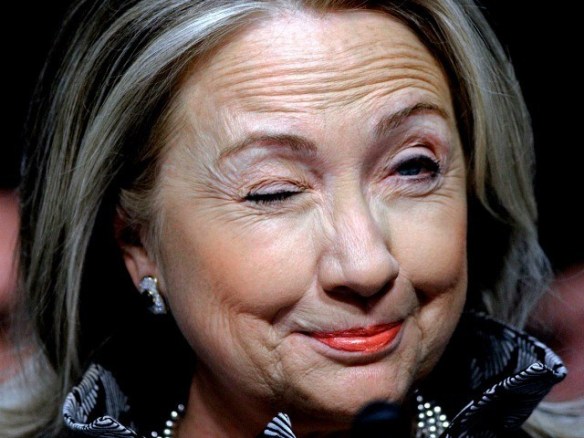
hillary-clinton-winking-AP-640x480

By Jason Hirthler

Source: CounterPunch

“I have almost reached the regrettable conclusion that the Negro’s greatest stumbling block in his stride toward freedom is not the White Citizen’s Counciler or the Ku Klux Klanner, but the white moderate, who is more devoted to ‘order’ than to justice.”

— Martin Luther King, Jr., Letter from a Birmingham Jail

Whether seated in Congress or exiting a voting booth, a corporate liberal is someone who supports anything progressive that does not challenge corporate power. In practice, this means corporate liberals will fight for progressive identity politics. If it has to do with race, sexual orientation, and gender, it generally doesn’t challenge corporate power. Major corporations support progressive positions on those issues, too. Corporate liberals march for gay rights and the larger LGBTQ community itself. They support feminism. They support reproductive rights. They support African-American protests against police brutality—up to the point where they become threatening to the establishment. (Bill Clinton did initiate the prison industrial complex that unduly incarcerates huge numbers of minorities.)

This support is all to the good. Tremendous progress has been made by popular protest of the devastating prejudices that have for years denied individual rights. But when their elected Democrats undermine economic justice, promote imperial warfare, and refuse to seriously address climate change, corporate liberals just look the other way. As Joe Clifford noted in his piece on Bernie Sanders, being a corporate liberal also means rejecting, “…a ban on fracking, a proposal to oppose TPP, the $15 per hour minimum wage proposal, a call for single-payer health care, and a statement of opposition to the illegal Israeli occupation.” These proposals, courageously put forward by James Zogby, Bill Mckibben, Cornell West and the rest of the Sanders contingent at the recent Democratic Platform Committee meeting in Washington, were all struck down. In a beautiful expression of moral courage, West refused to back the platform in its final iteration, saying,

“[If] we can’t say a word about [Trans-Pacific Partnership], if we can’t talk about Medicare for all explicitly, if the greatest prophetic voice dealing with impending ecological catastrophe can hardly win a vote and if we can’t even acknowledge occupation as something that’s real in the lives of a slice of humanity … it just seems to me there’s no way in good conscience I can say take it to the next stage.”

Yada Yada Yada

Words like these have no effect on the corporate liberal. If there’s a centimeter’s difference between their Democratic platform and the diseased corpus of Republican anarchism, the corporate conscience is salved. A corporate liberal is the one that puts “occupation” in quotes. A corporate liberal never makes the perfect the enemy of the good. A corporate liberal believes in reform, in humanitarian warfare, in the responsibility to protect, and in The New York Times front page. A corporate liberal supports all of this, though reform may be glacial, though good wars may slay millions, though interventions may undermine sovereignty, and though The Times may be rife with half-truth. It makes no difference, so long as reform is better than rollback, Barack’s slaughter is numerically less than Dubya’s, and The Washington Post is marginally more truthful than FOX News. As long as you can trust Erin Burnett more than Bill O’Reilly, it makes no difference that we will move further and further to the right, picking up steam until we barrel straight into corporate fascism. So long as the corporate liberal sits to the left of the patrician publican, he has some claim on the progressive mandate. Or so he says. Yet the best way to repel fascism, and realize that progressive mandate, is by joining a movement headed left, rather than a party moving right.

Nothing Forbidden

As Alan Nasser elucidates, there is nothing intolerable in the lesser evilism of the corporate liberal. He will endure—or more likely, watch others endure—intolerable realities while maintaining the unblinking rectitude of the blind ideologue. Author Chris Hedges writes that capitalism is “plunging us into a state of neo-feudalism, perpetual war, ecological disaster, and a dystopian nightmare.” But this, too, is not intolerable. We must accept it in order to ensure that the real nightmare—whomever happens to be running on the Republican ticket—is barred from the White House forever.

We must tolerate whatever Democrats do because they are better than Republicans. Even if that means, as it surely has and surely will, for all the identity groups corporate liberals support, a deteriorating quality of life. Lower incomes, higher unemployment. Bigger debts, bullshit jobs. Higher infant mortality, higher heart disease. More inequality, less social support. Less social support, more incarceration. More suicide, more alcoholism, more drug abuse, more debt, more stress, more unhappiness. And, if one is aware enough, the consciousness of having—perhaps unwittingly at the time—for more slaughter of brown people abroad, and the deliberate aggression against nuclear powers that will raise the prospect of nuclear extermination for millions. The Democrats have no such mandate, but the corporate liberal gives them the power to pretend they do. These are the wages of neoliberalism and imperialism, enabled by the logic of the lesser evil.

Like Dr. King, Karl Marx understood the major threat was not the fanatic on the fringe, but the moderate in the middle. The real threat is not the extremist, who will burn out by necessity if not already burned down by the moderate herd. It is the moderate herd that threatens to permit the intolerable through gradualism. Incremental genocide. Slow-motion regime change. The soft coup. The generational heist of millions of working class jobs. The decade-long liquidation of working class home equity. The century-long evisceration of labor rights. The hidden decades of disinformation campaigns that conflate freedom with free markets. Marx said, “Our task is that of ruthless criticism, and much more against ostensible friends than against open enemies.” He understood what King did, which is part of the reason why they are two of the most revolutionary figures of the last couple of centuries of Western civilization.

Too Much to Lose

Corporate liberals rehearse Manichean pieties about good and evil locked in a dualistic embrace, fighting to the death. There are no third parties in this vision. It is a necessary dualism. Hence the occasional need to undermine democracy to save it, as Hillary’s campaign demonstrated through repeated voting irregularities and financial chicanery engineered through her DNC front. It’s just simpler that way. For a political party of millionaires backed by billionaires, it just doesn’t do to disturb the status quo, rock the boat, upset the apple cart, shake the foundations, incite protest, disturb our creature comforts, move us out of our comfort zone, spark rebellion, overthrow the system, or change the world.

Is lesser evilism an elaborate rationale for preserving the status quo? Lenin said you can’t make a revolution in white gloves, and there are plenty of corporate liberals paying lip service to progress while glad-handing its well-heeled antagonists. That is why, in the end, corporate liberals are anti-revolutionaries. They would rather save capitalism than endure a potentially messy transition to socialism. Leave the revolution to Universal Studios and stubble-cheeked Third World rebels in hand-knitted berets. Social reforms in capitalist countries seem to happen like they did in South Africa, where identity politics achieve astounding successes, and calls for economic justice are swallowed up in the celebratory din. This is because corporate power cares deeply about economic power, but couldn’t care less about your sexual identity. For corporations—even if the executive board morally supports it—the gay community is ultimately another target market, a rich source of disposable income to be mined.

The least oppressed in any electorate always seem to be the greatest obstacle to change. Always willing to put justice on layaway. Always arguing for incrementalism, which strikes me as a luxury of the leisure class. Social progress will have little impact on them anyway, but paying lip service to its values will burnish their reputation. The discomfiting appearance of Bernie Sanders disturbed the polished script rehearsed by the Hillary camp for years. It was her turn, the first female president, upholding the rights of the vulnerable and achieving hard-won incremental gains through patience, hard work, and political acumen. For a moment, the Hillary faithful looked harried, wrong-footed, and exposed to the will of the mob. But now that the dodgy primaries are done, and Bernie has scampered back to the warmth of the herd, we can return to the language of compromise and the lesser evil. Had Bernie broke with the party he refused to technically join for 40 years, joined Jill Stein on the Green ticket, garnered support from voices like Kshama Sawant and movements like Socialist Alternative and Black Lives Matter, he could have founded a serious alternative to the mercenary duopoly. But he fell for the ruse of internal reform. But not everyone does. King continued in his Birmingham letter to discuss the white moderate, saying he was the one,

“… who prefers a negative peace which is the absence of tension to a positive peace which is the presence of justice; who constantly says: “I agree with you in the goal you seek, but I cannot agree with your methods of direct action”; who paternalistically believes he can set the timetable for another man’s freedom; who lives by a mythical concept of time and who constantly advises the Negro to wait for a “more convenient season.” Shallow understanding from people of good will is more frustrating than absolute misunderstanding from people of ill will. Lukewarm acceptance is much more bewildering than outright rejection.”

Sound familiar? King’s white moderate and Marx’s ostensible friend is our corporate liberal. Same spin, different decade. The corporate liberal is an embodiment of the idea that political parties are the graveyards of movements. Hedges himself wrote a book called, “Death of the Liberal Class” five years ago. It should’ve been the elegy before the interment of the Democratic Party as a serious option in electoral politics. Yet here we are, about to anoint another corporate liberal to the highest seat in the land. In that case, consider this article yet another epitaph awaiting its headstone. Let’s hope it’s not a long wait. Voices like Sawant’s and the momentum of movements like BLM give us reason to think it won’t be.

Jason Hirthler is a veteran of the communications industry and author of The Sins of Empire: Unmasking American Imperialism. He lives in New York City and can be reached at jasonhirthler@gmail.com.

Was Super Tuesday Rigged?

secret-win-V2-060416c_02_png__800×593_

By Jerry Kroth

Source: The Hampton Institute

Social scientists have long known that releasing poll information early, before polls have closed, has two effects: first it decreases voter turnout by about 12 percent,[1] and it increases the bandwagon effect, where people hop on and vote for the winner, by about 8 percent. [2]

On the morning of Super Tuesday, before anyone had voted, the Associated Press released a story that Hillary Clinton had already won. She was the “presumptive presidential nominee” and the victor. AP had made that announcement because of a super delegate count and decided she already beat Sanders.

Other media outlets then piggy-backed on this story, and virtually every American woke up that morning to headlines that Hillary had won-and remember, that is before anyone voted on Super Tuesday.

What a surprise! By the time you had your morning coffee and went off to the polls, you already knew Mrs. Clinton was the winner. Did that bias the election? Did it discourage people from voting? Did it create a “bandwagon effect?”

If one looks carefully at the percentage totals for Clinton versus Sanders totals for those primary states, it is clear the so-called “landslide” victory of Clinton on that day was fully within this margin of bias created by the bandwagon and voter turnout effects.

In other words, the AP story determined the outcome of this election.

Strong words? Well, let’s look at the data.

Three days before the election, a Yougov poll showed Clinton leading Sanders by two points in California. But after the Associated Press released its story, Clinton beat Sanders not by two points but by 13! Hillary got an 11 point “bump.”

From somewhere.

The same effect happened in New Mexico. Sanders was ahead of Clinton by a wide margin 54 to 40 percent. [3] By Super Tuesday, the situation reversed and Clinton beat Sanders 51.5 to 48.5. That surprising result gave Hillary an additional 13 points. Surprise! A 13 point “bump.”

In New Jersey, poll results just before Super Tuesday showed Clinton leading sanders 54 to 40 percent [4] but on election day she beat him 63 to 36, another unexpected 9 point “bump” in Hillary’s favor.

In South Dakota, a poll showed Sanders ahead of Clinton by 6 percentage points [5] just a few weeks before the primary, but on Super Tuesday Hillary pulled another rabbit out of her hat and beat Sanders by two points; an 8 point “bump” for Clinton.

Those are the only states where we can calculate pre-post results. Hillary got an unexpected 9 points in New Jersey, 8 points in South Dakota, 13 points in New Mexico, and 11 points in California. All unexpected. All unpredicted. All quite different from polls held just days before Super Tuesday.

And all very suspicious!

If one tries to rebut these findings alleging they all are within the margin of error for polls, then Sanders should have had just as many spurious bumps as Clinton. Didn’t happen! All went to Hillary. The skewing is not random! The statistical anomalies are consistently prejudiced toward Hillary.

Sixteen European countries ban reporting election results before voting occurs, and in the UK, reporting poll data on the day of the election is forbidden. [6]

All for good reason.

Serious attention should be paid to declaring these primaries invalid. Furthermore, the possibility of investigating media entities, in particular Gary Pruitt, CEO of the Associated Press, for any alleged collusion with the Clinton campaign should be aggressively pursued. Even if there is no corporate media complicity, it can still be argued that the AP’s desire for an early morning scoop determined, biased and corrupted this entire election.
Jerry Kroth, Ph.D. is Associate Professor Emeritus Santa Clara University. He may be contacted through his website, collectivepsych.com

Notes


Related Videos: