Prisons Without Walls: We’re All Inmates in the American Police State

they-live

By John W. Whitehead

Source: The Rutherford Institute

“It is perfectly possible for a man to be out of prison and yet not free—to be under no physical constraint and yet be a psychological captive, compelled to think, feel and act as the representatives of the national state, or of some private interest within the nation wants him to think, feel and act. . . . To him the walls of his prison are invisible and he believes himself to be free.”—Aldous Huxley, A Brave New World Revisited

Free worlders” is prison slang for those who are not incarcerated behind prison walls.  Supposedly, those fortunate souls live in the “free world.” However, appearances can be deceiving.

“As I got closer to retiring from the Federal Bureau of Prisons,” writes former prison employee Marlon Brock, “it began to dawn on me that the security practices we used in the prison system were being implemented outside those walls.” In fact, if Brock is right, then we “free worlders” do live in a prison—albeit, one without visible walls.

In federal prisons, cameras are everywhere in order to maintain “security” and keep track of the prisoners. Likewise, the “free world” is populated with video surveillance and tracking devices. From surveillance cameras in stores and street corners to license plate readers (with the ability to log some 1,800 license plates per hour) on police cars, our movements are being tracked virtually everywhere. With this increasing use of iris scanners and facial recognition software—which drones are equipped with—there would seem to be nowhere to hide.

Detection and confiscation of weapons (or whatever the warden deems “dangerous”) in prison is routine. The inmates must be disarmed. Pat downs, checkpoints, and random searches are second nature in ferreting out contraband.

Sound familiar?

Metal detectors are now in virtually all government buildings. There are the TSA scanning devices and metal detectors we all have to go through in airports. Police road blocks and checkpoints are used to perform warrantless searches for contraband. Those searched at road blocks can be searched for contraband regardless of their objections—just like in prison. And there are federal road blocks on American roads in the southwestern United States. Many of them are permanent and located up to 100 miles from the border.

Stop and frisk searches are taking place daily across the country. Some of them even involve anal and/or vaginal searches. In fact, the U.S. Supreme Court has approved strip searches even if you are arrested for a misdemeanor—such as a traffic stop. Just like a prison inmate.

Prison officials open, search and read every piece of mail sent to inmates. This is true of those who reside outside prison walls, as well. In fact, “the United States Postal Service uses a ‘Mail Isolation Control and Tracking Program’ to create a permanent record of who is corresponding with each other via snail mail.” Believe it or not, each piece of physical mail received by the Postal Service is photographed and stored in a database. Approximately 160 billion pieces of mail sent out by average Americans are recorded each year and the police and other government agents have access to this information.

Prison officials also monitor outgoing phone calls made by inmates. This is similar to what the NSA, the telecommunication corporation, and various government agencies do continually to American citizens. The NSA also downloads our text messages, emails, Facebook posts, and so on while watching everything we do.

Then there are the crowd control tactics: helmets, face shields, batons, knee guards, tear gas, wedge formations, half steps, full steps, pinning tactics, armored vehicles, and assault weapons. Most of these phrases are associated with prison crowd control because they were perfected by prisons.

Finally, when a prison has its daily operations disturbed, often times it results in a lockdown. What we saw with the “free world” lockdowns following the 2013 Boston Marathon bombing and the melees in Ferguson, Missouri and Baltimore, Maryland, mirror a federal prison lockdown.

These are just some of the similarities between the worlds inhabited by locked-up inmates and those of us who roam about in the so-called “free world.”

Is there any real difference?

To those of us who see the prison that’s being erected around us, it’s a bit easier to realize what’s coming up ahead, and it’s not pretty. However, and this must be emphasized, what most Americans perceive as life in the United States of America is a far cry from reality. Real agendas and real power are always hidden.

As Author Frantz Fanon notes, “Sometimes people hold a core belief that is very strong. When they are presented with evidence that works against that belief, the new evidence cannot be accepted. It would create a feeling that is extremely uncomfortable, called cognitive dissonance. And because it is so important to protect the core belief, they will rationalize, ignore and even deny anything that doesn’t fit in with the core belief.”

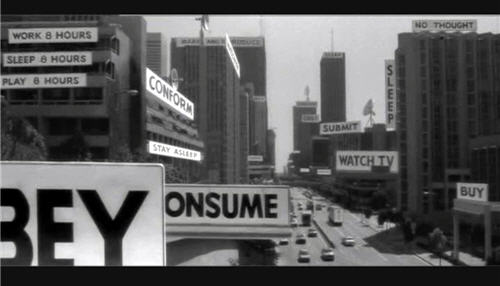
This state of denial and rejection of reality is the essential plot of John Carpenter’s 1988 film They Live, where a group of down-and-out homeless men discover that people have been, in effect, so hypnotized by media distractions that they do not see their prison environment and the real nature of those who control them—that is, an oligarchic elite.

Caught up in subliminal messages such as “obey” and “conform,” among others, beamed out of television and various electronic devices, billboards, and the like, people are unaware of the elite controlling their lives. As such, they exist, as media analyst Marshall McLuhan once wrote, in “prisons without walls.” And of course, any resistance is met with police aggression.

A key moment in the film occurs when John Nada, a homeless drifter, notices something strange about people hanging about a church near the homeless settlement where he lives. Nada decides to investigate. Entering the church, he sees graffiti on a door: They live, We sleep. Nada overhears two men, obviously resisters, talking about “robbing banks” and “manufacturing Hoffman lenses until we’re blue in the face.” Moments later, one of the resisters catches Nada fumbling in the church and tells him “it’s the revolution.” When Nada nervously backs off, the resister assures him, “You’ll be back.”

Rummaging through a box, Nada discovers a handful of cheap-looking sunglasses, referred to earlier as Hoffman lenses. Grabbing a pair and exiting the church, he starts walking down a busy urban street.

Sliding the sunglasses on his face, Nada is shocked to see a society bombarded and controlled on every side by subliminal messages beamed at them from every direction. Billboards are transformed into authoritative messages: a bikini-clad woman in one ad is replaced with the words “MARRY AND REPRODUCE.” Magazine racks scream “CONSUME” and “OBEY.” A wad of dollar bills in a vendor’s hand proclaims, “THIS IS YOUR GOD.”

What’s even more disturbing than the hidden messages, however, are the ghoulish-looking creatures—the elite—who appear human until viewed them through the lens of truth.

This is the subtle message of They Live, an apt analogy of our own distorted vision of life in the American police state. These things are in plain sight, but from the time we are born until the time we die, we are indoctrinated into believing that those who rule us do it for our good. The truth, far different, is that those who rule us don’t really see us as human beings with dignity and worth. They see us as if “we’re livestock.”

It’s only once Nada’s eyes have been opened that he is able to see the truth: “Maybe they’ve always been with us,” he says. “Maybe they love it—seeing us hate each other, watching us kill each other, feeding on our own cold f**in’ hearts.” Nada, disillusioned and fed up with the lies and distortions, is finally ready to fight back. “I got news for them. Gonna be hell to pay. Cause I ain’t daddy’s little boy no more.”

What about you?

As I point out in my book Battlefield America: The War on the American People, the warning signs have been cautioning us for decades. Oblivious to what lies ahead, most have ignored the obvious. We’ve been manipulated into believing that if we continue to consume, obey, and have faith, things will work out. But that’s never been true of emerging regimes. And by the time we feel the hammer coming down upon us, it will be too late.

As Rod Serling warned:

All the Dachaus must remain standing. The Dachaus, the Belsens, the Buchenwalds, the Auschwitzes—all of them. They must remain standing because they are a monument to a moment in time when some men decided to turn the earth into a graveyard, into it they shoveled all of their reason, their logic, their knowledge, but worst of all their conscience. And the moment we forget this, the moment we cease to be haunted by its remembrance. Then we become the grave diggers.

The message: stay alert.

Take the warning signs seriously. And take action because the paths to destruction are well disguised by those in control.

This is the lesson of history.
Battlefield America: The War on the American People

police-state-founders-warning

By John W. Whitehead

Source: The Rutherford Institute

“A government which will turn its tanks upon its people, for any reason, is a government with a taste of blood and a thirst for power and must either be smartly rebuked, or blindly obeyed in deadly fear.”—John Salter

We have entered into a particularly dismal chapter in the American narrative, one that shifts us from a swashbuckling tale of adventure into a bone-chilling horror story.

As I document in my new book Battlefield America: The War on the American People, “we the people” have now come full circle, from being held captive by the British police state to being held captive by the American police state. In between, we have charted a course from revolutionaries fighting for our independence and a free people establishing a new nation to pioneers and explorers, braving the wilderness and expanding into new territories.

Where we went wrong, however, was in allowing ourselves to become enthralled with and then held hostage by a military empire in bondage to a corporate state (the very definition of fascism). No longer would America hold the moral high ground as a champion of freedom and human rights. Instead, in the pursuit of profit, our overlords succumbed to greed, took pleasure in inflicting pain, exported torture, and imported the machinery of war, transforming the American landscape into a battlefield, complete with military personnel, tactics and weaponry.

To our dismay, we now find ourselves scrambling for a foothold as our once rock-solid constitutional foundation crumbles beneath us. And no longer can we rely on the president, Congress, the courts, or the police to protect us from wrongdoing.

Indeed, they have come to embody all that is wrong with America.

For instance, how does a man who is relatively healthy when taken into custody by police lapse into a coma and die while under their supervision? What kind of twisted logic allows a police officer to use a police car to run down an American citizen and justifies it in the name of permissible deadly force? And what country are we living in where the police can beat, shoot, choke, taser and tackle American citizens, all with the protection of the courts?

Certainly, the Constitution’s safeguards against police abuse means nothing when government agents can crash through your door, terrorize your children, shoot your dogs, and jail you on any number of trumped of charges, and you have little say in the matter. For instance, San Diego police, responding to a domestic disturbance call on a Sunday morning, showed up at the wrong address, only to shoot the homeowner’s 6-year-old service dog in the head.

Rubbing salt in the wound, it’s often the unlucky victim of excessive police force who ends up being charged with wrongdoing. Although 16-year-old Thai Gurule was charged with resisting arrest and strangling and assaulting police officers, a circuit judge found that it was actually the three officers who unlawfully stopped, tackled, punched, kneed, tasered and yanked his hair who were at fault. Thankfully, bystander cell phone videos undermined police accounts, which were described as “works of fiction.”

Not even our children are being spared the blowback from a growing police presence. As one juvenile court judge noted in testimony to Congress, although having police on public school campuses did not make the schools any safer, it did result in large numbers of students being arrested for misdemeanors such as school fights and disorderly conduct. One 11-year-old autistic Virginia student was charged with disorderly conduct and felony assault after kicking a trashcan and resisting a police officer’s attempt to handcuff him. A 14-year-old student was tasered by police, suspended and charged with disorderly conduct, resisting arrest and trespassing after he failed to obey a teacher’s order to be the last student to exit the classroom.

There is no end to the government’s unmitigated gall in riding roughshod over the rights of the citizenry, whether in matters of excessive police powers, militarized police, domestic training drills, SWAT team raids, surveillance, property rights, overcriminalization, roadside strip searches, profit-driven fines and prison sentences, etc.

The president can now direct the military to detain, arrest and secretly execute American citizens. These are the powers of an imperial dictator, not an elected official bound by the rule of law. For the time being, Barack Obama wears the executioner’s robe, but you can rest assured that this mantle will be worn by whomever occupies the Oval Office in the future.

A representative government means nothing when the average citizen has little to no access to their elected officials, while corporate lobbyists enjoy a revolving door relationship with everyone from the President on down. Indeed, while members of Congress hardly work for the taxpayer, they work hard at being wooed by corporations, which spend more to lobby our elected representatives than we spend on their collective salaries. For that matter, getting elected is no longer the high point it used to be. As one congressman noted, for many elected officials, “Congress is no longer a destination but a journey… [to a] more lucrative job as a K Street lobbyist… It’s become routine to see members of Congress drop their seat in Congress like a hot rock when a particularly lush vacancy opens up.”

As for the courts, they have long since ceased being courts of justice. Instead, they have become courts of order, largely marching in lockstep with the government’s dictates, all the while helping to increase the largesse of government coffers. It’s called for-profit justice, and it runs the gamut of all manner of financial incentives in which the courts become cash cows for communities looking to make an extra buck. As journalist Chris Albin-Lackey details, “They deploy a crushing array of fines, court costs, and other fees to harvest revenues from minor offenders that these communities cannot or do not want to raise through taxation.” In this way, says Albin-Lackey, “A resident of Montgomery, Alabama who commits a simple noise violation faces only a $20 fine—but also a whopping $257 in court costs and user fees should they seek to have their day in court.”

As for the rest—the schools, the churches, private businesses, service providers, nonprofits and your fellow citizens—many are also marching in lockstep with the police state. This is what is commonly referred to as community policing. After all, the police can’t be everywhere. So how do you police a nation when your population outnumbers your army of soldiers? How do you carry out surveillance on a nation when there aren’t enough cameras, let alone viewers, to monitor every square inch of the country 24/7? How do you not only track but analyze the transactions, interactions and movements of every person within the United States? The answer is simpler than it seems: You persuade the citizenry to be your eyes and ears.

It’s a brilliant ploy, with the added bonus that while the citizenry remains focused on and distrustful of each other, they’re incapable of focusing on more definable threats that fall closer to home—namely, the government and its militarized police. In this way, we’re seeing a rise in the incidence of Americans being reported for growing vegetables in their front yard, keeping chickens in their back yard, letting their kids walk to the playground alone, and voicing anti-government sentiments. For example, after Shona Banda’s son defended the use of medical marijuana during a presentation at school, school officials alerted the police and social services, and the 11-year-old was interrogated, taken into custody by social workers, had his home raided by police and his mother arrested.

Now it may be that we have nothing to worry about. Perhaps the government really does have our best interests at heart. Perhaps covert domestic military training drills such as Jade Helm really are just benign exercises to make sure our military is prepared for any contingency. As the Washington Post describes the operation:

The mission is vast both geographically and strategically: Elite service members from all four branches of the U.S. military will launch an operation this summer in which they will operate covertly among the U.S. public and travel from state to state in military aircraft. Texas, Utah and a section of southern California are labeled as hostile territory, and New Mexico isn’t much friendlier.

Now I don’t believe in worrying over nothing, but it’s safe to say that the government has not exactly shown itself to be friendly in recent years, nor have its agents shown themselves to be cognizant of the fact that they are civilians who answer to the citizenry, rather than the other way around.

Whether or not the government plans to impose some form of martial law in the future remains to be seen, but there can be no denying that we’re being accustomed to life in a military state. The malls may be open for business, the baseball stadiums may be packed, and the news anchors may be twittering nonsense about the latest celebrity foofa, but those are just distractions from what is really taking place: the transformation of America into a war zone.

Trust me, if it looks like a battlefield (armored tanks on the streets, militarized police in metro stations, surveillance cameras everywhere), sounds like a battlefield (SWAT team raids nightly, sound cannons to break up large assemblies of citizens), and acts like a battlefield (police shooting first and asking questions later, intimidation tactics, and involuntary detentions), it’s a battlefield.

Indeed, what happened in Ocala, Florida, is a good metaphor for what’s happening across the country: Sheriff’s deputies, dressed in special ops uniforms and riding in an armored tank on a public road, pulled a 23-year-old man over and issued a warning violation to him after he gave them the finger. The man, Lucas Jewell, defended his actions as a free speech expression of his distaste for militarized police.

Translation: “We the people” are being hijacked on the highway by government agents with little knowledge of or regard for the Constitution, who are hyped up on the power of their badge, outfitted for war, eager for combat, and taking a joy ride—on taxpayer time and money—in a military tank that has no business being on American soil.

Rest assured, unless we slam on the brakes, this runaway tank will soon be charting a new course through terrain that bears no resemblance to land of our forefathers, where freedom meant more than just the freedom to exist and consume what the corporate powers dish out.

Rod Serling, one of my longtime heroes and the creator of The Twilight Zone, understood all too well the danger of turning a blind eye to evil in our midst, the “things that scream for a response.” As Serling warned, “if we don’t listen to that scream – and if we don’t respond to it – we may well wind up sitting amidst our own rubble, looking for the truck that hit us – or the bomb that pulverized us. Get the license number of whatever it was that destroyed the dream. And I think we will find that the vehicle was registered in our own name.”

If you haven’t managed to read the writing on the wall yet, the war has begun.

Kick Open the Doorway to Liberty: What Are We Waiting For?

0823e935c920bdf2c31447b67612bfc6

By John W. Whitehead

Source: The Rutherford Institute

“The greatness of America lies in the right to protest for right.”—Martin Luther King Jr.

Everything this nation once stood for is being turned on its head.

Free speech, religious expression, privacy, due process, bodily integrity, the sanctity of human life, the sovereignty of the family, individuality, the right to self-defense, protection against police abuses, representative government, private property, human rights—the very ideals that once made this nation great—have become casualties of a politically correct, misguided, materialistic, amoral, militaristic culture.

Indeed, I’m having a hard time reconciling the America I know and love with the America being depicted in the daily news headlines, where corruption, cronyism and abuse have taken precedence over the rights of the citizenry and the rule of law.

What kind of country do we live in where it’s acceptable for police to shoot unarmed citizens, for homeowners to be jailed for having overgrown lawns (a Texas homeowner was actually sentenced to 17 days in jail and fined $1700 for having an overgrown lawn), for kids to be tasered and pepper sprayed for acting like kids at school (many are left with health problems ranging from comas and asthma to cardiac arrest), and for local governments to rake in hefty profits under the guise of traffic safety (NPR reports that police departments across the country continue to require quotas for arrests and tickets, a practice that is illegal but in effect)?

Why should we Americans have to put up with the government listening in on our phone calls, spying on our emails, subjecting us to roadside strip searches, and generally holding our freedoms hostage in exchange for some phantom promises of security?

As I document in my new book Battlefield America: The War on the American People, it doesn’t matter where you live—big city or small town—it’s the same scenario being played out over and over again in which government agents ride roughshod over the rights of the citizenry.

In such an environment, it’s not just our Fourth Amendment rights—which protect us against police abuses—that are being trampled. It’s also our First Amendment rights to even voice concern over these practices that are being muzzled. Just consider some of the First Amendment battles that have taken place in recent years, and you too will find yourself wondering what country you’re living in:

  • Harold Hodge was arrested for standing silently in front of the U.S. Supreme Court building, holding a sign in protest of police tactics.
  • Marine Brandon Raub was arrested for criticizing the government on Facebook.
  • Pastor Michael Salman was arrested for holding Bible studies in his home.
  • Steven Howards was arrested for being too close to a government official when he voiced his disapproval of the war in Iraq.
  • Kenneth Webber was fired from his job as a schoolbus driver for displaying a Confederate flag on the truck he uses to drive from home to school and back.
  • Fred Marlow was arrested for filming a SWAT team raid that took place across from his apartment.

And then there were the three California high school public school students who were ordered to turn their American flag t-shirts inside out on May 5 (Cinco de Mayo) because school officials were afraid it might cause a disruption and/or offend Hispanic students. Incredibly, the U.S. Supreme Court actually sided with the school and the Ninth Circuit Court of Appeals, affirming that it might be disruptive for American students to wear the American flag to an American public school.

While there are all kinds of labels being put on so-called “unacceptable” speech today, from calling it politically incorrect and hate speech to offensive and dangerous speech, the real message being conveyed is that Americans don’t have a right to express themselves if what they are saying is unpopular, controversial or at odds with what the government determines to be acceptable.

Whether it’s through the use of so-called “free speech zones,” the requirement of speech permits, the policing of online forums, or a litany of laws and policies that criminalize expressive activities, what we’re seeing is the caging of free speech and the asphyxiation of the First Amendment.

Long before the menace of the police state, with its roadside strip searches, surveillance drones, and SWAT team raids, it was our First Amendment rights that were being battered by political correctness, hate crime legislation, the war on terror and every other thinly veiled rationale used to justify censoring our free speech rights.

By suppressing free speech, the government is contributing to a growing underclass of Americans who are being told that they can’t take part in American public life unless they “fit in.” Mind you, it won’t be long before anyone who believes in holding the government accountable to respecting our rights and abiding by the rule of law is labeled an “extremist” and is relegated to an underclass that doesn’t fit in and must be watched all the time.

It doesn’t matter how much money you make, what politics you subscribe to, or what God you worship: we are all potential suspects, terrorists and lawbreakers in the eyes of the government.

In other words, if and when this nation falls to tyranny, we will all suffer the same fate: we will fall together. However, if it is possible to avert such an outcome, it will rest in us remembering that we are also all descendants of those early American revolutionaries who pushed back against the abuses of the British government. These people were neither career politicians nor government bureaucrats. Instead, they were mechanics, merchants, artisans and the like—ordinary people groaning under the weight of Britain’s oppressive rule—who, having reached a breaking point, had decided that enough was enough.

The colonists’ treatment at the hands of the British was not much different from the abuses meted out to the American people today: they too were taxed on everything from food to labor without any real say in the matter, in addition to which they had their homes invaded by armed government agents, their property seized and searched, their families terrorized, their communications, associations and activities monitored, and their attempts to defend themselves and challenge the government’s abuses dismissed as belligerence, treachery, and sedition.

Unlike most Americans today, who remain ignorant of the government’s abuses, cheerfully distracted by the entertainment spectacles trotted out before them by a complicit media, readily persuaded that the government has their best interests at heart, and easily cowed by the slightest show of force, the colonists responded to the government’s abuses with outrage, activism and rebellion. They staged boycotts of British goods and organized public protests, mass meetings, parades, bonfires and other demonstrations, culminating with their most famous act of resistance, the Boston Tea Party.

On the night of December 16, 1773, a group of men dressed as Indians boarded three ships that were carrying tea. Cheered on by a crowd along the shore, they threw 342 chests of tea overboard in protest of a tax on the tea. Many American merchants were aghast at the wanton destruction of property. A town meeting in Bristol, Massachusetts, condemned the action. Ben Franklin even called on his native city to pay for the tea and apologize. But as historian Pauline Maier notes, the Boston Tea Party was a last resort for a group of people who had stated their peaceful demands but were rebuffed by the British: “The tea resistance constituted a model of justified forceful resistance upon traditional criteria.”

The rest, as they say, is history. Yet it’s a history we cannot afford to forget or allow to be rewritten.

The colonists suffered under the weight of countless tyrannies before they finally were emboldened to stand their ground. They attempted to reason with the British crown, to plea their cause, even to negotiate. It was only when these means proved futile that they resorted to outright resistance, civil disobedience and eventually rebellion.

More than 200 years later, we are once again suffering under a long train of abuses and usurpations. What Americans today must decide is how committed they are to the cause of freedom and how far they’re willing to go to restore what has been lost.

Nat Hentoff, one of my dearest friends and a formidable champion of the Constitution, has long advocated for the resurgence of grassroots activism. As Nat noted:

This resistance to arrant tyranny first became part of our heritage when Samuel Adams and the Sons of Liberty formed the original Committees of Correspondence, a unifying source of news of British tyranny throughout the colonies that became a precipitating cause of the American Revolution. Where are the Sons of Liberty, the Committees of Correspondence and the insistently courageous city councils now, when they are crucially needed to bring back the Bill of Rights that protect every American against government tyranny worse than King George III’s? Where are the citizens demanding that these doorways to liberty be opened … What are we waiting for?

What are we waiting for, indeed?

Podcast Roundup

3/11: Srini Rao has an interesting conversation with animal rights activist Peter Young covering community activism, communication, survival tips, and his former life as a fugitive on the “Unmistakable Creative” podcast.

https://sitebuilderio.s3.amazonaws.com/unmistakablecreative/audios/012b5fac-3695-42b3-9a2d-ffd7d4d7f213/lessons-in-communication-from-a-fugitive-peter-young.mp3

3/11: On the latest “Guns and Butter”, Bonnie Faulkner interviews John Whitehead of  the Rutherford Institute. They discuss aspects of  “Police State America” including the Corporate State, American Legislative Exchange Council (ALEC), Offices of Inspector General (OIG), SWAT Teams, No-Knock Raids, the Schoolhouse to Jailhouse Track, the New York Prototype, MRAPs, Operation Vigilant Eagle, Atlas Four Androids, TSA and VIPR Teams, the Google/NSA connection and Fusion Centers.

http://archives.kpfa.org/data/20150311-Wed1300.mp3

3/11: Host Dave Lindorff discusses the recent coup plan disrupted by police in Venezuela with veteran journalist Alfredo Lopez — a story largely blacked out or mocked as bogus by the US corporate media despite solid evidence of a plot, and of US involvement in that plot on “This Can’t Be Happening”. Lindorff and Lopez, who are colleagues on the news site thiscantbehappening.net, also talk about why President Obama on Tuesday declared Venezuela an “unusual and extraordinary national security threat” to the US, and what that declaration means to Venezuela and Latin America.

http://s36.podbean.com/pb/0c1337348a3a2a92b0bdb73308121756/5503328c/data1/blogs18/661545/uploads/ThisCantBeHappening_031115.mp3

3/12: On the first of their recent “Media Roots” podcasts, Robbie and Abby Martin discuss the ending of the RT program “Breaking the Set”, the establishment’s Cold War resurrection, and the splintering of the left over Obama’s military policies. The second program features an interview with Mark Weisbrot, co-director of the Center for Economic and Policy Research, on current U.S. government actions against Venezuela.

Welcome to the Matrix: Enslaved by Technology and the Internet of Things

m2m-graphic1-2013-01-564x317_contentfullwidth

By John W. Whitehead

Source: The Rutherford Institute

“There will come a time when it isn’t ‘They’re spying on me through my phone’ anymore. Eventually, it will be ‘My phone is spying on me.’” ― Philip K. Dick

If ever Americans sell their birthright, it will be for the promise of expediency and comfort delivered by way of blazingly fast Internet, cell phone signals that never drop a call, thermostats that keep us at the perfect temperature without our having to raise a finger, and entertainment that can be simultaneously streamed to our TVs, tablets and cell phones.

Likewise, if ever we find ourselves in bondage, we will have only ourselves to blame for having forged the chains through our own lassitude, laziness and abject reliance on internet-connected gadgets and gizmos that render us wholly irrelevant.

Indeed, while most of us are consumed with our selfies and trying to keep up with what our so-called friends are posting on Facebook, the megacorporation Google has been busily partnering with the National Security Agency (NSA), the Pentagon, and other governmental agencies to develop a new “human” species, so to speak.

In other words, Google—a neural network that approximates a global brain—is fusing with the human mind in a phenomenon that is called “singularity,” and they’ve hired transhumanist scientist Ray Kurzweil to do just that. Google will know the answer to your question before you have asked it, Kurzweil said. “It will have read every email you will ever have written, every document, every idle thought you’ve ever tapped into a search-engine box. It will know you better than your intimate partner does. Better, perhaps, than even yourself.”

But here’s the catch: the NSA and all other government agencies will also know you better than yourself. As William Binney, one of the highest-level whistleblowers to ever emerge from the NSA said, “The ultimate goal of the NSA is total population control.”

Science fiction, thus, has become fact.

We’re fast approaching Philip K. Dick’s vision of the future as depicted in the film Minority Report. There, police agencies apprehend criminals before they can commit a crime, driverless cars populate the highways, and a person’s biometrics are constantly scanned and used to track their movements, target them for advertising, and keep them under perpetual surveillance.

Cue the dawning of the Age of the Internet of Things, in which internet-connected “things” will monitor your home, your health and your habits in order to keep your pantry stocked, your utilities regulated and your life under control and relatively worry-free.

The key word here, however, is control.

In the not-too-distant future, “just about every device you have — and even products like chairs, that you don’t normally expect to see technology in — will be connected and talking to each other.”

By 2018, it is estimated there will be 112 million wearable devices such as smartwatches, keeping users connected it real time to their phones, emails, text messages and the Internet. By 2020, there will be 152 million cars connected to the Internet and 100 million Internet-connected bulbs and lamps. By 2022, there will be 1.1 billion smart meters installed in homes, reporting real-time usage to utility companies and other interested parties.

This “connected” industry—estimated to add more than $14 trillion to the economy by 2020—is about to be the next big thing in terms of societal transformations, right up there with the Industrial Revolution, a watershed moment in technology and culture.

Between driverless cars that completely lacking a steering wheel, accelerator, or brake pedal, and smart pills embedded with computer chips, sensors, cameras and robots, we are poised to outpace the imaginations of science fiction writers such as Philip K. Dick and Isaac Asimov. By the way, there is no such thing as a driverless car. Someone or something will be driving, but it won’t be you.

The 2015 Consumer Electronics Show in Las Vegas is a glittering showcase for such Internet-connected techno gadgets as smart light bulbs that discourage burglars by making your house look occupied, smart thermostats that regulate the temperature of your home based on your activities, and smart doorbells that let you see who is at your front door without leaving the comfort of your couch.

Nest, Google’s $3 billion acquisition, has been at the forefront of the “connected” industry, with such technologically savvy conveniences as a smart lock that tells your thermostat who is home, what temperatures they like, and when your home is unoccupied; a home phone service system that interacts with your connected devices to “learn when you come and go” and alert you if your kids don’t come home; and a sleep system that will monitor when you fall asleep, when you wake up, and keep the house noises and temperature in a sleep-conducive state.

The aim of these internet-connected devices, as Nest proclaims, is to make “your house a more thoughtful and conscious home.” For example, your car can signal ahead that you’re on your way home, while Hue lights can flash on and off to get your attention if Nest Protect senses something’s wrong. Your coffeemaker, relying on data from fitness and sleep sensors, will brew a stronger pot of coffee for you if you’ve had a restless night.

It’s not just our homes that are being reordered and reimagined in this connected age: it’s our workplaces, our health systems, our government and our very bodies that are being plugged into a matrix over which we have no real control.

Moreover, given the speed and trajectory at which these technologies are developing, it won’t be long before these devices are operating entirely independent of their human creators, which poses a whole new set of worries. As technology expert Nicholas Carr notes, “As soon as you allow robots, or software programs, to act freely in the world, they’re going to run up against ethically fraught situations and face hard choices that can’t be resolved through statistical models. That will be true of self-driving cars, self-flying drones, and battlefield robots, just as it’s already true, on a lesser scale, with automated vacuum cleaners and lawnmowers.”

For instance, just as the robotic vacuum, Roomba, “makes no distinction between a dust bunny and an insect,” weaponized drones—poised to take to the skies en masse this year—will be incapable of distinguishing between a fleeing criminal and someone merely jogging down a street. For that matter, how do you defend yourself against a robotic cop—such as the Atlas android being developed by the Pentagon—that has been programmed to respond to any perceived threat with violence?

Unfortunately, in our race to the future, we have failed to consider what such dependence on technology might mean for our humanity, not to mention our freedoms.

Ingestible or implantable chips are a good example of how unprepared we are, morally and otherwise, to navigate this uncharted terrain. Hailed as revolutionary for their ability to access, analyze and manipulate your body from the inside, these smart pills can remind you to take your medication, search for cancer, and even send an alert to your doctor warning of an impending heart attack.

Sure, the technology could save lives, but is that all we need to know? Have we done our due diligence in asking all the questions that need to be asked before unleashing such awesome technology on an unsuspecting populace?

For example, asks Washington Post reporter Ariana Eunjung Cha:

What kind of warnings should users receive about the risks of implanting chip technology inside a body, for instance? How will patients be assured that the technology won’t be used to compel them to take medications they don’t really want to take? Could law enforcement obtain data that would reveal which individuals abuse drugs or sell them on the black market? Could what started as a voluntary experiment be turned into a compulsory government identification program that could erode civil liberties?

Let me put it another way. If you were shocked by Edward Snowden’s revelations about how NSA agents have used surveillance to spy on Americans’ phone calls, emails and text messages, can you imagine what unscrupulous government agents could do with access to your internet-connected car, home and medications? Imagine what a SWAT team could do with the ability to access, monitor and control your internet-connected home—locking you in, turning off the lights, activating alarms, etc.

Thus far, the public response to concerns about government surveillance has amounted to a collective shrug. After all, who cares if the government can track your whereabouts on your GPS-enabled device so long as it helps you find the fastest route from Point A to Point B? Who cares if the NSA is listening in on your phone calls and downloading your emails so long as you can get your phone calls and emails on the go and get lightning fast Internet on the fly? Who cares if the government can monitor your activities in your home by tapping into your internet-connected devices—thermostat, water, lights—so long as you can control those things with the flick of a finger, whether you’re across the house or across the country?

As for those still reeling from a year of police shootings of unarmed citizens, SWAT team raids, and community uprisings, the menace of government surveillance can’t begin to compare to bullet-riddled bodies, devastated survivors and traumatized children. However, both approaches are just as lethal to our freedoms if left unchecked.

Control is the key here. As I make clear in my book A Government of Wolves: The Emerging American Police State, total control over every aspect of our lives, right down to our inner thoughts, is the objective of any totalitarian regime.

George Orwell understood this. His masterpiece, 1984, portrays a global society of total control in which people are not allowed to have thoughts that in any way disagree with the corporate state. There is no personal freedom, and advanced technology has become the driving force behind a surveillance-driven society. Snitches and cameras are everywhere. And people are subject to the Thought Police, who deal with anyone guilty of thought crimes. The government, or “Party,” is headed by Big Brother, who appears on posters everywhere with the words: “Big Brother is watching you.”

Make no mistake: the Internet of Things is just Big Brother in a more appealing disguise.

Even so, I’m not suggesting we all become Luddites. However, we need to be aware of how quickly a helpful device that makes our lives easier can become a harmful weapon that enslaves us.

This was the underlying lesson of The Matrix, the Wachowski brothers’ futuristic thriller about human beings enslaved by autonomous technological beings that call the shots. As Morpheus, one of the characters in The Matrix, explains:

The Matrix is everywhere. It is all around us. Even now, in this very room. You can see it when you look out your window or when you turn on your television. You can feel it when you go to work… when you go to church… when you pay your taxes. It is the world that has been pulled over your eyes to blind you from the truth.

“What truth?” asks Neo.

Morpheus leans in closer to Neo: “That you are a slave, Neo. Like everyone else you were born into bondage. Born into a prison that you cannot smell or taste or touch. A prison for your mind.”


The Dire State of Our Nation (What You Won’t Hear from the Politicians)

Unknown-18

By John W. Whitehead

Source: The Rutherford Institute

No matter what the politicians might say about how great America is, the fact is that the nation seems to be imploding. Consider the following facts:

Our government is massively in debt. Currently, the national debt is somewhere in the vicinity of $18 trillion. More than a third of our debt is owned by foreign countries, namely China and Japan.

Our education system is abysmal. Despite the fact that we spend more than most of the world on education ($115,000 per student), we rank 36th in the world when it comes to math, reading and science, far below most of our Asian counterparts. Even so, we continue to insist on standardized programs such as Common Core, which teach students to be test-takers rather than thinkers.

Our homes provide little protection against government intrusions. Police agencies, already empowered to crash through your door if they suspect you’re up to no good, now have radars that allow them to “see” through the walls of your home.

Our prisons, housing the largest number of inmates in the world and still growing, have become money-making enterprises for private corporations that rely on the inmates for cheap labor.

We are no longer a representative republic. The U.S. has become a corporate oligarchy. As a recent survey indicates, our elected officials, especially those in the nation’s capital, represent the interests of the rich and powerful rather than the average citizen.

We’ve got the most expensive, least effective health care system in the world compared to other western, industrialized nations.

The air pollution levels are dangerously high for almost half of the U.S. population, putting Americans at greater risk of premature death, aggravated asthma, difficulty breathing and future cardiovascular problems.

Despite outlandish amounts of money being spent on the nation’s “infrastructure,” there are more than 63,000 bridges—one out of every 10 bridges in the country—in urgent need of repair. Some of these bridges are used 250 million times a day by trucks, school buses, passenger cars and other vehicles.

Americans know little to nothing about their rights or how the government is supposed to operate. This includes educators and politicians. For example, 27 percent of elected officials cannot name even one right or freedom guaranteed by the First Amendment, while 54 percent do not know the Constitution gives Congress the power to declare war.

Nearly one out of every three American children live in poverty, ranking us among the worst in the developed world.

Patrolled by police, our schools have become little more than quasi-prisons in which kids as young as age 4 are being handcuffed for “acting up,” subjected to body searches and lockdowns, and suspended for childish behavior.

We’re no longer innocent until proven guilty.  In our present surveillance state, that burden of proof has now been shifted so that we are all suspects to be spied on, searched, scanned, frisked, monitored, tracked and treated as if we’re potentially guilty of some wrongdoing or other.

Parents, no longer viewed as having an inherent right to raise their children as they see fit, are increasingly being arrested for letting their kids walk to the playground alone, or play outside alone. Similarly, parents who challenge a doctor’s finding or request a second opinion regarding their children’s health care needs are being charged with medical child abuse and, in a growing number of cases, losing custody of their children to the government.

Private property means little at a time when SWAT teams and other government agents can invade your home, break down your doors, kill your dog, wound or kill you, damage your furnishings and terrorize your family.

Court rulings undermining the Fourth Amendment and justifying invasive strip searches have left us powerless against police empowered to forcefully draw our blood, forcibly take our DNA, strip search us, and probe us intimately.

Americans have no protection against police abuse. It is no longer unusual to hear about incidents in which police shoot unarmed individuals first and ask questions later.

If there is any absolute maxim by which the federal government seems to operate, it is that the American taxpayer always gets ripped off. This is true, whether you’re talking about taxpayers being forced to fund high-priced weaponry that will be used against us, endless wars that do little for our safety or our freedoms, or bloated government agencies such as the National Security Agency with its secret budgets, covert agendas and clandestine activities.

Americans are powerless in the face of militarized police. As police forces across the country continue to be transformed into extensions of the military, Americans are finding their once-peaceful communities transformed into military outposts, complete with tanks, weaponry, and other equipment designed for the battlefield.

Now these are not problems that you can just throw money at. As I point out in my book A Government of Wolves: The Emerging American Police State, these are problems that will continue to plague our nation unless and until Americans wake up to the fact that we’re the only ones who can change things.

For starters, we’ll need to actually pay attention to what’s going on around us, and I don’t mean by turning on the TV news, which is little more than government propaganda. Pay attention to what your local city councils are enacting. Pay attention to what your school officials are teaching and not teaching. Pay attention to whom your elected officials are allowing to wine and dine them.

Most of all, stop acting like it really matters whether you vote for a Republican or Democrat, because it doesn’t, and start acting like citizens who expect the government to work for them, rather than the other way around.

While that bloated beast called the federal government may not listen to you, you can have a great impact on your local governing bodies if you’ll just take a stand. This will mean gathering together with your friends and neighbors and, for example, forcing your local city council to start opposing state and federal programs that are ripping you off. And if need be, your local city council can refuse to abide by the dictates that continue to flow from Washington, DC.

All of the signs point to something nasty up ahead. The time to act is now.

The Christmas Hope: A To-Do List for a Better World

peacesign

By John W. Whitehead

Source: The Rutherford Institute

As a child, my Christmas wish list came right out of the Sears and Roebuck catalogue—toys, board games, bikes, action figures, etc. My parents, like so many in their day, belonged to the working-class poor, so while I never lacked for the necessities of life, many of the items on my wish list never came to be. Even so, I was no worse off for it.

I wish the same could be said of those still unfulfilled items on my adult Christmas wish list. Each year, I wish for the same things—an end to war, poverty, hunger, violence and disease—and each year, I find the world relatively unchanged. Millions continue to die every year, casualties of a world that places greater value on war machines and profit margins than human life.

I’ve seen enough of the world in my 68 years to know that wishing is not enough. We need to be doing. It’s not possible to solve all of the world’s problems right away. For most people, putting an end to world hunger, poverty, disease and the police state may seem too insurmountable a task to even tackle. But as I point out in my book A Government of Wolves: The Emerging American Police State, there are practical steps each of us can take to move things in the right direction. Here’s what I would suggest for a start:

Tone down the partisan rhetoric, the “us” vs. “them” mentality. Instead of wasting time and resources on political infighting, which gets us nowhere, it’s time Americans learned to work together to solve the problems before us. The best place to start is in your own communities, neighbor to neighbor.

Turn off the TV and tune into what’s happening in your family, in your community and your world. Whatever you do, reduce your intake of mindless television and entertainment news. The only reality programming worth taking notice of is the one playing in your home and community.

Show compassion to those in need, be kind to those around you, forgive those who have wronged you, and teach your children to do the same. As author Robert Heinlein observed, “A dying culture invariably exhibits personal rudeness. Bad manners. Lack of consideration for others in minor matters. A loss of politeness, of gentle manners, is more significant than is a riot…”

Talk less, listen more. Take less, and give more. If people spent less time dwelling on and attending to their own needs and more time trying to help and understand those around them, many of the problems we currently face could be eliminated.

Stop acting entitled and start being empowered. We have moved into the Age of Entitlement, where more and more people feel entitled to certain benefits without having to work for them. There’s nothing wrong with helping those less fortunate, but as my parents taught me, there’s a lot to be said for an honest day’s work.

Remember that all people are endowed with inalienable rights. America cannot continue to lambast terrorist groups for their contempt for human life and dignity when our own nation violates these same principles time and again.

Stop being a hater. How can we ever hope to curb the hatred and animosity that have spurred global terrorism over the past few decades if we can’t even forgive the human failings of those in our immediate circles?

Learn tolerance in the true sense of the word. True tolerance stems from a basic respect for one’s fellow man or woman. And it should be taught to children from the time they can understand right from wrong.

Value your family. The traditional family, such that it is, is already in great disrepair, torn apart by divorce, infidelity, over-scheduling, overwork, materialism, and an absence of spirituality. Yet without the family, the true building block of our nation, there can be no freedom.

Feed the hungry, shelter the homeless and comfort the lonely and brokenhearted. Volunteer at a soup kitchen. Take part in local food drives. Take a meal to a needy family. “Adopt” an elderly person at a nursing home. Support the creation of local homeless shelters in your community.

Give peace a chance.  The military industrial complex has a lot to gain financially so long as America continues to wage its wars at home and abroad, but you can be sure that the American people will lose everything unless we find some way to give peace a chance. We can start by bringing all of our men and women in uniform home.

Start your own teaspoon brigade.  You don’t have to solve all the world’s problems single-handedly, nor do you have to solve them overnight. Little by little, you’ll get there, but you have to start somewhere. It is up to each of us to do our part to make this a better world for all. As the legendary singer, songwriter and activist Pete Seeger once remarked to me:

I tell everybody a little parable about the “teaspoon brigades.” Imagine a big seesaw. One end of the seesaw is on the ground because it has a big basket half full of rocks in it. The other end of the seesaw is up in the air because it’s got a basket one-quarter full of sand. Some of us have teaspoons, and we are trying to fill it up. Most people are scoffing at us. They say, “People like you have been trying for thousands of years, but it is leaking out of that basket as fast as you are putting it in.” Our answer is that we are getting more people with teaspoons every day. And we believe that one of these days or years—who knows—that basket of sand is going to be so full that you are going to see that whole seesaw going zoop! in the other direction. Then people are going to say, “How did it happen so suddenly?” And we answer, “Us and our little teaspoons over thousands of years.”

The Stealing of America by the Cops, the Courts, the Corporations and Congress

edward_r_murrow_a_nation_of_sheep_will_soon_have_a_government_of_wolves__2013-06-24

By John W. Whitehead

Source: The Rutherford Institute

“What the government is good at is collecting taxes, taking away your freedoms and killing people. It’s not good at much else.” —Author Tom Clancy

Call it what you will—taxes, penalties, fees, fines, regulations, tariffs, tickets, permits, surcharges, tolls, asset forfeitures, foreclosures, etc.—but the only word that truly describes the constant bilking of the American taxpayer by the government and its corporate partners is theft.

We’re operating in a topsy-turvy Sherwood Forest where instead of Robin Hood and his merry band of thieves stealing from the rich to feed the poor, you’ve got the government and its merry band of corporate thieves stealing from the poor to fatten the wallets of the rich. In this way, the poor get poorer and the rich get richer. All the while, the American Dream of peace, prosperity, and liberty has turned into a nightmare of endless wars, debilitating debt, and outright tyranny.

What Americans don’t seem to comprehend is that if the government can arbitrarily take away your property, without your having much say about it, you have no true rights. You’re nothing more than a serf or a slave.

In this way, the police state with all of its trappings—from surveillance cameras, militarized police, SWAT team raids, truancy and zero tolerance policies, asset forfeiture laws, privatized prisons and red light cameras to Sting Ray guns, fusion centers, drones, black boxes, hollow-point bullets, detention centers, speed traps and abundance of laws criminalizing otherwise legitimate conduct—is little more than a front for a high-dollar covert operation aimed at laundering as much money as possible through government agencies and into the bank accounts of corporations.

The rationalizations for the American police state are many. There’s the so-called threat of terrorism, the ongoing Drug War, the influx of illegal immigrants, the threat of civil unrest in the face of economic collapse, etc. However, these rationalizations are merely excuses for the growth of a government behemoth, one which works hand in hand with corporations to profit from a society kept under lockdown and in fear at all times.

Indeed, as I point out in my book A Government of Wolves: The Emerging American Police State, the real motivating factor behind erecting a police state is not to protect the people, but to further enrich the powerful. Consider the following costly line items, all part of the government’s so-called quest to keep us safe and fight terrorism while entrenching the police state, enriching the elite, and further shredding our constitutional rights:

$4.2 billion for militarized police. Almost 13,000 agencies in all 50 states and four U.S. territories participate in a military “recycling” program which allows the Defense Department to transfer surplus military hardware to local and state police. In 2012 alone, $546 million worth of military equipment was distributed to law enforcement agencies throughout the country.

$34 billion for police departments to add to their arsenals of weapons and equipment. Since President Obama took office, police departments across the country “have received tens of thousands of machine guns; nearly 200,000 ammunition magazines; thousands of pieces of camouflage and night-vision equipment; and hundreds of silencers, armored cars and aircraft.” While police departments like to frame the acquisition of military surplus as a money-saving method, in a twisted sort of double jeopardy, the taxpayer ends up footing a bigger bill. First, taxpayers are forced to pay millions of dollars for equipment which the Defense Department purchases from megacorporations only to abandon after a few years. Then taxpayers find themselves footing the bill to maintain the costly equipment once it has been acquired by the local police.

$6 billion in assets seized by the federal government in one year alone. Relying on the topsy-turvy legal theory that one’s property can not only be guilty of a crime but is also guilty until proven innocent, government agencies have eagerly cashed in on the civil asset forfeiture revenue scheme, which allows police to seize private property they “suspect” may be connected to criminal activity. Then whether or not any crime is actually proven to have taken place, the cops keeps the citizen’s property. Eighty percent of these asset forfeiture cases result in no charge against the property owner. Some states are actually considering expanding the use of asset forfeiture laws to include petty misdemeanors. This would mean that property could be seized in cases of minor crimes such as harassment, possession of small amounts of marijuana, and trespassing in a public park after dark.

$11,000 per hour for a SWAT team raid on a government dissident. The raid was carried out against Terry Porter, a Maryland resident who runs a welding business, is married with three kids, is outspoken about his views of the government, and has been labeled a prepper because he has an underground bunker and food supplies in case things turn apocalyptic. The raiding team included “150 Maryland State Police, FBI, State Fire Marshal’s bomb squad and County SWAT teams, complete with two police helicopters, two Bearcat ‘special response’ vehicles, mobile command posts, snipers, police dogs, bomb disposal truck, bomb sniffing robots and a huge excavator. They even brought in food trucks.”

$3.8 billion requested by the Obama administration to send more immigration judges to the southern border, build additional detention camps and add border patrol agents. Border Patrol agents are already allowed to search people’s homes, intimately probe their bodies, and rifle through their belongings, all without a warrant. As one journalist put it, “The surveillance apparatus is in your face. The high-powered cameras are pointed at you; the drones are above you; you’re stopped regularly at checkpoints and interrogated.” For example, an American citizen entering the U.S. from Mexico was subjected to a full-body cavity search in which she was subjected to a variety of invasive procedures, including an observed bowel movement and a CT scan, all because a drug dog jumped on her when she was going through border security. Physicians found no drugs hidden in her body.

$61 billion for the Department of Homeland Security, one of the most notoriously bloated government agencies ever created. The third largest federal agency behind the Departments of Veterans Affairs and Defense, the DHS—with its 240,000 full-time workers and sub-agencies—has been aptly dubbed a “runaway train.”

$80 billion spent on incarceration by the states and the federal government in 2010. While providing security, housing, food, medical care, etc., for six million Americans is a hardship for cash-strapped states, it’s a gold mine to profit-hungry corporations such as Corrections Corp of America and GEO Group, the leaders in the partnership corrections industry. Thus, with an eye toward increasing its bottom line, CCA has floated a proposal to prison officials in 48 states offering to buy and manage public prisons at a substantial cost savings to the states. In exchange, the prisons would have to contain at least 1,000 beds and states would have to maintain a 90% occupancy rate for at least 20 years. This has led to the phenomenon of overcriminalization of everyday activities, in which mundane activities such as growing vegetables in your yard or collecting rainwater on your property are criminalized, resulting in jail sentences for individuals who might otherwise have never seen the inside of a jail cell.

$6.4 billion a year for the Bureau of Prisons and $30,000 a year to house an inmate. There are over 3,000 people in America serving life sentences for non-violent crimes. These include theft of a jacket, siphoning gasoline from a truck, stealing tools, and attempting to cash a stolen check. Most of the non-violent offenses which triggered life sentences were drug crimes involving trace amounts of heroin and cocaine. One person imprisoned for life was merely a go-between for an undercover officer buying ten dollars’ worth of marijuana. California has more money devoted to its prison system than its system of education. State spending on incarceration is the fastest growing budget item besides Medicaid.

93 cents an hour for forced, prison labor in service to for-profit corporations such as Starbucks, Microsoft, Walmart, and Victoria’s Secret. What this forced labor scheme has created, indirectly or not, is a financial incentive for both the corporations and government agencies to keep the prisons full to capacity. A good portion of the 2 million prisoners in public facilities are forced to work for corporations, making products on the cheap, undermining free laborers, and increasing the bottom line for many of America’s most popular brands. “Prison labor reportedly produces 100 percent of military helmets, shirts, pants, tents, bags, canteens, and a variety of other equipment. Prison labor makes circuit boards for IBM, Texas Instruments, and Dell. Many McDonald’s uniforms are sewn by inmates. Other corporations—Microsoft, Victoria’s Secret, Boeing, Motorola, Compaq, Revlon, and Kmart—also benefit from prison labor.”

$2.6 million pocketed by Pennsylvania judges who were paid to jail youths and send them to private prison facilities. The judges, paid off by the Mid Atlantic Youth Service Corporation, which specializes in private prisons for juvenile offenders, had more than 5,000 kids come through their courtrooms and sent many of them to prison for petty crimes such as stealing DVDs from Wal-Mart and trespassing in vacant buildings.

$1.4 billion per year reportedly lost to truancy by California school districts, which receive government funding based on student attendance. The so-called “solution” to student absences from school has proven to be a financial windfall for cash-strapped schools, enabling them to rake in millions, fine parents up to $500 for each unexcused absence, with the potential for jail time, and has given rise to a whole new track in the criminal justice system devoted to creating new revenue streams for communities. For example, Eileen DiNino, a woman serving a two-day jail sentence for her children’s truancy violations, died while in custody. She is one of hundreds of people jailed in Pennsylvania over their inability to pay fines related to truancy, which include a variety of arbitrary fees meant to rack up money for the courts. For example, “[DiNino’s] bill included a laundry list of routine fees: $8 for a “judicial computer project”; $60 for Berks constables; $40 for “summary costs” for several court offices; and $10 for postage.” So even if one is charged with a $20 fine, they may end up finding themselves on the hook for $150 in court fees.

$84.9 million collected in one year by the District of Columbia as a result of tickets issued by speeding and traffic light cameras stationed around the city. Multiply that income hundreds of times over to account for the growing number of localities latching onto these revenue-generating, photo-enforced camera schemes, and you’ll understand why community governments and police agencies are lining up in droves to install them, despite reports of wide scale corruption by the companies operating the cameras. Although nine states have banned the cameras, they’re in 24 states already and rising.

$1.4 billion for fusion centers. These fusion centers, which represent the combined surveillance and intelligence efforts of federal, state and local law enforcement, have proven to be exercises in incompetence, often producing irrelevant, useless or inappropriate intelligence, while spending millions of dollars on “flat-screen televisions, sport utility vehicles, hidden cameras and other gadgets.”

In sum, the American police state is a multi-billion dollar boondoggle, meant to keep the property and the resources of the American people flowing into corrupt government agencies and their corporate partners. For those with any accounting ability, it’s clear that the total sum of the expenses being charged to the American taxpayer’s account by the government add up to only one thing: the loss of our freedoms. It’s time to seriously consider a plan to begin de-funding this beast and keeping our resources where they belong: in our communities, working for us.