It’s War: The Real Meat Grinder Starts Now

By Pepe Escobar

Source: Strategic Culture Foundation

No more shadow play. It’s now in the open. No holds barred. 

Exhibit 1: Friday, March 22, 2024. It’s War. The Kremlin, via Peskov, finally admits it, on the record.

The money quote:

“Russia cannot allow the existence on its borders of a state that has a documented intention to use any methods to take Crimea away from it, not to mention the territory of new regions.”

Translation: the Hegemon-constructed Kiev mongrel is doomed, one way or another. The Kremlin signal: “We haven’t even started” starts now.

Exhibit 2: Friday afternoon, a few hours after Peskov. Confirmed by a serious European – not Russian – source. The first counter-signal.

Regular troops from France, Germany and Poland have arrived, by rail and air, to Cherkassy, south of Kiev. A substantial force. No numbers leaked. They are being housed in schools. For all practical purposes, this is a NATO force.

That signals, “Let the games begin”. From a Russian point of view, Mr. Khinzal’s business cards are set to be in great demand.

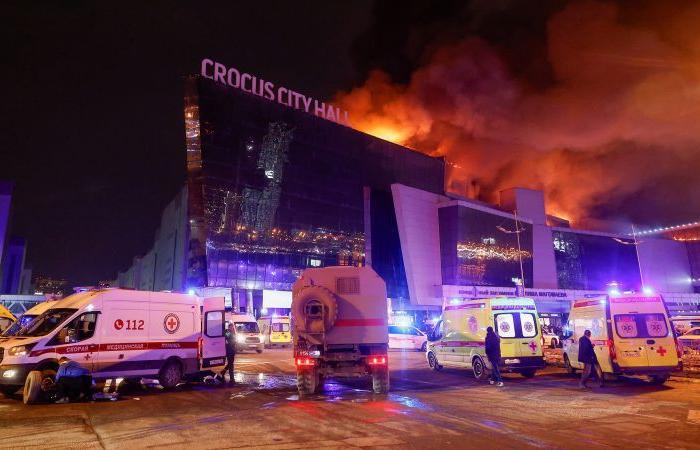
Exhibit 3: Friday evening. Terror attack on Crocus City, a music venue northwest of Moscow. A heavily trained commando shoots people on sight, point blank, in cold blood, then sets a concert hall on fire. The definitive counter-signal: with the battlefield collapsing, all that’s left is terrorism in Moscow.

And just as terror was striking Moscow, the US and the UK, in southwest Asia, was bombing Sana’a, the Yemeni capital, with at least five strikes.

Some nifty coordination. Yemen has just clinched a strategic deal in Oman with Russia-China for no-hassle navigation in the Red Sea, and is among the top candidates for BRICS+ expansion at the summit in Kazan next October.

Not only the Houthis are spectacularly defeating thalassocracy, they have the Russia-China strategic partnership on their side. Assuring China and Russia that their ships can sail through the Bab-al-Mandeb, Red Sea and Gulf of Aden with no problems is exchanged with total political support from Beijing and Moscow.

The sponsors remain the same

Deep in the night in Moscow, before dawn on Saturday 23. Virtually no one is sleeping. Rumors dance like dervishes on countless screens. Of course nothing has been confirmed – yet. Only the FSB will have answers. A massive investigation is in progress.

The timing of the Crocus massacre is quite intriguing. On a Friday during Ramadan. Real Muslims would not even think about perpetrating a mass murder of unarmed civilians under such a holy occasion. Compare it with the ISIS card being frantically branded by the usual suspects.

Let’s go pop. To quote Talking Heads: “This ain’t no party/ this ain’t no disco/ this ain’t no fooling around”. Oh no; it’s more like an all-American psy op. ISIS are cartoonish mercenaries/goons. Not real Muslims. And everyone knows who finances and weaponizes them.

That leads to the most possible scenario, before the FSB weighs in: ISIS goons imported from the Syria battleground – as it stands, probably Tajiks – trained by CIA and MI6, working on behalf of the Ukrainian SBU. Several witnesses at Crocus referred to “Wahhabis” – as in the commando killers did not look like Slavs.

It was up to Serbia’s Aleksandar Vucic to cut to the chase. He directly connected the “warnings” in early March from American and British embassies directed at their citizens not to visit public places in Moscow with CIA/MI6 intel having inside info about possible terrorism, and not disclosing it to Moscow.

The plot thickens when it is established that Crocus is owned by the Agalarovs: an Azeri-Russian billionaire family, very close friends of…

… Donald Trump.

Talk about a Deep State-pinpointed target.

ISIS spin-off or banderistas – the sponsors remain the same. The clownish secretary of the National Security and Defense Council of Ukraine, Oleksiy Danilov, was dumb enough to virtually, indirectly confirm they did it, saying on Ukrainian TV, “we will give them [Russians] this kind of fun more often.”

But it was up to Sergei Goncharov, a veteran of the elite Russia Alpha anti-terrorism unit, to get closer to unwrapping the enigma: he told Sputnik the most feasible mastermind is Kyrylo Budanov – the chief of the Main Directorate of Intelligence at the Ukrainian Ministry of Defense.

The “spy chief” who happens to be the top CIA asset in Kiev.

It’s got to go till the last Ukrainian

The three exhibits above complement what the head of NATO’s

military committee, Rob Bauer, previously told a security forum in Kiev: “You need more than just grenades – you need people to replace the dead and wounded. And this means mobilization.”

Translation: NATO spelling out this is a war until the last Ukrainian.

And the “leadership” in Kiev still does not get it. Former Minister of Infrastructure Omelyan: “If we win, we will pay back with Russian oil, gas, diamonds and fur. If we lose, there will be no talk of money – the West will think about how to survive.”

In parallel, puny “garden-and jungle” Borrell admitted that it would be “difficult” for the EU to find an extra 50 billion euros for Kiev if Washington pulls the plug. The cocaine-fueled sweaty sweatshirt leadership actually believes that Washington is not “helping” in the form of loans, but in the form of free gifts. And the same applies for the EU.

The Theater of the Absurd is unmatchable. The German Liver Sausage Chancellor actually believes that proceeds from stolen Russian assets “do not belong to anyone”, so they can be used to finance extra Kiev weaponizing.

Everyone with a brain knows that using interest from “frozen”, actually stolen Russian assets to weaponize Ukraine is a dead end – unless they steal all of Russia’s assets, roughly $200 billion, mostly parked in Belgium and Switzerland: that would tank the Euro for good, and the whole EU economy for that matter.

Eurocrats better listen to Russian Central Bank major “disrupter” (American terminology) Elvira Nabiullina: The Bank of Russia will take “appropriate measures” if the EU does anything on the “frozen”/stolen Russian assets.

It goes without saying that the three exhibits above completely nullify the “La Cage aux Folles” circus promoted by the puny Petit Roi, now known across his French domains as Macronapoleon.

Virtually the whole planet, including the English-speaking Global North, had already been mocking the “exploits” of his Can Can Moulin Rouge Army.

So French, German and Polish soldiers, as part of NATO, are already in the south of Kiev. The most possible scenario is that they will stay far, far away from the frontlines – although traceable by Mr. Khinzal’s business activities.

Even before this new NATO batch arriving in the south of Kiev, Poland – which happens to serve as prime transit corridor for Kiev’s troops – had confirmed that Western troops are already on the ground.

So this is not about mercenaries anymore. France, by the way, is only 7th in terms of mercenaries on the ground, largely trailing Poland, the US and Georgia, for instance. The Russian Ministry of Defense has all the precise records.

In a nutshell: now war has morphed from Donetsk, Avdeyevka and Belgorod to Moscow. Further on down the road, it may not just stop in Kiev. It may only stop in Lviv. Mr. 87%, enjoying massive national near-unanimity,  now has the mandate to go all the way. Especially after Crocus.

There’s every possibility the terror tactics by Kiev goons will finally drive Russia to return Ukraine to its original 17th century landlocked borders: Black Sea-deprived, and with Poland, Romania, and Hungary reclaiming their former territories.

Remaining Ukrainians will start to ask serious questions about what led them to fight – literally to their death – on behalf of the US Deep State, the military complex and BlackRock.

As it stands, the Highway to Hell meat grinder is bound to reach maximum velocity.

Challenges for Resolving Complex Conflicts

By Robert J. Burrowes

While conflict theories and resolution processes advanced dramatically during the second half of the 20th century, particularly thanks to the important work of several key scholars such as Professor Johan Galtung – see ‘Conflict Transformation by Peaceful Means (the Transcend Method)’ – significant gaps remain in the conflict literature on how to deal with particular conflict configurations. Notably, these include the following four.

First, existing conflict theory does not adequately explain, emphasize and teach how to respond in those circumstances in which parties cannot be brought to the table to deeply consider a conflict and the measures necessary to resolve it. This particularly applies in cases where one or more parties is violently defending (often using a combination of direct and structural violence) substantial interrelated (material and non-material) interests. The conflict between China and Tibet over the Chinese-occupied Tibetan plateau, the many conflicts between western corporations and indigenous peoples over exploitation of the natural environment, and the conflict between the global elite and ‘ordinary’ people over resource allocation in the global economy are obvious examples of a vast number of conflicts in this category. As one of the rare conflict theorists who addresses this question, Galtung notes that structural violence ‘is not only evil, it is obstinate and must be fought’, and his preferred strategy is nonviolent revolution. See The True Worlds: A Transnational Perspective p. 140. But how?

Second, existing conflict theory does not explain how to respond in those circumstances in which one or more parties to the conflict are insane. The conflict between Israel and Palestine over Israeli-occupied Palestine classically illustrates this problem, particularly notable in the insanity of Israeli Prime Minister Binjamin Netanyahu, Defense Minister Avigdor Lieberman and Justice Minister Ayelet Shaked. But it is also readily illustrated by the insanity of the current political/military leadership in the USA and the insanity of the political, military and Buddhist leaders in Myanmar engaged in a genocidal assault on the Rohingya. For a brief discussion of the meaning and cause of this insanity see ‘The Global Elite is Insane Revisited’.

As an aside, there is little point deluding ourselves that insanity is not a problem or even ‘diplomatically’ not mentioning the insanity (if this is indeed the case) of certain parties in particular conflicts. The truth enables us to fully understand a conflict so that we can develop and implement a strategy to deal with all aspects of that truth. Any conflict strategy that fails to accurately identify and address all key aspects of the conflict, including the insanity of any of the parties, will virtually certainly fail.

Third, and more fundamentally, existing conflict theory does not take adequate account of the critical role that several unconscious emotions play in driving conflict in virtually all contexts, often preventing its resolution. This particularly applies in the case of (but is not limited to) suppressed terror, self-hatred and anger which are often unconsciously projected as fear of, hatred for and anger at an opponent or even an innocent third-party (essentially because this individual/group feels ‘safe’ to the person who is projecting). See ‘The Psychology of Projection in Conflict’.

While any significant ongoing conflict would illustrate this point adequately, the incredibly complex and interrelated conflicts being conducted in the Middle East, the prevalent Islamophobia in some western countries, and the conflicts over governance and exploitation of resources in the Democratic Republic of Congo are superlative examples. Ignoring suppressed (and projected) emotions can stymie conflict resolution in any context, interpersonally and geopolitically, and it does so frequently.

Fourth, existing conflict theory pays little attention to the extinction-causing conflict being ongoingly generated by human over-consumption in the finite planetary biosphere (and currently resulting in 200 species extinctions daily) which is sometimes inadequately identified as a conflict caused by capitalism’s drive for unending economic growth in a finite environment.

So what can we do?

Well, to begin, in all four categories of cases mentioned above, I would use Gandhian nonviolent strategy to compel violent opponents to participate in a conflict transformation process such as Galtung’s. Why nonviolent and why Gandhian? Nonviolent because our intention is to process the conflict to achieve a higher level of need satisfaction for all parties and violence against any or all participants is inconsistent with that intention. But Gandhian nonviolence because only Gandhi’s version of nonviolence has this conflict intention built into it. See ‘Conception of Nonviolence’.

‘But isn’t this nonviolent strategy simply coercion by another name?’ you might ask. Well, according to the Norwegian philosopher, Professor Arne Naess, it is not. In his view, if a change of will follows the scrutiny of norms in the context of new information while one is ‘in a state of full mental and bodily powers’, this is an act of personal freedom under optimal conditions. Naess highlights this point with the following example: Suppose that one person carries another against their will into the streets where there is a riot and, as a result of what they see, the carried person changes some of their attitudes and opinions. Was the change coerced? According to Naess, while the person was coerced into seeing something that caused the change, the change itself was not coerced. The distinction is important, Naess argues, because satyagraha (Gandhian nonviolent struggle) is incompatible with changes of attitudes or opinions that are coerced. See Gandhi and Group Conflict: An Exploration of Satyagraha pp. 91-92.

To elaborate this point: Unlike other conceptions of nonviolence, Gandhi’s nonviolence is based on certain premises, including the importance of the truth, the sanctity and unity of all life, and the unity of means and end, so his strategy is always conducted within the framework of his desired political, social, economic and ecological vision for society as a whole and not limited to the purpose of any immediate campaign. It is for this reason that Gandhi’s approach to strategy is so important. He is always taking into account the ultimate end of all nonviolent struggle – a just, peaceful and ecologically sustainable society of self-realized human beings – not just the outcome of this campaign. He wants each campaign to contribute to the ultimate aim, not undermine vital elements of the long-term and overarching struggle to create a world without violence.

Consequently, given his conception of nonviolence, Gandhi’s intention is to reach a conflict outcome that recognizes the sanctity and unity of all life which, obviously, includes the lives (but also the physical and emotional well-being) of his opponents. His nonviolent strategy is designed to compel participation in a conflict process but not to impose his preferred outcome unilaterally. See Nonviolent Campaign Strategy and Nonviolent Defense/Liberation Strategy.

This can apply in the geopolitical context or in relation to ordinary individuals ‘merely’ participating in the violence of overconsumption. Using nonviolent strategy to campaign on the climate catastrophe or other environmental issues can include mobilizing individuals and communities to emulate Gandhi’s asceticism in a modest way by participating in the fifteen-year strategy outlined in The Flame Tree Project to Save Life on Earth which he inspired.

But even if we can use nonviolent strategy effectively to get the conflicting parties together, the reality is that suppressed and projected emotions – particularly fear, self-hatred and anger as mentioned above – or even outright insanity on the part of one or more parties may still make efforts to effectively transform the conflict impossible. So for conflict resolution to occur, we need individuals who are willing and able to participate with at least minimal goodwill in designing a superior conflict outcome beneficial to everyone concerned.

Hence, I would do one more thing in connection with this process. Prior to, and then also in parallel with, the ‘formal’ conflict process, I would provide opportunities for all individuals engaged in the process (or otherwise critical to it because of their ‘background’ role, perhaps as a leader not personally present at the formal conflict process) to explore in a private setting with a skilled ‘nisteler’ (who is outside the conflict process), the unconscious emotions that are driving their particular approach to the conflict. See ‘Nisteling: The Art of Deep Listening’. The purpose of this nisteling is to allow each participant in the conflict process to bring a higher level of self-awareness to it. See ‘Human Intelligence or Human Awareness?’

I am not going to pretend that this would necessarily be possible, quick, easy or even work in every context. Insane individuals are obviously the last to know they have a psychological problem and the least likely to participate in a process designed to uncover and remove the roots of their insanity. However, those who are trapped in a dysfunctional psychological state short of insanity may be willing to avail themselves of the opportunity. In time, the value of this aspect of the conflict resolution process should become apparent, particularly because delusions and projections are exposed by the person themself (as an outcome of the expertise of the person nisteling).

Obviously, I am emphasizing the psychological aspects of the conflict process because my own considerable experience as a nonviolent activist together with my research convinces me that understanding violence requires an understanding of the psychology that drives it. If you are interested, you can read about the psychology of violence, including the 23 psychological characteristics in the emotional profile of archetype perpetrators of violence, in the documents Why Violence? and Fearless Psychology and Fearful Psychology: Principles and Practice.

Ideally, I would like to see the concept of nistelers operating prior to, and then parallel with, focused attention on the conflict itself normalized as an inherent part of the conflict resolution process. Clearly, we need teams of people equipped to perform this service, a challenge in itself in the short-term.

If, however, conflicting parties cannot be convinced to participate in this process with reasonable goodwill, we can always revert to using nonviolent strategy to compel them to do so. And, if all attempts to conduct a reasonable conflict process fail (particularly in a circumstance in which insanity is the cause of this failure), to impose a nonviolent solution which nevertheless takes account of the insane’s party’s legitimate needs. (Yes, on just that one detail, I diverge from Gandhi.)

Having stated that, however, I acknowledge that only a rare individual has the capacity to think, plan and act strategically in tackling a violent conflict nonviolently, so considerable education in nonviolent strategy will be necessary and is a priority.

Given what is at stake, however – a superior strategy for tackling and resolving violent geopolitical conflicts including those (such as the threat of nuclear war, the climate catastrophe and decimation of the biosphere) that threaten human extinction – any resources devoted to improving our capacity to deliver this outcome would be well spent.

Provided, of course, that reducing (and ultimately eliminating) violence and resolving conflict is your aim.

In addition to the above, I would do something else more generally (that is, outside the conflict process).

Given that dysfunctional parenting is ultimately responsible for the behaviour of those individuals who generate and perpetuate violent conflicts, I would encourage all parents to consider making ‘My Promise to Children’ so that we start to produce a higher proportion of functional individuals who know how to powerfully resolve conflicts in their lives without resort to violence. If any parent feels unable to make this promise, then they have the option of tackling this problem at its source by ‘Putting Feelings First’.

If we do not dramatically and quickly improve our individual and collective capacity to resolve conflicts nonviolently, including when we are dealing with individuals who are insane, then one day relatively soon we will share the fate of those 200 species of life we drove to extinction today.


Biodata: Robert J. Burrowes has a lifetime commitment to understanding and ending human violence. He has done extensive research since 1966 in an effort to understand why human beings are violent and has been a nonviolent activist since 1981. He is the author of Why Violence? His email address is flametree@riseup.net and his website is here.

Robert J. Burrowes
P.O. Box 68
Daylesford, Victoria 3460
Australia

Email: flametree@riseup.net

Websites:
Nonviolence Charter
Flame Tree Project to Save Life on Earth
‘Why Violence?’
Feelings First
Nonviolent Campaign Strategy
Nonviolent Defense/Liberation Strategy
Anita: Songs of Nonviolence
Robert Burrowes
Global Nonviolence Network

Why are Police in the USA so Terrified?

(AP Photo/Jeff Roberson, File)

Robert J. Burrowes

In a recent incident in the United States, yet another unarmed man was shot dead by police after opening his front door in response to their knock. The police were going to serve an arrest warrant on a domestic violence suspect – the man’s neighbour – but went to the wrong address. See ‘Police kill innocent man while serving warrant at wrong address’.

For those who follow news in the United States, the routine killing of innocent civilians by the police has become a national crisis despite concerted attempts by political and legal authorities and the corporate media to obscure what is happening. See ‘Killed by Police’ and ‘The Counted: People killed by police in the US’.

So far this year, US police have killed 1,044 people. In contrast, from 1990 to 2016, police in England and Wales killed just 62 people. See ‘Fatal police shootings’.

Of course, these murders by the police are just the tip of the iceberg of police violence as police continue to demonstrate that the freedoms ‘guaranteed’ by the Fourth Amendment have been eviscerated. See ‘What Country Is This? Forced Blood Draws, Cavity Searches and Colonoscopies’.

So why are the police so violent? you might ask. Well, several scholars have offered answers to this question and you can read a little about what they say in these articles reviewing recent books on the subject. See ‘The Fraternal Order of Police Must Go’ and ‘Our Ever-Deadlier Police State’.

While there is much in these works with which I agree – such as the racism in US policing and the corruption of the legal system which is used to violently manage oppressed peoples in the name of ‘justice’ while leaving the individuals, banks and corporations on Wall Street unaccountable for their endless, ongoing and grotesque crimes against society, the economy and the environment – I would like to pose a deeper question: Why are police in the USA so terrified? This is the important question because only people who are terrified resort to violence, even in the context of policing. Let me explain why this is the case and how it has occurred in the police context in the USA.

Violence does not arise ‘out of nowhere’. And, sadly, its origin can be traced to what is euphemistically called the ‘socialization’ of children but which is more accurately labeled ‘terrorization’. You might think that this sounds extreme but if you spend some time considering the phenomenal violence – ‘visible’, ‘invisible’ and ‘utterly invisible’ – that we adults inflict on children during the ordinary course of the day – see Why Violence? and Fearless Psychology and Fearful Psychology: Principles and Practice – while deluding ourselves that we are preparing them to become just, decent and powerful citizens, then you might be willing to reconsider your concept of what it means to nurture children. Tragically, we are so far from any meaningful understanding of this notion, that it is not even possible to generate a widespread social discussion about how we might go about it.

So, having terrorized children into submission so that they unthinkingly and passively accept their preordained role in life – to act as a cog in a giant and destructive enterprise which they are terrorized into not questioning and over which they have no control – each of them takes their place in the global ‘economy’ wherever they can find a set of tasks that feels least painful. The idea of seeking their true path in order to search out their own unique destiny never even occurs to most of them and so they lead ‘shadow lives’ endlessly suppressing their awareness of the life that might have been.

Some of these individuals end up as recruits at a police training facility, where they are further terrorized into believing an elite-sponsored ideology that precludes genuine appreciation of the diversity of people in the community they will later police (that is, terrorize) in the name of ‘law and order’. After all, elite social control is more readily maintained when people, including the police, live in fear.

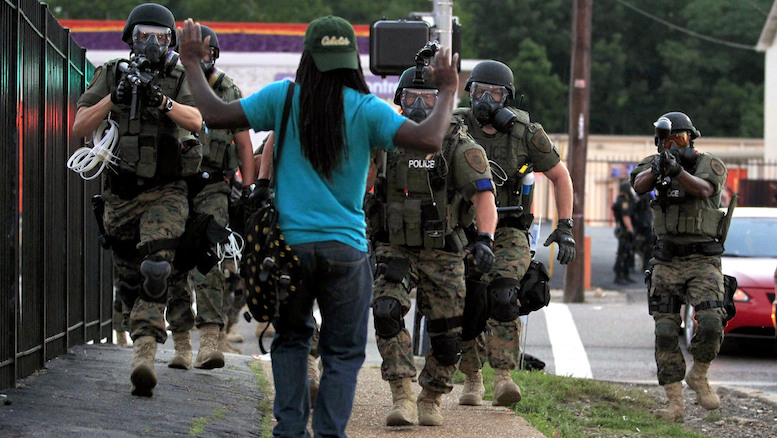
Police training further terrorizes the individuals involved and militarizes policing by encouraging recruits ‘to adopt a “warrior” mentality and think of the people they are supposed to serve as enemies’; the equipment they use, such as battering rams, flashbang grenades and Armoured Personnel Carriers, evoke a sense of war. See ‘War Comes Home: The Excessive Militarization of American Policing’.

But it doesn’t end with terrorization during childhood and then police training. Police practice functions within a long-standing cultural framework which has both wider social dimensions and narrower, localized ones. And this cultural framework has been changing, more quickly in recent years too. Unfortunately, more than ever before, this framework is increasingly driven by fear and older, delusional social expectations that police are there to maintain public safety or defend the community from criminal violence have given way to militarized assumptions, language and procedures that regard virtually everyone (and certainly indigenous people and people of color) as both dangerous and guilty until proven otherwise and treat the family home and car as targets to be ‘neutralized’ with military-style tactics and weapons. And this trend has been accelerated under Donald Trump. See ‘Trump to lift military gear ban for local police’.

By triggering fear and using military-style tactics and weapons, however, the very essence of the relationship between police and civilians is more rapidly, completely and detrimentally transformed in accord with elite interests. It equates law-enforcement with counter-terrorism and community safety with social control.

Fundamentally, of course, this plays its part in ensuring minimal effective resistance to the broader elite agenda to secure militarized control of the world’s populations and resources for elite benefit.

This transformation in the relationship between police and civilians has been accelerated by training US police in the use of military tactics that the Israeli military employs against the occupied Palestinians. See ‘Israel trains US law-enforcement in counter-terrorism’.

But consider the implications of this.

As Rashid Khalidi, the Edward Said professor of modern Arab studies at Columbia University, has noted in discussing this phenomenon: US police are learning paramilitary and counterinsurgency tactics from the Israeli military, border patrol and intelligence services, which enforce military law.

‘If American police and sheriffs consider they’re in occupation of neighborhoods like Ferguson and East Harlem, this training is extremely appropriate – they’re learning how to suppress a people, deny their rights and use force to hold down a subject population’. See ‘US Police Get Antiterror Training In Israel’.

Moreover, the most tangible evidence that the militarized training is having an impact on US policing is that both Israel and the US are using identical equipment against demonstrators, according to a 2013 report by the Israeli human rights organization B’Tselem and photographs of such equipment taken at three demonstrations in the USA. ‘Tear gas grenades, “triple chaser” gas canisters and stun grenades made by the American companies Combined Systems Inc. and Defense Technology Corp. were used in all three U.S. incidents, as well as by Israeli security forces and military units.’ See ‘US Police Get Antiterror Training In Israel’.

Given the sheer terror that drives Israeli military policy towards occupied and militarily undefended Palestine, it is little wonder that this fear is transmitted as part of any training of US police. All knowledge and technology is embedded with emotion, and fear is utterly pervasive in any military activity. Especially when it is directed in pursuit of unjust ends.

So what can we do?

If you are interested in working to reduce police fear and violence, you will get plenty of ideas in the document ‘A Toolkit for Promoting Justice In Policing’ which is summarized here: ‘15 Things Your City Can Do Right Now to End Police Brutality’.

If you want to organize a nonviolent action while reducing police fear to minimize the risk of police violence, there is a comprehensive list of guidelines here: ‘Nonviolent Action: Minimizing the Risk of Violent Repression’.

If you want to work towards ending the underlying fear that drives police (and other) violence, consider making ‘My Promise to Children’. In essence, if you want powerful individuals who are capable of resisting elite social control, including that implemented through police violence, then don’t expect children terrorized into obedience by parents, teachers and religious figures to later magically have this power.

And if you are inclined to resist violence in other contexts, consider participating in The Flame Tree Project to Save Life on Earth, signing the online pledge of The Peoples Charter to Create a Nonviolent World and/or using the strategic framework explained in Nonviolent Campaign Strategy for your peace, environmental or social justice campaign.

Why are the police so terrified? Essentially because they were terrorized as children and then terrorized during police training to violently defend elite interests against the rest of us. Elite control depends on us being too terrified to defend ourselves against their violence.

If humans are to survive this elite-driven onslaught, we need people courageous enough to resist police violence and other elite-driven violence strategically. Can we count on you?


Biodata: Robert J. Burrowes has a lifetime commitment to understanding and ending human violence. He has done extensive research since 1966 in an effort to understand why human beings are violent and has been a nonviolent activist since 1981. He is the author of Why Violence? His email address is flametree@riseup.net and his website is here.


Robert J. Burrowes
P.O. Box 68
Daylesford
Victoria 3460
Australia
Email: flametree@riseup.net

Websites:
Nonviolence Charter
Flame Tree Project to Save Life on Earth
‘Why Violence?’
Nonviolent Campaign Strategy
Nonviolent Defense/Liberation Strategy
Anita: Songs of Nonviolence
Robert Burrowes
Global Nonviolence Network


You Cannot Trap the ‘Magic Rat’: Trump, Congress and Geopolitics

By Robert J. Burrowes

A wonderful thing about observing and analyzing the human mind is that there is a seemingly infinite variety of phenomena to observe and analyze. I sometimes wonder if it is even remotely possible to master this subject but, even if it is not, at least it provides an unending source of ‘entertainment’.

The phenomenon that I want to discuss in this article is what Anita McKone and I call the ‘magic rat’.

Before proceeding, let me emphasize that the ‘magic rat’ is an incredibly dangerous psychological disorder that afflicts most political and virtually all corporate leaders, notably including those in the United States, thus rendering them incapable of responding intelligently and appropriately to the ongoing crises in human affairs. And, tragically, it afflicts most other people too, which is one reason why it is difficult to muster a strategic response to these crises, even at grassroots level.

In describing this disorder, I also want to emphasize that it never occurs in isolation. Individuals afflicted by this disorder will invariably have a multiplicity of other disorders too, not necessarily labeled ‘disorders’ in the psychological literature.

So what is the ‘magic rat’, and why can’t it be trapped?

When a human being is terrified to consider a particular fact or set of facts, their mind has an enormous variety of unconscious mechanisms for preventing them from doing so. The most obvious version of this phenomenon which has been identified is known as ‘denial’. See ‘The Psychology of Denial’.

However, the ‘magic rat’ is a different phenomenon which most humans routinely use (unconsciously) to avoid having to respond to frightening circumstances. The nature of these frightening circumstances varies from one individual to the next although patterns can be readily observed in many contexts.

In 2003, Anita had a dream in which a rat was running around and I was chasing it and hitting it with an iron bar. However, each time that I appeared to land a blow on the rat, the rat simply disappeared and reappeared somewhere else. And so my chase resumed. I just couldn’t pin it down.

This psychological phenomenon is readily observed and many people will be able to recall this from their own experience. The ‘magic rat’ occurs when someone is given information that terrifies them. It is important to understand that their fear is unlikely to be readily displayed and it will often be concealed behind some behaviour, such as an apparently ‘rational’ argument or ‘off-hand’ comment in response, or perhaps even a joke.

The frightening information might be personal but it might just as readily be information of any other kind, such as in relation to something that happened historically or about the state of the world. What matters is that the person to whom the information is presented is (unconsciously) terrified by it and responds (again unconsciously) by employing the ‘magic rat’.

The ‘magic rat’ is simply the mechanism by which an unconscious and terrified mind instantly switches its attention from something frightening to something more pleasant to avoid having any time to consciously engage with the presented information. The switch happens instantaneously precisely because the person is so terrified by the information that their mind takes their attention away from it in a moment. If their mind did not do this, the person would be compelled to consider the information and to respond to it.

As Anita and I discussed this phenomenon recently, we could easily recall four different responses by the ‘magic rat’ that we have observed. In no particular order, the first response is for the terrified person’s unconscious mind to shut out the frightening information so effectively that it might well have never been uttered/written; they then proceed as if it had not been.

The second response is for the person frightened by the information to instantly switch the topic of discussion to something else that feels safe (so that they do not have to engage with the information). In some contexts, this might look like a ‘rational’ response but, in fact, closer examination will reveal that their response is irrelevant to the issue raised previously. This version is probably the most difficult to identify simply because most of us have learned to largely ignore what we probably (but incorrectly) perceive as ‘red herrings’.

The third response is to ‘throw out smoke bombs’, as Anita describes it, so that the whole issue is clouded by distractive ‘noise’ designed to distract the attention of the person/people presenting the information in the first place so that they are lured into discussing a less frightening subject. These ‘smoke bombs’ can take many forms, including introducing irrelevant information to confuse you or offering a sarcastic comment as the preliminary to any response (which, of course, will be wide of the subject).

The fourth response is to attack you verbally or physically, because your information is considered an attack on them against which they must immediately and aggressively defend themselves. This version of the problem is sometimes labeled ‘kill the messenger’.

There are no doubt other versions of the ‘magic rat’: what matters is that the person in question is so frightened that they find a way to avoid dealing with the issue that makes them scared.

The purpose of the ‘magic rat’ mechanism is to enable an individual to remain feeling safe in the delusion that they have created for themselves and it is vital that the truth does not penetrate this delusion.

Why would an individual want to (unconsciously) use a delusion to feel safe? For the simple reason that, as a child, the individual never felt safe but was also never given any time or the necessary conditions to both feel this fear while feeling safe, and to actually be safe for most of the time. So because evolution did not equip any individual to live in a permanent state of feeling terrified, the child has no ‘choice’ but to (unconsciously) generate a delusional sense of safety in the unsafe environment. Once the child has done this, however, the delusional state becomes ‘permanent’ and is ‘defended’, both consciously and unconsciously depending on the context, using mechanisms such as the ‘magic rat’ described above.

So is this problem very prevalent? Unfortunately, it is ‘everywhere’. For instance, if you take the information I have presented above and consider this the next time you listen to or read something from Donald Trump, you will have an excellent opportunity to observe and identify the ways in which his mind routinely uses ‘magic rats’ to avoid dealing with reality. See, for example, his decisions in relation to the environment and climate, summarised in ‘A Running List of How Trump Is Changing the Environment‘.

You might also ponder the extraordinary violence that this man suffered, as a child, at the hands of those adults who were supposed to love him. In addition, you might consider the phenomenal danger to humanity of having this individual in charge of the world’s largest nuclear arsenal and its primary human, environmental and climate destroyer: the US military.

But Trump is not the only person afflicted with this psychological disorder. Members of both houses of the United States Congress, with only a few exceptions, also routinely display this disorder although, it should be emphasized, it is often combined with other disorders as they terrifiedly submit to the directives of the insane neocon elite driving US foreign policy and its perpetual war against life.

For instance, it has just been graphically highlighted, yet again, by the recent (virtually unanimous) Congressional decision to impose sanctions on Russia, Iran and North Korea for reasons which are readily refuted by the verifiable evidence if you are not too terrified to consider it. See, for example, ‘Intel Vets Challenge “Russia Hack” Evidence‘, ‘The Mask Is Off: Trump Is Seeking War with Iran‘, ‘Trump Intel Chief: North Korea Learned From Libya War to “Never” Give Up Nukes’ and ‘With the European Union Livid, Congress Pushes Forward on Sanctions Against Russia, Iran and North Korea‘.

You will also have no trouble identifying this disorder in Israeli or Saudi Arabian leaders either. Again, however, they are far from alone.

Most importantly though, the ‘magic rat’ is almost invariably evident when adults are challenged to consider their phenomenal violence – ‘visible’, ‘invisible’ and ‘utterly invisible’ – against children, which leads to the terrified and dysfunctional outcomes described above (as well as all of the other terrified and dysfunctional outcomes). See ‘Why Violence?‘ and ‘Fearless Psychology and Fearful Psychology: Principles and Practice‘.

So if you don’t even want to know about this violence, the good news is that your ‘magic rat’, if you have one, will ensure that you never even consider looking at these documents (or don’t get past the first page). The problem, for humanity as a whole, is that if too many people are too terrified to even consider the truth, then we are in deep trouble from which I can see no exit. Because if we are to extricate ourselves from this mess, we must start with the truth, no matter how terrifying.

Is there anything you can do next time you see someone use their magic rat? Yes. You can reflect that they sound too terrified to consider the information in question. If you feel capable of doing this, bear in mind that you might then need to also listen to their terrified response, which might be aggressive as well. For a fuller answer to this question, see ‘Nisteling: The Art of Deep Listening‘.

Moreover, if you ever notice your own mind being taken away from information that frightens you, see if you can take your attention back to what you found frightening and feel your fear. The information, in itself, is not going to cause you any harm. It is, after all, simply the truth and you are infinitely more powerful to know the truth and hence be in a position to respond to it, even if it scares you initially.

So if you feel able to respond intelligently and powerfully to reality, which means that you can contemplate information that is terrifying to many, then you might consider participating in the fifteen-year strategy of ‘The Flame Tree Project to Save Life on Earth‘ and signing the online pledge of ‘The People’s Charter to Create a Nonviolent World‘. And if you want to develop an effective strategy to resist one or the other of the many threats to our survival, consider using the strategic framework explained in Nonviolent Campaign Strategy.

We cannot trap the ‘magic rat’ that afflicts so many individuals but we might be able to assist some of them to recover from this psychological disorder. We might also be able to mobilise those not afflicted (or not so badly afflicted) to respond powerfully to frightening information about the state of our world.

Sadly, however, many people will use their ‘magic rat’ until the day they die. The important point is that we do not let these people, like Donald Trump, decide the fate of humanity.


Biodata: Robert J. Burrowes has a lifetime commitment to understanding
and ending human violence. He has done extensive research since 1966 in
an effort to understand why human beings are violent and has been a
nonviolent activist since 1981. He is the author of ‘Why Violence?
His email address is flametree@riseup.net
and his website is at http://robertjburrowes.wordpress.com


Robert J. Burrowes
P.O. Box 68
Daylesford
Victoria 3460
Australia
Email: flametree@riseup.net

Websites:
Nonviolence Charter
Flame Tree Project to Save Life on Earth
‘Why Violence?’
Nonviolent Campaign Strategy
Nonviolent Defense/Liberation Strategy
Anita: Songs of Nonviolence
Robert Burrowes
Global Nonviolence Network

ANOTHER TERRORIST, ANOTHER PAST CONNECTION WITH THE FBI

b-2-700x470

By James Henry

Source: Who.What.Why.

Another terrorist attack in a major American city, more frightening images and talk of pressure cookers and ball bearings, BBs and pipe bombs, “lone wolves” and Christmas tree lights.

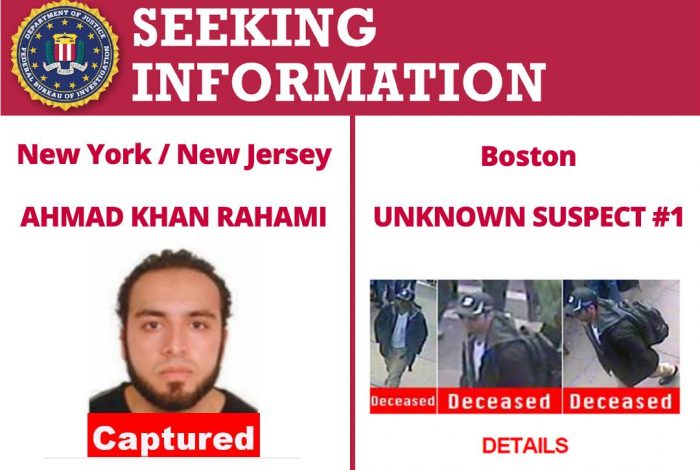
The latest alleged perpetrator is Ahmad Khan Rahami, a young Muslim man who grew up in America and likes souped-up cars. He became “self-radicalized” watching videos on the Internet that inspired him to blow up innocent Americans.

Some experts say the bombs he made show a high level of sophistication and training, but with more than a half a dozen bombs deployed, not a single person was killed. Some saw it coming — others say they can’t believe it.

He traveled to Afghanistan or Pakistan — or both — in the years prior to the attack. Nobody seems to know what he did there, but authorities are pretty sure there’s no wider conspiracy.

Cornered and desperate after authorities released his picture to the public, it’s a small miracle the suspect is still alive after a wild shootout with police.

Sound familiar?

The Boston Herald understandably thinks so. In a piece titled “Attack had eerie resemblance to Boston Marathon bombings,” the Herald points out the many superficial similarities to the 2013 attack at the Boston Marathon. The lead paragraph reads: “From pressure cookers, the release of a suspect photo, to the subsequent manhunt and shootout with cops, yesterday’s arrests of Ahmad Khan Rahami in New York City and New Jersey has stirred echoes of blasts at the Boston Marathon in 2013, security experts said.”

But there are far more significant similarities.

https://twitter.com/NYCityAlerts/status/777365213914001409?ref_src=twsrc%5Etfw

The reliably pro-law-and-order Herald left out the part about the FBI’s prior contact with the suspect. The New York Times, to its  credit, did inform us that the FBI conducted an “assessment” on Rahami in 2014, because his father told them he was a terrorist. Then dad took it back.

Interestingly, the Times also mentioned that the suspect’s father claims to have fought with the CIA-supported Afghan Mujahedin against the Soviets back in the 80s. The Times didn’t attach much significance to either revelation and probably won’t pursue the connections much further.

But, as with Tamerlan Tsarnaev, another recent “lone wolf” who suddenly started acting as a cartoonish Muslim fanatic, the FBI and CIA can be found lurking in the back story.

It is entirely possible that there are a lot of so-called lone wolves on the prowl — a sort of self-directed fifth-column of ISIS. But, according to investigative journalist Trevor Aaronson, an alarming number of them are being pushed and prodded by provocateurs on the federal payroll. We don’t know if Rahami was similarly pushed, but it’s a valid question nonetheless.

The FBI claims to have sent undercover agents to “investigate” Rahami, but “didn’t find enough information to charge him,” according to theBoston Globe. What that investigation consisted of is still, and likely will remain, unclear. The FBI seldom reveals its “sources and methods.”

At the very least, the public should be told what this type of contact looks like and whether it is at least conceivable that such government actions can contribute to pushing young men to commit these types of crimes.

But despite these obvious concerns, the US government’s “war on terror” strategies are strangely absent from President Barack Obama’s Countering Violent Extremism program, which is currently grappling with the thorny issue of what might be provoking these desperate acts.

Will we get a legitimate investigation that delves into the precise nature of federal agents’ interactions with Rahami, or will we just get another whitewash that only looks at “intelligence failures.” It will most likely be the latter (here’s why).

History Doesn’t Repeat, It Rhymes

How likely is it that Rahami’s travel to Afghanistan, an active war zone, escaped the scrutiny of federal agents? Tamerlan Tsarnaev traveled overseas to a geopolitical hotspot in the years before the Boston Marathon bombing, but the Feds claim to have ignored internal warnings about him and waved him through at the airport.

The FBI appears to be covering up their prior interactions with Tamerlan Tsarnaev. Will we see the same thing with Rahami?

Authorities never nailed down exactly where the bombs the Tsarnaevs used were made and who made them. Will we get these details in the Rahami  case? The public would like to know who is making all these “sophisticated” explosives.

Like Rahami, Tamerlan Tsarnaev had many of the hallmarks of an individual the FBI routinely coerces to act as undercover informants. In fact, WhoWhatWhy has documented compelling evidence (see here, here andhere).

And what about that decision to release the photos of Rahami? As with the Tsarnaevs such an action almost guarantees a desperate reaction from the pursued — not surprisingly ending in a potentially lethal gun battle.

Former Boston police Commissioner Edward F. Davis, who questioned the wisdom of releasing the Tsarnaevs’ photos after the Marathon bombing, again seems to be questioning the release of such photos. He told the Boston Herald: “Once those pictures go out, that’s when it’s most dangerous. … He [Rahami] attempted suicide by cop. It’s all very familiar.”

Zero for 40 at Predicting Attacks: Why Do Media Still Take FBI Terror Warnings Seriously?

By Adam Johnson

Source: FAIR

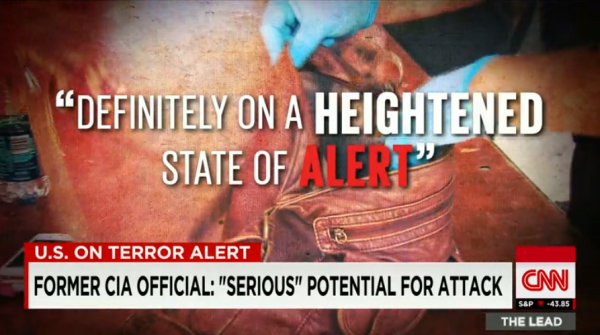
On Monday, several mainstream media outlets repeated the latest press release by the FBI that country was under a new “heightened terror alert” from “ISIL-inspired attacks” “leading up to the July 4th weekend.” One of the more sensational outlets, CNN, led with the breathless warning on several of its cable programs, complete with a special report by The Lead’s Jim Sciutto in primetime:

TerrorAlert

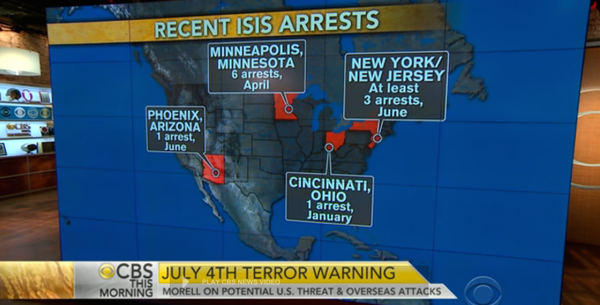
The threat was given extra credence when former CIA director—and consultant at DC PR firm Beacon Global Strategies—Michael Morell went on CBS This Morning (6/29/15) and scared the ever-living bejesus out of everyone by saying he “wouldn’t be surprised if we were sitting [in the studio] next week discussing an attack on the US.” The first piece of evidence Morell used to justify his apocalyptic posture, the “50 ISIS arrests,” was accompanied by a scary map on the CBS jumbotron showing “ISIS arrests” all throughout the US:

RecentISISArrests

But one key detail is missing from this  graphic: None of these “ISIS arrests” involved any actual members of ISIS, only members of the FBI—and their network of informants—posing as such. (The one exception being the man arrested in Arizona, who, while having no contact with ISIS, was also not prompted by the FBI.) So even if one thinks the threat of “lone wolf” attacks is a serious one, it cannot be said these are really “ISIS arrests.”  Perhaps on some meta-level, it shows an increase of “radicalization,” but it’s impossible to distinguish between this and simply more aggressive sting operations by the FBI.

In any event, this nuance gets left out entirely. As I’ve previously shown, in the media’s rush to hype the threat, the fact of FBI-manufactured—or at least “assisted”—terror plots is left out as a complicating factor altogether, and the viewer is left thinking the FBI arrested 50 actual ISIS sleeper cells.

Nevertheless, the ominous FBI (or Department of Homeland Security) “terror warning” has become such a staple of the on-going, seemingly endless “war on terror” (d/b/a war on ISIS), we hardly even notice it anymore. Marked by a feedback loop of extremist propaganda, unverifiable claims about “online chatter” and fuzzy pronouncements issued by a neverending string of faceless Muslim bad guys, and given PR cover by FBI-contrived “terror plots,” the specter of the impending “attack” is part of a broader white noise of fear that never went away after 9/11. Indeed, the verbiage employed by the FBI in this latest warning —“we’re asking people to remain vigilant”—implies no actual change of the status quo, just an hysterical nudge to not let down our collective guard.

There’s only one problem: These warnings never actually come to fruition. Not rarely, or almost never, but—by all accounts—never. No attacks, no arrests, no suspects at large.

Here’s a selection of previous FBI and DHS “terror warnings” over the past 14 years, not a single one of which actually predicted or foiled a terror attack:

October 2001: “Potential use of chemical/biological and/or radiological/nuclear weapons

November 2001: California bridges

February 2002: “Hollywood studios”

May 2002: Statue of Liberty

June 2002: “Around the Fourth of July holiday”

July 2002: Stadiums

August 2002: “Landmarks”

October 2002: “AQ to attack Amtrak

November 2002:Spectacular Al Qaeda attacks

February 2003: “Apartments, hotels, sports arenas and amusement parks

May 2003: “Possibility of multiple attacks”

May 2004: “Attempt to affect the outcome” of presidential election

July 2004: “Military facilities and large gatherings” on July 4th

August 2004: VA hospitals

January 2005: Dirty bomb

March 2005: US/Mexican border

October 2005: NYC & Baltimore subways

March 2006: “Sporting events”

June 2007: Colleges

December 2007:Shopping malls in Chicago and LA”

November 2008: “Al Qaeda to attack transit during Thanksgiving

November 2010: Mass transit in New York City

October 2011: “Americans in Europe” facing “commando-style AQ attack”

February 2011: “Financial institutions”

May 2011: “Threats of retaliation”

June 2011: Al Qaeda “hit list”

July 2011: “Private jets of executives” involved in drone manufacturing

September 2011: “Small planes”

September 2011: “New York City or Washington around…10th anniversary of 9/11

September 2011: Airports

March 2012: “Terrorist hacking”

August 2012: Anarchists blowing up bridge during Tampa RNC

September 2012: “Islamic violence over movie

August 2013: “San Fransisco on high alert

November 2013: “cyber attacks”

April 2014: “College students abroad”

December 2014: ISIS targeting Mississippi River bridge

December 2014: ISIS “sabotaging US military personnel” over social media

April 2015: ISIS targeting “parts of California

May 2015: ISIS targeting “military bases

A casual search reveals the FBI and DHS are a pitiful 0 for 40 warning of terror attacks—some of which were specifically about 4th of July threats, none of which materialized in any way. This should not be considered a comprehensive list of all threat warnings transmitted by media; I tried to narrow the scope to warnings that were at least in some way specific.

The actual terror attacks carried out on US soil—the Times Square bomber, “Underwear bomber,” Boston bombing and Garland attacks—were accompanied by no such warnings. (Nor were the often deadlier terrorist attacks by right-wing white terrorists–but terrorism in this category is rarely if ever the subject of FBI warnings.)

So why, a rational person may ask, does the media keeps repeating them if they’re wrong 100 percent of the time?

The problem is three fold:

  1. The FBI has all the incentive in the world to issue warnings and no incentive whatsoever to not issue warnings. Issuing warnings has no downside, while not doing so is all downside.
  2. The FBI, like all agencies of the government, does not operate in a political vacuum. Emphasizing the “ISIS threat” at home necessarily helps prop up the broader war effort the FBI’s boss, the president of the United States, must sell to a war-weary public. The incentive is to therefore highlight the smallest threats. This was a feature that did not go unnoticed during the Bush years, but has since fallen out of fashion.
  3. It has no actual utility. What does it mean to be “more vigilant”? It’s a vague call to alertness that officials, aside from “beefing up security” by local police, never quite explain what it means. If the FBI wanted to tell local police departments to up their security of the 4th of July weekend, surely they could do so quietly, without the chair of the House Committee on Homeland Security having to go on all major networks talking over b-roll of ISIS in apocalyptic terms.

When I brought up these objections up to CNN’s Sciutto, his response was less than satisfying:

fair question, the point is about the wider threat, FBI encourages people to attend events but be vigilant.

Yes, I would prefer warnings only when attacks were imminent. Which, of course, they never are. Because if they were, the government would actually attempt to stop them, rather than running a three-day PR tour. CNN‘s Jake Tapper, to his credit, would raise my concerns to Michael Chertoff later that day:

View image on Twitter

Ex-DHS head pushes back against terror warning skeptics http://cnn.it/1LyERVV 


While the attempt to introduce some skepticism is very much appreciated, Tapper missed the fundamental problem altogether. Next time he has on a Chertoff or a McCaul discussing a vague government terror warning, I’d like him to ask this simple question: “Has the FBI ever successfully warned, or foreshadowed in anyway, a terror attack in the United States? Because so far the count is 0 for 40+, and I’m curious what makes this time different.”

Put the burden of proof on those who are attempting to scare us, march our men and women off to war, and line their private security firm’s pockets. Don’t demand “FBI warning skeptics” disprove those in power; make those in power justify their own consistently discredited “warnings.”

If journalists still insist on disseminating these vague “threats,” I ask this question: How many false positives would be required for you to eventually stop doing so? Seventy? Two hundred?

Because 14 years on, I’m curious when, if ever, this media trope will ever end.

h/t Kevin Gosztola, who caught a 4th of July warning from 2004 I missed.\


Adam Johnson is an associate editor at AlterNet and writes frequently for FAIR.org. You can follow him on Twitter at @adamjohnsonnyc.