The Power of Presence, How “Living In The Now” Can Change Your Life

By Allie Stark

Source: Collective Evolution

Presence is the powerful practice of being in the moment.

It is created through an acute awareness of one’s thoughts, feelings, and emotions, and in our modern day society, being present doesn’t always come easily. The overstimulation and distraction that come from technology, social media, work, family life, social engagements, and the never-ending “to-do” lists regularly take us out of the now and into a memory from the past or a fear about the future.

Cultivating the power of presence comes from creating the space to observe one’s mind and one’s self. This skill of observation allows us to look at our own lives and the lives of others without attaching judgment or analysis. Using this awareness, we become mindfully attuned to all that is around us through our five senses (smell, touch, taste, sight, and sound) as well as our physical sensations — you know, those signs from our bodies that we often tend to ignore.

Our bodies are equipped with a natural mechanism called the “stress response,” also known as the “fight-or-flight” response, which was first described by Walter Cannon at Harvard. When we encounter something that feels like a threat, the amygdala in the brain experiences the emotion fear. The brain then communicates to the hypothalamus, which communicates to the nervous system, which signals to the adrenal glands to release the stress hormones cortisol, adrenaline, and noradrenaline. This assembly-line-like process of the sympathetic nervous system is a crucial part of our body’s internal self-protection mechanism. The only problem is that we are not physiologically designed to be frightened often.

In today’s world, many of us live in overdrive and operate in a constant state of “flight or flight.” This state can be a result of feeling the fear of imagined threats: financial security, societal achievement, the steadiness or demise of a relationship, a perceived health threat, the loss of a loved one, etc. Operating from this place, it is no wonder that many of us feel the perils of stress and anxiety on a daily basis. We struggle with migraines, digestive issues, difficulty breathing, lack of concentration, fatigue, depression, and innumerable other physical ailments because our body is actually attempting to flee the scene of a real threat (car crash, lion chase, assault, etc.) that simply isn’t there. 

The opposite is also true. When we practice deep breathing and mindfulness, we encourage our body to employ the “relaxation response,” our body’s counterbalance to the stress response as defined by Harvard professor Herbert Benson. Being in a state of relaxation, your body will experience physiological symptoms of ease, openness, and balance.

A few days ago, I unintentionally experimented with the topic of presence when I accidentally left my phone at home. Even though I am generally good about creating intentional space to be phone free, something felt different. Normally, I choose to not bring it on a walk, I choose to keep it in my purse during dinner with a friend, and I choose to put it on airplane mode when I am writing or working during the day. Yesterday was the middle of the work week and if I had been asked whether or not I wanted to bring my phone along for the day, my answer would have unquestionably been “yes.”

Climbing up the stairs to the train platform, my hand impulsively reached into my bag in search of my phone. I was subconsciously looking for a meditative distraction during my morning commute. Remembering that it wasn’t there, I closed my eyes, took five deep breaths, and boarded the train car upon its arrival. Within moments of taking my seat, three street performers made an announcement, turned up their boom box, and had at it with their superfly dance moves. I was engrossed and totally present: wide eyes, big smile, heart beating in my chest.

Over the course of the rest of the day, I made note of a few other observations that I could have missed if I was in the phone zone:

  • A gathering of beautiful purple flowers on the sidewalk that had fallen off a tree
  • The smile from a saxophone player on the street
  • A little girl selling brownies in front of her house (although there weren’t many left because she was eating them when she thought no one was looking!)
  • The way the breeze felt on my skin between the high-rises

Upon noticing each of these observations I felt the tension in my body dissipate, I smiled effortlessly, and my body felt calm and at ease. Being fully involved in the present moment, I didn’t have the time to become entrenched in thoughts about the past or fears about the future. I was simply aware of what was going on in the now.

Now let’s be realistic. I know that we live in a technology-focused era and that our phones and our computers are significant tools for work, connectivity, and enjoyment.

They serve a purpose, and an important one at that. We also live in an age where anxiety disorders are the most common mental illness in the U.S., affecting 40 million adults in the United States age 18 and older, or 18% of the population. Countless studies have begun to explore the effects of mindfulness on reducing anxiety and depression, with many of the results from these studies suggesting that mindfulness-based therapy is a promising intervention for treating anxiety and mood problems in clinical populations. If pills, therapies, and medical advice aren’t curing our ailments, it seems foolish not to give mindfulness a shot.

If nothing else, maybe we will get the opportunity to notice small and simple details throughout the day that put a smile on our face.

THE ELEVENTH HOUR

By Kingsley L. Dennis

Source: Waking Times

In the Age of Materialism, it is said that people have their orientation outwards and towards the boundary that separates humanity from the lower orders – the animals and plants – rather than the inner orientation towards Source. And it is within the great depth of materialism that represents the final stage of a grand cycle where the world reaches its ‘extremity of separation’ in a period of remoteness from the sacred impulse.

Unknowing and blind to this, the materialist believes they experience no loss because progress has given humanity much more than it ever had, and that material progress shall be their salvation. At such a time, it symbolizes that humankind has reached a limit of distance (an extremity) from its essential nature – from its centre – and thus from its sacred home. And the modern person – especially the product of westernized modernism – has gone so far from their essential nature that they have ceased to think of it or question its existence, and even fabricate and invent a pseudo-truth for its material reality.

Many now see these times of deep materialism as representing the ‘eleventh hour’ for humanity; as a decisive moment before a dramatic turn of events in its trajectory. Others, like myself, have referred to these times as representing humanity’s ‘dark night of the soul.’ I wrote the following passage over a decade ago:

We have now entered the crisis window, the transition phase – that heroic journey into the underworld – where we will be forced to experience a shamanic initiatory experience, perhaps a near-death experience, before we can emerge as an adolescent species with a new, more mature mind. Until we reach that stage, however, we will have to struggle with the death throes of the old mind, as old systems cling to power and global infrastructures attempt to remain in control of a world in transition…the ‘dark passage’ that we are now venturing into. This is part of our collective rites of passage: it will shake us, reshuffle and reorientate a great deal of life on the planet; and it will also, hopefully, catalyze and prepare us for a psychophysical transformation. The reorientation required – both psychological and physical – may be far from linear…as we wrestle with the cloak of the old world system that clings onto a modus operandi, refusing to let go without a fight. Despite our glorious, gleaming, polished achievements that the world displays with pride, our current systems (social, cultural, political and economic) are remarkably anachronistic, cunningly deceptive, opaque, and in dire need of renovation. Yet in order to sweep out the brushwood we may be forced to endure a metaphorical, and literal, dark night of the soul. The next 20 years cannot be the same as the last 20 years. Change is upon us rapidly, even if we are not aware of its pace.[1]

We were not aware of the pace as I wrote those words; and many are no more aware now even though that pace has dramatically quickened. At each cyclical renewal we are faced with prophecies of the ‘End Time’ that also throw up images and imaginations of the world apocalypse. Yet such an apocalypse is not a fatality but a revelation – a revealing. It marks the disintegration of one narrated cycle and the emergence of new mythological voices as heralding a departure from the dying throes of an aeon of time. At such a moment, the aftermath of an apocalypse/revealing lies a great expanse where reality itself requires a re-stitching together and reimagining. A new operation of worlding comes into being. There is a change of guard of the architypes: the social-status figures of leaders, politicians, and bankers are replaced by the metaphysician, the mystic, and the prophet.[2]

It is said that the nearness of an end of an era brings with it a sense of otherworldliness. It is at such threshold moments where the veil thins to allow a penetration, a mergence, of energies from various sources, physical and metaphysical. Dimensions start to crossover and intervene; boundaries begin to dissolve.  It is then that the illusion of ordinary, consensus reality is fast breaking down; this very same illusion that shielded many people from infra-psychic incursions. According to philosopher Rene Guenon, the extremity of materialistic beliefs and practices leads to a ‘solidification of the world,’ and it is this solidification that causes ‘fissures’ to open up through which ‘infra-psychic’ forces enter. In other words, humanity is invaded by the specters of its own psyche.

The reality of unknown psychic powers, and their influences, from beyond our world has always been part of human knowledge – only that now it comes out from its occult shell and more into visibility. The dissolution of the physical world, its fragmentation, chaos, and disarray, catalyzes the psychic manifestations that represent the phase of the dissolution of the present cycle. The dissolution of the present cycle of materialism only begets a necessary re-creation of the world. The hardening and extremity of corruption of our physical world must also lead to a degree of psychological fracturing if a new psycho-physical environment is to unfold. That is, unless there are cracks within the highly conditioned collective psychosphere of humanity, how can the light get it?

Every human soul is infused with a sense, a knowing, of the Transcendent – a filament or spark of Source – of the Alpha and Omega of all existence. Ignorance of it only exists on this physical, earthly plane, and obscured by the degraded forces of deep materialism. The inner faculty which recognizes this is often referred to as the Heart, and is the human being’s highest faculty – although it lies dormant or slumbering within most people. This is an incorruptible, inviolable element within the human – a ‘supramental organ of knowledge’ – that is beyond mind or intellect.

The sense of the transcendent implies an inner urge, longing, or pull to transcend the limitations of this plane of reality. These urges are the signs of the times – the moment of the eleventh hour. The contact with Source energy is available (gives) to those who are aware of it: ‘For unto every one that hath shall be given, and he shall have abundance: but from him that hath not shall be taken away even that which he hath.’ (Matthew 25:29). It is at the eleventh hour, from a dissolution to a new beginning, that we understand also the phrase: ‘and the last shall be first.’

Nostalgic for the Future

By Edward Curtin

Source: Behind the Curtain

Despite its pedigree as a fundamental element in civilization’s greatest stories, nostalgia has come to be associated with treacly sentimentality, defeatism, and spurious spiritual inclinations.  Homer, Vergil, Dante, the Biblical writers, and their ilk would demur, of course, but they have been dead for a few years, so progress’s mantra urges us to get on with it.  This is now.

But now is always, and like its twin – exile – nostalgia is perpetual.  The aching for “home” – from Greek algos, pain + nostos, homecoming – is not simply a desire for the past, whether in reality or imagination, time or place, but a passionate yearning for the best from the past to be brought into the future.

Nostalgia may be more a long ache of old people, but it is also a feeling that follows everyone along life’s way.  Its presence may be shorter in youth, and it may be brief, intermittent, and unrecognized, but it is there.  Surely it grows with experience.  As everyone knows, a taste, a smell, a sight, a sound, a song – can conjure up a moment’s happiness, a reverie of possibility.  Paradise regained, but differently.  A yearning recognized, as with seeing for the first time how Van Gogh’s blue paint opens a door to ecstasy or a line of poetry cracks open a space in one’s heart for prospective love.  Hope reborn as an  aperture to the beyond reimagined and made possible.

There is no need to ever leave where we are to find that we are already no longer there, for living is a perpetual leaving-taking, and the ache of loss is its price.

But like all pains, it is one we wish to relieve in the future; and in order to make a future, we must be able to imagine or remember it first.  We are all exiled in our own ways. Home was yesterday, and our lost homes lie in our futures, if we hold to the dream of homecoming, whatever that may mean to each person.  But it also has a universal meaning, since we dwell on this earth together, our one home for our entire human family.

You may think I am engaging in fluff and puff and flimsy imaginings.  But no.

All across the world there are hundreds of millions of exiles, forced by wars, power politics, poverty, starvation, destructive capitalism, and modernization’s calamitous consequences to leave their homes and suffer the disorientation of wandering.  Emigration, immigration, salvaging bits of the old in the new strange lands – thus is their plight.  So much lost and small hopes found in nostalgic remembering. Piecing together the fragments.

But in a far less physical sense, the homeless mind is the rule today.  There are very few people these days who don’t wish to somehow return to a time when the madness that engulfs us didn’t exist; to escape the whirligig of fragmented consciousness in which the world appears – i.e. is presented by the media – as a pointillistic painting whose dots move so rapidly that a coherent picture is near impossible.  This feeling is widespread.  It is not a question of politics.  It crisscrosses the world following the hyper-real unreality of the technologies that join us in a state of transcendental homelessness and anxiety.  All the propaganda about a “new normal” and a digital disembodied future ring hollow. The Great Reset is the Great Nightmare.  Nothing seems normal anymore and the future seems even less so.

The world has become Weirdsville. This is something that most people – young and old – feel, even if they can’t articulate it.  The feeling that all the news is false and that some massive con game is underway is pandemic.

Here is an insignificant bit of nostalgia.  I mention it because it points beyond itself, then and now.  It has always been nostalgia for the future.  I think it is a commonplace experience.

When I was in high school, there was a tiny cheese shop on Lexington Avenue and 85th St. in New York City near the subway that I took to and home from school.  It was the size of a walk-in closet.  Thousands of cheeses surrounded you when you entered. The smells were overwhelming.  I would often stop in there with empty pockets on my way home from school.  The proprietor, knowing I was in awe of the thousands of cheeses, would often give me little samples with pieces of crusty French bread.  He would regale me with tales of Paris and the histories of the various European cheeses. He would emphasize their livingness, how they breathed.  By the door was a large basket filled with long loaves of fragrant French bread flown in every morning from Paris by Air France.  These were the days before every supermarket sold knockoff versions of the genuine thing.  Each long loaf was in a colorful French tricolored paper bag.

Those loaves of bread in the French colors always transported me to Paris, a place I had never been, but whose language I was studying.  Then, and for years afterwards, I was nostalgic for a Paris that was not yet part of my physical experience.  How could this be? I asked myself.  One day I realized that I was not nostalgic for Paris or the cheese shop, nor for the cheese or the bread, which I had tasted many times, but for the paper bags the bread came in.  Why?

This question perplexed me until I realized my notion of nostalgia was wrong.  For those bags had always represented the future for me, the birds of flight a sign of freedom beckoning as my youthful world expanded.  My nostalgia for the Air France bags was a way to go back to go forward, not to wallow in sentimentality and the “good old days,” but to read the entrails for their prophetic message: the small-life world is limiting – expand your horizons.

It was not a question of jumping on a plane and going somewhere different, although that in time would also be good.  It was not an invitation to revisit that cheese shop, as if that were possible, for the store was long gone and in any case it would not mean the same thing.  It was not a desire to become a teenager again. You cannot repeat an experience, despite F. Scott Fitzgerald writing:  “You can’t repeat the past?…Why of course you can.”

The past in that sense is quicksand, a death wish.  For many people (and this is the prevalent understanding of nostalgia as an exclusively negative way of thinking), embittered nostalgia is their way of denying the present and the future, often by the fictitious creation of “the good old days” when everything was supposedly so much better.

But nostalgia can also be an impetus to create a better future, a reminder that good aspects of what has been lost need to be regained to change the course of the present’s future trajectory.

Today most people are bamboozled by world events, as an idiot wind blows through the putrescent words of the media sycophants who churn out their endlessly deceptive and confusing propaganda on behalf of their elite masters.  Given a few minutes peace of mind to analyze this drivel – a tranquility destroyed by the electronic frenzy – it becomes apparent that their fear, anxiety, and contradictory reports are intentional, part of a strategy to pound down the public into drooling, quaking morons.

But many people in their better moments do recall times when they experienced glimpses of a better life, transitory as those experiences might have been.  Moments when they felt more at home in their skin in a world where they belonged and they could make better sense of the news they received.  Not lost and wandering and constantly fearfully agitated by a future seemingly chaotic, leading to dusty death in a story told by an idiot full of sound and fury signifying nothing.

I suggest that those nostalgic moments revolve around the changing nature of our experience of space and time.  There was a time when time was time and space and speed had some human meaning, for people lived within the limits of the natural world of which they were a part.  As I wrote once before:

In former days you could cross over to other people’s lives and come back with a different perspective, knowing what was obvious was true and that to exist meant to be composed of flesh and blood like all the others in different places and to be bound by the natural cycles of life and death, spring and fall, summer and winter. There were limits then, on the land, water, and even in the sky, where space too had dimensions and the stars and planets weren’t imaginary landing strips for mad scientists and their partners in celluloid fantasies.

In that rapidly disappearing world where people felt situated in space and time, life was not yet a holographic spectacle of repetitive images and words, a pseudo-world of shadowy figures engaging in pseudo-debates on electronic screens with people traveling from one place to another only to find that they never left home. When the mind is homeless and the grey magic of digital propaganda is its element, life becomes a vast circinate wandering to nowhere. The experience of traveling thousands of miles only to see the same chain of stores lining the same roads in the same towns across a country where the same people live with their same machines and same thoughts in their same lives in their same clothes. A mass society of mass minds in the hive created by cell phones and measured in nanoseconds where the choices are the freedom to choose what is always the same within a cage of categories meant to render all reality a ‘mediated reality.’

Nostalgia is always about time and space. In that sense, it is equivalent to all human experience that also takes place within these dimensions.  And when technology has radically disrupted our human sense of limits in their regard, it becomes harder and harder to feel at home, to dwell enough to grasp what is happening in the world.

I believe that many people feel nostalgic for slower and more silent days when they could hear themselves think a bit.  When the sense of always being on the go and lacking time predominates as it does today, thinking becomes very difficult.  To think, one must dethrone King Rush and silence Queen Noise, the two conditions that the speed and noise of digital technology render impossible.  Tranquilized by the beeping trivia pouring out of the omnipresent electronic gadgets, the very devices being used by the elites to control the masses, a profound grasp of the source of one’s disquietude is impossible. The world becomes impossible to read. The sense of always being away, ungrounded, and mentally homeless in a cacophonous madhouse becomes the norm.  One feels sick in heart and mind.

Most people sense this, and whether they think of it as nostalgia or not, I believe they feel that something important is missing and that they are wandering like rolling stones, as Dylan voiced it so poetically, with no direction home.

How does it feel?  It feels lousy.

So it’s not a question of returning to “the good old days.”  The future beckons.  But if we don’t find a way to rediscover those essential human needs of slowness and silence, to name but two, I am afraid we will find ourselves speeding along into an inferno of our own making, where it’s noisy as hell and not fit for human habitation.

The end of childhood play

By Brian Kaller

Source: resilience

Recorded history is the history of adults–generals, statesmen, explorers and scientists–but all of those adults began their path as children. And running beneath this official history is the unofficial history of childhood games and rituals, many of which were passed down for generations; children inhabited a separate universe of traditions, contests, solemn rituals and codes of honour, like a Viking horde living in your house unnoticed. It was in this world that every future general first learned to lead, every future scientist first turned over logs to delight in the tiny nightmares underneath, and every future explorer first plucked up the courage to enter the haunted woods. Elderly people here in Ireland, who grew up without electricity or many cars, still remember the feral exploration and creative play that was once the birthright of every child.

“Children today don’t have to think much about games given to them – we made up our own,” said one elder. “We played spin the top, marbles, hoop the hoop, hop scotch, conkers, kick the can, scut the whip, jackstones, and box the fox. Hop scotch has survived to some extent, but only among girls … Even when the dark evenings closed in we played ‘Battle In, Battle Out,’ and ‘Jack jack show the light.’”

The games varied widely from person to person; villages only a few miles away could apparently have very different game-traditions. City streets, perhaps because they drew families from so many rural villages, seem to have been a vast melting pot of such games; when British novelist Norman Douglas published his whimsical overview of the children’s games of London in 1916, he spent dozens of pages–most of the book–just listing games. Not dozens of games, mind you–dozens of pages of lists of games, any of which could be as complex as any video game today and most of which were known to most children.

The games, rhymes, and rituals children invented were so ubiquitous, and so often out of sight of adults, that they were little remarked upon or recorded, and only now, when they have almost disappeared, can we look back and see how remarkable they were. In the 1950s the husband-and-wife team of Peter and Iona Opie interviewed children on playgrounds around the UK and found that, instead of being silly and spontaneous, children’s rhymes and stories actually preserved historical traditions their parents had lost.

“Boys continue to crack jokes that Swift collected from his friends in Queen Anne’s time,” Opie wrote. “They ask riddles which were posed when Henry VIII was a boy. . . . They learn to cure warts . . . after the manner which Francis Bacon learned when he was young. . . . They rebuke one of their number who seeks back a gift with a couplet known in Shakespeare’s day. . . . and they are [perpetuating stories] which were gossip in Elizabethan times.” They re-discovered the observation of Queen Anne’s physician John Arbuthnot, who said that “nowhere was tradition preserved pure and uncorrupt but amongst school-boys, whose games and plays are delivered down invariably from one generation to another.”

This is especially remarkable since most of these rituals were not taught by parents or grandparents, who might have learned them decades earlier, but by other children who could only have known them for a few years. Since they were re-transmitted over years rather than decades, their transmission signal should have decayed more quickly. Instead, the children proved stronger at retaining historical knowledge than most adults–not in the sense of reciting facts, but in treasuring their past.

Some of their superstitions, like a blister as proof of lying, date back at least to the 1500s, and they chanted a rhyme that apparently dates back to the era of France’s Henry IV in 1610. Most interestingly, country children still wore oak leaves or an acorn in their button-holes on 29 May to remember the return of Charles II in 1651–and could explain why they did so–at a time when few adults remembered the date.

Keep in mind, also, that few people were writing in the 1500s, most writing was not about children’s games, and much of what was written then has been lost–so if a ritual was first recorded in the 1500s, it could well be much older. Oral traditions can endure for thousands or even tens of thousands of years; Australian Aborigines have traditions about the sea level changing that seem to date from the last Ice Age. No one knows if any children’s rhymes and games date back so far, but Douglas believed that one chant stretched back to the time of Nero, and the Opies seemed to agree.

Their games and rituals were still very local, even in the 1950s when mass media was already washing away the local cultures of villages and neighbourhoods. “While some children roll eggs at Easter,” the Opies wrote, “or nettle the legs of classmates on the 29th of May, or leave little gifts on people’s doorsteps on St. Valentine’s Day, or act under the delusion that they are above the law on a night in November, other children, sometimes living only the other side of a hill, will have no knowledge of these activities.”

Here, too, Ireland held onto this heritage later than most countries, and a radio documentary of children playing in a Dublin school-yard in 1977 showed them using their own complicated musical chants. They weren’t all local traditions–one chant cited Shirley Temple, “the girl with the curly hair”–but even that showed the staying power of these songs, as this was two generations after she had been famous.

The Opies also noted that children spontaneously adopted a “code of oral legislation”–cultural institutions for testing truthfulness, swearing affirmation, making bets and bargains, and determining the ownership of property–the adult legal code in miniature. These codes universally included a practice absent from adult law, however–that of asking for respite, what we recognize as “calling time out,” and what today’s children reportedly call “pause,” a usage imported from video games.

“Throughout history, bands of children gathered and roamed city streets and countrysides, forming their own societies each with its own customs, legal rules and procedures, parodies, politics, beliefs, and art,” the blog Carcinisation pointed out. “With their rhymes, songs, and symbols, they created and elaborated the meaning of their local landscape and culture, practicing for the adult work of the same nature. We are left with only remnants and echoes of a once-magnificent network of children’s cultures, capable of impressive feats of coordination.”

This seems to have been true of all human cultures–anthropologists report it in hunter-gather tribes, and Zechariah 8:5 said that “the streets of the city shall be full of boys and girls playing.” Certainly it was true among people I knew in Ireland or the USA in living memory. To see how recently outdoor play was assumed, look at a map of most American cities; anything built before World War II is typically a grid for easy transport, but post-war suburban streets curl like tossed spaghetti and end in cul-de-sacs in order to do the opposite, to slow and discourage traffic to be “safe for families.” The sprawl that covers much of America looks the way it does because it was made to be safe for children to play in the street–which in 1945 was exactly what they would be doing.

If the returning GIs who first moved into these homes could be transported to the present day, however, they would be puzzled. Aside from the fact that the future never happened–no flying cars or robot butlers–the most glaring difference would be the absence of any children. To a time traveler it would seem like the beginning of a Twilight Zone episode, and they’d would demand to know what happened–was there a plague? An alien invasion? Are the children grown from pods now? Are they marched to an altar and sacrificed to a dark god? Or is this some horrific science-fiction future where children grow up staring at glowing rectangles, and are drugged when they get restless?

“Even the idea of a children’s game seems to be slipping from our grasp,” Neil Postman wrote in 1982. “A children’s game, as we used to think of it, requires no instructors or umpires or spectators; it uses whatever space and equipment are at hand; it is played for no other reason than pleasure. . . . Who has seen anyone over the age of nine playing Jacks, Johnny on the Pony, Blindman’s Buff, or ball-bouncing rhymes? . . . Even Hide-and-Seek, which was played in Periclean Athens more than two thousand years ago, has now almost completely disappeared from the repertoire of self-organized children’s amusements. Children’s games, in a phrase, are an endangered species.”

The decline began a few generations ago, when television steamrolled over children’s cultural traditions, and that screen has now multiplied into a billion hand-held ones. When children everywhere carry all the world’s pornography in their pocket, as well as electronic games psychologically designed to addict people as powerfully as heroin, few future leaders will organise their mates, and few budding scientists will turn over any logs. Moreover, children today grow up under effective house arrest, as local ordinances, paranoid neighbours and police conspire to prohibit children from venturing far outside. They grow up learning no lessons, organising no peers, and exploring no territory, unless it be shifting electrons around a screen, and the screen becomes their world.

This unnatural state takes all the power of modern society to maintain, and it does not have to be inevitable or permanent; even now some parents keep their children unplugged and gather with other parents who do the same. If they don’t live near the country themselves, they might visit family who do. They teach small children some games from old books, and let the children take it from there. How this guerrilla action proceeds will depend on the situation, but it needs to be done. Otherwise, today’s children will live in a country filled with the most dependent and least self-sufficient humans who ever lived, polarised and paralysed by their screens, and facing a difficult future. We will need a new generation of people who can strategise, negotiate, and work together again, and to do that we need children to experience childhood once more.

Déjà Vu All Over Again

The Matrix, resurrected

By John Semley

Source: The Baffler

MIDWAY THROUGH 1999’S THE MATRIX, Keanu Reeves’s hacker-cum-cyberpunk-messiah Neo sees a black cat shivering in a doorway. Then, he sees it again. “Woah,” he utters, in that trademark, flat Keanu Reeves way. “Déjà vu . . . ” The phenomenon, Trinity (Carrie-Anne Moss) tells him, means big trouble. In the titular world-scale digital simulation in which the bulk of the film unfolds, déjà vu signals a computer glitch: a case of the simulation tweaking its code in real time.

One can’t help but be reminded of this idea watching The Matrix Resurrections, a long-gap sequel to the original sci-fi trilogy, which ended with Reeves’s Neo striking a détente between the machine overlords that enslaved mankind within a counterfeit reality and the fleshy human resistors who opposed them. The new film opens as the original does, following a heavily-armed SWAT team as they swarm a seedy motel room where a leather-clad hacker is plonking away at a computer terminal. The scene expands to introduce a new character, Bugs (Jessica Henwick), who notes to her compatriot that this familiar scene is a training module, designed to hone the skills of the digital heavies who patrol the parameters of the matrix. Or rather, a version of it that exists within the original matrix. It’s sixty years after the events of the last film, and nearly twenty years after its release. Things have gotten deeper—if only slightly.

The simulation now includes a popular video game trilogy—called, of course, The Matrix—that re-stages the events of the original films. Neo, too, is back, in his guise as Thomas Anderson. This time he’s not a computer programmer but a video game designer, whose “great ambition was to make a game indistinguishable from reality.” He’s the chief architect of the Matrix game trilogy, which has just seen a sequel green-lit within the fiction of both the matrix and The Matrix. (Matrix Resurrections was itself promoted with a tie-in video game demo, The Matrix Awakens.) Like William James’s image of our world resting on an infinite regress of rocks, it seems like it’s matrixes all the way down.

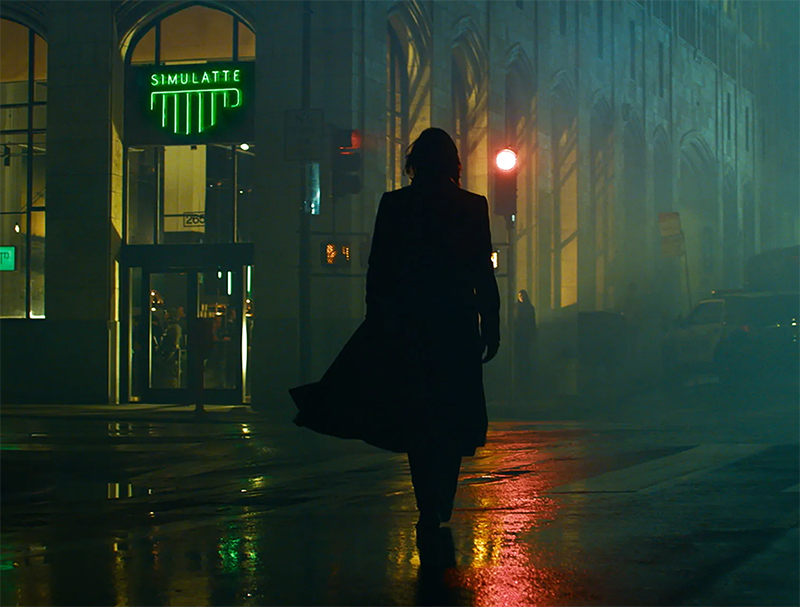
The planned game sequel prompts much hand-wringing. Characters bat ideas back and forth in an open-concept office, trying to get to the heart of what made the original Matrix work. Resurrections abounds with this sort of dorky meta-humor. There are jokes about the game design firm’s parent company being Warner Bros. (the actual film’s producer) and jokes about déjà vu. A fourth-wave coffee shop is called “Simulatte.” That kind of thing. It’s the sort of stuff that elicits barking, staccato guffaws from in-the-know audience members that quickly fade into barely bemused titters. It’s meant to be cute, but it’s mostly annoying.

Still, the film is not without its charms. Some of the early action scenes crack along reliably, playing with inversions of gravity and time, like a fleeter Christopher Nolan flick. And the notion of revisiting the world of the matrix is not without appeal. After all, the original film forecasted a world of digital disenfranchisement that is now, under the auspices of our current Silicon Valley overlords, regarded as aspirational. (In a telling touch, Resurrections moves the action from an implied Chicago to the Bay Area, explicitly marked by familiar landmarks and San Francisco PD cruisers.) And with its image of two pills representing diverging ideological bents, The Matrix provided a ready-made vocabulary that has been embraced in our real world, where everyone is redpilledblackpilledDanpilled, or Tedpilled. But Resurrections never manages to meaningfully intervene in the very conditions it seems to be diagnosing—and which the series had already diagnosed, decades ago. Like postmodernity itself, the state of digital dependency dramatized by The Matrix cannot be alleviated. It can only be mediated, with increasing levels of irony and winking self-awareness.

To wit: Resurrections is not about digitization, or the metaphysics of reality, or the broken promise of the cyberpunk genre. It is about movie reboots. Here, Neo must be liberated again, literally remaking his quest from the original film, with the obstacles re-skinned and old foes appearing in new guises (Jonathan Groff, playing the meddling computer program Smith, is a hunkier, paler imitation of the menacing Hugo Weaving). Characters snipe about how humanity is merely reframing the same handful of archetypal themes and ideas. “We’re still telling the same stories we’ve always told,” says one game designer, sounding like he’s been watching too many Jordan Peterson YouTubes. “Just with different names, different faces.” This may well be true. But it also feels like a cop-out. Especially because the original Matrix, as imagined by sororal duo Lilly and Lana Wachowski, felt genuinely inventive. It blended Terminator-styled dystopian sci-fi with Hong Kong wire-fu action and state-of-the-art special effects, all draped in the industrial liveries of a turn-of-the-millennium goth club. It may not have been wholly new. But it was thrilling remix. It spoke to the ennui of America at the “end of history.” It captured the soul-deadening, Dilbert-esque daily doldrums explored in films like Fight Club and Office Space. It also played straight to the anxiety around “Y2K” and the mounting cultural panic that home computers and toaster ovens might break down or turn against their owners. The Matrix felt like it was speaking to its time. Now, movies seem to chatter only among themselves.

There’s plenty of precedent here, of course: Ready Player Onethe recent Space Jam sequel; and the new Spider-Man movie, which draws together two decades worth of sticky narrative threads spun across three distinct franchises. Corporate wheeling-and-dealing is increasingly allegorized onscreen, to the point that many blockbusters are now about their own production. Within ten years, we’ll see Aaron Sorkin hoisting an Oscar overhead, rewarded by his peers for helming a chatty drama about the backroom legal finagling that saw a Star Wars-branded lightsaber licensed to the movie Free Guy. Hollywood is already lodged in the post-postmodern rabbit hole, with little to show for it. The culture is glitching, looping, stuck in some long, static interregnum, like a radio drifting between channels. If a new Matrix movie felt grimly inevitable in such a climate, it also had great potential.

And I suppose it’s nice that director Lana Wachowski (going solo this time) returned to wield some control over a story that would otherwise be expropriated however-which-way by the studio. But she has only a passing interest in the new convolutions of the simulation itself. Wachowski is more invested in revisiting Neo and Trinity’s wrenching, realities-spanning romance. Rather than the heady ideas at play in the premise—which have been by-and-large replaced by geeky in-jokes—she wants to explore (again) the profound power of love as some supernatural force. At its worst, the Wachowski worldview recalls that classic Simpsons joke: the secret ingredient is always capital-l Love.

This strain of touchy-feely sci-fi certainly has its admirers, and I sometimes count myself among them. But I find the Wachowskis’ sappiness (however earnest) more tolerable when enlivened by their stylistic and technical inventiveness. The rote, underdog rhythms of Speed Racer (2008) only work because they unfold within an aesthetic landscape that splits the difference between La Chinoise and Paper MarioThe Matrix’s heavy hooey about fate and choice and freeing one’s mind is leavened because, well, the movie is entertaining as hell. But now, the ideas are stale (2003’s The Matrix Reloaded already introduced the concept of its story being a remake), and the action settles into tedium: graceful bullet-time ballets are replaced by crunchy, John Wick-style fights and repetitive CGI set pieces that see Neo stopping hails of bullets with his hands, over and over and over again.

Perhaps there’s something modestly clever in the major meta-gesture of this newest Matrix—in its idea of the matrix reproducing its own destruction in the form of an interactive video game. After all, the notion that the very systems that delude us offer self-contained safe spaces for relieving those delusions is apt. Like capital, the matrix survives by evolving quicker than the forces that oppose it. If we take this message seriously, then the goodly thing to do is to ignore The Matrix Resurrections and all corporatized entertainments. To put down Twitter and TikTok and smooch our spouses; build a snowman with the kiddies; clink some beers with a gaggle of good buddies.

That we should all invest not in our virtual existences, but the fleshy, loving, contingent relationships of real life, is a perfectly decent message. That the Wachowskis have been repeating this tired line for two decades speaks despairingly to the conditions of our own, present-day dystopia. Resurrections is suspended between cyberpunk trappings that were already shopworn circa 1999 and the intellectual prison of high-concept meta-mongering. It is a movie of the interregnum, one that could have been auto-generated by it. In this way, The Matrix does manage to speak to the times. Again.

THE THRESHOLD OF EXHAUSTION: OUR TIME FOR REGATHERING & RECALIBRATION

By Kingsley L. Dennis

Source: Waking Times

Decades of expansionist practices and beliefs have brought us to a new threshold. It is not yet the threshold between human and spirit, as some would have preferred, but a threshold of exhaustion.

The modern age of post-industrialization has been feeding an acceleration cycle that is built upon continual expansion and consumption. These expansionist policies are mostly a result of the neo-capitalist thirst for ever increasing profits. And these ever-increasing returns have been predicated upon continuous wars, expanded trading (e.g. globalization), and the ongoing patterns of consumption. Modern world expansion has plundered and exhausted the world’s physical resources and has exploited the nervous system of humanity, bringing it to a psycho-fragility and biological burnout. The global brain is entering a state of dementia at the same time it is encountering competition from the automated global brain. This current human, and yet inhumane, thrust have brought the present generations to a threshold of exhaustion. We have saturated our limits of attention and are becoming quickly overwhelmed by the smallest of impacts. The human psyche is becoming over-sensitive to environmental stimuli that is now bombarding us from every media channel we can cram onto our devices. Humanity has forged a new environment for itself within the last century – and especially in the last decades – that pushes us further away from a natural context and towards an artificial, unnatural construct. Many people, or at least those within industrialized cultures, are now perceiving reality from within a bubble of stimulation. An overload of images, sounds, pixels, digitization, and the real-time ‘always on’ lifestyles that now wrap around us have created an unprecedented level of electromagnetic smog. We have slipped into an electronic ecosystem without being consciously aware of what was happening until we were already embedded deeply within it. This new electrocuted environment shifts humans from a state of self-perception into a mode of info-stimulation. Our minds and bodies are being re-tuned and recalibrated to exist within a state of permanent excitement.

Human life is now for many people an experience of hyper-expression. The human inner life is being pulled out of us and sprawled upon the external chaotic mediascape. No wonder we are witnessing so many cases of nervous system exhaustion. Our nervous systems are being exploited until the point of near explosion. The sad part here is that a medical industry has been established to cater to this by profit-centred chemicalization of our bodies and minds. It is no longer the jagged pill we should be cautious of but the plethora of smooth pills we are constantly offered that many people are only too willing to pop. The human nervous system (the body-mind) has reached a point of saturation: too much noise, too many nervous stimulations, too much vibrational dissonance: people are quite literally cracking up. There is a subtle state of traumatization that has entered as a low-level hum within our global vibration. Many people have become entrained into this hum. It is creating an underlying sense of anxiety, unease, uncertainty, and restless nervousness. Something is afoot. Many of us feel this, and yet cannot quite place it. There is a presence in the room – yet it is out of visible sight. A moment of regathering is now required.

A moment of regathering is necessary as individually and collectively we are becoming out-of-synch with our vibrational alignment. Technology has created some of this dissonance, although not all. Over the years, humanity has been given nudges to assist its re-alignment. But now, something stronger is required: ‘you have not been inclined to feel that nudge. Now, it has to be more so of a blow rather than a nudge.’[i] As a species we are not yet sufficiently unified, or connected, to be making the best use from technology. We can see this clearly from the behaviour we witness online and in social media. We are still too splintered for our technologies to be of most use to us. If we are not aligned, then there is the danger that any technologies we develop will create further dissonance and dysfunction. Humanity needs to respond to this situation, but by awareness and vibrational re-alignment, and not by taking itself further away from life: ‘it is never about ridding life of yourselves: sitting upon a hilltop void of self, void of world, no.’[ii] What we need is to strip it all away – to strip back our socially constructed lives into a way of living that is closer to the essential. We need to allow the expansive vibrational essence to flow through us: ‘allow this vibrational essence to flow through your being, birthing a new vibrational signature – a non-splintered one, a unified one.’[iii] Humanity needs to take off its bandages and to allow its wounds to heal. It is time to shift into a more harmonized species vibration; this is crucial now. A more aligned and vibrationally resonant humanity can emerge from this – ‘one consciousness at a time, one vibrational alignment at a time.’ And this is where human beings can be of purpose, both physically in their everyday lives and in alignment with the resonance of pure consciousness.

Human life is also about the expanding of our field of consciousness; to allow pure consciousness to manifest through the physical human being. The physical being is biologically encased, yet this does not mean that we should be encased in our limitations of consciousness. Humanity has already explored far and wide. We have gone deep into the oceans, far across the Earth, and high up into the atmosphere and into orbit. Yet if we don’t explore and reach ourselves first, then we shall have found nothing: ‘You can only ever but find yourselves. But if so coming from a splintered mind, you are finding everything else but yourselves.’[iv] It is time to unclose the closed; to reveal the unrevealed. How can we be going towards the “post-human” if we have not yet arrived at the fully human? By coming back to our essential selves, new pathways shall open up for us – a new resonance shall be gained. A new sight shall be revealed: ‘they will be new to the eyes that have not yet been open but old news to those that have been awake.’[v] The human is both within being and becoming – between stillness and movement. This is the flow of evolution and has always been so. Consciousness has always been in flow through humanity, yet it manifests in relation to the pathways that have been created. It is now time for new pathways to be established, so that pure consciousness can flow more abundantly. It is time now for a genuine human recalibration into a consciousness vibration – not into an artificial electro-smog vibration.

By recalibrating and re-wiring, then we are also dropping old patterns (patterning) and habits. As connections and patterns are internally shifted, so too will this affect our outer lives. To shift the outer, we must first shift the inner: ‘opening up for new pathways to be formed which are more of resonation to your being and to that of which is trying to manifest in form.’[vi] This is our moment for regathering and recalibration. It is the time for a readjustment and return to humanity’s home resonance. It is time for all of us to find The Way Back Home. We have been taught to be in a constant struggle of extremes; to be thrust between spurts of action and sudden, constant rest. In this way, we are actually flat-lining life: ‘You are straightening it out, and also it goes for the other end of constant rest. It has to be of resonance – of movement, of rest, of breath.’[vii] The energy is always there, available for us, only that it needs to be in resonance to the ‘mechanism or organism that is receiving such vibrations.’ And right now, the human organism requires some recalibration so that more expanded energy, consciousness, and awareness, can come forth through us. If a person is in dissonance, out of balance with themselves, rather than align with the energies of expanded consciousness they will more likely be sucked into the ecosystem of electro-energies. These energies are sub-nature. They are part of living existence, yet they are a lower form of life vibration. Electricity, said Rudolf Steiner, is light in a sub-material state. That is, it is a form of light that has fallen below the level of nature and has become what he termed ‘sub-nature.’ It is because of this that Steiner warned humankind to be cautious not to build cultures dependent or based on electricity. An electro-ecosystem will only serve to draw us away from our natural eco-system and into a lower vibrational state of sub-nature.

Modern living, as we can bear witness to, has de-sensitized many of us to natural energies of Nature. And the shift into increased digitization has only emphasized this. To attune ourselves to natural, vital life-forces we need to become closer to our natural environments. We need to spend more time outside, being in touch with the soil – to let our hands and feet be grounded by earthly energies. We shouldn’t be afraid of earthly dirt or the bacteria in the soil; not to be squeamish at the stains of bugs. What we need is an openness to a state of receptivity and rebalance. We have to make time for allowance – to allow ourselves to Be, to be present, and to be receptive to life’s vital forces. In this way, we can begin to overcome our collective de-sensitization and to allow the finer vibrational energies of the vital life-forces to flow through us into this beautiful world we have the privilege of experiencing.

By reaching the threshold of exhaustion, we can now take this opportunity to cross over into a different threshold – a threshold into a new phase where the human being merges with the vital life-forces of pure consciousness. A new phase is incoming. We only have to be balanced, stable, and in-synch for this new allowance.

Endnotes

All citations (listed below) were taken from the ABE communications as published in my previous book UNIFIED: Cosmos, Life, Purpose – Communicating with the Unified Source Field & How This Can Guide Our Lives and The Way Back Home: The ABE Conversations (Vol.1). The reference notes refer to Section 5 and the Question number.

[i] (S.5.Q11)

[ii] (S.5.Q11)

[iii] (S.5.Q11)

[iv] (S.5.Q14)

[v] (S.5.Q15)

[vi]  (S.5.Q19)

[vii] (S.5.Q23)

Opening image: Pedro Duran – http://piedrasenequilibrio.com/

When Everything Is Artifice and PR, Collapse Beckons

By Charles Hugh Smith

Source: Of Two Minds

The notion that consequence can be as easily managed as PR is the ultimate artifice and the ultimate delusion.

The consequences of the drip-drip-drip of moral decay is difficult to discern in day-to-day life. It’s easy to dismiss the ubiquity of artifice, PR, spin, corruption, racketeering, fraud, collusion and narrative manipulation (a.k.a. propaganda) as nothing more than human nature, but this dismissal of moral decay is nothing more than rationalizing the rot to protect insiders from the sobering reality that the entire system is unraveling and heading for its final reckoning: collapse.

We’ve become so accustomed to the excesses of marketing that we’ve lost the ability to recognize the difference between “science” that’s been carefully designed to reach a pre-planned conclusion and science that accepts the outcome, even if it harms well-funded interests.

The vast expanses of ignorance greatly aid this artifice. Even though high school physics, chemistry and biology are sufficient to tease apart the vast majority of rigged experiments, trials and studies, few Americans have the interest or fortitude to read Phase III trial results, etc. critically, and so the corporate media can trumpet bogus results without fear of exposure: all the statistical tricks and gimmicks are passed off as “science” to the distracted and gullible.

And if someone dares to examine the results critically, then those benefiting from the ignorance make the results “secret” until the year 2929. And that’s the entire game in a nutshell: maximizing private gain from artifice, PR, spin, corruption, racketeering, fraud, collusion and narrative manipulation, all masked by an putrid spew of virtue-signaling and PR.

Every institution that was once trustworthy has been debauched to maximize private gain: higher education, science, medicine, national defense–the list includes virtually every sector and industry in America. Nothing can be trusted because somebody behind the scenes is spinning the story and data to mask their self-interest, their immense gains and the carefully contrived structure of diverting investigation and eliminating transparency, competition and accountability.

Our technocratic obsession denies the existence of the moral universe, reducing the world to techno-gimmicks (electric air taxis for everyone!), techno-fantasies (fusion reactors on every corner!) and techno-distractions (which billionaire will be the first on Mars?), as if a nation and society hurtling toward moral, social, civic and economic collapse can be saved by some “innovation” that beneath the surface is nothing more than another profiteering monopoly or cartel.

Many people fear collapse, but quality, service and reliability have already collapsed. The washing machine that two generations ago was designed and built to last 25 years now breaks down after a few years–so sorry, the motherboard failed. That will cost you almost as much as new washer, and so the manufacturer, bank and retailer win because the weary, clueless consumer will do the easy thing and buy a new, expensive appliance on credit. The “old” appliance (brand-new by previous standards) is hauled off to the landfill, the ultimate destination of everything in our Landfill Economy of poorly made junk.

Service would be hauled to the landfill as well if it was tangible. Alas, it is simply maddening, as nothing works and Kafkaesque bureaucracies have so much power that they are immune to transparency, competition and accountability. their websites don’t work, they botch the most basic transactions and they perpetuate incorrect information, but too bad–there is no recourse.

Big Tech is equally impervious to transparency, competition and accountability. Your “crime” is never explained, and there is no recourse, for the Machine has no judiciary or human contact: you query the Machine knowing full well that you will never extract anything remotely fair or just from its algorithmic monstrosity.

Technology doesn’t extinguish moral decay or eliminate the stench of self-serving artifice, PR, spin, corruption, racketeering, fraud, collusion and narrative manipulation. Technology only enhances the potential for profiteering under the tissue-thin guise of “innovation,” “technological advance” and the threadbare delusions of a populace that has watched too many contrived narratives in which technology saves the day.

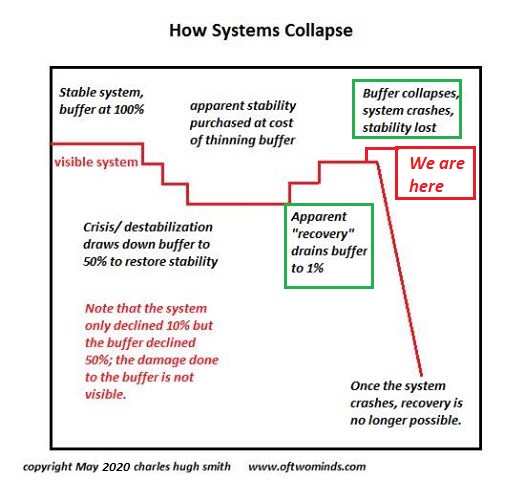
The moral buffers have already thinned; there is nothing left to tap. There is nothing left in what actually matters: social cohesion, moral legitimacy, civic virtue–all stripped, depleted, gone.

Drones and robots won’t save us from collapse. Neither will fusion reactors, electric air taxis, billionaires in space, missions to Mars, algae-based meat or any of the other thousand “innovations” those profiting from moral rot promote in the hopes that the banquet of consequences being served can be swept away by more gimmicks, more artifice, more delusions, more fantasies, more PR, more spin and more narrative control.

Collapse can’t be gimmicked away. The notion that consequence can be as easily managed as PR is the ultimate artifice and the ultimate delusion.

The Metaverse Is Big Brother in Disguise: Freedom Meted Out by Technological Tyrants

By By John W. Whitehead & Nisha Whitehead

Source: The Rutherford Institute

The term metaverse, like the term meritocracy, was coined in a sci fi dystopia novel written as cautionary tale. Then techies took metaverse, and technocrats took meritocracy, and enthusiastically adopted what was meant to inspire horror.”—Antonio García Martínez

Welcome to the Matrix (i.e. the metaverse), where reality is virtual, freedom is only as free as one’s technological overlords allow, and artificial intelligence is slowly rendering humanity unnecessary, inferior and obsolete.

Mark Zuckerberg, the CEO of Facebook, sees this digital universe—the metaverse—as the next step in our evolutionary transformation from a human-driven society to a technological one.

Yet while Zuckerberg’s vision for this digital frontier has been met with a certain degree of skepticism, the truth—as journalist Antonio García Martínez concludes—is that we’re already living in the metaverse.

The metaverse is, in turn, a dystopian meritocracy, where freedom is a conditional construct based on one’s worthiness and compliance.

In a meritocracy, rights are privileges, afforded to those who have earned them. There can be no tolerance for independence or individuality in a meritocracy, where political correctness is formalized, legalized and institutionalized. Likewise, there can be no true freedom when the ability to express oneself, move about, engage in commerce and function in society is predicated on the extent to which you’re willing to “fit in.”

We are almost at that stage now.

Consider that in our present virtue-signaling world where fascism disguises itself as tolerance, the only way to enjoy even a semblance of freedom is by opting to voluntarily censor yourself, comply, conform and march in lockstep with whatever prevailing views dominate.

Fail to do so—by daring to espouse “dangerous” ideas or support unpopular political movements—and you will find yourself shut out of commerce, employment, and society: Facebook will ban you, Twitter will shut you down, Instagram will de-platform you, and your employer will issue ultimatums that force you to choose between your so-called freedoms and economic survival.

This is exactly how Corporate America plans to groom us for a world in which “we the people” are unthinking, unresistant, slavishly obedient automatons in bondage to a Deep State policed by computer algorithms.

Science fiction has become fact.

Twenty-some years after the Wachowskis’ iconic film, The Matrix, introduced us to a futuristic world in which humans exist in a computer-simulated non-reality powered by authoritarian machines—a world where the choice between existing in a denial-ridden virtual dream-state or facing up to the harsh, difficult realities of life comes down to a blue pill or a red pill—we stand at the precipice of a technologically-dominated matrix of our own making.

We are living the prequel to The Matrix with each passing day, falling further under the spell of technologically-driven virtual communities, virtual realities and virtual conveniences managed by artificially intelligent machines that are on a fast track to replacing human beings and eventually dominating every aspect of our lives.

In The Matrixcomputer programmer Thomas Anderson a.k.a. hacker Neo is wakened from a virtual slumber by Morpheus, a freedom fighter seeking to liberate humanity from a lifelong hibernation state imposed by hyper-advanced artificial intelligence machines that rely on humans as an organic power source. With their minds plugged into a perfectly crafted virtual reality, few humans ever realize they are living in an artificial dream world.

Neo is given a choice: to take the red pill, wake up and join the resistance, or take the blue pill, remain asleep and serve as fodder for the powers-that-be.

Most people opt for the blue pill.

In our case, the blue pill—a one-way ticket to a life sentence in an electronic concentration camp—has been honey-coated to hide the bitter aftertaste, sold to us in the name of expediency and delivered by way of blazingly fast Internet, cell phone signals that never drop a call, thermostats that keep us at the perfect temperature without our having to raise a finger, and entertainment that can be simultaneously streamed to our TVs, tablets and cell phones.

Yet we are not merely in thrall with these technologies that were intended to make our lives easier. We have become enslaved by them.

Look around you. Everywhere you turn, people are so addicted to their internet-connected screen devices—smart phones, tablets, computers, televisions—that they can go for hours at a time submerged in a virtual world where human interaction is filtered through the medium of technology.

This is not freedom. This is not even progress.

This is technological tyranny and iron-fisted control delivered by way of the surveillance state, corporate giants such as Google and Facebook, and government spy agencies such as the National Security Agency.

So consumed are we with availing ourselves of all the latest technologies that we have spared barely a thought for the ramifications of our heedless, headlong stumble towards a world in which our abject reliance on internet-connected gadgets and gizmos is grooming us for a future in which freedom is an illusion.

Yet it’s not just freedom that hangs in the balance. Humanity itself is on the line.

If ever Americans find themselves in bondage to technological tyrants, we will have only ourselves to blame for having forged the chains through our own lassitude, laziness and abject reliance on internet-connected gadgets and gizmos that render us wholly irrelevant.

Indeed, we’re fast approaching Philip K. Dick’s vision of the future as depicted in the film Minority Report. There, police agencies apprehend criminals before they can commit a crime, driverless cars populate the highways, and a person’s biometrics are constantly scanned and used to track their movements, target them for advertising, and keep them under perpetual surveillance.

Cue the dawning of the Age of the Internet of Things (IoT), in which internet-connected “things” monitor your home, your health and your habits in order to keep your pantry stocked, your utilities regulated and your life under control and relatively worry-free.

The key word here, however, is control.

In the not-too-distant future, “just about every device you have—and even products like chairs, that you don’t normally expect to see technology in—will be connected and talking to each other.”

By the end of 2018, “there were an estimated 22 billion internet of things connected devices in use around the world… Forecasts suggest that by 2030 around 50 billion of these IoT devices will be in use around the world, creating a massive web of interconnected devices spanning everything from smartphones to kitchen appliances.”

As the technologies powering these devices have become increasingly sophisticated, they have also become increasingly widespread, encompassing everything from toothbrushes and lightbulbs to cars, smart meters and medical equipment.

It is estimated that 127 new IoT devices are connected to the web every second.

This “connected” industry has become the next big societal transformation, right up there with the Industrial Revolution, a watershed moment in technology and culture.

Between driverless cars that completely lacking a steering wheel, accelerator, or brake pedal, and smart pills embedded with computer chips, sensors, cameras and robots, we are poised to outpace the imaginations of science fiction writers such as Philip K. Dick and Isaac Asimov. (By the way, there is no such thing as a driverless car. Someone or something will be driving, but it won’t be you.)

These Internet-connected techno gadgets include smart light bulbs that discourage burglars by making your house look occupied, smart thermostats that regulate the temperature of your home based on your activities, and smart doorbells that let you see who is at your front door without leaving the comfort of your couch.

Nest, Google’s suite of smart home products, has been at the forefront of the “connected” industry, with such technologically savvy conveniences as a smart lock that tells your thermostat who is home, what temperatures they like, and when your home is unoccupied; a home phone service system that interacts with your connected devices to “learn when you come and go” and alert you if your kids don’t come home; and a sleep system that will monitor when you fall asleep, when you wake up, and keep the house noises and temperature in a sleep-conducive state.

The aim of these internet-connected devices, as Nest proclaims, is to make “your house a more thoughtful and conscious home.” For example, your car can signal ahead that you’re on your way home, while Hue lights can flash on and off to get your attention if Nest Protect senses something’s wrong. Your coffeemaker, relying on data from fitness and sleep sensors, will brew a stronger pot of coffee for you if you’ve had a restless night.

Yet given the speed and trajectory at which these technologies are developing, it won’t be long before these devices are operating entirely independent of their human creators, which poses a whole new set of worries. As technology expert Nicholas Carr notes, “As soon as you allow robots, or software programs, to act freely in the world, they’re going to run up against ethically fraught situations and face hard choices that can’t be resolved through statistical models. That will be true of self-driving cars, self-flying drones, and battlefield robots, just as it’s already true, on a lesser scale, with automated vacuum cleaners and lawnmowers.”

For instance, just as the robotic vacuum, Roomba, “makes no distinction between a dust bunny and an insect,” weaponized drones will be incapable of distinguishing between a fleeing criminal and someone merely jogging down a street. For that matter, how do you defend yourself against a robotic cop—such as the Atlas android being developed by the Pentagon—that has been programmed to respond to any perceived threat with violence?

Moreover, it’s not just our homes and personal devices that are being reordered and reimagined in this connected age: it’s our workplaces, our health systems, our government, our bodies and our innermost thoughts that are being plugged into a matrix over which we have no real control.

It is expected that by 2030, we will all experience The Internet of Senses (IoS), enabled by Artificial Intelligence (AI), Virtual Reality (VR), Augmented Reality (AR), 5G, and automation. The Internet of Senses relies on connected technology interacting with our senses of sight, sound, taste, smell, and touch by way of the brain as the user interface. As journalist Susan Fourtane explains:

Many predict that by 2030, the lines between thinking and doing will blur. Fifty-nine percent of consumers believe that we will be able to see map routes on VR glasses by simply thinking of a destination… By 2030, technology is set to respond to our thoughts, and even share them with others… Using the brain as an interface could mean the end of keyboards, mice, game controllers, and ultimately user interfaces for any digital device. The user needs to only think about the commands, and they will just happen. Smartphones could even function without touch screens.

In other words, the IoS will rely on technology being able to access and act on your thoughts.

Fourtane outlines several trends related to the IoS that are expected to become a reality by 2030:

1: Thoughts become action: using the brain as the interface, for example, users will be able to see map routes on VR glasses by simply thinking of a destination.

2: Sounds will become an extension of the devised virtual reality: users could mimic anyone’s voice realistically enough to fool even family members.

3: Real food will become secondary to imagined tastes. A sensory device for your mouth could digitally enhance anything you eat, so that any food can taste like your favorite treat.

4: Smells will become a projection of this virtual reality so that virtual visits, to forests or the countryside for instance, would include experiencing all the natural smells of those places.

5: Total touch: Smartphones with screens will convey the shape and texture of the digital icons and buttons they are pressing.

6: Merged reality: VR game worlds will become indistinguishable from physical reality by 2030.

This is the metaverse, wrapped up in the siren-song of convenience and sold to us as the secret to success, entertainment and happiness.

It’s a false promise, a wicked trap to snare us, with a single objective: total control.

George Orwell understood this.

Orwell’s masterpiece, 1984, portrays a global society of total control in which people are not allowed to have thoughts that in any way disagree with the corporate state. There is no personal freedom, and advanced technology has become the driving force behind a surveillance-driven society. Snitches and cameras are everywhere. And people are subject to the Thought Police, who deal with anyone guilty of thought crimes. The government, or “Party,” is headed by Big Brother, who appears on posters everywhere with the words: “Big Brother is watching you.”

As I make clear in my book Battlefield America: The War on the American People and in its fictional counterpart The Erik Blair Diaries, total control over every aspect of our lives, right down to our inner thoughts, is the objective of any totalitarian regime.

The Metaverse is just Big Brother in disguise.