The U.S. Deep State Rules – On Behalf of the Ruling Class

By Glen Ford

Source: Black Agenda Report

“The U.S. Deep State is unlike any other, in that there is no other global superpower bent on world domination.”

The Deep State is busy denying that it exists, even as it savages a sitting president and brutally bitch-slaps its host society, demanding the nation embrace its role as global psycho thug and kick some Russian ass. The New York Times, always available to divert attention from the essential facts of who rules America, points to Egypt, Turkey and Pakistan as the natural habitats of Deep States. Apparently, Deep State-infected countries tend to be nations with majority Muslim populations, whose military-intelligence apparatus hovers over society and periodically seizes control of the civil government.

The Times quoted high-ranking operatives of the Deep State to prove that such structures are alien to the U.S. Michael V. Hayden, who ran the CIA under Democratic President Obama and Republican George Bush, recoiled at the term. He “would never use” the words Deep State in connection with his own country. “That’s a phrase we’ve used for Turkey and other countries like that, but not the American republic.”

Loren DeJonge Schulman, a former Obama National Security Council official, claimed to be repelled by the very idea of an American Deep State. “A deep state, when you’re talking about Turkey or Egypt or other countries, that’s part of government or people outside of government that are literally controlling the direction of the country no matter who’s actually in charge, and probably engaging in murder and other corrupt practices,” she said.

Apparently, Ms. Schulman did not consider it murder when Obama and his top national security advisors met every Tuesday at the White House to decide who would be assassinated by drone or other means. But she is “shocked” to hear “that kind of [Deep State-phobic] thinking from” President Trump “or the people closest to him.”

Once the Times had located the nexus of Deep Statism in the Muslim world, the lesser lights at The New Yorker endorsed the corporate media consensus that the U.S. is Deep State-free. Staff writer David Remnick admits that U.S. presidents “have felt resistance, or worse, from elements in the federal bureaucracies,” citing Eisenhower’s warnings against the military-industrial complex, Lyndon Johnson’s “pressure from the Pentagon,” and the “rebuke” of Obama’s Syria policy through the State Department’s “dissent channel.” However, he denies that any “subterranean web of common and nefarious purpose” threatens the orderly and transparent processes of the U.S. political system.

In reality, the U.S. Deep State is by far the world’s biggest and most dangerous version of the phenomenon; a monstrous and not-so subterranean “web of common and nefarious purpose” that is, by definition, truly global, since its goal is to rule the planet. Indeed, the Deep States of Turkey, Egypt and Pakistan — all nominal U.S. allies – are midgets in comparison and must operate in a global environment dominated by Washington’s Deep State apparatus. So vast is the imperial Deep State, that its counterparts in other nations exist largely to collaborate with, resist, or keep tabs on the U.S. behemoth, the predator that seeks to devour all the rest.

What is a Deep State? The U.S. Deep State is unlike any other, in that there is no other global superpower bent on world domination. (Washington’s political posture is also unique; no other nation claims to be “exceptional” and “indispensable” and thus not subject to the constraints of international law and custom.) Indeed, the U.S. is so proudly and publicly imperialist that much of what should be secret information about U.S. military and other capabilities is routinely fed to the world press, such as the 2011 announcement that the U.S. now has a missile that can hit any target on the planet in 30 minutes, part of the Army’s “Prompt Global Strike” program. Frightening the rest of the world into submission — a form of global terrorism — is U.S. public policy.

However, arming and training Islamic jihadist terrorists to subvert internationally recognized governments targeted by the U.S. for regime change is more than your usual variety of covert warfare: It is a policy that must forever be kept secret, because U.S. society would suffer a political breakdown if the facts of U.S. and Saudi nurturing of the international jihadist network were ever fully exposed. This is Deep State stuff of the highest order. The true nature of U.S. foreign policy in the 21st century, and the real character of the current wars in Syria and Iraq, must be hidden from the U.S. public at all cost. An alternative reality must be presented, through daily collaboration between corporate media, corporate universities, and the public and covert organs of the U.S. State.

What part of the New York Times coverage of the war against Syria is a lie? Damn near all of it. What role does the Deep State play in crafting the lies dutifully promulgated by the corporate media? That’s impossible to answer, because the Deep State is a network of relationships, not a clearly delineated zone or space or set of organizations. The best way to describe the imperial Deep State is: those individuals and institutions that are tasked with establishing the global supremacy of the corporate ruling class. Such activities must be masked, since they clash with the ideological position of the ruling class, which is that the bourgeois electoral system of the United States is the world’s freest and fairest. The official line is that the U.S. State is a work of near-perfection, with checks and balances that prevent any class, group or section from domination over the other. The truth is that an oligarchy rules, and makes war on whomever it chooses — internationally and domestically — for the benefit of corporate capital.

The Deep State and its corporate imperatives manifestly exists when corporate lobbyists and lawyers are allowed to draw up the Trans Pacific Partnership global “trade” agreement, but the contents are kept secret from the Congresspersons whose duty is to vote on the measure. The Deep State is where corporate power achieves its class aims outside the public processes of government. It’s where the most vicious class warfare takes place, whether on a foreign killing field, or in the corporate newsroom that erases or misrepresents what happened on that battlefield.

At this stage of capitalism, the U.S. ruling class has less and less use for the conventional operations of the bourgeois state. It cannot govern in the old way. More and more, it seeks to shape events through the levers of the collaborating networks of the Deep State. It’s number one global priority is to continue the military offensive begun in 2011, and to break Russia’s resolve to resist that offensive. The ruling class and its War Party, now consolidated within the Democratic Party and regrouping among Republicans, have effectively neutralized a sitting president whose party controls both Houses of Congress, less than two months into his term.

Only a Deep State could pull that off.


BAR executive editor Glen Ford can be contacted at Glen.Ford@BlackAgendaReport.com.

Glen Ford’s blog

The New Media World Order

By Thierry Meyssan

Source: Voltairenet.org

In only a few months, the content of the Western national and international medias has undergone profound change. We are witnessing the birth of an Entente about which we know almost nothing – neither the real initiators, nor the real objectives – but whose direct anti-democratic consequences can be noticed immediately.

The West is currently going through an unprecedented systemic change – powerful forces are progressively orienting the totality of medias in a single direction. At the same time, the content of the medias is mutating– only last year, they were still logical, and tended towards objectivity. They offered one other mutual contradiction in a spirit of healthy competition. Now they act in gangs, basing their coherence on emotions, and becoming vicious when they are facing people they condemn.

The idea of an Entente between the medias is an extension of the experience of the International Consortium for Investigative Journalism (ICIJ), which does not unite the medias, but only individual journalists. It made itself famous by publishing information stolen from the accounts of two law firms in the British Virgin Islands, and from PricewaterhouseCoopers (PwC), the bank HSBC, and the Panamanian firm Mossack Fonseca. These revelations were mainly used to discredit the Russian and Chinese leaders, but also, once in a while, to shine some light on genuine offences committed by the Westerners. Above all, under the honourable pretext of the struggle against corruption, the violation of the confidentiality of lawyers and banks seriously damaged thousands of their honest clients without any reaction from public opinion.

Over a period of approximately forty years, we have been witnessing the progressive grouping of medias within certain international trusts. Currently, 14 groups share more than two thirds of the western Press (21st Century Fox, Bertelsmann, CBS Corporation, Comcast, Hearst Corporation, Lagardere Group, News Corp, Organizações Globo, Sony, Televisa, The Walt Disney Company, Time Warner, Viacom, Vivendi). From now on, the alliance operated by Google Media Lab and First Draft is forging links between these groups, which already enjoyed a dominant position. The presence in this Entente of the three most important Press agencies on the planet (Associated Press, Agence France-Presse, Reuters) guarantees it hegemonic power. This is without any doubt an «illicit entente», established not with the goal of price-setting, but mind-setting, the imposition of an already dominant thought.

We may have noticed that all the members of the Google Entente – without exception – have already, over the last six years, given unequivocal visions of the events that occurred in the Greater Middle East. And yet there had been no prior agreement between them, or at least, none of which we were aware. It is intriguing to note that five of the six international television channels which participated in the NATO propaganda cell are part of this Entente (Al-Jazeera, BBC, CNN, France24, Sky, but apparently not al-Arabiya).

In the United States, France and Germany, Google and First Draft assembled the medias present locally in the countries concerned, and others present on the international scale, to check the veracity of certain arguments. Besides the fact that we do not know who is hiding behind First Draft, and what political interests may have influenced a commercial company specialised in computer science to finance this initiative, the results achieved have little to do with a return to objectivity.

First of all because the allegations are not chosen for the place they occupy in the public debate, but because they have been quoted by individuals that the media Entente intends to vilify. We might imagine that these verifications enable us to get a little closer to the truth, but that is not the case at all – they reassure the citizen in the idea that the medias are honest, while the people they are condemning are not. This approach is not aimed at better understanding the world, but at beating down the people to be sacrificed.

Next, because an unwritten rule of this media Entente stipulates that only allegations from sources outside the Entente should be checked. The members agree not to use any critical faculty in the mutual appreciation of their work. They agree to reinforce the idea that the world is divided in two – «we» who tell the truth, and «the others» who are liars. This approach is damaging for the principle of pluralism, a precondition for democracy, and opens the way to a totalitarian society. This is not a new phenomenon, because we saw it at work during the coverage of the Arab Springs and the wars against Libya and Syria. But for the first time, it is aimed at a Western line of thought.

Finally, because the allegations that have been qualified as «false» will never be envisaged as errors, but always as lies. The point is to charge the «others» with Machiavellian intentions in order to discredit them. This approach damages the presumption of innocence.

That is why the functioning of the ICIJ and the Entente created by Google and First Draft violates the Munich Charter adopted by the International Federation of Journalists (IFJ) (Title II, articles 2, 4, 5 and 9).

It is no coincidence that certain absurd legal actions have developed against the same targets as those in the sights of the media Entente. In the United States, the Hogan Law has been dragged out for use against the Trump team, despite the fact that this text has never, absolutely never, been applied since its promulgation two centuries ago. And in France, the Jolibois Law has been revived for use against the political tweets of Marine Le Pen, despite the fact that jurisprudence had limited the application of that law to the distribution of a few ultra-pornographic magazines lacking a plastic wrapping. Since the principle of the presumption of innocence for scapegoats has been eradicated, it is now possible to put anyone on trial for any legal pretext. Furthermore, the legal actions mounted against the Trump team and Marine Le Pen, in the name of the laws named above, should also be be brought against a great number of other people – but they are not.

Moreover, citizens no longer react when the media Entente itself broadcasts false allegations. Thus, in the United States, they imagined that the Russian secret services had a compromising dossier on Donald Trump and were blackmailing him. Or, in France, this Entente invented the idea that it is possible to employ a fictitious parliamentary assistant, and went on to accuse François Fillon.

In the United States, the large and small medias which are members of the Entente went after the President. They garnered their own information from the wire-tapping of the Trump team which had been illegally ordered by the Obama administration. They work in coordination with the magistrates, who are using them to block the actions of the present government. This is without doubt a Mafia system.

The same US and French medias are attacking two candidates for the French Presidential election – François Fillon and Marine Le Pen. To the general problem of the media Entente is added the false impression that these targets are victims of a Franco/French conspiracy, whereas in fact, the instigator is a US citizen. The French notice that their medias are rigged, wrongly interpret the conspiracy as being directed against the right wing, and continue erroneously seeking the manipulators in their own country.

In Germany, the Entente is not yet effective, and probably will not be until the general elections.

During Watergate, the medias claimed to represent a «Fourth Estate», after the Executive, the Legislative, and the Judiciary. They affirmed that the Press exercised a function of control over the government in the name of the People. We can ignore for a moment the fact that President Nixon was charged with a similar offense to that of President Obama – bugging his opponent. We know today that the Watergate source, «Deep Throat», far from being a «whistle-blower», was in reality the Director of the FBI, Mark Felt. The treatment of this affair was a battle between a part of the administration and the White House, in which the electors were manipulated by both sides at once.

The idea of a «Fourth Estate» supposes that we recognise the same legitimacy for the 14 corporate trusts which own the great majority of the Western medias as for the citizens. This is to affirm the substitution of an oligarchy for democracy.

The remains one point which needs clarification – how have the targets of the Entente been chosen? The only obvious link between Donald Trump, François Fillon and Marine Le Pen is that all three hope to re-establish contacts with Russia, and fight with her against the breeding ground of jihadism – the Muslim Brotherhood. Although François Fillon was the Prime Minister of the goverment implcated in these events, all three of them represent the train of thought which contests the dominant vision of the Arab Springs and the wars against Libya and against Syria.

The Duran’s Alex Christoforou: Treating Russia As The ‘Bogeyman’ Has Failed

russia_wants_war_look_how_closely_they_put_country_to_our_military_bases

By

Source: MintPress News

ATHENS — So-called “fake news” has been in the news in recent months, and this debate over what is and what isn’t legitimate news reflects the political divisiveness that is increasingly prevalent in the United States and in Europe.

Like MintPress News, another website which was accused of purveying “fake news” is The Duran, a recently-launched website which offers perspectives and analysis on geopolitical issues which are frequently not found in mainstream U.S. and European media.

As the news cycle moved at lightning speed in recent months, MintPress had the opportunity to conduct a series of interviews with Alex Christoforou, one of the co-founders and writers for The Duran. In this wide-ranging interview, Christoforou discusses Trump’s election, foreign policy rhetoric and maneuvers thus far, the Russian reaction to the NATO buildup along its border, the anti-Russian sentiment in the U.S. political arena and mass media, developments in Syria and the Ukraine, the recent Cyprus reunification talks which were held in Geneva, the role of Turkey in the region and Turkish relations with the U.S. and Russia, the Trump administration’s support for “Brexit” and the possibility of a “Grexit,” the accusations of “fake news,” and more. These interviews first aired on Dialogos Radio in January and February.

MintPress News (MPN): President Trump has spoken out in favor of improved U.S. relations with Russia and with Vladimir Putin. Do you believe that Trump will make good on this pledge, in light of the challenges he is facing?

Alex Christoforou (AC): That’s an interesting question, and I think that’s something that everyone’s debating right now, how sincere he is in creating an atmosphere of detente between the U.S. and Russia. The first thing is that Obama was absolutely terrible for U.S.-Russia relations. He pretty much threw the whole relationship back into the Cold War era. Trump has got a lot of ground to cover, and there’s a lot of forces at work right now which are adamant about not having Trump create an atmosphere of detente with Russia. So Trump is really in a tough position here, especially given the initiatives that the Obama administration took up, which was really an effort by the outgoing administration to box Trump in.

They’ve created a hysteria of Russian hacking which has no evidence whatsoever, no evidence has been presented to the public at all. You have various media outlets really publishing a lot of fake news about Trump’s relationship with Putin and Russia. The fact is that Trump has never even met Vladimir Putin. So you have this interesting dynamic; if Trump does approach Russia with a much friendlier foreign policy and a much more workable foreign policy, right away Trump is going to be labeled by the mainstream media, the establishment media as a Putin stooge, as a Kremlin stooge, as a Russian “useful idiot,” and they’re going to point fingers and say, “Look, we told you so, Trump is the Manchurian candidate of the Kremlin.” It’s all absolutely ridiculous, to be honest.

My opinion is, sure the Kremlin was relieved to have Trump win the presidency, but not for the reasons that people think. Putin has made no secret of the fact that he wants a good partner in the United States and that the last eight years, especially the second term of Obama, have been very tense between Russia and the U.S. So Putin is probably looking forward to having a world leader that he can speak with on equal terms. Obama definitely was not that world leader. Without a doubt, Obama and Putin did not get along.

I think from that standpoint, Russia understands that in Trump they may have a leader that they can speak with. On the other hand, there’s this misconception that Russia was happy to see Hillary Clinton lose. This is false. Yes, Hillary Clinton was a dangerous prospect for a U.S. president. She was very bullish, very much a war hawk on Russia, especially with regard to Syria and the Ukraine, which are two geopolitical regions that are extremely important to Russia. But saying that, Putin definitely got the best of Obama on just about every single foreign policy initiative that the two countries faced in the last eight years. So the Kremlin pretty much knew that it if was going to be four years of Hillary Clinton, it would be a very easy go as to dealing with the U.S. on various challenges that the two countries faced.

On the one hand, I think they’re looking forward to Trump, and speaking with a world leader that they could work with. On the other hand, I think there’s a big part of Russia and a big part of the Kremlin that says, “We really ran over Obama pretty easily,” as far as geopolitics is concerned, and Hillary Clinton likely would have been a lot easier of an opponent to deal with. Will Trump stand by his word? I think he will. He’s a negotiator and I think he’s going to want to do deals.


MPN: The Trump administration’s foreign policy could be characterized as contradictory thus far, with this opening toward warmer relations with Russia on the one hand and an increased rhetoric against Iran on the other hand. Where do you believe these foreign policy contradictions can lead?

AC: I don’t think anybody knows yet where it could lead. Certainly we are seeing a change. On the one hand, we see that Trump would like better relations with Russia, which is what he was saying during his campaign as well. However, the mass media and most politicians from both sides of the aisle are quite hostile toward Russia. Trump has continued to maintain, however, that he desires good relations with Putin’s government. On the other hand, we see that Iran has taken over the “bogeyman” role which Russia held during the Obama administration, and it is evident that the Trump administration wants to do something about Iran. What this something will be, we don’t know just yet. The Trump administration is acting in a hostile manner toward Iran, including President Trump himself and [Secretary of Defense James] Mattis. Until now, we haven’t seen any concrete actions, other than a reinstatement of certain sanctions. But I do fear what action the Trump administration might decide to take against Iran. We will just have to see.

I do think that Trump, so far, is testing the waters, and it is clear that he does want better relations with Russia, while with Iran he is not following the same path as Obama. What these changes will be though and what policies will be adopted is not yet certain. It is still early, though, and much can change.

I think you definitely have a Cabinet that’s got mixed feelings about Russia, a Cabinet that’s very deep in its military experience. That could be seen as a good thing or a bad thing. One thing that military people seem to understand is the price of war and the risks of war, and that’s a good thing. They’re just not flippant about going into war because they understand what’s at stake and the human tragedy of war. On the other hand, military Cabinet picks tend to be a lot more hawkish and a lot more eager to project America’s military superiority.

I don’t agree with all of Trump’s Cabinet selections, but I think the most significant selection of all is that of Secretary of State Rex Tillerson. The Obama administration and Hillary Clinton and John Kerry left behind so much chaos, so many problems that Tillerson really has his work cut out for him. It’s not just Russia, but Syria, the Ukraine, Libya, ISIS, China, and Iran. For the first time, though, a successful businessperson will be in charge of the State Department, and it will be interesting to see which policies he will enforce.

I think at the end of the day, Trump will await people’s opinions, but I think the buck will stop with him. At least that’s the impression that I get as to what type of leader he will be. I think all the decisions will begin and end with his final word. It’s going to be a wait-and-see, but all signs show that he’s going to take a very CEO type of approach to running the country.


MPN: Do you believe that the fierce backlash that the Trump administration has faced is precisely a result of this desire for developing better relations with Russia?

AC: Yes, of course. That’s part of it. This panic over Russia began with Obama, continued with Hillary Clinton, and it seems that all of Washington, all of the advisers and certainly all of the media, are trying to undermine any efforts toward achieving detente between the two countries. My opinion is that this is an effort to smear Trump and to claim that he is unfit for the presidency.

For the time being, I don’t think we will see a significant shift in U.S.-Russia relations. I think we’ll be in a better position to judge things after six months or a year of the new administration. For now, the Russia hysteria has been thrust to the forefront to cast a negative cloud over Trump. However, the average American does not care about what’s happening with Russia. They are concerned with jobs, jobs, jobs. That is how they will evaluate the Trump administration and the new president. I think that this tactic of blaming Russia for everything and casting Putin as the bogeyman has failed, as proven by the election result itself, and I think it will continue to fail. The American people don’t care about what’s happening with Russia. They care about what’s happening at home.


MPN: Where do you believe all of the anti-Russian fearmongering can ultimately lead?

AC: It can lead to a hot war. It definitely has led to a cold war. The last thing we want is a hot war. You have two nuclear powers who are inching closer to each other in conflict, and I think that needs to be scaled back, and scaled back right away. I think we’ve already seen various proxy wars between the U.S. and Russia take place. We saw it in the Ukraine, we saw it in Syria. We already see the two sides engaging with each other, though they’re not engaging directly with each other. NATO troops moving up to Russia’s border is very provocative. We should never forget that the last time forces amassed on Russia’s border was during World War II, and during that war we cannot forget that Russia lost 28 million people. They paid a very, very heavy price for defeating Nazi Germany on the Eastern Front. So if there’s one thing that there’s any red lines that Russia is very firm about, it’s about having troops amassed on their border, and the other red line was about having any countries that are bordering them, for example the Ukraine, be integrated into NATO. These are red lines that Russia has been very firm in saying may not be crossed.

Saying that, Trump has really got to scale back the aggressive posturing of Obama. The media has helped to portray Russia as the aggressor, but when you take a step back and see who has provoked all the conflict in the various hot spots of the world, Russia has been very reactionary. The Ukraine was a coup d’etat. The U.S. and the European Union overthrew a democratically-elected government. That’s a fact. It’s indisputable, and that coup d’etat was initiated by [Assistant Secretary of State] Victoria Nuland and Ambassador [Geoffrey] Pyatt in Athens. This coup d’etat was instigated by a neoconservative faction in Washington. They put in place a far-right government, and some factions of that far-right party are openly fascist and neo-Nazi, and Russia reacted. Syria is the same thing. In Syria, you see a situation where the United States, with the help of Turkey, Saudi Arabia, and Qatar, went to overthrow a secular sovereign leader, once again, internationally recognized by the United Nations. They went to overthrow that leader, and they created chaos. Russia, once again, reacted to that, to the facts on the ground, and you have what’s been a complete disaster in Syria.

You have a very deep state and neocon faction in the U.S. that’s combined forces with this Hillary Clinton-neoliberal faction to create a lot of tension between U.S.-Russia relations. You have the mainstream media, which was in the tank with the neoliberal Hillary cabal from the get-go, fueling the fires of Russian hysteria, but the situation is anything but Russia being the aggressor. Russia has actually reacted to the facts being created by these neoconservatives and neoliberals that have really just run roughshod over the world disastrously, in Syria, in Libya, in Somalia, in Iraq, in Afghanistan, in the Ukraine. It’s been one disaster after another, and Putin has been very correct in really castigating the United States and saying, during his U.N. speech, “Do you realize what you’ve done?” That’s a profound statement, in telling the world this cannot continue, this regime change policy, this constant war-like attitude toward the Middle East has to stop, otherwise we’re going to turn a cold war and various proxy wars into hot war. The mainstream media is not helping, that’s for sure.


MPN: Recently, NATO forces have been mobilized in Germany and in Eastern Europe, the Russian ambassador to Turkey was murdered and the Russian ambassador to Greece lost his life under unclear circumstances. We had the Russian diplomats that were expelled from Washington in the final days of the Obama administration, and of course the accusations of Russian hacking and meddling in the U.S. elections. How has Vladimir Putin responded to all of this, in your view?

AC: Brilliantly, I think. Vladimir Putin’s response to all of this has really been wait-and-see. He was well within his diplomatic range and his diplomatic standing to retaliate against Obama’s kicking out of the 35 diplomats and the closing down of the two Russian locations in the U.S., but he didn’t. He took a very smart attitude of “Obama is gone in two or three weeks, let’s wait and see what Trump says and what Trump does when he comes into office.”

It was, in my opinion, such childish behavior from Obama toward Trump and toward the transition. Obama should not have been doing these things. It was very childish of him, and I think he lost a lot of respect from a lot of people on the world stage, as just being a very spiteful and childish world leader. He should not have taken these actions against Russia with only two, three weeks left in office. He should not have tried to sabotage Trump’s transition, and he should have really worked with the Trump administration to create a smooth transition.

The diplomat that died in Greece was actually a very underreported news story. Very, very few mainstream media outlets even picked up on that story, and it was, from what I’m seeing in the Greek media that’s reporting on it, under very unclear, very suspicious circumstances. No one really knows much about it. So that was an interesting story that was not picked up.


MPN: On the part of Russia, we have not seen much of a response to new Ukrainian attacks against the Donbass. What is the Ukraine trying to achieve, and why has Russia seemingly not responded?

AC: It’s very simple. The Ukraine is one of the problems that was created by Obama, Hillary Clinton, John Kerry, Victoria Nuland, and the EU. Let’s not forget that they overthrew the Ukrainian government. This was an illegal and provocative action, and in any event, the Ukraine was scheduled to hold elections the following year. There was no need for the U.S. and the EU to undertake this action against the Ukraine, the Ukrainian people, and against Russia, but they did so.

Now, I believe that the Ukraine is trying to start a new conflict and to once again draw attention to itself, because Kiev fears that Trump does not care much about the Ukrainian issue. I think Trump has shown this thus far. Trump recently spoke with Ukrainian President [Petro] Poroshenko, and it was the first time that the U.S. president did not use the phrase “Russian aggression toward the Ukraine,” which Obama would repeatedly state. Trump said that a solution has to be found for the Ukraine, that the two sides need to sit at the same table. This rhetoric was much different from that which was employed by Obama all these years, and I think the Ukrainian authorities are in shock. I detect some panic on their part, but instead of trying to find a solution to this problem, they are going in the opposite direction and trying to provoke a new conflict, hoping that the U.S. will intervene and side with them and that this will undermine the positive relations that Trump is seeking to develop with Putin. This is an incorrect strategy and it will not succeed. Europe cannot handle a war in the Ukraine. I think German Chancellor Angela Merkel understands this and Putin clearly stated this to her, that the Ukrainian government must halt these actions and sit at the negotiating table again and enforce the Minsk Protocol.

For the time being, I think Russia is holding steady with regard to the Ukraine and won’t make a move, because Russia knows, as does the EU, Merkel, and Trump, that the Ukraine is in a difficult situation. It’s a failed state. The efforts of the Obama administration and the EU in the Ukraine have failed, the Ukraine can’t handle any more. It is a corrupt state, its people are suffering, their current government is facing tremendous difficulties, and I think it’s a matter of time before we see major changes in the Ukraine.


MPN: What is the situation on the ground in Syria presently, how is Russia currently involved, and what might we expect to see from the Trump administration with regard to its policy toward Syria?

AC: In Syria you had a situation where Russia came in and they pounded the hell out of ISIS and al-Qaida. Al-Qaida, a.k.a. al-Nusra [Jabhat al-Nusra, the former name of the group now known as Jabhat Fateh al-Sham], a.k.a. the “moderate rebels” that the mainstream media seems to love, were lumped in along with ISIS as terrorist groups, which they are. Russia did not separate the two, and they took over military operations within that country along with Iran and the Syrian army. They defeated these terrorist organizations in Aleppo, and they liberated and gained control of the city. The people in Aleppo were extremely happy, they were celebrating. These are things that were not reported in the establishment media. All the reports were saying that [Syrian President Bashar] Assad was going to Aleppo and burning people. These reports have been proven to be 100 percent false. Aleppo is now under the sovereign, internationally-recognized control of the Syrian government, and now that they have control of the major cities in Syria, you’re going to see a campaign to push ISIS, al-Qaida, and al-Nusra out of the country.

Russia has now worked with Turkey to hammer out a ceasefire plan and a plan toward peace. Interestingly enough, the United States was left out of this deal. This was a huge blotch on Obama’s foreign policy record. Here, you have for the first time other powers in the region — Russia, Turkey, Iran — actually hammering out a peace deal without the United States. For Obama and John Kerry, this was probably the lowest point in their foreign policy record over the past eight years. Not only did they destroy a secular, internationally-recognized country, a secular nation that gave women rights, that gave freedom of religion to the all the people, that had health care, that had university education for all, they destroyed that country by trying to move it into the hands of al-Qaida/al-Nusra. But they also were pushed out of the peace plan for that country.

After Aleppo was liberated, I don’t see many people talking about Syria any longer. This was followed by Russia, Iran, and Syria working together to draft a new constitution, without American input, and to try to achieve a solution for Syria, again without U.S. involvement. This is significant. Now, with Trump, we just have to wait and see what his stance toward Syria will be. One thing is certain, though: Trump does not view Assad as the problem. He views ISIS as the problem, and I believe he will be able to collaborate with Russia to fight ISIS wherever it exists. For the time being, I wouldn’t say that the situation in Syria has calmed, it is still an ugly situation there, but there are efforts being made to find a solution. I think this solution will come from the defeat of ISIS and from Assad staying in power. This is clear. Assad is going nowhere.

I just want to make one more note, as far as the way that the press and the media has been covering this war. It was not a civil war. What happened in Syria was an invasion. It was an invasion of foreign jihadist, Wahhabi, ISIS, al-Qaida, al-Nusra forces, and they destabilized the nation and destroyed what was one of the few secular, stable nations in the region. This is a huge point. It’s very, very good that Syria did not go the way of Libya. Hopefully, the Syrian people can get rid of ISIS, can get rid of al-Qaida’s foreign invaders, and can get back to being the secular and peaceful nation that they were. It’s been a disastrous six years for the Syrian people.


MPN: In the closing days of the Obama administration, outgoing Assistant Secretary of State Victoria Nuland was dispatched to broker a solution regarding the divided island of Cyprus. Who is Victoria Nuland and what was her role in the Ukraine?

AC: She overthrew the government, plain and simple. I mean, we have it on tape. Do we not have her calling the ambassador to the Ukraine at that time, Geoffrey Pyatt, pretty much telling him who’s going to be in government? They were going over all the government appointees, they said the famous words about the EU, and the people that they talked about being placed into government were the people, in fact, that were placed into government. Victoria Nuland overthrew a democratically-elected government.

The previous government, as corrupt as it may have been or as unpopular as it may have been by 50 percent of the population that saw it in unfavorable terms, was still a democratically-elected government. Ukraine was going to have elections in a years’ time anyway, so what happened in the Ukraine was extremely regretful. It was the most blatant and obvious coup d’etat that has happened in probably the last 100 years.

[Author’s Note: The husband of Victoria Nuland, Robert Kagan, is a senior fellow with the Project on International Order and Strategy in the Foreign Policy program at the Brookings Institution, and the self-described “liberal interventionist” is widely regarded as a leading neoconservative.]


MPN: Victoria Nuland was one of the major players in these talks, which were held in Geneva in January, regarding the potential reunification in Cyprus. What was the outcome of these talks?

AC: If there’s one person that has taken the Cyprus reunification talks very seriously from the U.S. side, it has been Joe Biden. He’s shown a very big interest in solving the Cyprus problem. Joe Biden, as a politician, has always historically been very warm with the Greek-American population, and he seems to take Greek foreign policy issues very much to heart. Victoria Nuland has shown an interest in solving the Cyprus problem, though I would caution that Victoria Nuland does not seek a solution because she wants to create peace within the island of Cyprus. She sees things more from a geopolitical standpoint, of making sure that Cyprus is aligned with Western Europe, with NATO, and used as very much a geopolitical tool against Russian influence within the region.

The players involved in solving the Cyprus issue are, of course, the Greek Cypriots and the Turkish Cypriots, and along with them are the three guarantor states, which are the United Kingdom, Greece, and Turkey. For this solution to crystallize, it’s my belief that the framework of having a “guarantor nation,” in other words, to guarantee the peace on the island between the two communities, those guarantor nations have to be removed. That means that the 40,000 Turkish soldiers stationed on the island obviously have to leave, the Greek soldiers that are stationed on the island have to leave, and Cyprus has to find its path toward being a unified nation.

The negotiations right now are taking place between the two communities, the U.N. is very actively involved, and we’re very close to hammering out a deal between the two communities. The guarantor nations — Turkey, Greece, and the United Kingdom — will most likely be called in to oversee and to weigh in on whatever deal is finalized between the two sides. I believe that the concept of having “guarantor states” of a sovereign nation is going to be a thing of the past, and I think Cyprus will be a sovereign nation, not a divided island anymore. Victoria Nuland is out, so whatever influence she had in the negotiation process is all but over. Rex Tillerson, as the new Secretary of State, will take over from here on out, and we’ll see how engaged [the U.S. is] or how disengaged it is. We’re very close, and we’ll see how things play out. There’s a few issues at hand that they have to hammer out, very sticky issues, very tough issues, but we’re very, very close to seeing a unified Cyprus.

Saying that, what you’re looking at is a bi-zonal, bi-communal federal state, so you’ll have one country, but you’ll have a two-state solution. Each state will have its laws and certain powers to govern their side of the island, but you will also have one executive branch, which will also govern the island as a whole; a whole member of the international community, of the EU, of the U.N. You’re really looking at a “United States of Cyprus,” and that’s the solution that will most likely be brought to the table.

Regarding the talks, I think that Turkey got what it was looking for — namely, for nothing significant to happen with the Cyprus issue until the Turkish constitutional reforms have been passed. Until then, I believe talks will proceed slowly, step by step, but we won’t see any significant developments until Turkey is ready. Until then, we will only see minor developments. I foresee we will see more developments toward the summer, beginning in May and June and thereafter. Everything, however, will depend on Turkey, and I think that Turkey is not yet ready to express a clear position on the Cyprus issue.


MPN: Where do things stand at the present time with regard to Russian-Turkish relations? Is Turkish president Recep Tayyip Erdogan once again turning away from the U.S./NATO/EU sphere and moving toward Russia?

AC: That’s a good question. Erdogan, he’s something else. I think Erdogan is a survivor, he’s extremely controversial, he’s a very tough person to deal with both for the Russians and for the Americans. There’s no doubt that Erdogan has been hot and cold with Russia. They’ve had huge moments of disparity and very tense moments in recent months, but they’ve also found ways to bridge those gaps and to move past those tense moments. The same holds true with the United States. Erdogan has been playing the U.S. hot and cold as well for the past six months to a year.

I would say, two or three years ago, Erdogan had a vision of a “grand Ottoman resurgence,” a grand Ottoman empire in which Turkey would have influence over Syria, over Iraq, etc. I think now Erdogan has been forced to scale that vision down, and I would say that now Erdogan’s number one concern is the Kurds in the north of Syria. His number one foreign policy initiative is that he cannot allow a Kurdish state to form in the north of Syria and the north of Iraq. That would be disastrous for Turkey and would probably lead to the breakup of Turkey, given that Turkey has, I believe, an estimated 15 million Kurds who reside in the borders of the Turkish state. Having any type of autonomous Kurdish region in the north of Syria and the north of Iraq would be a red line that Erdogan would caution both the United States and Russia cannot be crossed.

Erdogan has scaled back his grand Ottoman vision and is now looking more to consolidating his power in Turkey and making sure that the Turkish state remains intact, without any Kurdish interference. Russia, with regard to Turkey, it’s been hot and cold in recent months, but they keep the channels of communication open. The relations are not the same as they were five to ten years ago, but they are steady, and Russia and Turkey are collaborating on Syria and have found some common ground on this issue. The same holds true for the United States. Erdogan is not an easy world leader to deal with. That’s just a fact.

I believe that Turkey is waiting for the constitutional reforms to pass, so that Erdogan attains absolute power. Until then I don’t believe we’ll see significant developments coming out of Turkey, and I think everyone is waiting to see what policy Trump and Rex Tillerson will adopt toward Turkey. I think we’ll see Turkey take an active role again in about six months. It will not make any moves until Erdogan attains absolute power. We will likely see some adverse developments, perhaps even some positive ones, but we will just have to wait and see.


MPN: Recently, we have seen an increase in Turkish belligerence toward Greece. Do you believe that Erdogan is angling toward fueling a conflict with Greece?

AC: No. There is no chance of such a development. I don’t believe we’ll see anything happen with Turkey. Erdogan, of course, will remain Erdogan. He’ll do what he does, he’ll be provocative toward Greece, Syria, NATO, and Cyprus. But I do not think we’ll see anything major happen until Erdogan attains full control. Turkey is slated to hold a referendum on constitutional reform in April, and in the new system the president will hold absolute power. In other words, we’ll be talking about “Sultan Erdogan” in a couple months’ time. Until this happens, nothing of significance will come out of Turkey. Erdogan will continue to be provocative, that’s his style, but we won’t see anything more until the constitution is changed and power is concentrated in his hands.


MPN: The Trump administration seems to have adopted a positive stance toward Brexit, while Trump’s nominee for the U.S. ambassadorship to the EU, Ted Malloch, has made a series of interesting statements recently, stating that the eurozone is headed toward collapse and predicting that Greece will unilaterally depart from the eurozone. What position do you believe we will see from the Trump administration going forward with regard to the EU, the euro, and issues like Brexit and Grexit?

AC: I think that Malloch and the Trump administration view Brexit positively. I believe that following Brexit, Trump will draw Britain closer to the U.S. sphere and put them against EU interests. Let’s not forget that Trump is a businessman and he is looking for certain things from Europe and from NATO members. He’s been clear about this, and I think he will use the United Kingdom, post-Brexit, to get what he wants from Europe, and in a manner which favors the interests of the United States. That’s how Trump operates; he’s a businessman above all.

Regarding Europe, the EU is doing a fine job destroying itself without the assistance of the United States, Trump, or Brexit. The EU, on its own, has managed to be a dysfunctional institution and European officials are performing a “miracle” in managing to destroy the EU from within. It’s nonsense for Brussels to blame Trump and Brexit for the EU’s problems, when Brussels is managing quite nicely on its own to destroy the EU. The EU has no one to blame but itself.


MPN: It’s been two years since the Syriza government took over power in Greece. How do you evaluate the current situation in the country and the first two years of Syriza’s reign in office?

AC: I think that it’s been terrible. Greece has been in an eight or nine year period of slow suffering. We’ve seen the country hollowed out economically and socially. It’s been just an economic crisis that seems to be never-ending, and you see it on the ground when you’re in Athens. The shops are closing, the people really have very, very few options as far as employment and earning an income. The Syriza government, in my opinion, has done everything in its power to make sure that the public sector is okay but the private sector is just marginalized and, I would say, almost demolished. The taxes have just become so sky high that it’s just destroyed any form of entrepreneurship, any form of desire within the people to start businesses, to run a business, because you just can’t pay the high taxes to keep that business open.

It’s not looking good for Greece, and they definitely need to figure out a way to either remove themselves from the euro and find a way to get back to some sort of economic sustainability, or they need to find a way to get that €350 billion debt wiped off the books, and that’s not going to happen. Germany has been very firm on their stance over the debt. But as long as that debt is hanging over the Greeks’ heads, that situation will never improve. It just cannot, it’s fiscally impossible.


MPN: Let’s talk about the site you write for, The Duran. This is a new online news initiative and you are one of its co-founders. Share with us a few words about it.

AC: The Duran is a publication that we started about eight or nine months ago. Myself, Peter Lavelle, Alexander Mercouris and Vladimir Rodzianko are the co-founders of The Duran, and we take an approach to geopolitics and news from a realpolitik standpoint. In other words, we try to see things from a very logical standpoint. The site is not about feel-good values and what should be right and what should be wrong. It takes a look at news from a perspective of how the world is and from the perspective that nation-states have interests, nation-states approach each other with those interests in mind, some states are big and powerful, some states are not big and powerful. The way the world works is not so much through what I would say has been, the last eight years, a value-based kind of outlook, that our values are morally superior to your values. We take an approach that each nation-state has certain interests and they’re going to deal with each other with those interests in mind and create a realpolitik type of an approach to world order.

The Duran is definitely not looking at things from the left, but we’re also not looking at things from the right. We try to take a much more balanced approach and just look at things from a very logical standpoint in terms of how we cover the news. We’re 100 percent independent. We’ve been accused of being Kremlin or Russia stooges. That’s not the case. We’re very transparent and open with our readers, we have live events with our readers where they can ask us questions via Facebook Live. We don’t try to hide our positions as to how we see geopolitics and the news that’s coming out of the U.S., Europe, etc., and we challenge people and leaders to give us their leaders and to engage in debate. That’s the only way we’re going to understand what has become a very complicated world, and it’s not going to get easier. There’s a lot of moving parts, and we’re moving away from U.S. hegemony to a more multipolar type of world order, where China has become a world power, where Russia has become a world power, where the EU is in a bit of disarray, where the United States with Trump and the election [are going through] a very divisive period, so it’s a very challenging time to cover news, but it’s also a very interesting time to cover news.

Mainstream Media’s ‘Victimhood’

aa-corporate-media-very-good-poster

By Robert Parry

Source: Consortium News

It’s heartwarming that The New York Times and The Washington Post are troubled that President Trump is loosely throwing around accusations of “fake news.” It’s nice and that they now realize that truth does not reliably come from the mouth of every senior government official or from every official report.

The Times is even taking out full-page ads in its own pages to offer truisms about truth: “The truth is hard. The truth is hidden. The truth must be pursued. The truth is hard to hear. The truth is rarely simple. The truth isn’t so obvious. …”  On Sunday, those truth truisms ran opposite an alarmist column by Jim Rutenberg entitled, “Will the Real Democracy Lovers Please Stand Up?” Meanwhile, The Washington Post launched its own melodramatic slogan, “Democracy Dies in Darkness.”

Yet, it was only weeks ago when the Post and Times were eagerly promoting plans for silencing or blacklisting independent news sites that didn’t toe the line on what the U.S. government and its allies were claiming was true.

On Nov. 20, the Times published a lead editorial calling on Facebook and other technology giants to devise algorithms that could eliminate stories that the Times deemed to be “fake.” The Times and other mainstream news outlets – along with a few favored Internet sites – joined a special Google-sponsored task force, called the First Draft Coalition, to decide what is true and what is not. If the Times’ editorial recommendations were followed, the disfavored stories and the sites publishing them would no longer be accessible through popular search engines and platforms, essentially blocking the public’s access to them. [See Consortiumnews.com’s “What to Do About ‘Fake News.’”]

On Thanksgiving Day, the Post ran a front-page story citing an anonymous group, called PropOrNot, blacklisting 200 Web sites, including Consortiumnews.com and other important sources of independent journalism, because we supposedly promoted “Russian propaganda.”

Although PropOrNot and the Post didn’t bother to cite any actual examples or to ask the accused for comment, the point was clear: If you didn’t march in lockstep behind the Official Narrative on, say, the Ukraine crisis or the war in Syria, you were to be isolated, demonized and effectively silenced. In the article, the Post blurred the lines between “fake news” – stories that are simply made up – and what was deemed “propaganda,” in effect, information that didn’t jibe with what the U.S. State Department was saying.

Back then, in November, the big newspapers believed that the truth was easy, simple, obvious, requiring only access to some well-placed government official or a quick reading of the executive summary from some official report. Over the last quarter century or so, the Times, in particular, has made a fetish out of embracing pretty much whatever Officialdom declared to be true. After all, such well-dressed folks with those important-sounding titles couldn’t possibly be lying.

That gullibility went from the serious, such as rejecting overwhelming evidence that Ronald Reagan’s Nicaraguan Contra rebels were deeply involved in drug trafficking, to the silly, trusting the NFL’s absurd Deflategate allegations against Tom Brady. In those “old” days, which apparently ended a few weeks ago, the Times could have run full-page ads, saying “Truth is whatever those in authority say it is.”

In 2002, when the George W. Bush administration was vouching for a motley crew of Iraqi “defectors” describing Saddam Hussein’s hidden WMDs, Iraq’s purchase of some “aluminum tubes” must have been for building nuclear bombs. In 2003, when Secretary of State Colin Powell showed some artist drawings of “mobile chemical weapons labs,” they must really exist – and anyone who doubted Powell’s “slam-dunk” testimony deserved only contempt and ridicule.

When the Obama administration issued a “government assessment” blaming the Syrian military for the sarin gas attack outside Damascus on Aug. 21, 2013, there was no need to scrutinize its dubious assertions or ask for actual proof. To do so made you an “Assad apologist.”

When a bunch of U.S. allies under the effective control of Ukraine’s unsavory SBU intelligence service presented some videos with computer-generated graphics showing Russians supplying the Buk missile that shot down Malaysia Airlines Flight 17 over eastern Ukraine on July 17, 2014, there was no need to examine the holes in the evidence or note that the realistic-looking graphics were fictional and based on dubious assumptions. To do so made you a “Moscow stooge.”

In other words, when the U.S. government was gluing black hats on an “enemy” and white hats on a U.S. “ally,” the Times never seemed to object. Nor did pretty much anyone else in the mainstream media. No one seemed to note that both sides usually deserved gray hats. With very few exceptions – when the State Department or other U.S. agencies were making the charges – the Times and its cohorts simply stopped applying responsible journalistic skepticism.

Of course, there is a problem with “fake news,” i.e., stories that are consciously made up for the purpose of making money from lots of clicks. There are also fact-free conspiracy theories that operate without evidence or in defiance of it. No one hates such bogus stories more than I do — and they have long been a bane of serious journalism, dating back centuries, not just to the last election.

But what the Times, the Post and the rest of the mainstream media have typically ignored is that there are many situations in which the facts are not clear or when there are alternative explanations that could reasonably explain a set of facts. There are even times when the evidence goes firmly against what the U.S. government is claiming. At those moments, skepticism and courage are necessary to challenge false or dubious Official Narratives. You might even say, “The truth is rarely simple. The truth isn’t so obvious…”

A Tough Transition

During the transition from the Obama administration to the Trump team, the Times, the Post and other mainstream media outlets got caught in their own transition from trusting whatever the outgoing officials said to distrusting whatever the incoming officials said. In those final days, big media accepted what President Obama’s intelligence agencies asserted about Russia supposedly interfering in the U.S. election despite the lack of publicly available evidence that could be scrutinized and tested.

Even something as squirrelly as the attack on Trump’s National Security Adviser Michael Flynn – with Obama holdovers citing the never-prosecuted Logan Act from 1799 as the pretext for ginning up some kind of criminal-sounding case that scared Trump into firing Flynn – was treated as legitimate, without serious questions asked. Since Obama officials were doing the feeding, the no-skepticism rule applied to the eating. But whatever statements came from Trump, even his few lucid moments explaining why war with nuclear-armed Russia wasn’t such a great idea, were treated as dangerous nonsense.

When Trump scolded the mainstream press for engaging in “fake news” and then applied the phrase “enemy of the people,” the Times, the Post and the rest went into full victimization-mode. When a few news companies were excluded from a White House news briefing, they all rushed to the barricades to defend freedom of the press. Then, Trump went even further – he rejected his invitation to the White House Correspondents Dinner, the black-tie/evening-gown event where mainstream media stars compete to attract the hottest celebrity guests and hobnob with important government officials, a walking-talking conflict-of-interest-filled evening, an orgy of self-importance.

So, the Times, the Post and their mainstream-media friends now feel under attack. Whereas just weeks ago they were demanding that Google, Facebook and other powerful information platforms throttle those of us who showed professional skepticism toward dubious claims from the U.S. government, now the Times, the Post and the others are insisting that we all rally around them, to defend their journalistic freedom. In another full-page ad on Sunday, the Times wrote: “Truth. It’s more important now than ever.”

I would argue that truth is always important, but especially so when government officials are leading countries toward war, when lives are at stake, whether in Iraq or Syria or Ukraine or the many other global hotspots. At those moments in the recent past, the Times did not treat truth – in all its subtlety and nuance – as important at all.

I would argue, too, that the stakes are raised even higher when propagandists and ideologues are risking the prospect of nuclear war that could kill billions and effectively end human civilization. However, in that case, the American people have seen little truly professional journalism nor a real commitment to the truth. Instead, it’s been much more fun to demonize Russian President Vladimir Putin and paint black-and-white pictures of the evil Russians.

At such moments, those New York Times’ truisms about truth are forgotten: “The truth is rarely simple. The truth isn’t so obvious. …”

Investigative reporter Robert Parry broke many of the Iran-Contra stories for The Associated Press and Newsweek in the 1980s. You can buy his latest book, America’s Stolen Narrative, either in print here or as an e-book (from Amazon and barnesandnoble.com).

The “White Helmets” Go To Hollywood

cseyujlwcaaq_tx-jpg_large

By Rick Sterling

Source: TruePublica

The netflix movie “The White Helmets” may win an Oscar in the “short documentary” category at the Academy Awards on Sunday February 26.  It will not be a surprise, despite the fact that the group is a fraud and the movie is a contrived infomercial.

The White Helmets are a “feel good” story like a Disney hero movie: 90% myth and fabrication. Most of what is claimed about the Syrian rescue group is untrue. They are not primarily Syrian; the group was initiated by British military contractor James LeMesurier and has been heavily funded (about $100 million) by the USA, UK and other governments. They are not volunteers; they are paid. This is confirmed in the Al Jazeera video which shows some White Helmet “volunteers’ talking about going on strike if they don’t get paid soon. Most of the heavy funding goes to the marketing which is run by “The Syria Campaign” based in New York. The manager is an Irish America woman Anna Nolan who has never been to Syria. As an example of its deception, “The Syria Campaign” website features video showing children dancing and playing soccer implying they are part of the opposition demand for a “free and peaceful” Syria . But the video images are taken from a 2010 BBC documentary about education in Syria under the Baath government.

When eastern Aleppo was finally freed from the armed militants, it was discovered that the White Helmets headquarters were alongside the headquarters of the Al Qaeda Syrian militant group. Civilians from east Aleppo reported that the White Helmets primarily responded when the militants were attacked. Soon after departing Aleppo in government supplied buses (!) the White Helmets showed up in the mountains above Damascus where they allied with terrorist groups in poisoning then shutting off the water source for five million people in Damascus.

The White Helmets’ claim to be neutral and independent is another lie. They only work in areas controlled by the rebel groups, primarily Nusra/ Al Qaeda.  Their leaders actively call for US and NATO intervention in Syria. Video shows White Helmet workers picking up the corpse of a civilian after execution and celebrating Nusra / Al Qaeda terrorist battle wins.

The movie is as fraudulent as the group it tries to heroize. The film-makers never set foot in Syria. Their video footage takes place in southern Turkey where they show White Helmet trainees in a hotel and talking on cell phones. Thrilling. There is some footage from inside Syria but it looks contrived.  The opening scene depicts a White Helmet “volunteer” going to work and beseeching his son not to give mommy a hard time. Real or scripted?

The message is simple: here are people we can support; they are under attack by the brutal “regime”…shouldn’t we “do something” to stop it??!

Khaled Khatib is said to be the person who filmed the footage from inside Syria. He has reportedly received a US visa and will attend the Oscars. This will likely garner special media attention. Ironically, some of those who have exploited the refugee issue for their own fund-raising campaigns, like Human Rights Watch, are groups which promote the war which created the refugee crisis.

Khatib has tweeted the first video he took showing the White Helmets. It looks remarkably unrealistic, with a girl who was totally buried being removed without injuries or wounds or even much dirt. Is it really possible to rescue people that quickly? In the real world, rescue workers are told to work slowly so as to not damage or exacerbate body injuries. The original video has the logo of Aleppo Media Center (AMC) which was created by the Syrian Expatriates Organization.  Their address on K Street in Washington DC suggests this is yet another Western funded media campaign driven by political objectives.

In the past few days, with perfect timing for the upcoming Oscars, there is yet another “miracle” rescue …. another girl totally buried but then removed and whisked away in record breaking time – perfect for social media.  Is it real or is it contrived?

This raises a question regarding the integrity of the Oscar Academy Awards. Are awards given for actual quality, authenticity, skill and passion?  Or are Oscar awards sometimes given under political and financial influence?  There is political motivation to promote the White Helmets as part of the effort to prevent the collapse of the Western/Israeli/regional campaign to overthrow the Syrian government.  These same governments have given boatloads of money to fuel the propaganda campaign. Last week Syria Solidarity Movement reached out to three marketing firms in the LA area to request help challenging the White Helmets nomination.  Two of the firms declined and the third said they were already being paid to promote the nomination!

The true source and purpose of the White Helmets was exposed almost two years ago. More recently Vanessa Beeley has documented the fact there is a REAL Syrian Civil Defence which was begun in the 1950’s and is a member of the International Civil Defense Organizations. This organization is opposite to the group created in Turkey in 2013. According to on-the-ground interviews in Aleppo, terrorists began by killing real Syrian rescue workers and stealing their equipment.  Since then the White Helmets have been supplied, by the West through Turkey, with brand new ambulances and related rescue equipment.

Max Blumenthal has written a two part detailed examination of the “shadowy PR firm” behind the “White Helmets”. And Jan Oberg has written an overview survey of the “pro” and “con” examinations in his work “Just How Gray are the White Helmets”.

Yet mainstream media, and some ‘alternative’ media, continue to uncritically promote the myth of the “White Helmets”. The promoters of the group absolutely deserve an award for marketing and advertising.  This is a field where truth and reality is irrelevant; it’s all about sales and manipulation. On that basis, the “White Helmets” has been an incredible success. The group was started as “Syria Civil Defense”  in Turkey in 2013.  It was re-branded as the “White Helmets” in 2014. It was heavily used in 2014 and 2015 by Nicholas Kristof, Avaaz and others to campaign for all out aggression against Syria.  In 2016 the group received the Rights Livelihood Award and was seriously considered for a Nobel Peace Prize.  These facts show how corrupt and politically and financially influenced the Rights Livelihood Award and Nobel Peace Prize can be.

The White Helmets movie is a tactic in the ongoing campaign of distortion and deception around Syria.  It’s a fraud, just like the fake kidnapping of NBC reporter Richard Engel. The Oscars will be a demonstration of the integrity of the Academy Awards.  The reporting on the story will be a test of the integrity and accuracy of media outlets. Ironically, the Israeli mainstream TV program I24 presented both sides and titled the segment “White Helmets: Heroes or Hoax?”.  In contrast, the highly popular and widely respected DemocracyNow has  only broadcast a puff piece promoting the “White Helmet” disinformation.  The coming days will reveal more about the ongoing information war against Syria.  Meanwhile on online petition continues to gather signatures to NOT give the Oscar to the White Helmets deception.

Why Do “Progressives” Like War?

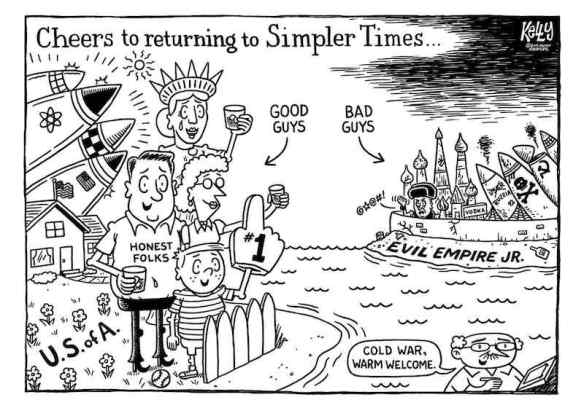
kelly-cold-war

By Philip Giraldi

Source: Unz Review

Liberals are supposed to be antiwar, right? I went to college in the 1960s, when students nationwide were rising up in opposition to the Vietnam War. I was a Young Republican back then and supported the war through sheer ignorance and dislike of the sanctimoniousness of the protesters, some of whom were surely making their way to Canada to live in exile on daddy’s money while I was on a bus going to Fort Leonard Wood for basic combat training. I can’t even claim that I had some grudging respect for the antiwar crowd because I didn’t, but I did believe that at least some of them who were not being motivated by being personally afraid of getting hurt were actually sincere in their opposition to the awful things that were happening in Southeast Asia.

As I look around now, however, I see something quite different. The lefties I knew in college are now part of the Establishment and generally speaking are retired limousine liberals. And they now call themselves progressives, of course, because it sounds more educated and sends a better message, implying as it does that troglodytic conservatives are anti-progress. But they also have done a flip on the issue of war and peace. In its most recent incarnation some of this might be attributed to a desperate desire to relate to the Hillary Clinton campaign with its bellicosity towards Russia, Syria and Iran, but I suspect that the inclination to identify enemies goes much deeper than that, back as far as the Bill Clinton Administration with its sanctions on Iraq and the Balkan adventure, which resulted in hundreds of thousands of deaths and the creation of a terror-narco state in the heart of Europe. And more recently we have seen the Obama meddling in Libya, Yemen and Syria in so called humanitarian interventions which have turned out to be largely fraudulent. Yes, under the Obama Dems it was “responsibility to protect time” (r2p) and all the world trembled as the drones were let loose.

Last Friday I started to read an op-ed in The Washington Post by David Ignatius that blew me away. It began “President Trump confronts complicated problems as the investigation widens into Russia’s attack on our political system.” It then proceeded to lay out the case for an “aggressive Russia” in the terms that have been repeated ad nauseam in the mainstream media. And it was, of course, lacking in any evidence, as if the opinions of coopted journalists and the highly politicized senior officials in the intelligence community should be regarded as sacrosanct. These are, not coincidentally, the same people who have reportedly recently been working together to undercut the White House by leaking and then reporting highly sensitive transcripts of phone calls with Russian officials.

Ignatius is well plugged into the national security community and inclined to be hawkish but he is also a typical Post politically correct progressive on most issues. So here was your typical liberal asserting something in a dangerous fashion that has not been demonstrated and might be completely untrue. Russia is attacking “our political system!” And The Post is not alone in accepting that Russia is trying to subvert and ultimately overthrow our republic. Reporting from The New York Times and on television news makes the same assumption whenever they discuss Russia, leading to what some critics have described as mounting American ‘hysteria’ relating to anything coming out of Moscow.

Rachel Maddow is another favorite of mine when it comes to talking real humanitarian feel good stuff out one side of her mouth while beating the drum for war from the other side. In a bravura performance on January 26th she roundly chastised Russia and its president Vladimir Putin. Rachel, who freaked out completely when Donald Trump was elected, is now keen to demonstrate that Trump has been corrupted by Russia and is now controlled out of the Kremlin. She described Trump’s lord and master Putin as an “intense little man” who murders his opponents before going into the whole “Trump stole the election with the aid of Moscow” saga, supporting sanctions on Russia and multiple investigations to get to the bottom of “Putin’s attacks on our democracy.” Per Maddow, Russia is the heart of darkness and, by way of Trump, has succeeded in exercising control over key elements in the new administration.

Unfortunately, people in the media like Ignatius and Maddow are not alone. Their willingness to sell a specific political line that carries with it a risk of nuclear war as fact, even when they know it is not, has been part of the fear-mongering engaged in by Democratic Party loyalists and many others on the left. Their intention is to “get Trump” whatever it takes, which opens the door to some truly dangerous maneuvering that could have awful consequences if the drumbeat and military buildup against Russia continues, leading Putin to decide that his country is being threatened and backed into a corner. Moscow has indicated that it would not hesitate use nuclear weapons if it is being confronted militarily and facing defeat.

The current wave of Russophobia is much more dangerous than the random depiction of foreigners in negative terms that has long bedeviled a certain type of American know-nothing politics. Apart from the progressive antipathy towards Putin personally, there is a virulent strain of anti-Russian sentiment among some self-styled conservatives in congress, best exemplified by Senators John McCain and Lindsey Graham. Graham has recently said “2017 is going to be a year of kicking Russia in the ass in Congress.”

It is my belief that many in the National Security State have convinced themselves that Russia is indeed a major threat against the United States and not because it is a nuclear armed power that can strike the U.S. That appreciation, should, if anything constitute a good reason to work hard to maintain cordial relations rather than not, but it is seemingly ignored by everyone but Donald Trump.

No, the new brand of Russophobia derives from the belief that Moscow is “interfering” in places like Syria and Ukraine. Plus, it is a friend of Iran. That perception derives from the consensus view among liberals and conservatives alike that the U.S. sphere of influence encompasses the entire globe as well as the particularly progressive conceit that Washington should serve to “protect” anyone threatened at any time by anyone else, which provides a convenient pretext for military interventions that are euphemistically described as “peace missions.”

There might be a certain cynicism in many who hate Russia as having a powerful enemy also keeps the cash flowing from the treasuring into the pockets of the beneficiaries of the military industrial congressional complex, but my real fear is that, having been brainwashed for the past ten years, many government officials are actually sincere in their loathing of Moscow and all its works. Recent opinion polls suggest that that kind of thinking is popular among Americans, but it actually makes no sense. Though involvement by Moscow in the Middle East and Eastern Europe is undeniable, calling it a threat against U.S. vital interests is more than a bit of a stretch as Russia’s actual ability to make trouble is limited. It has exactly one overseas military facility, in Syria, while the U.S. has more than 800, and its economy and military budget are tiny compared to that of the United States. In fact, it is Washington that is most guilty of intervening globally and destabilizing entire regions, not Moscow, and when Donald Trump said in an interview that when it came to killing the U.S. was not so innocent it was a gross understatement.

Ironically, pursuing a reset with Russia is one of the things that Trump actually gets right but the new left won’t give him a break because they reflexively hate him for not embracing the usual progressive bromides that they believe are supposed to go with being antiwar. Other Moscow trashing comes from the John McCain camp which demonizes Russia because warmongers always need an enemy and McCain has never found a war he couldn’t support. It would be a tragedy for the United States if both the left and enough of the right were to join forces to limit Trump’s options on dealing with Moscow, thereby enabling an escalating conflict that could have tragic consequences for all parties.

Tulsi Gabbard vs. ‘Regime Change’ Wars

2

Rep. Tulsi Gabbard is a rare member of Congress willing to take heat for challenging U.S. “regime change” projects, in part, because as an Iraq War vet she saw the damage these schemes do, as retired Col. Ann Wright explains.

By Ann Wright

Source: Consortium News

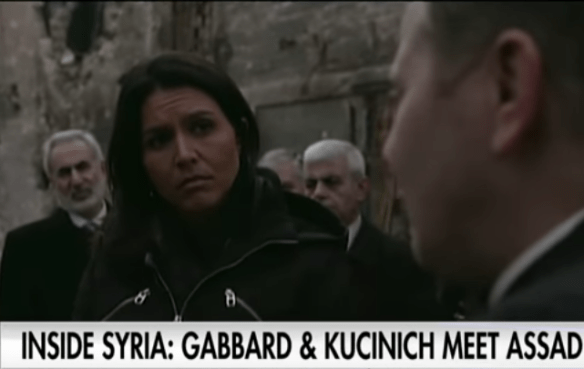
I support Rep. Tulsi Gabbard, D-Hawaii, going to Syria and meeting with President Bashar al-Assad because the congresswoman is a brave person willing to take criticism for challenging U.S. policies that she believes are wrong.

It is important that we have representatives in our government who will go to countries where the United States is either killing citizens directly by U.S. intervention or indirectly by support of militia groups or by sanctions.

We need representatives to sift through what the U.S. government says and what the media reports to find out for themselves the truth, the shades of truth and the untruths.

We need representatives willing to take the heat from both their fellow members of Congress and from the media pundits who will not go to those areas and talk with those directly affected by U.S. actions. We need representatives who will be our eyes and ears to go to places where most citizens cannot go.

Tulsi Gabbard, an Iraq War veteran who has seen first-hand the chaos that can come from misguided “regime change” projects, is not the first international observer to come back with an assessment about the tragic effects of U.S. support for lethal “regime change” in Syria.

Nobel Peace Laureate Mairead Maguire began traveling to Syria three years ago and now having made three trips to Syria. She has come back hearing many of the same comments from Syrians that Rep. Gabbard heard — that U.S. support for “regime change” against the secular government of Syria is contributing to the deaths of hundreds of thousands of Syrians and – if the “regime change” succeeded – might result in the takeover by armed religious-driven fanatics who would slaughter many more Syrians and cause a mass migration of millions fleeing the carnage.

Since 2011, the Obama administration supported various rebel groups fighting for “regime change” in Syria while U.S. allies – Saudi Arabia, Qatar and Turkey – backed jihadist groups including Islamic State and Al Qaeda’s Syrian affiliate, some of the same extremists whom the U.S. military is fighting in Iraq and Afghanistan. If Assad were overthrown, these extremists might take power and create even worse conditions for Syrians.

This possibility of jihadists imposing perverted extremist religious views on the secular state of Syria remains high due to international meddling in the internal affairs of Syria. This “regime change” project also drew in Russia to provide air support for the Syrian military.

Critical of Obama’s ‘Regime Change’

During the Obama administration, Rep. Gabbard spoke critically of the U.S. propensity to attempt “regime change” in countries and thus provoking chaos and loss of civilian life.

On Dec. 8, 2016, she introduced a bill entitled the “Stop Arming Terrorists Act” which would prohibit the U.S. government from using U.S. funds to provide funding, weapons, training, and intelligence support to extremists groups, such as the ones fighting in Syria – or to countries that are providing direct or indirect support to those groups.

In the first days of the Trump administration, Rep. Gabbard traveled to Syria to see the effects of the attempted “regime change” and to offer a solution to reduce the deaths of civilians and the end of the war in Syria. A national organization Veterans For Peace, to which I belong, has endorsed her trip as a step toward resolution to the Syrian conflict.

Not surprisingly, back in Washington, Rep. Gabbard came under attack for the trip and for her meeting with President Assad, similar to criticism that I have faced because of visits that I have made to countries where the U.S. government did not want me to go — to Cuba, Iran, Gaza, Yemen, Pakistan, North Korea, Russia and back to Afghanistan, where I was assigned as a U.S. diplomat.

I served my country for 29 years in the U.S. Army/ Army Reserves and retired as a colonel. I also served 16 years in the U.S. diplomatic corps in U.S. Embassies in Nicaragua, Grenada, Somalia, Uzbekistan, Kyrgyzstan, Sierra Leone, Micronesia, Afghanistan and Mongolia. I resigned from the U.S. government nearly 14 years ago in March 2003 in opposition to President George W. Bush’s “regime change” war on Iraq.

In my travels since my resignation, I didn’t agree with many of the policies of the governments in power in those countries. But I wanted to see the effects of U.S. government policies and, in particular, the effects of attempts at “regime change.”

I wanted to talk with citizens and government officials about the effects of U.S. sanctions and whether the sanctions “worked” to lessen their support for the government that the U.S. was attempting to change or overthrow.

For making those trips, I have been criticized strongly. I have been called an apologist for the governments in power. Critics have said that my trips have given legitimacy to the abuses by those governments. And I have been called a traitor to the United States to dare question or challenge its policy of “regime change.”

But I am not an apologist, nor am I a traitor … nor is Congresswoman Tulsi Gabbard for her recent trip to Syria.


Ann Wright served 29 years in the US Army/Army Reserves and retired as a colonel. She also was a U.S. diplomat for 16 years and served in U.S. Embassies in Nicaragua, Grenada, Somalia, Uzbekistan, Kyrgyzstan, Sierra Leone, Micronesia, Afghanistan and Mongolia. She resigned in March 2003 in opposition to the war in Iraq. She has lived in Honolulu since 2003. [A version of this story originally appeared at

Propaganda Techniques of Empire

index

By James Petras

Source: Axis of Logic

Introduction
Washington’s quest for perpetual world power is underwritten by systematic and perpetual propaganda wars. Every major and minor war has been preceded, accompanied and followed by unremitting government propaganda designed to secure public approval, exploit victims, slander critics, dehumanize targeted adversaries and justify its allies’ collaboration.

In this paper we will discuss the most common recent techniques used to support ongoing imperial wars.

Propaganda Techniques of Empire

Role Reversal
A common technique, practiced by the imperial publicists, is to accuse the victims of the same crimes, which had been committed against them.  The well documented, deliberate and sustained US-EU aerial bombardment of Syrian government soldiers, engaged in operations against ISIS-terrorist, resulted in the deaths and maiming of almost 200 Syrian troops and allowed ISIS-mercenaries to overrun their camp.   In an attempt to deflect the Pentagon’s role in providing air cover for the very terrorists it claims to oppose, the propaganda organs cranked out lurid, but unsubstantiated, stories of an aerial attack on a UN humanitarian aid convoy, first blamed on the Syrian government and then on the Russians.  The evidence that the attack was most likely a ground-based rocket attack by ISIS terrorists did not deter the propaganda mills.  This technique would turn US and European attention away from the documented criminal attack by the imperial bombers and present the victimized Syrian troops and pilots as international human rights criminals.

Hysterical Rants
Faced with world opprobrium for its wanton violation of an international ceasefire agreement in Syria, the imperial public spokespeople frequently resort to irrational outbursts at international meetings in order to intimidate wavering allies into silence and shut down any chance for reasonable debate resolving concrete issues among adversaries.

The current ‘US Ranter-in-Chief’ in the United Nations, is Ambassador Samantha Power, who launched a vitriolic diatribe against the Russians in order to sabotage a proposed General Assembly debate on the US deliberate violation (its criminal attack on Syrian troops) of the recent Syrian ceasefire.  Instead of a reasonable debate among serious diplomats, the rant served to derail the proceedings.

Identity Politics to Neutralize Anti-Imperialist Movements
Empire is commonly identified with the race, gender, religion and ethnicity of its practioners.  Imperial propagandists have frequently resorted to disarming and weakening anti-imperialist movements by co-opting and corrupting black, ethnic minority and women leaders and spokespeople.  The use of such ‘symbolic’ tokens is based on the assumption that these are ‘representatives’ reflecting the true interests of so-called ‘marginalized minorities’ and can therefore presume to ‘speak for  the oppressed peoples of the world’.  The promotion of such compliant and respectable ‘minority members’ to the elite is then propagandized as a ‘revolutionary’, world liberating historical event – witness the ‘election’ of US President Barack Obama.

The rise of Obama to the presidency in 2008 illustrates how the imperial propagandists have used identity politics to undermine class and anti-imperialist struggles.

Under Obama’s historical black presidency, the US pursued seven wars against ‘people of color’ in South Asia, the Middle East and North Africa.  Over a million men and women of sub-Saharan black origin, whether Libyan citizens or contract workers for neighboring countries, were killed, dispossessed and driven into exile by US allies after the US-EU destroyed the Libyan state – in the name of humanitarian intervention.  Hundreds of thousands of Arabs have been bombed in Yemen, Syria and Iraq under President Obama, the so-called ‘historic black’ president.  Obama’s ‘predator drones’ have killed hundreds of Afghan and Pakistani villagers.  Such is the power of ‘identity politics’ that ignominious Obama was awarded the ‘Nobel Peace Prize’.

Meanwhile, in the United States under Obama, racial inequalities between black and white workers (wages, unemployment, access to housing, health and educational services) have widened.  Police violence against blacks intensified with total impunity for ‘killer cops’.  Over two million immigrant Latino workers have been expelled – breaking up hundreds of thousands of families– and accompanied by a marked increase of repression compared to earlier administrations.  Millions of black and white workers’ home mortgages were foreclosed while all of the corrupt banks were bailed out – at a greater rate than had occurred under white presidents.

This blatant, cynical manipulation of identity politics facilitated the continuation and deepening of imperial wars, class exploitation and racial exclusion.  Symbolic representation undermined class struggles for genuine changes.

Past Suffering to Justify Contemporary Exploitation
Imperial propagandists repeatedly evoke the victims and abuses of the past in order to justify their own aggressive imperial interventions and support for the ‘land grabs’ and ethnic cleansing committed by their colonial allies – like Israel, among others. The victims and crimes of the past are presented as a perpetual presence to justify ongoing brutalities against contemporary subject people.

The case of US-Israeli colonization of Palestine clearly illustrates how rabid criminality, pillage, ethnic cleansing and self-enrichment can be justified and glorified through the language of past victimization.  Propagandists in the US and Israel have created ‘the cult of the Holocaust’, worshiping a near century-old Nazi crime against Jews (as well as captive Slavs, Gypsies and other minorities) in Europe, to justify the bloody conquest and theft of Arab lands and sovereignty and engage in systematic military assaults against Lebanon and Syria.  Millions of Muslim and Christian Palestinians have been driven into perpetual exile.  Elite, wealthy, well-organized and influential zionist Jews, with primary fealty to Israel, have successfully sabotaged every contemporary struggle for peace in the Middle East and have created real barriers for social democracy in the US through their promotion of militarism and empire building.  Those claiming to represent victims of the past have become among the most oppressive of contemporary elites.  Using the language of ‘defense’, they promote aggressive forms of expansion and pillage.  They claim their monopoly on historic ‘suffering’ has given them a ‘special dispensation’ from the rules of civilized conduct:  their cult of the Holocaust allows them to inflict immense pain on others while silencing any criticism with the accusation of ‘anti-Semitism’ and relentlessly punishing critics.  Their key role in imperial propaganda warfare is based on their claims of an exclusive franchise on suffering and immunity from the norms of justice.

Entertainment Spectacles on Military Platforms
Entertainment spectacles glorify militarism.  Imperial propagandists link the public to unpopular wars promoted by otherwise discredited leaders.  Sports events present soldiers dressed up as war heroes with deafening, emotional displays of ‘flag worship’ to celebrate the ongoing overseas wars of aggression.  These mind-numbing extravaganzas with crude elements of religiosity demand choreographed expressions of national allegiance from the spectators as a cover for continued war crimes abroad and the destruction of citizens’ economic rights at home.

Much admired, multi-millionaire musicians and entertainers of all races and orientations, present war to the masses with a humanitarian facade. The entertainers smiling faces serve genocide just as powerfully as the President’s benign and friendly  face accompanies his embrace of militarism.  The propagandist message for the spectator is that ‘your favorite team or singer is there just for you… because our noble wars and valiant warriors have made you free and now they want you to be entertained.’

The old style of blatant bellicose appeals to the public is obsolete:  the new propaganda conflates entertainment with militarism, allowing the ruling elite to secure tacit support for its wars without disturbing the spectators’ experience.

Conclusion
Do the Imperial Techniques of Propaganda Work?

How effective are the modern imperial propaganda techniques?  The results seem to be mixed.  In recent months, elite black athletes have begun protesting white racism by challenging the requirement for choreographed displays of flag worship. . . opening public controversy into the larger issues of police brutality and sustained marginalization.  Identity politics, which led to the election of Obama, may be giving way to issues of class struggle, racial justice, anti-militarism and the impact of continued imperial wars.  Hysterical rants may still secure international attention, but repeated performances begin to lose their impact and subject the ‘ranter’ to ridicule.

The cult of victimology has become less a rationale for the multi-billion dollar US-tribute to Israel, than the overwhelming political and economic influence and thuggery of billionaire Zionist fundraisers who demand US politicians’ support for the state of Israel.

Brandishing identify politics may have worked the first few times, but inevitably black, Latino, immigrant and all exploited workers, all underpaid and overworked women and mothers reject the empty symbolic gestures and demand substantive socio-economic changes – and here they find common links with the majority of exploited white workers.

In other words, the existing propaganda techniques are losing their edge – the corporate media news is seen as a sham.  Who follows the actor-soldiers and flag-worshipers once the game has begun?

The propagandists of empire are desperate for a new line to grab public attention and obedience.   Could the recent domestic terror bombings in New York and New Jersey provoke mass hysteria and more militarization? Could they serve as cover for more wars abroad . . .?

A recent survey, published in Military Times, reported that the vast majority of active US soldiers oppose more imperial wars. They are calling for defense at home and social justice.  Soldiers and veterans have even formed groups to support the protesting black athletes who have refused to participate in flag worship while unarmed black men are being killed by police in the streets.   Despite the multi-billion dollar electoral propaganda, over sixty percent of the electorate reject both major party candidates.  The reality principle has finally started to undermine State propaganda!