America, Meet Your New Dictator-in-Chief: The President’s Secret, Unchecked Powers

By John W. Whitehead & Nisha Whitehead

Source: The Rutherford Institute

“Life, liberty, and the pursuit of happiness have given way to permanent crisis management: to policing the planet and fighting preventative wars of ideological containment, usually on terrain chosen by, and favorable to, our enemies. Limited government and constitutional accountability have been shouldered aside by the kind of imperial presidency our constitutional system was explicitly designed to prevent.”— David C. Unger, The Emergency State: America’s Pursuit of Absolute Security at All Costs

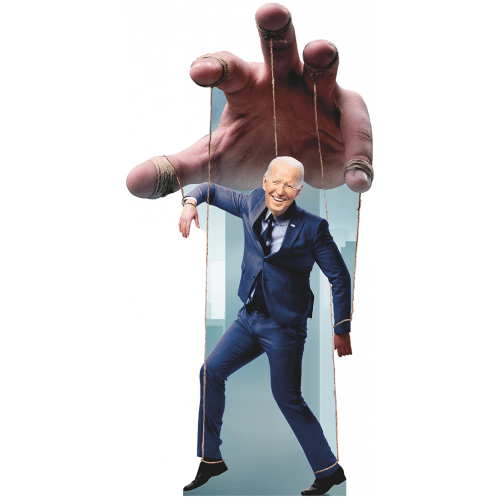
America, meet your new dictator-in-chief.

As the New York Times reports, “Newly disclosed documents have shed a crack of light on secret executive branch plans for apocalyptic scenarios—like the aftermath of a nuclear attack—when the president may activate wartime powers for national security emergencies.”

The problem, of course, is that we have become a nation in a permanent state of emergency.

Power-hungry and lawless, the government has weaponized one national crisis after another in order to expand its powers and justify all manner of government tyranny in the so-called name of national security.

The seeds of this present madness were sown almost two decades ago when George W. Bush stealthily issued two presidential directives that granted the president the power to unilaterally declare a national emergency, which is loosely defined as “any incident, regardless of location, that results in extraordinary levels of mass casualties, damage, or disruption severely affecting the U.S. population, infrastructure, environment, economy, or government functions.

Comprising the country’s Continuity of Government (COG) plan, these directives (National Security Presidential Directive 51 and Homeland Security Presidential Directive 20) provide a skeletal outline of the actions the president will take in the event of a “national emergency.”

Just what sort of actions the president will take once he declares a national emergency can barely be discerned from the barebones directives. However, one thing is clear: in the event of a national emergency, the COG directives give unchecked executive, legislative and judicial power to the president.

The country would then be subjected to martial law by default, and the Constitution and the Bill of Rights would be suspended.

Essentially, the president would become a dictator for life.

It has happened already.

As we have witnessed in recent years, that national emergency can take any form, can be manipulated for any purpose and can be used to justify any end goal—all on the say so of the president.

The emergency powers that we know about which presidents might claim during such states of emergency are vast, ranging from imposing martial law and suspending habeas corpus to shutting down all forms of communications, including implementing an internet kill switch, and restricting travel.

Yet according to documents recently obtained by the Brennan Center, there may be many more secret powers that presidents may institute in times of so-called crisis without oversight from Congress, the courts, or the public.

It doesn’t even matter what the nature of the crisis might be—civil unrest, the national emergencies, “unforeseen economic collapse, loss of functioning political and legal order, purposeful domestic resistance or insurgency, pervasive public health emergencies, and catastrophic natural and human disasters”—as long as it allows the government to justify all manner of government tyranny in the name of so-called national security.

The war on COVID-19, the war on terror, the war on drugs, the war on illegal immigration: all of these programs started out as responses to pressing national concerns and have since become weapons of compliance and control in the police state’s hands.

Deploying the same strategy it used with 9/11 to acquire greater powers under the USA Patriot Act, the police state—a.k.a. the shadow government, a.k.a. the Deep State—has been planning and preparing for such crises for years now, quietly assembling a wish list of presidential lockdown powers that could be trotted out and approved at a moment’s notice.

Indeed, the Trump Administration even asked Congress to allow it to suspend parts of the Constitution whenever it deems it necessary during the COVID-19 crisis and “other” emergencies. The Department of Justice (DOJ) went so far as to quietly trot out and test a long laundry list of terrifying powers that override the Constitution.

We’re talking about lockdown powers (at both the federal and state level): the ability to suspend the Constitution, indefinitely detain American citizens, bypass the courts, quarantine whole communities or segments of the population, override the First Amendment by outlawing religious gatherings and assemblies of more than a few people, shut down entire industries and manipulate the economy, muzzle dissidents, “stop and seize any plane, train or automobile to stymie the spread of contagious disease,” reshape financial markets, create a digital currency (and thus further restrict the use of cash), determine who should live or die.

These are powers the police state would desperately like to make permanent.

In such a climate, the American president becomes dictator with permanent powers: imperial, unaccountable and unconstitutional.

Bear in mind that the powers the government officially asked Congress to recognize and authorize barely scratch the surface of the far-reaching powers the government has already unilaterally claimed for itself.

Unofficially, the police state with the president at its helm has been riding roughshod over the rule of law for years now without any pretense of being reined in or restricted in its power grabs by Congress, the courts or the citizenry.

Although the Constitution invests the President with very specific, limited powers, in recent years, American presidents have claimed the power to completely and almost unilaterally alter the landscape of this country for good or for ill.

The powers amassed by each successive president through the negligence of Congress and the courts—powers which add up to a toolbox of terror for an imperial ruler—empower whoever occupies the Oval Office to act as a dictator, above the law and beyond any real accountability.

As law professor William P. Marshall explains, “every extraordinary use of power by one President expands the availability of executive branch power for use by future Presidents.”

Moreover, it doesn’t even matter whether other presidents have chosen not to take advantage of any particular power, because “it is a President’s action in using power, rather than forsaking its use, that has the precedential significance.”

In other words, each successive president continues to add to his office’s list of extraordinary orders and directives, expanding the reach and power of the presidency and granting him- or herself near dictatorial powers.

All of the imperial powers amassed by Barack Obama and George W. Bush—to kill American citizens without due process, to detain suspects indefinitely, to strip Americans of their citizenship rights, to carry out mass surveillance on Americans without probable cause, to suspend laws during wartime, to disregard laws with which he might disagree, to conduct secret wars and convene secret courts, to sanction torture, to sidestep the legislatures and courts with executive orders and signing statements, to direct the military to operate beyond the reach of the law, to operate a shadow government, and to act as a dictator and a tyrant, above the law and beyond any real accountability—were inherited by Donald Trump and passed along to Joe Biden.

These presidential powers—acquired through the use of executive orders, decrees, memorandums, proclamations, national security directives and legislative signing statements and which can be activated by any sitting president—enable past, president and future presidents to operate above the law and beyond the reach of the Constitution.

These are the powers that continue to be passed along to each successive heir to the Oval Office, the Constitution be damned.

This is what you might call a stealthy, creeping, silent, slow-motion coup d’état.

From Clinton to Bush, Obama to Trump, and now Biden, it’s as if we’ve been caught in a time loop, forced to re-live the same abuses over and over again: the same assaults on our freedoms, the same disregard for the rule of law, the same subservience to the Deep State, and the same corrupt, self-serving government that exists only to amass power, enrich its shareholders and ensure its continued domination.

We’ve been losing our freedoms so incrementally for so long—sold to us in the name of national security and global peace, maintained by way of martial law disguised as law and order, and enforced by a standing army of militarized police and a political elite determined to maintain their powers at all costs—that it’s hard to pinpoint exactly when it all started going downhill, but “we the people” are paying the price for it now.

We are paying the price every day that we allow the government to continue to wage its war on the American People, a war that is being fought on many fronts: with bullets and tasers, with surveillance cameras and license readers, with intimidation and propaganda, with court rulings and legislation, with the collusion of every bureaucrat who dances to the tune of corporate handouts while on the government’s payroll, and most effectively of all, with the complicity of the American people, who continue to allow themselves to be easily manipulated by their politics, distracted by their pastimes, and acclimated to a world in which government corruption is the norm.

Unless something changes in the way we deal with these ongoing, egregious abuses of power, the predators of the police state will continue to wreak havoc on our freedoms, our communities, and our lives.

If we continue down this road, there can be no surprise about what awaits us at the end.

After all, it is a tale that has been told time and again throughout history about how easy it is for freedom to fall and tyranny to rise, and it often begins with one small, seemingly inconsequential willingness on the part of the people to compromise their principles and undermine the rule of law in exchange for a dubious assurance of safety, prosperity and a life without care.

Unfortunately, the process of unseating a dictator and limiting the powers of the presidency is far from simple but at a minimum, it must start with “we the people.”

For starters, as I make clear in my book Battlefield America: The War on the American People and in its fictional counterpart The Erik Blair Diaries, we must recalibrate the balance of power.

Start locally—in your own communities, in your schools, at your city council meetings, in newspaper editorials, at protests—by pushing back against laws that are unjust, police departments that overreach, politicians that don’t listen to their constituents, and a system of government that grows more tyrannical by the day.

What we desperately need is a concerted, collective commitment to the Constitution’s principles of limited government, a system of checks and balances, and a recognition that they—the president, Congress, the courts, the military, the police, the technocrats and plutocrats and bureaucrats—answer to and are accountable to “we the people.”

This will mean that Americans will have to stop letting their personal politics and party allegiances blind them to government misconduct and power grabs.

It will mean holding all three branches of government accountable to the Constitution (i.e., vote them out of office if they abuse their powers).

And it will mean calling on Congress to put an end to the use of presidential executive orders, decrees, memorandums, proclamations, national security directives and legislative signing statements as a means of getting around Congress and the courts.

In other words, we’ve got to start making both the president and the police state play by the rules of the Constitution.
The Illusion of Freedom: We’re Only as Free as the Government Allows

By John W. Whitehead & Nisha Whitehead

Source: The Rutherford Institute

“Rights aren’t rights if someone can take them away. They’re privileges. That’s all we’ve ever had in this country, is a bill of temporary privileges. And if you read the news even badly, you know that every year the list gets shorter and shorter. Sooner or later, the people in this country are gonna realize the government … doesn’t care about you, or your children, or your rights, or your welfare or your safety… It’s interested in its own power. That’s the only thing. Keeping it and expanding it wherever possible.”— George Carlin

We’re in a national state of denial.

For years now, the government has been playing a cat-and-mouse game with the American people, letting us enjoy just enough freedom to think we are free but not enough to actually allow us to live as a free people.

Case in point: on the same day that the U.S. Supreme Court appeared inclined to favor a high school football coach’s right to pray on the field after a game, the high court let stand a lower court ruling that allows police to warrantlessly track people’s location and movements through their personal cell phones, sweeping Americans up into a massive digital data dragnet that does not distinguish between those who are innocent of wrongdoing, suspects, or criminals.

Likewise, although the Supreme Court gave the go-ahead for a death row inmate to have his pastor audibly pray and lay hands on him in the execution chamber, it refused to stop police from using hidden cameras to secretly and warrantlessly record and monitor a person’s activities outside their home over an extended period of time.  

For those who have been paying attention, there’s a curious pattern emerging: the government appears reasonably tolerant of those who want to exercise their First Amendment rights in a manner that doesn’t challenge the police state’s hold on power, for example, by praying on a football field or in an execution chamber.

On the other hand, dare to disagree with the government about its war crimes, COVID-19, election outcomes or police brutality, and you’ll find yourself silenced, cited, shut down and/or branded an extremist.

The U.S. government is particularly intolerant of speech that reveals the government’s corruption, exposes the government’s lies, and encourages the citizenry to push back against the government’s many injustices. For instance, Wikileaks founder Julian Assange, the latest victim of the government’s war on dissidents and whistleblowers, is in the process of being extradited to the U.S. to be tried under the Espionage Act for daring to access and disclose military documents that portray the U.S. government and its endless wars abroad as reckless, irresponsible, immoral and responsible for thousands of civilian deaths.

Even political protests are fair game for prosecution. In Florida, two protesters are being fined $3000 for political signs proclaiming stating “F—k Biden,” “F—k Trump,” and “F—k Policing 4 Profit” that violate a city ban on “indecent” speech on signs, clothing and other graphic displays.

The trade-off is clear: pray all you want, but don’t mess with the U.S. government.

In this way, the government, having appointed itself a Supreme and Sovereign Ruler, allows us to bask in the illusion of religious freedom while stripping us of every other freedom afforded by the Constitution.

We’re in trouble, folks.

Freedom no longer means what it once did.

This holds true whether you’re talking about the right to criticize the government in word or deed, the right to be free from government surveillance, the right to not have your person or your property subjected to warrantless searches by government agents, the right to due process, the right to be safe from militarized police invading your home, the right to be innocent until proven guilty and every other right that once reinforced the founders’ belief that this would be “a government of the people, by the people and for the people.”

Not only do we no longer have dominion over our bodies, our families, our property and our lives, but the government continues to chip away at what few rights we still have to speak freely and think for ourselves.

My friends, we’re being played for fools.

On paper, we may be technically free.

In reality, however, we are only as free as a government official may allow.

We only think we live in a constitutional republic, governed by just laws created for our benefit.

Truth be told, we live in a dictatorship disguised as a democracy where all that we own, all that we earn, all that we say and do—our very lives—depends on the benevolence of government agents and corporate shareholders for whom profit and power will always trump principle. And now the government is litigating and legislating its way into a new framework where the dictates of petty bureaucrats carry greater weight than the inalienable rights of the citizenry.

With every court ruling that allows the government to operate above the rule of law, every piece of legislation that limits our freedoms, and every act of government wrongdoing that goes unpunished, we’re slowly being conditioned to a society in which we have little real control over our lives.

As Rod Serling, creator of the Twilight Zone and an insightful commentator on human nature, once observed, “We’re developing a new citizenry. One that will be very selective about cereals and automobiles, but won’t be able to think.”

Indeed, not only are we developing a new citizenry incapable of thinking for themselves, we’re also instilling in them a complete and utter reliance on the government and its corporate partners to do everything for them—tell them what to eat, what to wear, how to think, what to believe, how long to sleep, who to vote for, whom to associate with, and on and on.

In this way, we have created a welfare state, a nanny state, a police state, a surveillance state, an electronic concentration camp—call it what you will, the meaning is the same: in our quest for less personal responsibility, a greater sense of security, and no burdensome obligations to each other or to future generations, we have created a society in which we have no true freedom.

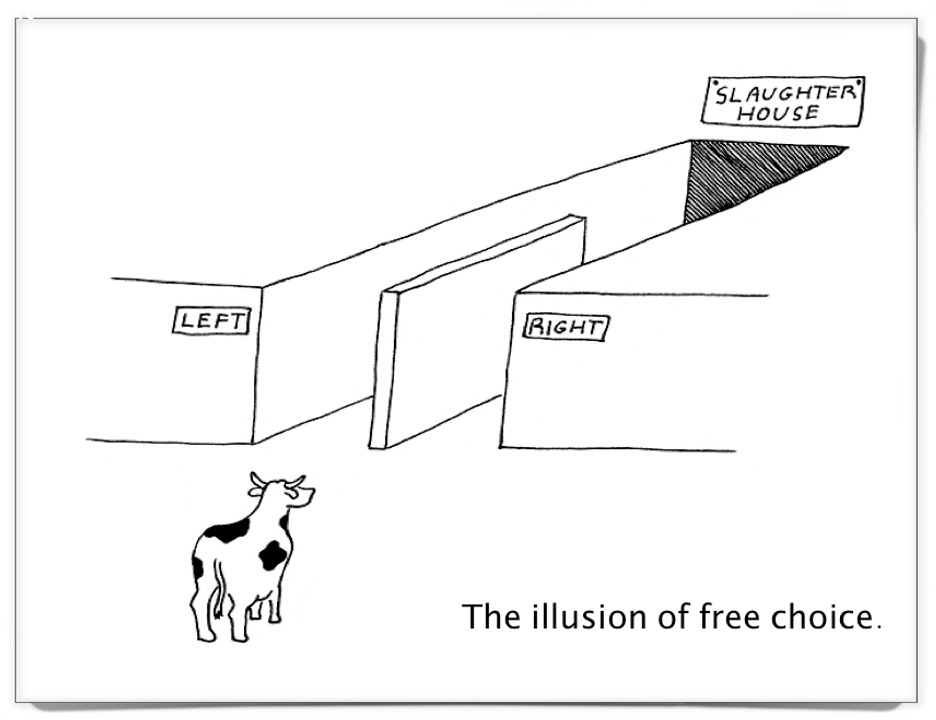
Government surveillance, police abuse, SWAT team raids, economic instability, asset forfeiture schemes, pork barrel legislation, militarized police, drones, endless wars, private prisons, involuntary detentions, biometrics databases, free speech zones, etc.: these are mile markers on the road to a fascist state where citizens are treated like cattle, to be branded and eventually led to the slaughterhouse.

Freedom, or what’s left of it, is being threatened from every direction. The threats are of many kinds: political, cultural, educational, media, and psychological. However, as history shows us, freedom is not, on the whole, wrested from a citizenry. It is all too often given over voluntarily and for such a cheap price: safety, security, bread, and circuses.

This is part and parcel of the propaganda churned out by the government machine.

That said, what we face today—mind manipulation and systemic violence—is not new. What is different are the techniques used and the large-scale control of mass humanity, coercive police tactics and pervasive surveillance.

We are overdue for a systemic check on the government’s overreaches and power grabs.

By “government,” I’m not referring to the highly partisan, two-party bureaucracy of the Republicans and Democrats. Rather, I’m referring to “government” with a capital “G,” the entrenched Deep State that is unaffected by elections, unaltered by populist movements, and has set itself beyond the reach of the law.

For years now, we have suffered the injustices, cruelties, corruption and abuse of an entrenched government bureaucracy that has no regard for the Constitution or the rights of the citizenry.

We have lingered too long in this strange twilight zone where ego trumps justice, propaganda perverts truth, and imperial presidents—empowered to indulge their authoritarian tendencies by legalistic courts, corrupt legislatures and a disinterested, distracted populace—rule by fiat rather than by the rule of law.

Where we find ourselves now is in the unenviable position of needing to rein in all three branches of government—the Executive, the Judicial, and the Legislative—that have exceeded their authority and grown drunk on power.

We are the unwitting victims of a system so corrupt that those who stand up for the rule of law and aspire to transparency in government are in the minority. This corruption is so vast it spans all branches of government: from the power-hungry agencies under the executive branch and the corporate puppets within the legislative branch to a judiciary that is, more often than not, elitist and biased towards government entities and corporations.

The predators of the police state are wreaking havoc on our freedoms, our communities, and our lives. The government doesn’t listen to the citizenry, it refuses to abide by the Constitution, which is our rule of law, and it treats the citizenry as a source of funding and little else.

The American kleptocracy (a government ruled by thieves) has sucked the American people down a rabbit hole into a parallel universe in which the Constitution is meaningless, the government is all-powerful, and the citizenry is powerless to defend itself against government agents who steal, spy, lie, plunder, kill, abuse and generally inflict mayhem and sow madness on everyone and everything in their sphere.

This dissolution of that sacred covenant between the citizenry and the government—establishing “we the people” as the masters and the government as the servant—didn’t happen overnight. It didn’t happen because of one particular incident or one particular president. It is a process, one that began long ago and continues in the present day, aided and abetted by politicians who have mastered the polarizing art of how to “divide and conquer.”

Unfortunately, there is no magic spell to transport us back to a place and time where “we the people” weren’t merely fodder for a corporate gristmill, operated by government hired hands, whose priorities are money and power.

As I make clear in my book Battlefield America: The War on the American People and in its fictional counterpart The Erik Blair Diaries, our freedoms have become casualties in an all-out war on the American people.

If we continue down this road, there can be no surprise about what awaits us at the end.

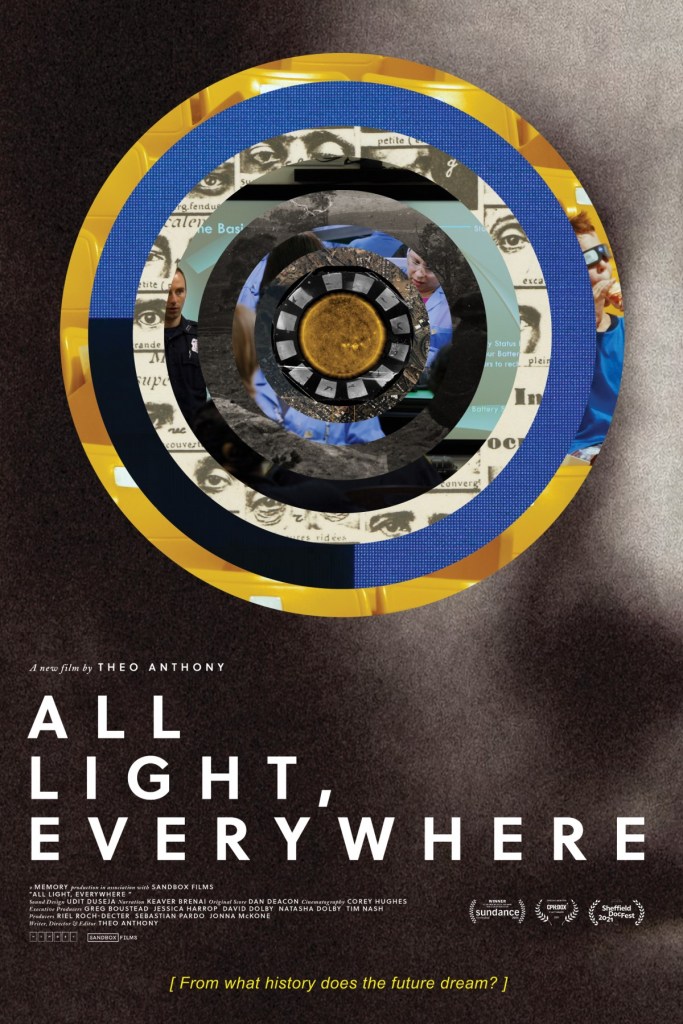
Saturday Matinee: All Light, Everywhere

Film Review: “All Light, Everywhere” — Darkness Visible

By Neil Giordano

Source: Arts Fuse

Do you trust what you see? How can you? Our eyes are no longer the primary way that we see; they have been swapped out for the filters of screens and technology. The suspicious mediation between cameras and our perception of ‘reality” has never been more ubiquitous — or more insidious. Perhaps what we don’t see, however, is at least as important as what we do see. But how can we become aware of what we don’t see?

These questions lie at the heart of the fascinating new documentary All Light, Everywhere, an entrancing blend of neuroscience, metaphysics, and technological history that has the smarts to apply some sly, subtle social commentary to its elusive subjects.

At first, the film seems to flitter among semi-connected topics: A marketing campaign that is testing its volunteers’ reactions to visual images; a tour of Axon Industries, the #1 maker of police body cameras, with its corporate spin doctor as our guide; an aerial composite-imaging system that was used secretly by Baltimore police to surveil the city. Interspersed into these “storylines” are narrated forays into the history of early photography along with B-roll of ordinary people preparing to view the 2017 solar eclipse with their own cameras (and eyes). This unrelenting focus on the production and consumption of visual imagery transforms the film into an almost fractal experience. It becomes a bit too much: the sheer ubiquity of people looking, eyes looking, images to be seen and consumed and interpreted, examinations of the various technologies serving up new pictures to be mediated. The unsettling point of this unconventional documentary seems to be to distort rather than clarify the subject at hand — and that may be just what director Theo Anthony wants.

The underlying political relevance of the film is transparent. We live in a surveillance society, consenting (though not always consciously) to being filmed, watched, and recorded by corporations hoping to sell us products based on the data they gather. The government snoops in the name of crime prevention and law enforcement. The value of the latter has been hotly debated in the last few years: George Floyd’s murder being a prime example. Here the police body cameras showed us what we believe to be an “objective” record of events, footage of police brutality and murder. But body camera images have been weaponized by both sides, each seeking to prove something that will help their case. What Axon Industries sells to police forces (and to the general public) is that they are confident their cameras will tell the “truth” about any police action. Accountability is promoted as their product’s best feature. But it is more than that — “behavior will change ” because of the presence of cameras, that they will inhibit bad behavior.

But what do body cameras actually show us? Are these videos an authentic record of reality? The documentary examines, abstractly at first and then far more concretely, how there is always bias. Where is the camera located on the body? Does its wide-angle lens distort our understanding of action? How is this data interpreted and by whom? There are so many levels of interpretation that “objectivity” has turned into a myth.

The film’s looks back into the past are also illuminating, unsettling illustrations of how camera technology has almost always been co-opted for violent and authoritarian uses, whether it be the American military tracking the enemy on the battlefield or in the early experiments in composite imaging used by police to profile criminals. The latter presages the now rampant use of facial recognition technology, its marketed value undercut by its practical limitations as well as ethical muddiness.

The irony is not lost that what we’re looking at is itself a film, another visual entity that requires us to watch and to mediate. The film’s meta-commentary confesses that its stochastic manipulation is by design. Highly kinetic editing leads our brains to make connections in ways that excited Eisenstein at the dawn of film a century ago: the whole is greater than the sum of the parts. The mind demands order, so the juxtaposition and collision of images generates meanings that did not exist in individual images.

Anthony draws on history to help us make sense of a visual world that is increasingly fleeting and fragmented. The film is reminiscent, in style and subject matter, of the works of Errol Morris. This goes for its sometimes desultory exposition, as well as its approach to epistemology. (Morris explores these issues in all of his films, as well as in his essays in his books Believing Is Seeing and The Ashtray.) In the third act of All Light, Everywhere, a well-placed quotation from Frederick Douglass summaries the central issue: “We all feel that there is something more. That the curtain has not yet been lifted. There is a prophet with us forever whispering that behind the seen lies the immeasurable unseen.” The “immeasurable unseen” may not be possible to capture on cameras, no matter how many we use or how hard we strive for an elusive objectivity. Perhaps it is more important for us to understand that urge for “something more” should lead to examining how, why, and for whom the image was made.

Watch All Light, Everywhere at Kanopy here: https://www.kanopy.com/en/product/12333392

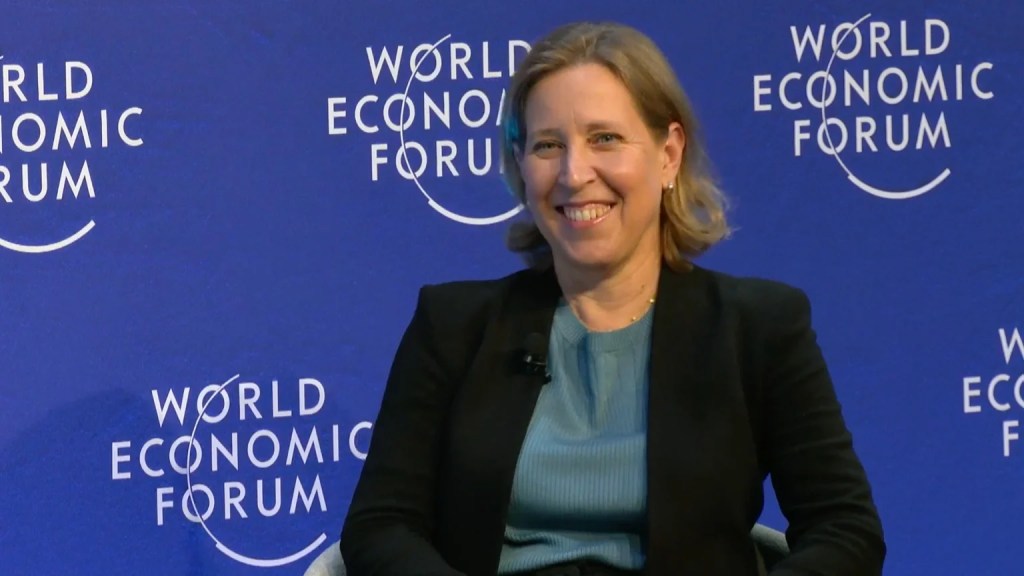
YouTube CEO at World Economic Forum: “There’ll always be work that we have to do” to censor “misinformation”

A commitment to constant censorship.

By Tom Parker

Source: Reclaim the Net

At the World Economic Forum Annual Meeting for 2022, an event where powerful CEOs and world leaders meet to “find solutions to the world’s most urgent challenges,” YouTube CEO Susan Wojcicki committed to persistent censorship of “misinformation” and praised YouTube’s existing censorship efforts.

Wojcicki made the comments after Alyson Shontell Lombardi, the Editor-in-Chief of Fortune Magazine, asked her whether YouTube’s efforts to censor misinformation will always be a “work in progress.”

“I think there’ll always be work that we have to do because there will always be incentives for people to be creating misinformation,” Wojcicki said. “The challenge will be to keep staying ahead of that and make sure that we are understanding what they are and the different ways that people may use to try to trick our systems and make sure that our systems are staying ahead of what’s necessary to make sure that we are managing that.”

Wojcicki continued by praising YouTube’s 5-6 year initiative of cracking down on content that’s deemed to be misinformation and said that users who look at YouTube search results or the homepage will see content from “authoritative sources” (mainstream media outlets that YouTube designates as authoritative) for “sensitive topics.”

Earlier in the conversation, Wojcicki said YouTube is “investing a huge amount to make sure that we’re fighting misinformation” and discussed the various ways YouTube is cracking down on misinformation. She pointed to YouTube introducing 10 COVID censorship policies, YouTube’s policy of not recommending “borderline content” which doesn’t break YouTube’s rules but is deemed to be “lower quality,” and YouTube’s policy of demonetizing content that’s deemed to be “propagating something that is generally understood as not accurate information.”

Wojcicki also talked about YouTube’s violative view rate (VVR) – a metric that shows how many views come from content that violates YouTube’s rules. The metric indicates how swiftly YouTube is censoring content. A low VVR signals that most of the content YouTube removes is being taken down before viewers have a chance to watch it.

Wojcicki noted that just 10-12 views of every 10,000 come from violative content and that this number has “come down significantly” over time.

“Our plan is to continue to work on it and make sure that we continue to reduce that,” Wojcicki added.

Wojcicki’s commitment to always crackdown on misinformation echoes her and the platform’s previous vows to censor misinformation. Days ago, Wojcicki promised to tackle “misinformation” to win over corporate cash. And earlier this year, she said: “Tackling misinformation and other harmful content is a top priority.”

YouTube has already deleted more than a million videos for “COVID misinformation,” plans to preemptively censor “new misinformation,” and has considered hiding the share button to prevent misinformation spread.

Related Videos

Saturday Matinee: Blue Thunder

Looking back at Blue Thunder

John Badham’s high-tech helicopter thriller Blue Thunder rode the crest of a decade obsessed with cool cars and aircraft…

By Ryan Lambie

Source: Den of Geek

Back in the 1980s, a company called Sega perfected what it referred to as the Full Body Experience. Less kinky than it sounds, this fusion of CRT television, videogame technology and hydraulic pistons aimed to give amusement arcade visitors a taste of what it might be like to drive a Ferrari Testarossa or motorcycle at breakneck speed or fly a fighter jet through a valley full of enemy aircraft.

For a generation of youths, these machines, with their chunky graphics and even chunkier controls, are the stuff of legend, and the mere mention of their names – Hang On, Out Run, After Burner, Space Harrier, Thunder Blade – is enough to evoke involuntary memories of Proustian proportions.

These half-remembered machines sum up the 80s era of mechanical wish fulfilment. More than any other, the decade catered to youthful fantasies of fast cars and deadly aircraft. Perhaps spurred on by the ongoing success of Star Wars, which placed Luke Skywalker at the helm of one of the coolest fighter craft ever committed to celluloid, the 80s saw a rash of mechanical fantasies appear in cinemas, arcades, and on television.

For examples, look no further than Magnum PI, first broadcast in 1980, in which Tom Selleck got to drive around in someone else’s Ferrari 308 GTS, and took the occasional ride in a friend’s helicopter. Knight Rider, first broadcast in 1982, saw David Hasselhoff drive around in an unspeakably cool talking car. In the movies, small boys got to fly through the skies on bikes (E.T.), in stolen spy planes (D.A.R.Y.L.), and sexy alien space craft (Flight Of The Navigator). Even Hollywood elder statesman Clint Eastwood got in on the act, as he controlled a top-secret Russian fighter jet with the power of his mind in Firefox.

Later on in the decade, Top Gun flew into cinemas, whose lovingly lit fighter jet porn inspired such films as Iron Eagle and its sequel. But before Top Gun, there was Blue Thunder, a 1983 movie that appeared to kick off a brief media love affair with helicopters.

Like Firefox, Blue Thunder had the benefit of some quite serious acting heft behind it. Roy Scheider, best known to wider audiences as the chap who blew up a shark real good in Jaws, turned in some quite brilliant performances in KluteThe French Connection (for which he was nominated for a Best Supporting Actor Oscar) and Marathon Man. Scheider starred alongside Malcolm McDowell, whose biggest successes at the time, either financially or critically speaking, were if…, A Clockwork Orange and Voyage Of The Damned.

Quite why either of them signed up for Blue Thunder isn’t initially clear; Scheider would essentially play second fiddle to the true star of the picture – the high-tech experimental helicopter, so important to the story that it gets title billing. But in a 1983 interview with Movies & Video Magazine (as recorded for posterity by Blue Thunder Online), Scheider explained that the film’s political overtones interested him in getting involved.

“So you see the underlying theme of the movie is that it’s a total invasion of privacy,” Scheider said. “Although this kind of device to control crowd would be very effective it would also be invasion of your personal liberties.  What my character does in the film is to show the community that this kind of device isn’t necessary to be flying over anyone’s life.”

As for McDowell, director John Badham noted in a Starlog interview that the actor was terrified of flying – a setback, considering the character he was supposed to play was an army colonel with a love of hurtling about in helicopters.

The plot, if you were a youth at the time, mattered little – there was a helicopter in the movie, and it got to blow stuff up with a big gatling gun, and that was all you needed to know. Viewed today, it’s surprising how long it takes for director John Badham to get to the explosive bits – which, as it turns out, is no bad thing.

Scheider plays Frank Murphy, a Vietnam veteran turned helicopter pilot for the Los Angeles Police Department. In spite of his troubled past, Murphy’s selected to fly a new, experimental helicopter called Blue Thunder, a kind of flying Swiss-army knife which would allow the police to spy on citizens from the air undetected, and gun down miscreants with the gigantic gatling cannon sticking out of the front.

It’s the twin topics of public freedom and state control which separate Blue Thunder out from most other vehicle-based films of the decade. Although a thriller first and foremost, Dan O’Bannon and Don Jakoby’s script poses some pertinent questions about privacy and surveillance; there are many scenes in Blue Thunder where technology is misused to spy on women in a state of undress, or on private conversations in people’s houses.

Interestingly, Dan O’Bannon, who was inspired to write Blue Thunder with his partner Don Jakoby after growing annoyed at the police helicopters buzzing around LA during the late 70s, wasn’t at all happy with the filmed treament of the script. “The political impact – and there was quite a bit – was toned down,” O’Bannon argued, making the villains of the piece the federal government rather than the LA police department.

Whether Blue Thunder’s political elements were toned down or not, there’s no doubt that, in an era where the British government’s looking to place missiles on the roofs of London buildings as an anti-terrorist measure during the Olympics, and personal privacy is a more current topic than ever before, the idea of a heavily-armed police helicopter scouting the skies doesn’t sound so far fetched.

Anyway, back to the plot. Murphy learns that a group of shady individuals within the military may be thinking of using the helicopter to exterminate troublesome political dissidents. This group is headed up by – surprise – Murphy’s old Nam-era nemesis, Colonel Cochrane, played by McDowell. As Murphy’s wife Kate (Candy Clark) heads off to a news network headquarters with a videotape which proves the military group’s guilt, Murphy steels himself for a final act confrontation with his new-found  military enemies.

And what a confrontation it is. Having carefully racheted up the post-Nixon era paranoia, John Badham lets fly with a closing stretch that pleased the young viewers less interested in the script’s earlier meditations on state control. For all those kids who sat in one of Sega’s Thunder Blade machines in the 80s, I suspect it’s Blue Thunder‘s closing action scene which was playing back in their heads as they prepared to pilot a remarkably familiar looking military helicopter.

At the helm of Blue Thunder, Murphy does battle with ordinary police choppers, a pair of fighter jets, and then Cochrane himself, who’s taken to the skies in an armed helicopter of his own. Without CG and with a mere sprinkling model effects, Badham stages an impressive aerial display above the streets of Los Angeles. To modern eyes, it’s not quite so jaw-dropping, but it’s still well shot, well choreographed and surprisingly intense – and there’s a sublimely comic moment involving a shower of roasted chickens.

On the acting front, Roy Scheider’s the consummate tough, unflappable hero, a young Daniel Stern is good value as his sidekick, while Warren Oates puts in a welcome appearance which would sadly prove to be among the last in his long career. Then there’s McDowell, who remains a cheerfully despicable hate figure, in spite of his terror behind the scenes. His character even gets his own obnoxious catchphrase – a stomach-churning “Catch you later”, complete with finger gun.

(On the topic of acting, Mario Machado, who memorably played a news anchor in the RoboCop movies, Scarface and Rocky III, among many others, also turns up in an identical role in Blue Thunder.)

From a technological standpoint, it’s inevitable that a film that dealt with the cutting-edge gadgetry of 80s America would look particularly outdated to 21st century eyes. In spite of this, Blue Thunder remains an intelligent and well-made thriller with some great action moments. Its box-office success triggered a spin-off ABC TV series of the same name in 1984, while rival network CBS brought out its own helicopter-based series, Airwolf, that same year.

Of all the vehicle-based films and TV shows to appear in the 80s, Blue Thunder is almost certainly among the best. Where most, such as Top Gun, brought with them an air-punching sense of jingoism, Blue Thunder is a bitter, cynical film, and that’s probably why it’s aged so well. It’s also a fact that the helicopter itself still looks extremely cool, even if it isn’t quite as high-tech as it was 30 years ago.

With superhero movies currently at the peak of their popularity, Hollywood movie makers are probably wondering what the next big thing might be. If so, might we suggest a return to the mechanical wish-fulfilment movies of the 80s, as exemplified by arcade games such as Thunder Blade, or the film that inspired it, Blue Thunder? If there’s one thing the current clutch of blockbusters are sorely missing, it’s a sexy helicopter.

Watch Blue Thunder on Crackle here: https://www.crackle.com/watch/520

On Censorship and Disinformation

By W.J. Astore

Source: Bracing Views

The best way to combat disinformation is with more and better information.  Censorship isn’t the answer.

The Biden administration has reached a different conclusion, creating a “Disinformation Governance Board” under the Department of Homeland Security. This “board” is headed by Nina Jankowicz, an unelected official and an apparent partisan hack. One example: she dismissed the infamous Hunter Biden laptop story as a “fairy tale” involving a “laptop repair shop”; it’s now been confirmed that Hunter’s laptop was real, and so too was that repair shop.

Democrats, of course, don’t have exclusive rights to censorship. Republicans always seem to be calling for books to be banned or education to be policed. But the real problem is much larger than partisan hackery and bickering. Efforts at censorship are all around us, couched as a way of protecting us from harmful lies and other forms of disinformation. Yet, as the comedian Jimmy Dore points out, the government isn’t that concerned about protecting you from lies; it is, however, deeply concerned with denying you access to certain truths, truths that undermine governmental authority and the dominant narrative.

As a retired U.S. military officer and as a historian, the most insidious lies and disinformation I’ve encountered have come from the government. Consider the lies revealed by Daniel Ellsberg and his leak of the Pentagon Papers. Consider the war crimes revealed by Chelsea Manning, aided by Julian Assange and Wikileaks. Consider the lies revealed in the recent Afghan War Papers. Consider the lies about the presence of WMD in Iraq, lies that were used to justify the disastrous Iraq War. The government, in short, is a center of lies and disinformation, which is precisely why we need an adversarial media, one that is willing to ferret out truth. Instead, we’re being offered a governmental Ministry of Truth in the form of a “Disinformation Governance Board.”

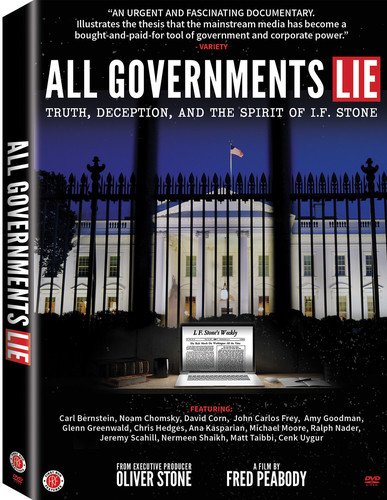
All things being equal, a democratic society thrives best when speech is as free as possible, trusting in the people to sort fact from fiction, and sound theories from blatant propaganda. And there’s the rub: trusting in the people. Because the government doesn’t trust us (remember Hillary Clinton’s comment about all those irredeemable deplorables), even as the government is often at pains to mislead and misinform us. As maverick journalist I.F. “Izzy” Stone said, all governments lie. It’s truly nonsensical, then, to allow the government to police what is true and what is “disinformation.”

But don’t we need some censorship in the name of safety or security or mental health or whatever? Sorry: censorship is rarely about safety, and it most certainly doesn’t serve the needs of the vulnerable. Instead, it serves the needs of the powerful, those who already possess the loudest megaphones in the public square.

But doesn’t someone like Donald Trump deserve to be censored because he spreads disinformation? Which is the bigger problem: Trump or censorship? I happen to think Trump is a divisive con man, but it was a bad precedent for Twitter to have banned him from tweeting. The bigger problem wasn’t Trump’s tweets but the media’s obsessive coverage of them in pursuit of ratings. The way to combat a blowhard like Trump is to ignore him, and to correct him when needed. To combat his lies with the truth. We don’t need a governmental Ministry of Truth to police the tweets of a former president. Not when the government is often the biggest liar.

The solution isn’t censorship but an active, engaged, and informed citizenry, assisted by a fourth estate, the press, that is truly independent and adversarial to power. But the weakening of education in America, combined with a fourth estate that is deeply compromised by the powerful and often in bed with the government, means that these democratic checks on power are less and less effective. Hence calls for quick yet dangerous “solutions” like censorship, where the censors (governmental boards, private corporations) are opaque and almost completely unaccountable to the people.

Unless your goal is to give the already powerful a monopoly on speech, censorship is not the answer.

‘We the People’ Are the New, Permanent Underclass in America

By John W. Whitehead & Nisha Whitehead

Source: The Rutherford Institute

“We are now speeding down the road of wasteful spending and debt, and unless we can escape we will be smashed in inflation.”—Herbert Hoover

This is financial tyranny.

The U.S. government—and that includes the current administration—is spending money it doesn’t have on programs it can’t afford, and “we the taxpayers” are the ones who must foot the bill for the government’s fiscal insanity.

We’ve been sold a bill of goods by politicians promising to pay down the national debt, jumpstart the economy, rebuild our infrastructure, secure our borders, ensure our security, and make us all healthy, wealthy and happy.

None of that has come to pass, and yet we’re still being loaded down with debt not of our own making.

Let’s talk numbers, shall we?

The national debt (the amount the federal government has borrowed over the years and must pay back) is $30 trillion and growing. That translates to roughly $242,000 per taxpayer.

Now the Biden administration is proposing a $5.8 trillion spending budget that notably includes $813 billion for national defense, $30 billion to “fund the police,” and a plan to reduce the national deficit by roughly $1 trillion over 10 years through additional tax hikes.

It’s estimated that the amount this country owes is now 130% greater than its gross domestic product (all the products and services produced in one year by labor and property supplied by the citizens).

The U.S. ranks as the 12th most indebted nation in the world, with much of that debt owed to the Federal Reserve, large investment funds and foreign governments, namely, Japan and China.

Essentially, the U.S. government is funding its very existence with a credit card.

In 2021, we paid more than $562 billion in interest on that public debt, which according to journalist Rob Garver, “is more than the annual budget of every individual federal agency except for the Treasury, the Department of Health and Human Services (which manages the Medicare and Medicaid government health insurance programs), and the Department of Defense.”

According to the Committee for a Reasonable Federal Budget, the interest we’ve paid on this borrowed money is “nearly twice what the federal government will spend on transportation infrastructure, over four times as much as it will spend on K-12 education, almost four times what it will spend on housing, and over eight times what it will spend on science, space, and technology.”

Clearly, the national debt isn’t going away anytime soon, especially not with government spending on the rise and interest payments making up such a large chunk of the budget.

Still, the government remains unrepentant, unfazed and undeterred in its wanton spending.

Indeed, the national deficit (the difference between what the government spends and the revenue it takes in) remains at more than $1.5 trillion.

If Americans managed their personal finances the way the government mismanages the nation’s finances, we’d all be in debtors’ prison by now.

Despite the government propaganda being peddled by the politicians and news media, however, the government isn’t spending our tax dollars to make our lives better.

We’re being robbed blind so the governmental elite can get richer.

We’re not living the American dream. We’re living a financial nightmare.

In the eyes of the government, “we the people, the voters, the consumers, and the taxpayers” are little more than pocketbooks waiting to be picked.

“We the people” have become the new, permanent underclass in America.

Consider: The government can seize your home and your car (which you’ve bought and paid for) over nonpayment of taxes. Government agents can freeze and seize your bank accounts and other valuables if they merely “suspect” wrongdoing. And the IRS insists on getting the first cut of your salary to pay for government programs over which you have no say.

We have no real say in how the government runs, or how our taxpayer funds are used, but we’re being forced to pay through the nose, anyhow.

We have no real say, but that doesn’t prevent the government from fleecing us at every turn and forcing us to pay for endless wars that do more to fund the military industrial complex than protect us, pork barrel projects that produce little to nothing, and a police state that serves only to imprison us within its walls.

If you have no choice, no voice, and no real options when it comes to the government’s claims on your property and your money, you’re not free.

It wasn’t always this way, of course.

Early Americans went to war over the inalienable rights described by philosopher John Locke as the natural rights of life, liberty and property.

It didn’t take long, however—a hundred years, in fact—before the American government was laying claim to the citizenry’s property by levying taxes to pay for the Civil War. As the New York Times reports, “Widespread resistance led to its repeal in 1872.”

Determined to claim some of the citizenry’s wealth for its own uses, the government reinstituted the income tax in 1894. Charles Pollock challenged the tax as unconstitutional, and the U.S. Supreme Court ruled in his favor. Pollock’s victory was relatively short-lived. Members of Congress—united in their determination to tax the American people’s income—worked together to adopt a constitutional amendment to overrule the Pollock decision.

On the eve of World War I, in 1913, Congress instituted a permanent income tax by way of the 16th Amendment to the Constitution and the Revenue Act of 1913. Under the Revenue Act, individuals with income exceeding $3,000 could be taxed starting at 1% up to 7% for incomes exceeding $500,000.

It’s all gone downhill from there.

Unsurprisingly, the government has used its tax powers to advance its own imperialistic agendas and the courts have repeatedly upheld the government’s power to penalize or jail those who refused to pay their taxes.

While we’re struggling to get by, and making tough decisions about how to spend what little money actually makes it into our pockets after the federal, state and local governments take their share (this doesn’t include the stealth taxes imposed through tolls, fines and other fiscal penalties), the government continues to do whatever it likes—levy taxes, rack up debt, spend outrageously and irresponsibly—with little thought for the plight of its citizens.

To top it all off, all of those wars the U.S. is so eager to fight abroad are being waged with borrowed funds. As The Atlantic reports, “U.S. leaders are essentially bankrolling the wars with debt, in the form of purchases of U.S. Treasury bonds by U.S.-based entities like pension funds and state and local governments, and by countries like China and Japan.”

Of course, we’re the ones who will have to repay that borrowed debt.

For instance, American taxpayers have been forced to shell out more than $5.6 trillion since 9/11 for the military industrial complex’s costly, endless so-called “war on terrorism.” That translates to roughly $23,000 per taxpayer to wage wars abroad, occupy foreign countries, provide financial aid to foreign allies, and fill the pockets of defense contractors and grease the hands of corrupt foreign dignitaries.

Mind you, that staggering $6 trillion is only a portion of what the Pentagon spends on America’s military empire.

The United States also spends more on foreign aid than any other nation, with nearly $300 billion disbursed over a five-year period. More than 150 countries around the world receive U.S. taxpayer-funded assistance, with most of the funds going to the Middle East, Africa and Asia. That price tag keeps growing, too.

As Forbes reports, “U.S. foreign aid dwarfs the federal funds spent by 48 out of 50 state governments annually. Only the state governments of California and New York spent more federal funds than what the U.S. sent abroad each year to foreign countries.”

Most recently, in response to Russia’s military aggression against Ukraine, the Biden Administration approved $13.6 billion in military and humanitarian aid for Ukraine, with an additional $200 million for immediate military assistance.

As Dwight D. Eisenhower warned in a 1953 speech, this is how the military industrial complex will continue to get richer, while the American taxpayer will be forced to pay for programs that do little to enhance our lives, ensure our happiness and well-being, or secure our freedoms.

This is no way of life.

Yet it’s not just the government’s endless wars that are bleeding us dry.

We’re also being forced to shell out money for surveillance systems to track our movements, money to further militarize our already militarized police, money to allow the government to raid our homes and bank accounts, money to fund schools where our kids learn nothing about freedom and everything about how to comply, and on and on.

It’s tempting to say that there’s little we can do about it, except that’s not quite accurate.

There are a few things we can do (demand transparency, reject cronyism and graft, insist on fair pricing and honest accounting methods, call a halt to incentive-driven government programs that prioritize profits over people), but it will require that “we the people” stop playing politics and stand united against the politicians and corporate interests who have turned our government and economy into a pay-to-play exercise in fascism.

Unfortunately, we’ve become so invested in identity politics that pit us against one another and keep us powerless and divided that we’ve lost sight of the one label that unites us: we’re all Americans.

Trust me, we’re all in the same boat, folks, and there’s only one real life preserver: that’s the Constitution and the Bill of Rights.

The Constitution starts with those three powerful words: “We the people.”

There is power in our numbers.

As I make clear in my book Battlefield America: The War on the American People and in its fictional counterpart The Erik Blair Diaries, that remains our greatest strength in the face of a governmental elite that continues to ride roughshod over the populace. It remains our greatest defense against a government that has claimed for itself unlimited power over the purse (taxpayer funds) and the sword (military might).

Where we lose out is when we fall for the big-talking politicians who spend big at our expense.

New York Times — a Bastion of Censorship and Corruption — Warns ‘America Has a Free Speech Problem’

The New York Times editorial board recently opined that Americans are losing “the right to speak their minds and voice their opinions,” yet this same newspaper refused to review, or even publish an advertisement for, RFK, Jr.’s runaway bestseller, “The Real Anthony Fauci.”

By Tony Lyons

Source: The Defender

In a bold, but clearly disingenuous, statement from its famed editorial board, “a group of opinion journalists whose views are informed by expertise, research, debate, and certain longstanding values,” The New York Times issued a cautionary statement:

“For all the tolerance and enlightenment that modern society claims, Americans are losing hold of a fundamental right as citizens of a free country: the right to speak their minds and voice their opinions in public without fear of being shamed or shunned.”

The editorial board pounded the point home:

“People should be able to put forward viewpoints, ask questions and make mistakes, and take unpopular but good-faith positions on issues that society is still working through — all without fearing cancellation …. Freedom of speech requires not just a commitment to openness and tolerance in the abstract. It demands conscientiousness…

“We believe it isn’t enough for Americans to just believe in the rights of others to speak freely; they should also find ways to actively support and protect those rights.”

Of course, The New York Times should be leading by example. In fact, it has not supported free speech, protected the First Amendment, or allowed honest debate. It has not allowed competing perspectives about the most important issues of the day.

Instead, it has been a mouthpiece for greedy corporations and corrupt government officials.

In support of the newspaper’s interests, and at the expense of the interests of American citizens, The New York Times censored Robert F. Kennedy, Jr.’s latest book, “The Real Anthony Fauci,” in every conceivable way.

It ranked the book No. 7 on its non-fiction bestseller list even though the book outsold any other book in America that week by thousands of copies.

Then it refused to allow Skyhorse Publishing to place an advertisement for the book because its censorship division, ironically called “Standards Management,” decided the book itself constituted misinformation — despite the paper’s stated policy that “Standards” only looks into whether an ad itself is “non-defamatory and accurate.”

The New York Times followed up with a scathing hit piece targeting Kennedy as “a leading voice in the campaign to discredit coronavirus vaccines and other measures being advanced by the Biden White House to battle a pandemic that was … killing close to 1,900 people a day.”

The Times accused Kennedy of circulating “false information” — without indicating what that information was or explaining why it was false — and of comparing the government pandemic response to the Holocaust, even though he didn’t do that.

Finally, The New York Times refused to review “The Real Anthony Fauci” or so much as comment on its historic grassroots success, even though it’s become a cult classic, selling more than 1 million copies in just four months, and launching a worldwide movement against government corruption and corporate greed.

“Despite all the lying, or maybe in reaction to it,” Tucker Carlson told me, “Robert F. Kennedy, Jr. is becoming a legitimate folk hero.”

He is a folk hero because he stood up, grabbed a bullhorn and spoke truth to power. He’s risked everything. He’s realized that you either care about justice or you care about personal consequences.

And for him there have been many.

After suppressing freedom of speech for two years and defending a specific, myopic and harmful narrative, the editorial board of the New York Times decided it was the perfect time to take a strong stance against censorship and cancel culture.

The irony of the most powerful and high-profile violator of First Amendment rights lamenting the lack of free speech — and offering up ideas to protect the rights of Americans — was palpable, inescapable and despicable.

Like Captain Renault in “Casablanca,” when he closes Rick’s Café Americain and proclaims: “I’m shocked, shocked to find that gambling is going on in here,” The New York Times gladly accepts its winnings.

The paper’s profitability has soared during the worst and most pervasive period of censorship in recent American history. Its owners have done absolutely nothing to protect the free speech rights of hundreds, if not thousands, of doctors, nurses, scientists and concerned citizens who have tried to discuss views, make arguments and analyze scientific studies that challenge the prevailing COVID narrative.

The Times has silenced debate, worked tirelessly to chastise, vilify and discredit those whose positions they disagree with, and failed to investigate serious claims of government corruption.

Nevertheless, the paper claims to lament that “when public discourse in America is narrowed, it becomes harder to answer … the urgent questions we face as a society.”

What could be more important, more urgent, than the truth about corruption at the highest levels of government, about a pandemic response that led to more serious illness and death than was necessary, about the most powerful public health official in the country being more concerned with helping Big Pharma maximize return on investment and mitigate risk to industry, rather than protecting people’s lives?

As The Times wrote, the worst kind of censorship is cancel culture and the worst kind of cancel culture is the “piling on” kind.

Why then, one might ask, did the paper run a hit piece about Robert F. Kennedy, Jr. that covered essentially the same subject matter as a dozen other hit pieces? Why now? Why this target?

His family thinks he’s wrong about vaccines, The Times noted. His friends think he’s wrong about vaccines. Dr. Fauci thinks he’s wrong about vaccines. Ever heard that before?

Any analysis about vaccine safety? Any facts? Any citations? Any discussion of Dr. Fauci’s despicable corruption as described in “The Real Anthony Fauci”?

No, no, no, no and no.

What was The New York Times doing when the whole world was attacking Robert F. Kennedy, Jr.?

Where was The New York Times when Robert F. Kennedy, Jr., Dr. Robert Malone, Dr. Judy Mikovits, Dr. Pierre Kory — and so many other impressive voices — were being stifled?

They were “piling on.” (If The New York Times really wants to do something for free speech, it should publish a book review, finally, of the runaway bestseller — “The Real Anthony Fauci.”)

The Times has stated it won’t “publish ad hominem attacks,” but it does publish hit pieces that any rational person understands are meant to discredit a book they don’t mention and obviously haven’t read.

The Times protects corrupt government officials against the unsuspecting public by forwarding policy statements or official memos their editors and reporters have not thoroughly vetted, investigated or corroborated.

The Times writers and editors are the worst kind of co-conspirators: the kind that claims to be protecting their victims.

The New York Times writes:

“At the individual level, human beings cannot flourish without the confidence to take risks, to pursue ideas and express thoughts that others might reject…. When speech is stifled or when dissenters are shut out of the public discourse, a society also loses its ability to resolve conflict, and it faces the risk of political violence.”

That’s where we are in America today. There is no debate, no public discourse, and we have lost the ability to resolve conflict.

We have separated the country into two Americas, at least partially because of the policies and practices of The New York Times.

The New York Post pointed out that the New York Times “published lies to serve a biased narrative.” The Post accused The Times of “malicious misreporting” and cites a book, “The Grey Lady Winked,” by Ashley Rindsberg.

Rindsberg is quoted as calling The New York Times “a truth-producing machine.” He believes the “fabrications and distortions” they’ve peddled since the 1920s were a system of twisting facts to manipulate public opinion about everything from “Hitler’s Germany and Stalin’s Russia to Vietnam and the Iraq War.”

The “reporting” is designed to “support a narrative aligned with the corporate whims, economic needs and political preferences” of The New York Times, Rindsberg claims. He believes the paper has consistently created “false narratives.”

The New York Post says The Times has the resources to do it:

“With close to $2 billion in annual revenue, the Times has the money, prestige, experience and stature to set the narratives that other news outlets invariably follow.”

Rindsberg alleges a former Times bureau chief in Berlin was a Nazi collaborator and that another star reporter for the paper parroted Soviet propaganda to defend Stalin.

The New York Times coverage in the lead-up to the Vietnam and Iraq wars seemed like government disinformation designed to support going to war.

More recently Rindsberg points to the stories that The New York Times published about Russia putting a bounty on U.S. soldiers in Afghanistan, which the Biden administration later conceded was misinformation, and the story about Capitol Police Officer Brian Sicknick being “murdered by rampaging Trump supporters,” though it was later proven he died of a stroke.

Similarly, Glenn Greenwald accused The New York Times of participating in “one of the most successful disinformation campaigns in modern electoral history.”

The Times, which before the 2020 election dismissed the Hunter Biden laptop as Russian disinformation, recently conceded that it was authentic.

It seems likely The New York Times coverage of the COVID Pandemic isn’t any different than its coverage of Hitler, Stalin, Vietnam, the Iraq War, January 6, the Russian bounty on American soldiers or the Hunter Biden laptop.

Like most of the major Big Tech platforms, The New York Times appears to have worked closely with Dr. Fauci and others, as representatives of the U.S. government, to control and propagate a specific narrative and to do what the government can’t legally do itself — censor ideas that it disagrees with or narratives that might be harmful to its corporate partners.

As discussed above, The New York Times actively suppressed Robert F. Kennedy, Jr.’s book and his allegations of corruption against Dr. Anthony Fauci. It defended Dr. Fauci without any investigation, without a full, free and fair discussion of what is clearly the most important book of the decade.

By ignoring Kennedy’s book, by refusing to review it, by not allowing advertisements, by misrepresenting its success on its bestseller list, the paper clearly did everything in its power to avoid any debate whatsoever about the real science behind the origins of COVID or the best practices for controlling the virus and protecting the public.

The New York Times has shown a total disregard for the scientific process, individual due process rights or for any real search for truth.

And, once again, it did all this while lecturing us about the importance of free speech.

We have arrived at George Orwell’s “1984.” Doublespeak is the universal language. The paper of record floods the world with disinformation, claims to be working tirelessly to protect the American people and has clearly become The Ministry of Truth.

Reading Robert F. Kennedy, Jr.’s book, “The Real Anthony Fauci” — the book Big Pharma, Dr. Fauci, the U.S. government and The New York Times will do absolutely anything to prevent you from reading — has become an act of rebellion, a blow to fascism and a clear message that censorship in America just doesn’t work.

Tony Lyons, president and publisher at Skyhorse publishing, and an attorney, was publisher at The Lyons Press between 1997 and 2004. He founded Skyhorse Publishing in 2006 and has been involved with every aspect of the book publishing process.