
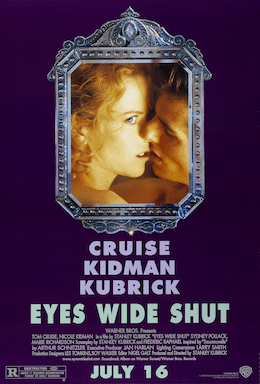
Saturday Matinee: Eyes Wide Shut

By Brian Eggert

Source: Deep Focus Review

Stanley Kubrick spent most of his filmmaking career thinking about how to bring Arthur Schnitzler’s 1926 novella Traumnovelle (Dream Story) to the screen. He deliberated over its dreamlike structure and how to capture the Austrian writer’s text on film. While mulling over the project, he incorporated aspects of its themes and meanings into his other films. And after every completed project, he would consider whether the time was right to finally adapt Traumnovelle. When he eventually made Eyes Wide Shut in 1999, it confounded most moviegoers and critics. Yet, the film secured a place in the unconscious and fostered a lingering fascination for many, often followed by repeat viewings, new assessments, and reconsiderations in the years to come. This was often the pattern with the director’s work, but it was more pronounced with his final film, partly because of its lengthy road to completion. Kubrick had spent years developing a script and making characteristically scrupulous preproduction plans. The eventual shoot became the longest in filmmaking history, amounting to 18 months of exhausting effort, followed by an intense editing process, at the end of which the 70-year-old director died of heart failure. Eyes Wide Shut would amount to a culmination of his lifelong obsessions—his most psychologically complex, formally demanding, and enigmatic piece of filmmaking.

The seed of Eyes Wide Shut began, of course, when Kubrick read Schnitzler’s novella. The text follows Fridolin and Albertine, a Jewish couple in turn-of-the-century Vienna, whose sexual fantasies and jealousy nearly tear them apart. After a Carnival ball, Albertine confesses to having had a lurid fantasy about another man during their recent vacation. In a jealous response, Fridolin sets out on an increasingly dangerous nocturnal odyssey of sexually charged yet decidedly surreal encounters. They culminate with his intrusion into a masked orgy held by an elite secret society that issues a grave warning should he ever reveal what he saw. Whether Fridolin’s sexual adventures are real or merely dreamt remains unclear, but he returns home and confesses what happened to Albertine. The couple finds strength in their new appreciation for the difference between dreams and waking life—and their intersection in fantasies. Serialized in the magazine Die Dame before its publication in book form, Schnitzler’s text was translated into English by Otto P. Schinnerer, titled Rhapsody: A Dream Novel.  

Accounts vary over when Kubrick first read the Schinnerer translation of Traumnovelle. One more frequently circulated story suggests that a shrink gave Kurbrick the book when he was shooting Spartacus (1960). However, the director’s early producing partner, James B. Harris, claims Kubrick had read Schnitzler before they first met in 1955. Whether his access to Traumnovelle came from his father’s extensive library, his time at New York’s City College and Columbia University, or his first wife, Ruth Sobotka, who was interested in Austrian literature, no one can confirm with certainty. Most recent scholarship, including the extensive work by authors Robert P. Kolker and Nathan Abrams in Eyes Wide Shut: Stanley Kubrick and the Making of His Final Film (2019) and Kubrick: An Odyssey (2024), resolve that the director had discovered Schnitzler in the 1950s or earlier. What’s not disputed is that Kubrick nursed lifelong neuroses around jealousy and sex, and Schnitzler’s considerable sex life and fixation on sexuality, introspection, adultery, and seduction emerged in his work. During Kubrick’s first marriage, for instance, he resented his wife’s advanced sexuality. He was jealous, and the notion that a spouse could look at their partner and conceal desire or even an affair horrified him. At the same time, he fantasized about other women yet felt helpless to act, much like Fridolin and the protagonist in Eyes Wide Shut

Early in his career, Kubrick compiled ideas and started developing several inward-looking scripts about marriage, sex, and infidelity to confront his fixations, including screenplays called JealousyThe Married Man, and A Perfect Marriage. None of them materialized, but given his preoccupations, it’s easy to understand what compelled him to adapt Vladimir Nabokov’s Lolita in 1962. Still, Schnitzler was always on his mind, but he could not ignore the challenges of adapting Traumnovelle. In a 1960 interview with The Observer, he made a vague allusion to making a film that sounds like Schnitzler’s work and conveys “the times, psychologically, sexually, politically, personally.” He added, “It’s probably going to be the hardest film to make.” His collaborator and second wife, Christiane Kubrick, also discouraged him from tackling Traumnovelle too early, realizing that the subject would undoubtedly strain their marriage, which was still in its early years after they wed in 1958. Christiane later told critic Richard Schickel that they had numerous arguments about him adapting the Schnitzler story over the years, and her husband took them “as evidence that material so stirring must be worth doing.” 

By the mid-1990s, when the director finally started work on his Schnitzler film in earnest, Kubrick’s adaptation had undergone several false starts. Over the decades, Kubrick met with writers such as Anthony Burgess, John le Carré, Michael Herr, Diane Johnson, and Terry Southern to work out the screenplay. Warner Bros. even announced the project in 1971, when Kubrick had imagined his version of Traumnovelle as a black-and-white sex comedy starring Woody Allen, whose early, funny films the director loved. Then he shifted to Steve Martin, meeting with the comedian from one of his favorite films, The Jerk(1979), to discuss the project. Eventually, he changed his mind and started to explore a more mysterious experience bordering on a thriller, perhaps because Albert Brooks so effectively captured jealousy in his comedy Modern Romance (1981). Brooks plays a film editor who keeps breaking up with his girlfriend because of an irrational, paranoid jealousy, stemming from his own sense of inadequacy. Famously, Kubrick called Brooks to congratulate him on the film and ask him how he conveyed jealousy so well. Transitioning to a serious tone for his adaptation of Traumnovelle, Kubrick wanted the leads to be played by a real-life celebrity couple. He didn’t want the neuroses in the story to be attributed to ethnicity, making the main character’s preoccupations those of a neurotic or Jewish stereotype. By contrast, having an attractive couple—such as Alec Baldwin and Kim Basinger or Bruce Willis and Demi Moore—at the center suggested these problems had more to do with universal emotional concerns that no degree of good looks or success could prevent.

This long-tailed development process was nothing new for the filmmaker. Every Kubrick production from the mid-1960s onward found the director committing years to exhaustive research, sometimes only to have the project fall through. The period between his last two films, Full Metal Jacket (1987) and Eyes Wide Shut, represents his most extended break from actual production in his career. During that time, Kubrick vacillated between potential projects, accumulating vast libraries of research on a Holocaust film based on Louis Begley’s Wartime Lies, a Viking epic based on H. Rider Haggard’s Eric Brighteyes, what would eventually become A.I. Artificial Intelligence(2001), and others. But in 1997, Warner Bros. announced that production would finally get underway on a new Kubrick film, which he wrote alongside Frederic Raphael, the Oscar-winning screenwriter of Darling (1965) and Two for the Road (1967). Throughout the lengthy shoot, even the months immediately following his death, Kubrick’s usual reclusiveness and demand for secrecy during production escalated public curiosity. The facts remained scant. Besides announcing the project’s two leads, Tom Cruise and Nicole Kidman, outlets such as Entertainment Weekly peddled unconfirmed information about the plot, claiming the stars would play “married psychiatrists who become obsessed with two of their patients.”

Kubrick had been in contact with Cruise since the early 1990s about a collaboration. Since the couple’s marriage in 1990, Cruise and Kidman had been the subject of tabloid fodder, from baseless rumors about Cruise’s sexuality and the couple’s status as Scientologists. The former was in the prime of his career, having earned an Oscar nomination for Born on the Fourth of July (1989) and reigning as champion over the North American box office throughout the 1990s. After Kidman starred alongside Cruise in Days of Thunder (1990) and Far and Away (1992), the Aussie performer started to show her range in To Die For (1995) and several Hollywood blockbusters. However, neither of them had done anything like a Kubrick film before. Throughout the extended shoot, which kept the stars from making other projects for almost two years, the media fueled rumors that they were finding Kubrick impossible to work with after supporting actors Harvey Keitel and Jennifer Jason Leigh left the production, their roles filled by Sydney Pollack and Marie Richardson. Reshoots lengthened the actual filming to around 400 days, long for even Kubrick’s typically extended shoots, while post-production took another year. 

All the while, reports of a protracted and troubled production failed to consider Kubrick’s usual painstaking methods, which had gone into overdrive from Kubrick’s decades-long interest in Schnitzler’s novella. His desire to get the story right, after it had consumed him for so many years, doubtlessly inflamed his already extreme meticulousness. In the years following Eye Wide Shut’s release, those involved in the production would tell stories about how Kubrick would demand countless takes, sometimes upward of 100, without offering clear direction. Perhaps he didn’t know what he was looking for until he saw it. Maybe the process broke down the pretenses of his actors, giving his signature detached quality to his performers. As usual, every detail had to be considered, labored over, and selected from thousands of options, evidenced in the endless boxes of photos in the Kubrick archive that informed his preproduction process. Kubrick encouraged Cruise and Kidman to go further than they ever had before to find their characters, from urging them to sleep in their apartment set to dominating their offscreen lives. For their part, the leads went along on the journey, receiving their director’s ideas with an open mind and trusting in his approach, no matter how unconventional or seemingly arbitrary. 

This painstaking endeavor of making Eyes Wide Shut and the resultant expectations it fostered among moviegoers and critics led to another in a long line of Kubrick films that didn’t strike viewers with its full dimension until much later. Each of Kubrick’s projects, from Lolita to Full Metal Jacket, was misunderstood upon its initial release. Only after multiple viewings and a decade or so of consideration are his films declared masterful and placed among the most celebrated examples of cinematic art. Eyes Wide Shut is no exception; it might even be the most pronounced example of this phenomenon of latent appreciation. Upon its release, many of Kubrick’s devoted followers considered the film a disappointment or a dreary finale to a monumental career. It wasn’t until well into the twenty-first century that reassessments of what proves to be his most emotionally confronting picture became more widespread. Complex in structure, bold in subject matter, and, like most Kubrick films, subject to boundless readings and critical analyses, Eyes Wide Shut is one of Kubrick’s most obsessed-over pictures. And for good reason: The story is unusual and meandering; the presentation is among his most unorthodox. The experience might even be impenetrable, except when a viewer pierces its surface and looks deeper, the film supplies rich cinematic nourishment.

The film’s first image is brief and, at first, without context. Opening titles read Cruise, Kidman, and Kubrick’s names. Then, as if our eyes have opened for a momentary peep, the frame reveals a woman, Kidman, from behind. She loosens her dress and drops it to the floor, standing completely, unabashedly naked, as she lifts her feet out and kicks the dress aside. The screen turns black again and reveals the film’s title. In this single shot, the camera’s metaphorical lids open to the image and shut again, acting almost reflexively to expose us to temptation and then immediately take away its unapologetically voyeuristic male gaze. Holding on any longer would be self-indulgent and potentially dangerous. Such themes prevail throughout Eyes Wide Shut, whose very title indicates the waking dream state of a film lingering between reality and reverie. Kubrick may have derived the title from True Lies(1994), another film about jealousy and suspicion within a marriage. He even kept a copy of the screenplay in his office and invited James Cameron to his home to discuss how he made the Arnold Schwarzenegger and Jamie Lee Curtis actioner. As a title, Eyes Wide Shut has the same paradoxical structure as True Lies. Then again, as Kolker and Abrams observe, Kurbrick, who had approached John le Carré to write the script, may have borrowed the phrase from the author’s Tinker, Tailor, Soldier, Spy, where a character named Stanley enters a “honey pot” situation with “eyes wide shut.” 

However the title formed—consciously or not—from other sources, Schnitzler’s novella remained a constant reference point and inspiration for the director. Kubrick takes us into the elegant Central Park West apartment of Dr. Bill Harford (Cruise) and his wife Alice Harford (Kidman), whose characters display marital intimacy, seemingly devoid of secrets—their openness apparent as Alice uses the toilet and Bill checks himself over in the bathroom mirror. Kubrick’s wide-angle lens portrays their impressive dwelling, decorated with paintings by Kubrick’s wife Christiane and her daughter Katharina Hobbs. The camera follows as these two well-dressed, attractive people leave their daughter with the babysitter so they may attend a high-class party on Fifth Avenue hosted by one of Bill’s patients. The millionaire Victor Ziegler (Sydney Pollack) has wealth that makes the Harfords look like middle-class pilot fish swimming with sharks. Production designers Les Tomkins and Roy Walker stage the ball shimmering with interior lights for the holidays, a surreal time of year when everything feels heightened. While the couple dances, Alice wonders if they know anyone at the party. Bill confirms they do not. They’re both out of their depth, and Bill will prove to be increasingly so throughout the ensuing 159 minutes. 

During their dance, Bill notices an old medical school pal, Nick Nightingale (Todd Field), playing piano and leaves Alice to catch up with him. Alice claims she’s going to the restroom but instead heads to the bar, where she meets Sandor Szavost (Sky du Mont), an attractive Hungarian fatcat, who comes on to her during a flirtatious dance. Bill, too, flirts with two models who promise to take him “where the rainbow ends”—a decidedly unattainable place that he never visits, not during that encounter nor any other in the film. Instead, Ziegler needs Dr. Bill upstairs to save an overdosed sex worker (Julienne Davis). After the party, the Harfords return home and channel the evening’s sexual tensions into making love. But the next evening, during another escape from reality, Bill and Alice smoke pot and, clearly influenced, move from verbal foreplay into the film’s most pivotal scene: a dizzying discussion about their flirtations from the night before. All at once, Alice’s tone becomes accusatory—she wants to know why she shouldn’t be jealous of Bill’s flirtation and why Bill isn’t upset about hers. Bill responds that he knows Alice would never be unfaithful because women “just don’t think like that.” Alice reflects, “If you men only knew…” and then proceeds to shut down his claim by recalling, with devastating detail, a memory of a naval officer she once saw and fantasized about during their vacation to Cape Cod.

Before Bill can respond, a call interrupts; he must leave their argument and make a late-night appearance for the family of a deceased patient. Bereaved, Marion (Marie Richardson) welcomes Bill and, having apparently harbored a sexual obsession with him, kisses him and confesses her love mere feet away from the corpse of her deceased father. However comically awkward, the moment confirms Alice’s claim for Bill—women do think like that, a realization that twists the knife of Alice’s confession. When Bill leaves Marion’s apartment, a group of hypermasculine college goons body check him and lash out with homophobic slurs. Afterward, humiliated and emasculated, Bill wanders the city on a series of sexual misadventures. Kubrick’s dark humor emerges in these scenes, as almost everyone Bill encounters—male and female—makes a sexual advance toward him. But, out of his depth, none of his potential trysts work out. Bill, it seems, isn’t even sure how to be unfaithful. A sex worker named Domino (Vinessa Shaw) picks him up, brings him back to her apartment, and asks him what kind of “fun” he wants. Uncertain, he asks, “What would you recommend?” And then his conscience returns when his cell phone buzzes, and it’s Alice on the other end. Instead of following through with Domino, he imagines his wife and the naval officer together—a black-and-white film playing in his mind incessantly. Kubrick refused to allow Cruise on the set when Kidman shot the monochrome sequence and forbade her from telling  her husband what was filmed, hoping Cruise’s uncertainty and jealousy might come through in his performance. 

During Bill’s late-night walks, the artifice of Eyes Wide Shut becomes increasingly conspicuous. Bill walks down the same city streets, constructed via immaculately detailed but wholly unreal sets in England’s Pinewood Studios, all radiant with deep underlighting from the Christmastime setting and sometimes rear-projected behind Cruise. Re-creating New York, a necessity because Kubrick refused to leave his England home, enhances the dreamlike aura of his mise-en-scène. While filming Full Metal Jacket, a production that led to him recreating a wartorn Vietnam wasteland in England, Kubrick remarked, “Sometimes it is easier to build ‘reality’ than go to it.” He applied that philosophy to Eyes Wide Shut. Based on thousands of photographs, measurements, and actual props from New York, Kurbrick’s production designers and set dressers built four blocks of convincing Greenwich Village locations on the Pinewood backlot. The studio shoot gave Kubrick complete control over the unpredictable lighting conditions, shooting, and design. For Kubrick, the set also supplied him with a memoryscape, drawing on details from his time living in New York City—many of which no longer existed. Kolker and Abrams called the setting “an expatriate’s dream of the New York he once knew.” But the effect, surely intended, imbues the faux nocturnal world Bill explores with the unreal textures of a waking, psychosexual dream shaped by his jealousy.  

While walking down one of these streets, reeling from his unfulfilled sexual temptations, Bill meets up with his old friend Nightingale after his set at a jazz club. Nightingale confesses that he has another late-night gig— a hush-hush event at an unknown location—where he plays blindfolded. Once, Nightingale laughs, he caught a glimpse of naked women everywhere. Intrigued, Bill insists on crashing the party and pries details from his friend. He sets out to rent the required cloak and mask costume and takes a cab to a Gothic mansion in upstate New York. Bill enters and gives the password Nightingale gave him—“Fidelio,” taken from Beethoven’s opera, meaning “faithful.” Standing on the margins, he bears witness to a ritualized orgy, where figures donning grotesque Venetian masks engage in impersonal sexual acts, the participants oddly pantomiming kisses and oral sex through their masks, even at the height of their undulations. One of the naked, masked women, who somehow recognizes Bill behind his disguise, warns him to leave. But Bill does not heed the warning and, soon identified as an interloper, he is captured by the ominous cloaked men behind this proceeding, exposed, and nearly punished. At the last moment, he is “redeemed” by the self-sacrificing woman concerned for his safety. Released and told never to inquire about the evening again, Bill returns home, feeling lucky to be alive.

Despite the presence of sexuality throughout the film, Eyes Wide Shut rarely attempts to be sexy. Instead, the film links Bill’s attempts at illicit sexuality with death: When Bill later returns to Domino’s apartment only to find her roommate, Sally (Fay Masterson), he learns that Domino has just discovered she’s HIV positive—tragic for her; a close call for Bill. When Bill returns his costume to Mr. Milich (Rade Šerbedžija), he finds the renter’s daughter (Leelee Sobieski) has become an exploited victim of her father, who attempts to sell her willing services to Bill. The orgy scene carries a stigma of nightmarish dread followed by a menacing threat. Regardless of the relative omnipresence of nudity and sex in the film, these moments are more about linking unfaithful sexuality with death and apprehension than arousal. Moreover, the film’s sexual scenes away from Alice are not meant to be erotic or real but rather distanced and ethereal, their intimacy and eroticism removed by their participants’ lack of real human connectivity. Cruise’s one brief onscreen sexual encounter with Kidman feels all the more realistic and meaningful by comparison.

When Bill returns to the sanctuary of their marital bed, Alice appears to be having a laughing nightmare. He asks her to tell him about the dream. She weeps as she confesses to a devastating, post-apocalyptic, orgiastic encounter that begins with the dreaded naval officer and escalates into countless men. At the sight of her husband’s presence in the dream, she laughs mockingly. Alice weeps at the cruelty of her unconscious thoughts, and Bill’s wounded ego isn’t helped. The next morning, Bill attempts to follow up with Nightingale but discovers, thanks to a flirtatious hotel clerk (Alan Cumming), that Nightingale was taken away by men early in the morning. Bill returns to the scene of the orgy and stands outside the estate’s front gate, where he’s issued a written warning to stop his inquiries—a moment given a chilling undercurrent from the film’s maddening, repetitive piano score by Jocelyn Pook. Bill soon learns of a reported beauty queen who overdosed and, in the morgue, sees that she was the same woman who saved him at the orgy and whose overdose he treated at Ziegler’s party. As his imagination runs wild, he notices a mysterious man following him. 

Most commonly associated with confident, heroic, save-the-day roles, Cruise plays the weakest and most emotionally vulnerable character of his career in Eyes Wide Shut. Kubrick presents him as an outsider, unable to penetrate the sexual world of the elite class. Despite being a well-paid doctor, he does not know anyone at Ziegler’s party, nor does he qualify for an invite to the orgy. When Bill arrives in a cab at the orgy instead of a limo, he’s instantly outed as someone who doesn’t belong. And so, feeling thoroughly inadequate both sexually and as a member of New York’s high-end social circle, Bill clings to the little authority he has: his medical license and his money. While he attempts to learn about the orgy and what happened to Nightingale, he comically flashes his doctor’s license like a detective’s badge to several thoroughly unimpressed New Yorkers: the costume shop owner, Domino’s roommate, a server in a diner, and the hotel clerk. If that doesn’t work, he dishes out cash to buy their favor, treating everyone as though they have a price. One can guess he imagines himself as an Important Man, yet Alice’s confession and his ejection from the orgy have bruised his ego. In an amusingly cruel streak, Kubrick casts Cruise against type. On the surface, he has all the hallmarks of a successful, good-looking family man. Yet, even as he tries to restore his ego through a meaningless sexual encounter, whether by circumstance or fear, he cannot manage to go through with it, nor can he earn anyone’s respect with his doctor’s badge or wallet full of cash. 

Later, Ziegler requests to see Bill at his obscenely lavish home. Bill’s host awkwardly offers a drink and a game of billiards before revealing he, too, was at the orgy. Ziegler attempts to convince Bill that the night’s theatrics were just that: a show designed to frighten him. He assures Bill that the sex worker’s death was an accidental overdose and that Nightingale is on a plane to his Seattle home. He encourages Bill to leave it alone, explaining that he’s meddling with the lives of influential people. “If I told you some of their names […] I don’t think you’d sleep so well,” he says. Once again, Bill returns home, shaken but also relieved, only to see that Alice has found his missing Venetian mask from the orgy and placed it on his pillow. With this, Bill weeps in a scene mirroring Alice’s earlier dream confession and says he’ll tell her everything. After talking it through, and after Bill apologizes, they come to an understanding: both may have fantasies, but some dreams can be just as dangerous as reality. Hopefully, they can know the difference in the future. And as for their shared cravings for emotionally detached sexuality, Alice offers her four-letter-word solution to reinvigorate their marriage: “Fuck.”

Eyes Wide Shut recognizes the reality of desires and fantasies, conscious and unconscious, while encouraging an open dialogue about them. Themes of masks that conceal true identities, eyes (open and shut), and states of consciousness and dreaming have a symbolic place within the film. Perhaps Kubrick, long happily married to his wife Christiane, sought to complete a sort of testimony to how a strong enough bond can accept the need for detached fantasy but also acknowledge and work through how “No dream is just a dream” within their marriage. Certainly, the coda of the film engrains the filmmaker’s intentions. These intentions may have influenced Kubrick’s choice to cast a real-life couple in the film, and his choice couldn’t have been more correct. Wearing down their superstar gloss with his repeated takes, Kubrick draws profound performances out of his stars, particularly Kidman and her staggering delivery of several long, upsetting monologues in Kubrick’s extended shots. With the pairing of these stars, there’s an undeniable onscreen-offscreen intrigue for the viewer, as we suspect, in some way, the filming has penetrated their married lives to give us some voyeuristic insight (even more so now, after their divorce). Kidman’s peak moment comes the night after Bill’s confession, where she’s shown smoking, her makeup gone, and her eyes bloodshot from crying all night. An unprecedented transformation has taken place: Kidman appears not like a movie star, nor even like her Central Park West elite character, but like a human being stripped of all her veneers to reveal the bare, crushed humanity underneath. 

Warner Bros. marketed the film mainly as a showcase for Cruise and Kidman. Despite rumors to the contrary, these actors gave everything to their director, and their uncanny performances, unique within their respective careers, attest to this. They sacrificed much over two years for what ultimately became an art film, something with which neither performer was familiar. Of course, defining (or not) Schnitzler’s story and Kubrick’s film through advertisements was another matter altogether. The studio’s promotional team loaded the movie trailer with all the signs of an “erotic thriller,” dwelling on dramatic images without dialogue, confident that the “Cruise Kidman Kubrick” names on the screen would be enough to sell the picture. Never mind if it led to audiences having misaligned expectations. To be sure, although it’s intended for mature adults, Eyes Wide Shut does not belong in the thriller genre. With a thriller, Bill’s would-be sexual adventures might amount to something beyond his jealous point of view; the thriller elements would instead be vindicated when Bill uncovers that the orgy was just as dangerous as he suspected, a revelation he never makes. If he uncovers a secret society of rich orgy-goers who rough up a piano player who can’t keep a secret and let a drug-addicted prostitute die, he also falls victim to their ruse. The advertising also ignores the dark humor found in the nightmarish surreality of Bill’s misadventures. But then, the unique tone of Kubrick’s film is difficult to pin down in its entirety, much less so in promotional material.

When Eyes Wide Shut opened in July of 1999, many critics and viewers were baffled or altogether shocked by its displays of sexuality and confronting ruminations on infidelity. Critics wrote positive to lukewarm reviews, but few declared it a landmark. Many cited their aversion to Warner Bros.’s release of an R-rated version into theaters that digitally blocked sexually graphic material cited as problematic by the MPAA—an artistic violation of Kubrick’s final film. Rather than accept box-office death with an NC-17 rating, the studio made the controversial decision for these digital alterations (an alternative considered by Kubrick to earn his contractually obligated R-rating) that placed digital figures in front of sex acts during the film’s orgy sequence. The studio later acknowledged their error and released Kubrick’s uncut version on various home video formats. As always, there were a number of complete dissenters, including Andrew Sarris’ assessment for the New York Observer, which described the film as “control-freak unreality.” Entertainment Weekly’s review thought the film’s revelations were unaffecting. Other critics complained about Kubrick’s intentionally slow pace or deliberately unnatural dialogue delivery by his actors, citing the director’s long-standing detached quality as an encumbrance to enjoying the picture.

Such responses failed to recognize the potential that little of Eyes Wide Shut takes place in what one could call “reality.” Few critics at the time considered this possibility. Kubrick and Frederic Raphael’s screenplay never intended realism, only to closely follow Schnitzler’s “dream novel” and show a world informed by Bill’s jealousy. As a result, Eyes Wide Shut cannot be pigeonholed into a single genre or sole interpretation, just like Kubrick’s pictures from 2001: A Space Odyssey (1968) to Barry Lyndon(1975) to The Shining(1980). Viewers must dissect, interpret, and consider minor behavioral quirks and visual touches, questioning seemingly self-contained scenes and encounters against the larger whole—just as a psychoanalyst would interpret a dream. Kubrick’s faith in his audience’s willingness to investigate themselves for meaning in film is also his most significant characteristic as an artist. He refuses to give answers, inviting viewer participation that often leads to rampant theories and speculation, ensuring his films’ longevity. In Eyes Wide Shut, the viewer must discover where the characters cross the line between dream and reality. That journey of breaking through can be confronting, repulsive, shocking, hilarious, unsettling, and emotionally eviscerating, but never short of engaging. With his posthumous release, accusations of Kubrick’s emotional coldness as a filmmaker have never had a more potent counterargument.

Given the timing of Kubrick’s death and the film’s release a few months later, Eyes Wide Shut would undergo another kind of scrutiny. Kubrick was famous for tinkering with his films immediately after their release and making edits based on initial audience reactions. Some have speculated whether the version released in July of 1999 was what Kubrick would have wanted. Before his death, Kubrick had screened the film for its superstar leads, along with several executives from Warner Bros.—the studio that had honored a long-held deal for the director to work in England, far away from Hollywood, in an unprecedented arrangement that allowed him to have final cut on whatever project he desired. Those in attendance attest to Kubrick’s satisfaction with the film. Kubrick told Jan Harlan, the production’s executive producer and his brother-in-law, that he felt it was his best film to date. Even so, Kubrick’s fervent followers have questioned whether the director would have changed anything about Eyes Wide Shut. Was the movie unfinished, or did Kubrick have more tinkering to do? What would Kubrick have changed? Does it matter? Such theorizing may be indicative of the Kubrick viewer, accustomed to conspiracy theories and mining his work for hidden meaning. But the speculation achieves little beyond indulging the imagination of enthusiasts, some of whom have taken it upon themselves to create fan edits or discredit the film as it exists. 

Whether deemed his final masterpiece, a late-career misfire, or an incomplete film, Eyes Wide Shut is perhaps Stanley Kubrick’s most divisive film. Whereas many of the director’s masterpieces have been canonized in their respective genres—comedy (Dr. Strangelove, 1964), science fiction (2001: A Space Odyssey), war (Full Metal Jacket), horror (The Shining), historical epic (Spartacus)—his final film continues to defy classification and resist the almost universal acclaim given to his other output. Its formal daring, confronting themes, and challenging presentation remain more interpretive and inaccessible than any other film to his name. Given that it preoccupied Kubrick for much of his life and, as argued by many scholars and commentators, supplies a summa to his career-long preoccupations, the film continues to be examined and debated for its portrait of a masculine crisis in the face of female desire, surreal cinemascape, and unconventional filmmaking. Many Kubrick films invite interpretation, particularly those in the second half of his career. But the dreamlike nature of Eyes Wide Shut only amplifies that quality, leaving a rich wellspring that, like Kubrick’s best films, offers a bottomless resource to explore. 


Bibliography:

Chion, Michel. Kubrick’s Cinema Odyssey. British Film Institute, 2001.

Karger, Dave. “Closing their ‘Eyes Wide Shut.’” Entertainment Weekly. 17 October 1997. https://ew.com/article/1997/10/17/closing-their-eyes-wide-shut/. Accessed 14 December 2024.  

Kolker, Robert P., and Nathan Abrams. Eyes Wide Shut: Stanley Kubrick and the Making of this Final Film. Oxford University Press, 2019. 

—. Kubrick: An Odyssey. Pegasus Books, 2024.

Ljujic, Tatjana, et al. (editors). Stanley Kubrick: New Perspectives. Black Dog Press, 2015.

LoBrutto, Vincent. Stanley Kubrick: A Biography. D.I. Fine Books, 1997.

Nelson, Thomas Allen. Kubrick, Inside a Film Artist’s Maze. New and expanded ed. Indiana University Press, 2000.

Sperb, Jason. The Kubrick Facade: Faces and Voices in the Films of Stanley Kubrick. Scarecrow Press, 2006.

Philips, Gene D., editor. Stanley Kubrick: Interviews. University Press of Mississippi, 2001.

Walker, Alexander, et al. Stanley Kubrick, Director: A Visual Analysis. Rev. and expanded. Norton, 1999.


Watch Eyes Wide Shut on tubi here: https://tubitv.com/movies/599629/eyes-wide-shut

Saturday Matinee: The Killing

By Jessica Schneider

Source: automachination

Rare is it that a heist film could yield success through failure. No, I am not talking about the film itself, as The Killing is a near-perfect suspense noir that in many ways transcends its genre, but rather that this perfectly plotted undertaking not only goes awry but still satisfies its viewers. Too often audiences are spoon-fed the suspense, wherein we witness the anti-hero tackle the battle through luck and cleverness, only to get away with it in the end. This, we’ve been trained to believe, is the only way to indulge an audience. Well, Kubrick killed all that with this film (no pun). Indeed, there is no grand sigh at the film’s end.

As his third full-length feature, Stanley Kubrick’s first two films contained varying degrees of quality that, despite their convention, were needed for him to achieve the tautness herein. Finishing at 84 minutes, with the use of perfunctory voiceover, the tone is unemotional, detached. (Rendered by radio announcer Art Gilmore, his voice is 180 from the later 1990s trailers that begin with, ‘In a world…’) Throughout, every move is plotted and carefully crafted. Roger Ebert noted this in his review and correlated the film’s intricacy with that of Kubrick’s chess ability. “The game of chess involves holding in your mind several alternate possibilities. The shifting of one piece can result in a radically different game,” Ebert says.

While the characters do serve as pieces that move the plot—their individuality is not so important given their archetypal nature. George is a gullible, dopey husband who is married to his manipulative, money-hungry wife Sherry who is engaging in an affair with a loser named Val. Johnny (Sterling Hayden) is the plan’s executor who remains steadfast and pugnacious when it suits him, and Nikki, who is paid five grand for rubbing out a horse from the sidelines, is a dope who resorts to racism before he too gets shot while seated within his sports car. We meet the other characters upon being told what their agreements are, and each learns his role as The Killing unfolds—careful deliberation and participation within every motive.

Based on the novel Clean Break by Lionel White, one cannot help but wonder if Kubrick took a mediocre book and made it into a well-executed masterwork. (The Shining, anyone?) Given I have not read the novel, I cannot comment, but The Killing is not only a brilliant title but one that works on both the literal and literary levels. Rather, this is a film about controlled risk and those who wish to engage in it. After all, one can’t be a gambler if one doesn’t love risk, and those who frequent the tracks are most definitely not doing it because of their love of horses.

The character of Johnny, rendered by Sterling Hayden, is effective as Hayden himself who, despite moving cautiously and aggressively, carries his weapon in a large flower box. (Which James Cameron would later utilize in Terminator 2: Judgment Day.) When Johnny finally manages to obtain the money, the bills are treated haphazardly, as many fall to the side of the wide laundry bag. Later, when he stuffs the bills into a large suitcase, the same occurs. It’s as though the prize itself isn’t worth the care and caution of the execution—is it merely about the love of the chase or the love of the dollar bill? How does one operate amid $2 million in cash? Note the final scene at the airport and you will see what I mean.

Criterion is featuring what they call ‘50s Kubrick,’ which consists of four films—his final being his great early achievement, Paths of Glory. Kubrick was only 28 when he directed The Killing and yet this has all the hallmarks of a mature, coherent film. While it does not reach the great emotional depths of the Kirk Douglas classic, The Killing is a masterwork of form and storytelling, and does not, for a moment, hesitate. If you want a film with no fat—this is it. As Ebert eloquently notes, ‘The writing and editing are the keys to how this film never seems to be the deceptive assembly that it is, but appears to be proceeding on schedule, whatever that schedule is.’

Indeed, schedules. The characters punctually do make their time, albeit not always successfully. As example, Nikki proves himself a successful sharpshooter who only gets his demise shortly afterwards. Who are we rooting for, anyway? Should we even care? While I plan to review all four of Kubrick’s ’50s films, I watched The Killing one weekend when I needed something detachable and unemotional. This is not to imply I didn’t care—quite the contrary. Rather, I needed something intricate, and something to study. This, coupled with my love for film noir, deemed it the perfect film for this occasion.

As I noted in my review regarding Kubrick’s first two films, he had to undergo patchwork mediocrity to reach his later ability. Ironically, on the same day of my re-watching The Killing, I also re-watched the 1988 film Die Hard, which is a decently executed thriller with all the ostentatious special effects and annoying character quips. There is no real depth, only a handful of good exchanges, and the contrast between the two films exists within the intelligence—The Killing most certainly has dumb characters, but the mind behind them never deviates from skill. And because The Killing relies heavily on the unfolding of events over the internal doubts of any one character, this is what ranks this film as great, albeit within the noir genre.

The final scene is one to not go overlooked, as Johnny appears at the airport with his wife Fay, and upon not being allowed to carry his suitcase on the plane, he is forced to check it. It is as though we have been waiting for this moment—when the suitcase accidentally opens, and the bills fly about like lost black and white birds. Johnny can’t escape, as the police are onto him. When Fay tells him to run, he responds with, ‘What’s the difference?’ For once, he is without a plan and so he turns around, helpless. The men exit the building and the film ends before they approach him. Johnny, while no longer in control, still maintains his cool. Like losing a game of chess, he will inevitably be rethinking his moves while in jail (presumably) and wondering what he could have done better. Perhaps not booking a flight from California to Boston with the evidence in hand might be a good start.

A Clockwork Orange: Waiting for the Sun

By Doug “Uncola” Lynn

Source: The Burning Platform

Society should not do the wrong thing for the right reason, even though it frequently does the right thing for the wrong reason.

 History has shown us what happens when you try to make society too civilized, or do too good a job of eliminating undesirable elements. It also shows the tragic fallacy in the belief that the destruction of democratic institutions will cause better ones to arise in their place.

Stanley Kubrick on “A Clockwork Orange”, an interview with film critic Michel Ciment

An obscure Texas political consultant named Bill Miller once said “politics is show business for ugly people”.  It’s true for the most part, aside from the consequences.  This is because the theatrics of politicians result in policies that affect the lives of others; often against the will of the governed. In books and movies, however, the characters are much ado about nothing. Until, that is, life imitates art.

So it is with the futuristic dystopian story of “A Clockwork Orange”.  Both the book, by the author Anthony Burgess, and the film by director Stanley Kubrick, serve as moral dilemmas and cautionary tales plumbing such considerations as free will, the duality of mankind, societal anarchy, and the ascendancy of an all-powerful state.

A 1973 review written in Sight and Sound Magazine, stated: “Kubrick has appropriated theme, character, narrative and dialogue from Anthony Burgess’ novel, but the film is more than a literal translation of a construct of language into dramatic-visual form”. Therefore, for that reason, and for others described later, the film will remain this article’s primary focus.

As any perfunctory internet research will show, Stanley Kubrick is known as a visionary artist and director, but also as the subject of multiple conspiracies. In addition to A Clockwork Orange, Kubrick’s oeuvre includes avant-garde films such as Dr. Strangelove, The Shining, 2001 A Space Odyssey, and Eyes Wide Shut; to name a few.  Just as these movies demonstrate the inner workings of mankind operating through the disparate threads which bind reality, so do some claim that a larger picture is presented as well.  The big picture, of course, is said to include conspiratorial clues and undertones in Kubrick’s films ranging from Freemasonry, to America’s alleged faked moon landing, to an occultist global financial elite, and the terrorist attacks of 911 being planned as a world transformational event.

There exist multiple published writings, both online and in print, describing the secret meanings hidden in Kubrick’s movies.  Furthermore, it has been argued that Kubrick’s “somewhat surreal films” appeal to the viewer’s subconscious and, therefore, “lend themselves to this sort of interpretation”.

That is another reason why Kubrick’s film will remain the focus of this essay, as opposed to the novel: Either these alleged conspiracies are imagined in the minds of the viewers, or Kubrick deliberately inserted these elements into his creations.  Given Kubrick’s reputation for perfectionism, one can only conclude the symbolism was specifically placed and for exact reasons.

For example, in Kubrick’s The Shining, there are those who contend it is “laden with symbolism, hidden messages”, and “conspiracy theories”.   In Eyes Wide Shut, some contend it was meant to reveal secret societies and sex-magic by means of “evidence” which includes occult symbolism and references to Ishtar, the ancient Babylonian goddess of fertility, love, war and sex.

In his other films, like 2001 A Space Odyssey, it has been argued the strategic placement of the sun, or other circular lights, were utilized by Kubrick as symbolic movie projectors of sorts, whereby time and events unwind before the audience like a clock.  Additionally, even in movies not directed by Kubrick, there are those who say mirrors are used to demonstrate mind control.  It is a fact both of these visualizations are present in A Clockwork Orange.

Once again, and for all of the reasons delineated heretofore, the following presentation will analyze Kubrick’s film as opposed to the novel from which it derived.  The story, and Kubrick’s alchemy, will then be analyzed through the lens of three separate realities followed by some concluding comments at the very end.

THE UNWINDING

In Kubrick’s A Clockwork Orange, the viewers witness the tragic life and circumstances of a teenager named Alex DeLarge navigating a decadent post-modern world. In the film, Alex is played by the actor Malcolm McDowell.  The story unfolds against the backdrop of a futuristic dystopian society that has descended into anarchy and violence; especially within the younger generation.

The very first scene focuses on the evil-eyed Alex adorned with a black fedora and sunray eyeliner beneath his right eye. As the camera pulls back, the boy is shown with three of his young friends identified in the narrative as “droogs”. The youths are shown sitting in the Korova Milk Bar where they imbibe “Milk Plus”; or milk laced with recreational drugs of various types.

Upon leaving the bar, the boys come across a drunk lying in an alley and singing what Alex calls the songs of the drunk man’s “fathers”.  This implies a line of separation between the previous time and the new; between the old and the young.  This separation of time is actually confirmed when the drunk tells the young hooligans he no longer wants to live in this “stinking world” because there’s “no law and order anymore”, where the young “get onto the old”, and “it’s no world for an old man any longer”.

The boys commence to beat the old boozer senseless.

In the next scene, Alex and his droogs come across a group of five other boys who, on an abandoned theatrical stage, are attempting to rape a young woman.  Seemingly, the stage implies the violence unfolding as melodrama, causing this viewer to question if the descent into societal violence was staged as well?  The boys assaulting the woman were wearing military-style camo clothing and adorned with Nazi accoutrements. Alex taunted them in a near Shakespearean manner, and the rival gangs went to war.  The battle also appeared as theatrically choreographed and was set in sync to Giaochino Rossini’s La Gazza Ladra overture.

In the next scene, we see Alex and his gang fleeing to the countryside in a red sports car, looking very much like four demons racing towards hell.

Chaos ensued until Alex eventually ended up in prison and, thus, in possession of the state.

In prison, Alex sat before an open Bible and fantasized he was a Roman soldier whipping the back of Jesus Christ. His voiceover narration said he didn’t like the New Testament’s “preachy talking” as much as the Old Testament’s violence and sex. He furthermore envisioned slicing open the throats of ancient enemies and later eating grapes fed to him by the naked wives and handmaidens of his vanquished foes.

In the privacy of the facility’s library, Alex petitioned the prison chaplain regarding a new treatment that could help him secure his freedom.  The chaplain informed Alex the new treatment was called the Ludovico Technique and that it was dangerous.  The boy then tells the priest that in spite of any potential danger, he wanted “for the rest of his life to be one act of goodness”.

In response, the chaplain tells Alex that “goodness is chosen” and “when a man cannot choose, he ceases to be a man”.

The next scenes showed a group of prisoners walking outside around a circle on the ground.  Before the men are lined up for inspection, a cadre of dignitaries exit from a long hallway, and walk before the prisoners. In so doing, one man tells the others that, soon, the “prisons will be full of political prisoners” and that the “petty criminals need faster reconditioning”. Standing in line, Alex speaks up and the man selects Alex from the group. The viewer later discovers the man was actually the new Minister of the Interior who was visiting the prison that day.

Soon, Alex is admitted into the Ludovico Treatment Center and begins his reconditioning. He is strapped to a chair with brackets forcing both of his eyes open so they can’t be closed. He then watches violent videos of which he greatly enjoys at first. When a man begins to bleed on screen, Alex’s bloodlust is quenched, and speaking in the Nadsat lingo (a combination of Cockney English and Russian), he says: “It’s funny how the colors of the real world only seem really real when you viddy them on a screen”.

After the first video, another film is shown where a woman in a red wig is being gang-raped. Due to the drugs being injected into Alex’s bloodstream, he begins to feel ill, but he can’t avert his gaze due to the brackets on his eyes. Even trying to move his eyes away, he says: “I still could not get out of the line of fire of this picture”.

In another scene, Alex views another session which consists of Nazis marching, paratroopers jumping, bombs falling, and all to the light and airy melody of Beethoven’s “Ninth Symphony, Fourth Movement”.  When Alex realizes the soundtrack is Beethoven, he begins to scream pitifully, begging the doctors to stop the treatment; because he once enjoyed that music as a free man.

Certainly one of the most challenging and difficult social problems we face today is, how can the State maintain the necessary degree of control over society without becoming repressive, and how can it achieve this in the face of an increasingly impatient electorate who are beginning to regard legal and political solutions as too slow? The State sees the spectre looming ahead of terrorism and anarchy, and this increases the risk of its over-reaction and a reduction in our freedom. As with everything else in life, it is a matter of groping for the right balance, and a certain amount of luck.

Stanley Kubrick on “A Clockwork Orange”, an interview with film critic Michel Ciment

His treatment complete, Alex is then presented to a group of onlookers as the Ministry of Interior addresses the audience.  The man tells them his political party promised Law and Order and “to make the streets safe for ordinary peace-loving citizens“.

In a demonstration that ensues on a raised dais, or stage, in front of the group, Alex is verbally and physically bullied while remaining unable to fight back.  As the bully exits the stage, an overhead spotlight, appearing very much like a film projector, or the sun, follows the man as he bows and waves to the audience.

Next, Alex was presented with a gorgeous, nicely tanned, platinum blonde who stands topless before him wearing only a pair of cotton panties.  As Alex, on his knees, reaches upward to touch her breasts, he becomes sick once again. The blonde then exits the stage similar to the bully, waving and bowing in dramatic fashion.

As the minister touts the new and improved Alex, the boy’s old prison chaplain rises up to challenge him, claiming Alex had been deprived of choice, and that his “reformation is insincere” because his conditioning requires “self-interest merely to avoid pain”. The chaplain then says: “He ceases to be a wrongdoer, he ceases also to be a creature capable of moral choice”.

In response, the Minister exclaims: “We’re not concerned with motives, with the higher ethics; we are concerned only with cutting down on crime and with relieving the ghastly congestions within our prisons”.  He then added:

“He will be your true Christian, ready to turn the other cheek. Ready to be crucified rather than crucify. Sick to the very heart at the thought of even killing a fly. Reclamation. Joy before the angels of God! The point is that it works!”

The State had set Alex free. Literally.  More chaos ensued; but, this time, it is all directed against the boy.  As Alex eventually returns to his old self, and the State even apologizes for not knowing any better, it remains clear the government still views Alex as a political pawn to be played in its next theatrical production.

The viewer is left with the impression of the cycle continuing; or merely more of the same as the sun rises and sets over the spinning world.

Alex is characterised not only by his actions against society, but in the actions of the State against Alex. The two are equated in the film, his charm reproduced in its durance, the principal difference – a perhaps considerable one – in the State’s coarsely institutional and indiscriminately committed immoralities that Alex can only practise on a restricted scale.

  – Daniels, Don. “A Clockwork Orange”,  Sight & Sound, Winter 1973

[A clockwork orange is] an organic entity, full of juice and sweetness and agreeable odor, being turned into an automaton.

 – Burgess, Anthony. 1987 prefatory note to “A Clockwork Orange: A Play With Music”

…the attempt to impose upon man, a creature of growth and capable of sweetness, to ooze juicily at the last round the bearded lips of God, to attempt to impose, I say, laws and conditions appropriate to a mechanical creation, against this, I raise my swordpen–”

  – Burgess, Anthony.  The character F. Alexander, “A Clockwork Orange”, p. 25

Through the Lens of Psychology and Violence, Chemically Enhanced

When I was a young man at college more than three decades ago, I asked one of my friends what he thought of the film A Clockwork Orange.  Now, this guy had a high IQ. When younger, he was identified as a gifted child who then became member of Mensa, and later the dean of the psychology department at a large American university.  I’ve never forgotten his answer. He said: “The future is sex and violence”.

Obviously, both he and Kubrick were proven correct.

Over the past four decades, global academia has made ignorant the youth in Western Societies. Whereas emphasis was once placed on critical thinking, logic, classic literature, science, and math, today’s schools now prioritize identity politics while the youth, especially boys, fall through society’s cracks mesmerized by television, violent video games, and drugs; prescribed or otherwise.

In A Clockwork Orange, Alex and his gang of droogs demonstrated awareness and cleverness, but simultaneously lacked compassion and empathy in ways that were near reptilian. Moreover, Alex’s parents were goofy enablers; the mother in particular, who had purple hair and seemed blind to her son’s evil. They were, in fact, perfect representations of the modern real-world parents who go on television, after their child murders and maims, to say:  “He seemed like such a nice boy. We never saw it coming”.

This has remained true since the Columbine shooters through the most current of events in even the bucolic U.S. Midwestern state of Iowa, where two separate girls were recently brutally assaulted and murdered in as many months.  Both the killers of Mollie Tibbets and Celia Barquin Arozamena were young men in their early twenties.  In the latter case, the murderer, Collin Daniel Richards, admitted he had an urge to rape and kill a woman” and the meme for his Facebook cover page said:  “Let’s go commit a murder”.

Obviously, we no longer live in a Norman Rockwell world.  Even so, we can’t say we weren’t warned by Kubrick in A Clockwork Orange.

The famous psychologist, Sigmund Freud, presented the idea that humans operate by means of a trinity of cognitive processes as follows:  The Id (instincts), Ego (reality) and Superego (morality).  Freud furthermore speculated these three systems (i.e. tripartite) developed at different stages of life.

In the case of Alex in Kubrick’s film, he was representative of the Id, acting out of his desire for childish satisfaction.  It is therefore possible the Ego in the film was represented by the modifying presence of the prison chaplain, and with the State acting as the Superego taming Alex’s Id by means of chemically conditioned censorship of action.

The Id, Ego, and Superego could also be perceived as manifested in the body (impulse), mind/soul (cognitive) and spirit (conscious /law).

As both the film, A Clockwork Orange, and present reality indicate: When balance is lacking, chaos follows in the form of hell on earth.  But, on the other hand, if proper balance can be restored, then both individuals and society are better off.

But what is the proper balance and who decides?  The State?  Or, is there another way to unify mankind into peace and harmony?

By definition, a human being is endowed with free will.  He can use this to choose between good and evil.  If he can only perform good or only perform evil, then he is a clockwork orange–meaning he has the appearance of an organism lovely with colour and juice but is in fact only a clockwork toy to be wound up by God or the Devil or (since this is increasingly replacing both) the Almighty State.  It is as inhumane to be totally good as it is to be totally evil.  The important thing is moral choice.  Evil has to exist along with good, in order that moral choice may operate.  Life is sustained by the grinding opposition of moral entities.

 –  Burgess, Anthony. 1986 introduction to “A Clockwork Orange”

I think this suggests the failure of culture to have any morally refining effect on society. Hitler loved good music and many top Nazis were cultured and sophisticated men but it didn’t do them, or anyone else, much good.

Stanley Kubrick on “A Clockwork Orange”, an interview with film critic Michel Ciment

Through the Lens of the Occult, Sun Worship, and Ancient Knowledge

Again, a simple internet search of “Stanley Kubrick occult” will yield a number of online links and even a book on the topic entitled “Kubrick’s Code: An Examination of Illuminati & Occult Symbolism in Stanley Kubrick’s Films”.  In A Clockwork Orange, specifically, there are those who contend “subliminals” are present therein, including references to MK Ultra/mind control, Freemasonry, Sun/Solar worship, Templar/Iron Cross, Black Sun, the Eye of Horus, and more.

Having personally seen the movie, and recently, I will say these elements are definitely incorporated into the film.  I was intrigued by the “Clockwork Orange as Sun” angle but, upon viewing the movie again, it appeared to me the solar aspect was presented (similar to Kubrick’s other films) as more of a film projector of sorts; whereby the viewers could nearly perceive themselves as projections in the screen, along with the fictional characters, as the story unwound.

A Clockwork Orange.  Mechanical. Circles. Time.

It is also said the sun can affect people’s moods; as does film.

In the earliest written creation epic, the “Enuma Elish”, claimed by some scholars to have influenced the Bible’s Book of Genesis, Marduk is the Babylonian god who defeats the female water god, Tiamat. Marduk is then awarded fifty other names. In Mesopotamia and Sumeria, Marduk is known as the sun gods Shamash and Anu (Utu), respectively.  In Egypt he was worshipped as Ra.

According to ancient lore, Marduk’s act of creation marks the start of time. He was also worshipped as Bel Marduk the God of war.

In the scriptures of Judaism and Christianity, Marduk and Tiamat were first identified as the humans Nimrod (In Genesis, chapter 10, called “a mighty hunter before the Lord”) and his wife Semiramis (later known as the mythological Queen of Heaven).

There are those who say it was Nimrod who established the first state religion by unifying mankind and building a tower in the Tigris/Euphrates region of antiquity.  However, after he incorporated, and then diversified, he went public:

Source

Did it all start on the plains of Shinar after a great flood, when the male sun overcame female water?

In A Clockwork Orange, Alex and his droogs were certainly warlike and sought to ravage the females in their paths.  Moreover, perhaps as another clue, one of the songs on the film’s soundtrack is titled “Overture to the Sun”.

In the scene previously described, when the rival gang was in the act of melodramatically wrestling a woman in order to rape her on a stage, it did appear Kubrick incorporated elements of the “Enuma Elish” into his film: namely the expanse of sky above and a winged sun god overlooking acts of sex and violence (Chaos) below.

Within the occult, there are those identifying the Sun as being a symbol of Lucifer the Light Bringer and with the accompanying “illuminating rays of knowledge”; all supposedly essential to the ancient sun worship cult called “The Illuminati”.

Furthermore, others have connected both Freemasonry and the Illuminati as having originated in ancient Egypt:

Popular history texts and encyclopedias generally paint the Illuminati as having its origins in 1776 Bavaria. However, the origins go back much further. The Illuminati are tied directly through masonry to the sun and Isis cults of ancient Egypt.

Source

In truth, Kubrick’s A Clockwork Orange has more occult symbols than even a U.S. dollar bill; along with specific parallels to Freemasonry.  All of these visuals, like the Eye of Horus right on the money, are hidden in plain sight:

The checkered pattern is found in Freemason lodges and is known as “Moses Pavement” which symbolizes the duality of man.  Of course, the Eye of Horus, snakes, and phalluses, are all symbols of the occult as well.

Why would Kubrick have included these in A Clockwork Orange and, also, in his other films?

Coincidence? Art? Conspiracy?

Let the readers, and viewers, decide.

Additionally, as addressed before, Kubrick’s film does include some peculiar references to Christianity.  Complementing Alex’s aforementioned prison fantasy of being a Roman soldier in the act of whipping Christ, there was an earlier scene in his room where he fondles his pet snake before the snake appeared to act as a phallus between the legs of a naked woman pictured on his wall.  The buttocks of the woman looked to have been held up by the raised arms of four naked Jesus Christ figurines; complete with crowns of thorns.  Then, as a rapturous Alex enjoyed the music of Beethoven in a near masturbatory manner, he envisioned himself a vampire and saw a woman in a white (wedding?) dress being hung by rope, along with fiery explosions and men being crushed by rocks.

These examples, along with the symbols of Alex’s pet snake and the Eye of Horus on his right sleeve and right eye, leave the viewer with the impression the boy’s worldview was nothing short of Luciferian.

Moreover, just as western holidays like Christmas (Sol) and Easter (Ishtar) have their originations in ancient sun worship and female pagan fertility deities, so too, it seems, does A Clockwork Orange.  In another example, one of the droogs in the Korova Milk Bar, with sun/projector overhead, drew milk from the breasts of a replica nymph that he called “Lucy”.

Are all of these occult references designed to point the viewer’s attention towards Lucifer? Was Kubrick trying to warn his audience that the future for both individual and state belonged to Satan? Or, is it possible the director was actually advocating for such?

Either way, Kubrick’s futuristic vision may have been right, on many levels correct, and in more ways, than most people today realize.

Through the Lens of the Established State, Modern Politics , Time, and the Circular Cycles of Man

There are those who have tied Donald Trump to Kubrick’s A Clockwork Orange:

And, paradoxically, it now appears the Satanists are even threatened by The Orange Jesus as they seek to convert the younger generation.

Founded in 2012, The Satanic Temple (not to be confused with the Church of Satan) is a non-theistic organization that has gained prominence since President Trump’s election. The group reported it gained “thousands of new members” after Trump won the presidential race.

…Since the election, The Satanic Temple has launched multiple campaigns aimed at challenging Christian influence in the political sphere. One example is their After School Satan Clubs.

Obviously those on the Political Left, and some in the middle, view Trump as similar to the right-wing, authoritarian (law and order) party in Kubrick’s film; who brainwashed naive dupes into supporting misguided policies. Yet, to the other half of the audience watching the political theater on their screens, it appears that Trump is more comparable to Alex; who, after creating carnage in the proverbial political swamp, is now undergoing reeducation by the Established State right before their very eyes.

Could Kubrick have foreseen the inevitability of time’s passage delivering an Orange Reality TV Star to the world stage? It’s doubtful, because he didn’t write the book.  Even so, is it still possible that Trump is a clockwork man, arriving right on schedule?

Since the times of the first songs, the elite have cynically oppressed the proles while telling them it’s for their own good; for their safety, or for the good of Mankind overall.  That is the commonality of gangsters, thugs, neocons, corrupt politicians, fascists, and tyrannical collectivists. They abrogate timeless moral principles for their own benefit and tell us it’s for ours.

In the narrative of A Clockwork Orange, there is a contrarian to the current government, an author, who played dual roles in the film’s plot. Towards the end, he argues on the telephone with an unseen coconspirator that “the common people must not sell liberty for a quieter life”.

Yet, isn’t that what we’ve done today in the once free nations of the western world?

In many ways, A Clockwork Orange is a mirrored representation of modern America.  In the movie, a right-wing party is the established power suppressing the rights of commoners in order to sustain its continuity of control; and the media, and opposition party, were fighting on the side of liberty.

Paradoxically, in the real world currently, the media, the Political Left, and lukewarm conservatives, are in singularity with the Established State; as Trump and his Deplorables wreak havoc before the global towers of power.

Based upon raw intuition, instinct, and Tweets, Trump is the political manifestation of Freud’s Id.  Therefore, he and his gang of supporters must be reformed via electronic programming and conditioning (punishment and reward) by the state as it seeks to secure its everlasting continuity.

Play ball and society will experience harmony, but only on the state’s terms.  Disobey at your own peril. This is one of the themes in A Clockwork Orange.   Other undertones of the film speak to secrecy, smoke, mirrors, and mind control, where the state vanquishes the violent urges of its citizens by creating a new reality via cyclical, or looped, feedback.  Consensus will be manufactured and contrarian views need not apply.  Not acceptable? No problem. The state has a pill for that.

As humans, we have free will, and that is a right that cannot be denied to us.  The Ludovico Technique represents the government’s, or any authority figure’s, interference with our personal liberties, and the dangers of these interferences. The battle of good versus evil is presented an innumerable amount of times in literature and cinema–but A Clockwork Orange puts a twist on this common theme.  Which is worse, chosen evil or forced good?  According to A Clockwork Orange, chosen evil is the lesser evil, because it demonstrates it allows us a choice.  If humans lose moral choice, they become machines.  Free will to choose between good and evil is the central theme and message in A Clockwork Orange.

Source

Whether or not Trump is real or just an actor, like in Kubrick’s films, he has revealed certain realities. The fact remains the state does not now endorse free will and it has, instead, resorted to electronic conditioning to form its new reality.

This will work until it doesn’t. Then the process begins again, just has it always has throughout history; as predictable as seasons, or the sun crossing the sky.

Conclusion

In researching this article, and Stanley Kubrick’s life’s work, I discovered many websites that were a strange combination of profoundly perceptive insights, unique observations, and batshit craziness.  But one interesting theme presented in Kubrick’s storytelling is the idea of mankind’s Odyssey:  Seeking meaning through faith, action, and fortune, upon the world stage; overcoming base instincts, then rising on a tide of reason and rationality, before the cycle rounds another bend and mankind falls again.

When watching A Clockwork Orange, the viewer is forced to consider the ironies of individual and state. In turn, this blogger now questions if both entities are not merely two parallel paths to hell on earth.

The sun rises and sets on individuals and nations alike. Yet, throughout history, Man’s Id was successfully moderated at times by his Ego and Superego thus allowing, for the most part, periods of equilibrium and justice; even if only for a season.

Fate or free will? That is the question. Given the cycles of history, where does hope now reside?  Why would anyone have optimism at all?

In A Clockwork Orange, the Ludovico Technique was meant to fix dystopia’s problems.  Today, in the real world, it is media narratives that are meant to address what ails us. Unfortunately, however, these are twin movies unspooling separately and all at once. In turn, it means certain worldviews must be reprogrammed, as it were.

This explains why social media companies are purging “incorrect thinkers” on their respective platforms. They are viewed as subversive moles, and petty criminals, damaging the fertile ground of the new world order.

It’s also why a bogus Russian dossier was utilized to derail the Orange Criminal.  One wonders if he was wound up as part of a plan to place asunder the old ways; like the tide rolling out before the dawn of a new day.

The lesson learned from A Clockwork Orange is to beware the algorithmic hammers of conformity; always watching, ever ready, and waiting to shine down from on high; ceaselessly smiling, shaking hands, and kissing babies on the way.

Before new experiments and orthodoxies can be tried, there must be good reasons to do so.  For out of chaos comes creation.  The circle runs like clockwork and always on time.

The Id of Man will be tempered by a new religion; or perhaps an old one by another name.

You Want a Picture of the Future? Imagine a Boot Stamping on Your Face

By John W. Whitehead

Source: The Rutherford Institute

“The Internet is watching us now. If they want to. They can see what sites you visit. In the future, television will be watching us, and customizing itself to what it knows about us. The thrilling thing is, that will make us feel we’re part of the medium. The scary thing is, we’ll lose our right to privacy. An ad will appear in the air around us, talking directly to us.”—Director Steven Spielberg, Minority Report

We have arrived, way ahead of schedule, into the dystopian future dreamed up by such science fiction writers as George Orwell, Aldous Huxley, Margaret Atwood and Philip K. Dick.

Much like Orwell’s Big Brother in 1984, the government and its corporate spies now watch our every move.

Much like Huxley’s A Brave New World, we are churning out a society of watchers who “have their liberties taken away from them, but … rather enjoy it, because they [are] distracted from any desire to rebel by propaganda or brainwashing.”

Much like Atwood’s The Handmaid’s Tale, the populace is now taught to “know their place and their duties, to understand that they have no real rights but will be protected up to a point if they conform, and to think so poorly of themselves that they will accept their assigned fate and not rebel or run away.”

And in keeping with Philip K. Dick’s darkly prophetic vision of a dystopian police state—which became the basis for Steven Spielberg’s futuristic thriller Minority Report which was released 15 years ago—we are now trapped into a world in which the government is all-seeing, all-knowing and all-powerful, and if you dare to step out of line, dark-clad police SWAT teams and pre-crime units will crack a few skulls to bring the populace under control.

Minority Report is set in the year 2054, but it could just as well have taken place in 2017.

Seemingly taking its cue from science fiction, technology has moved so fast in the short time since Minority Report premiered in 2002 that what once seemed futuristic no longer occupies the realm of science fiction.

Incredibly, as the various nascent technologies employed and shared by the government and corporations alike—facial recognition, iris scanners, massive databases, behavior prediction software, and so on—are incorporated into a complex, interwoven cyber network aimed at tracking our movements, predicting our thoughts and controlling our behavior, Spielberg’s unnerving vision of the future is fast becoming our reality.

Both worlds—our present-day reality and Spielberg’s celluloid vision of the future—are characterized by widespread surveillance, behavior prediction technologies, data mining, fusion centers, driverless cars, voice-controlled homes, facial recognition systems, cybugs and drones, and predictive policing (pre-crime) aimed at capturing would-be criminals before they can do any damage.

Surveillance cameras are everywhere. Government agents listen in on our telephone calls and read our emails. Political correctness—a philosophy that discourages diversity—has become a guiding principle of modern society.

The courts have shredded the Fourth Amendment’s protections against unreasonable searches and seizures. In fact, SWAT teams battering down doors without search warrants and FBI agents acting as a secret police that investigate dissenting citizens are common occurrences in contemporary America.

We are increasingly ruled by multi-corporations wedded to the police state. Much of the population is either hooked on illegal drugs or ones prescribed by doctors. And bodily privacy and integrity has been utterly eviscerated by a prevailing view that Americans have no rights over what happens to their bodies during an encounter with government officials, who are allowed to search, seize, strip, scan, spy on, probe, pat down, taser, and arrest any individual at any time and for the slightest provocation.

All of this has come about with little more than a whimper from a clueless American populace largely comprised of nonreaders and television and internet zombies. But we have been warned about such an ominous future in novels and movies for years.

The following 15 films may be the best representation of what we now face as a society.

Fahrenheit 451 (1966). Adapted from Ray Bradbury’s novel and directed by Francois Truffaut, this film depicts a futuristic society in which books are banned, and firemen ironically are called on to burn contraband books—451 Fahrenheit being the temperature at which books burn. Montag is a fireman who develops a conscience and begins to question his book burning. This film is an adept metaphor for our obsessively politically correct society where virtually everyone now pre-censors speech. Here, a brainwashed people addicted to television and drugs do little to resist governmental oppressors.

2001: A Space Odyssey (1968). The plot of Stanley Kubrick’s masterpiece, as based on an Arthur C. Clarke short story, revolves around a space voyage to Jupiter. The astronauts soon learn, however, that the fully automated ship is orchestrated by a computer system—known as HAL 9000—which has become an autonomous thinking being that will even murder to retain control. The idea is that at some point in human evolution, technology in the form of artificial intelligence will become autonomous and that human beings will become mere appendages of technology. In fact, at present, we are seeing this development with massive databases generated and controlled by the government that are administered by such secretive agencies as the National Security Agency and sweep all websites and other information devices collecting information on average citizens. We are being watched from cradle to grave.

Planet of the Apes (1968). Based on Pierre Boulle’s novel, astronauts crash on a planet where apes are the masters and humans are treated as brutes and slaves. While fleeing from gorillas on horseback, astronaut Taylor is shot in the throat, captured and housed in a cage. From there, Taylor begins a journey wherein the truth revealed is that the planet was once controlled by technologically advanced humans who destroyed civilization. Taylor’s trek to the ominous Forbidden Zone reveals the startling fact that he was on planet earth all along. Descending into a fit of rage at what he sees in the final scene, Taylor screams: “We finally really did it. You maniacs! You blew it up! Damn you.” The lesson is obvious here, but will we listen? The script, although rewritten, was initially drafted by Rod Serling and retains Serling’s Twilight Zone-ish ending.

THX 1138 (1970). George Lucas’ directorial debut, this is a somber view of a dehumanized society totally controlled by a police state. The people are force-fed drugs to keep them passive, and they no longer have names but only letter/number combinations such as THX 1138. Any citizen who steps out of line is quickly brought into compliance by robotic police equipped with “pain prods”—electro-shock batons. Sound like tasers?

A Clockwork Orange (1971). Director Stanley Kubrick presents a future ruled by sadistic punk gangs and a chaotic government that cracks down on its citizens sporadically. Alex is a violent punk who finds himself in the grinding, crushing wheels of injustice. This film may accurately portray the future of western society that grinds to a halt as oil supplies diminish, environmental crises increase, chaos rules, and the only thing left is brute force.

Soylent Green (1973). Set in a futuristic overpopulated New York City, the people depend on synthetic foods manufactured by the Soylent Corporation. A policeman investigating a murder discovers the grisly truth about what soylent green is really made of. The theme is chaos where the world is ruled by ruthless corporations whose only goal is greed and profit. Sound familiar?

Blade Runner (1982). In a 21st century Los Angeles, a world-weary cop tracks down a handful of renegade “replicants” (synthetically produced human slaves). Life is now dominated by mega-corporations, and people sleepwalk along rain-drenched streets. This is a world where human life is cheap, and where anyone can be exterminated at will by the police (or blade runners). Based upon a Philip K. Dick novel, this exquisite Ridley Scott film questions what it means to be human in an inhuman world.

Nineteen Eighty-Four (1984). The best adaptation of Orwell’s dark tale, this film visualizes the total loss of freedom in a world dominated by technology and its misuse, and the crushing inhumanity of an omniscient state. The government controls the masses by controlling their thoughts, altering history and changing the meaning of words. Winston Smith is a doubter who turns to self-expression through his diary and then begins questioning the ways and methods of Big Brother before being re-educated in a most brutal fashion.

Brazil (1985). Sharing a similar vision of the near future as 1984 and Franz Kafka’s novel The Trial, this is arguably director Terry Gilliam’s best work, one replete with a merging of the fantastic and stark reality. Here, a mother-dominated, hapless clerk takes refuge in flights of fantasy to escape the ordinary drabness of life. Caught within the chaotic tentacles of a police state, the longing for more innocent, free times lies behind the vicious surface of this film.

They Live (1988). John Carpenter’s bizarre sci-fi social satire action film assumes the future has already arrived. John Nada is a homeless person who stumbles across a resistance movement and finds a pair of sunglasses that enables him to see the real world around him. What he discovers is a world controlled by ominous beings who bombard the citizens with subliminal messages such as “obey” and “conform.” Carpenter manages to make an effective political point about the underclass—that is, everyone except those in power. The point: we, the prisoners of our devices, are too busy sucking up the entertainment trivia beamed into our brains and attacking each other up to start an effective resistance movement.

The Matrix (1999). The story centers on a computer programmer Thomas A. Anderson, secretly a hacker known by the alias “Neo,” who begins a relentless quest to learn the meaning of “The Matrix”—cryptic references that appear on his computer. Neo’s search leads him to Morpheus who reveals the truth that the present reality is not what it seems and that Anderson is actually living in the future—2199. Humanity is at war against technology which has taken the form of intelligent beings, and Neo is actually living in The Matrix, an illusionary world that appears to be set in the present in order to keep the humans docile and under control. Neo soon joins Morpheus and his cohorts in a rebellion against the machines that use SWAT team tactics to keep things under control.

Minority Report (2002). Based on a short story by Philip K. Dick and directed by Steven Spielberg, the setting is 2054 where PreCrime, a specialized police unit, apprehends criminals before they can commit the crime. Captain Anderton is the chief of the Washington, DC, PreCrime force which uses future visions generated by “pre-cogs” (mutated humans with precognitive abilities) to stop murders. Soon Anderton becomes the focus of an investigation when the precogs predict he will commit a murder. But the system can be manipulated. This film raises the issue of the danger of technology operating autonomously—which will happen eventually if it has not already occurred. To a hammer, all the world looks like a nail. In the same way, to a police state computer, we all look like suspects. In fact, before long, we all may be mere extensions or appendages of the police state—all suspects in a world commandeered by machines.

V for Vendetta (2006). This film depicts a society ruled by a corrupt and totalitarian government where everything is run by an abusive secret police. A vigilante named V dons a mask and leads a rebellion against the state. The subtext here is that authoritarian regimes through repression create their own enemies—that is, terrorists—forcing government agents and terrorists into a recurring cycle of violence. And who is caught in the middle? The citizens, of course. This film has a cult following among various underground political groups such as Anonymous, whose members wear the same Guy Fawkes mask as that worn by V.

Children of Men (2006). This film portrays a futuristic world without hope since humankind has lost its ability to procreate. Civilization has descended into chaos and is held together by a military state and a government that attempts to keep its totalitarian stronghold on the population. Most governments have collapsed, leaving Great Britain as one of the few remaining intact societies. As a result, millions of refugees seek asylum only to be rounded up and detained by the police. Suicide is a viable option as a suicide kit called Quietus is promoted on billboards and on television and newspapers. But hope for a new day comes when a woman becomes inexplicably pregnant.

Land of the Blind (2006). This dark political satire is based on several historical incidents in which tyrannical rulers were overthrown by new leaders who proved just as evil as their predecessors. Maximilian II is a demented fascist ruler of a troubled land named Everycountry who has two main interests: tormenting his underlings and running his country’s movie industry. Citizens who are perceived as questioning the state are sent to “re-education camps” where the state’s concept of reality is drummed into their heads. Joe, a prison guard, is emotionally moved by the prisoner and renowned author Thorne and eventually joins a coup to remove the sadistic Maximilian, replacing him with Thorne. But soon Joe finds himself the target of the new government.

All of these films—and the writers who inspired them—understood what many Americans, caught up in their partisan, flag-waving, zombified states, are still struggling to come to terms with: that there is no such thing as a government organized for the good of the people. Even the best intentions among those in government inevitably give way to the desire to maintain power and control at all costs.

Eventually, as I point out in my book Battlefield America: The War on the American People, even the sleepwalking masses (who remain convinced that all of the bad things happening in the police state—the police shootings, the police beatings, the raids, the roadside strip searches—are happening to other people) will have to wake up.

Sooner or later, the things happening to other people will start happening to us and our loved ones.

When that painful reality sinks in, it will hit with the force of a SWAT team crashing through your door, a taser being aimed at your stomach, and a gun pointed at your head. And there will be no channel to change, no reality to alter, and no manufactured farce to hide behind.

As George Orwell warned, “If you want a picture of the future, imagine a boot stamping on a human face forever.”