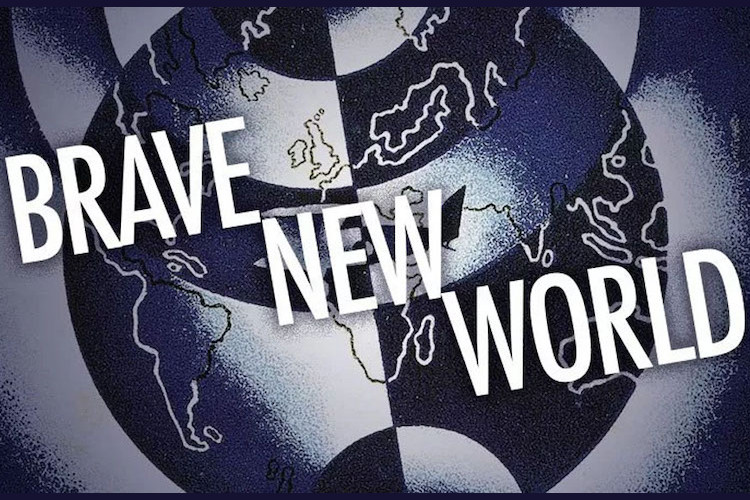
WHO WILL BE ‘BRAVE’ IN HUXLEY’S NEW WORLD?

By John W. Whitehead & Nisha Whitehead

Source: Waking Times

“ ‘Science?’….’Yes,’ Mustapha Mond was saying, ‘that’s another item in the cost of stability. It isn’t only art that’s incompatible with happiness; it’s also science. Science is dangerous; we have to keep it most carefully chained and muzzled…I’m interested in truth, I like science. But truth’s a menace, science is a public danger. As dangerous as it’s been beneficent. It has given us the stablest equilibrium in history…But we can’t allow science to undo its own good work. That’s why we so carefully limit the scope of its researchers…We don’t allow it to deal with any but the most immediate problems of the moment. All other enquiries are most sedulously discouraged…Our Ford himself did a great deal to shift the emphasis from truth and beauty to comfort and happiness…[but] People still went on talking about truth and beauty as though they were the sovereign goods. Right up to the time of the Nine Years’ War. That made them change their tune all right. What’s the point of truth or beauty or knowledge when the anthrax bombs are popping all around you? That was when science first began to be controlled – after the Nine Years’ War. People were ready to have even their appetites controlled then. Anything for a quiet life. We’ve gone on controlling ever since. It hasn’t been very good for truth, of course. But it’s been very good for happiness. One can’t have something for nothing. Happiness has got to be paid for. You’re paying for it, Mr. Watson – paying because you happen to be too much interested in beauty. I was too much interested in truth; I paid too.’ “ ~Aldous Huxley’s Brave New World

Where does one start in discussing the famed fiction novel of Huxley? Although most agree that there is a definite brilliance to the piece, most are also confused as to what was Huxley’s intention in writing the extremely influential dystopic vision. Was it meant to be taken as an exhortation? An inevitable prophecy? Or rather…was it meant as an Open Conspiracy?

What do I mean by an Open Conspiracy?

If we are going to talk about such things our story starts with H.G. Wells, whom Aldous acknowledged he was most certainly influenced by, particularly by Wells’ novels “A Modern Utopia,” “The Sleeper Awakes,” and “Men Like Gods,” when writing his “Brave New World.”

Although Aldous is quoted as referring to Wells as a “horrid, vulgar little man,” (Wells was indeed not a very likeable individual) it was not for reasons one might first assume. Aldous did share a Wellsian perspective in that society should be organised based on a caste system. Perhaps this was one of the reasons Aldous was so fascinated with learning about India’s Hindu religious beliefs and practices, which had coexisted for centuries with a deeply ingrained caste system to which India is still struggling to remove itself from to this day. This is not to say that one caused the other, or that Hinduism has not offered a plethora of great works and insights, but that it had become corrupted and thoroughly intertwined with upholding India’s caste system at some point one cannot deny; that it was used to justify a system of hierarchy from slave to the god-like state of a Brahmin and that British imperialists had always been greatly fascinated by this form of social organization one cannot deny.

Aldous was always interested in the subject of religion, but more so for its uses in behaviourism and mental conditioning achieved through such techniques as entering states of trance where an individual’s suggestibility could be manipulated. Hypnopædia was not just some quirky sci-fi concoction. It is also why Aldous was so interested in the work of Dr. William Sargant, whom Aldous repeatedly refers to in his writings and lectures and who was involved with the Tavistock Institute and MKUltra. More on this in Part two.

These spiritual/religious studies are what shaped the core thesis of Aldous’ book “Doors of Perception” which is considered the instruction manual for what started the counterculture movement. The title is influenced by the poet William Blake who wrote in 1790 in his book “The Marriage of Heaven and Hell,”:

if the doors of perception were cleansed then everything would appear to man as it is, Infinite. For man has closed himself up, till he sees all things through narrow chinks of his cavern

Another major influence for “Doors of Perception” was again H.G. Wells, from his book “The Door in the Wall,” which examines the contrast between aesthetics and science and the difficulty in choosing between them. The protagonist Lionel Wallace is unable to bridge the gap between his imagination and his rational, scientific side which leads to his death.

Aldous writes in his “Doors of Perception,”:

That humanity at large will ever be able to dispense with Artificial Paradises seems very unlikely…Art and religion, carnivals and saturnalia [ancient Roman pagan festival], dancing and listening to oratory – all these have served, in H.G. Wells’s phrase, as Doors in the Wall…Under a more realistic, a less exclusively verbal system of education than ours, every Angel (in Blake’s sense of that word) would be permitted as a sabbatical treat, would be urged and even, if necessary, compelled to take an occasional trip through some chemical Door in the Wall into the world of transcendental experience. If it terrified him, it would be unfortunate but probably salutary. If it brought him a brief but timeless illumination, so much the better. In either case the Angel might lose a little of the confident insolence sprouting from systematic reasoning and the consciousness of having read all the books…But the man who comes back through the Door in the Wall will never be quite the same as the man who went out…

Aldous was always chasing the perfect drug that would be minimal in its physically destructive effects but would allow an individual to tap into an almost consumer state of a religious/spiritual out-of-body experience, a transcendence that promised a connection with the Infinite, inner peace and enlightenment.

Enlightenment and inner peace in a pill, ready for whenever one needed a short holiday from the “illusion” of reality.

The name Soma, which Aldous used to name his fantasy ideal drug in “Brave New World,” was based off a plant whose juices were used to create the spiritual drink which was described in both the ancient religious practices of the Vedic tradition and Zoroastrianism, which called the plant and spiritual drink by the same name, Soma. Today, it is a mystery as to what plant they were referring to in these texts. Huxley no doubt chased after this dragon the entire latter half of his life, and indeed, psilocybin mushrooms are theorised as one of the potential candidates for what could have been named Soma centuries ago.

It is perhaps here that people are the most confused about the character of Huxley. After all, he was obviously walking the walk so to speak, thus didn’t he truly believe that psychedelics were the path to freedom through enlightenment?

Well, the argument has been made that Huxley’s approach to LSD [and other psychedelics] was essentially oligarchic, that it was to be regarded as a dangerous substance to be sampled only by such fine and visionary minds as his own. That is, those who had the mental strength, the mental stamina to reach enlightenment; those who were too weak to sustain such mental rigours would become the very opposite, and risked falling into the dark pit of complete madness, although this in of itself was perceived by many to be a form of clairvoyance. After all, what is it to be mad in a world that is sickeningly and inhumanely “normal”? This is most certainly how Ken Kesey thought when writing his “One Flew Over the Cuckoo’s Nest,” that madness itself was a form of liberation from the shackles of capitalist societal constraints.

Perhaps madness was the goal, it was after all, much more attainable that the promised enlightenment…

As William Sargant noted in his book “Battle for the Mind: A Physiology of Conversion and Brain-Washing” J.F.C. Hecker was studying the dancing mania phenomenon that occurred during the Black Death, which was a social phenomenon that arose in Europe between the 14th and 17th centuries. It involved groups of people who would begin to dance erratically during the Plague, sometimes thousands at a time until they would fall from exhaustion or from injuries. It was thought to have arisen in Aachen, Germany in 1374 and quickly spread throughout Europe with one of the last observations of it occurring in 1518 in Alsace, France.

Hecker observed in his research on the dancing mania that heightened suggestibility had the capability to cause a person to “embrace with equal force, reason and folly, good and evil, diminish the praise of virtue as well as the criminality of vice.

Such a state of mind was likened to the first efforts of the infant mind, Sargant writes “this instinct of imitation when it exists in its highest degree, is also united a loss of all power over the will, which occurs as soon as the impression on the senses has become firmly established, producing a condition like that of small animals when they are fascinated by the look of a serpent.

I wonder if Sargant imagined himself the serpent…

It is no wonder that the Tavistock Institute and the CIA became involved in looking at the effects of LSD and how to influence and control the mind. And perhaps it is no coincidence that Aldous Huxley was in close correspondence with William Sargant to which Sargant even refers to Aldous’ “insights” multiple times in his book “Battle for the Mind.”

Aldous is also quoted in a lecture he delivered to the Tavistock Group, California Medical School in 1961:

There will be, in the next generation or so, a pharmacological method of making people love their servitude, and producing dictatorship without tears, so to speak, producing a kind of painless concentration camp for entire societies, so that people will in fact have their liberties taken away from them, but will rather enjoy it, because they will be distracted from any desire to rebel by propaganda or brainwashing, or brainwashing enhanced by pharmacological methods. And this seems to be the final revolution.

Aldous goes on to state a year later in a lecture titled “The Ultimate Revolution” at UC Berkeley Language Center 1962:

Today we are faced, I think, with the approach of what may be called the ultimate revolution, the final revolution, where man can act directly on the mind-body of his fellows…we are in process of developing a whole series of techniques which will enable the controlling oligarchy who have always existed and presumably will always exist to get people to love their servitude. This is the, it seems to me, the ultimate in malevolent revolutions shall we say, and this is a problem which has interested me many years and about which I wrote thirty years ago, a fable, Brave New World, which is an account of society making use of all the devices available and some of the devices which I imagined to be possible making use of them in order to, first of all, to standardize the population, to iron out inconvenient human differences, to create, to say, mass produced models of human beings arranged in some sort of scientific caste system.

Yes, yes we get it. This is all to be taken as “warnings” to the public, a terrible necessity that will come about if over-population is not addressed (as he makes clear in his Brave New World Revisited). With over-population comes over-organization which in turn leads to the scientific advances in technology which we are told by Aldous can only lead to totalitarianism. Thus, population growth and advances in the sciences are the greatest threat to humankind. Wait, that sounds oddly very much like the reasonings of Mustapha Mond, have we come around full circle, what exactly does Aldous agree and disagree with here? Are we to have a scientific dictatorship in order to avoid a totalitarian system in the form of a scientific dictatorship?

In H.G. Wells’ “Open Conspiracy: Blueprints for a World Revolution,” he describes his vision for a Modern Religion:

‘…if religion is to develop unifying and directive power in the present confusion of human affairs it must adapt itself to this forward-looking, individuality-analyzing turn of mind; it must divest itself of its sacred histories…The desire for service, for subordination, for permanent effect, for an escape from the distressful pettiness and mortality of the individual life, is the undying element in every religious system.

The time has come to strip religion right down to that [service and subordination is all Wells wants to keep of the old relic of religion]The explanation of why things are is an unnecessary effortThe essential fact…is the desire for religion and not how it came about…The first sentence in the modern creed must be, not “I believe,” but “I give myself.” ‘

Hmm, is this the same Revolution as Aldous is speaking about? After all, there is a lot of similarity between H.G. Wells’ description of his “Modern Religion” and what Aldous is preaching in his “Doors of Perception,” to which Wells is undoubtedly a large influence. The desire to escape from the distressful pettiness and mortality of the individual life, that the explanation for why one does something is not important, only to be motivated by the desire for release, for a complete catharsis that only the fervour of a “religious,” a “spiritual” experience can bring about.

It is the desire for, not the care for why. To believe is not even acceptable, because to believe pertains to thought, it is merely a matter of surrender, that you give yourself. It is not to act with reason but to be possessed by its very opposite; to be in a state of existence where there are no words, and thus there are no thoughts, just direct sensory feeling.

The ultimate achievement is to completely surrender oneself to the external world, perhaps to a dictatorship without tears…

The reader should be aware that Wells wrote a book titled “The New World Order” in 1940, and is the first that I am aware of to pioneer this now-infamous term. The reader should also be aware that Julian Huxley (Aldous Huxley’s brother) was a co-author of “The Science of Life,” a part of Wells’ trilogy “The Outline of History” (1919), “The Science of Life” (1929), and “The Work, Wealth, and Happiness of Mankind” (1932) to which Wells made no qualms should be regarded as the new Bible. Julian was also a prominent member of the British Eugenics Society, serving as its Vice-President from 1937-1944 and its President from 1959-1962. Interesting life choices from the authors of the “new Bible.”

In addition, Aldous’ grandfather Thomas Huxley (“Charles Darwin’s bulldog”) was the biology teacher of H.G. Wells and was one of the largest influences in Wells’ life, promoting the works of Charles Darwin and Thomas Malthus, for more on this refer to my paper. Although Thomas Huxley lived before the time of the “science” of Eugenics, he was a stout Malthusian and thus one can rather safely say would have been a eugenicist if offered the chance.

Thus, we should regard Aldous’ mention of the stylish ‘Malthusian belt’ in his “Brave New World,” under a more somber light perhaps…

And now we are ready to walk through the doors of perception on Aldous himself, the true Huxley behind the projected illusion. We may not find Infinity at the end of this excursion, but we will most certainly be better equipped to tell the difference between Huxley’s self and non-self, between what is real and what is false.


ALL OUT WAR ON THE LIFE FORCE

By Julian Rose

Source: Waking Times

‘Guile’ and ‘cunning’ are two words that seldom feature in the modern vernacular, yet we need them now – because our species is under an unprecedented level of sustained attack – and it is guile and cunning that is being used to disguise this attack as some form of benevolent protection. The hypnotic effect this deception is having on mankind threatens to render our species extinct.

Who would guess? After all, those who believe what they read in the press and see on TV are sure they are being ‘saved’ not sacrificed.

Saved from Covid, global warming, the Russians and of course ‘terrorists’. While individuals in possession of a reasonable degree of awareness recognise that those calling the shots are trying to pull-off some grand plan which will leave them in charge of all the material avenues of daily life. What Klaus Schwab, director of the World Economic Forum likes to refer to as “you’ll own nothing and you’ll be happy.”

Which properly translates as “We’ll own everything and you’ll be fortunate if your still alive”.

Yet this is actually just one level of a multi pronged attack being prepared against humanity. It goes a lot deeper.

At the deeper level we are brought up against a struggle with our own minds to grasp the magnitude of the dark agenda proposed for life on earth. Many amongst us cannot even begin to fathom the fact that this is not just a new attempt to introduce a totalitarian dictatorship, but is in fact all out war on the life force itself. An attempt to render our very DNA for ever changed – engineered – into something wholly alien to that which drives the evolutionary dynamic of life on earth.

The origins of this anti-life persuasion stretch back a long way. They start with a refusal to recognise the essential spiritual composition of all matter. That at its essence, life – in all its animate and inanimate forms – is a manifestation of that which was brought to birth by a cosmic entity of pure spirit – over a great span of time – during which it evolved itself into what we call ‘matter’.

Matter is pure spirit congealed into material substance. That is why Jesus is cited as saying “Split wood, and I am there.” Our ancient rocks, soils, ferns, protozoa, aerobic microorganisms, insects, reptiles – and eventually man – form a grand diversity and continuum of expressions of one omnipotent cosmic source point we call God.

Initially, the life expression here on earth was of a very simple nature and lacked any form of self awareness. Yet all seemingly inanimate matter contains the seed of animation. It is, after all ‘all energy’ – but the fact that we cannot see the whirling atoms that form the composition of a rock does not mean they are not actual. That it is not alive.

The creative source point of all life is present even in the most ancient mountains and minerals of our planet.

All these are aspiring to become more than they are. They all have the capacity for constant movement towards a higher expression of themselves. Thus they ‘transform’ and move on, as it were, into subtler forms of expression of their original form. This is the true meaning of the word ‘evolution’.

We – mankind – are at the upper edge of this process of evolution, but we are still informed by all stages that got us here. We recognise them as being gradually evolving expressions within the development of our unique psycho-spiritual and physical propensities.

Thus we can today, if we so wish, feel ‘at one’ with the natural environment around us, simply because we are it – and it is us. There has never been a separation point, just a continuum of evolving expression of the pure source point from whence ‘life’ was birthed.

However, somewhere along the line, at a well developed stage of the continuum – with the human brain already active, a deviation of the natural evolutionary movement became manifest.

We will not speculate on what exactly that was, but will acknowledge its existence. This deviation could happen due to the ‘free will’ originally accorded to independent ‘thinking’ man.

Free will is the condition we call ‘freedom’ today; however, only when its intention is the continuing manifestation of the great diversity of the species and a further manifestation of its divine origins. A state I call ‘the responsibility of freedom’.

This ‘true freedom’ is precisely what came under attack many millennia ago. The motivation for the attack was based upon the desire that the riches the material world brings to birth should be seen and worshipped solely as inert matter, completely devoid of spirit. In other words, a denial of the existence of a (cosmic) creator which is reflected in all life forms – and a taking ownership of the material world (matter) as a ‘possession’ whose primary objective is personal enrichment.

Thus the divine source was stripped clean from the manifestation of its own creation.

From here, gorged on the wealth of three dimensional power, the false aspirants went on – driven by an insatiable infatuation with possession, to try to capture not just the material – but the innate spiritual expression of human and planetary evolution as well.

They saw that in spite of their taking a controlling influence over mankind, the life force remained irrepressible. This aroused a deep jealously in ‘the one who would be god-king’; and the only way of satiating this jealousy was to reek vengeance on this freedom loving life force. A force that would not allow itself to come under the control of a godless authority.

Great wars were set in motion by the jealous ones. The core of each was ‘divide man against himself’. Let him destroy himself.

But even the carnage reeked by this evil ploy did not completely vanquish the true human, driven as he/she is by the upwardly rising spirit of aspiration, resonant echo of the One Pure Spirit. That great mystery which stimulates the desire to consciously realise one’s oneness with Source.

So we arrive at today.

Today the jealous ones, bruised, but more vindictive than ever – thanks to their past failures – aim to attack and distort the very DNA of life itself. In order to splice into it the codes of their spirit-less digital mechanistic void, so as to create the ‘ex-human’ robotic designer-slave – that which has all its faculties genetically engineered, to the synthetic point of no return. No return to nature. No way home.

Thus the murderers seek to enthrone themselves as god-kings of their satanic empire.

Now they have declared open war on Earth as well as humanity – and are going for the jugular.

While this very small and very sick cabal leads the way, their army of foot soldiers trudge along behind, gazing into their mobile phones and wide screen TV’s, awaiting the next instructions. Their designer-slave minds already given over to the slow march into spiritual oblivion. Their bodies bent with denial. Their souls’ vital transmissions suffocated under a heavy blanket of uncontrolled and poisoned thinking, whose chief ingredient is – fear.

We know the plan – and we know of human-kind’s retrograde passivity which has been responsible for allowing this plan to get as far as it has.

We have learned that the Covid jab, chemtrails-aluminium, WiFi and fluoride combine to calcify the pineal gland and block its function as chief receptor of the higher vibrational cosmic energies.

We have learned that GMO and pesticides do a very similar thing to the plant kingdom which is here to nourish us. And we know that a great part of the food chain carries the burden of this toxicity.

We know that all such brutal attacks on this living planet and its occupants stem from a grossly distorted perception of what Life is all about. A reversal, in fact.

But we also know one more thing. That a rising tide of awakening humanity has recognised the deception and is now establishing a formidable resistance. And in doing so has discovered its inner powers and found the will to directly challenge the architects of destruction.

We start to understand how times of profound darkness can be precursors of times of searing illumination. How a great metamorphosis of life on earth is in the air.

A manifestation that will bring with it that which we nurture in our hearts and envision in our minds. We, guardians of the flag of truth and vanguard of a new society built on honour, wisdom, justice and truth.

It’s a battle royal, make no mistake. The road to peace is not secured via passivity and wishful thinking. Not at all. Not even prayer.

The great Indian Sadhu, Prabat Rajan Sarkar stated it this way “There is no other way of establishing peace than by fighting against the reasons that disturb the peace.”

So fight we will, until we win.

About the Author

Julian Rose is an early pioneer and practitioner of UK organic farming; an entrepreneur and leader of projects to create self sufficient communities based on local supply and demand; a teacher of holistic life approaches and the author of four books – one of which ‘Creative Solutions to a World in Crisis’ lays-out detailed guide-lines for the transformation of society into caring communities built upon ecological and spiritual awareness, justice and cooperation. See Julian’s website for more information www.julianrose.info

WE ARE ALL BEING COOKED IN THE SOUP TOGETHER

By Paul Levy

Source: Waking Times

One of the recurring thought-forms that I hear repeated everywhere during these apocalyptic times is, “We are all in this together.” It is ironic that “we are all in this together,” and yet, our world feels anything but together, as it is in an incredibly polarized and dissociated state. Our species is suffering from what Jung calls a “sickness of dissociation,” which is a state of fragmentation deep within the unconscious itself that has seemingly spilled outside of our skulls and, through psychic forces beyond our conscious awareness, has taken the form of polarizing collective events playing themselves out en masse on the world stage. Our dissociation is not solely pathological, however, but is an expression of a deeper holistic process that is in the act of revealing itself. To quote Jung, “the sickness of dissociation in our world is at the same time a process of recovery, or rather, the climax of a period of pregnancy which heralds the throes of birth. A time of dissociation … is simultaneously an age of rebirth.”[1]

Whenever I hear “We are all in this together,” it reminds me of an amazing paragraph that Jung wrote in the late 1950’s that is as relevant today as it was then. Here is an excerpt: “We are in the soup that is going to be cooked for us, whether we claim to have invented it or not…. We are threatened with universal genocide if we cannot work out the way of salvation by a symbolic death.”[2] In other words, we are fated to suffer an unconscious “literal” death if we don’t consciously go through a “symbolic” death. What does Jung mean by this?

We are all in the soup together, yet we are suffering from a sickness of dissociation, and we are needing to go through a symbolic death experience, while another part of us is being reborn! What is going on here? Is what’s happening in our world meaningless chaos, or is there “something deeper” going on? The short answer: Our species has gotten drafted into an archetypal death/rebirth experience – in symbolically dying to a part of ourselves that is no longer serving us, another part of us is being reborn. As Jung points out, “there are times [and ours seems to be one of them] when the spirit is completely darkened because it needs to be reborn.”[3]

We can deepen our understanding of the archetypal process of death and rebirth that we are living out by shedding light on a prototypical example of death and rebirth – i.e., The Incarnation. Contemplating the West’s prevailing myth of the birth of God as a human being—the Christ event—psychologically, which is to say symbolically (i.e., as if it is a dream of our species) can help us gain some crucial insights into the deeper archetypal process that we are collectively enacting unconsciously on the world stage during these truly apocalyptic times.

The word “apocalypse,” etymologically speaking, refers to something previously hidden being unveiled and brought to light – in other words, something is being revealed to us during these apocalyptic times. Whereas in religious language, the apocalypse has to do with the Incarnation of God and the coming of the Messiah, psychologically speaking, the “apocalypse” means the momentous, world-shattering event of the coming of what Jung calls “the Self” (the wholeness of our personality, i.e., the God within) into conscious realization. Instead of incarnating through one man, however, like God did over two thousand years ago through the individual person of Jesus, the divine is now incarnating through the unconscious psyche of all of humanity. “God,” Jung writes, “wants to become man,” and instead of choosing a pure, guiltless vessel, God has chosen, in Jung’s words, “the creaturely man filled with darkness—the natural man who is tainted with original sin.”[4]

In that same amazing paragraph Jung writes, “Through his further incarnation God becomes a fearful task for man, who must now find ways and means to unite the divine opposites in himself. He is summoned…. Christ has shown how everybody will be crucified upon his destiny, i.e., upon his self, as he was. He did not carry his cross and suffer crucifixion so that we could escape.”[5] In other words, regardless of our outer religious orientation, everyone of us is fated (whether we like it or not) to carry our cross—to consciously bear our shadow and suffer the tension of the opposites within us—just as Christ did. And yet, something that we could not have created via the efforts of our own ego can potentially emerge as a result of consciously bearing this creative tension.

In being “summoned,” like a healer, shaman or artist who is being called by their inner voice and sacred vocation, we are being subpoenaed by a higher power. Whenever the archetype of the Self is constellated, due to the opposites intrinsic to the nature of this experience, we invariably feel a state of extreme conflict within us that is epitomized by the Christian symbol of the cross. Viewed symbolically, Christ on the cross reveals to us that the development and differentiation of consciousness leads to an ever-increasing awareness of a primordial conflict within our soul which necessarily involves a crucifixion of the ego. To understand this conflict psychologically, we could say that the unconscious longs to reach the light of consciousness, while at the same time continually recoils against it, because it would rather remain unconscious. In theological terms, to quote Jung, “God wants to become man, but not quite.”[6]

The Self is made manifest—i.e., real in space and time—through consciously suffering the conflict between the opposites to the point where we begin to experience their synthesis and complementarity. Jung comments, “This condition of the crucifixion, then, is a symbolic expression for the state of extreme conflict, where one simply has to give up, where one no longer knows, where one almost loses one’s mind. Out of that condition grows the thing which is really fought for … the birth of the self.”[7] It is by going through an internal experience of what the historical crucifixion symbolizes that the divine holy and whole-making spirit gets born through us.

Jung comments, “One shouldn’t evade this conflict by escaping into a premature and anticipated state of redemption, otherwise one provokes it in the outside world. And that is of the devil.”[8] If we don’t deal with the source of the divine conflict within us, it will get projected outside of ourselves and dreamed up in the external world. In other words, in our avoidance of dealing with the conflict within us, we are unwittingly colluding with the darker forces of death and destruction that are playing out in the outer world.

Nature herself does not come to a permanent standstill when confronted with opposites – rather, she uses them to create, out of their very opposition, a synthesis, a new birth. When Christ is nailed to the cross during the crucifixion, it symbolically represents that it is through the experience of being bound and severely limited in the space/time continuum that itself becomes the doorway through which we become introduced to the transcendent part of us that is beyond the physical, i.e., our spiritual nature. In other words, it is in experiencing our finite limitations to the max that becomes a doorway to the infinite part of ourselves.

Nothing so promotes the growth of consciousness as confronting the opposites within ourselves. Holding the tension of the opposites that is inherent in the crucifixion experience invariably liberates us from holding and identifying with our fixed and cherished perspectives. Helping us transcend the notion of a privileged and correct point of view, we become aperspectival in our viewpoint, as we see the relativity of all viewpoints – a way of seeing which coincides with the meta-perspective of the Self.

The essence of the Christian gnosis—the Incarnation of God through humanity—can be best understood as humanity’s creative confrontation with the opposites and their synthesis in the Self. The Self—which Jung equates with Christ—is present in everyone, but typically in an unconscious and unrealized condition. Once we withdraw our projections and fixations upon an external historical or metaphysical figure, however, we can realize that the Self/Christ (or whatever name we call it) lives within us – in Jung’s words, we then “wake up the Christ within.”[9]

Nature herself does not come to a permanent standstill when confronted with opposites – rather, she uses them to create, out of their very opposition, a synthesis, a new birth. When Christ is nailed to the cross during the crucifixion, it symbolically represents that it is through the experience of being bound and severely limited in the space/time continuum that itself becomes the doorway through which we become introduced to the transcendent part of us that is beyond the physical, i.e., our spiritual nature. In other words, it is in experiencing our finite limitations to the max that becomes a doorway to the infinite part of ourselves.

Nothing so promotes the growth of consciousness as confronting the opposites within ourselves. Holding the tension of the opposites that is inherent in the crucifixion experience invariably liberates us from holding and identifying with our fixed and cherished perspectives. Helping us transcend the notion of a privileged and correct point of view, we become aperspectival in our viewpoint, as we see the relativity of all viewpoints – a way of seeing which coincides with the meta-perspective of the Self.

The essence of the Christian gnosis—the Incarnation of God through humanity—can be best understood as humanity’s creative confrontation with the opposites and their synthesis in the Self. The Self—which Jung equates with Christ—is present in everyone, but typically in an unconscious and unrealized condition. Once we withdraw our projections and fixations upon an external historical or metaphysical figure, however, we can realize that the Self/Christ (or whatever name we call it) lives within us – in Jung’s words, we then “wake up the Christ within.”[9]

The cross is the symbol of the suffering Godhead that redeems humanity. This suffering would not have occurred without darker forces seemingly opposed to God. This is to say that the powers of evil play a crucial, mysterious and essential role in the redemption of humanity. Jung continues, “Christ is the model for the human answers and his symbol is the cross, the union of the opposites. This will be the fate of man, and this he must understand if he is to survive at all.”[11]

To quote Trappist monk and author Thomas Merton, “every man is Christ on the Cross, whether he realizes it or not. But we, if we are Christians [and in the deeper symbolic sense we are all “Christians”], must learn to realize it.”[12] Realizing we are Christ on the Cross re-contextualizes our suffering, transforming it from a deeply problematic personal situation to a more universal process in which we have all gotten enlisted. It is important to distinguish our neurotic suffering—which is a result of our unconscious clinging and is totally unproductive—from the suffering which is “sent by God” (as Christian mystics would say) in order to purify us of our obscurations. Our neurotic suffering blocks us from experiencing the divine, while the suffering that is a result of our participation in the archetypal process of crucifixion, through connecting us to the deeper passion that Christ went through, is the doorway introducing us to something beyond ourselves.

Russian philosopher Nicolas Berdyaev writes, “But there was a tendency to forget that the cross had a universal significance and application. The Crucifixion awaits not only the individual man but also society as a whole, a State or a civilization.”[13] In other words, it is not just individuals who are symbolically going through a crucifixion experience, but our global civilization as a whole. The microcosm (the individual) and the macrocosm (the collective), like iterations of the same fractal, are mirrored reflections of each other. The Self (or whatever name we call it) is incarnating through us—both individually and as a species—and it makes all the difference in the world whether we consciously realize this or not.[14]

If we remain unconscious when a living archetypal process is activated within us, this inner process will physically manifest itself externally in the outside world, where, as if by fate, it will get unconsciously dreamed up and acted out in a “literal,” concrete and oftentimes destructive way. Instead of going through an inner symbolic death, for example, we then literally kill each other, as well as, ultimately, ourselves. If we recognize, however, that we are being cast to play a role in a deeper cosmic process, instead of being destined to enact it unconsciously, and hence, destructively, we are able to consciously and creatively “incarnate” this archetypal process as individuation.

We, as a species, to quote Jung, have been “drawn into the cycle of the death and rebirth of the gods.”[15] In other words, having become part of a deeper mythic, archetypal and alchemical process of transformation, we are going through a cosmic death-rebirth experience of a higher order. Jung describes “how the divine process of change manifests itself to our human understanding and how man experiences it – as punishment, torment, death, and transfiguration.”[16] This divinely-sponsored process is subjectively experienced by the human ego as torture.[17] However, if we don’t personalize the experience, identify with it or get stuck in its nightmarish aspect—a great danger—but allow this deeper process to refine us as it needs to, it can lead to a transfiguration of our very being.

Whether consciously or not, we are all in a state of grieving – the world we have known is dying. In addition, our sense of who we think we are—imagining we exist as a separate self, alien to and apart from other separate selves as well as the rest of the universe—is an illusion whose expiration date has now been reached. This illusion is like a non-existent mirage that, if not recognized as illusory, can become reified and thereby become a lethal mirage. Either our illusion expires, or we do. As the poet Rumi would say, we need to “die before we die.”

To step out of the illusion of thinking we exist as a separate self is to recognize—and be born into—our greater identity (whether we call it the Self, Christ, Buddha, etc.), that includes and embraces everything under the sun. The Self—who we actually are—is simultaneously the source and fruit of life itself, enhancing life beyond measure. Connecting with the Self is not only our only hope in these dark times, it’s what everything that is happening in our world is potentially helping us to realize. And yet, the way to ascend to the light of the Higher Self (in Christian terminology, to attain The Resurrected Body)—as Christ himself indicates via his descent to the underworld after his death on the cross—is by journeying through the darkness.

To quote Jung, “God really wants to become man, even if he rends him asunder[18] … because he wants to become man, the uniting of his antinomy must take place in man.”[19] Where else, after all, could the opposites intrinsic to God’s nature (e.g., light and dark, good and evil) attain unity except in the very vessel—humanity—that God has prepared just for this very purpose? Being cooked in the soup together, we are being immersed and baptized into a deeper cosmic process. We are playing a crucial role in the divine drama of incarnation, an insight that renders meaning to our suffering and assists us in discovering our place in the world as well as helping us to find our very selves.

THE ART OF THE UNDECEIVED

Strong confident woman.

By Gary Z McGee

Source: Waking Times

“Here the ways of men divide. If you wish to strive for peace of soul and happiness, then believe; if you wish to be a disciple of truth, then search.” ~Nietzsche

What does it mean to be undeceived?

To a certain extent, we are always deceived. For we are only human, all too human. But to the extent that we can become aware of deception—both self-deception and the deception of others—being undeceived means being ahead of the curve of the human condition.

First, it means embracing deception as an integral part of life. Then it means being strategically circumspect while creating your own meaning. It means taking everything that you’ve learned into consideration with humility and a good sense of humor. It means becoming so healthy that your very existence is a catalyst for healthy change. It means connecting courage to curiosity. It means taking a leap of courage. It means putting things into proper perspective by using health as a benchmark.

It is, paraphrasing Bruce Lee, “absorbing what is useful, discarding what is not, and adding what is uniquely your own.” Let’s break it down…

Absorb what is useful:

“If everyone is thinking alike, then no one is thinking.” ~Benjamin Franklin

What is useful? Well, if your goal is not only basic survival but also progressive evolution, then what is useful is what is healthy. Contrastingly, what is not useful is what is unhealthy.

So, how do you figure out what is healthy or not? Through logic, reason, and critical thinking. You cannot wish something into being healthy. You cannot simply believe something is healthy and, by your strong faith alone, expect it to be valid. You can only reason through if something is healthy or not. Once you have reasoned a thing to be healthy, you free yourself to absorb what is useful.

Absorbing what is useful is absorbing what is healthy. The path is then clear to question with a good conscience. You become undeceived. In a state of undeception, you are free to wield the question mark sword, the Sword of Truth, and to use it in a way that distinguishes what’s healthy from what’s not.

What is healthy is absorbed as something useful for progressive evolution. What is unhealthy can then be discarded as something useless, so as to avoid an unhealthy society.

Discard what is not useful:

“A fool thinks himself wise, a wise man knows himself to be a fool.” ~William Shakespeare

Discarding what is not useful (what is unhealthy) requires self-discipline. It requires vigilance. Most people don’t even know that they don’t know the difference between healthy and unhealthy. Especially people who have grown up, culturally conditioned and indoctrinated, in a profoundly sick society.

How do you know if you were born into a profoundly sick society?

1.) Any society that pollutes the air it needs to breathe is a profoundly sick society.

2.) Any society that pollutes the water it needs to drink is a profoundly sick society.

3.) Any society that pollutes the food it needs to eat is a profoundly sick society.

4.) Any society that pollutes the minds it needs to evolve with is a profoundly sick society.

You must have the self-discipline to daily question what is healthy and what is not. For health is not a matter of opinion. Health is a benchmark. Without this benchmark, you cannot discern what is useful from what is not useful.

As such, belief and certainty are the greatest obstacles blocking us from being able to discard what is not useful. This is especially dangerous when those beliefs and certainties are derived from the cultural conditioning of a profoundly sick society. Hence the importance of vigilance and strategic prudence.

In order to remain undeceived, we must remain circumspect. The Sword of Truth must be unleashed daily so that it may cut through the red tape of wishful thinking, irrational beliefs, and whimsical certitude.

It is only when our naïve beliefs have been shattered upon the hard concrete of reality that we are free to distinguish between what is healthy and what is not. As we begin to piece things together, we become undeceived. We are liberated to absorb what is useful and discard what is not.

Add what is uniquely your own:

“Small minds discuss people. Average minds discuss events. Great minds discuss ideas.” ~Henry Thomas Buckle

Once you have successfully threshed the chaff (unhealthy/useless) from the grain (healthy/useful), you are free to unleash your creativity. From swords to plowshares, your Sword of Truth becomes a Pen of Truth. With it, you are free to create high art; art that shatters molds, stretches comfort zones, and initiates wake up calls. You become free to prove why the pen will always be mightier than the sword.

Here, still, we must remain vigilant. For even art can become dogmatic. In order not to be deceived, we must always be in a state of questioning what we think we know and weighing it against the nonnegotiable scales of healthy/unhealthy. Should our art become dogmatic, we would be wise to absorb what is useful from it and discard what is not. This way we will always be openminded and openhearted enough to add what is uniquely our own.

Outdated truth must die so that it doesn’t taint the updated truth of the times. God must die so that God can be reborn. Creativity thrives off the ashes of old art. Evolution progresses or stagnates in proportion to how creative we can be after having absorbed what is useful (healthy) and discarding what is not (unhealthy).

The art of being undeceived is more like the juggler’s art than the interrogator’s. It should be flexible and adaptable to meet results which are sudden and unexpected. The undeceived understand that the self is masks all the way down perceiving delusions all the way up, and they have the acumen and the wherewithal to juggle both masks and delusions into a state of high humor and even higher art.

We Won’t Be Free Until Our Minds Are Free

By Caitlin Johnstone

Source: CaitlinJohnstone.com

There’s a quote from an ancient Buddhist text called the Dhammapada that’s often translated as, “We are what we think. All that we are arises with our thoughts. With our thoughts we make the world.”

In other words our mental habits shape our personality and determine how that personality will behave, and that behavior contributes to the shaping of the world.

We see a similar line in the Upanishads of Hinduism: “As is your desire, so is your intention. As is your intention, so is your will. As is your will, so is your deed. As is your deed, so is your destiny.”

These are two different ways of expressing the same timeless observation we see pop up in various forms throughout philosophical traditions around the world: that our actions arise from our thoughts and our thoughts arise from our conditioned mental habits, so we need to be very careful about what those mental habits are since it will ultimately determine our destiny.

But the people who pour the most energy and attention into this timeless observation as a group are not the Buddhists, nor the Hindus, nor any religious or philosophical tradition at all. Those who are the most interested in studying and acting upon this insight are the powerful people who rule this world.

The powerful understand that because people’s actions follow from their thoughts and the destiny of the world follows from people’s actions, if you can control the thoughts people think at mass scale you can control the destiny of the world.

Control the way people collectively think about things and you can control the way they act, you can control the way they organize, and you can control the way they vote. This is important because people have become more literate and better at sharing information over the years, and therefore more aware of the value of freedom and equality, so it’s gotten harder and harder to deny them freedom and equality without sparking violent revolutions and winding up with your head in a basket.

Power structures of more “enlightened” societies have addressed this dilemma by giving people the illusion of freedom snd equality while still keeping them enslaved to the agendas of their rulers via mass-scale psychological manipulation. Media institutionsonline platforms and think tanks are dominated by plutocrats in coordination with secretive government agencies to ensure that the information the majority of people consume serves the social, political, military and geostrategic interests of the ruling power structure.

This is why when you watch the news on TV it always kind of feels like they are deceiving you; that’s exactly what’s happening. Information that is inconvenient for the powerful is omitted, while information that serves the powerful is amplified and twisted in the most convenient light possible.

This happens not because the media-controlling class is personally leaning over the shoulder of every news reporter and instructing them to lie, but because if you control who runs a media outlet then you control who they will hire and who they will elevate, naturally giving rise to a system wherein reporters understand that the only way for them to advance their careers is to promote narratives which serve the ruling power establishment and marginalize narratives which don’t.

The best way to manipulate people without their knowing it is to appeal to their strongest and most unconscious impulses. In practice this means tugging at the psychological hooks of the ego, which at their base level are fear and identity. If you’ve made a strong identity out of something like belonging to a certain political party or a certain ideological or ethnic group, then it will carry a lot of egoic weight for you. If you’re in a fear state then there will be a lot of egoic contraction and you’ll consequentially take your thoughts very seriously.

If you can appeal to people’s base impulses of fear and identification it becomes very easy to insert ideas into their minds and give them new mental habits, and that’s exactly what propagandists do. You need to fear the terrorists, the Russians and the Chinese, because they’re going to harm you. You need to support the Democratic Party and everything its pundits tell you, because that’s your tribe. Those anti-vaxxers over there are your real enemy, not the nuclear-armed globe-spanning power structure that is driving our world to its doom in myriad ways. And on and on and on.

They give us the illusion of freedom, but as long as they chain our minds with propaganda we are not free. It wouldn’t matter if they gave us every personal liberty imaginable if a critical mass of us were still thinking in ways which benefit the powerful, because those thoughts would cause us to act, organize and vote in a way that benefits our rulers and not us.

If we want to free our minds from the chains of power, it’s not enough to do research and memorize a bunch of facts about what’s really going on in our nation and our world. The most important step to freeing our minds from their shackles is to remove from ourselves the psychological hooks of fear and identity to which those shackles are attached. This means freeing ourselves from the delusions of egoic consciousness, which, funny enough, brings us right back around to the central tenets of Buddhism and Hinduism again.

As long as humanity is enslaved to the ego it will remain enslaved to abusive power structures, because manipulators will always be able to use our egoic hooks to propagandize us into supporting their interests at mass scale. Until then it won’t ultimately matter how many civil liberties we gain or lose, because we’ll still be unable to move beyond the bonds of our psychological chains.

Not until humanity collectively breaks free from the gravitational pull of egoic consciousness will we truly blast off into the real potentiality of our species.

THE UGLINESS (AND HIDDEN BEAUTY) OF REAL AWAKENING

By Gary Z McGee

Source: Waking Times

“In order to be effective truth must penetrate like an arrow—and that is likely to hurt.” ~Wei Wu Wei

The path toward true awakening is painful and bumpy. It’s not pretty. In fact, it can be downright ugly. There are egoic pitfalls. There are soul-snaring brambles. There are existential knots. The way is never clear, until it is. And even then, it usually turns out to be an illusion.

The path is not soft and sweet but jagged and elusive. It is not artificially blissful but authentically painful. The joy of discovery on the one side is deep and can be genuinely ecstatic, but the agony on the other side cuts to the soul and can be devastatingly dismal.

Real awakening is both a reckoning and a wrecking, both an expansion and an annihilation. It is not pretend reconciliation. Authentic awakening is painfully transcendent. It grips the soul by the throat and doesn’t let go. Infinity casts its hook, and you’re taken—hook, line, and sinker—into Growth.

The key is to remain flexible and circumspect. The secret is to somehow find comfort within the discomfort. Easier said than done, sure. But as Spinoza said, “All things excellent are as difficult as they are rare.”

Heartbreaking Cognitive dissonance:

“Make no mistake about it – enlightenment is a destructive process. It has nothing to do with becoming better or being happier. Enlightenment is the crumbling away of untruth. It’s seeing through the facade of pretense. It’s the complete eradication of everything we imagined to be true.” ~Adyashanti

The Ugliness: psychological discomfort, ignorance, the pain of being wrong.

Cognitive dissonance is a humdinger of a psychosocial malady. It’s a counterintuitive glitch in the matrix, causing us to believe that belief is black and white. It’s not. Belief is relative to the observer. And when the “observer” is a fallible, imperfect, barely evolved, naked ape who’s prone to be mistaken about a great many things, belief can be downright blinding.

Cognitive dissonance is merely the discomfort experienced when two incongruent worldviews clash. It accounts for our hidden fears, our willful ignorance, and our tendency to cling to our comfort zone. It shines a spotlight on our utter inept ability to shine a spotlight. It’s the psychosocial irony of ironies. Indeed. It reveals that we are the fly in the ointment.

The Hidden beauty: clarity, clearness, curiosity, recalibration.

But if we can embrace our cognitive dissonance, if we can reconcile the discomfort of having been wrong, and if we can correct our incorrections, a deep clarity overcomes us. We’re suddenly able to reprogram outdated programming.

An overwhelming relation to Socrates quip “The only thing I know is that I know nothing,” grips us—balls to bones, ovaries to marrow. And our mind opens so wide that the only thing that can fit is everything.

Soulbreaking Mortal dread:

“What is above knows what is below, what is below does not know what is above.” ~Rene Daumal

The Ugliness: mortality, impermanence, soulbreak.

Existential Angst can be a soul-crippling thing. Death is a precipice; one in which we all share a natural fear of “heights.” Our mortality is a slap in the face to our immortal dreams. We wear our mortal coils like choke chains around our necks, gasping in sheer terror at the impermanence of all things.

But we ignore it at our own detriment. The more we repress our existential angst the uglier it gets. It festers within, eating away at our logic and reasoning. It becomes a blister of suppressed darkness that mercilessly sucks in love and light. It makes us ugly despite the beauty of life.

The Hidden beauty: honesty, adaptability, fearlessness, love.

Truly waking up to our mortality is allowing death to put life into perspective. This is a double-edged sword that cuts as it heals. It cuts with honesty and truth. It heals with the same, but a robustness comes from it, a resilience is born, tantamount to antifragility.

When we shine a light onto our mortal dread, we make an ally of our shadow. Absolute vulnerability trumps naïve invulnerability. Fear is transformed into fuel for the fire (fearlessness) of falling in love with our preciously short life.

Dark Night of the Soul:

“Undifferentiated consciousness, when differentiated, becomes the world.” ~Vedanta

The Ugliness: the existential black hole, ego death, choking on the red pill of truth.

Honestly facing our flaws, our wrongness, and our mortality creates a void. This void is the place where our ego goes to die. Where before, we naively clung to our beliefs and worldview through sheer ignorance, now, our innocence is burned away and the existential black hole opens wide before us, fierce and menacing, and threatening to consume all meaning.

Here, the egoic perspective is in deep crisis. The certainties of life fall apart. The puzzle becomes terribly more puzzling. We choke on the red pill. It gets lodged in our throat. We falsely imagine that all we need is the blue pill to wash it down. But as the ego dies, the soul is being born.

The Hidden beauty: transcendence, nonattachment, Soul initiation.

When we face our wrongness and our mortality with dignity and honor, with humor and honesty, with love and appreciation, we discover our ability to adapt and overcome. Our ego is baptized by the soul, becoming a workhorse for selflessness and growth as opposed to selfishness and comfort.

We transcend egocentric codependence through soulcentric interdependence. We learn how not to take ourselves too seriously. For we see how everything is transitory. All things are fleeting. The be-all-end-all is always beginning and always ending. We have learned the wisdom of practicing detachment as a way to remain connected to everything else.

Crushing Nihilism:

“Only to the extent that we can expose ourselves over and over to annihilation can that which is indestructible in us be found.” ~Pema Chodron

The Ugliness: deconstructed invulnerability, meaninglessness, Master’s Complex.

The higher we rise in our soulwork, the more meaningless the universe becomes. This is a crushing truth for a truth seeker. In our naivete and youthful ignorance, we imagined a universe full of meaning and purpose. We imagined a heavenly blueprint and a loving masterplan. But then we faced our cognitive dissonance and our mortal dread. We experienced ego-death, and it all came unraveled. The unrealistic, pie-in-the-sky, magical thinking center simply could not hold.

We were faced with a decision: remain stuck in comforting deception or discover the heartbreaking truth; remain blissfully ignorant or discover painful knowledge. We chose the latter, and it made all the difference. Nihilism, ennui, meaninglessness was the price we paid, but it was a whetstone we honed our souls against and now we are sharp enough to cut God.

The Hidden beauty: humor, absolute vulnerability, responsibility, meaning creation.

True awakening is a heartbreaking, soul shattering, meaning crushing experience. The wise develop a loving sense of humor regarding the cruelty of the cosmic joke. They smile though their heart is breaking. They laugh though their soul is trembling. They create meaning despite the collapse of meaning.

As Joseph Campbell profoundly stated, “Suddenly you’re ripped into being alive. And life is pain, and life is suffering, and life is horror, but my god you’re alive and it’s spectacular.” Indeed. And it is this spectacular experience that launches us into a state of reverence for the sharpening of suffering greatly.

Sharpness does not just come to a knife. Luster does not just come to a pearl. Crystallization does not just come to a diamond. The knife must be tested. The grit must be rubbed. The coal must be pressurized. Had we not been sharpened, had we not been rubbed, had we not been pressured by a cruel universe, then all we would have is grit, coal, and dullness. But we took the ugliness of our awakening and we transformed it into the beauty of living a life well-lived.

MASS PSYCHOSIS – HOW AN ENTIRE POPULATION BECOMES MENTALLY ILL

By Dylan Charles

Source: Waking Times

“Mass psychosis is an epidemic of madness and it occurs when a large portion of reality loses touch with reality and descends into illusions.”

When most people hear the term mass psychosis they think that it applies to everyone else but themselves. In the reality we’re sharing, however, we are all heavily influenced by the same negative forces, which have been assaulting the public psyche for decades now, and have only become increasingly more scientific and efficient in their ability to covertly influence the subconscious mind.

We are all targets in a war that aims to kill the mind, and cut it off from the ability to engage in rational thought and logical, reasonable discourse.

“Logic can be met with logic, while illogic cannot. It confuses those who think straight.”

In my quest to understand what is happening to people as a result of the mass-conditioning, mind-control and indoctrination oozing from every seam of our society, I’ve found that in order to root these forces out of your own mind, you can equip yourself with the same tools used against you, namely the reprogramming of the subconscious mind.

With the situation we are in now, we cannot expect for the current trends in media, propaganda and censorship to change in our favor any time soon. If we don’t turn the light of truth onto our own lives, we risk being swept away with the herd, going along just to be part of a tribe that only keeps you unhealthy, dysfunctional and afraid.

The following presentation does a helpful job of distilling the historical and philosophical understanding of what mass psychosis is, and how it manifests in our world as the most devastating social disasters and tragedies.

As a self-mastery coach, I help individuals ferret out the delusions that have been constructed in their own lives by their personal history and by the cultural influences hounding us to conform and join in the panic. They want us to lose touch with reality, therefore, we have to fight back by seizing total control of our own minds, bodies and behaviors.

Totalitarianism is on our door step. It is the obliteration of the individual. Your weapon in this war is your unique individuality, and when you step fully into this possibility, you become, simply, ungovernable and unencumbered by the forces tearing this society apart. If you’d like help in seeing how these forces are compelling you to sabotage your own life and never pursue the path of self mastery, contact me here. I love helping people remember who they really are amongst this insane backdrop of mass psychosis.

IT’S NO TIME TO BE NORMAL

By Paul Levy

Source: Waking Times

These times of the new normal are not normal times at all. Psychoanalyst Joyce McDougall coined the term normopathy to connote an excessive—and pathological—attachment and adaptation to conventional social norms. English psychoanalyst Christopher Bollas has coined a term with a similar meaning – normotic, which seems to be a variation of and play on the word neurotic. Not having developed an independent sense of self, people who are normopathic or normotic have a neurotic obsession with appearing normal, to fit in – they are abnormally normal. At the bottom of this malady is an insecurity of being judged and rejected. Normotics are overly concerned with how others view them, rendering them afraid to creatively express their unique individuality (which remains undeveloped as a result), which results in being afraid of participating in the call of their own individuation. As Jung counsels, we should be afraid of being too healthy-minded, as, ironically, this can easily become unhealthy.

Many families, groups or societies are afflicted with normopathy (according to whatever the group’s rules are regarding what is considered “normal”), such that it is considered normal to be normotic. The strange thing is if that if almost everyone in the group is normotic, the pathology is seen as normal and healthy, which makes the person in the group who isn’t subscribing to being normotic appear to be ab-normal, the one with the pathology. Insanely, in a case of projecting their own craziness, the ones with the pathology then pathologize the one who doesn’t have it. Something of this nature is going on in our world at the present time.

One of the greatest dangers about unconsciousness is proneness to suggestion, where we take on other peoples’ perspective of the world—and of who we are—thereby easily falling prey to the prevailing collective groupthink of the herd. The proclivity towards hive-mindedness strongly correlates with being susceptible to having our minds hijacked, manipulated and controlled by forces outside of ourselves.

Whatever term we use—normopathic or normotic—there are many people who depend upon and derive their self-worth through external validation by others. Being social creatures, we have an unconscious undertow to want to belong to a group, which opens us up to the possibility of disconnecting from our own intrinsic urge to uniquely individuate. Instead of seeing the world through our own eyes, we then see the world—and ourselves, i.e., our own self-image—not through how others see us, but how we imagine others see us. The source of this process lies in our own creative imagination, which we have out-sourced to others. To connect with our own sovereignty, we have to find the source within ourselves from which our true creative power derives.

In the challenging times that we are living through, it is crucially important for us to not “fit in,” but rather, express our unique creative spirit that more than anything wants to come through us and find its place in the world. Instead of blindly and passively subscribing to the new normal, let us create “the new abnormal,” in which we step into the radical act of being our naturally creative selves. Whereas repressed and unexpressed creativity is the greatest poison there is to the human psyche, creativity given free license to express itself is the greatest medicine imaginable.