There Are No Permanent Allies, Only Permanent Power

If we do not build left-right coalitions on issues such as militarism, health care, a living wage and union organizing, we will be impotent in the face of corporate power and the war machine.
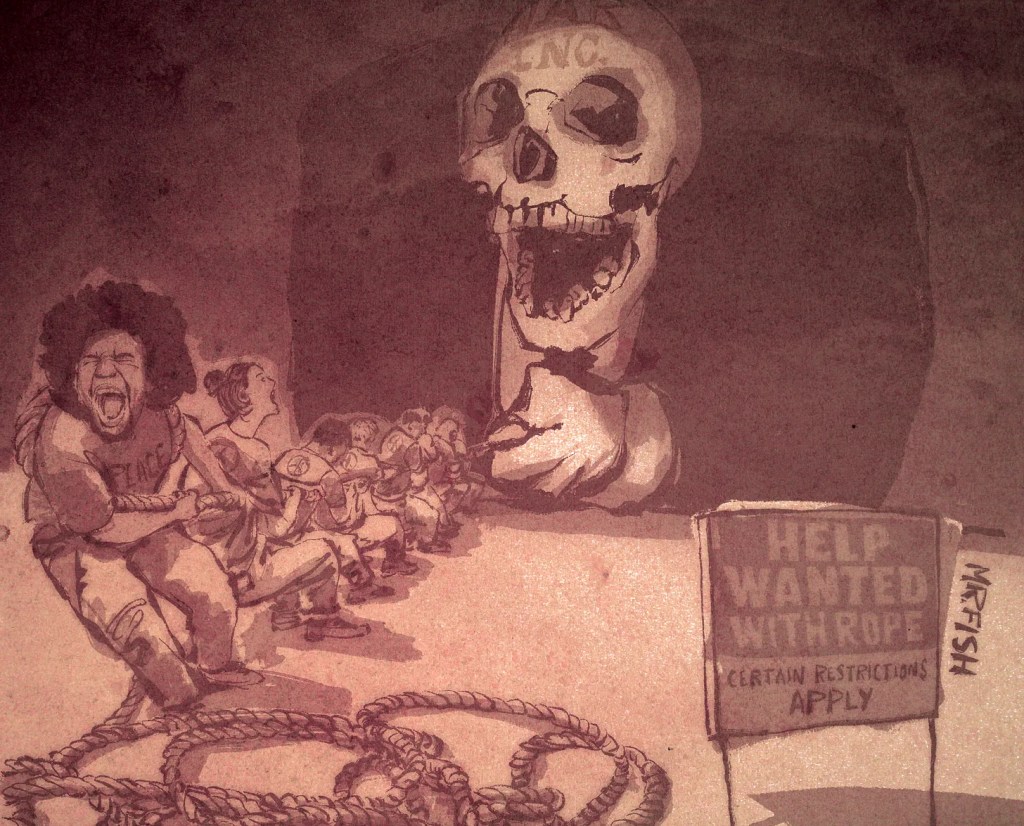
Give Enough Rope – by Mr. Fish

By Chris Hedges

Source: The Chris Hedges Report

On Sunday, February 19, I will be at the Lincoln Memorial in Washington at noon to speak at the anti-war rally, Rage Against the War Machine. There, I will be joined by Jimmy DoreDennis KucinichAnn WrightJill SteinMax BlumenthalCynthia McKinneyAnya ParampilDavid Swanson and other left-wing, anti-war activists I have shared platforms with for many years. I will also be joined by Ron PaulScott Horton and right-libertarian, anti-war figures whose political and cultural opinions I often disagree with. The inclusion of the right-wing has seen anti-war groups I respect, such as Veterans for Peace (VFP), refuse to join the rally. VFP issued a statement sent to me on Friday saying that “to endorse this event would have caused a huge disruption in VFP and had little effect on the outcome of the demonstration.” The board of Code Pink asked its co-founder, Medea Benjamin, one of the nation’s most important and effective left-wing and anti-war activists, to cancel her scheduled talk at the rally. 

“The left has become largely irrelevant in the U.S. because it is incapable of working with the right,” said Nick Brana, chair of The People’s Party, which organized the rally with libertarians. “It clings to identity politics over jobs, health care, wages and war, and condemns half the country as deplorables.”

We will not topple corporate power and the war machine alone. There has to be a left-right coalition, which will include people whose opinions are not only unpalatable but even repugnant, or we will remain marginalized and ineffectual. This is a fact of political life. Alliances are built around particular issues, in this case permanent war, which often fall apart when confronting other concerns. If I had organized the rally, there are some speakers I would not have invited. But I didn’t. This does not mean that there are no red lines: I would not join a protest that included neo-Nazi groups such as Aryan Nations or militias such as The Proud Boys or Oath Keepers. 

My father, a Presbyterian minister who was an army sergeant in North Africa during World War II, was a member of Concerned Clergy and Laity About Vietnam, an anti-war group that included the radical Catholic priests Philip and Daniel Berrigan. He took me with other clergy, almost all veterans, to anti-war rallies. There was much in the anti-war movement that he and other members of the religious group opposed, from the Yippies — who put forward a 145-pound pig named Pigasus the Immortal as a presidential candidate in 1968 — to groups such as the Weather Underground that embraced violence. He and the other clergy disliked the widespread drug use and propensity of some protestors to insult and bait the police. They had little in common with the Maoists, Stalinists, Leninists and Trotskyites within the movement. Daniel Berrigan, one of the most important anti-war activists in American history who was constantly in and out of jail and spent two years in federal prison, opposed abortion — a stance that today would probably see him deplatformed by many on the left. These clergy understood that the masters of war were their real enemies. They understood that the success of the anti-war movement meant forming alliances with people whose ideologies and beliefs were far removed from their pacifism, abstemious lifestyles and Christian faith. When I was about 12, my father told me that if the war was still going on when I turned 18 and I was drafted, he would go to prison with me. The jolt of that promise has remained with me my entire life.

The demands of the Rage Against the War Machine rally are ones I share. They include Not One More Penny for War in Ukraine; Negotiate Peace; Stop the War Inflation; Disband NATO; Global Nuclear De-Escalation; Slash the Pentagon Budget; Abolish the CIA and Military Industrial Deep State; Abolish War and Empire; Restore Civil Liberties; and Free Julian Assange.

I know war. I spent two decades reporting on conflicts all over the globe, including many months in Gaza, the world’s largest open-air prison, containing two million people including over a million children. I saw thousands of lives destroyed by United States military adventurism in Central America, Africa and the Middle East. Dozens of people I knew and worked with, including Kurt Schork, a Reuters reporter, and the Spanish cameraman Miguel Gil Moreno de Mora, died violent deaths.  

We must halt the decades of rampant and futile industrial killing. This includes ending the proxy war in Ukraine. It includes drastic cuts to the funding of the U.S. war machine, a state within a state. It includes disbanding NATO, which was established to prevent Soviet expansion into Eastern and Central Europe, not wage war around the globe. If Western promises to Moscow not to expand NATO beyond the borders of a unified Germany had been kept, I expect the Ukrainian war would have never happened.

To those who suffer directly from U.S. aggression, these demands are not academic and theoretical issues. The victims of this militarism do not have the luxury of virtue-signaling. They want the rule of law to be reinstated and the slaughter stopped. So do I. They welcome any ally who opposes endless war. For them, it is a matter of life or death. If some of those on the right are anti-war, if they also want to free Julian Assange, it makes no sense to ignore them. These are urgent existential issues that, if we do not mobilize soon, could see us slip into a direct confrontation with Russia, and perhaps China, which could lead to nuclear war. 

The Democratic Party, along with most of the Republican Party, is captive to the militarists. Each year, Congress increases the budget for the war industry, including for fiscal year 2023. It approved $847 billion for the military — a total that is boosted to $858 billion when accounts that don’t fall under the Armed Services committees’ jurisdiction are included. The Democrats, including nearly all 100 members of the House Congressional Progressive Caucus, and Republicans slavishly hand the Pentagon everything it demands.

The rally on February 19 is not about eliminating Social Security and Medicare or abolishing the minimum wage, which many libertarians propose. It is not a rally to denounce the rights of the LGBTQ community, which have been attacked by at least one of the speakers. It is a rally to end permanent war. Should these right-wing participants organize around those other issues, I will be on the other side of the barricades.

“I supported the Rage Against the War Machine Rally from the time of its conception and I support it today, even though I will not be one of the speakers because the organization I have been associated with for 20 years, CODEPINK, urged me not to speak,” Medea Benjamin told me in an email. “The CODEPINK staff felt that my participation would hurt the group’s standing with other coalitions committed to gay rights, women’s rights and anti-racism. They felt that Jackson Hinkle has taken stands that are anti-gay, anti-trans, anti-feminist and Islamophobic, and they were concerned about the sponsorship of the Libertarian Party’s Mises Caucus which, according to the Southern Poverty Law Center, has ties to white nationalists.”

“So why do I support the rally?” she asked. “Because I am heartbroken by a war that is causing such death and destruction in Ukraine. Because I have real fears that this war could lead us into World War III or a nuclear confrontation. Because both political parties are complicit in giving over $100 billion to Ukraine to keep this war going. Because the Biden administration is pushing this war to weaken Russia instead of promoting solutions. Because we urgently need as many voices as possible, from a broad variety of perspectives, to speak out so we can be much more effective at pressuring Congress and the White House to move this conflict from the bloody battlefield to the negotiating table. The future of our world stands in the balance.”

Benjamin said although she will not speak, she will be at the rally “cheering on the speakers” and is planning a lobby day two days later, on February 21, for those who want to take their anti-war message directly to the offices of Congress. You can register for the lobby day here.

Ralph Nader, who has just founded the Capitol Hill Citizena newspaper focused on Congress, has long advocated a left-right coalition as the only effective mechanism to push back against corporate power. He argues that those on the left who refuse to join left-right alliances are engaging in “self-immolation.” This refusal, he says, fosters political paralysis, not unlike the paralysis in the face of Senator Joseph McCarthy’s witch hunts in the 1950s against supposed Communists. Although many loathed McCarthy, the Republican establishment refused to join forces with the liberals and Democrats to end the smearing, blacklisting and imprisonment of dissidents. The left-right coalition is especially important if we are to rebuild labor unions, Nader points out, the only mechanism capable of crippling the ruling oligarchy. If we cannot reach across ideological divides, we will slit our own throats.  

“A left-right alliance on issue after issue, whether it’s on a living wage, ending endless wars of aggression by the United States; whether it’s striking down hard on corporate crime, fraud and abuse; whether it’s universal health insurance is an unbeatable movement,” Nader told me when I reached him by phone. “Just think of a senator receiving ten constituents from back home and five are liberals and five are conservatives. How is a senator going to game them? How is a senator going to sugarcoat them? It’s very difficult. Any time there is a left-right alliance, as in the enactment over 30 years ago of the Federal False Claims Act to go after corporate fraud in government programs and contracts, it’s an unbeatable combination.”

Sponsored by leading Republicans and Democrats, the False Claims Act amendments of 1986 have been used by the federal government to recover more than $62 billion of fraud and mismanagement funds stolen by corporations with government contracts.

“If you want to prevail on Congress to fulfill its duties under the Constitution and never engage in wars or become co-belligerents without a declaration of war by Congress — the last war that was declared by Congress was World War II, and we’ve engaged in many wars since then and are continuing to do so — you must have a left-right coalition,” Nader said. “Because there is no coalition in Congress, both Republicans and Democrats are war parties. They support a Pentagon budget that gives the generals more than they ask for. They have done this for almost eight years, most recently giving the Pentagon $48 billion more than the generals and President Biden requested, instead of giving that money for public health to prevent pandemics, death, injury and disease.”

Those who will pay the steepest price for this paralysis are those killed, wounded and displaced by the war machine, including the over 900,000 civilians killed directly, and millions more indirectly, as a result in the post-9/11 U.S. wars in Iraq, Afghanistan, Yemen, Syria, Libya, Somalia and Pakistan. But the left, mesmerized by a self-defeating boutique activism, also pays a price. As the empire unravels, the woke left, demanding moral absolutism, marginalizes and discredits itself at a moment of crisis. This myopia is a gift to the oligarchs, militarists and Christian fascists we must defeat.

Never Let A Good Crisis Go to Waste

Relentless Ukraine reporting helps conceal other conflicts

By Philip Giraldi

Source: Information Clearing House

It is astonishing how many observers of war in Ukraine who should know better have been inclined to take at face value the assertions of “sources” that clearly originate among the various governments that are involved in the conflict. Those leaders who are engaged in the inexorable march by the US and its allies to turn the Ukraine crisis into World War 3 surely have learned the lesson that managing the narrative of what is taking place is the greatest weapon that the war hawks have in their possession. One recalls how post-9/11 and leading up to the Iraq War the George W. Bush White House and the neocons in the Pentagon lied about nearly everything to convince the public that Saddam Hussein was a terrorist supporting megalomaniac armed with weapons of mass destruction, inevitably describing him as a man in some ways comparable to Adolf Hitler. Nevertheless, many observers of what was occurring were not fooled and there were large scale demonstrations in a number of cities prior to the invasion in March 2003, which, of course, were rarely reported in the mainstream media in order to control the message.

Iraq in some ways was a learning experience for those in government and also for those in the media who did the heavy lifting by propagating the deception to a largely unsuspecting public. What we are seeing now relating to Ukraine and Russia, however, makes the Iraq experience look like child’s play in terms of the sheer audacity of the alleged information that makes it, or does not make it, into the news. I note particularly the recent terrorist car bombing of Russian activist journalist Dalya Dugina by a Ukrainian assassin made the news for roughly forty-eight hours before disappearing, but not before the lie that Prime Minister Vladimir Putin was responsible was firmly planted in a number of places in the mainstream media.

Now that Joe Biden is about to designate a two or three star general to head the Ukraine campaign and has pledged billions of dollars more in aid, Ukraine will be all the news all the time. The US involvement will also feature a catchy name. I would suggest Operation Empty Wallets, which is what Americans will soon be experiencing due to government bailouts and other profligate spending, or maybe Operation Give Me a Break. And it will also create a new dimension to the narrative-shaping in that Ukraine reporting’s domination of what comes out of the newsrooms already is effectively killing much of what else might otherwise be appearing on TV or in the newspapers. That selective management of information provides cover for neglecting stories that might prove embarrassing for those in power. It in effect means that there has been plenty of room for the usual players to engage in business as usual with hardly any scrutiny by the public over what is going on outside Ukraine in secondary theaters like the Middle East and Africa.

All of which leads one to examine what the two countries that have unilaterally declared themselves to be rules makers and enforcers have been up to. Those two countries are perhaps not surprisingly the United States and Israel. The US is, in fact, increasing its combat role in Africa featuring airstrikes in Somalia, all of which have taken place since US President Joe Biden approved the redeployment of hundreds of special forces troops to that country in May, reversing a decision by former President Donald Trump to reduce troop levels in AFRICOM. The two latest attacks killed at least twenty Somalis, all of whom were of course described as “terrorists” by the US command. Independent sources state that US forces have bombed Somalia at least 16 times under Biden, killing between 465 and 545 alleged al-Shabaab militants, including no less than 200 individuals in a single drone plus ground forces strike on March 13th.

Describing the paucity of reporting on the issue, Kelley Beaucar Vlahos, a senior adviser at the Quincy Institute for Responsible Statecraft, observed “If you were unaware that we were bombing Somalia, don’t feel bad, this is a completely under-the-radar news story, one that was curiously absent from the headlines in all of the major newspapers…”

And then there is Syria, where a paucity of information in the media reflects White House policy. The United States, which has possibly as many as a dozen illegal bases in Syria, has a major airbase located in the al-Omar oil field in Syria’s northeastern Deir Ezzor province. Several weeks ago, three US soldiers were reportedly slightly wounded in rocket attacks directed at the base by alleged “Iranian-backed militants.” The US responded to the claimed attacks by launching strikes from Apache helicopters against three vehicles belonging to an Afghan Shia militia, killing between six and ten “militants,” and there are reports that more tit-for-tat exchanges of fire are likely. CENTCOM afterwards claimed that President Joe Biden personally ordered the strikes in “self-defense” and justified them by citing Article II of the US Constitution. But the Constitution was never intended to cover illegal activity in a foreign land where US forces are occupying a country with which it is not at war and which has a functioning government that opposes the American presence. The US reportedly has its illegal bases mostly located in the oil producing and agricultural bread basket of the country. Both the grain and oil are routinely stolen by the US and much of the oil winds up in Israel.

So, one inevitably comes to Israel, which has used the cover provided by Ukraine not only to bomb Syria frequently but also to kill Palestinians both in Gaza and on the occupied West Bank. Recently the pace has accelerated with the Israeli Army and police killing on average several Palestinians every day, very little of which is reported in the US media, a fatality rate five times higher than that which prevailed in 2021. It is clearly a deliberate policy to step up the pressure on the Palestinians and a vital part of the process is to let it happen with minimal scrutiny by the media and public, so Israel is widely publicizing the support it is giving to Ukraine to draw attention away from what it does locally.

In short, Israel is increasing efforts to make the historic Palestine Palestinian-free by rendering life so miserable that many Arabs will decide to leave. The use of selective violence and constant harassment is all part of that effort and Palestinians have found that describing Israel as an “apartheid” state does not accurately describe the intensity of the indiscriminate punishments and killings by soldiers which have become all too common.

Israel meanwhile is also doing its best to delegitimize Palestinian national identity by labeling Arab human rights groups as “terrorists.” Israeli police recently raided the offices of seven such groups, confiscated their office equipment and communications, and ordered the premises to be shut down completely. Ironically, a CIA assessment of the groups determined that they were not in any way terrorist linked. The Joe Biden administration characteristically responded to the development by indicating that it was “concerned” but did not condemn the Israeli action.

So, if you open a newspaper or turn on the television and watch or read the international news, you will be told what to think about what is going on in Ukraine. And it will be from the Ukrainian/US government point of view. If you are interested in what the US and Israel are up to in the Middle East, you will most often be out of luck as “defending democracy” in Ukraine while also demonizing Russia is providing cover for Washington and Jerusalem to get into all kinds of mischief. It is a reality derived from how the media and government work collectively to shape policies that in no way benefit the American public. Instead, powerful interest groups with plenty of cash drive the process and are the ones who gain still more power and money through it. It is the sad reality of what has happened to our “land of the free and home of the brave.”

What Will You Say When Millions Of People Starve To Death?

By Michael Snyder

Source: End of the American Dream

For a long time, those of us that were claiming that a global famine was coming were widely mocked.  The skeptics could see the exact same trends that everyone else could see, but they just assumed that we would find a way to muddle through somehow.  So they didn’t want to listen to common sense, and they weren’t interested in warnings from “gloom and doomers” such as myself.  But I don’t consider myself to be a “doom and gloomer” because I am actually a very optimistic person.  I am so excited to be living during this time in human history, but I also know that very difficult times are ahead of us.  One of the major trends that I keep writing about over and over is famine, because the truth is that there simply is not going to be enough food for everyone on the planet in 2023 and beyond.  Of course the mainstream media is also starting to issue similar warnings.  For example, the following comes from a Yahoo News article entitled “Millions in East Africa face starvation due to drought”

The World Health Organization warned on Wednesday that millions of people in East Africa face the threat of starvation. Speaking at a media briefing in Geneva, WHO Director-General Tedros Adhanom Ghebreyesus said that drought, climate change, rising prices and an ongoing civil war in northern Ethiopia are all contributing to worsening food insecurity.

Over 50 million people in East Africa will face acute food insecurity this year, a study from late July by the World Food Programme and Food and Agriculture Organization found. Roughly 7 million children are suffering from malnourishment and, according to the United Nations High Commissioner for Refugees, hundreds of thousands are leaving their homes in search of food or livelihoods. Affected countries include Djibouti, Ethiopia, Kenya, Somalia, South Sudan, Sudan and Uganda.

In Somalia, authorities are projecting that vegetable and grain production will “drop by about 80% this year” due to the endless drought that they are currently experiencing.

Millions of precious people in Africa are facing imminent starvation.  But most of us in the western world don’t care, because our grocery stores are still full of food.

If you are one of those people that are choosing to ignore what is happening on the other side of the planet, you can afford to be cocky for now.

But conditions are starting to change here too.

Earlier today, I came across an excellent article about how the multi-year megadrought in the western half of the country is absolutely devastating the ranching industry…

The megadrought in the Western U.S., the region’s worst in 1,200 years, is threatening America’s cattle heartland: withering pastures, wrecking feed harvests and endangering a quintessential way of life.

The drought is forcing ranchers here in Texas and across the Southern plains to make an agonizing decision: Sell early now for less money than they planned on — or hold on, pray for rain and risk losing everything.

Sadly, more ranchers are deciding to sell off cattle with each passing day.

If you can believe it, the rate at which cattle are being sold is now 120 percent above last year’s level…

Over the last two weeks of July, the national cattle sale rate also jumped to 120 percent above 2021 levels — an average that reporting by The Hill and KAMR suggested conceals even higher frenzies of sales in some markets.

What this means is that lots of beef is coming on to the market.

Beef prices had been soaring, but in the short-term all of the cattle that are being slaughtered will help to moderate prices.

However, the outlook for 2023 is grim.  The national cattle herd just keeps getting smaller and smaller, and some beef producers in Oklahoma are now predicting that ground beef “could eventually top $50 per pound”

Thanks to the unending economic symptoms of the pandemic and 2022’s inflation double-punch, average beef prices are currently about twice what they were in 2019. Add in the deepening widespread drought, a shortage of hay and feed, skyrocketing prices, transport costs, and various other metrics, some Southwest Oklahoma beef producers suggest cheap ground beef could eventually top $50 per pound.

If the price of ground beef does reach 50 dollars a pound, what do you think our country will look like?

Needless to say, at that point there will be absolutely no debate about whether we are in a global food crisis or not.

And we are also being told that we could soon be facing shortages of potatoes and tomatoes.  The following comes from Zero Hedge

Days ago, we said the next food insecurity problem that may impact Americans’ eating habits could be an emerging potato shortage. Now there appears to be another issue: Tomatoes are getting squeezed, and risks of a ketchup shortage rise as a severe drought batter California’s farmland.

California accounts for a quarter of the world’s tomato output. The worst drought in 1,200 years has forced farmers to abandon fields as crops turn to dust amid a water crisis.

I recently wrote an entire article about the coming tomato shortage that you can find right here.  Unless some rain comes along, the tomato crop in California this year is going to be absolutely disastrous.

So are you ready to eat less pizza because there isn’t enough pizza sauce to go around?

And are you ready to pay twice as much for spaghetti sauce at the grocery store?

On top of everything else, we are also potentially facing an extremely painful shortage of cotton

Intense drought has forced cotton farmers to abandon millions of acres that have produced so little cotton that they are no longer worth harvesting, the Wall Street Journal reported Tuesday.

Farmers will harvest an estimated 7.13 million acres, abandoning approximately 5.35 million acres due to an ongoing drought hammering southern U.S. states, representing an estimated abandonment rate of 42.87%, according to the National Cotton Council of America, who based their analysis on U.S. Department of Agriculture (USDA) data. This represents the smallest harvest by area since 1868, The Wall Street Journal reported.

What I have touched on in this article is just the tip of the iceberg.

Agricultural production is going to be way down all over the planet this year.

But we will surely find a way to “muddle through” somehow, right?

If you have been a skeptic of reports of shortages and famine, it is time to wake up.

We really are staring an unprecedented global crisis right in the face, and the months ahead are going to be filled with pain.

The Pentagon Budget as Corporate Welfare for Weapons Makers

By William Hartung (with introduction by TomDispatch)

Source: TomDispatch.com

What company gets the most money from the U.S. government? The answer: the weapons maker Lockheed Martin. As the Washington Post recently reported, of its $51 billion in sales in 2017, Lockheed took in $35.2 billion from the government, or close to what the Trump administration is proposing for the 2019 State Department budget. And which company is in second place when it comes to raking in the taxpayer dollars? The answer: Boeing with a mere $26.5 billion. And mind you, that’s before the good times even truly begin to roll, as TomDispatch regular and weapons industry expert William Hartung makes clear today in a deep dive into the (ir)realities of the Pentagon budget.  When it comes to the Department of Defense, though, perhaps we should retire the term “budget” altogether, given its connotation of restraint. Can’t we find another word entirely? Like the Pentagon cornucopia?

Sometimes, it’s hard to believe that perfectly sober reportage about Pentagon funding issues isn’t satire in the style of the New Yorker’s Andy Borowitz.  Take, for instance, a recent report in the Washington Examiner that Army Secretary Mark Esper and other Pentagon officials are now urging Congress to release them from a September 30th deadline for fully dispersing their operation and maintenance funds (about 40% of the department’s budget).  In translation, they’re telling Congress that they have more money than even they can spend in the time allotted.

It’s hard to be forced to spend vast sums in a rush when, for instance, you’re launching a nuclear arms “race” of one by “modernizing” what’s already the most advanced arsenal on the planet over the next 30 years for a mere trillion-plus dollars (a sum that, given the history of Pentagon budgeting, is sure to rise precipitously).  In that context, let Hartung usher you into the wondrous world of what, in the age of The Donald, might be thought of (with alliteration in mind) as the Plutocratic Pentagon. Tom

How the Pentagon Devours the Budget
Normalizing Budgetary Bloat
By William D. Hartung

Imagine for a moment a scheme in which American taxpayers were taken to the cleaners to the tune of hundreds of billions of dollars and there was barely a hint of criticism or outrage.  Imagine as well that the White House and a majority of the politicians in Washington, no matter the party, acquiesced in the arrangement.  In fact, the annual quest to boost Pentagon spending into the stratosphere regularly follows that very scenario, assisted by predictions of imminent doom from industry-funded hawks with a vested interest in increased military outlays.

Most Americans are probably aware that the Pentagon spends a lot of money, but it’s unlikely they grasp just how huge those sums really are.  All too often, astonishingly lavish military budgets are treated as if they were part of the natural order, like death or taxes.

The figures contained in the recent budget deal that kept Congress open, as well as in President Trump’s budget proposal for 2019, are a case in point: $700 billion for the Pentagon and related programs in 2018 and $716 billion the following year.  Remarkably, such numbers far exceeded even the Pentagon’s own expansive expectations.  According to Donald Trump, admittedly not the most reliable source in all cases, Secretary of Defense Jim Mattis reportedly said, “Wow, I can’t believe we got everything we wanted” — a rare admission from the head of an organization whose only response to virtually any budget proposal is to ask for more.

The public reaction to such staggering Pentagon budget hikes was muted, to put it mildly. Unlike last year’s tax giveaway to the rich, throwing near-record amounts of tax dollars at the Department of Defense generated no visible public outrage.  Yet those tax cuts and Pentagon increases are closely related.  The Trump administration’s pairing of the two mimics the failed approach of President Ronald Reagan in the 1980s — only more so.  It’s a phenomenon I’ve termed “Reaganomics on steroids.”  Reagan’s approach yielded oceans of red ink and a severe weakening of the social safety net.  It also provoked such a strong pushback that he later backtracked by raising taxes and set the stage for sharp reductions in nuclear weapons.

Donald Trump’s retrograde policies on immigration, women’s rights, racial justice, LGBT rights, and economic inequality have spawned an impressive and growing resistance.  It remains to be seen whether his generous treatment of the Pentagon at the expense of basic human needs will spur a similar backlash.

Of course, it’s hard to even get a bead on what’s being lavished on the Pentagon when much of the media coverage failed to drive home just how enormous these sums actually are. A rare exception was an Associated Press story headlined “Congress, Trump Give the Pentagon a Budget the Likes of Which It Has Never Seen.” This was certainly far closer to the truth than claims like that of Mackenzie Eaglen of the conservative American Enterprise Institute, which over the years has housed such uber-hawks as Dick Cheney and John Bolton.  She described the new budget as a “modest year-on-year increase.” If that’s the case, one shudders to think what an immodest increase might look like.

The Pentagon Wins Big

So let’s look at the money.

Though the Pentagon’s budget was already through the roof, it will get an extra $165 billion over the next two years, thanks to the congressional budget deal reached earlier this month.  To put that figure in context, it was tens of billions of dollars more than Donald Trump had asked for last spring to  “rebuild” the U.S. military (as he put it).  It even exceeded the figures, already higher than Trump’s, Congress had agreed to last December.  It brings total spending on the Pentagon and related programs for nuclear weapons to levels higher than those reached during the Korean and Vietnam wars in the 1950s and 1960s, or even at the height of Ronald Reagan’s vaunted military buildup of the 1980s. Only in two years of Barack Obama’s presidency, when there were roughly 150,000 U.S. troops in Iraq and Afghanistan, or about seven times current levels of personnel deployed there, was spending higher.

Ben Freeman of the Center for International Policy put the new Pentagon budget numbers in perspective when he pointed out that just the approximately $80 billion annual increase in the department’s top line between 2017 and 2019 will be double the current budget of the State Department; higher than the gross domestic products of more than 100 countries; and larger than the entire military budget of any country in the world, except China’s.

Democrats signed on to that congressional budget as part of a deal to blunt some of the most egregious Trump administration cuts proposed last spring.  The administration, for example, kept the State Department’s budget from being radically slashed and it reauthorized the imperiled Children’s Health Insurance Program (CHIP) for another 10 years.  In the process, however, the Democrats also threw millions of young immigrants under the bus by dropping an insistence that any new budget protect the Deferred Action for Childhood Arrivals, or “Dreamers,” program.  Meanwhile, the majority of Republican fiscal conservatives were thrilled to sign off on a Pentagon increase that, combined with the Trump tax cut for the rich, funds ballooning deficits as far as the eye can see — a total of $7.7 trillion worth of them over the next decade.

While domestic spending fared better in the recent congressional budget deal than it would have if Trump’s draconian plan for 2018 had been enacted, it still lags far behind what Congress is investing in the Pentagon.  And calculations by the National Priorities Project indicate that the Department of Defense is slated to be an even bigger winner in Trump’s 2019 budget blueprint. Its share of the discretionary budget, which includes virtually everything the government does other than programs like Medicare and Social Security, will mushroom to a once-unimaginable 61 cents on the dollar, a hefty boost from the already startling 54 cents on the dollar in the final year of the Obama administration.

The skewed priorities in Trump’s latest budget proposal are fueled in part by the administration’s decision to embrace the Pentagon increases Congress agreed to last month, while tossing that body’s latest decisions on non-military spending out the window.  Although Congress is likely to rein in the administration’s most extreme proposals, the figures are stark indeed — a proposed cut of $120 billion in the domestic spending levels both parties agreed to. The biggest reductions include a 41% cut in funding for diplomacy and foreign aid; a 36% cut in funding for energy and the environment; and a 35% cut in housing and community development.  And that’s just the beginning.  The Trump administration is also preparing to launch full-scale assaults on food stamps, Medicaid, and Medicare.  It’s war on everything except the U.S. military.

Corporate Welfare

The recent budget plans have brought joy to the hearts of one group of needy Americans: the top executives of major weapons contractors like Lockheed Martin, Boeing, Northrop Grumman, Raytheon, and General Dynamics. They expect a bonanza from the skyrocketing Pentagon expenditures. Don’t be surprised if the CEOs of these five firms give themselves nice salary boosts, something to truly justify their work, rather than the paltry $96 million they drew as a group in 2016 (the most recent year for which full statistics are available).

And keep in mind that, like all other U.S.-based corporations, those military-industrial behemoths will benefit richly from the Trump administration’s slashing of the corporate tax rate.  According to one respected industry analyst, a good portion of this windfall will go towards bonuses and increased dividends for company shareholders rather than investments in new and better ways to defend the United States.  In short, in the Trump era, Lockheed Martin and its cohorts are guaranteed to make money coming and going.

Items that snagged billions in new funding in Trump’s proposed 2019 budget included Lockheed Martin’s overpriced, underperforming F-35 aircraft, at $10.6 billion; Boeing’s F-18 “Super Hornet,” which was in the process of being phased out by the Obama administration but is now written in for $2.4 billion; Northrop Grumman’s B-21 nuclear bomber at $2.3 billion; General Dynamics’ Ohio-class ballistic missile submarine at $3.9 billion; and $12 billion for an array of missile-defense programs that will redound to the benefit of… you guessed it: Lockheed Martin, Raytheon, and Boeing, among other companies.  These are just a few of the dozens of weapons programs that will be feeding the bottom lines of such companies in the next two years and beyond.  For programs still in their early stages, like that new bomber and the new ballistic missile submarine, their banner budgetary years are yet to come.

In explaining the flood of funding that enables a company like Lockheed Martin to reap $35 billion per year in government dollars, defense analyst Richard Aboulafia of the Teal Group noted that “diplomacy is out; air strikes are in… In this sort of environment, it’s tough to keep a lid on costs. If demand goes up, prices don’t generally come down. And, of course, it’s virtually impossible to kill stuff. You don’t have to make any kind of tough choices when there’s such a rising tide.”

Pentagon Pork Versus Human Security

Loren Thompson is a consultant to many of those weapons contractors.  His think tank, the Lexington Institute, also gets contributions from the arms industry.  He caught the spirit of the moment when he praised the administration’s puffed-up Pentagon proposal for using the Defense Department budget as a jobs creator in key states, including the crucial swing state of Ohio, which helped propel Donald Trump to victory in 2016.  Thompson was particularly pleased with a plan to ramp up General Dynamics’s production of M-1 tanks in Lima, Ohio, in a factory whose production line the Army had tried to put on hold just a few years ago because it was already drowning in tanks and had no conceivable use for more of them.

Thompson argues that the new tanks are needed to keep up with Russia’s production of armored vehicles, a dubious assertion with a decidedly Cold War flavor to it.  His claim is backed up, of course, by the administration’s new National Security Strategy, which targets Russia and China as the most formidable threats to the United States.  Never mind that the likely challenges posed by these two powers — cyberattacks in the Russian case and economic expansion in the Chinese one — have nothing to do with how many tanks the U.S. Army possesses.

Trump wants to create jobs, jobs, jobs he can point to, and pumping up the military-industrial complex must seem like the path of least resistance to that end in present-day Washington.  Under the circumstances, what does it matter that virtually any other form of spending would create more jobs and not saddle Americans with weaponry we don’t need?

If past performance offers any indication, none of the new money slated to pour into the Pentagon will make anyone safer.  As Todd Harrison of the Center for Strategic and International Studies has noted, there is a danger that the Pentagon will just get “fatter not stronger” as its worst spending habits are reinforced by a new gusher of dollars that relieves its planners of making any reasonably hard choices at all.

The list of wasteful expenditures is already staggeringly long and early projections are that bureaucratic waste at the Pentagon will amount to $125 billion over the next five years.  Among other things, the Defense Department already employs a shadow work force of more than 600,000 private contractors whose responsibilities overlap significantly with work already being done by government employees.  Meanwhile, sloppy buying practices regularly result in stories like the recent ones on the Pentagon’s Defense Logistics Agency losing track of how it spent $800 million and how two American commands were unable to account for $500 million meant for the war on drugs in the Greater Middle East and Africa.

Add to this the $1.5 trillion slated to be spent on F-35s that the nonpartisan Project on Government Oversight has noted may never be ready for combat and the unnecessary “modernization” of the U.S. nuclear arsenal, including a new generation of nuclear-armed bombers, submarines, and missiles at a minimum cost of $1.2 trillion over the next three decades.  In other words, a large part of the Pentagon’s new funding will do much to fuel good times in the military-industrial complex but little to help the troops or defend the country.

Most important of all, this flood of new funding, which could crush a generation of Americans under a mountain of debt, will make it easier to sustain the seemingly endless seven wars that the United States is fighting in Afghanistan, Pakistan, Syria, Iraq, Libya, Somalia, and Yemen.  So call this one of the worst investments in history, ensuring as it does failed wars to the horizon.

It would be a welcome change in twenty-first-century America if the reckless decision to throw yet more unbelievable sums of money at a Pentagon already vastly overfunded sparked a serious discussion about America’s hyper-militarized foreign policy.  A national debate about such matters in the run-up to the 2018 and 2020 elections could determine whether it continues to be business-as-usual at the Pentagon or whether the largest agency in the federal government is finally reined in and relegated to an appropriately defensive posture.


William D. Hartung, a TomDispatch regular, is the director of the Arms and Security Project at the Center for International Policy and the author of Prophets of War: Lockheed Martin and the Making of the Military-Industrial Complex.


The Simulacra Democracy

By John Steppling

Source: CounterPunch

… a nation in which 87 percent of eighteen- to twenty-four year olds (according to a 2002 National Geographic Society/Roper Poll survey) cannot locate Iran or Iraq on a world map and 11 percent cannot locate the United States (!) is not merely “intellectually sluggish.” It would be more accurate to call it moronic, capable of being fooled into believing anything …”

— Morris Berman

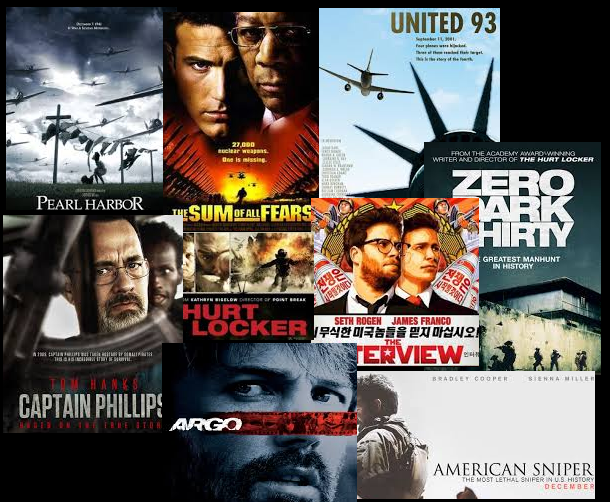
I cannot remember U.S. culture ever being quite so compromised by ruling class control. Hollywood turns out one jingoistic and militaristic and racist film and TV show after another. Corporate news is completely controlled by the same forces that run Hollywood. It is the complete capitulation of the liberal class to the interests of the increasingly fascistic U.S. elite. And this didn’t start with Donald Trump. Certainly in its current incarnation it goes back at least to Bill Clinton, and really it goes back to the end of World War Two. The ideological trajectory was formed under the Dulles brothers and military industrial complex — representing U.S. business interests and exhibiting a demand for global hegemony. But once the Soviet Union collapsed, the project was accelerated and intensified.

Another starting point might well be the 1960 Bay of Pigs fiasco, or the 1961 CIA (and MI6) assassination of Patrice Lumumba. Or Kennedy’s 1962 speech at American University calling for the end of Pax Americana. We know what happened to Kennedy soon after that. Pick any of these incidents. But it was the fall of the U.S.S.R. that signaled to the governing class, the proprietor class, that the last real obstacle to global domination had been removed. In the interim, one finds the Iran/Contra affair, and the invasion of Iraq. The real and the symbolic meaning of the Soviet Union is forgotten today, I think. Its meaning for the developing world, especially.

The next conscious trial balloon was Clinton’s attack on the former Yugoslavia. A test run for expanding NATO. And it worked. The propaganda machine has never been as successful as it was when it demonized the Serbs and Milosevic. Then came 9/11. And the well honed PR machine spewed an endless barrage of hyper-patriotic rhetoric and disinformation. American exceptionalism was given full credibility. And remember Colin Powell and his cartoon visual teaching aids at the UN? Nobody was going to argue. Certainly not the white liberal class. And Hollywood upped its game in churning out military fantasies. And in just churning out fantasies. A genre that lent itself to obvious neo-colonial messages. By 2007, when Barack Obama announces he will run for President, the master narrative for America was firmly entrenched. The biggest hit from Hollywood in this period is Avatar (2009), a neo-colonial fable that fit seamlessly with Obama’s reconquest of Africa.

Dan Glazebrook recently wrote:

The year 2009, two years before Gaddafi’s murder, was a pivotal one for US-African relations. First, because China surpassed the US as the continent’s largest trading partner; and second, because Gaddafi was elected President of the African Union. The significance of both for the decline of US influence on the continent could not be clearer. Whilst Gaddafi was spearheading attempts to unite Africa politically, committing serious amounts of Libyan oil wealth to make this dream a reality, China was quietly smashing the West’s monopoly over export markets and investment finance. Africa no longer had to go cap-in-hand to the IMF for loans, agreeing to whatever self-defeating terms were on offer, but could turn to China – or indeed Libya – for investment. And if the US threatened to cut them off from their markets, China would happily buy up whatever was on offer. Western economic domination of Africa was under threat as never before.

The US response was to increase base building, upgrade AFRICOM, and then murder Gadaffi. Hollywood hits from this period include The Hurt Locker and The Dark Knight. Meanwhile domestically Obama was giving the OK for militarizing of police departments across the country. On another front….Danny Haiphong wrote…

What isn’t discussed often enough is how Obama has worked tirelessly to protect and fulfill the interests of the corporate healthcare system. In 2009, he collaborated with the monopoly health insurance industry and its pharmaceutical counterparts to repress the demand for single payer healthcare. The conditions at the time appeared ripe for a single payer system. Popular discontent with Republican Party rule was at its highest point. A relatively organized movement for single payer care was represented by organizations such as Healthcare Now. The Democratic Party possessed a majority in both the House and Senate.

Obama came to power as Wall Street went into meltdown, 2008. But instead of hope and change we got almost 5 trillion dollars moving to the top 1% of the financial elite. Poverty increased every year under Obama, as did inequality. Social Network came out in 2010 and Wolf of Wall Street in 2013. Both were big hits. The message from Hollywood never changed. And part of that message is that wealth is its own justification and a symbol of virtue. Hollywood, and U.S. liberals just naturally gravitate toward the rich.

Obama attacked Afghanistan, Iraq, Syria, Libya, Sudan, Somalia, and Yemen. And it is perhaps that last venture that will prove to be his most significant. Arming, training, and coordinating the Saudi aggression (and now that has escalated to boots on the ground) against the helpless Yemen has resulted in the largest humanitarian catastrophe in five decades.

The U.S. now has all but formally criminalized dissent, especially if that dissent is aimed at Israel.

None of this is to create exact corollaries between political action and studio product. But rather that the overriding message of Hollywood in both film and TV is to validate U.S. exceptionalism. And to hedge criticism with faint token protest. But its not just Hollywood, its theatre and fiction and all the rest of the arts. The erasure of the working class is the most pronounced truth in American culture today. There are no Clifford Odets (a high school drop out) anymore; they have been replaced by a steady stream of well groomed compliant MFA grads. Mostly from elite and expensive schools. Hemingway and James Baldwin were not college grads, nor was Tennessee Williams, the son of a traveling shoe salesman. Even more recent authors such as Thomas Pynchon were college drop outs (to join the Navy), but the point is that today mass culture is carefully controlled. Dreiser was a college drop out, and Twain was a typesetters apprentice. Others like Faulkner, went to University, but also worked. In Faulkner’s case as a postman. Same profession as Henry Miller and Charles Bukowski. Stephen Crane and Hemingway worked as journalists, when that was an honorable profession.

The decision makers in mass culture are mostly firmly entrenched in the Democratic Party ethos (witness stuff like House of Cards, Madame Secretary, or Veep). If one only gets one’s news from MSNBC or FOX or CNN then one will take away mostly pure propaganda. Rachel Maddow has a career based on craven parroting of DNC approved talking points and conclusions. Bill Maher, whose show is on HBO, is of late pimping for war. Sunday news talk shows do not invite radical voices, not ever. Michael Parenti isn’t on those shows, nor  are Ajamu Baraka or Glen Ford Mike Whitney or Ed Curtin or Dan Glazebrook or Stephen Gowans. No, but there are plenty of retired generals and politicians. This is a media that exerts absolute control of message.

The loss of the working class, of class diversity, has been a far bigger blow to the health of the culture than anything else. One might argue that culture has always been, in the modern era, a province of the bourgeoisie, and that’s true. But there is still a rather pronounced change that has taken place. But Americans are discouraged from thinking in terms of class. They see individualism and identity. Get me more women directors they cry….which would give us more versions of Zero Dark Thirty, I guess. Gender equality matters, something every single socialist country in history has emphasized. Something Chavez saw fit to write into the Bolivarian constitution on day one. Chavez, who liberal avatar Bernie Sanders dismissed as a “dead communist dictator”. Chavez, who feminist avatar Hillary Clinton worked overtime to oust from power.

People are shocked…shocked I say…that US soldiers are killed in Niger. Darn that Donald Trump. When it is pointed out that it was Obama who sent troops there in his pivot to Africa, one is met with blank stares. The concern over U.S. soldiers dying is simply mind numbing in its hypocrisy and blinkered exceptionalism. I mean just count the numbers of dead civilians due to U.S. drone strikes from just one year. Pick any year you like.

Under Obama, the US African Command (AFRICOM) has penetrated every African country but Zimbabwe and Eritrea. AFRICOM has locked African nations into military subservience. In 2014, the US conducted 674 military operations in Africa . According to a recent Freedom of Information Act request by Intercept, the US currently has Special Forces deployed in more than twenty African nations.

Danny Haiphong

People are terrified today lest they be called conspiracy theorists. No single pejorative term has exercised such disproportionate power. There is a subterranean subject position associated with this, too. A masculine identity that connects with the presentation of those accepting of the official version of things. It is ‘no nonsense, mature, and sort of tough guy’ pose. Only weak and muddled (feminine you see!) would bother to question official narratives of…well, anything. It is staggering, really, why so few ask why is it OK to assassinate people without due process? Why is it whistleblowers, truth tellers, are being locked away and shunned? Why are there 900 plus US military bases around the world. Why, given the growing poverty in the U.S. do we need an updated nuclear arsenal that will cost trillions? In fact why is the defense budget over 4 billion a day? The liberal educated class seem not to ask such questions. Let alone ask is the U.S. arming takfiri jihadists in Syria? Most of what people call conspiracy is just perfectly reasonable skepticism. Given a history that includes COINTELPRO, Operation Northwoods, Gladio, MKUltra, and Operation AJAX. This is also relevant in terms of the coming war on *fake news*. An idea put forward by Obama and now in enthusiastic Orwellian operation by Facebook, YouTube, and Google. In the U.K. Theresa May proudly announces the government SHOULD control what one can see on the internet. Censorship is pitched as protection.

And then we come to NATO and Europe. Why does NATO even exist one might ask? I mean the USSR doesn’t exist anymore. Well, the answer has been under construction for a few years now, and that answer is the extraordinary anti Putin propaganda of the U.S. The “Russian Threat” is now an accepted trope in public discourse. Or the anti Iranian disinformation. In fact Iran is far more democratic and less a global threat (actually its NO global threat) than U.S. boon allies Israel and Saudi Arabia. Which brings us back to Yemen. The utter destruction of Yemen, poorest Arab country in the world, and now one with the largest Cholera outbreak in history, posed no threat to ANYONE. Certainly not to the United States. Are we to believe the House of Saud is worth supporting? They behead homosexuals and witches in Saudi Arabia. The leader of KSA is a 32 year old psychopath named Mohammed Bin Salman. Someone please explain the U.S. support for this country?

Or Venezuela. The U.S. has waged various campaigns against this sovereign nation for over a decade now. A democracy. But a disobedient one. Where is the outcry? When people are going on about Harvey Weinstein, a troglodyte movie producer that literally everyone knew was a serial abuser, I wonder that the women of Venezuela seem not to count. Or of Libya, or Haiti, or Puerto Rico, or hell, the women of Houston right now. Poor women. Ah, but that is class again. Now perhaps the Weinstein affair will yield good results and some form of collective protection and maybe even unionizing will take place to limit the power of rich white men. I doubt it, but maybe. Still, given that the liberal class today applaud the idea of making it OK for women to bomb defenseless villages in Afghanistan or Iraq or Yemen, just like men, and given that most of these horrified by Weinstein were and are solidly behind Hillary Clinton and the DNC, and laud adulation on figures like Maddie Albright, it seems hard to imagine.

David Rosen:

Sexual abuse and violence in the U.S. is as old as the country. America’s patriarchal culture long legitimized sexual abuse and violence toward women — and children — whether conducted at the workplace, at home, a nightclub or on a deserted street. During the nation’s earliest days, the custom of sexual abuse and violence was legitimized through the notion of “chastisement.” This was a feature of Anglo-American common law that recognized the husband as master of “his” household and, thus, permitted him to subject “his” wife to corporal punishment, including rape, so long as he did not inflict permanent injury upon her. Sexual abuse was institutionalized in the rape of African and later African-American female slaves. As the legal scholar Adrienne Davis notes, “U.S. slavery compelled enslaved black women to labor in three markets – productive, reproductive, and slavery – crucial to the political economy.”

One need only note the sexual violence that takes place in the U.S. military (See Kirby Dick’s The Invisible War). But that is not the military you see in this season’s TV shows such as SEAL Team or Valor or The Brave. The current Tom Cruise film American Made is a sort of comedy about Barry Seal who worked as a pilot for the CIA, and with various cartels in South America. Yeah, nothing funnier than squashing a socialist government like in Nicaragua. There is not a single Spanish speaking character who is not either a drunk, a sadist, or just incompetent. This stunningly racist revisionism was called “jaunty and bouncy” by the Hollywood Reporter.

The liberal class will always side with the status quo. Always. They do not care if the status quo is fascist. And its suits them much more to lay out bromides about male abuse of women, as long as this doesn’t mean having to untangle the complexity of women in unfamiliar non tourist visited nations like Yemen or Libya or Honduras. Just like the fact that U.S. domestic police departments murdered over a thousand black men in 2015. And continue to do so, along with increasing numbers of black women. That’s just not a jaunty bouncy story, I guess. Obama has never been comfortable talking about or to black people. He did manage to scold Colin Kaepernick recently though, about the pain he, Kaepernick, might be causing. The pain of white billionaire sports team owners I guess. The Uncle Tomism of what Glen Ford called black misleadership has never been greater. And that’s another crime we can lay, largely, at the feet of Barack Obama.

The U.S. House voted unanimously to sanction Iran and North Korea, an absurdity and a crime, and yet one that barely registered on the media Richter scale. What has Iran or North Korea ever done to hurt anyone in the United States? It is Saudi Arabia and Israel that fear a democratic nation like Iran and the influence they wield in the region. Iran is accused of fomenting instability but evidence is never given. Russia is said to control U.S. public opinion, but evidence is never given. The U.S. doesn’t even bother to really try and make claims about Venzeuela, because its just part of inherited wisdom that they are *bad*. Like Castro was bad, like Gadaffi, like Aristide, like anyone exhibiting independence. The world according to media entertainment is made up of bad guys and good guys. Mike Pompeo, head of the CIA, recently stated that his agency would become a “much more vicious agency” in fighting its enemies. Its actually hard to imagine what that might look like given CIA history. More vicious than rendition, drone killing and black site torture? Remember it was the U.S. and its School of the Americas that trained those death squads in Central America. Hollywood makes comedies about this.

In any event nobody in Hollywood complains. Just as none of the actresses assaulted by Weinstein (and countless others) said anything lest they lose career opportunities. Just as nobody complains about the racism and demonizing of Muslims or Serbs or North Koreans or Russians lest they not get the job. Coercion is silent and a given. It is also absolute. Most actors and directors simply don’t think about it, and most know little beyond what they hear on corporate news or read in the NYTimes. But I understand. People have to eat, have to feed their families. The real problem is that power is ever more consolidated. Distribution of films is monopolized. And for most Americans, foreign policy remains a giant black hole about which they know very little. Tell someone Milosovic was actually a good guy and they will laugh at you (this still happens on the left, too, rather depressingly). Tell them Russia is not threatening the U.S. or Europe, and they will laugh at you. Try to explain what Imperialism is and means, and you get that bored look of irritation. A good rule of thumb is if the U.S. targets a country or leader, then its worth questioning the western generated propagated propaganda in mainstream media about said country or leader (think Syria, Gadaffi, Aristide, Milosovic, Iran, North Korea). The U.S. does not go after countries who welcome western capital.

One of the things I’ve noticed about Hollywood film is the extraordinary amount of self pity from most characters. Self pity, entitlement, and sarcasm. The people who produce and make film and TV today, by and large, tacitly censor themselves. Some don’t have to, of course. But there is a general group think at work. And it extends to the way characters are written. The problems of affluent white people is the template here. Few examine the wider world, and mostly when they do it is seen as a world of threat and menace. An uncivilized place in need of guidance from the civilized white West (The Lost City of Z comes to mind, which made all the approved anti colonial notes while still creating a colonial narrative anyway.). But it is even more narrow than that. Everything resembles a studio; political discussions, even if they take place in outer space, resemble studio executives discussing opening weekend profits, or Neilson ratings. And since Hollywood itself ever more resembles Wall Street, or some corporate headquarters, that is increasingly what the world looks like. It is a profound loss of imagination. Westerns look and sound the same as melodramas set in Santa Monica or New York. Fantasy worlds resemble corporate headquarters or corporate motivational weekends. It is a world created by writers under thirty, largely, and certainly under forty. These are worlds created by people who themselves know very little of the world. They know even less about having to work for a living. The entire universe of film is absent any class awareness. History is simplified the better to appeal to a wider audience. Everything feels and sounds the same. And it is stultifying. There are films and TV from Europe, even from the U.K. that have merit, have heterogeneous sensibilities, but not from Hollywood. Like White House press conferences, the idea is to stay on message. Black characters sound white (or are given caricature *black* dialect and dialogue), brown characters sound white (or are given caricature barrio dialects), and Muslims sound dangerous and devious. Asians seem lifted from Fu Manchu serials or Charlie Chan. Strange when I hear people make fun of ethnic cliches from the 1940s, because it is really no different today (and check the recent TV incarnation of the venerable Star Trek franchise where the Klingon villains are very dark, live in dark spaceships and utter a guttural invented language all of which suggests something oddly racist and like nothing so much as colonial portraits of savages from darkest Africa).

Fixation on Trump’s crimes distracts from a system in which crime is a built-in factor. Clinton, Bush, Obama, and Trump. They are only the figureheads that carry water for the system. And the system is the property of the ruling class. People vote as if it crucially matters, and they vote for who they like. Not for policy because mostly they have no idea of policy. Trump is an obvious target, but that’s the problem in a sense. America didn’t become racist and violent overnight. The forces of social unrest have been building for decades. Trump was inevitable. His lack of basic literacy mirrors the nation he nominally heads, and his vulgarity mirrors the vulgarity of America, as does his misogyny and racism. The same advisors are in place and if Hillary had won, those openly fascist thugs applauding Trump would still be committing hate crimes. Has Trump empowered them? To a degree, yes. But an HRC win would likely have provided motivation of a different sort and the same violence would be taking place. You cannot sustain, as a country, this level of inequality. And as more super hurricanes descend on us, as the bio-sphere collapses, none of this may end up mattering. There is something disturbing, actually, about the relentless attacks on Trump. Its like beating up a special needs kid. Where was this hatred and outrage before? I mean Trump’s America, a term I hear a lot, is just America. We have over 2 million people in prison in the U.S. Far and away leaders in the world. Infant mortality however puts the U.S. between 26th and 51st, depending on who is counting. There is no Universal Heath Care, no union protection for workers, no maternity leave, no free education. What is there to feel so special about, exactly? Trump was very popular on his moronic reality TV show. I’m guessing more than few now outraged by this buffoonish reactionary watched that show. I mean it did last fifteen years I believe. Who did they think he was? There is nothing wrong with identifying the crimes of Trump’s administration. But there is something deeply wrong in not recognizing it as a continuation of prevailing policy. Yes, it is worse in many areas. The environment for one. But then again, 47% of the world’s pollution is caused by the military. And the U.S. has a military bigger than the next ten largest militaries in the world. And every president since the first  Bush has increased the military budget. The nightmare did not begin with the swearing in of Donald Trump. But nobody likes him. They liked Obama. And that is why he was able to do so much harm. Trump is dangerous not because of what he thinks (he mostly doesn’t) but because of his ignorance and weakness (and fear). And that weakness generated his welcoming hand to the Pentagon. Foreign policy is really in the hands of a man nicknamed ‘Mad Dog’. One cannot blame this catastrophic situation on one man. This is the creation of American history.

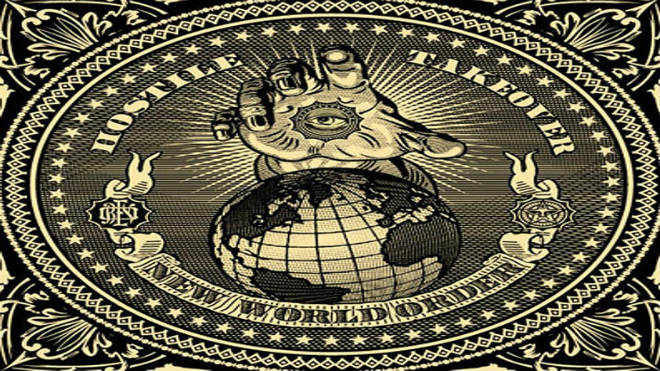
‘New World Order’ is falling apart

By Wayne Madsen

Source: Intrepid Report

One of the more welcomed outcomes of the paring back of the U.S. State Department bureaucracy is the elimination of scores of “status quo enthusiasts.” Since the end of World War II, the State Department’s ranks have been populated by foreign service officers and career diplomats who have championed the international status quo.

These minions of Foggy Bottom received encouragement for their protective stance on post-World War II and the Cold War in President George H. W. Bush’s speech on September 11, 1990, which was titled, “Toward a New World Order.” Under the “new world order,” regional and global security concerns would supplant democratic independence movements. The immediate effect of this “order” was brutal crackdowns on secession in the periphery of the former Soviet Union, including Abkhazia, South Ossetia, Nagorno-Karabakh, Transnistria, as well as in Somalia, the Kurdish regions of Iraq and Turkey, East Timor, Sudan, and Ethiopia. However, in Yugoslavia, which the United States and European Union wanted to see dissolved, secessionists in seven constituent states were encouraged to secede from the federation. That resulted in the bloodiest military conflicts in Europe since World War II.

Leaders of secessionist groups visiting Washington were traditionally shunned by the State Department. These hapless would-be presidents and prime ministers would be lucky to meet with a low-ranking State Department employee. However, if their independence movements were championed by the Central Intelligence Agency, they would get red carpet treatment. Such was the case with Secretary of State Madeleine Albright’s favorite Balkans “toy boy,” Hashim Thaci, the leader of the terrorist Kosovo Liberation Army and now president of the Republic of Kosovo, which was carved out of Serbia but is still unrecognized by many of the world’s most important nations, including China and Russia.

Today, one of the most-commonly seen words in State Department Country Desk reports is “secession.” In the past, State Department senior bureaucrats would be raising this development with the secretary of state as a major threat to U.S. interests. The CIA would then be instructed to remedy the situation by providing intelligence support to the countries where secessionist activity was a rising problem. “Support” would range from intelligence assistance to full-blown military aid.

As the United States recedes from the “world’s only superpower” status, to the chagrin of neoconservatives who are pouring into the Donald Trump administration in order to right the capsizing ship-of-state, secessionist activity is seen from the streets of Catalonia, which recently re-elected a pro-independence parliament, to virtual city-states in Mexico, which are increasingly going it alone to offset the breakdown in federal security and law enforcement support.

In the secessionist-minded Republika Srpska, a restive constituent region of the Bosnia-Herzegovina federation, Serbian nationalists have held a banned “statehood” celebration in the regional capital of Banja Luka. Srpska President Milorad Dodik demanded more autonomy for his region, declaring there were two Serbian states, Serbia and Republika Srpska. Present at the banned event were Serbian Defense Minister Aleksandar Vulin, Interior Minister Nebojsa Stefanovic, and former Serbian President Tomislav Nikolic. Joining them was Anatoly Bibilov, the president of the breakaway Republic of the Republic of South Ossetia–the State of Alania in the Caucasus region.

To the consternation of Eurocrats in Brussels and in the Balkans, also in attendance was Aleksandar Karadjordjevic and his wife, the heirs presumptive to the throne of the former Yugoslavia, and Johann Gudenus, the chairman of the Austrian Freedom Party (FPO), which makes up half of the governing coalition of Austria. Dodik awarded a Republika Srpska medal to Austrian Vice-Chancellor Hans Christian Strache, the leader of the FPO faction in the Austrian government. In the past, such an international outpouring of support for a secessionist-minded republic would have resulted in a flurry of diplomatic protests and démarches from the State Department.

After a recent election returned a coalition of pro-independence Catalonian parties to a majority of 70 seats in the Catalonian 135-seat parliament, the neofascist Madrid government of Mariano Rajoy has been put into a quandary. The Catalonian parliament has re-elected former Catalonian President Carles Puigdemont, who was removed by Rajoy after an October 1, 2017, referendum that favored independence. Puigdemont, who is in self-exile in Belgium, where he has the support of the powerful Flemish pro-independence party, faces arrest by the Madrid regime if he returns to Catalonia. The thuggish reaction by the Rajoy regime has engendered sympathy for the Catalonian cause in other secessionist-minded regions of Spain, including the Basque region, Valencia, and Galicia, and around the world.

The case of Catalonia has resulted in popular blowback against Spain from other parts of Europe, including Scotland, which is demanding a second referendum on independence upon Britain’s exit from the European Union. Support for continued membership in the EU has also increased demands for independence from Wales and Northern Ireland in the United Kingdom.

Taking a cue from the Madrid government, Nigerian authorities recently arrested Cameroonian Anglophone secessionist movement leader Sessekou Julius Ayuk Tabe, along with some of his aides, in the Nigerian capital of Abuja. The arrests came after Cameroon accused Nigeria of harboring supporters of the breakaway region of Ambazonia on the Nigerian side of the border. French-speaking Cameroon considers the English-speaking secessionist movement to be a “terrorist” organization, the usual appellation assigned by Third World dictatorships to pro-democracy groups and movements.

The newly-inaugurated president of Somaliland, Muse Bihi Abdi, was received with full diplomatic honors on his first trip abroad to neighboring Djibouti. What makes this newsworthy is that no country has formally recognized Somaliland’s self-declared independence from Somalia, even though the country has been independent for 19 years. Somaliland, which has its own currency and issues its own passports, maintains an effective government as compared to that of Somalia’s. In the past, Djibouti’s full honors for the Somaliland president would have resulted in a curt diplomatic note from the U.S. embassy in Djibouti for extending de facto recognition of Somaliland. There is now a scramble for military and political influence in the Horn of Africa by the United States, China, France, Turkey, Germany, Russia, Japan, Britain, the United Arab Emirates, Iran, Saudi Arabia, Egypt, and Qatar.

The UAE sees Somaliland and a restored independent South Yemen as in its national interests, hence, the oil-rich federation is establishing de facto bases in Somaliland’s port of Berbera, the Yemeni island of Socotra in the Gulf of Aden, and two key Yemeni islands in the Red Sea: Perim and Kamaran. In the past, the United States, which always wanted Socotra for its own military use, merely because it was once a Soviet intelligence base, would have threatened Yemen and the UAE with reprisals. However, Yemen is a failed state and the UAE is now overshadowing American influence in the Red Sea/Gulf of Aden region.

In Mexico, the town of Tancítaro, which lies deep within the drug cartel-controlled state of Michoacán, has decided to establish a de facto city-state. The “avocado capital of the world” is now governed by a “junta,” which is backed by wealthy avocado growers who have hired their own security force to contend with the narco-gangs. Similar quasi-city states have been established in Monterrey, where local businesses have taken over security duties from corrupt police, and Ciudad Nezahualcóуotl (or “Neza”), outside of Mexico City, where the local leftist administration has established its control over the local police, monitoring their every activity for corruption or human rights abuses.

The Algerian government has decided, after years of opposition, to acceding to some of the demands of the minority Berber Kabylie Independence Movement. Amazigh, the Berber language, is now an official language of Algeria. Algeria now celebrates January 12 as Yennayer, the Amazigh New Year. An Amazigh language academy is now planned in Algeria. In the past, the U.S. State Department, influenced by U.S. oil and gas firms active in southern Algeria, would have been aghast at concessions by the Algerian government to Berber nationalists. In what worries Spain, Amazigh is now the third most widely spoken language in Catalonia, after Spanish and Catalan. The Catalans and Amazigh share common ancient roots that have manifested themselves in modern cooperation to advance their statehood goals.

In India, some “scheduled tribals,” the name assigned by the government to indigenous tribal groups, are examining historical documents between British colonial officials and their own past leaders and are discovering they have every right to independence from India. Indian police recently arrested for “sedition” the 83-year-old Ramo Birua, from a village in Jharkhand state, because he called for the raising of the flag of an independent Kolhan state. Birua and his followers cited the rule imposed in 1837 by the British Agent for Kolhan region, Sir Thomas Wilkinson. The “Wilkinson Rule” stipulated that the existing civil and criminal laws of tribal states would be recognized by the British authorities. India’s independence did nothing to change the Wilkinson Rule, thus, “scheduled tribes” across India have a legal right to go their own way. In the case of Mr. Birua, he claims his tribe’s right to sovereignty is ensured by British Queen Elizabeth II, as the heir to Queen Victoria, the British monarch whose royal imprimatur was conferred upon the Wilkinson Rule.

Even within the United States, there is talk of “autonomy” by states from federal intrusions. Colorado is prepared to fight the Trump administration’s stated crack down on marijuana sales. In Colorado and other states that have legalized marijuana, Democratic and Republican officials are prepared to fight the Drug Enforcement Administration in any moves against their legalized medical and recreational marijuana industries. The same applies to federal authority to conduct offshore oil exploration and drilling. California, which has also declared its independence from Trump’s withdrawal from the Paris Climate Accord, is standing opposed to drilling in its Pacific waters. Florida successfully persuaded Trump to exempt it from the drilling order, however, Virginia, North Carolina, and other states are seeking similar exemptions. Other matters that are driving states’ rights rebellions against Washington are in the areas of immigration, federal land use, engine emissions standards, voting rights, health care, and public education. Puerto Rico and the U.S. Virgin Islands, abandoned by Washington after repeated hurricane disasters, are subtly re-evaluating their previous opposition to independence.

The demise of neo-colonialist busybody diplomats at the State Department has ushered a “global spring,” where both active and long-dormant independence movements are seeing glimmers of hope for their own nation-states.

8 Critical Factors Behind Every Food Crisis

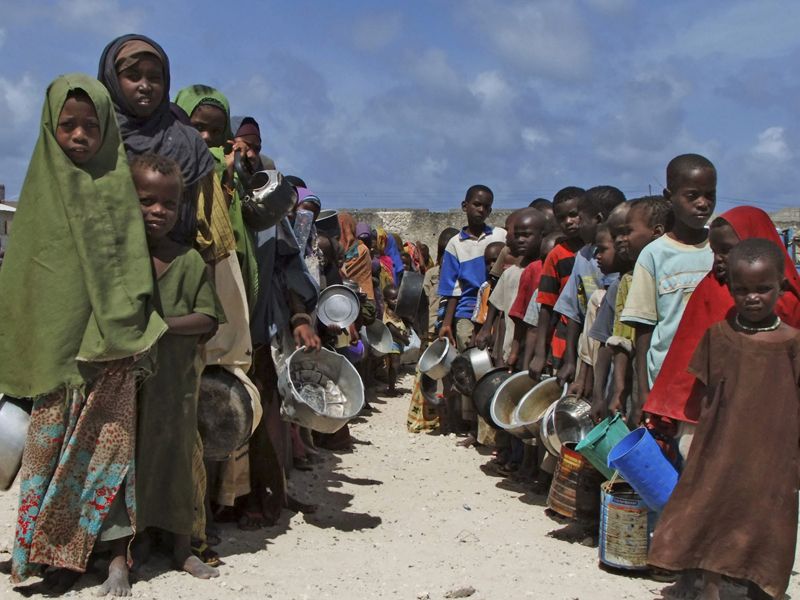
FILE – In this Monday, Aug. 15, 2011 file photo, children from southern Somalia hold their pots as they line up to receive cooked food in Mogadishu, Somalia. A report by two U.S. government-funded famine and food agencies gives the highest death toll yet, estimating that 260,000 people died – more than double previous estimates. (AP Photo/Farah Abdi Warsameh, File)

By John Hawthorne

Source: Business Connect

From the beginning of time, their have been food crises in one form or another. Ancient books such as the Bible have records of various famines devastating portions of the world.

And while it’s easy to attribute these crises to a single cause, such as war or drought, the causes are usually much deeper and much more complex.

Nelson Mandela said, “Overcoming poverty is not an act of charity, it is an act of justice.”

In order for us to achieve the kind of justice envisioned by Mandela, it’s essential that we first understand the underlying causes of food crises. Only after we have understood can we then begin creating meaningful solutions.

With that in mind, here are 8 primary factors behind almost every global food crisis. While not all 8 of these will be present at a time, you will almost always find several of these at work.

Factor #1 – Poverty

One of the greatest factors in every food crisis is stark and abject poverty. This isn’t surprising. With enough money, anyone can ensure they have enough food. But with many developing nations sitting well below the poverty line, the population simply can’t afford the food they so desperately need.

Additionally, poverty has a distinct effect on food output. In Africa, for example, many farmers can’t afford proper irrigation and fertilizer. This, in turn, leads to lower yields, which then reduces the overall amount of food available to the population.

The population of the Sub-Saharan region of Africa is expected to grow at an astronomical rate, topping out at 2.4 billion by 2050. This will continue to exacerbate the poverty issue, which will then continue to drive the lack of sufficient food in the area.

Factor #2 – Drought and Desertification

Widespread droughts, leading to the desertification of particular locations also causes huge disruptions to food production. For example, leading up to and during the global food crisis of 2008, 110 countries experienced significant droughts. This caused even the most well-irrigated, fertile areas to become arid deserts, making it impossible to grow crops.

As Mark Hughes noted:

Australia is normally the second largest exporter of grain, after the U.S. The continent, though, is experiencing an ongoing drought that has been described as the worst in a century. Grain yields have shrunk and many silos remain empty. Australia’s drought is a major factor in global wheat stocks being at their lowest since 1979. In fact, many wheat and rice farmers are switching to crops that demand less water, such as wine grapes.

Additionally, farmers often let animals over-graze on their land, reducing the amount of vegetation and increasing desertification. If the soil becomes dry enough, it is ruined and unable to support any crops at all.

Finally, as populations grow, deforestation occurs at an increased rate, which then leads to less vegetation and more desertification.

Factor #3 – Political Pressure

In the past, the International Monetary Fund has pressured small farmers, particularly in impoverished African countries, to abandon agricultural farming in favor of industrial work. The money generated from this practice would be used to pay off debt and import food.

While it may sound like a working strategy, it has created catastrophic results.

As Eric Holt-Giménez noted:

The urban population increased seven-fold, swelling from 18% to 33% of the population. Millions of poor and unemployed workers have swelled the cities—with two-thirds of them living in slums. The manufacturing and industrial sector did not “take off” in African countries; the percent of the GDP coming from industry was 30% in 1961 and 32% in 2000. In the countryside, as plantations for agro-exports expanded, food production plummeted and poverty grew. Though the rural population, density increased by 180% as more farmers were crowded onto smaller plots.

Factor #4 – Increased Consumption of Meat and Dairy

Many countries have begun adopting a more Western diet, which includes eating significantly more meat and dairy. To make this happen, farmers have been forced to raise more cattle, and more cattle means more grain being consumed.

The problem, however, is that this causes a significant deficiency in terms of calories consumed versus calories available. A cow consumes approximately 700 calories worth of grain to produce a piece of meat containing only 100 calories. When this happens on a massive scale, an enormous shortage of food is the end result. The longer this deficit continues, the greater the imbalance will become.

Factor #5 – Increased Oil and Transportation Costs

When the price of oil goes up, the energy cost for planting and transporting foods goes through the roof. When food costs more to grow, it then costs more to sell. These rising costs then make it more difficult for the local population to purchase crops as well as for farmers to export their crops to industrialized nations.

Additionally, increased oil costs has led many countries to invest heavily in the development of agro-fuels. More agro-fuels always means less food available.

As Esther Vivas helpfully puts it:

The increase in the price of oil, which doubled in 2007 and 2008 and caused a big rise in the price of fertilizers and transport related to the food system, has resulted in increasing investment in the production of alternative fuels such as those of plant origin. Governments in the United States, the European Union, Brazil and others have subsidized production of agro-fuels in response to the scarcity of oil and global warming. But this green fuel production comes into direct competition with the production of food. To give just one example, in 2007 in the United States 20% of the total cereal harvest was used to produce ethanol and it is calculated in the next decade that this figure will reach 33%. We can imagine the situation in the countries of the South.

Factor #6 – Falling World Aid

At the peak of the 2007-2008 food crisis, food aid was at it’s lowest point since 1961. This is one of the oddities about the national food market. When cereal prices are low, countries look to sell their food through international aid. However, when food prices are high, they prefer to sell them on the open market for increased profits.

In other words, during food crises, when food is scarcest and at it’s highest prices, it isn’t available for international aid. When the bottom falls out of world aid, food crises grow in magnitude.

Factor #7 – International Conflicts

International conflicts are a particularly visible factor behind many food crises. During conflicts, it’s common for one country to restrict exports to another country, which then reduces the amount of food available to the general population.

Or, even worse, dictators will intentionally isolate their countries, refusing foreign aid that is desperately needed. Aid workers may be blocked from entering the country, making it difficult for the citizens to receive needed help. If foreign aid does come, they seize it for themselves, depriving the population of desperately needed sustenance.

Factor #8 – Disease

If a country experiences a particularly violent outbreak of a disease, it can completely disrupt the overall food supply. For example, the HIV/AIDS crisis in Africa has killed farmers, which in turn pushes families deep into poverty.

When a population is undernourished, drugs become less effective and can at times create intense hunger pains. These two factors combined create a vicious cycle of death, poverty, and hunger.

Additionally, certain highly contagious diseases can restrict the amount of aid available to a country. For example, during the 2014 Ebola epidemic in West Africa, aid workers were restricted from traveling to the region due to fear of spreading the disease.

Perfect Storms

Most food crises aren’t the result of a single factor. Rather, they are caused by a perfect storm of events that coalesce into a deadly storm.

For example, in 2011, Somalia was devastated by a drought that caused widespread crop failure. The food crisis was made even worse by a non-functioning government as well as a national conflict. All these forces combined to make it difficult for aid workers to reach those who so desperately needed help.

The result was that approximately 260,000 people died.

Because the problems are almost always complex and multi-layered, the solutions must be equally multi-faceted. Simple solutions typically exacerbate the problem at the expense of the local population.

The best solutions are those that involve numerous parties working together to create a tangible, workable solution.

There will always be food crises to one degree or another. But as we grow in our understanding of what causes them, we can also grow in our ability to bring them to an end.

International Collaboration to End Violence


By Robert J. Burrowes

While much of the world is engulfed in violence of one sort or another
(whether violence in the home or on the street, exploitation, ecological
destruction or war), a global network of individuals and organizations
is committed to ending this violence in all of its manifestations.

With individual signatories in 100 countries and organizational
endorsements in 35 countries, each of these individuals and
organizations works on one or more manifestations of violence in their
locality and some of the organizations and networks have considerable
national or even international reach.

However, as you might understand, there is a great deal to be done and
the Charter network continues to expand as more people and organizations
are motivated to join this shared effort.

Here is an outline of what some of these individual signatories of ‘The
People’s Charter to Create a Nonviolent World‘ are doing. You are
welcome to join them.

A native of Iran, Professor Manijeh Navidnia was born in Tehran where
she attended school and university. She married in 1982 and had her
first child in 1985. Her original research interests were in social
science and sociology but after collaborating with the Islamic Azad
University, she became interested in strategic studies and most of her
research work and publications since then have focused on security. Her
first book in 2009 was particularly focused on ‘societal security’ and
her political engagements are designed to enhance international
cooperation across cultures.

Mahad Wasuge is a key figure at the Heritage Institute for Policy
Studies in Somalia. The Institute has recently published a shocking
report on ‘Somalia’s Drought Induced Crises: Immediate Action and Change
of Strategy Needed‘ in response to the ongoing drought in Somalia which threatens millions of people. ‘The ongoing drought in Somalia – referred to in the Somali
language as Sima, which means the leveler, ubiquitous or pervasive – has
enveloped the entire country. If rain does not arrive by mid April, and
if a massive humanitarian campaign is not mounted swiftly, the drought
could morph into an insidious famine that could devastate the country’:
hundreds of thousands of vulnerable men, women and children could starve
to death. Sadly, while awareness of the ongoing suffering and the
potential famine has been high, ‘the response of the international
community and the mitigation strategy by Somalia has been wholly
inadequate.’ Despite UN agencies raising over US$300 million, the
majority of the population across the country is not receiving basic
necessities. ‘Many pastoral communities have also lost 80 percent of
their livestock, escalating their vulnerability to an alarming and
perilous level.’

Ruth Phillips is the central figure in the initiative to create ‘an
ecological, co-housing village here on a fully restored, 17th century
chateau estate in rural France. The property lies in the heart of 30
acres of parklands and forests in the midst of quiet, deep-green nature,
surrounded by hills and mountains, forests and lakes. It is set in the
eastern Dordogne, one of most unspoilt regions of France’. They have
permission to create a permaculture village around the chateau for
residential and/or holiday use, with 23 houses blended into the natural
and historic landscape. Plans include the chateau ‘hub’ offering
education, leisure and cultural activities for residents and visitors; a
small restaurant; a multi-functional workshop space; the swimming pool;
a sauna and communal space, as well as large individual garden plots and
access to acres of forest and fields on the property. The site aims to
be a showcase for permaculture and sustainable living. Too good to be
true? Check out the Ecochateau website and email Ruth if you want to go there to stay for a while and help make their vision a more complete reality.

Burmese scholar and activist, Dr Maung Zarni has been indefatigable in
his efforts to raise awareness of the Burmese government’s genocidal
assault on the Rohingya Muslim population in Burma. He has also not
shied away from drawing attention to democracy icon Aung San Suu Kyi’s
complicity in this genocidal assault. While he has written many articles
on the subject, this two-minute video will give you a clearer sense of
Zarni, the compassionate scholar/activist: ‘Multiple Denials of
Myanmar’s Atrocity Crimes against Rohingyas prevent a peaceful
resolution’. For more, check out Zarni’s website.

In one of her public talks, Kathleen Macferran posed the question ‘Are we really safer when we put those who harm others behind bars and forget about them?‘ She explores
the idea of ‘turning our prisons into houses of healing and creating connections that lead to greater safety’ by having incarcerated men and women return to our communities as peacemakers.

Greg Kleven is a 68 year-old American living and teaching English in
Viet Nam. He was 18 years old when he went to Viet Nam as a soldier in
1967 ‘and thought that what I was doing was right. But after a few
months in country I realized that I had made a huge mistake. The war was
wrong and I should never have participated.’ After going home he had a
hard time adjusting back into society. ‘I couldn’t get the war out of my
mind.’ In 1988 he went back to Viet Nam as a tourist and realized he had
a chance ‘to make up for what I had done’. For the next two years he
helped organize ‘return trips for veterans who wanted to go back and see
Viet Nam as a country, not a war’. In 1990 he started teaching English
in Ho Chi Minh City and he has been doing it ever since. Greg shares the
passion to ‘some day put an end to all wars and violence in the world’.

Professor of Mathematical Analysis, Tarcisio Praciano-Pereira, reports
from Brazil that he is personally well but that living in Brazil is
‘very bad! I am 73 years old and I have suffered the dictatorship of
1964 when I was forced into exile. So I have a very clear picture of
what is going on here and this doesn’t make
me well because I know clearly the dangers we are facing. My life has
changed entirely, my intellectual production has dropped down because I
am all the time in the fight. I am seriously afraid! And I am not a
young boy anymore as I was in 1964.’ He advised the death of a judge of
the Supreme Court, who was overseeing a massive corruption investigation
into the state oil company, Petrobras, against the will of the ‘putsch
owners’ and conservative media outlet ‘Globo’. It is clear that the
possibility of crime in this death cannot be dismissed. Now they are
trying to replace the dead judge with the Justice Secretary ‘who is
nothing but a criminal. Please take a stand against this if you can.
Afraid is the right picture, friend! Yes, Fora Temer! Fora Temer, o
traira!’

Ending human violence requires courage, not to mention toughness and
determination, often in extraordinarily difficult circumstances.

For that reason, you might be sceptical about the prospects of achieving
it.

But if you wish to join the people above in working to create a world in
which peace, justice and ecological sustainability ultimately prevail
for all life on Earth, you can do so by signing the online pledge of
The People’s Charter to Create a Nonviolent World‘ and participating in
The Flame Tree Project to Save Life on Earth‘.

Can we do it? If we do not try, we will never know. And one day, fairly
soon now according to some climate scientists (and assuming we can avert
nuclear war in the meantime), homo sapiens sapiens will enter Earth’s
fossil record without even making a concerted effort to prevent it.


Biodata: Robert J. Burrowes has a lifetime commitment to understanding
and ending human violence. He has done extensive research since 1966 in
an effort to understand why human beings are violent and has been a
nonviolent activist since 1981. He is the author of ‘Why Violence?
His email address is flametree@riseup.net
and his website is at http://robertjburrowes.wordpress.com


Robert J. Burrowes
P.O. Box 68
Daylesford
Victoria 3460
Australia
Email: flametree@riseup.net

Websites:
Nonviolence Charter
Flame Tree Project to Save Life on Earth
‘Why Violence?’
Nonviolent Campaign Strategy
Nonviolent Defense/Liberation Strategy
Anita: Songs of Nonviolence
Robert Burrowes
Global Nonviolence Network