M=EC2 – THE MEDITATION EQUATION

By Kingsley Dennis

Source: Waking Times

‘When one begins to meditate, one accomplishes the only really free deed in this human life… we are completely free in this. Meditation is the archetypal free deed. – Rudolf Steiner

Arguably one of the world’s most famous equations is Einstein’s E = mcwhere energy equals mass times the speed of light squared. I am now proposing my own equation, which likely will be nowhere near as recognized or celebrated. Nevertheless, I feel it has worth sharing. Here it is: M = ECWhat does it signify? It means: meditation equals extended mind times contact and communication. At this point, I feel that some explanation is required. Here goes.

Philosophers, artists, and scientists have been debating for centuries the questions concerning human consciousness: what it is and how it emerges. The question of human consciousness has also been at the heart of many wisdom teachings, although these have tended to be based on revelation rather than investigation and empirical research. Over the course of these varied discussions, debates have been divided between the materialistic approach (the mind is contained in the brain), and what may be rather loosely termed as the ‘spiritual-metaphysical’ worldview (the mind exists outside of the brain). In recent decades, thanks largely to the advance in technologies, scientists have been able to map and study the human brain – including neuronal patterns, brain disorders, and pathways of human thinking. Yet this has led, in main, to an increased certitude among many scientists of a material view of human consciousness.

In other words, consciousness exists as a by-product of the physical brain and, as such, cannot exist without brain function. This is the dominant view amongst materialist thinkers and scientists. In more recent years however, and with the further research into nonlocal and field phenomena, investigators have been re-visiting mainstream theories of human consciousness. Specifically, as the unified field theory gains more support pointing to the nature of a nonlocal, interconnected cosmos, a different perspective is emerging on how consciousness may operate. And an understanding on the true nature of consciousness will validate and give meaning to the act of meditation; specifically, how meditation may provide access to contact, and possibly communication, beyond the material realm. First, we need to explore current concepts and perspectives on human consciousness.

Concepts of Consciousness: 1 – The Turbine Theory

The dominant mainstream narrative concerning human consciousness is that it is generated by the brain as a form of by-product. This has been referred to as the ‘turbine theory,’ whereby just how electricity would be generated by a working turbine as a by-product, so too is human consciousness the by-product of a functioning human brain (motor). This theory postulates human consciousness as being local and produced from something tangible. Also, when this producer/motor stops functioning – i.e., the brain ceases to be alive – then consciousness, and related streams of experience, likewise stop. Medical science has gone a long way to validate the ‘turbine theory’ of consciousness by repeated experiments on how impaired brain functioning results in distorted consciousness.

The basic premise of this understanding of consciousness is that neuronal networks in the human brain have evolved to such a high state of complexity that they produce a level of self-consciousness above that of any other animal on the planet (except perhaps dolphins, porpoises, and whales). Here, the degree of consciousness produced by each specific living creature is related to the level of biological complexity. In recent years, there have been renewed calls for a neurological basis for consciousness. For many scientists working in this field, consciousness is a by-product of complexity; thus, complex systems produce varying levels of consciousness, and ‘how much consciousness they have depends on how many connections they have and how they’re wired up.’[1] Despite recent scientific theories of consciousness, most still cling to the basis of an old paradigm ‘turbine theory.’

In other words, that consciousness is a secondary phenomenon resulting from primary activity located in the human brain. Regardless of the attempts by mainstream science to strengthen their outlook on consciousness, this ‘complexity-produces-consciousness as a by-product’ perspective has so many holes. The many holes in this dominant yet conservative theory is owing to a range of experiences that throw doubt upon its validity. Challenges to the turbine theory of consciousness have come, as one example, from increasing evidence of ‘after death’ conscious experiences.

Concepts of Consciousness: 2 – The Cloud Theory

According to the orthodox view, consciousness ceases when the brain dies – i.e., no generator, no current. For many, this may seem like an obvious deduction. However, evidence to the contrary clearly contradicts this theory. Many cases have shown that human consciousness is maintained even though a person is technically declared brain dead. The near-death experience (known as NDE) has been reported by sufficiently large numbers of people who were declared brain-dead. Conscious experience in brain dead people has been reported in almost 25 percent of tracked cases. The NDE phenomenon has now been widely researched and discussed by many credible sources.[2] Furthermore, this phenomenon is not new and there are accounts of NDEs occurring in medieval times.[3] The existence of consciousness – a by-product of brain activity – in the absence of brain function cannot be accounted for by the mainstream turbine theory. There are also numerous indications that human consciousness exists in cases of permanent death. That is, many years after a person has died their consciousness remains available for contact and communication, such as through channelling or forms of ESP. There is now enough credible evidence to put doubt into the mainstream theory that consciousness is solely a by-product of localized brain activity.

One way to account for these anomalies would be to suggest that consciousness is in some way conserved beyond the brain – that is, as a nonlocal phenomenon. In this hypothesis, consciousness is something stored external to the brain. This can be framed in terms of a ‘cloud theory’ of consciousness, as this is similar to how information would be conserved on digital platforms accessed by computer networks or other cloud-enabled devices. Likewise, using this analogy, the mainstream ‘turbine theory’ of consciousness would be akin to an old-fashioned computer without Internet or built-in-memory that would lose all its data once switched off. In this regard, the cloud theory posits consciousness as nonlocal, rather than localized within the brain. Furthermore, the cloud theory allows for not only individual consciousness to be stored, and be recalled, but multiple.

This perspective of accessing multiple consciousnesses, beyond the individual one, is reminiscent of Jung’s collective unconscious. This theory would appear to support the observations of psychiatrists and consciousness researchers who have induced altered states of consciousness in their clients, including past life regression. When in altered states a vast majority of people have the capacity to recall almost everything that has happened to them, as well as in previous life incarnations. Moreover, their recall is not limited solely to their own experience but can also include the experiences of other people as well.[4] This cloud theory therefore suggests something akin to a collective field of consciousness that makes complete information available relative to the mode of access. This perspective shares similarities with the scientific research on the Akashic Field[5] and Morphic Resonance.[6] However, despite the appropriateness of the cloud theory of consciousness, it too does not account for all observations.

Concepts of Consciousness: 3 – The Unified Field Theory

In various recorded accounts of altered state consciousness, it appears that contact/access is not only made with traces of one’s nonlocal consciousness but also with distinctive separate conscious intelligence. That is, with an active consciousness that is not the consciousness of a human being. Such experiences, once the realm of mystical, shamanic, or indigenous traditions, has increasingly entered mainstream culture. Previously, such ‘encounters’ were labelled as supernatural or simply conveniently ignored as a quirky anomaly. However, as western science has developed its exploration of the inner realms (such as in transpersonal psychology and similar practices), such experiences have become more widespread and thus need to be accounted for. From this evidence a remarkable conclusion arises: that human consciousness can connect, and often communicate, with conscious entities that not only manifest a sense of self, but also carry distinct memories and information. This experience can neither be accounted for in the mainstream turbine theory nor the cloud theory of consciousness. We now need to consider yet another concept – that consciousness is a unified field phenomena with holographic qualities.

The unified field theory posits that consciousness may manifest in spacetime yet originates from a source that exists in a realm beyond spacetime.  In other words, consciousness has its origins in a deeper dimension (in a ‘unified source field’) and yet manifests through physical-material reality. This concept would suggest that all forms of localized consciousness are expressions of a unified consciousness field that is beyond spacetime. The implications of this understanding are that consciousness is not ‘in’ the brain, ‘produced’ by the brain, nor ‘stored’ beyond the brain. Rather, the human mind is a localized aspect of a conscious intelligence that infuses the cosmos from its source beyond spacetime.

This may be a hard pill to swallow for many people. However, when we examine the phenomena that is consciousness, this perspective makes a lot of sense. The viewpoint of this new model says that the brain receives and interprets consciousness, which is an interrelated aspect of the cosmos, and then projects this as the individual mind. Yet the brain does not produce consciousness. This understanding, which is now increasingly supported by the very latest scientific findings, points toward a Unified Source Field (USF) as generating what we perceive as spacetime. The materiality of spacetime is thus a holographic projection, coded from an underlying cosmic intelligence-field. It is this underlying intelligence-field that is the source of all material reality and conscious life. Every element that emerges into physical reality is simultaneously interrelated with the underlying Unified Source Field. As such, each material element in existence is also in contact and communication with this unified intelligence-field. Human consciousness – the human mind – is at all times connected to a deeper dimension of Source consciousness.

A Deeper Dimension: Consciousness, Contact, Communication

The understanding that consciousness originates from a deeper dimension of reality beyond spacetime has been embraced by many well-known spiritual figures, mystics, visionaries, artists, and even a handful of intuitive scientists. It may one day come to represent the dominant understanding amongst humanity (as it perhaps once was). The universe has already been recognized by mainstream science as exhibiting an incredible – almost impossible – degree of coherence. Now we may know why this is. It is because there is no random cosmos, no separation of materiality and immateriality, no empty space, no ‘out there’ and ‘in here.’ Everything – absolutely everything – is an integral part of a nonlocal conscious field whose origin is a Unified Source Field (USF) existing beyond the spacetime dimension. What this implies is that there is an inherent form of order to the material dimension. The cosmos, and all aligned aspects within it, adheres to an intelligent, conscious impulse toward coherence and connection.[7] Perception too, as an attribute of consciousness, trends toward greater conscious coherence (awareness) and connection. At the core of this drive for connectivity, I suggest, is an urge for conscious awareness of Source (the Unified Source Field). And so, this leads me back to the equation at the beginning of this essay; what I call the meditation equation: M = EC2.

Meditation equals extended mind times contact and communication. Meditation has from time immemorial been a part of human life, even if not formally recognized as so. Meditation can take only a second. A quick pause of chatter in the mind. A momentary close of the eyes. A transitory step back from the entanglement in physical reality. A fleeting respite from external stimuli. A brief break from the outer world to focus upon the inner. And the inner world is expansive – it is where the origin resides. And in this state, contact can be made with those aspects in existence beyond our material reality. And with contact can also come communication.

As human beings, we are already in contact and communication with aspects beyond our perception or acknowledgment. We only do not recognize such contacts as so. The inner nudge, the inspirational idea, the coincidental happening, the inexpressible sense, the indescribable knowing. These are the contacts humanity has. What if we consciously take it to the next level by intending to listen to such contact? What if we then ask for communication? We can give ourselves permission to start asking for contact and communication whilst in a meditative state. By showing acceptance, and readiness to allow for contact and communication beyond our physical senses and sense-reality, we are acknowledging the interrelatedness of all life. And life wishes to communicate amongst itself. Sentient life wishes to be heard, and to share.

Life is not meaningless nor without purpose. Our inherent connectivity transcends localized space and time. The human being is intrinsically connected with the cosmos and with Source consciousness. One day, it is hoped, this understanding will be, for all of us, as clear as pure water; and we will laugh gently to ourselves thinking how it could ever have been otherwise.

Pop Culture Has Become an Oligopoly

By Adam Mastroianni

Source: Experimental History

You may have noticed that every popular movie these days is a remake, reboot, sequel, spinoff, or cinematic universe expansion. In 2021, only one of the ten top-grossing films––the Ryan Reynolds vehicle Free Guy––was an original. There were only two originals in 2020’s top 10, and none at all in 2019.

People blame this trend on greedy movie studios or dumb moviegoers or competition from Netflix or humanity running out of ideas. Some say it’s a sign of the end of movies. Others claim there’s nothing new about this at all.

Some of these explanations are flat-out wrong; others may contain a nugget of truth. But all of them are incomplete, because this isn’t just happening in movies. In every corner of pop culture––movies, TV, music, books, and video games––a smaller and smaller cartel of superstars is claiming a larger and larger share of the market. What used to be winners-take-some has grown into winners-take-most and is now verging on winners-take-all. The (very silly) word for this oligopoly, like a monopoly but with a few players instead of just one.

I’m inherently skeptical of big claims about historical shifts. I recently published a paper showing that people overestimate how much public opinion has changed over the past 50 years, so naturally I’m on the lookout for similar biases here. But this shift is not an illusion. It’s big, it’s been going on for decades, and it’s happening everywhere you look. So let’s get to the bottom of it.

(Data and code available here.)

Movies 

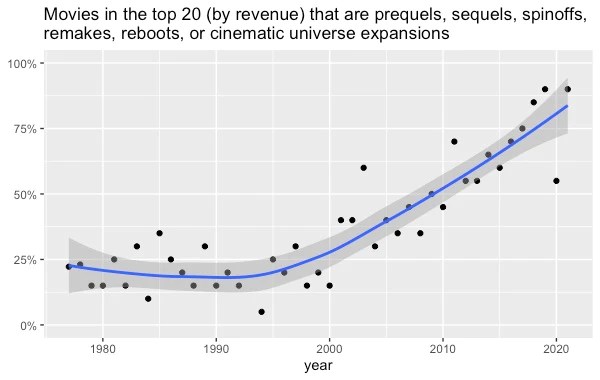
At the top of the box office charts, original films have gone extinct. 

I looked at the 20 top-grossing movies going all the way back to 1977 (source), and I coded whether each was part of what film scholars call a “multiplicity”—sequels, prequels, franchises, spin-offs, cinematic universe expansions, etc. This required some judgment calls. Lots of movies are based on books and TV shows, but I only counted them as multiplicities if they were related to a previous movie. So 1990’s Teenage Mutant Ninja Turtles doesn’t get coded as a multiplicity, but 1991’s Teenage Mutant Ninja Turtles II: The Secret of the Ooze does, and so does the 2014 Teenage Mutant Ninja Turtles remake. I also probably missed a few multiplicities, especially in earlier decades, since sometimes it’s not obvious that a movie has some connection to an earlier movie.

Regardless, the shift is gigantic. Until the year 2000, about 25% of top-grossing movies were prequels, sequels, spinoffs, remakes, reboots, or cinematic universe expansions. Since 2010, it’s been over 50% ever year. In recent years, it’s been close to 100%.

Original movies just aren’t popular anymore, if they even get made in the first place.

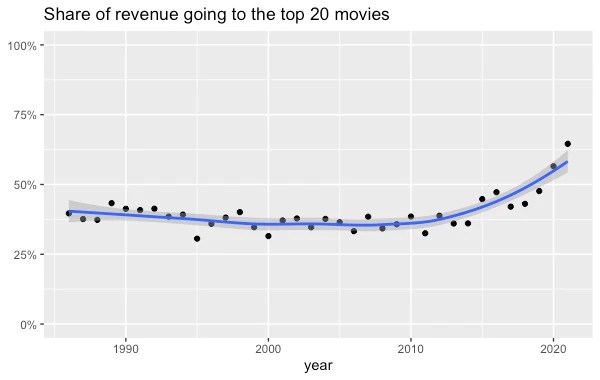
Top movies have also recently started taking a larger chunk of the market. I extracted the revenue of the top 20 movies and divided it by the total revenue of the top 200 movies, going all the way back to 1986 (source). The top 20 movies captured about 40% of all revenue until 2015, when they started gobbling up even more.

Television

Thanks to cable and streaming, there’s way more stuff on TV today than there was 50 years ago. So it would make sense if a few shows ruled the early decades of TV, and now new shows constantly displace each other at the top of the viewership charts.

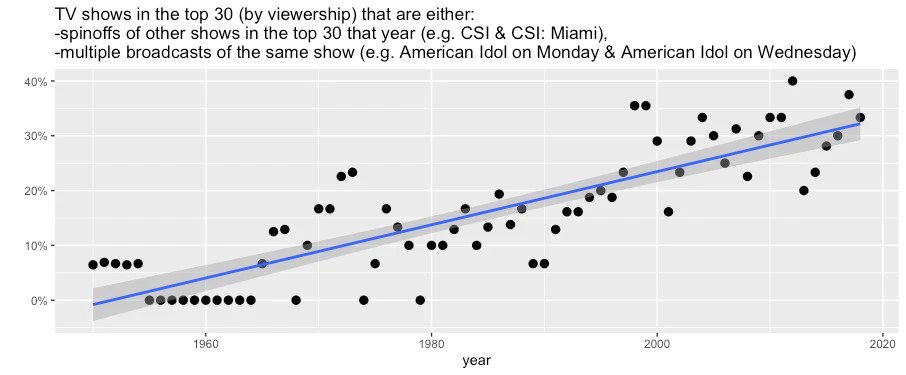
Instead, the opposite has happened. I pulled the top 30 most-viewed TV shows from 1950 to 2019 (source) and found that fewer and fewer franchises rule a larger and larger share of the airwaves. In fact, since 2000, about a third of the top 30 most-viewed shows are either spinoffs of other shows in the top 30 (e.g., CSI and CSI: Miami) or multiple broadcasts of the same show (e.g., American Idol on Monday and American Idol on Wednesday). 

Two caveats to this data. First, I’m probably slightly undercounting multiplicities from earlier decades, where the connections between shows might be harder for a modern viewer like me to understand––maybe one guy hosted multiple different shows, for example. And second, the Nielsen ratings I’m using only recently started accurately measuring viewership on streaming platforms. But even in 2019, only 14% of viewing time was spent on streaming, so this data isn’t missing much.

Music

It used to be that a few hitmakers ruled the charts––The Beatles, The Eagles, Michael Jackson––while today it’s a free-for-all, right?

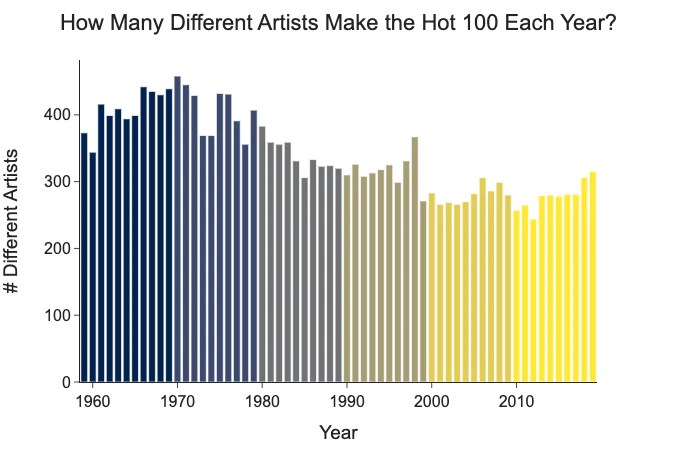
Nope. A data scientist named Azhad Syed has done the analysis, and he finds that the number of artists on the Billboard Hot 100 has been decreasing for decades.

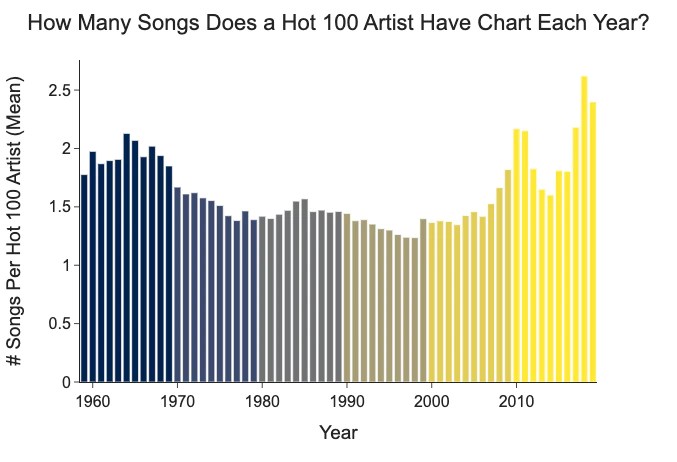
And since 2000, the number of hits per artist on the Hot 100 has been increasing. 

(Azhad says he’s looking for a job––you should hire him!)

A smaller group of artists tops the charts, and they produce more of the chart-toppers. Music, too, has become an oligopoly.

Books

Literature feels like a different world than movies, TV, and music, and yet the trend is the same.

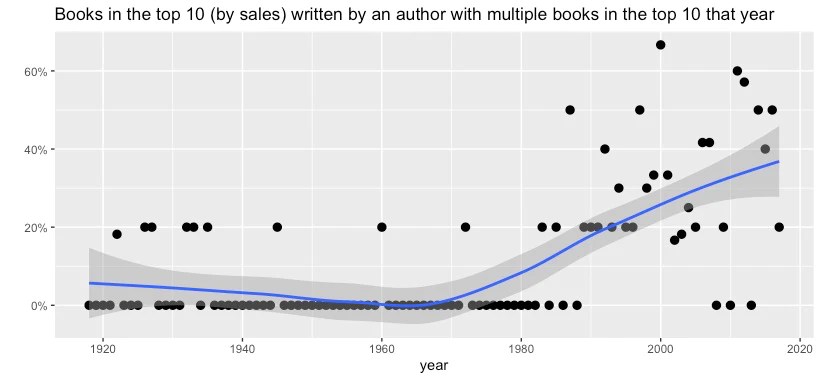
Using LiteraryHub’s list of the top 10 bestselling books for every year from 1919 to 2017, I found that the oligopoly has come to book publishing as well. There are a couple ways we can look at this. First, we can look at the percentage of repeat authors in the top 10––that is, the number of books in the top 10 that were written by an author with another book in the top 10.

It used to be pretty rare for one author to have multiple books in the top 10 in the same year. Since 1990, it’s happened almost every year. No author ever had three top 10 books in one year until Danielle Steel did it 1998. In 2011, John Grisham, Kathryn Stockett, and Stieg Larsson all had two chart-topping books each.

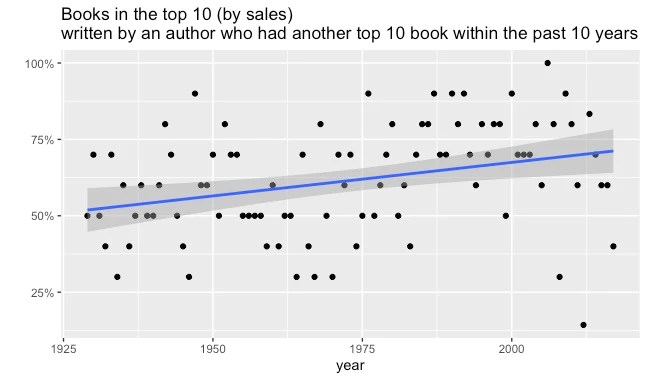
We can also look at the percentage of authors in the top 10 were already famous––say, they had a top 10 book within the past 10 years. That has increased over time, too. 

In the 1950s, a little over half of the authors in the top 10 had been there before. These days, it’s closer to 75%.

Video games

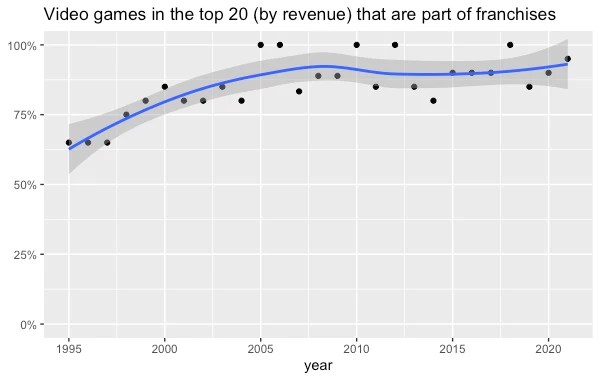
I tracked down the top 20 bestselling video games for each year from 1995 to 2021 (sources: 1234567) and coded whether each belongs to a preexisting video game franchise. (Some games, like Harry Potter and the Sorcerer’s Stone, belong to franchises outside of video games. For these, I coded the first installment as originals and any subsequent installments as franchise games.)

The oligopoly rules video games too:

In the late 1990s, 75% or less of bestselling video games were franchise installments. Since 2005, it’s been above 75% every year, and sometimes it’s 100%. At the top of the charts, it’s all Mario, Zelda, Call of Duty, and Grand Theft Auto.

Why is this happening?

Any explanation for the rise of the pop oligopoly has to answer two questions: why have producers started producing more of the same thing, and why are consumers consuming it? I think the answers to the first question are invasionconsolidation, and innovation. I think the answer to the second question is proliferation.

Invasion

Software and the internet have made it easier than ever to create and publish content. Most of the stuff that random amateurs make is crap and nobody looks at it, but a tiny proportion gets really successful. This might make media giants choose to produce and promote stuff that independent weirdos never could, like an Avengers movie. This can’t explain why oligopolization started decades ago––YouTube only launched in 2005, for example, and most Americans didn’t have broadband until 2007––but it might explain why it’s accelerated and stuck around.

Consolidation

Big things like to eat, defeat, and outcompete smaller things. So over time, big things should get bigger and small things should die off. Indeed, movie studiosmusic labelsTV stations, and publishers of books and video games have all consolidated. Maybe it’s inevitable that major producers of culture will suck up or destroy everybody else, leaving nothing but superstars and blockbusters. Indeed, maybe cultural oligopoly is merely a transition state before we reach cultural monopoly.

Innovation

You may think there’s nothing left to discover in art forms as old as literature and music, and that they simply iterate as fashions change. But it took humans thousands of years to figure out how to create the illusion of depth in paintings. Novelists used to think that sentences had to be long and complicated until Hemingway came along, wrote some snappy prose, and changed everything. Even very old art forms, then, may have secrets left to discover. Maybe the biggest players in culture discovered some innovations that won them a permanent, first-mover chunk of market share. I can think of a few:

  • In books: lightning-quick plots and chapter-ending cliffhangers. Nobody thinks The Da Vinci Code is high literature, but it’s a book that really really wants you to read it. And a lot of people did!
  • In music: sampling. Musicians seem to sample more often these days. Now we not only remake songs; we franchise them too.
  • In movies, TV, and video games: cinematic universes. Studios have finally figured out that once audiences fall in love with fictional worlds, they want to spend lots of time in them. Marvel, DC, and Star Wars are the most famous, but there are also smaller universe expansions like Better Call Saul and El Camino from Breaking Bad and The Many Saints of Newark from The Sopranos. Video game developers have understood this for even longer, which is why Mario does everything from playing tennis to driving go-karts to, you know, being a piece of paper.

Proliferation

Invasion, consolidation, and innovation can, I think, explain the pop oligopoly from the supply side. But all three require a willing audience. So why might people be more open to experiencing the same thing over and over again?

As options multiply, choosing gets harder. You can’t possibly evaluate everything, so you start relying on cues like “this movie has Tom Hanks in it” or “I liked Red Dead Redemption, so I’ll probably like Red Dead Redemption II,” which makes you less and less likely to pick something unfamiliar. 

Another way to think about it: more opportunities means higher opportunity costs, which could lead to lower risk tolerance. When the only way to watch a movie is to go pick one of the seven playing at your local AMC, you might take a chance on something new. But when you’ve got a million movies to pick from, picking a safe, familiar option seems more sensible than gambling on an original.

This could be happening across all of culture at once. Movies don’t just compete with other movies. They compete with every other way of spending your time, and those ways are both infinite and increasing. There are now 60,000 free books on Project Gutenberg, Spotify says it has 78 million songs and 4 million podcast episodes, and humanity uploads 500 hours of video to YouTube every minute. So uh, yeah, the Tom Hanks movie sounds good.

What do we do about it?

Some may think that the rise of the pop oligopoly means the decline of quality. But the oligopoly can still make art: Red Dead Redemption II is a terrific game, “Blinding Lights” is a great song, and Toy Story 4 is a pretty good movie. And when you look back at popular stuff from a generation ago, there was plenty of dreck. We’ve forgotten the pulpy Westerns and insipid romances that made the bestseller lists while books like The Great GatsbyBrave New World, and Animal Farm did not. American Idol is not so different from the televised talent shows of the 1950s. Popular culture has always been a mix of the brilliant and the banal, and nothing I’ve shown you suggests that the ratio has changed.

The problem isn’t that the mean has decreased. It’s that the variance has shrunk. Movies, TV, music, books, and video games should expand our consciousness, jumpstart our imaginations, and introduce us to new worlds and stories and feelings. They should alienate us sometimes, or make us mad, or make us think. But they can’t do any of that if they only feed us sequels and spinoffs. It’s like eating macaroni and cheese every single night forever: it may be comfortable, but eventually you’re going to get scurvy. 

We haven’t fully reckoned with what the cultural oligopoly might be doing to us. How much does it stunt our imaginations to play the same video games we were playing 30 years ago? What message does it send that one of the most popular songs in the 2010s was about how a 1970s rock star was really cool? How much does it dull our ambitions to watch 2021’s The Matrix: Resurrections, where the most interesting scene is just Neo watching the original Matrix from 1999? How inspiring is it to watch tiny variations on the same police procedurals and reality shows year after year? My parents grew up with the first Star Wars movie, which had the audacity to create an entire universe. My niece and nephews are growing up with the ninth Star Wars movie, which aspires to move merchandise. Subsisting entirely on cultural comfort food cannot make us thoughtful, creative, or courageous.

Fortunately, there’s a cure for our cultural anemia. While the top of the charts has been oligopolized, the bottom remains a vibrant anarchy. There are weird books and funky movies and bangers from across the sea. Two of the most interesting video games of the past decade put you in the role of an immigration officer and an insurance claims adjuster. Every strange thing, wonderful and terrible, is available to you, but they’ll die out if you don’t nourish them with your attention. Finding them takes some foraging and digging, and then you’ll have to stomach some very odd, unfamiliar flavors. That’s good. Learning to like unfamiliar things is one of the noblest human pursuits; it builds our empathy for unfamiliar people. And it kindles that delicate, precious fire inside us––without it, we might as well be algorithms. Humankind does not live on bread alone, nor can our spirits long survive on a diet of reruns.

MATERIALISM & THE LOSS OF SOUL

By Kingsley L. Dennis

Source: Waking Times

The non-material, or non-visible, realm does not lie dormant. It is active, constantly. It is what infuses and makes possible the world we know and see. The intangible realm of vital forces is what we often call the ‘spiritual’ dimension for within it lies the conscious intelligences that establish material life. Spiritual matters have long been an abstract thing for many people. Yet they are no longer to remain abstract – they are now to flow into culture not only through ‘spiritual channels,’ but through all manner of ways, including people. The flow and merger between the suprasensory world and the sensory world (the realm of the phenomenal), has always been in operation. Only now, it looks set to increase.

Materialism is all good and well – yet up to a certain point. This is recognized by some as the ‘Fall’ – the deep immersion into physical reality. To a certain degree, this immersion into physicality was necessary for developing individualism and to perceive existence in relation to Source. Once this recognition is gained, then begins the ‘return journey’ back to Source/Origin consciousness. However, if a species remains too long within the grip of materialistic forces, then a hardening – or deadening – can occur that crystallizes certain faculties and organs of perception, which leads to an evolutionary stagnation. As such, the stagnation of evolvement can be due to the over-influence of entropic forces. The impulse of spiritual knowledge (developmental forces) descending into the physical world has been opposed by other forces that do not wish for people to discover their inner freedom. Yet this time, this moment in human development, has been foreseen and, on some levels, even planned for. What is to come about has been viewed as inevitable by those who know what is at stake.

The entropic forces that exist in opposition aim to ‘over-materialize’ materialism. They intend to deepen the entanglement within physical matter, and to create artificial material forms that would not have arisen in the natural course of human evolvement. This is a matter of exercising certain powers upon the physical plane. This is being applied in such a way as to block a renewal of human culture beyond materialism and to direct it into a new form of materialism, a more etheric form that seems un-material. This is what I refer to as the ‘fallacy of materialism’ – the digital-virtual realms, whilst seeming contrary to physical-materialism, are in fact working to deepen human entanglement in material forces. These digitized spaces, because of their sense of non-physicality, are really an etheric manifestation of materialism. Or rather, a realm of theoretical materialism. Theoretical materialism signifies a reality construct that does not need to be physical to the touch, yet it is based on, or is a projection from, a material foundation. Within both the theoretical and regular mode of materialism, the human being is encapsulated within an amalgamation of material processes. It is also a world of facts and external evidence that a person becomes lost within. All life experience proceeds from this material realm, and this conditions the human being to gain a view of life that is factually based, and to accept that there is no other reality except this world of materialism and factual experience. Any notion of the soul or spirit – the transcendental impulse – is either regarded as being a by-product from material reality or is rejected altogether as a false notion. This is the power of the immersion into matter-reality.

Deep materialism finally becomes a cosmology of entropy and decline. It leads to mechanical, artificial modes of thinking that eventually brings about a stagnation in those forces driving human development. If continued, these materialistic forces carve out a path of technological advancement and evolution that further blocks vital, spiritualized forces. In this route, the human being strives for greater material benefits yet neglects the vital human forces of spiritualized connection. Our current epoch is concerned with the development of the material world; and if the human being is not to degenerate totally into a mere accomplice of machines, then a path must be found which leads from the mechanical impulse towards a life of the spirit. However, entropic forces are in play that are opposed to forms of spiritualization (spiritual freedom), and which work to reduce and, eventually, dispose of spiritual seeking and to replace it with an ethereal and otherworldly ‘virtual paradise’ where all needs can be fulfilled-by-illusion. A part of this ‘supra-materialism’ is the notion of immortality that is arising through transhumanist tropes. This can be referred to as the immortality falsehood as it works not through the spirit-soul but through a prolongation of the physical life experience by merger with machinic forms. This is a mode of potential immortality within the physical sphere but not within the spiritual. In the end, it is an entrapment for it disavows the inner spirit release from the physical domain. This can lead to a state of soullessness within the human being as the contact with Source becomes, over time, diminished. Or, perhaps this materialistic, transhumanist agenda will attract those people already without full spirit-soul incarnation.

It may be that there are people walking around in physical incarnation, in physical bodies, yet who are lacking, for want of a better word, a soul. Rudolf Steiner made note of this a hundred years ago when he stated

‘…a kind of surplus of individuals is appearing in our times who are without Egos [‘I’], who are not truly human beings. This is a terrible truth…They make the impression of a human being if we do not look closely, but they are not human in the fullest sense of the word.’ 1

Steiner warned us to be aware that what we encounter as human beings in human form may not always have to be what it appears to be. He stated that the outer appearance can be just that: appearance. He went on to state: ‘We encounter people in human form who only in their outer appearance are individuals…in truth, these are humans with a physical, etheric, and astral body, but beings are embodied in them, beings that make use of these individuals in order to operate through them.’2 What this refers to is that human bodies can be vessels for other beings to operate through.

This makes us realize that the world of ‘spirit’ may not always be what we have thought it to be. In other words, it may not be all divine light and ascension. It also involves the aspect of discernment. For there are players and forces that wield a great deal of influence within the physical world. And some of these influences act through the presence of certain individuals that may appear outwardly ‘normal.’ In this light, a completely different kind of spirituality is at work in present-day humanity. It may be inferred, without sounding dramatic, that certain power groups, and their important individual members, are influenced (and perhaps dominated) by a non-human species of being that are intent on implementing non-human objectives. Such groups and individuals would, in this case, exhibit a distinct lack of ‘soul’ – i.e., empathy and compassion – and would appear to others as displaying almost sociopathic tendencies.[i] Yet at the same time, such people can appear unusually charismatic and are able to exert great influence over other people, especially with their words and speeches, whilst being themselves emotionally stunted.

To consider this further, such beings might be motivated in their actions to attempt to block other human being’s connection to their own individual inner/spiritual impulse. By a range of actions, they could focus on distracting people away from the notion of a metaphysical reality and of their inherent connection to Source (or a realm of vital conscious intelligence beyond matter-reality). In extreme cases, such players might even target the bio-psycho human body in an attempt to sabotage the vessel so as to make it a less viable vehicle for soul-spirit incarnation. What else might they hope to achieve? Again, referring to Rudolf Steiner, he stated that: ‘Their objective is to maintain the whole of life as a mere economic life, to gradually eradicate everything else that is part of the intellectual and spiritual life, to eradicate the spiritual life precisely where it is most active…and swallow up everything through the economic life.’3

By hijacking cultural, social, and economic systems, the focus turns away from the inner life, which tends to be more active once people have satisfied their primary needs (see Maslow’s Hierarchy of Needs). Also, if there are uncertainties, disruptions, and fluctuations in these systems, then people can become psychologically influenced in a negative way. That is, for those people who come under the domination of such economic forces – i.e., are subservient through debt – they are more likely to experience a loss of personal empowerment and will. If we take only a cursory glance at the actions of many incumbent leaders, politicians, corporate businesses, financial institutions, and more, we can see a clear lack of any soulful behaviour or intent. Quite the contrary, many of these individuals and groups seem determined to curtail human freedoms, sovereignty, and inner empowerment. If Steiner were alive today, he would no doubt say that what we are currently witnessing upon the physical plane is an act of soulless terraforming of the planet and a controlling manipulation of the human life experience by nefarious forces that have anti-human aims and intentions. Perhaps this is why so many people today are experiencing depression, frustration, and apathy – a paralysis of will – from which they feel unable to resolve. This gets manifested as a sense of weariness and dissatisfaction that is projected out into their everyday lives.

Because of this, and other factors, the consciously aware person of today is being asked to step into their role as a physical representative of sacred life. It is important that metaphysical realities are never diminished or disowned, and that the life of the spirit remains healthy and strong in expression within physical life. If there is ever a struggle against the human soul, then we may be witnessing this in these current times. We would do well to remember that each person possesses that special treasure that can never be taken from them. And this is the true eternal and genuine immortality. These are the times to be soulful, and to bring forth the human spirit.

References

Cited in Grosse, Erdmuth Johannes (2021) Are There People Without A Self? Forest Row: Temple Lodge, p31-2

Cited in Grosse, Erdmuth Johannes (2021) Are There People Without A Self? Forest Row: Temple Lodge, p60

Cited in Grosse, Erdmuth Johannes (2021) Are There People Without A Self? Forest Row: Temple Lodge, p63

Einstein and Freud’s ‘Why War?’ Revisited: Why Anti-War Efforts Go Nowhere

By Robert J. Burrowes

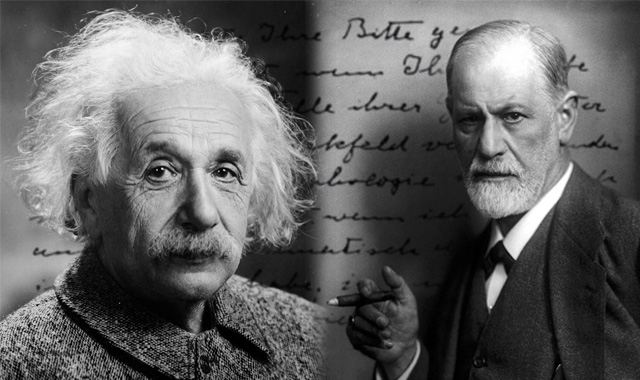
In 1932, Sigmund Freud and Albert Einstein exchanged letters, later published under the title ‘Why War?’ See ‘Why War? An exchange of letters between Freud and Einstein’.

However, whatever insight these two giants of an earlier era brought to our understanding of war, the reality is that a great deal has been learned since they corresponded.

Nevertheless, since the emergence of an identifiable, organized anti-war movement during World War I which has grown to include a diverse range of activists and organizations from across the political spectrum, as well as peace and conflict resolution scholars from various disciplines, there is little evidence that this movement, or any of the many organizations within it, has been learning from its failures by systematically undertaking or commissioning further research to understand the phenomenon of war more completely and then devising a strategy to end it based on that learning.

Hence, during its existence for more than 100 years, the organized anti-war movement – and the subsequently developed peace movement with its broader agenda – has had minimal impact in preventing or halting particular military conflicts, including wars, and zero impact in ending war generally, as the record testifies.

And so, even today, war continues in several countries in West Asia (the Middle East), Africa, elsewhere and, more recently, in Ukraine with the antiwar movement again demonstrating its ineffectiveness and, in the case of Ukraine, failing to comprehend the deeper agenda behind what is taking place in that country. See ‘The War in Ukraine: Understanding and Resisting the Global Elite’s Deeper Agenda’.

Of course, while an utterly inadequate analysis of what, fundamentally, is driving war is the critical foundation of the anti-war movement’s problems, it is still just one of the substantial range of problems it faces, some of which derive from this flawed analysis but others which a better analysis would expose. These include, for example, an understanding of why the fear of most of those within the anti-war movement is preventing the movement from mustering the commitment and courage that will be necessary if we are to undertake the many actions necessary to end war. In essence, fear makes most participants in the movement happy to complain about war but not take action themselves (or take action that has zero or minimal impact).

As Daniel Berrigan noted in his 1969 book No Bars to Manhood: ‘the waging of war, by its nature, is total – but the waging of peace, by our own cowardice, is partial.’

This cowardice means that a large proportion of the anti-war movement contents itself with a range of powerless measures – usually extending no further than signing petitions, issuing lameduck ideologically-oriented statements, writing articles, organizing conferences, issuing calls for negotiations or appeals to politicians – all invariably devoid of emotional and geopolitical reality as well as realistic measures to avert/halt the latest war.

This might include advocacy of measures, such as those developed under the guise of international humanitarian law, in relation to ‘outlawing war’ or outlawing particular weapons systems, despite the obvious observation that these legal constraints are routinely violated with impunity by any military power, starting with the United States, or non-state actor that is unconstrained by questions of legality.

Beyond this, ‘action’, when it is taken, is usually confined to conducting (notoriously ineffective) street protests or employing other tactics devoid of strategic impact in the context (of ending war). As former US Secretary of State Alexander Haig once noted about a massive anti-war demonstration: ‘Let them march all they want, as long as they continue to pay their taxes.’ See Alexander Haig. As a four-star general, Haig, not regarded as the most intelligent Secretary of State in US history, certainly understood that tactical choice is a question of strategy. Most activists have no idea.

So if we are to end war as a phenomenon in human affairs, or even meaningfully attempt to prevent or end a particular war, we need to do a number of things. Most fundamentally, we must start with a sound understanding of what causes violence to begin with because war does not emerge from a vacuum. War, when all is considered, is just another manifestation of violence, like everything from violence against women to economic exploitation to environmental destruction.

And if we are not able or willing to investigate and understand what is causing violence, and address this fundamental cause as part of our strategy, then our other efforts to end the manifestations of violence, including war, must all be in vain. Again, as the record readily testifies.

What Causes Violence?

So what is the cause of violence? Here is what 41 years (1966-2007) of concerted effort taught me.

Perpetrators of violence learn their craft in childhood. If you inflict violence on a child, they learn to inflict violence on others. The political leaders who decide to wage war, the military leaders who plan and conduct it, as well as the soldiers, sailors and aircraft personnel who fight war each suffered violence as a child. The terrorist suffered violence as a child. The neo-Nazi suffered violence as a child. The individual who inflicts violence on his (or her) partner suffered violence as a child. The corporate executive who exploits working class people and/or those who live in Africa, Asia or Central/South America suffered violence as a child. The racist or religious bigot suffered violence as a child. The individual who perpetrates violence in the home, in the schoolyard or on the street suffered violence as a child. The individual who overconsumes, or even consumes certain products and/or otherwise destroys the biosphere, suffered violence as a child.

So let me illustrate this point, in a very simplified way, by briefly explaining the parenting experience of a neo-Nazi. This individual has been terrorized by their parents and/or other significant adults in their life into projecting their fear onto particular groups of human beings and into believing that violence is a morally correct and superior way of dealing with these ‘different’ people. But for a much fuller and more nuanced explanation of this point, see the sections headed ‘The Emotional Profile of Archetype Perpetrators of Violence’ and ‘The Spectrum of the Violent Personality’ in ‘Why Violence?’

If we want to end violence in all of its manifestations, structural and otherwise, locally and globally, then we must finally end our longest and greatest war: the adult war on children. And here is an additional incentive: if we do not tackle the fundamental cause of violence, then our combined and unrelenting efforts to tackle all of its other symptoms must ultimately fail. And extinction at our own hand – by nuclear war or other means – is inevitable.

How can I claim that violence against children is the fundamental cause of all other violence? Consider this. There is universal acceptance that behaviour is shaped by childhood experience. If it was not, we would not put such effort into education and other efforts to ‘socialize’ children to ‘fit into’ their society. And this is why many psychologists have argued that exposure to war toys and violent video games shapes attitudes and behaviours in relation to violence.

But it is far more complex than this and, strange though it may seem, it is not just the ‘visible’ violence (such as hitting, screaming at and sexually abusing) that we normally label ‘violence’ that causes the main damage, although this is extremely damaging. The largest component of damage arises from the ‘invisible’ and ‘utterly invisible’ violence that we adults unconsciously inflict on children during the ordinary course of the day. Tragically, the bulk of this violence occurs in the family home and at school. See ‘Why Violence?’ and ‘Fearless Psychology and Fearful Psychology: Principles and Practice’.

So what is ‘invisible’ violence? It is the ‘little things’ we do every day, partly because we are just ‘too busy’. For example, when we do not allow time to listen to, and value, a child’s thoughts and feelings, the child learns to not listen to themSelf thus destroying their internal communication system. When we do not let a child say what they want (or ignore them when they do), the child develops communication and behavioral dysfunctionalities as they keep trying to meet their own needs (which, as a basic survival strategy, they are genetically programmed to do).

When we blame, condemn, insult, mock, embarrass, shame, humiliate, taunt, goad, guilt-trip, deceive, lie to, bribe, blackmail, moralize with and/or judge a child, we both undermine their sense of Self-worth and teach them to blame, condemn, insult, mock, embarrass, shame, humiliate, taunt, goad, guilt-trip, deceive, lie, bribe, blackmail, moralize and/or judge.

The fundamental outcome of being bombarded throughout their childhood by this ‘invisible’ violence is that the child is utterly overwhelmed by feelings of fear, pain, anger and sadness (among many others). However, mothers, fathers, teachers, religious figures and other adults also actively interfere with the expression of these feelings and the behavioral responses that are naturally generated by them and it is this ‘utterly invisible’ violence that explains why the dysfunctional behavioral outcomes actually occur.

For example, by ignoring a child when they express their feelings, by comforting, reassuring or distracting a child when they express their feelings, by laughing at or ridiculing their feelings, by terrorizing a child into not expressing their feelings (for example, by screaming at them when they cry or get angry), and/or by violently controlling a behavior that is generated by their feelings (for example, by hitting them, restraining them or locking them into a room), the child has no choice but to unconsciously suppress their awareness of these feelings.

However, once a child has been terrorized into suppressing their awareness of their feelings (rather than being allowed to have their feelings and to act on them) the child has also unconsciously suppressed their awareness of the reality that caused these feelings. This has many outcomes that are disastrous for the individual, for society and for nature because the individual will now easily suppress their awareness of the feelings that would tell them how to act most functionally in any given circumstance and they will progressively acquire a phenomenal variety of dysfunctional behaviors, including some that are violent towards themself, others and/or the Earth.

From the above, it should also now be apparent that punishment should never be used. ‘Punishment’, of course, is simply one of the words we use to obscure our awareness of the fact that we are using violence. Violence, even when we label it ‘punishment’, scares children and adults alike and cannot elicit a functional behavioural response. See ‘Punishment is Violent and Counterproductive’ and ‘The Rule of Law: Unjust and Violent’.

If someone behaves dysfunctionally, they need to be listened to, deeply, so that they can start to become consciously aware of the feelings (which will always include fear and, often, terror) that drove the dysfunctional behaviour in the first place. They then need to feel and express these feelings (including any anger) in a safe way. Only then will behavioural change in the direction of functionality be possible. See ‘Nisteling: The Art of Deep Listening’.

‘But these adult behaviors you have described don’t seem that bad. Can the outcome be as disastrous as you claim?’ you might ask. The problem is that there are hundreds of these ‘ordinary’, everyday behaviors that destroy the Selfhood of the child. It is ‘death by a thousand cuts’ and most children simply do not survive as Self-aware individuals. And why do we do this? As mentioned above, we do it so that each child will fit into our model of ‘the perfect citizen’: that is, obedient and hardworking student, reliable and pliant employee/soldier, and submissive law-abiding citizen (that is, one who pays their taxes, including those for war, and votes and/or lobbies politicians rather than acting powerfully themSelf).

The bottom line is simple: As parents, teachers, religious figures and adults generally, we want the child to be obedient to our commands, and not powerfully able to act in accord with their own Self-will. And we achieve this outcome by terrorizing the child into doing what we want rather than nurturing the child’s innate capacity to listen, deeply, to themSelf in order to follow their own will.

Moreover, once we destroy the Selfhood of a child, it has many flow-on effects. For example, once you terrorize a child into accepting certain information about themSelf, other people and the state of the world – with the bulk of this information mediated by elite agents including education systems, the entertainment industry and the corporate media – the child becomes unconsciously fearful of dealing with new information, especially if this information is contradictory to what they have been terrorized into believing. As a result, the child will unconsciously dismiss new information, no matter how truthful, out of hand.

In short, the child has been terrorized in such a way that they are no longer capable of learning (or their learning capacity is seriously diminished by excluding any information that is not a simple extension of what they already ‘know’). If you imagine any of the bigots you know, you are imagining someone who is utterly terrified. But it’s not just the bigots; virtually all people are affected in this manner making them incapable of responding adequately to new (or even important) information. This is one explanation why some people are ‘climate deniers’, most people do nothing in response to the climate catastrophe and even those people who do take action usually do so ineffectively. See ‘The Global Climate Movement is Failing: Why?’

But the same can be said for those working to end war – see ‘The War to End War 100 Years On: An Evaluation and Reorientation of our Resistance to War’ – end the nuclear weapons race or engage in other struggles, including liberation struggles, that are vital parts of the global struggle to create a more peaceful, just and sustainable human culture. See ‘Why Activists Fail’.

And to briefly put this issue in the current global context, the vast bulk of the human population, including most of those individuals whom society would regard as ‘highly intelligent’, has been readily terrorized into believing that they are threatened by a pathogenic virus (labeled ‘SARS-CoV-2’) when there is no documented, scientific proof that such an entity as a pathogenic virus even exists – see ‘Dismantling the Virus Theory – The “measles virus” as an example’ and What Really Makes You Ill? Why everything you thought you knew about disease is wrong – and certainly no documented scientific proof that a virus labeled SARS-CoV-2 exists. See ‘COVID-19: The virus does not exist – it is confirmed!’ and ‘Statement On Virus Isolation (SOVI)’. And for an account of researcher Christine Massey’s fruitless search over the course of more than a year to find evidence of an isolated virus, via Freedom of Information requests to health/science institutions all over the world, see ‘177 health/science institutions globally all failed to cite even 1 record of “SARS-COV-2” purification, by anyone, anywhere, ever’.

Despite this, the vast bulk of the human population has been terrorized into accepting a series of medical intrusions (including lockdowns, PCR tests, mask-wearing and gene-altering injectables) when, in fact, there is no documented, scientific proof that (assuming there was a ‘pathogenic virus’) lockdowns, PCR tests, mask-wearing or ‘vaccines’ even ‘work’ and/or extensive documentation of their harm. See, for example, ‘And How Are the Children? Lockdowns, Massive Fear, Deaths from Suicides and Drug Abuse’The WHO Confirms that the Covid-19 PCR Test is Flawed: Estimates of “Positive Cases” are Meaningless. The Lockdown Has No Scientific Basis’‘Conclusion Regarding Masks: They Do Not Work’‘Masks “don’t work,” are damaging health and are being used to control population: Doctors panel’‘The Truth about the Covid-19 Vaccine’A Final Warning to Humanity‘COVID Shots to “Decimate World Population,” Warns Dr. Bhakdi’ and ‘20 Facts about Vaccination Your Doctor Forgot To Tell You’.

And because the fear generated by the elite-driven ‘virus’/injectable narrative has been so debilitating and thus engendered a high level of obedience by the population at large, it is a rare individual who has investigated both the shortcomings in this narrative and the horrific agenda that this narrative is concealing, let alone identified a powerful strategy to resist it. See ‘We Are Human, We Are Free’.

So, to return to the focus of this article, let me briefly reiterate this vital point: The essence of what human beings call ‘socialization’ is the process by which each child is terrorized in such a way that they are no longer capable of learning or their learning capacity is seriously diminished. The multifaceted violence inflicted throughout childhood and adolescence ensures that the adult who emerges is suppressing awareness of an enormous amount of fear, pain, sadness and anger (among many other feelings) and must live in delusion to remain unaware of these suppressed feelings. This ensures that, as part of their delusion, the individual develops a strong sense that what they are doing already is functional and working (no matter how dysfunctional and ineffective it may actually be) while not investigating the existence of evidence that might contradict their delusion and/or unconsciously suppressing awareness of any evidence they come across that does contradict it. They do this because, unconsciously, people learn to identify obedience with ‘functional and working’ (because they do not get punished for being obedient). See ‘Why Violence?’‘Fearless Psychology and Fearful Psychology: Principles and Practice’‘Do We Want School or Education?’‘Love Denied: The Psychology of Materialism, Violence and War’ and ‘Human Intelligence or Human Awareness?’

Just one critically important outcome of this terrorization process is that a significant proportion of the human population is effectively insane, and this certainly includes the Global Elite and those primary elite agents on which it relies to generate and maintain wars. See ‘The Global Elite is Insane Revisited’.

Another critically important outcome of this terrorization process is that the international conflict resolution architecture – which is essentially a legal framework – does not take emotional factors into account. Hence it is not capable of resolving conflicts in any meaningful way. This is why negotiations often go nowhere, particularly in a timeframe that would avert adverse outcomes. And why ‘agreements’ that are reached are utterly superficial. The fundamental drivers of the conflict – invariably including suppressed terror, self-hatred and anger which are often unconsciously projected at the other party – are never addressed and will continue to manifest as violence in various forms, even if military violence is ended in a particular context. See ‘Challenges for Resolving Complex Conflicts’.

So if we want a powerfully effective anti-war movement (or peace movement, environmental movement, social justice movement….) then we need Self-aware individuals who can think, plan and act powerfully as part of strategically-oriented organizations to achieve ambitious longer-term goals. Such as ending the institution of war.

Anything less will fail. Again, as the record demonstrates.

So What Can We Do?

Ending war is possible. But it will take a courageous, sophisticated, strategic effort, given how deeply violence is embedded into the human ‘socialization’ process which makes war just one of the many approved violent behaviours in which adults are expected and encouraged to participate, beginning with paying taxes to finance it.

So while it is possible to end war, this won’t be happening any time soon.

And it can’t happen until we commit ourselves to eliminating violence against children so that human society creates adults who are psychologically whole and powerfully able to participate in conflict without resorting to violence to ‘resolve’ it.

Nevertheless, in parallel with efforts to eliminate violence against children, those powerful enough can also participate in a comprehensive strategy to end war as explained on the ‘Nonviolent Strategy’ website, starting with this list of ‘Strategic Goals to End War’. This is extrapolated from a book which explained why a strategy of nonviolent defense, understood and implemented by sufficient committed and organized individuals, is strategically superior to any military strategy. See The Strategy of Nonviolent Defense: A Gandhian Approach.

Or, if you want to participate in a strategy to end a particular war, such as that in Ukraine, particularly given the possibility of it morphing into a longer term insurgency – see ‘Ukraine And The New Al Qaeda’ – you can read how to do so here: Nonviolent Defense/Liberation Strategy.

But, as explained above, precisely because of their socialization experience during childhood, most of those who would identify as ‘anti-war’ are simply too frightened to act powerfully in resisting it. Hence, war will continue until we address its root cause: violence against children.

Biodata: Robert J. Burrowes has a lifetime commitment to understanding and ending human violence. He has done extensive research since 1966 in an effort to understand why human beings are violent and has been a nonviolent activist since 1981. He is the author of ‘Why Violence?‘ . His email address is flametree@riseup.net and his website is at http://robertjburrowes.wordpress.com

THE ANTI-STATIST: A REBEL FOR OUR TIMES

By Gary Z McGee

Source: Waking Times

“One man who stopped lying could bring down a tyranny.” ~Aleksandr Solzhenitsyn

All flag worshipers have the same unhealthy religion: statism. Flag worship is a nationalist’s false idol. It doesn’t matter if you’re a sieg-heiling Nazi or a little kid singing the pledge of allegiance. It’s all parochial symbolism digging its tentacles into contemporary ideals. It leads to blind conformity, indoctrinated complacency, bloated pride, war, and people all too happy to choke on the blue pill of blind obedience to an outdated chain of command.

Flag worship is a psychosocial hang-up. It works because we are social creatures. But what begins as a symbol for unifying people becomes a symbol for dividing people when it is taken too seriously or too pridefully.

In a world of 195 nation states, all with their own flags, it behooves us to use the same reasoning that Aristotle used when he said, “It is the mark of an educated mind to be able to entertain a thought without accepting it,” and then apply it to the concept of flags. Better to entertain a flag without accepting its authority. That’s what anti-statists do. And so, anti-statists are free under all banners.

Statism keeps the world divided. Divided people are easier to control. As Maximilien Robespierre surmised, “The secret of freedom lies in educating people, whereas the secret in tyranny is in keeping them ignorant.” Anti-statists teach us how not to be ignorant statists. They teach us how to rise above our cultural conditioning and how to become well-informed free-range humans instead.

As Nietzsche famously explained, “State is the name of the coldest of all cold monsters. Coldly it lies; and this lie slips from its mouth: ‘I, the state, am the people.’” Anti-statists are here to remind us that we are NOT the state. We are free individuals who require others to be free so that we can remain free. It really is that simple. As Albert Camus said, “I rebel, therefore we exist.”

Statism only functions when unhealthy, divided individuals create an us-versus-them mentality. It cannot continue if people are healthy and connected. It cannot continue if people realize that freedom is paramount. In short: statism fails when enough people achieve a sense of freedom and wellbeing despite the state.

So how do you know if you’re a statist or not?

Here are seven tell-tale signs you may be a statist:

1.) You are a statist if you believe that you need a ruler to rule over you.

2.) You are a statist if you believe that you require permission to be free.

3.) You are a statist if you blindly worship a flag.

4.) You are a statist if you believe that violence is the solution to problems.

5.) You are a statist if you believe that people should be forced into doing things without their consent.

6.) You are a statist if you believe that an authority should make decisions for you.

7.) You are a statist if you believe in comfortable obedience over uncomfortable freedom.

Anti-statism is an alien concept in our world, even though statelessness can be extended to all living beings “in principle” and “in theory,” at its irreducible bedrock nature, it is exceptionally difficult to be sovereign and stateless. This is because the entire world is plagued with the disease of statism. Statism is so second-nature to our existence that we never question it.

We might as well be fish questioning water. But we are NOT fish. We are human beings with the ability for deep logic, higher reasoning, and basic common sense. As Alvaro Koplovich quipped, “A man without a government is like a fish without a bicycle.” Fish do not need bicycles. Just like mankind does not need government, though he is conditioned to think he does.

People are unlikely to question a system they’ve been indoctrinated into, even if that system goes against common sense, the golden rule, and the non-aggression principle. People are more likely to stick to what they’ve been conditioned to believe, whether that belief is judicial, political, religious or all three (statism).

Overcoming statism takes a particular flavor of courage that doesn’t readily exist in the average person. It’s a kind of courage that must be birthed through great psychological upheaval and the death of one’s cultural conditioning. It must be nursed and cultivated daily, lest it slip back into passivity or typical, ineffective, and outdated modes of courage. It must be guided by a unique and daring flavor of leadership: a radical leadership that checks and balances constructs of power and teaches others how to do the same. This is Anti-statism.

Freedom begins by overcoming false truths. A false truth is any belief that is deemed invalid according to universal laws. It’s our responsibility alone to figure this out. Nobody else can do it for us. It’s our responsibility alone to question what we’ve been taught.

What’s crucial to understand is that the concept of freedom is almost entirely psychological in nature. In today’s day and age, it is less about breaking free physically (from harsh overt slavery), and more about breaking free psychologically (from comfortable covert slavery). Breaking free psychologically is rising above the cultural conditioning and reconditioning our condition.

The anti-statist does this with pluck and aplomb, acting as both a beacon of light for those stuck in the dark (confused and disoriented) AND as a beacon of darkness for those blinded by the light (culturally conditioned).

Anti-statists force us to look into the cultural mirror. They teach us how to pour the statist Kool Aid down the sink. They teach us how and why to deny any authority that claims we need permission to be free. They teach us how to disobey inauthentic leadership and how to embrace authentic leadership instead. They teach us how to become leaders who teach others HOW to think rather than WHAT to think.

Where statism is comfortable slavery, anti-statism is uncomfortable freedom. The anti-statist is free and uses that freedom with the soul intent to free others. They escape tyranny by freeing others through the symbol of their own freedom. Thus, freedom begets more freedom.

As the folks at Academy of Ideas said, “Contrary to what statist propaganda teaches, freedom cannot be imposed on us from above, nor is it created or destroyed at the ballot box. Freedom emerges at a societal level when enough of us recognize its value and structure our lives accordingly.”

Freedom must find its limit in justice and justice must find its limit in freedom. Otherwise, we either find ourselves living in a free-for-all state of chaos where anybody can do anything without any consequences (like the movie The Purge), or we’re living in a violent authoritarian state with oppressive laws and the illusion of freedom (like statism). Ideally, freedom balanced with justice and justice balanced with freedom is the healthiest way.

Here are five anti-statist tactics to overcome statism:

1.) Don’t ask for permission to be free.

2.) Don’t pay for the guards to guard you.

3.) Learn self-defense and honor the nonaggression principle.

4.) Vote with your feet: Don’t vote in, vote out.

5.) Don’t rely on government; govern yourself.

(Further reading: The Best Way to Manage Slaves (and how to avoid becoming one.)

Though anti-statists are born into a profoundly sick society, they decide not to be a part of it. They decide to live in the “real” world, a world not tainted by the unhealthy culture that the false system has created. Although the unhealthy culture is something the anti-statist must deal with, it is not something they must be a part of unless they choose to.

The anti-statist takes up the mantle of freedom despite authority so that you, your mother, your daughters, and even your granddaughters can one day be free from the powers of false men. They feel it is their own responsibility, as truly free humans, to do something about the unhealthy state of affairs because nobody else will. Nobody else seems to have the capacity to do what the anti-statist can do.

A wise man once said, “All that is needed for the forces of evil to triumph is for good men and women to do nothing.” Thus, anti-statists refuse to do nothing. They don’t waste time talking about being good men. They ARE good men. They will not allow evil to triumph. Even if that means they must make the goody-two-shoes and snowflakes of the world uncomfortable. Even if that means they must be amoral in the face of shortsighted morality and blind immorality.

When the laws of a nation-state are moral and just, the anti-statist follows them. When they are immoral and unjust, the anti-statist breaks them. This is because the anti-statist has become a self-ruling, self-overcoming, amoral agent unto himself. He can see through the nationalism that blinds the statist and, for that reason, he is a forerunner regarding the healthy and progressive evolution of the species.

Where statists believe that you require permission to be free, anti-statists understand that you are required to be free. Where the statist believes that only the state can provide and protect one’s freedom, the anti-statist understands that it is the sole responsibility of each individual to provide and protect their own freedom and often it must be taken away from the state. As William Blake said, “I must create a system or be enslaved by another Man’s.”

At the end of the day, it comes down to taking personal responsibility. The anti-statist teaches us all that it is our sole responsibility to realize how we are caught up in the song and dance of an extremely dangerous religion known as statism. Statism is an avalanche of outdated cultural conditioning that has divided the world for too long. It is high time that we break the cascade of divisiveness.

If, as Voltaire warned, “No snowflake in an avalanche ever feels responsible,” then the anti-statist’s rebuttal is: if enough snowflakes take the responsibility to distance themselves from the avalanche, then there is no avalanche.

WHY IS NON-CONFORMITY YOUR GREATEST ASSET IN THESE STRANGE TIMES?

By Dylan Charles

Source: Waking Times

Have you noticed that in most of the great works of dystopian science fiction and cinema there’s a recurring theme of mass conformity to uncomfortably rigid and enforced social norms?

There’s always an impenetrable bureaucracy which has reduced the masses to statistical averages to be more efficiently managed. The system is never benign and loving, because paradoxically, at the top of the pyramid there always resides a single individual ruler, who is invariably psychotic, having no contact with reality. His psychosis is mirrored by the masses, and paradoxically, the individual is overrun by the mass so the the mass can be overrun by an individual.

The citizen-collective in these stories is intrinsically recognized as inhuman, unnatural, malignant and dangerous. It is compassionless, irrational, illogical and excessively emotional. To behold such a well-behaved and compliant hive stirs the primal fear of dying before death, of not-living while alive, and of an existence devoid of meaning.

The hero in these stories is always the lone individual who finds it unbearable to subjugate his autonomy to the herd. As much as he understands the consequences for non-conformity he simply cannot refuse the risk of rebellion, and is compelled to covertly express his distinctiveness. Once he experiences the thrill of making some small departure from the standard, he is thereby morally obliged to further differentiate himself, ultimately arousing the fury of the state which aims to brutally suppress him in order to maintain its position of absolute authority.

George Orwell’s 1984 is a favored example of this because the book takes you inside the mind of someone who cannot resist the pull of inner authenticity, self-integrity and truth. Aroused by truth and love, the protagonist, Winston Smith, is simply incapable of squashing his internal drive towards individuation from the party-mind, and sets out on a futile endeavor to experience the joys of having a genuine human existence… if only for a moment.

“So long as human beings stay human, death and life are the same thing.” ~Winston Smith, 1984

I won’t spoil it for you, but it doesn’t go well. He gets a short glimpse of what life could be like outside of the prison of total obedience, but is quickly punished. And horribly so.

Our natural drive towards individuation and authenticity is such a powerfully buoyant force that to subjugate it requires a tremendous counter force. Fear is typically what does the trick. Fear is the glue that holds the collective together.

What many people don’t realize is that this same story plays out metaphorically in our personal lives all day everyday, and without a proper understanding of how the mind seeks safety amongst the tribe, we’re at the mercy of the default programs running in the subconscious mind.

This is where we are wired to conform to the group, because the subconscious mind is the survival-seeking mechanism at the root of consciousness, and it compels us to pursue the safety of not being rejected, abandoned, ridiculed or ostracized. It looks at what everyone else is doing and it imitates, emulates, copies, and mimics the most common behaviors it sees in the tribe around us, now matter how insane or psychotic they are.

It has the faulty perception that to exist outside of the tribe is fatal, when in today’s society, the opposite is true.

But the good life lies beyond the herd, because by its very nature, the herd is a reduction to an average. It is by definition mediocre.

Just look at the quality of the average today. Unhealthy, unhappy, broke, dissatisfied, depressed, emotional, disconnected, dysfunctional and delusional. Being average here is deadly.

The good life is found in your authenticity and individuality. This is the part of you that has access to those non-average, non-mediocre experiences which make life worth living and inspire you to live deeply into your definition of success. Without the nuances of individual experience and authentic expression, life is dull, stupid, frightful and boring.

Culturally we have a history of valuing the individual in his own right. We’ve always revered him over the collective and credit the ingenuity and creativity of individualistic, non-conformist thinking for shaping the system and circumstances which built the foundation of the prosperity we enjoy today. This is reflected in a few excellent quotes from some of our most revered American authors, speaking from a time when there was no herd mentality, only individuals collaborating to build something unique:

“All greatness of character is dependent on individuality. The man who has no other existence than that which he partakes in common with all around him, will never have any other than an existence of mediocrity.”~James Fenimore Cooper

“If a man does not keep pace with his companions, perhaps it is because he hears a different drummer. Let him step to the music which he hears, however measured or far away.” ~Henry David Thoreau

“They [conformists] think society wiser than their soul, and know not that one soul, and their soul, is wiser than the whole world… Society everywhere is in conspiracy against the manhood of every one of its members… Whoso would be a man, must be a nonconformist… Nothing is at last sacred but the integrity of your own mind.” ~Ralph Waldo Emerson

Again, your best, most prosperous life is dependent on your willingness and ability to differentiate yourself from this sick tribe. The subconscious, however, wants you to feel safe, which is not the same thing as being safe, nor happy. And this is why your individuality is essential to real happiness and prosperity. It represents the drive to express your most extraordinary qualities, which is required to bring your true nature to completion.

Carl Jung elucidated this process of individuation, which is the psyche’s journey toward full maturation and independence. Individuation is, as he put it is, ‘to divest the self of false wrappings.’ The false wrappings of today’s world are revealed in how you self-sabotage and how you hold yourself back from your potential.

What repetitive behaviors do you engage in that you wish you didn’t? Where did the programs for these behaviors originate? Are they yours by choice, or are they learned from others, perhaps your family or tribe of origin? What do you repeatedly do, or not do, that takes your further and further from living the life you deserve and desire?

Here’s a final quote by Carl Jung on the importance of expressing your uniqueness and allowing for your individuation.

“Insofar as society is itself composed of de-individualized human beings, it is completely at the mercy of ruthless individualists. Let it band together into groups and organizations as much as it likes – it is just this banding together and the resultant extinction of the individual personality that makes it succumb so readily to a dictator. A million zeros joined together do not, unfortunately, add up to one.

Ultimately everything depends on the quality of the individual, but our fatally shortsighted age thinks only in terms of large numbers and mass organizations, though one would think that the world had seen more than enough of what a well disciplined mob can do in the hands of a single madman… People go on blithely organizing and believing in the sovereign remedy of mass action, without the least consciousness of the fact that the most powerful organizations in the world can be maintained only by the greatest ruthlessness of their leaders and the cheapest of slogans.” ~Carl Jung

Revolution, Awakening, And Leaving Abusive Relationships All Happen In Unexpected Ways

By Caitlin Johnstone

Source: CaitlinJohnstone.com

People don’t generally leave abusive relationships in egoically satisfying, Hollywood-friendly ways.

I point this out because those of us who are watching the people’s abusive relationship with predatory power structures and hoping for revolutionary change often tend to envision the status quo ending in an epic way that will make for a good story and let us feel good about ourselves and how right we were. And that just isn’t how these things tend to go.

One of the most shameful things about being in an abusive relationship is how much longer you’ll let it go on for than an outside observer would expect. How much brutality you’ll put up with and the ways you’ll justify it to yourself.

The shame of this can be soul-crushing. A friend once said, “The worst part wasn’t when he raped me, it was having to make him breakfast afterward.” The shamefulness of the abuse and degradation you’ll put up with because of where you’re at in your mind is why people don’t discuss this aspect more, which is why the loved ones of people in those relationships often have such a hard time understanding it. People don’t talk about it, so many don’t understand how common it is.

Generally when someone leaves an abusive relationship it’s not really because they were hit one too many times. It’s not because it got worse than it used to be. Sometimes it will be because the abuser started to assault the victim’s child, but even that will often happen in ways that are a lot more complicated and shameful than the victim acknowledges when telling the story later on.

Generally when someone leaves an abusive relationship it happens for the same reason flowers bloom: because it was time. Something just shifts, and suddenly you’re seeing things you weren’t seeing before. You start noticing patterns, noticing manipulations, noticing the malice in the abuser’s face that you’d previously compartmentalized away from seeing.

And then when you leave the reality of it doesn’t often make for a great Hollywood movie or Hallmark TV special. It doesn’t fit well into egoically gratifying stories. A process just kind of plays itself out, some things happen in ways you probably didn’t anticipate, and then one day you’re not waking up next to the same person anymore. You might try to tell heroic stories about it, or others might do that on your behalf, but really it just kind of happened when the happening was ripe.

Spiritual enlightenment often happens in the same way. Zen Buddhism is full of stories of sudden awakenings where a monk meditates for thirty years while remaining locked in delusion and then suddenly experiences satori after slipping and falling or hearing a teacher say something unexpected or whatever.

It happens when it’s time. A good teacher might offer some spiritual practices to help “lay the groundwork” for awakening, but one person can take those practices and never awaken while another can awaken very quickly. It’s not like building a house or learning a new language where you set to work and do certain things in a certain way and then eventually you have what you set out to obtain. Awakening doesn’t work that way. It’s not the product of personal will. It happens when it happens.

A pot of water can sit there on the stove for minutes without looking like much is happening. When people look at our current environment of murderous exploitative status quo systems and deeply propagandized populations they’ll often despair because it’s very much the same: it doesn’t look like much is happening.

But then the water begins to boil. But then the battered wife escapes to safety. But then the spiritual aspirant sees beyond the veil of illusion. But then the people rise up.

Humans are storytelling creatures; that’s why it’s possible to gain such a tremendous amount of power over us by controlling our stories. We are storytelling creatures whose primate brains weren’t evolved for the purpose of giving us any absolute understanding of ultimate reality, whose senses only take in a tiny fraction of our surroundings, whose minds don’t process what’s happening in the ways science tells us things are actually happening.

What do you get when you have a storytelling animal with a very limited capacity to perceive life as it really is? You get a lot of things happening in ways that the creature did not expect, because none of their mental stories told them to anticipate it happening in that way. And then probably telling a bunch of stories about what happened which don’t truly reflect reality.

If and when humanity does wake up from its propaganda-induced coma and push for the changes needed for us to evade extinction and create a healthy world together, it will happen in ways we’re not expecting. It will happen in ways that aren’t pleasing to the ego. It will happen in ways that don’t allow us to stand up and say “Aha! You see? I was right all along!” It will happen in ways that don’t form a compelling narrative.

And how could it? If humanity is to survive into the distant future we’re going to have to transcend the egoic mental habits which led us into this mess. We’re going to have to transcend our unhealthy relationship with mental narrative which made us so easy to manipulate and propagandize. We’re going to have to transcend our self-destructive patterning, which will necessarily have to come from an unpatterned, and therefore unexpected direction.

It will happen when it happens, in a way we couldn’t possibly have predicted it would happen.

So don’t despair if it looks like things aren’t headed toward change. The boiling water, the escaped abuse victim, and the deeply enlightened mind all looked the same at one point.

Don’t despair, and don’t fear the unknown. The unknown is the only direction humanity’s salvation can possibly come from.

THE POWER OF DISCERNMENT

By Kingsley L. Dennis

Source: Waking Times

At our general level of awareness there is often no perceptible or discernible pattern to the flow of events. Partly this stems from having been conditioned into perceiving a particular dominant reality program. We do not have access to objective reality, although there can be moments and instances when glimpses occur. The phenomenon of miracles is an example of this, when the laws of a reality outside of our own intervene/operate within our subjective reality. Likewise, many ancient tales, fables, allegories, etc, are representations of what we refer to as a ‘higher dimension’ operating within our own. Such impulses help us, whether we are conscious of it or not, to re-orientate our perception against the indoctrinated programming. What we often take to be reality is in fact only a very thin slice of a much ‘bigger picture.’

The act of discernment is an inward one; as such, it requires a disciplined focus. Yet as we have seen, modern societies not only do they not cater to such practices, but they also actively dissuade us from approaching them. The result of this is that people in general do not see – or feel – a need for such a discernment. Modern life keeps us occupied and diverted by other pursuits. Unfortunately, it is often the case that ‘shock impacts’ are required in order for us to shift our attention away from the ‘straight path’ of normalized living. And we’ve been living with such a ‘shock event’ for almost two years now since the outbreak of the pandemic. We could see our current predicament from this perspective: that modern life was in need of a ‘crisis point’ within its old patterns for there to arise within people the need for something else. It is in such moments of deep reflection that an inner realization may occur: the recognition that common (i.e., consensus) culture does not provide sufficient meaning for our lives. That is, there is the lack of any transcendental, metaphysical impulse. An awareness of such lack often occurs in times when there is a noticeable deterioration in social and cultural systems. Such recognition – or re-cognition – is not yet dominant among the majority of our modern so-called ‘civilized’ nations. Yet we are soon reaching that tipping point.

For too long we have been absent from the vale of ‘soul-making,’ to quote the poet John Keats. And yet the signs have always been there to guide the way. When our early cave-dwelling ancestors first made their handprints upon the walls of their caves they were signalling to the external world: ‘I am here – I exist.’ The inner spark of the human being was attempting to be heard – to be imprinted onto the outer life. It was an early stage in the expression of an interiorized human consciousness. In each epoch our consciousness perceives and interprets reality in a particular way. How we experience the reality around us influences our perception of it, and vice-versa. This is why our perceptions have always been a target for direct manipulation – it is our reality-sensing software.

As part of our steps toward discernment we can begin by a recognition of the following factors: i) acknowledgement of one’s situation and the need for self-development and/or life adjustment; and ii) the need for partial detachment from one’s social and cultural conditioning and external influences. By recognizing these two factors a person can make the first step to self-aware discernment. A gradual de-conditioning of the social personality (the persona) helps to develop a detached perspective and to see external impacts for what they are. In order to see and think clearly, we need to methodically de-clutter our social personality. Then, and only then, can a conscious step be taken toward inner freedom and genuine liberty. That is, the old patterns must become less determined, dogmatic, and fixed. Then through this space, where old belief patterns have left their moorings, can new perceptions emerge. As this process gradually unfolds it is important that each person stays grounded in the world – in their everyday lives – and not to entertain themselves with amusing fantasies or unwarranted intoxications. Furthermore, it is important to remember that in all we do we should be in harmony and balance, and not in conflict with our everyday life. Our dignity and decency is not in what it has achieved, nor what it is, but in what it can become. And this is a choice each person can make.

Our Choice

As in everything in our lives, we make a choice. When it comes down to basics – which it inevitably must do – then we find that we have a fundamental choice between living a life in Love or in Fear. In other words, if we choose Love then we side with compassion, empathy, creativity, connection, support, sharing, and resilience. And if we choose to align with the Fear then we give ourselves over to control, manipulation, anxiety, and vulnerability – all the expressions of a culture of oppression.

If we ascribe to a life lived as islands of separation, then inevitably we learn (or are conditioned) to place our trust externally upon a range of institutions; these may range from religious, work/career, social, educational, political, etc. And if these institutions fail us then we naturally feel vulnerability, or even betrayed. And yet the truth of the matter is that we betrayed ourselves in the first place by outsourcing our trust. If we live a life relying upon external systems, then we must be prepared to feel distraught should those external systems break-down. In such times of great transition, such as now, these social institutions are themselves very fragile. Further, many of these systems are now revealing themselves to be corrupt – or being utilized by corrupt human agents. Right now, I would say that we are witnessing the ‘great unravelling’ of many of our once trusted systems. We are seeing head-on the undoing of many dishonest, unethical, and toxic structures that inevitably can no longer serve our interests. This unravelling is revealing that our sense of vulnerability is partly the dismantling of our false assumptions. And further, that our sense of vulnerability is the fear of letting go. It is important to be open to receiving information, even if it is of the disagreeable kind. Yet in being open to such information does not mean we should adopt a position of fear. We have to make a choice of not accepting, or adopting, these external aspects of fear and toxicity. They do not ‘belong’ to us.

In knowing this, we are compelled to seek out those experiences that feel real to us, and which can assist us in developing as human beings. If there is a ‘truth’ to be discerned, then it must surely come not through artificial constructs but through our everyday personal experiences. To understand that which we call the ‘self’ is only a construct until we can experience it through the revelation brought about by others. Alone, we are unable to ‘see’ the self – no more than we can see our own faces. And just as we need a mirror in order to view our face, so too do we need other people and experiences in life to be as mirrors to reveal the workings of the inner Self. In the end, it is our participation in life that shall teach us the discernment we need to tell truth from falsehood. No online course or TV program can teach us this. Let us not back away from ourselves – let us invite us closer in.