Globalisation: Hyperstition, Surveillance, and the Empire of Reason

By S.C. Hickman

Source: Techno Occulture

Edmund Berger in his essay Underground Streams speaking of various tactics used by the Situationists, Autonomia, and the Carnivalesque:

“Like the Situationists the Autonomia would engage with the tradition of the Carnivalesque alongside a Marxist political analysis. Bakhtin had described the carnival as “political drama without footlights,” where the dividing line between “symbol and reality” was extremely vague, and the Autonomia had embodied this approach through their media-oriented tactics of detournement. But under a regime of emergency laws a great portion of the Autonomia was sent to prison or into exile, leaving its legacy through an extensive network of radical punk and anarchist squats and social centers.”

One of the things we notice is that the Autonomia movement actually struck a nerve at the heart of Power and forced their hand, which obligingly reacted and used their power over and dominion of the Security System to screen out, lock up, and exclude this threat. That’s the actual problem that will have to be faced by any emancipatory movement in the present and future: How to create a movement that can be subversive of the system, and yet chameleon like not rouse the reactionary forces to the point of invoking annihilation or exclusionary measures?

A movement toward bottom-up world building, hyperstition, and exit from this Statist system will have to do it on the sly utilizing a mirror world strategy that can counter the State and Public Security and Surveillance strategies.  Such Counter-Worlds of Exit and Hyperstitional instigation will need to work the shadow climes of the energetic unconscious, triggering a global movement from the shadows rather than in direct opposition.

In many ways as I think we need a politics of distortion, allure, and sincerity, one that invents a hyperstitional hyperobject among the various multidimensional levels of our socio-cultural systems, calling forth the energetic forces at the heart of human desire and intellect, bypassing the State and Corporate filters and Security Systems of power and control. Such a path will entail knowing more about the deep State’s secret Security apparatus and Surveillance methodologies, technologies, and tactics than most thinkers are willing to acknowledge or even apprehend. Like the Hacker movements of the 90’s up to Anonymous one will need to build shadow worlds that mimic the stealth weapons of the State and Corporate Global apparatus and assemblages; but with one caveat – these weapons are non-violent “weapons of the mind”, and go unseen and unrecognized by the State Security Systems at Local and Global levels.

A global system of mass, warrantless, government surveillance now imperils privacy and other civil liberties essential to sustaining the free world. This project to unilaterally, totally control information flow is a product of complex, ongoing interplay between technological, political, legal, corporate, economic, and social factors, including research and development of advanced, digital technologies; an unremitting “war on terror”; relaxed surveillance laws; government alliances with information technology companies; mass media manipulation; and corporate globalism. One might say it as the Googling of the World.

The United Stats internally hosts 17 intelligence agencies under the umbrella known as the Security Industrial Complex. They are also known for redundancy, complexities, mismanagement and waste. This “secret state” occupies 10,000 facilities across the U.S. Over the past five years the total funding budget exceeded half a trillion dollars. The notion of globalization which has its roots in the so called universalist discourses of the Enlightenment had as its goal one thing: to impose a transparent and manageable design over unruly and uncontrollable chaos: to bring the world of humans, hitherto vexingly opaque, bafflingly unpredictable and infuriatingly disobedient and oblivious to human wishes and objectives, into order: a complete, incontestable and unchallenged order. Order under the indomitable rule of Reason.1

This Empire of Reason spreads its tentacles across the known world through networks and statecraft, markets and tradecraft, war and secrecy, drugs and pharmakon.  The rise of the shadow state during Truman’s era began a process that had already been a part of the Corporate worldview for decades. The monopoly and regulation of a mass consumption society was and always will be the goal of capitalist market economies. In our time the slow and methodical spread of the American surveillance state and apparatus has shaped the globalist agenda. Because of it the reactionary forces of other state based control systems such as Russia and China are exerting their own power and surveillance systems as counters to Euro-American hegemony.

Surveillance is a growing feature of daily news, reflecting its rapid rise to prominence in many life spheres. But in fact surveillance has been expanding quietly for many decades and is a basic feature of the modern world. As that world has transformed itself through successive generations, so surveillance takes on an ever changing character. Today, modern societies seem so fluid that it makes sense to think of them being in what Bauman terms a ‘liquid’ phase. Always on the move, but often lacking certainty and lasting bonds, today’s citizens, workers, consumers and travelers also find that their movements are monitored, tracked and traced. Surveillance slips into a liquid state.

As Bauman relates it liquid surveillance helps us grasp what is happening in the world of monitoring, tracking, tracing, sorting, checking and systematic watching that we call surveillance. Such a state of affairs engages with both historical debates over the panopticon design for surveillance as well as contemporary developments in a globalized gaze that seems to leave nowhere to hide, and simultaneously is welcomed as such. But it also stretches outwards to touch large questions sometimes unreached by debates over surveillance. It is a conversation in which each participant contributes more or less equally to the whole. (Bauman)

Our network society has installed its own “superpanopticon” (Mark Poster). Such a system is ubiquitous and invisible to the mass of users. As Poster states it “The unwanted surveillance of one’s personal choice becomes a discursive reality through the willing participation of the surveilled individual. In this instance the play of power and discourse is uniquely configured. The one being surveilled provides the information necessary.” For Poster, this supply of self-surveillance is provided through consumer transactions stored and immediately retrievable via databases in their constitution of the subject as a “sum of the information in the fields of the record that applies to that name.” The database compiles the subject as a composite of his or her online choices and activities as tracked by IFS. This compilation is fixed on media objects (images, text, MP3s, Web pages, IPs, URLs) across the deluge of code that can be intercepted through keyword pattern recognition and private lists of “threatening” URLs.2

Our so called neoliberal society has erased the Public Sphere for the atomized world of total competition in a self-regulated market economy devoid of politics except as stage-craft. As authors in the Italian autonomist movements have argued for the past fifty and more years, this “total subsumption” of capital upon the life-sphere has been accomplished through “material” and “immaterial” means.  According to these authors, capital in late capitalism and neoliberalism has attempted to progressively colonize the entire life-sphere. Resistance, they argue, comes through the “reserves” to capital that remain as the social and intellectual foundation from which capital draws, including through “immaterial labor” using digital means. Gradually during modernity, such theorists have argued, life itself has been taken as a target for capitalist subsumption, through the cooptation of communication, sexual and familial relationships (Fortunati 1995), education, and every other sphere of human activity, with economic exchange and survival as the ultimate justification for all relationships.3

Capital’s “apparatus of capture” has become increasingly efficient and broad in its appropriation of selves as subjects of its political economy through the combination of appropriating governmental functions such as: buying off political actors and agencies, cutting public funding to modernist institutions and infrastructures, redefining the agenda of education and other cultural institutions toward capitalist values, owning and narrowing the focus of the media, forcing family structures and individuals to adapt to scarcity economies, and using government police and surveillance forces and economic pressures to crush resistance. In short, it is said that neoliberalism has advanced by the totalitarian institutionalization of national and international capitalism, one nation after another, using domestic means to force compliance in domestic markets and using international pressures (economic, military, cultural) to do the same to other countries, cultures, and peoples. (Day, pp. 126-127)

The increased accuracy (or believed accuracy) of increased surveillance and feedback targeting through the collection of social big data and its analyses and social and political uses (ranging from drone predators to state surveillance in both democratic and communist/ authoritarian governments to consumer targeting— for example, the targeting done by Target Corporation, as described in a 2012 New York Times article [Duhigg 2012])— belong to a conjoined mechanism of cybernetic and neoliberal governmentality, which crosses governmental and corporate databases and organizations. Social big data seeks to demarcate trends, which then directly or indirectly act as norms, which further consolidate individual and group action within market-determined norms (Rouvroy 2013). People are forced into competition, into a “freedom” that is monitored and checked within systems of feedback control. As Norbert Weiner suggested in the Cold War period (Wiener 1954, 1961), communicative control can be used toward a discourse of “rationality”; a rationality that is seen as proper to a given political economy. The documentary indexing of the subject provides the codes for the subject’s social positioning and expressions by others and by itself. Thanks to networked, mobile devices, the subject can attempt to continuously propose him- or herself to the world as the subject of documentary representation. (Day, pp. 132-133)

Those of us in the West who use mobile devices are becoming hooked into an elaborate datasociety in which every aspect of our lives is conditioned to enforce a self-regulatory system of choices and taboos. The surveillance is done at the level of individuals, who are monitored and whose actions are predicted throughout key moments of their consumption or production, marking changes in trends and phase states, and recalculating the trajectory of entities according to these new parameters and relationships. Our algorithmic society is splicing us all into a grid of total control systems from which it will become increasingly difficult to extricate ourselves.

As Douglas Rushkoff said recently digital technology is programmed. This makes it biased toward those with the capacity to write the code. In a digital age, we must learn how to make the software, or risk becoming the software. It is not too difficult or too late to learn the code behind the things we use—or at least to understand that there is code behind their interfaces. Otherwise, we are at the mercy of those who do the programming, the people paying them, or even the technology itself.4 More and more our mass society is being programmed through an immaterial grid of datafied compliance and surveillance that captures our desires and regulates our choices. In some ways we’ve become the mindless generation, unable to stand back from the immersive worlds of our technosphere in which we live and breath. We’ve become enamored with our Mediatainment Industrial Complex that encompasses us to the point that those being born now will not know there ever was a word without gadgets. In fact we’ve all become gadgets in a market world of science fiction, our desires captured by the very gadgets we once thought would free us from the drudgery of time. Instead we’ve been locked within a world without time, a timeless realm in which the very truth of history has been sucked out of it and instead we live in a mythic time of no time, prisoners of a cartoon world of endless entertainment and false desires. In such a world the virtual has become actual, we wander through life caught in the mesh of a fake world of commodity cartoons, citizens of a dreamland turned nightmare. Shall we ever wake up?

Modern radical thought has always seen subjectivation as an energetic process: mobilization, social desire and political activism, expression, participation have been the modes of conscious collective subjectivation in the age of the revolutions. But in our age, energy is running out and desire, which has given modern social dynamics their soul, is absorbed in the black hole of virtualization and financial games, as Jean Baudrillard argues in his 1976 book, Symbolic Exchange and Death. In this book, Baudrillard analyzes the hyperrealistic stage of capitalism, and the instauration of the logic of simulation.

The end of the spectacle brings with it the collapse of reality into hyperrealism, the meticulous reduplication of the real, preferably through another reproductive medium such as advertising or photography. Through reproduction from one medium into another the real becomes volatile, it becomes the allegory of death, but it also draws strength from its own destruction, becoming the real for its own sake, a fetishism of the lost object which is no longer the object of representation, but the ecstasy of denegation and its own ritual extermination: the hyperreal. […]

The reality principle corresponds to a certain stage of the law of value. Today the whole system is swamped by indeterminacy, and every reality is absorbed by the hyperreality of the code and simulation. The principle of simulation governs us now, rather that the outdated reality principle. We feed on those forms whose finalities have disappeared. No more ideology, only simulacra. We must therefore reconstruct the entire genealogy of the law of value and its simulacra in order to grasp the hegemony and the enchantment of the current system. A structural revolution of value. This genealogy must cover political economy, where it will appear as a second-order simulacrum, just like all those that stake everything on the real: the real of production, the real of signification, whether conscious or unconscious.

Capital no longer belongs to the order of political economy: it operates with political economy as its simulated model. The entire apparatus of the commodity law of value is absorbed and recycled in the larger apparatus of the structural law of value, this becoming part of the third order of simulacra. Political economy is thus assured a second life, an eternity, within the confines of an apparatus in which it has lost all its strict determinacy, but maintains an effective presence as a system of reference for simulation. (Baudrillard 1993a: 71-72, 2).5

We’ve all become simulations now. It’s not our bodies that matter in this digital universe of data, but rather the dividual traces we leave across the virtualized world that can be manipulated to produce profit. In the sphere of semiocapitalism, financial signs are not only signifiers pointing to particular referents. The distinction between sign and referent is over. The sign is the thing, the product, the process. The “real” economy and financial expectations are no longer distinct spheres. In the past, when riches were created in the sphere of industrial production, when finance was only a tool for the mobilization of capital investment in the field of material production, recovery could not be limited to the financial sphere. It also took employment and demand. Industrial capitalism could not grow if society did not grow. Nowadays, we must accept the idea that financial capitalism can recover and thrive without social recovery. Social life has become residual, redundant, irrelevant. (Bifo)

Those of us of an older generation still remember what existed the other side of the virtual screen, but the mass of young being born now will not have that luxury and their minds will be completely immersed in this new virtual actuality with no sense of the Outside.

While those on the Left still ponder outmoded political worlds the world of capital has abandoned both the political and the social. It’s time to wake up … I wanted to say, “before it’s too late”. My problem, my despair is that it is already too late. And, yet, I continue throwing out my little posts in hopes that someone is listening, that someone will awaken from their dogmatic slumber and act… is that you?


  1. Bauman, Zygmunt; Lyon, David. Liquid Surveillance: A Conversation (PCVS-Polity Conversations Series) (pp. 79-80). Wiley. Kindle Edition.
  2. Raiford Guins. Edited Clean Version: Technology and the Culture of Control (Kindle Locations 1304-1308). Kindle Edition.
  3. Day, Ronald E.. Indexing It All: The Subject in the Age of Documentation, Information, and Data (History and Foundations of Information Science) (p. 126). The MIT Press. Kindle Edition.
  4. Douglas Rushkoff. Program or Be Programmed (Kindle Locations 1363-1367). Kindle Edition.
  5. Berardi, Franco Bifo. After the Future (Kindle Locations 2276-2294). AK Press. Kindle Edition.

Three Paths

By Erik Lindberg

Source: Resilience

To have lost the godlike conceit that we may do what we will, and not to have acquired a homely zest for doing what we can, shows a grandeur of temper which cannot be objected to in the abstract, for it denotes a mind that, though disappointed, foreswears compromise.  But, if congenial to philosophy, it is apt to be dangerous to the commonwealth.  –Thomas Hardy

We have the choice of three paths into the future.  But choice is probably not the right word, for historical change is, at its most orderly, the result of action and reaction and reaction to that.  The word paths may in the same way be too tidy, for we are more likely to go crashing into the thickets than to follow the marked and warn paths that inhabit our imagination.

But here, in this brief exercise, I’m thinking about moral and cognitive maps and the way we might direct our ideals.   Perhaps, then, I may be forgiven these simplifications.  I am not making predictions about how the future might actually unfold; rather, I’m imagining the directions towards which we might cast our highest aspirations.

1) The Arc of History Bends towards Progress

Path 1 might be called the Liberal[i] Choice.  It follows the idea that a just and secure global order requires basic equality among all humans and all nations.  But equality is only a half of it: as important as the ideal of equality to the Liberal vision is the way equality might be achieved—namely by way of economic growth and increased overall wealth, which (the Liberal half-assumes and half-hopes) will be spread more equitably in the coming decades, allowing the impoverished to increase their standard of living faster than the already-prosperous will.  The Liberal vision imagines that Western and industrialized standards of living might be spread across the globe so that all people might enjoy electricity, paved roads, internet connection, urban anonymity, and (almost as human right) relief from the most difficult aspects of manual labor or subsistence farming, with the opportunity to become educated and free from the limiting prejudices of traditional societies.  It sees mobility, individualism, and choice as the hallmarks of this just and equitable society[ii], and imagines humanity becoming more cosmopolitan, tolerant, and secular, while earning its daily bread through endeavors deemed creative according to middle class values.[iii]

Liberals sometimes appreciate the link between economic growth or growing overall prosperity, on the one hand, and a tolerant and cosmopolitan global order, on the other.  This link is more implied than discussed (though it is also sometimes difficult to find policy makers discussing anything but economic growth).   But Liberals are mistaken to assume, as they often do, that education, mobility, and secular tolerance (along with the embrace of “free markets” and the cultivation of an entrepreneurial spirit) have themselves created economic growth and growing prosperity, and are wrong to imagine (as they do in a vague and image-filled sort of way) that Africa, Asia, and South America might join the Euro-American prosperous middle class once they free themselves from the train of ancient and venerable prejudices[iv] that stunt their progress.  Western prosperity, after all, is not a pretty thing if you look into it too much.

Liberals are likewise mistaken to believe that tolerance or peacefulness is a simple state of mind, or that they might be projected effectively with bumper-stickers, protest signs, and earth-tone sweaters, or that a Clinton regime would have somehow been less bloody than a Trump one, or, cum Sanders, that our unparalleled levels of consumption (i.e. prosperity) does not in fact require a menacing global military presence in addition to the manipulations of a multi-billion dollar marketing industry.  Peace does not come from virtuous mental states; it is instead the product of a delicate sociological balance that is absent in many parts of the world and that is disappearing in traditionally Liberal nations—and often for reasons that Liberals are hard-pressed to explain except by declaring that we need more Liberalism and its states of mind, backed by vague and increasingly incoherent policy objectives.  The tepid enthusiasm for the center left (in the U.S. last autumn or in France today[v]) may be a symptom of its incoherent and increasingly implausible vision.

2.  Power Realism[vi]

As I write these words, geo-political analysts are envisioning Russia and the United States on the verge of a new cold war.  Perhaps.  Regardless of how heated it becomes, the nature of this new East-West opposition, especially when compared to the previous one, is well worth noting.  Not only has the past ideological divide mainly disappeared, we might instead be struck by the way these global rivals are coming to resemble each other.  Never mind the possible scandals and whatever is at their root, the arrival of Trump represents what might hyperbolically be called Russianization of the U.S.  Like Putin, after all, Trump does not operate according to a myth of emancipation, but only according to the pursuit of national power.  Trump may not share Putin’s understanding that the source of power lies in resources (but perhaps he does), but his actions and his economic assumptions seem to concur with this view, as does the operating outlook that statecraft should work to corner as many remaining resources as possible.[vii]

Meanwhile, the rise of Trump and Trumpism in the U.S., as well as similar movements and sentiments in Western Europe, should in fact be attributed to the failure of the Liberal path and the decline of global economic growth—the end of one version of the “delicate sociological balance,” and the only version most of us can imagine (that gap in imagination is why I write).  Long term stagnation and the end of expansive bourgeois hope have worked to weaponize the “me first” attitude: under a neo-Liberal world order, self-interest was supposed to lead to a rising tide, but Power Realists have little need for any such benevolent apologia.  Now harnessed by belligerent nationalists, this attitude of economic competition is more and more likely to accept wide-scale inequality and is instead concerned to be on the winning side of a winner-take-all competition over the world’s remaining resources and comparative advantages.[viii]

To put this last point in another way, relatively few people have, at least until very recently, been willing to openly and consciously embrace the me-first belief-system of Power Realism, absent any accompanying narrative of emancipation.  But most of the West’s middle-class has long wanted, expected, and demanded in a way that effectively “chooses” a path of Power Realism and the international bullying it requires–far sooner, at least, than it would veer towards a lowering of any such demand and expectations.

Dead Ends

Liberals and Power Realists equally see the dead-end that the opposing path leads to.  But both are equally blind to, or at least resignedly sanguine about, the dead-end that their own path leads to.  Liberals correctly understand that the widespread global inequality that Power Realists appear ready to tolerate will lead to permanent war and conflict and perpetual assaults on national security by those left behind.

Meanwhile, Power Realists seem to understand[ix]  or sense (though they don’t openly articulate it in public) that the Liberal vision of 3% economic growth into perpetuity is a farce and a fantasy, and that the whole world will never live like we in Europe or America do.[x]  Our way of life may in fact depend, in the end, on the walls and borders that Liberals decry on “moral” grounds.  Insularity and defensiveness may be the required dispensation, as we choose our way of life over global equality.  Power Realists also intuit that most Liberals can be turned into Power Realists under increasingly common economic conditions.  The mere loss of expansive prospects is enough to turn many an Obama supporter into a Trump supporter.   Minor economic decline, even the absence of economic expansion, was all that it took.  Except for those prepared to blaze a new trail into uninhabited ideological wilds, Path 1 usually leads to Path 2 with the onset of only moderate duress.  Liberals mistakenly believe that hate is a prime driver[xi] of inequality or discrimination, and that it might be purged from the heart with an enlightened dose of Liberal hope.  This may occasionally be true, but hate is more the symptom and might inflict itself on anyone who has suffered repeated humiliations or degradation—or even the mere loss of unquestioned privilege.

Our current political conflicts, both domestic and international, can therefore be largely attributed to our adherence to these two merging paths—especially if we take into account our destabilized climate and resulting droughts in places like Syria and Somalia, in addition to all the other ways nations and peoples jostle for power and advantage.  Climate chaos and the resulting political chaos will be the most notable legacy of Liberal growth and the Power Realism that has begun to cruelly manage it.[xii]

Political conflicts are almost always presented as a battle of ideals (as with the American choice of freedom over tyranny during WWII[xiii]) with the implied presumption that we might choose peace and equality as discrete policies or national values, unconnected from our economic and consumptive being- in-the-world.  According to this battle of ideals, then, one side sees the world divided between a coalition of enlightenment, empathy, tolerance, and inclusion, opposed to uninformed bigotry and short-sighted selfishness.  As a bumper sticker I saw the other day smugly put it, “I think, therefore I’m Liberal.”  The other side sees a line dividing steadfast, uncompromising faithfulness and resolve from naïve and undiscerning acceptance and compromise, a line between strength and weakness, between realism and soft-headed idealism.

But our current global change and conflicts are better understood with concepts drawn from sociology or anthropology than from self-reassuring talking-points.   A stable social order requires what we might refer to as consent or “buy in,” perhaps a lessening of the inevitable tension between civilization and its discontents into a stable détente.  During the short Pax Americana, this consent has been purchased with the promise of expanding prospects for all, fueled by an economy that devoured its own resource base in a way that renders its continuation impossible.  The Liberal order replaced social bonds with growing possibility,[xiv] and required for its maintenance the fulfilled promise that every year would provide more and that every generation could expect distinct material improvements. [xv] This order had no plan for material contraction or the onset of limits, other than to declare in the face of reality that there are no limits to growth.

This lack of a plan for stasis, let alone degrowth, might explain the demise of what so many Liberals believed to be the arc of history.  We maintain our acquisitive and competitive values and the primacy of individual liberty.  But in the absence of the growth and opportunity that purchased consent, trust horizons shrink and we see a turn towards group identity (as an alternative to participation in some imaginary global civilization) and begin an openly hostile scramble for remaining pockets of wealth and privilege (in the absence of the promise that everyone might have more forever).  Globalist buy-in has no dependable currency.

Picture global conflict not as the fight between liberals and conservatives, between the enlightened and the ignorant, between moderates and fundamentalists.  Picture, instead, penniless children with their noses pressed against the candy store window, while entitled brats stuff their pockets full of unearned loot.[xvi]  Forget ideals and instead imagine repeated humiliation, envy, and frustration, broken promises and abortive ideals.  It is not some obscure “ideology of hate” or an unexplained failure of moderate pro-Western policies according to which the explosive vest is strapped on.  Nor can we explain as simple sexism the way Donald Trump’s gropings (and so much else) were so widely forgiven.  Far stronger than we tend to accept is the desire for purpose and belonging, and the desperate (and sometimes violent) search for renewed social bonds when the limitless world of boundless and bondless expansion flounders on the shoals of a finite planet.  We once lived in a world when there was little disbelief in face of the comforting contradiction that we might all somehow “get ahead.”  Now it is clear that only a few can actually do so.  It is this realization that creates nationalism, Brexit, right wing populism, hatred of immigrants, or “America First.”

3. A Third Way

The Liberal Dream is dying because the planet was never infinite and our potential never limitless–not because some bad-guy ignoramuses somehow got the upper hand.  A social order could never be maintained for long by the promise of more every year, while the tide can only rise so high before it washes all good fortune away.  The most direct and facile, yet brutal and likely, antithesis of Liberal Growthism is personified by Trump, Putin, or Le Pen today, Hitler, Mussolini and Franco in years past,[xvii] and can only lead to war and repression.[xviii]  Such rulers are what arise at the onset of Liberalism’s decline.  But they offer no real solution, only a quick reordering of hope and expectation into anger and hate—an ordering nonetheless.  Intoxicated by the thrill of an arms race, Power Realists ignore the fact that the oppression and forceful repression of at least half the world’s population is unsustainable, and that the immiseration it spreads will eventually inflict us all.  Liberals know this and are aghast at the rise of these values.  But they, in turn, are all too ready to ignore the fact that Liberal hope requires unsustainable growth and insulate themselves from the realization that our global climate crisis was not caused by nationalism or the greed of someone else.  It was caused by this same growth, which continues to demand levels of goods and services that are bringing our ecological systems to the point of collapse.

There is of course a third choice—one that is simple yet mainly unthinkable.  It sees with heart stopping clarity the dead-end towards which the other two paths lead and has math, science, and even hard-headed economic analysis[xix] on its side, not to mention a pretty solid interpretation of most of the world’s major religions.  But it is a choice that few appear prepared to adopt, even entertain.  It accepts the view that a secure and stable global order must be a relatively egalitarian one—that, according to one idiom, all God’s children deserve a fair share of the Earth’s bounty.  It understands that the 5% of the global population that the United States accounts for cannot continue to use a quarter or a fifth of the world’s energy and natural resources while emitting a similar proportion of carbon dioxide.

And here is where this path parts ways from any of the views normally deemed fit for polite company: for it does not believe that the rest of the world should be brought to our level; that would be ecological suicide.  For if the whole world were to live like Americans we would need an additional four to six Earth’s to supply the required energy and natural resources, and to absorb our terrible waste.  A transition to wind and solar power does not substantially change this equation, nor do all the most far-flung efficiencies that anyone might realistically imagine.

The path according upon which humanity has a chance to find a just and sustainable world requires what is unthinkable yet mathematically impeachable and morally imperative: that we in America and Europe live more like African villagers, Indian subsistence farmers, and South American peasants.[xx]  They must become our models for the triumph of human dignity and justice, not to mention sustainability.  We, who have the appearance, at least, of a choice, must choose this sort of radical simplicity, embrace the hard work and the community interdependence, and abandon dreams that we might live without limits and be or do anything we can imagine (that godlike conceit was forged under the illusion that we have an infinite universe at our disposal[xxi]).

This will never happen you say.  It is unrealistic.  People will never give up privilege unless they have to.[xxii]  Congratulations: you have just chosen Path 2.  But true enough, I can’t disagree, this skepticism is probably warranted, especially if the limits of human aspiration are to be pragmatic and strategic, if you can’t hope beyond the current political parties and already established life-paths for middle class people.  For there is no clear path from where we are to a world of radically simple sustainability, except the one paved with cataclysmic violence and bloodshed, in which we will eventually be forcefully taken to our knees.[xxiii]

But we might still stand up and declare, “this is the right path, this is what I support, this is where I will throw my energy.”  There is no reason why we must continue to choose Path 1 or Path 2, or accept it–no reason why we must continue to pretend that our way of life or our side of the ideological divide (give or take a few ideological tweaks) is just and sustainable.  There is no reason why we should continue to give our consent to the maintenance of either growth or inequality.   Let us openly and loudly declare our commitment to our own eventual material poverty, and in this declaration find moral and spiritual wealth.  Let us begin to proclaim the unthinkable and think it every day.


[i] By Liberals I mean philosophical Liberals, which has generally included many who are considered political conservatives.  Ronald Reagan was as much a Liberal as Bernie Sanders.  Donald Trump, however, may not be a Liberal.

[ii] To borrow Chris Smaje’s term, Liberals are “solutionist” when it comes to freedom and choice, unable to see that there are in it advantages and disadvantages, payoffs and collateral damage.

[iii] Where apps are “creative” but managing erosion on a hardscrabble farm is not.

[iv] And accept that loan from the IMF along with the accompanying “restructuring” and “reforms.

[v] Does anyone really embrace the vision of a Clinton or a Macron?  Or is it just a safe alternative to the alternative?

[vi] I am not suggesting that “Power Realists” are across the board more “realistic.”

[vii]http://www.resilience.org/stories/2017-01-24/donald-trump-and-economic-growth-a-brief-interregnum-on-growthism/

[viii] http://www.resilience.org/stories/2017-01-24/donald-trump-and-economic-growth-a-brief-interregnum-on-growthism/

[ix] I’m completely not sure about this.  Power Realists may be as Growthist as neo-liberals and certainly trumpet the ideals of economic growth.  But their rise, I would assert without much qualification, has been made possible by the ending of growth and their policies are suited to the end of a Growthist order.

[x] It is with some weariness that I feel compelled to provide evidence for this conclusion.   Either the idea that the Earth can provide enough resources for the rest of the world to live like us, or the idea that exponential growth remains a viable plan for the future, on their own, belie any mathematical conclusions. But the Liberal vision requires both.  A true Liberal paradise would require that we maintain 3% or so economic growth in the industrialized world, while the “developing” world grows even faster to catch up.  The main reason that this can’t work is, simply, that growth is tantamount to mass genocide followed by mass suicide.  For despite ballyhooed efficiencies and alleged “decoupling” no one has figured out to create more stuff for more people without using more natural resources.  There is no way to lift a 400 ton passenger airplane off the ground with a small ecological footprint or provide everyone with one-hundred horsepower personal transportation without making the planet unlivable.  If everyone were to live like Americans, we would require about 6 times the current amount of things like rubber, oil, timber, concrete, and iron ore.  Meanwhile 3% economic growth—the amount most Liberal economists believe is necessary to maintain our delicate sociological balance—means that the size of the economy (and the amount of natural resources it requires) will double every 23 years.  That means in 56 years, the natural resource requirements would be quadruple the current level.  This is not a viable path into the future.  These resources simply don’t exist, and attempting to squeeze them out of our planet would make it unlivable.  Past and current attempts may already have.  No wonder so many pro-growth technophiles look to outer space as the solution to humanity’s alleged need for growth—which begs the very basic existential question of why so many humans see this as a better plan than the unthinkable one I suggest below.  I review some of the fundamental problems of economic growth in http://www.resilience.org/stories/2017-02-22/economic-growth-a-primer/

[xi] What Jacques Derrida would have referred to as a “transcendental signifier,” a thing-in-itself, something that just is, which, like “evil,” not only needs no further explanation, but in fact shuns it.

[xii] As Michael Klare has recently noted more people are on the brink of starvation now than at any time since WWII.  http://www.resilience.org/stories/2017-04-21/climate-change-genocide/

[xiii] This “choice” is far better described with that word, and with the notion of “ideals,” than anything we encounter today.  However, the clean narrative of good vs evil has nevertheless been simplified, with the relation of national interests to resources and empire being erased from the picture, or perhaps overshadowed by the atrocities.

[xiv] http://www.resilience.org/stories/2017-01-17/the-growthist-self-growthism-part-3/

[xv] http://www.resilience.org/stories/2016-01-11/a-geo-physis-of-freedom/

[xvi] And then picture these same entitled brats with their noses pressed up against another window on some other day.

[xvii] As the US Joint Forces Command concluded in 2010, “A severe energy crunch is inevitable without a massive expansion of production and refining capacity. While it is difficult to predict precisely what economic, political, and strategic effects such a shortfall might produce, it surely would reduce the prospects for growth in both the developing and developed worlds. Such an economic slowdown would exacerbate other unresolved tensions, push fragile and failing states further down the path toward collapse, and perhaps have serious economic impact on both China and India. At best, it would lead to periods of harsh economic adjustment. To what extent conservation measures, investments in alternative energy production, and efforts to expand petroleum production from tar sands and shale would mitigate such a period of adjustment is difficult to predict. One should not forget that the Great Depression spawned a number of totalitarian regimes that sought economic prosperity for their nations by ruthless conquest.”  https://fas.org/man/eprint/joe2010.pdf, p.22 (emphasis added).

[xviii] Someone like Reagan is of great historical interest, what with his attempt to create a synthesis of the two, reflected in his soaring rhetoric, but paid for with massive debt and the strategic use of populist hate.

[xix] I am not, of course, referring to most mainstream economic analysis.  Economics as a discipline has been charged mainly with the task of figuring out how to grow the economy regardless of the consequences or the possibility.  By “hard-headed” I am thinking of the few economists who have escaped this Growthist ideology and follow what Charles Hall and Kent Klitgaard refer to as “biophysical economics.”

[xx] This point has been made most poignantly by Chris Smaje.  If you haven’t been reading his work, start now.  It’s among the most interesting in the “deep sustainability” world.  I need to further note that this current essay was motivated by Chris’s “Article 51” where he writes: “I’ve been accused before of irresponsibly wishing to lower the standard of living in the wealthier countries to the level of common misery experienced by humankind in general in relation to my remarks on immigration. On reflection, I’m happy to embrace that accusation, if I’m allowed a few extra lines of defence. I embrace it because, well, what’s the alternative? Historically, capitalist ideology has justified itself with aqueous metaphors of downward trickling and upwardly rising tides that benefit all. It’s become clear that these are mirages. So the argument against a fair global spread of economic resources then boils down essentially to the devil take the hindmost. I can’t justify that to myself ethically, and in any case I think that road leads to a still deeper mire of global misery.”  http://www.resilience.org/stories/2017-03-28/article-51/

Smaje consistently condenses complicated issues into digestible form without sacrificing the complexity.  I’m trying to recondense some of his thoughts—or my take on them—into my own idiom and may be justly accused of adding little to what he has already said.

[xxi] It’s a nice sentiment, and it’s everywhere.  The prevailing “moral” of 90% of the movies currently made for 5 year olds is that they can be who or whatever they want, if they only follow their dreams and “be themselves.”  I get where this is coming from, and can glimpse the cost of abandoning this fiction.  But we need to start considering the fact that it just isn’t true, and certainly can’t be, at least as currently understood, for 6 or 7 or 8 billion people.  It might be possible, for a while, for half a billion or so.  And then they are likely to kick and scream and pout when the promise turns out to have been false.

[xxii] And the ecological limits of the world will never appear to us as a “have to,” even though they most certainly are.

[xxiii] There are of course brave pioneers who have beaten a track in this direction—ones like Jim Merkel.  But the problem of a whole-society or whole-system transition has yet to be solved.

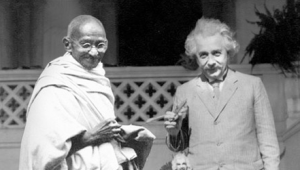
Why War? Building on the legacy of Einstein, Freud and Gandhi

By Robert J. Burrowes

In 1932, Sigmund Freud and Albert Einstein conducted a correspondence subsequently published under the title ‘Why War?’ See ‘Why War: Einstein and Freud’s Little-Known Correspondence on Violence, Peace, and Human Nature’. In many ways, this dialogue between two giants of the 20th century is symbolic of the effort made by many humans to understand that perplexing and incredibly damaging feature of human experience: the institution of war.

In a recent article, the founder of peace research, Professor Johan Galtung, reminded us of the legacy of Freud and Einstein in this regard and reflected on their dialogue, noting some shortcomings including their failure to ‘unpack conflict’. See ‘Freud-Einstein on Peace’.

Of course, Freud and Einstein weren’t the first to consider the question ‘Why War?’ and their dialogue was preceded by a long sequence of individuals and even some organizations, such as the Women’s International League for Peace and Freedom and War Resisters’ International, who sought to understand, prevent and/or halt particular wars, or even to understand and end the institution itself, as exemplified by the Kellogg-Briand Pact in 1928 outlawing war. Moreover, given the failure of earlier initiatives, many individuals and organizations since Freud and Einstein have set out to understand, prevent and/or halt wars and these efforts have taken divergent forms.

Notable among these, Mohandas K. Gandhi was concerned to develop a mode of action to deal with many manifestations of violence and he dramatically developed, and shared, an understanding of how to apply nonviolence, which he labeled satyagraha (holding firmly to the truth), in overcoming large-scale violence and exploitation. He successfully applied his strategic understanding of nonviolence to the Indian independence struggle against British colonial rule. But while Gandhi was happy to acknowledge his debt to those who had gone before, he was not shy in proclaiming the importance of finding new ways forward: ‘If we are to make progress, we must not repeat history but make new history. We must add to the inheritance left by our ancestors.’

My own journey to understand human violence was caused by the death of my two uncles, Bob and Tom, in World War II, ten years before I was born. My childhood in the 1950s and 1960s is dotted with memories of my uncles, stimulated through such events as attending memorial services at the Shrine of Remembrance where their war service was outlined. See ‘My Brothers’ on my father’s website.

But by the early 1960s, courtesy of newspaper articles and photos, I had become aware of exploitation and starvation in Africa and elsewhere, and as a young university student in the early 1970s I was reading literature about environmental destruction. It wasn’t just war that was problematic; violence took many other forms too.

‘Why are human beings violent?’ I kept asking. Because I thought that this question must have been answered somewhere, I kept reading, including the work of Freud and Karl Marx as an undergraduate, but also the thoughts of many other scholars, such as Frantz Fanon, as well as anarchists, feminists and those writing from other perspectives which offered explanations of violence, whether direct, structural or otherwise.

By the early 1980s I had started to read Gandhi and I had begun to understand nonviolence, as Gandhi practised and explained it, with a depth that seemed to elude the activists I knew and even the scholars in the field that I read.

Separately from this, I was starting to gain a sense that the human mind was not something that could be understood well by viewing it primarily as an organ of thinking and that much of the literature and certainly most of the practitioners in the field of psychology and related fields, especially psychiatry, had failed to understand the emotional depth and complexity of the human mind and the implications of this for dealing with conflict and violence. In this sense, it was clear to me, few had understood, let alone been able to develop, Freud’s legacy. This is because the fundamental problem is about feeling (and, in relation to violence, particularly suppressed fear and anger). Let me explain why.

Violence is something that is usually identified as physical: it involves actions like hitting, punching and using weapons such as a gun. This is one of the types of violence, and probably the one now most often lamented, that is inflicted on indigenous peoples, women and people of colour, among others.

Separately from this, Gandhi also identified exploitation as violence and Galtung elaborated this concept with his notion of ‘structural violence’. Other forms of violence have been identified and they take many forms such as financial violence, cultural violence and ecological violence. But violence can be more subtle than any of these and, hence, much less visible. I have given two of these forms of violence the labels ‘invisible violence’ and ‘utterly invisible violence’. Tragically, ‘invisible violence’ and ‘utterly invisible violence’ are inflicted on us mercilessly from the day we are born. And, as a result, we are all terrorized.

So what are ‘invisible’ and ‘utterly invisible’ violence?

In essence, ‘invisible’ violence is the ‘little things’ we do every day, partly because we are just ‘too busy’. For example, when we do not allow time to listen to, and value, a child’s thoughts and feelings, the child learns to not listen to themSelf thus destroying their internal communication system.

When we do not let a child say what they want (or ignore them when they do), the child develops communication and behavioural dysfunctionalities as they keep trying to meet their own needs (which, as a basic survival strategy, they are genetically programmed to do). When we blame, condemn, insult, mock, embarrass, shame, humiliate, taunt, goad, guilt-trip, deceive, lie to, bribe, blackmail, moralize with and/or judge a child, we both undermine their sense of Self-worth and teach them to blame, condemn, insult, mock, embarrass, shame, humiliate, taunt, goad, guilt-trip, deceive, lie, bribe, blackmail, moralize and/or judge.

The fundamental outcome of being bombarded throughout their childhood by this ‘invisible’ violence is that the child is utterly overwhelmed by feelings of fear, pain, anger and sadness (among many others). However, parents, teachers and other adults also actively interfere with the expression of these feelings and the behavioural responses that are naturally generated by them and it is this ‘utterly invisible’ violence that explains why the dysfunctional behavioural outcomes actually occur.

For example, by ignoring a child when they express their feelings, by comforting, reassuring or distracting a child when they express their feelings, by laughing at or ridiculing their feelings, by terrorizing a child into not expressing their feelings (e.g. by screaming at them when they cry or get angry), and/or by violently controlling a behaviour that is generated by their feelings (e.g. by hitting them, restraining them or locking them into a room), the child has no choice but to unconsciously suppress their awareness of these feelings.

However, once a child has been terrorized into suppressing their awareness of their feelings (rather than being allowed to have their feelings and to act on them) the child has also unconsciously suppressed their awareness of the reality that caused these feelings. This has many outcomes that are disastrous for the individual, for society and for nature because the individual will now easily suppress their awareness of the feelings that would tell them how to act most functionally in any given circumstance and they will progressively acquire a phenomenal variety of dysfunctional behaviours, including many that are violent towards themselves, others and/or the Earth.

Moreover, this emotional (or psychological) damage will lead to a unique combination of violent behaviours in each case. And some of these individuals will gravitate to working in one of the social roles that specifically requires, or justifies, the use of ‘legitimized violence’, such as the violence carried out by police, prosecuting lawyers, magistrates and judges, as well as that inflicted by the military. Others, of course, will operate outside the realm of legitimized violence and be labelled as ‘criminals’.

But, you might be wondering, what is the link between what happens in childhood and war?

The answer is simply that perpetrators of violence, and those who collaborate with them, are created during childhood. And these perpetrators and collaborators are all terrified, self-hating and powerless – for much greater detail of the precise psychological characteristics of perpetrators of violence and their collaborators, see ‘Why Violence?’  and ‘Fearless Psychology and Fearful Psychology: Principles and Practice’ – and they go on to perform all of the key roles in creating, maintaining, equipping, staffing and legitimizing the institutions of war and in conducting it.

If it weren’t for the violence to which we are all mercilessly subjected throughout childhood, there would be no interest in violence or war of any kind. If we were raised without violence, we would be naturally peaceful and cooperative, content to spend our time seeking to achieve our own unique evolutionary potential and to nurture the journey of others as well as life itself, rather than just become another cog in someone else’s military (or other bureaucratic or corporate) machine.

If any of the above resonates with you, then I invite you to make ‘My Promise to Children’.

In addition, if further reducing the violence in our world appeals to you, then you are also welcome to consider participating in ‘The Flame Tree Project to Save Life on Earth’,  signing the online pledge of ‘The People’s Charter to Create a Nonviolent World’ and/or considering using the strategic framework on one or the other of these two websites for your campaign to end violence or war in one context or another: Nonviolent Campaign Strategy and Nonviolent Defense/Liberation Strategy.

A child is not born to make war. But if you inflict enough violence on a child, and destroy their capacity to become their own unique and powerful self, they will be terrorised into perceiving violence and war as their society wants them to be perceived. And violence and war, and the institutions that maintain them, will flourish.

If we want to end war, we must halt the adult war against children as a priority.


Biodata: Robert J. Burrowes has a lifetime commitment to understanding
and ending human violence. He has done extensive research since 1966 in
an effort to understand why human beings are violent and has been a
nonviolent activist since 1981. He is the author of ‘Why Violence?
His email address is flametree@riseup.net
and his website is at http://robertjburrowes.wordpress.com


Robert J. Burrowes
P.O. Box 68
Daylesford
Victoria 3460
Australia
Email: flametree@riseup.net

Websites:
Nonviolence Charter
Flame Tree Project to Save Life on Earth
‘Why Violence?’
Nonviolent Campaign Strategy
Nonviolent Defense/Liberation Strategy
Anita: Songs of Nonviolence
Robert Burrowes
Global Nonviolence Network

Are We (Collectively) Depressed?

By Charles Hugh Smith

Source: Of Two Minds

We need to encourage honesty above optimism. Once we can speak honestly, there is a foundation for optimism.

Psychoanalysis teaches that one cause of depression is repressed anger.

The rising tide of collective anger is visible in many places: road rage, violent street clashes between groups seething for a fight, the destruction of friendships for holding the “incorrect” ideological views, and so on. I Think We Can Safely Say The American Culture War Has Been Taken As Far As It Can Go.

A coarsening of the entire social order is increasingly visible: The Age of Rudeness.

This raises a larger question: are we as a society becoming depressed as we repress our righteous anger and our sense of powerlessness as economic and social inequality rises?

Depression is a complex phenomenon, but it typically includes a loss of hope and vitality, absence of goals, the reinforcement of negative internal dialogs, and anhedonia, the loss of the joy of living (joie de vivre).

Depressive thoughts (and the emotions they generate) tend to be self-reinforcing, and this is why it’s so difficult to break out of depression once in its grip.

One part of the healing process is to expose the sources of anger that we are repressing. As psychiatrist Karen Horney explained in her 1950 masterwork, Neurosis and Human Growth: The Struggle Towards Self-Realization, anger at ourselves sometimes arises from our failure to live up to the many “shoulds” we’ve internalized, and the idealized track we’ve laid out for ourselves and our lives.

The recent article, The American Dream Is Killing Us does a good job of explaining how our failure to obtain the expected rewards of “doing all the right things” (getting a college degree, working hard, etc.) breeds resentment and despair.

Since we did the “right things,” the system “should” deliver the financial rewards and security we expected. This systemic failure to deliver the promised rewards is eroding social mobility and the social contract while generating frustration, anger, etc.

We are increasingly angry at the system, but we reserve some anger for ourselves, because the mass-media trumpets how well the economy is doing and how some people are doing extremely well. Naturally, we wonder, why them and not us? The failure is thus internalized.

One response to this sense that the system no longer works as advertised is to seek the relative comfort of echo chambers–places we can go to hear confirmation that this systemic stagnation is the opposing political party’s fault.

We don’t just self-sort ourselves into political “tribes” online–we congregate in increasingly segregated communities and states: The Simple Reason Why A Second American Civil War May Be Inevitable.

Americans are moving to communities that align more with their politics. Liberals are moving to liberal areas, and conservatives are moving to conservative communities. It’s been going on for decades. When Jimmy Carter was elected in 1976, 26.8% of Americans lived in landslide counties; that is counties where the president won or lost by 20% of the vote.

By 2004, 48.3% of the population lived in these counties. This trend continues to worsen. As Americans move to their preferred geographic bubbles, they face less exposure to opposing viewpoints, and their own opinions become more extreme. This trend is at the heart of why politics have become so polarizing in America.

We’re self-sorting at every level. Because of this, Americans are only going to grow more extreme in their beliefs, and see people on the other side of the political spectrum as more alien.”

Part of the American Exceptionalism we hear so much about is a can-do optimism: set your mind to it and everything is possible.

The failure to prosper as anticipated is generating a range of negative emotions that are “un-American”: complaining that you didn’t get a high-paying secure job despite having a college degree (or advanced degree) sounds like sour-grapes: the message is you didn’t work hard enough, you didn’t get the right diploma, etc.

It can’t be the system that’s failed, right? I discuss this in my book Why Our Status Quo Failed and Is Beyond Reform: the top 10% who are benefiting mightily dominate politics and the media, and their assumption is: the system is working great for me, so it must be working for everyone. That’s the implicit narrative parroted by status quo mouthpieces.

The inability to express our despair and anger generates depression. Some people will redouble their efforts, others will seek to lay the blame on “the other” (some external group) and others will give up. What few people will do is look at the sources of systemic injustice.

Perhaps we need a national dialog about declining expectations, rising inequality and the failure of the status quo that avoids the blame-game and the internalization trap (i.e. it’s your own fault you’re not well-off).

We need ways to express our resentment, anger, despair, etc. that are directed at the source, the complex system we inhabit, not “the other.” We need to encourage honesty above optimism. Once we can speak honestly, there is a foundation for optimism.


Lifting the Veil of Psychopathic Intrusion in Everyday Life

what-people-think-psychopaths-are-streetdemocracy

By Nozomi Hayase

Source: Dissident Voice

In recent years, the conception of the psychopath has gained a new upsurge of interest. Popular culture’s sensational image of Hannibal Lecter in the movie Silence of the Lambs and notorious killers like Ted Bundy have long cultivated public fascination. Now, awareness is spreading beyond these portrayals of outlandish criminals. More people are beginning to recognize the existence of socialized psychopaths who are not so outwardly violent.

Psychopaths walk among us, quietly blending into society. They could be corporate CEOs who exploit their workers, politicians who lie to get elected or Don Juan-like womanizers who inspire love to play with others hearts. Roughly 1-2 % of individuals in overall society are estimated to have been affected by this pervasive personality disorder (Neumann & Hare, 2008), yet some suggest these numbers are conservative and that many go unnoticed (Kantor, 2006).

The difficulty of accurately identifying psychopaths partly lies in a significant ambiguity among mental health professionals. Psychopathy expert, Robert D. Hare (1996) described the pivotal shift that occurred in 1980 with the publication of the third edition of the American Psychiatric Association’s Diagnostic and Statistical Manual of Mental Disorders (DSM-3), concerning the diagnosis of psychopathy. He noted how in this standard classification of mental disorder that has become the clinician’s bible, psychopathy was renamed antisocial personality disorder (ASPD), and defined by “persistent violations of social norms, including lying, stealing, truancy, inconsistent work behavior and traffic arrests” (para. 5).

Hare (1996) explained how this change was made based on the reasoning that affective and interpersonal traits that play a primary role in understanding psychopathy were difficult to measure. As a result, this diagnostic criteria of ASPD that mainly refer to criminal and outwardly observable antisocial behaviors, stripped off personality traits that are critical factors inherent in psychopathy. The trend of omitting the traits unique to this pathology has not been overturned to this day in the latest version of diagnostic manual DSM-5.

Along with this blurring of diagnosis, the very nucleus of this psychiatric disorder seems to have contributed to creating this lack of clarity. In his seminal work The Mask of Sanity, first published in 1941, psychiatrist Hervey M. Cleckley articulated how, among other personality traits such as their superficial charm, emotional poverty and egocentricity, the essential characteristic of psychopathy lies in its deceitful nature; hiding their lack of internal structure in a façade of normalcy.

Without knowing what to look for, even for professionals it is extremely hard to detect the psychopathic individual. This is made even more difficult when the very characteristics involve deception. All this has unleashed this dangerous population with few restraints, bringing great risk to the public. Their ability to fake and hide makes their exploitation invisible to the public eye. Oftentimes, people do not recognize abuse in a relationship until much of the damage is done. There are even cases where those who suffered harm do not realize they are victims.

Now, with the Internet and social media, a new level of education is happening. Through YouTube channels and online forums, those who experienced significant pain inflicted by these deranged individuals are coming together to gain validation that is desperately needed, yet often lacking in formal therapy. They are spouses, friends and co-workers, whose life had been ruined financially, mentally or emotionally. Those who had close encounters with these unknown members of society have seen the true face of psychopathy. With this sharing of first hand experience and witnesses outside lab experiments, the mystery of psychopathy is slowly being unveiled.

Hollowness as Elusive Core

In Without Conscience, Hare (1993) describes a psychopath as “a self-centered, callous, and remorseless person profoundly lacking in empathy and the ability to form warm emotional relationships with others, a person who functions without the restraints of conscience” (p. 2). The elusive core of this pathology is an absence of empathy. This sets those affected apart from the rest. People equipped with the ability to put themselves into another’s shoes often take this attribute for granted and don’t recognize the crucial role this seemingly innate aspect of human nature plays in forming a sense of one’s own self.

Humans are social beings. We exist in relation and develop identity through making connections with others at an emotional level. For instance, mother’s validation and proper attuning to her baby’s needs is crucial for infants to cultivate their sense of reality.

Psychopaths do not bond in the same way most people do and have not secured healthy attachment to caregivers. Because of this lack of attachment, argued by Hare (1993) as being a symptom of psychopathy, they cannot develop their identity based upon concrete reality.

Empathy unlocks the door into the world of a larger humanity, allowing one to experience higher emotions of joy, love and compassion. As the foundation of their identity is divorced from an empathic ground, psychopaths are emotionally held down in a “pre-socialized world”, lacking the full range of emotions (Meloy, 1988).

There is nothing inside to hold their identity together. As described in a T.S. Eliot’s poem, they are “hollow men… stuffed men -leaning together, headpiece filled with straw” (1934/1951, p. 56). Out of this vacuousness at the center of their personality, a head grows with an intelligence that is cunning and clever and primarily serves narrow selfish interests.

The being personified in this entity is enslaved by an internal void. They are a nobody and are driven to fill an insatiable hunger at any cost. Hare (1993) describes how they are “social predators who charm, manipulate, and ruthlessly plow their way through life, leaving a broad trail of broken hearts, shattered expectations, and empty wallets” (p. xi). Like going out on a hunt, they trespass people’s boundaries, dragging those who enter their proximity into their dark hole of nothingness. Anyone can become a target and once trapped, they are often sucked dry if not completely destroyed.

Idealization, Prelude to Seduction

The psychopath’s predation follows certain destructive relationship patterns that they repeat throughout their life. Regardless of differences in background, the victims all share similar cycles of abuse. Claudia Moscovici (2010) on her blog Psychopathyawareness describes these patterns in three stages; idealization, devaluation and then discard.

The first stage of a psychopathic relationship is idealization. This is a powerful and seductive period when psychopaths allure their potential victims. With superficial charm, this cunning and manipulative population enchants their targets. They put their new love interest on a pedestal, saying whatever the person wants to hear, transfixing whoever has become the unfortunate prey. It could be a whirlwind romance or promising partnership. Showered with flattery and adulation, targets often feel they are finally getting the appreciation they deserve in life.

In Snakes in Suits: When Psychopaths Go to Work, Hare and leading organizational psychologist Paul Babiak (2006) described this period as an assessment phase, where psychopaths examine their targets’ value and utility. They outlined the four main messages that psychopaths convey to their targets to create an instant connection, which they call the “psychopathic bond”. These are: 1) “I like who you are”; 2) “I am just like you”; 3) “Your secrets are safe with me”; 4) “I am the perfect friend, lover, partner for you” (p. 74-78).

If you are chosen, you will be adored and made to feel special. In their idealizing gaze, you are a center of the universe and can do no wrong. This newly acquainted friend or lover taps into fears, insecurity and deep wishes and morphs themselves into becoming anything their victim wants them to be.

Their seemingly caring gestures appear very genuine and many mistake this as empathy. Later, targets would reflect back on that exciting beginning and feel that they had been fooled. Hare describes how, unlike other mental disorders, psychopaths are rational and that “their behavior is the result of choice, freely exercised” (1993, p. 22). Although it is true that some of the deviants are calculative and indeed plot all the way through, at the same time, as Hare suggests, it is often done more instinctively and is not necessarily planned out. Their love-bombing during this phase rather appears to be an effect of their pathology, caused by impaired emotional processing.

Narcissistic Mirror and Erosion of Identity

So, why do they idealize? The idealization is a part of their pathological makeup. Psychopaths are truly outsiders. Without being a part of the world informed by empathy, they live in isolation and develop a sense of self that is divergent from the majority of society. Researchers point to the psychopath as having a “narcissistic and grossly inflated view of their self-worth and importance” (Hare, 1993 p. 38), a “grandiose self-structure” and a “psychopathology of narcissism” (Meloy, 2001, p. 11).

Although psychopathy is different from the other severe personality dysfunction recognized in the psychiatric community as Narcissistic Personality Disorder (NPD), its core of empathy deficit encompasses some of the features exhibited by NPD. Like those who suffer from excessive narcissism, they are trapped in mirrors of self-absorption and can’t recognize others as having their own autonomous thoughts and feelings. Through not being grounded in a consensual reality, they lack objectivity in their assessment of their own selves. For them, reality is constructed not based on who they really are, but who they want and believe themselves to be.

Being cut off from emotional reality, they are dead inside and can’t harvest their own energy. So they become parasites and feed off others’ emotional reactions. When they idealize their partners, they are unconsciously wanting to establish a connection to a source of creativity, that which gives emotional sustenance. Through weaving a fantasy and duping the other into their web of deception, they extract the life forces of the victim.

For psychopaths, relationship is the stage on which they enact their grandiose fantasy. Others are seen as an extension of themselves, as props that can be used. Anyone who comes their way is screened for their ability to perform a role that serves their plot. Their chosen targets become an object of desire and are pursued with great passion. With beam-like attention, they turn the spotlight on the victims. Through mirroring the victims’ positive qualities, predators disarm their prey and bring them under the luminary light of their narcissistic mirror. In this, the victim’s identity is eroded, yet with constant flattery and attention, they feel pumped up and elated.

This internal casting process can be seen as the psychopath launching a parallel persona upon their targets’ identity and then using it as a mask to create a rapport with their target. Yet, this mirroring is not consciously carried out. It is an automatic reflex that happens when they see something they want in others. Also, in some cases, in others’ positive attributes, these self-absorbed individuals see an idealized image of themselves. Like the Greek myth of Narcissus who falls in love with his own reflection in the water and then pines away, this is the effect of psychopaths seeing themselves in another’s reflection that is created by victims favorably responding to idealization and then trying to claim that image for themselves.

This mirroring starts to fade after the psychopaths successfully attach themselves to their hosts and is then replaced with mind games. Without being able to feel genuine emotions, the psychopath from a young age studied human behavior and learned how to effectively create a favorable response. They will slowly start to use this acquired skill of clever manipulation to keep their victims inside their delusional bubble and maintain control.

Devaluation and the Broken Mirror

What comes next is devaluation, marked as a betrayal with broken promises. This is when psychopaths who had always seen their partners in a positive light will begin to criticize and withdraw their attention. They slowly tear down the pedestal they once put victims up on and engage in subtle ridicule and condescension. Confused, the targets often internalize these criticisms and start becoming convinced that they are not as perfect as the psychopaths initially made them feel and that they have faults just like everyone else.

So, why does this devaluation happen? Many who have been taken for a ride wonder why this person who once seemed to love them so much, changes all of sudden. After psychopaths absorb their targets’ good traits, they cannot truly make them their own. There is nothing that can fill their bottomless pit and soon the void starts to grow again. When the initial thrill and excitement of a new target wears off, they get bored. This is the point where those who have been taken in by the charm start to see the mask slipping.

While victims begin to have a glimpse of the hollow man behind the mask of the manufactured persona, in the eyes of the psychopath, the victim ceases to be the perfect mirror that reflects back their delusions of grandeur. This happens because those who were made to be reflections in their mirror are living human beings. When victims start to act autonomously, as every human being is meant to do, these malignantly narcissistic individuals experience their self-image fluctuating and their mirror of absorption beginning to shatter.

In a sense, psychopaths are like bullets that have been fired by a gun they themselves barely understand. Distortion in the mirror that occurs during this devaluation process is experienced by them as an attack on their very existence. When they start to realize their idealized partner is fallible, they experience injury and believe that what pulled the trigger is coming from outside them. The love of life that they once declared quickly becomes malformed or damaged goods and the victim can even be seen as an object of hatred and contempt. The idealized self-image projected onto their partners now disappears from the mirror and they have to look for it elsewhere. Thus, rinse and repeat. They start chasing a new object of ‘affection’ and begin the idealization phase all over again.

Discarded

Little does the victim know, but the person they had fallen for is now gone. The psychopath has already abandoned their masks. At this point, if the target remains useful to them, they would be kept around, but otherwise, the psychopath moves on, as if the previous victim never existed. The duration of each stage leading up to the final discard depends on how fast the targets catch on to their ploy or whether they cease to be useful.

After being cast aside, the victims might feel they were handled dishonestly. They realize that their partners were fraudulent and that what they thought was love or true friendship was an illusion. Those who were wronged ask themselves if their partners really cared about them at all. When the psychopath’s mask is finally blown off and one begins to glimpse the monster behind that mask, one is flooded with questions that may never be answered.

It is important not to forget that these are ‘hollow men’. They suffer from shallow emotions and don’t have the same capacity for feeling as most people do. Hare (1993) describes their apparent lack of emotional depth, noting how they “seem to know the dictionary meanings of words but fail to comprehend or appreciate their emotional value or significance” (p. 128). They are “like a color-blind person who sees the world in shades of gray but who has learned to function in a colored world” (p. 129). Without having vital emotional understanding, they mimic experiences they can’t really understand through simulating emotions and parroting words that others use.

Without this understanding, those with empathy assume the other has a similar orientation and they fill in the blanks by projecting good attributes and interpreting words of those who lack feeling for others according to how they themselves use language. As the relationship unfolds beyond the initial stage, the differences eventually begin to emerge and the shallow consciousness behind the beautiful words starts to unravel.

As they are not tied to others by empathy, psychopaths have little connection to their own history and are uprooted from the shared narrative of humanity. They live in the present moment and are driven by immediate needs and instinctual desires. Just like the hollowness of their soul, their words are empty, rarely matching actions. They promise eternal devotion and love to describe their transient and fleeting desires of the here and now. For them there is no future; there is no past. There is nothing lasting that deeply connects them with other human fellows. They try on one personality and then drop it when it becomes inconvenient and move on to the next as needed.

The Anesthetized Heart

Who are these empty souls, masquerading as friends, lovers and good Samaritans, whose self-gratifying deeds in the end always leave their victims bewildered? The beast inside this small minority of society seizes everything that moves. They conquer the other, turning constantly evolving images of their targets into frozen snapshots of abstraction, which they then possess. In extreme cases, this is seen in the example of serial killers cutting up victims’ dead bodies and sleeping with them. Although the degree might be different, this deadening force that works within is the same. Psychopaths try to wipe out victims’ identity, so to make them a clean slate that can more perfectly mirror their grandiose self. Through lies and re-framing events, they attack their target’s memory, making them doubt their own sense of self. What awaits one toward the end of the relationship, if one does not disentangle themselves in time, can even be a total annihilation of the self.

The horror displayed by psychopathy and this moral bankruptcy often provokes an image of evil. In People of the Lie: The Hope for Healing Human Evil, psychiatrist and author Scott Peck (1983) defined evil as a reversal of the word ‘live’, and portrayed it as something that crushes life. They have what psychologist James Hillman (1992) characterized as an “anesthetized heart, the heart that has no reaction to what it faces, thereby turning the variegated sensuous face of the world into monotony, sameness, oneness” (p. 64).

Empathy is the foundation of conscience. It is to think with the heart and to feel with others. As the psychopath is delinked from the heart; from that which ties all living beings together, they are in a kind of darkness, where the light of conscience cannot reach. They lack insight about the situations they are in. They can intellectually understand what they are doing, but they cannot be fully conscious of their own actions and their devastating effects.

This state of numbness blinds them to the beast within that is devouring their victims. It makes them become deaf to the cries of those who are slowly dying. After the initial honeymoon phase, when their partners don’t defer to the psychopath’s version of reality and question this pretend world, they rush out and punish the victims. When victims strike back, psychopaths often fail to see how those abused are trying to defend themselves and instead twist reality. They deflect, misconstrue conversations to fit a narrative where they are constantly aggrieved and injured, making the victims look like the perpetrators.

No amount of love is enough for them. In the effort to communicate with these disordered individuals, words bounce back off their hardened hearts and become echos that the psychopath cannot hear. They rationalize and make one feel what they can’t feel about themselves, transmitting these emotions like poison. Victims are called too sensitive, crazy or imagining things and are further dragged into the predator’s one-sided reality.

Recovery and Path Back to the Self

How can those who are captured in a toxic web escape this snare and stop the bleeding that has been feeding this beast? These hungry carnivores sink their claws into their prey through the innate human trait of empathy and exploit our trusting nature. Most people relate to others in dialogue, giving a space for another’s perspective to enter in the interaction. Psychopaths on the other hand, not abiding by empathy, live in solipsism and operate in a monologue. While victims are trying to understand their perspective, these emotional vampires move quickly to direct the narrative, giving no chance for their targets to participate in the unfolding story as a co-creator. Through being nitpicky and accusative, they make victims back off from asserting their needs and make them walk on eggshells.

In relationship with these deadly individuals, what remains unconscious, both the dark and bright parts of oneself become vulnerable for manipulation. During idealization, the psychopath, like a puppeteer, attaches invisible heartstrings to their targets. They promise to fill a void, play on one’s vanity, mirroring back desires and enamoring victims with their own reflected beauty. Victims would not know until much later how this idealization was conditioning them to act in a certain way. What happens is a transfer of authority, where without realizing it, victims slowly begin to seek for approval from this pretend friend or partner.

When the devaluation phase sets in, if victims begin to become aware of what is happening and try to fortify their boundaries, they are often so deep in the fantasy and the fog of confusion becomes so thick that they cannot even see the path from which they came. They often suppress their emotions and take the blame in confrontational situations, so as not to ruin this idealized image.

Master manipulators know their prey, their insecurities and desires and know very well which buttons to push to get what they want. Chosen targets become like rats in a maze that leads to a shadow of one’s former self. As long as one performs according to the master’s plot, they will be rewarded, yet when one derails from their story, they are punished. Many desperately try to mend the broken mirror that once reflected their idealized self and focus on fixing what they have been brainwashed to believe as their ‘issues’.

For those who have been abducted into psychopaths’ illusory world, the path back to the self lies within. Recovery from the terror of the anesthetized heart calls for fully reclaiming one’s own empathy. This first requires one to have empathy for oneself; to claim all that was disowned within. Through accepting one’s own emotions without judgment no matter what they are, one can make a more conscious relationship with them and recognize how these emotions have been used as a tool for control. One can then break this hypnotic spell and take back the power to define one’s own reality.

Larger Social Implications

The relationship with a psychopath is like nothing experienced before. Until it is lived on a personal level, it is difficult to understand the depth of its destruction. This is a kind of psychological warfare being quietly waged upon victims. Psychopaths build up their targets and then knock them down under the rug. In the aftermath, victims may come to realize that they have been in a battle for their own life and that what is at stake is something even larger. This psychopathic invasion into one’s life is an infiltration of our deeper humanity. So, what is the agenda behind this dark force and where is it taking us?

Those with imperiled empathy are haunted by an eternal emptiness. They are thirsty, yet they can’t drink from the water of life. All they see are frozen images on the surface. This internal vacuum can turn into a monstrous desire for power that boils below consciousness. Philosopher Friedrich Nietzsche (1920) once signified this force when he urged his readers to make themselves “superior to humanity in power, in loftiness of soul, —contempt” (p. 38). This fighter for human freedom revealed to us the fall of human nature in his call for the will to power. He asked:

What is good? —Whatever augments the feeling of power, the will to power, power itself, in man. What is evil? —Whatever that springs from weakness. What is happiness? —The feeling that power increases—that resistance is overcome. (p. 42-43)

In praise of independence, psychopaths condemn human emotions such as attachment and jealousy as weakness and deny attributes like compassion and cooperation. They hijack and pull the development of the individual into becoming a reflection of their dry and deserted soul.

The encounter with psychopaths brings forth the fundamental question of evil; how can humanity confront what has become so terrifying in the world? Austrian philosopher Rudolf Steiner (1943/1977) once elucidated how the role of evil is to educate us to freedom and love:

Love would be impossible for man and freedom would be impossible for man without the possibility of sailing down into the abyss. A man unable of his own free decision to choose good or evil, would be a being only led on a leading string to a good which must be attained of necessity and who had no power to choose the good of his own fully purified will, by the love which springs from freedom. (p. 206)

We are born into the cradle of nature and unconsciously carried by affects and desires that stem from deep obligation to one another. Governed by this internal law of empathy, emotions that arise from a communal ground such as the sense of guilt or shame or simply feelings for the other, naturally regulate self-interests and restrain actions in consideration of others’ needs.

Unless we are ripped away from this protective world of empathy, how will we become aware of it and understand its true value? Psychopaths make us fight against ourselves. Their assault on empathy awakens us to the force that denies and breaks the bond of brotherhood. It gives us an opportunity to find the strength within to resist this will to power. By being pushed to the edge, we are asked to uphold out of free will all that makes us human.

When one fights this battle consciously, one can see this ‘evil’ for what it truly is. Hare (1993) shared a view held by some investigators that “behind Cleckley’s ‘mask of sanity’ lies not insanity but a young child of nine or ten” (p. 169). Like poet Rainer Maria Rilke’s myth of dragons being transformed into princesses at the last moment, perhaps these frightening members of society are a part of our own humanity that is “waiting to see us just once being beautiful and courageous” (1992, P. 85).

When we find courage to turn to what has become so dark, we find ourselves anew in those who are forgotten or condemned –within the shadows of man. We become survivors and begin to understand the true meaning of this battle.

One day, a stranger knocked at the door and opened our eyes to a side of humanity that we didn’t know existed. Darkness had a gift. It let us see the light that shines from within. With this light, mankind may find its true path toward evolution, becoming a species that can truly love. This is our salvation, where lies the potential for redemption of ourselves and the world.


Nozomi Hayase, Ph.D., is a writer who has been covering issues of freedom of speech, transparency, and decentralized movements. Her work is featured in many publications. Find her on twitter @nozomimagine Read other articles by Nozomi.

Marrying robots, killing with drones, and making empty selfies

by Edward Curtin

Source: Intrepid Report

Today everything has become a spectacle, including writing. My title probably caught your eye, as it was intended. But now I would like to tell you a personal story about a man whose brilliant work foreshadowed and dissected the issues of my title before it existed. In this he was prophetic, and it is why his work is so important. He always insisted that true artists were able to uncover society’s conflicts before they emerged consciously. Though a psychologist by profession, he was in this sense an artist as well.

His name, Rollo May, has disappeared from public discourse in this era of biological psychology and psychiatry. This great American thinker and writer was the man who introduced existential psychology to the United States. And though he died twenty-one years ago, his prescient voice begs to be heard in our current conditions.

From his first important book in 1950—The Meaning of Anxiety—he examined key underlying issues that have plagued this country ever since: the worship of technology as a death cult; the loss of a genuine sense of self; sex obsessions leading to lovelessness and impotence; and violence yoked to a lack of compassion.

In book after book, he reiterated one of his central themes: that full passionate life is only possible when one refuses to block off from consciousness the frightful emotions of anxiety, guilt, and despair. In this, his life’s work ran against the grain of the emerging zeitgeist of happy pills, mood stabilizers, and the happiness industry. “After despair,” he wrote, “the one thing left is possibility.” For possibility (Latin, posse, to be able) means power, and true power only comes to those who dare to be weak and freely embrace their personal destinies and the truth of their political and cultural conditions. I think it is not an exaggeration to say that we are presently living in an era of despair, and to embrace that reality is a hard but necessary pill to swallow. May is a wonderful guide.

While topical, in many ways his message is timeless as well. But I would like to tell you about some things I learned from him years ago that speak to our current condition. And it seems fitting that I should begin these thoughts on a day when a prominent, mainstream website has published an article arguing that humans should be able to marry robots and the day of those blissful conjugal ties is in our not too distant future. So I will proceed with those lovely words ringing in my mind: “I now pronounce you robot and wife.”

It was during the closing years of the Cold War when he and I sat down for a long conversation about his thought. Cold War rhetoric and nuclear saber rattling dominated the news and a strong anti-nuclear movement was astir. I had been deeply impressed with May’s paradoxical thinking ever since I had read his award-winning Love and Will in 1969, a year in which I had been forced out of a college teaching position for “heretical” thinking and opposition to the Vietnam war. In his work, which was not openly political, I nevertheless found a voice of deep wisdom and prophetic power. He seemed to be unearthing hidden springs of the madness sweeping the country, and in so doing also addressing the future, and, of course, me. I was feeling particularly vulnerable, yet paradoxically intensely strong, as I had recently declared myself a conscientious objector from war and the Marine Corps. It was a time like today when death and destruction were in the air, and, as Yeats puts it: “Things fall apart; the center cannot hold/Mere anarchy is loosed upon the world/The blood-dimmed tide is loosed, and everywhere/The ceremony of innocence is drowned/The best lack all conviction, while the worst/Are full of passionate intensity.”

The first thing I noticed about May the day we met was that he seemed painfully vulnerable, as though he had so opened himself to existence that the slightest breeze could blow him away. Yet when he began talking I sensed a fierceness, as well, as I recalled a favorite quote of his from Beethoven: “I will seize fate by the throat.”

So I asked him, “In reading your works one of the things that strikes me is the vitality you draw from an awareness of death. Most people would call this morbid and depressing, and yet it seems to bring you joy. I wonder how this began for you?”

“Well,” he answered without hesitation but in his ruminative way, “I’ve had some long bouts with killing illnesses. I had tuberculosis for five or six years. I had malaria fever when I was in Greece. And I’ve had several other bouts with death. If most people would call the consciousness of death depressive, I think they are the ones who have the—what I would call—masochistic or neurotic viewpoint. All through human history mortality has been faced directly and out of it, and this especially true for the ancient Greeks, they got the sense of the value of life from the fact that we are mortal. Now our age is afraid of death and we repress it and we think the only wise thing is to think about living, which strikes me as itself very sick. It’s because we’ve wedded ourselves to technology, and technology is really a study of death. You say ‘vitality.’ You can’t speak of technology as having vitality. Vitality is the human beings contribution and he ought to use technology to make his life richer. But we have become identified with it.”

Presto! Back to the present/future! As if on cue, a refutation of May’s dismissal of machines having life walks in my door. I see the mailman deliver our mail, so I get up and fetch it. An invitation has arrived for a public lecture at the college where I teach—a lecture by the futurist Ray Kurzweil, the man of “Singularity” fame, the prognosticator of the day he says is coming when artificial intelligence will surpass human intelligence and human biology will disappear into the machine. Ray has a plan to never die, so he takes 130 plus supplements a day to keep himself alive until he is able to upload his consciousness onto a hard drive and become one with the machine for a happy immortality as bits of information. Sounds like a great hereafter. And Ray has a backup plan in case the pills don’t do the trick and keep him going until he impregnates the machine; he’ll be fresh frozen at the Alcor Life Extension Foundation where he expects to be defrosted like a frozen burrito in no more than fifty years.

May said to me, “I’m very much against the quantitative views of human life. You could live exceptionally as Pascal did and die in your middle forties. As Kierkegaard did also. The length of life I don’t think is relevant. The idea that we are going to prolong life for two hundred years seems to me to be the most misplaced goal in the whole technological, crazy scheme.”

It looks like Rollo had a point: the worship of technology as a death cult. He could see it then, and today it is carrying us to our doom unless we change course. “More and more,” he wrote, “the question is being asked whether society as a whole is psychotic, and the pause after the question is a sign that the answer could be yes as well as no.” There was, he then felt, a fear of psychosis on a very broad scale, and at the heart of this fear is a loss of faith in the reality of the self, as well as a widespread feeling that one can never be sure anything is real. This sense of unreality has increased exponentially since then, and the issue of self-identity has become a hall of mirrors in our reality-media funhouse. “As in a Kafka novel, everything is waiting for us, but we ourselves do not appear.” But what does appear today, as then, but in a slightly different guise, and grows larger and larger as people’s faith in themselves grows smaller and smaller and their sense of impotence increases, is the possibility of nuclear warfare and world destruction—a new cold war started by the United States by encircling Russia and setting Ukraine ablaze. The ultimate technological death cult is, of course, nuclear weapons .

May made the connections. Like the great sociologist C. Wright Mills, he knew that our destinies are personal and social, and to deny one is to deny the other. By being existential he meant understanding the individual, not as an atomized self, but as a person-in-the world. Mills called it the sociological imagination; May preferred the term paradoxical. But they were on the same page. One’s sense of self—self-identity—is rooted social and historical conditions.

Starting with Man’s Search for Himself in the 1950s and continuing until his death in 1994, May repeatedly explored the reasons why there was an increasing loss of a genuine sense of self resulting in widespread identity confusion and a growing apathy linked to a lack of compassion. He clearly described the anxiety and loneliness that ate at so many people who “not only do not know what they want; they often do not have any clear idea of what they feel.” Feeling only empty and bored and lacking a real sense of self, they conform to hollow cultural values and mores while consuming the goods and services that a consumer culture offers to fill them up. Consuming, they are consumed. This powerless dependency, rooted in a lack of self-identity and the need to be liked, leads to painful anxiety, despair, and powerlessness resulting in acquiescence to social ills. This is today’s selfie/media culture in a nutshell, what Christopher Lasch once called the culture of narcissism.

I obviously couldn’t ask him when we talked, but I can imagine his response to today’s trends of people marrying robots, selfie photos, Facebook, avatars and second lives in cyberspace, the growth of pornography, sex with machines, the sexual saturation of culture, electronic warfare, drone killings, etc.—a bemused laugh and a comment suggesting the tragedy of it all. In Love and Will he wrote that “the contemporary paradoxes in sex and love have one thing in common, namely the banalization of sex and love. By anesthetizing feeling in order to perform better, by employing sex as a tool to prove prowess and identity, by using sensuality to hide sensitivity, we have emasculated sex and left it vapid and empty. The banalization of sex is well-aided and abetted by our mass communication. . . . They oversimplify love and sex, treating the topic like a combination and learning to play tennis and buying life insurance. In this process, we have robbed sex of its power by sidestepping eros (the creative life force); and we have ended by dehumanizing both.” He predicted that this technical approach to sex would lead to sex obsessions, lovelessness, and increased sexual impotence. And here we are—Viagra, big butts, enhanced this and enhanced that—all in the service of sexual satisfaction produced by the cult of technique and devoid of passion.

“Shooting” yourself with a phone camera, sex with a robot or a machine, and killing with drones—this is life today. We have become separated from our humanity by our machines. We worship our images and in so doing can’t grasp the death and destruction caused by our drones and foreign wars. Others don’t exist in this solipsistic culture. May saw it coming and explained why. He saw that violence was yoked to a lack of compassion and that this lack of compassion (to suffer with others) was connected to our flight from death and emotions we consider negative. He saw this form of thinking as an effort to control life that was self-defeating and could only lead to more violence.

“Paradoxical thinking,” he told me, “seems to me to be the only kind that gets to the root of human existence. I don’t think analytical thinking does. It leaves out too much. You remember Heraclitus. I think he’s quite right that we always think in terms of positive/negative. We think like electricity, thus both the negative and positive pole and the oscillation back and forth, and human thinking is a play with opposites.”

Since he has written so much about the breakdown of our traditional myths and symbols, I asked him if there was any one word or symbol that he thought encompassed the body of his work.

After a long pause, he said, “No, I think that’s impossible for any person who writes to say. I think you could say it much better than I could because we’re so much in it. All I know is that I think paradoxically.” And without pause or any word from me, he continued. “Well, if you wanted to push me, I would say that what I think is the basic, well, the basic symbol of my life, I would say that it is compassion. That’s what matters most to me. I grew up in a rather difficult family, quite difficult. I did not have a good childhood. I was quite lonely as a child. And I did suffer a good deal.”

Out of this childhood pain, he learned early to be a therapist for his family, and felt that these experiences gave him an acute sensitivity to others’ feelings. In his memoir Paulus, about his friend, Paul Tillich, the great Protestant theologian, he wrote words that could equally apply to himself: “Someone has to mediate, to make a connection through his own life between opposites.” For out of his wounds, May has created a powerful body of writings, and out of a torn self, a paradox of wholeness.

For us today, in the era of apathy, depression, and indifference to the suffering and deaths of “others” everywhere, May’s work begs to be resurrected. He urges us to care again, and to let our care and compassion lead us to act to stop the violence that we are taught to ignore. Don’t look away, I can hear him say, face fully all dimensions of the human experience, the negative and positive; remember that despair and joy are linked to the possibility of freedom; reject the cult of death that hides within technological obsessiveness; and remember that love brings the intimation of our mortality but also our greatest joys and passions.

And if he were still sitting across from me—and you—today, he’d probably also say with a grin, “Above all, don’t marry a robot.”

Edward Curtin is a sociologist and writer who teaches at Massachusetts College of Liberal Arts and has published widely.

Ebola News Gives Me a Guilty Thrill. Am I Crazy?

_76476153_76475767

By

Source: Pacific Standard

What it means to feel a little excited about the prospect of a horrific event.

Folks speak blithely about their guilty pleasures. But if you get a little thrill when you contemplate the worldwide obliteration of society in a horrific Armageddon, have you crossed a line from “person with a guilty pleasure” to “person who is a dangerous psychopath”?

This was a question that wrecked most of one afternoon following a discussion of Ebola with some co-workers. We were brainstorming ideas for stories about the awful pandemic, and the topic of American preparedness came up. Although Ebola seems decently isolated on our shores, public health officials are girding our infrastructure for worst-case scenarios.

I made the following confession: Although obviously the West African Ebola crisis sickens and saddens me, and although I of course don’t want Ebola to run rampant … whenever I hear about the idea of our nation crumbling in an apocalyptic plague, I get an amoral twinge of excitement. It’s a tiny but unavoidable rush, not unlike the burst one feels when a rollercoaster begins to crest a hill, or when Darth Vader flicks on his lightsaber for the climactic battle of The Empire Strikes Back. I feel a similar frisson when it seems like a geopolitical crisis is bringing us to the brink of World War III (all summer, every time I read about ISIS’s march, I felt a jolt). I’m not proud of the way I feel, but it never goes away.

“If it’s not in the hypothetical and you’re seeing the devastation and you’re more excited than distraught, then you’re in the psychopathic range.”

Surely, I thought, at least some of my journalist coworkers could relate. They could not. “Dude,” one muttered to me. “That’s kinda fucked up.” Red-faced, I took to Gchat and iMessage to see if any non-work friends felt a similar electricity when they considered a real-world apocalypse. “Not really,” said one. “I don’t get scared, but I don’t get excited, either,” said another. “I don’t even want to be homeless in America, much less experience The Road,” said one of my dearest pals.

My pondering had turned to mild panic. Was I crazy? Or at least, in the immortal words of Matchbox 20, just a little unwell? I sought journalists’ favorite kind of professional help: I called up some researchers, specifically, in this case, those who had studied humanity’s fixation on end-of-the-world scenarios. I began each interview by asking if I was crazy for having my shameful thrills about apocalyptic news.

“I have that, too!” exclaimed University of Minnesota neuroscientist Shmuel Lissek (to my great relief). The idea of Armageddon “wakens your autonomic nervous system,” he says. “Your heart starts beating faster, you start breathing faster, your sweat glands engage. There’s a certain exhilaration from that idea, and one can enjoy that kind of arousal, especially if there’s a part of you that knows it won’t happen.”

Lissek’s research on the human fear-response suggests that apocalyptic exhilaration is actually the product of useful evolutionary traits. “We’d rather have a false alarm than miss a potential threat,” he says. “Organisms endowed with brain circuitry leading them to take even minor threats”—such as the unlikely prospect of a worldwide Ebola outbreak—”seriously are more likely to pass on their genes.” Plus, he says, “Life gets boring with the in and out routine of our daily lives, so having something like [the apocalypse] be a possibility is exciting.”

Of course, cautions Lissek, some balance is in order here. “When the apocalypse is in the hypothetical, it’s normal for the excitement to be stronger than the fear,” he says. “If it’s not in the hypothetical and you’re seeing the devastation and you’re more excited than distraught, then you’re in the psychopathic range.”

But University of California-San Diego psychologist Nicholas Christenfeld has a slightly different take. He agrees that my feelings were in the normal range for humans, but said that those feelings were the result of an irrational aspect of human cognition.

“If you hear about a horrible tragedy that kills 1,200 people, there’s some part of us that thinks, Just 1,200? But 120,000 would be so much cooler!” Christenfeld says it’s part of a quirky divide in human thought when we experience or hear about any kind of massive event, be it a natural disaster or a well-executed air-show performance from the Blue Angels. On the one hand, we recognize the valence of our emotions—a judgment about whether the thing we’re experiencing is good or bad. But we also recognize the magnitude of the emotion—the degree to which it’s big or rare.

“In humans, to some extent, the valence is secondary,” Christenfeld says. “One could run up the magnitude and make things more exciting and engrossing, regardless of whether the thing you’re thinking about is good or bad.” He compares it to the experience of enjoying a tragic movie in which the protagonists die. “You’ll say, ‘It was so gripping! I wept!’ It’s not that you liked that they died, but you liked the intensity of the emotion,” he says. “These apocalypses are tapping into that same two-factor experience. The vast scale of the destruction would be awesome, in the literal definition of that word.”

Other experts suspected my excitement might have to do with contemplating the world that would come after a society-destroying plague. “We’re so stressed and overloaded, that you can start to think, Wouldn’t life be simpler if things just broke down?” says Jeff Greenberg, a social psychologist at the University of Arizona. “As long as we’re among the survivors, life gets simpler. In a world like ours right now, the idea of being heroic and doing the right thing is so complex that we don’t know what it might even be. But in a post-apocalyptic world, we’d have simpler ways to know what the right thing is.”

Along similar lines, University of California-Davis sociologist John R. Hall drew a parallel between my thinking and people’s endless fascination with the terrorist attacks of September 11, 2001. “When you have a phenomenon like 9/11, it’s literally a disclosure, which is the Greek meaning of the word,” he says. “It unveils an understanding of the world that is beyond what any of us possessed before or could’ve imagined having. Apocalyptic events seriously draw into question people’s taken-for-granted understanding of their worlds.” In other words, the end of the world as we know it can show the world as it always really was, beneath the veneer of stability.

These conversations put me somewhat at ease about my own mental health (at least in this particular matter). And all of the experts I spoke with emphasized that, as long as I don’t have a desire to bring about the end times (I don’t), I pose no threat to society.

But a new question popped up: If humans are predisposed to find apocalyptic scenarios exciting, couldn’t that numb our feelings of urgency about preventing the apocalypse? Even if we don’t want to speed it along, would my (and others’) desire for thrills subconsciously keep me from wanting to avert disaster? None of the experts I spoke with had a conclusive answer, though none of them seemed too worried about it. However, guilty creature that I am, I raced to the website of Doctors Without Borders and made a donation. I, like all sane people, continue to hope the crippling crisis in Liberia, Sierra Leone, and Guinea will come to an end soon.

Speaking of guilt, there’s one last tidbit I should mention. Greenberg, the social psychologist, pointed out that my choice of profession might also predispose me to my extremely guilty pleasure. “You’re in a business where bad news is exciting, right?” he asks. “The apocalypse would give you more stuff to write about.” Touché.