Liberal Russophobia and War Propaganda

Image: PRIMICIAS

By Margaret Kimberley

Source: Black Agenda Report

U.S. liberals are the worst perpetrators of Russophobic behavior. They are most likely to follow the dictates of corporate media and the democratic party and proudly take part in discriminatory acts. But foolish bans of anything Russian are just the most visible indication that war propaganda is at the root of the hysteria.

The city of Boston and the Commonwealth of Massachusetts prohibit discrimination based upon race, color, gender, disability, religion, and national origin. Such discrimination is prohibited by most cities, states, and the federal government as well. But one wouldn’t know that due to a plethora of discriminatory acts carried out against Russian nationals. The latest perpetrator is the Boston Athletic Association (BAA) , which announced that citizens of Russia and Belarus who reside in those countries will be barred from participating in the Boston marathon taking place on April 18, 2022. The war in Ukraine, years of Russiagate hysteria, and corporate media demonization of Vladimir Putin and all Russians have led to this moment of dubious distinction.

The weaknesses of what passes for a left wing movement have been fully exposed ever since Russian troops entered Ukraine on February 24, 2022. Of course many people who are called leftists and even those who consider themselves as such are in fact just liberals. They do not stand against imperialism as any leftist ought to do. The eight-year long U.S./NATO scheme to use Ukraine as a weapon against Russia should be universally condemned by anyone claiming to be in that cohort. Leftists can have principled disagreement about Putin’s decision, but they should not ignore the culpability of the U.S. and NATO and their support for the 2014 coup which overturned an election and put neo-Nazi groups in power.

Their confusion on Russia and Ukraine is emblematic of their confusion about so many other issues. The faux left are a highly problematic group, making common cause with the democratic party wing of the war party, and ignoring the war crimes committed by Bill Clinton, Barack Obama, and now Joe Biden. Not only do they fail to ask, “What about?,” but they have no critique of the U.S. role which instigated this crisis. They say nothing about the U.S. and its NATO allies refusing to engage in negotiations which might end the suffering of the Ukrainian people they claim to care about so much.

So deep is the rot that they say nothing about increasingly blatant and bizarre examples of Russophobia. Russian cats cannot enter international cat shows, a Russian singer was fired from the Metropolitan Opera when she refused to denounce her government, an orchestra canceled a festival featuring the music of Russian composer Tchaikovsky, and a tribute to space exploration removed the name of cosmonaut Yuri Gagarin from the program.

It is tempting to snicker about the denial of recognition to Russian cats, but the lack of opposition to the Boston marathon action is shameful indeed. People who see themselves as enlightened, and even intellectually and morally superior to others are silent in the face of an obviously unfair and illegal act.

The BAA is typical of U.S. elite organizations. It makes a big show of proving itself diverse and equitable by establishing a Boston Runners Collaborative whose mission is “… expanding access to running and walking in Boston with a focus on communities of color.” The outreach was in part motivated by the murder of Ahmaud Arbery , whose memory is not certainly not honored by phony shows of racial solidarity. So the BAA used the cold blooded murder of a Black man to jump on a superficial liberal bandwagon and illegally banned people who live in a country their government is telling them to hate.

Of course the BAA is not alone. Politicians, pundits and corporate media all tell us to “stand with Ukraine” and to call Putin a war criminal. American presidents are never connected to war crimes, even when they invade Iraq and kill thousands of people, destroy Libya and kill thousands of people, or enact sanctions and steal government assets that kill thousands of people. The war criminal category is only deemed appropriate for leaders the U.S. doesn’t like.

U.S. liberal elites are as much in the thrall of the dictates of their leadership as the members of January 6th mob who attacked the capital. Their critical thinking skills are practically non-existent, or they go along to get along, or silence themselves due to cowardice. The end result is much worse than a Russian missing a race.

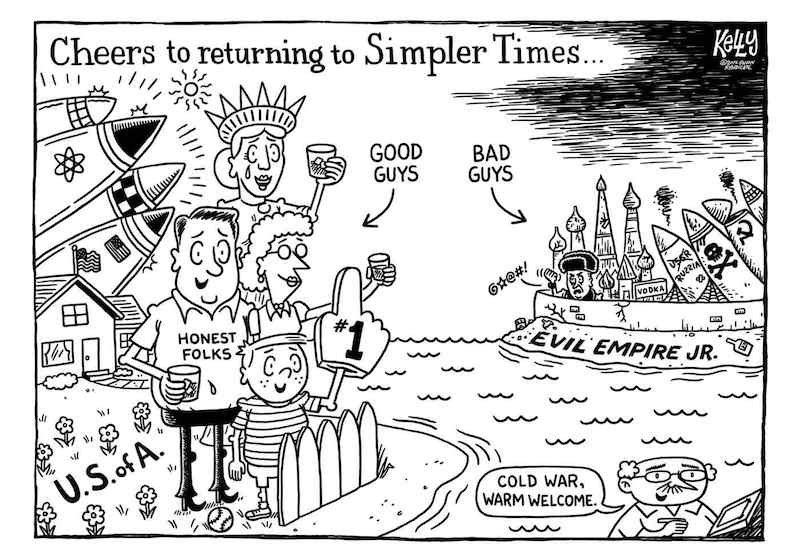
The blue and yellow flags and whipping up of hysteria have a very important and dangerous aim. The goal of the propagandists is to get the country in the mood for war. When the slippery slope gets steeper and the public are convinced that the use of “tactical nukes” or other such nonsense is acceptable, the entire world will be at risk.

Perhaps the plight of Russian and Belarusian athletes isn’t viewed as an important human rights issue. Of course world leaders do much worse to millions more people. But every acceptance of what may seem to be a minor slight can lead to major implications. Liberalism itself is a great danger. The censoring of left voices in media and the conscious effort to disappear all but the state narrative are liberal led efforts and lead to dehumanizing whomever the president and his friends in corporate media may choose to target.

So let the Russians run. Acquiescing to this misguided effort will lead to greater dangers in the future.

Pity the Nation

Credit: JOEL PETT

Pity the Nation

Pity the nation whose people are sheep

And whose shepherds mislead them…

Pity the nation oh pity the people

Who allow their rights to erode

and their freedoms to be washed away

– Lawrence Ferlinghetti

By Scott Ritter

Source: Consortium News

In the past few months, the United States has undergone a kind of transformation that one only reads about in history books — from a nation which imperfectly, yet stolidly, embraced the promise, if not principle, of freedom, especially when it came to that most basic of rights — the freedom of expression. Democracies live and die on the ability of an informed citizenry to engage in open debate, dialogue and discussion about difficult issues. Freedom of speech is one of the touch-stone tenets of American democracy — the idea that, no matter how out of step with mainstream society one’s beliefs might be, the retained right to freely express opinions thus derived without fear of censorship or repression existed.

No more.

In the aftermath of the Russian invasion of Ukraine, the Russophobia which had taken grip in the United States since Russia’s first post-Cold War president, Boris Yeltsin, handed the reins of power over to his hand-picked successor, Vladimir Putin, has emerged much like the putrid core of an over-ripe boil. That this anti-Russian trend existed in the United States was, in and of itself, no secret. Indeed, the United States had, since 2000, pushed aside classic Russian area studies in the pursuit of a new school espousing the doctrine of “Putinism,” centered on the flawed notion that everything in Russia revolved around the singular person of Vladimir Putin.

The more the United States struggled with the reality of a Russian nation unwilling to allow itself to be once again constrained by the yoke of carpetbagger economics disguised as “democracy” that had been prevalent during the Yeltsin era, the more the dogma of “Putinism” took hold in the very establishments where intellectual examination of complex problems was ostensibly transpiring — the halls of academia which in turn produced the minds that guided policy formulation and implementation.

Outliers like Jack Matlock, John Mearsheimer and Stephen Cohen were cashiered in favor of a new breed of erstwhile Russian expert, led by the likes of Michael McFaul, Fiona Hill and Anne Applebaum. Genuine Russian area studies was supplanted by a new field of authoritarian studies, where the soul of a nation that once was defined by the life and works of Dostoevsky, Tolstoy, Gorky, Lenin, Stalin, Sakharov, and Gorbachev was distilled into a shallow caricature of one man — Putin.

We had seen this play before, in the buildup to the U.S.-led invasion and occupation of Iraq, when the national identity of a people who traced their heritage back to the Biblical times of Babylon was encapsulated in the person of one man, Saddam Hussein. By focusing solely on a manufactured narrative derived from a simplistic understanding of one man, the United States papered over the complex internal reality of the Iraqi nation and its people, and in doing so set itself up for defeat. It was if Iraq’s long and storied history ceased to exist.

The impact this erasure of context and relevance from the national discourse was felt in the lead up to the decision to initiate what was, by all sense and purposes, an illegal war of aggression — the greatest war crime of all, according to U.S. Supreme Court justice and U.S. chief prosecutor during the Nuremburg War Crimes Tribunal, Robert H. Jackson.

My own personal experience serves as witness to this reality. As a former chief weapons inspector in Iraq from 1991-1998, I was uniquely positioned to comment on the veracity of the claims made by the United States that Iraq retained weapons of mass destruction capability in violation of its obligation to be disarmed of such. When my stance was deemed convenient to a narrative attacking a Democratic president, Bill Clinton, I was readily embraced. However, when my fact-based narrative ran afoul of the regime-change policies of Clinton’s successor, George W. Bush, I was cast aside as a pariah.

Politics of Personal Destruction

The politics of personal destruction were employed in full, and I was attacked for being a shill of Saddam and, perhaps worst of all for someone who served his nation proudly and honorably as an officer of U.S. Marines, anti-American. It didn’t matter that, without exception, the fact-based arguments I made challenging the case for war with Iraq proved to be accurate — at the time and place where the arguments could have, and should have, resonated greatest (during the buildup to the invasion) — that my voice had been effectively silenced.

I see the same template in play again today when it comes to the difficult topic of Russia. Like every issue of importance, the Russian-Ukraine conflict has two sides to its story. The humanitarian tragedy that has befallen the citizens of Ukraine is perhaps the greatest argument one can offer up in opposition to the Russian military incursion.  But was there surely a viable diplomatic off ramp available which could have avoided this horrific situation?

To examine that question, however, one must be able and willing to engage in a fact-based discussion of Russian motives. The main problem with this approach is that the narrative which would emerge is not convenient for those who espouse the Western dogma of “Putinism,” based as it is on the irrational proclivities and geopolitical appetite of one man — Vladimir Putin.

The issue of NATO expansion and the threat it posed to Russian national security is dismissed with the throw-away notion that NATO is a defensive alliance and as such could pose no threat to Russia or its leader. The issue of the presence of the cancer of neo-Nazi ideology in the heart of the Ukrainian government and national identity is countered with the “fact” that Ukraine’s current president is himself a Jew. The eight-year suffering of the Russian-speaking citizens of the Donbass, who lived and died under the incessant bombardment brought on by the Ukrainian military, is simply ignored as if it never happened.

The problem with the pro-Ukrainian narrative is that it is at best incomplete, and worse incredibly misleading. NATO expansion has been consistently identified by Russia as an existential threat. The domination of the hate-filled neo-Nazi ideology of the Ukrainian far-right is well documented, up to and including their threat to kill the incumbent president, Volodymyr Zelensky, if he did not do their bidding. And the fact that the former president of Ukraine, Petro Poroshenko, promised to make the Russian-speaking population of the Donbass cower in the basements under the weight of Ukrainian artillery fire is well documented.

Unfortunately for those seeking to have an informed, fact-based discussion, dialogue, and debate about the complex problem that is Ukraine-Russian relations is the reality that facts are not conducive to the advancement of the “Putinism” dogma that has gripped American academia, government, and mainstream media today.

The Saddam-era tactics of smearing the character of anyone who dares challenge what passes for conventional wisdom when it comes to Russia and its leader is alive and well and living in the land of the free and the home of the brave. The age-old tactic of boycotting such voices by the mainstream media is in full-swing — the so-called news channels are flooded with the acolytes of “Putinism,” while anyone who dares challenge the officially sanctioned narrative of “Ukraine good, Russia bad” is excluded from participating in the “discussion.”

‘Russian Misinformation’

And, in this age where social media has, in many ways, supplanted the mainstream media as the source of choice for most Americans, the U.S. government has colluded with the commercial providers of the major platforms used to share information to label anything that deviates from the official line as “Russian misinformation,” going so far as to label data derived from Russian sources as “state-sponsored,” along with a warning that supposes the information within is somehow flawed and dangerous to normal democratic discourse.

The ultimate sanction, however, came when the U.S. government pressured the corporate internet providers to shut down all Russian-affiliated media, leading to the closure of RT America and other media outlets whose accuracy and impartiality, upon examination, far exceeded that of their American counterparts.

Now America is taking it to the next level when it comes to the pandemic of Russophobia that is sweeping across the country, purging everything Russian from the national discourse and experience. Russian books are being banned and Russian restaurants boycotted and worse, attacked. The massive economic sanctions enacted against Russia and the Russian people has extended to what amounts to an erasure of all things Russian from the American experience.

Where will this stop? History shows that America is capable of healing itself — the national shame that was the treatment of Japanese- Americans during World War II is a clear demonstration of this phenomenon. However, the politics of cancellation which has emerged in the American body politic has never carried with it the kind of potential blow-back that exists in the case of Russia.

In the pell-mell rush toward cancelling Russia in the name of defeating Putin, emotion has replaced common sense, to the point that people are ignoring the fact that Russia is a nuclear power willing and able to use its Armageddon-inducing arsenal in defense of what it views as its legitimate national security interests.

There has never been a time when a national discussion has been more essential to the continued survival of the American people and all humanity. If this discussion could occur armed with the full range of facts and opinions relating to Russia, there might be hope that reason would prevail, and all nations would walk away from the abyss of our collective suicide. Unfortunately, the American experiment in democracy is not conducive for such near-term embrace of sanity and reason.

“Pity the nation,” Ferlinghetti wrote, “whose leaders are liars, whose sages are silenced, and whose bigots haunt the airwaves.”

Pity America.

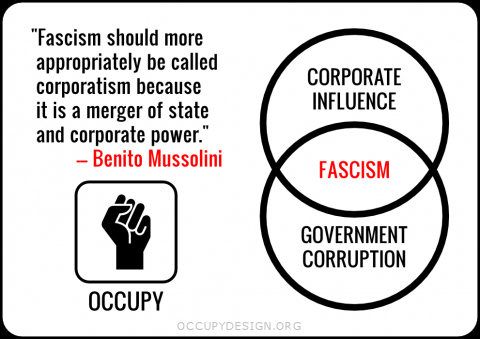
Death of Free Speech leads to Fascism

By Dmitry Orlov

Source: Club Orlov

Freedom of speech is rather important. If people do not feel free to express their thoughts, then all they can do is endlessly repeat what has been said before, creating an echo chamber which no new understandings can ever penetrate. What they repeat may have been a tissue of lies from the outset, or it may have been true or relevant once, but will become outdated and, essentially, as good as a lie.

Lies beget ignorance. Ignorance begets fear. Fear begets hatred. And hatred begets violence. The ability to speak our minds and to listen to others—even those who are said to be our enemies—is what separates us from wild beasts. Deprive us of this right, and sure as rain we degenerate into subhumans who claw at the ground, howl at the moon and gnaw on raw human flesh… or something like that.

The practice of free speech is quite a demanding art. Just being able to make intelligible sounds with your mouth or to poke at a keyboard in a way that pleases the spell-checker makes you no more an expert practitioner of free speech than does the ability to get up from your chair and walk to the bathroom make you a ballet dancer. Free speech encompasses the expression of fact and opinion. Facts cannot be fake, or you can stand accused of libel or of spreading disinformation. Opinion cannot be incendiary, or you can stand accused of undermining public order.

To be on the safe side, free speech should not contain performatives—speech acts that seek to alter the state of the world. Calls to action, unsolicited advice, coercion, intimidation, threats, personal categorizations and the like can all reasonably be banned without hurting the exercise of free speech at all. Demagoguery—attempts to manipulate public sentiment by exploiting popular desires, fears and prejudices—is rather unhelpful, although to some extent unavoidable. Some forms of free speech should be rightfully privileged over the rest: the literary arts (both fiction and nonfiction), cinematography, music, visual and performance arts are at the top; political slogans shouted over swine-toned music at an audience of sloppy drunks are definitely near the bottom.

The quality of society is directly proportional to the quality of its exercise of free speech, and to assure high quality some form of quality control is usually called for. Governments often have to backstop this need by legislating against certain forms of speech. The older standard against incendiary speech or speech that may cause a panic—shouting “Fire!” in a crowded theater—is justified as a matter of public safety. Newer standards against hate speech and discrimination are on shakier ground. They are essentially gag orders that drive the exercise of certain forms of speech underground, thereby making it harder to regulate and more dangerous. The expectation that banning “hate speech” will prevent hatred is unrealistic; nor is the expectation that haters can be compelled to do their hating in silence. Likewise, banning discriminatory speech can only suppress overt expressions of discrimination but not the behavior itself, making it more intractable, since nothing short of a lobotomy can prevent people from discriminating against those they find disagreeable.

Aside from government-provided backstops (which are blunt, inaccurate instruments) most of what provides for high-quality free speech is self-control and, to the extent that it is needed, self-censorship. Essentially, every negative form of free speech—disinformation, libel, demagoguery, manipulation, incendiary rhetoric, etc.—reduce the level of respect and trust between the speaker and the audience. Taken to an extreme, the concept of free speech itself becomes superfluous as everybody manifests their ignorance while spouting their worthless opinions without bothering to listen to anyone else—because everyone else is equally ignorant and their opinions are equally worthless and meaningless. The only thing that can prevent this backslide into worthlessness and meaninglessness is high standards of social adequacy.

But how can such high standards persist in a world of trolls and bots, of concocted false narratives endlessly blasted out at full volume, where a thought that is significantly longer than a tweet simply cannot be expressed? How can they be enforced if the modern value system requires tolerance, nondiscrimination and inclusiveness toward all—including the most miserable miscreants—lowering the price of admission to public discourse to zero? Surprisingly, it can, and it does persist: some writers find their readers and some performers find their audiences—somehow. Their numbers aren’t huge, but then, since quality is almost always inversely proportional to quantity, their small numbers don’t matter that much.

In fact, these numbers are so small that to ascribe any sort of significant agency to those who pay attention, or to those to whom they pay attention. The proper and essential function of free speech is not to somehow remake the world in one’s own image (you should consider yourself lucky if you can bring about a change in yourself, never mind make a difference in your own family or neighborhood). Its function is to keep you sane and grounded and to prevent you from cascading down through lies, ignorance, fear, hatred and violence, eventually degenerating into wild beasts who claw at the ground, howl at the moon and chew on each other…

The concocted false narratives endlessly blasted out at full volume make such work difficult. The narratives that are designed to generate a misplaced sense of agency are perhaps the most difficult veil to shred. No matter how many times I try to explain that the US is not a democracy and that it doesn’t matter who is president, these facts seem to just bounce off people’s heads. When I try to explain certain facts about technology—for instance, that wind and solar power unfortunately just don’t work and that the countries that pursue them are setting themselves up for economic disaster, but that for all of its dangers nuclear power does seem to have a very important future (although only in certain countries)—in response people demand to know whether or not I am “in favor” of nuclear power.

What a ridiculous question! That’s like you asking your flush toilet what it thinks of sewage treatment or your office chair whether it is in favor of a sedentary lifestyle. Just like the office chair and the toilet you and I, with respect to nuclear power, are not subjects but objects. If you are reading this, then you are willy-nilly in favor of nuclear power, because if the nuclear reactors were off your screen would be blank and you’d be sitting in the dark with the heat or the air conditioning not working. But that’s a false choice—simply because it isn’t on offer—any more than an office chair or a toilet can decide whether it wishes to be sat on or not.

And now there is another development that is making the exercise of free speech even more difficult: the phenomenon of “deplatforming.” Various companies, including Twitter, Facebook, PayPal, Patreon and various others, have taken it upon themselves to become arbiters of free speech and interpreters of the First Amendment. Their conceit is that their user base forms a “community” upon which they are entitled to impose “community standards.” In fact, they are privately owned for-profit companies and their clients are individuals or other companies, not communities. They may try to argue that they are publishers of some sort, and publishers are entitled to maintaining an editorial policy, but there is an unbridgeable gap between the editorial process and just typing some text and clicking “publish.” In fact, what they are attempting to do is perhaps best described as vigilante censorship. The most that they are entitled to do is refer their users for prosecution if there is reason to believe that their users have violated specific laws.

I became aware of this new “deplatforming” menace a couple of months ago, when some of my readers started abandoning Patreon after it deplatformed certain people. Prior to that my readership on Patreon had been growing nicely, but then the growth stalled. I’ll never know—and don’t really care—what was behind these decisions, since I don’t see them as legitimate. Typical parting comments from my readers were:

“You crossed the line with censorship and I cannot support this company.”

“I believe in freedom of speech. Censorship is not a virtue. Shame on you.”

“Patreon should not be a moral arbiter. You are supposed to be a payment platform.”

“This site cannot be trusted to support free speech.”

In short, Patreon’s censorship, which it disingenuously called “community standards,” was costing me money, and so I complained:

“Your editorial policy is costing me money. Since Patreon is just a paywalled blogging platform I don’t understand why you should have an editorial policy at all. If you find that your clients are violating state or federal laws you should refer them for prosecution; if not, I honestly do not understand what gives you the reason or the right, or the legal competence, to act as interpreters of the First Amendment.”

The answer I got back was rather terse: “…we do not disclose any details surrounding creator page removals…” First, that isn’t an answer to my question. Second, it shows a remarkable degree of contempt for any sort of fairness. Secret tribunals that result in “removals,” that are based on vague, private, arbitrary rules, that refuse to disclose the basis of their decisions, that cause financial losses but refuse acknowledge them or to compensate for them… doesn’t that sound just a tiny bit fascist?

And so I set up a SubscribeStar account where I publish all the same materials as on Patreon, and to which my readers have been gradually migrating. SubscribeStar is not quite as feature-rich as Patreon (yet) and it has been banned by PayPal (not a big loss; my readers seem to hate PayPal) but it does have the advantage of being honest: it is simply a blogging platform integrated with a paywall.

Meanwhile, the “deplatforming” has only grown worse. Most recently, CNN aired a public denunciation of RT (which it accused of being Russian), and based on this denunciation Facebook saw it fit to ban RT from Soapbox, Waste-Ed, Backthen as well shut down a personal project “In The Now” by the American journalist Anissa Naouai (because she works for RT). These were projects with millions of subscribers and billions of views. CNN’s denunciation was phrased as follows: these projects influence America’s young people! The bloody Russians are at it again, contaminating “our precious bodily fluids”!

None of this has anything at all to do with Russia, or the Russian government, or Putin personally. RT is government-financed, but so is BBC (which, it has now been admitted, lied about the fake chemical attacks in Syria’s Douma, causing Trump to unleash a volley of cruise missiles on Syria, most of which, luckily, the Syrians managed to shoot down). But while the British may lie as they wish (and provoke war crimes as a result) the Russians aren’t allowed to say anything at all—because they are Russian.

To understand the rationale behind this bout of Russophobia, it is important to understand that it has nothing to do with “containing Russia” or anything of the sort (that project has already failed). Instead, Russophobia neatly serves the internal political needs of the US and other Western countries. Two trends—the gradual suppression of free speech and the gradual dehumanization of Russians—go hand in hand. Free speech can be suppressed because of “Russian trolls” and election results can be manually rearranged as needed because of “Russian meddling.”

What makes such measures necessary? The West is experiencing an entire series of crises that is beginning to form the classical pattern defined by Lenin as the revolutionary situation: the elites can no longer rule as before while their subjects can no longer live as before. Western establishment (primarily its Deep State component) is forced to confront this problem. How can it preserve its power and maintain control, all without changing course or even swapping out it deeply unpopular public-facing figureheads? It has decided to deal with this crisis by suppressing the public will. Since such suppression is incompatible with maintaining the fiction of democratic governance, democracy has got to go. That’s where the Russians come in handy: if the voters don’t vote as programmed, then an entire election can be annulled because of “Russian meddling.” “Russian trolls” and Russian “fake news” are helpful too: they offer an excuse for suppressing free speech.

Having a phantom enemy is very helpful. First, there is nothing like the fear of an external enemy to force people to rally around their ruling elites. Second, since the enemy is a phantom, there is no danger of defeat in an actual war. But there is another danger: in the process of vilifying this phantom enemy, Russians as an ethnos are being progressively dehumanized. And the problem is that dehumanizing the enemy always results in degeneracy—not of the enemy, but of the dehumanizers themselves. Inevitably, it is the dehumanizers who end up running around on all fours, howling at the moon and having each other for dinner. Lies engender ignorance; ignorance engenders fear; fear engenders hatred; hatred engenders violence. At some point a horrific crime against Russians will take place, which will baptize both the Western elites and their Untermenschen in Russian blood, tying them together with bonds of criminal complicity. (This scenario has already been tested out in Eastern Ukraine.)

Before our eyes the most reactionary and the most chauvinistic and homicidal parts of Western financial elites are transforming Western “democracy” into a model terrorist dictatorship. But it is very hard to see what they could possibly hope to achieve other than the physical destruction of their own populations—if that can be considered an achievement. Perhaps their actual achievement will be in being able to carry out this destruction without having their own populations even notice that it is happening, lost as they are in a world of delusions fashioned out of false narratives endlessly blasted at them at high volume. We should feel lucky that a few voices are still able to pierce through the Bedlam, although we don’t know for how much longer. In the meantime, take a look around. This is what fascism looks like.

How CNN Led Facebook To Censor Pages Of Russia-Backed Video Company And Manufactured News Story

Disclosure: Kevin Gosztola co-hosts the “Unauthorized Disclosure” podcast with Rania Khalek, who is a contributor for Maffick Media’s Soapbox. “Unauthorized Disclosure” is entirely listener-funded. Shadowproof is member-supported and funded by reader donations.

By Kevin Gosztola

Source: Shadowproof

CNN went in search for a story about a Russian-funded digital media project that produces viral videos aimed at undermining American democracy. When CNN journalists could not find what they were looking for, they effectively manufactured the news by giving Facebook a pretext for removing the project’s pages used to share videos. Now, the cable news network had their story.

Four CNN journalists worked on the report, “Russia is backing a viral video company aimed at American millennials.” It appeared online late in the day on February 15 and broke the news that Maffick Media had their Facebook pages for three video channels suspended.

Maffick also produces In The Now, which Facebook took down as well.

Facebook never required pages to include information about their parent companies nor has the social media company ever labeled state-sponsored media, which CNN acknowledged. Yet, since the project involves funding from Russian state media, CNN believed Facebook may want to require the pages to disclose such details.

CNN contacted Facebook on February 13, and Facebook informed CNN they were “contemplating doing something about labeling state-funded media,” according to Donie O’Sullivan, a CNN reporter who worked on the story. The media organization held their story until Facebook took action.

Maffick produces three video channels—Backthen, which explores the history of Western imperialism, Waste-Ed, which covers environmental issues, including climate change, and Soapbox, which covers politics and current events.

As O’Sullivan said during an interview on CNN, “The content was pretty critical of the U.S government, of U.S mainstream media, but nothing that would be totally out of the ordinary necessarily.” Videos made a “lot of legitimate arguments,” and they “weren’t necessarily really hiding their Russian ties.”

“If you were to start Googling these pages, you could quickly work it back to see,” O’Sullivan added.

Journalist Rania Khalek, who produces videos for Soapbox, was interviewed by CNN, along with Maffick Media chief operating officer J. Ray Sparks. The interview took place in Berlin on February 11. However, CNN did not initially contact them.

“CNN was contacting peripheral employees, some of the people in the U.S., one of the camera people that I worked with. They contacted her,” Khalek shared. “And they actually lied to [this person] and told her they had already spoken to me, when they had not.”

According to Khalek, CNN seemed to be interested in whether any Maffick employees were difficult to work with, whether employees or contractors were paid decently, and whether they were leery of the stories they were asked to cover.

J. Ray Sparks contacted CNN to inform them that they were aware the news network was attempting to dig up dirt. Maffick made CEO Anissa Naouai, Khalek, and Sparks available to CNN in the interest of transparency, even though it was clear journalists were looking for material for a hit piece on the project.

Shadowproof was provided with a copy of the unedited interview that CNN conducted with Khalek and Sparks.

More Like An Interrogation By Intelligence Agents Than An Interview

The interview was conducted by CNN correspondent Drew Griffin. In February 2018, Griffin went to the home of a woman in Florida, a private citizen who supported Donald Trump’s presidential campaign, and insisted she was duped by Russia when she ran the “Team Trump Broward County” Facebook page.

The page’s events were reportedly promoted by Russia’s Internet Research Agency, a Kremlin-linked troll farm operated out of St. Petersburg.

“I don’t go with Russians, c’mon, give me a break,” the woman insisted, while Griffin tried to take away her independence as a campaign supporter and shame her for something out of her control.

The questions asked by Griffin collectively amounted to an interrogation. He went out of his way not to engage with answers to his questions that conflicted with the story CNN was chasing.

Also, Griffin was fishing for very private details involving the business model of Maffick that would help CNN attack the project. Sparks provided answers, despite the fact that the questions were invasive, and the vast majority of U.S. news media outlets would probably refrain from sharing such information with the public.

CNN misquoted Sparks twice. In the print report, they said Sparks claimed it was “standard business practice” not to disclose who owned a Facebook page. That made it seem like Sparks was specifically referring to Maffick and that he was exhibiting a flippant attitude to the question of who funds Maffick. However, Sparks said “standard industry practice” and was making a general point about CNN holding Maffick to a standard most media organizations throughout the world do not follow.

Griffin asked why Maffick tells employees and contractors they are funded by the Russia government but not their audience. “There’s no mention of Russia or Ruptly on the Facebook pages. Why is that?”

“Because that’s standard industry practice,” Sparks replied. “We get this question a lot, and it’s a funny question to me because why does Great Big Story not put CNN on their Facebook page? Why does CNN not put Time Warner on their Facebook page? The audience is not interested in these things.”

Sparks added, “I worked for Comedy Central for many years. No one ever knew that Comedy Central was owned by MTV, and that MTV was owned by Viacom. These were things that you had to discover as a more esoteric audience within the industry. The general audience never is interested in these things, and the standard practice is to just simply not mention them because the audience is not interested.”

Whether Sparks is right or not is insignificant. CNN used a different word so it better suited their story.

[Note: CNN later issued a correction during the weekend after Shadowproof published this report:

“The original version of this article incorrectly quoted Sparks as saying it is ‘standard business practice’ for a media outlet not to disclose its ownership on its Facebook page. He actually referred to ‘standard industry practice’ and ‘standard practice.’”]

Baselessly Accused Of Boosting ‘Kremlin Narratives’

Although Khalek and Sparks detailed their editorial independence at Maffick extensively, Griffin remained incredulous at the reality that officials working at the Kremlin are not dictating what specific stories should be covered. CNN quoted Ben Nimmo, a “senior fellow for information defense at the Atlantic Council’s Digital Forensic Research Lab,” to undermine their assertions.

“They routinely boost Kremlin narratives, especially those which portray the West negatively,” Nimmo stated.

He added Maffick’s pages are “broadly anti-U.S. and anti-corporate. That’s strikingly similar to RT’s output. Maffick may technically be independent, but their tone certainly matches the broader Kremlin family.”

The Atlantic Council is a militaristic think tank that receives funding from the U.S. government. In particular, Nimmo holds himself out as some bot hunter, who is an expert at exposing “Kremlin influence networks.” Yet, as journalist Max Blumenthal highlighted in 2018, Nimmo misidentified “several living, breathing individuals as Russian bots or Kremlin ‘influence accounts.’ Nimmo’s victims included Mariam Susli, a well-known Syrian-Australian social media personality, the famed Ukrainian concert pianist Valentina Lisitsa, and a British pensioner named Ian Shilling.”

Khalek told Griffin why her journalism challenges U.S. foreign policy and the power of U.S. corporations.

“I’m an American, right? My priority and my responsibility is to challenge destructive policies [of] the government that I pay tax dollars to. And that’s what I focus on in my videos,” Khalek declared. “I challenge war. I challenge corporate ownership of our government and of our political system. And this is one of the few places that I have where I can actually do that with complete editorial control.”

“Now, if CNN would like to give me a job to spend my time challenging the war industry and corporations, I’d be happy to do that. But that’s just not the case.”

“I have complete editorial control over my work on Soapbox,” Khalek said, prior this comment. “I get to tell the truth about war and corporations, which you don’t get to hear much about in corporate outlets, like CNN, where people oftentimes even get fired for being antiwar. You know, I’d ask, you where was Marc Lamont Hill’s editorial freedom when CNN fired him for telling the truth about Israeli occupation of Palestine?”

Griffin plowed forward as if he was oblivious to what happened to the former CNN contributor, and at no point did Griffin offer any examples, where specific Russian policies were mindlessly championed by Khalek or other Maffick contractors to boost the Kremlin.

Succumbing To Russophobia

It was the German Marshall Fund, which brought records on the ownership of Maffick to the attention of CNN. They also were the source CNN used to back up the notion that Facebook should require Maffick to disclose its ownership.

Bret Schafer, a social media analyst at the German Marshall Fund, said “that he believes most people who see content from the pages on Facebook have no idea it could be tied to Russia.”

“It should be clearly labeled,” he told CNN, “and when they don’t label them, they need to be called out on that.”

The German Marshall Fund receives funds from the U.S. government, and as it states on its website, the fund was founded in 1972 as “a non-partisan, nonprofit organization through a gift from Germany as a permanent memorial to Marshall Plan assistance.”

“GMF maintains a strong presence on both sides of the Atlantic. In addition to its headquarters in Washington, D.C., GMF has offices in Berlin, Paris, Brussels, Belgrade, Ankara, Bucharest, and Warsaw. GMF also has smaller representations in Bratislava, Turin, and Stockholm.”

The Marshall Plan was a foreign policy strategy adopted in 1947 to expand American dominance in the world. It aimed to expand access to European markets for U.S. businesses and fend off the rise of communism in countries like Italy and France.

One of the German Marshall Fund’s projects is the Alliance For Securing Democracy. It was far more strident in its assessment of Maffick than CNN.

The project’s advisory council includes Michael Chertoff, former Homeland Security Department chief, Bill Kristol, who was a board member of the Project for the New American Century, which pushed for the invasion of Iraq, Rick Ledgett, former NSA deputy director, Mike McFaul, former U.S. ambassador to Russia, Mike Morell, former acting CIA director, John Podesta, former chairman of Hillary Clinton’s presidential campaign, Mike Rogers, former congressman and chair of the House Intelligence Committee, James Stavridis, a former admiral who led European Command, and Jake Sullivan, former national security advisor to Vice President Joe Biden. (Journalist Glenn Greenwald further detailed the “marriage of convenience” between establishment Democrats and neoconservatives.)

It is the Alliance For Securing Democracy that developed Hamilton 68, a “tracker” it claimed could unearth Russian influence operations. But the individuals involved with Hamilton 68 have refused to share their methodology. They follow accounts “run by people around the world who amplify pro-Russian themes either knowingly or unknowingly,” which means any dissent deemed to be “anti-American” can draw their attention to hashtags worth tracking.

James Carden, a contributor for The Nation, wrote, “Projects like Hamilton 68 are the opposite of what one would expect in an open society like the United States: In essence, it seeks to police and narrow the scope of acceptable political discourse. The implicit message is that Americans should ignore unpleasant news so long as it comes from foreign outlets, regardless of the veracity of the story.”

“That the well-regarded German Marshall Fund has succumbed to the Russophobia now so in vogue across the political spectrum is cause for both sadness and concern,” Carden added.

“Completely In Line With What We’re Hearing From The Kremlin”

Twice Griffin pressed Khalek on her views. He maintained they are “completely in line with what we’re hearing from the Kremlin, especially on Venezuela.”

“Okay, do you have a specific criticism about what I said about Venezuela?” Khalek replied. “The U.S. right now under Trump—the president that CNN is very much against—is currently attempting to launch a right-wing coup in Venezuela and what I see from the mainstream press in the U.S., across the board, is support for that.”

“What I’m interested in is accurate reporting in Venezuela about what’s happening and what the U.S. is doing there,” Khalek continued. “And you know, that might align with this entity or that entity, but that’s not what I care about. What I care about is telling the truth. And I would like to know why CNN isn’t telling the truth about what’s happening in Venezuela.”

Khalek further outlined why this notion of “views aligning with the Kremlin” is dangerous.

Say I’m antiwar. Say that Trump right now is threatening a military intervention against Venezuela. If I oppose that, which the Russian government I think does—and so do other governments in the world. They also oppose it. But if I oppose U.S. war, does that automatically mean I’m going to be accused of being aligned with the Kremlin? And with this Russia hysteria that we’re experiencing now, I feel like this is a very, very dangerous McCarthyist tactic to start saying that leftist views, antiwar views are just the Kremlin government’s talking points.

Immediately following this statement from Khalek, Griffin said, “Business model folks and others who think there’s so much negative publicity surrounding a Russian label, especially in the world of journalistic freedom, that your company is probably purposely distancing itself from any kind of public or branding related to Russia.”

“Is that true? In terms of trying to grow this company and grow these channels, it would be wise that you did not have any kind of connection with Russia available to the public?”

Either Griffin has a lot of gall or is plainly ignorant. Khalek, Naouai, and Sparks granted unprecedented access to their work. Because it did not conform to widespread notions of state-funded media bandied about in Russia investigation coverage, Griffin and others at CNN discounted what was shared.

Griffin stuck to hyping the danger of Russian-funded media so CNN can keep profiting off the panic. So, it is stories like this one that drive media and journalists with ties to Russia underground and pushes them to engage in secrecy for their survival.

***

The key issue, which CNN deliberately avoids, is one that has been prevalent since 2014, when Abby Martin was an anchor for RT America and spoke out against Russian military aggression in Crimea. She went on Piers Morgan’s show on CNN and told Morgan that RT was no different than any other corporate media station in America.

“We’re talking about six corporations that control 90 percent of what Americans see, hear, and read, lead up to the Iraq War parroting exactly what the establishment said. I mean, you could reflect the exact same criticism on all the corporate media channels,” Martin contended.

As she put it, “RT toes a perspective of the Russian foreign policy just as the entire corporate media apparatus toes the perspective of the U.S. establishment.”

“Why do I have to work for RT to tell the truth about corporations and the U.S. government?” Martin asked. “I mean, seriously, you guys are beholden to advertisers that you cannot criticize.” That is why Martin was working for RT, not CNN.

Until journalists at U.S. media outlets, like CNN, quit projecting images on the cave wall for citizens in order to help the U.S. government maintain its global dominance and insulate government officials from scrutiny, particularly on matters of war, there will always be Americans who seek out jobs with foreign media outlets. They will seek out companies like Maffick to produce dissident journalism, which establishment media organizations refuse to support.

UPDATE: The report was updated on February 18 to reflect details from an interview with Donie O’Sullivan on CNN’s “Reliable Sources,” and to include the correction CNN printed after Shadowproof published this report.

Freedom Rider: Vladimir Putin and war propaganda

By Margaret Kimberley

Source: Intrepid Report

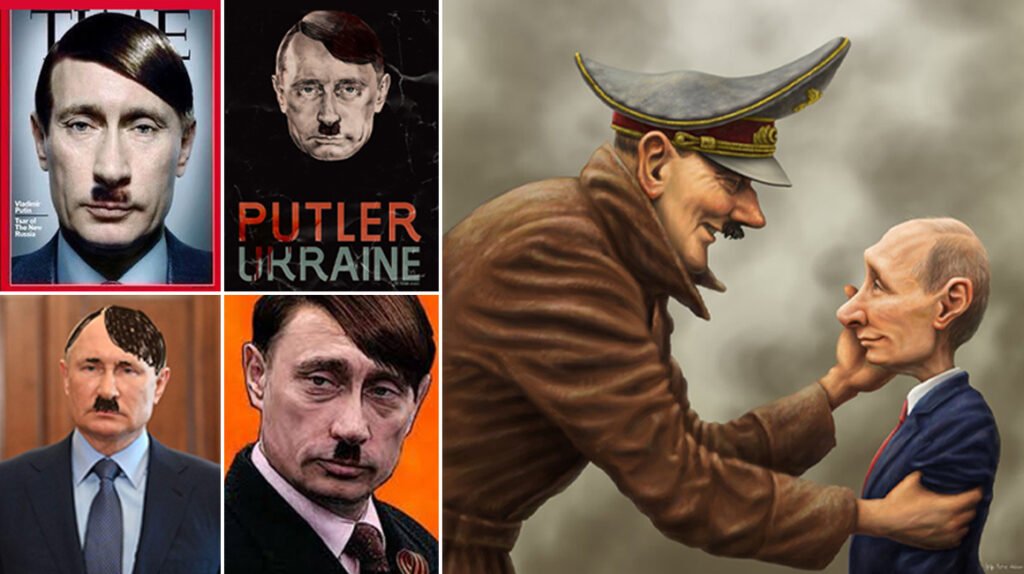
Vladimir Putin is blamed for everything that goes awry in Europe and the United States. In the United Kingdom his country was even blamed for bad weather as tabloid headlines screamed about icy Russian winds. The Brexit vote and Donald Trump’s Electoral College victory are said to be the result of Putin’s interference, even though the machinations of American oligarch Robert Mercer are most responsible for both outcomes.

When high level vitriol is shared by the corporate media and the American political duopoly and then repeated ad nauseum it is clear that the target will be subjected to more than mere slander. Such an attack carried out against a foreign leader is proof that the United States is ready for war by other means if not outright military conflict.

Russia has been a target ever since the fall of the Soviet Union in 1991. In its weakened state it was a victim of its own rapacious oligarch class and aside from having a nuclear arsenal was no match for its former rival. Bill Clinton openly dispatched operatives to meddle in the 1996 election and ensured that Boris Yeltsin kept the country ripe for plunder.

But in a supreme irony of history Yeltsin chose Vladimir Putin to succeed him. He took on the worst of the thieves and in so doing made himself an enemy of forces who hoped to pull his country apart. But he was not antagonistic to the United States. Libya might have been saved if Russia had used its United Nations Security Council veto against the no fly zone resolution in 2011. Only when the United States installed a fascist, anti-Russian government in Ukraine did Putin get the message that America should not be accommodated.

Putin stopped going along to get along but the American appetite for conquest is unstoppable. Syria is the place where Russia drew a line in the sand—and successfully, too. But the United States and NATO won’t admit defeat and continue the suffering of the Syrian people.

Now the drama surrounding the poisoning of former Russian spy Sergie Skripal in the U.K. has ensnared the Russian government. It is far-fetched to think that in the midst of an election campaign and the upcoming world soccer cup in Russia that Putin would decide to attack a former double agent he had allowed to go free eight years ago.

Prime Minister Theresa May is like her American counterparts: a liar and a violator of international law. The Organization for the Prohibition of Chemical Weapons (OPCW) has a process for nations to request information from one another and they are given 10 days to do so. Instead, May demanded that Russia prove the unprovable, that it wasn’t responsible, and that it do so in 24 hours. She declared that Russia was “likely” responsible and expelled 23 Russian diplomats from the country.

Labour party opposition leader Jeremy Corbyn was little better. He did say that the government should actually wait for proof of Russian involvement in Skripal’s poisoning but he also indulged in an anti-Russian screed as he vented against authoritarianism, oligarchs and human rights abuses. Saudi crown prince Mohammed bin Salman had just received a warm welcome in London from May, the royal family and the press. No one said a word about his genocide against the people of Yemen. But facts won’t get in the way of blatant war propaganda.

Putin has created a kind of madness on both sides of the ocean as politicians look for ever more bizarre ways to engage in Russophobia which is intended to damage his nation. Donald Trump’s appointment of Rex Tillerson as secretary of state was said to be influenced by Putin. Of course, everyone conveniently forgot that trope and now Tillerson’s dismissal is said to have been carried out on Putin’s orders.

Putin is even accused of being a racist. The Christopher Steele dossier, a creation of the Democratic Party and the ill-fated Hillary Clinton campaign, alleges that some on Putin’s staff used the “N-word ” in reference to Barack Obama. Any assertions in this dubious document are impossible to prove and it is unlikely that Steele’s second hand Russian sources reached into the Kremlin inner circle. This particular assertion comes from Michael Isikoff, a Steele partner in crime who dutifully leaked information which led to the granting of a FISA warrant and the Mueller investigation of Trump.

The creation of an all purpose villain is meant to cover up Democratic Party electoral failures, end the Trump presidency, and of course make the case for the American exceptionalism and interventions. Regime change, proxy wars, and imperial conquest are all very much a part of the anti-Putin hysteria.

But the Russophobes are playing a very dangerous game. The story of the poisoned man does not take place in a vacuum. While the public are distracted by a tall tale of Putin killing any Russian whoever died outside of that country, the very dangerous Syrian war continues. Lies about the Russian government should be taken very seriously. They are war propaganda and they are meant to get public support for military action against Russia and its allies.

The Skripal story is so murky that it will be difficult to ever determine culpability. But years of lies have had the desired effect. The public will believe anything about Putin and the Russian government no matter how ridiculous the charge. The American media are finally forced to report on the story of Robert Mercer’s Cambridge Analytica and the role it played in getting Trump an Electoral College victory. But the implications of a right-wing oligarch tipping the scales in our so-called democracy are ignored. Instead the New York Times reported on the Russian ancestry of a Cambridge Analytica staffer in a desperate effort to continue the dangerous charade.

Fifteen years ago this same government proclaimed that Iraq was the great danger and used the charge to make the case for war. Little has changed since. America excels at warfare and that is always preceded by propaganda.

In announcing new weapon developments Putin declared that mutually assured destruction (MAD) is not a thing of the past. If the U.S. and its allies were sane this would be a positive development. But they are not sane and every move and every charge brings the world closer to the precipice. The United States, not Russia, poses the greatest threat to peace and life on the planet. That must never be forgotten.


Margaret Kimberley’s Freedom Rider column appears weekly in BAR, and is widely reprinted elsewhere. She maintains a frequently updated blog as well as at freedomrider.blogspot.com. Ms. Kimberley lives in New York City, and can be reached via e-Mail at Margaret.Kimberley(at)BlackAgendaReport.com.

The Crisis of US Imperial Governance and the Struggle for a New World

By Danny Haiphong

Source: Black Agenda Report

“Economic crisis at home and endless war abroad has placed finance and monopoly capital in political disarray.”

When I was here last year, I spoke a lot about ideology and how the struggle for social transformation in the mainland of imperialism partly depended upon the ideological development of oppressed people trapped within US borders. The 2016 elections were beginning to pick-up momentum, but it was unclear what direction they would go. Fast-forward to the present and, I don’t know about you all, but I am exhausted. The election of Donald Trump has presented both new and old challenges. It has created an almost circus-like political environment with dire consequences for the masses. What precipitated the circus-show is a crisis of governance that has been intentionally misunderstood by US imperialism’s corporately owned media and political elite.

To distort the crisis, a state of anti-Russian madness has been prescribed to medicate political consciousness in rapidly changing times. The rise of China and Russia has exposed the bankruptcy of US imperialism on all fronts. Economic crisis at home and endless war abroad has placed finance and monopoly capital in political disarray. Donald Trump took advantage of the chaos. He spoke about jobs, he spoke about wars, and he spoke to the growing insecurities of white Americans of working and middle class status who no longer can rely on the wages of whiteness for guaranteed prosperity. The duopoly and its capitalist masters had no one to offer, indeed nothing to offer, so Trump rode in on his orange horse to become the head of state of imperialism.

“The rise of China and Russia has exposed the bankruptcy of US imperialism on all fronts.”

The ruling class does not want people in the United States to understand the context of the Trump Presidency. It has reapplied Cold War fears with Russia as the prime target. Russia’s geopolitical moves away from imperialism have been deemed just as criminal as China’s economic supremacy. The US does not depend as much on Russia in the economic sense, but it trembles in fear at the prospect of growing Russian economic activity across Eurasia. Yet, provoking Russia militarily will lead to World War. This is a risk the ruling class appears willing to take as the anti-Russia narrative in the US has only intensified since Hillary Clinton made the erroneous claim of Russian interference in the 2016 elections.

According to the US ruling class and its “intelligence officials,” Russia promotes “fakes news” to assist Donald Trump. Russian President Vladimir Putin lurks in our social media, and is hacking his way through algorithms to smear the US political system. Russia is infecting minds with its Russia Today “propaganda” arm. The Ruskies have no regard for the damage they have caused to so-called US democracy. Putin wants total control of the US and will wield his most talented social media users to get the job done. This is what the corporate media sounds like these days.

“The U.S. trembles in fear at the prospect of growing Russian economic activity across Eurasia.”

Of course, the US ruling class doesn’t want to talk about how US intelligence already collects the numbers, emails, and calls of every single person in the world who uses a cell phone or computer. They don’t want to tell you about how the US has interfered in every election in Russia since the Soviet Union fell, or how it has led bloody proxy wars and coups in over fifty countries in as many years. They don’t want to discuss how Russia has absolutely nothing to do with the millions of incarcerated people in the US or the fact that it is the US monopoly capitalist economy, not the emerging capitalist economy of Russia, which has automated many of the jobs and siphoned much of the wealth that once belonged to a privileged sector of US workers. No, it would rather attention be placed on the Russian boogeyman.

Anti-Russian hysteria doesn’t just distract the broad masses of people from the legitimate causes of the conditions afflicting the working and unemployed. It feeds into an atmosphere of war that strikes the very roots of the US social order. Imperialism is the rule of monopoly and finance capital. This system has run its course. It cannot hold onto political legitimacy any more than it can spur economic development beyond the meager 1 to 2 percent growth calculated year after year. In a sense, war is all the system has left. And war is exactly what the ruling class will get, with or without Trump.

“They don’t want to tell you about how the US has interfered in every election in Russia since the Soviet Union fell, or how it has led bloody proxy wars and coups in over fifty countries in as many years.”

War with Russia is today’s clarion call for “American unity.” In times of crisis, the US imperial state has relied on war to bring political and economic relief from domestic crisis. Every major US-led war has in part been waged for this purpose. What differs now is that war with Russia could bring about the destruction of humanity. Scientists have confirmed that nuclear war could make the planet uninhabitable.

What is also different about this current war drive with Russia is how it marks the historical conclusion of the current stage in the world imperialist order. When the US threatened nuclear war with the atomic bombing of Japan in 1945 and the Cuban missile crisis almost two decades later, the world was in the midst of a transition from Western monopoly capitalism to proletarian socialism. Revolutions in Vietnam, Cuba, and the Soviet Union, to name a few, threatened to undo the very notion of private property. And while US and Western backlash nearly eliminated the socialist bloc by 1991, the imperialist order entered a transition stage of its own that some call “neo-liberalism.”

Neo-liberalism has greatly expanded the reach of capitalism’s tentacles and widened the impact of capitalist crisis since its inception in the late 1970s. Neo-liberalism has unleashed unfettered capitalist production by imposing economic stagnation on participating countries. Meanwhile, China’s socialist model has paved a different path, one marked by unprecedented growth and poverty reduction. China has understandably attracted underdeveloped nations so desperately seeking to escape from the clutches of neo-colonial impoverishment. Russia has grown close to China, providing both countries with much assistance in the way of constructing a multi-polar economic arrangement based on the principles of sovereignty and mutually beneficial cooperation. According to the logic of neo-liberal capital, only war with Russia and China can save the system from itself.

“War with Russia could bring about the destruction of humanity.”

This conclusion stems from the fact that neo-liberal capital is not growing, it is contracting. Eighty-percent of workers are near-poor in the US while six mega billionaires hold ownership of over half of the planet’s wealth. Concentrated profit does not mean that all is well with the ruling class. Internal contradictions are eating the capitalist system alive. Neither finance capital nor its monopoly investors can arrest the resultant decline. The growth of technology to speed up production and profit has left millions stuck in permanent unemployment. A high-tech system of production is an expensive system of production, requiring lower wages and debt to absorb the falling rate of profit. Global overproduction has thus developed alongside mass misery.

Such conditions are at the root of mass incarceration, where millions of mostly Black and poor workers are warehoused in cages because there is nothing on the outside that the system can offer. They are also the root of mass surveillance, as the system must keep tabs on an increasingly restless population and justify infringements on civil liberties as necessary counter-terror measures. The War on Terror and Drugs have been prerequisites toward keeping the population scared and its attention away from the US capitalist overlords who fund and support drug trafficking and terrorism for political gain. And when all else fails, blame Russia.

“The system must keep tabs on an increasingly restless population and justify infringements on civil liberties as necessary counter-terror measures.”

The struggle against neo-liberal capital and anti-Russian hysteria is a struggle to transform and revolutionize society. This struggle requires both practical political organization and ideological development. There will be no revolution without revolutionary thought, and no revolution without revolutionary action. All too often the left is debating which one is the most important for the future success of a revolutionary movement. The answer is both, together.

For most, this explanation is understandably too broad to inform individual political energy. Liberal thought and action thus becomes attractive because it hides behind the cloak of the possible and pragmatic. It is easier to think in terms of electoral politics than in global struggle. It is far more simple to advocate for a cooperative economy or universal basic income without spelling out the broad context that prevents their formation. In order for any material victories to be won on a mass scale, the victors must understand the world in which they fight.

“A movement for social transformation in the US has still yet to be born.”

Conscious struggle has brought about meaningful and deep changes in recent years. Mumia Abu-Jamal is now receiving Hep-C treatment after years of struggle with the State of Pennsylvania. The release of Chelsea Manning and Oscar Rivera Lopez also come to mind. Solidarity with Cuba freed the Cuban 5 and has given the socialist nation more opportunities to develop its economy. But these victories have come in the midst of great cost. A movement for social transformation in the US has still yet to be born, as the presence of dozens of political prisoners and the ongoing US blockade against Cuba reminds us.

Not once did I mention the Democratic or Republican Party. Both parties have done their part to create the crisis before us. A rejection of the two-parties means an embrace of the struggle against imperialism worldwide. It means that the nations with US targets on their backs should be seen as potential allies. Yes, this includes Russia. And Syria. It includes the left movements in Latin America. In the spirit of Malcolm X, the Black liberation movement, and the historic anti-imperialist struggle around the world, the time has come to search for real bonds of solidarity around the world to aid in the struggle against white supremacy, capitalism, and empire in the US and the West. Let no one, not even those who call themselves “the left,” tell you otherwise.


Danny Haiphong is an Asian activist and political analyst in the Boston area. He canbereachedatwakeupriseup1990@gmail.com

The Democrats’ Dangerous Diversion

By Nicolas J S Davies

Source: Consortium News

The current debate over “fake news” has reminded me of a conversation I had several years ago with a former citizen of East Germany, now living in the United States. He explained that, in East Germany, everybody knew that what the media told them about their own country was a bunch of lies and propaganda. So they assumed that what the media told them about the West was just propaganda, too.

Now living in the U.S., he had come to realize that a lot of what the East German media said about life in the U.S. was actually true. There really are people living on the street, people with no access to healthcare, widespread poverty, a lack of social welfare and public services, and many other problems, as the East German media accurately reported, and as the Chinese government also noted in its latest report on human rights in the U.S.

My friend wished he and his countrymen had understood the difference between what their media told them about their country and what they reported about the West. Then they could have made more intelligent choices about which aspects of life in the West to adopt, instead of allowing Western experts to come in and impose the entire neoliberal model on their country.

In the West, of course, the state media of East Germany and other Communist countries were held up to ridicule. I remember hearing that people in the U.S.S.R. would open their newspapers in the morning and have a good laugh at the latest “fake news” in Pravda. But, as my German friend eventually understood, there was some truth amongst the propaganda, and the hidden danger of such a corrupted media system is that people end up not knowing what to believe, making informed democratic choices almost impossible.

In the end, people all over Eastern Europe were cornered into a false choice between two ideological systems that both came as top-down package deals, instead of being able to take charge of their own societies and democratically decide their own future.

In the U.S., we live under a two-party political system, not a one-party system as in East Germany, and our media reflect that. As each of our two main political parties and our media have fallen more totally under the sway of unbridled plutocratic interests, our mass media has devolved into a bifurcated version of what my friend observed in East Germany, triply corrupted by commercial interests, partisan bias and ideological and nationalist propaganda.

Down the Rabbit Hole 

Since the 2016 election campaign, our political system seems to have devolved into something like the nonsense world of Lewis Carroll’s Alice In Wonderland, with Donald Trump as the Queen of Hearts, Hillary Clinton as Humpty Dumpty, the Republicans and Democrats as Tweedledum and Tweedledee, the election as the Caucus Race (which Lewis Carroll based on U.S. political caucuses) and the whipsawed American public as the permanently baffled Alice.

In Lewis Carroll’s Caucus Race, an assortment of creatures ran randomly around a racetrack with no start or finish line, until the Dodo called the race over, declared them all winners and told Alice (the public?) she had to give them all prizes.

In similar fashion, the 2016 election between two of the most unpopular presidential candidates in U.S. history seems to have no finish line, but to live on in round-the-clock campaigns to corral the public into one of its two camps. The artificial, top-down nature of both these campaigns should be a warning that, like the election campaigns they grew out of, they are designed to corral, control and direct masses of people, not to offer real solutions to any of the serious problems facing our country and the world.

On one hand, we have President Trump, Republican Congressional leaders, Breitbart, Fox News and Rush Limbaugh, spouting nonsense worthy of Lewis Carroll, even in major presidential speeches, while dismissing criticism as “fake news.”

The Trump camp will never acknowledge that only a quarter of voting-age Americans voted for him, nor that even less of us share his views or the interests he represents. In this corrupt two-party system, no effort or expense is spared to persuade the public that we must vote for one of the two major party presidential candidates, whether we agree with either of them or not. But that cuts both ways, leaving most of the public unrepresented no matter who wins, and depriving any new government of a genuine popular mandate.

But Republican leaders play a more straightforward winner-take-all game than the Democrats. So they will try to ride Trump’s victory and their Congressional majorities as far as they will take them on all fronts: more tax breaks for the wealthy and corporations; more draconian cuts in social spending; more privatization of healthcare, education and other public services; more detention and deportation of immigrants; a more aggressive police response to social problems and public protest; more destruction of the natural world and the climate; and more increases in a military budget that already broke post-WWII records under Bush and Obama, to fuel a more openly aggressive and dangerous war policy – in other words, more of all the things that most Americans would agree we have already had too much of.

On the other side, Democratic Party leaders and the CIA, supported by the New York Times, the Washington Post, CNN and MSNBC, have conjured up unproven charges that Russia stole the election for Trump as the heart of their campaign against him. In Trump, history has handed them a political opponent with a piñata of vulnerabilities, from unprecedented conflicts of interest to policies that benefit only his own wealthy class to willful ignorance of how almost everything he is responsible for as president really works.

And yet the cabal formerly known as the Clinton campaign shows little interest in pointing out that our new Emperor has no clothes on, let alone in seriously resisting his repressive, plutocratic policies, and is instead obsessed with convincing the public that a birthmark on his naked bum looks like a hammer and sickle.

A Saving Grace?

Paradoxically, if Trump really reduced tensions between the U.S. and Russia, as his hawkish Democratic opponents fear, that could be the saving grace of his entire presidency. George W. Bush’s and Barack Obama’s regime change wars, NATO expansion and the U.S.-backed coup in Ukraine have ignited a new Cold War that many respected scientists believe has raised the risk of human mass extinction to its highest level since the 1950s.

In the pursuit of false security based on post-Cold War triumphalism and a fleeting mirage of military supremacy, our corrupt leaders have jeopardized not just our security but our very existence, leaving us at two and a half minutes to midnight on the Bulletin of the Atomic Scientists (BAS)Doomsday Clock.

As Jonathan Marshall at Consortiumnews.com reported on March 10, experts from the Federation of American Scientists, the Natural Resources Defense Council and MIT wrote in a recent BAS article that new “super-fuzes” installed on U.S. nuclear warheads since 2009 have significantly increased the danger of nuclear war by giving the U.S. the ability to destroy all Russia’s fixed land-based nuclear missiles with only a fraction of U.S. own weapons.

Coupled with President Obama’s deployment of a formerly illegal ABM (anti-ballistic missile) system on Aegis missile destroyers and at bases in Eastern Europe, the authors wrote that this upgrade to U.S. nuclear warheads is “exactly what one would expect to see if a nuclear-armed state were planning to have the capacity to fight and win a nuclear war by disarming enemies with a surprise first strike.” They concluded that “Russian planners will almost surely see the advance in fuzing capability as empowering an increasingly feasible U.S. preemptive nuclear strike capability.”

In the case of a suspected Russian nuclear missile launch, the U.S. satellite-based early warning system can give President Trump 30 minutes to judge whether we are really facing a nuclear attack or not. But Russia’s land-based early warning system is not so generous. In the case of a suspected U.S. nuclear launch targeting Russia, President Putin would have as little as 7 to 13 minutes to decide whether Russia was really under nuclear attack and whether to retaliate.

In the midst of escalating tensions over Syria, Ukraine, Iran or some other new crisis, a realistic fear of a U.S. first strike could force a hasty decision by Russian officials and seal the fate of humanity. The BAS authors believe that this predicament leaves Russia little choice but to pre-delegate its nuclear launch authority to lower levels of command, increasing the risk of an accidental or mistaken launch of nuclear weapons.

In an epitome of understatement, they point out that, “Forcing this situation upon the Russian government seems likely to be detrimental to the security interests of the United States and its Western allies.”

While U.S. officials are largely silent about the dangers of these developments in U.S. nuclear weapons policy, President Putin has spoken frankly about them and expressed dismay that the U.S. has rejected every Russian offer of cooperation to reduce these risks. Talking to a group of journalists at the St. Petersburg International Economic Forum in June 2016, he concluded, “I don’t know how this is all going to end. … What I do know is that we will need to defend ourselves.”

But despite the existential dangers of deteriorating relations with Russia, Democratic Party leaders have grasped the CIA’s unproven “assessments” that Russia may have tried to influence the outcome of the U.S. election as a lifeline by which to salvage their positions of power after their party’s electoral implosion.

Since the leadership of the Democratic Party was taken over by the corporate-backed Democratic Leadership Council (DLC) a generation ago, it has followed an unwritten rule that it must never accept responsibility for losing an election, nor respond to signs of public disaffection with any weakening of its commitment to pro-corporate, neoliberal policies. In its desperation to prevent the democratic reform of the Democratic Party, it is aggressively tarring nuclear-armed Russia with the same brush it used to tar and feather Ralph Nader after the 2000 election.

The mortal aversion of Democratic Party leaders to progressive reform suggests that they prize their own control of the party even above winning elections, the rational purpose of any political party. Their ugly smear campaign against Keith Ellison, the progressive candidate for Democratic National Committee (DNC) chair, mirrored the DNC’s corrupt campaign to undermine Sen. Bernie Sanders in the Democratic primaries and the DLC cabal’s bare-knuckles response to progressive challengers for the past 30 years.

For the DLC Democrats to snatch defeat from the jaws of the long-term victory that the country’s shifting demographics seem to guarantee their party requires a truly historic level of corruption.

Their unshakable commitment to fight tooth and nail for the interests of their wealthy campaign contributors over those of poorer, younger and darker-skinned voters in every election, every national, state and local party committee and on every issue, even as they pretend they are doing the exact opposite, could only be a viable political strategy in Lewis Carroll’s Wonderland. In the real world, their demonstrated disdain for the people from whose votes they derive their power is a strategy for political suicide.

Different Kind of Politics

These corrupt party leaders and their corporate media cheerleaders dare not remind us that Bernie Sanders’s candidacy for president inspired more enthusiasm and drew bigger crowds than Trump’s or Clinton’s, despite one eightieth of the early media promotion lavished on Trump by some corporate media and the fact that almost the entire Democratic Party establishment lined up against him.

For decades, DLC Democrats have run on vague messages about “values” to avoid being cornered into explicit progressive policy positions that might alienate their wealthy patrons. Sanders was greeted with open arms by younger voters ready for a renaissance of real politics based on actual policies that solve real problems, like universal healthcare, free college tuition, progressive taxation to pay for it all and a more cautious approach to U.S.-backed “regime change” in other countries.

By contrast, an analysis of campaign messaging by the Wesleyan Media Project found that “Clinton’s message was devoid of policy discussions” when compared to other recent presidential campaigns, including even Trump’s, and that this was a critical factor in her failure.

According to opinion polls, Bernie Sanders may now be the most popular politician in America. Polls consistently showed that Sanders was likely to beat Trump in the general election if the Democratic Party allowed him to get that far, but the DNC fundraising machine pulled out every trick in the book to make sure that didn’t happen. If truth be told, Sanders’s success was probably a more accurate reflection of the evolving political views of a majority of Americans in 2016 than the billion-dollar auction of the presidency between the Game Show King and the Queen of Chaos.

These two camps represent factions of the powerful interests that have controlled American politics for decades, from the military-industrial complex and the CIA to the dirty energy and for-profit “healthcare” industries, to say nothing of the commercial media industry itself, which covered this election all the way to the bank and for whom the show must go on and on and on … and on.

Lies of Both Sides.

Like the people of East Germany in the 1980s, we now face the challenge of a society in crisis, compounded by a treacherous media environment, with not just one, but two competing camps presenting us with false, self-serving interpretations of the multi-faceted crisis their corruption has spawned. While they compete for our trust, they share a common interest in insisting that one of the two mythological worldviews they have staked out must be right.

But as Cornel West recently told the students at my local high school in Miami in a Black History Month speech, “You don’t have to choose between the lies on one side and the lies on the other side.” So the question becomes where to turn for something other than lies, and how to recognize the truth when we stumble across it.

The paradox of our Internet age is that we nearly all have access to a wider range of media than ever before, yet we are still exposed and susceptible to corporate, partisan and ideological propaganda. In theory, we no longer have to be victims of for-profit media whose business models prioritize their profits over their duty to inform the public. But in reality, we do not form our views of the world as independently as we think we do.

This is easier to grasp in the case of commercial advertising than in the arena of political or ideological indoctrination. There is a well-known dictum in the business world that goes, “I know that half the money we spend on advertising is wasted. I just don’t know which half.” The flip-side of this is that the other half is not wasted.

So the advertising industry in the United States spends $220 billion per year, $700 for each man, woman and child in the country, to sell us products and services. And yet we still like to think that we make independent, rational choices about our spending, based on enlightened self-interest and cultivated tastes, not on the work of copywriters churning out pitches, images and jingles in ad agency cubicles.

One of the by-products of the mass monetization of American politics since the 1980s is that politics has become a profitable new arena for advertising, marketing and public relations firms. Its practitioners apply the techniques and experience they’ve developed in other areas to the world of politics, helping politicians and parties to convert the money they raise from wealthy campaign contributors into votes, and ultimately into power over all our lives. So we should be just as wary of political marketing and advertising as of the commercial variety. We should also be more humble in recognizing our own vulnerability to these profitable forms of persuasion and deception.

My copy of Alice in Wonderland has a quotation from James Joyce in the front of the book: “Wipe your glasses with what you know.” What we know is often our best protection against being misled by advertisers, politicians and pundits, if we will only remember what we know and trust it over the misinformation that surrounds us.

“Wiping our glasses with what we know” can provide a reality check on the current Russophobia campaign. We know very well that the U.S. and Russia possess the bulk of the world’s nuclear weapons, and that war between our two countries would likely mean death for ourselves and our families and the end of life as we know it for people everywhere.

We also know that it is our country and its allies, not Russia, that have launched invasions, military occupations, bombing campaigns, coups and drone wars against at least ten countries in the past 20 years, while Russia only recently become engaged in two of these conflict zones when its interests were directly impacted by our actions.

So we can see that the greatest danger in this relationship is not the threat of some unprovoked and unprecedented act of Russian aggression. The more real and serious danger is that a confrontation with Russia over one of the hot spots we have ignited will lead to an escalation of tensions in which a mistake, a misunderstanding, a miscalculation, a bluff called, a “red line” crossed or some other kind of failed brinksmanship will trigger a war that will escalate to the use of nuclear weapons, and from there to Armageddon.

Even with the lines of communication set up after the Cuban missile crisis and the stabilization of the Cold War balance of terror by the principle of Mutually Assured Destruction (MAD), we now know that we came very close to Armageddon many times, including simply by accident.

Instead of being corralled by either side in the “Russia did it” campaign, we should be urging our leaders to sit down and talk seriously with Russia’s leaders, to stop taking dangerous actions that exacerbate tensions, uncertainties and mutual isolation, and to return to serious negotiations to leave our children and grandchildren a peaceful world, free of nuclear weapons, where these dangers will no longer threaten them.

Amid lies and distortions on all sides, the corruption of politics and media by commercial interests and the billion dollars per year our government spends directly on public relations and propaganda, James Joyce’s advice can still serve us well. Make sure to wipe your glasses with what you know as you read or watch “news” from any source or listen to politicians of any party, and we may just find a way out of this rabbit hole before the roof crashes in on us.


Nicolas J S Davies is the author of Blood On Our Hands: the American Invasion and Destruction of Iraq.  He also wrote the chapters on “Obama at War” in Grading the 44th President: a Report Card on Barack Obama’s First Term as a Progressive Leader.

Why Do “Progressives” Like War?

kelly-cold-war

By Philip Giraldi

Source: Unz Review

Liberals are supposed to be antiwar, right? I went to college in the 1960s, when students nationwide were rising up in opposition to the Vietnam War. I was a Young Republican back then and supported the war through sheer ignorance and dislike of the sanctimoniousness of the protesters, some of whom were surely making their way to Canada to live in exile on daddy’s money while I was on a bus going to Fort Leonard Wood for basic combat training. I can’t even claim that I had some grudging respect for the antiwar crowd because I didn’t, but I did believe that at least some of them who were not being motivated by being personally afraid of getting hurt were actually sincere in their opposition to the awful things that were happening in Southeast Asia.

As I look around now, however, I see something quite different. The lefties I knew in college are now part of the Establishment and generally speaking are retired limousine liberals. And they now call themselves progressives, of course, because it sounds more educated and sends a better message, implying as it does that troglodytic conservatives are anti-progress. But they also have done a flip on the issue of war and peace. In its most recent incarnation some of this might be attributed to a desperate desire to relate to the Hillary Clinton campaign with its bellicosity towards Russia, Syria and Iran, but I suspect that the inclination to identify enemies goes much deeper than that, back as far as the Bill Clinton Administration with its sanctions on Iraq and the Balkan adventure, which resulted in hundreds of thousands of deaths and the creation of a terror-narco state in the heart of Europe. And more recently we have seen the Obama meddling in Libya, Yemen and Syria in so called humanitarian interventions which have turned out to be largely fraudulent. Yes, under the Obama Dems it was “responsibility to protect time” (r2p) and all the world trembled as the drones were let loose.

Last Friday I started to read an op-ed in The Washington Post by David Ignatius that blew me away. It began “President Trump confronts complicated problems as the investigation widens into Russia’s attack on our political system.” It then proceeded to lay out the case for an “aggressive Russia” in the terms that have been repeated ad nauseam in the mainstream media. And it was, of course, lacking in any evidence, as if the opinions of coopted journalists and the highly politicized senior officials in the intelligence community should be regarded as sacrosanct. These are, not coincidentally, the same people who have reportedly recently been working together to undercut the White House by leaking and then reporting highly sensitive transcripts of phone calls with Russian officials.

Ignatius is well plugged into the national security community and inclined to be hawkish but he is also a typical Post politically correct progressive on most issues. So here was your typical liberal asserting something in a dangerous fashion that has not been demonstrated and might be completely untrue. Russia is attacking “our political system!” And The Post is not alone in accepting that Russia is trying to subvert and ultimately overthrow our republic. Reporting from The New York Times and on television news makes the same assumption whenever they discuss Russia, leading to what some critics have described as mounting American ‘hysteria’ relating to anything coming out of Moscow.

Rachel Maddow is another favorite of mine when it comes to talking real humanitarian feel good stuff out one side of her mouth while beating the drum for war from the other side. In a bravura performance on January 26th she roundly chastised Russia and its president Vladimir Putin. Rachel, who freaked out completely when Donald Trump was elected, is now keen to demonstrate that Trump has been corrupted by Russia and is now controlled out of the Kremlin. She described Trump’s lord and master Putin as an “intense little man” who murders his opponents before going into the whole “Trump stole the election with the aid of Moscow” saga, supporting sanctions on Russia and multiple investigations to get to the bottom of “Putin’s attacks on our democracy.” Per Maddow, Russia is the heart of darkness and, by way of Trump, has succeeded in exercising control over key elements in the new administration.

Unfortunately, people in the media like Ignatius and Maddow are not alone. Their willingness to sell a specific political line that carries with it a risk of nuclear war as fact, even when they know it is not, has been part of the fear-mongering engaged in by Democratic Party loyalists and many others on the left. Their intention is to “get Trump” whatever it takes, which opens the door to some truly dangerous maneuvering that could have awful consequences if the drumbeat and military buildup against Russia continues, leading Putin to decide that his country is being threatened and backed into a corner. Moscow has indicated that it would not hesitate use nuclear weapons if it is being confronted militarily and facing defeat.

The current wave of Russophobia is much more dangerous than the random depiction of foreigners in negative terms that has long bedeviled a certain type of American know-nothing politics. Apart from the progressive antipathy towards Putin personally, there is a virulent strain of anti-Russian sentiment among some self-styled conservatives in congress, best exemplified by Senators John McCain and Lindsey Graham. Graham has recently said “2017 is going to be a year of kicking Russia in the ass in Congress.”

It is my belief that many in the National Security State have convinced themselves that Russia is indeed a major threat against the United States and not because it is a nuclear armed power that can strike the U.S. That appreciation, should, if anything constitute a good reason to work hard to maintain cordial relations rather than not, but it is seemingly ignored by everyone but Donald Trump.

No, the new brand of Russophobia derives from the belief that Moscow is “interfering” in places like Syria and Ukraine. Plus, it is a friend of Iran. That perception derives from the consensus view among liberals and conservatives alike that the U.S. sphere of influence encompasses the entire globe as well as the particularly progressive conceit that Washington should serve to “protect” anyone threatened at any time by anyone else, which provides a convenient pretext for military interventions that are euphemistically described as “peace missions.”

There might be a certain cynicism in many who hate Russia as having a powerful enemy also keeps the cash flowing from the treasuring into the pockets of the beneficiaries of the military industrial congressional complex, but my real fear is that, having been brainwashed for the past ten years, many government officials are actually sincere in their loathing of Moscow and all its works. Recent opinion polls suggest that that kind of thinking is popular among Americans, but it actually makes no sense. Though involvement by Moscow in the Middle East and Eastern Europe is undeniable, calling it a threat against U.S. vital interests is more than a bit of a stretch as Russia’s actual ability to make trouble is limited. It has exactly one overseas military facility, in Syria, while the U.S. has more than 800, and its economy and military budget are tiny compared to that of the United States. In fact, it is Washington that is most guilty of intervening globally and destabilizing entire regions, not Moscow, and when Donald Trump said in an interview that when it came to killing the U.S. was not so innocent it was a gross understatement.

Ironically, pursuing a reset with Russia is one of the things that Trump actually gets right but the new left won’t give him a break because they reflexively hate him for not embracing the usual progressive bromides that they believe are supposed to go with being antiwar. Other Moscow trashing comes from the John McCain camp which demonizes Russia because warmongers always need an enemy and McCain has never found a war he couldn’t support. It would be a tragedy for the United States if both the left and enough of the right were to join forces to limit Trump’s options on dealing with Moscow, thereby enabling an escalating conflict that could have tragic consequences for all parties.