Why Do “Progressives” Like War?

kelly-cold-war

By Philip Giraldi

Source: Unz Review

Liberals are supposed to be antiwar, right? I went to college in the 1960s, when students nationwide were rising up in opposition to the Vietnam War. I was a Young Republican back then and supported the war through sheer ignorance and dislike of the sanctimoniousness of the protesters, some of whom were surely making their way to Canada to live in exile on daddy’s money while I was on a bus going to Fort Leonard Wood for basic combat training. I can’t even claim that I had some grudging respect for the antiwar crowd because I didn’t, but I did believe that at least some of them who were not being motivated by being personally afraid of getting hurt were actually sincere in their opposition to the awful things that were happening in Southeast Asia.

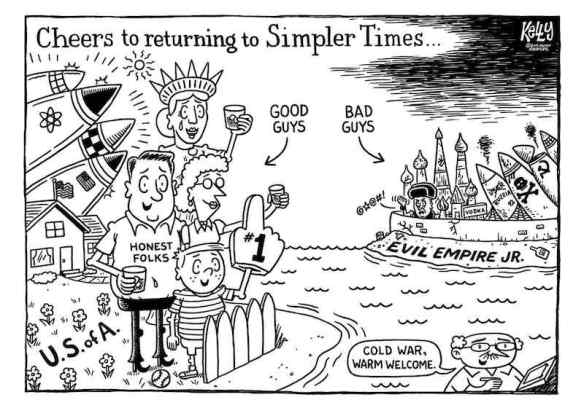
As I look around now, however, I see something quite different. The lefties I knew in college are now part of the Establishment and generally speaking are retired limousine liberals. And they now call themselves progressives, of course, because it sounds more educated and sends a better message, implying as it does that troglodytic conservatives are anti-progress. But they also have done a flip on the issue of war and peace. In its most recent incarnation some of this might be attributed to a desperate desire to relate to the Hillary Clinton campaign with its bellicosity towards Russia, Syria and Iran, but I suspect that the inclination to identify enemies goes much deeper than that, back as far as the Bill Clinton Administration with its sanctions on Iraq and the Balkan adventure, which resulted in hundreds of thousands of deaths and the creation of a terror-narco state in the heart of Europe. And more recently we have seen the Obama meddling in Libya, Yemen and Syria in so called humanitarian interventions which have turned out to be largely fraudulent. Yes, under the Obama Dems it was “responsibility to protect time” (r2p) and all the world trembled as the drones were let loose.

Last Friday I started to read an op-ed in The Washington Post by David Ignatius that blew me away. It began “President Trump confronts complicated problems as the investigation widens into Russia’s attack on our political system.” It then proceeded to lay out the case for an “aggressive Russia” in the terms that have been repeated ad nauseam in the mainstream media. And it was, of course, lacking in any evidence, as if the opinions of coopted journalists and the highly politicized senior officials in the intelligence community should be regarded as sacrosanct. These are, not coincidentally, the same people who have reportedly recently been working together to undercut the White House by leaking and then reporting highly sensitive transcripts of phone calls with Russian officials.

Ignatius is well plugged into the national security community and inclined to be hawkish but he is also a typical Post politically correct progressive on most issues. So here was your typical liberal asserting something in a dangerous fashion that has not been demonstrated and might be completely untrue. Russia is attacking “our political system!” And The Post is not alone in accepting that Russia is trying to subvert and ultimately overthrow our republic. Reporting from The New York Times and on television news makes the same assumption whenever they discuss Russia, leading to what some critics have described as mounting American ‘hysteria’ relating to anything coming out of Moscow.

Rachel Maddow is another favorite of mine when it comes to talking real humanitarian feel good stuff out one side of her mouth while beating the drum for war from the other side. In a bravura performance on January 26th she roundly chastised Russia and its president Vladimir Putin. Rachel, who freaked out completely when Donald Trump was elected, is now keen to demonstrate that Trump has been corrupted by Russia and is now controlled out of the Kremlin. She described Trump’s lord and master Putin as an “intense little man” who murders his opponents before going into the whole “Trump stole the election with the aid of Moscow” saga, supporting sanctions on Russia and multiple investigations to get to the bottom of “Putin’s attacks on our democracy.” Per Maddow, Russia is the heart of darkness and, by way of Trump, has succeeded in exercising control over key elements in the new administration.

Unfortunately, people in the media like Ignatius and Maddow are not alone. Their willingness to sell a specific political line that carries with it a risk of nuclear war as fact, even when they know it is not, has been part of the fear-mongering engaged in by Democratic Party loyalists and many others on the left. Their intention is to “get Trump” whatever it takes, which opens the door to some truly dangerous maneuvering that could have awful consequences if the drumbeat and military buildup against Russia continues, leading Putin to decide that his country is being threatened and backed into a corner. Moscow has indicated that it would not hesitate use nuclear weapons if it is being confronted militarily and facing defeat.

The current wave of Russophobia is much more dangerous than the random depiction of foreigners in negative terms that has long bedeviled a certain type of American know-nothing politics. Apart from the progressive antipathy towards Putin personally, there is a virulent strain of anti-Russian sentiment among some self-styled conservatives in congress, best exemplified by Senators John McCain and Lindsey Graham. Graham has recently said “2017 is going to be a year of kicking Russia in the ass in Congress.”

It is my belief that many in the National Security State have convinced themselves that Russia is indeed a major threat against the United States and not because it is a nuclear armed power that can strike the U.S. That appreciation, should, if anything constitute a good reason to work hard to maintain cordial relations rather than not, but it is seemingly ignored by everyone but Donald Trump.

No, the new brand of Russophobia derives from the belief that Moscow is “interfering” in places like Syria and Ukraine. Plus, it is a friend of Iran. That perception derives from the consensus view among liberals and conservatives alike that the U.S. sphere of influence encompasses the entire globe as well as the particularly progressive conceit that Washington should serve to “protect” anyone threatened at any time by anyone else, which provides a convenient pretext for military interventions that are euphemistically described as “peace missions.”

There might be a certain cynicism in many who hate Russia as having a powerful enemy also keeps the cash flowing from the treasuring into the pockets of the beneficiaries of the military industrial congressional complex, but my real fear is that, having been brainwashed for the past ten years, many government officials are actually sincere in their loathing of Moscow and all its works. Recent opinion polls suggest that that kind of thinking is popular among Americans, but it actually makes no sense. Though involvement by Moscow in the Middle East and Eastern Europe is undeniable, calling it a threat against U.S. vital interests is more than a bit of a stretch as Russia’s actual ability to make trouble is limited. It has exactly one overseas military facility, in Syria, while the U.S. has more than 800, and its economy and military budget are tiny compared to that of the United States. In fact, it is Washington that is most guilty of intervening globally and destabilizing entire regions, not Moscow, and when Donald Trump said in an interview that when it came to killing the U.S. was not so innocent it was a gross understatement.

Ironically, pursuing a reset with Russia is one of the things that Trump actually gets right but the new left won’t give him a break because they reflexively hate him for not embracing the usual progressive bromides that they believe are supposed to go with being antiwar. Other Moscow trashing comes from the John McCain camp which demonizes Russia because warmongers always need an enemy and McCain has never found a war he couldn’t support. It would be a tragedy for the United States if both the left and enough of the right were to join forces to limit Trump’s options on dealing with Moscow, thereby enabling an escalating conflict that could have tragic consequences for all parties.

Goose-stepping Our Way Toward Pink Revolution

7158ef9ad95b21ae22abe271cdefd349

By CJ Hopkins

Source: CounterPunch

So the global capitalist ruling classes’ neutralization of the Trumpian uprising seems to be off to a pretty good start. It’s barely been a month since his inauguration, and the corporate media, liberal celebrities, and their millions of faithful fans and followers are already shrieking for his summary impeachment, or his removal by … well, whatever means necessary, including some sort of “deep state” coup. Words like “treason” are being bandied about, treason being grounds for impeachment (not to mention being punishable by death), which appears to be where we’re headed at this point.

In any event, the nation is now officially in a state of “crisis.” The editors of The New York Times are demanding congressional investigations to root out the Russian infiltrators who have assumed control of the executive branch. According to prize-winning economist Paul Krugman, “a foreign dictator intervened on behalf of a US presidential candidate” … “we are being governed by people who take their cues from Moscow,” or some such nonsense. The Washington Post, CNN, MSNBC, The Guardian, The New Yorker, Politico, Mother Jones, et al. (in other words virtually every organ of the Western neoliberal media) are robotically repeating this propaganda like the Project Mayhem cultists in Fight Club.

The fact that there is not one shred of actual evidence to support these claims makes absolutely no difference whatsoever. As I wrote about in these pages previously, such official propaganda is not designed to be credible; it is designed to bludgeon people into submission through sheer relentless repetition and fear of social ostracization … which, once again, is working perfectly. Like the “Iraq has WMDs” narrative before it, the “Putin Hacked the Election” narrative has now become official “reality,” an unchallengeable axiomatic “fact” that can be cited as background to pretend to bolster additional ridiculous propaganda.

This “Russia Hacked the Election” narrative, let’s remember, was generated by a series of stories that it turned out were either completely fabricated or based on “anonymous intelligence sources” that could provide no evidence “for reasons of security.” Who could forget The Washington Post‘s “Russian Propagandist Blacklist” story (which was based on the claims of some anonymous’ blog and a third rate neo-McCarthyite think tank), or their “Russians Hacked the Vermont Power Grid” story (which, it turned out later, was totally made up), or CNN’s “Golden Showers Dossier” story (which was the work of some ex-MI6 spook-for-hire the Never Trump folks had on their payroll), or Slate‘s “Trump’s Russian Server” story (a half-assed smear piece by Franklin Foer, who is now pretending to have been vindicated by the hysteria over the Flynn resignation), or (and this is my personal favorite) The Washington Post‘s “Clinton Poisoned by Putin” story? Who could possibly forget these examples of courageous journalists speaking truth to power?

Well, OK, a lot of people, apparently, because there’s been a new twist in the official narrative. It seems the capitalist ruling classes now need us to defend the corporate media from the tyrannical criticism of Donald Trump, or else, well, you know, end of democracy. Which millions of people are actually doing. Seriously, absurd as it obviously is, millions of Americans are now rushing to defend the most fearsome propaganda machine in the history of fearsome propaganda machines from one inarticulate, populist boogeyman who can’t maintain his train of thought for more than fifteen or twenty seconds.

All joking aside, the prevailing mindset of the ruling classes, and those aspiring thereto, is more frightening than at any time I can remember. “The Resistance” is exhibiting precisely the type of mindlessly fascistic, herd-like behavior it purports to be trying to save us from. Yes, the mood in Resistance quarters has turned quite openly authoritarian. William Kristol captured it succinctly: “Obviously strongly prefer normal democratic and constitutional politics. But if it comes to it, [I] prefer the deep state to the Trump state.” Neoliberal Rob Reiner put it this way: “The incompetent lying narcissistic fool is going down. Intelligence community will not let DT destroy democracy.” Subcommandante Micheal Moore went to the caps lock to drive the point home: “It doesn’t take a rocket scientist to figure out what was going on: TRUMP COLLUDING WITH THE RUSSIANS TO THROW THE ELECTION TO HIM,” and demanded that Trump be immediately detained and renditioned to a secure facility: “Let’s be VERY clear: Flynn DID NOT make that Russian call on his own. He was INSTRUCTED to do so. He was TOLD to reassure them. Arrest Trump.”

These a just a few of the more sickening examples. The point is, millions of American citizens (as well as citizens of other countries) are prepared to support a deep state coup to remove the elected president from office … and it doesn’t get much more fascistic than that.

Now I want to be clear about this “deep state” thing, as the mainstream media is already labeling anyone who uses the term a hopelessly paranoid conspiracy theorist. The deep state, of course, is not a conspiracy. It is simply the interdependent network of structures where actual power resides (i.e., the military-industrial complex, multinational corporations, Wall Street, the corporate media, and so on). Its purpose is to maintain the stability of the system regardless of which party controls the government. These are the folks, when a president takes office, who show up and brief him on what is and isn’t “possible” given economic and political “realities.” Despite what Alex Jones may tell you, it is not George Soros and roomful of Jews. It is a collection of military and intelligence officers, CEOs, corporate lobbyists, lawyers, bankers, politicians, power brokers, aides, advisers, and assorted other permanent members of the government and the corporate and financial classes. Just as presidents come and go, so do the individuals comprising the deep state, albeit on a longer rotation schedule. And, thus, it is not a monolithic entity. Like any other decentralized network, it contains contradictions, conflicts of interest. However, what remains a constant is the deep state’s commitment to preserving the system … which, in our case, that system is global Capitalism.

I’m going to repeat and italicize that to hopefully avoid any misunderstanding. The system the deep state primarily serves is not the United States of America, i.e., the country most Americans believe they live in; the system it serves is globalized Capitalism. The United States, the nation state itself, while obviously a crucial element of the system, is not the deep state’s primary concern. If it were, Americans would all have healthcare, affordable education, and a right to basic housing, like more or less every other developed nation.

And this is the essence of the present conflict. The Trump regime (whether they’re sincere or not) has capitalized on people’s discontent with globalized neoliberal Capitalism, which is doing away with outmoded concepts like the nation state and national sovereignty and restructuring the world into one big marketplace where “Chinese” investors own “American” companies that manufacture goods for “European” markets by paying “Thai” workers three dollars a day to enrich “American” hedge fund crooks whose “British” bankers stash their loot in numbered accounts in the Cayman Islands while “American” workers pay their taxes so that the “United States” can give billions of dollars to “Israelis” and assorted terrorist outfits that are destabilizing the Middle East to open up markets for the capitalist ruling classes, who have no allegiance to any country, and who couldn’t possibly care any less about the common people who have to live there. Trump supporters, rubes that they are, don’t quite follow the logic of all that, or see how it benefits them or their families.

But whatever … they’re all just fascists, right? And we’re in a state of crisis, aren’t we? This is not the time to sit around and analyze political and historical dynamics. No, this is a time for all loyal Americans to set aside their critical thinking and support democracy, the corporate media, and the NSA, and CIA, and the rest of the deep state (which doesn’t exist) as they take whatever measures are necessary to defend us from Putin’s diabolical plot to Nazify the United States and reenact the Holocaust for no discernible reason. The way things are going, it’s just a matter of time until they either impeach his puppet, Trump, or, you know, remove him by other means. I imagine, once we get to that point, Official State Satirist Stephen Colbert will cover the proceedings live on the “Late Show,” whipping his studio audience up into a frenzy of mindless patriotic merriment, as he did in the wake of the Flynn fiasco (accusing the ruling classes’ enemies of treason being the essence of satire, of course). After he’s convicted and dying in jail, triumphant Americans will pour out onto the lawn of Lafayette Square again, waving huge flags and hooting vuvuzelas, like they did when Obama killed Osama bin Laden. I hope you’ll forgive me if I don’t attend. Flying home may be a little complicated, as according to The Washington Post, I’m some kind of Russian propagandist now. And, also, I have this problem with authority, which I don’t imagine will go over very well with whatever provisional government is installed to oversee the Restoration of Normality, and Love, of course, throughout the nation.

Nationalist Propaganda has Many Progressives Demonizing ‘The Russians’

79deb5d0f06719de3743bb630d314563

By Robert Barsocchini

Source: Washington’s Blog

Neocon and neoliberal war propaganda, as exhibited in the Washington Post, New York Times, etc., “has turned much of the liberal/progressive community” in the US “into a pro-New Cold War constituency willing to engage in a new breed of McCarthyism”, Robert Parry notes today.  (This author has personally witnessed similar displays.)

Leading Russia expert Stephen Cohen, a professor at Princeton, observes there has been a possibly ‘unprecedented’ ‘propaganda’ ‘tsunami’ occurring in the US targeting Russia and Putin and increasing the already high risk of nuclear war. (The Nation)  This predates the election and the “unproven allegations that Putin had intervened … to put Trump in the White House”, and largely stems from Russia’s intervention at the behest of the Syrian government to prevent the Western-sponsored overthrow of the Syrian state by what US officials privately say is an insurgency dominated by Islamic terrorists being funded by US-backed Saudi dictator Salman bin Abdulaziz’s cadre and similar parties.

Jeff McMahan, a philosopher at Rutgers, notes of the kind of propaganda observed by Cohen that “the powerful sense of collective identity within a nation is often achieved by contrasting an idealized conception of the national character with caricatures of other nations, whose members are regarded as less important or worthy or, in many cases, are dehumanized and despised as inferior or even odious.”  As Parry noted last week, another example of this is the Washington establishment doctrine, partially a holdover from eugenics scholarship and largely a PR tactic serving overtly stated goals of hegemonic expansion, that Russia as a nation is so inferior that any “equivalence” between it and the US is impossible.

However, the world outside the US doctrinal system sees the matter somewhat differently.  In a Western-run global poll taken during the height of the ongoing Ukraine crisis, the international community considered both Russia and the US, along with other countries, for the title of “greatest threat to world peace”.  The US was voted greatest threat by far, receiving twelve times more votes than Russia and three times more votes than the runner-up, Pakistan.

As author David Swanson recently noted in Foreign Policy Journal, in the 95% of the world that is not the US, it is scarcely a secret “that the United States is (as that Putin stooge Martin Luther King Jr. put it) the greatest purveyor of violence on earth. The United States is the top weapons dealer, the top weapons buyer, the biggest military spender, the most widespread imperial presence, the most frequent war maker, the most prolific overthrower of governments, and from 1945 to 2017 the killer of the most people through war.”

McMahan continues: “When nationalist solidarity is maintained” through the type of nationalism described above (which includes keeping much of what Swanson describes secret from or distorting it for the domestic population) “the result is often brutality and atrocity on an enormous scale.”  The Bulletin of Atomic Scientists, which includes respected thinkers and sponsors such as Stephen Hawking, notes the world is at an extremely dangerous moment in terms of the potential for nuclear war, and has set its “doomsday clock” to three minutes to midnight.

Somewhat similar to gang membership, nationalism, McMahan concludes, provides people with “a sense of security and belonging and, by merging their individual identities into the larger national identity, enables them to expand the boundaries of the self, thereby enhancing their self-esteem.

“[W]hile nationalist sentiment may have beneficial effects within the nation, these are greatly outweighed from an impartial point of view by the dreadful effects that it has on relations between nations.”*


Robert J. Barsocchini is an independent researcher and reporter whose interest in propaganda and global force dynamics arose from working as a cross-cultural intermediary for large corporations in the film and Television industry. His work has been cited, published, or followed by numerous professors, economists, lawyers, military and intelligence veterans, and journalists. Updates on Twitter.

*McMahan, Jeff. The Ethics of Killing: Problems at the Margins of Life. 6th ed. New York: Oxford University Press, 2002. Pp 221. Print.

Phantom Democracy in the Age of the Internet

trumpandflag

By Nozomi Hayase

Source: Dissident Voice

After the Electoral College vote, the Trump presidency is now official. As denial and blame games continue, it becomes clear this was not a foreign government coup d’état. The truth is that democracy in America has been rotten to the core for decades. It is meddled with by corporate lobbyists, Big Pharma, Big Oil and Wall Street –those who are addicted to money and power.

American democracy is hollowed out, veiled with a loud media echo chamber, bringing feigned solidity to its emptiness. Out of this vacuum emerges a madness for power. U.S. politics is a contest of those who are driven by insatiable hunger – the most callous, cunning and manipulative people in society.

In this system, only people who lack empathy and advance self-serving agendas without concerns for others can rise to the top. The results of this year’s presidential election may mean that this person who many saw as ‘unfit to be president’ was better suited to play this dirty game than his opponent, Hillary Clinton.

Ascent of Trump

Donald Trump, a perceived outsider, seemed to appear out of nowhere. The former producer of the American game show The Apprentice sniffed the vulnerability of disfranchised Americans who are continually betrayed by the establishment. He then quickly moved in for the kill, turning the electoral arena into a new Reality TV show.

With social media as a hunting ground, this new Republican contender made direct connection with his audience, pouring out charm and grooming them with fake promises. By deploying words as weapons of control, he managed to garner favorable reactions from his followers. His language cast a magic spell where contradictory remarks and lies bypassed critical examination. Emotions triumphed over reason and under the grip of irrational logic, facts no longer seemed to matter. With a chameleon-like ability to shape-shift and say whatever voters wanted to hear, he was able to create a mirage and ensnare the populace into a grandiose fantasy.

What was the press, as a supposed watchdog of power doing during this Trump’s uncanny rise in popularity? Mainstream media did nothing to prevent it and instead facilitated this process. His bombastic comments hit jackpot high ratings in the corporate media and rhetoric not bound by facts was not only tolerated, but actively promoted with their shortsighted mentality of profit at any cost.

WikiLeaks and the Democratizing Power of the Internet

This same corporate media also buried a few important facts regarding the 2016 U.S. presidential election. This year’s election was an unprecedented phenomenon. This is not only because the lesser evil game was fought between two of the historically most disliked candidates, but also because of the role played by a new actor from outside of the U.S. electoral arena. Days before the election, a Forbes article acknowledged the significance of WikiLeaksDNC emails, calling them a “Holy Grail of understanding of U.S. electoral politics.” It noted how “few understand the importance of WikiLeaks in the eventual writing of the history of presidential politics.”

WikiLeaks has shown how elections in the existence of a truly free press will never be the same as before. U.S. politics sponsored by corporate masters creates a milieu of deception, lies and fraud that is fraught with corruption. These power driven politicians can only thrive in secrecy. When their actions are exposed, like Hillary’s highly paid Goldman Sachs speeches, crafted public images that suck the masses into their illusions of grandeur tend to shatter. Contrary to hysterical rants of ‘Russia hacked the election!’, the defeat of the Clinton dynasty was a testimony to the power of transparency.

WikiLeaks, the world’s first global 4th estate, which operates outside of any government was birthed on the Internet. It showed a potential for emancipation unleashed by this Net. Much of the force of democratization on the Internet is being subverted to create mass surveillance and censorship. Yet at the same time, its effect of empowering ordinary people cannot be denied.

In fact, Bernie Sander’s campaign was built on social media’s grassroots organizing. With independent campaign funding, this virtually unknown senator from Vermont successfully sparked the idea of socialism and raised issues of Wall Street corruption, economic injustice and poverty at a national level. Sander’s largest support came from millennials. It was these natives of the Internet that galvanized his political revolution.

Fake News and Fake Authority

Democrats appear to be disconnected with this new reality of the Internet’s bottom up spontaneous crowd gathering or even worse were adversaries to it. This was shown in their reaction to the corruption revealed in the DNC email database and Trump’s winning of the election.

On the second day of the Democratic National Convention, hundreds of Sanders delegates who learned about DNC’s rigging of the primary walked out in protest. Chanting “This is what Democracy looks like!”, they vowed not to go with Hillary. This crisis of the American political system opened up an opportunity for real democracy. But then, Bernie turned away, urging his supporters to nominate Hillary and sided with the corrupted Democratic Party. His failure to seize this historical moment helped throw the election to Trump, who the Clinton campaign had portrayed as a ‘pied piper candidate’.

After all this came the Fake News explosion. Some established liberal media, freaked out by the country quickly turning red in this Republican takeover, created a new red scare. On November 24, an article in The Washington Postmade wild accusations that Russia was engaging in propaganda during the election to spread ‘fake news’ in favor of Trump. The anonymous site that claimed to have identified these fake news sites that the author cited in the article, was shown to be nothing but a black list that labels anyone who challenges the official narrative as untrustworthy or even insinuating them to be Russian agents, spies or traitors.

Despite U.S. Intelligence Chief James Clapper’s claim that intelligence agencies lacked strong evidence for WikiLeaks’ connection with an alleged Russian cyberattack, it was way easier for progressives to ignore facts and spread paranoia, blaming the loss of Clinton on anyone but themselves.

In the age of the Internet, fake news can easily be manufactured and spread. Yet, at the same time it can also be shut down with countering views that surround them. Also, in this new environment, traditional media is losing its monopolizing power to disseminate information. They no longer can claim to be the sole purveyor of truth. In the case of the Washington Post‘s fake news scandal, The Intercept and Matt Taibbi of Rolling Stone quickly denounced and challenged its claim, halting this report on ‘fake news’. Social media networks also countered the gatekeepers who tried to dictate what is real through filtering views that challenge the official narrative. In the end, this fake news article was debunked, with Wapo issuing a correction on that story shortly after its publication. What this has shown is the publisher’s false authority and the establishment’s desperate attempt to reassert their shrinking legitimacy to keep people under their sphere of influence.

From Regime Change to Game Changer

The election is over and liberals’ hope to stop the rise of demagoguery is fading. The president elect began recruiting his rich buddies into his cabinet. Recently, he convened a group of Silicon Valley tech leaders to invite them into his new ‘construction project to rebuild America’. As this void of American democracy is being filled with more blatant patronage networks, new insurgencies of civic power are also arising. The potent and creative power of the Internet is already here. Those who have experienced it will not easily succumb to the reality being handed down to them from the teetering Trump Tower.

Just as the power of the Internet can be used by the oligarchic class to corral the masses, it can also be used to empower the people, through its open network. When the liberating force of a free net is claimed by citizens to create movements across borders, linking diverse struggles, it can give all a chance to not only change a regime, but to change the game altogether.

One game changer is WikiLeaks. With the creative use of technology, this Internet of the media built a robust network that is resistant to censorship, making it possible for the organization to be free from state and corporate influence, allowing it to truly serve the interests of the people. It has gained its own credibility through a perfect record of authentication of documents and rigorous scientific journalism that publishes full and verifiable archives. Despite corporate media’s smearing of the organization, public opinion polls indicate that Americans strongly approve WikiLeaks’ Podesta leaks.

Another democratic tool that is available to people everywhere is cryptocurrency like Bitcoin. With this new invention, ordinary people now have power to create their own money and peer-to-peer networks that are not intermediated by any governments, banks or corporations. Just as WikiLeaks distributes free speech beyond borders and lets truth be discovered through each individual’s participation, with Bitcoin, free speech becomes an app that can be downloaded from anywhere by anyone and values are created through people transacting freely, verified by a consensus of equal peers.

In Their Nothingness, We Find Our Power

On January, 20 2017, Trump will be sworn in with the Oath of Office. The White House will become his new executive boardroom. With this United States Incorporated, the Constitution may be slowly shredded off from his business contract. With the president elect’s proposal on Twitter to give penalties, including jail time or loss of citizenship for burning the American flag, coupled with his recent call for the expansion of nuclear weapons, many are rightfully fearful of the future.

Yet, wars and destruction of civil society are already happening around the world. Crackdowns on cash and schemes of demonetization are taking place in countries like Venezuela and India. When faced with the reality of their national currencies quickly disappearing or losing value, people are waking up to the fact that these claimed values are fake and that they are not backed by real economic activity or anything of true value. More and more people are seeing bubbles pumped up by toxic assets and fraud of financial engineering that rent-seeks earnings of hard working people and creates money out of thin air.

In his speech “Currency Wars and Bitcoin’s Neutrality”, technologist and author Andreas Antonopoulos spoke of how “cash is being eradicated around the world as a scourge.” He then pointed out how governments are waging currency wars against other countries and their own people in order to benefit from a crisis they artificially created. He emphasized how governments and central banks can’t win this game, because “cash is something that we can create, electronic cash, self sovereign cash, digital cash – Bitcoin.” He then noted how this math-based ‘Internet of money’ offers an exit from this old world of currency wars. He alerted the Bitcoin community that as the battle intensifies, those who create a new infrastructure as an exit from nation-state gated economies, and those who point to this exit will be called traitors, criminals, thug and terrorists.

This war on cash and censorship with Fake News memes are attacks on our fundamental freedoms. It is a battle for truth, involving the question of who will define our human reality. This war is now full on, yet mostly brewing beneath the radar. Just before Christmas, President Obama quietly signed into law the 2017 National Defense Authorization Act. This included the ‘Countering Disinformation and Propaganda Act’, which was presented to help counter foreign enemy propaganda, yet is actually a McCarthy era-style censorship law.

We live in a time when traditional authority and leaders have failed us and there is vacuousness in this space where a center used to hold. In the story of Faust, Goethe wrote about a universal man following his thirst for knowledge. In this journey, Dr. Faust meets Mephisto (the devil) who tried to trick and tempt him to come under his control. In the scene A Dark Gallery, Faust told Mephisto, “In your Nothingness I hope to find my All”. He then took the key and entered into this mysterious unknown.

Our quest for real democracy invokes this thirst for knowledge. It invites us all to enter into the realm of Nothingness. We no longer want to believe; we want to know. We no longer blindly accept a world conceived by a few elites. Now, in this chaos and abyss we are descending into, we may be able to find the real source of our own legitimacy. With knowledge that springs from deep within, we are able to penetrate the deception of those who seek to control us and recognize their actual emptiness. In their nothingness, we can find the creative power that has always been there, power that can bring life back to this phantom of democracy.


Nozomi Hayase, Ph.D., is a writer who has been covering issues of freedom of speech, transparency, and decentralized movements. Her work is featured in many publications. Find her on twitter @nozomimagine. Read other articles by Nozomi.

Indict Clinton For the Russian DNC and RNC Hack

The Trump Dossier: Created by Spies”R”Us?

chris-steele-1

By Phil Butler

Source: New Eastern Outlook

Chris Steele is a former MI6 and FBI asset who compiled a dossier of unsubstantiated allegations about President-elect Donald Trump. The current Director at the private security and investigation firm Orbis Business Intelligence, is a curious player in the sensational efforts of Trump adversaries. Here is what I discovered about the former British intelligence officer.

For Donald Trump’s part, his press conference this week revealed his righteous indignation at just how far his opponents will go to smear his coming administration. Shunning Buzzfeed and ostracizing CNN for their irresponsible broadcasting of the “dossier”, Mr. Trump was crystal clear in pointing the finger at crooked media and the people behind. The incoming president was also clear in identifying his adversaries, a fact that has been corroborated.

The Steele dossier was contracted by both Republican and Democratic adversaries of Mr. Trump. Senator John McCain, the notoriously hawkish Arizona arms industry puppet, admitted he turned over the dossier to the FBI. While McCain’s involvement is shocking enough, I believe other familiar faces funded the extended smear campaign. The Guardian has done some of the homework in tracking down how this dossier came into being, but this “Steele” character is still a bit of an enigma.

Chris Steele has only this week come into the limelight, but Mother Jones had actually reported on some of his activities back in October of 2016. By using The Guardian story, and what can be gleaned from the Mother Jones report, profiling Mr. Trump’s new nemesis is actually not so difficult. Steel’s LinkedIn profile and connections are telling. Steele has received some interesting endorsements on LinkedIn.

First, Jonathan Winer, who’s a Special Envoy at US Department of State, acknowledged the former MI6 agent on his international relations skills, it is key to note that Winer is not only the special envoy for Libya, but he was previously a senior director at Margery Kraus’ APCO Worldwide, a former Assistant Secretary of State, and Secretary of State John Kerry’s legislative assistant. Are your eyebrows raised?

Paul Andrews, who’s director of Ultrax Consulting Limited also recommended Steele. Of further interest is the fact Andrews was a member of Her Majesty’s Foreign Commonwealth Office for 15 years. Maybe a direct quote from Andrews’ security agency will shed more light:

“ULTRAX has, both directly and indirectly, been a leading provider of training services to Her Majesty’s Government and is one of a small number of private companies to have been entrusted with providing consultancy services and training to Ministry of Defence and Government Agencies with a National Security agenda.”

Clovis Meath Baker CMG OBE is a senior adviser to the UK Government’s so-called Stabilisation Unit. He recommended Steele for his “counterterrorism” capacity. As an interesting note here, Baker is an associate fellow at the Royal United Services Institute (RUSI) is the world’s oldest independent think tank on international defense and security.

Chris Burrows, Steele’s fellow director at Orbis, he’s in the same circles as the Trump dossier author, but with a wider reach within the LinkedIn community. Burrows was the First Secretary of the UK Foreign and Commonwealth Office for 9 years, and is perhaps tied in part to the Moscow element of this story. His recommendations include one from Fedor Zhavoronkov, who is the most intriguing figure in this loop of spooks I found so far. Zhavoronkov was a key security account manager for the famous Grant Vympel agency in Russia formed from the famous special operations Group “Vympel, which took part in storming the Russian “White House” in support of then President Boris Yeltsin. I mention this only because the 2nd October Revolution only narrowly failed with the reluctant help of elements of the Russian military. Of dissenters in Russia, there are still many.

Tyler Durden at Zero Hedge takes the same track I did in framing the connections of Christopher Steele, but he goes further in assessing the credibility of the so-called “Trump dossier”. Durden quotes one Andrew Wordsworth, co-founder of London-based investigations firm Raedas, who often works on Russian issues, who called the dossier “unconvincing” at best. What is most “convincing” for me is the fact Chris Steele was involved with Alexander Litvinenko, the man whose death the British leadership tried to pin on Vladmir Putin. According to today’s reports, Steele has now fled his multimillion pound sterling home fearing his own life. You read this correctly, the web of “Putin probably did it” macabre is growing huge.

The murdered Russian double agent Alexander Litvinenko, Ukraine revolution cheerleader and warmonger Senator John McCain, MI6 spooks out the ying yang, Fake News going rampant, the US intelligence community melting down, and Donald Trump accused of more infidelity than Putin himself – what else can we expect in the next few days? McCain visits the scene of his war crimes, then flies home to turn over make-believe dossiers on a new president? Oh well, just read this Daily Mail piece and find a copy of Alice in Wonderland, then come back and tell me which crazy world we live in.

Washington’s Global Economic Wars

bf82233ae78cbffa718c3c7768ed31afc418d015

By James Petras

Source: Axis of Logic

Introduction
During most of the past two decades Washington has aggressively launched military and economic wars against at least nine countries, either directly or through its military aid to regional allies and proxies.  US air and ground troops have bombed or invaded Afghanistan, Iraq, Pakistan, Libya, Somalia, Syria, Yemen and Lebanon.

More recently Washington has escalated its global economic war against major economic rivals as well as against weaker countries.  The US no longer confines its aggressive impulses to peripheral economic countries in the Middle East, Latin America and Southern Asia:  It has declared trade wars against world powers in Asia, Eastern and Central Europe and the Gulf states.

The targets of the US economic aggression include economic powerhouses like Russia, China, Germany, Iran and Saudi Arabia, as well as Syria, Yemen, Venezuela, Cuba and the Donbas region of Ukraine.

There is an increasingly thinner distinction between military and economic warfare, as the US has frequently moved from one to the other, particularly when economic aggression has not resulted in ‘regime change’ – as in the case of the sanctions campaign against Iraq leading up to the devastating invasion and destruction.

In this essay, we propose to examine the strategies and tactics underlying Washington’s economic warfare, their successes and failures, and the political and economic consequences to target nations and to world stability.

Washington’s Economic Warfare and Global Power
The US has used different tactical weapons as it pursues its economic campaigns against targeted adversaries and even against its long-time allies.

Two supposed allies, Germany and Saudi Arabia, have been attacked by the Obama Administration and US Congress via ‘legal’ manipulations aimed at their financial systems and overseas holdings.  This level of aggression against sovereign powers is remarkable and reckless.  In 2016 the US Justice Department slapped a $14 billion dollar penalty on Germany’s leading international bank, Deutsche Bank, throwing the German stock market into chaos, driving the bank’s shares down 40% and destabilizing  Germany’s financial system.  This unprecedented attack on an ally’s major bank was in direct retaliation for Germany’s support of the European Commission’s $13 billion tax levy against the US-tax evading Apple Corporation for its notorious financial shenanigans in Ireland.  German political and business leaders immediately dismissed Washington’s legalistic rhetoric for what it was: the Obama Administration’s retaliation in order to protect America’s tax evading and money laundering multinationals.

The chairman of the German parliament’s economic committee stated that the gross US attempt to extort Deutsche Bank had  all the elements of an economic war.   He noted that Washington had a “long tradition of using every available opportunity to wage what amounted to a  trade war if it benefits their own economy” and the “extortionate damages claim” against Deutsche Bank were a punitive example.  US economic sanctions against some of Germany’s major trade partners, like Russia, China and Iran, constitute another tactic to undermine Germany’s huge export economy.  Ironically, Germany is still considered “a valued ally” when it comes to the US wars against Syria, Afghanistan and Iraq, which have driven millions of refugees to Europe creating havoc with Germany’s political, economic and social system and threatening to overthrow the government of ‘ally’ Angela Merkel.

The US Congress launched an economic-judicial war against its closest ally in the Gulf region when it approved legislation granting US victims of Islamist terrorism, especially related to the attacks on September 11, 2001, the right  to sue the government of Saudi Arabia and seize its overseas assets.  This included the Kingdom’s immense ‘sovereign funds’ and constitutes an arbitrary and blatant violation of Saudi sovereignty.  This opens the Pandora’s Box of economic warfare by allowing victims to sue any government for sponsoring terrorism, including the United States!   Saudi leaders immediately reacted by threatening to withdraw billions of dollars of assets in US Treasuries and investments.

The US economic sanctions against Russia are designed to strengthen its stranglehold on the economies of Europe which rely on trade with Russia.  These have especially weakened German and Polish trade relations with Russia, a major market for German industrial exports and Polish agriculture products.   Originally, the US-imposed economic sanctions against Moscow were supposed to harm Russian consumers, provoke political unrest and lead to ‘regime change’.   In reality, the unrest it provoked has been mainly among European exporters, whose contracts with Russia were shredded and billions of Euros were lost.  Furthermore, the political and diplomatic climate between Europe and Russia has deteriorated while Washington has ‘pivoted’ toward a more militaristic approach.

Results in Asia have been even more questionable:  Washington’s economic campaign against China has moved awkwardly in two directions:  Prejudicial trade deals with Asian-Pacific countries and a growing US military encirclement of China’s maritime trade routes.

The Obama regime dispatched Treasury Secretary Jack Lew to promote the Trans- Pacific Partnership (TPP) among a dozen regional governments, which would blatantly exclude China, Asia’s largest economic power.   In a slap to the outgoing Obama Administration, the US Congress rejected his showpiece economic weapon against China, the TPP.

Meanwhile, Obama ‘encouraged’ his erstwhile ‘allies’ in the Philippines and Vietnam to sue China for maritime violations over the disputed ‘Spratly Islands’ before the Permanent Court of Arbitration.   Japan and Australia signed military pacts and base agreements with the Pentagon aimed at disrupting China’s trade routes.  Obama’s so-called ‘Pivot to Asia’ is a transparent campaign to block China from its markets and trading partners in Southeast Asia and Pacific countries of Latin American.  Washington’s flagrant economic warfare resulted in slapping harsh import tariffs on Chinese industrial exports, especially steel and tires.  The US also sent a ‘beefed up’ air and sea armada for ‘joint exercises’ along China’s regional trade routes and its access to critical Persian Gulf oil, setting off a ‘war of tension’.

In response to Washington’s ham-fisted aggression, the Chinese government deftly rolled out the Asian Infrastructure Investment Bank (AIIB) with over fifty countries eagerly signing on for lucrative trade and investment deals with Beijing.  The AIIB’s startling success does not bode well for Obama’s ‘Pivot to Pacific Hegemony’.

The so-called US-EU-Iran accord did not end Washington’s trade war against Teheran.  Despite Iran’s agreement to dismantle its peaceful uranium enrichment and nuclear research programs, Washington has blocked  investors and tried to undermine trade relations, while still holding billions of dollars of Iranian state assets, frozen since the overthrow of the Shah in  1979.  Nevertheless, a German trade mission signed on a three billion trade agreement with Iran in early October 2016 and called on the US to fulfill its side of the agreement with Teheran – so far to no avail.

The US stands alone in sending its nuclear naval armada to the Persian Gulf and threatens commercial relations. Even the Kingdom of Saudi Arabia, the longstanding enemy of the Iranian Islamic Republic, has agreed to a cooperative oil production arrangement at a recent OPEC meeting.

Washington’s declaration of economic warfare against two of its most strategic powerful allies, Germany and Saudi Arabia and three rising competitor world powers, has eroded US economic competitiveness, undermined its access to lucrative markets and increased its reliance on aggressive military strategies over diplomacy.

What is striking and perplexing about Washington’s style of economic warfare is how costly this has been for the US economy and for US allies, with so little concrete benefit.

US oil companies have lost billions in joint exploitation deals with Russia because of Obama’s sanctions.  US bankers, agro-exporters, high-tech companies are missing out on lucrative sales just to ‘punish’ Russia over the incredibly corrupt and bankrupt US coup regime in Ukraine.

US multi-national corporations, especially those involved in Pacific Coast transport and shipyards, Silicon Valley high tech industry and Washington State’s agro-export producers are threatened by the US trade agreements that exclude China.

Iran’s billion dollar market is looking for everything from commercial airplanes to mining machinery.  Huge trade deals have has been lost to US companies because Obama continues to impose de facto sanctions.  Meanwhile, European and Asian competitors are signing contracts.

Despite Washington’s dependence on German technical knowhow and Saudi petro-dollar investments as key to its global ambitions, Obama’s irrational policies continue to undermine US trade.

Washington has engaged in economic warfare against ‘lesser economic powers’ that nevertheless play significant political roles in their regions.  The US retains the economic boycott of Cuba; it wages economic aggression against Venezuela and imposes economic sanctions against Syria, Yemen and the Donbas region in eastern Ukraine.  While these countries are not costly in terms of economic loss to US business interests, they exercise significant political and ideological influence in their regions, which undermine US ambitions.

Conclusion
Washington’s resort to economic warfare complements its military fueled empire building.

But economic and military warfare are losing propositions.  While the US may extract a few billion dollars from Deutsch Bank, it will have lost much more in long-term, large-scale relations with German industrialists, politicians and financiers.  This is critical because Germany plays the key role in shaping economic policy in the European Union.  The practice of US multi-national corporations seeking off-shore tax havens in the EU may come to a grinding halt when the European Commission finishes its current investigations.  The Germans may not be too sympathetic to their American competitors.

Obama’s Trans-Pacific Partnership (TPP) has not only collapse, it has compelled China to open new avenues for trade and cooperation with Asian-Pacific nations – exactly the opposite of its original goal of isolating Beijing.  China’s Asia Infrastructure and Investment Bank (AIIB) has attracted 4 time more participants than Washington’s TPP and massive infrastructure projects are being financed to further bind ASEAN countries to China.  China’s economic growth at 6.7% more than three times that of the US at 2%.  Worse, for the Obama Administration, Washington has alienated its historically most reliable allies, as China, deepens economic ties and cooperation agreements with Thailand, Philippines, Pakistan, Cambodia and Laos.

Iran, despite US sanctions, is gaining markets and trade with Germany, Russia, China and the EU.

The Saudi-US conflict has yet to play-out but any escalation of law suits against the kingdom will result in the flight of hundreds of billions of investment dollars from the US.

In effect, Obama’s campaign of economic warfare may lead to the infinitely more costly military warfare and the massive loss of jobs and profits for the US economy.   Washington is increasingly isolated. The only allies supporting its campaign of economic sanctions are second and third rate powers, like Poland and current corrupt parasites in Ukraine.  As long as the Poles and Ukrainians can ‘mooch’ off of the IMF and grab EU and US ‘loans’, they will cheerlead Obama’s charge against Russia.  Israel, as long as it can gobble up an additional $38 billion dollars in ‘aid’ from Washington, remains  the biggest advocate for war against Iran.

Washington spends billions of US tax-payer dollars on its military bases in Japan, Philippines and Australia to maintain its hegemony in the Asia-Pacific region.   Its allies, though, are salivating at the prospect for greater trade and infrastructure investment  deals with China.

Economic warfare doesn’t work for the Washington because the US economy cannot compete, especially when it attacks its own allies and traditional partners.  Its regional allies are keen to join the ‘forbidden’ markets and share in major investment projects funded by China.  Asian leaders increasingly view Washington, with its ‘pivot to militarism’ as politically unreliable, unstable and dangerous.  After the Philippine government economic mission to China, expect more to ‘jump ship’.

Economic warfare against declared adversaries can only succeed if the US is committed to free trade with its allies, ends punitive sanctions and stops pushing for exclusive trade treaties that undermine its allies’ economies.   Furthermore, Washington should stop catering to the whims of special domestic interests.  Absent these changes, its losing campaign of economic warfare can only turn into military warfare – a prospect devastating to the US economy and to world peace.


Please note James Petras’s new collection of essays with Clarity Press:
THE END OF THE REPUBLIC AND THE DELUSION OF EMPIRE

ISBN: 978-0-9972870-5-9
$24.95 / 252 pp. / 2016

Intelligence Report On Russian Election Influence Is A Flop

index

Source: Moon of Alabama

Yesterday the U.S. Director of National Intelligence, the CIA, the NSA and the FBI released a report about alleged Russian hacking of the Democratic National Council and on Russian influence operation on the U.S. presidential election. The report failed to convince anyone. It is indeed a public relation disaster for the Intelligence Community.

John Harwood covers “the economy and national politics for CNBC and the New York Times.” More then 100,000 people follow him on Twitter. He is known as Hillary Clinton supporter and chummy with John Podesta who ran Clinton’s election campaign.

Harwood set up a simple poll. It is not statistically representative but gives a picture of a general sentiment.

harwood

This result surely shows the limits of power of the so-called Intelligence Community. But it is worse: yesterday’s “Russian hacking” claims failed to convince even its most ardent and anti-Russian supporters.

Daily Beast: U.S. Spy Report Blames Putin for Hacks, But Doesn’t Back It Up

Kevin Rothrock (Moscow Times):

I cannot believe my eyes. Is this really part of the US government’s intelligence case?I’ll say it: the declassified USG report “Assessing Russian Activities and Intentions in Recent US Elections” is an embarrassment.

Susan Hennessey (Lawfare, Brookings):

The unclassified report is underwhelming at best. There is essentially no new information for those who have been paying attention.

Bill Neely (NBCNews):

Lots of key judgements but not many key facts & no open proof in US Intell. report into alleged Russian hacking.

Stephen Hayes (Weekly Standard):

The intel report on Russia is little more than a collection of assertions. Understand protecting sources/methods, but it’s weak.

Julia Ioffe (The Atlantic):

It’s hard to tell if the thinness of the #hacking report is because the proof is qualified, or because the proof doesn’t exist.@JeffreyGoldberg Have to say, though, I’m hearing from a lot of Russia watchers who are very skeptical of the report. None like Putin/Trump.

When you lost even Julia Ioffe on your anti-Russian issue …

Clapper as DNI and Brennan as CIA chief should have been fired years ago. They will both be gone by January 20. The Intelligence Community will remember them as the chief-authors of this devastating failure.


Related Articles:

The Russians Did Not “Hack” the US Election – a Few Facts from a Former CIA Spy

US Report Still Lacks Proof on Russia ‘Hack’

Russian Scum!!!

Related Podcast: