Fuck You, Dying American Empire: Reflections of an Aging Anti-Imperialist

Credit: JOEL PETT

By Jonah Raskin

Source: CounterPunch

Last year at Jamia Millia Islamia Central University in New Delhi, India I met students and teachers who thought that it was cool that I’d written an anti-imperialist book and that it was still in print nearly fifty years after it was first published. It was easy to be an anti-imperialist at Jamia Millia. After all, the students and the teachers were anti-imperialists and all worked-up about U.S. drones, U.S. air strikes and about the Syrians on the ground who had been battered and bombed.

It was also relatively easy to be an anti-imperialist in the late 1960s and early 1970s when anti-imperialism was a red badge of courage in SDS, the Venceremos Brigade, in anti-war circles and even among the Yippies, who were far more internationalist in their outlook than many on the Left assumed. Once upon a time, Jerry Rubin went to Cuba to check out the revolution, and later to Chile with singer and songwriter, Phil Ochs, to see what Salvador Allende was doing.

But here in the U.S. in 2018, is it still possible to be an authentic anti-imperialist, an anti-imperialist in more than name? I thought about that question recently when a former comrade explained that he was still an anti-imperialist and wondered if I was one, too.

It wasn’t the first time that my politics were questioned. In 1980, soon after Reagan was elected president, Professor Edward Said asked me if I was still on the Left and hadn’t drifted to the right like that former radical, David Horowitz, whom Alexander Cockburn dismissed as a “whiner.” A plain “Yes,” or a “No” answer wouldn’t do, nor a “Maybe.”

Am I now and have I ever been an anti- imperialist? It’s really nobody’s business but my own!

I don’t know anyone in my part of northern California who calls himself or herself an anti-imperialist, though friends and neighbors claim to be against racism, sexism, patriarchy and ageism.

U.S. anti-imperialism has a noble lineage. Mark Twain was an anti-imperialist and so was his friend and fellow writer, William Dean Howells. They both belonged to the American Anti-Imperialist League that was founded in 1898 to oppose the U.S. annexation of the Philippines and whose members included an odd assortment of individuals such as Jane Addams, Josephine Shaw Lowell, Henry James, David Starr Jordan, Grover Cleveland and Andrew Carnegie.

The League, which didn’t oppose U.S. entry into World War I, disbanded in 1920 just as U.S. imperialism was flexing its global muscles more than every before, though from its founding the American republic aimed to go West and become a continental empire.

Then, in the twentieth-century, the nation began to shrink the globe big time, to extract labor from peasants and workers in Asia and Africa and export American light bulbs, American Gatling guns, American lingo—“Kilroy Was Here”—and American movies.

Cultural imperialism always bugged me more than any other aspect of imperialism. I hated to see U.S. cultural commodities supplant indigenous cultures. That sight still rankles me, whether I see it in India, Mexico or the American South West. Every time I see and hear about the survival of ancient myths, legends, dances and music I’m ready to cheer.

Membership in an anti-imperialist league or organization makes sense, but to be an anti-imperialist of one in a sea of California anti-intellectualism and provincialism—“We’re number one”—has little or no meaning to me. Why be an anti-imperialist in name only? No, thanks! I don’t mean to live off past glory, though it was a thrill to meet students in India who had studied The Mythology of Imperialism and who told me it was the first book they’d ever read in which they could hear that the author was angry. That was me! I was pissed.

At 77, it’s not possible to be angry with the same intensity that I was angry at 27 when I wrote my anti-imperialist book in-between rioting in the streets, spray painting slogans at Times Square at midnight, going to jail and having the cops kick the shit out of me. I don’t know of any other way to be an anti-imperialist except the way I was an anti-imperialist during the War in Vietnam.

Indeed, it’s no easy feat to be an old anti-imperialist. Che died at 39, Lenin at 53 and Mark Twain at 74. The author of The Adventures of Huckleberry Finn and A Connecticut Yankee in King Arthur’s Court, which takes a big swipe at weapons of mass destruction, noted near the end of his life, “I am always on the side of the revolutionists, because there never was a revolution unless there were some oppressive and intolerable conditions against which to revolute.” Thanks, Mr. Twain. I’m glad you said that.

Today, there are so many oppressive and intolerable conditions the world over, and so many different imperialisms: the Chinese, the Russian, the India, the Israeli, the Brazilian and the U.S. It was comforting in the 1960s and 1970s to recognize that the American Empire was in decline and that the Soviets, the Vietnamese and the Chinese stood up to the Pentagon. Gratifying, too, that crowds in Paris, Rome, and London denounced the U.S. invasion and occupation of Vietnam, Laos and Cambodia.

Now, who stands up to the White House, the Senate, Google, Facebook and Amazon? Precious few citizens! Empires have proliferated and reinvented themselves. The American Empire is still in decline, though as George Lucas noted in 1980 it did “Strike Back” with Reagan, and later with Bush I, Bush II, Clinton and Obama.

An empire in decline—whether Roman, British, or American—isn’t a pretty thing. It can take decades to fall apart. I saw that when I lived in England. An Empire in decline isn’t really anything to cheer about. Indeed, the fall of empire makes life miserable for migrants, serfs, slaves, refugees, prisoners, pensioners and even for aging anti-imperialists. Maybe it’s a cheap shot. I don’t care. I’ll say it here, “Goodbye and Fuck you, American Empire.”

How CNN Led Facebook To Censor Pages Of Russia-Backed Video Company And Manufactured News Story

Disclosure: Kevin Gosztola co-hosts the “Unauthorized Disclosure” podcast with Rania Khalek, who is a contributor for Maffick Media’s Soapbox. “Unauthorized Disclosure” is entirely listener-funded. Shadowproof is member-supported and funded by reader donations.

By Kevin Gosztola

Source: Shadowproof

CNN went in search for a story about a Russian-funded digital media project that produces viral videos aimed at undermining American democracy. When CNN journalists could not find what they were looking for, they effectively manufactured the news by giving Facebook a pretext for removing the project’s pages used to share videos. Now, the cable news network had their story.

Four CNN journalists worked on the report, “Russia is backing a viral video company aimed at American millennials.” It appeared online late in the day on February 15 and broke the news that Maffick Media had their Facebook pages for three video channels suspended.

Maffick also produces In The Now, which Facebook took down as well.

Facebook never required pages to include information about their parent companies nor has the social media company ever labeled state-sponsored media, which CNN acknowledged. Yet, since the project involves funding from Russian state media, CNN believed Facebook may want to require the pages to disclose such details.

CNN contacted Facebook on February 13, and Facebook informed CNN they were “contemplating doing something about labeling state-funded media,” according to Donie O’Sullivan, a CNN reporter who worked on the story. The media organization held their story until Facebook took action.

Maffick produces three video channels—Backthen, which explores the history of Western imperialism, Waste-Ed, which covers environmental issues, including climate change, and Soapbox, which covers politics and current events.

As O’Sullivan said during an interview on CNN, “The content was pretty critical of the U.S government, of U.S mainstream media, but nothing that would be totally out of the ordinary necessarily.” Videos made a “lot of legitimate arguments,” and they “weren’t necessarily really hiding their Russian ties.”

“If you were to start Googling these pages, you could quickly work it back to see,” O’Sullivan added.

Journalist Rania Khalek, who produces videos for Soapbox, was interviewed by CNN, along with Maffick Media chief operating officer J. Ray Sparks. The interview took place in Berlin on February 11. However, CNN did not initially contact them.

“CNN was contacting peripheral employees, some of the people in the U.S., one of the camera people that I worked with. They contacted her,” Khalek shared. “And they actually lied to [this person] and told her they had already spoken to me, when they had not.”

According to Khalek, CNN seemed to be interested in whether any Maffick employees were difficult to work with, whether employees or contractors were paid decently, and whether they were leery of the stories they were asked to cover.

J. Ray Sparks contacted CNN to inform them that they were aware the news network was attempting to dig up dirt. Maffick made CEO Anissa Naouai, Khalek, and Sparks available to CNN in the interest of transparency, even though it was clear journalists were looking for material for a hit piece on the project.

Shadowproof was provided with a copy of the unedited interview that CNN conducted with Khalek and Sparks.

More Like An Interrogation By Intelligence Agents Than An Interview

The interview was conducted by CNN correspondent Drew Griffin. In February 2018, Griffin went to the home of a woman in Florida, a private citizen who supported Donald Trump’s presidential campaign, and insisted she was duped by Russia when she ran the “Team Trump Broward County” Facebook page.

The page’s events were reportedly promoted by Russia’s Internet Research Agency, a Kremlin-linked troll farm operated out of St. Petersburg.

“I don’t go with Russians, c’mon, give me a break,” the woman insisted, while Griffin tried to take away her independence as a campaign supporter and shame her for something out of her control.

The questions asked by Griffin collectively amounted to an interrogation. He went out of his way not to engage with answers to his questions that conflicted with the story CNN was chasing.

Also, Griffin was fishing for very private details involving the business model of Maffick that would help CNN attack the project. Sparks provided answers, despite the fact that the questions were invasive, and the vast majority of U.S. news media outlets would probably refrain from sharing such information with the public.

CNN misquoted Sparks twice. In the print report, they said Sparks claimed it was “standard business practice” not to disclose who owned a Facebook page. That made it seem like Sparks was specifically referring to Maffick and that he was exhibiting a flippant attitude to the question of who funds Maffick. However, Sparks said “standard industry practice” and was making a general point about CNN holding Maffick to a standard most media organizations throughout the world do not follow.

Griffin asked why Maffick tells employees and contractors they are funded by the Russia government but not their audience. “There’s no mention of Russia or Ruptly on the Facebook pages. Why is that?”

“Because that’s standard industry practice,” Sparks replied. “We get this question a lot, and it’s a funny question to me because why does Great Big Story not put CNN on their Facebook page? Why does CNN not put Time Warner on their Facebook page? The audience is not interested in these things.”

Sparks added, “I worked for Comedy Central for many years. No one ever knew that Comedy Central was owned by MTV, and that MTV was owned by Viacom. These were things that you had to discover as a more esoteric audience within the industry. The general audience never is interested in these things, and the standard practice is to just simply not mention them because the audience is not interested.”

Whether Sparks is right or not is insignificant. CNN used a different word so it better suited their story.

[Note: CNN later issued a correction during the weekend after Shadowproof published this report:

“The original version of this article incorrectly quoted Sparks as saying it is ‘standard business practice’ for a media outlet not to disclose its ownership on its Facebook page. He actually referred to ‘standard industry practice’ and ‘standard practice.’”]

Baselessly Accused Of Boosting ‘Kremlin Narratives’

Although Khalek and Sparks detailed their editorial independence at Maffick extensively, Griffin remained incredulous at the reality that officials working at the Kremlin are not dictating what specific stories should be covered. CNN quoted Ben Nimmo, a “senior fellow for information defense at the Atlantic Council’s Digital Forensic Research Lab,” to undermine their assertions.

“They routinely boost Kremlin narratives, especially those which portray the West negatively,” Nimmo stated.

He added Maffick’s pages are “broadly anti-U.S. and anti-corporate. That’s strikingly similar to RT’s output. Maffick may technically be independent, but their tone certainly matches the broader Kremlin family.”

The Atlantic Council is a militaristic think tank that receives funding from the U.S. government. In particular, Nimmo holds himself out as some bot hunter, who is an expert at exposing “Kremlin influence networks.” Yet, as journalist Max Blumenthal highlighted in 2018, Nimmo misidentified “several living, breathing individuals as Russian bots or Kremlin ‘influence accounts.’ Nimmo’s victims included Mariam Susli, a well-known Syrian-Australian social media personality, the famed Ukrainian concert pianist Valentina Lisitsa, and a British pensioner named Ian Shilling.”

Khalek told Griffin why her journalism challenges U.S. foreign policy and the power of U.S. corporations.

“I’m an American, right? My priority and my responsibility is to challenge destructive policies [of] the government that I pay tax dollars to. And that’s what I focus on in my videos,” Khalek declared. “I challenge war. I challenge corporate ownership of our government and of our political system. And this is one of the few places that I have where I can actually do that with complete editorial control.”

“Now, if CNN would like to give me a job to spend my time challenging the war industry and corporations, I’d be happy to do that. But that’s just not the case.”

“I have complete editorial control over my work on Soapbox,” Khalek said, prior this comment. “I get to tell the truth about war and corporations, which you don’t get to hear much about in corporate outlets, like CNN, where people oftentimes even get fired for being antiwar. You know, I’d ask, you where was Marc Lamont Hill’s editorial freedom when CNN fired him for telling the truth about Israeli occupation of Palestine?”

Griffin plowed forward as if he was oblivious to what happened to the former CNN contributor, and at no point did Griffin offer any examples, where specific Russian policies were mindlessly championed by Khalek or other Maffick contractors to boost the Kremlin.

Succumbing To Russophobia

It was the German Marshall Fund, which brought records on the ownership of Maffick to the attention of CNN. They also were the source CNN used to back up the notion that Facebook should require Maffick to disclose its ownership.

Bret Schafer, a social media analyst at the German Marshall Fund, said “that he believes most people who see content from the pages on Facebook have no idea it could be tied to Russia.”

“It should be clearly labeled,” he told CNN, “and when they don’t label them, they need to be called out on that.”

The German Marshall Fund receives funds from the U.S. government, and as it states on its website, the fund was founded in 1972 as “a non-partisan, nonprofit organization through a gift from Germany as a permanent memorial to Marshall Plan assistance.”

“GMF maintains a strong presence on both sides of the Atlantic. In addition to its headquarters in Washington, D.C., GMF has offices in Berlin, Paris, Brussels, Belgrade, Ankara, Bucharest, and Warsaw. GMF also has smaller representations in Bratislava, Turin, and Stockholm.”

The Marshall Plan was a foreign policy strategy adopted in 1947 to expand American dominance in the world. It aimed to expand access to European markets for U.S. businesses and fend off the rise of communism in countries like Italy and France.

One of the German Marshall Fund’s projects is the Alliance For Securing Democracy. It was far more strident in its assessment of Maffick than CNN.

The project’s advisory council includes Michael Chertoff, former Homeland Security Department chief, Bill Kristol, who was a board member of the Project for the New American Century, which pushed for the invasion of Iraq, Rick Ledgett, former NSA deputy director, Mike McFaul, former U.S. ambassador to Russia, Mike Morell, former acting CIA director, John Podesta, former chairman of Hillary Clinton’s presidential campaign, Mike Rogers, former congressman and chair of the House Intelligence Committee, James Stavridis, a former admiral who led European Command, and Jake Sullivan, former national security advisor to Vice President Joe Biden. (Journalist Glenn Greenwald further detailed the “marriage of convenience” between establishment Democrats and neoconservatives.)

It is the Alliance For Securing Democracy that developed Hamilton 68, a “tracker” it claimed could unearth Russian influence operations. But the individuals involved with Hamilton 68 have refused to share their methodology. They follow accounts “run by people around the world who amplify pro-Russian themes either knowingly or unknowingly,” which means any dissent deemed to be “anti-American” can draw their attention to hashtags worth tracking.

James Carden, a contributor for The Nation, wrote, “Projects like Hamilton 68 are the opposite of what one would expect in an open society like the United States: In essence, it seeks to police and narrow the scope of acceptable political discourse. The implicit message is that Americans should ignore unpleasant news so long as it comes from foreign outlets, regardless of the veracity of the story.”

“That the well-regarded German Marshall Fund has succumbed to the Russophobia now so in vogue across the political spectrum is cause for both sadness and concern,” Carden added.

“Completely In Line With What We’re Hearing From The Kremlin”

Twice Griffin pressed Khalek on her views. He maintained they are “completely in line with what we’re hearing from the Kremlin, especially on Venezuela.”

“Okay, do you have a specific criticism about what I said about Venezuela?” Khalek replied. “The U.S. right now under Trump—the president that CNN is very much against—is currently attempting to launch a right-wing coup in Venezuela and what I see from the mainstream press in the U.S., across the board, is support for that.”

“What I’m interested in is accurate reporting in Venezuela about what’s happening and what the U.S. is doing there,” Khalek continued. “And you know, that might align with this entity or that entity, but that’s not what I care about. What I care about is telling the truth. And I would like to know why CNN isn’t telling the truth about what’s happening in Venezuela.”

Khalek further outlined why this notion of “views aligning with the Kremlin” is dangerous.

Say I’m antiwar. Say that Trump right now is threatening a military intervention against Venezuela. If I oppose that, which the Russian government I think does—and so do other governments in the world. They also oppose it. But if I oppose U.S. war, does that automatically mean I’m going to be accused of being aligned with the Kremlin? And with this Russia hysteria that we’re experiencing now, I feel like this is a very, very dangerous McCarthyist tactic to start saying that leftist views, antiwar views are just the Kremlin government’s talking points.

Immediately following this statement from Khalek, Griffin said, “Business model folks and others who think there’s so much negative publicity surrounding a Russian label, especially in the world of journalistic freedom, that your company is probably purposely distancing itself from any kind of public or branding related to Russia.”

“Is that true? In terms of trying to grow this company and grow these channels, it would be wise that you did not have any kind of connection with Russia available to the public?”

Either Griffin has a lot of gall or is plainly ignorant. Khalek, Naouai, and Sparks granted unprecedented access to their work. Because it did not conform to widespread notions of state-funded media bandied about in Russia investigation coverage, Griffin and others at CNN discounted what was shared.

Griffin stuck to hyping the danger of Russian-funded media so CNN can keep profiting off the panic. So, it is stories like this one that drive media and journalists with ties to Russia underground and pushes them to engage in secrecy for their survival.

***

The key issue, which CNN deliberately avoids, is one that has been prevalent since 2014, when Abby Martin was an anchor for RT America and spoke out against Russian military aggression in Crimea. She went on Piers Morgan’s show on CNN and told Morgan that RT was no different than any other corporate media station in America.

“We’re talking about six corporations that control 90 percent of what Americans see, hear, and read, lead up to the Iraq War parroting exactly what the establishment said. I mean, you could reflect the exact same criticism on all the corporate media channels,” Martin contended.

As she put it, “RT toes a perspective of the Russian foreign policy just as the entire corporate media apparatus toes the perspective of the U.S. establishment.”

“Why do I have to work for RT to tell the truth about corporations and the U.S. government?” Martin asked. “I mean, seriously, you guys are beholden to advertisers that you cannot criticize.” That is why Martin was working for RT, not CNN.

Until journalists at U.S. media outlets, like CNN, quit projecting images on the cave wall for citizens in order to help the U.S. government maintain its global dominance and insulate government officials from scrutiny, particularly on matters of war, there will always be Americans who seek out jobs with foreign media outlets. They will seek out companies like Maffick to produce dissident journalism, which establishment media organizations refuse to support.

UPDATE: The report was updated on February 18 to reflect details from an interview with Donie O’Sullivan on CNN’s “Reliable Sources,” and to include the correction CNN printed after Shadowproof published this report.

RIP INF Treaty: Russia’s Victory, America’s Waterloo

By Dmitry Orlov

Source: Club Orlov

On March 1, 2018 the world learned of Russia’s new weapons systems, said to be based on new physical principles. Addressing the Federal Assembly, Putin explained how they came to be: in 2002 the US withdrew from the Anti-Ballistic Missile Treaty. At the time, the Russians declared that they will be forced to respond, and were basically told “Do whatever you want.”

And so they did, developing new weapons that no anti-ballistic missile system can ever hope to stop. The new Russian weapons include one that is already on combat duty (Kinzhal), one that is being readied for mass production (Avangard) and several that are currently being tested (Poseidon, Burevestnik, Peresvet, Sarmat). Their characteristics, briefly, are as follows:

• Kinzhal: a hypersonic air-launched cruise missile that flies at Mach 10 (7700 miles per hour) and can destroy both ground installations and ships.

• Avangard: a maneuverable hypersonic payload delivery system for intercontinental ballistic missiles that flies at better than Mach 20 (15300 miles per hour). It has a 740-mile range and can carry a nuclear charge of up to 300 kilotons.

• Poseidon: an autonomous nuclear-powered torpedo with unlimited range that can travel at a 3000-foot depth maintaining a little over 100 knots.

• Burevestnik: a nuclear-powered cruise missile that flies at around 270 miles per hour and can stay in the air for 24 hours, giving it a 6000-mile range.

• Peresvet: a mobile laser complex that can blind drones and satellites, knocking out space and aerial reconnaissance systems.

• Sarmat: a new heavy intercontinental missile that can fly arbitrary suborbital courses (such as over the South Pole) and strike arbitrary points anywhere on the planet. Because it does not follow a predictable ballistic trajectory it is impossible to intercept.

The initial Western reaction to this announcement was an eerie silence. A few people tried to convince anyone who would listen that this was all bluff and computer animation, and that these weapons systems did not really exist. (The animation was of rather low quality, one might add, probably because Russian military types couldn’t possibly imagine that slick graphics, such as what the Americans waste their money on, would make Russia any safer.) But eventually the new weapons systems were demonstrated to work and US intelligence services confirmed their existence.

Forced to react, the Americans, with the EU in tow, tried to cause public relations scandals over some unrelated matter. Such attempts are repeated with some frequency. For instance, after the putsch in the Ukraine caused Crimea to go back to Russia there was the avalanche of hysterical bad press about Malaysian Airlines flight MH17, which the Americans had shot down over Ukrainian territory with the help of Ukrainian military.

Similarly, after Putin’s announcement of new weapons systems, there was an eruption of equally breathless hysterics over the alleged “Novichok” poisoning of Sergei Skripal and his daughter. A couple of Russian tourists, if you recall, were accused of poisoning Skripal by smearing some toxic gas on the doorknob of his house some time after he left it never to return. Perhaps such antics made some people feel better, but opposing new, breakthrough weapons systems by generating fake news does not an adequate response make.

Say what you will about the Russian response to the US pulling out of the ABM treaty, but it was adequate. It was made necessary by two well-known facts. First, the US is known for dropping nuclear bombs on other countries (Hiroshima, Nagasaki). It did so not in self-defense but just to send a message to the USSR that resistance would be futile (a dumb move if there ever was one). Second, the US is known to have repeatedly planned to destroy the USSR using a nuclear first strike. It was prevented from carrying it out time and again, first by a shortage of nuclear weapons, then by the development of Soviet nuclear weapons, then by the development of Soviet ICBMs.

Ronald Reagan’s “Star Wars” was an attempt to develop a system that would shoot down enough Soviet ICBMs to make a nuclear first strike on the USSR winnable. This work was terminated when Reagan and Gorbachev signed the Anti-Ballistic Missile Treaty in December, 1987. But then when Bush Jr. pulled out of the ABM treaty in 2002 it was off to the races again. Last year Putin declared that Russia has won: the Americans can now rest assured that if they ever attack Russia the result will be their complete, guaranteed annihilation, and the Russians can rest secure in the knowledge that the US will never dare to attack them.

But that was just the prelude. The real victory happened on February 2, 2019. This day will be remembered as the day when the Russian Federation decisively defeated the United States in the battle for Eurasia—from Lisbon to Vladivostok and from Murmansk to Mumbai.

So, what did the Americans want, and what did they get instead? They wanted to renegotiate the INF treaty, revise some of the terms and expand it to include China. Announcing that the US is suspending the INF treaty, Trump said: “I hope we’re able to get everybody in a big, beautiful room and do a new treaty that would be much better…” By “everybody” Trump probably meant the US, China and Russia.

Why the sudden need to include China? Because China has an entire arsenal of intermediate-range weapons with a range of 500-5500 (the ones outlawed by the INF treaty) pointed at American military bases throughout the region—in South Korea, Japan and Guam. The INF treaty made it impossible for the US to develop anything that could be deployed at these bases to point back at China.

Perhaps it was Trump’s attempt to practice his New York real-estate mogul’s “art of the deal” among nuclear superpowers, or perhaps it’s because imperial hubris has rotted the brains of just about everyone in the US establishment, but the plan for renegotiating the INF treaty was about as stupid as can be imagined:

1. Accuse Russia of violating the INF treaty based on no evidence. Ignore Russia’s efforts to demonstrate that the accusation is false.

2. Announce pull-out of the INF treaty.

3. Wait a while, then announce that the INF treaty is important and essential. Condescendingly forgive Russia and offer to sign a new treaty, but demand that it include China.

4. Wait while Russia convinces China that it should do so.

5. Sign the new treaty in Trump’s “big, beautiful room.”

So, how did it actually go? Russia instantly announced that it is also pulling out of the INF treaty. Putin ordered foreign minister Lavrov to abstain from all negotiations with the Americans in this matter. He then ordered defense minister Shoigu to build land-based platforms for Russia’s new air and ship-based missile systems—without increasing the defense budget. Putin added that these new land-based systems will only be deployed in response to the deployment of US-made intermediate-range weapons. Oh, and China announced that it is not interested in any such negotiations. Now Trump can have his “big, beautiful room” all to himself.

Why did this happen? Because of the INF treaty, for a long time Russia has had a giant gaping hole in its arsenal, specifically in the 500-5500 km range. It had air-launched X-101/102s, and eventually developed the Kalibr cruise missile, but it had rather few aircraft and ships—enough for defense, but not enough to guarantee that it could reliably destroy all of NATO. As a matter of Russia’s national security, given the permanently belligerent stance of the US, it was necessary for NATO to know that in case of a military conflict with Russia it will be completely annihilated, and that no air defense system will ever help them avoid that fate.

If you look at a map, you will find that having weapons in the 500-5500 km range fixes this problem rather nicely. Draw a circle with a 5500 km radius around the Russian enclave of Kaliningrad; note that it encompasses every single NATO country, North Africa and Middle East. The INF treaty was not necessarily a good deal for Russia even when it was first signed (remember, Gorbachev, who signed it, was a traitor) but it became a stupendously bad deal as NATO started to expand east. But Russia couldn’t pull out of it without triggering a confrontation, and it needed time to recover and rearm.

Already in 2004 Putin announced that “Russia needs a breakthrough in order to have a new generation of weapons and technology.” At the time, Americans ignored him, thinking that Russia could fall apart at any moment and that they will be able to enjoy Russian oil, gas, nuclear fuel and other strategic commodities for free forever even as the Russians themselves go extinct. They thought that even if Russia tried to resist, it would be enough to bribe some traitors—like Gorbachev or Yeltsin—and all would be well again.

Fast-forward 15 years, and is that what we have? Russia has rebuilt and rearmed. Its export industries provide for a positive trade balance even in absence of oil and gas exports. It is building three major export pipelines at the same time—to Germany, Turkey and China. It is building nuclear generating capacity around the world and owns a lion’s share of the world’s nuclear industry. The US can no longer keep the lights on without Russian nuclear fuel imports. The US has no new weapons systems with which to counter Russia’s rearmament. Yes, it talks about developing some, but all it has at this point are infinite money sinks and lots of PowerPoint presentations. It no longer has the brains to do the work, or the time, or the money.

Part of Putin’s orders upon pulling out of the INF treaty was to build land-based medium-range hypersonic missiles. That’s a new twist: not only will it be impossible to intercept them, but they will reduce NATO’s remaining time to live, should it ever attack Russia, from minutes to seconds. The new Poseidon nuclear-powered torpedo was mentioned too: even if an attack on Russia succeeds, it will be a Pyrrhic one, since subsequent 100-foot nuclear-triggered tsunamis will wipe clean both coasts of the United States for hundreds of miles inland, effectively reducing the entire country to slightly radioactive wasteland.

Not only has the US lost its ability to attack, it has also lost its ability to threaten. Its main means of projecting force around the world is its navy, and Poseidon reduces it to a useless, slow-moving pile of scrap steel. It would take just a handful of Poseidons quietly shadowing each US aircraft carrier group to zero out the strategic value of the US Navy no matter where in the world it is deployed.

Without the shackles of the INF treaty, Russia will be able to fully neutralize the already obsolete and useless NATO and to absorb all of Europe into its security sphere. European politicians are quite malleable and will soon learn to appreciate the fact that good relations with Russia and China are an asset while any dependence on the US, moving forward, is a huge liability. Many of them already understand which way the wind is blowing.

It won’t be a difficult decision for Europe’s leaders to make. On the one pan of the scale there is the prospect of a peaceful and prosperous Greater Eurasia, from Lisbon to Vladivostok and from Murmansk to Mumbai, safe under Russia’s nuclear umbrella and tied together with China’s One Belt One Road.

On the other pan of the scale there is a certain obscure former colony lost in the wilds of North America, imbued with an unshakeable faith in its own exceptionalism even as it grows ever weaker, more internally conflicted and more chaotic, but still dangerous, though mostly to itself, and run by a bloviating buffoon who can’t tell the difference between a nuclear arms treaty and a real estate deal. It needs to be quietly and peacefully relegated to the outskirts of civilization, and then to the margins of history.

Trump should keep his own company in his “big, beautiful room,” and avoid doing anything anything even more tragically stupid, while saner minds quietly negotiate the terms for an honorable capitulation. The only acceptable exit strategy for the US is to quietly and peacefully surrender its positions around the world, withdraw into its own geographic footprint and refrain from meddling in the affairs of Greater Eurasia.

Saker interview with Michael Hudson on Venezuela, February 7, 2019

By The Saker and Michael Hudson

Source: The Saker

Introduction: There is a great deal of controversy about the true shape of the Venezuelan economy and whether Hugo Chavez’ and Nicholas Maduro’s reform and policies were crucial for the people of Venezuela or whether they were completely misguided and precipitated the current crises.  Anybody and everybody seems to have very strong held views about this.  But I don’t simply because I lack the expertise to have any such opinions.  So I decided to ask one of the most respected independent economists out there, Michael Hudson, for whom I have immense respect and whose analyses (including those he co-authored with Paul Craig Roberts) seem to be the most credible and honest ones you can find.  In fact, Paul Craig Roberts considers Hudson the “best economist in the world“!
I am deeply grateful to Michael for his replies which, I hope, will contribute to a honest and objective understanding of what really is taking place in Venezuela.
The Saker

The Saker: Could you summarize the state of Venezuela’s economy when Chavez came to power?

Michael Hudson: Venezuela was an oil monoculture. Its export revenue was spent largely on importing food and other necessities that it could have produced at home. Its trade was largely with the United States. So despite its oil wealth, it ran up foreign debt.

From the outset, U.S. oil companies have feared that Venezuela might someday use its oil revenues to benefit its overall population instead of letting the U.S. oil industry and its local comprador aristocracy siphon off its wealth. So the oil industry – backed by U.S. diplomacy – held Venezuela hostage in two ways.

First of all, oil refineries were not built in Venezuela, but in Trinidad and in the southern U.S. Gulf Coast states. This enabled U.S. oil companies – or the U.S. Government – to leave Venezuela without a means of “going it alone” and pursuing an independent policy with its oil, as it needed to have this oil refined. It doesn’t help to have oil reserves if you are unable to get this oil refined so as to be usable.
Second, Venezuela’s central bankers were persuaded to pledge their oil reserves and all assets of the state oil sector (including Citgo) as collateral for its foreign debt. This meant that if Venezuela defaulted (or was forced into default by U.S. banks refusing to make timely payment on its foreign debt), bondholders and U.S. oil majors would be in a legal position to take possession of Venezuelan oil assets.

These pro-U.S. policies made Venezuela a typically polarized Latin American oligarchy. Despite being nominally rich in oil revenue, its wealth was concentrated in the hands of a pro-U.S. oligarchy that let its domestic development be steered by the World Bank and IMF. The indigenous population, especially its rural racial minority as well as the urban underclass, was excluded from sharing in the country’s oil wealth. The oligarchy’s arrogant refusal to share the wealth, or even to make Venezuela self-sufficient in essentials, made the election of Hugo Chavez a natural outcome.

The Saker: Could you outline the various reforms and changes introduced by Hugo Chavez? What did he do right, and what did he do wrong?

Michael Hudson: Chavez sought to restore a mixed economy to Venezuela, using its government revenue – mainly from oil, of course – to develop infrastructure and domestic spending on health care, education, employment to raise living standards and productivity for his electoral constituency.

What he was unable to do was to clean up the embezzlement and built-in rake-off of income from the oil sector. And he was unable to stem the capital flight of the oligarchy, taking its wealth and moving it abroad – while running away themselves.

This was not “wrong”. It merely takes a long time to change an economy’s disruption – while the U.S. is using sanctions and “dirty tricks” to stop that process.

The Saker: What are, in your opinion, the causes of the current economic crisis in Venezuela – is it primarily due to mistakes by Chavez and Maduro or is the main cause US sabotage, subversion and sanctions?

Michael Hudson: There is no way that’s Chavez and Maduro could have pursued a pro-Venezuelan policy aimed at achieving economic independence without inciting fury, subversion and sanctions from the United States. American foreign policy remains as focused on oil as it was when it invaded Iraq under Dick Cheney’s regime. U.S. policy is to treat Venezuela as an extension of the U.S. economy, running a trade surplus in oil to spend in the United States or transfer its savings to U.S. banks.

By imposing sanctions that prevent Venezuela from gaining access to its U.S. bank deposits and the assets of its state-owned Citco, the United States is making it impossible for Venezuela to pay its foreign debt. This is forcing it into default, which U.S. diplomats hope to use as an excuse to foreclose on Venezuela’s oil resources and seize its foreign assets much as Paul Singer hedge fund sought to do with Argentina’s foreign assets.

Just as U.S. policy under Kissinger was to make Chile’s “economy scream,” so the U.S. is following the same path against Venezuela. It is using that country as a “demonstration effect” to warn other countries not to act in their self-interest in any way that prevents their economic surplus from being siphoned off by U.S. investors.

The Saker: What in your opinion should Maduro do next (assuming he stays in power and the USA does not overthrow him) to rescue the Venezuelan economy?

Michael Hudson: I cannot think of anything that President Maduro can do that he is not doing. At best, he can seek foreign support – and demonstrate to the world the need for an alternative international financial and economic system.

He already has begun to do this by trying to withdraw Venezuela’s gold from the Bank of England and Federal Reserve. This is turning into “asymmetrical warfare,” threatening what to de-sanctify the dollar standard in international finance. The refusal of England and the United States to grant an elected government control of its foreign assets demonstrates to the entire world that U.S. diplomats and courts alone can and will control foreign countries as an extension of U.S. nationalism.

The price of the U.S. economic attack on Venezuela is thus to fracture the global monetary system. Maduro’s defensive move is showing other countries the need to protect themselves from becoming “another Venezuela” by finding a new safe haven and paying agent for their gold, foreign exchange reserves and foreign debt financing, away from the dollar, sterling and euro areas.

The only way that Maduro can fight successfully is on the institutional level, upping the ante to move “outside the box.” His plan – and of course it is a longer-term plan – is to help catalyze a new international economic order independent of the U.S. dollar standard. It will work in the short run only if the United States believes that it can emerge from this fight as an honest financial broker, honest banking system and supporter of democratically elected regimes. The Trump administration is destroying illusion more thoroughly than any anti-imperialist critic or economic rival could do!

Over the longer run, Maduro also must develop Venezuelan agriculture, along much the same lines that the United States protected and developed its agriculture under the New Deal legislation of the 1930s – rural extension services, rural credit, seed advice, state marketing organizations for crop purchase and supply of mechanization, and the same kind of price supports that the United States has long used to subsidize domestic farm investment to increase productivity.

The Saker: What about the plan to introduce a oil-based crypto currency? Will that be an effective alternative to the dying Venezuelan Bolivar?

Michael Hudson: Only a national government can issue a currency. A “crypto” currency tied to the price of oil would become a hedging vehicle, prone to manipulation and price swings by forward sellers and buyers. A national currency must be based on the ability to tax, and Venezuela’s main tax source is oil revenue, which is being blocked from the United States. So Venezuela’s position is like that of the German mark coming out of its hyperinflation of the early 1920s. The only solution involves balance-of-payments support. It looks like the only such support will come from outside the dollar sphere.

The solution to any hyperinflation must be negotiated diplomatically and be supported by other governments. My history of international trade and financial theory, Trade, Development and Foreign Debt, describes the German reparations problem and how its hyperinflation was solved by the Rentenmark.

Venezuela’s economic-rent tax would fall on oil, and luxury real estate sites, as well as monopoly prices, and on high incomes (mainly financial and monopoly income). This requires a logic to frame such tax and monetary policy. I have tried to explain how to achieve monetary and hence political independence for the past half-century. China is applying such policy most effectively. It is able to do so because it is a large and self-sufficient economy in essentials, running a large enough export surplus to pay for its food imports. Venezuela is in no such position. That is why it is looking to China for support at this time.

The Saker: How much assistance do China, Russia and Iran provide and how much can they do to help? Do you think that these three countries together can help counter-act US sabotage, subversion and sanctions?

Michael Hudson: None of these countries have a current capacity to refine Venezuelan oil. This makes it difficult for them to take payment in Venezuelan oil. Only a long-term supply contract (paid for in advance) would be workable. And even in that case, what would China and Russia do if the United States simply grabbed their property in Venezuela, or refused to let Russia’s oil company take possession of Citco? In that case, the only response would be to seize U.S. investments in their own country as compensation.

At least China and Russia can provide an alternative bank clearing mechanism to SWIFT, so that Venezuela can by pass the U.S. financial system and keep its assets from being grabbed at will by U.S. authorities or bondholders. And of course, they can provide safe-keeping for however much of Venezuela’s gold it can get back from New York and London.

Looking ahead, therefore, China, Russia, Iran and other countries need to set up a new international court to adjudicate the coming diplomatic crisis and its financial and military consequences. Such a court – and its associated international bank as an alternative to the U.S.-controlled IMF and World Bank – needs a clear ideology to frame a set of principles of nationhood and international rights with power to implement and enforce its judgments.

This would confront U.S. financial strategists with a choice: if they continue to treat the IMF, World Bank, ITO and NATO as extensions of increasingly aggressive U.S. foreign policy, they will risk isolating the United States. Europe will have to choose whether to remain a U.S. economic and military satellite, or to throw in its lot with Eurasia.

However, Daniel Yergin reports in the Wall Street Journal (Feb. 7) that China is trying to hedge its bets by opening a back-door negotiation with Guaido’s group, apparently to get the same deal that it has negotiated with Maduro’s government. But any such deal seems unlikely to be honored in practice, given U.S. animosity toward China and Guaido’s total reliance on U.S. covert support.

The Saker: Venezuela kept a lot of its gold in the UK and money in the USA. How could Chavez and Maduro trust these countries or did they not have another choice? Are there viable alternatives to New York and London or are they still the “only game in town” for the world’s central banks?

Michael Hudson: There was never real trust in the Bank of England or Federal Reserve, but it seemed unthinkable that they would refuse to permit an official depositor from withdrawing its own gold. The usual motto is “Trust but verify.” But the unwillingness (or inability) of the Bank of England to verify means that the formerly unthinkable has now arrived: Have these central banks sold this gold forward in the post-London Gold Pool and its successor commodity markets in their attempt to keep down the price so as to maintain the appearance of a solvent U.S. dollar standard.

Paul Craig Roberts has described how this system works. There are forward markets for currencies, stocks and bonds. The Federal Reserve can offer to buy a stock in three months at, say, 10% over the current price. Speculators will by the stock, bidding up the price, so as to take advantage of “the market’s” promise to buy the stock. So by the time three months have passed, the price will have risen. That is largely how the U.S. “Plunge Protection Team” has supported the U.S. stock market.

The system works in reverse to hold down gold prices. The central banks holding gold can get together and offer to sell gold at a low price in three months. “The market” will realize that with low-priced gold being sold, there’s no point in buying more gold and bidding its price up. So the forward-settlement market shapes today’s market.

The question is, have gold buyers (such as the Russian and Chinese government) bought so much gold that the U.S. Fed and the Bank of England have actually had to “make good” on their forward sales, and steadily depleted their gold? In this case, they would have been “living for the moment,” keeping down gold prices for as long as they could, knowing that once the world returns to the pre-1971 gold-exchange standard for intergovernmental balance-of-payments deficits, the U.S. will run out of gold and be unable to maintain its overseas military spending (not to mention its trade deficit and foreign disinvestment in the U.S. stock and bond markets). My book on Super-Imperialism explains why running out of gold forced the Vietnam War to an end. The same logic would apply today to America’s vast network of military bases throughout the world.

Refusal of England and the U.S. to pay Venezuela means that other countries means that foreign official gold reserves can be held hostage to U.S. foreign policy, and even to judgments by U.S. courts to award this gold to foreign creditors or to whoever might bring a lawsuit under U.S. law against these countries.

This hostage-taking now makes it urgent for other countries to develop a viable alternative, especially as the world de-dedollarizes and a gold-exchange standard remains the only way of constraining the military-induced balance of payments deficit of the United States or any other country mounting a military attack. A military empire is very expensive – and gold is a “peaceful” constraint on military-induced payments deficits. (I spell out the details in my Super Imperialism: The Economic Strategy of American Empire (1972), updated in German as Finanzimperium(2017).

The U.S. has overplayed its hand in destroying the foundation of the dollar-centered global financial order. That order has enabled the United States to be “the exceptional nation” able to run balance-of-payments deficits and foreign debt that it has no intention (or ability) to pay, claiming that the dollars thrown off by its foreign military spending “supply” other countries with their central bank reserves (held in the form of loans to the U.S. Treasury – Treasury bonds and bills – to finance the U.S. budget deficit and its military spending, as well as the largely military U.S. balance-of-payments deficit.

Given the fact that the EU is acting as a branch of NATO and the U.S. banking system, that alternative would have to be associated with the Shanghai Cooperation Organization, and the gold would have to be kept in Russia and/or China.

The Saker:  What can other Latin American countries such as Bolivia, Nicaragua, Cuba and, maybe, Uruguay and Mexico do to help Venezuela?

Michael Hudson: The best thing neighboring Latin American countries can do is to join in creating a vehicle to promote de-dollarization and, with it, an international institution to oversee the writedown of debts that are beyond the ability of countries to pay without imposing austerity and thereby destroying their economies.

An alternative also is needed to the World Bank that would make loans in domestic currency, above all to subsidize investment in domestic food production so as to protect the economy against foreign food-sanctions – the equivalent of a military siege to force surrender by imposing famine conditions. This World Bank for Economic Acceleration would put the development of self-reliance for its members first, instead of promoting export competition while loading borrowers down with foreign debt that would make them prone to the kind of financial blackmail that Venezuela is experiencing.

Being a Roman Catholic country, Venezuela might ask for papal support for a debt write-down and an international institution to oversee the ability to pay by debtor countries without imposing austerity, emigration, depopulation and forced privatization of the public domain.

Two international principles are needed. First, no country should be obliged to pay foreign debt in a currency (such as the dollar or its satellites) whose banking system acts to prevents payment.

Second, no country should be obliged to pay foreign debt at the price of losing its domestic autonomy as a state: the right to determine its own foreign policy, to tax and to create its own money, and to be free of having to privatize its public assets to pay foreign creditors. Any such debt is a “bad loan” reflecting the creditor’s own irresponsibility or, even worse, pernicious asset grab in a foreclosure that was the whole point of the loan.

The Saker:  Thank you very much for taking the time to reply to my questions!

Expect Increased Smearing Of Progressives As Russian Assets

By Caitlin Johnstone

Source: CaitlinJohnstone.com

After WikiLeaks documents provided irrefutable evidence that the Democratic National Committee had violated its charter by rigging its primary for Hillary Clinton against Bernie Sanders, what should have happened is this:

  • The DNC apologizing profusely to the public for violating the promises it had made to the electorate.
  • Massive, sweeping changes to bring transparency and public accountability to the DNC’s inner workings, including a complete overhaul of staff and leadership.
  • If at all possible, a complete do-over of the primary vote.
  • A dedication to attacking Trump’s right-wing policies from the left, showing the public that a progressive approach works better than a conservative one.

If this had happened Americans would not only be living in a vastly saner political landscape, but Trump probably would not have won in 2016. If the Democratic establishment had shown clearly and unequivocally that it was remorseful for its malfeasance and made an immediate overhaul that people could see for themselves, they wouldn’t have alienated nearly as many voters.

Instead, what happened was the DNC changing absolutely nothing, Nanci Pelosi saying she doesn’t see anything wrong with primary rigging, and the Democratic Party shrieking about Russia for more than two years.

Watching the establishment Russia narrative take hold of public consciousness was like watching a zombie outbreak. First it infected the slow ones, the virulent Clintonites who never had any natural defense against CIA/CNN narratives, which was disturbing and distressing but not at all surprising. Then, bit-by-bit, the Russia hysteria began to creep leftward. Progressives I’d been fighting alongside in 2016 began succumbing to the Russiagate mind virus in 2017, folding under peer pressure and aggressive mass media manipulation. Some of them held strong for a few months, then when one of the hollow but oh-so-confident-sounding “bombshell” Russiagate reports struck them in the right way at the right time they made public social media posts saying they were now convinced.

I watched them drop like flies. To this very day I still see Russia hysteria on my social media feeds from progressive Berniecrats I’d followed early on who transformed into McCarthyite cold war hawks at some point in the interim. When I post something skeptical of the establishment Russia narrative on Twitter I see accounts with red roses next to their name, a sign of support for the Democratic Socialists of America, arguing with me and accusing me of sympathizing with Trump and Putin.

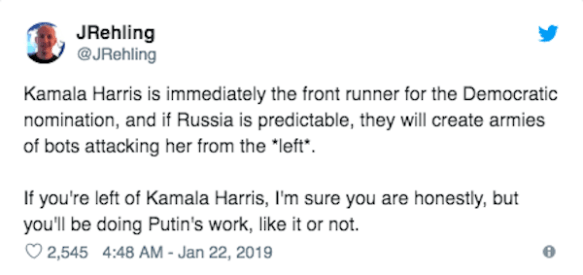
Writers like Max Blumenthal and Glenn Greenwald have been warning since the outbreak of this pernicious mass manipulation that it would be used to target the left, but their warnings went unheeded as more and more progressive minds were funneled into the belief that the best way to fight Trump was to get behind the Russia hysteria bandwagon and push with all your might. And now, even as America’s 2020 presidential race is barely in its infancy, we are already beginning to see Russiagate used to smear anyone to the left of Hillary Clinton as Russian dupes.

I’d like to draw attention to a few recent social media posts which have gained a lot of traction in the last few days, not for the impact those posts have but for what they portend for the rest of the 2020 race. The first is from the Twitter account for the Russiagate documentary Active Measures, and it received thousands of shares:

“Bernie was the one Democrat not to vote to keep sanctions on Deripaska (he also voted against Russia sanctions and Magnitsky),” the post reads. “@SenSanders won’t stand up to billionaires in Russia and he wants you to to believe he’ll stand up to them in America. #fraud”

The second comes from professional linguist and engineer John Rehling, who has over 50 thousand Twitter followers, and it received hundreds of shares:

“Kamala Harris is immediately the front runner for the Democratic nomination, and if Russia is predictable, they will create armies of bots attacking her from the *left*,”  reads Rehling’s (now deleted) tweet. “If you’re left of Kamala Harris, I’m sure you are honestly, but you’ll be doing Putin’s work, like it or not.”

The third comes from Shareblue manipulator Caroline Orr, just one of many similar posts that she has made in recent days. Orr has also launched a GoFundMe to investigate Tulsi Gabbard’s imaginary Putin-Assad ties/score a free vacation to Hawaii, and is also circulating the baseless rumor that “Russian-linked accounts” are pushing for a Bernie-Tulsi 2020 ticket. Note the URL Orr highlighted in the tweet below featuring her allegation that Gabbard is “pro-Putin” and “pro-Assad”.

https://twitter.com/RVAwonk/status/1085084216726044672

In each case, posts punching left with accusations of Kremlin servitude gained traction with their followers, which means there is already an audience for this schtick. And, again, the presidential race has barely even begun. Things are likely to get a whole lot uglier between now and November 2020.

This is your life for the next two years, progressives. This is what those of you who drank the Russiagate Kool-Aid have helped buy for what passes for America’s political left today. You can expect such accusations to get far more common and far more aggressive as this thing drags on. The left can either play along with this and let centrist cold war rhetoric suck all the oxygen out of the room for the advancement of progressive policies, or they can fight back against this moronic facilitation of longstanding intelligence community agendas.

This use of Russiagate to herd the political left toward supporting America’s “center” (so-called only because it is the mainstream view, which in turn is only due to plutocratic narrative control) will actively move things further into corporatist dystopia. Supporting a “moderate” Democratic Party while the Republican Party always pushes as far to the right as it possibly can is guaranteeing a continuous overall movement to the right, which is why the gains made by the left in the early 20th century are almost gone now. If you have one person half-pulling westward on one end of a rope and another person tugging eastward with all their might, they’re going to move steadily east.

The slow, incremental changes advocated by the political “center” are code for no change whatsoever; they’re just buying time so that their corporate sponsors, who themselves never slow down, can finish shoring up control before the public forces them to scale back. If progressives don’t start attacking this “Move right or you’re a Russian agent” schtick directly and with full force, it will snuff them out completely.

A N.Y. Times Story Just Accidentally Shredded the Russiagate Hysteria

By Lee Camp

Source: TruthDig

Every once in a while, one of those stories comes along that makes the mainstream corporate media look like a bunch of middle-school kids filming their “news show” on an iPhone with their neck ties crooked. Recently, one of those stories splashed down into the middle of our cultural zeitgeist like a small meteor landing in the middle of an elite dinner party.

It made our mass media pundits look like hardened fools. But they have kept spouting their nonsense anyway, hoping no one notices the soup dripping down their faces.

But to talk about that, I have to talk about this: Last month we finally got to see the Senate report spelling out the Russian meddling in our last election. And it was a bombshell. It rocked the heart of our country. It shredded the inflamed mucousy core of our palpitating democracy.

As Dan Cohen reported for the Grayzone Project, the report said that “…everything from the Green Party’s Jill Stein to Instagram to Pokemon Go to the African American population had been used and confused by the deceptive Facebook pages of a private Russian troll farm called the Internet Research Agency.”

That’s right. Russia even used Pokémon Go to pulverize the previously pristine 2016 election. That’s ever so frightening, since Pokémon Go is CIA-backed. (I guess it’s high time we just accept that the CIA has been taken over by those ruthless vodka drinkers.)

Back to the point—we learned from the report last month that the Russian Internet Research Agency manipulated every one of us with Facebook ads. If you don’t mind though, the Senate and the corporate media (and anybody else who knows the secret oligarchy handshake) would really prefer you just ignore the fact that Facebook clearly stated: “…56% [of the Russian ads] were after the election” and “…roughly 25% of the ads were never shown to anyone.”

But like an overweight man dressed like Wolverine at a Comic-Con, our brave congressmen and -women are not about to be dissuaded by reality. After the reports came out, Sen. Mark Warner tweeted, “Incredible. These bombshell reports demonstrate just how far Russia went to exploit the fault lines of our society and divide Americans, in an attempt to undermine and manipulate our democracy.”

Just after posting that, Warner patriotically pissed his red, white and blue Underoos.

So who are these amazing nonpartisan unbiased sleuths who put together this legitimate and nonpartisan unbiased Senate report? The New York Times found out they are a group called New Knowledge (which sounds like a terrible boy band). New Knowledge was founded by two veterans of the Obama administration, Jonathon Morgan and Ryan Fox. …So, I guess we’re, um, doing away with the “nonpartisan unbiased” thing.

Well, in that case—I say go hard or go home. I want MORE bias!

The Grayzone Project pointed out that besides working for Obama and the State Department, “… Morgan also developed technology for the Defense Advanced Research Projects Agency (DARPA), the arm of the Department of Defense created for basic, applied technological research, and futuristic war toys.”

All right, all right, not bad. But I know what you’re thinking. “Lee, that might be a great bias appetizer, but we want the full bias entree!”

OK, how about this?

Ryan Fox is a 15-year veteran of the NSA and was a computer analyst for the Joint Special Operations Command (JSOC) military unit. JSOC is notorious for its spree of atrocities across the Middle East. …

Hell yeah! You can feel that bias in my toes, can’t ya? But, the truth is, we’re still only at a 45 percent bias rating. I say we get it up to at least 65 percent. Back to Dan Cohen:

The report … was overseen by Renee DiResta, a former Wall Street trader and tech specialist who was recruited by Obama’s State Department to devise strategies for combating online ISIS propaganda.

So now we’ve got former Wall Street, former State Department, former Obama White House, former NSA, former DARPA, and former JSOC writing this completely legitimate completely factual report for the Senate about the powerful Russian impact of Facebook ads that no one ever saw.

I love it. This is like a report written by a hungry virus telling you not to wash your hands.

But hold on, it’s not only this Senate report that showed nefarious Russian meddling. It’s also all of those evil Russian bots. How do we know there are evil Russian bots? Well, most outlets quote Hamilton 68, which tracked Russian influence operations on Twitter.

Outlets like MSNBC, The Washington Post, The New York Times, Mother Jones and Tiger Beat. They’re all quoting Hamilton 68 or people who are referencing work done by Hamilton 68. Well, who the hell made Hamilton 68, and why does it sound like a ’90s alt-rock band that opened for Blink 182?

Oh, what do you know! Our old friend “[Jonathon] Morgan is also one the developers of Hamilton 68. … Funded by the German Marshall Fund’s Alliance for Securing Democracy—which is itself backed by NATO and USAID.”

Well OK, that sounds pretty serious. Clearly these people have found a special device that locates Russian bots on the interwebs, and it most likely resembles the thing Egon used in the “Ghostbusters” movies. So, shouldn’t we just congratulate Morgan on helping to develop the holy grail for spotting Russian bots and then call it a day? Well, there’s one itsy bitsy problem:

 … one of Hamilton 68’s founders, Clint Watts, admitted that the Twitter accounts it follows may actually be real people who are not Russian at all.

Real people? Who aren’t Russian? Call me crazy, but what I personally look for in a Russian bot is something that is at least Russian. And if not that, then a bot. And if neither, then you don’t have much of a goddamn Russian bot, do ya? Claiming these are Russian bots is like saying, “I just met the Queen of England, except she may have been a small Icelandic goat.”

Then, a few weeks ago The New York Times revealed that New Knowledge carried out an elaborate false flag operation to hurt the election chances of Judge Roy Moore in Alabama. You might recall that Roy Moore is an accused pedophile and a proven dipshit. And I don’t believe he should be elected to pick the bedbugs out of Rush Limbaugh’s armpits. But that doesn’t mean I think these New Knowledge charlatans shouldn’t be revealed for what they are.

So here’s how New Knowledge’s game worked, according to the Times. New Knowledge created a fake Facebook page in order to get conservatives in Alabama to support patio supply salesman Mac Watson instead of Roy Moore.

New Knowledge then tried to make everyone think that Moore’s campaign was working with the Kremlin by showing that he had thousands of Russian bots following his Twitter account. Many in the mainstream media ran with this outlandish idea. Mother Jones’s well-researched (sarcasm) article on the topic was titled “Russian Propagandists Are Pushing for Roy Moore to Win!” In the article they sourced (Can you guess?) Hamilton 68.

So to rehash: Hamilton 68, using their “Ghostbusters” device (patent pending), found that Russian bots (which may not be Russian and may not be bots and may not be Russian bots) were simply in love with alleged pedophiliac Alabama judges. So much so, that a majority of their tweets (meaning at least 51 percent) were in support of Roy Moore.

But as The New York Times has revealed, New Knowledge’s own internal report said, “We orchestrated an elaborate ‘false flag’ operation that planted the idea that the Moore campaign was amplified on social media by a Russian botnet.”

After these revelations came out a few weeks ago, Facebook suspended some of the accounts. So now The New York Times found itself in a quandary. They must have been thinking, “We need to report on this huge development in which the core authors of the Senate report on Russian meddling and the co-founder of Hamilton 68 were involved in lying, bullshitting, and false-flagging in order to help the Democratic party. But that completely undermines the Russiagate hysteria we have anchored our ship to. What do we do?”

Well, kids, take notes. This is how you do it. This is how you have your yellowcake uranium story and eat it too.

The New York Times headline was “Facebook Closes 5 Accounts Tied to Russia-Like Tactics in Alabama Senate Race”

Russia-like tactics?! This is literally an article about how Russia was NOT involved in the Alabama senate race false flag. In fact, it’s an article on how the guy who helped write the Senate report on the so-called Russian tactics is also one of the top people at New Knowledge, which either created or pushed pretend Russian bots to support Roy Moore so that they could leak to the press, “Russian bots are supporting Roy Moore!”

Sometimes the ability of the legacy media to believe (or at least regurgitate) their own bullshit is truly breathtaking.

To sum up this fuck de cluster:

1) The Senate report is laughable.

2) Any journalist who quotes Hamilton 68 should have their face sewn to the carpet.

3) If you want ridiculous pathetic reporting on nonsense that seduces us all to the edge of nuclear annihilation, turn to your mainstream corporate media.

4) If you want someone to actually put together the truth about these issues, you’ll have to turn to alternative outlets like Truthdig or the Grayzone Project.

5) Bill Murray and the Ghostbusters were ahead of their time.

If you think this column is important, please share it. To find out about all of Lee Camp’s columns, subscribe to his free newsletter here

 This column is based on a monologue Lee Camp wrote and performed on his TV show “Redacted Tonight.”


Two New Reports Point to Further US Decline & Higher Risk of War

By James ONeill

Source: New Eastern Outlook

Two recent reports from the United States strongly suggest the United States is planning a major war with Russia and China, but are far from certain that they could in fact succeed in such a war. The reports also provide insights into how the United States will meet the budgetary demands of such war preparations, but almost zero appreciation of the social and human costs of such policies.

The first of these reports is entitled “Providing for the Common Defence” (November 2018). It is the report prepared for the purpose of assessing the National Defence Strategy document released in early 2018.

It acknowledges that changes “at home and abroad are diminishing US military advantages,” and that this diminution of these “advantages” poses a threat to “vital United States interests.”

Geopolitical shifts in the regional power structures are “undermining deterrence of United States adversaries and confidence of United States allies, thus increasing the likelihood of military conflict”. Should such a conflict eventuate, the United States could “suffer unacceptably high casualties and a loss of major capital assets.”

The report says that “America is losing its advantage in key war fighting areas such as air and missile defence, cyber and space operations, anti-surface and anti- submarine warfare, long range ground-based fires, and electronic warfare”.

It further acknowledges that “America’s edge is diminishing or has disappeared in many key technologies that underpin US military superiority”.

Such frankness is not without precedent in US strategy papers and the implications of the above quotations are a probable reason why the report has received almost zero coverage in the western mainstream media.

Acknowledgements of technological deficiency and strategic disadvantage do not sit comfortably with the image of an all-powerful America willing and able to defeat any threat to its own global interests or those of its allies. The latter prefer the comfortable delusion of an omnipotent US “umbrella.”

The Commission’s strategy for addressing this perceived falling behind and consequent loss of military omnipotence is however itself fatally flawed. The proposed “solution” is to spend vastly greater sums of money at a rate of 3-5% above inflation.

That means that a significantly greater share of the federal budget would have to be devoted to military spending. The only way that could be achieved, given that the United States government already has a huge growing deficit ($22 trillion and counting) would have to come, the report acknowledges, by cuts to social spending such as pensions, Medicare and social security. The “trade-offs” the report acknowledges will be “difficult”, a statement that seriously under- estimates the social devastation that such cuts would bring about.

This argument is put forward in a society which already spends more on defence than that spent by the next eight national military budgets combined. United States national infrastructure, in everything from bridges to schools is already crumbling; and these proposals will only accelerate that downward trend.

It does not seem to occur to the report writers that the entire premise that the United States should maintain its attempt to control the world for the benefit of the United States is neither desirable nor wanted by the vast majority of the worlds nations as evidenced by multiple UN General Assembly resolutions.

The second report is issued by the United States Government Accountability Office (GAO) and is entitled: National Security: Long Range Emerging Threats Facing the United States as Identified by Federal Agencies (December 2018.) It has received even less publicity then the ‘Providing for the Common Defence’ document.

The probable reason for this mainstream media reticence is because the GAO report actually details where the United States is lagging in military capability viz a viz its two perceived principal rivals: Russia and China.

The fact of relative military weakness is not new. Andrei Martyanov in his book Losing Military Supremacy (2018) provided a detailed analysis of why Russian military technology was superior to the United States in several important fields. What Martyanov said about Russia applies with equal validity to Chinese technology.

Martyanov’s argument was dramatically illustrated by President Putin’s 1st March 2018 address to the Russian Parliament. The initial American reaction was to discount Putin’s claims, although within days the military industrial complex was demanding more funds to counteract the superiority of Russian weaponry outlined in Putin’s speech.

The GAO Report now provides an authoritative acknowledgement that Putin was not bluffing. Under the section of the report headed “Weapons” it has this to say:

Hypersonic weapons. China and Russia are pursuing hypersonic weapons because their speed, altitude, and maneuverability may defeat most missile defence systems, and they may be used to improve long range conventional and nuclear strike capabilities. There are no existing countermeasures.

Missiles. Adversaries are developing missile technology to attack the United States in novel ways and challenge US missile defence, including conventional and nuclear ICBMs, sea launched land attack missiles, and space based missiles that could orbit the earth.

Aircraft. China and Russia are developing new aircraft, including stealth aircraft, which could fly faster, carry advanced weapons, and achieve greater ranges. Such aircraft could force US aircraft to operate at further distances and put more US targets at risk.

There is more in the same vein. The only caveat to add to those points is the use of the conditional tense. The use of such words as “may” or “could” is redundant. That technology is already operational (www.thesaker.is 1 March 2018).

A number of commentators have argued that the technology gap between Russian and Chinese systems and that of United States is now measured in decades. There is no evidence to suggest this gap could be bridged in the foreseeable future. A more likely scenario is that the technological gap could widen.

Although there are powerful voices in the United States administration and ‘deep state’ generally sufficiently delusional and frankly crazy enough to believe that the United States could “win” a nuclear war with Russia and/or China, the GAO report should act as a constraint on their wilder ambitions.

History demonstrates that it is unwise to underestimate the extent to which the United States will go to maintain its self appointed role is the world’s dominant hegemon, (see Michael Pembroke’s Korea (2018). The reality is that the era of United States dominance is now well past.

Rather than risk a nuclear war that would wreak unimaginable losses upon all the world’s peoples, including for the first time the United States, the more likely scenario will be an intensification of what Andrei Korybko calls ‘hybrid warfare.’ A current illustration of this is the campaign being waged against Huawei, ostensibly because of the potential for Chinese cyber espionage but in reality to weaken and undermine China’s 2025 program for leadership in artificial intelligence, quantum information and other sophisticated technologies, and enforce America’s allies to buy their inferior products.

Proxy wars in the Middle East, Africa, Asia and Latin America are also likely to increase exponentially.

These two reports demonstrate that the United States has lost its previous technological and military superiority, but equally, that it is willing to go to extraordinary lengths to prevent any further erosion of its world wide role and its replacement by the two emerging countervailing superpowers, Russia and China. Whether or not that American determination will tip the world into a catastrophic nuclear exchange will be one of the major questions for 2019.

State Secrets and the National-Security State

By Jacob G. Hornberger

Source: Activist Post

Inadvertently released federal documents reveal that U.S. officials have apparently secured a secret indictment against Julian Assange, the head of WikiLeaks who released secret information about the internal workings of the U.S. national-security establishment. In any nation whose government is founded on the concept of a national-security state, that is a cardinal sin, one akin to treason and meriting severe punishment.

Mind you, Assange isn’t being charged with lying or releasing false or fraudulent information about the U.S. national-security state. Everyone concedes that the WikiLeaks information was authentic. His “crime” was in disclosing to people the wrongdoing of the national-security establishment. No one is supposed to do that, even if the information is true and correct.

It’s the same with Edward Snowden, the American contractor with the CIA and the NSA who is now relegated to living in Russia. If Snowden returns home, he faces federal criminal prosecution, conviction, and incarceration for disclosing secrets of the U.S. national-security establishment. Again, his “crime” is disclosing the truth about the internal workings of the national-security establishment, not disseminating false information.

Such secrecy and the severe punishment for people who disclose the secrets to the public were among the things that came with the conversion of the federal government to a national-security state.

Recall that when the U.S. government was called into existence by the Constitution, it was a type of governmental structure known as a limited-government republic. Under that type of governmental structure, the federal government’s powers were extremely limited. The only powers that federal officials could lawfully exercise were those few that were enumerated in the Constitution itself.

Under the republic form of government, there was no enormous permanent military establishment, no CIA, and no NSA, which are the three components of America’s national-security state. The last thing Americans wanted was that type of government. In fact, if Americans had been told that the Constitution was going to bring into existence a national-security state, they never would have approved the deal and would have continued operating under the Articles of Confederation, a type of governmental system where the federal government’s powers were so few that it didn’t even have the power to tax.

Under the republic, governmental operations were transparent. There was no such thing as “state secrets” or “national security.” Except for the periodic backroom deals in which politicians would make deals, things generally were open and above-board for people to see and make judgments on.

That all changed when the federal government was converted from a limited-government republic to a national-security state after World War II. Suddenly, the federal government was vested with omnipotent powers, so long as they were being exercised by the Pentagon, the CIA, or the NSA in the name of “national security.”

Interestingly enough, the conversion of the federal government to a national-security state was not done through constitutional amendment. Nonetheless, the federal judiciary has long upheld or simply deferred to the exercise of omnipotent powers by the national-security establishment.

An implicit part of the conversion was that the Pentagon, the CIA, and the NSA would be free to exercise their omnipotent powers in secret. Secrecy has always been a core element in any government that is structured as a national-security state, especially when it involves dark, immoral, and nefarious powers that are being exercised for the sake of “national security.”

One action that oftentimes requires the utmost in secrecy involves assassination, which is really nothing more than legalized murder. Not surprisingly, many national-security officials want to keep their role in state-sponsored murder secret. Another example is coups initiated in foreign countries. U.S. officials bend over backwards to hide their role in such regime-change operations. And then there are the surveillance schemes whereby citizens are foreigners are spied up and monitored. Kidnapping, indefinite detention, and torture are still more examples.

Of course, these are the types of things that we ordinarily identify with totalitarian regimes. The reason for that is that a national-security state governmental system is inherent to totalitarian regimes. For example, the Nazi government, which was a national-security state too, had an enormous permanent military establishment and a Gestapo, which wielded the powers of assassination, indefinite detention, torture, and secret surveillance. And not surprisingly, to disclose the secrets of German’s national-security state involved severe punishment.

But it’s not just Nazi Germany. There are many other examples of totalitarian regimes that are based on the concept of national security and structured as a national-security state. Chile under Pinochet. The Soviet Union. Communist China. North Korea. Vietnam. Egypt. Pakistan. Iraq. Afghanistan. Saudi Arabia. Turkey, Myanmar. And the United States. The list goes on and on.

And every one of those totalitarian regimes has a state-secrets doctrine, the same doctrine that the Pentagon, CIA, and NSA have.

A newspaper in Vietnam, which of course is ruled by a communist regime, reported that a Vietnamese citizen named Phan Van Anh Vu was sentenced to 9 years in prison for “deliberately disclosing state secrets.”

A website for the Committee to Protect Journalists reported that the Chinese communist regime charged a Chinese journalist named Yang Xiuqiong with “illegally providing state secrets overseas.” The Chinese Reds have also charged a prominent environmental activist named Liu Shu with “revealing state secrets related to China’s counterespionage work.”

The military dictatorship in Myanmar convicted two Reuters reporters for violating the country’s law that prohibits the gathering of secret documents to help an enemy.

RT reports that the Russian military will “launch obligatory courses on the protection of state secrets starting next year.

US News reports that the regime in Turkey is seeking the extradition from Germany of Turkish journalist Can Dunbar, who was convicted of revealing state secrets.

Defenders of Assange and Snowden and other revealers of secrets of the U.S. national security state point to the principles of freedom of speech and freedom of the press to justify their disclosures.

I’ve got a better idea: Let’s just dismantle America’s decades-long, nightmarish Cold War-era experiment with the totalitarian structure known as a national-security state and restore a limited-government republic to our land.