An Inconvenient Revolution

By Charles Hugh Smith

Source: Of Two Minds

Convenience isn’t just about small appliances. It’s also about ruling nations. Let’s start with the semantics of ruling nations. Some labels might be viewed as somewhat inflammatory (Kleptocracy, anyone?), so let’s stick with the neutral Ruling Order.

Some things have been extraordinarily convenient for the Ruling Order. Take the life and death of one Jeffrey Epstein, an intel “asset” who assembled a veritable goldmine of dirt on an astounding collection of bigwigs, and then became, well, inconvenient.

Very conveniently, the security camera in his cell failed, the guards dozed off and he hung himself in this fortuitous interlude. This was the acme of convenience.

Extending the Surveillance State into Big Tech’s planetary-wide social media networks was also convenient, and a bargain to boot. Instead of all that expensive stuff the Communist State in China had to pay for, America’s Ruling Order just put the squeeze on Big Tech and saved a bundle.

The Surveillance State assumes that any revolt / revolution can either be nipped in the bud by identifying foreign influences / domestic extremists, or crushed by foreknowledge of the storming of the barricades.

In conventional times, these are pretty safe assumptions. But the times are no longer conventional, and so the Ruling Order is in effect investing its treasure and confidence in fighting the last war.

It’s convenient if rebelling citizens organize themselves in visible networks and concentrate into groups that can be crushed by force. It’s inconvenient if the revolution is not neatly organized and crushable but an invisible revolution of not showing up.

In other words, a revolution of getting fed up and opting out, of finding some other way to live rather than spending 10 years paying down the student loans and another 30 years paying down the mortgage and the last few years of one’s life watching the tides of financial excess erode the sand castles of pensions and retirement.

There’s a consequential asymmetry to the inconvenience caused by people getting fed up and opting out. The average worker not showing up is consequential but not catastrophic. But when the managerial class thins out, and those doing the dirty work thin out, there are no replacements, and the system breaks down.

Few are willing to make the beds, empty the bedpans and work in slaughterhouses. When those willing to do the work nobody else wants to do quit, the system collapses. Those with higher expectations will not volunteer to do the dirty work, and many are unable to do the work even if they are willing. It’s too hard and too physically punishing. (Says a guy who’s carried stupid amounts of lumber up hillsides where no forklift could go.)

Despite what many of us may think, the majority of workers lack the experience and tools to manage complex operations. (Those of us who try soon reach our limits.) Many lack a deep enough knowledge to fix major breakdowns. When the critical operational and managerial people retire, quit, or find some other way to live, the system breaks down.

All the surveillance and all the force that the Ruling Order depends on to maintain its dominance is useless when people get fed up and quit supporting the system with their labor and their borrowing / spending. All the surveillance and facial recognition software is worthless, all the monitoring of kitten and puppy photos on social media, all the tracking of foreign influence–none of it matters any more.

It’s inconvenient when those whose sacrifices are essential to the system get fed up and find some other way to live. Yet this is the inevitable consequence of a system hopelessly corrupted by fraud, inequality and unfairness, a system rigged to benefit the few at the expense of the many. People eventually get fed up and opt out.

They don’t throw themselves on the gears of an odious system, they simply stop greasing the gears with their time, effort, experience, debt and money. It doesn’t take many opting out to trigger decay and collapse. The Pareto Distribution applies. The system can adjust to the first 4% opting out, but those consequential few trigger the decay of the commitment of the next 20%, and the system cannot survive when the 20% find some other way to live. The 80% can still be willing to grease the gears but that’s no longer enough to maintain the coherence of the system.

The asymmetry of decay and collapse is inconvenient.

Our Ruling Elites Have No Idea How Much We Want to See Them All in Prison Jumpsuits

By Charles Hugh Smith

Source: Of Two Minds

Even the most distracted, fragmented tribe of the peasantry eventually notices that they’re not in the top 1%, or the top 0.1%.

Let’s posit that America will confront a Great Crisis in the next decade. This is the presumption of The Fourth Turning, a 4-generational cycle of 80 years that correlates rather neatly with the Great Crises of the past: 1781 (Revolutionary War, constitutional crisis); 1861 (Civil War) and 1941 (World War II, global war).

What will be the next Great Crisis? Some anticipate another great-power war, others foresee another civil war, still others reckon a military coup is likely, and some view a collapse of the economy and U.S. dollar as inevitable.

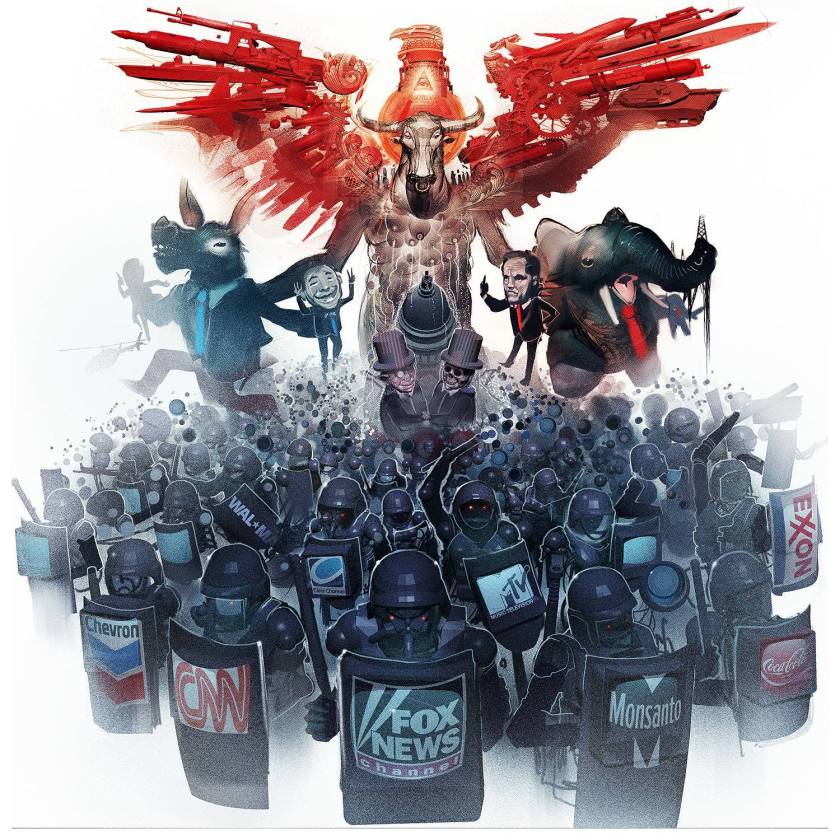
While anything’s possible, I propose a novel crisis unlike any in the past, a Moral Crisis in which the people challenge the power of the nation’s corrupt Ruling Elites: not just elected officials, but the technocrats of the Deep State, the vested interests pillaging the nation, the New Overlords of Big Tech, the financier New Nobility, the Corporate Media and the self-serving state/corporate technocrat Nomenklatura who do the dirty work of the Ruling Elites.

Divide-and-Conquer has been the absurdly easy strategy of the Ruling Elites to fragment and disempower the citizenry. It’s child’s play for the Ruling Elites to ceaselessly promote a baker’s dozen of divisive issues via the corporate media, and then watch the resulting conflicts split the citizenry into fragmented camps which subdivide further with every new toxic injection.

The one issue that could unite the fragmented citizenry is moral revulsion: As the Epstein case promises to reveal, there is literally no limit on the excesses and exploitations of the privileged few in America, no limit on what our Ruling Elites can do with absolute impunity.

The Nobility of the feudal era had some reciprocal obligation to its serfs; our New Nobility has no obligation to anyone but themselves. It is painfully obvious that there are two sets of laws in America: bankers can rip off billions and never serve time, and members of the Protected Class who sexually exploit children get a wrist-slap, if that.

Here’s the sad reality: everybody in the Ruling Elites looked the other way: all the self-described “patriots” in the Intelligence services, all the technocrats in the Departments of Justice, State, etc., the Pentagon, and on and on. Everybody with any power knows the whole class of Ruling Elites is completely corrupt, by definition: to secure power in the U.S., you have to sell your soul to the Devil, one way or the other.

Like all Ruling Elites, America’s Elites are absolutely confident in their power: this is hubris taken to new heights.

That the citizenry could finally have enough of their corrupt, self-serving Overlords does not seem in the realm of possibility to the Protected Few. There’s always a way to lawyer-up and plea-bargain for a wrist-slap, a way to bend another “patriot” (barf), a way to offer a bribe cloaked as a plum position in a philanthro-capitalist NGO (non-governmental organization), and so on.

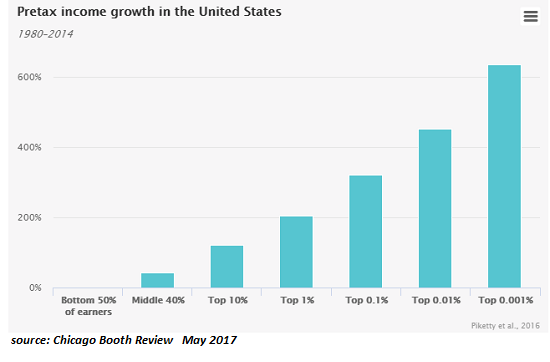
The possibility that moral outrage could spark a revolt seems improbable in such a distracted culture, but consider the chart below: even the most distracted, fragmented tribe of the peasantry eventually notices that they’re not in the top 1%, or the top 0.1%, and that the Ruling Elites have overseen an unprecedented concentration of wealth and power into the hands of the few at the expense of the many:

Our Ruling Elites have no idea how many of us already want to see them all in prison jumpsuits, and they also have no idea how fast the moral revulsion with their corrupt “leadership” might spread. Scanning the distracted, consumerist rabble from the great heights of their wealth and power, they reckon the capacity for moral outrage is limited, leaving them safe from any domestic crusade.

They also trust that the citizenry can be further fragmented, further distracted, and so they will continue to be invulnerable. Or worst case scenario, a few especially venal villains will need to be sacrificed, and then all will return to the bliss of Neofeudal exploitation.

But they may have misread the American citizenry, just as they’ve misread history.

The Great Unraveling Begins: Distraction, Lies, Infighting, Betrayal

By Charles Hugh Smith

Source: Of Two Minds

The good news is renewal becomes possible when the entire rotten status quo collapses in a putrid heap.

There are two basic pathways to systemic collapse: external shocks or internal decay. The two are not mutually exclusive, of course; it can be argued that the most common path is internal decay weakens the empire/state and an external shock pushes the rotted structure off the cliff.

As Dave of the X22 Report and I discuss in The World Is About To Change & It’s Going To Be Glorious, we are in the early stages of terminal internal decay.There are a number of dynamics shared by decaying empires/states:

1. The ruling elites lose the moral imperative to sacrifice for the good of the empire/state. Instead they use the power of the state to further their own private interests and agendas.

2. The ruling elites start “fudging” reports (i.e. lies are presented as truths) and promoting narratives to mask their self-aggrandizement and the erosion of the nation/empire under their self-interested rule.

In other words, the elites know the public would resist their leadership if the truth were widely known, so the ruling elites devote tremendous resources to massaging the news to distract the public from reality and reflect positively on their self-serving leadership.

Since the weaknesses of the empire are being hidden, they cannot be addressed, and so rot that could have been fixed early becomes widespread and fatal.

3. Flush with the state’s wealth and power, the ruling elite splinters into warring camps which squander the empire’s remaining wealth on private battles over which camp will rule what appears solid and eternal–the empire.

4. As the elites battle it out, the nation/empire falls apart as the leadership’s focus is on internecine conflicts over the spoils of the empire, rather than on preserving the foundations of the empire’s wealth and security.

5. As the truth inevitably leaks out, the public grasps the enormity of the elites’ betrayal of the nation and the public interest. Faith in the elites and the institutions they control plummets, and the Great Unraveling becomes unstoppable.

6. In a last-ditch effort to save their wealth and power, the elites distract the public with Bread and Circuses– “free money” in various guises (Universal Basic Income, Modern Monetary Theory, etc.)–and the distracting Circus of political theater and a surfeit of entertainment.

Whether the elites or the public are aware of it or not, America is well down the path to terminal internal decay: Distraction, Lies, Infighting, Betrayal.

The good news is renewal becomes possible when the entire rotten status quo collapses in a putrid heap of broken promises, dysfunctional institutions, blatant lies, unpayable debts and cascading defaults.

The Coming Collapse

By Chris Hedges

Source: Occupy.com

The Trump administration did not rise, prima facie, like Venus on a half shell from the sea. Donald Trump is the result of a long process of political, cultural and social decay. He is a product of our failed democracy. The longer we perpetuate the fiction that we live in a functioning democracy, that Trump and the political mutations around him are somehow an aberrant deviation that can be vanquished in the next election, the more we will hurtle toward tyranny. The problem is not Trump. It is a political system, dominated by corporate power and the mandarins of the two major political parties, in which we don’t count. We will wrest back political control by dismantling the corporate state, and this means massive and sustained civil disobedience, like that demonstrated by teachers around the country this year. If we do not stand up we will enter a new dark age.

The Democratic Party, which helped build our system of inverted totalitarianism, is once again held up by many on the left as the savior. Yet the party steadfastly refuses to address the social inequality that led to the election of Trump and the insurgency by Bernie Sanders. It is deaf, dumb and blind to the very real economic suffering that plagues over half the country. It will not fight to pay workers a living wage. It will not defy the pharmaceutical and insurance industries to provide Medicare for all. It will not curb the voracious appetite of the military that is disemboweling the country and promoting the prosecution of futile and costly foreign wars.

It will not restore our lost civil liberties, including the right to privacy, freedom from government surveillance, and due process. It will not get corporate and dark money out of politics. It will not demilitarize our police and reform a prison system that has 25 percent of the world’s prisoners although the United States has only 5 percent of the world’s population. It plays to the margins, especially in election seasons, refusing to address substantive political and social problems and instead focusing on narrow cultural issues like gay rights, abortion and gun control in our peculiar species of anti-politics.

This is a doomed tactic, but one that is understandable. The leadership of the party, the Clintons, Nancy Pelosi, Chuck Schumer, Tom Perez, are creations of corporate America. In an open and democratic political process, one not dominated by party elites and corporate money, these people would not hold political power. They know this. They would rather implode the entire system than give up their positions of privilege. And that, I fear, is what will happen. The idea that the Democratic Party is in any way a bulwark against despotism defies the last three decades of its political activity. It is the guarantor of despotism.

Trump has tapped into the hatred that huge segments of the American public have for a political and economic system that has betrayed them. He may be inept, degenerate, dishonest and a narcissist, but he adeptly ridicules the system they despise. His cruel and demeaning taunts directed at government agencies, laws and the established elites resonate with people for whom these agencies, laws and elites have become hostile forces. And for many who see no shift in the political landscape to alleviate their suffering, Trump’s cruelty and invective are at least cathartic.

Trump, like all despots, has no ethical core. He chooses his allies and appointees based on their personal loyalty and fawning obsequiousness to him. He will sell anyone out. He is corrupt, amassing money for himself—he made $40 million from his Washington, D.C., hotel alone last year—and his corporate allies. He is dismantling government institutions that once provided some regulation and oversight. He is an enemy of the open society. This makes him dangerous. His turbocharged assault on the last vestiges of democratic institutions and norms means there will soon be nothing, even in name, to protect us from corporate totalitarianism.

But the warnings from the architects of our failed democracy against creeping fascism, Madeleine Albright among them, are risible. They show how disconnected the elites have become from the zeitgeist. None of these elites have credibility. They built the edifice of lies, deceit and corporate pillage that made Trump possible. And the more Trump demeans these elites, and the more they cry out like Cassandras, the more he salvages his disastrous presidency and enables the kleptocrats pillaging the country as it swiftly disintegrates.

The press is one of the principal pillars of Trump’s despotism. It chatters endlessly like 18th-century courtiers at the court of Versailles about the foibles of the monarch while the peasants lack bread. It drones on and on and on about empty topics such as Russian meddling and a payoff to a porn actress that have nothing to do with the daily hell that, for many, defines life in America. It refuses to critique or investigate the abuses by corporate power, which has destroyed our democracy and economy and orchestrated the largest transfer of wealth upward in American history.

The corporate press is a decayed relic that, in exchange for money and access, committed cultural suicide. And when Trump attacks it over “fake news,” he expresses, once again, the deep hatred of all those the press ignores. The press worships the idol of Mammon as slavishly as Trump does. It loves the reality-show presidency. The press, especially the cable news shows, keeps the lights on and the cameras rolling so viewers will be glued to a 21st-century version of “The Cabinet of Dr. Caligari.” It is good for ratings. It is good for profits. But it accelerates the decline.

All this will soon be compounded by financial collapse. Wall Street banks have been handed $16 trillion in bailouts and other subsidies by the Federal Reserve and Congress at nearly zero percent interest since the 2008 financial collapse. They have used this money, as well as the money saved through the huge tax cuts imposed last year, to buy back their own stock, raising the compensation and bonuses of their managers and thrusting the society deeper into untenable debt peonage. Sheldon Adelson’s casino operations alone got a $670 million tax break under the 2017 legislation. The ratio of CEO to worker pay now averages 339 to 1, with the highest gap approaching 5,000 to 1.

This circular use of money to make and hoard money is what Karl Marx called “fictitious capital.” The steady increase in public debt, corporate debt, credit card debt and student loan debt will ultimately lead, as Nomi Prins writes, to “a tipping point—when money coming in to furnish that debt, or available to borrow, simply won’t cover the interest payments. Then debt bubbles will pop, beginning with higher yielding bonds.”

An economy reliant on debt for its growth causes our interest rate to jump to 28 percent when we are late on a credit card payment. It is why our wages are stagnant or have declined in real terms—if we earned a sustainable income we would not have to borrow money to survive. It is why a university education, houses, medical bills and utilities cost so much. The system is designed so we can never free ourselves from debt.

However, the next financial crash, as Prins points out in her book “Collusion: How Central Bankers Rigged the World,” won’t be like the last one. This is because, as she says, “there is no Plan B.” Interest rates can’t go any lower. There has been no growth in the real economy. The next time, there will be no way out. Once the economy crashes and the rage across the country explodes into a firestorm, the political freaks will appear, ones that will make Trump look sagacious and benign.

And so, to quote Vladimir Lenin, what must be done?

We must invest our energy in building parallel, popular institutions to protect ourselves and to pit power against power. These parallel institutions, including unions, community development organizations, local currencies, alternative political parties and food cooperatives, will have to be constructed town by town. The elites in a time of distress will retreat to their gated compounds and leave us to fend for ourselves. Basic services, from garbage collection to public transportation, food distribution and health care, will collapse. Massive unemployment and underemployment, triggering social unrest, will be dealt with not through government job creation but the brutality of militarized police and a complete suspension of civil liberties.

Critics of the system, already pushed to the margins, will be silenced and attacked as enemies of the state. The last vestiges of labor unions will be targeted for abolition, a process that will soon be accelerated given the expected ruling in a case before the Supreme Court that will cripple the ability of public-sector unions to represent workers. The dollar will stop being the world’s reserve currency, causing a steep devaluation. Banks will close. Global warming will extract heavier and heavier costs, especially on the coastal populations, farming and the infrastructure, costs that the depleted state will be unable to address. The corporate press, like the ruling elites, will go from burlesque to absurdism, its rhetoric so patently fictitious it will, as in all totalitarian states, be unmoored from reality. The media outlets will all sound as fatuous as Trump. And, to quote W.H. Auden, “the little children will die in the streets.”

As a foreign correspondent I covered collapsed societies, including the former Yugoslavia. It is impossible for any doomed population to grasp how fragile the decayed financial, social and political system is on the eve of implosion. All the harbingers of collapse are visible: crumbling infrastructure; chronic underemployment and unemployment; the indiscriminate use of lethal force by police; political paralysis and stagnation; an economy built on the scaffolding of debt; nihilistic mass shootings in schools, universities, workplaces, malls, concert venues and movie theaters; opioid overdoses that kill some 64,000 people a year; an epidemic of suicides; unsustainable military expansion; gambling as a desperate tool of economic development and government revenue; the capture of power by a tiny, corrupt clique; censorship; the physical diminishing of public institutions ranging from schools and libraries to courts and medical facilities; the incessant bombardment by electronic hallucinations to divert us from the depressing sight that has become America and keep us trapped in illusions. We suffer the usual pathologies of impending death. I would be happy to be wrong. But I have seen this before. I know the warning signs. All I can say is get ready.

The Price of Resistance

Statues at the Museum of Myths and Traditions. (León)

By Chris Hedges

Source: OpEdNews.com

In the conflicts I covered as a reporter in Latin America, Africa, the Middle East and the Balkans, I encountered singular individuals of varying creeds, religions, races and nationalities who majestically rose up to defy the oppressor on behalf of the oppressed. Some of them are dead. Some of them are forgotten. Most of them are unknown.

These individuals, despite their vast cultural differences, had common traits–a profound commitment to the truth, incorruptibility, courage, a distrust of power, a hatred of violence and a deep empathy that was extended to people who were different from them, even to people defined by the dominant culture as the enemy. They are the most remarkable men and women I met in my 20 years as a foreign correspondent. And to this day I set my life by the standards they set.

You have heard of some, such as Vaclav Havel, whom I and other foreign reporters met most evenings, during the 1989 Velvet Revolution in Czechoslovakia, in the Magic Lantern Theatre in Prague. Others, no less great, you probably do not know, such as the Jesuit priest Ignacio Ellacuria, who was assassinated in El Salvador in 1989. And then there are those “ordinary” people, although, as the writer V.S. Pritchett said, no people are ordinary, who risked their lives in wartime to shelter and protect those of an opposing religion or ethnicity being persecuted and hunted. And to some of these “ordinary” people I owe my own life.

To resist radical evil is to endure a life that by the standards of the wider society is a failure. It is to defy injustice at the cost of your career, your reputation, your financial solvency and at times your life. It is to be a lifelong heretic. And, perhaps this is the most important point, it is to accept that the dominant culture, even the liberal elites, will push you to the margins and attempt to discredit not only what you do, but your character. When I returned to the newsroom at The New York Times after being booed off a commencement stage in 2003 for denouncing the invasion of Iraq and being publicly reprimanded by the paper for my stance against the war, reporters and editors I had known and worked with for 15 years lowered their heads or turned away when I was nearby. They did not want to be contaminated by the same career-killing contagion.

Ruling institutions–the state, the press, the church, the courts, academia–mouth the language of morality, but they serve the structures of power, no matter how venal, which provide them with money, status and authority. In times of national distress–one has only to look at Nazi Germany–all of these institutions, including the academy, are complicit through their silence or their active collaboration with radical evil. And our own institutions, which have surrendered to corporate power and the utopian ideology of neoliberalism, are no different. The lonely individuals who defy tyrannical power within these institutions, as we saw with the thousands of academics who were fired from their jobs and blacklisted during the McCarthy era, are purged and turned into pariahs.

All institutions, including the church, Paul Tillich once wrote, are inherently demonic. And a life dedicated to resistance has to accept that a relationship with any institution is often temporary, because sooner or later that institution is going to demand acts of silence or obedience your conscience will not allow you to make. To be a rebel is to reject what it means to succeed in a capitalist, consumer culture, especially the idea that we should always come first.

The theologian James H. Cone in his book “The Cross and the Lynching Tree” writes that for oppressed blacks the cross was a “paradoxical religious symbol because it inverts the world’s value system with the news that hope comes by way of defeat, that suffering and death do not have the last word, that the last shall be first and the first last.”

Cone continues: “That God could ‘make a way out of no way’ in Jesus’ cross was truly absurd to the intellect, yet profoundly real in the souls of black folk. Enslaved blacks who first heard the gospel message seized on the power of the cross. Christ crucified manifested God’s loving and liberating presence in the contradictions of black life–that transcendent presence in the lives of black Christians that empowered them to believe that ultimately, in God’s eschatological future, they would not be defeated by the ‘troubles of this world,’ no matter how great and painful their suffering. Believing this paradox, this absurd claim of faith, was only possible in humility and repentance. There was no place for the proud and the mighty, for people who think that God called them to rule over others. The cross was God’s critique of power–white power–with powerless love, snatching victory out of defeat.”

Reinhold Niebuhr labeled this capacity to defy the forces of repression “a sublime madness in the soul.” Niebuhr wrote that “nothing but madness will do battle with malignant power and ‘spiritual wickedness in high places.’ ” This sublime madness, as Niebuhr understood, is dangerous, but it is vital. Without it, “truth is obscured.” And Niebuhr also knew that traditional liberalism was a useless force in moments of extremity. Liberalism, Niebuhr said, “lacks the spirit of enthusiasm, not to say fanaticism, which is so necessary to move the world out of its beaten tracks. It is too intellectual and too little emotional to be an efficient force in history.”

The prophets in the Hebrew Bible had this sublime madness. The words of the Hebrew prophets, as Abraham Heschel wrote, were “a scream in the night. While the world is at ease and asleep, the prophet feels the blast from heaven.” The prophet, because he saw and faced an unpleasant reality, was, as Heschel wrote, “compelled to proclaim the very opposite of what his heart expected.”

This sublime madness is the essential quality for a life of resistance. It is the acceptance that when you stand with the oppressed you get treated like the oppressed. It is the acceptance that, although empirically all that we struggled to achieve during our lifetime may be worse, our struggle validates itself.

Daniel Berrigan told me that faith is the belief that the good draws to it the good. The Buddhists call this karma. But he said for us as Christians we did not know where it went. We trusted that it went somewhere. But we did not know where. We are called to do the good, or at least the good so far as we can determinate it, and then let it go.

As Hannah Arendt wrote in “The Origins of Totalitarianism,” the only morally reliable people are not those who say “this is wrong” or “this should not be done,” but those who say “I can’t.” They know that as Immanuel Kant wrote: “If justice perishes, human life on earth has lost its meaning.” And this means that, like Socrates, we must come to a place where it is better to suffer wrong than to do wrong. We must at once see and act, and given what it means to see, this will require the surmounting of despair, not by reason, but by faith.

I saw in the conflicts I covered the power of this faith, which lies outside any religious or philosophical creed. This faith is what Havel called in his great essay “The Power of the Powerless” living in truth. Living in truth exposes the corruption, lies and deceit of the state. It is a refusal to be a part of the charade.

“You do not become a ‘dissident’ just because you decide one day to take up this most unusual career,” Havel wrote. “You are thrown into it by your personal sense of responsibility, combined with a complex set of external circumstances. You are cast out of the existing structures and placed in a position of conflict with them. It begins as an attempt to do your work well, and ends with being branded an enemy of society. … The dissident does not operate in the realm of genuine power at all. He is not seeking power. He has no desire for office and does not gather votes. He does not attempt to charm the public. He offers nothing and promises nothing. He can offer, if anything, only his own skin–and he offers it solely because he has no other way of affirming the truth he stands for. His actions simply articulate his dignity as a citizen, regardless of the cost.”

The long, long road of sacrifice and suffering that led to the collapse of the communist regimes stretched back decades. Those who made change possible were those who had discarded all notions of the practical. They did not try to reform the Communist Party. They did not attempt to work within the system. They did not even know what, if anything, their tiny protests, ignored by the state-controlled media, would accomplish. But through it all they held fast to moral imperatives. They did so because these values were right and just. They expected no reward for their virtue; indeed they got none. They were marginalized and persecuted. And yet these poets, playwrights, actors, singers and writers finally triumphed over state and military power. They drew the good to the good. They triumphed because, however cowed and broken the masses around them appeared, their message of defiance did not go unheard. It did not go unseen. The steady drumbeat of rebellion constantly exposed the dead hand of authority and the rot of the state.

I stood with hundreds of thousands of rebellious Czechoslovakians in 1989 on a cold winter night in Prague’s Wenceslas Square as the singer Marta Kubisova approached the balcony of the Melantrich building. Kubisova had been banished from the airwaves in 1968 after the Soviet invasion for her anthem of defiance “Prayer for Marta.” Her entire catalog, including more than 200 singles, had been confiscated and destroyed by the state. She had disappeared from public view. Her voice that night suddenly flooded the square. Pressing around me were throngs of students, most of whom had not been born when she vanished. They began to sing the words of the anthem. There were tears running down their faces. It was then that I understood the power of rebellion. It was then that I knew that no act of rebellion, however futile it appears in the moment, is wasted. It was then that I knew that the communist regime was finished.

“The people will once again decide their own fate,” the crowd sang in unison with Kubisova. [Editor’s note: To see YouTube photographs of the 1989 revolution and hear Kubisova sing the song in a studio recording, click here.]

The walls of Prague were covered that chilly winter with posters depicting Jan Palach. Palach, a university student, set himself on fire in Wenceslas Square on Jan. 16, 1969, in the middle of the day to protest the crushing of the country’s democracy movement. He died of his burns three days later. The state swiftly attempted to erase his act from national memory. There was no mention of it on state media. A funeral march by university students was broken up by police. Palach’s gravesite, which became a shrine, saw the communist authorities exhume his body, cremate his remains and ship them to his mother with the provision that his ashes could not be placed in a cemetery. But it did not work. His defiance remained a rallying cry. His sacrifice spurred the students in the winter of 1989 to act. Prague’s Red Army Square, shortly after I left for Bucharest to cover the uprising in Romania, was renamed Palach Square. Ten thousand people went to the dedication.

We, like those who opposed the long night of communism, no longer have any mechanisms within the formal structures of power that will protect or advance our rights. We too have undergone a coup d’e’tat carried out not by the stone-faced leaders of a monolithic Communist Party but by the corporate state.

We may feel, in the face of the ruthless corporate destruction of our nation, our culture and our ecosystem, powerless and weak. But we are not. We have a power that terrifies the corporate state. Any act of rebellion, no matter how few people show up or how heavily it is censored, chips away at corporate power. Any act of rebellion keeps alive the embers for larger movements that follow us. It passes on another narrative. It will, as the state consumes itself, attract wider and wider numbers. Perhaps this will not happen in our lifetimes. But if we persist, we will keep this possibility alive. If we do not, it will die.

Dr. Rieux in Albert Camus’ novel “The Plague” is not driven by ideology. He is driven by empathy, the duty to minister to suffering, no matter the cost. Empathy, or what the Russian novelist Vasily Grossman called “simple human kindness,” becomes in all despotisms a subversive act. To act on this empathy–the empathy for human beings locked in cages less than an hour from us [here in Princeton], the empathy for undocumented mothers and fathers being torn from their children on the streets of our cities, the empathy for Muslims who are demonized and banned from our shores, fleeing the wars we created, the empathy for poor people of color gunned down by police in our streets, the empathy for girls and women trafficked into prostitution, the empathy for all those who suffer at the hands of a state intent on militarization and imposing a harsh cruelty on the vulnerable, the empathy for the earth that gives us life and that is being contaminated and pillaged for profit–becomes political and even dangerous.

Evil is real. But so is love. And in war–especially when the heavy shells landed on crowds in Sarajevo, sights so gruesome that to this day I cannot eat a piece of meat–you could feel, as frantic family members desperately sought out loved ones among the wounded and dead, the concentric circles of death and love, death and love, like rings from the blast of a cosmic furnace.

Flannery O’Connor recognized that a life of faith is a life of confrontation: “St. Cyril of Jerusalem, in instructing catechumens, wrote: ‘The dragon sits by the side of the road, watching those who pass. Beware lest he devour you. We go to the Father of Souls, but it is necessary to pass by the dragon.’ No matter what form the dragon may take, it is of this mysterious passage past him, or into his jaws, that stories of any depth will always be concerned to tell, and this being the case, it requires considerable courage at any time, in any country, not to turn away from the storyteller.”

Accept sorrow–for who cannot be profoundly sorrowful at the state of our nation, the world and our ecosystem–but know that in resistance there is a balm that leads to wisdom and, if not joy, a strange, transcendent happiness. Know that if we resist we keep hope alive.

“My faith has been tempered in Hell,” wrote Vasily Grossman in his masterpiece “Life and Fate.” “My faith has emerged from the flames of the crematoria, from the concrete of the gas chamber. I have seen that it is not man who is impotent in the struggle against evil, but the power of evil that is impotent in the struggle against man. The powerlessness of kindness, of senseless kindness, is the secret of its immortality. It can never be conquered. The more stupid, the more senseless, the more helpless it may seem, the vaster it is. Evil is impotent before it. The prophets, religious leaders, reformers, social and political leaders are impotent before it. This dumb, blind love is man’s meaning. Human history is not the battle of good struggling to overcome evil. It is a battle fought by a great evil struggling to crush a small kernel of human kindness. But if what is human in human beings has not been destroyed even now, then evil will never conquer.”