“He’s a rewarder of those who seek him. Some say God is a punisher, but do you know what we do with child abusers today? We put child abusers in prison if we find out about ‘em. God is not a child abuser! God is a good god. Why don’t you just say that out loud with me right no? God is a good god, you always remember that! God is not gonna do you harm… (pause) There is a judgement coming someday…”
—“Mrs. Hook” from The Christian Pirates cable access show.
History will note that for a short period at the end of the 20th century, there was this “format” called “VHS” (“Video Home System” is what it stood for) that allowed people to do something called “videotaping” “off” their television sets (it didn’t work exactly like that, but it’s, you know, close enough). But what history might neglect to record is that certain things got passed around from hand to hand on this format samizdat style in what was then called the “VHS tape trading underground.” During the mid-1980s to the late 90s, traders and flea market dealers were making pirated copies of things like the banned Rolling Stones movie Cocksucker Blues, Heavy Metal Parking Lot, “Screaming Boy” (lunatic Dallas public access preacher Jonathan Bell, later made famous by The Daily Show), a tape of a groupie blowing out a candle with her pussy for guitarist Steve Vai and “The Great Satan At Large,” a satanic talk show, among hundreds of other things.
One of the most heavily circulated items during the “VHS tape trading underground” days was a synapse-frying excursion straight into the dark heart of the most deeply disturbed, bat-shit crazy 80s TV evangelism titled “Perverse Preachers, Fascist Fundamentalists and Kristian Kiddie Kooks.” When the tape began making the rounds in the early 90s, the jaw-dropping selection of low IQ buffoonery, superstitious insanity and wildly inappropriate kiddie shows made by people who should NEVER BE LEFT ALONE UNSUPERVISED WITH YOUNG CHILDREN was the centerpiece of many a weed and alcohol-fuelled viewing fest.
An unnamed Internet reviewer said this of “Perverse Preachers, Fascist Fundamentalists and Kristian Kiddie Kooks”:
Americans: See why the rest of the world thinks we’re a bunch of blithering idiots!
Rest of the world: See why Americans are a bunch of blithering idiots!
That pretty much sums it up in a nutshell.
One of the more perplexing things on exhibit in “Perverse Preachers, Fascist Fundamentalists and Kristian Kiddie Kooks” is the clips from the no budget “Christian Pirates” cable access show where godless children are forced to “walk the plank” by one-legged Captain Hook and they sing songs about hoping that Satan gets paralyzed and has to use a wheelchair. There’s Jimmy Swaggart’s tearful confession of whore mongering (a masterclass in fleecing the faithful with the “I have sinned” ploy). A Jim and Tammy Faye Bakker press conference. There’s a lot of asking for money, natch, some racist Bible prophecy, preaching against something one of them calls “Marxism” and a “joyous” man with hands growing from his shoulders who, er, counts his blessings. It’s not just Christianity that takes a beating here. New Age beliefs are lampooned and there’s even an appearance by Queen Uriel from the nutty Unarius Academy of Science.
“Perverse Preachers, Fascist Fundamentalists and Kristian Kiddie Kooks” was produced by a Boston-based zine called Zontar. It came with an attached pamphlet that you can see reproduced here. Aside from being a masterpiece of video folk art (YES, this should preserved and elevated to museum status) it’s one of the single best things ever to get stoned and watch. I guarantee you’ll be blown away by “Perverse Preachers, Fascist Fundamentalists and Kristian Kiddie Kooks” (and if you’re not, you’ll be issued a full refund…)
BONUS VIDEO: Disgraced—but still currently raking it in like a gangsta on BET—TV evangelist Robert Tilton in the infamous “Pastor Gas” video that has made the rounds on the Internet since the first days of MySpace. My VHS copy of “Perverse Preachers, Fascist Fundamentalists and Kristian Kiddie Kooks” included this:
“ ‘Science?’….’Yes,’ Mustapha Mond was saying, ‘that’s another item in the cost of stability. It isn’t only art that’s incompatible with happiness; it’s also science. Science is dangerous; we have to keep it most carefully chained and muzzled…I’m interested in truth, I like science. But truth’s a menace, science is a public danger. As dangerous as it’s been beneficent. It has given us the stablest equilibrium in history…But we can’t allow science to undo its own good work. That’s why we so carefully limit the scope of its researchers…We don’t allow it to deal with any but the most immediate problems of the moment. All other enquiries are most sedulously discouraged…Our Ford himself did a great deal to shift the emphasis from truth and beauty to comfort and happiness…[but] People still went on talking about truth and beauty as though they were the sovereign goods. Right up to the time of the Nine Years’ War. That made them change their tune all right. What’s the point of truth or beauty or knowledge when the anthrax bombs are popping all around you? That was when science first began to be controlled – after the Nine Years’ War. People were ready to have even their appetites controlled then. Anything for a quiet life. We’ve gone on controlling ever since. It hasn’t been very good for truth, of course. But it’s been very good for happiness. One can’t have something for nothing. Happiness has got to be paid for. You’re paying for it, Mr. Watson – paying because you happen to be too much interested in beauty. I was too much interested in truth; I paid too.’ “ ~Aldous Huxley’s Brave New World
Where does one start in discussing the famed fiction novel of Huxley? Although most agree that there is a definite brilliance to the piece, most are also confused as to what was Huxley’s intention in writing the extremely influential dystopic vision. Was it meant to be taken as an exhortation? An inevitable prophecy? Or rather…was it meant as an Open Conspiracy?
What do I mean by an Open Conspiracy?
If we are going to talk about such things our story starts with H.G. Wells, whom Aldous acknowledged he was most certainly influenced by, particularly by Wells’ novels “A Modern Utopia,” “The Sleeper Awakes,” and “Men Like Gods,” when writing his “Brave New World.”
Although Aldous is quoted as referring to Wells as a “horrid, vulgar little man,” (Wells was indeed not a very likeable individual) it was not for reasons one might first assume. Aldous did share a Wellsian perspective in that society should be organised based on a caste system. Perhaps this was one of the reasons Aldous was so fascinated with learning about India’s Hindu religious beliefs and practices, which had coexisted for centuries with a deeply ingrained caste system to which India is still struggling to remove itself from to this day. This is not to say that one caused the other, or that Hinduism has not offered a plethora of great works and insights, but that it had become corrupted and thoroughly intertwined with upholding India’s caste system at some point one cannot deny; that it was used to justify a system of hierarchy from slave to the god-like state of a Brahmin and that British imperialists had always been greatly fascinated by this form of social organization one cannot deny.
Aldous was always interested in the subject of religion, but more so for its uses in behaviourism and mental conditioning achieved through such techniques as entering states of trance where an individual’s suggestibility could be manipulated. Hypnopædia was not just some quirky sci-fi concoction. It is also why Aldous was so interested in the work of Dr. William Sargant, whom Aldous repeatedly refers to in his writings and lectures and who was involved with the Tavistock Institute and MKUltra. More on this in Part two.
These spiritual/religious studies are what shaped the core thesis of Aldous’ book “Doors of Perception” which is considered the instruction manual for what started the counterculture movement. The title is influenced by the poet William Blake who wrote in 1790 in his book “The Marriage of Heaven and Hell,”:
“if the doors of perception were cleansed then everything would appear to man as it is, Infinite. For man has closed himself up, till he sees all things through narrow chinks of his cavern“
Another major influence for “Doors of Perception” was again H.G. Wells, from his book “The Door in the Wall,” which examines the contrast between aesthetics and science and the difficulty in choosing between them. The protagonist Lionel Wallace is unable to bridge the gap between his imagination and his rational, scientific side which leads to his death.
Aldous writes in his “Doors of Perception,”:
“That humanity at large will ever be able to dispense with Artificial Paradises seems very unlikely…Art and religion, carnivals and saturnalia [ancient Roman pagan festival], dancing and listening to oratory – all these have served, in H.G. Wells’s phrase, as Doors in the Wall…Under a more realistic, a less exclusively verbal system of education than ours, every Angel (in Blake’s sense of that word) would be permitted as a sabbatical treat, would be urged and even, if necessary, compelled to take an occasional trip through some chemical Door in the Wall into the world of transcendental experience. If it terrified him, it would be unfortunate but probably salutary. If it brought him a brief but timeless illumination, so much the better. In either case the Angel might lose a little of the confident insolence sprouting from systematic reasoning and the consciousness of having read all the books…But the man who comes back through the Door in the Wall will never be quite the same as the man who went out…”
Aldous was always chasing the perfect drug that would be minimal in its physically destructive effects but would allow an individual to tap into an almost consumer state of a religious/spiritual out-of-body experience, a transcendence that promised a connection with the Infinite, inner peace and enlightenment.
Enlightenment and inner peace in a pill, ready for whenever one needed a short holiday from the “illusion” of reality.
The name Soma, which Aldous used to name his fantasy ideal drug in “Brave New World,” was based off a plant whose juices were used to create the spiritual drink which was described in both the ancient religious practices of the Vedic tradition and Zoroastrianism, which called the plant and spiritual drink by the same name, Soma. Today, it is a mystery as to what plant they were referring to in these texts. Huxley no doubt chased after this dragon the entire latter half of his life, and indeed, psilocybin mushrooms are theorised as one of the potential candidates for what could have been named Soma centuries ago.
It is perhaps here that people are the most confused about the character of Huxley. After all, he was obviously walking the walk so to speak, thus didn’t he truly believe that psychedelics were the path to freedom through enlightenment?
Well, the argument has been made that Huxley’s approach to LSD [and other psychedelics] was essentially oligarchic, that it was to be regarded as a dangerous substance to be sampled only by such fine and visionary minds as his own. That is, those who had the mental strength, the mental stamina to reach enlightenment; those who were too weak to sustain such mental rigours would become the very opposite, and risked falling into the dark pit of complete madness, although this in of itself was perceived by many to be a form of clairvoyance. After all, what is it to be mad in a world that is sickeningly and inhumanely “normal”? This is most certainly how Ken Kesey thought when writing his “One Flew Over the Cuckoo’s Nest,” that madness itself was a form of liberation from the shackles of capitalist societal constraints.
Perhaps madness was the goal, it was after all, much more attainable that the promised enlightenment…
As William Sargant noted in his book “Battle for the Mind: A Physiology of Conversion and Brain-Washing” J.F.C. Hecker was studying the dancing mania phenomenon that occurred during the Black Death, which was a social phenomenon that arose in Europe between the 14th and 17th centuries. It involved groups of people who would begin to dance erratically during the Plague, sometimes thousands at a time until they would fall from exhaustion or from injuries. It was thought to have arisen in Aachen, Germany in 1374 and quickly spread throughout Europe with one of the last observations of it occurring in 1518 in Alsace, France.
Hecker observed in his research on the dancing mania that heightened suggestibility had the capability to cause a person to “embrace with equal force, reason and folly, good and evil, diminish the praise of virtue as well as the criminality of vice.”
Such a state of mind was likened to the first efforts of the infant mind, Sargant writes “this instinct of imitation when it exists in its highest degree, is also united a loss of all power over the will, which occurs as soon as the impression on the senses has become firmly established, producing a condition like that of small animals when they are fascinated by the look of a serpent.”
I wonder if Sargant imagined himself the serpent…
It is no wonder that the Tavistock Institute and the CIA became involved in looking at the effects of LSD and how to influence and control the mind. And perhaps it is no coincidence that Aldous Huxley was in close correspondence with William Sargant to which Sargant even refers to Aldous’ “insights” multiple times in his book “Battle for the Mind.”
Aldous is also quoted in a lecture he delivered to the Tavistock Group, California Medical School in 1961:
“There will be, in the next generation or so, a pharmacological method of making people love their servitude, and producing dictatorship without tears, so to speak, producing a kind of painless concentration camp for entire societies, so that people will in fact have their liberties taken away from them, but will rather enjoy it, because they will be distracted from any desire to rebel by propaganda or brainwashing, or brainwashing enhanced by pharmacological methods. And this seems to be the final revolution.”
Aldous goes on to state a year later in a lecture titled “The Ultimate Revolution” at UC Berkeley Language Center 1962:
“Today we are faced, I think, with the approach of what may be called the ultimate revolution, the final revolution, where man can act directly on the mind-body of his fellows…we are in process of developing a whole series of techniques which willenable the controlling oligarchy who have always existed and presumably will always exist to get people to love their servitude. This is the, it seems to me, the ultimate in malevolent revolutions shall we say, and this is a problem which has interested me many years and about which I wrote thirty years ago, a fable, Brave New World, which is an account of society making use of all the devices available and some of the devices which I imagined to be possible making use of them in order to, first of all, to standardize the population, to iron out inconvenient human differences, to create, to say, mass produced models of human beings arranged in some sort of scientific caste system.”
Yes, yes we get it. This is all to be taken as “warnings” to the public, a terrible necessity that will come about if over-population is not addressed (as he makes clear in his Brave New World Revisited). With over-population comes over-organization which in turn leads to the scientific advances in technology which we are told by Aldous can only lead to totalitarianism. Thus, population growth and advances in the sciences are the greatest threat to humankind. Wait, that sounds oddly very much like the reasonings of Mustapha Mond, have we come around full circle, what exactly does Aldous agree and disagree with here? Are we to have a scientific dictatorship in order to avoid a totalitarian system in the form of a scientific dictatorship?
In H.G. Wells’ “Open Conspiracy: Blueprints for a World Revolution,” he describes his vision for a Modern Religion:
‘…if religion is to develop unifying and directive power in the present confusion of human affairs it must adapt itself to this forward-looking, individuality-analyzing turn of mind; it must divest itself of its sacred histories…The desire for service, for subordination, for permanent effect, for an escape from the distressful pettiness and mortality of the individual life, is the undying element in every religious system.
The time has come to strip religion right down to that [service and subordination is all Wells wants to keep of the old relic of religion]…The explanation of why things are is an unnecessary effort…The essential fact…is the desire for religion and not how it came about…The first sentence in the modern creed must be, not “I believe,” but “I give myself.” ‘
Hmm, is this the same Revolution as Aldous is speaking about? After all, there is a lot of similarity between H.G. Wells’ description of his “Modern Religion” and what Aldous is preaching in his “Doors of Perception,” to which Wells is undoubtedly a large influence. The desire to escape from the distressful pettiness and mortality of the individual life, that the explanation for why one does something is not important, only to be motivated by the desire for release, for a complete catharsis that only the fervour of a “religious,” a “spiritual” experience can bring about.
It is the desire for, not the care for why. To believe is not even acceptable, because to believe pertains to thought, it is merely a matter of surrender, that you give yourself. It is not to act with reason but to be possessed by its very opposite; to be in a state of existence where there are no words, and thus there are no thoughts, just direct sensory feeling.
The ultimate achievement is to completely surrender oneself to the external world, perhaps to a dictatorship without tears…
The reader should be aware that Wells wrote a book titled “The New World Order” in 1940, and is the first that I am aware of to pioneer this now-infamous term. The reader should also be aware that Julian Huxley (Aldous Huxley’s brother) was a co-author of “The Science of Life,” a part of Wells’ trilogy “The Outline of History” (1919), “The Science of Life” (1929), and “The Work, Wealth, and Happiness of Mankind” (1932) to which Wells made no qualms should be regarded as the new Bible. Julian was also a prominent member of the British Eugenics Society, serving as its Vice-President from 1937-1944 and its President from 1959-1962. Interesting life choices from the authors of the “new Bible.”
In addition, Aldous’ grandfather Thomas Huxley (“Charles Darwin’s bulldog”) was the biology teacher of H.G. Wells and was one of the largest influences in Wells’ life, promoting the works of Charles Darwin and Thomas Malthus, for more on this refer to my paper. Although Thomas Huxley lived before the time of the “science” of Eugenics, he was a stout Malthusian and thus one can rather safely say would have been a eugenicist if offered the chance.
Thus, we should regard Aldous’ mention of the stylish ‘Malthusian belt’ in his “Brave New World,” under a more somber light perhaps…
And now we are ready to walk through the doors of perception on Aldous himself, the true Huxley behind the projected illusion. We may not find Infinity at the end of this excursion, but we will most certainly be better equipped to tell the difference between Huxley’s self and non-self, between what is real and what is false.
Back in the 1880s, the mathematician and theologian Edwin Abbott tried to help us better understand our world by describing a very different one he called Flatland.
Imagine a world that is not a sphere moving through space like our own planet, but more like a vast sheet of paper inhabited by conscious, flat geometric shapes. These shape-people can move forwards and backwards, and they can turn left and right. But they have no sense of up or down. The very idea of a tree, or a well, or a mountain makes no sense to them because they lack the concepts and experiences of height and depth. They cannot imagine, let alone describe, objects familiar to us.
In this two-dimensional world, the closest scientists can come to comprehending a third dimension are the baffling gaps in measurements that register on their most sophisticated equipment. They sense the shadows cast by a larger universe outside Flatland. The best brains infer that there must be more to the universe than can be observed but they have no way of knowing what it is they don’t know.
This sense of the the unknowable, the ineffable has been with humans since our earliest ancestors became self-conscious. They inhabited a world of immediate, cataclysmic events – storms, droughts, volcanoes and earthquakes – caused by forces they could not explain. But they also lived with a larger, permanent wonder at the mysteries of nature itself: the change from day to night, and the cycle of the seasons; the pin-pricks of light in the night sky, and their continual movement; the rising and falling of the seas; and the inevitability of life and death.
Perhaps not surprisingly, our ancestors tended to attribute common cause to these mysterious events, whether of the catastrophic or the cyclical variety, whether of chaos or order. They ascribed them to another world or dimension – to the spiritual realm, to the divine.
Paradox and mystery
Science has sought to shrink the realm of the inexplicable. We now understand – at least approximately – the laws of nature that govern the weather and catastrophic events like an earthquake. Telescopes and rocket-ships have also allowed us to probe deeper into the heavens to make a little more sense of the universe outside our tiny corner of it.
But the more we investigate the universe the more rigid appear the limits to our knowledge. Like the shape-people of Flatland, our ability to understand is constrained by the dimensions we can observe and experience: in our case, the three dimensions of space and the additional one of time. Influential “string theory” posits another six dimensions, though we would be unlikely to ever sense them in any more detail than the shadows almost-detected by the scientists of Flatland.
The deeper we peer into the big universe of the night sky and our cosmic past, and the deeper we peer into the small universe inside the atom and our personal past, the greater the sense of mystery and wonder.
At the sub-atomic level, the normal laws of physics break down. Quantum mechanics is a best-guess attempt to explain the mysteries of movement of the tiniest particles we can observe, which appear to be operating, at least in part, in a dimension we cannot observe directly.
And most cosmologists, looking outwards rather inwards, have long known that there are questions we are unlikely ever to answer: not least what exists outside our universe – or expressed another way, what existed before the Big Bang. For some time, dark matter and black holes have baffled the best minds. This month scientists conceded to the New York Times that there are forms of matter and energy unknown to science but which can be inferred because they disrupt the known laws of physics.
Inside and outside the atom, our world is full of paradox and mystery.
Breaking News: Evidence is mounting that a tiny subatomic particle is being influenced by forms of matter and energy that are not yet known to science but which may nevertheless affect the nature and evolution of the universe. https://t.co/8cwwhlPCOe
Despite our science-venerating culture, we have arrived at a similar moment to our forebears, who gazed at the night sky in awe. We have been forced to acknowledge the boundaries of knowledge.
There is a difference, however. Our ancestors feared the unknowable, and therefore preferred to show caution and humility in the face of what could not be understood. They treated the ineffable with respect and reverence. Our culture encourages precisely the opposite approach. We show only conceit and arrogance. We seek to defeat, ignore or trivialise that which we cannot explain or understand.
The greatest scientists do not make this mistake. As an avid viewer of science programmes like the BBC’s Horizon, I am always struck by the number of cosmologists who openly speak of their religious belief. Carl Sagan, the most famous cosmologist, never lost his sense of awestruck wonder as he examined the universe. Outside the lab, his was not the language of hard, cold, calculating science. He described the universe in the language of poetry. He understood the necessary limits of science. Rather than being threatened by the universe’s mysteries and paradoxes, he celebrated them.
When in 1990, for example, space probe Voyager 1 showed us for the first time our planet from 6 billion km away, Sagan did not mistake himself or his fellow NASA scientists for gods. He saw “a pale blue dot” and marvelled at a planet reduced to a “mote of dust suspended in a sunbeam”. Humility was his response to the vast scale of the universe, our fleeting place within it, and our struggle to grapple with “the great enveloping cosmic dark”.
Mind and matter
Sadly, Sagan’s approach is not the one that dominates the western tradition. All too often, we behave as if we are gods. Foolishly, we have made a religion of science. We have forgotten that in a world of unknowables, the application of science is necessarily tentative and ideological. It is a tool, one of many that we can use to understand our place in the universe, and one that is easily appropriated by the corrupt, by the vain, by those who seek power over others, by those who worship money.
Until relatively recently, science, philosophy and theology sought to investigate the same mysteries and answer the same existential questions. Through much of history, they were seen as complementary, not in competition. Abbott, remember, was a mathematician and theologian, and Flatland was his attempt to explain the nature of faith. Similarly, the man who has perhaps most shaped the paradigm within which much western science still operates was a French philosopher using the scientific methods of the time to prove the existence of God.
Today, Rene Descartes is best remembered for his famous – if rarely understood – dictum: “I think, therefore I am.” Four hundred years ago, he believed he could prove God’s existence through his argument that mind and matter are separate. Just as human bodies were distinct from souls, so God was separate and distinct from humans. Descartes believed knowledge was innate, and therefore our idea of a perfect being, of God, could only derive from something that was perfect and objectively real outside us.
Weak and self-serving as many of his arguments sound today, Descartes’ lasting ideological influence on western science was profound. Not least so-called Cartesian dualism – the treatment of mind and matter as separate realms – has encouraged and perpetuated a mechanistic view of the world around us.
We can briefly grasp how strong the continuing grip of his thinking is on us when we are confronted with more ancient cultures that have resisted the west’s extreme rationalist discourse – in part, we should note, because they were exposed to it in hostile, oppressive ways that served only to alienate them from the western canon.
Hearing a Native American or an Australian Aboriginal speak of the sacred significance of a river or a rock – or about their ancestors – is to become suddenly aware of how alien their thinking sounds to our “modern” ears. It is the moment when we are likely to respond in one of two ways: either to smirk internally at their childish ignorance, or to gulp at a wisdom that seems to fill a yawning emptiness in our own lives.
Science and power
Descartes’ legacy – a dualism that assumes separation between soul and body, mind and matter – has in many ways proved a poisonous one for western societies. An impoverished, mechanistic worldview treats both the planet and our bodies primarily as material objects: one a plaything for our greed, the other a canvas for our insecurities.
The British scientist James Lovelock who helped model conditions on Mars for NASA so it would have a better idea how to build the first probes to land there, is still ridiculed for the Gaia hypothesis he developed in the 1970s. He understood that our planet was best not viewed as a very large lump of rock with life-forms living on it, though distinct from it. Rather Earth was as a complete, endlessly complex, delicately balanced living entity. Over billions of years, life had grown more sophisticated, but each species, from the most primitive to the most advanced, was vital to the whole, maintaining a harmony that sustained the diversity.
Few listened to Lovelock. Our god-complex got the better of us. And now, as the bees and other insects disappear, everything he warned of decades ago seems far more urgent. Through our arrogance, we are destroying the conditions for advanced life. If we don’t stop soon, the planet will dispose of us and return to an earlier stage of its evolution. It will begin again, without us, as simple flora and microbes once again begin recreating gradually – measured in aeons – the conditions favourable to higher life forms.
But the abusive, mechanistic relationship we have with our planet is mirrored by the one we have with our bodies and our health. Dualism has encouraged us to think of our bodies as fleshy vehicles, which like the metal ones need regular outside intervention, from a service to a respray or an upgrade. The pandemic has only served to underscore these unwholesome tendencies.
In part, the medical establishment, like all establishments, has been corrupted by the desire for power and enrichment. Science is not some pristine discipline, free from real-world pressures. Scientists need funding for research, they have mortgages to pay, and they crave status and career advancement like everyone else.
Kamran Abbasi, executive editor of the British Medical Journal, wrote an editorial last November warning of British state corruption that had been unleashed on a grand scale by covid-19. But it was not just politicians responsible. Scientists and health experts had been implicated too: “The pandemic has revealed how the medical-political complex can be manipulated in an emergency.”
He added: “The UK’s pandemic response relies too heavily on scientists and other government appointees with worrying competing interests, including shareholdings in companies that manufacture covid-19 diagnostic tests, treatments, and vaccines.”
So many conflicts of interest in the decisions that shape our understanding of the world. Here's just one more tiny, unremarkable nugget told in passing:
'Google’s parent company, Alphabet, owns 12% of Vaccitech', the biotech firm behind AstraZeneca's jab https://t.co/XSslDkpDd4
But in some ways Abbasi is too generous. Scientists haven’t only corrupted science by prioritising their personal, political and commercial interests. Science itself is shaped and swayed by the ideological assumptions of scientists and the wider societies to which they belong. For centuries, Descartes’ dualism has provided the lens through which scientists have often developed and justified medical treatments and procedures. Medicine has its fashions too, even if they tend to be longer-lived – and more dangerous – than the ones of the clothing industry.
In fact, there were self-interested reasons why Descartes’s dualism was so appealing to the scientific and medical community four centuries ago. His mind-matter division carved out a space for science free from clerical interference. Doctors could now claim an authority over our bodies separate from that claimed by the Church over our souls.
But the mechanistic view of health has been hard to shake off, even as scientific understanding – and exposure to non-western medical traditions – should have made it seem ever less credible. Cartesian dualism reigns to this day, seen in the supposedly strict separation of physical and mental health. To treat the mind and body as indivisible, as two sides of the same coin, is to risk being accused of quackery. “Holistic” medicine still struggles to be taken seriously.
Faced with a fear-inducing pandemic, the medical establishment has inevitably reverted even more strongly to type. The virus has been viewed through a single lens: as an invader seeking to overwhelm our defences, while we are seen as vulnerable patients in desperate need of an extra battalion of soldiers who can help us to fight it off. With this as the dominant framework, it has fallen to Big Pharma – the medical corporations with the greatest firepower – to ride to our rescue.
Vaccines are part of an emergency solution, of course. They will help save lives among the most vulnerable. But the reliance on vaccines, to the exclusion of everything else, is a sign that once again we are being lured back to viewing our bodies as machines. We are being told by the medical establishment we can ride out this war with some armour-plating from Pfizer, Moderna and AstraZeneca. We can all be Robocop in the battle against Covid-19.
Pfizer claims people will likely need a third dose of its Covid-19 vaccine within six to 12 months of receiving the first two doses.
CEO Albert Bourla says, from then on, it is also possible that people may require annual booster shots. pic.twitter.com/Ki9nVLVg7v
But there are others ways to view health than as an expensive, resource-depleting technological battle against virus-warriors. Where is the focus on improving the ever-more nutrient-deficient, processed, pesticide-laden, and sugar and chemical-rich diets most of us consume? How do we address the plague of stress and anxiety we all endure in a competitive, digitally connected, no-rest world stripped of all spiritual meaning? What do we do about the cosseted lifestyles we prefer, where exertion is a lifestyle choice renamed as exercise rather than integral to our working day, and where regular exposure to sunshine, outside of a beach vacation, is all but impossible in our office-bound schedules?
Fear and quick-fixes
For much of human history, our chief concern was the fight for survival – against animals and other humans, against the elements, against natural disasters. Technological developments proved invaluable in making our lives safer and easier, whether it was flint axes and domesticated animals, wheels and combustion engines, medicines and mass communications. Our brains now seem hardwired to look to technological innovation to address even the smallest inconvenience, to allay even our wildest fears.
So, of course, we have invested our hopes, and sacrificed our economies, in finding a technological fix to the pandemic. But does this exclusive fixation on technology to solve the current health crisis not have a parallel with the similar, quick-fix technological remedies we keep seeking for the many ecological crises we have created?
Global warming? We can create an even whiter paint to reflect back the sun’s heat. Plastics in every corner of our oceans? We can build giant vacuum-cleaners that will suck it all out. Vanishing bee populations? We can invent pollinator drones to take their place. A dying planet? Jeff Bezos and Elon Musk will fly millions of us to space colonies.
Were we not so technology obsessed, were we not so greedy, were we not so terrified of insecurity and death, if we did not see our bodies and minds as separate, and humans as separate from everything else, we might pause to ponder whether our approach is not a little misguided.
Science and technology can be wonderful things. They can advance our knowledge of ourselves and the world we inhabit. But they need to be conducted with a sense of humility we increasingly seem incapable of. We are not conquerors of our bodies, or the planet, or the universe – and if we imagine we are, we will soon find out that the battle we are waging is one we can never hope to win.
“Leveraging Mindful Practices To Maximize Productivity”, reads a Forbes headline from last week.
“Using mindfulness to overcome financial stress”, reads another headline published a few days ago by Financy.
“The impact of mindfulness on businesses in the work from home era”, reads another by Business Review from last week.
Over the last few years we’ve seen a surge in the forceful mainstreaming of so-called mindfulness practices, a westernized iteration of various eastern meditative traditions emphasizing non-judgemental present-moment awareness which can, as a side effect, reduce stress levels. If you look at the headlines above, it’s not hard to see toward what end these practices are being promoted.
The way mindfulness is being so aggressively prescribed as a means to relieve the soul-crushing stress of meaningless labor under a meaningless system has been discussed at length in Ronald Purser’s 2019 book “McMindfulness“, which critiques the way “mindfulness has become a banal form of capitalist spirituality that mindlessly avoids social and political transformation, reinforcing the neoliberal status quo.” Are you experiencing financial stress from being ruthlessly exploited by your unfathomably wealthy employer? Mindfulness it away! Are you having trouble coping with the demands of empty gear-turning in an amoral corporate machine which benefits humanity in no discernible way? McMindfulness, baby!
The sticking point here is that mindfulness, like literally every other spiritual practice that has ever existed, can be used to psychologically compartmentalize away from certain aspects of reality. Bringing awareness to the present moment can indeed take mental energy away from stress-inducing impotent thought patterns, but it can also take attention away from real problems which should in fact be dealt with at some point: the fact that you are in an abusive marriage. The fact that you are in an abusive workplace. The fact that the working class is in an abusive relationship with the ruling class.
Hang out in spiritual circles long enough and you’ll realize that most of the people who frequent them are using spirituality to run away from themselves. Using spirituality as stress management instead of addressing the inherently stressful living situation they’ve found themselves in. Using spirituality to give themselves a few nice feelings here and there to escape from the unpleasant reality that all their close interpersonal relationships since birth have been with malignant narcissists. Using spirituality to give themselves a nice story about going to Heaven when they die to comfort themselves through the suffering caused by early childhood trauma.
This is false spirituality, and it comprises the overwhelming majority of what’s out there, whether you’re talking about personal spirituality, New Age/spiritual-but-not-religious spirituality, or organized religion. Probably ninety-nine percent of spirituality as it actually exists in our world is just glorified escapism. Nice stories, feel-good conceptual re-frames, practices to help you bliss out on the surface instead of addressing the deep sources of profound suffering underneath. Devices for reality avoidance, no different from drugs, overeating, compulsive sexual behavior, video games or Netflix binging.
False spirituality serves corrupt power. It always has: from the minute the local strongman discovered he can manipulate his subjects with fairy tales about invisible deities who only speak to him, to the Roman empire promoting a religion which promotes meekness, poverty, obedience and “render unto Caesar what is Caesar’s”, all the way to mindfulness practices being promoted at the World Economic Forum in Davos.
False spirituality serves corrupt power because it draws awareness away from a clear perception of reality, and therefore away from a clear perception of corrupt power. True spirituality does the exact opposite.
True spirituality means expanding consciousness of what’s true and real, both within and without. It means bringing consciousness to the subconscious dynamics within us which generate our suffering, rather than using feel-good spiritual practices or religious narratives to sedate ourselves through that suffering. It means becoming conscious of our true nature, of the way self, experience and perception are really happening as opposed to how the mind tells us they are happening. It means bringing consciousness to the unconscious aspects of our lives, our community, our society, and our species. It means shining the light of truth on all the injustice and depravity the powerful work so hard to keep anyone from looking at.
True spirituality isn’t pretty. It isn’t cutesy. It isn’t comfortable for the ego. It means getting absolutely, uncompromisingly real with yourself and calling the truth out into the light, regardless of how ugly or embarrassing it might be to realize. It means getting absolutely, uncompromisingly real about the contradictions and sources of dissonance in your personal life, no matter how inconvenient or downright terrifying it can be when you have to eliminate them. It means getting absolutely, uncompromisingly real about what’s going on in the world, even if it means flushing your old worldview and the psychological comfort it gave you right down the toilet.
Corrupt power relies on keeping things hidden and endarkened. That’s why government secrecy is a thing. That’s why mass media propaganda is a thing. That’s why the persecution of Julian Assange is a thing. That’s why internet censorship is a thing. Corrupt power structures cannot thrive in the light, because if people could see clearly how badly they’re being robbed and exploited and by whom they would immediately use the their vast numbers to overhaul that system. Corrupt power and false spirituality have therefore always had a symbiotic relationship, while corrupt power and true spirituality have always been natural enemies.
For this reason, it’s unsurprising that so much of what passes for spirituality in our world today is false. No matter what the age and no matter where the location, those with the ability to dominate culture the most successfully have been those with the most power. Healthy impulses to shed the light of truth in all directions would at best receive no platform and at worst get people burned at the stake, while unhealthy power-serving belief systems would be widely promoted by the powerful.
This remains as true as ever today. Colonialism, capitalism, consumerism and imperialism have left us so disconnected from ourselves, from our roots, from the land we live on and from any sense of depth that the majority of us end up turning in desperation to power-serving belief systems, not realizing what they are. We let old power-serving religions give us our spirituality. We let the news man tell us what’s good and what’s true. We let Hollywood tell us what’s meaningful, what’s worth living for, what’s worth dying for.
And it never satisfies. It never can. Trying to fill that hole we’re trying to fill with what mainstream culture offers us is like trying to quench your thirst with seawater.
Only truth can satiate us. Only by shining the light of truth inwardly and bringing our endarkened aspects into consciousness can we extend our roots downward in the way our spirit craves. Only by shining the light of truth outward to the reality of our current circumstances in this world can our branches extend upward and let our spirit soar.
The one advantage true spirituality has going for it that it didn’t have in ages past, if you can call it an advantage, is the fact that we as a species appear to have trolled ourselves into an evolve-or-die predicament, leaving ourselves in check on the chessboard where the only way to escape the checkmate of extinction via climate collapse or nuclear war is to collectively awaken to reality.
Humanity will not survive if we don’t all start getting very, very real with ourselves very, very soon, both inwardly and outwardly. We survive by purging ourselves of inner falseness and outer falseness, thereby reaching the level of maturity needed to shift to a collaboration-based planetary civilization where we work in harmony with each other and with our ecosystem for the common good.
We will either make the jump or we will not. Whether we do or don’t will have a lot to do with how courageous we are; whether we are brave enough to desire the truth come what may, or whether we succumb to the inertia of fear and fail.
The good news is we can all help building momentum for that jump right now, by doing everything we can to expand human consciousness both inwardly within ourselves and outwardly in the world. Sing the truth loudly, wake up as many people as you can to as much truth as you can, and wake yourself up to as much truth as possible by bringing consciousness to your inner dynamics.
Shine bright, and shine in all directions, and we just might win this thing.
A spiritual war is upon us and the individual is challenged to maintain integrity in a sea of greed, egotism, terror and fear. With no clear path toward spiritual evolution, so many of us floundering and losing ourselves to addiction, despair and self-destruction.
When in the past ordinary religions might have served to offer a pathway toward spiritual awakening based upon the experiences of their ancient sages, today, the best they seem to offer is communal support. Far too often, though, modern religions are mired in greed, scandal, pedophilia and outright terrorism. Religions are failing to provide the help one needs to spiritually thrive in this insane world.
“Spirit can hardly be found in noisy, crowded churches and temples. Even where the teachings of the past sages have been established they have been spoiled by the insensitive trend of the times.
The spirit of the world’s religions died long ago and left most temples and churches merely empty shells.
These places continue as superficial social conventions and can only supply their devotees with shallow activities, psychological games of shadow playing, and hypnosis, all of which have absolutely nothing to do with spiritual reality.
This is the faith of today’s world, and most of their achievements are not the true answer.” ~ Taoist Master Hua Ching Ni
What then, is spiritual reality? And what does it look like in a world governed by fear, distracted by materialism, and kept in conflict by egotism? It’s really quite straightforward, says Master Ni, who refers to it as the “plain, simple truth of your life,’ which is best understood as the profoundly important concept of inner peace.
“The first spiritual goal of Taoism is the restoration and realization of one’s own well-balanced being, and then one’s spiritual evolution.
The highest goal of life is to combine oneself with the spiritual energy of the universe. There is one way to eliminate all wonder, bewilderment and confusion and that is to have inner peace.
The primary method or principle for personal cultivation is to keep peace within oneself and maintain normalcy in one’s environment; thus you can dwell with the spiritual energy and the spiritual energy dwells within you.” ~ Taoist Master Hua Ching Ni
Comparing the teachings of ordinary religions to true personal spiritual cultivation, Master Ni notes that undeveloped human beings follow and devote themselves to belief systems, deities and spiritual figureheads. In contrast, individuals seeking genuine spiritual evolution understand these systems for what they are: illusions and traps.
“People mistake religious emotionalism and hypnosis for spiritual reality.
Often in history religious emotion has been exalted as truth itself. This gave birth to all kinds of religious prejudice and persecution. Religious mobs have carried out the mischief caused by the hot-blooded in the forceful image of a spiritual sovereign. This has not the slightest connection with spiritual reality. It is the manifestation of the impure, heavy, bloody energy of undeveloped human beings before having completed their spiritual evolution.
Many people are fooled by their own ignorance or that of others. And in their ignorance they fool others too. People like this have no hope of reaching the spiritual realm. They will have no chance to touch the real spiritual life. So, before you commit yourself to any religion, you should develop the mental ability to discern what is religious emotion and what is the spiritual truth. One is the right way to follow, and the other is only a psychological pitfall and trap. This is very important for a seeker of truth on the spiritual path.” ~ Taoist Master Hua Ching Ni
Generating this type of spiritual emotionalism has become a profitable art form. Take note of the costumes worn by Catholic Cardinals and deference to the Pope in his symbolic Mitre hat. Islamic fundamentalists and ISIS do the same when they emote fear and terror by parading captives in front of religious soldiers clad in all black robes with faces covered, armed with rifles and sabres. Using symbolic imagery as tools of dominance and control, as Master Ni points out, has absolutely nothing to do with true spiritual reality.
What would the world look like if individuals first placed their own spiritual development ahead of their desire to change the world in accordance with their beliefs about spirituality and feelings of religious emotionalism? What if individuals were instead offered a plan of genuine spiritual cultivation, a path that led to actual inner peace?
“The spiritual process itself is a process of the evolution of the human spirit.” ~ Taoist Master Hua Ching Ni
“When the song of the angels is stilled, when the star in the sky is gone, when the kings and princes are home, when the shepherds are back with their flocks, the work of Christmas begins: to find the lost, to heal the broken, to feed the hungry, to release the prisoner, to rebuild the nations, to bring peace among the people, to make music in the heart.” ― Howard Thurman
The Christmas story of a baby born in a manger is a familiar one.
The Roman Empire, a police state in its own right, had ordered that a census be conducted. Joseph and his pregnant wife Mary traveled to the little town of Bethlehem so that they could be counted. There being no room for the couple at any of the inns, they stayed in a stable (a barn), where Mary gave birth to a baby boy, Jesus. Warned that the government planned to kill the baby, Jesus’ family fled with him to Egypt until it was safe to return to their native land.
Yet what if Jesus had been born 2,000 years later?
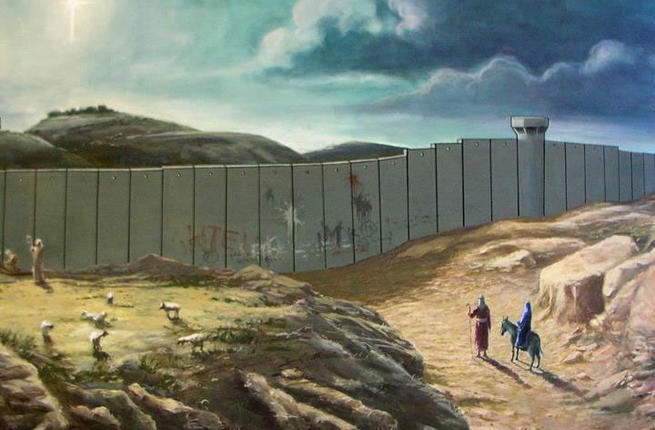
What if, instead of being born into the Roman police state, Jesus had been born at this moment in time? What kind of reception would Jesus and his family be given? Would we recognize the Christ child’s humanity, let alone his divinity? Would we treat him any differently than he was treated by the Roman Empire? If his family were forced to flee violence in their native country and sought refuge and asylum within our borders, what sanctuary would we offer them?
Those nativity scenes were a pointed attempt to remind the modern world that the narrative about the birth of Jesus is one that speaks on multiple fronts to a world that has allowed the life, teachings and crucifixion of Jesus to be drowned out by partisan politics, secularism, materialism and war, all driven by a manipulative shadow government called the Deep State.
The modern-day church has largely shied away from applying Jesus’ teachings to modern problems such as war, poverty, immigration, etc., but thankfully there have been individuals throughout history who ask themselves and the world: what would Jesus do?
What would Jesus—the baby born in Bethlehem who grew into an itinerant preacher and revolutionary activist, who not only died challenging the police state of his day (namely, the Roman Empire) but spent his adult life speaking truth to power, challenging the status quo of his day, and pushing back against the abuses of the Roman Empire—do about the injustices of our modern age?
Dietrich Bonhoeffer asked himself what Jesus would have done about the horrors perpetrated by Hitler and his assassins. The answer: Bonhoeffer was executed by Hitler for attempting to undermine the tyranny at the heart of Nazi Germany.
Martin Luther King Jr. asked himself what Jesus would have done about America’s warmongering. The answer: declaring “my conscience leaves me no other choice,” King risked widespread condemnation when he publicly opposed the Vietnam War on moral and economic grounds.
Even now, despite the popularity of the phrase “What Would Jesus Do?” (WWJD) in Christian circles, there remains a disconnect in the modern church between the teachings of Christ and the suffering of what Jesus in Matthew 25 refers to as the “least of these.”
Yet this is not a theological gray area: Jesus was unequivocal about his views on many things, not the least of which was charity, compassion, war, tyranny and love.
After all, Jesus—the revered preacher, teacher, radical and prophet—was born into a police state not unlike the growing menace of the American police state. When he grew up, he had powerful, profound things to say, things that would change how we view people, alter government policies and change the world. “Blessed are the merciful,” “Blessed are the peacemakers,” and “Love your enemies” are just a few examples of his most profound and revolutionary teachings.
When confronted by those in authority, Jesus did not shy away from speaking truth to power. Indeed, his teachings undermined the political and religious establishment of his day. It cost him his life. He was eventually crucified as a warning to others not to challenge the powers-that-be.
Can you imagine what Jesus’ life would have been like if, instead of being born into the Roman police state, he had been born and raised in the American police state?
Consider the following if you will.
Had Jesus been born in the era of the America police state, rather than traveling to Bethlehem for a census, Jesus’ parents would have been mailed a 28-page American Community Survey, a mandatory government questionnaire documenting their habits, household inhabitants, work schedule, how many toilets are in your home, etc. The penalty for not responding to this invasive survey can go as high as $5,000.
Instead of being born in a manger, Jesus might have been born at home. Rather than wise men and shepherds bringing gifts, however, the baby’s parents might have been forced to ward off visits from state social workers intent on prosecuting them for the home birth. One couple in Washington had all three of their children removed after social services objected to the two youngest being birthed in an unassisted home delivery.
Then again, had Jesus’ parents been undocumented immigrants, they and the newborn baby might have been shuffled to a profit-driven, private prison for illegals where they first would have been separated from each other, the children detained in make-shift cages, and the parents eventually turned into cheap, forced laborers for corporations such as Starbucks, Microsoft, Walmart, and Victoria’s Secret. There’s quite a lot of money to be made from imprisoning immigrants, especially when taxpayers are footing the bill.
From the time he was old enough to attend school, Jesus would have been drilled in lessons of compliance and obedience to government authorities, while learning little about his own rights. Had he been daring enough to speak out against injustice while still in school, he might have found himself tasered or beaten by a school resource officer, or at the very least suspended under a school zero tolerance policy that punishes minor infractions as harshly as more serious offenses.
Had Jesus disappeared for a few hours let alone days as a 12-year-old, his parents would have been handcuffed, arrested and jailed for parental negligence. Parents across the country have been arrested for far less “offenses” such as allowing their children to walk to the park unaccompanied and play in their front yard alone.
Rather than disappearing from the history books from his early teenaged years to adulthood, Jesus’ movements and personal data—including his biometrics—would have been documented, tracked, monitored and filed by governmental agencies and corporations such as Google and Microsoft. Incredibly, 95 percent of school districts share their student records with outside companies that are contracted to manage data, which they then use to market products to us.
Jesus’ anti-government views would certainly have resulted in him being labeled a domestic extremist. Law enforcement agencies are being trained to recognize signs of anti-government extremism during interactions with potential extremists who share a “belief in the approaching collapse of government and the economy.”
While traveling from community to community, Jesus might have been reported to government officials as “suspicious” under the Department of Homeland Security’s “See Something, Say Something” programs. Many states, including New York, are providing individuals with phone apps that allow them to take photos of suspicious activity and report them to their state Intelligence Center, where they are reviewed and forwarded to law-enforcement agencies.
Viewed by the government as a dissident and a potential threat to its power, Jesus might have had government spies planted among his followers to monitor his activities, report on his movements, and entrap him into breaking the law. Such Judases today—called informants—often receive hefty paychecks from the government for their treachery.
Had Jesus used the internet to spread his radical message of peace and love, he might have found his blog posts infiltrated by government spies attempting to undermine his integrity, discredit him or plant incriminating information online about him. At the very least, he would have had his website hacked and his email monitored.
Had Jesus attempted to feed large crowds of people, he would have been threatened with arrest for violating various ordinances prohibiting the distribution of food without a permit. Florida officials arrested a 90-year-old man for feeding the homeless on a public beach.
Had Jesus spoken publicly about his 40 days in the desert and his conversations with the devil, he might have been labeled mentally ill and detained in a psych ward against his will for a mandatory involuntary psychiatric hold with no access to family or friends. One Virginia man was arrested, strip searched, handcuffed to a table, diagnosed as having “mental health issues,” and locked up for five days in a mental health facility against his will apparently because of his slurred speech and unsteady gait.
Without a doubt, had Jesus attempted to overturn tables in a Jewish temple and rage against the materialism of religious institutions, he would have been charged with a hate crime. Currently, 45 states and the federal government have hate crime laws on the books.
Had anyone reported Jesus to the police as being potentially dangerous, he might have found himself confronted—and killed—by police officers for whom any perceived act of non-compliance (a twitch, a question, a frown) can result in them shooting first and asking questions later.
Rather than having armed guards capture Jesus in a public place, government officials would have ordered that a SWAT team carry out a raid on Jesus and his followers, complete with flash-bang grenades and military equipment. There are upwards of 80,000 such SWAT team raids carried out every year, many on unsuspecting Americans who have no defense against such government invaders, even when such raids are done in error.
Instead of being detained by Roman guards, Jesus might have been made to “disappear” into a secret government detention center where he would have been interrogated, tortured and subjected to all manner of abuses. Chicago police have “disappeared” more than 7,000 people into a secret, off-the-books interrogation warehouse at Homan Square.
Indeed, as I show in my book Battlefield America: The War on the American People, given the nature of government then and now, it is painfully evident that whether Jesus had been born in our modern age or his own, he still would have died at the hands of a police state.
Thus, as we draw near to Christmas with its celebrations and gift-giving, we would do well to remember that what happened on that starry night in Bethlehem is only part of the story. That baby in the manger grew up to be a man who did not turn away from evil but instead spoke out against it, and we must do no less.
I was just watching a gaggle of blue-checkmarked narrative managers attack progressive commentators Katie Halper and Briahna Joy Gray on Twitter for platforming antiwar journalist Rania Khalek on the grounds that Khalek is an “Assadist”, which is imperialist for “someone who opposes western imperialism in Syria”.
At no point do any of these narrative managers bother to address the actual things these women were discussing together or why anything Khalek was saying in their video conference was wrong. They do not feel the need to do such a thing, because they have this label, “Assadist”, which they can pin on one of the speakers and thereby reject one hundred percent of her work and one hundred percent of the people who give her a platform from which to speak. They feel no need to address the arguments, because they have a label which they all agree means they can completely un-person someone who opposes western regime change agendas in a specific region.
There are many such labels that are used to exclude people from positions of influence and power for simply disagreeing with the official doctrine of status quo oligarchic imperialism in any way. “Assadist” is one of them; it allows someone to be completely marginalized from platforms of significant influence without anyone ever needing to admit that they’re simply depriving anyone of a platform who criticized the way the US power alliance used proxy armies and propaganda campaigns in a campaign to topple Damascus. “Kremlin asset” is another, as are “conspiracy theorist”, “tankie”, or “[insert imperialism-targeted leader] apologist”.
In reality, these labels are interchangeable with the word “heretic”. They mean “Someone who disagrees with the mainstream consensus religion of oligarchic imperialism”.
In ages past people would be excluded from positions of influence and power if they did not belong to the dominant religion in that place and time. If you were a Jew living in the Holy Roman Empire, for example, the door would be closed to you from ever holding a position of power or influence over the mainstream population. In the same exact way, those who do not espouse the mainstream orthodoxy of continual military expansionism and status quo politics are cut off from major positions in politics and media using the modern-day equivalent of the “heathen” label. It’s a very old dynamic adapted for a new world.
Caitlin Johnstone: 'Mainstream establishment orthodoxy is essentially a religion, as fake and power-serving as any other, and if you want to work in mainstream politics or media you need to demonstrate that you are a member of that religion' https://t.co/kUrbutA9Cj
Oligarchic imperialism is the new dominant world religion. It is the scripture that everyone reads from. It is what shapes our culture. It is what holy wars are fought over and acts of terrorism committed for. It’s what power is built around. It’s what you’re branded a heretic for rejecting. It’s just as fake as any other religion, just as crafted toward the advantage of the powerful as any other religion, and just as dependent upon blind faith in insubstantial narratives as any other religion. But it lets its adherents feel smug and superior to people who believe in those primitive older religions.
Adherents of the old dominant religion used to read the Bible; adherents of the new dominant religion read The New York Times. Adherents of the old dominant religion used to go to church on Sunday; adherents of the new dominant religion go to Hollywood movies. Adherents of the old dominant religion fought in the crusades; adherents of the new dominant religion kill families with drones and Tomahawk missiles overseas. Adherents of the old dominant religion used to burn heretics at the stake; adherents of the new dominant religion imprison journalists and deplatform “Assadists”, “Putin apologists” and “conspiracy theorists” so their ideas don’t infect the rest of the flock.
These labels exist because if mainstream platforms admitted that they refuse access to literally anyone who disagrees with status quo oligarchic imperialism, they would have to admit that they are not the objective arbiters of absolute reality they portray themselves as being, but are in fact propagandists for a very specific belief system. That they are not tasked with the responsibility of reporting the news, but with promoting the doctrine of the new dominant world religion. That they aren’t news reporters, but high priests.
Religion isn’t disappearing, it has just changed its form. The world has become too small for widespread belief in omnipotent deities creating the universe in six days and controlling all our affairs, so now people tell new fairy tales about a liberal world order which must be preserved by a beneficent superpower and its allies. In reality it is nothing other than propaganda for a murderous, tyrannical theocratic empire, of just the sort once presided over by Rome.
Western imperialism is worse than every single issue the mass media are screaming in your face about on any given day. It is without exaggeration worse than 100 percent of those issues. If people could really grasp the horrific nature of imperial warmongering, the wars would be forced to end. It is the job of the imperial high priests to prevent this from happening, which is why they use dismissive labels to marginalize anyone who might be inclined to remind you of this.
In a murderous, tyrannical theocratic empire, the only sane position to hold is that of heresy and apostasy. Hopefully one day mankind will open its eyes to reality and require no blind faith in any artificial belief constructs of any kind.
There are very few writers who have done more to try to open the public’s mind to the evil nature of the American empire than David Ray Griffin. His series of books on the false flag attacks of September 11, 2001 will endure for a long time, and they will one day, when it is safe to do so, be recognized as seminal texts exposing the traitorous conspiracy of elements within the Unites States’ government to launch the endless so-called war on terror. That many now know, and many more will, that those so-called “terrorist” attacks were carried out by terrorists in the highest reach of the U.S. government will be due to his extraordinary work.
What many do not know is that David Ray Griffin is a Christian theologian with impeccable credentials and a scholarly oeuvre of dozens of theological books. And that long before his conscience led him to devote himself to exposing the U.S. government’s lies about the September 11 attacks, he was committed to proclaiming the radical Christian gospel of a living Christ, who was executed by the Roman state for opposing its grotesque and violent empire.
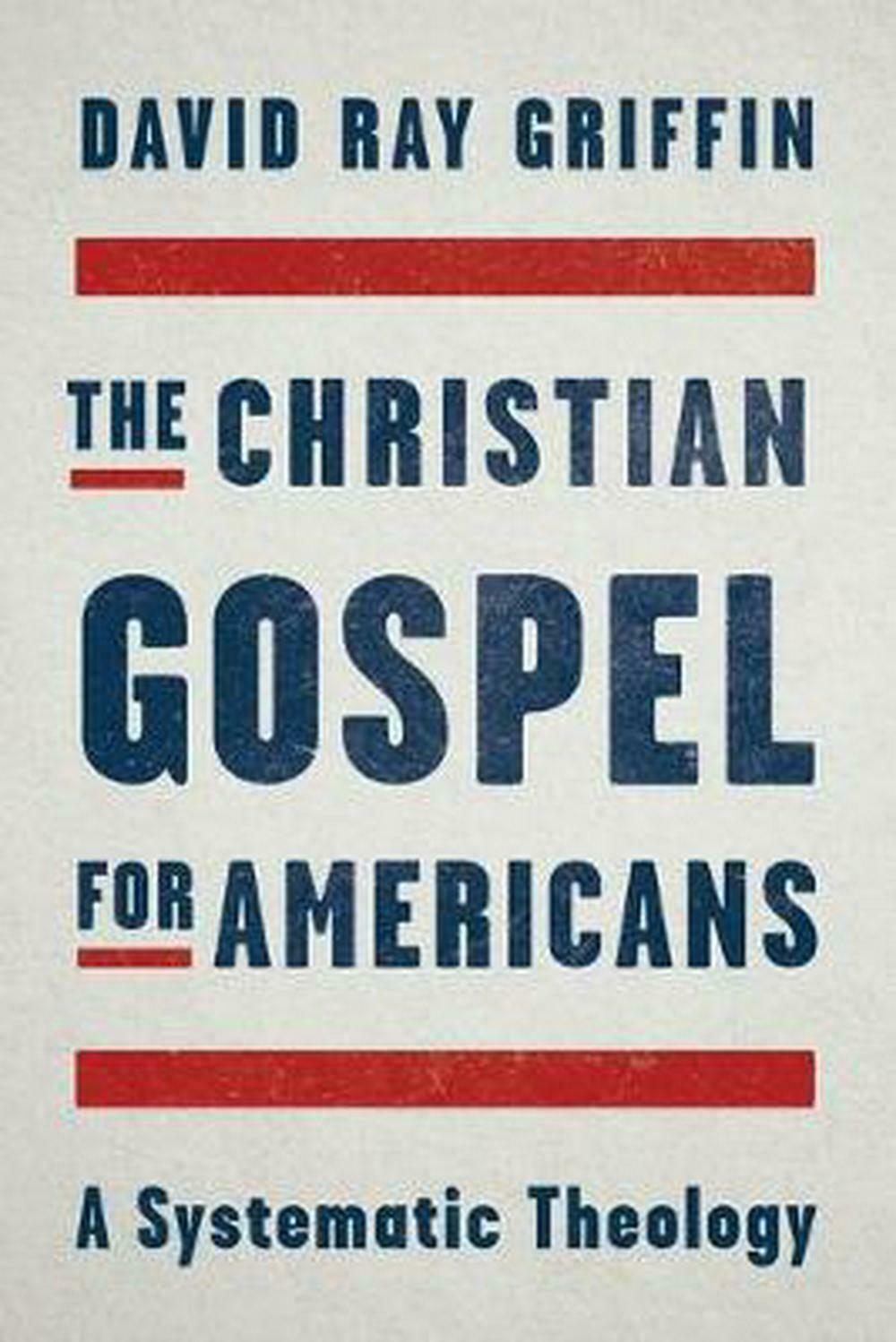
The Christian Gospel for Americans is his crowning achievement, a rare marriage of spiritual contemplation and social analysis that brings to life Jesus and the Hebrew prophets for contemporary Americans. It is an accessible systematic theology of freedom and creativity that will inspire hope in all caring souls to resist the demonic American Empire. It is an intellectual tour de force, a kaleidoscopic “constructive postmodern” example of process theology at its finest, drawing on the work of Alfred North Whitehead, John Cobb, and Henri Bergson, among others. Rarely does such a book come along to roil the waters of religious and social complacency.
Times change. Once in the United States of America, theologians were fêted as important social critics and considered worth heeding. Two of the most famous in the mid-to-late twentieth century were Reinhold Niebuhr and Paul Tillich. Both appeared on the cover of Henry Luce’s Time Magazine, and Barack Obama was later fond of referring to Niebuhr to justify his violent policies to extend the American empire. Obama knew his audience, for Niebuhr was noted for a neo-orthodox theological perspective that encouraged “political realism,” popular among the elites who had created and extended the American empire. He was a friend of the rich and famous ruling establishment. His critiques of immoral government practices were always offered within the parameters of official acceptance, conservative and liberal. He was the establishment’s theologian, lionized by the empire-touting Time magazine as the theologian who really understood politics and how God figured into the necessary realism of American foreign policy.
To his great credit, David Ray Griffin is a brave theologian who will never appear on the cover of Time magazine, for his message is more in keeping with the Biblical prophets who warned the people that their government’s behavior is an abomination in the eyes of God, and if they do not dissent and reject such policies, they will be rejecting the God they say they worship. In true prophetic style, he connects the dots to say: look at what you are doing, slaughtering innocents everywhere as you worship your golden calf. When the Hebrew prophets “indict Israel or Judah,” he writes, “the indictments are not directed against the people in general, but against the elites who were responsible for creating and maintaining the structures of domination and exploitation.’”
The American elites surely do not wish to publicize a man who says such things; better to ignore him or have their mouthpieces call him a “conspiracy nut,” which of course they have.
Griffin’s book is rooted in the basic fact that “Christian theology is necessarily at once theological and political” since Jesus was a radical rebel leader who opposed the demonic power of the Roman Empire and was executed for that reason. This is so fundamental, yet it has been papered over, especially since the age of Constantine in the fourth century. Griffin says:
For one thing, the complete opposition of Jesus and his followers to the imperialism of their day has been largely hidden to readers of the gospels. The main reason for this hiddenness is that the authors of the gospels, seeking to present the message of Jesus so as to serve the needs of the Christian movement 40 or more years after the death of Jesus, sought to make it appear that Jesus’ message was directed against, and evoked opposition from, ‘the Jews,’ rather than the Roman Empire and those who collaborated with it….This failure of later Christians to understand the beginnings of their religion has contributed to what is arguably the most fateful reversal in history: Christianity, in origin probably the most explicitly anti-imperial religious movement ever, has since the fourth century provided the religious foundation for the growth of empires even more extensive than Rome’s….He [Jesus] was crucified by the Roman Empire – not by ‘the Jews’ – because he was perceived as a threat by Roman authorities. Given the nature of Jesus’ life and his death, American Christians today should be anti-imperialistic, rather than basking in the pleasures of Empire, as did the Roman populace two thousand years ago – ignoring the terror and poverty brought to other provinces by Roman rule.
This is the foundation upon which Griffin builds his gospel for Americans.
His theological method is liberal, while his content is conservative. This means that to establish truth by appealing to authority is rejected as a method. It is only evidence and reason that he relies on to establish the truth of various doctrines. Therefore science and modern scholarship are important and must always be considered. To claim something is true because of a deposit of divine revelation that you can read in the Bible is an old way of doing theology and Griffin rejects that method. In fact, his understanding of revelation is an ongoing process, insight as part of the creative and spontaneous freedom of living in openness to God’s spirit.
His theology is conservative in content because it rests upon certain primary doctrines of the Christian gospel (good news) “such as God’s creation of the world, God as actively present in it, and divinely-given life after death.”
For those unfamiliar with modern theological thinking that is not bound by a particular church’s teachings and respects science, Griffin’s method might at first seem unusual. As one trained in theology and philosophy, I can assure you it is not. His process of reasoning accords with the best scholarship in those disciplines, but one has to take the time to enter into its postmodern worldview that positions many of the conundrums of traditional religious thinking within a new framework, one that Griffin calls postmodern naturalism where “divine influence must be understood as part of the normal cause-effect relations, not an exception to them.”
Griffin takes on many of the great issues that have perplexed inquiring minds: the problem of evil, creation, truth, human freedom, God’s so-called omnipotence, miracles, life after death, out-of-body experiences, etc. Whether you end up agreeing with all his reasoning or not, you will be challenged to assess your thinking. I find his systematic theological analyses to be brilliant and always intriguing.
But the point of his systematic theology is to bring us to his analysis of the demonic nature of the American Empire and the need for Christians and people of all faiths to resist it. In my opinion, his argument for the demonic as a real power in the world, and that the United States is in its grip, is true. He says:
Can we look at the past century of our world without thinking that the human race must be under the influence of such a power? The twentieth century was by far the bloodiest century in history, with unprecedented slaughter and genocide, and yet we have taken no steps to overcome the war-system of settling disputes. Americans created nuclear weapons and then, when we learned how deadly they are, built thousands more, until we had the world wired to be destroyed many times over. After we learned that a relatively modest exchange of nuclear weapons could initiate a “nuclear winter,” leading to the death of human civilization and other higher forms of life, we still did not abolish them.
He gives the historical background to the American belief in its divine mission, the idea of Manifest Destiny, and the city on the hill nonsense about America being God’s country whose mission was to spread democracy around the world. He quotes George W. Bush saying, in his state-of-the-union address two months before laying waste to Iraq based on lies, “The liberty we prize is not America’s gift to the world; it is God’s gift to humanity.”
Melville couldn’t have said it better through the mouth of mad Ahab. Mad Ahab, mad Bill Clinton, mad George, mad Lyndon Johnson, the list goes on and on. Madmen all, God’s men in their minds, or perhaps just lying madmen playing with our minds, God be damned.
Griffin lays it all out – Iran 1953, Guatemala 1954, Vietnam 1954-73, Indonesia 1965, etc. – all the blood, the massacres, the evil empire doing its nonstop handiwork across the world.
He does, however, omit a crucial element of the demonic at work here in the U.S., as if something is blocking him from recognizing it, some shadow blocking his sight. It is a strange omission. It is as if his vision is focused outward on all the evil the American government inflicts on the world, but here in his own house, he cannot see the demonic at work.
He nowhere mentions the American government’s assassinations of JFK, Malcolm X, MLK, and RFK, all martyrs to the unspeakable truth that this country is in the grip of evil killers who will stop at nothing to silence the voices of genuine peacemakers who have opposed the American Empire. Their deaths opened the door to hell on earth for millions of others around the world.
He correctly catalogues the long list of U. S. atrocities, false flag attacks, coup d’états, immoral and endless wars; gives dates; draws a damning picture of a country in the grip of demonic forces intent on savagely killing innocents wherever it can find them. He shows conclusively that the United States is the Roman Empire updated and outfitted to kill millions with sophisticated weapons and to spread its imperialistic power with evil intent.
He makes an open and shut case that if one wishes to follow the Christian Gospel, one must act in opposition to this evil empire. But he forgets that the crucifixion is also a domestic affair, and the homegrown rebels must be eliminated first.
Even the wisest of men, such as the David Ray Griffin, have their Achilles heels.
But despite that omission, or maybe because of it since it shows us how flawed we all are, The Christian Gospel for Americans is a brilliant clarion call to action.





 After the Crash