Corporate Looting as ‘Rescue Plan,’ Robber Barons as ‘Saviors’

By Joshua Cho

Source: FAIR.org

For a perfect illustration of how corporate media function as ruling class propaganda, watch how they spin a titanic upward redistribution of wealth as a “rescue plan” for the US economy, and paint a robber baron like US Treasury Secretary Steve Mnuchin as a “savior” of the American public.

In discussions of the (officially) estimated $2.2 trillion Coronavirus Aid, Relief and Economic Security (CARES) Act—the largest government spending program in US history—before it was signed into law on March 27, corporate media largely abandoned the pretense of serving as watchdogs on behalf of the public in order to advocate for protecting and enriching the fortunes of their owners.

Instead of scrutinizing the bill as the robbery in progress that it is—as an understandable story with identifiable victims and victimizers—corporate media sold the CARES Act as an urgent necessity required to combat the coronavirus pandemic for everyone. Like the previous corporate bailout during the Great Recession (Extra!, 1/09), corporate media avoided raising questions about the necessity of having the government bail out large corporations, or whether the bill could be restructured to serve people rather than profits.

According to the Committee for a Responsible Budget, while the CARES Act dedicated $290 billion in direct payments to people and $260 billion in expanded unemployment benefits, it dedicated $300 billion in tax breaks and $875 billion in loans to big and small businesses—more than two dollars for corporations for every dollar for people, in other words.

When corporate media reported on negotiations and deliberations over the CARES Act, they either hailed it as a bipartisan achievement, or else shamed politicians who accurately pointed out that it overwhelmingly benefited corporations at the expense of workers. On the day the CARES Act was signed into law, NPR (3/27/20) praised the bill as “the largest rescue package in American history and a major bipartisan victory for Congress.”

Reporting in real-time, the Washington Post (3/24/20) spun the CARES Act as an attempt to “address the coronavirus crisis,” with the aim of “flooding the economy with capital to revive businesses and households.” When there was Democratic pushback over the Senate GOP bill for being “disproportionately tilted toward helping companies,” the Post described this as “partisan rancor and posturing on Capitol Hill” that blocked “the rescue bill.” The Post concern-trolled those who supported better legislation, and derided House Democrats’ putative attempts to chart their own “competing piece of legislation,” because “it could take even longer to arrive at a bipartisan consensus that can pass both chambers and get signed into law.”

The New York Times (3/22/20) made it clear that protecting workers and imposing conditions on handing out trillions in taxpayer dollars were frivolous reasons to oppose the legislation, as the Times cast Senate Democrats as villains for ostensibly opposing the bill because it “failed to adequately protect workers or impose strict enough restrictions on bailed-out businesses.” The Times described the “party-line vote” as a “stunning setback” for both the Trump administration’s “ambitious timeline” and “the rescue package,” and warned Democrats that they “risked a political backlash” if “they are seen as obstructing progress on a measure that is widely regarded as crucial to aid desperate Americans and buttress a flagging economy.”

The Times also drew parallels to the “spectacle in 2008,” when the House defeated a “$700 billion Wall Street bailout that aimed to stabilize the financial system amid a global meltdown.” Even in 2020, the Times is still spinning the upward redistribution of wealth from taxpayers to the big banks that caused the crisis as an ostensible success that saved what corporate media consider to be “the economy” (Extra!, 10/10).

Days later, the Times’ “As Coronavirus Spread, Largest Stimulus in History United a Polarized Senate” (3/26/20) spun the 96-to-0 Senate vote in favor of the bill as a heroic bipartisan compromise on legislation “intended to get the nation through the crippling economic and health disruptions being inflicted on the world by the coronavirus.” The Times leaned into corporate media’s civility fetish designed to demobilize opposition to the Trump regime (FAIR.org, 8/1/18, 12/22/19) when it depicted Democratic opposition to Senate Republicans’ “corporate giveaway” legislation as politically reckless and harmful to the country’s interests:

It was a shocking and politically perilous decision in the middle of a paralyzing national crisis, a moment when lawmakers are traditionally expected to put aside differences for the good of the country, or face a political backlash.

By contrast, in the false balance endemic in news coverage in the Trump era, the Times portrayed Senate Republicans as reasonable leaders who were “willing to momentarily abandon their small-government zeal” in the interest of “sealing a quick deal with Democrats” (GQ, 12/10/19; Washington Post, 4/27/12). Though the legislation didn’t include a necessary suspension of rent, utility and mortgage payments, or guarantee monthly payments, as advised by many economists, the Times spun it as a legislative victory for Senate Democrats:

In the end, Democrats won what they saw as significant improvements in the measure through their resistance, including added funding for healthcare and unemployment, along with more direct money to states. A key addition was tougher oversight on the corporate bailout fund, including an inspector general and congressionally appointed board to monitor it, disclosure requirements for businesses that benefited, and a prohibition on any of the money going to Mr. Trump’s family or his properties — although they could still potentially benefit from other provisions.

The problem with this triumphant Democratic ResistanceTM narrative is that it happens to be false. Politico’s report (3/26/20) on the negotiations over what it also hailed as a “rescue package” revealed that the final bill largely reflected the Senate Republicans’ “unemployment insurance and direct payments schemes” as “originally outlined,” with Sen. Mitch McConnell claiming that the CARES Act was a bill that was “largely, not entirely but largely, produced by Republicans in consultation with the Democratic minority.”

The Democratic leadership’s lack of concern with proper oversight of the bailout funds was also exposed when Speaker Nancy Pelosi chose her first-term congressmember friend Donna Shalala as part of the five-member oversight panel, despite her numerous conflicts of interest, evident lack of expertise or reported interest in the job (American Prospect, 4/18/20).

The American Prospect’s David Dayen has done some of the best reporting on the CARES Act, and he’s observed (3/25/20) how means-testing the $1,200 stimulus payments by basing it off IRS data in 2018 and 2019 was designed to limit the number of Americans who can receive it. The miserly one-time $1,200 stimulus payment will primarily reach Americans who already have direct deposit information on file with the IRS, with the unbanked (who happen to be the poorest) having to wait up to four months for paper checks, and who will be lucky to remain at the same address during that time without a suspension of rent payments.

While Democratic leaders like Pelosi opposed emergency universal basic income—and delayed payments to set up a bureaucracy ostensibly dedicated to make sure wealthy Americans don’t get anything—the richest Americans are in fact receiving an average stimulus payment of $1.7 million in the form of a millionaire tax cut.

Dayen has noted how the official “$500 billion” provided by the CARES Act to bailout large corporations is actually underreporting the enormity of the federal government’s corporate giveaway, as Trump regime officials like Larry Kudlow and Steve Mnuchin admitted their intent to leverage the Federal Reserve’s emergency lending authority to turn $500 billion into a $4.5 trillion money cannon aimed at large corporations.

What was in actuality a $6 trillion spending package had few conditions attached to the largesse given to large corporations, as the money can still go to mergers, executive compensation and paying dividends to shareholders, with no requirement that they keep employing workers to receive this handout.

It’s hard to overstate the injustice and scale of this upward redistribution of wealth. Commenting on 2008’s bailout, economist Richard Wolff (Guardian, 11/4/13) pointed out how funding the bailout through borrowing money effectively transfers wealth upward from regular taxpayers to rich bondholders, because the government is borrowing money from—and paying interest to—large corporations and the rich that it could have taxed them for instead. Rather than letting shareholders be wiped out first, according to the ostensible rules of capitalism—where they are supposed to bear the risk, instead of the government—the government is shoveling money to tax-dodging corporations like Boeing who admit to not needing these funds.

By borrowing the money for a program that prioritizes saving the rich, rather than printing money to fund an emergency universal basic income for the people like Rep. Rashida Tlaib’s proposal, the government is effectively paying the rich for saving them. The fact that these viable alternative stimulus proposals weren’t enacted is inexcusable. Especially when the Federal Reserve is hinting its willingness to increase the money supply by buying unlimited debt to fund the CARES Act, the fact that the necessary funds magically appear to fund corporate bailouts instead of necessary social programs (like Medicare for All) exposes the “How are you going to pay for it?” talking point as a fraud (Extra!, 6/12).

Pam and Russ Martens of Wall Street on Parade (3/26/20) observed how the CARES Act also allows the Fed to create “Special Purpose Vehicles” and hide this money from their balance sheets, allowing them to avoid the FOIA requests used to the expose the enormity of the $29 trillion bailout from 2008, in addition to repealing public meeting and recordkeeping requirements for Fed-related programs. This allows the Fed to evade transparency and accountability by holding meetings in secret.

But when corporate media aren’t busy spinning massive corporate robbery of taxpayer money as a rescue package for “the economy,” they’re busy spinning robber barons like Mnuchin as heroic “saviors” instead. Reuters’ “This Is No 2008: Mnuchin Borrows From Paulson’s Economic Crisis Playbook” (3/20/20) depicted Mnuchin as an unlikely hero thrust into the role of solving the US’ economic woes, as they reported:

US Treasury Secretary Steven Mnuchin has stepped into the breach as the Trump administration’s point man to rescue the economy from coronavirus devastation, taking on the role his former Goldman Sachs boss, Hank Paulson, played over a decade ago.

Mnuchin has closely followed the financial crisis playbook used by Paulson when he led the Treasury Department in 2008, reactivating Federal Reserve credit market backstops and asking Congress for $1 trillion to prop up companies and consumers as the economy grinds to a halt due to the spread of the virus.

Apparently, for Reuters, there is only one “playbook” to be followed for all economic crises: massive taxpayer-funded giveaways to large corporations, and crumbs for everyone else. The report contained praise from official sources praising Mnuchin for being “pragmatic” and “rising to the occasion,” with few questions beyond whether he can succeed in his noble mission, as Reuters wondered whether Mnuchin can “strong-arm executives or influence President Donald Trump to take the drastic steps the unprecedented crisis may demand.” Whether Mnuchin and the Trump regime are actually trying to “rescue the economy” is apparently unquestionable, even though Mnuchin would dismiss record-breaking levels of unemployment as “not relevant” only a few days later (Common Dreams, 3/26/20).

The Wall Street Journal’s “How Mnuchin Became Washington’s Indispensable Crisis Manager” (3/31/20) also peddled this fictitious savior narrative when it reported that “Mnuchin has become Washington’s indispensable deal-maker in trying to keep the crisis from throwing the world’s largest economy into the deepest downturn since the Great Depression,” while shepherding “a pair of rescue bills through Congress.”

The Journal depicted Mnuchin’s ability to retain Trump’s confidence while working with Democrats as something that will be “all the more needed in the weeks ahead as the pandemic is expected to worsen,” in order to “get things done in partisan Washington.” Those “skills” didn’t seem to manifest when additional funding for state and local governments, and expanded food stamp benefits needed to rescue people, were left out of the “Phase 3.5” coronavirus legislation last week (Intercept, 4/22/20).

The Washington Post’s “The Dealmaker’s Dealmaker: Mnuchin Steps In as Trump’s Negotiator, but President’s Doubts Linger With Economy in Crisis” (3/27/20) also praised Mnuchin’s efforts to “bridge divides” and forge bipartisan “agreements.” While to the Post’s credit, the piece noted how the “Treasury Department’s demands have often appeared to represent the interests of big business rather than workers,” its overall thrust was encapsulated by its subhead: “Can his economic rescue plan quickly stabilize an economy headed toward calamity?”

The New York Times’ “How Powell and Mnuchin Became the Duo in Charge of Saving the Economy” (3/31/20) reported on Mnuchin’s “vital partnership” with Fed chair Jerome Powell, echoed the “unlikely hero” narrative, and described their efforts as “critical not only to workers and businesses,” but also to Trump’s “re-election” chances:

The coronavirus poses the most significant economic threat since at least 2008, thrusting Mr. Mnuchin and Mr. Powell into key roles in determining whether the United States economy suffers a short, manageable slowdown or enters a deep and painful recession.

When the Times briefly acknowledged concerns about the massive concentration in power and newfound influence in Powell and Mnuchin’s hands, and questions about the integrity of the “oversight” process, it treated the CARES Act favoring big corporations over workers as a hypothetical scenario, rather than a plain fact.

In a unique situation where workers and small business owners have the shared interest in not being wiped out by the pandemic, how else does one characterize the disproportionately stricter conditions placed on small businesses to retain workers to receive bailout money—while big corporations have no such limitations—except as a plan to save big corporations over workers? The Times’ later reports (4/22/20, 4/26/20) on big corporations receiving bailout money intended for small businesses, and receiving concierge service for coronavirus aid at their expense, should’ve been predictable—as it was to some observers in real time (American Prospect, 3/25/20).

Throughout this coverage, it’s quite telling who counts as “the economy” and what measures are considered “necessary” or “adequate,” because it reveals who corporate media consider to be disposable (working class America), and who needs “saving” (large corporations and the American oligarchy). With the CARES Act, corporate media reversed the narrative in a truly Orwellian fashion, portraying corporate looting of the Treasury as necessary to “rescue the economy,” while the main questions regarding “savior” officials like Mnuchin are whether his plans to “save the economy” can succeed. When 26 million Americans lost their jobs between March 18 and April 22, while the wealth of US billionaires increased by $308 billion (more than 10%), there’s no other way to look at corporate media spin as anything but ruling class propaganda to legitimize saving capital while letting people die (In These Times, 4/6/20).

A Debt Jubilee Is the Only Way to Avoid a Depression

By Michael Hudson

Source: The Unz Review

Even before the coronavirus appeared, many American families were falling behind on student loans, auto loans, credit card balances and other payments. America’s debt overhead was pricing its labor and industry out of world markets. A debt crisis was inevitable eventually, but covid-19 has made it immediate.

Massive social distancing, with its accompanying job losses, stock dives, and huge bailouts to debt-strapped corporations, raises the threat of a depression. But it doesn’t have to be this way. History offers us another alternative in such situations: a debt jubilee. This slate-cleaning, balance-restoring step recognizes the fundamental truth that when debts grow too large to be paid without reducing debtors to poverty, the way to hold society together and restore balance is simply to cancel the bad debts.

The word Jubilee comes from the Hebrew word for trumpet — yobel. In Mosaic Law, it was blown every fifty years to signal the Year of the Lord, in which personal debts were to be cancelled. The alternative, the prophet Isaiah warned, was for smallholders to forfeit their lands to creditors: “Woe to you who add house to house and join field to field till no space is left and you live alone in the land.” When Jesus delivered his first sermon, the Gospel of Luke describes him as unrolling the scroll of Isaiah and announcing that he had come to proclaim the Year of the Lord, the Jubilee Year.

Until recently, historians doubted that such a debt jubilee would have been possible in practice, or that such proclamations could have been enforced. But Assyriologists have found that from the beginning of recorded history in the Near East, it was normal for new rulers to proclaim a debt amnesty upon taking the throne. Instead of blowing a trumpet, the ruler “raised the sacred torch” to signal the amnesty.

It is now understood that these rulers were not being utopian or idealistic in forgiving debts. The alternative would have been for debtors to fall into bondage. Kingdoms would have lost their labor force, since so many would be working off debts to their creditors. Many debtors would have run away (much as Greeks emigrated en masse after their recent debt crisis) and communities would have been prone to attack from without.

The parallels to the current moment are notable. The U.S. economy has polarized sharply since the 2008 financial crisis. For far too many, the debts in place leave little income available for spending on goods and services or in the national interest. In a crashing economy, any demand that newly massive debts be paid to a financial class that has already absorbed most of the wealth gained since 2008 can only further split our society.

This has happened before in modern times — after World War I, the burden of war debts and reparations bankrupted Germany, contributing to the global financial collapse of 1929-31. Most of Germany was insolvent, and its politics polarized between the Nazis and Communists. We all know how that ended.

America’s 2008 bank crash offered a great opportunity to write down the often-fraudulent junk mortgages that burdened many lower-income families, especially minorities. But this was not done, and millions of American families were evicted.

The way to restore normalcy today is a debt writedown. The debts in deepest arrears, and most likely to default, are student debts, medical debts, general consumer debts and purely speculative debts. They block spending on goods and services, shrinking the “real” economy. A debt writedown would be pragmatic, not merely a moral sympathy with the less affluent.

In fact, it could create what the Germans called an “Economic Miracle” — their own modern debt jubilee in 1948, the currency reform administered by the Allied Powers. When the Deutsch Mark was introduced, replacing the Reichsmark, 90 percent of government and private debt was wiped out. Germany emerged as an almost debt-free economy, with low costs of production that jump-started its modern economy.

In the past, the politically powerful financial sector has blocked a writedown. Until now, the basic ethic of most people has been that debts must be repaid. But it is time to recognize that most debts now cannot be paid — through no real fault of the debtors in the face of today’s economic disaster.

The coronavirus outbreak is serving as a mind-expansion exercise, making hitherto unthinkable solutions thinkable. Debts that can’t be paid, won’t be. A debt jubilee may be the best way out.


Michael Hudson, author of “… and forgive them their debts” and “Killing the Host,” is president of the Institute for the Study of Long-Term Economic Trends and is Distinguished Research Professor of Economics at the University of Missouri–Kansas City.

From Quarantine To Tyranny To Rebellion: Where Is The Line In The Sand?

By Brandon Smith

Source: Alt-Market.com

America is in a haze right now. It seems like half the country is in denial of the danger while the other half is awaking from apathy and frantically trying to prepare. This is creating a fog of confusion as one side screams “it’s nothing but the flu, stop buying up the grocery store…!”, and the other side just keeps stocking goods, though in an inexperienced way that prioritizes comfort over practicality.

The other day I went by the grocery store to grab a few peripheral items while they still exist on sale, and this was the first time since the Covid-19 situation began that people in my area actually seemed…different.   The usual carefree obliviousness was gone from their faces and they all had a deer-in-the-headlights look, their eyes wide as saucers as they nervously scrambled around the store.  None of them were absorbed into their cell phones.  All of them were alert as many people huddled over their cart, quickly snatching items from the shelves as if protecting themselves from potential thieves.  It seems that reality is finally hitting the masses square in the face like a sucker punch.

Suddenly, the prepper movement doesn’t look so “crazy” after all, and average people are now turning to prepper forums and websites to ask us for information on how to plan more effectively. Instead of stacking piles of toilet paper for psychological comfort, they are now buying food supplies.  The people who used to accuse us of being “chicken littles” and “doom mongers” are eerily silent. I almost miss them. At the very least, everyone is now concerned about the situation, if not for different reasons.

This is a far cry from the past two months, when governments around the world as well as the UN’s WHO continually downplayed the pandemic threat and offered the public nothing in terms of usable advice. The establishment consistently kept the public in the dark, not just on the virus and its capabilities but also on the vast weaknesses in the global economy. Abruptly in the past week they suggest that a threat is ahead and now millions of people are scrambling to prepare however they can.

As I have noted in previous articles, there is a reason why the establishment refused to inform the citizenry of the instabilities inherent in the pandemic scenario; the more unknowns there are for the public the more panic will set it, chaos ensues, and it is chaos that can be exploited to push forward numerous agendas. These agendas include global centralization as well as the erasure of constitutional liberties.

Now that a national collapse event is slowly being accepted by many as a legitimate possibility, there is a debate rising as to what measures the government should take, or should be allowed to take. Those of us in the prepper and liberty movements always knew this day was coming; a day when the public would start considering trading away an array of freedoms in exchange for promises of security.

Even now, government officials are still trying to tell people that this event will be “short lived”.

“Don’t worry”, they say, “It will only last a couple of weeks.” Oh, and “Don’t concern yourselves with food shortages, that’s not going to happen…” You can look at these lies in two different ways:

1) The government is trying to stave off a “panic” by slowly easing people into the reality that the system is breaking.

2) The government is trying to keep people passive to the danger so that when the system breaks completely they will be unprepared, desperate and easier to manipulate.

I believe the second option is the most likely given the evidence at hand, but in either case the government is crippling the public response time to the disaster. They did this for months and they are still trying to do it now.

So, my argument is, why should we suddenly take their advice or take orders from them when the manure hits the fan? They have FAILED in their responsibilities to inform and protect the citizenry, and they are about to violate their prime mandate, which is to protect the personal liberties that make our society worth living in. Without these freedoms, there is no point to keeping our system intact anyway.

The establishment and its defenders will claim that we all “have to make sacrifices” today in order to have freedoms tomorrow, but that’s not how the constitution was designed to work. Our rights are MORE important during times of distress and crisis, for it is in these times that we need to know what we are fighting for, and what we are struggling for. Survival is meaningless if we have to accept tyranny to achieve it.

Once governments see a chance to usurp freedoms from the people, they DO NOT tend to give those freedoms back later unless the people become a viable opponent that could bring the establishment down.

There are some who will say that a forced quarantine is necessary to protect the “greater good” of the greater number. It is true that the Covid-19 virus is a danger, and I think the people who claim it’s “no worse than the flu” are fighting a losing battle as the death rate is clearly much higher than the average flu virus. They will look extremely foolish a few months from now as the virus continues to cycle through the population and the dead continue to increase. That said, I think I understand why they cling to this crumbling argument.

They think that by arguing that the pandemic is “all hype” they can morally justify resistance to the inevitable totalitarian response from governments. They think it has to be one or the other:  Either the virus is hyped and resistance is acceptable, or the virus is real and resistance is unacceptable. I ask – Why can’t it be both? The virus is dangerous to many, but a totalitarian response is still unacceptable.

The virus is in fact more destructive than any flu in recent memory – It’s not a plague on the level of the Black Death, but if it continues to kill at a rate of 3% to 5% as it has been then this puts a large number of human beings at risk. It is not something to be taken lightly, and those people that are actively trying to discourage others from preparing for it are truly narcissistic in their ideology. If you don’t think it’s a threat, then don’t prepare, but don’t scream at others for taking precautions just because you desperately want to be right, and don’t come around demanding food and supplies from those same people when the ceiling comes crashing down on your head.

Also, understand that Covid-19 is only part of the problem. The bigger crisis is in the economy itself; a collapse has been built into the system for years now, and the virus has little to do with it.  Leftist kids are going around calling this pandemic the “boomer remover”, almost cheering the assumption that mostly older and conservative Americans will die from this.  I have to break it to them that during the economic collapse that is inevitably coming they will have to wipe the snot from their noses and put on their big-boy diapers otherwise they aren’t going to survive either; most of them have no discernible skills and no preparations to speak of.  They are essentially useless.

If Covid-19 is a “boomer remover”, then the economic crisis is a “snowflake bake”, and they are about to get roasted.

As I have noted time and time again over the past few years, the Everything Bubble only needed one major trigger event to fully implode, but the international banks and central banks created that precarious bubble in the first place, and they set up all the conditions which made it so dangerous. The virus is not the cause of the crash, it is just very good cover for the banks who are the real perpetrators.

Ignore the virus if you want, but the economic collapse is undeniable. Accept that the national and global emergency is real (even if it has been financially engineered), and let’s move on to a more meaningful debate: Should governments be allowed to implement martial law measures in response?

In my view there is no excuse for tyranny, even during a pandemic event. The majority of the public is more than capable of voluntary quarantine without government enforcement. Add government intervention into the mix and it will only make people want to do the opposite.  And beyond that, Covid-19 has such a long incubation period that ultimately most people will probably contract it anyway. Total containment is not achievable (as we have just seen in South Korea). Quarantines might slow the spread, which is good, but do not expect to avoid this virus indefinitely. Why sacrifice your freedoms for safety that is an illusion?

Then there is the argument of “herd immunity”, which is utter nonsense and always has been. Either a person or group is immune, or they are not, and people who are not immune do not put immune people at risk. Period. The claim that the virus might “mutate” within non-vaccinated or non-immune people and put vaccinated people at risk is a propaganda argument that ignores science. Generally, when a virus does mutate, it mutates into a less deadly or infectious strain, not a more deadly strain. Viruses are programmed to survive, too. If they evolved to kill ALL potential hosts then that would be counter to their survival imperative, which is why they usually evolve in the other direction.

In terms of Covid-19, there is no “herd immunity” by the establishment definition anyway, because it is a brand new virus. There is no vaccine and the vast majority of people have no antibodies. No one can make the argument that people need to be forcefully locked down in order to maintain a herd immunity that doesn’t exist.

Finally, there is a question of agenda and motive behind the rising call for martial law-like measures over the pandemic. For example, Champaign, Illinois mayor Deborah Frank Feinen has given herself executive powers in response to the coronavirus infection that are outright dictatorial and Soviet in their violations. Among other things, she demands the power to enforce curfews, ban public gatherings, ban alcohol, ban or confiscate firearms, as well as confiscate supplies from any citizen if those supplies are “needed for emergency response”.

Is this really about protecting the public? How does it protect the public to confiscate their only means of defense, or confiscate their food and supplies? This type of thing is usually done in communist countries, and it is done to protect government power, not protect the people.

Understand also that the Champaign mayor is not the only official calling for these types of actions. From New York to LA and beyond, those of us who are paying attention have noticed a swift and quiet implementation of orders that are whittling down American freedoms. Do not expect Donald Trump to operate differently, either. Expect him to initiate martial law measures (though he may not call it “martial law”) in the next few months. Expect him to activate Executive Order 13603, which was created by Barack Obama in 2012 and allows the federal government to appropriate everything from land to food to firearms in the event of a national emergency. This is going to happen. Count on it.

The pandemic is not an excuse for tyranny, and I for one will not comply. I and many I know will self quarantine for a time with the expectation that we will eventually contract the virus, and hopefully our immune systems are strong enough to fight it. In the meantime, I will not be allowing any government officials to confiscate my supplies or my firearms “for my own safety” or “for the greater good”.

I will not be cooperating with census takers asking questions about how much supplies I have stocked and whether or not I am ill.  I will not sit idle while checkpoints are set up in my county to enforce travel restrictions or demand people test for symptoms. I will not be signing up for government rations in exchange for my biometric data. I will not be visiting the local FEMA center for government aid. And, I will fight anyone that tries to assert martial law tactics in my area.

A message to the government: I know you won’t, but I suggest you leave people alone and let them self isolate in peace. Your brand of “help” is not the kind of help we need. You and the financial elites that reside over you created this mess, and we do not trust you to clean it up. At bottom, this disaster should result in your removal from power. You should be held accountable and replaced.

The system itself needs to be rebuilt from the ground up and principles of liberty need to return to the forefront of our society. Centralization and globalization have caused untold grief and terror to humanity; this collapse only reinforces the argument that we need to try something different. They will say that the world was “not centralized enough” and that a more global (totalitarian) framework is the solution. But, of course, who really benefits from that in the end? The common man, or the elites?

They can offer any rationalization they want in the name of public safety, but we know what the real play is here. If the line is crossed into martial law, I plan to fight. Not just for me, but for the next generation. Because if I do not, those children may grow up in the world never knowing what freedom truly is. There are fates worse than death, and a life of tyranny and slavery is one of them.

The Covid-19 Dominoes Fall: The World Is Insolvent

By Charles Hugh Smith

Source: Of Two Minds

Subtract their immense debts and they have negative net worth, and therefore the market value of their stock is zero.

To understand why the financial dominoes toppled by the Covid-19 pandemic lead to global insolvency, let’s start with a household example. The point of this exercise is to distinguish between the market value of assets and net worth, which is what’s left after debts are subtracted from the market value of assets.

Let’s say the household has done very well for itself and owns assets worth $1 million: a home, a family business, 401K retirement accounts and a portfolio of stocks and other investments.

The household also has $500,000 in debts: home mortgage, auto loans, student loans and credit card balances.

The household net worth is thus $1,000,000 minus $500,000 = $500,000.

Let’s say a typical financial crisis and recession occur, and the household’s assets fall 30%. 30% of $1 million is $300,000, so the the market value of the household’s assets falls to $700,000.

Deduct the $500,000 in debts and the household’s net worth has fallen to $200,000. The point here is debts remain regardless of what happens to the market value of assets owned by the household.

Then the speculative asset bubbles re-inflate, and the household takes on more debt in the euphoric expansion of confidence to buy a larger house, expand the family business and enjoy life more.

Now the household assets are worth $2 million, but debt has risen to $1.5 million. Net worth remains at $500,000, since debt has risen along with asset values.

Alas, all bubbles pop, and the market value of the household assets decline by 30%, or $600,000. Now the household assets are worth $2,000,000 minus $600,000 or $1,400,000. The household net worth is now $1,400,000 minus $1,500,000 or negative $100,000. the household is insolvent.

On top of that, the net income of the family business plummets to near-zero in the recession, leaving insufficient income to pay all the debts the household has taken on.

This is an exact analog for the entire global economy, which pre-pandemic had assets with a market value of $350 trillion and debts of $255 trillion and thus a net worth of around $100 trillion.

The $11 trillion that has evaporated in the market value of U.S. stocks is only a taste of the losses in market value. Global stock markets has lost $30 trillion, and once yields rise despite central bank manipulations (oops, I mean intervention), $30 trillion in the market value of bonds will vanish into thin air.

The market value of junk bonds has already plummeted by trillions, and that’s not even counting the trillions lost in small business equity, shadow banking and a host of other non-tradable assets.

Then there’s the most massive asset bubble of all, real estate. Millions of properties delusional owners still think are worth $1.4 million will soon revert to a more reality-based valuation around $400,000, or perhaps even less, meaning $1 million per property will melt into air.

Once the market value of global assets falls by $100 trillion, the world is insolvent.

Everyone expecting the financial markets to magically return to January 2020 levels once the pandemic dies down is delusional. All the dominoes of crashing market valuations, crashing incomes, crashing profits and soaring defaults will take down all the fantasy-based valuations of bubblicious assets: stocks, bonds, real estate, bat guano, you name it. (Actually, bat guano will be the keeper of all the asset classes listed.)

The global financial system has already lost $100 trillion in market value, and therefore it’s already insolvent. The only question remaining is how insolvent?

Here’s a hint: companies whose shares were recently worth $500 or $300 will be worth $10 or $20 when this is over. Bonds that were supposedly “safe” will lose 50% of their market value. Real estate will be lucky to retain 40% of its current value. And so on.

As net worth crashes below zero, debts remain. The loans must still be serviced or paid off, and if the borrowers default, then the losses must be absorbed by the lenders or taxpayers, if we get a repeat of 2008 and the insolvent taxpayers are forced to bail out the insolvent financial elites.

Here’s the S&P 500. Where is the bottom? There is no bottom, but nobody dares say this. Companies with negative profits have no value other than the cash on hand and the near-zero auction value of other assets. Subtract their immense debts and they have negative net worth, and therefore the market value of their stock is zero.

Welcome to the New Communist Police State, blamed on a virus

By Scott Baker

Source: OpEdNews.com

The draconian measures being taken or certainly being talked about – food rationing?!– will end up killing more people than the virus.

How many elderly will die because their caregivers can’t get to them (bye bye meals on wheels)? How many people already on special diets won’t be able to maintain them and get sick as a result? (Me, I eat mostly fresh, unboxed/uncanned food, devoid of extra salt and sugar, instead of the cheap crap that only governments will pay for).

People will die from this too.

Think you can can substitute daily school lunches for actual school and not have the same infection rate? Forget it. It’ll slow it down for a couple of weeks at most. And in New York City, 74% of the children in public school are poor. Without school lunch they go hungry. With school lunch, and then a return to home, their parents – or parent, singular, since many come from single parent households – can’t work, they can’t staff our hospitals, clean our streets, or do any of the hundred things the Departments of Health say are necessary to contain the virus.

People will die from this too.

I’m not usually paranoid, but this seems to be a way of trapping people into a police state. Oh, and yeah, what happens to the actual police who have to enforce this regime of deprivation? Will they use force when someone wants to go for a jog? If they injure someone, who will treat them in the over-crowded hospitals? Supposedly, exercise is fine, but what if you want to go jogging or biking in a group? I am scheduled to lead a 50-person bike group around New York City the end of April. Is that against the laws now? Wait…what law? Expect court challenges…wait, what courts? They are all working remotely or not at all. Our Civil Rights are already gone but we just don’t know it yet. Where is the ACLU? They are silent. Rights for LGBT, for voting…wait, long lines at polling stations. That’s already forbidden. Ohio postponed its primary for today. A half dozen other states did as well.

And recessions kill. You can’t pay your bills. Evictions and utility shutoffs are supposedly illegal in our new communist state, but what happens when the landlord or utility can’t pay its bills? Yes I know, record profits for utilities in the last few years. But that went into buybacks. That wasn’t against the law and still isn’t. It SHOULD be but it wasn’t. And corporations are deep in debt now, and bankruptcies will follow in a week or so; it’s that close. The economy is being unraveled and government can’t, or won’t, even pass the first of dozens of mitigating bills in the New Communism. The New Communism includes tax breaks and bailouts for the largest corporations though, $850 billion worth, so the Administration has learned nothing. Worse, actually, the centerpiece of the proposal is to eliminate the payroll tax, which will save corporations many millions, might trickle down to the employee, unless the corporations pocket the extra, and won’t help those out of a job or working for tips at all. Even worse, it will gut Social Security and Medicare, already due to start running out of money in a few years, even during Trump’s next term – and yes, he will get another term unless Biden or Sanders can distinguish themselves by what they will do differently, AND we have a recession. But, getting back to Social Security and Medicare; Trump has already said he wants to rein in the costs (read: gut or eliminate the programs millions depend upon to survive). Trump wants a permanent underclass, not entitled to any entitlements, even those it earned. He wants the free-to-be-corrupt market to provide for your old age or illness, or to let you die if you don’t plan 40 years ahead, or anticipate cancer.

This is permanent. We are giving up our rights supposedly temporarily. But that’s what was said after 9/11, and we still have the Patriot Act and a permanent war footing. BTW, presidential candidate Tulsi Gabbard wants a $1,000/month guaranteed income for everyone. That would be much more in keeping with our Civil Rights and much more fair. But no one is listening to her in the MSM or debates,where she is excluded.

This is permanent. This will kill more people than the virus ever would.

So, again, more people will die from the measures to contain the virus – which will ultimately fail anyway – than from the virus itself.

The Economic Cataclysm Ahead

By Charles Hugh Smith

Source: Of Two Minds

The economic storm hasn’t passed; the false calm is only the eye of the financial hurricane.

To understand the economic cataclysm ahead, do the math. Those expecting the Covid-19 pandemic to leave the U.S. economy untouched are implicitly making these preposterously unlikely claims:

1. China will resume full pre-pandemic production and shipping within the next two weeks.

2. Chinese consumers will resume borrowing and spending at pre-pandemic rates in a few weeks.

3. Every factory and every worker in China will resume full pre-pandemic production without any permanent closures or disruptions.

4. Corporate America’s just-in-time inventories will magically expand to cover weeks or months of supply chain disruption.

5. Not a single one of the thousands of people who flew direct from Wuhan to the U.S. in January is an asymptomatic carrier of the coronavirus who escaped detection at the airport.

6. Not a single one of the thousands of people who flew from China to the U.S. in February is an asymptomatic carrier of the coronavirus.

7. Not a single one of the thousands of people who are in self-quarantine broke the quarantine to go to Safeway for milk and eggs.

8. Not a single person who came down with Covid-19 after arriving in the U.S. feared being deported so they did not go to a hospital and are therefore unknown to authorities.

9. Even though U.S. officials have only tested a relative handful of the thousands of people who came from Covid-19 hotspots in China, they caught every single asymptomatic carrier.

10. Not a single asymptomatic carrier caught a flight from China to Southeast Asia and then promptly boarded a flight for the U.S.

I could go on but you get the picture: an extremely contagious pathogen that is spread by carriers who don’t know they have the virus to people who then infect others in a rapidly expanding circle has been completely controlled by U.S. authorities who haven’t tested or even tracked tens of thousands of potential carriers in the U.S.

These same authorities are quick to claim the risk of Covid-19 spreading in the U.S. is low even as the 14 infected people they put on a plane ended up infecting 25 passengers on the flight. These same authorities tried to transfer quarantined people to a rundown facility in Costa Mesa CA that was not suitable for quarantine, forcing the city to file a lawsuit to stop the transfer.

Do these actions instill unwavering confidence in the official U.S. response? You must be joking.

Do the math, people. The coronavirus is already in the U.S. but authorities have no way to track it due to its spread by asymptomatic carriers. People who don’t even know they have the virus are flying to intermediate airports outside China and then catching flights to the U.S.

None of the known characteristics of the virus support the confidence being projected by authorities. The tests are not reliable, few are being tested, carriers can’t be detected because they don’t have any symptoms, the virus is highly contagious, thousands of potential carriers continue to arrive in the U.S., etc. etc. etc.

The network of global travel remains intact. Removing a few nodes (Wuhan, etc.) does not reduce the entire network’s connectedness that enables the rapid and invisible spread of the virus.

Second, what authorities call over-reaction is simply prudent risk management. As I noted yesterday in How Many Cases of Covid-19 Will It Take For You to Decide Not to Frequent Public Places?, when an abstract pandemic becomes real, shelves are emptied and streets are deserted.

It doesn’t take thousands of cases to trigger a dramatic reduction in the willingness to mix with crowds of strangers. A relative handful of cases is enough to be consequential.

Many of the new jobs created in the U.S. economy over the past decade are in the food and beverage services sector, the sector that is immediately impacted when people decide to lower their risk by staying home rather than going out to crowded restaurants, theaters, bars, etc.

Many of these establishments are hanging on by a thread due to soaring rents, taxes, fees, healthcare and wages. Many of the employees are also hanging on by a thread, only making rent if they collect big tips.

Central banks can borrow money into existence but they can’t replace lost income. A significant percentage of America’s food and beverage establishments are financially precarious, and their exhausted owners are burned out by the stresses of keeping their business afloat as costs continue rising. The initial financial hit as people reduce their public exposure will be more than enough to cause many to close their doors forever.

As small businesses fold, local tax revenues crater, triggering fiscal crises in local government budgets dependent on ever-higher tax and fee revenues.

A significant percentage of America’s borrowers are financially precarious, one paycheck or unexpected expense away from defaulting on student loans, subprime auto loans, credit card payments, etc.

A significant percentage of America’s corporations are financially precarious, dependent on expanding debt and rising cash flow to service their expanding debt load. Any hit to their revenues will trigger defaults that will then unleash second-order effects in the global financial system.

The global economy is so dependent on speculative euphoria, leverage and debt that any external shock will tip it over the cliff. The U.S. economy is far more precarious than advertised as well.

The economic storm hasn’t passed; the false calm is only the eye of the financial hurricane.

The Economic Crash So Far: A Look At The Real Numbers

By Brandon Smith

Source: Alt-Market.com

There are many problems when attempting to track a faltering economy. For one, the people in government generally do not want the public to know when the system is in decline because this looks bad for them. They prefer to rig statistical indicators as much as possible and hope that no one notices. When the crash occurs, they then claim that “no one saw it coming” and the disaster “came out of nowhere”, so how could they be to blame?

I have even heard it argued that political leaders, including the president, have a “duty” to lie about the state of the economy because once they admit to the decline they will cause a panic and perpetuate the crisis. This is stupidity. If an economic system is in disrepair and is built on a faulty foundation, then the problems should be identified and fixed immediately. The weak businesses should be culled, not bailed out. The wasteful government spending should be cut, not increased. The downturn should not be hidden and prolonged for years or decades. In most cases, this only makes the inevitable crash far worse and more damaging.

Another factor, which some people might call “conspiracy theory” – but it has been proven time and time again in history – is that the money elites have a tendency to engineer economic disasters while deliberately hiding the real statistics from the public. Why? Well, if the real data was widely disseminated, then a crash would not be much of a surprise and the populace could be prepared for it. I suspect the elites hide the data because they WANT the crash to be a surprise. The bigger the shock, the bigger the psychological effect on the masses. This fear and confusion allows them to make changes in the power structure of a nation or of the entire world that they would not be able to accomplish otherwise.

The most rigged statistics tend to be the least important overall in analysis, but this does not stop the mainstream media and investors from hyper focusing on them. How many times have you told friends and family about the collapse in manufacturing or the explosion in consumer and corporate debt, only to hear them say, “But the stock market is at all-time highs!” Yes, even though stock markets are a meaningless trailing indicator, even though GDP stats are a complete fallacy, and even though jobless numbers do not include tens of millions of people out of work, these are the stats that the average person takes mental note of when consuming their standard 15 minutes of news per day.

While the issue of rigged statistics makes analysis of a crash difficult, a willfully ignorant citizenry makes reporting on the real data almost impossible. It’s sad to say, but a large number of people do not want to hear about negative information. They want to believe that all is well, and will delude themselves with fantasies of blind optimism and endless summers. Like the tale of “The Ant And The Grasshopper”, they are grasshoppers and they see anyone who focuses on the negative as “chicken littles” and “doom mongers”. In their minds they have all the time in the world, until they freeze and starve when winter comes.

When I encounter people who actually believe the manipulated numbers or buy into the stock market farce or simply don’t want to accept that a crash could happen in their lifetime, I always ask them to consider these questions: If the global economy is not on the verge of collapse, then why did central banks keep propping it up for the past ten years? And if central banks have been propping up the system, how much longer do you think they can do this? How much longer do you think they want to do it? What if one day they decide to let the entire house of cards tumble? What if such an event actually benefits them?

We’ve seen that a broken economy can be technically held together for a decade, but under the surface, the structure continues to rot. The bottom line is that even if the elites wanted to keep the system going for another ten years, and even if politicians continued to help them by pumping out false statistics, there is no way to hide the effects of crumbling fundamentals. We saw this during the crash of 2008, and now we’re seeing it again.

After nearly ten years of stimulus inflated the largest financial bubble in history (the Everything Bubble), the Federal Reserve and other central banks halted stimulus measures and tightened global liquidity. By the end of 2018, a new crash began, the implosion of the Everything Bubble had been triggered. All of this is still just an extension of the crash of 2008, which never really subsided; it was only slowed down through tens of trillions of dollars in central bank intervention. Now, the central banks have started an avalanche that cannot be stopped. But the fact of the matter is, they don’t really want to stop it.

Here are the indicators so far that prove a crash is happening in the U.S. while a majority of the public is oblivious:

GDP numbers are completely manipulated. Government spending of taxpayer dollars on a number of inflated programs, including continued spending on Obamacare, is added to GDP calculations. Without this fancy accounting, U.S. GDP growth would actually be negative, according to ShadowStats. But even with the juiced data, official GDP growth is still in decline, falling to 1.9% and well below the 3% growth we were supposed to see this year.

Official unemployment stats remain at all-time lows, which is commonly cited by the mainstream media, Donald Trump (he used to argue the opposite three years ago), and even the Federal Reserve in reference to the health and stability of the economy. What they do not mention much is the 95 million people not in the labor force and not counted because they have been unemployed for so long. When the media does mention this fact, they claim the number is “misleading”, that most of these people are students or retired, that the retirement age is decreasing and Baby Boomers are leaving the workforce sooner, and that the people who don’t have jobs are simply “not interested” in working. None of this is true.

The retirement age is increasing in the U.S., not decreasing, according the SS Administration. Current average retirement age is now 67, up from 65, almost the same as it was during the Great Depression.

Baby Boomers are not retiring at rates similar to ten years ago, and are in fact attempting to stay in the workforce due to the poor economy. Many of them are trying to come OUT of retirement just to make ends meet.

The labor participation rate remains near record lows.

Interestingly, the Bureau of Labor Statistics (BLS) house survey that is used to determine if people “want a job” assumes that if you are near retirement age and do not have a job, you are simply not interested in a job, and they count you as “non-participating”. However, if you DO have a job and you are near retirement age, they count you as participating. It’s a rather convenient assumption on the government’s part to claim that just because an unemployed person is near retirement age, that means they “don’t want a job”.

While there is surely a small percentage of the 95 million people not counted in the labor force that do not want a job, if unemployment stats counted U-6 measurements as they used to, the unemployment rate would be closer to 20%.

Another problem is the quality of jobs being created. U.S. manufacturing jobs, as well as higher wage jobs, are in steep decline. They have been replaced with low paying jobs in the service sector.

Real wages in the U.S. have not kept up with inflation. The average worker is now losing money overall as prices rise beyond the pace of their incomes.

As more and more Millennials say they cannot afford to buy a home, rental prices have skyrocketed in the past several years. The home ownership rate plunged starting in 2006 and has not recovered since.

U.S. manufacturing has fallen to levels not seen since the crash of 2008. U.S. factory orders have slumped in 2019.

U.S. Services PMI continues to falter since spring of this year. Job growth is now slowing and over 8,500 retail stores have been closed down already in 2019. Web-based retail is not picking up the slack, as online sellers like Amazon are suffering from falling profits.

Corporate profits overall have tumbled this year and projected future profits have been drastically adjusted to the downside.

Corporate debt, consumer debt and national debt are all at historic highs. Corporate cash flow is so tight that Federal Reserve repo purchases continue to run into high demand. This debt signal is one we saw in 2007, just before the credit crisis.

U.S. trucking and railroad freight continue to log steep declines in traffic and goods. This tells us what we already know: Even though consumer spending has increased recently, this does not mean people are buying more stuff or have more disposable income. What is really happening is inflation, or stagflation. Cost of living is going up. Debt payments are going up. Consumers are spending more on the same amount of stuff, or less stuff, and have less expendable income. U.S. consumers are being bled dry.

All of these factors and more show an economy in recession or depression (depending on what historic standards you use). In the darker corners of the investment world, the great hope is that the central banks will return to pumping trillions into the banking sector ($16 trillion during the TARP bailout dwarfs the $250 billion the Fed has recently pumped out in their repo markets). They hope that this will free up even more credit. Meaning, they believe only more debt will save the system from suffering.

I say, time is up on the debt party. More stimulus will not stall the crash that is already happening, and the Fed does not appear poised to print anywhere near what it did during the credit crisis, at least not in time to change the trend. The can has been kicked for the last time. The grasshopper mentality will not save people from the clear reality. Only preparation and planning will.

The Unraveling Quickens

By Charles Hugh Smith

Source: Of Two Minds

Even if we don’t measure the erosion of intangible capital, the social and political consequences of this impoverishment are manifesting in all sorts of ways.

The central thesis of my new book Will You Be Richer or Poorer? is the financial “wealth” we’ve supposedly gained (or at least a few of us have gained) in the past 20 years has masked the unraveling of our intangible capital: the resilience of our economy, our social capital, i.e. our ability to find common ground and solve real-world problems, our sense that the playing field, while not entirely level, is not two-tiered, and our sense of economic security–have all been shredded.

The unraveling of everything that actually matters is quickening. While every “news” outlet cheerleads the stock market (“The Dow soared today as investor optimism rose… blah blah blah”), our “leadership” and our media don’t even attempt to measure what’s unraveling, much less address the underlying causes.

The hope is that if we ignore what’s unraveling, it will magically go away. But that’s not how reality works.

The unraveling is gathering momentum because prices have been pushing higher while wages lag, feeding the rising precariousness and inequality of our economy. The connection between people losing ground and social disorder/disunity has been well established by historians such as Peter Turchin Ages of Discord and David Hackett Fischer The Great Wave: Price Revolutions and the Rhythm of History.

In our era, trust in the legitimacy of our institutions is unraveling because the statistics presented as “facts” are so clearly designed to support the status quo narrative that everything’s getting better every day in every way rather than the politically unwelcome reality that the bottom 95% are losing ground and whatever they do earn and own is increasingly at risk from forces outside their control.

Economic decay leads to social and political disorder / disunity. The sudden rise of vast homeless encampments is one manifestation of the social fabric unraveling. In the political realm, the insanity of accusing Democratic candidates of being “Russian agents” matches the hysterical destructiveness of the McCarthy era in the 1950s.

It all starts with economic decay, so let’s look at some charts. Here’s a chart of income inequality which helps drive wealth inequality.

Note that the only group that benefited from the past 20 years of speculative bubbles is the top 1%. The whole idea that inflating bubbles creates a “wealth effect” that “trickles down” is preposterous, as evidenced by the decline of the middle 60% of households while the speculators and owners of bubble-assets skimmed the vast majority of income gains.

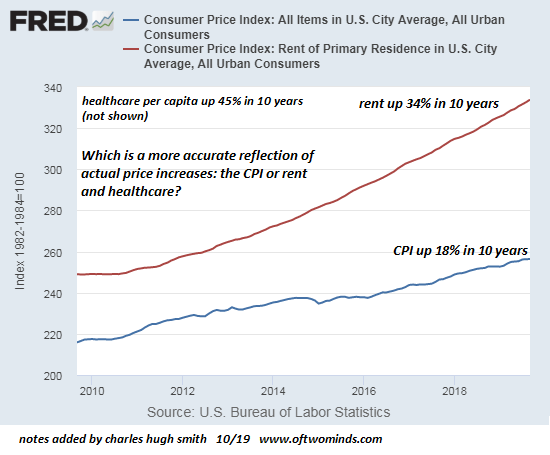
Meanwhile, we’re told inflation is less than 2% annually while rising costs have outpaced meager wage increases. What’s a more realistic measure of real-world inflation–the official Consumer Price Index (CPI) at 18% over ten years or rent and healthcare at 34% and 45%?

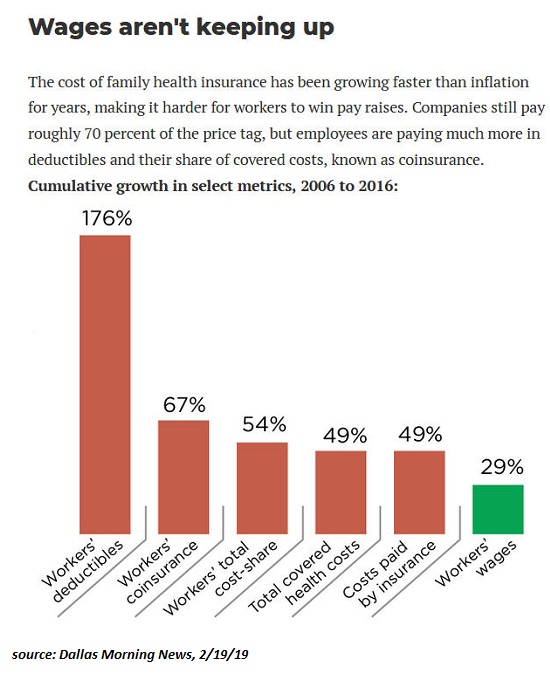
According to the Chapwood Index, real-world inflation in urban America is running 9% to 13% annually. This is more in line with reality than the bogus CPI, as evidenced by this chart of wages and healthcare costs:

Even if we don’t measure the erosion of intangible capital, the social and political consequences of this impoverishment are manifesting in all sorts of ways: large-scale social disorder is breaking out around the globe, and the political middle ground has completely vanished: no matter which way an issue is decided, one camp will refuse to accept the outcome.

The only way forward with any chance of success is to start by acknowledging the decay of our economy due to rampant financialization, legalized looting, the pathologies of “winner take most” speculation and the realities of a two-tiered system in which entrenched elites are “more equal” than the rest of us, economically, socially and politically. We have to accept the limits of technology to reverse the unraveling and assess the damage that’s already been done to our shared capital.

Acting as if the system is working just fine and the problem is perception/optics is accelerating the unraveling.