The modern food system is being shaped by the capitalist imperative for profit. Aside from losing their land to global investors and big agribusiness concerns, people are being sickened by corporations and a system that thrives on the promotion of ‘junk’ (ultra-processed) food laced with harmful chemicals and cultivated with the use of toxic agrochemicals.
It’s a highly profitable situation for investment firms like BlackRock, Vanguard, State Street, Fidelity and Capital Group and the food and agribusiness conglomerates they invest in. But BlackRock and others are not just heavily invested in the food industry. They also profit from illnesses and diseases resulting from the food system by having stakes in the pharmaceuticals sector as well. For them, it’s a win-win situation.
Lobbying by agrifood corporations and their well-placed, well-funded front groups ensures this situation prevails. They continue to capture policy-making and regulatory space at international and national levels and promote the (false) narrative that without their products the world would starve.
They are now also pushing a fake-green, ecomodernist agenda and rolling out their new proprietary technologies in order to further entrench their grip on a global food system that produces poor food, illness, environmental degradation, dependency and dispossession.
The prevailing globalised agrifood model is built on unjust trade policies, the leveraging of sovereign debt to benefit powerful interests, population displacement and land dispossession. It fuels export-oriented commodity monocropping and regional food insecurity.
This model is responsible for increasing rates of illness, nutrient-deficient diets, a narrowing of the range of food crops, chemical runoffs, increasing levels of farmer indebtedness and the eradication of biodiversity. And it relies on a policy paradigm that privileges urbanisation, global markets and agrifood corporations’ needs ahead of rural communities, local markets, on-farm resources and food sovereignty.
In addition, there are also the broader geopolitical aspects of food and agriculture in a post-COVID world characterised by food inflation, hardship and multi-trillion-dollar global debt.
There are huge environmental, political, social and health issues that stem from how much of our food is currently produced and consumed. A paradigm shift is required.
That book contains substantial sections on the agrarian crisis in India and issues affecting the agriculture sector. Aruna Rodrigues — prominent campaigner and lead petitioner in the GMO Mustard Public Interest Litigation in the Supreme Court of India — stated the following about the book:
This is graphic, a detailed horror tale in the making for India, an exposé on what is planned, to hand over Indian sovereignty and food security to big business.”
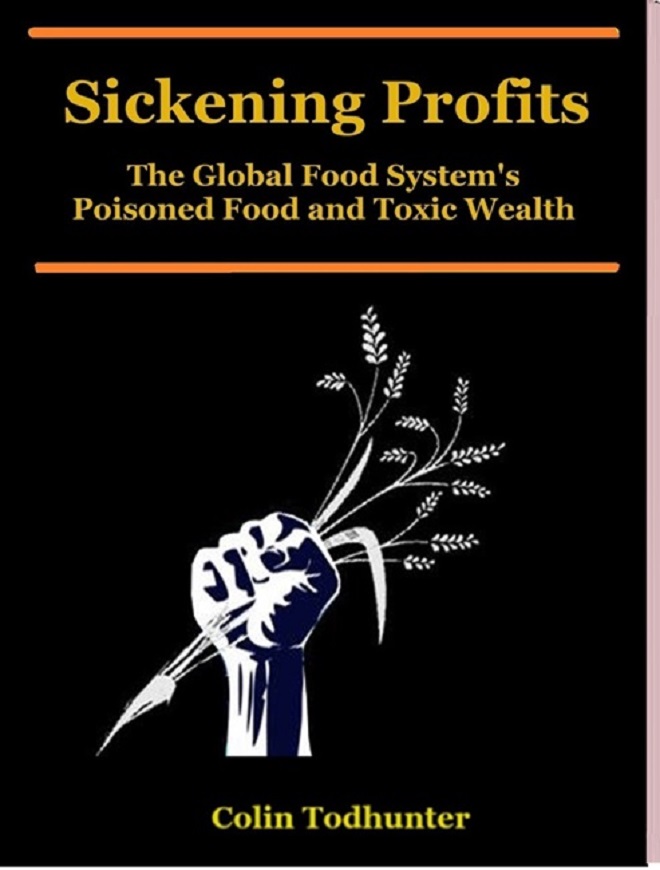
‘Sickening Profits’ continues in a similar vein. By describing situations in Ukraine, India, the Netherlands and elsewhere, it is another graphic horror tale in the making that is being intensified across the globe. The question is: Can it be stopped?
“I speak of peace, therefore, as the necessary rational end of rational men. I realize that the pursuit of peace is not as dramatic as the pursuit of war–and frequently the words of the pursuer fall on deaf ears. But we have no more urgent task.” – John F. Kennedy
For most people, it’s difficult to imagine much of what’s happening today. And this is why so many seem in the dark about what we should do to alleviate our problems. Looking at the situation in which a proxy is being waged on Russia from Ukraine, nothing seems to add up. The same is true for the genocide now going on in Gaza. And when we superimpose problems like curing cancer and other diseases, environmental problems, and failing economies, the only thing we can see is that our leaders have failed miserably at prioritising. It’s also obvious that we, the people, are the farthest thing from their minds.
Regarding visualisation, there’s no bigger confusion than grasping just how much money the Western powers are shovelling into the war against Russia. So far, something like $233 billion has been donated to Ukraine. The top donors are the EU($90B) and the United States ($73B). Interestingly, most of the EU funding has been aimed at financial aid, while the US donates are mostly military aid. Neither the EU nor the US spent much on humanitarian aid, at least not by comparison. But then, humanitarian money does not go into the pockets of the elites, now does it? The arms companies and financial institutions seem to be leveraging this Ukraine mess for a return on assets. But that’s another story. Now, I’d like to compare spending on Ukrainian and Israeli wars against efforts that do help human beings.
Let’s look at one of humanity’s most dreaded killers: cancer. In total, global oncology spending in 2022 was $193 billion. The numbers are far more telling in key research, where funding often comes from philanthropy. The Lancet reported recently that some 66,388 awards with a total investment of about $24.5 funded research for 2016–20. And now these figures have nosedived. In 2020, there were 19.3 million cases and 10 million deaths from the dreaded disease.
If we look at how many people are starving on our planet, it’s appalling to think of billions thrown away on unwinnable wars for the sake of selling weapons. In 2021, U.N. World Food Programme Executive Director David Beasley said it would take an estimated $40 billion annually to end world hunger by 2030. Let’s think about that for a moment. Each day, 25,000 people, including more than 10,000 children, die from hunger and related causes. Envision the lost potential of all those children perishing, if you can. Beasley went on to etch the situation in stone with this statement:
“There is 400 trillion dollars’ worth of wealth on the earth today, and the fact that 9 million people die from hunger every year… Shame on us. In the height of COVID, billionaires’ net worth increase was $5.2 billion per day. At the same time, 24,000 people die per day from hunger. Shame on us. Every hour, the net worth of billionaires during the height of COVID was a substantial $216 million per hour. Yet 1000 people per hour were dying from hunger… Shame on us.”
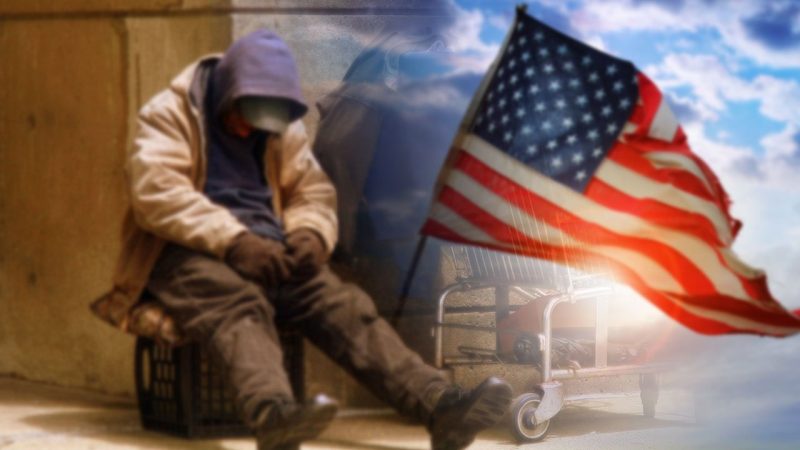
Two-hundred-sixteen million dollars per hour! I’ll wager the vast majority of that wealth had nothing whatsoever to do with helping human beings, curing disease, or stopping the endless wars. Moving on, let’s look at the homeless/poverty situation worldwide. In 2021, there were 150 million homeless people worldwide. While so many people here in Greece and other countries in Europe strive to go live in the United States, few realise that over 18% of the people living in my country live below the poverty line. And no one wanting to become American realises that the overwhelming solution to poverty in my country is to punish and imprison the poor (Homelessness World Cup). Using only what’s been spent on Ukraine so far, the U.S. Government could have issued a check for $1,825 to each of the 40 million homeless people in the country. That’s two or even three months’ rent for all homeless people in the USA.
Even in highly developed countries like Germany, more than 14.8% of the people are living beneath the national poverty line. Interestingly, some Latin American countries equal or better poverty rate than North American or some European countries. Take Argentina as an example. The situation there is no worse than it is in the United States. In Chile, only 9% of the population lives in dire circumstances. Unbelievably, there are countries like Bangladesh, traditionally thought of as the world’s poorest countries, where less than 13% of the population lives below the poverty line. In Romania, 26% of the people live in extreme poverty, and in neighbouring Bulgaria, the rate is almost 24%.
Turning to more practical matters that bear on quality of life and efficiency, we find the United States of America ranks 13th out of 141 countries in overall infrastructure. What a stunning achievement for the richest (supposedly) country in the world! After all, how do we balance what a country’s wealth is? What is the negative value of a dangerous, rusty bridge or a pothole in a road so deep you can hear Chinese being spoken from its depths? How bad is 13th place? Well, the American Society of Civil Engineers estimated that it would take 50 years to complete only the necessary repairs on more than 46,000 deteriorated bridges in the country. Both the Trump and Biden administrations promised to pour more money into the problem, but so far the US of A is still crumbling. So that you understand, Spain, Singapore, South Korea, Japan, and eight other countries have better quality infrastructures than the US. Remember I mentioned at the beginning, prioritisation? Is it possible that the Spaniards are doing more to care for their own people than America? Does Spain start proxy wars on Russia’s borders? I do not see Spanish ships in the South China Sea provoking war.
Since we landed in Spain, let’s take a look at some interesting facts about their quality of life. For instance, the Spanish Constitution includes a right to housing. The reality of homelessness there is that less than 8.5% of the population is homeless, and most of those live in shelters. Spain ranked 27th out of OF 189 countries in the Human Development Index Rankings. Romania was 49th, the USA was 17th, Chile 43rd, and South Korea was 23rd. For me at least, what is significant in these numbers is the wide disparity in position in a world that was supposed to be some globalisation miracle a couple of decades ago. Despite all the PR and belly-rubbing the people of Earth have received, things in most countries are just not getting better. And trillions are being spent on wars and corporate machinations that steal from our prosperity.
Returning to my thesis, we must add the humongous waste of money that has gone to the state of Israel, Saudi deals, and the new monies soon to flow in that direction simply to eradicate or force migrate the Palestinians. Before the current crisis, the Biden administration had pledged $14.3 billion in aid to Israel since the October 7th Hamas campaign against the Israelis began. But this figure is a bit misleading if we want to see just how massive the American sacrifice for Israel has been. Since World War II, the United States has given Israel more aid than any other nation, currently more than $260 billion. To wrap things up for this report, the U.N. says the conflict in Yemen is one of the world’s worst humanitarian crises. Saudi Arabia does not receive American aid through loans, grants, or gifts pegged for killing Yemenis. However, the US Accounting Office reported that between 2015 and 2021, the US Department of Defense supplied more than $54.6 billion in military support for the Saudis and the United Arab Emirates. Now, imagine what human strife could be alleviated with these hundreds of billions combined with the trillions spent on failed US wars across the globe.
For those who enjoy simple examples of what could be. There are over 33,000 homeless veterans who fought these wars for the United States. The billions in military support only for Saudi Arabia would be enough to gift each one of those vets $1.7 million. You do the math. What is being spent to kill millions of us, could save the millions being killed PLUS millions of others starving, wasting away, or swept away by disasters. Now you tell me when the time will be right to get out the torches and pitchforks.
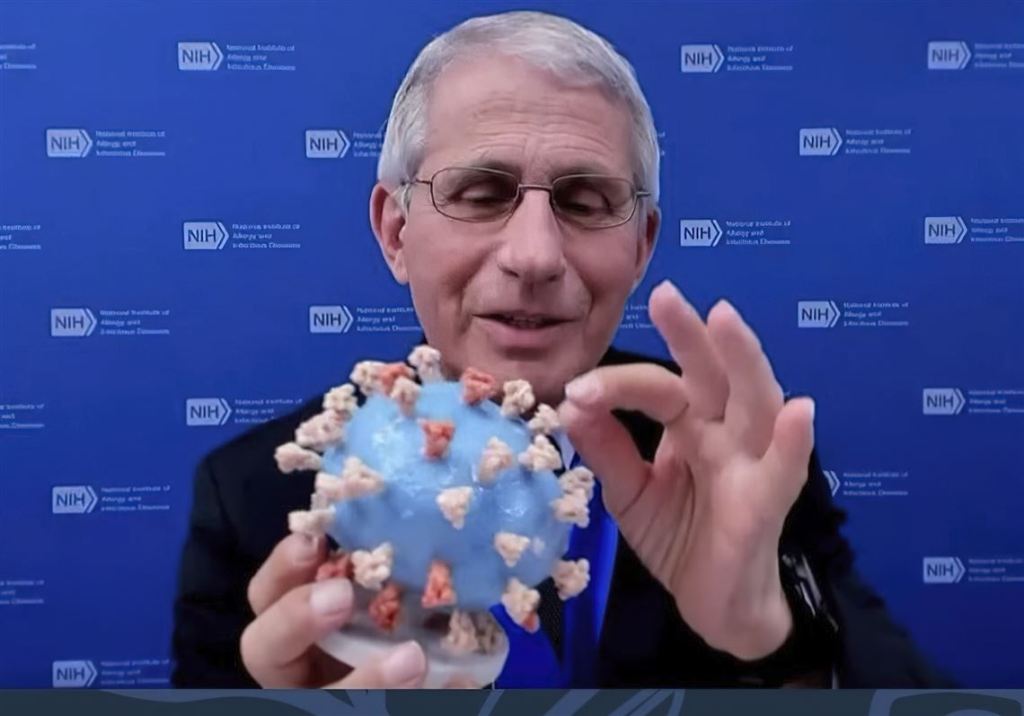
Dr. Anthony Fauci and the CIA have some splainin’ to do.
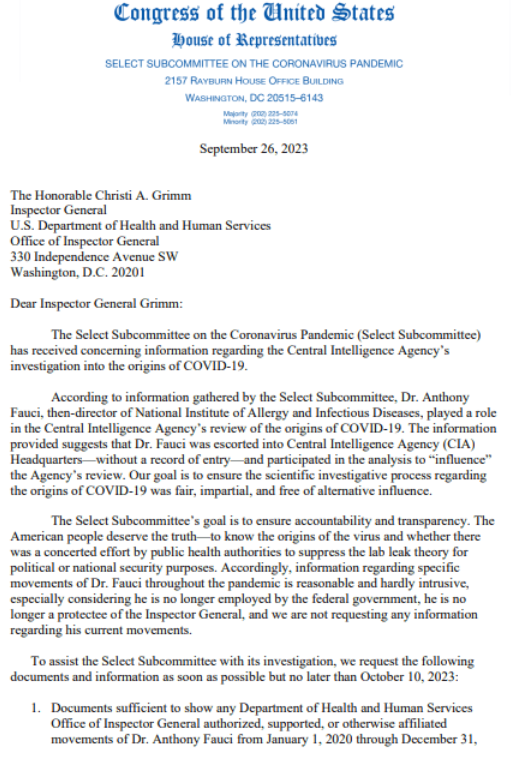
According to a new letter from the House’s Select Subcommittee on the Coronavirus Pandemic, Fauci was admitted to CIA headquarters “without a record of entry” while the agency was conducting its official analysis of the origins of COVID-19.
The letter claims Fauci “participated in the analysis to ‘influence’ the Agency’s review.” The date of the alleged meeting is not disclosed.
Rep. Brad Wenstrup (R., Ohio), chair of the committee, gave the inspector general of the Department of Health and Human Services until October 10 to submit all requested items and pertinent communications related to the then-director of National Institute of Allergy and Infectious Diseases’ clandestine meeting at Langley.
“The American people deserve the truth—to know the origins of the virus and whether there was a concerted effort by public health authorities to suppress the lab leak theory for political or national security purposes,” Wenstrup said.
Dr. Fauci has not yet made any public statements on the matter, but his alleged visit to CIA headquarters raises important questions.
Dr. Fauci has not yet made any public statements on the matter, but his alleged visit to CIA headquarters raises important questions.
Did Fauci request the meeting or the CIA?
Why was the meeting held in secret?
Was the CIA aware that Fauci had interests that may have conflicted with his ability to make an objective assessment of the origins of COVID-19?
Each of these questions is important, but let’s begin with the last one.
1. A Conflict of Interest?
As director of NIAID, Fauci, early in the pandemic, dismissed allegations that COVID-19 might have emerged from the Wuhan Institute of Virology, calling these claims “conspiracy theories” and alleging it was “molecularly impossible.”
It was later learned that Fauci made these statements even though scientists he commissioned to author a paper on the origins of the virus privately said otherwise.
It turns out Dr. Fauci had a very good reason to conceal the fact that COVID-19 likely escaped from the lab in Wuhan, as most US government agencies now believe (including the FBI and the CIA).
The National Institutes of Health (NIH), the agency that oversees NIAID, admitted in the fall of 2021 that for years the agency had been funding what was described as “risky virus research in Wuhan,” a charge Fauci had repeatedly and vociferously denied. Fauci, a longtime defender of gain-of-function research, had signed off on funding provided to the non-profit organization EcoHealth Alliance that had resulted in an “unexpected result”: an enhanced coronavirus from bats created in partnership with the Wuhan Institute of Virology.
That NIH had funded gain-of-function research is now beyond dispute, evidenced by the recent termination of funding for WIV after NIH “determined that…WIV conducted an experiment that violated the terms of the grant regarding viral activity, which possibly did lead…to…unacceptable outcomes.”
According toVanity Fair reporter Katherine Eban, officials at EcoHealth Alliance say they informed NIH of this “unexpected result” (an enhanced coronavirus) in a progress report in 2018, but Fauci says he didn’t see the progress report prior to his congressional testimony.
All of this helps explain why Fauci was so insistent from the very beginning that COVID-19 originated naturally from a wet market, even though scientists who wrote the “Proximal Origin” paper in Nature in early 2020 told him it was “friggin’ likely” and “plausible” the virus emerged from the Wuhan lab.
Was the CIA aware of this potential conflict of interest when Fauci allegedly visited CIA headquarters in an attempt to “influence the Agency’s review”?
2. Why Was the Meeting Held in Secret and Who Authorized It?
Putting aside the question of conflicting interests, there is the simple question of secrecy.
One could argue Fauci visited CIA headquarters because he was director of NIAID and an infectious disease expert. The problem with this argument is that Fauci had already made many public statements on the origins of the virus, and if he was simply offering an elaboration of his points, there would be no need to hold such a meeting secretly.
Moreover, the CIA was conducting an independent review. That means the agency was supposed to reach its determination without outside influence.
A visit from Fauci has all the appearances of attempting to influence the outcome of the CIA’s report, which is no doubt why the visit went “without a record of entry.”
Who authorized the secret visit and why?
3. Who Requested the Meeting and Who Was Present?
The fact that Fauci’s alleged visit to Langley was done surreptitiously suggests that both the CIA and Fauci understood there were troubling ethics in making such a visit when the agency was conducting an independent review of COVID-19’s origins.
This raises an important question: Who requested the meeting, Fauci or the CIA?
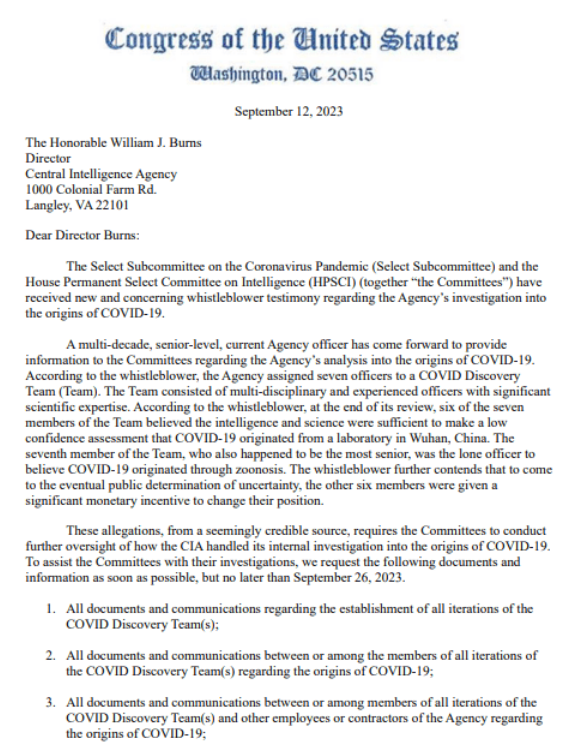
This is not a trivial question. Mere weeks ago, a letter sent to CIA Director William Burns stated that a senior-level CIA whistleblower claimed the agency attempted to bribe six analysts who concluded with a low level of confidence that COVID-19 originated in the Wuhan lab, allegedly offering six of the seven agents cash incentives to change their conclusions.
“The whistleblower,” the letter states, “contends that to come to the eventual public determination of uncertainty, the other six members were given a significant monetary incentive to change their position.”
If the charge is true, it means public officials attempted to bribe CIA analysts tasked with providing an official government assessment of the origins of the most deadly pandemic in a century to influence the outcome of their report.
That’s a very serious charge. The public deserves answers.
‘A Massive Coverup Spanning from China to DC’?
From the beginning of the pandemic, there has been a persistent government effort to silence and marginalize those who questioned NIH’s policies and conclusions.
It began with coordinated attacks on those who challenged the government’s COVID policies, which was first revealed when the American Institute for Economic Research published emails showing NIH Director Francis Collins instructing subordinates (including Fauci) on the need for “a quick and devastating published take down (sic)” of the premises of the Great Barrington Declaration, whose authors Collins described as “fringe epidemiologists.” (These “fringe” epidemiologists came from Stanford, Harvard, and Oxford University.)
The attacks later shifted toward those who challenged the government’s assertion that COVID could only have originated naturally, a claim that was treated as dogma. Social media sites suspended users (at the behest of the government) who suggested COVID could have been man-made.
It’s become apparent that “fighting misinformation” was never NIH’s goal, or that of any other government agency. The goal was to fight information that conflicted with the government’s narratives, a common practice of authoritarian regimes.
David Asher, the man who led the State Department’s investigation into the origins of COVID-19, recently explained to New York magazine journalist David Zweig that the reason we have so little information about COVID’s origins is because people in power prefer it that way.
“Our own State Department told us ‘don’t get near this thing, it’ll blow up in your face,’” Asher told Zweig. “It’s a massive coverup spanning from China to DC.”
The unprecedented attacks on free speech Americans have witnessed the last three years stem directly from what Asher describes. During the pandemic, NIH was awarded $150 million to fight “misinformation,” a block of money that has been halted in the wake of NIH’s blunders and First Amendment challenges.
The most important thing to understand is that the war on “misinformation” isn’t an effort to spread the truth; it’s an effort to conceal it.
Free speech is truth’s greatest ally, which is precisely why authoritarian regimes throughout history have been so hostile to it. The famed Supreme Court Justice Louis D. Brandeis had it right when he observed, in Whitney v. California that “the freedom to think as you will and to speak as you think are means indispensable to the discovery and spread of political truth.”
If Americans want the truth about the origins of COVID-19, they should stop supporting government-led efforts to censor speech and start pressing those in power to answer questions—starting with Dr. Fauci and the CIA.
On critical matters, our medical authorities have no interest in settling the science. Instead, battles are won in the arena of smear and insinuation
The reality is that most of us are not ready for the truth. We want reassurance. We cling to our comfort blankets because the idea that we live in a world in which our and our families’ interests are not paramount is too disturbing.
The idea that our fates are entirely dependent on a giant Ponzi scheme that might come crashing down at any moment from any one of multiple design flaws – an ecological crisis, a nuclear catastrophe, a pandemic or a hubristic mis-step with Artificial Intelligence – is simply too terrifying.
So, even as we mock a figurehead like Donald Trump, Joe Biden or Boris Johnson, we remain deeply invested in the system that keeps producing them. We need to believe – and just as desperately as a child refusing, a little longer, to give in to suspicions that Father Christmas might not exist. Despite all the evidence to the contrary, our societies, we insist, are on a continuous upwards trajectory named progress.
Few are willing to consider that we might actually be in a death spiral. So instead of doing something to change the world, we bury our heads. We ignore every sign, however blatant, of the system’s inherent dysfunction and corruption.
Horse dewormer
These dark thoughts are prompted in part by the very belated concession from the Food and Drug Administration (FDA) – whispered by government lawyers in a court hearing – that for two years it has been peddling disinformation about both Ivermectin and the fact that doctors were not authorised to prescribe it in the treatment of Covid.
Ok, let’s pause right there. Because already I sense you reaching for the remote to change channels. Isn’t Ivermectin a horse drug that only anti-vaxxers and Covid deniers ever talk about?
Before I lose you entirely, let me hurriedly issue a disclaimer. This piece isn’t really about Ivermectin – least of all its efficacy in the treatment of Covid. I’m not a doctor and I’m not qualified to judge. I talk about things I am familiar with, that I have some insight on.
I’m not interested in medical debates about Ivermectin. I’m interested in deconstructing the political debates around it – and what they tell us about the way medical matters, and much else besides, have been entirely captured by political and commercial interests.
I can assure you I have no shares in Ivermectin and won’t profit either way, whether its use increases or declines. Unlike Big Pharma, that’s not the reason I’m taking an interest.
It just so happens that Ivermectin is a particularly fascinating case study – both of the corruption of our governance and regulatory systems, and of our own unwillingness to recognise that corruption out of fear of what it might signify.
Ivermectin provides one more data point that might help drag each of us out of our carefully constructed cocoon of ideological comfort. It might make us a little angrier, a little more willing to fight for our species’ survival.
‘Merely quips’
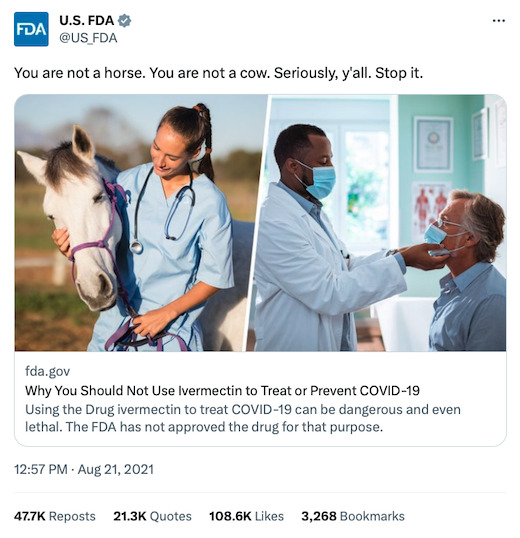
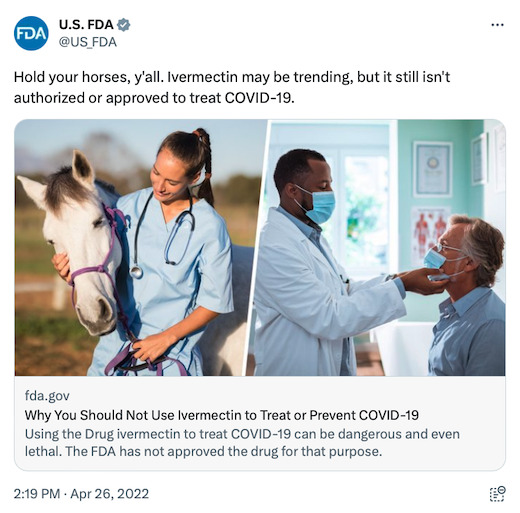
After all, the general assumption that Ivermectin is a horse dewormer didn’t come from nowhere. It was a view cultivated in us by the FDA and the corporate media. Here is the tweet the agency sent out exactly two years ago to persuade us that only dangerous nutjobs talk about Ivermectin:
I am guessing that those 108,000 likes make it one of the most influential tweets ever by the FDA. There is a reason why it went so viral.
The corporate media worked overtime to promote exactly the same messaging: that Ivermectin was only good for horses and cows. The media echoed the FDA in implying very strongly that the drug’s use in humans was not safe. There was not a late-night show host who did not mock Ivermectin as a horse drug and ridicule its supporters, even leading doctors.
Super-star podcaster Joe Rogan’s admission that he had been prescribed Ivermectin by his doctor when he fell ill with Covid were enough to foment demands for his banning from social media for spreading misinformation.
Social media giants like Youtube played their own part, treating any reference to Ivermectin, in pretty much any positive context, even by doctors, as “misinformation”. The algorithms were adjusted accordingly, which is why I will have to avoid mentioning Ivermectin when I post this story on social media.
And yet now, two years on, the FDA is quietly admitting that it, not Rogan, outright lied. Ivermectin isn’t a medicine used only by vets. It’s a human drug that’s been prescribed billions of times – and so successfully that it won the Nobel prize for medicine in 2015.
And not just that. It is now the FDA – not Rogan – admitting that Ivermectin is safe and that doctors, including Rogan’s, do indeed have the authority to prescribe the drug, not just to treat parasites but to treat Covid too.
It was tweets like the one above that instigated a witch-hunt by US state medical boards against doctors who prescribed Ivermectin, the matter at the heart of the case currently before the 5th US Circuit Court of Appeals.
With the FDA’s statements about Ivermectin now being harshly criticised by the judges hearing the case, the US government has fallen back on the barely credible argument that its comments were meant as “merely quips”.
So why would the FDA lie about Ivermectin – and maintain that lie for at least two years until forced to come clean under cross-examination by the courts?
And why did all those expert medical correspondents working for Big Media, journalists who knew only too well that Ivermectin was a human drug, conspire with the FDA in promoting a blatant lie?
Here, for example, is Dr Sunjay Gupta of CNN being put on the spot by Rogan when he appeared on his show. He is forced to admit, uncomfortably, that the media were not telling the truth about Ivermectin.
Emergency use
Which brings us to the politics surrounding Ivermectin – which is far more revelatory than any medical debate about it.
Remember, the FDA’s drug division receives three-quarters of its funding from the pharmaceutical industry. That doesn’t just mean the continuing salaries of many thousands of government officials depend on keeping Big Pharma happy. It also ensures wider political pressures. Washington prefers not to alienate Big Pharma and then have to foot the FDA’s budget through higher taxes. And, as we shall see, leading politicians have every incentive to avoid picking a fight with a corporate America.
The reality is that Ivermectin and other drugs that might have been repurposed for Covid posed an enormous threat in principle to the FDA and its funders in Big Pharma – completely aside from the practical question of whether those drugs actually work against Covid.
The new, experimental mRNA vaccines could only be rushed out for use in humans on the basis of an emergency authorisation so long as no other drug could be shown to be an effective treatment for Covid.
Well, that was a good thing, I hear you say. Those vaccines reduced the severest symptoms, even if sadly they didn’t actually stop transmission.
Let’s pull back a second and try to see the bigger picture for a moment. Let’s do precisely what the FDA and Pfizer don’t want us to do: engage our critical faculties.
Ivermectin has been off-patent for years. No one can make any serious money from it, and certainly not giant pharmaceuticals based in the United States. Any Indian factory with the right approvals can knock out the tablets for a few cents.
So in short, Big Pharma, which was poised to become fabulously enriched by its new vaccines, had every financial incentive imaginable to make sure there were no rivals in the stakes for a Covid miracle cure. The focus had to be entirely and exclusively on the vaccines.
Endless profiteering
The corporate media had exactly the same priorities. Why?
A superficial, if truthful analysis is that companies like Pfizer subsidise the corporate media as heavily as they do the FDA. Just watch this short compilation video to get a sense of quite how complete Big Pharma’s stranglehold of sponsorship is on the main TV networks:
But a deeper analysis is that Big Pharma and Big Media are just separate wings of the same Big Business empire headquartered in the US. What’s good for Big Pharma is good for Big Weapons is good for Big Farming is good for Big Food is good for Big Media, and so on.
What is important for all of them is the maintenance of a political and economic climate that allows for Big Everything’s permanent profiteering. What is good for one of them is good for all.
So Ivermectin was never going to be allowed a look-in, irrespective of whether it worked.
But that doesn’t really matter, I hear you interject, because Ivermectin doesn’t work against Covid.
And how do we know that? The anwer is we don’t. Our assumption that Ivermectin is useless against Covid is nothing more than that. It is an assumption. Some studies suggest it doesn’t help, while others suggest possible effectiveness.
Medicine has an established way to deal with such uncertainties. It settles them with an expensive, large-scale, randomised, controlled study.
In a time of profound crisis such as a pandemic, politics has an additional way to settle such questions: move heaven and earth to carry out emergency trials of drugs that look like they may be suitable for repurposing against the threat. Shift into a war footing.
Which is exactly what would have happened – not just for Ivermectin but for other promising potential treatments like the mis-named sunshine hormone Vitamin D – if we lived in a world in which scientific principles, not profiteering by a tiny wealth-elite, guided our societies’ decisions.
Instead, all of us – even children who were under no threat from Covid – were forced to worship exclusively at the altar of the novel vaccines.
That should make your blood boil.
Many millions of people died. Some of them might have been helped through the use of safe, potentially beneficial treatments before the vaccines were rolled out.
Some of those who refused to take the vaccines – the heretics – might have had their lives saved through the approval of other treatments.
Everyone, even the vaccinated and multi-boosted, might have had even better outcomes with the help of treatments to complement the vaccines.
Instead, the response to the pandemic prioritised one thing only: not saving lives, but maximising to the greatest extent possible the profits of Big Pharma.
I don’t know whether Ivermectin would have helped. You don’t know whether it would have helped. But what’s important – what is scandalous – is that the FDA doesn’t know either, and still doesn’t care to know whether lives would have been saved through the use of treatments in place of, or in addition to, the vaccines.
That is a violation both of fundamental medical ethics and of the social contract. I can barely believe I need to spell it out – and even less that I will be called irresponsible for doing so by the vaccine cultists.
Smears and insinuation
The issue isn’t whether Ivermectin works against Covid. That narrow issue is the one Big Pharma, Big Media and the FDA want you focusing on. Because they have made sure the question will only ever be settled in the arena of official smear amd insinuation, in misleading social media soundbites like the FDA’s horse drug one.
That isn’t science, it’s propaganda.
To run a controlled trial of Ivermectin for treating Covid – even now, three years too late – costs a small fortune. One that can be afforded only by Big Pharma or governments. And in the circumstances, neither has any interest to find out.
Why does this matter? It shouldn’t need stating. But from reactions on social media, I see that it very much does.
It matters because it shows that we live in a world where “facts” are of no interest, where science is not followed, unless it can be monetised. Science is no longer for the benefit of all. It has become private property – the property of powerful, unaccountable corporations – like everything else in our societies. Science has been weaponised to further enrich a corrupt wealth-elite.
It matters because, if we continue to resign ourselves so passively to these constant mind-games and manipulations, we must also accept that the profiteering they conceal should take priority over our health, over saving lives.
Ivermectin isn’t the issue. It’s a waymark: to the depths of corruption to which our supposedly Enlightened, rational civilisation has been sunk by money and its worship.
“Trust the experts,” we are constantly being told, whatever the topic of discussion. The problem with this advice is that the so-called “experts” are frequently wrong, sometimes as a result of plain incompetence and other times because it is their function to propagandize rather than to educate.
For instance, I got my start doing citizen journalism speaking out against the US government’s planned war on Iraq. In 2002 and early 2003, the government claimed that Iraq had stockpiles of chemical and biological weapons, active weapons manufacturing programs, and an active nuclear program aimed at producing a nuclear bomb. Mainstream media outlets like the New York Times uncritically parroted the government’s claims. All the “expert” analysts and commentators towed the official line.
When I would point out to people that there was no credible evidence to support the government’s claims that Iraq had weapons of mass destruction (WMD) and that the documentary record rather indicated that Iraq had been disarmed of the weapons it produced during the 1980s with the support of the US government, I was frequently confronted with the idea that we should trust the expert intelligence analysts because surely government policymakers must have classified information supporting their case that they just couldn’t share with the public.
Later, when the Central Intelligence Agency (CIA) issued its official report acknowledging that Iraq had indeed been disarmed by UN inspectors by 1991 and never restarted its weapons programs, a whole new propaganda narrative was developed to whitewash how the US government lied to the American people and the world. We were then fed the myth that there had been an “intelligence failure”, the truth being that the government had successfully waged a disinformation campaign against the public for the purpose of manufacturing consent for an illegal war of aggression that left Iraq devastated, with negative ripple effects throughout the Middle East, including the war’s precipitation of the rise of the Islamic State of Iraq and Syria (ISIS).
Another example is the housing bubble that precipitated the 2008 financial crisis. The mainstream “experts” insisted that there was no bubble, that the economy was rolling along nicely. Right up to the bubble’s peak, Federal Reserve Chairman Ben Bernanke refused to see it. In the New York Times, throughout the 2000s, Keynesian economist Paul Krugman lauded the Fed’s inflationary monetary policy that was the principal cause of the housing bubble only to ludicrously blame the bubble on the forces of the free market after it burst.
Meanwhile, free market economists schooled in the ideas of Austrian economics, so called because its founders and early luminaries hailed from Austria, were accurately warning how the Fed’s policy of maintaining artificially low interest rates—meaning rates below where they would otherwise be if determined by the market rather than by a roomful of policymakers—was fueling a housing bubble that would cause economic devastation when it inevitably burst. Congressman Ron Paul famously warned about this as early as 2001, yet we were consistently told by the mainstream “experts” that we shouldn’t listen to him or other advocates of liberty in the marketplace.
The preposterousness of the mainstream narrative was so overwhelming, it prompted me to write a book titled Ron Paul vs. Paul Krugman: Austrian vs. Keynesian Economics in the Financial Crisis, which ended up getting a rave review by none other than Barron’s. Gene Epstein, the former Economics and Books editor for Barron’s said of it:
Any work of economics that can make you laugh is at least worth a look. If in less than 100 pages it also informs you about a subject of great importance, it might just qualify as a must-read. Jeremy Hammond, a political journalist self-taught in economics and a writer of rare skill, has produced such a book…. This short work conveys more insight into the causes and cures of business cycles than most textbooks, and more about the recent business cycle than most volumes of much greater length.
Once again, we could see that there is a whole class of “experts” whose primary function was not to truly educate us about how the economy functions but to manufacture consent for the existence of central banking—the Fed being a government-legislated private monopoly over the currency supply.
That episode also once again illustrates how any non-expert willing to commit the time to self-education can easily see through the lies and deceptions propagated by the “experts”.
Arguably, there is no more perfect example of how the “experts” get things completely wrong than the governmental responses to the COVID‑19 pandemic. While I and others fervently opposed the lockdown measures from the start on the grounds that they would do more harm than good, the thought-controlling media insisted that we must trust the government’s “experts” like Dr. Anthony Fauci. We should “follow the science” we were told, while Fauci claimed to be science incarnate, deeming himself beyond reproach by proclaiming that to criticize him was to attack science itself.
While all the “experts” in the so-called “public health” establishment were proclaiming that widespread acceptance of the mRNA COVID‑19 vaccines would end the pandemic by conferring herd immunity, dissident voices like my own were being censored for telling the truth that there was no scientific evidence that the vaccines would induce durable sterilizing immunity that would prevent infection and transmission of the virus.
I was also warning since very early into the mass vaccination campaign that the policy goal of getting everyone vaccinated could prolong the pandemic and worsen outcomes in the long-term because of the immunologic phenomenon of “original antigenic sin” and the opportunity cost of superior natural immunity. These warnings, too, proved prescient as we now know from the available scientific evidence that the mRNA COVID‑19 vaccines do result in an “immune imprinting” so that vaccinated individuals are stuck generating a suboptimal immune response to circulating SARS‑CoV‑2 variants.
After it became obvious from the data that the vaccines failed to prevent infection and transmission of the virus, the media went so far in their efforts to defend the criminal regime of lockdowns and coerced mass vaccination by gaslighting us and absurdly denying that the COVID‑19 vaccines were sold to the public on the basis of lies.
We’re also supposed to trust doctors, but my own household’s experience with the medical establishment led us to the opposite conclusion. The doctors were not just unhelpful; they were less than useless. Especially in my wife’s case, listening to them caused more harm than good. In fact, it wasn’t until we learned to stop listening to the doctors and started trusting our own judgment that my wife and I both found a path to healing from the respective health problems we used to have (leaky gut in my case and mercury toxicity from dental amalgams in my wife’s).
Throughout the time that I was seeking help from the so-called “health care” system, I was repeatedly confronted by doctors whose ignorance was matched only by their arrogance and condescension. I ultimately bypassed the doctors by researching our symptoms directly in the medical literature; we diagnosed ourselves and successfully treated the root cause of our respective symptoms (taking steps to heal my gut and getting the mercury fillings safely removed followed by a two-year mercury detox regimen, respectively).
The supposed “experts” with an “MD” after their name were far more interested in lazily pushing pharmaceutical products on us to treat symptoms than in doing their job to try to figure out what the root cause was, much less in figuring out treatments aimed at addressing the underlying cause.
So, the next time you hear someone telling you to place your trust in the “experts”, emphasize the foolishness of placing blind faith in supposed authorities in lieu of doing one’s own research and thinking for oneself, and remind the person how the “experts” are frequently nothing more than professional propagandists serving a given political or financial agenda.
“All across the board, illness, disability, cancer, heart, autism, fertility…WeFkdUp !!!” —The Ethical Skeptic on Twitter
What if Dr. Geert Vanden Bossche is correct? The Dutch virologist said at the outset of the Covid-19 episode in 2020 that vaccinating the world in the midst of an epidemic was insane because it would train the virus to evolve more dangerously while disabling human immune systems.
Last week he issued a warning that the world was within weeks of just such a new and deadly immune escape variant outbreak that would bring on a shocking wave of sickness and death among people who received multiple Covid-19 vaccinations. This would happen on top of an already accelerating rise in latent vaccine adverse reactions manifesting as aggressive cancers, blood disorders, cardiac injury, neurological disease, and much, much more.
To this point in the Covid-19 story, Western Civ in general, and the USA in particular, have descended into an epic group psychosis as a result of the managed mind-fuckery induced by their own governments in collusion with a pharmaceutical industry metastasizing on money the way an aggressive cancer feeds on sugar in a human body. Fearful citizens swallowed all manner of unreality foisted on them by means of propaganda and censorship.
We still don’t know for sure how, who, and why, exactly, Covid-19 was set loose on the world, and the public health agencies don’t want you to know. Perhaps the worst and most baldly dishonest act was the official suppression of effective treatments with common, safe, anti-virals that could have saved millions of lives. And all just to preserve the vaccine companies’ liability shield from the Emergency Use Authorization. In fact, governments are still militating against the sale and use of ivermectin and hydroxychloroquine, which could be taken prophylactically in anticipation of a new outbreak.
So, if these populations were driven crazy by authorities ginning up their fear and preying on it, what will happen if that fear turns to anger instead? Because that’s exactly what will happen when Americans, and perhaps even Europeans, realize they’ve been subject to history’s biggest homicidal fraud. That anger is going to seek targets, and they are going to find them very easily in their own government officials and also — get this — in the medical establishment that has betrayed its patients so unconscionably.
It’s just impossible to say exactly how that will play out on-the-ground. Governments are already falling — Spain, the Netherlands — but these were parliamentary downfalls according to regular political procedure. Our country has no such procedures for changing authority in a time of crisis. Instead, we have a president up to his neck in bribery scandal and executive agency thuggery, and political parties sunk in corruption, and no way to get rid of them except elections many months away — elections which at least half the people don’t believe are honest.
This crisis of bad faith and sickness is happening at the same time that Western Civ enters an equally vicious crisis of economy and finance. America and Europe are broke. All are playing games with their conjoined banking systems and their currencies. All are de-industrializing economies strictly based on industrial production of goods no longer being produced, and pretending to replace them with economies of computer vapor-ware. That can’t work and can only end badly in collapsing standards of living.
The past few years, an apparent coalition of global elites, functioning in orgs such as the WEF, the WHO, the EU, the IMF, the central banks, and countless NGOs, along with shadowy intel units and what remains of the old news media, have promoted ever more desperate top-down control programs to prevent a breakdown into wholesale economic and political disorder. Their efforts increasingly tilt into pretense.
Try to impose digital currencies and health passports? Fuggeddabowdit. You will only get a chaos of work-arounds, non-compliance, and probably violent opposition. Keep that stupid, dishonorable, perfidious, and unnecessary war going in Ukraine and you run the risk of turning Western Civ into a matched set of ashtrays.
As you can see, there has already been enough official mischief, crime, and malfeasance to severely piss-off the population. If Dr. Vanden Bossche is correct, we are perhaps heading into the conclusive shock of an evil era. Some kind of monumental correction will be in order. The people will need some way to regain credible self-governance, either through personnel change in every locus of power, or some revision in structure and procedure. For now, there is little faith that our institutions can manage either of those options. Better maintain situational awareness as we creep into the unknown.
I’d like to pose a question I’ve been dancing around for the last couple of posts: Is the United States a failed society?
That may seem overly dramatic, but please hear me out.
Recently, it has once again come to the attention of the news media that Americans are an order of magnitude more likely to die at every age than citizens of other advanced, wealthy, industrialized nations.
This was most recently expounded by a Financial Times correspondent named John Burn-Murdoch. The article itself is paywalled, but this Twitter thread contains all the relevant information:
It makes for sobering reading. A lot of times the discussion just focuses on total life expectancy, that is, the number on the death certificate. That’s fallen too, but not as dramatically. But life expectancy differs at various ages. Yet, what the numbers invariably show is that, at every single age Americans are more likely to die than their counterparts in other wealthy industrialized nations.
For example, one in 25 five-year-olds in the United States will not live to see their fortieth birthday. That means a lot of parents are going to have to bury their children. But at every age, whether you’re twenty-five or fifty, your chances of dying are much higher in the United States than anywhere else. By age 29, the average American is four times more likely to die than a 29 year-old in another country. I’ve heard plenty of stories from people in their twenties and thirties talking about their high-school years like military veterans recounting their service during wartime (“fifteen in my class didn’t make it out.”). And those are just ordinary citizens!
In other words, growing up in the United States is extraordinarily deadly.
In fact, the social outcomes for the average American are worse than the most socially deprived areas of the United Kingdom like Blackpool—an area synonymous with industrial decline. At every single point along the income distribution, Americans are more likely to be hurt, injured, or killed than their peers in other wealthy, developed nations.
Furthermore, these trends are exclusively confined to the United States. Even Cuba, a relatively poor country under continuous sanctions by the United States since the nineteen-sixties, now has better health outcomes (e.g. life expectancy, infant mortality, chronic diseases). So, too, does China, which has overtaken the U.S. in a number of health metrics despite being the largest country in terms of total population.
The Atlantic’s Derek Thompson has called the United States “The Rich World’s Death Trap.” He interviews John Burn-Murdock here:
The bottom line is this: in many ways, your life chances are much, much lower in the United States than in any other wealthy, industrialized nation in the world. This is simply undeniable.
Which leads me to pose the question I asked above.
Peer Countries
Because this is such a fraught topic, it’s worthwhile to get some things out of the way. Certainly your life chances in the United States are better than many other parts of the world at the moment.
Some places are run by military dictatorships like North Korea or Myanmar. Some places are in outright civil war like Syria, Libya or Sudan. Some areas are in an active shooting war like Ukraine and Russia. Some countries have huge areas of absolute deprivation like sub-Saharan Africa, India, the Philippines or Afghanistan. Some countries have lost control over parts of their territory to drug gangs like Mexico, El Salvador, Peru and Ecuador. You’re certainly better off here than in many of those other countries.
So let’s just acknowledge that right off the bat. Of course, this raises questions about just how supposedly wonderful the current state of our world actually is, but that’s a topic for another time.
But I think it’s absolutely invalid to invoke those countries as a justification for the abysmal statistics listed above. Here’s why: the United States is at the absolute apex of the global economy, and has been since World War Two. We issue the world’s reserve currency. We have more billionaires than anywhere else. We are home to the largest and most powerful corporations in the world. No country in the world is more wealthy or powerful than the United States at the present moment.
This is the concept of peer nations. Those are the ones we should be judging ourselves against. You can use a number of indicators for this. The United States is a member of both the OECD and the G-7. In fact, it is the key member of these organizations. It is at peacetime. It is an electoral democracy. It has the world’s largest GDP. It is surrounded by the world’s two largest oceans and has benign neighbors to the north and the south. It has not had a war on its home soil since the 1860s.
Simply put, the United States has more resources at its disposal and more wherewithal to tackle social problems than anywhere else in the world.
So, unlike many other countries around the world, the United States has no excuse whatsoever for the sorry state of its citizenry, and comparing the United States to non-peer countries is no more than pathetic excuse-making in the face of damning evidence that the U.S. government simply chooses to ignore burgeoning social problems and leaves the majority of its citizens to fend for themselves.
What Else Is New?
Reading these facts, I’m wondering why any of this this is news to people. As far back as 2013 I noted the following:
Americans die younger and experience more injury and illness than people in other rich nations, despite spending almost twice as much per person on health care.
That was the startling conclusion of a major report released earlier this year by the U.S. National Research Council and the Institute of Medicine. It received widespread attention. The New York Times concluded: “It is now shockingly clear that poor health is a much broader and deeper problem than past studies have suggested.”
It received widespread attention all right, and then was promptly forgotten. But even earlier, in 2012, there was this report from The Lancet:
American teenagers have the highest rates of drug and alcohol abuse in the developed world. And they are far more likely to be killed by violence than peers in Europe. This lost generation, whose unemployment rate is 20 percent, leads the modern world in some of the most dangerous and irresponsible behaviors, according to a new study released by the Lancet medical journal.
In 2019, husband-and-wife economists Angus Deaton and Anne Case coined the term “deaths of despair,” and noted that these were exclusively confined to the United States. In 2020, they published a book chronicling their grim studies with that same title. It, too, received a brief burst of attention in the media and then promptly disappeared down the memory hole just like everything else.
So this is old news. As Burn-Murdock’s article notes, the divergence between the U.S. and its peers has been continuously growing since around 1990, and has been getting even more acute in recent years.
The above podcast touts how “rich” we are compared with other nations using metrics like dollar income. But what does a high salary even mean when you are less likely to survive than other places? What are you supposed to do with that money, anyway—fill your oversized house with crap? As the saying goes, “you can’t take it with you.” This also belies the insanely high cost of everything in America, especially housing, which leads to 70 percent of Americans feeling financially stressed according to CNBC, despite how “rich” we supposedly are. According to Brookings, 44 percent of Americans earn low wages in this allegedly “rich” country.
And, as economist Dean Baker has noted, people in many other countries choose to take their additional “income” as leisure time, which may be another reason why they are so much healthier than we are. Americans work longer hours than anyone else, and at unusual times. The United States has a lousy work culture, with much less vacation or family leave time than other countries. Americans also take less vacation, work longer days, and retire later. Citizens of other countries also don’t have to pay for as many things out of their own pocket—from transportation, to retirement, to health care—due to a misguided fear of “socialism,” making income comparisons misleading. What sense does it make to earn a lot of money if you are lonely and isolated and have no time off to enjoy it? And much of that extra income is dedicated to cushioning ourselves from the fallout of a society decaying around us and positional goods to compete with everyone else.
My question is this: if the United States is not a failed society, then by what criteria should we judge success? Are context-free income statistics, GDP, and the number of billionaires really the appropriate measure for a good society rather than the well-being of the average citizen? People like to tout America’s so-called “innovation,” but one area we don’t seem to be innovating very much in is keeping our citizens healthy and alive.
The symptoms versus the disease
The reasons given for the above statistics are the usual ones: gun violence, drug overdoses, suicides, car crashes, metabolic diseases, and lack of access to basic and preventative health care compared to other nations.
But I want to distinguish the symptoms from the disease.
In medicine, doctors are taught to separate the symptoms from the disease. If a patient is suffering from a fever, jaundice, and swelling, for example; the fever, jaundice, and swelling aren’t what is making them ill. Instead, these are all symptoms caused by the disease which the patient is afflicted with, and it is the doctor’s job to determine what the disease is from the symptoms and try to cure it.
If that is the case, then what is the disease we are suffering from in this instance? In my opinion, it is this: American society is fundamentally rotten to the core.
We have effectively restructured our entire society as a lottery. Under this system, you’re entitled to precisely nothing except what you can claw free from the impersonal market casino rigged in favor the House. American society been transformed into a brutal winner-take-all tournament in the name of “meritocracy,” and most Americans seem to be okay with that.
At every point on their hierarchy, from the highest perch to the lowest, everyone is desperately trying to maintain their current position, hyperattuned to status, fearful of falling into the abyss, clawing each other’s eyes out to hold onto their small piece of the pie in a crabs-in-a-bucket scenario. “There is no such thing as society” has been elevated from a political statement to a a central guiding tenet where it’s every man for himself and the devil take the hindmost.
While other nations at least try to look after the welfare of all of their citizens, in America if you are not rich, successful or an entrepreneur, then your life is worth nothing. If you aren’t good enough, or don’t measure up, then you deserve to suffer. We actively hate the poor and think they should die. We talk about them like animals. Average is over. The rich get richer. Winners take all.
Cutthroat capitalism is the order of the day. Your only task when you get up every morning is to get as much of the other guy’s money as possible into your own bank account by any means necessary for the next twenty-four hours and do it all over again the next day. There is no higher purpose. “Freedom” is defined as the ability for the rich to do whatever they like to the rest of us without consequence or sanction. It’s a world of predator and prey where you can either be one or the other—there is no other option.
Unlike in other countries, in the United States the government does not exist to help its citizens; rather, its primary role is to funnel money to a series of well-connected insiders feeding at various troughs. The rest of us are on our own. No one is on your side.
In every country, you need to educate your citizenry and keep them safe and healthy. That is the most basic task of any government, anywhere. In the United States, these tasks are delegated to predatory institutions designed to extract as much money as possible so that sticky-fingered middlemen can siphon off as vast amounts to feather their nests. A small sliver of executives in finance, education and health care get obscenely rich while the rest of the population struggles and is mired in debt, assuming they can even access those services at all. As a result, Americans pay wildly inflated prices for just about everything, from health care, to education, to energy, to entertainment and telecommunications. And the system cannot be changed because those insiders and middlemen fund the political campaigns and spend billions on highly effective propaganda. The rich people at the apex cynically strip-mine society for their benefit, while there are fewer paths than ever to a middle class lifestyle for the average person.
“Everything for myself and my immediate offspring; nothing for other people,” is the pervasive ethos: “I dont want pay for someone else’s (health care, education, fill-in-the blank).” But once that attitude becomes endemic, you no longer have anything even resembling a society anymore; you have only collection of individuals fending for themselves. As the title of a post from a few years back put it, “I don’t know how to explain to you that you should care about other people.”
It is a nation of sociopaths where fellow citizens are seen as either enemies or competitors. The simple warmth of human kindness has been abolished. Americans walk around in a constant state of fear and high alertness like the prey animals they have become. Or else they have the thousand-yard-stare grazing in the aisles at Walmart. I’ve mentioned before how many Americans seem to be crazed and deranged, or zonked out on drugs, and don’t know how to behave around other people or show basic decency. People seem more and more desperate. I personally have witnessed many more acts of erratic behavior and dangerous driving lately, and have heard similar stories from other people. American society seems to be under more pressure than ever before, and people are cracking up left and right. It feels like a lot of people—even the supposedly “successful” ones—have basically checked out and are simply going through the motions.
The United States is a plantation society to the core. At a basic, fundamental level, American society is not set up not to deliver a good quality of life to it citizens, but rather for a small segment of hard, hard men to get unfathomably rich beyond the dreams of avarice, with the rest of us no more than insects to be stepped on in pursuit of that goal. And if some people happen to enjoy good lives anyway under that system, well, it’s more of an unintentional side-effect than a deliberate outcome. Perhaps you’re one of those hard men (or women), or hope to be. Good for you, I guess.
So I think that’s the fundamental reason for all of the above. That’s the disease, and everything else is merely a symptom—our refusal to properly fund universal health care; our built environment designed exclusively around cars and lack of public transportation; our fat and sugar-laden diets; our overcrowded prisons; our opioid-addicted homeless; our frayed social safety nets; our violent, trigger-happy cops; our extortionate education costs; our predatory financial institutions; our refusal to build affordable housing; and our propensity to shoot one another. American society is rotten to the core.
For example, even though our weekly mass shootings make international headlines, they don’t really have that much of an impact on life expectancy when you compare them against the size of the world’s third most populous nation, despite troubling statistics like these:
Last year (2022), two people died from gun violence in the United States every hour. In 2023, there have been at least 160 mass shootings across the US so far this year. There are 120 guns for every 100 Americans. No other nation has more civilian guns than people. About 44% of US adults live in a household with a gun, and about one-third personally own one.
But that’s not the question we should be asking. The question we should be asking is this: what does this level of gun massacres and homicidal mania say about the nature of American society itself?
What does it say about American society that so many people have to turn to alcohol, opioids and other addictive drugs just to cope?
What does it say about America that it produces so many mentally-ill and broken people?
What does it say that Americans are so much fatter and sicker than people in other countries?
What does it say that we lock up more of our citizens than anywhere else in the world?
Americans are prickly and thin-skinned. They can’t bear any criticism of their nation, and will absolutely lose their minds at even the implication that they do not live in the best country on earth, despite mountains of evidence to the contrary (unless you are very wealthy). They will rationalize away all of the statistics listed above. Or else they will resort to immigrants as a way to shore up their fragile egos: “Everyone wants to move here!!!” Interestingly, according to the podcast above (-14:39), U.S. immigrants seem to live about as long as anyone else in the world. Perhaps it’s because immigrant communities tend to look after each other and manage to keep the toxic, every-man-for-himself individualism of mainstream American culture at arm’s length. Too bad for the rest of us, though.
In the end, the facts speak for themselves: By the standards that actually matter for the average individual, compared to peer nations, the United States is an objective failure.
Why is it like this? Some pessimists say that it’s been like this from day one and there’s nothing we can do about it. Perhaps they’re right. But the facts tell a different story. According to the data, it’s really only since 1990 that this yawning chasm in social outcomes has opened up in between the United States and the rest of the world. During the New Deal era, for instance, these gaps didn’t exist or actually favored Americans. The United States was able to accomplish big things like building the Hoover Dam and putting a man on the moon, and people didn’t hate and fear their own government. The U.S. was perceived very differently abroad.
Here’s what I think happened. Starting in the 1970s a small group of sociopathic men at the top of the hierarchy acquired the means and the tools to reshape the United States in their own image. They founded think-tanks. They funded economics departments and political campaigns. They bought up the media. They started television networks to promote their agenda. They packed the courts. They used the latest cutting-edge psychological research and techniques that had been developed in the service of advertising to remold the society like putty in their hands. Throughout the decade of the 1980s under Reagan, their plans ultimately came to fruition, and the transformation was compete by 1990 which is why the changes became apparent after then. Ever since, we’ve been living in the society that they have created. I’m skeptical that Americans were always inherently more sociopathic and antisocial than people everywhere else—I think to a large extent we’ve been made to be this way.
So we’re all living in the end result of that. And now that it has been accomplished, we see the ugly results everywhere around us, including increasing political radicalization and strife as the failure of this vision of society is becoming increasingly apparent but we seem to be incapable of envisioning an alternative or are too fearful of change. Instead, we seem to be doubling down. I fear it’s already too late to turn things around, and this is just the way American society will be forever now and things will just continue to get worse and worse for the vast majority of us. We will remain the (not so) rich world’s death trap, permanently.
I’ll conclude with this passage which I read years ago:
If I could paint the country in one broad stroke, I would say it’s a place where one concept of freedom – used to lobby for private interests and free markets – is at odds with another kind: the ability to lead a life you enjoy. Fewer and fewer seem privileged with this second kind. Not Trayvon Martin, who was a victim of a certain kind of racism which had, as its root, private property anxiety. Not the natural gas employee who has consigned himself to a life of doing something that he feels ought not to be done. Even I – who have managed to escape from time to time – always find, upon return, a cordial invitation to fall in line.
In 2021, an Oxfam review of IMF COVID-19 loans showed that 33 African countries were encouraged to pursue austerity policies. Oxfam and Development Finance International also revealed that 43 out of 55 African Union member states face public expenditure cuts totalling $183 billion over the next few years.
As a result, almost three-quarters of Africa’s governments have reduced their agricultural budgets since 2019, and more than 20 million people have been pushed into severe hunger. In addition, the world’s poorest countries were due to pay $43 billion in debt repayments in 2022, which could otherwise cover the costs of their food imports.
Last year, Oxfam International Executive Director Gabriela Bucher stated that there was a terrifying prospect that in excess of a quarter of a billion more people would fall into extreme levels of poverty in 2022 alone. That year, food inflation rose by double digits in most African countries.
By September 2022, some 345 million people across the world were experiencing acute hunger, a number that has more than doubled since 2019. Moreover, one person is dying of hunger every four seconds. From 2019 to 2022, the number of undernourished people grew by 150 million.
Billions of dollars’ worth of arms continue to pour into Ukraine from the NATO countries as US neocons pursue their goal of regime change in Russia and balkanisation of that country.
Yet people in those NATO countries are experiencing increasing levels of hardship. The US has sent almost 80 billion dollars to Ukraine, while 30 million low-income people across the US are on the edge of a ‘hunger cliff’ as a portion of their federal food assistance is taken away. In 2021, it was estimated that one in eight children were going hungry in the US. In England, 100,000 children have been frozen out of free school meals.
Due to the disruptive supply chain effects of the conflict in Ukraine, speculative trading that drives up food prices, the impact of closing down the global economy under the guise of COVID and the inflationary impacts of pumping trillions of dollars into the financial system between September 2019 and March 2020, people are being driven into poverty and denied access to sufficient food.
Matters are not helped by issues that have long plagued the global food system: cutbacks in public subsidies to agriculture, WTO rules that facilitate cheap, subsidised imports which undermine or wipe out indigenous agriculture in poorer countries and loan conditionalities, resulting in countries ‘structurally adjusting’ their agri sectors thereby eradicating food security and self-sufficiency – consider that Africa has been transformed from a net food exporter in the 1960s to a net food importer today.
Great game food geopolitics continue and result in elite interests playing with the lives of hundreds of millions who are regarded as collateral damage. Policies, underpinned by neoliberal dogma masquerading as economic science and necessity, which are designed to create dependency and benefit a handful of multi-billionaires and global agribusiness corporations who, ably assisted by the World Bank, IMF and WTO, now preside over an increasingly centralised food regime.
Many of these corporations have engaged in rampant profiteering at a time when people across the world are experiencing rising food inflation. For instance, 20 corporations in the grain, fertiliser, meat and dairy sectors delivered $53.5 billion to shareholders in the fiscal years 2020 and 2021. At the same time, the UN estimates that $51.5 billion would be enough to provide food, shelter and lifesaving support for the world’s 230 million most vulnerable people.
As a paper in the journal Frontiers noted in 2021, these corporations form part of a powerful alliance of multinational corporations, philanthropies and export-oriented countries who are subverting multilateral institutions of food governance. Many who are involved in this alliance are co-opting the narrative of ‘food systems transformation’ as they anticipate new investment opportunities and seek total control of the global food system.
This type of ‘transformation’ is more of the same wrapped in a climate emergency narrative in an attempt to move food and farming further towards an ecomodernist techno-dystopia controlled by big agribusiness and big tech, as described in the article “The Netherlands: Template for Ecomodernism’s Brave New World.”
A ‘brave new world’ where a concoction of genetically engineered items, synthetic food and ultra-processed products will do more harm than good – but will certainly boost the bottom line of the pharmaceutical corporations.
While securing further dominance over the global food system and undermining food security in the process, global agribusiness frames this as ‘feeding the world’.
The model these corporations promote not only creates food insecurity but also produces death and illness.
Former Professor of Medicine Dr Paul Marik recently stated:
If you believe the narrative, Type 2 diabetes is a progressive metabolic disease that’ll result in cardiac complications. You’re going to lose your legs. You’re going to have kidney disease, and the only treatment is expensive pharma drugs. That is completely false. It’s a lie.
It is projected that by the end of this decade half of the world’s population are going to be obese and over 20% to 25% will have Type 2 diabetes.
According to Marik, the bottom line is Type 2 diabetes is a metabolic disease due to bad lifestyle and really bad eating habits:
“We eat all the time. We snack all the time. This is part of the food industry’s goal. Processed food, starch, becomes an addiction. Most of us are glucose addicted and it’s, in fact, more addictive than cocaine. It creates this vicious cycle of insulin resistance.”
He adds that if you’re insulin resistant, this prevents leptin and the other hormones acting on your brain, so you’re continually hungry:
“If you are continually hungry, you eat more, which causes more insulin resistance. It causes this vicious cycle of overeating carbohydrates…”
Over the past 60 years in Western nations, there have been fundamental changes in the quality of food. In 2007, nutritional therapist David Thomas in “A Review of the 6th Edition of McCance and Widdowson’s the Mineral Depletion of Foods Available to Us as a Nation” noted a precipitous change towards convenience and pre-prepared foods containing saturated fats, highly processed meats and refined carbohydrates, often devoid of vital micronutrients yet packed with a cocktail of chemical additives including colourings, flavourings and preservatives.
Aside from the negative impacts of Green Revolution cropping systems and practices, Thomas proposed that these changes are significant contributors to rising levels of diet-induced ill health. He added that ongoing research clearly demonstrates a significant relationship between deficiencies in micronutrients and physical and mental ill health.
Increasing prevalence of diabetes, childhood leukaemia, childhood obesity, cardiovascular disorders, infertility, osteoporosis and rheumatoid arthritis, mental illnesses and so on have all been shown to have some direct relationship to diet, specifically micronutrient deficiency, and pesticide use.
It is clear that we have a deeply unjust and unsustainable food system that causes environmental devastation, illness and malnutrition, among other things. People often ask: So, what’s the solution? The solutions have been made clear time and again and involve a genuine food transition towards agroecology.
Unlike the co-opted version of ‘food transition’ being promoted, agroecology offers concrete, practical solutions to many of the world’s problems that move beyond (but which are linked to) agriculture. Agroecology challenges the prevailing moribund doctrinaire economics of a neoliberalism that drives a failing system. Well-known academics like Raj Patel and Eric Holtz-Gimenez have written extensively on the potential of agroecology. And its benefits are clear.
In finishing, let us consider the skin-deep morality pedalled throughout the COVID period. During COVID, the official narrative was underpinned by emotive slogans like ‘protect lives’ and ‘keep safe’. Those who refused the COVID jab were labelled ‘granny killers’ and ‘irresponsible’. All presided over by government politicians who too often failed to obey their own COVID rules.
Meanwhile, while having terrorised the public with a health crisis narrative, they continue to collude with powerful agrifood corporations that destroy health courtesy of their practices. They continue to facilitate a system that serves the needs of global agricapital and ruthless investors like BlackRock’s Larry Fink who secure massive profits from a monopolistic food system (Fink also invests in the pharma sector – one of the biggest beneficiaries of a sickening global food regime) that by its very nature creates illness, malnutrition and hunger.
The COVID narrative was imbued with the notion of moral responsibility. The people who sold it to the masses have no morality. Like the UK’s former health minister and COVID rule breaker Matt Hancock (see Matt Hancock’s Car Crash Interview), they are willing to sell their soul (or influence) to the highest bidder – in Hancock’s case, a £10,000 wage demand for a day’s ‘consultancy’ as a sitting politician or a few hundred thousand to bolster his ego, bank balance and image on a celebrity TV programme.
In a corrupted and corrupting society, the rewards could be even higher for the likes of Hancock when he leaves office (a health minister who helped traumatise the population while doing nothing to hold the health-damaging agribusiness corporations to account). But with a long line of well-rewarded fraudsters to choose from, we already know that.




 After the Crash