The Fine Edge Between Comedy and Horror: The Millions Interviews Margaret Atwood

atwood-the_heart_goes_last

By Claire Cameron

Source: The Millions

The Heart Goes Last Margaret Atwood’s first standalone novel since The Blind Assassin, which won the Man Booker in 2000 — is a novel that teeters on the fine edge between comedy and horror. The writing is full of Atwood’s wry humor, but the dystopian world in which the characters live, whether they are a sleeping in a car and fleeing thugs or under surveillance in a tightly controlled community, is an alternate world that is full of horror.

The novel tells the story of Stan and Charmaine. After a great financial crash, their home is repossessed, their credit is frozen, and they are left to eek out a meager life living in their cramped Honda for shelter. Stan sleeps in the driver’s seat so they can flee quickly during the night if need be. With only Charmaine’s money from a bartending job, they dumpster dive, eat day old doughnuts, and have no viable prospects for their future. When Charmaine sees an ad on TV for Consilience, a suburban utopia and a ‘social experiment,’ she signs them up to take a look. Participants are given a home of their own in exchange for going to prison every other month.

The idea behind Consilience is that a full prison creates full employment and all prosper. While Charmaine and Stan do their month in jail, they swap places with an alternate couple who live their life, drive their scooters, and sleep in their bed until the month is up and they trade places again. In a set up that recalls a Midsummer’s Night Dream-like mix up, unknown to each other both Stan and Charmaine have chance encounters with their alternates. Confusion, obsession, and mistrust turn into revelations about the truth about Consilience.

The more I read, the more I questioned whether I could describe the community of Consilience and the chaos outside its gates as taking place in an alternate world. So much of what happens in this novel, from foreclosed houses to private prisons, is already part of our world. The world of The Heart Goes Last feels more like a twisted version of our current reality. Only small changes would be needed to make it all ‘true.’ Just as Charmaine and Stan’s lives contort when they seek out their alternates, utopian turns dystopian and comedy bends into horror with, as Atwood says, “one small turn of the wrench.”

I interviewed Atwood over the phone from her hotel room in New York. We spoke about not having sex with furniture, Pepper the greeting robot, themes in Victorian literature, and quotas in private prisons.

The Millions: The Heart Goes Last has your trademark humor, but the circumstances that Stan and Charmaine find themselves in are horrifying.

Margaret Atwood: A lot of things are funny to those watching them, but not to the person undergoing them. The person who slips on the banana peel doesn’t think it’s funny as a rule.

TM: Charmaine says near the beginning of the book that, “comedy is so cold and heartless, it makes fun of people’s sadness.”

MA: It does, unfortunately. Sometimes people make fun of themselves, but if you dig down there’s a bit of that too. On the other hand, where would we be if we couldn’t laugh? I think they’ve always been joined at the hip.

TM: At the beginning of the novel, you quote Ovid, William Shakespeare, and a blog post by writer Adam Frucci[1] — who sets out to test an ottoman with a fake vagina. I have to ask: Did you have sex with furniture to research this novel?

MA: I think that piece of furniture is intended only for men?

TM: Frucci warned that it was, “no Kleenex clean up, my friends.” Actually, what he endured to test the ottoman is a good example of something that is funny for the reader, but not so for the person going through the experience.

MA: One of the headlines of that post is “I did this so you don’t have to.” Frucci has probably woken to find himself strangely famous. A lot of people are reading that blog post.

The other thing that has to trouble your mind is — who had this idea for this piece of furniture? And would you have this in your living room? I have many questions.

TM: Maybe you’ve given the ottoman maker a little sales bump?

MA: I have a feeling that a piece of furniture with a sex thing built into it came and went fairly swiftly. If that blog post was written in 2009, the furniture has fairly quickly been superseded by the advances in robotics.

Do you know about Pepper the robot? Pepper is not a sex robot. In fact, Pepper comes with instructions that say explicitly that you are not supposed to use it for sex, though I don’t know how you could.

Pepper is a greeting robot, like one that Stan, the main character in The Heart Goes Last, is working on before he gets fired at Dimple Robotics. Except that Stan’s is a grocery bagging robot. It is supposed to smile at you.

Pepper is supposed to be able to read your emotions. They were installing Pepper as a greeting robot in Japan where greeting is a social custom. And then they put him/her on for private sale and he/she sold out very quickly. Apparently we want someone who can read our emotions.

TM: At Dimple Robotics, Stan’s job, before he looses it, was working on the empathy module of his robot.

MA: Personally, I don’t want someone who can read my emotions, because then you can’t dissimulate, can you? If somebody asks if you are having a nice day and you say yes, but you’re actually not…it spoils your act.

TM: It’s the white lies that get us through.

MA: I’m afraid that’s correct. They do. “That’s a lovely dress! You look wonderful!”

TM: The novel is filled with this kind of joke — your humor is always close to hand. I love a line on writing from Sheila Heti’s How Should a Person Be?: “You have to know where the funny is, and if you know where the funny is, you know everything.” Do you agree?

MA: No, but it’s a good hint. You don’t know everything if you know that, but you know some things. It’s true in a negative way. If something is unintentionally funny, you ought to know. If you intended it to be very serious and dramatic, but actually it’s funny, then you are in trouble.

There is a wonderful book called The Stuffed Owl. It’s an anthology of good, but bad, verse. It’s well worth reading. It is full of writers who were aiming for the heights and tripped on the banana peel.

TM: As I was reading The Heart Goes Last, I kept thinking back to Survival, your thematic guide to Canadian literature that was published in 1972. In it you said: “I read then primarily to be entertained.” Do you still?

MA: Go back to what the ancients used to say, that art should entertain and instruct. They didn’t say to what degree. If it doesn’t entertain, and by entertain I don’t mean just frivolous, I mean engage your attention and keep you going. If that doesn’t happen, you’re not going to turn the page. So there has to be something engaging enough to keep you reading.

That is why first chapters are so important. If you can’t get the reader through the first chapter, they are never going to get to your pithy piece of wisdom on page 85.

On the other hand, if there is nothing serious in it, you may be entertained on a superficial level and it’s a one time read. Or it’s what we call a “beach read.” Or what I sometimes call a “hotel room drawer read.” I leave them there for others to enjoy. I did that in Hong Kong once and they were so screamingly honest that they collected the books and mailed them back to me. I thought that was so sweet.

TM: The Heart Goes Last is about characters who give up their freedom for comfort. When Stan and Charmaine tour Consilience for the first time they both feel reason to worry about how it runs. However, after experiencing the discomfort and fright of life in a car, they opt for comfort, “the bath towels clinched the deal.”

MA: Yes. It’s also about how circumstances cause people to do things that they would otherwise not do. That is a human universal truth. Stan and Charmaine give up their freedom, but of what does their freedom consist? They don’t have a lot of money, they are living in their car, they are subject to every thug and criminal that stumbles across them, so that is maybe “freedom,” but of a very limited kind.

TM: Can we expect a scared or thirsty human to make good decisions?

MA: You can’t. Self-preservation kicks in. A person will make the decision that you think gives him or her the best chance of getting through.

TM: In that way, is The Heart Goes Last a survival story?

MA: A lot of people lived that, or something close to it, when the 2008 crash happened. They were thrown out onto their front lawn or living in their cars. That is ongoing.

There’s a movie that just came out that I must go and see called 99 Homes — it’s the story of a man who evicts people from their houses because they couldn’t pay their mortgages. As I said, the situation is ongoing.

I was listening to the radio in London, England, and there was a show about people who had moved back into their parents’ houses, or parents who have had their kids move back in, because they could not afford to either rent or buy in London. It was too expensive.

TM: The set up of your novel felt so real.

MA: It is real.

TM: But it’s not necessarily your reality. David Mitchell wrote about how he imagines the far past or the far future, that to get in the right mindset he thinks about the things that the characters might take for granted in life.

MA: We did a lot of car travel when I was a child. We also did a lot of camping out. So that wasn’t under duress, but I know what it’s like to sleep in a car.

TM: There are other parts of the book that could be taken as speculative fiction, but aren’t, like private prisons.

MA: There are private prisons in the U.S. The Atlantic just did a huge piece on this. There is nothing in the U.S. constitution that says you can’t make people do enforced labor if they are convicted criminals.

There’s a history of that kind of prison as enterprise. The Australian penal colony was one of them. They would send people to work off their sentence. Someone was making money out of it.

TM: I also read that in Arizona there are three private prisons that require 100 percent inmate occupancy.

MA: You have to keep them full to make them profitable and that is a recipe for creating more prisoners.

TM: In 2008, when you published Payback, a book of non-fiction about the nature of debt, it almost felt like the world of finance had collapsed at your feet. The timing was quite something. Tell me about your crystal ball?

MA: I don’t actually have a crystal ball, but I do read advertisements when I’m sitting on the subway. I was seeing a lot of them that said “let us help you get out of debt.” I thought, boy, if there are all these enterprises doing that, there must be an awful lot of people in debt.

The other thing is that, if you are a student of Victorian literature, as once I was, debt is a big theme. Not only with Dickens, but a number of other writers as well. So is the prison system.

TM: In Survival you wrote, “Literature is not only a mirror; it is also a map.” Can The Heart Goes Last be read as a map?

MA: Maybe a map, but also a door. Open the door and what’s inside? Stan and Charmaine are in a planned prison system, a for-profit enterprise. What they don’t know when they go in is how the enterprise is making its money. The thing to ask about private prisons is who is making the profit? And how much are they making. Maybe it’s time to rethink. What should we have instead?

__

[1] I contacted Adam Frucci, author of “I Had Sex with Furniture: The Shameful (NSFW) Fleshlight Motion Review,” to comment about the honor of becoming an Atwood epigraph: “I didn’t really believe it at first — Ovid, Shakespeare, and my goofy blog post from 2009. I can’t say that of all of the things I’ve ever written that this is the one I want people to remember and attach to my name, but what can you do? All I can really do is be honored and assume that Margaret Atwood is a huge fan of all of my work and looks to me for inspiration all the time. That’s about accurate, right?”


The Wickedness of [US] Foreign Policy

us-imperialism-nepal-south-asia-revolution

By Sheldon Richman

Source: Center for a Stateless Society

If you want to see how inhumane people can be, just watch those who make and execute foreign policy. We could spend all day discussing the cruelties that politicians and bureaucrats commit against people who live inside the United States. Think how many are caged like wild animals because they manufacture, sell, or consume disapproved substances; gamble where government has forbade it; traded sexual services for money; possessed a gun they weren’t “supposed” to possess; etc. ad infinitum. Naturally, America leads the world in locking up people.

But at least the policy of mass imprisonment gets increasing attention. Subject to far less scrutiny is how America’s (mis)leaders, (mis)representatives and public (self-)servants treat foreigners, especially those with dark skins and a still-unfamiliar religion. When we talk about foreign policy, how easy it is to get wrapped up in abstractions like empire,intervention, nonintervention, and kinetic military action. These are important concepts to understand, of course, but foreign-policy conversations often become sterile examinations of “policy,” when what we need is a full awareness of the harm to individual human beings, the destruction of their families, homes, communities, and societies. These persons are the victims of our rulers’ geopolitical stratagems, which seemly outrank all other considerations. Yet each victim has a story embodying unique relationships and aspirations, a story that is permanently changed by an American cluster bomb, drone-launched missile, or special-ops mission.

The best that can be said of the perpetrators of this carnage and social devastation is that they are guilty of gross negligence. Many of their acts, however, cross into the territory of premeditated murder and the infliction of mayhem with malice aforethought.

One need not look hard for the most egregious examples taking place right at this moment. In Yemen the Obama administration gives indispensable material support to Saudi Arabia’s barbaric war — war ought not to require a qualifier like barbaric, but it seems necessary these days — on the poorest population in the region. The U.S.-facilitated starvation blockade and cluster-bombing take an untold number of Yemeni lives while devastating the social order. Policymakers — a euphemism for the architects of devastation — can rationalize this cruelty in geopolitical terms — the Houthis, who incidentally are fighting al-Qaeda-affiliated jihadis, are (falsely) said to be instruments of Iran — but the fact remains that individual persons who did no harm to anyone are being slaughtered and starved with the help of American politicians and military bureaucrats.

Or how about Syria? U.S. conduct carries out a seemingly incoherent policy of simultaneously targeting the regime of President Bashar al-Assad and one of his chief adversaries, the Islamic State, while helping another Islamist group, al-Nusra Front, that has pledged allegiance to Ayman al-Zawahiri, Osama bin Laden’s successor as head of al-Qaeda, perpetrators of the 9/11 attacks. Estimates of the death total in Syria’s civil war reach as high as 340,000, a number that represents the toll at the hands of both government and rebel forces. (The total is sometimes invidiously attributed to Assad’s military alone.) The injured and refugees are probably uncountable.

What must be understood is that most of these deaths, injuries, and dispossessions would probably not have occurred had the Obama administration — most especially Secretary of State Hillary Clinton — not early on intensified the civil war by declaring Assad’s regime “illegitimate,” demanding that he “go” (i.e., die), and overseeing the transfer weapons and jihadi fighters from Benghazi, Libya. While doing all this, the Obama administration was thwarting promising efforts toward a negotiated settlement, which might have stopped or at least reduced the killing of innocent persons. For details see these three articles by the excellent investigate journalist Jonathan Marshall.

And then there’s Libya itself, which Clinton boasts is an example of “smart power at its best.” In 2011 she had egg on her face because she was on the wrong side of the Arab Spring, having defended Egypt’s military dictator, Hosni Mubarak, as a family friend and trusted world leader to the bitter end while throngs of aggrieved Egyptians were in the streets demanding his exit. Needing to clean up her image (perhaps in preparation for her quest for the presidency), she along with administration national-security VIPs Samantha Power and Susan Rice persuaded a reluctant Obama that the residents of Benghazi had to be saved from Col. Muammar Gaddafi’s alleged genocidal designs. The only problem was that Gaddafi had no genocidal designs. (Also see this and this.) And in a classic exhibition of mission-creep, the U.S.-led NATO air campaign went from protecting Benghazi to changing the regime in Tripoli, prompting Clinton to gloated, “We came. We saw. He died.” (Gaddafi was killed extrajudicially, reportedly in a most gruesome manner.)

Since the U.S. intervention, Libya has been wracked by sectarian civil war — even the Islamic State now holds territory there — prompting many Libyans to flee to Europe, which now has to contend with a growing refugee crisis. As noted, the Libyan power vacuum, featuring the unlocking of Gaddafi’s arsenal of heavy weapons, helped to boost the Islamist rebel militias in Syria, to the delight of U.S. allies Turkey (which fears the Kurds) and Saudi Arabia (which fears Iran and the Shi’ites). After the nightmare in Iraq, one has to wonder what Clinton was thinking. The closest thing we have to an answer is from then-Secretary of War Robert Gates, an opponent of the intervention, who said, “We were playing it by ear.” (And let’s not forget: destabilization itself can be an objective.)

Of course we could point to Iraq, George W. Bush’s invasion of which in 2003 set most of the aforementioned mayhem in motion, and Afghanistan, but the story is largely the same: innocent lives are sacrificed to the politicians’ grand agenda. Little people living small lives can’t be allowed to stand in the way.

Does “Creative Destruction” Include the State?


uncle-sam-gun-head

By Charles Hugh Smith

Source: Of Two Minds

When do we get to exercise democracy and fire every factotum, apparatchik, toady and lackey in the state who has abused his/her authority?

Everyone lauds “creative destruction” when it shreds monopolies and disrupts private enterprise “business as usual.” If thousands lose their middle-class livelihoods– hey, that’s the price of progress.

Improvements in productivity and efficiency can’t be stopped, and those employed making buggy whips and collecting horse manure from fetid streets will have to move on to other employment.

This raises an obvious question few dare ask: does this inevitable process of creative destruction include the state? If not, why not? Aren’t the state and the central bank the ultimate monopolies begging to be disrupted for the benefit of all? If government is inefficient and unproductive, shouldn’t it be “creatively destroyed” in the same fashion as private enterprise?

The obvious answer is yes. Why should a monopoly (government) remain untouched by new knowledge and competition as it skims the cream from society to fund its own monopolies and grants one monopoly/cartel privilege after another to its private-sector cronies?

Under the tender care of the state, we now have uncompetitive, inefficient parastic cartels dominating higher education, national defense, healthcare insurance, pharmaceuticals and hospitals– to name but a few of the major industries that are now state-enforced cartels thanks to the heavy hand of the state (i.e. regulatory capture).

Under the tender mercies of the state, prosecutors have a 90% conviction rate thanks to rigged forensic evidence, threats of life imprisonment (better to plea-bargain than risk years in America’s gulag) and other strong-arm tactics that presume guilt, not innocence. We have the best judicial system that money can buy, meaning you’re jail-bait if you can’t put your hands on a couple hundred thousand for legal defense and the all-important media campaign.

No wonder “we’re number one” in false convictions, innocent people rotting away in the drug gulag and overcrowded prisons. The citizenry are fish in a barrel for overzealous prosecutors and “get tough on drugs” politicos.

And for goodness sake, don’t get caught with cash–you must be a drug lord! Only drug lords have more than $200 cash on them at any one time. Once again, the state monopoly on force reckons you’re guilty until proven innocent–and in cases where your cash and car were “legally stolen” (a.k.a. civil forfeiture) by the state, that will cost you months or years and tens of thousands in legal fees to get your property back–unless you’re targeted for further investigation.

As I have described here in detail, the state can empty your bank account on the barest suspicion that you might owe more taxes than you paid. Due process and rule of law have been replaced with legalized looting and harassment by government in America.

Orwell and Kafka Do America: How the Government Steals Your Money–“Legally,” Of Course (March 24, 2015)

Welcome to the Predatory State of California–Even If You Don’t Live There (March 20, 2012)

The Predatory State of California, Part 2 (March 21, 2012)

Criminalizing Poverty For Profit: Local Government’s New Debtors Prisons

Pimping the Empire, Conservative-Style

Pimping the Empire, Progressive-Style

When the Savior State Becomes the Enemy of the People (October 30, 2009)

As for using your rights to uncover whatever illegal spying and dirty tricks the state imposed on you in years past–good luck getting a Freedom of Information claim processed. The state’s organs of security are busy targeting suspected terrorists with drone strikes, and your trivial concerns about constitutional rights don’t count.

In fact, why exactly are you asking? Your inquiry is highly suspicious.

If there is a difference between the U.S. national security state and the Stasi, it is merely technological. We don’t have to depend on snitches; we got high-tech tools, pilgrim.

There are two systems under our state: one for insiders and one for the rest of us. Insiders get a free pass, everyone else gets the state’s boot on their neck. If you’re Hillary Clinton, rules are for the little people who haven’t managed to skim tens of millions in bribes ( a.k.a. speaking fees and campaign contributions). There is no financial crime that can’t be turned into a heroic expression of America’s greatness–if you can afford the bribes.

Here’s how bad it is: let’s say you’re a senior U.S. senator whose husband is the penultimate crony insider worth hundreds of millions of dollars. This is a power couple to be reckoned with, wielding state and private-wealth power.

So what did the national security state say when the senator asked for minimal factual reports on agency activities? Blow chow, honey.

The lady in question is senior U.S. senator Dianne Feinstein, who is married to investment banker/financier Richard Blum. Interestingly, Feinstein had carried the national security state’s water for years in the senate, defending our Stasi/KGB from inquiry or even the dimmest light of media exposure.

Hey, America’s Stasi: you guys really know how to reward your water carriers.

The full story can be found in the new book Lords of Secrecy: The National Security Elite and America’s Stealth Warfare.

Here’s my question: when do we get to exercise democracy and fire every factotum, apparatchik, toady and lackey in the state who has abused his/her authority, trampled on our constitutional rights, participated in civil forfeiture, threatened innocent citizens, looted the system for personal gain and committed malfeasance? It’s called accountability and rule of law, people.

If you can’t fire your Stasi, KGB, corrupt prosecutors, greedy cops and parasitic politicos, then you don’t have a real democracy, you just have a phony facsimile of democracy, an empty shell that’s up held up as propaganda to a skeptical world.

There is No Pipeline, Schools are Prisons

school_is_prison_by_twarrior-d4atw5g

By Ryan Calhoun

Source: Center for a Stateless Society

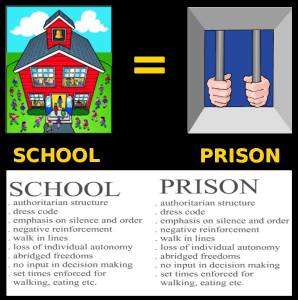
We are told there is a pipeline in the United States that travels from our school system to our criminal justice system. Correct as the data corroborating the pipeline’s existence may be, it is a flawed way of conceptualizing the issue. There is no pipeline out of schools and into prisons, because schools and prisons in this country are not conceptually separable.

Every child is mandated to receive an education with the threat of reprisal by the judicial system if they fail to. Children are thus coerced into attending a learning center, almost none of which adequately meet the educational needs of children. Some opt for public school “alternatives” like homeschooling or private schools, but the model of education is still generally the same and attendance is vigorously enforced. Through forced schooling, children are largely deprived of the ability to engage with the world and learn by means of play. They must cease the process of seeking fulfillment of genuine desires and begin one of alienation from their natural curiosity.

The consequences are shockingly apparent in a case out of Columbia, South Carolina where a police officer at a public high school physically manhandled a young black girl. The scene: A female student sits passively in her chair while the officer demands she stand. The lead-up to the incident is irrelevant. Insubordination to authority in schools is an inevitability for any child with a mind and drive of her own. For having such a mind and drive of her own (“resisting” in law enforcement-speak) the student was grabbed by the neck, slammed to the ground and dragged across the classroom, all while still partially connected to her desk.

Once again, this is not abnormal behavior. Disobedience is something youth do well and often. The response to disobedience, insubordination, and general independent-streaks at any school usually boils down to authoritative command and punishment. Physical assault on children is not legal in all schools, but it is in 19 states. Each year, over 800 children are assaulted legally and as a matter of policy at their schools. In South Carolina, it is legal to handcuff students for simply being loud.

In addition to the female assault victim in the South Carolina incident, the classmate who filmed the shocking video was also later arrested and held on bail. She was kidnapped for filming what was, by any reasonable standard, child abuse. Why was this allowed to happen? Her charge was “Disturbing school.” Please allow this to fully register. Non-violent, peaceful actions by children are construed as attacks on the supposed civility of school.

This officer’s assault is not an aberration; it is how schools treat students. They have no freedom to leave. Anyone who escapes is treated as a fugitive. They are permitted to go home, but this does not change the striking similarities between prisons and schools. It is now regular for schools to have guards — some are cops hired out and some are the schools’ own security staff. Students are filed along corridors and into rooms in such a way as to surveil and control their flow of activity.

People of color are far more likely to find themselves physically assaulted by staff in schools. They are more likely to receive punishment than their white counterparts for the same behavior, and as a result, they begin to recognize the system’s perception of them as marked criminals. Eventually, many are sent to even more coercive penal environments, where the violence and authoritarianism from the administration only escalates. Many students are lucky enough to avoid the transition from educational to criminal detention centers. But far too many either aren’t able to successfully navigate the educational-police state, or have the deck stacked against them from the outset. Their fate is a sad and unnecessary one.

There is no pipeline from school to prison. Some are just forced to stay in class.

Citations to this article:

Terrorizing School Children in the American Police State

stpp

By Henry Giroux

Source: Counterpunch

Americans live in an age, to rephrase, W.E.B. Dubois, in which violence has become the problem of the twenty-first century. As brutalism comes to shape every public encounter, democratic values and the ethical imagination wither under the weight of neoliberal capitalism and post-racial racism. Giving way to the poisonous logics of self-interest, privatization, and the unfettered drive for wealth, American society reneges on the social contract and assumes the role of a punishing state.[i] Under the regime of a predatory neoliberalism, compassion and respect for the other are viewed increasingly with contempt while the spectacle of violence titillates the multitudes and moves markets. A free-market mentality now drives and corrupts politics, destroys social protections, celebrates a hyper-competitiveness, and deregulates economic activity. As politics is emptied of any sense of social responsibility, the apostles of casino capitalism preach that allegedly amoral economic activity exacts no social costs, and in doing so they accelerate the expanding wasteland of disposable goods and people.[ii] One consequence is a vast and growing landscape of human suffering, amplified by a mass-mediated metaphysics of retribution and violence that more and more creeps into every commanding institution of American society, now serving a myriad of functions such as sport, spectacle, entertainment, and punishment. Alain Badiou rightly calls those who run our current political system a “regime of gangsters.”[iii] These so called gangsters produce a unique form of social violence. According to Badiou, they:

Privatize everything. Abolish help for the weak, the solitary, the sick and the unemployed. Abolish all aid for everyone except the banks. Don’t look after the poor; let the elderly die. Reduce the wages of the poor, but reduce the taxes on the rich. Make everyone work until they are ninety. Only teach mathematics to traders, reading to big property-owners and history to on-duty ideologues. And the execution of these commands will in fact ruin the lives  of millions of people.[iv]

Increasingly, institutions such as schools, prisons, detention centers, and our major economic, cultural and social institutions are being organized around the production of violence. Rather than promote democratic values and a respect for others or embrace civic values, they often function largely to humiliate, punish, and demonize any vestige of social responsibility. Violence both permeates and drives foreign policy, dominates popular culture, and increasingly is used to criminalize a wide range of social behaviors, especially among African-Americans.[v] In part, the totality of violence in American society can be understood in terms of its doubling function. At one level, violence produces its own legitimating aesthetic as part of a broader spectacle of entertainment, offering consumers the pleasure of instant gratification, particularly in the visibility and celebration of extreme violence. This is evident in television series such as Game of Thrones and Hannibal, endless Hollywood films such as Dread (2012), Django (2012), and Mad Max: Fury Road (2015), and video games such as Grand Theft Auto 4 (2008), and Mortal Combat (2011), and Battlefield Hardline (2015).

At another level, violence functions as a brutalizing practice used by the state to squelch dissent, incarcerate poor minorities of class and color, terrorize immigrants, wage a war on minority youth, and menace individuals and groups considered disposable or a threat. Not only does such violence destroy the conditions and institutions necessary to develop a democratic polity, it also accelerates abusive forms of punitiveness and control that extend from the prisons to other institutions such as schools. In this instance, violence becomes the ultimate force propagating what might be called punishment creep. The punishment creep that has moved from prisons to other public spheres now has a firm grip on both schools and the daily rituals of everyday life. Margaret Kimberly captures one instance of the racist underside of punishment creep. She writes: “Black people are punished for driving, for walking down the street, for having children, for putting their children in school, for acting the way children act, and even for having children who are killed by other people. We are punished, in short, because we still exist.”[vi]

Violence in America has always been defined partly by a poisonous mix of chauvinism, exceptionalism, and terrorism that runs through a history marked by genocidal assaults against indigenous Native Americans, the brutality of slavery, and a persistent racism that extends from the horror of lynchings and chain gangs to a mass incarceration state that criminalizes black behavior and subjects many black youth to the shameful dynamics of the school-to-prison-pipeline and unprecedented levels of police abuse. Violence is the premier signature of what Ta-Nehisi Coates calls “The Dreamers,” those individuals and groups who have “signed on, either actively or passively, to complicity in everything from police shootings to real estate redline, which crowds blacks into substandard housing in dangerous neighborhoods…The Dream is about the totality of white supremacy in American history and its cumulative weight on African-Americans, and how one attempts to live with that.”[vii] In part, violence whether produced by the state, corporations, or racist individuals is difficult to abstract from an expression of white supremacy, which functions as an index for demanding “the full privileges of the state.”[viii]

Police violence against African-Americans has become highly visible and thrust into the national spotlight as a result of individuals recording acts of police abuse with their cell phones and other tools of the new technologies. In the last few years, there has been what seems like a torrent of video footage showing unarmed black people being assaulted by the police. For instance, there is the shocking video of Walter Scott being shot in the back after fleeing from his car; Eric Garner dying as a result of being put in a chock hold by a white policeman who accused him of illegally selling cigarettes; the tragic killing of Freddie Gray who after making eye contact with a police officer was put in a police van and purposely given a jarring ride that resulted in his death; and the needless shooting of 12 year-old Tamir Rice for playing with a pellet gun in the snow in a park, and so it goes. All of these deaths are morally indefensible and are symptomatic of the deep-seated racism and propensity for violence in many police forces in the United States.

Yet, as Jeah Lee observes, while such crimes have attracted national attention, the “use of force by cops in schools…. has drawn far less attention [in spite of the fact that] over the past five years at least 28 students have been seriously injured, and in one case shot to death, by so-called school resource officers—sworn, uniformed police assigned to provide security on k-12 campuses.”[ix] Increasingly as public schools hand over even routine disciplinary problems to the police, there is a resurgence of cops in schools. There are over 17,000 school resource officers in more than half of the schools in the United States.[x] In spite of the fact that violence in schools have dropped precipitously, school resource officers are the fastest growing segment of law enforcement.

In part, the militarizing of schools and the accompanying surge of police officers are driven by the fear of school shootings, particularly in the aftermath of the Columbine High School tragedy in 1999, and the massacre that took place at Sandy Hook Elementary School in 2013, both of which have been accentuated by the ever present wave of paranoia that followed the terrorist attacks of 9/11.[xi] What advocates of putting police in the schools refuse to acknowledge is that the presence of police in schools has done nothing to stop such mass shootings. While the fear of school shootings are overestimated, the fact remains that schools are still one of the safest places for children to be. Caught under the weight of a culture of fear and a rush to violence, many young people in schools are the most recent victims of a punishing state in a society that “remains in a state of permanent, endless war,” a war that is waged through militarized policies at home and abroad. [xii]

What has become clear is that cops in schools do not make schools safer. Erik Eckholm reporting for the New York Times stated that judges, youth advocates, parents, and other concerned citizens “are raising alarm about what they have seen in the schools where officers are already stationed: a surge in criminal charges against children for misbehavior that many believe is better handled in the principal’s office.”[xiii] In Texas, police officers have written “more than 100,000 misdemeanor tickets each year” and many of these students “face hundreds of dollars in fines, community service, and in some cases, a lasting record that could affect applications for jobs or the military.”[xiv] The transformation of disciplinary problems into criminal violations has often resulted in absurd if not tragic results. For instance, in 2009, in Richardson, Texas “a 14-year old boy with Asperger’s syndrome was given a $364 police citation for using an expletive in his classroom.”[xv] It gets even more ludicrous. “A 12-year-old student in Stuart, Florida, was arrested in November 20008 for ‘disrupting a school function.’ The ‘disruption’ was that the student had ‘passed gas.’”[xvi]

Similarly, a number of civil rights groups have reported that the presence of police in schools often “means more suspensions, which disproportionately affect minority students.” [xvii] Many of the young people who end up in court are poor black and brown students, along with students with disabilities. What must be recognized is that schools in general have become combat zones where it is routine for many students to be subjected to metal detectors, surveillance cameras, uniformed security guards, weapons searches, and in some cases SWAT team raids and police dogs sniffing for drugs.[xviii] Under such circumstances, the purpose of schooling appears to be to contain and punish young people, especially those marginalized by race and class, rather than educate them. What is beyond doubt is that “Arrests and police interactions… disproportionately affect low-income schools with large African-American and Latino populations.”[xix] For the many disadvantaged students being funnelled into the “school-to-prison pipeline,” schools ensure that their futures look grim indeed, as their educational experiences acclimatize them to forms of carceral treatment.[xx] There is more at work here than a flight from responsibility on the part of educators, parents, and politicians who support and maintain policies that fuel this expanding edifice of law enforcement against the young and disenfranchised. Underlying the repeated decisions to turn away from helping young people is the growing sentiment that youth, particularly minorities of color and class, constitute a threat to adults and the only effective way to deal with them is to subject them to mind-crushing punishment. Students being miseducated, criminalized, and arrested through a form of penal pedagogy in prison-type schools provides a grave reminder of the degree to which the ethos of containment and punishment now creeps into spheres of everyday life that were largely immune in the past from this type of state and institutional violence.

No longer are schools spaces of joy, critical teaching, and support, as too many are now institutions of containment and control that produce pedagogies of conformity and oppression and in the name of teaching to the test serve to kill the imagination. Within such schools, the lesson that young people are learning about themselves is that they can’t engage in critical thinking, be trusted, rely on the informed judgments of teachers and administrators, and that their behavior is constantly subject to procedures that amount to both an assault on their dignity and a violation of their civil liberties. Schools have become institutions in which creativity is viewed as a threat, harsh discipline a virtue, and punishment the reward for not conforming to what amounts to the dictates of a police state. How many more images of young school children in handcuffs do we have to witness before it becomes clear that the educational system is broken, reduced largely to a punishing factory defined by a culture of fear and an utter distrust of young people?

According to the Advancement Project, schools have become increasingly intolerant of young people, imposing draconian zero tolerance policies on them by furthering a culture steeped in criminalizing often minor, if not trivial, student behaviors. What is truly alarming is not only the ways in which young people are being ushered into the criminal justice system and treated less as students than as criminals, but the harsh violence to which they are often subjected by school resource officers. According to a report by Mother Jones, Jonathan Hardin, a Louisville Metro Police officer, in 2014 “was fired after his alleged use of force in two incidents at Olmsted Academy North middle school: He was accused of punching a 13-year-old student in the face for cutting the cafeteria line, and a week later of putting another 13-year-old student in a chokehold, allegedly knocking the student unconscious and causing a brain injury.”[xxi] In a second incident that year, “Cesar Suquet, then a 16-year-old high school student in Houston, was being escorted by an officer out of the principal’s office after a discussion about Suquet’s confiscated cell phone. Following a verbal exchange, police officer Michael Y’Barbo struck Suquet at least 18 times with a police baton, injuring him on his head, neck and elsewhere.”[xxii] Y’Barbo claimed that beating a student with a police baton was “reasonable and necessary” and “remains on regular assignment including patrol.”[xxiii] There are have also been incidents where students have been shot, suffered brain injuries, and have been psychologically traumatized. Jaeah Lee cites a young black high school student in Detroit who after a troubling interaction with a school police officer speaks for many young people about the dread and anxiety that many students experience when police occupy their schools. He states that “”Many young people today have fear of the police in their communities and schools.”[xxiv]

If one important measure of a democracy is how a society treats its children, especially young children who are black, brown, or suffer from disabilities, there can be little doubt that American society is failing. As the United States increasingly models its schools after prisons, students are no longer viewed as a social investment in the future. A deadly mixture of racism and violence in the 21st century has become increasingly evident in the violence being waged against young people in American schools. If students in general are now viewed as a potential threat, black students are regarded increasingly as criminals. One result is that schools increasingly have come to resemble war zones, spaces marked my distrust, fear, and demonization. With more police in the schools than ever before, security has become more important than providing children with a critical education and supportive learning environment. As authority in many of the schools is often handed over to the police and security forces who are now asked to deal with all alleged disciplinary problems, however broadly defined, the power and autonomy of teachers and school administrators are weakened at the expense of the safety of the students. This loss of authority is clear in New York City where school administrators have no control over security forces who report directly to local police departments.

In most cases, the disciplinary problems that take place in schools involve trivial the infractions such as violating a dress code, scribbling on a desk, or holding a 2-inch toy gun. The assault on children in the public schools suggest that black and brown children cannot view schools as safe places where they can be given a quality education. Instead, schools have become sites of control, testing, and punishment all too eager to produce pedagogies of repression, and more than willing to erect, once again, what has been called the school-to-prison pipeline, especially for youth of color. Roxane Gay is right in observing that

Black children are not allowed to be children. They are not allowed to be safe, not at home, not at pool parties, not driving or sitting in cars listening to music, not walking down the street, not in school. For black children, for black people, to exist is to be endangered. Our bodies receive no sanctity or safe harbor.[xxv]

It is inconceivable that in an alleged democracy poor minorities at all grade levels in the public schools are subjected to shameful criminal practices such as being handcuffed and carted off to jail for minor incidents— and that such draconian practices could take place in a society that views itself as a democracy. Stripped of their public mission as institutions that nurture young people to become informed, critically engaged citizens, schools have become punishing factories all too willing to turn disciplinary authority over to the police and to usher students into the harsh bureaucracy of the criminal justice system.[xxvi]

One recent example of a particularly disturbing incident of police brutality was captured in a series of videos recorded in West Spring High School in South Carolina. Prior to the incident being filmed, a young black student named Shakara took out her cellphone in class. The teacher asked her for it and when she refused to hand it over, she was asked to leave the class. The teacher then called the vice principal. Rather than attempt to defuse the situation, the vice principal called for a School Resource Officer.  At this point, Officer Ben Fields enters the classroom. One of Shakira’s classmates, Niya Kenny, asked her classmates to start filming because as she put it: “I told them to start filming because we know his reputation–well, I know it.” In what follows, as filmed by one of the students, Officer Ben Fields approaches the young woman, appears to give her no time to stand up and proceeds by grabbing her left arm while placing his right arm around her neck; he then lifts her desk, pulls her out of her seat, slams her to the ground, and drags her across the floor before handcuffing her. The video is difficult to watch given the extreme level of violence used against a high school student. The young woman was arrested as was Kenny, who both filmed the incident and loudly protested the treatment of Shakara. Fields was fired soon afterwards, but incredulously both students are being charged with “disturbing schools, a crime punishable by up to ninety days in jail or a thousand dollar fine.”[xxvii]

What has emerged after the incident went viral was information indicating that Fields had a previous reputation for being aggressive with students, and he was viewed as a threat by many students who nicknamed him “Officer Slam.” Moreover, he had a previous record of violently assaulting people.[xxviii] The question that should be asked as a result of this shocking act of police violence against a young black girl is not how Fields got a job in a school working with children, but what kind of society believes that police should be in the school in the first place. Whatever happened to teacher and administrator responsibility? Sadly, it was a school administrator who called in the police at Spring Valley High School because the student would not turn over her phone. Even worse, when Sheriff Leon Lott announced his decision to fire Fields, he pointed out that the classroom teacher and administrator supported actions of the police officer and made it clear that “they also had no problems with the physical part.”[xxix] Both the teacher and administrator should be fired. This incident was in all probability a simple disciplinary problem that should have been handled by responsible educators. Students should not be treated like criminals. It is one thing to not assume responsibility for students, but another to subject them to brutal assaults by the police.

Lawlessness runs deep in American society and has been normalized. Brutal attacks on defenseless children rarely get the attention they deserve and when they do the corporate media refuses to acknowledge that America has become a suicidal society willing even to sacrifice its own children to an expanding punishing state that protects the interests of the corporate and financial elite.[xxx] How else to explain the shameless defense of such a brutal assault against a young black girl by pundits such as CNN’s Harry Houck and Don Lemon, who implied that such violence was warranted because Shakara did not respect the officer, as if the beating of a black child by a police officer, who happens also to be a body-builder, who can lift 300 pounds, justifies such actions. This is a familiar script in which black people are often told that whatever violence they are subject to is legitimate because they acted out of place, did not follow rules that in reality oppress them, or simply refused to fall in line. The other side of this racist script finds expression in those who argue that any critique of the police endangers public safety. In this dangerous discourse, the police are the victims, a line of argument recently voiced in different ways by both President Obama and by James Comey, the director of the Federal Bureau of Investigation. This discourse not only refuses to recognize the growing visibility of police violence, it shores up one of the foundations of the authoritarian state, suggesting that the violence propagated by the police should not be subject to public scrutiny. As an editorial in the New York Times pointed out, this “formulation implies that for the police to do their jobs, they need to have free rein to be abusive. It also implies that the public would be safer if Americans with cellphones never started circulating videos of officers battering suspects in the first place….This trend is straight out of Orwell.”[xxxi]

Educators, young people, parents and others concerned about violence in schools need to organize and demand that the police be removed from school. Not only is their presence a waste of taxpayer’s money and an interference with children’s education, have they also pose a threat to student safety.[xxxii] Instead of putting police in schools, money should be spent on more guidance teachers, social workers, teachers, community intervention workers, and other professionals who are educated and trained to provide a safe and supportive environment for young people. It is particularly crucial to support those social services, classroom practices, and policies that work to keep students in schools. Everything possible should be done to dismantle the school-to-prison pipeline and the underlying forces that produce it. At the same time, more profound change must take place on a national level since the violence waged by the police is symptomatic of a society now ruled by a financial elite who trade in cruelty, punishment, and despair. American society is broken, and the violence to which it appears addicted to will continue until the current configurations of power, politics, inequality, and injustice are eliminated.

The increasing visibility of police brutality in schools and in the streets speaks to a larger issue regarding the withering of democracy in the United States and the growing lawlessness that prevails in a society in which violence is both a spectacle and sport–and one of the few resources left to use to address social problems. America is paying a horrible price for turning governance at all levels over to people for whom violence serves as the default register for addressing important social issues. The Spring Valley High School case is part of a larger trend that has turned schools across the country into detention centers and educators into hapless bystanders as classroom management is ceded to the police. What we see in this incident and many others that have not attracted national attention because they are not caught on cellphones are the rudiments of a growing police state. Violence is now a normalized and celebrated ideal for how America defines itself–an ideal that views democracy as an excess or, even worse, a pathology. This is something Americans must acknowledge, interrogate, and resist if they don’t want to live under a system of total terror and escalating violence.

Notes.

[i] I have taken up this theme in The Violence of Organized Forgetting (San Francisco: City Lights Books, 2014).

[ii] Brad Evans and Henry A. Giroux, Disposable Futures: The Seduction of Violence in the Age of the Spectacle (San Francisco: City Lights Books, 2015).

[iii] Alain Badiou, The Rebirth of History (London: Verso, 2012), 12.

[iv] Ibid., 13.

[v] Jody Sokolower, “Schools and the New Jim Crow: An Interview With Michelle Alexander,” Truthout, (June 4, 2013). http://www.truth-out.org/news/item/16756-schools-and-the-new-jim-crow-an-interview-with-michelle-alexander

[vi]. Margaret Kimberly, “Jail for Sending Their Kid to School? How America Treats Black Women and Children Like Criminals” AlterNet, (May 9, 2012). Online:

http://www.alternet.org/story/155330/jail_for_sending_their_kid_to_school_how_america_treats_black_women_and_children_like_criminals/

[vii] Mary Ann Gwinn, “Author Ta-Nehisi Coates: ‘In this country, white is receiving the full privileges of the state,’” The Seattle Times (October 14, 2015). Online: http://www.seattletimes.com/entertainment/books/qa-with-ta-nehisi-coates-author-of-between-the-world-and-me/

[viii] Ibid.

[ix] Jeah Lee, “Chokeholds, Brain Injuries, Beatings: When School Cops Go Bad,” Mother Jones (July 14, 2015). Online: http://www.motherjones.com/politics/2015/05/police-school-resource-officers-k-12-misconduct-violence

[x] Amy Goodman, “When School Cops Go Bad: South Carolina Incident Highlights Growing Police Presence in Classrooms,” Democracy Now!, (October 27, 2015).Online: http://www.democracynow.org/2015/10/28/when_school_cops_go_bad_south

[xi] Jessica Glenza, “’Good guys’ with guns: how police officers became fixtures in US schools,” The Guardian (October 28, 2015). Online: http://www.theguardian.com/us-news/2015/oct/28/sworn-police-officers-us-schools-guns

[xii] Glenn Greenwald, “Arrest of 14-Year-Old Student for Making a Clock: the Fruits of Sustained Fearmongering and Anti-Muslim Animus,” The Intercept (September 16, 2015). https://theintercept.com/2015/09/16/arrest-14-year-old-student-making-clock-fruits-15-years-fear-mongering-anti-muslim-animus/

[xiii] Erik Eckholm, “With Police in Schools, More Children in Court,” The New York Times, (April 12, 2013). Online: http://www.nytimes.com/2013/04/12/education/with-police-in-schools-more-children-in-court.html

[xiv] Ibid., Eckholm, “With Police in Schools, More Children in Court.”

[xv] Advancement Project, Test, Punish, and Push Out: How ‘Zero Tolerance’ and High-Stakes Testing Funnel Youth in the School-To-Prison Pipeline (Washington, D.C.: Advancement Project, March 2010). Online at: http://www.advancementproject.org/sites/default/files/publications/rev_fin.pdf

[xvi] Ibid., Advancement Project.

[xvii] Greg Toppo, “Civil rights groups: Cops in schools don’t make students safer,” USA Today, (October 28, 2015). Online: http://www.usatoday.com/story/news/2015/10/28/school-resource-officer-civil-rights/74751574/

[xviii] Criminal InJustice Kos, “Criminal InJustice Kos: Interrupting the School to Prison Pipeline,” DailyKos (March 30, 2011). Online at: http://www.dailykos.com/story/2011/03/30/960807/-Criminal-InJustice-Kos:-Interrupting-the-School-to-Prison-Pipeline

[xix] Smartypants, “A Failure of Imagination,” Smartypants Blog Spot (March 3, 2010). Online at: http://immasmartypants.blogspot.com/2010/03/failure-of-imagination.html

[xx] See Mark P. Fancher, Reclaiming Michigan’s Throwaway Kids: Students Trapped in the School-to Prison Pipeline (Michigan: ACLU, 2011). Online at: http://www.njjn.org/uploads/digital_library/resource_1287.pdf; and Advancement Project, Test, Punish, and Push Out: How ‘Zero Tolerance’ and High-Stakes Testing Funnel Youth in the School-To-Prison Pipeline (Washington, D.C.: Advancement Project, March 2010). Online at: http://www.advancementproject.org/sites/default/files/publications/rev_fin.pdf

[xxi] Ibid., Lee, “Chokeholds, Brain Injuries, Beatings: When School Cops Go Bad.”

[xxii] Ibid., Lee, “Chokeholds, Brain Injuries, Beatings: When School Cops Go Bad.”

[xxiii] Ibid., Chokeholds, Brain Injuries, Beatings: When School Cops Go Bad.”

[xxiv] Ibid., Lee, “Chokeholds, Brain Injuries, Beatings: When School Cops Go Bad.”

[xxv] Roxane Gay, “Where Are Black Children Safe?,” New York Times, (October 27, 2015). Online: http://www.nytimes.com/2015/10/30/opinion/where-are-black-children-safe.html

[xxvi] See: William Ayers, Rick Ayers, Bernardine Dohrn, eds. Zero Tolerance: Resisting the Drive for Punishment in Our Schools :A Handbook for Parents, Students, Educators, and Citizens (New York: The New Press, 2001); Henry A. Giroux, Youth in a Suspect Society (New York: Palgrave, 2009); Judith Kafka, The History of “Zero Tolerance” in American Public Schooling (New York: Palgrave, 2013).

[xxvii] Rashad, Arisha, Scott, Lyla and the rest of the ColorofCange Team, “ Editorial,” Color of Change (October 27, 2015). Email correspondence.

[xxviii] Andrew Emett, “Same Cop Who Attacked School Girl Also Caught Assaulting Army Vet in Similar Takedown,” Free Thought Project.com, (October 27, 2015); http://thefreethoughtproject.com/cop-slammed-high-school-girl-ground-assaulted-army-vet-similar-takedown/ ; see also Ibid., Goodman, “When School Cops Go Bad: South Carolina Incident Highlights Growing Police Presence in Classrooms.”

[xxix] Amy Davidson, “What Niya Kenny Saw,” The New Yorker (October 30, 2015). Online: http://www.newyorker.com/news/amy-davidson/what-niya-kenny-saw?mbid=nl_151031_Daily&CNDID=14760251&spMailingID=8208167&spUserID=MjY0MzU4NDM2ODAS1&spJobID=783800743&spReportId=NzgzODAwNzQzS0

[xxx] Sonali Kolhatkar, “Police Are the Greatest Threat Facing Black Kids in Schools,” Truth Dig, (October 27, 2015). http://www.truthdig.com/report/item/police_are_the_greatest_threat_facing_black_kids_in_school_20151028

[xxxi] Editorial, “Political Lies About Police Brutality,” The New York Times, (October 27, 2015). Online: http://www.nytimes.com/2015/10/27/opinion/political-lies-about-police-brutality.html?_r=0

[xxxii] See, for instance, Amanda Petteruti, Just Policy Institute, Education Under Arrest: The Case against Police in Schools,” Just Policy Institute (2011). http://www.justicepolicy.org/uploads/justicepolicy/documents/educationunderarrest_fullreport.pdf

 

Henry A. Giroux currently holds the McMaster University Chair for Scholarship in the Public Interest in the English and Cultural Studies Department and a Distinguished Visiting Professorship at Ryerson University. His most recent books are America’s Education Deficit and the War on Youth (Monthly Review Press, 2013) and Neoliberalism’s War on Higher Education (Haymarket Press, 2014). His web site is www.henryagiroux.com.

Why the Drug War Has Been a Forty-Year Lynching

nixon-war-on-drugs-quote

By Bob Fitrakis and Harvey Wasserman

Source: FreePress.org

The Drug War has been a forty-year lynching….
…the corporate/GOP response to the peace and civil rights movements.

It’s used the Drug Enforcement Administration and other policing operations as a high-tech Ku Klux Klan, meant to gut America’s communities of youth and color.

It has never been about suppressing drugs. Quite the opposite.

And now that it may be winding down, the focus on suppressing minority votes will shift even stronger to electronic election theft.

The Drug War was officially born June 17, 1971, (http://www.drugpolicy.org/new-solutions-drug-policy/brief-history-drug-war) when Richard Nixon pronounced drugs to be “Public Enemy Number One.” In a nation wracked by poverty, racial tension, injustice, civil strife, ecological disaster, corporate domination, a hated Vietnam War and much more, drugs seemed an odd choice.
In fact, the Drug War’s primary target was black and young voters.

It was the second, secret leg of Nixon’s “Southern Strategy” meant to bring the former Confederacy into the Republican Party.

Part One was about the white vote.

America’s original party of race and slavery (https://zinnedproject.org/materials/a-peoples-history-of-the-united-states-updated-and-expanded-edition/)was Andrew Jackson’s Democrats (born 1828).

After the Civil War the Party’s terror wing, the KKK, made sure former slaves and their descendants “stayed in their place.”

A century of lynchings (at least 3200 of them) (http://www.yale.edu/ynhti/curriculum/units/1979/2/79.02.04.x.html)efficiently suppressed the southern black community.

In the 1930s Franklin Roosevelt’s New Deal social programs began to attract black voters to the Democratic Party. John Kennedy and Lyndon Johnson’s support for civil and voting rights legislation, plus the 24th Amendment ending the poll tax, sealed the deal. Today blacks, who once largely supported the Party of Lincoln,  vote 90% or more Democrat (http://blackdemographics.com/culture/black-politics/).

But the Democrats’ lean to civil rights angered southern whites. Though overt racist language was no longer acceptable in the 1970s, Nixon’s Republicans clearly signaled an open door to the former Confederacy (https://www.thenation.com/article/why-todays-gop-crackup-is-the-final-unraveling-of-nixons-southern-strategy/).

But recruiting angry southern whites would not be enough for the Republicans to take the south. In many southern states more than 40% of potential voters were black. If they were allowed to vote, and if their votes were actually counted, all the reconstructed Democrat Party would need to hold the south would be a sliver of moderate white support.

That’s where the Drug War came in.

Reliable exact national arrest numbers from 1970 through 1979 are hard to come by.

But according to Michelle Alexander’s superb, transformative The New Jim Crow, and according to research by Marc Mauer and Ryan King of the Sentencing Project, more than 31,000,000 Americans were arrested for drugs between 1980 and 2007 (http://newjimcrow.com).

Further federal uniform crime report statistics compiled by www.freepress.org indicate that, between 2008 and 2014, another 9,166,000 were arrested for drug possession.
Taken together, than means well over 40,000,000 American citizens have been arrested for drugs in the four decades since Nixon’s announcement.
It is a staggering number: more than 10% of the entire United States, nearly four times the current population of Ohio, far in excess of more than 100 countries worldwide.
A number that has gutted the African-American community.  A national terror campaign far beyond the reach of even the old KKK.
Justice Department statistics indicate than half of those arrests have been for simple possession of marijuana.
According to US Bureau of Justice statistics, between 1980 and 2013, while blacks were 12% of the population, blacks constituted 30% of those arrested for drug law violations and nearly 40% of those incarcerated in all U.S. prisons.  Thus some 20,000,000 African-American men have been sent to prison for non-violent “crimes” in the past forty years.
If the Hispanic population is added in, as much as 60% of drug arrests are of racial or ethnic minorities.
On the 40th anniversary of the Drug War in 2010, the Associated Press used public records to calculate that the taxpayer cost of arresting and imprisoning all these human beings has been in excess of $1,000,000,000.
Sending them all to college would have been far cheaper.  It also would have allowed them to enhance and transform their communities.
Instead, they were taken from their families.  Their children were robbed of their parents.  They were assaulted by the prison culture, stripped of their right to vote and stopped from leading the kind of lives that might have moved the nation in a very different direction.
Nixon also hated hippies and the peace movement. So in addition to disenfranchising 20,000,000 African-Americans, the Drug War has imprisoned additional millions of young white and Hispanic pot smokers.
Thus the DEA has been the ultra-violent vanguard of the corporate culture war.
In 1983 Ronald Reagan took the Drug War to a new level.  Using profits from his illegal arms sales to Iran, he illegally funded the Contra thugs who were fighting Nicaragua’s duly elected Sandinista government.
The Contras were drug dealers who shipped large quantities of cocaine into the US—-primarily in the Los Angeles area—-where it was mostly converted to crack.
That served a double function for the GOP.
First, it decimated the inner city.
Then Reagan’s “Just Say No” assault—-based on the drugs his Contra allies were injecting into our body politic—-imposed penalties on crack far more severe than those aimed at the powdered cocaine used in the white community.
In 1970 the US prison population was roughly 300,000 people.  Today it’s more than 2.2 million, the largest in world history by both absolute number and percentage of the general population.  There are more people in prison in the US than in China, which has five times the population (http://www.bjs.gov/index.cfm?ty=tp&tid=11).

According to the Sentencing Project, one in seventeen white males has been incarcerated, one in six Latinos, and one in three blacks.
By all accounts the Drug War has had little impact on drug consumption in the US, except to make it more profitable for drug dealers (http://www.bjs.gov/index.cfm?ty=tp&tid=11).  It’s spawned a multi-billion-dollar industry in prison construction, policing, prison guards, lawyers, judges and more, all of them invested in prolonging the drug war despite its negative impacts on public health.

For them, the stream of ruined lives of non-violent offenders is just another form of cash flow.
Like the Klan since the Civil War, the Drug War has accomplished its primary political goal of suppressing the black vote and assaulting the African-American community.
It’s shifted control of the South from the Democrats back to the Republican Party. By slashing voter eligibility and suppressing black turnout, the Drug War crusade has helped the GOP take full control of both houses of the US Congress and a majority of state governments across the US.
But the repressive impacts hit everyone, and ultimately enhance the power of the corporate state.
Toward that end, the southern corporate Democrat Bill Clinton’s two terms as a Drug Warrior further broadened the official attack on grassroots America. Clinton was determined to make sure nobody appeared tougher on “crime.”  He escalated the decimation of our democracy far beyond mere party politics, deepening the assault on the black community, and the basic rights of all Americans for the benefit of his Wall Street funders.  Obama has been barely marginally better.
In political terms, the Nixon-Reagan GOP remains the Drug War’s prime beneficiary. Today’s Republicans are poised to continue dominating our electoral process through the use of rigged electronic registration rolls and voting machines. That’s a core reality we all must face.
But no matter which party controls the White House or Congress, by prosecuting a behavior engaged in by tens of millions of Americans, the Drug War lets the corporate state arrest (and seize assets from) virtually anyone it wants at any time. It has empowered a de facto corporate police state beyond public control.

Regardless of race, we all suffer from the fear, repression and random assaults of a drug-fueled repressive police force with no real accountability.
In the interim, the Drug War is not now and never has been about drugs.
Legalizing pot is just the beginning of our recovery process.
Until we end the Drug War as a whole, America will never know democracy, peace or justice.
____________________
THE SIXTH JIM CROW: ELECTRONIC ELECTION THEFT & THE 2016 SELECTION will be released by Bob Fitrakis & Harvey Wasserman by January, 2016. Their CITIZEN KASICH will follow soon thereafter. Bob’s FITRAKIS FILES are at www.freepress.org; Harvey’s ORGANIC SPIRAL OF US HISTORY will appear in 2016.

Related video:

How Do You Prepare a Child for Life in the American Police State?

index

By John W. Whitehead

Source: The Rutherford Institute

“Fear isn’t so difficult to understand. After all, weren’t we all frightened as children? Nothing has changed since Little Red Riding Hood faced the big bad wolf. What frightens us today is exactly the same sort of thing that frightened us yesterday. It’s just a different wolf.” ― Alfred Hitchcock

In an age dominated with news of school shootings, school lockdowns, police shootings of unarmed citizens (including children), SWAT team raids gone awry (leaving children devastated and damaged), reports of school resource officers tasering and shackling unruly students, and public schools undergoing lockdowns and active drills, I find myself wrestling with the question: how do you prepare a child for life in the American police state?

Every parent lives with a fear of the dangers that prey on young children: the predators who lurk at bus stops and playgrounds, the traffickers who make a living by selling young bodies, the peddlers who push drugs that ensnare and addict, the gangs that deal in violence and bullets, the drunk drivers, the school bullies, the madmen with guns, the diseases that can end a life before it’s truly begun, the cynicism of a modern age that can tarnish innocence, and the greed of a corporate age that makes its living by trading on young consumers.

It’s difficult enough raising a child in a world ravaged by war, disease, poverty and hate, but when you add the police state into the mix—with its battlefield mindset, weaponry, rigidity, surveillance, fascism, indoctrination, violence, etc.—it becomes near impossible to guard against the toxic stress of police shootings, SWAT team raids, students being tasered and shackled, lockdown drills, and a growing unease that some of the monsters of our age come dressed in government uniforms.

Children are taught from an early age that there are consequences for their actions. Hurt somebody, lie, steal, cheat, etc., and you will get punished. But how do you explain to a child that a police officer can shoot someone who was doing nothing wrong and get away with it? That a cop can lie, steal, cheat, or kill and still not be punished?

Kids understand accidents: sometimes drinks get spilled, dishes get broken, people slip and fall and hurt themselves, or you bump into someone without meaning to, and they get hurt. As long as it wasn’t intentional and done with malice, you forgive them and you move on. Police shootings of unarmed people—of children and old people and disabled people—can’t just be shrugged off as accidents, however.

Tamir Rice was no accident. Cleveland police shot and killed the 12-year-old, who was seen playing on a playground with a pellet gun. Surveillance footage shows police shooting the boy two seconds after getting out of a moving patrol car. Incredibly, the shooting was deemed “reasonable” and “justified” by two law enforcement experts who concluded that the police use of force “did not violate Tamir’s constitutional rights.”

Aiyana Jones was also no accident. The 7-year-old was killed after a Detroit SWAT team launched a flash-bang grenade into her family’s apartment, broke through the door and opened fire, hitting the little girl who was asleep on the living room couch. The cops weren’t even in the right apartment. Ironically, on the same day that President Obama refused to stop equipping police with the very same kinds of military weapons and gear used to raid Aiyana’s home, it was reported that the police officer who shot and killed the little girl would not face involuntary manslaughter charges.

Obama insists that $263 million to purchase body cameras for police will prevent any further erosions of trust, but a body camera would not have prevented Aiyana from being shot in the head. Indeed, the entire sorry affair was captured on camera: a TV crew was filming the raid for an episode of The First 48, a true-crime reality show in which homicide detectives have 48 hours to crack a case.

While that $263 million will make Taser International, the manufacturer of the body cameras, a whole lot richer, it’s doubtful it would have prevented a SWAT team from shooting 14-month-old Sincere in the shoulder and hand and killing his mother.

No body camera could have stopped a Georgia SWAT team from launching a flash-bang grenade into the house in which Baby Bou Bou, his three sisters and his parents were staying. The grenade landed in the 2-year-old’s crib, burning a hole in his chest and leaving him with scarring that a lifetime of surgeries will not be able to easily undo.

No body camera could have prevented 10-year-old Dakota Corbitt from being shot by a Georgia police officer who tried to shoot an inquisitive dog, missed, and hit the young boy, instead.

When police shot 4-year-old Ava Ellis in the leg, shattering the bone, it actually was an accident, but it was an accident that could have been prevented. Police reported to Ava’s house after being told that Ava’s mother, who had cut her arm, was in need of a paramedic. Cops claimed that the family pet charged the officer who was approaching the house, causing him to fire his gun and hit the little girl.

Alberto Sepulveda, 11, died from one “accidental” shotgun round to the back, after a SWAT team raided his parents’ home. Thirteen-year-old Andy Lopez Cruz was shot 7 times in 10 seconds by a California police officer who mistook the boy’s toy gun for an assault rifle. Christopher Roupe, 17, was shot and killed after opening the door to a police officer. The officer, mistaking the Wii remote control in Roupe’s hand for a gun, shot him in the chest.

These children are more than grim statistics on a police blotter. They are the heartbreaking casualties of the government’s endless, deadly wars on terror, on drugs, and on the American people themselves.

Not even the children who survive their encounters with police escape unscathed. Increasingly, their lives are daily lessons in compliance and terror, meted out with every SWAT team raid, roadside strip search, and school drill.

Who is calculating the damage being done to the young people forced to watch as their homes are trashed and their dogs are shot during SWAT team raids? A Minnesota SWAT team actually burst into one family’s house, shot the family’s dog, handcuffed the children and forced them to “sit next to the carcass of their dead and bloody pet for more than an hour.” They later claimed it was the wrong house.

More than 80% of American communities have their own SWAT teams, with more than 80,000 of these paramilitary raids are carried out every year. That translates to more than 200 SWAT team raids every day in which police crash through doors, damage private property, terrorize adults and children alike, kill family pets, assault or shoot anyone that is perceived as threatening—and all in the pursuit of someone merely suspected of a crime, usually some small amount of drugs.

What are we to tell our nation’s children about the role of police in their lives? Do you parrot the government line thatpolice officers are community helpers who are to be trusted and obeyed at all times? Do you caution them to steer clear of a police officer, warning them that any interactions could have disastrous consequences? Or is there some happy medium between the two that, while being neither fairy tale nor horror story, can serve as a cautionary tale for young people who will encounter police at virtually every turn?

No matter what you say, there can be no avoiding the hands-on lessons being taught in the schools about the role of police in our lives, ranging from active shooter drills and school-wide lockdowns to incidents in which children engaging in typically childlike behavior are suspended (for shooting an imaginary “arrow” at a fellow classmate), handcuffed (for being disruptive at school), arrested (for throwing water balloons as part of a school prank), and even tasered (for not obeying instructions).

For example, a middle school in Washington State went on lockdown after a student brought a toy gun to class. A Boston high school went into lockdown for four hours after a bullet was discovered in a classroom. A North Carolina elementary school locked down and called in police after a fifth grader reported seeing an unfamiliar man in the school (it turned out to be a parent).

Better safe than sorry is the rationale offered to those who worry that these drills are terrorizing and traumatizing young children. As journalist Dahlia Lithwick points out: “I don’t recall any serious national public dialogue about lockdown protocols or how they became the norm. It seems simply to have begun, modeling itself on the lockdowns that occur during prison riots, and then spread until school lockdowns and lockdown drills are as common for our children as fire drills, and as routine as duck-and-cover drills were in the 1950s.”

These drills have, indeed, become routine.

As the New York Times reports: “Most states have passed laws requiring schools to devise safety plans, and several states, including Michigan, Kentucky and North Dakota, specifically require lockdown drills. Some drills are as simple as a principal making an announcement and students sitting quietly in a darkened classroom. At other schools, police officers and school officials playact a shooting, stalking through the halls like gunmen and testing whether doors have been locked.”

Police officers at a Florida middle school carried out an active shooter drill in an effort to educate students about how to respond in the event of an actual shooting crisis. Two armed officers, guns loaded and drawn, burst into classrooms, terrorizing the students and placing the school into lockdown mode.

What is particularly chilling is how effective these lessons in compliance are in indoctrinating young people to accept their role in the police state, either as criminals or prison guards. If these exercises are intended to instill fear and compliance into young people, they’re working.

Sociologist Alice Goffman understands how far-reaching the impact of such “exercises” can be on young people. For six years, Goffman lived in a low-income urban neighborhood, documenting the impact such an environment—a microcosm of the police state—on its residents. Her account of neighborhood children playing cops and robbers speaks volumes about how constant exposure to pat downs, strip searches, surveillance and arrests can result in a populace that meekly allows itself to be prodded, poked and stripped.

As journalist Malcolm Gladwell writing for the New Yorker reports:

Goffman sometimes saw young children playing the age-old game of cops and robbers in the street, only the child acting the part of the robber wouldn’t even bother to run away: I saw children give up running and simply stick their hands behind their back, as if in handcuffs; push their body up against a car without being asked; or lie flat on the ground and put their hands over their head. The children yelled, “I’m going to lock you up! I’m going to lock you up, and you ain’t never coming home!” I once saw a six-year-old pull another child’s pants down to do a “cavity search.”

Clearly, our children are getting the message, but it’s not the message that was intended by those who fomented a revolution and wrote our founding documents. Their philosophy was that the police work for us, and “we the people” are the masters, and they are to be our servants. Now that has been turned on its head, fueled by our fears (some legitimate, some hyped along by the government and its media mouthpieces) about the terrors and terrorists that lurk among us.

It’s getting harder by the day to tell young people that we live in a nation that values freedom and which is governed by the rule of law without feeling like a teller of tall tales. Yet as I point out in my book Battlefield America: The War on the American People, unless something changes and soon for the young people growing up, there will be nothing left of freedom as we have known it but a fairy tale without a happy ending.

The Crisis of the Now: Distracted and Diverted from the Ever-Encroaching Police State

corp_media_500

By John W. Whitehead

Source: The Rutherford Institute

“When a population becomes distracted by trivia, when cultural life is redefined as a perpetual round of entertainments, when serious public conversation becomes a form of baby talk, when, in short, a people become an audience and their public business a vaudeville act, then a nation finds itself at risk: culture-death is a clear possibility.”—Author Neil Postman

Caught up in the spectacle of the forthcoming 2016 presidential elections, Americans (never very good when it comes to long-term memory) have not only largely forgotten last year’s hullabaloo over militarized police, police shootings of unarmed citizens, asset forfeiture schemes, and government surveillance but are also generally foggy about everything that has happened since.

Then again, so much is happening on a daily basis that it’s understandable if the average American has a hard time keeping up with and remembering all of the “events,” manufactured or otherwise, which occur like clockwork and keep us distracted, deluded, amused, and insulated from reality while the government continues to amass more power and authority over the citizenry.

In fact, when we’re being bombarded with wall-to-wall news coverage and news cycles that change every few days, it’s difficult to stay focused on one thing—namely, holding the government accountable to abiding by the rule of law—and the powers-that-be understand this. As investigative journalist Mike Adams points out:

This psychological bombardment is waged primarily via the mainstream media which assaults the viewer by the hour with images of violence, war, emotions and conflict. Because the human nervous system is hard wired to focus on immediate threats accompanied by depictions of violence, mainstream media viewers have their attention and mental resources funneled into the never-ending ‘crisis of the NOW’ from which they can never have the mental breathing room to apply logic, reason or historical context.

Consider if you will the regularly scheduled trivia and/or distractions in the past year alone that have kept us tuned into the various breaking news headlines and entertainment spectacles and tuned out to the government’s steady encroachments on our freedoms:

Americans were riveted when the Republican presidential contenders went head-to-head for the second time in a three-hour debate that put Carly Fiorina in a favored position behind Donald Trump; Hillary Clinton presented the softer side of her campaign image during an appearance on The Tonight Show with Jimmy Fallon; scientists announced the discovery of what they believed to be a new pre-human species, Homo naledi, that existed 2.8 million years ago; an 8.3 magnitude earthquake hit Chile; massive wildfires burned through 73,000 acres in California; a district court judge reversed NFL player Tom Brady’s four-game suspension; tennis superstar Serena Williams lost her chance at a calendar grand slam; and President Obama and Facebook mogul Mark Zuckerberg tweeted their support for a Texas student arrested for bringing a homemade clock to school.

That was preceded by the first round of the Republican presidential debates; an immigration crisis in Europe; the relaxing of Cuba-U.S. relations; the first two women soldiers graduating from Army Ranger course; and three Americans being hailed as heroes for thwarting a train attack in France. Before that, there was the removal of the Confederate flag from the South Carolina statehouse; shootings at a military recruiting center in Tennessee and a movie theater in Louisiana; the Boy Scouts’ decision to end its ban on gay adult leaders; the first images sent by the New Horizons spacecraft of Pluto; and the victory over Japan of the U.S. in the Women’s World Cup soccer finals.

No less traumatic and distracting were the preceding months’ newsworthy events, which included a shooting at a Charleston, S.C., church; the trial and sentencing of Boston Marathon bomber suspect Dzhokhar Tsarnaev; the U.S. Supreme Court’s affirmation of same-sex marriage, Obamacare, lethal injection drugs and government censorship of Confederate flag license plates; and an Amtrak train crash in Philadelphia that left more than 200 injured and eight dead.

Also included in the mix of distressing news coverage was the death of 25-year-old Freddie Gray while in police custody and the subsequent riots in Baltimore and city-wide lockdown; the damning report by the Dept. of Justice into discriminatory and abusive practices by the Ferguson police department; the ongoing saga of Hillary Clinton’s use of a private email account while serving as secretary of state; the apparently deliberate crash by a copilot of a German jetliner in the French Alps, killing all 150 passengers and crew; the New England Patriots’ fourth Super Bowl win; a measles outbreak in Disneyland; the escalating tensions between New York police and Mayor Bill de Blasio over his seeming support for anti-police protesters; and a terror attack at the Paris office of satire magazine Charlie Hebdo.

Rounding out the year’s worth of headline-worthy new stories were protests over grand jury refusals to charge police for the deaths of Eric Garner and Michael Brown; the disappearance of an AirAsia flight over the Java Sea; an Ebola outbreak that results in several victims being transported to the U.S. for treatment; reports of domestic violence among NFL players; a security breach at the White House in which a man managed to jump the fence, cross the lawn and enter the main residence; and the reported beheading of American journalist Steven Sotloff by ISIS.

That doesn’t even begin to touch on the spate of entertainment news that tends to win the battle for Americans’ attention: Bruce Jenner’s transgender transformation to Caitlyn Jenner; the death of Whitney Houston’s daughter Bobbi Kristina Brown; Kim Kardashian’s “break the internet” nude derriere photo; sexual assault allegations against Bill Cosby; the suicide of Robin Williams; the cancellation of the comedy The Interview in movie theaters after alleged terror hack threats; the wedding of George Clooney to Amal Alamuddin; the wedding of Angelina Jolie and Brad Pitt; the ALS ice bucket challenge; and the birth of a baby girl to Prince William and Kate.

As I point out in my book Battlefield America: The War on the American People, these sleight-of-hand distractions, diversions and news spectacles are how the corporate elite controls a population by entrapping them in the “crisis of the NOW,” either inadvertently or intentionally, advancing their agenda without much opposition from the citizenry.

Professor Jacques Ellul studied this phenomenon of overwhelming news, short memories and the use of propaganda to advance hidden agendas. “One thought drives away another; old facts are chased by new ones,” wrote Ellul.

“Under these conditions there can be no thought. And, in fact, modern man does not think about current problems; he feels them. He reacts, but he does not understand them any more than he takes responsibility for them. He is even less capable of spotting any inconsistency between successive facts; man’s capacity to forget is unlimited. This is one of the most important and useful points for the propagandists, who can always be sure that a particular propaganda theme, statement, or event will be forgotten within a few weeks.”

But what exactly has the government (aided and abetted by the mainstream media) been doing while we’ve been so cooperatively fixated on whatever current sensation happens to be monopolizing the so-called “news” shows?

If properly disclosed, consistently reported on and properly digested by the citizenry, the sheer volume of the government’s activities, which undermine the Constitution and in many instances are outright illegal, would inevitably give rise to a sea change in how business is conducted in our seats of power.

Surely Americans would be concerned about the Obama administration’s plans to use behavioral science tactics to “nudge” citizens to comply with the government’s public policy and program initiatives? There would be no end to the uproar if Americans understood the ramifications of the government’s plan to train non-medical personnel—teachers, counselors and other lay people—in “mental first aid” in order to train them to screen, identify and report individuals suspected of suffering from mental illness. The problem, of course, arises when these very same mental health screeners misdiagnose opinions or behavior involving lawful First Amendment activities as a mental illness, resulting in involuntary detentions in psychiatric wards for the unfortunate victims.

Parents would be livid if they had any inkling about the school-to-prison pipeline, namely, how the public schools are being transformed from institutions of learning to prison-like factories, complete with armed police and surveillance cameras, aimed at churning out compliant test-takers rather than independent-minded citizens. And once those same young people reach college, they will be indoctrinated into believing that they have a “right” to be free from acts and expressions of intolerance with which they might disagree.

Concerned citizens should be up in arms over the government’s end-run tactics to avoid abiding by the rule of law, whether by outsourcing illegal surveillance activities to defense contractors, outsourcing inhumane torture to foreign countries, causing American citizens to disappear into secret interrogation facilities, or establishing policies that would allow the military to indefinitely detain any citizen—including journalists—considered a belligerent or enemy.

And one would hope American citizens would be incensed about being treated like prisoners in an electronic concentration camp, their every movement monitored, tracked and recorded by a growing government surveillance network that runs the gamut from traffic cameras and police body cameras to facial recognition software. Or outraged that we will be forced to fund a $93 billion drone industry that will be used to spy on our movements and activities, not to mention the fact that private prisons are getting rich (on our taxpayer dollars) by locking up infants, toddlers, children and pregnant women?

Unfortunately, while 71% of American voters are “dissatisfied” with the way things are going in the United States, that discontent has yet to bring about any significant changes in the government, nor has it caused the citizenry to get any more involved in their government beyond the ritualistic election day vote.

Professor Morris Berman suggests that the problems plaguing us as a nation—particularly as they relate to the government—have less to do with our inattention to corruption than our sanctioning, tacit or not, of such activities. “It seems to me,” writes Berman, “that the people do get the government they deserve, and even beyond that, the government who they are, so to speak.”

In other words, if we end up with a militarized police state, it will largely be because we welcomed it with open arms. In fact, according to a recent poll, almost a third of Americans would support a military coup “to take control from a civilian government which is beginning to violate the constitution.”

So where does that leave us?

As legendary television journalist Edward R. Murrow warned, “Unless we get up off our fat surpluses and recognize that television in the main is being used to distract, delude, amuse, and insulate us, then television and those who finance it, those who look at it, and those who work at it, may see a totally different picture too late.”