1% Politics and the New Gilded Age

By Rajan Menon

Source: Intrepid Report

Despair about the state of our politics pervades the political spectrum, from left to right. One source of it, the narrative of fairness offered in basic civics textbooks — we all have an equal opportunity to succeed if we work hard and play by the rules; citizens can truly shape our politics — no longer rings true to most Americans. Recent surveys indicate that substantial numbers of them believe that the economy and political system are both rigged. They also think that money has an outsized influence on politics. Ninety percent of Democrats hold this view, but so do 80 percent of Republicans. And careful studies confirm what the public believes.

None of this should be surprising given the stark economic inequality that now marks our society. The richest 1 percent of American households currently account for 40 percent of the country’s wealth, more than the bottom 90 percent of families possess. Worse yet, the top 0.1 percent has cornered about 20percent of it, up from 7 percent in the mid-1970s. By contrast, the share of the bottom 90 percent has since then fallen from 35 percent to 25 percent. To put such figures in a personal light, in 2017, three men — Jeff Bezos, Warren Buffett, and Bill Gates — possessed more wealth ($248.5 billion) than the bottom 50 percent of Americans.

Over the last four decades, economic disparities in the U.S. increased substantially and are now greater than those in other wealthy democracies. The political consequence has been that a tiny minority of extremely wealthy Americans wields disproportionate influence, leaving so many others feeling disempowered.

What Money Sounds Like

Two recent headline-producing scandals highlight money’s power in society and politics.

The first involved super-affluent parents who used their wealth to get their manifestly unqualified children into highly selective colleges and universities that previously had reputations (whatever the reality) for weighing the merits of applicants above their parents’ wealth or influence.

The second concerned Texas Senator Ted Cruz’s reported failure to reveal, as election laws require, more than $1 million in low-interest loans that he received for his 2012 Senate campaign. (For that lapse, the Federal Election Commission (FEC) fined Senator Cruz a modest $35,000.) The funds came from Citibank and Goldman Sachs, the latter his wife’s longtime employer. News of those undisclosed loans, which also cast doubt on Cruz’s claim that he had funded his campaign in part by liquidating the couple’s assets, only added to the sense that favoritism now suffuses the politics of a country that once prided itself on being the world’s model democracy. (Journalists covering the story couldn’t resist pointing out that the senator had often lambasted Wall Street’s “crony capitalism” and excessive political influence.)

The Cruz controversy is just one reflection of the coming of 1 percent politics and 1 percent elections to America at a moment when the first billionaire has been ensconced in the Oval Office for more than two years, posing as a populist no less.

Since the Supreme Court’s 2010 ruling in Citizens United v. Federal Election Commission, money has poured into politics as never before. That’s because the Court ruled that no limits could be placed on corporate and union spending aimed at boosting or attacking candidates running for political office. Doing so, the justices determined in a 5-4 vote, would be tantamount to restricting individuals’ right to free speech, protected by the First Amendment. Then came the Court’s 2014 McCutcheon v. Federal Election Commission decision (again 5-4), which only increased money’s influence in politics by removing the aggregate limit on an individual’s contribution to candidates and to national party committees.

In an age when money drives politics, even ex-presidents are cashing in. Fifteen years after Bill Clinton departed the White House, he and Hillary had amassed a net worth of $75 million — a 6,150percent increase in their wealth. Barack and Michelle Obama’s similarly soared from $1.3 million in 2000 to $40 million last year — and they’re just warming up. Key sources of these staggering increases include sky-high speaking fees (often paid by large corporations), including $153 million for the Clintons between February 2001 and May 2016. George W. Bush also made tens of millions of dollars in this fashion and, in 2017, Obama received $400,000 for a single speech to a Wall Street firm.

No wonder average Americans believe that the political class is disconnected from their day-to-day lives and that ours is, in practice, a democracy of the rich in which money counts (and counts and counts).

Cash for College

Now let’s turn to what those two recent scandals tell us about the nexus between wealth and power in America.

First, the school scam. Parents have long hired pricey tutors to coach their children for the college admissions tests, sometimes paying them hundreds of dollars an hour, even $1,500 for 90 minutes of high-class prep. They’ve also long tapped their exclusive social and political connections to gin up razzle-dazzle internships to embellish those college applications. Anyone who has spent as much time in academia as I have knows that this sort of thing has been going on for a long time. So has the practice of“legacy admissions” — access to elite schools especially for the kids of alumni of substantial means who are, or might prove to be, donors. The same is true of privileged access to elite schools for the kids of mega-donors. Consider, for instance, that $2.5 million donation Charles Kushner made to Harvard in 1998, not long before his son Jared applied. Some of the folks who ran Jared’s high school noted that he wasn’t exactly a whiz-bang student or someone with sky-high SAT scores, but — surprise! — he was accepted anyway.

What’s new about the recent revelations is that they show the extent to which today’s deep-pocketed helicopter parents have gone into overdrive, using brazen schemes to corrupt the college admissions process yet more. One unnamed parent spent a cool $6.5 million to ensure the right college admitted his or her child. Others paid hefty amounts to get their kids’ college admissions test scores falsified or even hired proxies to take the tests for them. Famous actors and financial titans made huge payments to university sports coaches, who then lied to admissions officers, claiming that the young applicants were champions they had recruited in sports like water polo, crew, or tennis. (The kids may have known how to swim, row, or play tennis, but star athletes they were not.)

Of course, as figures on the growing economic inequality in this country since the 1970s indicate, the overwhelming majority of Americans lack the connections or the cash to stack the deck in such ways, even assuming they would do so. Hence, the public outrage, even though parents generally understand that not every aspirant can get into a top school — there aren’t enough spots — just as many know that their children’s future happiness and sense of fulfillment won’t depend on whether they attend a prestigious college or university.

Still, the unfairness and chicanery highlighted by the admissions scandal proved galling, the more so as the growing crew of fat cats corrupting the admissions process doubtless also preach the gospel of American meritocracy. Worse, most of their kids will undoubtedly present their fancy degrees as proof that quality wins out in our society, never mind that their starting blocks were placed so far ahead of the competition.

To add insult to injury, the same parents and children may even portray admissions policies designed to help students who lack wealth or come from underrepresented communities as violations of the principles of equal opportunity and fairness, democracy’s bedrock. In reality, students from low-income families, or even those of modest means, are startlingly less likely to be admitted to top private universities than those from households in the top 10 percent. In fact, applicants from families in the top 1 percent are now 77 times more likely than in the bottom 20 percent to land in an elite college, and 38 of those schools admit more kids from families in that top percentage than from the bottom 60 percent.

Buying Politics (and Politicians), American-Style

Now, let’s return to the political version of the same — the world in which Ted Cruz swims so comfortably. There, too, money talks, which means that those wealthy enough to gain access to, and the attention of, lawmakers have huge advantages over others. If you want political influence, whether as a person or a corporation, having the wealth needed to make big campaign contributions — to individuals or groups — and to hire top-drawer lobbyists makes a world of difference.

Official data on the distribution of family income in the United States show that the overwhelming majority of Americans can’t play that game, which remains the preserve of a tiny super-rich minority. In 2015, even with taxes and government-provided benefits included, households in the lowest 20 percent accounted for only about 5 percent of total income. Their average income — not counting taxes and government-provided assistance — was only $20,000. The share of the bottom 50 percent — families making $61,372 or less — dropped from 20 percent to 12 percent between 1978 and 2015.  By contrast, families in the top 1 percent earned nearly 50 percent of total income, averaging $215,000 a year — and that’s only income, not wealth. The super-rich have plenty of the latter, those in the bottom 20 percent next to none.

Before we proceed, a couple of caveats about money and political clout. Money doesn’t always prevail. Candidates with more campaign funds aren’t guaranteed victory, though the time politicians spend raising cash leaves no doubt that they believe it makes a striking difference. In addition, money in politics doesn’t operate the way simple bribery does. The use of it in pursuit of political influence works more subtly, and often — in the new era opened by the Supreme Court — without the slightest need to violate the law.

Still, in Donald Trump’s America, who would claim that money doesn’t talk? If nothing else, from inaugural events — for Trump’s inaugural $107 million was raised from a host of wealthy donors with no limits on individual payments, 30 of which totaled $1 million or more — to gala fundraisers, big donors get numerous opportunities to schmooze with those whose campaigns they’ve helped bankroll. Yes, there’s a limit — currently $5,600 — on how much any individual can officially give to a single election campaign, but the ultra-wealthy can simply put their money into organizations formed solely to influence elections as well as into various party committees.

Individuals, companies, and organizations can, for instance, give money to political action committees (PACs) and Super PACs. Though bound by rules, both entities still have lots of leeway. PACs face no monetary limits on their independent efforts to shape elections, though they can’t accept corporate or union money or take more than $5,000 from individuals. They can provide up to $5,000 to individual election campaigns and $15,000 per party committee, but there’s no limit on what they can contribute in the aggregate. Super PACs have far more running room. They can rake in unlimited amounts from a variety of sources (as long as they’re not foreign) and, like PACs, can spend limitless sums to shape elections, providing they don’t give money directly to candidates’ campaigns.

Then there are the dark money groups, which can receive financial contributions from any source, American or foreign. Though their primary purpose is to push policies, not individual campaigns, they can engage in election-related work, provided that no more than half their funds are devoted to it. Though barred from donating to individual campaigns, they can pour unlimited money into Super PACs and, unlike PACs and Super PACs, don’t have to disclose who gave them the money or how much. Between 2008 and 2018, dark money groups spent $1 billion to influence elections.

In 2018, 2,395 Super PACs were working their magic in this country. They raised $1.6 billion and spent nearly $809 million. Nearly 78 percent of the money they received came from 100 donors. They, in turn, belonged to the wealthiest 1 percent, who provided 95 percent of what those Super PACs took in.

As the 2018 congressional elections kicked off, the four wealthiest Super PACs alone had $113.4 million on hand to support candidates they favored, thanks in substantial measure to business world donors. In that election cycle, 31 individuals ponied up more than $5 million apiece, while contributions from the top four among them ranged from almost $40 million to $123 million.

The upshot: if you’re running for office and advocate policies disliked by wealthy individuals or by companies and organizations with lots of cash to drop into politics, you know from the get-go that you now have a problem.

Wealth also influences political outcomes through the lobbying industry. Here again, there are rules, but even so, vast numbers of lobbyists and eye-popping amounts of lobbying money now are at the heart of the American political system. In 2018 alone, the 50 biggest lobbying outfits, largely representing big companies, business associations, and banks, spent $540 million, and the grand total for lobbying that year alone was $3.4 billion.

Nearly 350 of those lobbyists were former legislators from Congress. Officials departing from senior positions in the executive branch have also found artful ways to circumvent presidential directives that prohibit them from working as lobbyists for a certain number of years.

Do unions and public interest groups also lobby? Sure, but there’s no contest between them and corporations. Lee Drutman of the New America think tank notes that, for every dollar the former spent in 2015, corporate donors spent $34. Unsurprisingly, only one of the top 20 spenders on lobbying last year was a union or a public-interest organization.

The sums spent by individual companies to gain political influence can be breathtaking. Take now-embattled Boeing. It devoted $15 million to lobbying in 2018 — and that’s not counting its campaign contributions, using various channels. Those added another $8.4 million in the last two-and-a-half years. Yet Boeing only placed 11th among the top 20 corporate spenders on lobbying last year. Leading the pack: the U.S. Chamber of Commerce at $94.8 million.

Defenders of the status quo will warn that substantially reducing money’s role in American politics is sure to threaten democracy and civil liberties by ceding undue power to the state and, horror of horrors, putting us on the road to “socialism,” the right wing’s bogeyman du jour. This is ludicrous. Other democracies have taken strong steps to prevent economic inequality from subverting their politics and haven’t become less free as a result. Even those democracies that don’t limit political contributions have adopted measures to curb the power of money, including bans on television ads (a huge expense for candidates in American elections: $3 billion in 2018 alone just for access to local stations), free airtime to allow competitors to disseminate their messages, and public funds to ease the financial burden of election campaigns. Compared to other democracies, the United States appears to be in a league of its own when it comes to money’s prominence in politics.

Those who favor continuing business as usual like to point out that federal “matching funds” exist to help presidential candidates not be steamrolled by competitors who’ve raised mounds of money. Those funds, however, do no such thing because they come with stringent limits on total spending. Candidates who accept matching funds for a general election cannot accept contributions from individuals. Moreover, matching funds are capped at $20 million, which is a joke considering that Barack Obama and Mitt Romney spent a combined $1.2 billion in individual contributions alone during the 2012 presidential election. (Super PACs spent another $350 million to help Romney and $100 million to back Obama.)

A New American Tradition?

Rising income inequalitywage stagnation, and slowing social mobility hurt ordinary Americans economically, even as they confer massive social and political advantages on the mega-rich — and not just when it comes to college admissions and politics either.

Even the Economist, a publication that can’t be charged with sympathy for left-wing ideas, warned recently of the threat economic inequality poses to the political agency of American citizens. The magazine cited studies showing that, despite everything you’ve heard about the power of small donations in recent political campaigns, 1 percent of the population actually provides a quarter of all the money spent on politics by individuals and 80 percent of what the two major political parties raise. Thanks to their wealth, a minuscule economic elite as well as big corporations now shape policies, notably on taxation and expenditure, to their advantage on an unprecedented scale. Polls show that an overwhelming majority of Americans support stricter laws to prevent wealth from hijacking politics and want the Citizens United ruling overturned. But then just how much does the voice of the majority matter? Judging from the many failed efforts to pass such laws, not much.

Ecuador Has Been Hit by 40 Million Cyber Attacks Since Assange’s Arrest

By Elias Marat

Source: The Mind Unleashed

The government of Ecuador claims that the country has come under a broad and concerted cyber attack, with approximately 40 million attempts to compromise web portals connected to public institutions ever since the controversial decision to allow UK police to forcibly remove Wikileaks founder Julian Assange from their London Embassy.

Deputy Minister of Information and Communication Technologies Patricio Real told reporters that the wave of attacks began shortly after last Thursday’s arrest of Assange by British authorities. Real said that the attacks “principally come from the United States, Brazil, Holland, Germany, Romania, France, Austria and the United Kingdom, and also from here, from our territory.”

On April 11, Ecuadorian President Lenin Moreno revoked the diplomatic asylum extended to Asange by the South American nation in 2012. In a legally dubious move, Quito also revoked the Ecuadorian nationality granted to Assange in 2017.

Ecuador’s El Comercio reported that the telecommunications ministry’s undersecretary of electronic government, Javier Jara, claimed that following “threats received by these groups related to Julian Assange”–such as the shadowy network Anonymous–the country began suffering “volumetric attacks.

Volumetric attacks are a type of distributed denial of service (DDoS) attack in which servers are flooded with requests in an attempt to overload them with traffic, thus preventing users from accessing the network.

According to AFP, the targets included the foreign ministry, central bank, tax authorities, the office of the president, and a number of other government agencies’ websites. None of the attacks succeeded in destroying or stealing data.

The attacks also come amid the Ecuadorian government’s detention of Ola Bini, a Swedish national and software developer allegedly tied to Wikileaks who was detained last Thursday as he attempted to attend a martial arts event in Japan. Bini, as well as two unidentified Russian “hackers,” are being held for their alleged role in a “hackers’ network” based in the country. Bini, who is accused of having met with Assange 12 times, has also just been accused of playing a role in blackmail attempts targeting President Moreno.

Since 2017, Assange’s relationship with his Ecuadorean hosts sharply deteriorated amid President Lenin Moreno’s attempts to curry favor with international creditors and wealthy governments in the north such as the United States, the United Kingdom and Spain. Moreno began referring to Assange on various occasions as a “miserable hacker,” an “irritant,” and a “stone in the shoe” of his government.

Last year, the London embassy cut off his access to the internet for alleged political meddling following requests by Quito that he stop commenting on affairs in other countries.

Relations took a strong turn for the worse in March following the release of a batch of documents known as the “INA Papers,” which implicated the president in alleged corruption, including money-laundering, offshore bank accounts and a shell company named INA Investment Corporation that is based in Panama and was used by President Moreno’s family to procure furniture, property, and luxury goods.

It is widely speculated that while Wikileaks has still not been directly tied to the release of the INA Papers, President Moreno was enraged after personal photographs were released showing his opulent private life, including photos of the president enjoying lavish lobster breakfast-in-bed and lobster dinners–imagery considered damning by Ecuador’s electorate especially given Moreno’s prior boasting of a poverty diet of eggs and white rice, which he claimed to regularly eat as he rammed through austerity measures that led to thousands of layoffs in the poor yet resource-rich South American country.

Within Ecuador, opinions have been evenly split about Assange, with the country’s right-wing and centrists supporting the decision to end his asylum while the left and supporters of former President Rafael Correa have considered the move a scandalous act of outright prostration before the “imperialists” of the Global North.

As such, social media reactions to the government’s complaints of “cyber attacks” have provoked both outrage and mockery from the Ecuadorian public, with some social media users thanking Assange for releasing the INA Papers and others claiming that the attacks will serve as a convenient smokescreen for the country’s authorities to further plunder the public coffers of the South American country.

Israel Lobby Rebuts Omar’s Claims About Its Immense Influence By Exerting Its Immense Influence

By Caitlin Johnstone

Source: CaitlinJohnstone.com

In response to criticisms made by Congresswoman Ilhan Omar that US political leaders have too much allegiance to Israel and its lobbying groups, House Democrats have put forward an entire House resolution in accordance with demands made by AIPAC and the Anti-Defamation League.

“The backlash [over Omar’s comments] continued on Monday, as the Anti-Defamation League wrote a letter to Pelosi calling for a House resolution to specifically reject what the organization calls Omar’s ‘latest slur,’” Politico reports. “‘We urge you and your colleagues to send the unambiguous message that the United States Congress is no place for hate,’ the group’s CEO, Jonathan Greenblatt, wrote in a letter.”

“The charge of dual loyalty not only raises the ominous specter of classic anti-Semitism, but it is also deeply insulting to the millions upon millions of patriotic Americans, Jewish and non-Jewish, who stand by our democratic ally, Israel,” tweeted the Israel lobbying group AIPAC on Friday in response to Omar’s comments.

“I hope @AIPAC isn’t too angry that it took Democratic House leaders almost 48 whole hours to do what they’re told to condemn their own member and will instead be understanding that it was a weekend and that’s what caused the delay,” snarked journalist Glenn Greenwald in response to the news of the House resolution.

US politicians of all faiths and in both parties have indeed been falling all over themselves in a mad scramble to tell the freshman congresswoman that she is wrong and evil for suggesting that there is undue loyalty to Israel among US politicians.

“It is disturbing that Rep. Omar continues to perpetuate hurtful anti-Semitic stereotypes that misrepresent our Jewish community,” tweeted California Congressman Juan Vargas, who is not Jewish. “Additionally, questioning support for the U.S.-Israel relationship is unacceptable,” Vargas continued, inadvertently re-stating Omar’s original argument.

“But serious question: How is it anti-Semitic to question Christian Republican allegiance to Israel?” asked journalist Rania Khalek in response to the controversy. “Because it’s people like Rep. Kevin McCarthy and Sen. Marco Rubio who Ilhan Omar and Rashida Tlaib were initially called anti-Semitic for challenging on loyalty to Israel.”

It is indeed interesting that the label “antisemitism” is being pinned on an argument directed at mostly non-Jewish lawmakers and not at Jews at all. It is also interesting that the House resolution’s current text twists that reality on its head by falsely implying that the comments were directed at Jewish politicians. The most Omar-specific parts of the resolution read as follows:

Whereas the definition further includes ‘‘accusing Jewish citizens of being more loyal to Israel, or to the alleged priorities of Jews worldwide, than to the interests of their own nations’’;

Whereas the myth of dual loyalty, including allegations that Jews should be suspected of being disloyal neighbors or citizens, has been used to marginalize and persecute the Jewish people for centuries for being a stateless minority;

Whereas accusing Jews of dual loyalty because they support Israel, whether out of a religious connection, a commitment to Jewish self-determination after millennia of persecution, or an appreciation for shared values and interests, suggests that Jews cannot be patriotic Americans and trusted neighbors, when Jews have served our Nation since its founding, whether in public life or military service;

Whereas accusations of dual loyalty generally have an insidious, bigoted history, including (1) the discriminatory internment of Americans of Japanese descent during World War II on the basis of race; (2) the Dreyfuss affair; when Alfred Dreyfuss, a Jewish French artillery captain was falsely convicted of passing secrets to Germany based on his Jewish background; (3) when the loyalty of President John F. Kennedy was questioned because of his Catholic faith; and (4) the post-9/11 conditions faced by Muslim-Americans in the United States, including unfounded, vicious attacks on and threats to Muslim-American Members of Congress;

Omar’s comments have nothing to do with Jews, Judaism or Jewishness, but with the geopolitical entanglements between the US and a nation which currently serves as an outpost for US military agendas in the Middle East. It’s a basic, unassailable fact that the agenda to maintain this relationship holds immense sway in America’s capitol, which is why the only arguments you see against it are fallacious, dishonest, irrelevant, or even prove it to be true.

“It is so disingenuous of some of these members of Congress who are lining up to condemn these questioning voices as if they have no campaign finance interest in the outcome,” former congressman Brian Baird told the New York Times today. “If one dares to criticize Israel or dares to criticize AIPAC, one gets branded anti-Semitic, and that’s a danger to a democratic republic.”

Ilhan Omar has sparked one of the most interesting conversations happening in America today, and the smear campaign against her has nothing to do with fighting antisemitism, but with silencing that conversation. The social engineers are not interested in fighting religious bigotry, they are interested in shutting her up.

In an increasingly neoliberalism-weary world, the old smear tactics of labeling a dissident voice a “communist” or a “socialist” don’t pack the kind of punching power they used to, so new ones are needed. The propagandists have been field testing them for a while now, and whenever a successful prototype rolls off the conveyor belt you quickly see it shipped around the world. Smears of Kremlin servitude found purchase in the US, and it wasn’t long before we saw the BBC posing an image of Labour leader Jeremy Corbyn against the backdrop of the Kremlin wearing what was made to resemble a Soviet-era hat. Antisemitism smears found purchase against Corbyn in the UK, and it wasn’t long before we saw those same smear tactics used across the pond against Ilhan Omar. If an imperial smear field tests well in our new political climate, you can be certain you’ll see it used elsewhere within the empire before long.

https://twitter.com/PrettyBadLefty/status/1102748288309231618

This bogus concern trolling about antisemitism has always been about smearing, and the smearing has always been about narrative control. If they can manipulate the public into distrusting someone who voices a dissenting narrative, they can keep that dissenting narrative from entering the bloodstream of mainstream consciousness. The need to keep a nuclear-armed branch of the US-centralized empire in the heart of the most crucial strategic location on earth is too important for our rulers to allow its fate to be left in the hands of the democratic process, so they control the narrative about it with extreme aggression and smear anyone who questions it. That’s all this has ever been.

Biggest Nunes Memo Revelations Have Little To Do With Its Content

By Caitlin Johnstone

Source: Consortium News

It’s fitting that the ever-tightening repetitive loops of America’s increasingly schizophrenic partisan warfare finally hit peak shrillness and skyrocketed into a white noise singularity on Groundhog Day. Right now, we’re right about at the part of the movie where Bill Murray is driving over a cliff in a pickup truck with a large rodent behind the wheel.

If you only just started paying attention to U.S. politics in 2017 what I’m about to tell you will blow your mind, so you might want to sit down for this: believe it or not, there was once a time when both of America’s mainstream political parties weren’t screeching every single day that there was news about to break any minute now which would obliterate the other party forever. No Russiagate, no Nunes memo, no Rachel Maddow red yarn graphs, no Sean Hannity “tick tock,” no nothing. People screaming that the end is nigh and it’s all about to come crashing down were relegated to street corners and the occasional Infowars appearance, not practicing mainstream political punditry for multimillion dollar salaries on MSNBC and Fox News.

I’m not saying it’s a bad thing that Americans are starting to look critically at the power dynamics in their country, but the partisan filters they’ve pulled over their eyes are causing mass confusion and delusion. Now everyone who questions the CIA is a Russian agent and the term “deep state” suddenly means “literally anyone who doesn’t like Donald Trump.” Your take on the contents of the Nunes memo will put you in one of two radically different political dimensions depending on which mainstream cult you’ve subscribed to, and it will cause you to completely miss the point of the entire ordeal.

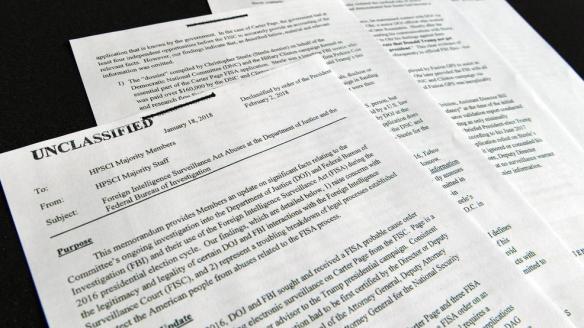
The part of the memo that has everyone talking today reads as follows: “Furthermore, Deputy Director McCabe testified before the Committee in December 2017 that no surveillance warrant would have been sought from the FISC without the Steele dossier information.”

This refers to a surveillance warrant requested by the FBI’s then-Deputy Director Andrew McCabe from the Foreign Intelligence Surveillance Court seeking permission to spy on the communications of Carter Page, a member of the 2016 Trump campaign. The controversy revolves around the claim that this surveillance warrant would never have even been requested if not for the clearly biased, Clinton-funded, and error-riddled Christopher Steele dossier which is acknowledged even by its former MI6 author to be 10 to 30 percent inaccurate.

Combine that with the fact that this has never been made clear to the public, and baby you’ve got yourself a scandal. The FBI knowingly using extremely tainted evidence from one presidential campaign to get permission to spy on another would indeed be a very big deal.

There are some problems with the “BOOM! Bigger than Watergate!” exclamations that pro-Trump partisans have been parading around about this, however. The first is that the memo is only an internal communication between Republican congressmen; it’s not a sworn testimony or legal transcript or anything legally binding. It’s basically just some Republican ideas about what happened. The assertions made therein are reportedly being hotly contested by Democrats with knowledge of the situation, which is in turn being disputed by Republicans.

Another thing putting a damper on the GOP’s “KABOOM!” parade is the fact that the memo’s contents are not even entirely new; CNN reported way back in April of last year that sources had informed them that the Steele dossier had been used to get a FISA warrant on the Trump campaign. Additionally, even if every single allegation in the memo is true, the revelations are still arguably far less earth shattering than the Edward Snowden revelations of 2013 exposing the NSA’s sprawling domestic espionage network, so the expectation that these less significant new revelations would cause a radical transformation in U.S. politics when the Snowden revelations did not seems highly unrealistic.

Nonetheless, there have been some extremely important revelations as a result of this memo; they just haven’t come from the contents of the memo itself. In the same way that cybersecurity analysts observe the metadata underlying hacked files rather than the contents of the files themselves, political analysts have been pointing out that a lot can be learned about the political establishment by looking at its response to the possibility of the memo’s release.

“Memo is clearly not a blockbuster. We can tell so by reading it. Which makes Dems’ frantic efforts to prevent anyone from reading it seem even more bizarre,” observed TYT’s Michael Tracey. “Veracity of memo’s claims aside, we were told that its release would undermine the rule of law. So, just checking: is the rule of law still in tact?” he added later.

“Now it is clear to all,” WikiLeaks’ Julian Assange tweeted. “The claims about how the ‘Nunes’ memo would destroy ‘national security’ were lies. Classification stickers are used by bureaucrats trying to obtain ‘political security’ for their cronies.”

“One effect of the memo – it’s an example of how extensively we overclassify information,” wrote National Review’s David French. “I’m highly dubious that any information disclosed threatens national security in any way, shape, or form. I’d be willing to bet the Dem response is similarly harmless. Release it.”

Indeed, both the FBI and high-profile Democrats have been claiming that the memo’s unredacted release would pose a national security threat, with California Congressman (and virulent Russiagater) Eric Swalwell going so far to call it “brainwashing.” A CNN panelist wandered completely off the paddock and suggested that yesterday may have been America’s last day as a democracy. Why were they all flipping out so hysterically over a release of information that plainly poses no threat to the American people?

In addition to Assange’s assertion that government secrecy has far less to do with national security than political security (a claim he has made before which seems to be proving correct time and time again), there’s the jarring question posed by Republican Congressman Thomas Massie: “who made the decision to withhold evidence of FISA abuse until after Congress voted to renew FISA program?”

Whoa, Nelly. Hang on. What is he talking about?

It would be understandable if you were unaware of the debate over the reauthorization of FISA surveillance which resulted in unconditional bipartisan approval last month – the mainstream media barely touched it. In point of fact, though, the very surveillance practices alleged to have been abused in this hotly controversial memo are the same which was waved through by both the House and the Senate, and by the very same people promoting the memo in many cases.

The McCabe testimony was in December. FISA was renewed in January. Why is all this just coming out now? If the Republicans truly believed that McCabe said what the memo claims he said, why wasn’t the public informed before their elected representatives renewed the intelligence community’s dangerously intrusive surveillance approval? Was this information simply forgotten about until after those Orwellian powers had been secured?

Of course not. Don’t be an idiot.

This makes the kicking, screaming, wailing and gnashing of teeth by the political establishment make a lot more sense, doesn’t it? Now suddenly we’re looking at a he-said, she-said partisan battle over an issue which can only be resolved with greater and greater transparency of more and more government documents, and we can all see where that’s headed. In their rush to win a partisan battle and shield their president from the ongoing Russiagate conspiracy theory, the Republicans may have exposed too much of the establishment foundation upon which both parties are built.

The term “deep state” does not mean “Democrats and Never-Trumpers” as Republican pundits would have you believe, nor does the term refer to any kind of weird, unverifiable conspiracy theory. The deep state is in fact not a conspiracy theory at all, but simply a concept used in political analysis for discussing the undeniable fact that unelected power structures exist in America, and that they tend to form alliances and work together in some sense.

There is no denying the fact that plutocrats, intelligence agencies, defense agencies and the mass media are both powerful and unelected, and there is no denying the fact that there are many convoluted and often conflicting alliances between them. All that can be debated is the manner and extent to which this is happening.

The deep state is America’s permanent government, the U.S. power structures that Americans don’t elect. These power structures plainly have a vested interest in keeping America’s Orwellian surveillance structures in place, as evidenced by the intelligence community’s menacingly urgent demand for FISA renewal back in December. If there’s any thread to be pulled that really could make waves in the way Official Washington (hat tip to the late Robert Parry) operates, it is in the plot holes between the bipartisan scramble toward unconditional surveillance renewal and the highly partisan battle over exposing the abuse of those very powers.

If we’re going to see a gap in the bars of our cages, that’s a great place to keep our eyes trained, so keep watching. Watch what happens in a partisan war where both parties have a simultaneous interest in revealing as little of the game as possible and exposing the other party. Things could get very interesting.

Brazile Fallout: Hillary Privatized the DNC with Help from a Washington Law Firm

By Pam Martens and Russ Martens

Source: Wall Street On Parade

Secret side agreements are a common maneuver by corporate law firms. Here’s how they work. An agreement that is legal and passes the smell test is drafted and submitted to a court or a regulatory body for public consumption. Then, a separate, secret side agreement is written and signed by both sides and it contains all of the smelly, shady, ethically questionable hard details on how the original agreement will be carried out.

Donna Brazile, the former interim Chair of the Democratic National Committee (DNC) during the 2016 presidential campaign, has written a new book, “Hacks: The Inside Story of the Break-ins and Breakdowns that Put Donald Trump in the White House,” and has revealed the secret side agreement that the DNC had with Hillary Clinton’s campaign.

In 2015, Hillary Clinton’s campaign set up a joint fundraising committee called the Hillary Victory Fund (HVF) with the DNC and over 30 state democratic committees. The public portion of the agreement indicated that Hillary would raise funds for her own campaign while also allocating a portion to the DNC to help the overall Democratic Party as well as allocating funds to state democratic committees in order to support down-ballot candidates in their local elections. But the secret side agreement that effectively privatized the DNC, giving Hillary and her campaign lawyers control of the DNC and its money, had yet to see the light of day.

This is how Brazile describes the secret side agreement in her book:

“The agreement—signed by Amy Dacey, the former CEO of the DNC, and Robby Mook [Clinton’s campaign manager] with a copy to Marc Elias [lawyer at Perkins Coie]  — specified that in exchange for raising money and investing in the DNC, Hillary would control the party’s finances, strategy, and all the money raised. Her campaign had the right of refusal of who would be the party communications director, and it would make final decisions on all the other staff. The DNC also was required to consult with the campaign about all other staffing, budgeting, data, analytics, and mailings.”

The Clinton camp has now attempted to defend itself by saying these terms are standard because they were not going to kick in until the Democratic Party had chosen its official presidential nominee at its party convention in July 2016. But that’s not what the actual secret side agreement says. It indicates the following: “Beginning October 1, 2015,” the HVF would begin transferring $1.2 million to the DNC at the start of each month with that release “conditioned on” Hillary Clinton’s primary campaign personnel being consulted “and have joint authority over strategic decisions over the staffing, budget, expenditures, and general election related communications, data, technology, analytics, and research. The DNC will provide HFA advance opportunity to review on-line or mass email, communications that features a particular Democratic primary candidate.”

Additionally, the secret agreement states that “the DNC agrees that no later than September 11, 2015 it will hire one of two candidates previously identified as acceptable to HFA” (Hillary for America, the primary campaign fund for Clinton) as its Communications Director. All of this is occurring in the fall of 2015 with the official Democratic nominating convention not taking place until July 2016.

As Politico reported in May 2016, the Hillary Victory Fund was a sham in multiple other ways. First, Politico writes that less than 1 percent of the money raised stayed in the state’s coffers. The Treasurer of the Hillary Victory Fund actually had the power to move money in and out of state committee bank accounts. Politico reporters Ken Vogel and Isaac Arnsdorf cite the following example to show how things actually worked:

“…the Minnesota Democratic-Farmer-Labor Party received $43,500 from the victory fund on Nov. 2, only to transfer the same amount to the DNC that same day. The pattern repeated itself after the Minnesota party received transfers from the victory fund of $20,600 on Dec. 1 (the party sent the same amount to the DNC the next day) and $150,000 on Jan. 4 (it transferred the same amount to the DNC that day).

“That means that Minnesota’s net gain from its participation in the victory fund was precisely $0 through the end of March. Meanwhile, the DNC pocketed an extra $214,100 in cash routed through Minnesota — much of which the DNC wouldn’t have been able to accept directly, since it came from donors who had mostly had already maxed out to the national party committee.

“A similar pattern transpired with most of the participating state parties. As of March 31, only eight state parties (most of which were in battleground states such as Colorado, Florida, Nevada, New Hampshire and Virginia) had received more from the victory fund than was transferred from their accounts to the DNC.”

Brazile backs up this account in her book, writing that “the states kept less than half of 1 percent of the $82 million they had amassed from the extravagant fund-raisers Hillary’s campaign was holding….”

Brazile notes in her book that the lawyer, Marc Elias, of the politically-connected law firm, Perkins Coie, was copied on the secret side agreement. Elias has repeatedly come under scrutiny for his multi-faceted roles in the 2015-2016 presidential campaign. Most recently, he was exposed as the guy behind the hiring of Fusion GPS which compiled the scandalous Russian dossier on Donald Trump, using both Hillary campaign funds and DNC funds. The Washington Post reported that Elias was allowed to spend these funds “without oversight by campaign officials, according to a spokesperson for his law firm.”

Elias served as the General Counsel to Hillary’s primary campaign committee, Hillary for America, as well as serving as one of a team of lawyers from Perkins Coie that provided legal advice to the DNC. (Elias also provided legal advice to the Democratic Senatorial Campaign Committee, Democratic Congressional Campaign Committee, and Democratic Governors Associations, according to the Perkins Coie web site last year.)

As a legal adviser to the DNC, Elias should have known that its charter mandated fairness and impartiality to all primary candidates. But when WikiLeaks released emails last year that had been hacked at the DNC, Marc Elias was caught giving advice on how to tar Senator Bernie Sanders after his campaign suggested that the Hillary Victory Fund was skirting Federal election law. The email from Elias read:

“My suggestion is that the DNC put out a statement saying that the accusations the Sanders campaign are not true. The fact that CNN notes that you aren’t getting between the two campaigns is the problem. Here, Sanders is attacking the DNC and its current practice, its past practice with the POTUS and with Sec Kerry. Just as the RNC pushes back directly on Trump over ‘rigged system’, the DNC should push back DIRECTLY at Sanders and say that what he is saying is false and harmful the [sic] the Democratic party.”

Writing for Politico in 2014, Ken Vogel detailed how Elias and Perkins Coie have not only been the legal go-to guys for the Democratic party over the years but how they have also tinkered with Federal election law to shift more power to the 1 percent. Vogel writes:

“Perkins Coie’s political law practice, anchored by Elias and former White House Counsel Bob Bauer, has something of a stranglehold on the Democratic Party’s election law business, representing not only the party committees themselves but everyone from [Harry] Reid (whose various committees have paid $317,000 in legal fees to Perkins Coie over the years) to Obama ($7.4 million) to the major Democratic super PACs ($19 million).”

The thrust of the article, however, is that Elias played a central role in further opening the spigots for legal revenues his firm might be expected to collect in the future by tinkering with Federal legislation at the eleventh hour. Vogel writes:

“A powerful Democratic lawyer helped craft a provision that was slipped into a year-end spending bill allowing political parties to raise huge new pools of cash — including some for legal fees that are likely going to be collected by his own firm…

“The change has the potential to halt or at least slow the erosion of power of the political parties, since it would increase the maximum amount of cash that rich donors may give to the national Democratic and Republican party committees each year from $97,400 to $777,600 or more.”

The question that no one seems to be asking is who are the main beneficiaries of Perkins Coie’s heavy influence at the top of the Democratic Party. Despite Obama’s re-election for a second term, the Democratic Party shed nearly 1,000 seats from coast to coast. The Republicans now control both houses of Congress and the Executive Branch. A man with the lowest approval rating in modern history now occupies the Oval Office.

The primary beneficiaries of this hubris have been the 1 percent – Wall Street and hedge fund titans – and giant multi-national corporations that dominate the client roster at Perkins Coie.

Those within the Clinton camp and DNC who are suggesting to the American people that there is nothing to see here, time to move along, are dead wrong. Just because the Republican presidential campaign may have been corrupted by outside forces doesn’t mean that the Democratic campaign wasn’t also corrupted by its own outside forces. It’s time to follow the obscene political money trail wherever it leads.

Related Articles:

Are Hillary Clinton and the DNC Skirting Election Law?

DNC’s Direct Marketing Firm Shows Bias on Facebook Against Bernie Sanders

WikiLeaks Bombshell: Emails Show Citigroup Had Major Role in Shaping and Staffing Obama’s First Term

Democratic Party crisis explodes in wake of Brazile revelations

By Patrick Martin

Source: WSWS.org

The political crisis in the Democratic Party, brought to the surface with the publication Thursday of excerpts of a campaign memoir by the former interim chairman of the Democratic National Committee (DNC), Donna Brazile, erupted into mutual denunciations over the weekend.

Brazile made public an unprecedented agreement between the DNC (under previous chair Debbie Wasserman Schultz) and the Hillary Clinton presidential campaign that involved Clinton paying off the DNC’s debts and providing it a monthly subsidy in return for gaining control over the appointment of DNC officials and the right of approval over key operational decisions.

The deal was concluded in August 2015, six months before the first votes were to be cast in caucuses or primaries, when the DNC was required by its own rules to remain neutral in the contest between Clinton, Vermont Senator Bernie Sanders and several other candidates for the Democratic presidential nomination.

A further revelation from Brazile’s book was made public Saturday: she acknowledged discussions among leading Democrats in September 2016, after Hillary Clinton had collapsed at a ceremony in New York City marking the 15th anniversary of the 9/11 attacks, over whether Clinton should be replaced as the presidential candidate because of health concerns. Brazile writes that she herself considered Vice President Joe Biden as the logical replacement, but did not make the proposal.

Within hours of this report, 100 former Clinton campaign aides, headed by campaign chairman John Podesta and campaign manager Robby Mook, put their signatures on an open letter denouncing Brazile’s criticism of the Clinton campaign.

The “Open Letter From Hillary For America 2016 Team” makes use of the same Russia-baiting technique employed by the Democrats in their political conflict with the Trump White House, but this time directed against a former top Democrat. In assailing Brazile, the first paragraph of the open letter declares: “It is particularly troubling and puzzling that she would seemingly buy into false Russian-fueled propaganda, spread by both the Russians and our opponent, about our candidate’s health.”

The health questions about Clinton were fueled, however, not by Moscow, but by video broadcast over American cable television networks showing the candidate being lifted into a vehicle by aides and Secret Service agents, in visible distress. The characteristic duplicity of top campaign officials, who initially sought to conceal the incident, added to the ensuing furor.

Even more revealing is what is missing from the Clinton camp’s “Open Letter”: there is no reference whatsoever to the main revelation stemming from Brazile’s book—the secret joint fundraising agreement between the Clinton campaign and the DNC, six months before the first caucus in Iowa, giving Clinton effective control of the party apparatus. The Clinton aides do not dispute that this backroom deal occurred and make no attempt to justify it.

On Sunday morning, Brazile appeared on the ABC News program “This Week with George Stephanopoulos.” The host, himself a former top political aide in the White House of Bill Clinton, provided a platform for Brazile to repeat her exposure of the collusion between the Clinton campaign and the DNC and discuss the “Open Letter” from the former Clinton campaign officials.

She bitterly denounced the Clinton camp, both for its treatment of the DNC while she was in charge, and for their ferocious response to her new book. “George, for those who are telling me to shut up, they told Hillary that a couple of months ago,” Brazile declared. “You know what I tell them? Go to hell! I’m going to tell my story.”

Brazile also touched on a topic of intense but largely behind-the-scenes discussion in official Washington: the July 2016 murder of Seth Rich, a low-level IT staffer at the DNC, who was shot to death in what police called a failed robbery attempt. The Trump White House and ultra-right media allies, including Alex Jones of InfoWars and Sean Hannity of Fox News, have portrayed Rich, rather than Russian hackers, as the likely source for the DNC emails obtained by WikiLeaks, and his killing as a retaliatory “hit” ordered by the Clinton campaign.

Brazile reportedly suggests in her book—which will not be available to the public until Tuesday—that Rich’s death, warnings from the Obama administration about Russian hacking and repeated online threats from Trump supporters had made her extremely concerned about security issues, to the point where she had her home swept for bugs and installed multiple security devices. In her interview Sunday with Stephanopoulos, she spoke of her fears for her own personal safety. Her mention of Seth Rich, entirely unsolicited, seemed a veiled warning to the Clinton camp that more revelations about 2016 campaign skullduggery could be forthcoming.

Current DNC Chair Tom Perez was interviewed Sunday on “Meet the Press” on NBC and directly rejected the two main issues raised by Brazile. He maintained, “The charge that Hillary Clinton was somewhere incapacitated is quite frankly ludicrous,” although he did not attribute that concern to Russian propaganda.

He went on to argue that Clinton won the Democratic primary contest by four million votes, and the DNC was not in control of those elections, which are run by the state governments, while noting that the caucuses, which are controlled by the party apparatus, were mostly won by Sanders, not Clinton. Perez would concede only that “the DNC fell short during critical moments of the primary,” in terms of openly favoring Clinton over Sanders.

Significantly, neither Sanders nor any of his top aides or supporters made an appearance on any of the Sunday television talk shows. Sanders issued a statement on Brazile’s revelations suggesting that the conduct of the 2016 campaign was a diversion from the effort to mobilize opposition to the Trump administration.

The fact is that Brazile informed Sanders of the joint fundraising agreement and the takeover of the DNC by Clinton more than a year ago, and he has chosen to say nothing about it. This is part of his effort to prop up the Democratic Party and prevent the millions of working people and youth who supported his campaign from drawing the political conclusion that it is necessary to break with the Democrats in order to conduct any genuine struggle against the billionaires who dominate the US political system.

The conflict within the Democratic Party has erupted under conditions where the Republican Party is bordering on civil war, with several Republican senators denouncing Trump as a threat to American democracy—and then announcing they would retire from office rather than oppose him—and a vicious conflict developing between the party establishment and the fascist-minded elements around Trump, spearheaded by his former chief political aide and campaign manager, Stephen Bannon, now returned to his position as chief executive of the ultra-right Breitbart News.

In recent days, it has been reported that in an upcoming book titled The Last Republicans, the author cites interviews with George H. W. Bush and his son George W. Bush in which the two last Republican presidents before Trump denounce the current occupant of the White House and reveal that they refused to vote for him in 2016. In response, Trump tweeted an attack on his Republican presidential critics.

The ABC “This Week” program on which Brazile was interviewed began with the presentation of a new Washington Post/ABC News poll showing public support for Trump falling to its low point for the year, only 37 percent, with 59 percent opposing. Trump’s showing was the worst for any first-year president since modern polling began. Other polls have shown public support for the Republican-controlled Congress hitting new lows as well.

The vast majority of working people are increasingly alienated from the two-party political system in the United States, correctly regarding both the Democrats and the Republicans as tools of the super-rich and looking for an alternative. The central political question is the building of a political movement of the working class that will fight the capitalist system as a whole and advance a program to defend jobs, living standards and democratic rights, and oppose imperialist war.

Freedom Rider: Dump the Democrats for Good

gettyimages-621673240

By Margaret Kimberly

Source: Black Agenda Report

“The Democrats were so entrenched in their corruption and self-dealing that they didn’t see the Bernie Sanders campaign for modest reform as the savior it might have been.”

This columnist did not see a Donald Trump victory coming. The degree of disgust directed at an awful candidate was more than I had predicted. Neither the corporate media, nor Wall Street nor the pundits nor the pollsters saw this coming either. Their defeat and proof of their uselessness is total. Those of us who rejected the elite consensus and didn’t support Hillary Clinton should be proud.

Black people are now in fear and in shock when we ought to be spoiling for a fight. All is not lost. Even the victory of the openly bigoted Trump poses an opportunity to right our political ship. Not the electoral ship, the political one. For decades black Americans have been voting for people who have done them wrong. Bill Clinton got rid of public assistance as a right, and undid regulations that kept Wall Street in check. He put black people in jail and yet black people didn’t turn on him until he and his wife tried to defeat Obama. But Obama gave us more of the same. Bailouts of Wall Street, interventions and death for people all over the world, and a beat down of black people who still loved him. Despite the fear of Republican victory we end up losing whenever a Democratic presidential candidate wins.

“Obama bailed out banks, insurance companies, Big Pharma and even Ukraine.”

Victory is ours if we dump the Democrat Party and their black misleaders. The Democrats were so entrenched in their corruption and self-dealing that they didn’t see the Bernie Sanders campaign for modest reform as the savior it might have been. Instead they marched in lock step with a woman who was heartily disliked. Sanders went along as the sheep dog who led his flock straight over the cliff. The Democrats inadvertently galvanized people who had stopped participating in the system and who want change from top to bottom.

One of our biggest problems lies not in facts but in perceptions. What did Democrats do for black people? The Democrats ship living wage jobs off shore in corrupt trade deals like NAFTA and TTP. They don’t prosecute killer cops or raise the minimum wage. Trump will be hard pressed to deport more people than Obama did. The list of treachery is very long.

When Donald Trump asked black people, “What have you got to lose?” his words were met with derision. But in reality he posed a good question. What do we have to show for years of Democratic votes? Obama bailed out banks, insurance companies, Big Pharma and even Ukraine. But he didn’t rebuild Detroit or New Orleans. The water in Flint, Michigan is still poisoned and the prisons are still full.

“There may be opportunity in this crisis if we dare to seize it.”

The outpouring of love for Barack Obama was purely symbolic. In state after state, black people who gave him victory in 2008 and 2012 stayed home. They loved seeing him and his wife dressed up at state dinners but they were never fully engaged in politics because that is not what Democrats want. The love was phony and void of any political intent. Donald Trump will be president because of that veneer of political activism.

As for white people who voted for Trump, of course many of them are racists. However they are not without valid complaints. They don’t want neoliberalism but black people don’t either. They don’t want wars around the world and neither do black people. We corrupt our own heritage of radicalism in favor of shallow symbolism. While we slept walk in foolish nostalgia for Obama and cried at the thought of him leaving office, white people kept their hatred of Hillary to themselves or lied to pollsters. They want America to be great again, great for them. White nostalgic yearnings are dangerous for black people, and we must be vigilant. But there may be opportunity in this crisis if we dare to seize it.

Republicans have been the white people’s party for nearly 50 years. Trump just made it more obvious. He didn’t tell us anything we didn’t already know. We don’t have to be the losers in this election. Let us remember what we have achieved in our history. Half of black Americans didn’t even have the right to vote in the 1960s yet made earth shattering progress in a short time. But we must understand the source of that progress. It came from struggle and daring to create the crises that always bring about change.

“The dread of redneck celebration should not be our primary motivation right now.”

Yes white people will strut for president Trump but that doesn’t mean we must submit as if we are in the Jim Crow days of old. We have ourselves to rely on and we can reclaim our history of fighting for self-determination. The dread of redneck celebration should not be our primary motivation right now. Before we quake in fear at white America we must send the scoundrels packing.

The black politicians and the Democratic National Committee and the civil rights organizations that don’t help the masses must all be kicked to the proverbial curb. The rejection must be complete and blame must be laid squarely at their feet.

Those of us who voted for the green party ticket of Jill Stein and Ajamu Baraka must stand firmly and proudly for our choice. We must strategize on building a progressive party to replace the Democrats who never help us. We must applaud Julian Assange and Wikileaks for exposing their corruption. There should be no back tracking on the fight to build left wing political power.

“We must strategize on building a progressive party to replace the Democrats who never help us.”

The black people who didn’t return to the polls shouldn’t be blamed either. Those individuals must have personal introspection that is meaningful and political. Their lack of enthusiasm speaks to Democratic Party and black misleadership incompetence. We should refrain from personal blame and help one another in this process as we fight for justice and peace.

The end of the duopoly is the first step in liberation. Staying with a party that literally did nothing was a slow and agonizing death. Sometimes shock therapy is needed to improve one’s condition. If we don’t take the necessary steps to free ourselves this election outcome will be a disaster. Instead, why not bring the disaster to the people who made it happen? The destruction of the Democratic Party and creation of a truly progressive political movement is the only hope for black America.

Rigged

delegates

By David Swanson

Source: Let’s Try Democracy

The 2016 Republican presidential primary was rigged. It wasn’t rigged by the Republicans, the Democrats, Russians, space aliens, or voters. It was rigged by the owners of television networks who believed that giving one candidate far more coverage than others was good for their ratings. The CEO of CBS Leslie Moonves said of this decision: “It may not be good for America, but it’s damn good for CBS.” Justifying that choice based on polling gets the chronology backwards, ignores Moonves’ actual motivation, and avoids the problem, which is that there ought to be fair coverage for all qualified candidates (and a democratic way to determine who is qualified).

The 2016 Democratic presidential primary was rigged. It wasn’t rigged by bankers, misogynists, Russians, Republicans, or computer hackers. It was rigged by the Democratic National Committee and its co-conspirators in the media, many of whom have helpfully confessed (in case it wasn’t obvious) in emails leaked from the DNC and from John Podesta. The DNC chose Hillary Clinton and worked hard to make sure that she “won.” Nobody has produced a hint of evidence as to who leaked the emails that added unnecessary confirmation of this rigging, but they should be thanked for informing us, whoever they are.

The FBI investigation of Hillary Clinton’s misuse of email was as rigged as the non-prosecution of the CEO of Wells Fargo. The U.S. political system is bought and paid for. Without millions of dollars to funnel to television networks for advertising, any candidate is rigged right out of participating. This rigging of the system is not fixed by someone like Donald Trump pretending for a while that he won’t take bribes, that he’ll spend only his own money, because most people don’t have that kind of money to spend. This rigging is not fixed by making someone like Hillary Clinton take her bribes through her family foundation or requiring that her political action committees remain theoretically separate from the campaign they are collaborating hand-in-glove with, because money buys power.

The debates are rigged by a private entity with no official status that calls itself the Commission on Presidential Debates and transforms open debates among multiple candidates into exclusively bipartisan joint appearances with many large and fine points negotiated beforehand.

Actual governance of the United States is rigged. Congress plans to attempt to ram through a number of intensely unpopular measures just after the election, including a supplemental spending bill for more wars and including the Trans-Pacific Partnership. The hope is that most people will have tuned out after the election circus, and that most of them will forget what happened 2 or 4 years later.

The demonization of Vladimir Putin is rigged. Nobody has seen evidence that he or his government did us the favor of informing us of the DNC’s corruption. He proposed a ban on cyber “war” that was rejected by the United States, for goodness sake. There’s no evidence that Russia shot down an airplane in Ukraine or invaded Ukraine or seized Crimea or plotted attacks on the United States. The United States pulled out of the ABM treaty, expanded NATO to Russia’s border, built missile bases, arranged military “exercises,” facilitated a Ukrainian coup, and pushed a string of hostile lies. Russia has shown even more restraint than your typical U.S. voter (who usually sits home and does not vote, especially in primaries).

Military spending is rigged. Nobody knows it amounts to over half of U.S. discretionary spending.  Nobody knows it’s as much in the U.S. as in the rest of the world (allies and otherwise) combined. Nobody pays attention to the bribes from war profiteers, or to the threats held over Congress members to pull weapons jobs out of districts or states. Supporters of both big candidates claim their candidate plans to cut military spending. Both candidates have said the exact opposite. The debates and interviews steer clear of the whole topic.

The shapes of the districts are blatantly rigged by gerrymandering. The existence of the Senate, in which Rhode Island and Wyoming each have as much say as California is rigged against the popular will. The electoral college is rigged against the popular will and in favor of concentrating national campaigns in a handful of “swing states.”

Voter registration is rigged. A handful of states have now made it automatic, as most states have long-since done for military draft registration. In the rest of the country, thousands of young people run around registering voters, imagining they are engaged in “activism.” Meanwhile, the right to vote can be denied to anyone by claiming they aren’t registered.

People’s names are stripped from voting rolls through a so-called justice system that brands them as felons, and through the careful rigging of those rolls by corrupt and partisan state governments that intentionally strip out people likely to vote for a particular party. This includes racial profiling. Bob Fitrakis, Harvey Wasserman, Greg Palast and others have reported extensively on these practices.

Election day is rigged as well. It’s not a holiday. Most people have to work. Poor districts and racial minority districts tend to have fewer machines and longer lines. ID requirements are used to deny people the right to vote. Intimidation and racial profiling by partisan activists serve the same function of rigging the election. The myths and lies about the virtually nonexistent phenomenon of “voter fraud” also serve to rig the election.

The election machines are also rigged. That is to say: instead of verifiable paper ballots publicly hand-counted in front of observers from all interested parties in each polling place, we have a faith-based system of voting on black-box machines that can never, even in theory, be checked for accuracy. These machines have been very easily hacked in demonstrations. These machines have visibly flipped votes before the eyes (and cameras) of countless voters. These machines have almost certainly played a key role in flipping the results of numerous elections.

Now, the wider the margin of victory, the less likely an electronic flipping. And the fact that machines can easily be used to steal an election does not mean that they always will be. But it was very odd during the late summer of 2016 to watch the U.S. media announce that these machines were totally unreliable — just what many of us had been saying for years. But the media said this in order to accuse Russia of planning to sabotage the coming U.S. election, or in order to accuse Russia of exactly what these media reports themselves did: plant seeds of doubt in U.S. minds.

Those doubts should be there. People should watch for visible problems with machines and with partisan and racist intimidators, and report all such to 1-866-OUR-VOTE, to county clerks, to secretaries of state, and to corporate and independent media. Then we should work for necessary reforms, including a respectful cessation of the U.S. government’s routine practice of interfering in elections and overthrowing governments in other people’s countries — a practice that has clearly resulted in the U.S. media projecting such behavior on others.

Ultimately, an unrigging of the U.S. system might take the form of amending the U.S. Constitution to slip in words like these:

The rights protected by the Constitution of the United States are the rights of natural persons only.

Artificial entities, such as corporations, limited liability companies, and other entities, established by the laws of any State, the United States, or any foreign state shall have no rights under this Constitution and are subject to regulation by the People, through Federal, State, or local law. The privileges of artificial entities shall be determined by the People, through Federal, State, or local law.

The judiciary shall not construe the spending of money to influence elections to be speech under the First Amendment.

All elections for President and members of the United States House of Representatives and the United States Senate shall be entirely publicly financed. No political contributions shall be permitted to any federal candidate, from any other source, including the candidate. No political expenditures shall be permitted in support of any federal candidate, or in opposition to any federal candidate, from any other source, including the candidate. The Congress shall, by statute, provide limitations on the amounts and timing of the expenditures of such public funds and provide criminal penalties for any violation of this section.

State and local governments shall regulate, limit, or prohibit contributions and expenditures, including a candidate’s own contributions and expenditures, for the purpose of influencing in any way the election of any candidate for state or local public office or any state or local ballot measure.

The right of the individual U.S. citizen to vote and to directly elect all candidates by popular vote in all pertinent local, state, and federal elections shall not be violated. Citizens will be automatically registered to vote upon reaching the age of 18 or upon becoming citizens at an age above 18, and the right to vote shall not be taken away from them. Votes shall be recorded on paper ballots, which shall be publicly counted at the polling place. Election day shall be a national holiday.

Nothing contained in this amendment shall be construed to abridge the freedom of the press. During a designated campaign period of no longer than six months, free air time shall be provided in equal measure to all candidates for federal office on national, state, or district television and radio stations, provided that each candidate has, during the previous year, received the supporting signatures of at least five percent of their potential voting-age constituents. The same supporting signatures shall also place the candidate’s name on the ballot and require their invitation to participate in any public debate among the candidates for the same office.