The Eye of the Beholder: There is Never Anything New

414JCSYLsPL._SX332_BO1,204,203,200_

A review of John Steppling’s new book, Aesthetic Resistance and Dis-Interest

By Paul Haeder

Source: Dissident Voice

it is through mimesis, (identification with the mirror image) that one gains a sense of unity, self-containment and mastery over the body. If that was all that there was to it, humanity would be condemned to dwell forever entombed in the hell of mirrors. However, the identification with an Other in the mirror opens out the possibility for symbolic thought.

— John Desmond, author, thinker, who is interested in the history of marketing; construction of knowledge in marketing; consuming culture; morality and marketing; advertising and public policy

The beauty of ideas and words and sculpting frames and philosophical groundings is that we in Western culture having nothing more challenging than the numbness of a consumer-wrecked world where crass hucksterism and financial voodoo wizardry – even with its nuclear tipped propaganda, surveillance and missile dragnet technological orgasm science serves up – pales in comparison to any tried and tested narrative grammar of idea wizards.

Yet, dealing with words now, we see, as one noted playwright and thinker attests, involves PR packaged thinking, possibly a flagrant fascism tied to what can be written (thought) and what cannot be (said).

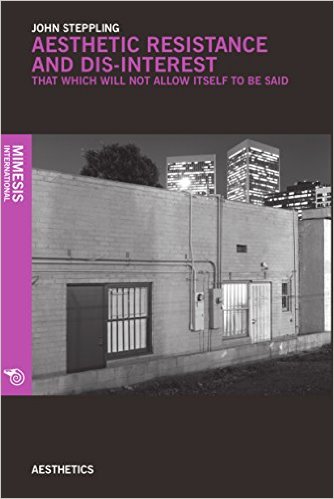
The title to his book says it all, sometimes – Aesthetic Resistance and Dis-Interest – That Which Will Not Allow Itself to be Said. This is just out in 2016, by playwright, raconteur and philosopher, John Steppling, from the organization, Mimesis International. The book is a compilation of some of his blog postings, and not to denigrate the word “blog” to mean anyone and their uncle expressing anything out there on the world wide web.

Like stepping stones into Steppling’s mind, each essay is a revving reverberating call to mental action, as each essay follows the Introduction with more nitrous oxide pumped into each cylinder of the 12 cylinder motor of his mind: one, Narrative & Empathy; two, Magical Thinking; three, Pedagogy; four, Nothing is Art; five, The Impossible Playwright; six, Someone to Watch Over Me; seven, The Political Uncanny; eight, That Which Will Not Allow Itself to be Said; nine, The Hidden Narrative.

Here, Steppling drills down into the cortex of the American – European, white, patriarchal, Puritan and Elitist – brain, sort of the flash mob mentality we are downloading determinedly. He plugs holes in the tinny junk thinking and pseudo intellectualism hovering around academia, the So Called Liberal Media, the Corporate boardrooms, the waiting rooms at TED Talks 3.0, and the ER’s resuscitating the pop culture that doubles in the minds of the masters of consumption as true art (sic). It’s a violent country, the art is anti-art, and the world of the Imperialist, right-wing or leftie, is predicated on a Heart of Darkness destruction that Steppling decants into the incantation:

The unfinished and fragmentary now emerge as comments all by themselves. When the worst aggressions in society today are often those paraded as benign, or self branded as innocent, even curative, the default response must be one of disconnection. The age of marketing, fueled by Imperialist Capital, has obliterated ideas of belief. Ideas of evidence and trust in our own feelings are all the time under duress and coercion. Aesthetic coercion is the staple of a system of image and narrative control the erases the individual while unrelentingly trumpeting his triumph.

Mimesis conceptually and psychoanalytically is something Theodore Adorno, Robert Hullor-Kentor and Fabo Akcelrud Durao study as they break into the mind of the human condition under the duress of capitalism-hucksterism-market competition-cultural posturing in order to understand how we as thinkers and believers re-narrate when we read a novel or watch a film, as well as engage with poetry and theater. Steppling is looking at this sirocco of thought tied to art, and it’s only that, art, if it changes us somehow. Art can mean buildings, parks, ways entire city blocks and towns are laid out and made to be something more than a mess against nature or utilitarian. Or practical in the Puritanical way. Looking at the Palaeolithic rock paintings around the world, Steppling posits that these sophisticated and voluminous paintings are “exclusively mimetic participation in a magical object .. and that Neolithic artifacts represent a significant change of consciousness, and of the human relationship to the group.”

This short book delves into the heart of what it is to be human, what Pierre Janet (L’Evolution de la Memoire) says how we become the very beingness of “I” – Narration created humanity. This book is just a small sluice into the larger wetlands that spread across the more rarefied postulations of Steppling’s thoughts and comments, here, at this blog: John Steppling – The Practice of Writing – Theatre Film Culture).

Ironically, his most recent post talks about his youth, when he was born in 1951, Laguna Beach, where his mother worked at Woolsworth and father acted in community theater. Steppling looks at Charles Olson and his work in the Yucatan, the same year, 65 years ago, and in that looking back, Steppling unfragments the fragments of memory, youth, childhood, origin, which all boils down to a Western culture seeded with capitalism that is moved by destruction and the boom in the bust:

When Olson dug into the dirt of the Yucatan hills, my parents had moved to Laguna Beach. My mother worked at Woolworths as a counter girl. My father acted in the community theatre there. It was a sleepy beautiful barely touched village, really. It lay off the old Highway — the old PCH. In those years nobody thought about the destruction of entire pine forest in the San Bernadino mountains. Olson didn’t dream of tourist high rises, resorts for white people, all across the Yucatan peninsula.

A half century has been spent in the West destroying things, and destroying people, and destroying beauty. A post apocalyptic treeless suburb, that is the inner circle of hell. Having to live next to affluent white men who bitch about Jews, and then look to play a round of golf at one of the thousands of courses in drought ravaged California. While in far off corners of the globe U.S. made bombs explode and kill and maim. These same guys, over drinks, might discuss topics like ‘reverse racism’. Fifty solid years of this. — John Steppling’s blog

Imagine in this crass, Hollywood-drenched, Chosen Few World of high financial and structural violence and rape and rapine, resource wars, total cultural and physical annihilation of the tribes, and we have Steppling surfing these monster 100-foot waves seeking what it means to be in the present reading the footprints of the past, histories written and rewritten, and into the eye of the poet, which is the vortex of our cultural wars: “The sedimentation of terror into language, specifically into the naming of things, is that magical element in spoken text that differentiates it from reading to oneself silently. Both can be mimetic, but the range of the frightening is greater when it happens on stage.”

Steppling dis-interns the graveyards of humanity and philosophy in a process of eliminating vis-a-vis this modern, scientific and technocratic metallic world the magic, the thoughtful, the greater good of humanity to express, as poets and as the players, actors, in this life theater. He ties this into those who have fought to erase memory, to dominate:

The domination of nature coincided with the neutralizing of Language. Shorn of terror, the cry became the concept, Dionysian energy was expelled, superstition replaced by logic. This was the force of Enlightenment thinking, and the correctives were real, but less observed, the cleansing of that which allowed for the tragic to reveal itself. The tragic as a sensibility; and without that sensibility, the infinite domination, unchecked rational horror grow on the underside of the image and word.

He’s looking at class in most of his work, and Steppling discovers that corporate interests have eliminated the outsider, helped to cull the very idea of class and what the artist’s role is in “the great Spectacle today.” We see threaded like glacial melt Steppling’s look at how we in this punishment society put down the poor, forcing the poor into some crazy reformulaton in our theater or film.

Housebreak them. Make them heel. Make them sentimental. This is the paternalism of ‘encouragement.’ I’ve always felt insulted when anyone wanted to encourage me. Encouragement is the sadism of the ownership class, the good plantation owner, those who enjoy the power that comes from encouragement. I’ve said before, grants and the writing of applications for grants is a form of psychological servitude.

Art, politics, education, and creativity, the word, the intersection of a neoliberalism, a fake Left, all those ideas come into the mental landscape of Steppling, who is a studied playwright, living in a world of intellectual conceptualizations, and he sees the bright line of mimesis as how Adorno formulated it – “as a way out from under the crushing conformity and standardization of mass culture, to trace authentic artworks and to trace the path of their occurrence,” John writes.

I’ve been experiencing first-hand this deadening of culture, ideas, words, poetry, in the education systems I have taught in, and the echo of William Burroughs who called school “the Job” is a place where Steppling and I and so many others see as penal colonies where “the spontaneous fantasies of children are literally beaten out of them . . . the business of extinguishing that fantasy and creativity.”

Mimesis is a form of expression, not a Xerox copier in the head. – John Steppling

This book is a slice on the microscope slide looking at the DNA of modern American psychosis – and the truth is in the antithesis of human and narrative truth, Steppling has discovered in his six decades on the planet:

The only truth now is bureaucratic, administrative, or data based. The fixedness of both ideas and beliefs in those ideas, has disappeared from the contemporary life. One feels that people, in general, deal with quantifications, with administrative rules and regulations. The age of regulations. They do not explore the nature of meaning.

I can digress here, which is one of Steppling’s favorite pastimes writing — entering and exiting the rabbit hole. Punishment, retribution, class war, patriarchal bullshit. Check this out — state of ever-Blue Politics of Washington State:

Division of child support services killing the parent (mostly men) big time if some part of child support has not been paid:

a warning — driver’s license will be suspended; no commercial driver’s license shall be gotten; all Fish and Wildlife licenses issued suspended (can’t fish, hunt, or trap); can’t gather seaweed or shellfish; you won’t be able to maintain insurance coverage; doing business in the state of WA will be affected; your ability to practice your licensed profession, occupation, or trade in WA will be suspended; you shall be held in contempt of court by the state of WA.

In so many ways, Steppling speaks to my own struggle with education and social work and social justice in this state or anywhere. Imagine, you fuck up and don’t pay child support, so, the state goes after you with vengeance. Ahh, then you end up in Haeder’s casebook, homeless, strung out, lost, abandoned. It does happen, these laws and punishments, this retributive society, one that is spittle from Hollywood and the leadership (sic) class that is bent on eviscerating the poor. Steppling says there are no writers, poets, musicians, artists, philosophers really chipping away at the pedantic or the narrow self-important angles to get a real narrative of what sort of fascism that is here now and has been here for decades. Again, time and time again, I talk to these Democrats, these people voting for same sex marriage, same sex adoption, goofy ideas about girls and women in war, all the shitty PC and broken diversity crap, and, alas, we are in a time of collective abandonment, a psyche that is cleaved by trauma, because really very few care to know the cause of so much class hate, class pain.

The bedrock of this lack of thinking and struggle to see meaning as the universal pathway to thought is a society transforming nature and the inclination of the human to work within self outward, working to be original and the same at the time, but now we are a culture denuded of agency, split into identities created by marketing and advertising, and transfixed into a “giant apparatus of policing.” The checks and balances are those so-called culture purveyors, those gesticulating freaks that are unwilling to see a life, live a life, outside of Capital Imperialism, Neoliberalism, Fascism of Privatization.

Steppling doesn’t delve deeply in some of the neo-tribalist thinkers in any of his work; I’ve always been able to make that leap by thinking about the ideas of tribalism cocooned in the philosopher Daniel Quinn’s brain, who calls this a period of remembering, dislodging the great forgetting around what it is to be human outside the narrow constraints of 12,000 or 8,000 years of totalitarian agriculture. John does see tribes of the past living in relatively stable settings. The elimination of so many tribes around the world in the name of capital, manifest destiny, whiteness, is a testament to Western societies slurping up the coin of the realm at a price: “ . . . contemporary societies of the West have perfected a kind of industrial level violence and irrational lust for conquest, and a fetid clenched jaw blindness that has no rival in history. It is the culmination of something that went very wrong.”

Steppling looks at theater, architecture, post-modernism, Freudian and Jungian psychology, the art scene, fine art, photography, Hollywood, propaganda, education, all the lower forms of capitalism, all those devolving collective dendrites of a culture preened by cultural gatekeepers and the models of each generation’s tragically hip pseudo thinkers, all those posing intellectuals.

The crucible of Steppling’s galvanizing thinking is tied to what is authentic artwork, what is the concrete thing that is the spontaneous creative gravity pulling forth this flash-point of the highly creative, which is at the same instance a series of contradictions that make the process magic and concrete.

Edward Said calls this the undefined time and place. Steppling adds, “These are the contours of the imagination. We hear, we invent, we are deaf – but all of it is engaged with, and absorbed.”

In the larger frame of Steppling’s looming and far-ranging essays on/at/in his blog, we are taken into a minefield of the depraved minds of those cultural and propaganda spinners who have not only co-opted liberalism and urbanity . . . but what it means to be a writer, someone telling stories versus someone marketing stories, spinning and PR-lobbing things that are not accurate. This world Steppling covers extensively in his writing, calling to task the posings/posturing and the denaturing of figurative art into something set in a ghost-land of misled identities, narratives and characters.

We get to the data driven shit world of today, all the bureaucracies, this punishment culture, this one driven by a war machine run by USA, Israel, the G-7, the wicked stinger of the scorpion called capitalism. There is a critique of the whiteness of this imperialism, depraved and puritan all in one heave, and there is gentrification of the land and culture and arts, as well as this art-loving haute bourgeoisie class that has denuded meaning and hard work from education, learning, and thinking. This is the class warfare that provides the fodder for ever more Draconian and pervasive punishment and retribution and financial recriminations.

A world people by bearded Duck Dynasty creeps and nerds stuck in Ikea-furnished prisons. It all comes down to lacking curiosity and dependence on technocratic dogma. Titrating back into this deadening tool of marketing and generic history and measured thinking. Steppling calls for open schools which “must offend, must drive some off, must never be bland or generic. Better to be wrong.”

Paulo Freire’s pedagogy, “teaching people to see and hear is the first thing. And then to stimulate the mimetic in relation to all of it. To relearn narrative and story. That is the beginning.”

What Freire posits – He who thinks and does not learn is in great danger.

The vocabulary of our times is not up to snuff in Steppling’s view. It’s torn from our collective memory, reshaped as a kind of amnesia, what Russell Jacoby calls “… the general loss of memory is not to be explained solely psychological . . . . Rather it is social amnesia – memory driven out of mind by the social and economic dynamics of this society.” In the critical mass of the mind in this human condition is what we might like to consider true artwork, a type of “force of negativing the madness of society, the waste and abuse, and this is the negative dialectic; negate the negation, for that is the reality today.”

Daily I toil teaching people around me – younger – to live with resistance and refusal as the underpinning of any life in this hijacked capitalism, the drone warfare of consumerism bombarding us every nano second. Steppling is a friend of Henry Giroux, and in this short book pulls from one of his books, The Violence of Organized Forgetting (2014):

Students are now taught to ignore human suffering and to focus mainly on their own self-interests and by doing so they are being educated to exist in a political and moral vacuum. Education under neoliberalism is a form of radical depoliticization, one that kills the radical imagination and the hope for a world that is more just, equal, and democratic.

This insight Steppling brings to art, unraveling the fabric of mass media, his microscope on those attempts at art in TV, and his dog-earing philosophy-psychology-the dark arts of culture. For him, there is a real sense of lamentation in America, longing for some imagined or pre-invented past where there was “order” or some sense of commonly held beliefs.

We are in a time of conformity, Steppling poses, even in our supposed non-conforming perception, and in that broken covenant this society has a  “narcissistic desire . . . self aggrandizement . . . splitting and projection of our bad selves onto the Other.”

He ventures back to how much we have changed in America, how culture is tied to an infantile psyche, “ever afraid of being found out in its incompleteness, in turn cannot afford to gaze too long at certain things.”

I see it everyday, working in Chinatown, Portland, serving as a case manager for homeless, recovering addicts, early release prisoners, veterans, families. This gaze, this head down society looking at those flip after flip pages of self-loathing and self-aggrandizement, well, it is madness to see the broken people living on pavement, actually in the doorways of fancy restaurants and hip shoe stores. Raging lunacy, pickled brains, entire families and their dogs out there, in the oh so hip Portlandia represents what Steppling pinpoints in his work.

I stop and talk to those really down and out, on my way to my office where I serve people who have at least gotten teeth yanked, bellies checked, and are in temporary housing and tied to the recovery model of Narcotics Anonymous, Heroin Anonymous, Alcoholics Anonymous, you name it, all those sponsors and other case managers. These people on the streets have their stories too, amazing ones, torn from the psychological hell that people create for their children, spouses, friends, lovers.

“The purpose of Western capitalist society is to erase ALL stories and replace them with commercials, or, in other words, with anti-stories,” he writes. This is the crux of what Steppling uncovers throughout his musings and philosophical ministerial show. Until the story we have in 21st America is one where the working stiffs, including social workers and teachers like me, imagine we may be moving up some ladder, to be the kings and queens of our castles, to have those two week trips to Machu Pichu, or wherever, any fantasy that has been peddled in the crap we consume — TV, drama, movies, news, magazines, the WWW, education.

I find it more and more difficult to find empathy coming from these people, and even supposedly successful folk with jobs and mortgages and some flimsy undergraduate degrees can spew some of the most hateful fascist craps — “Way too many people on earth. Seven-point-one billion, so someone has to go. I have no problem putting the needle in the arm of some loser druggies shooting or snorting up. They should be the first to go.”

This propaganda consumed by these suburbanites, calling for eugenics and mass slaughter against those we love to stigmatize. You know, people who were once loved or held as babies, now on the streets, struggling, lunatics panhandling, voices in their heads, forever driven to show us how close we are to disaster. Ourselves.

Steppling cites Arno Gruen, how hatred is fueled to destroy empathy. “Sometimes we blame the victims. They make us feel very uncomfortable; we are ashamed of our empathy because we hate the victim ourselves.” (The Betrayal of the Self, 2007)

This is what Steppling unseals in this hermetically coffined society where the stories of struggle — real struggle, the hardscrabble struggle of barely knowing who we are, let alone the struggle of the streets, this school to prison pipeline and cradle to grave social system that has been set up by Capitalism  — are never written about with depth and empathy and understanding, and the victims grow, and nothing Hollywood or literary-wood or drama-wood produces even is close to the reality of struggle, near death, Dickensian and Kafka-esque, all of the stories that need to be told, never get told.

Just cut-outs, the reality of people who do not exist in the minds of the controllers, those gate-keepers, those plied with money artists and editors and MFA instructors and super-star Oprah Book of the Month folk.

His look at the death of agency and the death of independent thought, the killing of questioning minds and the suffocation of the soul speak loudly in this book and on/in/at his blog.

Just today . . . . Thinking about Steppling’s look at this failure of the punishment state, the war on drugs, the war on people, I ran into story after story on my caseload — people the triple victim of a penality-corrupt legal-penal system. Older women, now clean and sober, in stable housing my organization provides, with some hands up, and yet, story after story of obscene legal bills being busted for possession, spending 75 days in the clinker and coming out with $3000 bills for the court costs and the fees and such, and, then, two years later, after homelessness, after living on the streets, dumpster diving, scrapping, anything but dealing with letter and summons and warrnats, bam, the $3000 is now $5000, and then the driver’s license is suspended, another $1500 owed there for penalities.

Imagine, trying to get these people minimum wage jobs, and then all these fees and retributions and pounds of flesh held against them, in the tens of thousands per person. Former homeless people, who were not worrying about US Postal deliveries or summons or the long arm of the law creating debtors’ fees, prison, etc. These are not the stories of the elite, the vaunted value-added ones educated at Harvard or UCLA. The stories of my people are on the police blotters or are ripped to shreds by the middle class Speilbergs or anyone with hearts of stone and brains channeled for the One Percent, to tell stories that are both lies and false memories.

Imagine this entire gambit broken down as a way to push more propaganda and the dark arts of vilifying and blaming the victim.

Foreclosure after couch surfing after stolen children after endless payments to the ferryman and the financial philanderers.

This is the way Steppling points his readers to, as the underskin of his work:

And one sees it today in corporate news coverage. The control by the state of “message.” The “message” of the Olympics is Russia is bad, and full of stupid people. You see terms like “cassocks” used a lot. You see the control in what is covered and what is NOT covered. Your see it in the idiotic disinformation on the planned covert destabilizing of Venezuela (as an example). . . . The media distorts Israeli violence and apartheid. It treats all dissent in the US as either terrorism or kooks. And most of all, the control is exercised via ” entertainment.” The constant, CONSTANT, outpouring of stupidity.

So we are here, where disagreements with the law, the financial rules, all those bankers’ games, everything that culls any sense of common sense, that is somehow suspect. There is madness in what Steppling points to, and this is a country that is in possession of a stone (stoic) heart of a killer, as D.H, Lawrence wrote.

The struggle to understand and value art that “knows something that we do not know” is a constant theme in John Steppling’s work-world.

What if?

Seer

By rahkyt

Source: Sacred Space in Time

What if, every moment were meaningful? Every thought no matter how banal, ever word no matter how mundane. Every action, no matter its intention sends reverberations of meaning out into time and space. Interacting with the thoughts, words and actions of others. With the world of the senses, the infinite worlds above and below and the ineffable creations beyond contemplation.

What if this is true right now? As you sit here reading these words? What if your problems, the things going on in your relationships, with your family, friends and acquaintances, in your community and nation have meaning beyond that we generally ascribe to them? And what if this were a show, and inscrutable and infinite entities beyond our ability to sense had access to our every thought, could see our reality from outside of time – cycling back and forth thru lives and eons with some cosmic remote – and were observing us as if we were the most popular reality show ever?

If all this were true, would it make you look at your life any differently? Live with the understanding that each moment is a precious gift? That these brief, fleeting lives of ours are as ephemeral as cirrus clouds in the stratosphere; only a brief and whimsical flowering amidst the bounteous and infinite glory of eternal creation.

If every moment is meaningful and there is more to creation than our eyes and ears and hands can interpret, them that must mean that there is more to us, too. That life is precious. That each soul has worth. That no matter how unimportant and worthless we each might think we are, our personal qualities are exactly that unique expression of the infinite and eternal act of creation that gives each life and body worth.

I have worth. You matter. We have value. See how long you can carry that thought today.

Life, is priceless.


What Really Matters?

fms-act-love

By Zen Gardner

Source: ZenGardner.com

It’s amazing how the big questions in life are pushed to the end of the line. Sure everyone wonders about the “big stuff” on and off, but their lives are too preoccupied with other issues that they’ve been told are more pressing and important – when it’s nothing of the sort.

This applies directly to the on-going awakening and how to put our best foot forward in times like these. How best can we be used to effect change? What is the most productive and effective course of action in our personal lives?

With everything at stake at this crucial juncture in history these questions become profoundly important. And the answers just may surprise each of us.

The Preparation

I can guarantee that any real truth seeker is facing a lot of personal challenges at this time. It may be health issues, relationship challenges and perhaps changes, or finding a sound spiritual orientation in these rapidly shifting vibrations. A lot is going on, and this is as it should be.

We’re being honed and prepared for what lay ahead of us.

If our hearts are confused, anxious, distracted or over-burdened we won’t be much good to anyone. We may even be carrying baggage unknown to us that Universe is peeling away to free us for our next challenges. These can often be ingrained psychic and subconscious memes that keep playing out in our daily lives and reactions unbeknownst to us that are holding us back.

We may even be subjecting ourselves to triggers that bring on these attached, reactive behaviors while thinking these are necessary or even foundational influences in our lives. These are not easy to face up to, especially when it touches on things we consider dearest to us, but if we’re to keep progressing in truly conscious awakening face them we must.

It only stands to reason then that these have to be sorted out first if we’re to be the true warriors we are meant to be.

But it’s not easy.

First Things First

Anyone who has awakened has had this same fundamental experience: Everything began anew. Once we see the true bigger picture of who we are and what we’re here for, everything gets reset and we start on a brand new path in life.

However, we tend to emphasize part 2 of the above statement and look quickly for our role here and what we can do about this ugly matrix trying to control and close in on us. That’s very important, but we can’t short circuit part 1 too quickly. Who are we? This naturally continues to come up as we progress through the maze of rabbit holes and broaden our perspectives. The discovery and changes just occur, as long as we keep yielding to them and making the necessary breaks with our past programming.

But the personal challenges and realizations will get deeper and deeper, and they come with a price. It’s the same one every time – letting go – sometimes even of our most cherished beliefs or personal attachments. It can be quite painful, but it’s designed for our good, as well as the good of others whom we’ll be freer to help and influence with a truly clear signal.

The Inner Child

I’ve found for myself, with the help of very loving friends with whom I could open up, that issues that have been holding me back without my even knowing it have a lot to do with primal character traits that were formed since childhood. I’m intensely aware of so many aspects of this whole realm of study in personal attributes, societal influences and our spiritual path, but seeing these things in oneself can come as a real shock.

These realizations can come at a very dear price, but it’s a price worth paying. It’s obviously different for everyone, but if we don’t see in ourselves our reactive mechanisms that still need healing then we’re going to run into problems. Attributes like deep seated insecurity stemming from years of emotional suppression, neglect and feelings of abandonment develop very strong reactive defense and sublimated cover-up mechanisms that we accept as natural or “normal” when they aren’t in the least.

Most everyone raised in this world has been terribly abused at some point or other. The very nature of child and adolescent rearing in this callous world seriously wounds our spirits and forms habitual responses that can only be healed when we embrace that inner child and let it know it’s OK to experience and express that trauma as we truly face ourselves.

That’s when the chains fall off and the deep empowerment begins.

A Time to Draw Together

I’m no psychologist but human nature I know because I am human, and we all have profound commonalities both in this 3-D dimension and in the collective consciousness. We’re interwoven, which is why the matrix of deceit endeavors so hard to break up our honest and heartfelt communing with each other in every way possible, even pitting us against each other, when our closeness and shared experience is our very strength.

But we can only come together after we come apart from the old, including our old selves. We have to first get free of our previous mindsets, habits, emotional baggage and whatever is in the way or holding us back, whether we realize it fully or not. From there we’ll see more clearly, our motives will be more pure, and we’ll be much more effective in everything we say and do.

The price is everything, but the rewards and results are beyond comprehension. Those can be pretty difficult to see when you’re passing through the “valley of death” of the old but they will appear. You’ll get hints along the way. And the more readily we let go in full confidence that Universe is right there with us and that the experience is not a “bad” one or “wrong” at some level the easier it gets.

But it can be quite painful.

In True Unity There Is Strength

As the world turns darker people are naturally drawing closer to each other. No matter how much they fully grasp what’s going on in the world, people tend to pull together in small more tightly knit groups with those they love and trust.

This is a drawing for strength and support, which we all need, and now more than ever.

For the awakened this can be more challenging to fulfill. Most of us are scattered about and connected via the internet where we can find others with the same understanding and perspective. That’s our true family and fully drawing together may not be that easy.

Communities are forming across the world. We are finding each other and many of us have been developing wonderful relationships with others with whom we resonate. Now is the time to further cultivate those relationships and perhaps make some hard decisions to prepare for what’s ahead.

This does not preclude ongoing activism of every sort, in fact we need that more than ever, but most everyone can feel the shift has stepped up and is earnestly moving us in new and very challenging ways.

Letting Go

I’m reminded of the famous monkey trap analogy, where a box is baited with a treat with only enough room for the monkey’s hand to get into it. Once he grabs the treat he supposedly won’t let go of it and is not able to pull his hand out of the box.

Trapped by his own holding on.

We all do this. The point here is a tremendous change is taking place on many levels. The vibrational shift affects everything at every level and requires adaptation, movement and innovation, even if only on a spiritual level. But the key to freedom and being and expressing our true selves is letting go, detachment.

Therein lies our primary challenge. Will we be a landscape of willfully trapped monkeys not willing to let go of whatever it may be that we think we need, are attached to or stubbornly holding on to? Or will we be a liberated army of fully free warriors ready to do battle in this last ditch fight for planet earth?

It’s up to each of us to decide.

As for me, I paid admission to this a long time ago and have no intention of stopping short for any reason or cherished or coveted idea or attachment. It’s all or nothing. And that’s freedom, which only breeds more freedom, empowerment and alignment with Universe.

Onward. There’s really nothing to lose. Our need for attachments is illusory and what’s holding on to them needs to simply let go. It will probably be quite painful, but it will subside. Just don’t hurry out of the experience, that’s where the real learning takes place.

Draw close to loved ones during this time, but keep your pursuit hot and determination kindled.

Love always, Zen


3 Ways to Overcome the System and Start Your Own Revolution

F9uXOjIj4WQq6disjprvezl72eJkfbmt4t8yenImKBVvK0kTmF0xjctABnaLJIm9

By Gary ‘Z’ McGee

Source: ZenGardner.com

How does it become a man to behave toward the American government today? I answer, that he cannot without disgrace be associated with it. I cannot for an instant recognize that political organization as my government which is the slave’s government also.” ~Henry David Thoreau

Here’s the thing: starting a revolution is a daunting task. Being a revolution, really living it, is still challenging, but it’s considerably less daunting. Raging against the machine has its place, and it can be fun as hell pissing in the Cocoa Puffs of the powers-that-be, but when it comes down to it, rebellious antics against the murderous man-machine are a flash in the pan compared to living the revolution day-in and day-out.

Don’t get me wrong, defending ourselves against machine-men with machine-hearts is a vital aspect of living the revolution, but it isn’t primary. What is primary is being the change we seek, and not allowing ourselves the easy path toward becoming machines ourselves. Whether it’s downsizing our carbon footprint or rebuilding our community blueprint, living the revolution is less about directly fighting the system and more about building a healthier one. Like Buckminster Fuller advised, “You never change things by fighting the existing reality. To change something, build a new model that makes the existing model obsolete.”

Which I only half agree with. Truly living the revolution is doing both: fighting the existing system while also building a new one. With this in mind, the following three tactics are primary actions we all must take in order to overcome the unhealthy, unsustainable, and violent man-machine of the all-too-cliché Matrix.

1. Overcome the Appropriation of Your Freedom

“To put it still more plainly: the desire for security and the feeling of insecurity are the same thing. To hold your breath is to lose your breath. A society based on the quest for security is nothing but a breath-retention contest in which everyone is as taut as a drum and as purple as a beet.” ~Alan Watts

Don’t give into the hype of state-driven human governance. The hype is diabolically hyperreal, an abstraction of an abstraction, and it’s preventing you from being authentically free. Stop drinking the Kool-Aid the system has been trying to pour down your throat your entire life. Flip over the punchbowl instead. It’s distracting you from the following three truths: everything is connected; you are the world and the world is you; and you are independent because you are interdependent upon a healthy environment. Otherwise your independence is nothing more than a tool of your ego and your ego is nothing more than a pawn for the unhealthy system.

Overcoming the appropriation of your freedom is first realizing that everything is connected. The system doesn’t want you to understand this, because then the jig is up. The system wants you to believe that you need it in order to survive. But all you actually need is food, water, shelter, and healthy human companionship in a clean environment. As it stands, the system locks up your food, it unsustainably bottles your water, it brainwashes you into believing that’s all okay, while devastating entire ecosystems behind the scenes and calling it “progress.” Exactly the opposite of what we need as a healthy species.

If, as Albert Camus said, “In order to understand the world, one has to turn away from it on occasion,” then it behooves us to turn away from the Matrix and face the Desert of the Real so that we can get the horse of progressive, sustainable evolution back in front of the cart of outdated, unsustainable “progress.” In order to understand the world as it really is, we must be able to turn away from anyone or any system that undermines the health of the world as an interconnected organism. It begins by looking into the mirror and changing your worldview from “you versus the world” to “you are the world.”

2. Overcome the Hijacking of Your Imagination

“The best use of imagination is creativity. The worst use of imagination is anxiety.” ~Deepak Chopra

Choose acceptance over anxiety. Use your imagination to flip the script. There’s more ways to be in this world than the way you’ve been spoon-fed into believing. Understand that the system is designed to keep you indebted to it, then turn the tables by realizing that debt is ultimately an illusion, a cartoon in your head, a hyperreal abstraction that has your brain tied up in knots. Accept that you’ve been swallowing the blue pill of deceit your entire life, and then have the courage to swallow the red pill of truth instead.

As Chuck Palanuik warns, “Big Brother is making sure your imagination withers. Until it’s as useful as your appendix. He’s making sure your attention is always filled. With the system always filling you, no one has to worry about what’s in your mind. With everyone’s imagination atrophied, no one will ever be a threat to the system.”

As it stands, inside the system, you’ve been tranquilized by the trivial. Your creativity has been syphoned into mindless jobs and fed back to you as colorful placation. Devoid of imagination, you live in a sea of hyper-realities that have dulled your senses to what it truly means to be free. Break the cycle. Don’t allow the conquer-control-consume-destroy-repeat, knee-jerk reaction of culture to destroy your imagination. Don’t allow your life to be turned into a commodity. Be creative despite the crippling status anxiety of the system.

Take back the airplane of your imagination. You are the pilot, not them. So the system hijacked your imagination? Hijack it right back. The only “war” you need to worry about is going on in your head. As Diane Di Prima said, “The only war that matters is the war against imagination. All other wars are subsumed by it.” Indeed, seek that sacred space where imagination reimagines itself.

3. Overcome the Suppressing of Your Spirituality

“Which is more likely — that the whole natural order is to be suspended, or that a Jewish minx should tell a lie?” ~David Hume

You have to choke on the finite God that’s been shoved down your throat before you can digest the infinite God that wakes you up. The finite God is religion. The infinite God is spirituality. The suppression of our spirituality by both the church and the state is a tough one to overcome. After all, it is human nature to cling to beliefs, no matter how absurd. But overcome it we must if we are to evolve as a healthy species, let alone to thrive despite the unhealthy system surrounding us.
Religion is rigid, dogmatic, and divisive, and when taken too seriously, it’s violent. Spirituality is flexible, open-minded, harmonious, holistic, and antithetical to violence. Religion is based upon politics and belief. Spirituality is based upon mystery and awe. Spirituality is everything religion claims to be, but isn’t. Religion assumes. Spirituality subsumes. The system (church and state) wants you to assume that it has your best interest at heart, when really it relies upon you being ignorant and apathetic. Spirituality is antithetical to the system precisely because it encourages awareness and empathy. Spirituality attempts to rejuvenate sacred and moral traditions that have disintegrated because of the divisiveness of the church and state; a divisiveness that has caused worldwide disorientation and dissociation.

At the end of the day, being the revolution isn’t a fad, it’s a lifestyle. This isn’t a diet that you go on for a week and then go back to your old, rigid, destructive, consumerist ways devoid of any deep, spiritual meaning. No. This is a life-link. This is interdependent freedom. This is reimagining imagination. This is reconnecting the spiritual disconnect between nature and the human soul. It will be the brave and audacious minority –who dare to live the revolution despite the cow-eyed majority that are codependent on an unhealthy system –who will change the world.

As Henri Bergson profoundly articulated:

“Fortunately, some are born with spiritual immune systems that sooner or later give rejection to the illusory worldview grafted upon them from birth through social conditioning. They begin sensing that something is amiss, and start looking for answers. Inner knowledge and anomalous outer experiences show them a side of reality others are oblivious to, and so begins their journey of awakening. Each step of the journey is made by following the heart instead of following the crowd and by choosing knowledge over the veils of ignorance.”


About the Author

Gary ‘Z’ McGeea former Navy Intelligence Specialist turned philosopher, is the author of Birthday Suit of God and The Looking Glass Man. His works are inspired by the great philosophers of the ages and his wide awake view of the modern world.

This article (3 Ways to Overcome the System and Start Your Own Revolution) was originally created and published by Waking Times and is printed here under a Creative Commons license with attribution to Gary ‘Z’ McGee and WakingTimes.com. It may be re-posted freely with proper attribution, author bio, and this statement of copyright.

The Clock Inside Us

time-travel_2

By Eman Shahata

Source: The New Inquiry

Once a weapon to combat idleness, the clock has become a prosthesis, augmenting the human body to override its need for rest

IF time is money, then sleep is theft. Today’s cult of busyness regards sleep as a defect that threatens to render people competitively unfit. In a recent article for the Guardian, Lucy Rock wrote about CEOs’ “competitive sleep deprivation,” with top executives sleeping for a mere three to four hours, mimicking Margaret Thatcher’s four-hour sleep cycle when she was in office. Similarly, Angela Ahrendts, head of retail at Apple and former CEO of Burberry, has claimed she “gets a headache when she sleeps for more than six hours.”

Such enthusiasm for sleeplessness seems to make an executive virtue out of a capitalistic necessity. But it has deep epistemological roots. In the wake of Enlightenment and in tandem with the emergence of capitalism, humans began to view nature as a pool of resources to be tamed, mastered, owned, and directed toward fulfilling human desires. It wasn’t long before this conquest of nature was redirected toward the intransigencies of human nature. Despite all the technological advances that positivistic science yielded, humans were still faced with their own physical limitations. They could build skyscrapers of glass and steel that defied gravity in the name of human reason, yet they could not tame the unreasonable demands of their own body for rest.

The attempt to tame the body of its unprofitable tendency to tire began as an effort to make “saving time” a moral issue. Sixteenth-century moralist and mercantilist discourses already regarded punctuality as a prerequisite for the conception of a modern man, the pinnacle of social development in an imagined context of linear progress. British historian E.P. Thompson points out in “Time, Work-Discipline and Industrial Capitalism” that toward the end of the 17th century, as wage labor relations began to become more prevalent, time began to be conceived as a precious commodity to be spent rather than merely passed. “Those who are employed experience a distinction between their employer’s time and their ‘own’ time,” Thompson notes. “And the employer must use the time of his labor, and see that it is not wasted.” Tolling bells and fines levied by employers taught students and workers that their time was being counted, that it was a regulated and regimented currency.

Moralists urged “time thrift,” and framed the waste of time as summoning divine punishment. As British nonconformist minister Oliver Heywood put it in the 17th century tract Meetness for Heaven, “This is our working day, our market time … O Sirs, sleep now, and awake in hell, whence there is no redemption.” Paternalist and colonialist discourses, whether in addressing the English poor or indigenous people from developing countries, represented idleness as a trait of those who are “naturally inferior.” For instance, as Thompson notes, clergyman John Clayton’s pamphlet “Friendly Advice to the Poor” urges the factory worker, whom he refers to as a “sluggard,” to use his time efficiently and refrain from “dulling his spirit by Indolence.” Similarly, where theories of social evolutionism gained prominence, time discipline was seen as essential for the transition to “mature societies.” Thompson notes how economic-growth theorists viewed Mexican mineworkers as “indolent and childlike people” because of their deficient time discipline.

Parallel to the rise of “time thrift” comes the monumental role of the clock. In 17th century Britain, clocks restructured work habits by materializing the ethic of time thrift, setting a clear demarcation between “work” and “life” and reminding workers of their tasks. The omnipresence of clocks was a guarantor of regulation, it ensured the institution of order in the workspace. The clock’s ubiquity legitimized time discipline and naturalized it, making it banal and commonsensical. It made sure that no one escaped the tempo.

One might say that the clock becomes a subject, with agency in its own right, shaping social customs and subjecting people to its rhythms. As anthropologist Bruno Latour has argued, technology and things are not simply animated by humans but also mediate human action. And as anthropologist Benjamin Snyder argues, clocks served the purpose of training and manipulating the body to accomplish set tasks, thereby “turning it into an inexhaustible source of energy.” The incessant sound of the ticking clock, the mounting anxiety it almost automatically evokes, has come to regulate the body and embed it within the culture of busyness.

If clocks are agents that shape human actions, is it valid to assume that clocks are an “other”? By making sure everyone maximizes their efficiency, clocks address the physical limitations of the human body, becoming a kind of prosthesis that pushes humans closer to reaching an “optimal” state of activity.

This is reflected in the late 19th century emergence of the idea of an “internal clock,” which exemplifies how biological processes can be redefined in terms of prominent material objects. By this means, the ideology of time discipline— inseparable from the clock—becomes seen as a natural imperative. In the wake of the clock’s ubiquity, positivist and scientific rhetoric began to depict the biological clock as an “endogenous” factor that operates according to “innate” biological rhythms, leading to medical advice shaped by the metaphors it employs: “how to reset your internal clock” and so on. Such advice points to the mechanization of the body, which now requires “daily maintenance.”

It may seem as if the presence of a master clock in our brains, which synchronizes and sets sleeping patterns on its own, means we no longer need an outside force to tame our bodies. Our bodies have internalized this systemic regulation, becoming in this sense, machinic. However, what implications arise from this? This mechanization of the body—a precursor and template for the ongoing reconceptualization of the self in terms of quantities alone—reflects how our bodies have become products, rather than agents, of a culture of busyness and rationality that glorifies productivity. Scientific discourses have succeeded in masking the way we’ve been clocked in and can no longer clock out. 

Philip K. Dick’s Moral Vision

731200982635AM

[Editor’s note: on this 34th anniversary of the death of Philip K. Dick, I’m sharing the 10th and final chapter of Patricia S. Warrick’s bibliographical retrospective “Mind in Motion” (1987). It’s a good reminder of what makes PKD’s work so unique and enduringly relevant.]

This critical study of Dick’s fiction is a work without a concluding chapter – and appropriately so. To summarize his ideas, to categorize his work, to deliver the final word would be to violate Dick’s vision. He saw a universe of infinite possibility, with shapes that constantly transformed themselves – a universe in process. He had not delivered his final word when he died on March 2, 1982, because for him the Word was truly the Living Word, the power that creates and re-creates patterns. Trapped in the stasis of a final statement, the Word would have been defeated by entropy and death.

But if we cannot make a final statement, we can at least note the significance of his opus of fiction for the times in which we live. Great creative personalities often see the essence of an age with a clarity denied to the mass of people. their vision is so vivid that when subsequent events confirm it, humanity, slower at arriving at a realization of its present, hails them as prophetic. I believe that Dick may well be one of those creative personalities whom we hail as visionaries. The claim seems a strange one, considering the literary form in which he worked. Blake, Wordsworth, Yeats – the Romantics with the the elegance of poetic diction make up the visionary company, not writers working in a prose form often regarded as trash. But let us for the moment ignore the form in which he was forced to write and consider instead his vision.

He had a remarkable sense of the cultural transformation taking place in the last half of the twentieth century. He pointed out the cracks in our institutions, our ideologies, and our value systems that would inevitably lead to their collapse. He understood that what had been functional in an industrial age would not work as our culture transformed itself and moved into an Information Age. Such changes often march in with violence. As Dick’s fiction declares again and again, the late twentieth century is a time at war with itself, not with an external enemy. To fight against what one abhors without realizing it lies within is to destroy all. Dick warns us against doing this to ourselves. The cloud of chaos inevitably hangs above the Dickian landscape, a reminder that a like chaos will descend on the real world and envelop us if we continue to make war.

Dick’s fiction calls up our basic cultural assumptions, requires us to reexamine them, and points out the destructive destinations to which they are carrying us. The American Dream may have succeeded as a means of survival in the wilderness of early America; it allowed us to subdue that wilderness and build our holy cities of materialism. But now, the images in Dick’s fiction declare, we live in a new kind of wilderness, a wasteland wilderness, because those cities and the culture that built them are in decay. We need a new American dream to overcome this wasteland. Dick’s ubiquitous wasteland landscape is a moral mirror asking us to journey within and explore the universe of mind and psyche where all the forms that shape the outer world are created. The critical journey of discovery is into the mysterious realm of inner space. Just as Dick’s Fomalhaut Cosmos was a universe created by his imagination, so the universe in which we live is constructed of our ideas about it. To change it we must change our ideas.

Dick’s work makes no new declarations about our time; we knew early in the twentieth century that ours was an Age of Anxiety. But the gift of his powerful mythmaking ability is to give us the stories that help us see both what we are and what we may become as we move into the Space Age. His novel contribution is the bizarre images he creates that so vividly picture our anxieties. Phantasmagoric  shapes, the Dickian protagonist calls them, as he muses about the swirl of awesome possibilities sweeping through his mind. They are disorienting images – without clear boundary, inconsistent, contradictory, fragmented, at war with one another. They force us to reconsider our conventional conception of reality. Dick said that “science fiction is uniquely a kind of semi-reality. It is not a statement that ‘this is,’ but a statement, ‘What if this were.’ The difference is crucial in every respect.” Frightening as are some of the futures Dick imagines for mankind, they are not fixed. We are Leo Buleros, we are “choosers,” Dick tells us in the Three Stigmata of Palmer Eldritch; and The Divine Invasion envisions another future than nuclear destruction that we can choose.

We have noted Dick’s wide acquaintance with the classics. But much as Dick loved classical literature, he did not draw on this source in creating his characters. The Dickian fictional world is a world without Titans or Heroes; instead it is a world cut off from the gods. It is filled with little people lacking in power or wisdom, who daily face the dilemma of trying to survive in the face of the inexplicable destructive forces that constantly try to snuff them out. Yet they are not the conventional antiheroes of modern fiction. Perhaps the oxymoron heroic antihero best describes Dick’s protagonist. finally, the Dickian hero acts. He may writhe and struggle to escape, but in the end he accepts the burden of his existential freedom. Daily, he finally learns, he must once again to push the boulder of moral responsibility up the hill of right action. Freedom thus becomes of highest value in Dick’s code. The individual must be free to make moral choices, even though he may often fail to make the right choice. Dick declares again and again, for the individual to be turned into a machine programmed to carry out the decisions of others is “the greatest evil imaginable; the placing on what was a free man who laughed and cried and made mistakes and wandered off into foolishness and play a restriction that limits him, despite what he may imagine or think, to fulfilling an aim outside his own personal – however puny – destiny.”

Our study of Dick’s writings has traced the journey of his restless mind, watching as it grasped an idea, created a metaphor for it in a fictional pattern of antimonies, discarded it for another idea – always spiraling forward albeit often in a wobbling, erratic course. Yet from the beginning one element remains constant in all the fiction – Dick’s faith in the power of empathy. The idea was not well developed or labeled when it first appeared. We see empathy in two of his early short stories as through a glass darkly. He has not yet given it a name. Instead, his characters act it out, and only later does he recognize what his fiction has said. In “Roog” Dick pictures a dog who guards the garbage can of his owners against the garbage men who come to collect it each week. The dog is driven crazy because he cannot offer protection to his owners against these weekly raids. Years later, Dick commented on the story, explaining that he was describing an actual dog owned by a Berkeley neighbor. “I watched the dog suffer, and I understood a little of what was destroying him, and I wanted to speak for him. That’s the whole of it right there. Snooper couldn’t talk. I could. In fact I could write it down, and someone could publish it and many people could read it. Writing fiction has to do with this: becoming the voice for those without voices. It’s not your own voice, you the author; it is all those other voices which normally go unheard.”

“Beyond Lies the Wub,” Dick’s first published story, also dramatizes the concept of empathy. It tells the story of a pig-like alien captured and eventually eaten be a crew of space adventurers despite the fact that the wub possesses human characteristics. Captain Franco and his men lack the ability to see beneath the wub’s appearance. Twenty years later Dick said of the story”:

The idea I wanted to get down on paper had to do with the definition of “human.” The dramatic way I trapped the idea was to present ourselves, the literal humans, and then an alien life form that exhibits the deeper traits that I associate with humanity: not a biped with an enlarged cortex — a forked radish that thinks, to paraphrase the old saying — but an organism that is human in terms of its soul.

I’m sorry if the word “soul” offends you, but I can think of no other term. Certainly, when I wrote the story “Beyond Lies the Wub” back in my youth in politically active Berkeley, I myself would never have thought of the crucial ingredient in the wub being a soul; I was a fireball radical and atheist, and religion was totally foreign to me. However, even in those days (I was about twenty-two years old) I was casting about in an effort to contrast the truly human from what I was later to call the “android or reflex machine” that looks human but is not — the subject of the speech I gave in Vancouver in 1972 [“The Android and the Human,” included herein] — twenty years after “Beyond Lies the Wub” was published. The germ of the idea behind the speech lies in this, my first published story. It has to do with empathy, or, as it was called in earlier times, caritas or agape.

In this story, empathy (on the part of the wub, who looks like a big pig and has the feelings of a man) becomes an actual weapon for survival. Empathy is defined as the ability to put yourself in someone else’s place. The wub does this even better than we ordinarily suppose could be done: Its spiritual capacity is its literal salvation. The wub was my idea of a higher life form; it was then and it is now. On the other hand, Captain Franco (the name is deliberately based on General Franco of Spain, which is my concession in the story to political considerations) looks on other creatures in terms of sheer utility; they are objects to him, and he pays the ultimate price for this total failure of empathy. So I show empathy possessing a survival value; in terms of interspecies competition, empathy gives you the edge. Not a bad idea for a very early story by a very young person!

Two years after writing “The Wub,” Dick again explored the concept in “The Last of the Masters” (1954) and now he named it and actually called it empathy. In the story a young freedom fighter, Silvia, finally encounters the head of the coercive government and discovers he is a robot. She says in horror, “My God, you have no understanding of us. You run all this, and you’re incapable of empathy. You’re nothing but a mechanical computer.”

By the second period of Dick’s fiction when he writes his great novels of the 1960s, empathy is regularly used as the key element defining the authentic human being. the concept is made concrete most vividly in “The Little Black Box,” published in 1964. Dick then incorporates the black empathy box in Do Androids Dream where those like J.R. Isidore who use it regularly gain the strength to climb up through the difficulties of their daily lives. Beyond that, the power of empathy frees the individual from the prison house of his own consciousness and allows him to slip through the mirror forever reflecting back his own image. Once beyond, he sees the world from an alien consciousness to which he gives the same rights and worth as his own awareness. All life, not just his own, becomes sacred.

At first glance, Dick seems to be a contemporary writer who in many ways espouses an old-fashioned moral view that places him in the long tradition of humanistic writers. From the beginning, his writing insists that each individual has a responsibility to act in a moral way, even though that early fiction makes no reference to God. And of course by the end of his career, the novels focus on the major concepts of the Judeo-Christian tradition. While these concepts are never accepted in their entirety – in fact they are almost always revised – they are never denied or negated.

A closer examination of Dick’s moral code, however, shows us that given the complexities of the contemporary world, the values of traditional Christian humanists are too simple to be workable. He develops a code of valor that is much more demanding. Choice is no longer a choice between good and evil, as the moralist in an earlier age would have declared. Today the problem facing each man is that even when he practices empathy and yearns to make the right moral choice, he often finds himself in a moral dilemma where in order to do right he must also do wrong. Again and again the Dickian hero is faced with this tragic choice: to do the right thing he must violate his own moral nature: for example, Tagomi, Glen Runciter, Joseph Adams, Joe Chip, Rick Deckard. The moral road is not an easy one. The critical metaphor for this arduous journey is the upward climb – Wilbur Mercer on the hill, Joe Chip on the stairs.

In an interview near the end of his life Dick once again reinforced his belief that moral values are the ultimate values: “In a sense what I’m saying is that all life is a moral issue. Which is a very Jewish idea. The Hebrew idea about god is that God is found in morality, not in epistemology. That is where the Almighty exists, in the moral area. It isn’t just what I said once, that in Hebrew monotheism ethics devolve directly god. that’s not it. It’s that God and ethics are so interwoven that where you have one you have the other.”

Dick is an iconoclastic literary figure. His fiction refuses to conform to the characteristics of any particular category. Because he uses many of the techniques of science fiction, he is customarily labeled as a writer in that genre. But the strong, often overwhelming, elements of realism in his fiction – novels Martian Time-Slip and Dr. Bloodmoney, for example – make that label somewhat inaccurate. In many ways he seems to fit into the tradition of Absurdist literature, and he readily admitted the influence in his formative stage of Beckett, Genet, and other Absurdist dramatists. The typical Absurd hero inhabits a grotesque world whose structures violate reason and common sense but are nevertheless true. He is constantly frustrated, muddled, or horrified by the inexplicable events that seem to happen only to him and finally lead him in paranoiac panic to decide that Fate is deliberately playing pranks on him. Not the Fall of Man but his pratfalls are the concern of the Absurdist writer. So, too, are pratfalls often Dick’s concerns. Yet in fuller assessment, we find that Dick does not fit neatly into this category because he refuses to give in to the nihilism of the French Absurdists.

Dick on occasion proclaimed himself a writer in the Romantic tradition who was particularly influenced by German Romanticism. He read Goethe and Schiller when he was young, and the works of Beethoven and other German romantic composers were among his favorites. His intuitive mode of creativity and his emotional excesses characterize him as a romantic, as does his rebellion against all institutions that violate individual freedom. “I’m a Sturm and Drang romantic,” he himself declares in one interview.

When we continue to look for Dick’s literary ancestors, we discover that the ones from which he is rooted most directly are the metaphysical poets. Dick claimed them as among his favorite poets and uses quotations from Vaughan and Marvell and Donne in his fiction. For example, he quotes Donne’s Holy Sonnet XIV, “Batter my Heart, three person’d God,” in its entirety in Timothy Archer. His four chambered metaphors resemble metaphysical conceits with their concentrated images that involve an element of dramatic contrast, or strain, or of intellectual difficulty. Like Donne, he uses a colloquial style. Both writers are obsessed with the idea of death and treat it again and again in their works. So, too, do both writers blend wit and seriousness, intense feelings and vast erudition.

A discussion of literary influences is not a discussion of the essence of Dick’s fiction because his literary voice is unique. He is an eclectic, choosing and using ideas, techniques, and quotations from the literary tradition as he creates in his own distinctive form. He is a synthesizer but never an imitator. the bibliography accompanying Timothy Archer demonstrates the wide range of literature that yielded material to him: the Bible, works of Aeschylus, Plato, Virgil, Dante, Shakespeare, Donne, Vaughan, Goethe, Schiller, Yeats, to name the major writers. In this final novel Dick felt free to reveal his debt to and use of the great literary tradition, a use that he hid under cryptic allusions in most of his science fiction.

Time must be  the judge of Dick’s literary worth. If, as some of us suspect it will, Time does declare him one of the major writers of the twentieth century, he will be hailed as the synthesizer of a new literary form yoking realism and the fantastic. The novels to which I have given major attention in this study (with the possible exception of A Scanner Darkly) all succeed in this new form, for which I have chosen the term quantum-reality fiction. Dick’s fiction gives too little emphasis to science to be called true science fiction. It gives too much emphasis to the real world to be called fantasy. It violates common-sense reality too often to be called realistic fiction. He sees with a new vision as he creates imaginary worlds for his reader – a vision that declares all worlds to be fictions, brought into existence by the consciousness of the creator. Man faces the void and keeps it at bay only by the power of his intelligence to create forms.

The universe where Dick’s characters live when they fall out of commonsense reality is built on concepts that are a part of quantum physics. As physicists describe it, quantum reality is evasive and seems forever to hide beyond direct observation. Quantum physicists do not entirely agree about the nature of quantum reality, except in labeling it as bizarre. A contemporary physicist notes, “if we take the claims [of some outspoken physicists] at face value, the stories physicists tell resemble the tales of mystics and madmen… Not ignorance, but the emergence of unexpected knowledge forces on us all new visions of the way things really are.” Quantum theory holds that all elementary events occur at random, governed only by statistical laws. And Heisenberg’s famous uncertainty principle forbids an accurate knowledge of a quantum particle’s position and momentum. Beyond that, the prevailing quantum theory holds that there is no reality without the act of observation. Dick’s fiction catches the essence of this quantum reality, and he is probably the first writer of fiction to have done so.

In addition to his creation of quantum reality fiction, Dick also deserves recognition for the development of the complex four-chambered metaphor that allows him to picture the dialectical mode of the human mind as it moves in the process of thinking.

Beyond his accomplishments as a writer, Dick merits recognition for his accomplishments as a human. He struggled to live by his code of valor. In the face of great adversity, he survived and created. He was a tortured genius, condemned to live within a brilliant mind that compulsively drove itself to gather up and live out all the anxiety, pain, and torment of our age. Perhaps he needed so to suffer before he could transform our shared experiences into literature. Perhaps he did not choose but worked heroically in the shadow of a mental illness from which he had no escape. He is not the first writer to be so tortured. I recently reread a biography of Virginia Woolf which describes her struggle to write in the face of repeated nervous breakdowns, and I noted how similar Dick’s life was in this respect. He was less fortunate than she; he had no lifetime spouse like Leonard Woolf to shelter him economically and emotionally and to publish his works.

Dick’s life was a quest for meaning, a struggle with the great metaphysical problem of our time – how to reconcile what he knew in his head with what he knew in his heart. He identified himself with his little men, unheroic protagonists who endure in the face of great adversity, going quietly about their work. His work was writing and he, too, went about it quietly, eschewing publicity. Through all the mental and physical illness he never stopped writing for more than a brief time. He never lost faith in the power of literature to create a shared consciousness for the community of men. Looking at our strife-torn world, he said:

The key is this. We must shape a joint dream that differs for and from each of us, but it must harmonize in the sense that it must not exclude and negate from section to section. How this is to be done I can’t of course say; maybe it can’t be done. But… if two people dream the same dream it ceases to be an illusion; the sole prior test that distinguished reality from hallucination was the consensus gentium, that one other or several others saw it, too. This is the idios kosmos, the private dream, contrasted to the shared dream of us all, the koinos kosmos. What is new in our time is that we are begining to see the plastic, trembling quality of the koinos kosmos – which scares us, its insubstantiality – and the more-the-merrier-vapor quality of the hallucination. Like science fiction, a third reality is formed half way between.

In his writing Dick shared with us his private dreams and his nightmares about this new reality in the future toward which we move. He said he was disturbed by those reviewers who found only bitterness and pessimism in his fiction because his mood was one of trust. “Perhaps,” he said, “they are bothered by the fact that what I trust is so very small. They want something vaster. I have news for them; there is nothing vaster.” For Dick all that one could trust was the capacity of the ordinary person to act with courage when courage is required. He explained, “To me the great joy in writing a book is showing some small person, some ordinary person doing something in a moment of great valor, for which he would get nothing and which would be unsung in the real world. the book, then, is the song about his valor.”

Perhaps this book can be regarded at least in part as a song about the valor of Philip K. Dick. For he continued to write over the years, hounded by poverty, often depressed, and ignored by the mainstream literary world where he hoped for recognition. He lived in a sea of emotional disaster, he was often ill, he used drugs, he alienated his friends, he destroyed five marriages… Yet incredibly he wrote well over forty novels and one hundred short stories, and at least eight of those novels, the ones we have examined in detail, seem likely to become classics. He was one of the most courageous of writers, a man who lived by his own code of valor.

Weaponized Hyperreality: Social Engineering Through Corporate State Propaganda and Religion

2789bbece2d59ed130d9d0ee1aeea307

By Luther Blissett and J. F. Sebastian of Arkesoul

Perhaps no philosophical concept more aptly describes the current cultural milieu than hyperreality, characterized by wikipedia as “an inability of consciousness to distinguish reality from a simulation of reality, especially in technologically advanced postmodern societies.” The predominance of hyperreality comes at a time when people in power have never had more to conceal, distort and distract the population from while there’s never been more people who have more means and motives to stay distracted. This is evident in many aspects of contemporary life from corporate news narratives shaped by sponsors and “official sources”, increasingly absurd denials of the true state of the economy from (mis)leaders, widespread dependence on pharmaceuticals worsened by direct-to-consumer advertising and a sham drug war, fanatical worship of celebrities, to slavish acquiescence to fads and fashion. But most obvious is the increasing amount of time spent in front of screens whether for work, shopping, social media, education, self-expression, games, web content, or the exponentially growing volume of video entertainment. Though video games and web series are catching up, the primary narrative formats for cultural expression and transmission today are still television and film.

Struggling to retain their cultural/economic status in the face of increased competition while appeasing shareholders of their monolithic multinational corporate owners, large film and television studios are increasingly risk averse. This is glaringly apparent in the output of major studios which are for the most part the media equivalent of comfort food; familiar (formulaic), satisfying (crowd pleasing), full of empty calories (lacking intellectual/emotional complexity or challenging ideas) and generally bland in terms of content and presentation. On television this is commonly displayed through clichéd tropes, characters and situations while films are now more than ever driven by CGI enhanced spectacle. Both rely on repeating what has worked in the past and (for viewers of a certain age) appealing to nostalgia while pandering to current cultural trends.

Of course such strategies overlap, as there’s more than a few television programs that offer Hollywood style spectacle and big budget movies which imitate successful formulas in the form of adaptations, sequels, prequels, reboots, spin-offs, and mockbusters. In fact the majority of Hollywood’s summer blockbuster output is now comprised of such derivative and safe content predominantly in the form of fantasy and science fiction films.

The ideological motives and functions of cinema and other pop culture are manifold, but a major one is control and influence of mass audiences. We now know the US government has been doing it at least since the 1950s. According to a Church Committee investigation detailing Operation Mockingbird in 1976:

“The CIA currently maintains a network of several hundred foreign individuals around the world who provide intelligence for the CIA and at times attempt to influence opinion through the use of covert propaganda. These individuals provide the CIA with direct access to a large number of newspapers and periodicals, scores of press services and news agencies, radio and television stations, commercial book publishers, and other foreign media outlets.”

More recently, in 1991 the Task Force Report on Greater CIA Openness revealed the CIA “now has relationships with reporters from every major wire service, newspaper, news weekly, and television network in the nation,” which enables them to “turn some ‘intelligence failure’ stories into ‘intelligence success’ stories, and has contributed to the accuracy of countless others.” It also revealed that the CIA has “persuaded reporters to postpone, change, hold, or even scrap stories that could have adversely affected national security interests…” (Global Research, Lights, Camera… Covert Action: The Deep Politics of Hollywood)

Government influence of culture factories such as Hollywood through covert infiltration or embedded advisors ensures that the end product reflects the values and behaviors they wish to promote (ie. xenophobia, deference to authority, nationalism, parochialism, narcissism, anti-intellectualism, consumerism, rapaciousness, etc). In some cases, most notably Zero Dark Thirty and United 93,  the goal is to cement an official narrative into the collective consciousness. A more sophisticated method of social engineering via Hollywood is predictive programming; presenting through media societal changes to be implemented by leaders in order to gradually condition the public and reduce resistance to such changes.

Manipulation of public sentiment through mass media also makes sense from a purely corporate perspective. Why wouldn’t media owners gear the ideological content of their products to support the systems they benefit from while screening out more critical messages? Occasional subversive content may get past the gatekeepers if it’s immediately profitable (which it sometimes can be if particularly resonant), can be co-opted in some way that serves the status quo, or if the creative minds behind it are particularly lucky, talented, and/or well connected. Regardless, one could argue uncritical media consumption is a form of pacification through distraction and escapism and all corporate media content are a result of calculating the highest return on investment, which more often than not reflects the culture’s most deeply ingrained values and myths.

This is particularly true for fantasy/sci film films, which have become ubiquitous for a number of reasons including cultural tastes of global demographics, aesthetic trends (eg. hyperreal CG effects for evermore spectacular imagery), impact of changing media technology on the economics of production and distribution, growing awareness of the value of properties belonging to rich fictional universes which can be mined by worldbuilding studio screenwriters, and in many cases, resonance with our increasingly dystopian world. Most fundamental is profitability, especially as sfx technology becomes more advanced and affordable, licensing opportunities increase, and film franchises that come with large and passionate built-in fan bases reduce the need for marketing and practically sell themselves.

Many who grow up immersed in geek culture already have a hyperreal relationship with fantasy and science fiction realms which heightens the nostalgia evoked by the stream of multimedia incarnations and product tie-ins (bolstered by cult-like fan communities). Is it any surprise that fans who’ve extrapolated on the “Jedi” concept from the Star Wars films turned it into a religion? The Jedi cosmology (and similar ones from countless sci-fi/fantasy films) are modeled on mysticism, a philosophical framework which could fill a void for spiritually deprived materialist cultures. For many people, comic book fandom is another safe and entertaining way to explore concepts that might otherwise be too “out there” (perhaps especially among those who share an equally strong interest in materialist science). At the same time, because of the influence of marketing, the greater role of technology in society and changing cultural trends, geek culture has become a larger part of mainstream culture. Combined with celebrity worship, the lure of technology (both on-screen and off), and increasingly omnipotent powers of multinational corporations, modern big budget sci-fi/fantasy films represent a confluence of potent socioreligious crosscurrents.

Recent works such as Christopher Knowles’s Our Gods Wear Spandex and Grant Morrison’s Supergods examine to an extent superheroes as modern mythological archetypes. Bill Moyer’s The Power of Myth explored how Joseph Campbell’s theory of the monomyth (or hero’s journey) influenced and shaped the Star Wars films (which itself has influenced myriad blockbusters since). In The Hero With a Thousand Faces, Campbell identified a story template used in almost all pre-modern cultures across the globe which goes something like this:

A reluctant “chosen one” in an ordinary world receives a call to adventure and warning of a danger that must be confronted. With the training and wisdom of a mentor the hero crosses the threshold into the unknown. Companions acquired along the way assist in overcoming a series of challenges and temptations until reaching the depth of their fears and resultant apotheosis or rebirth. This empowers them to achieve their goal and return triumphant to an admiring family/community/nation etc.

It’s not hard to see the attraction of narratives such as this which tap into primal emotional needs and can be found in a wide range of religious narratives such as the lives of Buddha, Christ, Muhammad and Rama among others. It also serves as a metaphor for spiritual/psychological journeys through life.

In a recent post on his Secret Sun blog, Christopher Knowles states “Myths grow out of times of crisis and upheaval, in one way or another. The current vogue for superheroes is a symptom of the powerlessness felt by a populace under assault by the realities of Globalist social engineering, war-making and economic redundancy.” I would add that myths can also be exploited to function as part of a cultural assault to perpetuate Globalist agendas. Authoritarians are all too eager to depict themselves as monomythic demigod saviors and/or those serving them as self-sacrificing rugged individualist heroes fulfilling their grand destinies.

In the same piece, Knowles concludes: “But myths do die. They aren’t immortal. The next war or wars may in fact sweep away the myths of the 20th Century entirely. The wars may send people reaching back to far older myths as civil wars can rekindle the bonfires of identity, sending people back to the myths of ancestors. This has always emerged in times of close conflict, particularly in conflicts seen as struggles against occupying powers.”

If he’s correct, there may be some hope for our culture to reclaim myths as a means of understanding reality rather than serve as a trapdoor to fabricated hyperreality. The problem is that there is a gap that needs “filling in” between reality and hyperreality. One of the many consequences of postmodernism is the complete blurring of the line between what is real and what is not. A sort of apathy has kicked in within the human psyche given that crushing truths, not easily discernable in the past, are all out there in the raw. Religious and scientific truths once held sacred can be easily discarded. Morality is a rare hobby in a generation both cynical and powerless to discern reality. This is as well due to globalism and technology, which serve as hubs for information retrieval that wasn’t readily available. Humanity has developed thicker skin, while at the same time widened the existential void left by a reality that is less and less objectifiable. Opinion makers are everywhere, information is ubiquitous, and the species is obsessed with being entertained while answers are readily manufactured in the shape of capital fetishes, all the while ideology that purportedly made a call for a “better and different” world, such as Marxism and psychoanalysis, has become both a haunting spectre and an empty promise.

In the past these formulae failed. In the future they seem more and more unlikely. Capitalism has adapted itself to revolutionary ideology. It has generated even more power from it, defusing the motivation for change and twisting the definition of revolution, all the while turning such concepts into brands. The irony. There is call for a “new objectivism”, however. A bet for a system reboot, in which categorical truths can be retrieved and argued from. The analogy is this: keeping what works and dismissing what doesn’t. Sounds like a simple and logical plan. The problem is that those who get to define what works and what doesn’t will be the powerful, uncanny minority. This is their game, and we have cynically accepted it. It is the way it is. Unless we can evolve from reality to hyperreality, and from hyperreality back into reality, as a species that learns, adapts, understands how high the stakes really are, and moves forward as a collective that is conscious and responsible of its flaws, it appears we are doomed. Three scenarios: first, the narrative will continue as is: the majority will continue to be repressed, and will perpetually seek escape by the hand that feeds until lost completely in hyperreality. Technology moves forward, religion condenses into inconvenient myth: we completely “plug in”. Then what? Well, you just have to see Her to see into this future. The second, war extinguishes civilization and winds back the evolutionary clock, think Mad Max, until we reach the first scenario, as if in a loop. The third and most bleak, nuclear war. The species ends.

What we learn from this exercise is that we are at the apex. This is it. The crushing truth of existence is firmly on our shoulders. War is unravelling. An ever-shrinking number of brands dominate the world. And an even smaller number of people call the shots. In between reality and hyperreality there is confusion. There is no longer a basis to discern between the two. We are as it were, lost. We need to fill in this gap. We need to dig deeper than ever before for a reason to dissolve our differences. Somehow the dilemma is set: surrender or die. But the crux of the problem can be overridden if we use the knowledge and tools we have to fight for a better, and more responsible alternative.

Buddhism and the Brain

741-hz-consciousness-expansion-is-bes-airl-hear-the-messages-of-the-universe-in-your-mind

Many of Buddhism’s core tenets significantly overlap with findings from modern neurology and neuroscience. So how did Buddhism come close to getting the brain right?

By David Weisman

Source: Seed Magazine

Over the last few decades many Buddhists and quite a few neuroscientists have examined Buddhism and neuroscience, with both groups reporting overlap. I’m sorry to say I have been privately dismissive. One hears this sort of thing all the time, from any religion, and I was sure in this case it would break down upon closer scrutiny. When a scientific discovery seems to support any religious teaching, you can expect members of that religion to become strict empiricists, telling themselves and the world that their belief is grounded in reality. They are always less happy to accept scientific data they feel contradicts their preconceived beliefs. No surprise here; no human likes to be wrong.

But science isn’t supposed to care about preconceived notions. Science, at least good science, tells us about the world as it is, not as some wish it to be. Sometimes what science finds is consistent with a particular religion’s wishes. But usually not.

Despite my doubts, neurology and neuroscience do not appear to profoundly contradict Buddhist thought. Neuroscience tells us the thing we take as our unified mind is an illusion, that our mind is not unified and can barely be said to “exist” at all. Our feeling of unity and control is a post-hoc confabulation and is easily fractured into separate parts. As revealed by scientific inquiry, what we call a mind (or a self, or a soul) is actually something that changes so much and is so uncertain that our pre-scientific language struggles to find meaning.

Buddhists say pretty much the same thing. They believe in an impermanent and illusory self made of shifting parts. They’ve even come up with language to address the problem between perception and belief. Their word for self is anatta, which is usually translated as ‘non self.’  One might try to refer to the self, but the word cleverly reminds one’s self that there is no such thing.

When considering a Buddhist contemplating his soul, one is immediately struck by a disconnect between religious teaching and perception. While meditating in the temple, the self is an illusion. But when the Buddhist goes shopping he feels like we all do: unified, in control, and unchanged from moment to moment. The way things feel becomes suspect. And that’s pretty close to what neurologists deal with every day, like the case of Mr. Logosh.

Mr. Logosh was 37 years old when he suffered a stroke. It was a month after knee surgery and we never found a real reason other than trivially high cholesterol and smoking. Sometimes medicine is like that: bad things happen, seemingly without sufficient reasons. In the ER I found him aphasic, able to understand perfectly but unable to get a single word out, and with no movement of the right face, arm, and leg. We gave him the only treatment available for stroke, tissue plasminogen activator, but there was no improvement. He went to the ICU unchanged. A follow up CT scan showed that the dead brain tissue had filled up with blood. As the body digested the dead brain tissue, later scans showed a large hole in the left hemisphere.

Although I despaired, I comforted myself by looking at the overlying cortex. Here the damage was minimal and many neurons still survived. Still, I mostly despaired. It is a tragedy for an 80-year-old to spend life’s remainder as an aphasic hemiplegic. The tragedy grows when a young man looks towards decades of mute immobility. But you can never tell with early brain injuries to the young. I was yoked to optimism. After all, I’d treated him.

The next day Mr. Logosh woke up and started talking. Not much at first, just ‘yes’ and ‘no.’ Then ‘water,’ ‘thanks,’ ‘sure,’ and ‘me.’ We eventually sent him to rehab, barely able to speak, still able to understand.

One year later he came back to the office with an odd request. He was applying to become a driver and needed my clearance, which was a formality. He walked with only a slight limp, his right foot a bit unsure of itself. His voice had a slight hitch, as though he were choosing his words carefully.

When we consider our language, it seems unified and indivisible. We hear a word, attach meaning to it, and use other words to reply. It’s effortless. It seems part of the same unified language sphere. How easily we are tricked! Mr. Logosh shows us that unity of language is an illusion. The seeming unity of language is really the work of different parts of the brain, which shift and change over time, and which fracture into receptive and expressive parts.

Consider how easily Buddhism accepts what happened to Mr. Logosh. Anatta is not a unified, unchanging self. It is more like a concert, constantly changing emotions, perceptions, and thoughts. Our minds are fragmented and impermanent. A change occurred in the band, so it follows that one expects a change in the music.

Both Buddhism and neuroscience converge on a similar point of view: The way it feels isn’t how it is. There is no permanent, constant soul in the background. Even our language about ourselves is to be distrusted (requiring the tortured negation of anatta). In the broadest strokes then, neuroscience and Buddhism agree.

How did Buddhism get so much right? I speak here as an outsider, but it seems to me that Buddhism started with a bit of empiricism. Perhaps the founders of Buddhism were pre-scientific, but they did use empirical data. They noted the natural world: the sun sets, the wind blows into a field, one insect eats another. There is constant change, shifting parts, and impermanence. They called this impermanence anicca, and it forms a central dogma of Buddhism.

This seems appropriate as far as the natural world is concerned. Buddhists don’t apply this notion to mathematical truths or moral certainties, but sometimes, cleverly, apply it to their own dogmas. Buddhism has had millennia to work out seeming contradictions, and it is only someone who was not indoctrinated who finds any of it strange. (Or at least any stranger than, say, believing God literally breathed a soul into the first human.)

Early on, Buddhism grasped the nature of worldly change and divided parts, and then applied it to the human mind. The key step was overcoming egocentrism and recognizing the connection between the world and humans. We are part of the natural world; its processes apply themselves equally to rocks, trees, insects, and humans. Perhaps building on its heritage, early Buddhism simply did not allow room for human exceptionalism.

I should note my refusal to accept that they simply got this much right by accident, which I find improbable. Why would accident bring them to such a counterintuitive belief? Truth from subjective religious rapture is also highly suspect. Firstly, those who enter religious raptures tend to see what they already know. Secondly, if the self is an illusion, then aren’t subjective insights from meditation illusory as well?

I don’t mean to dismiss or gloss over the areas where Buddhism and neuroscience diverge. Some Buddhist dogmas deviate from what we know about the brain. Buddhism posits an immaterial thing that survives the brain’s death and is reincarnated. After a person’s death, the consciousness reincarnates. If you buy into the idea of a constantly changing immaterial soul, this isn’t as tricky and insane as it seems to the non-indoctrinated. During life, consciousness changes as mental states replace one another, so each moment can be considered a reincarnation from the moment before. The waves lap, the sand shifts. If you’re good, they might one day lap upon a nicer beach, a higher plane of existence. If you’re not, well, someone’s waves need to supply the baseline awareness of insects, worms, and other creepy-crawlies.

The problem is that there’s no evidence for an immaterial thing that gets reincarnated after death. In fact, there’s even evidence against it. Reincarnation would require an entity (even the vague, impermanent one called anatta) to exist independently of brain function. But brain function has been so closely tied to every mental function (every bit of consciousness, perception, emotion, everything self and non-self about you) that there appears to be no remainder. Reincarnation is not a trivial part of most forms of Buddhism. For example, the Dalai Lama’s followers chose him because they believe him to be the living reincarnation of a long line of respected teachers.

Why have the dominant Western religious traditions gotten their permanent, independent souls so wrong? Taking note of change was not limited to Buddhism. The same sort of thinking pops up in Western thought as well. The pre-Socratic Heraclitus said, “Nothing endures but change.” But that observation didn’t really go anywhere. It wasn’t adopted by monotheistic religions or held up as a central natural truth. Instead, pure Platonic ideals won out, perhaps because they seemed more divine.

Western thought is hardly monolithic or simple, but monotheistic religions made a simple misstep when they didn’t apply naturalism to themselves and their notions of their souls. Time and again, their prominent scholars and philosophers rendered the human soul exceptional and otherworldly, falsely elevating our species above and beyond nature. We see the effects today. When Judeo-Christian belief conflicts with science, it nearly always concerns science removing humans from a putative pedestal, a central place in creation. Yet science has shown us that we reside on the fringes of our galaxy, which itself doesn’t seem to hold a particularly precious location in the universe. Our species came from common ape-like ancestors, many of which in all likelihood possessed brains capable of experiencing and manifesting some of our most precious “human” sentiments and traits. Our own brains produce the thing we call a mind, which is not a soul. Human exceptionalism increasingly seems a vain fantasy. In its modest rejection of that vanity, Buddhism exhibits less error and less original sin, this one of pride.

How well will any religion apply the lessons of neuroscience to the soul? Mr. Logosh, like every person who’s brain lesion changes their mind, challenges the Western religions. An immaterial soul cannot easily account for even a stroke associated with aphasia. Will monotheistic religions change their idea of the soul to accommodate data? Will they even try? It is doubtful. The rigid human exceptionalism is cemented firmly into dogma.

Will Buddhists allow neuroscience to render their idea of reincarnation obsolete? This is akin to asking if the Dalai Lama and his followers will decide he’s only the symbolic reincarnation of past teachers. This is also doubtful, but Buddhism’s first steps at least made it possible. Unrelated to neuroscience and neurology, in 1969 the Dalai Lama said his “office was an institution created to benefit others. It is possible that it will soon have outlived its usefulness.” Impermanence and shifting parts entail constant change, so perhaps it is no surprise that he’s lately said he may choose the next office holder before his death.

Buddhism’s success was to apply the world’s impermanence to humans and their souls. The results have carried this religion from ancient antiquity into modernity, an impressive distance. With no fear of impermanent beliefs or constant change, how far will they go?