Saturday Matinee: JFK

By Brian Eggert

Source: Deep Focus Review

Just moments after President John F. Kennedy’s assassination on November 22, 1963, the press and government officials assigned blame to a lone gunman. The popular theory: Lee Harvey Oswald, a bad man working alone, shot the young and handsome President with three bullets fired from the sixth floor of the Texas School Book Depository in Dallas. Shortly thereafter, Oswald was arrested, and then later killed by seemingly patriotic vigilante Jack Ruby. In the aftermath, Supreme Court Chief Justice Earl Warren was tasked to investigate the assassination in 1964 and, along with seven committee members of the Warren Commission, concluded the assassination was the work of Oswald and Oswald alone. Meanwhile, Lyndon B. Johnson took over the country. Several years passed before the United States House Select Committee on Assassinations carried out the second investigation into the events. The HSCA stated, among many other conclusions that contradicted the Warren Commission report, that recorded police radio evidence proves at least two shooters fired that day, and there was probable cause to believe Kennedy’s assassination was a conspiracy. Throughout this period and beginning in 1966, District Attorney Jim Garrison of Orleans Parish, New Orleans, had his own ideas, and many of them are explored by Oliver Stone in his incredible film, JFK.

Hope for a factual and true account of the events surrounding Kennedy’s assassination remains improbable, if not impossible. Contradictory evidence and assessments have clashed since the Warren Commission report, including countless books and analyses written about the subject. Few other historical events have been debated so passionately by both the public and private spheres. By synthesizing these debates, Stone’s film takes considerable liberties with the facts and history surrounding the incident, using Garrison’s investigation as a lens through which his screenplay scrutinizes this watershed moment in American history, marking the loss of so-called “American Innocence”. JFK is not fact. Through bravura filmmaking, Stone fabricates a narrative out of truth, belief, and supposition. He breaks down a conspiracy so elaborate that anyone could get lost in its intricacies. He puts forth a singular filmic examination of the previous thirty years of theories, and in some cases exposes lies that were told surrounding Kennedy’s assassination. Where Stone’s 1993 picture remains a landmark is how it recapitulates varied assassination theories and commentary into a singular source, through which his audience can once again ask questions about what happened and why. And when those questions are inevitably given unsatisfactory or contradictory answers from official sources, Stone hopes we get angry and demand the truth.

If JFK serves another purpose beyond fulfilling the needs of rousing, electric cinema, the picture creates an intense and undeniable metaphor for how American culture reacted to and feared the truth of the JFK assassination. Stone embeds enough facts into his fiction that the audience cannot help but question the official story and, in turn, realize the federal government’s claims about what happened were either incompetent or intentionally false. Stone once admitted, “No one really knows what exactly happened on November 22, 1963, or who did it, but there sure are an abundance of flaws in the official investigation.” Stone’s film sets out to challenge the Warren Commission by creating a blueprint of JFK conspiracy theories of merit and packaging those ideas in the form of a detective story unlike any other. The film’s goals are simple, but its details are byzantine. Several ongoing strains in JFK force us to question the official story: the film puts Oswald’s life under the microscope, suggesting he could not have been the lone gunman; it examines the details of the assassination in Dealey Plaza; it considers Garrison’s government informant Mr. X; it entertains notions that the CIA and mafia played roles in a conspiracy; and, in perhaps its most famous sequence, the film rebukes the so-called “magic-bullet theory” introduced by the Warren Commission. Primarily, Stone wants his audiences to believe that forces conspired to carry out a political coup d’état. He compared the notion to Hamlet, saying, “It’s the untold story of a murder that occurred at the dawn of our adulthood… The real king was killed, and a fake king was put on the throne.”

Stone’s choice and depiction of his protagonist only further complicate matters. He represents Jim Garrison as an American hero—the driving force behind the only criminal trial ever to stem from the assassination. Garrison maintained a most fervent hypothesis that supposed businessman Clay Shaw, a suspected CIA agent, somehow took part in a CIA plot to carry out a coup d’état against Kennedy. Garrison eventually brought Shaw to trial and lost. However, Garrison’s investigative methods and accusations that he used JFK’s assassination for media attention and professional gain have been washed over by the filmmaker in order to provide his film with a stalwart heroic figure to dramatize the proceedings. Stone makes a conscious choice to avoid many of the actual hardships and ugly truths in Garrison’s personal life, such as how Garrison’s investigation and his subsequent criticism lead to his personal ruin through alcohol and womanizing. What’s more, Garrison was not present at much of the trial because of a double hernia, leaving Assistant D.A. James Alcock to address the courtroom. Stone made these decisions as an artist assembling a drama with real-life significance, as opposed to a historical documentary or exposé. As a result, the director’s artistic choices surrounding Garrison are often the ammunition his film’s detractors use against the factual integrity of his coup d’état hypothesis.

Indeed, Stone’s method of delivery contains expressive, if not sensationalist moments of cinematic flair. He’s unopposed to exaggerating for effect, using every device in his faculty to distribute a firm wallop to the viewer’s gut. The purpose behind his three-hour-and-twenty-six-minute (the Director’s Cut length) drama is to convince his audience, on an emotional level, that Kennedy was assassinated as part of a conspiracy. Stone sought to study the assassination through the eyes of multiple witnesses, though each perspective would be represented with conflicting details, like the characters in Akira Kurosawa’s Rashomon (1950). Stone also culled influence from Costa-Gavras’ feverish thriller (1969), which depicts a political assassination early on, and then through the course of the film reexamines what happened through eyewitness accounts and video footage. To achieve this approach, cinematographer Robert Richardson used multiple film stocks (35mm, 16mm, even Super 8) and aspect ratios, sometimes requiring several cameras with different stocks for a single scene, such as the film’s recreation of the assassination in Dealey Plaza. Editors Joe Hutshing and Pietro Scalia jump between these film stocks, creating JFK’s intense rhythm, the pace that makes over three hours of runtime feel like ninety minutes. The editors freely cut between real and recreated newsreel footage, black-and-white photography, overexposed flashbacks, and Richardson’s clean lensing on then-modern-day scenes. The entire film looks and feels like a triumph of montage (of JFK’s eight Academy Award nominations, it won for Best Cinematography and Best Editing).

Craft aside, development on JFK began in 1988 when Stone met Ellen Ray, a publisher for Sheridan Square Press, who had just published Garrison’s second book, On the Trail of the Assassins. She gave Stone a copy and, after reading it, he purchased the film rights. Garrison had many critics throughout the government, among historians, and even conspiracy theorists. But much of what Garrison wrote about—the extent of the alleged conspiracy—had extensive consequences in the American government. Regardless of Garrison’s oft-condemned methods or conclusions, for Stone the man epitomized his own passion to keep searching for the truth, no matter what. “I feel you have to keep digging into history to understand what happened to us and our generation,” Stone noted.  He took the same approach to Garrison himself and, before he ever considered making a film based on Garrison’s book, he met a sixty-eight-year-old who had spent twenty-three years in the military, flew planes in World War II, was a former FBI agent, co-commanded his regional National Guard, and served three terms as a District Attorney. Stone’s mission: determine if Garrison had in fact used JFK’s assassination for media attention and professional gain, or if he was a crusader whose aim was true, even if his methods were at times flawed. Ultimately, Stone determined Garrison’s preliminary investigation went out on a limb and he trusted people he shouldn’t have; but after Garrison wrote a second book, he focused his theories more, because he cared about the truth, not political gain.

Garrison was never intended to be the subject of JFK; Stone used Garrison’s case against Clay Shaw as a catalyst to expose the inconsistencies in the Warren Commission and further explore the wealth of theories surrounding the assassination. Stone realized that placing Garrison at the center of his film would earn criticisms from Garrison’s detractors, but the director felt exposing truths that had been mired in lies for thirty years was more important. After all, Garrison’s presence within the film was not biographical; the character was merely a metaphor who represented the work of several key investigations. In addition to Garrison’s book, Stone purchased the rights to Jim Marrs’ 1989 text Crossfire: The Plot That Killed Kennedy; he also hired a group of independent researchers that would assist in compiling theories. The filmmaker kept his efforts secret, as he was just finishing work on Born on the Fourth of July (1989) and would next shoot The Doors (1991). He learned filming Salvador and Platoon (both released in 1986) that, when shooting potentially controversial subject matter, the fewer people aware of his plans in the preliminary stages meant fewer obstructions once the production was moving forward. And once he had fully delved into the evidence available to his team, he became more convinced of an elaborate cover-up from positions of power within the U.S. government. “When you begin to sift through it,” he said, “there’s no escaping the thread.” Only after Warner Bros. became involved did Stone’s wife at the time stop worrying that he would end up dead, as so many key witnesses had, for poking his nose where it didn’t belong.

In spite of the contentious subject matter, Warner Bros.’ top brass embraced Stone’s idea, particularly chairman and CEO Terry Semel, who oversaw All the President’s Men (1976), The Parallax View (1974), and The Killing Fields (1984) during his time at the studio. After the production had a home and an estimated $20 million budget, Stone worked on the script with his primary collaborators: Yale graduate Jane Rusconi headed his research team; Columbia School of Journalism professor Zachary Sklar, who had served as editor on Garrison’s second book, served as co-writer. At times, Stone’s proclivities as a dramatist and seeker of historical truth were at odds. Stone used composite characters that would later earn him criticisms among the press, who viewed JFK as an historical treatise instead of a motion picture. For example, there were two gay men who saw David Ferrie and Clay Shaw together, but Stone combined them into a single role played by Kevin Bacon. Stone also combined two essential meetings Garrison had in Washington D.C. into a single meeting with Mr. X, chillingly played by Donald Sutherland. The first of Garrison’s meetings was with Fletcher Prouty, a former Air Force colonel and Pentagon contact for the CIA; the second was Richard Case Nagell, an alleged CIA agent. Stone himself met with Prouty and incorporated much of what was said into the script. Regardless of his creative streamlining of the facts, Stone’s screenplay was becoming monumental and his budget was now double what he originally estimated.

Producer Arnon Milchan was there to smooth over studio roadblocks. Milchan sought out Stone and had to convince the director to allow him to produce. The producer was drawn to Quixotic projects such as Martin Scorsese’s The King of Comedy (1982) and Terry Gilliam’s Brazil (1985), or later David Fincher’s Fight Club (1999) and Alejandro G. Iñárritu’s Birdman or (The Unexpected Virtue of Ignorance) (2014). Milchan is a maverick, much like Stone, and the producer’s appreciation of film as an art form meant he seeks to align with rare nonconformist filmmakers. Fortunately, he was the kind of producer who could convince Warner Bros. and European investors to double Stone’s originally quoted budget to $40 million; he persuaded the Dallas City Council to allow Stone to shoot in Dealey Plaza, which no one had ever done before; and he convinced the distributors to release an epic-length picture into theaters. Milchan also played a major role in the film’s casting, which includes many of Hollywood’s most well-respected performers of the 1990s. Foremost was Kevin Costner as Jim Garrison, who beat out dozens of other actors who were considered (Harrison Ford, Robin Williams, Willem Dafoe, Tom Berenger, Alec Baldwin, and so on). When the director was getting closer to casting Costner, he wrote a note to himself saying, simply, “Kevin Costner—Jim Garrison, all-American quality.” Nevertheless, Costner originally turned down the role and required some finagling. Stone heard a rumor that Costner promised his wife Cindy that he would take a year off after shooting Robin Hood: Prince of Thieves (1991); and so, Stone sent Cindy a copy of Garrison’s books. She read them and, according to Costner, told him, “You have to do this.”

The production itself presented a challenge for Stone both physically and psychologically, since he was starting with a 156-page script. However, the script was actually longer, since pages were filled with notes, scribbles of dialogue, and arrows in the margins. While shooting, the director was methodical and detail oriented, keeping track of the film’s multiple strains, including what wasn’t even in the script. Frequent cutaways to documentary footage or black-and-white video, and half a dozen other video processes, rattled around in Stone’s brain. “I thought I might really go down on this one,” Stone said. “This could be a movie that totally misses it. Too talky, too difficult, too much information… Maybe this will be Heaven’s Gate. But goddamnit, it’s worth it. Because this is one I believe in. No doubt.” Indeed, long before reading Garrison’s book, Stone’s life was shaped by the JFK assassination. He was at the formative age of seventeen in 1963, and what’s more his parents were divorcing at the time. “It left me feeling that there was a mask on everything,” he once said. In subsequent years, Stone’s perception of his government continued to be shaped by “Vietnam, then the bombing of Cambodia and Laos, the Pentagon Papers, the Chile affair, Watergate, going up to the Iran-Contra in the eighties. We’ve had a series of major shocks.” These events shaped Stone and would deeply influence several of his projects, including PlatoonWall Street (1987), Born on the Fourth of JulyThe Doors, and Nixon (1995). These films would provide a veritable catalog of his feelings during their respective periods. It almost goes without saying that JFK would become Stone’s passion project.

Perhaps due to the subject matter or simply Stone’s radical approach to all his films, most of mainstream Hollywood and the media was hoping the wildly ambitious, controversial film would overwhelm Stone and spin out of control, taking the director with him. Before shooting even began, George Lardner of The Washington Post arrived on-set uninvited, snooping around, and later published a 5,000-word reaction to his visit entitled “On the Set: Dallas in Wonderland: How Oliver Stone’s Version of the Kennedy Assassination Exploits the Edge of Paranoia”. Amid his censures, Lardner critiqued a stolen first draft of the JFK script as a series of “absurdities and palpable untruths” in what seemed like a preemptive smear campaign. Given Lardner’s history as a CIA investigator with contacts in the agency still, Stone began to feel like Garrison, as if forces in the government were trying to stop him. Likewise, Garrison had tried to subpoena various members of the CIA, governors, and crucial witnesses, but his requests were unreasonably denied. In the meantime, Garrison’s offices were bugged, his files copied and given to the defense, and attempts were made to bribe Garrison to stop his investigation. Similarly, various editorials in The Washington PostChicago Tribune, and Time magazine picked apart Stone’s production and the early draft of his script, forming opinions about a film that had not yet been shot.

The screen story unfolds with Garrison’s investigation into Lee Harvey Oswald’s alleged friend David Ferrie (Joe Pesci), following a lead from witness Willie O’Keefe (Kevin Bacon), a convicted male prostitute, that Ferrie and Clay Shaw (Tommy Lee Jones) had discussed killing Kennedy. At the same time, Garrison’s team investigates how the shooting from the Book Depository could not have been carried out for a number of reasons. They also investigate Oswald (played by Gary Oldman, but also two other actors), a former Marine who defected to the Soviet Union, and yet suspiciously was able to return to U.S. soil during the Cold War without much hassle. As Garrison’s team learns more about Oswald, it seems he was indeed a “patsy” as he claimed to be, having become a low-level member of various anti-Castro Free Cuba Committee rallies, some held by former FBI agent-turned-private-investigator Guy Bannister (Ed Asner), as attested to by Bannister’s employee Jack Martin (Jack Lemmon). Or consider Jack Ruby (Brian Doyle-Murray), Oswald’s killer, who later called Kennedy’s assassination “an act of overthrowing the government”. These loose strains and leads discovered by the investigating team congeal into something more cohesive after Garrison meets with the so-called Mr. X (Sutherland), a colonel in the U.S. Air Force who suggests a vast governmental conspiracy conceived by the CIA and the U.S. military to maintain a thriving military industrial complex under Lyndon B. Johnson. Garrison finally takes aim at Shaw, hoping to shed light on the coup d’état conspiracy in open court. Though changing testimonies and dead witnesses weaken his arguments and he loses the case, he brings a new awareness to the facts by showing the footage shot by witness Abraham Zapruder for the first time in public, and detailing the absurdity of the Warren Commission’s “magic-bullet theory”.

When JFK was released on December 20, 1991, the polarized response from critics called Stone’s picture everything from “an insult to the intelligence” to “dubious” to “seditiously enthralling”. Discussions put Stone’s approach under the microscope for his blend of fact and tabloid-worthy fiction. Scenes of Clay Bertrand and David Ferrie donning costume attire—the former gilded to look like Mercury, the latter even more absurd-looking than his usual crooked wig and painted eyebrows—slapping and pinching each other’s nipples in the presence of the boyish male prostitutes hardly boasts credibility. Though the gay community recoiled at such scenes, moments like this show Stone at his frenzied best, using his hyperbolic style to wrangle his audience into hysterics over the official story. A few critics such as Roger Ebert or Time magazine’s Richard Corliss realized what Stone was trying to do. Corliss put it best: “Part history book, part comic book, the movie rushes toward judgment for three breathless hours, lassoing facts and factoids by the thousands, then bundling them together into an incendiary device that would frag any viewer’s complacency.” Elsewhere, MPAA president Jack Valenti compared JFK to Leni Riefenstahl’s Nazi propaganda documentary, Triumph of the Will (1941). Likewise, an attorney for the Warren Commission, David Belin called the film “a big lie that would make Adolf Hitler proud.” Others missed the point entirely. Anthony Lewis of New York Times described the film with incredulity, writing it “tells us that our government cannot be trusted to give an honest account of a Presidential assassination”—as if no government had ever betrayed the trust of its people before. By the time the dust settled around JFK, most agreed that, formally speaking, JFK was an amazement, but as history it was nothing more than a three-hour conspiracy theory.

However, the term “conspiracy theory” comes with its own negative associations that, quite unjustly, dismiss all integrity of the associated claim as paranoia. Theories about the U.S. government faking the first moon landing or the Holocaust being an elaborate setup remain laughable examples embraced by crackpots. And yet, instances of relevant and true conspiracy theories exist throughout history, confirmed long after the fervor of their origination has passed. Accusations from the Martin Luther King Jr. camp that he was being monitored by the FBI may have sounded paranoid at the time, but J. Edgar Hoover’s COINTELPRO initiative speaks to the contrary: Hoover wanted “to pinpoint potential troublemakers and neutralize them before they exercise their potential for violence.” This included feminist organizations, anti-Vietnam protesters, and civil rights movements. Elsewhere, those who consider The Manchurian Candidate (1962) to be far-fetched would find the CIA’s secret mind control experiments (codenamed MK-Ultra) alarming. Information on the Top Secret project was unveiled in 1977 when the Freedom of Information Act exposed the existence of the project, the details of which remain in question after CIA director Richard Helms destroyed many of the files on the program in 1973. Nevertheless, President Bill Clinton gave a speech in 1995 on a Bioethics Report that detailed the CIA’s mind control experiments conducted at U.S. hospitals, universities, and military facilities during the Cold War. (It should be noted that the former CIA director Helms later admitted Clay Shaw was indeed in the CIA, an admission that can only moderately validate Garrison’s in-court claims so many years after the fact.)

The point is, a conspiracy theory should not be disregarded simply because of its association by name with other, more fantastic conspiracy theories. Nor should JFK be disregarded as a work of pure fiction. Even looking at a few details within the film that happen to be true, unanswerable questions arise that contradict the Warren Commission and any lone gunman theory. Some would argue that any measure of fiction implanted into fact results in a work of fiction, but the degree to which JFK is fact or fiction is ultimately up to the viewer. Of course, not every detail in the film is clean and untarnished. But there’s a lot of truth in JFK, leading to a log of questions. The lingering questions Stone raises: “Why didn’t Oswald shoot when Kennedy was coming straight at him instead of waiting for a worse shot from the rear through a tree? What was Oswald’s history? How come he knew these people in New Orleans [Bannister, Ferrie, Shaw, etc.]? What about Ruby’s history? Oswald’s connections to Cuba? Ferrie’s connections to Oswald? Oswald’s military history, which seems to border on intelligence work? What about all the dead witnesses?” The answers to these questions, and the implications of those answers, are almost too big to contemplate.

JFK gets swept up in these questions and brings the viewer along for the journey. Some of these questions lead nowhere and cannot be supported by facts. Consider the scene where Pesci’s fervent David Ferrie raves to Garrison and his team in a hotel room about his involvement with Oswald and the CIA, plainly under the influence of multiple substances. “This is too fuckin’ big for you, you know that? Who did the president, who killed Kennedy, fuck man! It’s a mystery! It’s a mystery wrapped in a riddle inside an enigma! The fuckin’ shooters don’t even know!” But his guard is down, and in his ravings he confesses to helping carry out Kennedy’s assassination. Garrison’s own books admit that Ferrie never made such an outright admission, even though Garrison believed Ferrie and Oswald were indeed associates. Though the scene never occurred in real life, it illustrates for the viewer the level of unbridled paranoia Garrison saw in his witnesses, and the general feeling of suspicion and terror in the wake of the assassination. To be sure, for every erroneous fact in JFK, there’s a measure of undeniable truth the film’s harshest critics are quick to overlook. Stone takes what Garrison believed and propels it into a drama, which in turn leads to an open discussion about the facts and suppositions of Kennedy’s assassination.

Along the way, Stone sets out to establish a number of facts, or truths. First, he establishes that Oswald did not act alone. He comes to this conclusion by forming a concrete argument against the Warren Commission’s belief that only three bullets were fired, largely using the Zapruder film combined with the topography of the bullet’s trajectory. Herein, we see with our own eyes how three bullets from behind could not have caused the damage inflicted on both Governor Connolly and Kennedy, whose head follows the trajectory of a bullet back and to the left, as though his shooter was in front of him to the right. Furthermore, Stone supposes that an organized assassination could not be pulled off by amateurs. There are less factual suppositions about the events leading up to the assassination, and less tangible evidence, largely based in accusation and suspicion. But Stone suggests that the CIA found an enemy in Kennedy, who fired three major CIA players at the time (Charles Cabell, Richard Bissell, and Alan Dulles) and tried to restrict CIA paramilitary activities to the Pentagon, giving them motive to conspire against their leader. Who else but the government could arrange for Kennedy’s Secret Service and military escorts to be so skeletal in Dallas? The facts after the assassination are also suspect, specifically in how LBJ ran the country. He did not follow Kennedy’s policies, and instead aligned his policies with those of the Joint Chiefs, who clashed with Kennedy on virtually every major political issue of the time. Kennedy wanted to ban nuclear testing; to end the Cold War; to avoid violent confrontations with Cuba, Laos, and Vietnam. And then there were the hours after the shooting, when the press’ wire stories circulated around the globe in locations like New Zealand. The media was quickly provided with complete profiles on Oswald, despite there being utter chaos amid authorities in the aftermath of the shooting and no announcements made by those interviewing Oswald. This suggests a carefully prepared cover story.

Because Oswald had not yet been convicted or properly interviewed for his accused crime, the nation’s opinion on the subject was already set by the press, which pinned Oswald as the lone shooter—not the alleged shooter. History was already made for the media and American people. No investigation needed. Those who still believe the lone gunman theory (a mere 30% of Americans, based on a 2013 Gallup poll) harbor an alarming disregard for the facts. But the reactions among many of those who believe there was some manner of conspiracy, governmental or otherwise, have an even more alarming response: apathy. Which is to say, the majority people (81% of Americans at its highest rate, according to the same Gallup poll) accept that Kennedy’s assassination was a conspiracy. Most accept this theory without anger or action. After all, Americans aren’t demanding the declassification of unreleased documents from the Warren Commission in any great number. How frightening and, to put it mildly, saddening, that Americans would believe in a conspiracy to assassinate their supposedly beloved President Kennedy, but then refuse to act in response or demand the truth. Regardless of how Americans feel about the false conclusions and their seemingly ingrained belief that a conspiracy did indeed take place, apathy takes over as history becomes almost mythologized into a distant bedtime story. Anger over the lies and the crime itself is subdued by the acceptance that we will probably never learn the truth about what happened. And once our anger is curbed to a mild grumble, whether it was a lone gunman or a conspiracy, the conclusion elicits the same defeated, unsatisfied response.

In many ways, Stone creates a Capra-esque story, a dreamy sort of tale set to John Williams’ classicized score, about a noble man who served in WWII and Korea, but sees the assassination as the death of an idyll. A servant of his country, Garrison begins to investigate when he suspects something is amiss with the Kennedy assassination. The bulk of his investigation, conducted after 1966, leads him into dark territory, shattering his ideals and perceptions about his own country. And for seeking the truth, he is finally accused, disgraced, and beaten by the opposition. On these basic levels, the story of Stone’s version of Jim Garrison has an almost Mr. Smith Goes to Washington quality that devolves with the hero’s disillusionment—recounting the death of American idealism. How appropriate that Stone wrote in his original casting notes for Garrison, “Find a real person—new Gary Cooper, create him yourself. A James Stewart, like old days.” Elsewhere, Stone was well aware that Garrison’s evidence was sometimes questionable, his conclusions broad, and his personal life troubled (as shown in squabbles with his wife, played by Sissy Spacek). On the job, he was accused of using truth serums, bribing witnesses, and making promises for reduced sentences. But throughout JFK, Stone transforms him into a metaphor for American idealism, depicting Garrison as an American hero so devoted to his cause that he occasionally overlooks his wife and child, while certain members of Garrison’s team (namely District Attorney Bill Broussard, played by Michael Rooker) refuse to believe the all-encompassing nature of his conspiracy theory. Costner, who had already played iconic (actual and otherwise) heroes like Elliot Ness, Ray Kinsella, Lt. John J. Dunbar, and Robin Hood, was perfectly suited for Stone’s intentions for the role.

As Garrison’s delusions about American innocence are crushed by the end of JFK, we see before us the end of idealism, the destruction of hope for America. The glory of Stone’s intensely subjective film is that it remains angry. “Sure, we are showing you our theories and saying that we believe them to be true,” Stone remarked, “but we clearly differentiate between fact and theory in the film.” Working in such theory, JFK reminds viewers, most successfully during the film’s analysis of the “magic-bullet theory”, that inconsistencies run rampant in the Warren Commission—and not only regarding Lee Harvey Oswald. Stone assigns varied measures of culpability to the Pentagon, the CIA, the FBI, and the soon-to-be-sworn-in President Johnson—all to maintain and grow the economic viability of the military industrial complex by continuing a prolonged conflict in Vietnam, largely in response to Kennedy’s determination to pull troops out of Vietnam, and not to invade Cuba. Today, as the U.S. continues to find convenient reasons to invade or police other countries for oil and other natural resources, the potential of an elaborate scheme to perform a coup seems not so unlikely. If indeed Kennedy wanted to put an end to Vietnam, the dollar value attached to such a proposition would be catastrophic. Only after a tragic amount of death, and a now-unfathomable degree of stateside civil unrest and protest, was the conflict finally put to an end by the U.S. in 1973—just in time to prevent the country from falling apart at the seams.

Not having answers has instituted new characteristics into the American consciousness that remain alive and well today, which are: apathy and the dismissal of healthy paranoia, and their combined toxicity. Consider how reactions to JFK focused on everything unverifiable, but refused to deal with the facts put forth by Stone’s film, perhaps because they represent an uncertainty. People despise uncertainty, and they will believe just about anything in place of it. The populace feels a sense of apathy because they have long since accepted they will never know what really happened behind Kennedy’s assassination. Such apathy is noxious, poisoning Americans with the defeatist notion that The Powers That Be are all-powerful, undoubtedly duplicitous in one way or another, and therefore “What am I supposed to do about it?—after all, it’s not as though the government is breaking down my door.” So as long as we can live our quiet lives in peace, what does history matter? And besides, most of the people associated with the original investigation are either dead or too aged to be considered reliable. But all hope is not lost. Answers may still come, someday. The JFK Act of 1992, instilled in large part as a response to Stone’s film, demands all government records pertaining to JFK’s assassination to be made public by October 2017. But there’s a caveat. The President at the time, no doubt receiving briefings from the intelligence community, has the power to keep the records sealed.

Two statues welcome visitors to the National Archives building in Washington D.C., personifications of the Past and Future. The Past statue placard asks that you “Study the Past,” while the Future tells you “Past is Prologue”. Oliver Stone wants his audience to remember that, historically, the U.S. is not above carrying out an action that supplants one government for another. And so, JFK cannot be thought of as just a motion picture—though, what a fine motion picture it is on purely cinematic terms. Rather, it must also be regarded as an urgent and aggressive reflector of American culture’s distrust for its government, since most viewers walk away from the film believing, at the very least, that the lone gunman theory is either too simple or has been entirely fabricated to cover-up a coup d’état. Whether the viewer embraces one of the countless conspiracy theories, or merely accepts that the Warren Commission remains negligent (or worse, a series of lies), the film taps into our subdued anger, reignites it, and asks that we demand to know what actually happened. There’s a moment at the end of Garrison’s closing arguments where Costner looks directly into the camera, seemingly breaking the fourth wall, and he says, “It’s up to you.” Ella Wheeler Wilcox’s quote from the opening of the film, also used in JFK marketing materials, comes to mind: “To sin by silence when we should protest makes cowards out of men.” JFK does not stand as a historical document or marker of fact; rather, with an incredible degree of formal audacity and skill, it compels us on an undeniable emotional level and asks that we continue to search for the truth.


Bibliography:

Hamburg, Eric. JFK, Nixon, Oliver Stone and Me: An Idealist’s Journey from Capitol Hill to Hollywood Hell. PublicAffairs, 2002.

Riordan, James. Stone: A Biography of Oliver Stone. New York: Aurum Press, 1996.

Salewicz, Chris. Oliver Stone: Close Up: The Making of His Movies. Thunder’s Mouth Press, 1998.

Stone, Oliver. JFK: The Book of the Film. New York: Applause Books, 2000.

Toplin, Robert Brent. History by Hollywood “JFK: Fact, Fiction, and Supposition,” pp. 45–78. University of Illinois Press, 1996.

____________________

Watch JFK on Tubi here: https://tubitv.com/movies/602256/jfk
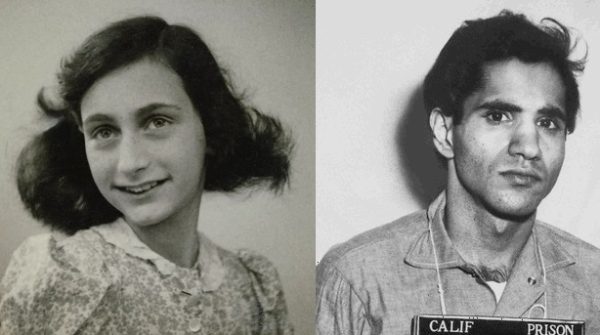
American Pravda: Anne Frank, Sirhan Sirhan, and AIDS

By Ron Unz

Source: The Unz Review

As an heir to the most famous political family in modern American history, Robert F. Kennedy, Jr. is hardly an obscure individual, and recent events have greatly elevated his national prominence.

Although he had spent most of his career as a highly-successful environmental attorney, during the early 2000s he gradually became involved with the grassroots movement questioning the safety and efficacy of our proliferating vaccines, a cause widely ridiculed or ignored by our national elites but increasingly resonating with many worried families.

Then the sudden Covid epidemic moved public health issues to the absolute center of the political debate, including the highly controversial steps taken to control the disease. For the first time in history, most Americans were suddenly subjected to lockdowns, which imposed severe restrictions upon their freedom of movement and assembly, and although these were originally presented as temporary measures expected to last only a couple of weeks, across much of the country they actually remained in place for a year or longer. Moreover, the permanent solution proposed for the crisis was the largest mass-vaccination drive in world history, with the leading vaccines relying upon a new and relatively untested mRNA biotechnology developed by our profit-hungry pharmaceutical giants, a situation that raised deep suspicions among many citizens.

Given these developments, the once marginal anti-vaxxing movement suddenly exploded onto the national stage, cutting across many existing political, social, and ideological fault-lines and encompassing perhaps 20-30% of America’s population, with Kennedy and his Children’s Health Defense non-profit soon becoming leading champions of these fearful individuals. Despite lacking any media coverage or a promotional advertising campaign, his book The Real Anthony Fauci sold over 500,000 copies by early January, spending two months on the Amazon bestseller list, much of that time at the very top.

The media establishment regards our vaccination drive as an absolutely crucial national priority and is intensely hostile to those who challenge it, so Kennedy soon became one of its leading villains. In mid-December, a team of six journalists and researchers at the Associated Press unleashed a ferocious 4,000 word assault, followed a few weeks later by a similar critique in leftist Counterpunch. But both these pieces attacked Kennedy on rather mundane grounds, claiming that his anti-vaccination arguments were wrong, dangerous, and possibly financially motivated, and neither gained much attention, nor seemed to damage his popular momentum.

When the media targets an individual, it monitors his every utterance, seeking the slightest opening to vilify him, and last week an opportunity came as Kennedy spoke before a crowd of 30,000 anti-vaxxers at a rally in Washington, DC. Indulging in overly-heated rhetoric, he declared “We have witnessed over the last 20 months a coup d’état against democracy, and the controlled demolition of the United States Constitution and the Bill of Rights.” He further suggested that that government requirements for vaccinations and mandates were imposing “fascism” on our society, with families having nowhere to escape: “Even in Hitler’s Germany, you could cross the Alps to Switzerland. You could hide in an attic like Anne Frank did.”

In our deeply secular society, Nazi Germany has replaced Satan as the epitome of pure evil, while Anne Frank—a Jewish teenager who died of typhus in a German hospital near the end of the war—has been elevated to the status of a sacred martyr. Although drawing such historical analogies is hardly uncommon in political rhetoric, it can sometimes produce angry reactions, especially if these are orchestrated by a hostile media, and Kennedy’s supposedly scandalous references immediately provoked a firestorm of critical coverage, soon leading him to apologize.

With Kennedy’s enemies fanning the flames, his brief reference to the sad fate of a girl who died three generations ago may have received a hundred times more media coverage than the large rally he had headlined or the huge sales of his national bestseller. When the media seeks to destroy someone’s reputation, it will react with hair-trigger reflexes to his slightest misstep.

Yet oddly enough, the same media organs that created a major national controversy out of a few ill-chosen words at a political rally had previously allowed certain of Kennedy’s other, seemingly far greater vulnerabilities to pass almost entirely unnoticed.

These days being labeled a “conspiracy theorist” is a particularly serious charge, with the slur suggesting dangerous mental illness, and surely stigmatizing Kennedy in such a manner would have been an ideal means of discrediting him. But although the author had publicly proclaimed himself a conspiracy theorist of the most explicit sort last month, almost all our hostile journalists carefully averted their eyes.

In the 1960s the conspiratorial term of abuse was first applied to those who challenged the official story that President Kennedy had died at the hands of a deranged lone gunman, and was later broadened to include the many other assassinations that soon followed, including that of the president’s own brother. And on December 8th, nearly the entire Forum page of the San Francisco Chronicle was filled by a Kennedy column arguing that his father Sen. Robert F. Kennedy had been slain by a group of secret conspirators, with the convicted gunman merely being an innocent patsy who should finally be released from prison.

Yet although Kennedy’s legion of media critics attacked him on almost all other grounds, fair or unfair, they carefully avoided that seemingly easy means of branding him as delusional. The long AP attack that ran a week later mentioned not a word, nor did the January Counterpunch piece. As a consequence, I doubt whether more than a tiny slice of the public is aware that Kennedy is a “conspiracy theorist.”

The obvious reason for this strange media reticence was that Kennedy’s position was very solidly grounded in hard factual evidence. In 2018 I drew upon some of the material in David Talbot’s widely-praised 2008 book Brothers to describe the strange aspects of the assassination.

If the first two dozen pages of the Talbot book completely overturned my understanding of the JFK assassination, I found the closing section almost equally shocking. With the Vietnam War as a political millstone about his neck, President Johnson decided not to seek reelection in 1968, opening the door to a last minute entry into the Democratic race by Robert Kennedy, who overcame considerable odds to win some important primaries. Then on June 4, 1968, he carried gigantic winner-take-all California, placing him on an easy path to the nomination and the presidency itself, at which point he would finally be in a position to fully investigate his brother’s assassination. But minutes after his victory speech, he was shot and fatally wounded, allegedly by another lone gunman, this time a disoriented Palestinian immigrant named Sirhan Sirhan, supposedly outraged over Kennedy’s pro-Israel public positions, although these were no different than those expressed by most other political candidates in America.

All this was well known to me. However, I had not known that powder burns later proved that the fatal bullet had been fired directly behind Kennedy’s head from a distance of three inches or less although Sirhan was standing several feet in front of him. Furthermore, eyewitness testimony and acoustic evidence indicated that at least twelve bullets were fired although Sirhan’s revolver could hold only eight, and a combination of these factors led longtime LA Coroner Dr. Thomas Naguchi, who conducted the autopsy, to claim in his 1983 memoir that there was likely a second gunman. Meanwhile, eyewitnesses also reported seeing a security guard with his gun drawn standing immediately behind Kennedy during the attack, and that individual happened to have a deep political hatred of the Kennedys. The police investigators seemed uninterested in these highly suspicious elements, none of which came to light during the trial. With two Kennedy brothers now dead, neither any surviving members of the family nor most of their allies and retainers had any desire to investigate the details of this latest assassination, and in a number of cases they soon moved overseas, abandoning the country entirely. JFK’s widow Jackie confided in friends that she was terrified for the lives of her children, and quickly married Aristotle Onassis, a Greek billionaire, whom she felt would be able to protect them.

Over the years, the 1968 Robert Kennedy assassination has attracted merely a sliver of the books and research devoted to the earlier killing of his elder brother in Dallas, and Talbot’s text spent only a few pages sketching out the strong evidence that the convicted gunman was merely an innocent dupe, manipulated by the true conspirators. But in 2018, two additional books appeared that were entirely focused on the case.

A Lie Too Big To Fail by longtime journalist and conspiracy researcher Lisa Pease ran 500 pages and covered the events of that fatal California evening in exhaustive detail, winning the endorsements of filmmaker Oliver Stone and renowned JFK researcher James W. Douglass. When I read it a few months ago, I found the huge volume of material quite useful but felt that it relied too heavily upon the recollections of eyewitnesses, which can easily grow attenuated over the decades. I was also disturbed to note that the text sometimes seemed to gradually transform reasonable suspicions into apparent certainties, eventually arguing that 3-4 different gunmen were probably firing at the presidential candidate that evening while Sirhan’s own gun had held only blanks.

At the very end, the author also veered off into building castles in the air with regard to other assassinations, arguing that Oswald probably had multiple personalities and that Jack Ruby was operating under a post-hypnotic suggestion, thinly documented claims that seriously weakened her credibility, as did her earlier suggestion that John Lennon had been killed by a government-programmed assassin in 1980 for his past criticism of the Vietnam War. Sometimes less is better, and I think that Pease’s book would have been much stronger if it had been heavily edited and substantially cut. All those extraneous elements should have been left on the cutting-room floor rather than distracting from the central evidence she provided regarding the existence of an RFK assassination conspiracy and Sirhan’s likely innocence.

Meanwhile, The Assassination of Robert F. Kennedy by Tim Tate and the Brad Johnson was released that same year and suffered from none of these flaws. The two conspiracy researchers had spent some 25 years heavily involved in the case, and although their volume was only around half the length of the Pease book, it seemed a far more effective treatment of the topic, including eyewitness accounts but focused primarily upon the undeniable physical and forensic evidence while avoiding any damaging bouts of unwarranted speculation.

While working at CNN, one of the authors had originally obtained the audiotape establishing the number of shots fired, which probably constitutes the single strongest piece of evidence in the case. The book analyzed and evaluated that crucial item in tremendous detail, and also focused upon the fatal shot, which was fired at point-blank range from behind the candidate while Sirhan, the supposed gunman, was standing several feet in front. But since both the publisher and the lead author were British, the work seems to have received much less attention in this country, and I only discovered and read it after Kennedy cited it in his SF Chronicle column.

Unlike many other controversial American killings or terrorist attacks, the powerful evidence of a conspiracy in the case of the RFK assassination was physical and seemingly undeniable. Wikipedia is notoriously reluctant to promote conspiratorial narratives, but in this case the striking facts are presented with only rather weak challenges.

The conclusive proof from the audio recording only came to light in 2004, but I was surprised to discover that all the other strong evidence, including the large number of unexplained bullet holes, had already been known and reported for decades.

Former Congressman Allard K. Lowenstein had been heavily involved in the 1968 election campaign, playing a major role in the effort to unseat incumbent President Lyndon Johnson. In 1977 he published a long cover-story in the influential Saturday Review, setting forth the overwhelming evidence that a second gunman had been involved in the shooting, and my content-archiving system provides a convenient PDF copy. So nearly all the crucial facts in the case have been known for 45 years, but were almost always ignored by our dishonest or cowardly American media.

Three years after publicly revealing that explosive information, Lowenstein himself was dead, supposedly shot at the age of 51 by a deranged lone gunman who had been a former student of his, but I have been informed that his personal friends never believed that story.

Given this massive preponderance of evidence, we can easily understand why the harsh media attacks upon Kennedy had so carefully avoided mentioning his conspiratorial beliefs regarding his father’s assassination. Such criticism would have merely brought the issue to wider public attention, and anyone who began looking into the matter would have quickly concluded that Kennedy was probably correct while our media had spent a half-century covering up the true facts of the 1968 assassination. And if Kennedy were telling the truth and the media lying, many people would begin to wonder if the same might also be true on the vaxxing issue.

Over the last couple of months, I have noted that this pattern of media reticence has been even more pronounced with regard to the actual contents of Kennedy’s landmark book. Perhaps one might argue that his statements about the death of his father were personal matters exempt from media scrutiny, or even that the details of a particular assassination so many decades ago had no relevance to his vaxxing arguments. But it seemed utterly bizarre that all of the harsh attacks on his book had carefully avoided mentioning its major theme.

I had opened Kennedy’s book assuming that it would focus almost entirely on the vaccination issues with which the author had long been identified. Yet I soon discovered that nearly half the text—some 200 pages—was instead devoted to the disease of AIDS, an entirely different topic, and that the claims he made were absolutely incendiary. As I wrote in December:

Yet according to the information provided in Kennedy’s #1 Amazon bestseller, this well-known and solidly-established picture, which I had never seriously questioned, is almost entirely false and fraudulent, essentially amounting to a medical media hoax. Instead of being responsible for AIDS, the HIV virus is probably harmless and had nothing to do with the disease. But when individuals were found to be infected with HIV, they were subjected to the early, extremely lucrative AIDS drugs, which were actually lethal and often killed them. The earliest AIDS cases had mostly been caused by very heavy use of particular illegal drugs, and the HIV virus had been misdiagnosed as being responsible. But since Fauci and the profit-hungry drug companies soon built enormous empires upon that misdiagnosis, for more than 35 years they have fought very hard to maintain and protect it, exerting all their influence to suppress the truth in the media while destroying the careers of any honest researchers who challenged that fraud. Meanwhile, AIDS in Africa was something entirely different, probably caused mostly by malnutrition or other local conditions.

I found Kennedy’s account as shocking as anything I have ever encountered.

In 1985 AZT, an existing drug, was found to kill the HIV virus in laboratory tests. Fauci then made tremendous efforts to speed it through clinical trials as an appropriate treatment for healthy, HIV-positive individuals, with FDA approval finally coming in 1987, producing Fauci’s first moment of triumph. Priced at $10,000/year per patient, AZT was one of the most expensive drugs in history, and with the cost covered by health insurance and government subsidies, it produced an unprecedented financial windfall for its manufacturer.

Kennedy devotes an entire chapter to the story of AZT, and the tale he tells is something out of Kafka or perhaps Monty Python. Apparently, Fauci had been under enormous pressure to produce medical breakthroughs justifying his large budget, so he manipulated the AZT trials to conceal the extremely toxic nature of the drug, which rapidly killed many of the patients who received it, with their symptoms being ascribed to AIDS. So following FDA approval in 1987, hundreds of thousands of perfectly healthy individuals found to be infected with HIV were placed on a regimen of AZT, and the large number of resulting deaths was misattributed to the virus rather than to the anti-viral drug. According to the scientific experts cited in the book, the vast majority of post-1987 “AIDS deaths” were actually due to AZT.

Prior to the Covid outbreak, AIDS had spent almost four decades as the world’s highest-profile disease, absorbing perhaps a couple of trillion dollars of funding and becoming the central focus of an army of scientists and medical experts. It simply boggles the mind for someone to suggest that HIV/AIDS might have largely been a hoax, and that the vast majority of deaths were not from the illness but from the drugs taken to treat it.

My science textbooks sometimes mentioned that during the benighted 18th century, leading Western physicians treated all manner of ailments with bleeding, a quack practice that regularly caused the deaths of their patients, with our own George Washington often numbered among the victims. Indeed, some have argued that for several centuries prior to modern times, standard medical treatments inadvertently took far more lives than they saved, and those too poor or backward to consult a doctor probably benefited from that lack. But I had never dreamed that this same situation might have occurred during the most recent decades of our modern scientific age.

Since the 1980s AIDS has been an explosive topic in the public sphere, and anyone—whether scientist or layman—who questioned the orthodox narrative was viciously denounced as having blood on his hands. During the early 2000s South African President Thabo Mbeki had cautiously raised such possibilities and was massively vilified by the international media and the academic community. Yet when Kennedy’s #1 Amazon bestseller went much farther, devoting seven full chapters to making the case that HIV/AIDS was merely a medical hoax, his media antagonists carefully avoided that subject even while they attacked him on all other grounds.

Once again, the only plausible explanation is that the hostile journalists and their editors have recognized that Kennedy’s factual evidence was too strong and any such attacks might prove disastrously counter-productive. As far back as the 1990s, a former Harvard professor had publicly declared that the AIDS hoax was as great a scientific scandal as the notorious Lysenko fraud, and if a substantial portion of the American public concluded that AIDS was indeed a medical phantom that had been promoted for 35 years by our gullible and dishonest media, the credibility of the latter on current vaccination issues might be completely annihilated.

It would have been the easiest thing in the world for the media to accurately blast Kennedy as “a conspiracy theorist whose book claims that AIDS is a hoax,” and that simple, short phrase would have immediately dealt a massive body-blow to his public reputation. But many people would then have begun looking into the facts, and once they did so, the tables might have quickly turned, destroying the credibility of his critics. The total silence of the media suggests that they greatly feared that possibility.

The hostile media demanded that Kennedy immediately apologize for his heated words regarding fascism and Anne Frank, and to his credit he quickly did so. But I believe that he now has every right to demand that the same media publicly apologize for having spent the last fifty years concealing the true facts of his father’s assassination from his own family and from the American people. And he and others should also begin demanding that the media and medical establishments apologize for the catastrophic HIV/AIDS disaster they inflicted upon our society, a disaster that probably led to the horrible deaths of hundreds of thousands of perfectly healthy Americans. These two matters carry vastly greater weight than a glancing spoken reference to the events of World War II.

One reason that the remarkable silence surrounding Kennedy’s controversial disclosures was so easily apparent to me is that I have become familiar with that pattern. Over the last several years both media outlets and activist organizations have similarly shied away from the published contents of this website and my own writings, doing their best to avert their eyes from material that was many times more controversial than what they would have eagerly attacked and denounced elsewhere. I have discussed what I call this “Lord Voldemort Effect,” and have described some notable examples in the media.

Many of my own essays have dealt directly with the same controversial topics highlighted in Kennedy’s writings and public statements, and for those so interested in exploring them, they are conveniently grouped together in these categories:

Related Reading:

Who’s Afraid of Conspiracy Theory?

By Tim Hayward

Source: Tim Hayward’s Blog

‘Conspiracy theory’ is frequently used as a derogatory term, a term of disdain and implicit criticism. An effect of this is to discourage certain kinds of legitimate critical inquiry. But surely, in a world where conspiracies happen, we need good theories of what exactly is happening. The only people who really have anything to worry about from conspiracy theories are conspirators who stand to be exposed by them. For the rest of us, if someone proposes a far-fetched theory, we are instinctively sceptical; if they propose a theory that accounts for some otherwise unaccountable occurrences, they may be helping us learn something.

Of course, people can sometimes be misled by conspiracy theories, but people are misled by the beliefs that conspiracy theories challenge too. This betokens a need for careful scrutiny of controversial contentions quite generally. Obviously, a conspiracy theory is only a theory unless there is also proof. But it is one thing to demand the truth of a theory be proven; it is quite another to pronounce that such a theory can never be accepted as true. Unfortunately, even academic critics fail to observe that clear distinction, with some of them going so far as to condemn conspiracy theories in general, pre-emptively.[1]

Yet what are denigrated as ‘conspiracy theories’ are quite often legitimate lines of inquiry pursued in a spirit of critical citizenship, with the aim of holding to account those who exercise otherwise unaccountable power and influence over our lives, including in ways we are not all always aware of.

My argument, then, is that a kind of inquiry that can be intellectually respectable and socially necessary is far too readily sidelined with the categorisation of it as ‘conspiracy theory’. However, since the name has stuck, I propose we should embrace the designation and push back from the sideline to show how it is possible to engage in conspiracy theory using credible methods of research.

The problem that concerns critics, in fact, is a kind of extravagantly speculative activity that involves believing untested hypotheses. This can appropriately be called conspiracism.[2] Conspiracism designates a fallacious mode of reasoning that reduces questions of explanation to posited conspiracies, without properly investigating the evidence. Conspiracists are prone to see conspiracies everywhere, and to believe what they think they see, without giving sufficient consideration to alternative explanations. What is wrong with conspiracism, though, can be specified by reference to standards of inquiry set by good conspiracy theory. So the two things could hardly be more different.

It is especially important to be aware of the difference, given how it has been effaced in public discussions. Early ideas about a ‘conspiracist mindset’, from Harold Lasswell and Franz Neumann, informed Richard Hofstadter’s influential study of the political pathologies of the ‘paranoid style’ in the 1960s. This association of conspiracy suspicions with irrationality and paranoia was then actively promoted in the United States, especially, and as Lance deHaven Smith notes, ‘the conspiracy-theory label was popularized as a pejorative term by the Central Intelligence Agency (CIA) in a propaganda program initiated in 1967.’[3]  The program, created as a response to critical citizens’ questions about the assassination of J F Kennedy, ‘called on media corporations and journalists to criticize “conspiracy theorists” and raise questions about their motives and judgments.’ Its reach has extended greatly since.

Professor Peter Knight of Manchester University, who heads a major international interdisciplinary research network, funded by the European Union, to provide a comprehensive understanding of conspiracy theories, takes it to be a now generally accepted fact that ‘some of the labelling of particular views as “conspiracy theories” is a technique of governmentality.’[4]

So who’s afraid of conspiracy theorists? Is it possible that certain governments want us all to be?

It is interesting to note that Professor Knight thinks that if serious conspiracy theories can sometimes be on the right track, then perhaps what they are finding should not be thought of as conspiracies. For instance, he writes, ‘it is possible that different parts of the labyrinthine U.S. intelligence agencies were involved with some of the 9/11 attackers in contradictory and ambiguous ways that fall short of an actual conspiracy, but which nonetheless undermine the notion of complete American innocence.’ The point is, those contradictions and ambiguities merit study, whatever they are called. Knight’s tantalizing idea of an ‘involvement’ that ‘falls short of an actual conspiracy’ brings me in mind of analogous definitional questions that were raised about Bill Clinton’s descriptions of his  ‘involvement’ with a White House intern. Good sense suggests that what people are interested to know is what happened, not what someone calls it. Ultimately, the serious conspiracy theorist – or theorist of conspiracies, as Knight puts it – wants to know what is going on, and hypotheses about ‘involvements’ of all kinds can figure in the inquiry.[5]

We should bear in mind too, that the very name of this field was bestowed upon it by those who sought to pre-empt its development. Its actual practitioners might think their activities could be more aptly designated in one or more of a number of other, albeit less catchy, ways, such as, for instance, critical civic investigation, intellectual due diligence, investigative journalism, critical social epistemology, or critical social theory.

Which brings me to my main reason for speaking out in defence of the activity: as citizens we find ourselves increasingly struck by anomalies and inconsistencies in official and mainstream accounts of public affairs, not to mention in matters of foreign policy. But whenever we try to share our concerns in a public forum, there seem to be people there ready to harangue us with put-downs about being crazy conspiracy theorists. The reason why they do this is something I shall reflect on another time.[6] My point for now is that we have been drawn to conspiracy theory for reasons that are very far from crazy.


Notes

[1] There is a marked tendency in certain literatures to take this generalized approach to conspiracy theories. Several philosophers – including David Coady, Charles Pigden, Kurtis Hagen, and Lee Basham – have commented critically on it, with Matthew Dentith, in particular, criticizing the failure of such approaches to consider the possibility of finding merits in particular conspiracy theories. He provides examples of ‘generalist positions which take the beliefs or behaviours of some conspiracy theorists as being indicative of what belief in conspiracy theories generally entails.’ (Matthew Dentith,  ‘The Problem of Conspiracism’, Argumenta, [forthcoming in 2017]) An example is Douglas and Sutton who state that ‘in the main conspiracy theories are unproven, often rather fanciful alternatives to mainstream accounts’; they also argue that conspiracy theorists are likely to believe conspiracy theories because they are more likely to sympathise with conspirators. (Karen Douglas and Robbie M. Sutton, (2011) Does it take one to know one? Endorsement of conspiracy theories is influenced by personal willingness to conspire’, Psychology, 50(3), 2011: 544-552.)

[2] On this, I endorse the recent exposition offered by Matthew Dentith (ibid): ‘recent philosophical work has challenged the view that belief in conspiracy theories should be considered as typically irrational. By performing an intra-group analysis of those people we call “conspiracy theorists”, we find that the problematic traits commonly ascribed to the general group of conspiracy theorists turn out to be merely a set of stereotypical behaviours and thought patterns associated with a purported subset of that group. If we understand that the supposed problem of belief in conspiracy theories is centred on the beliefs of this purported subset – the conspiracists – then we can reconcile the recent philosophical contributions to the wider academic debate on the rationality of belief in conspiracy theories.’  He identifies the challenge I am arguing we need to take on: ‘Typically, when we think of conspiracy theorists we do not think of people who theorised about the existence of some particular conspiracy – and went on to support that theory with evidence – like John Dewey (who helped expose the conspiracy behind the Moscow Trials of the 1930s), or Bob Woodward and Carl Bernstein (who uncovered the conspiracy behind who broke in to the Democratic National Committee Headquarters at the Watergate office complex in the 1970s). Instead, we think of the advocates and proponents of weird and wacky conspiracy theories … .’

[3] Lance deHaven Smith, Conspiracy Theory in America, University of Texas Press, 2013: p.21; see also Chapter 4 passim.

[4] Peter Knight, ‘Plotting Future Directions in Conspiracy Theory Research’, in Michael Butter and Maurus Reinkowski, eds, Conspiracy Theories in the Middle East and the United States, Berlin: De Gruyter, 2014: p.347.

[5] ‘Involvements’ amongst people can include any of the typical elements of conspiracy such as collusion, collaboration, conniving, tacitly understanding, secretly agreeing, jointly planning, acquiescing, turning a blind eye, covering up for, bribing, intimidating, blackmailing, misdirecting or silencing, and many other more nuanced kinds of arrangement.

[6] In a third blog of this series I shall be asking ‘Do we face a conspiracy to curtail freedom of expression?’ Meanwhile, the second will be a discussion of ‘Conspiracy theory as civic responsibility’. A full academic paper comprising extended versions of each of these will be available shortly. (And yes, for afficionados who are wondering, there will be a full response to proposals of ‘cognitive infiltration’ to ‘cure’ us. I may even suspend my reputed politeness…)

‘Conspiracy Theories’ and Clandestine Politics

MarkLombardi

By Jeffrey M. Bale

Source: Lobster Magazine

Very few notions generate as much intellectual resistance, hostility, and derision within academic circles as a belief in the historical importance or efficacy of political conspiracies. Even when this belief is expressed in a very cautious manner, limited to specific and restricted contexts, supported by reliable evidence, and hedged about with all sort of qualifications, it still manages to transcend the boundaries of acceptable discourse and violate unspoken academic taboos. The idea that particular groups of people meet together secretly or in private to plan various courses of action, and that some of these plans actually exert a significant influence on particular historical developments, is typically rejected out of hand and assumed to be the figment of a paranoid imagination. The mere mention of the word ‘conspiracy’ seems to set off an internal alarm bell which causes scholars to close their minds in order to avoid cognitive dissonance and possible unpleasantness, since the popular image of conspiracy both fundamentally challenges the conception most educated, sophisticated people have about how the world operates and reminds them of the horrible persecutions that absurd and unfounded conspiracy theories have precipitated or sustained in the past. So strong is this prejudice among academics that even when clear evidence of a plot is inadvertently discovered in the course of their own research, they frequently feel compelled, either out of a sense of embarrassment or a desire to defuse anticipated criticism, to preface their account of it by ostentatiously disclaiming a belief in conspiracies. (1)

They then often attempt to downplay the significance of the plotting they have uncovered. To do otherwise, that is, to make a serious effort to incorporate the documented activities of conspiratorial groups into their general political or historical analyses, would force them to stretch their mental horizons beyond customary bounds and, not infrequently, delve even further into certain sordid and politically sensitive topics. Most academic researchers clearly prefer to ignore the implications of conspiratorial politics altogether rather than deal directly with such controversial matters.

A number of complex cultural and historical factors contribute to this reflexive and unwarranted reaction, but it is perhaps most often the direct result of a simple failure to distinguish between ‘conspiracy theories’ in the strict sense of the term, which are essentially elaborate fables even though they may well be based upon a kernel of truth, and the activities of actual clandestine and covert political groups, which are a common feature of modern politics. For this and other reasons, serious research into genuine conspiratorial networks has at worst been suppressed, as a rule been discouraged, and at best been looked upon with condescension by the academic community. (2) An entire dimension of political history and contemporary politics has thus been consistently neglected. (3)

For decades scholars interested in politics have directed their attention toward explicating and evaluating the merits of various political theories, or toward analyzing the more conventional, formal, and overt aspects of practical politics. Even a cursory examination of standard social science bibliographies reveals that tens of thousands of books and articles have been written about staple subjects such as the structure and functioning of government bureaucracies, voting patterns and electoral results, parliamentary procedures and activities, party organizations and factions, the impact of constitutional provisions or laws, and the like. In marked contrast, only a handful of scholarly publications have been devoted to the general theme of political conspiracies–as opposed to popular anti-conspiracy treatises, which are very numerous, and specific case studies of events in which conspiratorial groups have played some role — and virtually all of these concern themselves with the deleterious social impact of the ‘paranoid style’ of thought manifested in classic conspiracy theories rather than the characteristic features of real conspiratorial politics. (4)

Only the academic literature dealing with specialized topics like espionage, covert action, political corruption, terrorism, and revolutionary warfare touches upon clandestine and covert political activities on a more or less regular basis, probably because such activities cannot be avoided when dealing with these topics. But the analyses and information contained therein are rarely incorporated into standard works of history and social science, and much of that specialized literature is itself unsatisfactory. Hence there is an obvious need to place the study of conspiratorial politics on a sound theoretical, methodological, and empirical footing, since ignoring the influence of such politics can lead to severe errors of historical interpretation.

This situation can only be remedied when a clear-cut analytical distinction has been made between classic conspiracy theories and the more limited conspiratorial activities that are a regular feature of politics. ‘Conspiracy theories’ share a number of distinguishing characteristics, but in all of them the essential element is a belief in the existence of a ‘vast, insidious, preternaturally effective international conspiratorial network designed to perpetrate acts of the most fiendish character’, acts which aim to ‘undermine and destroy a way of life.’ (5)

Although this apocalyptic conception is generally regarded nowadays as the fantastic product of a paranoid mindset, in the past it was often accepted as an accurate description of reality by large numbers of people from all social strata, including intellectuals and heads of state. (6) The fact that a belief in sinister, all-powerful conspiratorial forces has not been restricted to small groups of clinical paranoids and mental defectives suggests that it fulfills certain important social functions and psychological needs.(7)

First of all, like many other intellectual constructs, conspiracy theories help to make complex patterns of cause-and-effect in human affairs more comprehensible by means of reductionism and oversimplification. Secondly, they purport to identify the underlying source of misery and injustice in the world, thereby accounting for current crises and upheavals and explaining why bad things are happening to good people or vice versa. Thirdly, by personifying that source they paradoxically help people to reaffirm their own potential ability to control the course of future historical developments. After all, if evil conspirators are consciously causing undesirable changes, the implication is that others, perhaps through the adoption of similar techniques, may also consciously intervene to protect a threatened way of life or otherwise alter the historical process. In short, a belief in conspiracy theories helps people to make sense out of a confusing, inhospitable reality, rationalize their present difficulties, and partially assuage their feelings of powerlessness. In this sense, it is no different than any number of religious, social, or political beliefs, and is deserving of the same serious study.

The image of conspiracies promoted by conspiracy theorists needs to be further illuminated before it can be contrasted with genuine conspiratorial politics. In the first place, conspiracy theorists consider the alleged conspirators to be Evil incarnate. They are not simply people with differing values or run-of-the-mill political opponents, but inhuman, superhuman, and/or anti-human beings who regularly commit abominable acts and are implacably attempting to subvert and destroy everything that is decent and worth preserving in the existing world. Thus, according to John Robison, the Bavarian Illuminati were formed ‘for the express purpose of ROOTING OUT ALL THE RELIGIOUS ESTABLISHMENTS, AND OVERTURNING ALL THE EXISTING GOVERNMENTS IN EUROPE.’ (8)

This grandiose claim is fairly representative, in the sense that most conspiracy theorists view the world in similarly Manichean and apocalyptic terms.

Secondly, conspiracy theorists perceive the conspiratorial group as both monolithic and unerring in the pursuit of its goals. This group is directed from a single conspiratorial centre, acting as a sort of general staff, which plans and coordinates all of its activities down to the last detail. Note, for example, Prince Clemens von Metternich’s claim that a ‘directing committee’ of the radicals from all over Europe had been established in Paris to pursue their insidious plotting against established governments. (9)

Given that presumption, it is no accident that many conspiracy theorists refer to ‘the Conspiracy’ rather than (lower case)conspiracies or conspiratorial factions, since they perceive no internal divisions among the conspirators. Rather, as a group the conspirators are believed to possess an extraordinary degree of internal solidarity, which produces a corresponding degree of counter solidarity vis-a-vis society at large, and indeed it is this very cohesion and singleness of purpose which enables them to effectively execute their plans to destroy existing institutions, seize power, and eliminate all opposition.

Thirdly, conspiracy theorists believe that the conspiratorial group is omnipresent, at least within its own sphere of operations. While some conspiracy theories postulate a relatively localized group of conspirators, most depict this group as both international in its spatial dimensions and continuous in its temporal dimensions. ‘[T]he conspirators planned and carried out evil in the past, they are successfully active in the present, and they will triumph in the future if they are not disturbed in their plans by those with information about their sinister designs.’(10)

The conspiratorial group is therefore capable of operating virtually everywhere. As a consequence of this ubiquitousness, anything that occurs which has a broadly negative impact or seems in anyway related to the purported aims of the conspirators can thus be plausibly attributed to them.

Fourthly, the conspiratorial group is viewed by conspiracy theorists as virtually omnipotent. In the past this group has successfully overthrown empires and nations, corrupted whole societies, and destroyed entire civilizations and cultures, and it is said to be in the process of accomplishing the same thing at this very moment. Its members are secretly working in every nook and cranny of society, and are making use of every subversive technique known to mankind to achieve their nefarious purposes. Nothing appears to be able to stand in their way–unless the warnings of the conspiracy theorists are heeded and acted upon at once. Even then there is no guarantee of ultimate victory against such powerful forces, but a failure to recognize the danger and take immediate countervailing action assures the success of those forces in the near future.

Finally, for conspiracy theorists conspiracies are not simply a regular feature of politics whose importance varies in different historical contexts, but rather the motive force of all historical change and development. The conspiratorial group can and does continually alter the course of history, invariably in negative and destructive ways, through conscious planning and direct intervention. Its members are not buffeted about by structural forces beyond their control and understanding, like everyone else, but are themselves capable of controlling events more or less at will. This supposed ability is usually attributed to some combination of demonic influence or sponsorship, the possession of arcane knowledge, the mastery of devilish techniques, and/or the creation of a preternaturally effective clandestine organization. As a result, unpleasant occurrences which are perceived by others to be the products of coincidence or chance are viewed by conspiracy theorists as further evidence of the secret workings of the conspiratorial group. For them, nothing that happens occurs by accident. Everything is the result of secret plotting in accordance with some sinister design.

This central characteristic of conspiracy theories has been aptly summed up by Donna Kossy in a popular book on fringe ideas:

Conspiracy theories are like black holes–they suck in everything that comes their way, regardless of content or origin…Everything you’ve ever known or experienced, no matter how ‘meaningless’, once it contacts the conspiratorial universe, is enveloped by and cloaked in sinister significance. Once inside, the vortex gains in size and strength, sucking in everything you touch. (11)

As an example of this sort of mechanism, one has only to mention the so-called ‘umbrella man’, a man who opened up an umbrella on a sunny day in Dealey Plaza just as President John F. Kennedy’s motorcade was passing. A number of ‘conspiracy theorists’ have assumed that this man was signalling to the assassins, thus tying a seemingly trivial and inconsequential act into the alleged plot to kill Kennedy. It is precisely this totalistic, all-encompassing quality that distinguishes ‘conspiracy theories’ from the secret but often mundane political planning that is carried out on a daily basis by all sorts of groups, both within and outside of government. It should, however, be pointed out that even if the ‘umbrella man’ was wholly innocent of any involvement in a plot, as he almost certainly was, this does not mean that the Warren Commission’s reconstruction of the assassination is accurate.

However that may be, real covert politics, although by definition hidden or disguised and often deleterious in their impact, simply do not correspond to the bleak, simplistic image propounded by conspiracy theorists. Far from embodying metaphysical evil, they are perfectly and recognizably human, with all the positive and negative characteristics and potentialities which that implies. At the most basic level, all the efforts of individuals to privately plan and secretly initiate actions for their own perceived mutual benefit –insofar as these are intentionally withheld from outsiders and require the maintenance of secrecy for their success–are conspiracies. Moreover, in contrast to the claims of conspiracy theorists, covert politics are anything but monolithic. At any given point in time, there are dozens if not thousands of competitive political and economic groups engaging in secret planning and activities, and most are doing so in an effort to gain some advantage over their rivals among the others. Such behind-the-scene operations are present on every level, from the mundane efforts of small-scale retailers to gain competitive advantage by being the first to develop new product lines to the crucially important attempts by rival secret services to penetrate and manipulate each other. Sometimes the patterns of these covert rivalries and struggles are relatively stable over time, whereas at other times they appear fluid and kaleidoscopic, as different groups secretly shift alliances and change tactics in accordance with their perceived interests. Even internally, within particular groups operating clandestinely, there are typically bitter disagreements between various factions over the specific courses of action to be adopted. Unanimity of opinioon historical judgements. There is probably no way to prevent this sort of unconscious reaction in the current intellectual climate, but the least that can be expected of serious scholars is that they carefully examine the available evidence before dismissing these matters out of hand.


Footnotes

1. Compare Robin Ramsay, ‘Conspiracy, Conspiracy Theories and Conspiracy Research’, Lobster 19 (1990), p. 25: ‘In intellectually respectable company it is necessary to preface any reference to actual political, economic, military or paramilitary conspiracies with the disclaimer that the speaker “doesn’t believe in the conspiracy theory of history (or politics)”.’This type of disclaimer quite clearly reveals the speaker’s inability to distinguish between bona fide conspiracy theories and actual conspiratorial politics.

2. The word ‘suppress’ is not too strong here. I personally know of at least one case in which a very bright graduate student at a prestigious East Coast university was unceremoniously told by his advisor that if he wanted to write a Ph.D. thesis on an interesting historical example of conspiratorial politics he would have to go elsewhere to do so. He ended up leaving academia altogether and became a professional journalist, in which capacity he has produced a number of interesting books and articles.

3. Complaints about this general academic neglect have often been made by those few scholars who have done research on key aspects of covert and clandestine politics which are directly relevant to this study. See, for example, Gary Marx, ‘Thoughts on a Neglected Category of Social Movement Participant: The Agent Provocateur and the Informant’, American Journal of Sociology 80:2 (September 1974), especially pp. 402-3. One of the few dissertations dealing directly with this topic, though not in a particularly skilful fashion, is Frederick A. Hoffman, ‘Secret Roles and Provocation: Covert Operations in Movements for social Change’ (Unpublished Ph.D. Dissertation: UCLA Sociology Department, 1979). There are, of course, some excellent academic studies which have given due weight to these matters–for example, Nurit Schleifman, Undercover Agents in the Russian Revolutionary Movement: The SR Party, 1902-1914 (Basingstoke: Macmillan/ St. Anthony’s College, 1988); and Jean-Paul Brunet, La police de l’ombre: Indicateurs et provocateurs dans la France contemporaine (Paris: Seuil, 1990)–but such studies areunfortunately few and far between.

4. The standard academic treatments of conspiracy theories are Richard Hofstadter, ‘The Paranoid Style in American Politics’, in Hofstadter, The Paranoid Style in American Politics and Other Essays (New York: Knopf, 1966), pp. 3-40; Norman Cohn, Warrant for Genocide: The Myth of the Jewish World-Conspiracy and the Protocols of the Elders of Zion (Chico, CA: Scholars, 1981 [1969]); J. M. Roberts, The Mythology of the Secret Societies (London: Secker & Warburg, 1972); Johannes Rogallavon Bieberstein, Die These von der Verschwrung, 1776-1945: Philosophen, Freimaurer, Juden, Liberale und Sozialisten als Verschwrergegen die Sozialordnung (Frankfurt am Main: Peter Lang, 1976); and Carl F. Graumann and Serge Moscovici, eds., Changing Conceptions of Conspiracy (New York: Springer, 1987). See also the journalistic studies by George Johnson, Architects of Fear: Conspiracy Theories and paranoia in American Politics (Los Angeles: Tarcher, 1983); and Jonathan Vankin, Conspiracies, Cover-Ups, and Crimes: Political Manipulation and Mind Control in America (New York: Paragon House, 1992).

5. See Hofstadter, ‘Paranoid Style’, pp. 14, 29.

6. Although conspiracy theories have been widely accepted in the most disparate eras and parts of the world, and thus probably have a certain universality as explanatory models, at certain points in time they have taken on an added salience due to particular historical circumstances. Their development and diffusion seems to be broadly correlated with the level of social, economic, and political upheaval or change, though indigenous cultural values and intellectual traditions determine their specific form and condition their level of popularity.

7. As many scholars have pointed out, if such ideas were restricted to clinical paranoids, they would have little or no historical importance. What makes the conspiratorial or paranoid style of thought interesting and historically significant is that it frequently tempts more or less normal people and has often been diffused among broad sections of the population in certain periods. Conspiracy theories are important as collective delusions, delusions which nevertheless reflect real fears and real social problems, rather than as evidence of individual pathologies. See, for example, Hofstadter,’Paranoid Style’, pp. 3-4.

8. See his Proofs of a Conspiracy Against All the Religions and Governments of Europe, Carried on in the Secret Meetings of free Masons, Illuminati, and Reading Societies, Collected from Good Authorities (New York: G. Forman, 1798), p. 14. This exhibits yet another characteristic of ‘conspiracy theorists’–the tendency to over-dramatize everything by using capital letters with reckless abandon.

9. See his ‘Geheime Denkschrift nber die Grundung eines Central-Comites der nordischen Machte in Wien’, in Aus Metternichs nachgelassenen Papieren, ed. by Richard Metternich-Winneburg (Vienna: 1881),vol. 1, p. 595, cited in Rogalla von Bieberstein, These von der Verschwrung, pp. 139-40.

10. Dieter Groh, ‘Temptation of Conspiracy Theory, Part I’, in Changing Conceptions of Conspiracy, p. 3. A classic example of conspiratorial works that view modern revolutionary movements as little more than the latest manifestations of subversive forces with a very long historical pedigree is the influential book by Nesta H. Webster, Secret Societies and Subversive Movements (London: Boswell, 1924). For more on Webster’s background, see the biographical study by Richard M. Gilman, Behind World Revolution: The Strange Career of Nesta H. Webster (Ann Arbor: Insight, 1982), of which only one volume has so far appeared.

11. Kooks: A Guide to the Outer Limits of Human Belief (Portland: Feral House, 1994), p. 191.

12. For more on P2, see above all the materials published by the Italian parliamentary commission investigating the organization, which are divided into the majority (Anselmi) report, five dissenting minority reports, and over one hundred thick volumes of attached documents and verbatim testimony before the commission. Compare also Martin Berger, Historia de la loggia masonica P2 (Buenos Aires: El Cid, 1983); Andrea Barbieri et al, L’Italia della P2 (Milan: Mondadori, 1981); Alberto Cecchi, Storia della P2 (Rome: Riuniti, 1985); Roberto Fabiani, I massoni in Italia (Milan: L’Espresso, 1978); Gianfranco Piazzesi, Gelli: La carriere di un eroe di questa Italia (Milan: Garzanti, 1983); Marco Ramat et al, La resistabile ascesa della P2: Poteri occulti e stato democratico (Bari: De Donato, 1983); Renato Risaliti, Licio Gelli, a carte scoperte (Florence: Fernando Brancato, 1991); and Gianni Rossi and Franceso Lombrassa, In nome della ‘loggia’: Le prove di come lamassoneria segreta ha tentato di impadronarsi dello stato italiano. Iretroscena della P2 (Rome: Napoleone, 1981). Pro P2 works include those of Gelli supporter Pier Carpi, Il caso Gelli: La verita sulla loggia P2 (Bologna: INEI, 1982); and the truly Orwellian work by Gelli himself, La verita (Lugano: Demetra, 1989), which in spite of its title bears little resemblance to the truth.

13. For the AB, see Ivor Wilkins and Hans Strydom, The Super-Afrikaners: Inside the Afrikaner Broederbond (Johannesburg: Jonathan Ball, 1978); and J.H.P.Serfontein, Brotherhood of Power: An Expose of the Secret Afrikaner Broederbond (Bloomington and London: Indiana University, 1978).Compare also B. M. Schoeman, Die Broederbond in die Afrikaner-politiek (Pretoria: Aktuele, 1982); and Adrien Pelzer, Die Afrikaner-Broederbond: Eerste 50 jaar (Cape Town: Tafelberg, 1979).

14. See his Historians’ Fallacies: Toward a Logic of Historical Thought (New York: Harper & Row, 1970), pp. 74-8.

How The Deep State’s Two-Dimensional Engineered Reality Actually Works

deep_state_2_0

By Bernie Suarez

Source: Waking Times

It is refreshing to see more and more of humanity wake up to the functional real-time political reality of the world we now live in. There are many human beings throughout the planet who now understand that corruption has taken over. They understand that criminals run the world. They understand that in America a powerful ruling elite bought out politicians and corporations to get what they want. They understand that the ruling elite operate in networks that transcend the boundaries of nation states in an agenda intended to lead to global domination using their military might.

People are understanding that government propaganda is real, and that the U.S. government has gotten away with one false flag attack on its own people after another; 9/11 being just one of them, all for the purposes of justifying endless war. People also understand that the war on terror, which was ushered in by 9/11, is a lie and that because of this phony war on terror the Pentagon and U.S. military is swimming in billions of dollars of free money to do whatever they want. But what does all of this mean? Do we really understand how they’ve done it and how all of this works?

In 1999 Directors Andy and Lana Wachowski brought us an interesting film called The Matrix which nicely depicts how two alternate realities simultaneously exist: one in which the people in it have no clue what is real and what is not because the sum of the two-dimensional parts they are exposed to seems real, even though it’s not, and another reality where you are irreversibly awakened from that fictional reality.

Over the past 17+ years since the release of The Matrix film many people have awakened to the political reality we live in. For many people it is not difficult to see the parallels between the world we live in and the world depicted in The Matrix. We can see that there is an artificial reality in play that looks and feels real, but it is not. It’s a system designed to keep you enslaved, keep you disempowered, keep you in fear and keep you dependent on big government for survival. Most importantly it’s a system designed to keep itself in power and to preserve whatever agenda it has. Ultimately, this artificial reality is tending towards a global order where the ruling elite hope to absolutely control humanity forever in a way that is absolutely and uncompromisingly in line with their wishes.

The question we should be asking is, How does this matrix work and how does it relate to the three-dimensional physical reality we live in? To answer that, the concept of the “Deep State” was originally proposed to describe the political corruption in Turkey as a secret state acting within a state.

Though we had been warned about these ruling elite, banksters and shadow government by previous presidents going back 200+ years, following the post 9/11 period more and more people began wrapping this concept around their heads. To many, the idea of a group of elite running the world, deemed for years by the U.S. mainstream media and propaganda machine as lunatic “conspiracy theories”, suddenly didn’t seem so crazy after all. Today the concept of a “Deep State,” perhaps because of its roots in Turkey, is much more believable and is seen as more plausible.

In an interview for his book The Road to 9/11, author Peter Dale Scott describes the “Deep State” saying:

It refers to a parallel secret government, organized by the intelligence and security apparatus, financed by drugs, and engaging in illicit violence, to protect the status and interests of the military against threats from intellectuals, religious groups, and occasionally the constitutional government. In this book, I adapt the term somewhat to refer to the wider interface in America between the public, the constitutionally established state, and the deep forces behind it of wealth, power, and violence outside the government. You might call it the back door of the Public state, giving access to dark forces outside the law.

Since the publishing of Scott’s book, the term “Deep State” has gained increased attention and now serves as a practical model to describe how the shadow government operates.

And as humanity continues to awaken to the political reality that surrounds us, the concept of the Deep State becomes more a reality and much less fictional than the idea of the “matrix”, though these two are very intricately related as we’ll see.

The Matrix refers to the illusory engineered pseudo-reality that many people live in. The Deep State is the apparatus that allows that engineered and artificial two-dimension reality to be put out by the control system for daily consumption by the masses.

In order to appreciate this relationship consider the quote from former CIA director William Casey in 1981 when he said that:

We’ll know our disinformation program is complete when everything the American public believes is false.

This is an example of how the Deep State, which is led by Intelligence and their control and manipulation of news, is at the root of the creation of the false engineered world of lies that many people live in. As we can see by the Casey comment, the goal is not to tell a few lies but to actually create an entire reality based on those lies (think Sandy Hook, Bin Laden death hoax, etc).

Manufacturing the 2-Dimensional Reality

What many people don’t realize is that this false world of lies and deceit which is presented to the masses as “reality” is nothing more than a series of two-dimensional items strung together by the controlled media to create an artificial reality. Like the individual frames in a movie reel, each frame seems insignificant until you look at all the frames in a timed sequence. The sequential frames then present an artificial perceived reality.

This is the reason why every time the controllers pull off a staged crisis actor event or a false flag attack like 9/11, those defending the event including the media never seem to think it’s important to provide actual evidence for their claims. That’s because the three-dimensional evidence that truth seekers ask for always conflicts with the two-dimensional presentation they are putting out. The organic presentation of the truth itself, however, is never two-dimensional. It is actual, concrete, multi-dimensional truth which can be reasonably, logically and scientifically verified in real-time on multiple levels and reproduced endlessly without government interference due to its realistic and often simplistic nature.

This is why the demand for “proof” of government and mainstream media claims surrounding false flags and staged events always tends to become the thing that gets truth seekers demonized, attacked, accused, and even profiled as a “harassers” and criminals.

I recently wrote about the attack on Truth that we are seeing today and how it’s not just Truth that is under attack but the very search for Truth. That’s because today, searching for truth is a direct threat to the Deep State, it’s hypnotic control of the masses and its web of lies that make up the matrix, which in turn is keeping people enslaved.

The last thing the ruling oligarchs want is for people to wake up from the matrix of lies which the Deep State has put in place. Thus identifying the Deep State then logically becomes the first step in all of this. Most people in the U.S. don’t realize the degree to which the CIA and the Pentagon are secretly controlling the illusion of government. Even in an election year like 2016, Americans continue to believe the illusion of choice and Democracy which is actually one of the most important features to the operation of the Deep State.

As I’ve written about recently, in 2016 too many Americans are going in circles, like Groundhog Day, believing the same exact lies and promises told to them by the puppet politicians who are running for president, not realizing that this is precisely how the Deep State works. They put out their puppets and pseudo-promises, they ratchet up the campaign hoopla, and they have the candidates tell you anything you want to hear before they select their next puppet president mouthpiece.

Though most Americans know full well that to repeatedly do the same thing over and over again while expecting different results constitutes insanity, they do this very thing each time a presidential election year comes around. These same Americans witness this process with their own eyes every 4 years; another election, another president, the same results.

The result every time is more war, billions of dollars to the Pentagon slush fund, more false flags to justify more wars, more corruption and less accountability from government officials who get caught lying and committing crimes, more lies and propaganda sold to us by CIA’s mainstream media, more police state and tyranny against the people, less freedoms, more staged mass shootings, more globalization and illegal trade agreements, more medical and scientific fraud and false claims to feed the pockets of the pharmaceutical industries and vaccine industries, and, among other things, bigger steps to get us closer and closer to the permanent establishment of a new world order to be sold as United Nations’ “sustainable” living and “global peace and prosperity.”

It is incredible to think that at the smallest level, all of this is possible because unaware and naive Americans continue to believe the phony, artificial and engineered two-dimensional reality presented to them every day by mainstream media and Hollywood. They continue to misconstrue fiction for reality.

That simple inability to discern two-dimensional proof of a claim (a picture, a video, an empty claim by mainstream media or politicians) from three-dimensional proof (all the factors that make a story true including the full collection of physical, and scientific easily reproducible proof, real non-crisis actor eyewitnesses, real blood, real logical spontaneously captured sequences of events, open investigations, etc.) now threatens the survival of the human race and is dooming humanity to a potentially very dark future. This is a future which only those who are awakened to the difference between the presented two-dimensional reality and the actual three-dimensional reality, can potentially save humanity from.

Because this is so, those who realize the reality of the Deep State are therefore the greatest threat to the plans of the ruling elite who run the Deep State. This is why so many online trolls and shills are actually paid to spread State propaganda, lies, create division, insert doubt about topics and post State-sponsored “rebuttals” to key arguments on blog sites and social media. This is why they are fighting so hard to control the Internet, to criminalize activists, and to profile them as “domestic extremists”. This is also why sports fans are mesmerized with pro-military propaganda commercials and fake military worship pre-game ceremonies. This is why so many video games have pro-military and pro-war components to them. This is also why America is always told to “honor” the military. That’s because the military and the Intelligence is the enforcement arm of this evil Deep State. But they do know that as long as they deliver you entertainment, laughter and fun times, you’ll never question what or who the Deep State is. To the blind sheep it’s not something worth interrupting their life to believe, to try to recognize or to find answers for.

In the end, you can call it whatever you want but it’s still the matrix of lies we live in. It operates simultaneously with reality. It looks, feels and tastes real even though it is not. Can you taste it? Can you feel it? It’s all around us as we speak, but whether you see it for what it is, is entirely up to you.

Saturday Matinee: Terror in Resonance

9abcdefghijk_k31463y

“Terror in Resonance” is an 11 episode anime series directed by Shinichirō Watanabe (director of a number of cult anime titles such as Cowboy Bebop, Space Dandy and Samurai Champloo). This latest series (known in Japan as Terror in Tokyo) centers on two teenage terrorist masterminds code-named Nine and Twelve who collectively go by the name Sphynx. They set off a number of targeted bombs around the city while releasing videos designed to communicate cryptic messages to authorities. What starts off as a conventional “cat & mouse” detective story gradually becomes an even more intriguing parapolitical parable. Terror in Resonance stands out for its mixture of elements from Akira, Dark Angel and V for Vendetta and references to familiar topics in the conspiracy milieu such as thermite bombs, remotely piloted planes, EMPs and human experimentation.

Watch the first five episodes for free on Hulu:

The Age of Authoritarianism: Government of the Politicians, by the Military, for the Corporations

what-corporate-america-wants

By John W. Whitehead

Source: The Rutherford Institute

“I was astonished, bewildered. This was America, a country where, whatever its faults, people could speak, write, assemble, demonstrate without fear. It was in the Constitution, the Bill of Rights. We were a democracy… But I knew it wasn’t a dream; there was a painful lump on the side of my head… The state and its police were not neutral referees in a society of contending interests. They were on the side of the rich and powerful. Free speech? Try it and the police will be there with their horses, their clubs, their guns, to stop you. From that moment on, I was no longer a liberal, a believer in the self-correcting character of American democracy. I was a radical, believing that something fundamental was wrong in this country—not just the existence of poverty amidst great wealth, not just the horrible treatment of black people, but something rotten at the root. The situation required not just a new president or new laws, but an uprooting of the old order, the introduction of a new kind of society—cooperative, peaceful, egalitarian.” ― Historian Howard Zinn

America is at a crossroads.

History may show that from this point forward, we will have left behind any semblance of constitutional government and entered into a militaristic state where all citizens are suspects and security trumps freedom.

Certainly, this is a time when government officials operate off their own inscrutable, self-serving playbook with little in the way of checks and balances, while American citizens are subjected to all manner of indignities and violations with little hope of defending themselves.

As I make clear in my book Battlefield America: The War on the American People, we have moved beyond the era of representative government and entered a new age—the age of authoritarianism. Even with its constantly shifting terrain, this topsy-turvy travesty of law and government has become America’s new normal.

Don’t believe me?

Let me take you on a brief guided tour, but prepare yourself. The landscape is particularly disheartening to anyone who remembers what America used to be.

The Executive Branch: Whether it’s the Obama administration’s war on whistleblowers, the systematic surveillance of journalists and regular citizens, the continued operation of Guantanamo Bay, or the occupation of Afghanistan, Barack Obama has surpassed his predecessors in terms of his abuse of the Constitution and the rule of law. President Obama, like many of his predecessors, has routinely disregarded the Constitution when it has suited his purposes, operating largely above the law and behind a veil of secrecy, executive orders and specious legal justifications. Rest assured that no matter who wins this next presidential election, very little will change. The policies of the American police state will continue.

The Legislative Branch:  It is not overstating matters to say that Congress may well be the most self-serving, semi-corrupt institution in America. Abuses of office run the gamut from elected representatives neglecting their constituencies to engaging in self-serving practices, including the misuse of eminent domain, earmarking hundreds of millions of dollars in federal contracting in return for personal gain and campaign contributions, having inappropriate ties to lobbyist groups and incorrectly or incompletely disclosing financial information. Pork barrel spending, hastily passed legislation, partisan bickering, a skewed work ethic, graft and moral turpitude have all contributed to the public’s increasing dissatisfaction with congressional leadership. No wonder 86 percent of Americans disapprove of the job Congress is doing.

The Judicial Branch: The Supreme Court was intended to be an institution established to intervene and protect the people against the government and its agents when they overstep their bounds. Yet through their deference to police power, preference for security over freedom, and evisceration of our most basic rights for the sake of order and expediency, the justices of the United States Supreme Court have become the guardians of the American police state in which we now live. As a result, sound judgment and justice have largely taken a back seat to legalism, statism and elitism, while preserving the rights of the people has been deprioritized and made to play second fiddle to both governmental and corporate interests.

Shadow Government: America’s next president will inherit more than a bitterly divided nation teetering on the brink of financial catastrophe when he or she assumes office. He or she will also inherit a shadow government, one that is fully operational and staffed by unelected officials who are, in essence, running the country. Referred to as the Deep State, this shadow government is comprised of unelected government bureaucrats, corporations, contractors, paper-pushers, and button-pushers who are actually calling the shots behind the scenes right now.

Law Enforcement: By and large the term “law enforcement” encompasses all agents within a militarized police state, including the military, local police, and the various agencies such as the Secret Service, FBI, CIA, NSA, etc. Having been given the green light to probe, poke, pinch, taser, search, seize, strip and generally manhandle anyone they see fit in almost any circumstance, all with the general blessing of the courts, America’s law enforcement officials, no longer mere servants of the people entrusted with keeping the peace but now extensions of the military, are part of an elite ruling class dependent on keeping the masses corralled, under control, and treated like suspects and enemies rather than citizens. In the latest move to insulate police from charges of misconduct, Virginia lawmakers are considering legislation to keep police officers’ names secret, ostensibly creating secret police forces.

A Suspect Surveillance Society: Every dystopian sci-fi film we’ve ever seen is suddenly converging into this present moment in a dangerous trifecta between science, technology and a government that wants to be all-seeing, all-knowing and all-powerful. By tapping into your phone lines and cell phone communications, the government knows what you say. By uploading all of your emails, opening your mail, and reading your Facebook posts and text messages, the government knows what you write. By monitoring your movements with the use of license plate readers, surveillance cameras and other tracking devices, the government knows where you go. By churning through all of the detritus of your life—what you read, where you go, what you say—the government can predict what you will do. By mapping the synapses in your brain, scientists—and in turn, the government—will soon know what you remember. And by accessing your DNA, the government will soon know everything else about you that they don’t already know: your family chart, your ancestry, what you look like, your health history, your inclination to follow orders or chart your own course, etc. Consequently, in the face of DNA evidence that places us at the scene of a crime, behavior sensing technology that interprets our body temperature and facial tics as suspicious, and government surveillance devices that cross-check our biometricslicense plates and DNA against a growing database of unsolved crimes and potential criminals, we are no longer “innocent until proven guilty.”

Military Empire: America’s endless global wars and burgeoning military empire—funded by taxpayer dollars—have depleted our resources, over-extended our military and increased our similarities to the Roman Empire and its eventual demise. The U.S. now operates approximately 800 military bases in foreign countries around the globe at an annual cost of at least $156 billion. The consequences of financing a global military presence are dire. In fact, David Walker, former comptroller general of the U.S., believes there are “striking similarities” between America’s current situation and the factors that contributed to the fall of Rome, including “declining moral values and political civility at home, an over-confident and over-extended military in foreign lands and fiscal irresponsibility by the central government.”

I haven’t even touched on the corporate state, the military industrial complex, SWAT team raids, invasive surveillance technology, zero tolerance policies in the schools, overcriminalization, or privatized prisons, to name just a few, but what I have touched on should be enough to show that the landscape of our freedoms has already changed dramatically from what it once was and will no doubt continue to deteriorate unless Americans can find a way to wrest back control of their government and reclaim their freedoms.

That brings me to the final and most important factor in bringing about America’s shift into authoritarianism: “we the people.” We are the government. Thus, if the government has become a tyrannical agency, it is because we have allowed it to happen, either through our inaction or our blind trust.

Essentially, there are four camps of thought among the citizenry when it comes to holding the government accountable. Which camp you fall into says a lot about your view of government—or, at least, your view of whichever administration happens to be in power at the time.

In the first camp are those who trust the government to do the right thing, despite the government’s repeated failures in this department. In the second camp are those who not only don’t trust the government but think the government is out to get them. In the third camp are those who see government neither as an angel nor a devil, but merely as an entity that needs to be controlled, or as Thomas Jefferson phrased it, bound “down from mischief with the chains of the Constitution.”

Then there’s the fourth camp, comprised of individuals who pay little to no attention to the workings of government, so much so that they barely vote, let alone know who’s in office. Easily entertained, easily distracted, easily led, these are the ones who make the government’s job far easier than it should be.

It is easy to be diverted, distracted and amused by the antics of the presidential candidates, the pomp and circumstance of awards shows, athletic events, and entertainment news, and the feel-good evangelism that passes for religion today. What is far more difficult to face up to is the reality of life in America, where unemployment, poverty, inequality, injustice and violence by government agents are increasingly norms.

The powers-that-be want us to remain divided, alienated from each other based on our politics, our bank accounts, our religion, our race and our value systems. Yet as George Orwell observed, “The real division is not between conservatives and revolutionaries but between authoritarians and libertarians.”

The only distinction that matters anymore is where you stand in the American police state. In other words, you’re either part of the problem or part of the solution.

The Deep State: The Unelected Shadow Government Is Here to Stay

deep_state_2_0

By John W. Whitehead

Source: The Rutherford Institute

Behind the ostensible government sits enthroned an invisible government, owing no allegiance and acknowledging no responsibility to the people.” ― Theodore Roosevelt

America’s next president will inherit more than a bitterly divided nation teetering on the brink of financial catastrophe when he or she assumes office. He will also inherit a shadow government, one that is fully operational and staffed by unelected officials who are, in essence, running the country.

To be precise, however, the future president will actually inherit not one but two shadow governments.

The first shadow government, referred to as COG or continuity of government, is made up of unelected individuals who have been appointed to run the government in the event of a “catastrophe.”

The second shadow government, referred to as the Deep State, is comprised of unelected government bureaucrats, corporations, contractors, paper-pushers, and button-pushers who are actually calling the shots behind the scenes right now.

The first shadow government, COG, is a phantom menace waiting for the right circumstances—a terrorist attack, a natural disaster, an economic meltdown—to bring it out of the shadows, where it operates even now. When and if COG takes over, the police state will transition to martial law.

Yet as I point out in my book Battlefield America: The War on the American People, it is the second shadow government, the Deep State, which poses the greater threat to our freedoms. This permanent, corporatized, militarized, entrenched bureaucracy is unaffected by elections, unaltered by populist movements, and beyond the reach of the law.

This is the hidden face of the police state.

These two shadow governments, which make a mockery of representative government and the “reassurance ritual” of voting, have been a long time in the making. Yet they have been so shrouded in secrecy, well hidden from the eyes and ears of the American people, that they exist and function in contravention to the principles of democratic government.

As the following makes clear, these shadow governments, which operate beyond the reach of the Constitution and with no real accountability to the citizenry, are the reason why “we the people” have no control over our government.

The COG shadow government plan was devised during the Cold War as a means of ensuring that a nuclear strike didn’t paralyze the federal government.

COG initially called for three teams consisting of a cabinet member, an executive chief of staff and military and intelligence officials to practice evacuating and directing a counter nuclear strike against the Soviet Union from a variety of high-tech, mobile command vehicles. If the president and vice president were both killed, one of these teams would take control, with the ranking cabinet official serving as president.

This all changed after the attacks of September 11, 2001, when it became clear that there would be no warning against a terrorist attack. Instead of waiting until an attack occurred to mobilize part-time bureaucrats and activate evacuation schemes, George W. Bush opted to change COG and establish a full-time, permanent shadow government, stationed outside the capital, run by permanently appointed (not elected) executive officials.

COG has since taken on a power—and a budget—of its own.

Incredibly, under the Obama administration, the plans for the shadow government have expanded and grown far more elaborate and costly than many realize. It is what investigative journalist William M. Arkin refers to as “the latest manifestation of an obsession with government survival.”

In much the same way that the nation was taken hostage after 9/11 by color-coded terror alerts and “See Something, Say Something” campaigns that transformed us into a fearful, watchful nation of suspects, the government’s efforts to prepare us for a so-called national disaster have, in turn, left us a constant state of near-emergency and acclimated us to the sight of militarized police, military drills on American soil, privatized prisons, the specter of internment camps, and the erosion of constitutional rights, especially as they pertain to so-called “extremists,” domestic or otherwise.

Study the COG plans carefully, however, and you’ll find that the concern isn’t so much about protecting our government as it is about protecting the nation’s governmental elite.

As Arkin reports: “Countless billions have been spent on this endeavor over the years, a secret orgy of preparedness going on behind the scenes, one that ensures Washington can defend itself, take care of its own, and survive no matter what.”

To this end, the government has invested heavily in the “architecture of fear”: massive underground bunkers—the size of small cities—which are sprinkled throughout the country for the government elite to escape to “in case of an imminent nuclear strike so that they can set up a kind of Administration-in-exile, directing every order of business from retaliation to recovery.”

These bunkers, strategically located around the nation’s capital and in key states, represent a who’s who on the shadow government’s payroll, with every department and agency represented, from the Department of Education and the Trademark Office to the Small Business Administration and the National Archives.

No sector has been overlooked: military, surveillance, counterintelligence, scientific, political, judicial, corporate contractors, as well as computer programmers, engineers, fire fighters, craftsmen, security guards, branch chiefs, financial managers, supply officers, secretaries and stenographers, all of whom have been entrusted with special ID cards allowing them clearance into the doomsday survival sites. They’ve even included individuals tasked with patent and trademark processing. They even have contingency plans to save priceless works of art.

The Federal Relocation Arc near Washington DC will reportedly serve as the emergency bunker for “every Cabinet department (and every government organization deemed essential).” Site R, a 700,000-foot facility inside Raven Rock Mountain near Camp David, will serve as a backup Pentagon. Peters Mountain near Charlottesville, Va., is the likely site for the nation’s domestic spies to hide out. Congress will retire to a subterranean facility near the posh Greenbrier resortin West Virginia, which served as an internment facility for Japanese, Italian and German diplomats during World War II. And a 600,000-square-foot complex inside Virginia’s Mount Weather is expected to be the primary relocation site for the White House, the Supreme Court and much of the executive branch.

Built into the side of a mountain, Mount Weather, near Bluemont, Va., is staffed 24 hours a day, seven days a week. This self-contained facility contains, among other things, a hospital, crematorium, dining and recreation areas, sleeping quarters, reservoirs of drinking and cooling water, an emergency power plant, a radio/television studio and a full-time police and fire department.

There is also an Office of the Presidency at Mount Weather, which regularly receives top-secret national security information from all the federal departments and agencies. This facility was largely unknown to everyone, including Congress, until it came to light in the mid-1970s. Military personnel connected to the bunker have refused to reveal any information about it, even before congressional committees. In fact, Congress has no oversight, budgetary or otherwise, on Mount Weather, and the specifics of the facility remain top-secret.

These facilities reinforce a troubling government mindset that treats the American people as relatively insignificant and expendable. Because you know who’s not on the list of key-individuals-to-be-saved-in-the-eventuality-of-a-disaster? You and me and every other American citizen who is viewed as a mere economic unit to be tallied, bought and sold by those in power.

Not to worry, however. The government hasn’t completely forgotten about us.

In the event of a “national emergency”—loosely defined as “any incident, regardless of location, that results in extraordinary levels of mass casualties, damage, or disruption severely affecting the U.S. population, infrastructure, environment, economy, or government functions”—the executive branch and its unelected appointees will be given unchecked executive, legislative and judicial power.

In such an event, the Constitution will effectively be suspended, thereby ushering in martial law.

However, writing for Radar magazine, Christopher Ketcham suggests that the government won’t have completely forgotten about the rest of us. In fact, Ketcham believes that the government also has plans to imprison hundreds of thousands of “potentially suspect” Americans in detention camps.

Ketcham describes a program created by the Department of Homeland Security that relies on a database of Americans who might be considered potential threats in the event of a national emergency. Referred to by the code name Main Core, this database reportedly contains the names of millions of Americans who, “often for the slightest and most trivial reason, are considered unfriendly, and who, in a time of panic, might be incarcerated. The database can identify and locate perceived ‘enemies of the state’ almost instantaneously.”

Sounds unnervingly like the objectives of the government’s new Domestic Terrorism Czar and the Strong Cities network, which will be working to identify and target potential extremists, doesn’t it?

Under Ketcham’s scenario, if a terrorist attack occurs, the president will declare a national emergency, activating COG procedures and throwing the country into martial law with the shadow government at the helm. The administration will then round up the “dangerous” Americans listed in Main Core and place them in one of the many internment camps or private prisons built for just such an eventuality.

For all intents and purposes, the nation is one national “emergency” away from having a full-fledged, unelected, authoritarian state emerge from the shadows. All it will take is the right event—another terrorist attack, perhaps, or a natural disaster—for such a regime to emerge from the shadows.

As unnerving as that prospect may be, however, it is the second shadow government, what former congressional staffer Mike Lofgren refers to as “the Deep State, which operates according to its own compass heading regardless of who is formally in power,” that poses the greater threat right now.

Consider this: how is it that partisan gridlock has seemingly jammed up the gears (and funding sources) in Washington, yet the government has been unhindered in its ability to wage endless wars abroad, in the process turning America into a battlefield and its citizens into enemy combatants?

The credit for such relentless, entrenched, profit-driven governance, according to Lofgren, goes to “another government concealed behind the one that is visible at either end of Pennsylvania Avenue, a hybrid entity of public and private institutions ruling the country according to consistent patterns in season and out, connected to, but only intermittently controlled by, the visible state whose leaders we choose.”

This “state within a state” hides “mostly in plain sight, and its operators mainly act in the light of day,” says Lofgren, and yet the “Deep State does not consist of the entire government.”

Rather, Lofgren continues:

It is a hybrid of national security and law enforcement agencies: the Department of Defense, the Department of State, the Department of Homeland Security, the Central Intelligence Agency and the Justice Department. I also include the Department of the Treasury because of its jurisdiction over financial flows, its enforcement of international sanctions and its organic symbiosis with Wall Street.

All these agencies are coordinated by the Executive Office of the President via the National Security Council. Certain key areas of the judiciary belong to the Deep State, such as the Foreign Intelligence Surveillance Court, whose actions are mysterious even to most members of Congress. Also included are a handful of vital federal trial courts, such as the Eastern District of Virginia and the Southern District of Manhattan, where sensitive proceedings in national security cases are conducted.

The final government component (and possibly last in precedence among the formal branches of government established by the Constitution) is a kind of rump Congress consisting of the congressional leadership and some (but not all) of the members of the defense and intelligence committees. The rest of Congress, normally so fractious and partisan, is mostly only intermittently aware of the Deep State and when required usually submits to a few well-chosen words from the State’s emissaries.

In an expose titled “Top Secret America,” The Washington Post revealed the private side of this shadow government, made up of 854,000 contract personnel with top-secret clearances, “a number greater than that of top-secret-cleared civilian employees of the government.”

Reporting on the Post’s findings, Lofgren points out:

These contractors now set the political and social tone of Washington, just as they are increasingly setting the direction of the country, but they are doing it quietly, their doings unrecorded in the Congressional Record or the Federal Register, and are rarely subject to congressional hearings…

The Deep State not only holds the nation’s capital in thrall, but it also controls Wall Street (“which supplies the cash that keeps the political machine quiescent and operating as a diversionary marionette theater”) and Silicon Valley.

As Lofgren concludes:

[T]he Deep State is so heavily entrenched, so well protected by surveillance, firepower, money and its ability to co-opt resistance that it is almost impervious to change… If there is anything the Deep State requires it is silent, uninterrupted cash flow and the confidence that things will go on as they have in the past. It is even willing to tolerate a degree of gridlock: Partisan mud wrestling over cultural issues may be a useful distraction from its agenda.

Remember this the next time you find yourselves mesmerized by the antics of the 2016 presidential candidates or drawn into a politicized debate over the machinations of Congress, the president or the judiciary: it’s all intended to distract you from the fact that you have no authority and no rights in the face of the shadow governments.