A Shaky Foundation

By Michael Krieger

Source: Liberty Blitzkrieg

And so castles made of sand fall in the sea, eventually.
– Jimi Hendrix

There’s a widespread belief out there that the U.S. and the global economy in general is on much sounder footing ever since the financial crisis of a decade ago. Unfortunately, this false assumption has resulted in widespread complacency and elevated levels of systemic risk as we enter the early part of the 2020s.

All it takes is a cursory amount of research to discover nothing was “reset” or fixed by the government and central bank response to that crisis. Rather, the entire response was just a gigantic coverup of the crimes and irresponsible behavior that occurred, coupled with a bailout designed to enrich and empower those who needed and deserved it least.

Everything was papered over in order to resuscitate a failed paradigm without reforming anything. Since it was all about pretending nothing was structurally wrong with the system, the response was to build more castles of sand on top of old ones that had unceremoniously crumbled. The whole event was a huge warning sign and opportunity to change course, but it was completely ignored. Enter novel coronavirus.

I’ve been concerned about the coronavirus outbreak from the start, and have been tweeting about it consistently for well over a month.

This observation proved prescient within just a few weeks, as the U.S. Centers for Disease Control (CDC) screwed up its early response to the pandemic in the most sloppy and unimaginable way possible. For whatever reason, the CDC instituted ridiculously stringent guidelines for testing potential infections by limiting testing to only those who recently traveled from China or had contact with someone known to be infected. The CDC continued to stick to these insane guidelines as the disease began to spread rapidly all over the world, particularly in South Korea and Italy.

The event that finally prompted the CDC to change its guidelines was the emergence of the first confirmed incidence of community spread coronavirus in the U.S., which occurred in northern California. The health professionals caring for that patient had requested testing days earlier, but the CDC rejected the initial request, putting medical staff and others at risk for no good reason. On top of all that, the limited testing kits the CDC had sent out didn’t work properly. The level of incompetence and failure we’ve seen from the CDC is almost hard to fathom, but given how hollowed out and corrupt our society has become, shouldn’t be surprising.

At this point, nobody knows what the eventual impact of the coronavirus on the planet will be. Anyone who says they know for sure is lying, but I think we should be taking it very seriously given the potential tail risks. A global pandemic is an uncertain and dangerous thing in the most robust and healthy of systems, but the consequences within a fragile house of cards system such as ours can be devastating.

A month ago, stock market valuations were near the highest ever and interest rates were near the lowest they’ve been in recorded human history. A gigantic “everything bubble” of historic proportions had been blown and investors were flying too close to the sun. It was a balloon looking for a pin, and it found one in the coronavirus. Nobody knew what the pin would be, which is exactly why the stock market collapsed so rapidly the moment investors began to appreciate the gravity of the situation. The fragility of the financial markets should be taken as a warning sign with regard to the rest of the system.

Financial assets have been intentionally blown to nonsensical levels in order to coverup the massive rot underneath. They’ve been masking the fact that much of the underlying economy consists of little more than financial engineering scams and war-making enterprises. The imperial oligarchy we live under is an utterly rotten, corrupt, and fragile superstructure that’s been carefully hidden for ten years under a facade of euphoric markets and a mass of debt-based consumption slaves.

The coronavirus itself should be seen in this context. The global system as it exists is simply not prepared for anything like this, but the reality is things like this do occur from time to time. Maybe we’ll get lucky and avoid the worst case scenario with this virus, but that’s not the point. There will always be other pins, and when your entire superstructure is fundamentally fragile and led by mediocre, corrupt sociopaths, it doesn’t take much to bring it down faster than you can imagine.

We stand at a moment where the fragility of our Potemkin Village paradigm will increasingly confront the harsh realities of meatspace. Coronavirus is a warning. It’s exposing a lot already, and will likely expose far more as it continues to spread. It’s exposing our ridiculous financial bubbles, it’s exposing the fact the U.S. can’t even manufacture its own surgical masks or medicines, and it’s exposing the clownish ineptitude of our leaders and institutions.

It’s important we take this warning to heart and do something useful with it. It’s crucial we understand that the current paradigm is long past its useful life and likely won’t be hanging around much longer. Don’t cry or experience nostalgia for what was, rather, get your stuff together so you can help build and usher in the new world to come.

Those too attached to the way things have been will have a particularly hard time adjusting to the turbulent times ahead, so you want to do whatever you can in order to avoid being in that group. Change doesn’t have to be bad, but resistance to change can be deadly. Don’t allow yourself to be a casualty.

The Economic Cataclysm Ahead

By Charles Hugh Smith

Source: Of Two Minds

The economic storm hasn’t passed; the false calm is only the eye of the financial hurricane.

To understand the economic cataclysm ahead, do the math. Those expecting the Covid-19 pandemic to leave the U.S. economy untouched are implicitly making these preposterously unlikely claims:

1. China will resume full pre-pandemic production and shipping within the next two weeks.

2. Chinese consumers will resume borrowing and spending at pre-pandemic rates in a few weeks.

3. Every factory and every worker in China will resume full pre-pandemic production without any permanent closures or disruptions.

4. Corporate America’s just-in-time inventories will magically expand to cover weeks or months of supply chain disruption.

5. Not a single one of the thousands of people who flew direct from Wuhan to the U.S. in January is an asymptomatic carrier of the coronavirus who escaped detection at the airport.

6. Not a single one of the thousands of people who flew from China to the U.S. in February is an asymptomatic carrier of the coronavirus.

7. Not a single one of the thousands of people who are in self-quarantine broke the quarantine to go to Safeway for milk and eggs.

8. Not a single person who came down with Covid-19 after arriving in the U.S. feared being deported so they did not go to a hospital and are therefore unknown to authorities.

9. Even though U.S. officials have only tested a relative handful of the thousands of people who came from Covid-19 hotspots in China, they caught every single asymptomatic carrier.

10. Not a single asymptomatic carrier caught a flight from China to Southeast Asia and then promptly boarded a flight for the U.S.

I could go on but you get the picture: an extremely contagious pathogen that is spread by carriers who don’t know they have the virus to people who then infect others in a rapidly expanding circle has been completely controlled by U.S. authorities who haven’t tested or even tracked tens of thousands of potential carriers in the U.S.

These same authorities are quick to claim the risk of Covid-19 spreading in the U.S. is low even as the 14 infected people they put on a plane ended up infecting 25 passengers on the flight. These same authorities tried to transfer quarantined people to a rundown facility in Costa Mesa CA that was not suitable for quarantine, forcing the city to file a lawsuit to stop the transfer.

Do these actions instill unwavering confidence in the official U.S. response? You must be joking.

Do the math, people. The coronavirus is already in the U.S. but authorities have no way to track it due to its spread by asymptomatic carriers. People who don’t even know they have the virus are flying to intermediate airports outside China and then catching flights to the U.S.

None of the known characteristics of the virus support the confidence being projected by authorities. The tests are not reliable, few are being tested, carriers can’t be detected because they don’t have any symptoms, the virus is highly contagious, thousands of potential carriers continue to arrive in the U.S., etc. etc. etc.

The network of global travel remains intact. Removing a few nodes (Wuhan, etc.) does not reduce the entire network’s connectedness that enables the rapid and invisible spread of the virus.

Second, what authorities call over-reaction is simply prudent risk management. As I noted yesterday in How Many Cases of Covid-19 Will It Take For You to Decide Not to Frequent Public Places?, when an abstract pandemic becomes real, shelves are emptied and streets are deserted.

It doesn’t take thousands of cases to trigger a dramatic reduction in the willingness to mix with crowds of strangers. A relative handful of cases is enough to be consequential.

Many of the new jobs created in the U.S. economy over the past decade are in the food and beverage services sector, the sector that is immediately impacted when people decide to lower their risk by staying home rather than going out to crowded restaurants, theaters, bars, etc.

Many of these establishments are hanging on by a thread due to soaring rents, taxes, fees, healthcare and wages. Many of the employees are also hanging on by a thread, only making rent if they collect big tips.

Central banks can borrow money into existence but they can’t replace lost income. A significant percentage of America’s food and beverage establishments are financially precarious, and their exhausted owners are burned out by the stresses of keeping their business afloat as costs continue rising. The initial financial hit as people reduce their public exposure will be more than enough to cause many to close their doors forever.

As small businesses fold, local tax revenues crater, triggering fiscal crises in local government budgets dependent on ever-higher tax and fee revenues.

A significant percentage of America’s borrowers are financially precarious, one paycheck or unexpected expense away from defaulting on student loans, subprime auto loans, credit card payments, etc.

A significant percentage of America’s corporations are financially precarious, dependent on expanding debt and rising cash flow to service their expanding debt load. Any hit to their revenues will trigger defaults that will then unleash second-order effects in the global financial system.

The global economy is so dependent on speculative euphoria, leverage and debt that any external shock will tip it over the cliff. The U.S. economy is far more precarious than advertised as well.

The economic storm hasn’t passed; the false calm is only the eye of the financial hurricane.

Why this Draconian Response to COVID-19?

By Jeffrey A. Tucker

Source: Activist Post

Imagine if you are the organizer of a major arts and tech event that attracts a quarter-million attendees. One week out from the conference, the mayor cancels your event. Your event is not named specifically, just that all events involving more than 2,500 people are officially banned. He does this using emergency powers, justified in the name of containing a virus.

And that’s it. This is what happened to South by Southwest, one of the most important events in the world in Austin, Texas, which has thus far not reported a single case of COVID-19. Based on last year’s numbers, It’s the end for:

  • 73,716 conference attendees and 232,258 festival attendees;
  • 4,700 speakers
  • 4,331 media/press attendees
  • 2,124 sessions
  • 70,00 trade show attendees occupying 181,400 square feet of exhibit space
  • 351 official parties and events
  • 612 international acts
  • 1,964 performance acts

Local merchants are devastated. All hotel and flight reservations are lost. It’s a financial calamity for the city (last year brought half a billion dollars for local merchants) and for untold millions of people affected by the abrupt decision.

Draconian, to say the least.

Making matters worse, a vicious and completely false report published by Variety said that the festival was aching for the city to make the call so that the festival could collect insurance money. This turns out to be entirely wrong: South by Southwest had no insurance against infectious disease. It was a smear and response to mass frenzy. After all, a petition on Change.org signed by 55,000 people had demanded the cancellation.

The city acquiesced to the mob. A grand and glorious conference was destroyed – the first of many this season.

Italy now has 16 million people under quarantine, which is to say that they are prisoners.

Anyone living in Lombardy and 14 other central and northern provinces will need special permission to travel. Milan and Venice are both affected. Prime Minister Giuseppe Conte also announced the closure of schools, gyms, museums, nightclubs and other venues across the whole country. The measures, the most radical taken outside China, will last until 3 April.

Americans have been quarantined on cruise ships and then forced to pay for their later hospitalization. The government that quarantines you has zero intention to pay the costs associated with your care, to say nothing of the opportunity costs of missing work.

The press isn’t helping. The New York Times has cheered it all on, aggressively advocating that governments go Medieval on this one.

In six months, if we are in a recession, unemployment is up, financial markets are wrecked, and people are locked in their homes, we’ll wonder why the heck governments chose disease “containment” over disease mitigation. Then the conspiracy theorists get to work.

The containment strategy was never debated or discussed. For the first time in modern history, governments of the world have taken it upon themselves to control population flows in the hopes of stemming the spread of this disease – regardless of the cost and with scant evidence that this strategy will actually work.

More and more, the containment response is looking like global panic. What’s interesting, Psychology Today points out, is that your doctor is not panicking:

COVID-19 is a new virus in a well-known class of viruses. The coronaviruses are cold viruses. I’ve treated countless patients with coronaviruses over the years. In fact, we’ve been able to test for them on our respiratory panels for the entirety of my career.

We know how cold viruses work: They cause runny noses, sneezing, cough, and fever, and make us feel tired and achy. For almost all of us, they run their course without medication. And in the vulnerable, they can trigger a more severe illness like asthma or pneumonia.

Yes, this virus is different and worse than other coronaviruses, but it still looks very familiar. We know more about it than we don’t know.

Doctors know what to do with respiratory viruses. As a pediatrician, I take care of patients with hundreds of different viruses that behave similarly to this one. We take care of the kids at home and see them if the fever is prolonged, if they get dehydrated, or if they develop breathing difficulty. Then we treat those problems and support the child until they get better.

Meanwhile, the New England Journal of Medicine reports as follows:

On the basis of a case definition requiring a diagnosis of pneumonia, the currently reported case fatality rate is approximately 2%. In another article in the Journal, Guan et al. report mortality of 1.4% among 1,099 patients with laboratory-confirmed Covid-19; these patients had a wide spectrum of disease severity. If one assumes that the number of asymptomatic or minimally symptomatic cases is several times as high as the number of reported cases, the case fatality rate may be considerably less than 1%. This suggests that the overall clinical consequences of Covid-19 may ultimately be more akin to those of a severe seasonal influenza (which has a case fatality rate of approximately 0.1%) or a pandemic influenza (similar to those in 1957 and 1968) rather than a disease similar to SARS or MERS, which have had case fatality rates of 9 to 10% and 36%, respectively.

Slate’s piece on this topic offers more perspective:

This all suggests that COVID-19 is a relatively benign disease for most young people, and a potentially devastating one for the old and chronically ill, albeit not nearly as risky as reported. Given the low mortality rate among younger patients with coronavirus—zero in children 10 or younger among hundreds of cases in China, and 0.2-0.4 percent in most healthy nongeriatric adults (and this is still before accounting for what is likely to be a high number of undetected asymptomatic cases)—we need to divert our focus away from worrying about preventing systemic spread among healthy people—which is likely either inevitable, or out of our control—and commit most if not all of our resources toward protecting those truly at risk of developing critical illness and even death: everyone over 70, and people who are already at higher risk from this kind of virus.

Look, I’m obviously not in a position to comment on the medical aspects of this; I defer to the experts. But neither are medical professionals in a position to comment on the political response to this; mostly they have assiduously declined to do so.

Meanwhile, governments are willy-nilly making drastic decisions that profoundly affect the status of human freedom. Their decisions are going to affect our lives in profound ways. And there has thus far been no real debate on this. It’s just been presumed that containment of the spread rather than the care of the sick is the only way forward.

What’s more, we have governments all-too-willing to deploy their awesome powers to control human populations in direct response to mass public pressure based on fears that have so far not been justified by any available evidence. For this reason, we have every reason to be concerned.

Are we really ready to imprison the world, wreck financial markets, destroy countless jobs, and massively disrupt life as we know it, all to forestall some uncertain fate, even as we do know the right way to deal with the problem from a medical point of view? It’s at least worth debating.

How the Super-Rich Will Destroy Themselves

HangTheBankers

By Paul Buchheit

Source: Nation of Change

Perhaps they believe that their underground survival bunkers with bullet-resistant doors and geothermal power and anti-chemical air filters and infrared surveillance devices and pepper spray detonators will sustain them for two or three generations.

Perhaps they feel immune from the killings in the streets, for they rarely venture into the streets anymore. They don’t care about the great masses of ordinary people, nor do they think they need us.

Or do they? There are a number of ways that the super-rich, because of their greed and lack of empathy for others, may be hastening their own demise, while taking the rest of us with them.

1. Pandemic (Because of Their Disdain for Global Health)

“A year ago the world was in a panic over Ebola. Now it’s Zika at the gate. When will it end?” –Public health expert Dr. Ali Khan.

It could end with a global pandemic that spreads with the speed of the 1918 Spanish Flu, but with a virulence that kills over half of us, rich and poor alike. Vanderbilt University’s Dr. William Schaffner warned us a decade ago, “You’ve got to really invest vast resources right now to protect us from a pandemic.” Added infectious disease specialist Dr. Stephen Baum, “There’s nobody making vaccines anymore because the profitability is low and the liability is high.”

The flu is just one of our worries. It has been estimated that less than 10 percent of the budget for health research is spent on diseases that cause 90 percent of the world’s illnesses. According to a study in The Lancet, of the 336 new drugs developed in the first decade of this century, only four of them were for diseases impacting third-world peoples. World Health Organization director Margaret Chan lamented the long decades of disregard for the African-centered effects of the Ebola virus: “Ebola has historically been confined to poor African nations. The R&D incentive is virtually non-existent. A profit-driven industry does not invest in products for markets that cannot pay.”

The super-rich had better make sure their anti-chemical air filters are also anti-viral.

2. Terrorism (Because of Global Inequality)

In The Spirit Level, Richard Wilkinson and Kate Pickett document some of the most frightening effects of inequality: higher levels of crime and violence, impacting all classes of people.

Inequality is worst at the global level, and the victims of global greed are getting more violent. The World Protests report concluded that the most recent decade represents one of the most agitated periods in modern history — comparable to pre-Civil-War days, World War 1, and the Civil Rights era. According to expert Scott Atran, terrorism primarily appeals to young men who are bored and underemployed; for them, “jihad is an egalitarian, equal-opportunity employer.”

The terrorism of the future could easily take the form of the viral killers mentioned above. As Dr. Khan notes, “A deadly microbe like smallpox — to which we no longer have immunity — can be easily recreated in a rogue laboratory.”

3. Drought (Because of Their Denial of Environmental Destruction)

National Geographic’s 2012 Greendex Survey reveals a remarkable human response to environmental damage: “[Those] demonstrating the least sustainable behavior as consumers, are least likely to feel guilty about the implications of their choices for the environment.” Citizens of Mexico, Brazil, China, and India tend to be most concerned about climate change, pollution, and species loss, while American, French, and British consumers are more concerned about the state of the economy and the cost of energy and fuel.

Even worse than denial is the outright suppression of climate-saving technologies, as, for example, by the American Legislative Exchange Council (ALEC), which wants to charge the “freeriders” who install solar panels on their roofs.

The result of this environmental contempt, according to a Columbia University study, is the prospect of “drought beyond the sub-tropics and into the Northern Hemisphere mid-latitudes, regions of globally important agricultural production.”

The super-rich can while away the hours in their underground bunkers watching videos of the good old days when the earth was cool.

4. Atrophy (Because of the Debt-Induced Collapse of Innovation)

A Small Business Administration study found that only 2% of the Millennial Generation are entrepreneurs (self-employed or business owners), compared to 6.7% of Baby Boomers and 5.4% in Generation X. According to the Kauffman Foundation, 20- to 34-year-olds made up over a third of all new business startups in 1997, but less than a quarter of them today. The super-rich have manipulated the financial system to the point that would-be entrepreneurs, many of them young and deeply in debt, are unable or unwilling to take chances on new startups.

Yet on a global scale youth entrepreneurship is on the rise. America is exceptional in its entrepreneurial decline.

5. Decay (Because of Their Disregard for Our Crumbling Infrastructure)

The corporate elite may face further business collapse if they continue to ignore the breakdown in our nation’s infrastructure. The American Society of Civil Engineers estimates that every American household is losing $3,400 per year in disposable income due to infrastructure deficiencies.

The tens of billions of dollars already being paid for additional transportation and storage costs may not kill the capitalists, but the losses to China and other fast-developing nations will surely deflate their stock prices and their egos.

How the Super-Rich Could Help Themselves

Amidst all the talk of unity and prayer and peace, a solution exists: job opportunities and affordable housing. The super-rich could prolong life for all of us, including themselves, if they recognized the need to support a strong society. If not, they’ll be ensconced in their bunkers with their children at their sides, with nowhere to go and nothing to do.

Fear of the Walking Dead: The American Police State Takes Aim

cdc_zombie_attacks

By John W. Whitehead

Source: The Rutherford Institute

“Fear is a primitive impulse, brainless as hunger, and because the aim of horror fiction is the production of the deepest kinds of fears, the genre tends to reinforce some remarkably uncivilized ideas about self-protection. In the current crop of zombie stories, the prevailing value for the beleaguered survivors is a sort of siege mentality, a vigilance so constant and unremitting that it’s indistinguishable from the purest paranoia.”— Terrence Rafferty, New York Times

The zombies are back. They are hungry. And they are lurking around every corner.

In Kansas, Governor Sam Brownback has declared October “Zombie Preparedness Month” in an effort to help the public prepare for a possible zombie outbreak.

In New York, researchers at Cornell University have concluded that the best place to hide from the walking dead is the northern Rocky Mountains region.

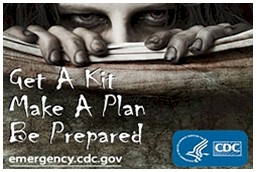
And in Washington, DC, the Centers for Disease Control and Prevention have put together a zombie apocalypse preparation kit “that details everything you would need to have on hand in the event the living dead showed up at your front door.”

The undead are also wreaking havoc at gun shows, battling corsets in forthcoming movie blockbusters such as Pride and Prejudice and Zombies, running for their lives in 5K charity races, and even putting government agents through their paces in mock military drills arranged by the Dept. of Defense (DOD) and the Center for Disease Control (CDC).

The zombie narrative, popularized by the hit television series The Walking Dead, in which a small group of Americans attempt to survive in a zombie-ridden, post-apocalyptic world where they’re not only fighting off flesh-eating ghouls but cannibalistic humans, plays to our fears and paranoia.

Yet as journalist Syreeta McFadden points out, while dystopian stories used to reflect our anxieties, now they reflect our reality, mirroring how we as a nation view the world around us, how we as citizens view each other, and most of all how our government views us.

Fear the Walking Dead—AMC’s new spinoff of its popular Walking Dead series—drives this point home by dialing back the clock to when the zombie outbreak first appears and setting viewers down in the midst of societal unrest not unlike our own experiences of the past year (“a bunch of weird incidents, police protests, riots, and … rapid social entropy”). Then, as Forbes reports, “the military showed up and we fast-forwarded into an ad hoc police state with no glimpse at what was happening in the world around our main cast of hapless survivors.”

Forbes found Fear’s quick shift into a police state to be far-fetched, but anyone who has been paying attention in recent years knows that the groundwork has already been laid for the government—i.e., the military—to intervene and lock down the nation in the event of a national disaster.

Recognizing this, the Atlantic notes: “The villains of [Fear the Walking Dead] aren’t the zombies, who rarely appear, but the U.S. military, who sweep into an L.A. suburb to quarantine the survivors. Zombies are, after all, a recognizable threat—but Fear plumbs drama and horror from the betrayal by institutions designed to keep people safe.”

We’ve been so hounded in recent years with dire warnings about terrorist attacks, Ebola pandemics, economic collapse, environmental disasters, and militarized police that it’s no wonder millions of Americans have turned to zombie fiction as a way to “envision how we and our own would thrive if everything went to hell and we lost all our societal supports.” As Time magazine reporter James Poniewozik phrases it, the “apocalyptic drama lets us face the end of the world once a week and live.”

Here’s the curious thing, however: while zombies may be the personification of our darkest fears, they embody the government’s paranoia about the citizenry as potential threats that need to be monitored, tracked, surveilled, sequestered, deterred, vanquished and rendered impotent.

Why else would the government feel the need to monitor our communications, track our movements, criminalize our every action, treat us like suspects, and strip us of any means of defense while equipping its own personnel with an amazing arsenal of weapons?

For years now, the government has been carrying out military training drills with zombies as the enemy. In 2011, the DOD created a 31-page instruction manual for how to protect America from a terrorist attack carried out by zombie forces. In 2012, the CDC released a guide for surviving a zombie plague. That was followed by training drills for members of the military, police officers and first responders.

As journalist Andrea Peyser reports:

Coinciding with Halloween 2012, a five-day national conference was put on by the HALO Corp. in San Diego for more than 1,000 first responders, military personnel and law enforcement types. It included workshops produced by a Hollywood-affiliated firm in…overcoming a zombie invasion. Actors were made up to look like flesh-chomping monsters. The Department of Homeland Security even paid the $1,000 entry fees for an unknown number of participants…

“Zombie disaster” drills were held in October 2012 and ’13 at California’s Sutter Roseville Medical Center. The exercises allowed medical center staff “to test response to a deadly infectious disease, a mass-casualty event, terrorism event and security procedures”…

[In October 2014], REI outdoor-gear stores in Soho and around the country are to hold free classes in zombie preparedness, which the stores have been providing for about three years.

The zombie exercises appear to be kitschy and fun—government agents running around trying to put down a zombie rebellion—but what if the zombies in the exercises are us, the citizenry, viewed by those in power as mindless, voracious, zombie hordes?

Consider this: the government started playing around with the idea of using zombies as stand-ins for enemy combatants in its training drills right around the time the Army War College issued its 2008 report, warning that an economic crisis in the U.S. could lead to massive civil unrest that would require the military to intervene and restore order.

That same year, it was revealed that the government had amassed more than 8 million names of Americans considered a threat to national security, to be used “by the military in the event of a national catastrophe, a suspension of the Constitution or the imposition of martial law.” The program’s name, Main Core, refers to the fact that it contains “copies of the ‘main core’ or essence of each item of intelligence information on Americans produced by the FBI and the other agencies of the U.S. intelligence community.”

Also in 2008, the Pentagon launched the Minerva Initiative, a $75 million military-driven research project focused on studying social behavior in order to determine how best to cope with mass civil disobedience or uprisings. The Minerva Initiative has funded projects such as “Who Does Not Become a Terrorist, and Why?” which “conflates peaceful activists with ‘supporters of political violence’ who are different from terrorists only in that they do not embark on ‘armed militancy’ themselves.”

In 2009, the Dept. of Homeland Security issued its reports on Rightwing and Leftwing Extremism, in which the terms “extremist” and “terrorist” were used interchangeably to describe citizens who were disgruntled or anti-government.

Meanwhile, a government campaign was underway to spy on Americans’ mail, email and cell phone communications. News reports indicate that the U.S. Postal Service has handled more than 150,000 requests by federal and state law enforcement agencies to monitor Americans’ mail, in addition to photographing every piece of mail sent through the postal system.

Fast forward a few years more and you have local police being transformed into extensions of the military, taught to view members of their community as suspects, trained to shoot first and ask questions later, and equipped with all of the technology and weaponry of a soldier on a battlefield.

Most recently, the Obama administration hired a domestic terrorism czar whose job is to focus on anti-government American “extremists” who have been designated a greater threat to America than ISIS or al Qaeda. As part of the government’s so-called war on right-wing extremism, the Obama administration has agreed to partner with the United Nations to take part in its Strong Cities Network program, which will train local police agencies across America in how to identify, fight and prevent extremism.

In other words, those who believe in and exercise their rights under the Constitution (namely, the right to speak freely, worship freely, associate with like-minded individuals who share their political views, criticize the government, own a weapon, demand a warrant before being questioned or searched, or any other activity viewed as potentially anti-government, racist, bigoted, anarchic or sovereign), have just been promoted to the top of the government’s terrorism watch list.

Noticing a pattern yet?

“We the people” or, more appropriately, “we the zombies” are the enemy in the eyes of the government.

So when presented with the Defense Department’s battle plan for defeating an army of the walking dead, you might find yourself tempted to giggle over the fact that a taxpayer-funded government bureaucrat actually took the time to research and write about vegetarian zombies, evil magic zombies, chicken zombies, space zombies, bio-engineered weaponized zombies, radiation zombies, symbiant-induced zombies, and pathogenic zombies.

However, in an age of extreme government paranoia, this is no laughing matter.

The DOD’s strategy for dealing with a zombie uprising, outlined in “CONOP 8888,” is for all intents and purposes a training manual for the government in how to put down a citizen uprising or at least an uprising of individuals “infected” with dangerous ideas about freedom.

Rest assured that the tactics and difficulties outlined in the “fictional training scenario” are all too real, beginning with martial law.

As the DOD training manual states: “zombies [read: “activists”] are horribly dangerous to all human life and zombie infections have the potential to seriously undermine national security and economic activities that sustain our way of life. Therefore having a population that is not composed of zombies or at risk from their malign influence is vital to U.S. and Allied national interests.”

So how does the military plan to put down a zombie (a.k.a. disgruntled citizen) uprising?

The strategy manual outlines five phases necessary for a counter-offensive: shape, deter, seize initiative, dominate, stabilize and restore civil authority. Here are a few details:

Phase 0 (Shape): Conduct general zombie awareness training. Monitor increased threats

(i.e., surveillance). Carry out military drills. Synchronize contingency plans between federal and state agencies. Anticipate and prepare for a breakdown in law and order.

Phase 1 (Deter): Recognize that zombies cannot be deterred or reasoned with. Carry out training drills to discourage other countries from developing or deploying attack zombies and publicly reinforce the government’s ability to combat a zombie threat. Initiate intelligence sharing between federal and state agencies. Assist the Dept. of Homeland Security in identifying or discouraging immigrants from areas where zombie-related diseases originate.

Phase 2 (Seize initiative): Recall all military personal to their duty stations. Fortify all military outposts. Deploy air and ground forces for at least 35 days. Carry out confidence-building measures with nuclear-armed peers such as Russia and China to ensure they do not misinterpret the government’s zombie countermeasures as preparations for war. Establish quarantine zones. Distribute explosion-resistant protective equipment. Place the military on red alert. Begin limited scale military operations to combat zombie threats. Carry out combat operations against zombie populations within the United States that were “previously” U.S. citizens.

Phase 3 (Dominate): Lock down all military bases for 30 days. Shelter all essential government personnel for at least 40 days. Equip all government agents with military protective gear. Issue orders for military to kill all non-human life on sight. Initiate bomber and missile strikes against targeted sources of zombie infection, including the infrastructure. Burn all zombie corpses. Deploy military to lock down the beaches and waterways.

Phase 4 (Stabilize): Send out recon teams to check for remaining threats and survey the status of basic services (water, power, sewage infrastructure, air, and lines of communication). Execute a counter-zombie ISR plan to ID holdout pockets of zombie resistance. Use all military resources to target any remaining regions of zombie holdouts and influence. Continue all actions from the Dominate phase.

Phase 5 (Restore civil authority): Deploy military personnel to assist any surviving civil authorities in disaster zones. Reconstitute combat capabilities at various military bases. Prepare to redeploy military forces to attack surviving zombie holdouts. Restore basic services in disaster areas.

Notice the similarities?

Surveillance. Military drills. Awareness training. Militarized police forces. Martial law.

As I point out in my book, Battlefield America: The War on the American People, if there is any lesson to be learned, it is simply this: whether the threat to national security comes in the form of actual terrorists, imaginary zombies or disgruntled American citizens infected with dangerous ideas about freedom, the government’s response to such threats remains the same: detect, deter and annihilate.

To return to AMC’s Fear the Walking Dead: it’s the police state “tasked with protecting the vulnerable” that poses some of the gravest threats to the citizenry.

From the Atlantic:

When the military arrives, mowing down hostile “walkers” with ease, setting up camp to screen out any further infection, the moment is presented with an ironic note of triumph. The main character, Travis Manawa (Cliff Curtis), tells his group they can rest easy—help has finally arrived… As the soldiers begin hauling anyone spiking a fever away to quarantine zones, Travis insists their intentions are noble while the rest of his family begins to realize the military doesn’t really have a plan except to crush any potential threat. Are you a zombie? They’ll shoot you in the head. Do you look sick? You’re probably about to be a zombie. Do you have a problem with their approach? Then they have a problem with you, too.

One of the show’s most brilliant touches has been the characterization of the soldiers themselves, not as impassive robots hell-bent on enforcing martial law, but as worryingly recognizable guys around town. Whenever Travis pleads with his local commander to address community fears and complaints, he might as well be talking to an ornery bowling buddy. The soldiers are tetchy and irritable rather than monstrous, clearly overwhelmed by the impossible situation they face, and granted authority through the guns in their hands and little else. In a pivotal scene, one of them tries to cajole Travis into firing a killshot at a distant zombie through a sniper scope, even though he knows Travis believes there might be a cure. The soldiers insist the zombies are dead beyond salvation—an unfortunate truth on the show, but also a sad reflection of just how dehumanized the enemy can become in the midst of war.

The latest episode, “Cobalt,” revealed the military’s endgame: With the zombie situation deteriorating, they plan to flee and wipe out everyone they leave behind, at this point motivated only by the need to survive, rather than to protect. Countering that is the family unit that has forged new bonds in the crisis. These organically loyal communities, the writers Robert Kirkman and David Erickson argue, are the only kind that can survive in such a world… More than anything, Fear the Walking Dead is a drama about occupation, the breakdown of society, and the ease with which seemingly decent people can decide that might makes right. Like any dystopian fiction, it’s easy to dismiss as fantasy, but remove the zombies and Fear could be taking place in dozens of real-world locations… This is happening here, Kirkman and Erickson are saying, but it could happen anywhere.

 

How a Minimal Ebola Outbreak Will Devastate the U.S. Economy

By Dave Hodges

Source: Investment Watch

A World Bank analysis of the economic impact of Ebola on national economies suggests that only a minimal outbreak of the virus could very well devastate the United States and its economic interests.

Economic Consequences of the Perceived Threat of Ebola

There are two dominant theories related to the present Ebola crisis. One theory states that the media and certain government sponsored agencies such as the CDC, NIH and the FDA are hyping the Ebola crisis to promote the roll-out of mandatory vaccines. This notion promotes the belief that Ebola will not impact that many people but the fear being promoted will drive people to help people like Bill Gates make a fortune from the inevitable vaccines that  will follow this crisis. The theory certainly has merit.

The second theory postulates that Ebola will serve as a depopulation instrument AND the elite (e.g. Bill Gates) will make money on the demise of much of humanity through the implementation of mandatory vaccines, while Ebola rips through the population claiming millions of lives.

This second theory also proposes that the super-elite need not worry about succumbing to Ebola because of the fact that there are at least two vaccines and one vaccine, the 2006 human-tested Crucell vaccine, is being withheld from the public and is not being reported on in the media despite a paper trail pointing to its existence and possible efficacy as a treatment agent in the fight against Ebola. This fact has given rise to the possibility that the Crucell vaccine is effective, but the majority of the population will be receiving the hastily prepared and subsequently dangerous GSK vaccine. On the surface, this would seem like crazy thinking. However, it is actually very logical thinking because the Obama administration refuses to shut down air travel from West Africa or to shut down our porous border while trying to prevent the possibility of bioterrorism involving Ebola. Any prudent person would shut down the entry points of Ebola into the U.S. Therefore, we need to be asking what does the Obama administration know that the rest of us do not?

Which of the two theories is true? In terms of economic collapse, it does not matter which is true because either scenario will result in economic devastation.

The globalists are already warning the world about what lies ahead. On October 8, 2014, the World Bank warned about economic consequences of Ebola outbreaks on West African economies.

 “With Ebola’s potential to inflict massive economic costs on Guinea, Liberia, and Sierra Leone and the rest of their neighbors in West Africa, the international community must find ways to get past logistical roadblocks and bring in more doctors and trained medical staff, more hospital beds, and more health and development support to help stop Ebola in its tracks,” says Jim Yong Kim, the President of the World Bank Group.

In fact, the World Bank has published an economic analysis and a series of projections regarding the impacted Ebola countries in West Africa.
ebola-economics-in-africa

Ebola’s Critical Mass Impact On the U.S. Economy

What is the threshold of GDP loss that a country like the United States can endure before the wheels come off of the economy? In other words, how much of a percentage impact would Ebola have to have on the economy to devastate most businesses? Recently, the Washington Post published figures which set the historical average profit margin for a U.S. business at 4.6%. This means that if the spin-off effects of Ebola exceeds a 5% impact on the economy, the wheels will quickly come off the U.S. economy. Business failures will lead to a Stock Market collapse. Because the Glass-Steagall Act was repealed under Clinton, the Banks would be the next to fail  because they are recklessly tied to  underwriting and insuring many investment events in the Stock Market and individual savings and retirement accounts would disappear as well when the banks collapse.

Quickly, the country would fall into chaos. As widespread as the cascading economic collapse would become, no amount of martial law would contain the chaos.
Turn your attention to the World Bank chart, listed above, with regard to the projected economic impact on Liberia based upon low, medium and high projected effects  of an Ebola outbreak on their economy. Pay attention to the percentage of loss of their economic base listed in the above World Bank projections.


Ebola’s Impact on Liberia             Percentage of Impact

Low Impact From Ebola                          – 3.4%

Medium Impact From Ebola                   –  5.8%

High Impact From Ebola                         –  12.0%


Some are wondering why Liberia was chosen to illustrate the economic impact of Ebola and what this could potentially mean to the United States economy? Sierra Leone and Guinea have very primitive economies compared to Liberia, therefore, the impact of Ebola on their respective economies would be insignificant as a basis of comparison to the United States. To some extent, a Liberian comparison is invalid on its face because the Liberians do not have anything close to a 3,000 mile salad. In Liberia, there is virtually no “Just In Time” (JIT) delivery which forms the backbone of our service economy here in the United States. However, the Liberian numbers give us some idea of what we could expect in the U.S. when Ebola gains a foothold.

Since the economy of the United States is based upon JIT and our economic institutions are considerably more well-integrated and intertwined than they are in Liberia, what do you suppose would be the low, medium and high impact on the United States? Undeniably, the impact of Ebola as a factor of economic devastation would be catastrophically higher. The social consequences are devastatingly higher as well because a lower percentage of Americans are able to provide their own food supply as compared to Liberia. There are no numbers that I can point to with regard to the low, medium and high impact effect of Ebola on the U.S. economy except to say that any analysis would place the percentage of impact at a far higher rate than the World Bank projections listed for Liberia. It is safe to conclude that even a low impact effect of Ebola on the U.S. economy would exceed the 5% threshold.

When Going Out In Public Becomes Too Much of a Risk

As any politician, sociologist or policeman will tell you that the fabric that holds society together is voluntary conformity and trust. Most Americans obey most laws because we understand the importance of societal cooperation as opposed to the dangers of living in a state of anarchy. The other factor that binds society together is trust. One of the key elements of trust in America is that our citizens trust the fact that it is safe to go out in public. And going out in public is where much of America’s economic business is conducted (i.e. restaurants, movie theaters, shopping malls, football games, concerts, etc.).

Mike Adams, appearing as a guest on The Common Sense Show on October 6, 2014, captured this notion when he stated that when Americans lose trust in the belief that it is safe to be in crowds, the impact on our way of life, and especially on our economy, will be catastrophic.

To illustrate just how devastating the effects can be on the economy when people lose trust in the belief that it is safe to go out in public, let’s take a look at the immediate reaction from the citizens of Dallas when only one Ebola case, Thomas Duncan, surfaced in the city.

When it was announced that Thomas Duncan had contact with some Dallas school children, we saw the immediate impact as Dallas moms began to keep their children home from school. Officials in Louisiana refused to receive Thomas Duncan’s property. Subsequently, and according to the AP and Veolia North America, Duncan’s effects were  disposed of in drums taken from a Dallas apartment where Duncan became ill and were burned at the company’s incinerator in Port Arthur., TX.

It does not matter what I write or what someone broadcasts on their talk show about Ebola, once people perceive there is a threat, even a low-level threat posed by someone like Thomas Duncan, the people will panic. Rationality will not be part of the decision making process. Fear will take over.

How long would police, fire, EMT personnel, hospital personnel, people that service our water supplies and the doctors that service our infirm, stay on the job following an Ebola outbreak? An examination of this question, by using Hurricane Katrina, as a comparison, tells us that by the third day, virtually all essential  services would be seriously compromised because of personnel defections. In this scenario, how would chronically ill people receive their medications? How would people get emergency appendectomies or other emergency medical procedures?  There will be no “911, what’s your emergency”? The factors that bind society together will quickly unravel  as Ebola spreads even on a relatively low level of impact.

What can you do to prepare if the economy collapses because of the economic impact of Ebola?

US Has More Sanctions Against Russia Than Against Ebola

images

By Paul Craig Roberts

Source: PaulCraigRoberts.org

We have known since . . . well, when haven’t we known that our public officials are incompetent [more specifically, incompetent at tasks serving the public interest]. Their incompetence is always expensive, but now it risks a worldwide ebola pandemic.

With so little known about a deadly disease, one would think that with ebola on the rampage in three west Africa countries, air flights to and from these countries would be halted.

When riots or kidnappings present dangers in foreign lands, the State Department issues a travel advisory and warns, and sometimes prevents, Americans from traveling to areas of danger. As the ebola danger goes beyond the person himself, one would think public officials would have halted traffic to and from west Africa. In fact, it is harder for a critic of the US government, especially if the critic is Muslim, to enter the US than for a person infected with ebola. Indeed, there are a number of Russians who cannot enter the US because of unilaterally imposed US sanctions. But there are no sanctions against ebola.

Apparently, public health officials have an outdated and incorrect comprehension of ebola and how it spreads. A sufficient number of medical personnel protected against ebola patients’ body fluids but without respirators have now been infected to indicate that the current strain of ebola can spread by air like flu. This also means surface contact.

Airplane cleaning crews at New York LaGuardia are on strike because there are no precautions or protections for cleaners who could come into contact with ebola from an infected passenger. Neither does the next passenger on an outgoing flight have any assurance that he will not be sitting in the seat occupied by an ebola carrier on the incoming flight.

In fact, something like this might have already occurred. A British citizen who has not been to countries where there are ebola outbreaks has just died in Skopje, Macedonia, apparently from ebola. His companion told authorities that they had travelled straight from the UK. The hotel has been sealed off, and the hotel staff and ambulance crew have been isolated. I assume also the traveling companion, but the report doesn’t say. http://rt.com/news/194640-briton-ebola-macedonia-dead/

Five US airports that have flights to the infected west African countries have imposed screening on incoming passengers, such as temperature checks. This is better than nothing, but if, as is believed, the deadly virus has a long incubation period, this screening would only catch people with symptoms, and, of course, there are many reasons for high temperatures, especially during cold and flu season.

So what our incompetent public officials have arranged is screening that will quarantine people who have caught a cold but fail to catch those carrying ebola who have not yet come down with it.

Par for the course.

Political issues in the Ebola crisis

ebola

By Patrick Martin

Source: WSWS.org

The report that a healthcare worker in Dallas, Texas, one of those who treated Ebola victim Thomas Eric Duncan before his death, has herself contracted the disease, is a significant and troubling event. Dr. Thomas Frieden, director of the US Centers for Disease Control and Prevention, admitted in a television interview Sunday, “It’s deeply concerning that this infection occurred.”

While Frieden claimed that current protocols for treating Ebola patients were effective in preventing the spread of the disease, arguing that there must have been “a breach of protocol,” no actual explanation has been given for how the healthcare worker became infected. She was not one of the 48 primary contacts with Duncan who were being monitored for possible exposure, but worked in a more peripheral role. Her infection was only detected when she contracted a fever and reported it herself.

There are a growing number of such cases, including doctors and nurses in the affected regions of Liberia, Sierra Leone and Guinea, who were well aware of the procedures, and an NBC News photographer, whose infection has caused the quarantining of the entire reporting team, led by Dr. Nancy Snyderman, the network’s chief medical correspondent. These cases suggest that despite the repeated assurances from health officials, there is much that is not known about how the disease is transmitted.

What is certain is that the Ebola outbreak in West Africa is a catastrophe for the people of that region. More than 8,000 people have been infected and more than 4,000 have died, with no signs that the epidemic has been curtailed. The heroic efforts of doctors, nurses and aid workers have been sabotaged by the collapse of the healthcare systems of these countries, among the poorest in the world. Only 20 percent of the affected population in West Africa has access to a treatment center.

It is almost impossible to overstate the dimensions of the disaster. Until this year, Ebola was a disease of remote rural areas that had killed only 1,500 people in 20 previous outbreaks over 40 years. Now the disease has reached urban centers like Monrovia, capital of Liberia, a city of one million, and individuals infected with the virus have travelled from the region only to fall ill in the United States, Spain and Brazil. There are well-founded fears that Ebola could become a global plague, particularly if it reaches more densely populated countries like Nigeria, or the impoverished billions of South and East Asia.

The impotent global response to the immense tragedy in West Africa is a serious warning. The Ebola crisis has proven to be a test of the ability of capitalism, as a world system, to deal with an acute and deadly threat. The profit system has failed. A society organized on the basis of production for private gain and divided into antagonistic nation-states, with a handful of imperialist powers dominating the rest, is incapable of the systematic, energetic and humane response that this crisis requires. It is no accident that the Ebola outbreak takes place in countries that are former colonies of imperialist powers. Guinea was a French colony, Sierra Leone a British colony, and Liberia a de facto US colony since its founding by freed American slaves. Despite their nominal independence, each country remains dominated by giant corporations and banks based in the imperialist countries, which extract vast profits from the mineral wealth and other natural resources. Guinea is the world’s largest bauxite exporter, Sierra Leone depends on diamond exports, Liberia has long been the fiefdom of Firestone Rubber (now Bridgestone).

These countries are unable to provide even rudimentary healthcare services to their populations, not because they lack resources, but because they are exploited and oppressed by a global economic system controlled by Wall Street and other financial and commodity markets. This economic system is so unequal that the 85 richest individuals on the planet control more wealth than the poorest three billion people, nearly half of humanity.

Economic development, particularly over the past 40 years, has created an interconnected and globalized world. Thousands of people travel every day between West Africa and other parts of the world. The revolution in transportation and communications means that what happens in West Africa today can affect Dallas, Boston, Madrid and Rio de Janeiro tomorrow. This makes the Ebola epidemic not a regional event, but a world event.

But the response to the Ebola crisis is carried out by national governments driven by competing national interests, and concerned, not with the danger of the virus to the world’s people, but with how it affects the interests of the ruling class in each nation. Thus there are calls in the United States and Europe for imposing an embargo on travelers from Liberia, Sierra Leone and Guinea, although health experts warn that such an action would cause the economic collapse of these countries, vastly worsening the epidemic and making its global spread more rather than less likely.

Equally reactionary is the Obama administration’s decision to send 4,000 US troops to Liberia, ostensibly to build health treatment facilities. Why are heavily armed soldiers chosen for such a mission? They are not construction workers or healthcare providers. If healthcare workers and journalists have become infected, despite taking every precaution, then certainly soldiers could themselves fall victim to the disease, and bring the virus home with them. The real agenda of Washington is to secure a basis for its Africa Command (AFRICOM), up to now excluded from the continent by local opposition, thus advancing the interests of American imperialism against its rivals, particularly China.

The potential dangers of a disease like Ebola spreading from rural Africa to the world have long been understood by epidemiologists and other scientists. It has been the subject of specialized studies and best-selling books. The issue has even penetrated into popular culture through films from The Andromeda Strain to Outbreak and 28 Days. But the profit system has been incapable of generating a serious effort to forestall an entirely predictable crisis.

The detection of Ebola in the mid-1970s should have been the occasion for the launching of an intensive effort to study the virus, analyze how it is transmitted and develop antidotes and a vaccine. This did not take place, in large measure, as a report last month suggested, because the giant pharmaceutical companies that control medical research saw little profit in saving the lives of impoverished villagers in rural Africa (see “Profit motive big hurdle for Ebola drugs”).

What little research has been conducted on possible cures and vaccines was funded by the US Pentagon, for dubious reasons: at best, to protect US soldiers who might be deployed to the jungles of central Africa as an imperialist invasion force; at worst, to determine whether the virus could be weaponized for use against potential enemies.

What would a serious response to the Ebola crisis look like? It would entail a massive, internationally coordinated response which calls on vast resources on the scale necessary both to save as many as possible of those under immediate threat and to prevent the development of an outbreak on a global scale.

It would mean the mobilization of doctors, nurses, public health workers and scientists from America, Europe, Russia, China and the rest of the world to fight back against a deadly threat to the entire human race. And it would mean taking control of this response out of the hands of the national military establishments, particularly the Pentagon, and the giant pharmaceutical firms, one of the most corrupt and rapacious detachments of big business.