The Facts:The global chaos ensuing with COVID-19 is pushing humanity to ask deep questions and understand deep truths about our world. It also is pushing us to reimagine our reality.
Reflect On:Are you truly inspired to go back to normal? Or could this be a good time to observe the frailty of our current systems and perhaps re-imagine a world where we can truly thrive?
Global ‘chaos’ is happening in response to an emerging consciousness within us that no longer resonates with the society we have created. The ‘chaos’ inspires us to let go of many of the current systems we have in place that were created from a way of thinking and being we simply don’t connect with any longer. More than ever, people are feeling the urge to imagine and create new systems and structures in our society that better match this emerging level of consciousness.
Of course, none of this goes without those that wish to hold on to our current ways of living, calling out a desire to go back to ‘normal.’ At the same time, many are looking upon the measures being put in place during this COVID-19 event and are asking: are we headed for a totalitarian state?
From my observation, sure, we can head there, if we choose to collectively stay asleep. But there is another path, one that is being seen by those who are awakening to a new state of being, a new state of consciousness within themselves. This state of consciousness is showing them they are connected to everything and everyone. There is an understanding that what is done unto others is done unto themselves. Oneness is a feeling at the core of this state of being.
From this emerging state of being, most of what we have created in our world no longer makes sense, and a desire to create something new that matches this new state of consciousness is creating ideas that we must have conversations about. YES, it is OK to think outside the box, YES it is OK that you don’t resonate any longer with many of the things and ways of doing things in our current society, there is nothing wrong with you in feeling these things.
Chaos, as it is often called, happens as a way to reflect what we are currently doing and feeling. If we are living in a world almost completely disconnected from our hearts, built and moved by the mind’s incessant desire for more, we will create chaos. We will especially create chaos when we continually miss all the signs that it is time for a change, and instead choose to keep our heads down and simply go about ‘normal life’ as if it’s something that truly fulfills us. This chaos is simply an alarm clock going off telling us to wake up.
Will chaos always be needed? No, but in a world where we are so distracted, unconscious and not paying attention, it is a beautiful catalyst.
Not only does it show us what experience happens when we stay in this level of being that is disconnected and that thinks more about individual survival than anything else, but it also continues to push the needle further and further to destruction, acting as a fire being lit under our asses to wake up.
You may not agree with me on these ideas, and I would love to challenge another way of seeing this. The truth is you can see this chaos in multiple ways. We can stay busy, caught up in the emotion and drama of all that is happening. We can fight and resist all that is happening, and in this way, we might see chaos as something to fear. Another way to look at it is, we can slow down, tale a breath, tune into this emerging consciousness and approach changing our world from this manner.
As I often say, what reality do you want to plug into and keep feeding? You can create change by energetically feeding and nurturing new ideas, anger isn’t necessary. It reinforces the polarity.
Not long ago we did a meditation and conversation afterwards that was designed to explore this topic further, I invite you to check it out below.
Here’s what denormalization means: there was no “New Normal” for the dinosaurs.
Everyone talks about the “New Normal,” as if there’s a guarantee that life will return to normal. But the “New Normal” is De-Normalization, which I define as everything that was normal is gone and will not be replaced with some new normal. In other words, normal is gone, done, over: old normal, new normal, doesn’t matter: normal is history.
Denormalization is currently used to describe a database optimization process, but it’s too valuable a concept to be limited to a narrow geekspeak term.
What I mean by Denormalization is the complete dismantling of what was taken for granted as normal and the loss of any future version of normal. Consider sports as an example. We all know the Old Normal that millions hope will magically return: $100 million player contracts, millions in TV ad revenues, pro franchises worth billions of dollars, NCAA playoffs, etc.: a dominant kingdom in the nation’s media and mindshare.
The dirty little secret that troubled the kingdom long before Covid-19 was a steady erosion in attendance at live games and in the viewing audience. Younger generations have relatively little interest in all the trappings and habits of Boomer sports manias. They’d rather watch the 3-minute highlight video on their phones than blow half a day watching games that are generally lacking in drama and are largely replaceable with some other game.
What few seem to notice is that the Old Normal had become insanely expensive, irksome and boring, activities that were habits coasting on momentum. Those embedded in the Old Normal acclimatized to the absurdly overpriced seats, snacks, beer, parking, etc. of live events and the insanely long commutes required to get to the venue and then back home, as their happy memories of $5 seats decades ago is the anchor of their lifelong devotion and habits.
The old fans coasting on ritual habituated to the cookie-cutter nature of the games, while those who never acquired the habit look with amazement at the seemingly endless dull progression of hundreds of interchangeable sporting events.
Advertisers will eventually notice that younger generations never acquired the habit of worshipping sports and so there is nothing to stem the collapse of the Old Normal but older fans, some percentage of whom will find they don’t miss it once they fall out of the habit.
Some other percentage will find they can no longer afford to attend live games, or they’ll realize they no longer feel it’s worth it to grind through traffic or public transit just to sit for additional hours and then repeat the entire slog back home.
Another percentage will suddenly awaken to the artifice of the whole thing; they will simply lose interest. Others will finally realize the corporate machine (which includes college sports) has long since lost any connection to the era that they remember so fondly.
This same Denormalization will dismantle fast food, dining out, air travel, healthcare, higher education and innumerable other iterations of normal that have become unaffordable even as the returns on the lavish investments of time and money required diminish sharply.
How many of you deeply miss air travel? You’re joking, right? Only certifiably insane people would miss the irksome hassle and discomfort, from the endless delays due to mechanical problems (don’t you people keep any spare parts, or is it all just in time like every other broken system in America?), the seats that keep getting smaller as the passengers keep getting larger, the fetid terminals, and so on.
Like all the other iterations of normal, the entire experience has been going downhill for decades, but we all habituated to the decline because we were stuck with it.
What few seem to understand is all the Old Normal systems can’t restabilize at some modestly lower level of diminishing returns; their only possible future is collapse. Just as fine-dining restaurants cannot survive at 50% capacity because their cost structure is so astronomical, the same is true of sports, airports, airlines, cruise lines, fast food, movie theaters, healthcare, higher education, local government services and all the rest of the incredibly fragile and unaffordable Old Normal.
None of these systems can operate at anything less than about 80% of full capacity and customers paying 80% of full pop, i.e. full retail. Since their fixed cost structures are so high, and their buffers so thin, there’s nothing below the 80% level but air, i.e. a quick plummet to extinction.
Here’s what denormalization means: there was no New Normal for the dinosaurs. A few winged species survived and evolved into the birds of today, but that is by no stretch of the imagination a New Normal that included all the other dinosaur species. For them, denormalization meant extinction.
De-Normalization: everything that was normal is gone and will not be replaced with some new normal. Normal is gone, done, over: goodbye to all that.
The phrase “thinking about the unthinkable” has always been associated with the unthinkable cataclysm of a nuclear war, and rightly so. Lately, though, I’ve been pondering another kind of unthinkable scenario, nearly as nightmarish (at least for a democracy) as a thermonuclear Armageddon, but one that’s been rolling out in far slower motion: that America’s war on terror never ends because it’s far more convenient for America’s leaders to keep it going — until, that is, it tears apart anything we ever imagined as democracy.
I fear that it either can’t or won’t end because, as Martin Luther King, Jr., pointed out in 1967 during the Vietnam War, the United States remains the world’s greatest purveyor of violence — and nothing in this century, the one he didn’t live to see, has faintly proved him wrong. Considered another way, Washington should be classified as the planet’s most committed arsonist, regularly setting or fanning the flames of fires globally from Libya to Iraq, Somalia to Afghanistan, Syria to — dare I say it — in some quite imaginable future Iran, even as our leaders invariably boast of having the world’s greatest firefighters (also known as the U.S. military).
Scenarios of perpetual war haunt my thoughts. For a healthy democracy, there should be few things more unthinkable than never-ending conflict, that steady drip-drip of death and destruction that drives militarism, reinforces authoritarianism, and facilitates disaster capitalism. In 1795, James Madison warned Americans that war of that sort would presage the slow death of freedom and representative government. His prediction seems all too relevant in a world in which, year after year, this country continues to engage in needless wars that have nothing to do with national defense.
You Wage War Long, You Wage It Wrong
To cite one example of needless war from the last century, consider America’s horrendous years of fighting in Vietnam and a critical lesson drawn firsthand from that conflict by reporter Jonathan Schell. “In Vietnam,” he noted, “I learned about the capacity of the human mind to build a model of experience that screens out even very dramatic and obvious realities.” As a young journalist covering the war, Schell saw that the U.S. was losing, even as its military was destroying startlingly large areas of South Vietnam in the name of saving it from communism. Yet America’s leaders, the “best and brightest” of the era, almost to a man refused to see that all of what passed for realism in their world, when it came to that war, was nothing short of a first-class lie.
Why? Because believing is seeing and they desperately wanted to believe that they were the good guys, as well as the most powerful guys on the planet. America was winning, it practically went without saying, because it had to be. They were infected by their own version of an all-American victory culture, blinded by a sense of this country’s obvious destiny: to be the most exceptional and exceptionally triumphant nation on this planet.
As it happened, it was far more difficult for grunts on the ground to deny the reality of what was happening — that they were fighting and dying in a senseless war. As a result, especially after the shock of the enemy’s Tet Offensive early in 1968, escalating protests within the military (and among veterans at home) together with massive antiwar demonstrations finally helped put the brakes on that war. Not before, however, more than 58,000 American troops died, along with millions of Vietnamese, Cambodians, and Laotians.
In the end, the war in Indochina was arguably too costly, messy, and futile to continue. But never underestimate the military-industrial complex, especially when it comes to editing or denying reality, while being eternally over-funded for that very reality. It’s a trait the complex has shared with politicians of both parties. Don’t forget, for instance, the way President Ronald Reagan reedited that disastrous conflict into a “noble cause” in the 1980s. And give him credit! That was no small thing to sell to an American public that had already lived through such a war. By the way, tell me something about that Reaganesque moment doesn’t sound vaguely familiar almost four decades later when our very own “wartime president” long ago declared victory in the “war” on Covid-19, even as the death toll from that virus approaches 150,000 in the homeland.
In the meantime, the military-industrial complex has mastered the long con of the no-win forever war in a genuinely impressive fashion. Consider the war in Afghanistan. In 2021 it will enter its third decade without an end in sight. Even when President Trump makes noises about withdrawing troops from that country, Congress approves an amendment to another massive, record-setting military budget with broad bipartisan support that effectively obstructs any efforts to do so (while the Pentagon continues to bargain Trump down on the subject).
The Vietnam War, which was destroying the U.S. military, finally ended in an ignominious withdrawal. Almost two decades later, after the 2001 invasion, the war in Afghanistan can now be — the dream of the Vietnam era — fought in a “limited” fashion, at least from the point of view of Congress, the Pentagon, and most Americans (who ignore it), even if not the Afghans. The number of American troops being killed is, at this point, acceptably low, almost imperceptible in fact (even if not to Americans who have lost loved ones over there).
More and more, the U.S. military is relying on air power, unmanned drones, mercenaries, local militias, paramilitaries, and private contractors. Minimizing American casualties is an effective way of minimizing negative media coverage here; so, too, are efforts by the Trump administration to classify nearly everything related to that war while denying or downplaying “collateral damage” — that is, dead civilians — from it.
Their efforts boil down to a harsh truth: America just plain lies about its forever wars, so that it can keep on killing in lands far from home.
When we as Americans refuse to take in the destruction we cause, we come to passively accept the belief system of the ruling class that what’s still bizarrely called “defense” is a “must have” and that we collectively must spendsignificantly more than a trillion dollars a year on the Pentagon, the Department of Homeland Security, and a sprawling network of intelligence agencies, all justified as necessary defenders of America’s freedom. Rarely does the public put much thought into the dangers inherent in a sprawling “defense” network that increasingly invades and dominates our lives.
Meanwhile, it’s clear that low-cost wars, at least in terms of U.S. troops killed and wounded in action, can essentially be prolonged indefinitely, even when they never result in anything faintly like victory or fulfill any faintly useful American goal. The Afghan War remains the case in point. “Progress” is a concept that only ever fits the enemy — the Taliban continues to gain ground — yet, in these years, figures like retired general and former CIA director David Petraeus have continued to call for a “generational” commitment of troops and resources there, akin to U.S. support for South Korea.
Who says the Pentagon leadership learned nothing from Vietnam? They learned how to wage open-ended wars basically forever, which has proved useful indeed when it comes to justifying and sustaining epic military budgets and the political authority that goes with them. But here’s the thing: in a democracy, if you wage war long, you wage it wrong. Athens and the historian Thucydides learned this the hard way in the struggle against Sparta more than two millennia ago. Why do we insist on forgetting such an obvious lesson?
“We Have Met the Enemy and He Is Us”
World War II was arguably the last war Americans truly had to fight. My Uncle Freddie was in the Army and stationed at Pearl Harbor when it was attacked on December 7, 1941. The country then came together and won a global conflict (with lots of help) in 44 months, emerging as the planetary superpower to boot. Now, that superpower is very much on the wane, as Donald Trump recognized in running successfully as a declinist candidate for president in 2016. (Make America Great Again!) And yet, though he ran against this country’s forever wars and is now president, we’re approaching the third decade of a war on terror that has yielded little, spread radical Islamic terror outfits across an expanse of the planet, and still seemingly has no end.
“Great nations do not fight endless wars,” Trump himself claimed only last year. Yet that’s exactly what this country has been doing, regardless of which party ruled the roost in Washington. And here’s where, to give him credit, Trump actually had a certain insight. America is no longer great precisely because of the endless wars we wage and all the largely hidden but associated costs that go with them, including the recently much publicized militarization of the police here at home. Yet, in promising to make America great again, President Trump has failed to end those wars, even as he’s fed the military-industrial complex with even greater piles of cash.
There’s a twisted logic to all this. As the leading purveyor of violence and terror, with its leaders committed to fighting Islamic terrorism across the planet until the phenomenon is vanquished, the U.S. inevitably becomes its own opponent, conducting a perpetual war on itself. Of course, in the process, Afghans, Iraqis, Libyans, Syrians, Somalis, and Yemenis, among other peoples on this embattled planet of ours, pay big time, but Americans pay, too. (Have you even noticed that high-speed railroad that’s unbuilt, that dam in increasing disrepair, those bridges that need fixing, while money continues to pour into the national security state?) As the cartoon possum Pogo once so classically said, “We have met the enemy and he is us.”
Early in the Iraq War, General Petraeus asked a question that was relevant indeed: “Tell me how this [war] ends.” The answer, obvious to so many who had protested in the global streets over the invasion to come in 2003, was “not well.” Today, another answer should be obvious: never, if the Pentagon and America’s political and national security elite have anything to do with it. In thermodynamics class, I learned that a perpetual motion machine is impossible to create due to entropy. The Pentagon never took that in and has instead been hard at work proving that a perpetual military machine is possible… until, that is, the empire it feeds off of collapses and takes us with it.
America’s Military Complex as a Cytokine Storm
In the era of Covid-19, as cases and deaths from the pandemic continue to soar in America, it’s astonishing that military spending is also soaring to record levels despite a medical emergency and a major recession.
The reality is that, in the summer of 2020, America faces two deadly viruses. The first is Covid-19. With hard work and some luck, scientists may be able to mass-produce an effective vaccine for it, perhaps by as early as next spring. In the meantime, scientists do have a sense of how to control it, contain it, even neutralize it, as countries from South Korea and New Zealand to Denmark have shown, even if some Americans, encouraged by our president, insist on throwing all caution to the winds in the name of living free. The second virus, however, could prove even more difficult to control, contain, and neutralize: forever war, a pandemic that U.S. military forces, with their global strike missions, continue to spread across the globe.
Sadly, it’s a reasonable bet that in the long run, even with Donald Trump as president, America has a better chance of defeating Covid-19 than the virus of forever war. At least, the first is generally seen as a serious threat (even if not by a president blind to anything but his chances for reelection); the second is, however, still largely seen as evidence of our strength and exceptionalism. Indeed, Americans tend to imagine “our” military not as a dangerous virus but as a set of benevolent antibodies, defending us from global evildoers.
When it comes to America’s many wars, perhaps there’s something to be learned from the way certain people’s immune systems respond to Covid-19. In some cases, the virus sparks an exaggerated immune response that drives the body into a severe inflammatory state known as a cytokine storm. That “storm” can lead to multiple organ failure followed by death, yet it occurs in the cause of defending the body from a viral attack.
In a similar fashion, America’s exaggerated response to 19 hijackers on 9/11 and then to perceived threats around the globe, especially the nebulous threat of terror, has led to an analogous (if little noticed) cytokine storm in the American system. Military (and militarized police) antibodies have been sapping our resources, inflaming our body politic, and slowly strangling the vital organs of democracy. Left unchecked, this “storm” of inflammatory militarism will be the death of democracy in America.
To put this country right, what’s needed is not only an effective vaccine for Covid-19 but a way to control the “antibodies” produced by America’s forever wars abroad and, as the years have gone by, at home — and the ways they’ve attacked and inflamed the collective U.S. political, social, and economic body. Only when we find ways to vaccinate ourselves against the destructive violence of those wars, whether on foreign streets or our own, can we begin to heal as a democratic society.
To survive, the human body needs a healthy immune system, so when it goes haywire, becomes wildly inflamed, and ends up attacking and degrading our vital organs, we’re in trouble deep. It’s a reasonable guess that, in analogous terms, American democracy is already on a ventilator and beginning to feel the effects of multiple organ failure.
Unlike a human patient, doctors can’t put our democracy into a medically induced coma. But collectively we should be working to suppress our overactive immune system before it kills us. In other words, it’s truly time to defund that military machine of ours, as well as the militarized version of the police, and rethink how actual threats can be neutralized without turning every response into an endless war.
So many years later, it’s time to think the unthinkable. For the U.S. government that means — gasp! — peace. Such a peace would start with imperial retrenchment (bring our troops home!), much reduced military (and police) budgets, and complete withdrawal from Afghanistan and any other place associated with that “generational” war on terror. The alternative is a cytokine storm that will, in the end, tear us apart from within.
Clearly, 2020 has been unlike any previous year in the last century or so. The world is currently battling against an infodemic of propaganda spewing from the corporate media and official health authorities. Yes, people are sick and dying. However, the statistics make it clear that COVID-19 simply does not warrant a total lockdown of the planet and further destruction of the economy.
Regardless, nations around the world are using COVID-19 as an opportunity to grab more surveillance and police state powers, institute mask and vaccine mandates, accelerate the push towards a completely digital world, enact more corporate bailouts, and generally, extreme control and involvement in citizens lives. The sheer magnitude of the COVID-19 operation is unparalleled, with the most recent similar event being the attacks of September 11, 2001. As with the 9/11 attacks, the predator class is using COVID-19 as the excuse to push plans and agendas which predate the spread of the novel coronavirus.
Even so, the COVID-19 operation is unlike any other event to take place in modern history because the results of this event are affecting people in every single nation on the planet and will continue to for years to come. Also, unlike 9/11 – which took place over the course of one morning – the COVID-19 operation is taking place daily for months on end. The effects of this constant bombardment with fear and panic are taking a toll on the hearts and minds of free people all around the world. Quite simply, the people are ready for this to end and they will do almost anything to achieve this goal. It is within this space of fear and uncertainty which the predator class has now begun to insert themselves, ready to present the “solution” to our ills.
The Great Reset
As every student of power and deception knows, the easiest way to achieve victory over your opponent is to guide them to a predetermined destination which benefits your agenda. If you can do this while convincing your opponent that they are consciously making their own choices and the path is for their own good – well, you are all but guaranteed success. I believe the evidence indicates this is the strategy we are seeing unfold during the COVID-19 operation.
The predetermined path we are being led down is known as “The Great Reset” and was announced in early June by the World Economic Forum. Regular readers will remember that on October 18, 2019, the Bill and Melinda Gates Foundation partnered with the Johns Hopkins Center for Health Security and the WEF on a high-level pandemic exercise known as Event 201. Event 201 simulated how the world would respond to a coronavirus pandemic which swept around the planet. The simulation imagined 65 million people dying, mass lock downs, quarantines, censorship of alternative viewpoints under the guise of fighting “disinformation,” and even floated the idea of arresting people who question the pandemic narrative.
The launch of The Great Reset was supported by Klaus Schwab, the founder and executive chairman of the World Economic Forum; England’s Prince Charles; Antonio Guterres, Secretary-General of the UN; and Kristalina Georgieva of the International Monetary Fund. The kick-off was truly an international event with the participation of Ma Jun, the chairman of the Green Finance Committee at the China Society for Finance and Banking and a member of the Monetary Policy Committee of the People’s Bank of China. The event was also supported by Bernard Looney, CEO of BP; Ajay Banga, CEO of Mastercard; and Bradford Smith, president of Microsoft.
During the launch of The Great Reset, Prince Charles stated that humanity cannot waste time because “we need to put nature at the heart of how we operate.” UN Secretary-General Guterres called for “more equal, inclusive and sustainable economies and societies” that can face pandemics, climate change, and other global challenges.
In an opinion piece published in The Globe and Mail, Klaus Schwab provided more details on the goals of The Great Reset (emphasis added):
COVID-19 lockdowns may be gradually easing, but anxiety about the world’s social and economic prospects is only intensifying. There is good reason to worry: a sharp economic downturn has already begun, and we could be facing the worst depression since the 1930s. But, while this outcome is likely, it is not unavoidable.
To achieve a better outcome, the world must act jointly and swiftly to revamp all aspects of our societies and economies, from education to social contracts and working conditions. Every country, from the United States to China, must participate, and every industry, from oil and gas to tech, must be transformed. In short, we need a “Great Reset” of capitalism.
Schwab goes on to describe several crises facing humanity, including rising government debt, unemployment, and increasing social unrest. Combined with COVID-19, these crises will leave the world less sustainable, less equal and more fragile. “We must build entirely new foundations for our economic and social systems,” Schwab writes. He details the 3 main components of TGR agenda, specifically fairer market outcomes, investments in “equality and sustainability,” and harnessing the innovations of the Fourth Industrial Revolution.
When it comes to producing “fairer market outcomes,” Schwab calls for governments to improve coordination in tax, regulatory, and fiscal policy. He also calls for upgrading trade agreements and moving towards a “stakeholder economy.” When he speaks of equality and sustainability, Schwab means that current and future government stimulus and relief packages should be used to create a new system that is “more resilient, equitable and sustainable.”He also calls for more “green” urban infrastructure and incentivizing industries to improve their environmental record.
Finally, Schwab calls for utilizing the innovations of “the Fourth Industrial Revolution” to support public good. The 4IR is another pet project of Schwab which was first announced in December 2015. To put it simply, the 4IR is the digital panopticon of the future, where digital surveillance is omnipresent and humanity uses digital technology to alter and, hopefully, improve our lives. Sometimes known as “The Internet of Things,” this world will be powered by 5G and 6G technology.
“Ubiquitous, mobile supercomputing. Intelligent robots. Self-driving cars. Neuro-technological brain enhancements. Genetic editing. The evidence of dramatic change is all around us and it’s happening at exponential speed,” Schwab wrote for the announcement of the 4IR.
Of course, for Schwab and other globalists, the 4IR also lends itself towards more central planning and top-down control. The goal is a track and trace society where all transactions are logged, every person has a digital ID that can be tracked, and social malcontents are locked out of society via social credit scores.
In fact, much of this call for a Great Reset is already playing out. For example, Mastercard and the Bill and Melinda Gates Foundation-funded GAVI recently announced a partnership with AI-powered “identity authentication” company, Trust Stamp. As MintPress Newsreported, “The program, which was first launched in late 2018, will see Trust Stamp’s digital identity platform integrated into the GAVI-Mastercard “Wellness Pass,” a digital vaccination record and identity system that is also linked to Mastercard’s click-to-play system that powered by its AI and machine learning technology called NuData.“
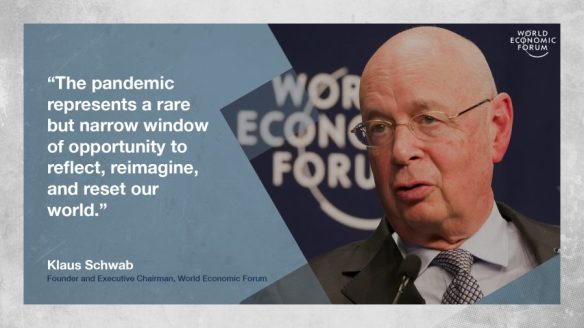
This is why astute readers are skeptical when they hear Schwab say, “the pandemic represents a rare but narrow window of opportunity to reflect, reimagine, and reset our world to create a healthier, more equitable and more prosperous future.”
Who exactly is Schwab speaking to when he speaks of a more prosperous future? How long has this Great Reset been in the works? The answers to these questions can help us understand the true goals of this agenda.
As researcher Brandon Smith reported, Christine Lagarde, former head of the IMF,discussed a global reset as far back as 2014. “The reset is often mentioned in the same breath as ideas like “the New Multilateralism” or “the Multipolar World Order” or “the New World Order.” All of these phrases mean essentially the same thing,” Smith writes.
Smith correctly notes that the Great Reset is not a response to the pandemic, but rather, “the global reset as implemented by central banks and the BIS/IMF is the cause of the collapse. The collapse is a tool, a flamethrower burning a great hole in the forest to make way for the foundations of the globalist Ziggurat to be built.”
New Normal, Same World Order
In early July, Schwab and French author Thierry Malleret released a book outlining the vision of The Great Reset. The book, Covid-19: The Great Reset, explores what the post-pandemic world might look like. “Will there be enough collective will to take advantage of this unprecedented opportunity to reimagine our world, in a bid to make it a better and more resilient one as it emerges on the other side of this crisis?,” Schwab and Malleretpondered at the release of the book. The two men believe COVID-19 triggered “momentous changes and magnified the fault lines that already beset our economies and societies.” They also predict that falling oil prices and a freeze in tourism could lead to a wave of massive anti-government demonstrations.
“One path will take us to a better world: more inclusive, more equitable and more respectful of Mother Nature. The other will take us to a world that resembles the one we just left behind – but worse and constantly dogged by nasty surprises,” the authors argue.
In the book, Schwab expands upon the initial announcement of The Great Reset. Once again he calls for the 4th Industrial Revolution and the digitalization of everything, powered by 5G technology. However, Schwab goes even further in his book, calling for rethinking the “social contract” society has with governments.
Schwab also calls for a nature based or green economy. In January 2020, the WEF released their report, Nature Risk Rising: Why the Crisis Engulfing Nature Matters for Business and the Economy, as part of their New Nature Economy series of reports. The report is “the first of a series of New Nature Economy reports, prepared through the Nature Action Agenda, a platform that aims to encourage a movement of businesses, governments, civil society, academics, innovators and youth to disrupt business-as-usual approaches.”
A second report, The Future of Nature and Business, was released in July. Once again, the WEF states that COVID-19 presents an “opportunity, to change the way we eat, live, grow, build and power our lives to achieve a carbon-neutral, ‘nature-positive’ economy and halt biodiversity loss by 2030. Business as usual is no longer an option.“
In a companion report, the WEF provides some detail on what it means to change the way we eat. “Another set of policy measures that would stimulate more resource-efficient food systems entail directing stimulus packages towards R&D to support the diversification away from diets based on resource intensive animal proteins, and towards four main categories of alternatives – aquatic, plant-based, insect-based and laboratory-cultured,” the report states. This push for alternatives to animal proteins has coincided with a rise in laboratory created fake meat, including products funded by the Bill and Melinda Gates Foundation.
Interestingly, the companion report also calls for “corporate bailout packages for the meat sector” which “could accelerate these developments.” Coincidentally, because of COVID-19, the Trump administration awarded $15.5 billion in relief aid for the meat and dairy industry. Once again, the predictions and declarations of these global institutions appear to play out in reality as perfect as any scripted TV show.
The calls for a Great Reset greatly mimic previous programs and initiatives put forward by other globalist organizations, including the United Nations. Researcher F. William Engdahl provided much-needed clarity in a recent piece on the announcement of The Great Reset. Engdahl notes that, “the declaration by the World Economic Forum to make a Great Reset is to all indications a thinly-veiled attempt to advance the Agenda 2030 “sustainable” dystopian model, a global “Green New Deal” in the wake of the covid19 pandemic measures. Their close ties with Gates Foundation projects, with the WHO, and with the UN suggest we may soon face a far more sinister world after the covid19 pandemic fades.”
Strategic Intelligence, Strategic Partners, and Event 201
In March, the WEF launched the COVID Action Platform which is essentially a call for global government in response to COVID-19. The answer, WEF believes, is to have greater global cooperation, move away from the nation-state, and tackle the world’s problems as one international community.
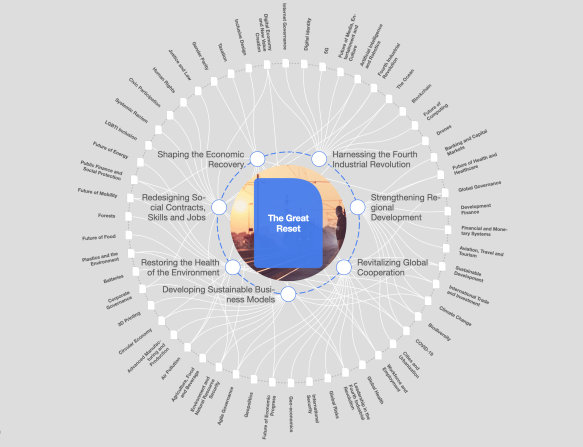
Along with the launch of the Action Platform, the WEF released an impressive graphic as part of their “Strategic Intelligence” platform, which outlines the wide ranging ways their plans will effect and shape the world of the 21st century and beyond. From the media’s role in the pandemic to finding a vaccine, the graphic attempts to provide details on this centrally planned future being promoted by the WEF. I encourage all readers to spend an evening going down the rabbit hole that is the COVID Action Platform for a better understanding of where we are headed.
With the launch of The Great Reset, the WEF also launched a Strategic Intelligence graphic detailing how their plans will unfold. The Great Reset graphic details how everything from drones, blockchain, the future of energy, LGBTI inclusion, and 3D printing will play a role in the New Normal. Once again, I encourage readers to take a dive into this graphic to gain clarity on what the WEF and their partners have planned for the coming decade.
The WEF promotes itself as the “International Organization for Public-Private Cooperation.” They partner with a variety of private companies, philanthropic outlets, and governments to achieve their goals. Researcher Steven Guinness recently outlined how the WEF partners with various institutions to accomplish their stated aims and how the Strategic Intelligence platform is “co-curated with leading topic experts from academia, think tanks, and international organizations.”
“‘Co-curators‘ are perhaps the most important aspect to consider here, given that they have the ability to ‘share their expertise with the Forum’s extensive network of members, partners and constituents, as well as a growing public audience,’” Guinness writes. “It is safe to assume then that when co-curators speak, members and partners of the World Economic Forum listen. This in part is how the WEF’s agenda takes shape.”
As Guinness notes, the co-curators of the Strategic Intelligence road map of the globalist vision include Harvard university, the Massachusetts Institute of Technology, Imperial College London, Oxford University, Yale and the European Council on Foreign Relations. Several of these institutions continue to play an influential role in shaping the narrative around COVID-19.
The WEF’s highest level of partnership is known as Strategic Partners. There are only 100 international companies listed as Strategic Partners. Each partner receives an invitation if they have “alignment with forum values.” These partners “shape the future through extensive contribution to developing and implementing Forum projects and championing public-private dialogue.”
The WEF’s Strategic Partners include Johnson & Johnson, and the Bill and Melinda Gates Foundation. BillGates is also a long time “Agenda Contributor” for the WEF.As mentioned above, the Bill and Melinda Gates Foundation partnered with the Johns Hopkins Center for Health Security and the WEF on the Event 201 pandemic exercise in October 2019. Johnson & Johnson were also partners in the exercise.
As TLAV has previously documented, the Bill and Melinda Gates Foundation operates in a similar fashion to the WEF: their publicly stated goals mask a global control agenda. Thus, it should come as no surprise that Klaus Schwab, founder of the WEF, is a former attendee and member of the Steering Committee for the secretive Bilderberg Group.
The WEF itself is akin to a more public Bilderberg Group which brings together around 3,000 business leaders, international political leaders, economists, celebrities, and journalists for a five day conference to discuss global issues. The WEF meets every January in Davos, Switzerland, to discuss their agenda. The elitism of the WEF has resulted in Schwab and his cohorts being nicknamed The Davos Class.
In January 2021 the theme of the WEF meeting will be “The Great Reset.” It’s important that we keep an eye on the WEF and their push for the Great Reset as we draw closer to election 2020 and a potential Dark Winter. Klaus Schwab, Bill Gates, and their ilk are determined to present themselves as the saviors of humanity. They are using the COVID-19 panic as an opportunity to push their agenda while selling it as the cure to our problems.
This predator class attempts to mask their true intentions with flowery language designed to lull the waking masses back to sleep. To be clear, our world is absolutely, without a doubt existing in an unsustainable paradigm. We do have growing income inequality, police violence, failing healthcare systems, and insufficient food production systems. These problems were apparent before COVID-19 and the fragility of these systems has indeed become more obvious in recent months. However, these psychopaths would prefer if we allowed them to stay in the driver’s seat as they careen us into a future of technocratic control and the end of individual liberty.
While Schwab and Gates would prefer that the people of the world submit to their vision, we must stand against this push for centralization of power and technology. The Great Reset is coming, and perhaps, it should come. We have many issues facing our species that need to be addressed. However, central planning, surveillance, and loss of individual liberty is not the answer. The answer is decentralization, opting out en masse, non-compliance, and non-participation in the systems which have brought us to this predicament.
We, as free people, must decide what path we intend to take. Will we stand by and allow the predators to seize control of all resources and power for the coming generations?Or, will we finally break free from their violent systems and initiate a Great Reset which benefits the people, from bottom to top?
The answer depends on you.
Question Everything, Come To Your Own Conclusions.
It has frequently been observed that terror can rule absolutely only over people who are isolated against each other and that therefore one of the primary concerns of tyrannical government is to bring this isolation about. Isolation may be the beginning of terror; it certainly is its most fertile ground; it always is its result. This isolation is, as it were, pretotalitarian; its hallmark is impotence insofar as power always comes from people acting together, acting in concert; isolated people are powerless by definition.”
Hannah Arendt, The Origins of Totalitarianism
Western civilization, led by the US government and media, has embarked upon a campaign of mass psychological terrorism designed to cover for the collapsing economy, set up a new pretext for Wall Street’s ongoing plunder expedition, radically escalate the police state, deeply traumatize people into submission to total social conformity, and radically aggravate the anti-social, anti-human atomization of the people.
The pretext for this abomination is an epidemic which objectively is comparable to the seasonal flu and is caused by the same kind of Coronavirus we’ve endured so long without totalitarian rampages and mass insanity.
The global evidence is converging on the facts: This flu is somewhat more contagious than the norm and is especially dangerous for those who are aged and already in poor health from pre-existing maladies. It is not especially dangerous for the rest of the population.
The whole concept of “lockdowns” is exactly upside down, exactly the wrong way any sane society would respond to this circumstance.
It’s the vulnerable who should be shielded while nature takes its course among the general population, who should go about life as usual. Dominionist-technocratic rigidity can’t prevent an epidemic from cycling through the population in spite of the delusions of that religion, especially since Western societies began their measures far too late anyway.
So it’s best to let herd immunity develop as fast as it naturally will, at which time the virus recedes from lack of hosts (and is likely to mutate in a milder direction along the way). This is the only way to bring a safer environment for all including the most vulnerable.
The fact that most societies have rejected the sane, scientific route in favor of doomed-to-fail attempts at a forcible violent segregation and sterilization is proof that governments aren’t concerned with the public health (as if we didn’t know that already from a thousand policies of poisoning the environment while gutting the health care system), but are very ardent to use this crisis they artificially generated in order radically to escalate their police state power toward totalitarian goals.
The whole concept of self-isolation and anti-social “distancing” is radically anti-human. We evolved over millions of years to be social creatures living in tight-knit groups. Although modern societies ideologically and socioeconomically work to massify and atomize people, nevertheless almost all of us still seek close human companionship in our lives.
(I suspect most of the internet police-state-mongers are not only fascists at heart but are confirmed misanthropic loners who couldn’t care less about human closeness.)
This terror campaign seeks to blast to pieces any remaining human closeness, which means any remaining humanity as such, the better to isolate individual atoms for subjection to total domination. Arendt wrote profoundly on this goal of totalitarian governments, though even she didn’t envision a state-driven cult of the literal physical repulsion of every atom from every other atom.
So far the people are submitting completely to a terror campaign dedicated to the total eradication of whatever community was left in the world, and especially whatever community was starting to be rebuilt.
Some dream of this terror campaign somehow bringing about a magical collective transformation. They don’t explain how that is supposed to happen when everyone’s so terrorized they’re desperate to detach physically from their own shadows, let alone physically come together with other people. But any kind of political or social action, any kind of movement-building, requires close person-to-person contact.
It seems that for most erstwhile self-alleged dissidents, the fact that social media is no substitute for face-to-face organizing and group action, a fact hitherto universally acknowledged by these dissidents, is another truth suddenly to be jettisoned replaced by its complete antithesis.
Thus the terror campaign is a virus causing those it infects to abdicate all activism and all prospect for all future activism, for as long as they remain insane with the fever of this propaganda terror.
Far more profoundly and evoking despair, the terror campaign is a virus causing those it infects to fear and loathe all human contact, all companionship, all closeness, all things which ever made us human in the first place. Prior totalitarian regimes sought this lack of contact and trust through networks of informers.
These networks are part of today’s terror campaign as well, encouraged from above and spontaneously arising from below as a result of the feeling of terror as well as the exercise of prior petty-evil intentions on the part of petty-evil individuals.
But today’s totalitarian potential is far worse than this. Now the regimes aspiring to total domination have terrorized and brainwashed the vast majority of people into an automatic physical distrust of all other people. One no longer fears that someone is an informer, but fears the very existence of another human being.
Any kind of human relations, from personal friendship and romance to friendly social gatherings and clubs to social and cultural movements become impossible under such circumstances. This threatens to be the end of the very concept of shared humanity, to be replaced by an anthill of slave atoms with no consciousness beyond fear and the most animal concern for food and shelter, which already is allowed or denied in the same way experimenters do with lab rats.
And the more people fear and loathe the literal physical existence of all other people, the more the situation becomes ripe for every epidemic of murder, from the spiking rate of domestic violence and killings to incipient lynch mobs to pogroms to Nazi-style extermination campaigns.
This is the system’s end goal. It’s the logical end where every trend of today leads. All of it is trumped up over an epidemic which objectively is a flu season somewhat rougher than average.
Why do the people want to surrender and throw away all reality and future prospect of shared humanity, happiness, freedom, well-being, over so little? Is this really a terminal totalitarian death cult, the globe as one massive Jonestown?
So far it seems this is what the majority wants. If they don’t really want this consummation of universal death in spirit, emotion and body, they’d better snap out of their terror-induced mental delirium fast, before it’s too late.
The laughably hopeless hope is that by propping up the corpses, the populace will discern some faint flicker of life in the decaying carcasses and return to their free-spending ways.
Call it cultural synchronicity, but it increasingly feels like we’re living in the 1979 Talking Heads song Life During Wartime, which was anchored by the lyric “This Ain’t No Party, This Ain’t No Disco, This Ain’t No Foolin’ Around.” Indeed.
It also feels like Life During Wartime because the propaganda is so blatant and intense:we’re winning the war on Covid-19, and our wars on everything else, too, of course, as war is the favored metaphor and favored policy at the end of the Empire.
The ceaseless propaganda is that “a vaccine is right around the corner.” The inconvenient reality is that Corporate Insiders Pocket $1 Billion in Rush for Coronavirus Vaccine: Well-timed stock bets have generated big profits for senior executives and board members at companies developing vaccines and treatments.
In other words, wartime profiteering isn’t just allowed, it’s encouraged–yet another sign that we’re in the final decay/collapse phase of Imperial Pretensions.
It’s easy to mix up the propaganda and the counter-propaganda, because they’re both so extreme. There is no middle ground, only pre-packaged positions which dictate which “data” is cherry-picked to support the political partisanship that’s being defended.
In a world of thousands of unread papers published in hundreds of scientific journals no one even reads and a corrupt culture of “science for sale,” there’s a veritable orchard to cherry-pick.
“Robert Horton, editor in chief of The Lancet, one of the most respected professional peer reviewed publications in the world dealing with biomedical research had this to say in an editorial published by The Lancet in April of 2015:”
“The case against science is straightforward: much of the scientific literature, perhaps half, may simply be untrue. Afflicted by studies with small sample sizes, tiny effects, invalid exploratory analyses, and flagrant conflicts of interest, together with an obsession for pursuing fashionable trends of dubious importance, science has taken a turn towards darkness.”
“And this, published in 2009, by Dr. Marcia Angell, former editor of The New England Journal of Medicine, another world leading publication in medical research:”
“It is simply no longer possible to believe much of the clinical research that is published, or to rely on the judgment of trusted physicians or authoritative medical guidelines. I take no pleasure in this conclusion, which I reached slowly and reluctantly over my two decades as an editor of The New England Journal of Medicine.”
Metaphorically speaking, the civilian populace believes “we’re winning” until the bombs start dropping on their homes. For some reason, this doesn’t feel like “winning.”
The V-shaped recovery is the propaganda war the status quo must win, for this is the narrative battle for the hearts and minds of the populace. The fear here is that should the populace lose confidence in The V-shaped recovery, they might reduce their borrowing and spending and increase their saving, dooming an economy that depends entirely on marginal spending funded by debt to keep from imploding.
As the chart of the rising wedge model of breakdown below illustrates, when big-ticket costs ratchet higher like clockwork–rent, property taxes, childcare, higher education, debt, healthcare, etc.– while income stagnates for the bottom 90%, any drop in spending, no matter how modest, breaks the system because any reduction in spending reduces tax revenues, corporate profits and debt payments below the critical threshold.
This is why the Federal Reserve is so keen on bailing out bankrupt-in-all-but-name corporations and banks: The laughably hopeless hope is that by propping up the corpses, the populace will discern some faint flicker of life in the decaying carcasses and return to their free-spending ways.
This is also why “stimulus” is being scattered from helicopters: the hope is that by substituting borrowed trillions for earned trillions, people will substitute magical thinking for clear-eyed recognition that the era of “growth” has transitioned into the era of DeGrowth, a state of affairs that signals the demise of all the bloated, sclerotic institutions operated to benefit insiders and Corporate America’s cartels and monopolies: the most protected bastions of the era, colleges and hospitals, are going broke and closing.
As Marx noted, “everything solid melts into air” when it’s no longer financially viable. Helicopter “stimulus” just creates a temporary illusion of solidity.
The foundations are collapsing, but by all means, please keep your eye on the decaying corpses: didn’t an eyelid flicker in that one? I could swear that one moved its foot…
This is “life in wartime,” where the battles are waged in narratives, confidence and magical thinking.
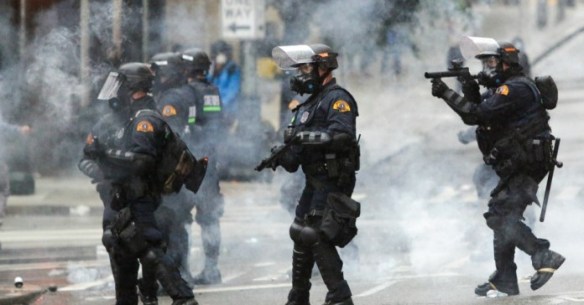
When you see riot police surround the Lincoln Memorial and protesters snatched off the streets by masked soldiers in unmarked cars.
And when you realize that it is all being watched by an unblinking eye of A.I. surveillance.
At times, it feels like we are living in a real-world version of dystopia. The strange outcome, though, is that it means we need dystopian fiction now more than ever, to help us sort and even make it through it.
You’d think with everything going on, now would be the last time to escape to a world of darkness. And yet books, including those of awful imagined worlds, are in deep demand.
Some of it has been a return to old classics. In a period of disease and lockdowns lasting for weeks, booksellers report the seeming irony that Albert Camus’ The Plague and Gabriel García Márquez’s One Hundred Years of Solitude have seen renewed demand. And some of it has been escaping into new worlds, as with Divergent author Veronica Roth taking readers into another post-apocalypse with her new novel Chosen Ones. People have even been willing to enter imagined worlds that seem not too far away, such as Lawrence Wright’s best-selling pandemic thriller The End of October.
Yet the value of the genre is as much in education as entertainment. It can elucidate dangers, serving the role of warning and even preparation. Think of the recent resonance of Margaret Atwood’s 1985 Handmaid’s Tale and its 2020 sequel The Testaments or the revival of interest in It Can’t Happen Here by Sinclair Lewis in 1935. These are finely written works, not as indulgences, but as a pure expression of the idea that to be forewarned is to be forearmed. Even Susan Collins’ Hunger Games prequel, The Ballad of Songbirds and Snakes, might be interpreted in that light, showing how authoritarian rule can originate through the manipulations of an ambitious striver.
Our personal corner of this dark market is the meld of imagination with research. For our book Burn-In: A Novel of the Real Robotic Revolution, we chose the setting of not a far-off imagined world like Panem or Gilead, but Washington, D.C., just around the corner. What happens as Silicon Valley’s visions of utopia hits our real, and very divided, country? What plays out in politics, business, and even family life as our economy is rewired by AI and automation? Yet to make our scenario more haunting, we back up everything that happens in it with 27 pages of endnotes.
When the scarier elements from an imagined world come to life in the real one, however, there is no gleeful “I told you so.” When the novel coronavirus accelerated the more widespread roll out of the robots, remote work, job automation, and AI surveillance projected in our book, we certainly weren’t happy. All it meant was that all the tough dilemmas that our characters face would come quicker for all of us. What was perhaps most disturbing of the last few weeks, though, were when some of the most dystopian scenes we had painted of a future Washington, D.C., also came true, from our book’s scene of riot police deployed around the Lincoln Memorial to the militarized fence thrown up around the White House being put exactly where we had it in Burn-In.
Yet what makes dystopian fiction different is that its creators are oddly optimists at heart, as we are. These works are not about prediction, but prevention. The stories warn of just how far things can go if action isn’t taken, wrapped in a package that is far more impactful than a white paper or PowerPoint. Indeed, research shows that narrative, the oldest communication technology of all, holds more sway over both the public and policymakers than even the “most canonical academic sources.” Our minds can’t help but connect to the “synthetic environment” that our fictional heroes and villains experience, living part of our lives through theirs, even if imagined.
Most importantly, though, the dark worlds are only the setting. The stories are really about the agency of the people in them. And that is perhaps the true value of the dystopian fiction. These stories are not about what those characters experience so much as how they act. At the heart of every story of darkness is a story of perseverance.
As we face our own difficult journeys through the reality of 2020, it is perhaps that lesson which is most important of all.
The Covid-19 virus itself didn’t run the United States into a ditch but it exposed the weakness and rot in the nation’s drive-train, and now all of us passengers on that disabled bus must decide whether to stay helplessly inside the smoldering wreckage arguing over who’s to blame, or begin a long, uncertain march down the road on our own two feet to a place of new arrangements.
In 1918, the country was lashed by a far deadlier pandemic disease at the same time it was fighting a world war, and daily life barely missed a step. The economy then was emphatically one of production, not the mere consumption of things made elsewhere in the world (exchanged for US IOUs), nor of tanning parlors, nail salons, streaming services, and Pilates studios. The economy was a mix of large, medium, and small enterprises, not just floundering giants, especially in the retail commerce of goods. We lived distributed in towns, cities not-yet-overgrown, and a distinctly rural landscape devoted to rural activities — not the vast demolition derby of entropic suburbia that has no future as a human habitat. Banking was only five percent of the economy, not the bloated matrix of rackets now swollen to more than forty percent of so-called GDP. Government at the federal and state levels was miniscule compared to the suffocating, parasitic leviathan it is now.
What happened? Like Hemingway’s old quip about a man going broke slowly and then all-at-once, we allowed everything in American life to creep into hapless giantism too cumbersome to adapt to new conditions, and suddenly conditions have changed. And now it’s all coming apart: the dying chain stores, the giant zombie companies that can only exist by borrowing money to buy back their own stocks, the auto-makers who have run out of lending schemes for non-creditworthy customers, the shale oil fracking companies that could never make a red cent, the agri-biz farmers grown morbidly obese on a diet of credit and government subsidies (just like their end-customers grew obese on engineered snack-foods), the Wall Street lords of financialization hypothecating fortunes by leveraging the stripped assets of everything not nailed down from sea to shining sea, the swelling underclass conditioned to helplessness, addiction, and vice, the inescapable ambient tyranny of media hype, propaganda, and disinformation, and, of course, the catastrophe that government has become.
Get this: none of these things now wobbling and staggering will be resurrected. They’re all going extinct, like the Baluchitherium of the Oligocene. To keep propping them up — as the Federal Reserve sedulously props up financial markets — will only promote the illusion that we don’t have to move on and conduct daily human life differently. A worldwide contraction was already underway before Covid-19 stepped onstage. The contraction was sending a very loud and clear message: gigantism went as far as it could go and now it’s up to the smaller and nimbler to carry on. Beware the promises of the sclerotic authorities asking you to remain in thrall to them — and dependent on them.
Expect these authorities to screw up even the next big exercise in their own franchise: the 2020 election. It will be the climax to a season of political hysteria and will complete the chapter of our history that left us on that smoldering big bus in the ditch. The scramble away from that disaster scene will be frightful and desperate. No matter who ends up in control of the government — or pretends to be — the same forces of contraction and decomplexifying will actually rule and you will have to act accordingly.
Many people will seek to escape the places they live now to find new homes and livelihoods elsewhere. These demographic movements are already underway. New York City is hemorrhaging much of its tax base as the wealthy flee, Chicago too, and the whole state of California. These places will be overwhelmed by functional bankruptcy, even if legal legerdemain allows them to avoid declaring it. Other states, counties and municipalities — including many suburban blobs — will also founder, meaning all the usual support systems and safety nets vanish. Many supply chains will break. Money may either be scarce or worthless, which are two ways of going broke.
Right now, start planning where you might go and what you can do. The turmoil will be filled with opportunity to find ways to be useful to other people, to devise work-arounds for ruptured systems and relationships, in getting food to people, making things they need, distributing them, fixing things that are broken where possible, and moving people and stuff from point A to point B. There will be plenty of work for people who are willing to do it. Keep in mind that it’s entirely up to you to make good choices.
Don’t despair, and if you find yourself veering toward it, get over yourself. It’s just part of becoming stronger than you thought you could be, and the times will require it of you anyway. The offices that gave out brownie points for avouched victimhood will also be shutting down. Won’t that be a relief? Welcome to the joyful illumination that life is difficult for everybody. Who is ready for this epic journey?







 After the Crash