‘What It Takes to Be President of the American Police State: Anti-Big Money, Anti-War, Pro-Constitution, Freedom-Loving Candidates Need Not Apply’

imageedit_4850_9701377216

By John W. Whitehead

Source: A Government of Wolves

“The qualifications for president seem to be that one is willing to commit mass murder one minute and hand presidential medals of freedom to other war criminals in the next. One need only apply if one has very loose, flexible, or non-existent morality.”—Author and activist Cindy Sheehan

Long gone are the days when the path to the White House was open to anyone who met the Constitution’s bare minimum requirements of being a natural born citizen, a resident of the United States for 14 years, and 35 years of age or older.

Today’s presidential hopefuls must jump through a series of hoops aimed at selecting the candidates best suited to serve the interests of the American police state. Candidates who are anti-war, anti-militarization, anti-Big Money, pro-Constitution, pro-individual freedom and unabashed advocates for the citizenry need not apply.

The carefully crafted spectacle of the presidential election with its nail-biting primaries, mud-slinging debates, caucuses, super-delegates, popular votes and electoral colleges has become a fool-proof exercise in how to persuade a gullible citizenry into believing that their votes matter.

Yet no matter how many Americans go to the polls on November 8, “we the people” will not be selecting the nation’s next president.

While voters might care about where a candidate stands on healthcare, Social Security, abortion and immigration—hot-button issues that are guaranteed to stir up the masses, secure campaign contributions and turn any election into a circus free-for-all—those aren’t the issues that will decide the outcome of this presidential election.

What decides elections are money and power.

We’ve been hoodwinked into believing that our votes count, that we live in a democracy, that elections make a difference, that it matters whether we vote Republican or Democrat, and that our elected officials are looking out for our best interests. Truth be told, we live in an oligarchy, and politicians represent only the profit motives of the corporate state, whose leaders know all too well that there is no discernible difference between red and blue politics, because there is only one color that matters in politics—green.

As much as the Republicans and Democrats like to act as if there’s a huge difference between them and their policies, they are part of the same big, brawling, noisy, semi-incestuous clan. Watch them interact at social events—hugging and kissing and nudging and joking and hobnobbing with each other—and it quickly becomes clear that they are not sworn enemies but partners in crime, united in a common goal, which is to maintain the status quo.

The powers-that-be will not allow anyone to be elected to the White House who does not answer to them.

Who are the powers-that-be, you might ask?

As I point out in my book Battlefield America: The War on the American People, the powers-that-be are the individuals and corporations who profit from America’s endless wars abroad and make their fortunes many times over by turning America’s homeland into a war zone. They are the agents and employees of the military-industrial complex, the security-industrial complex, and the surveillance-industrial complex. They are the fat cats on Wall Street who view the American citizenry as economic units to be bought, sold and traded on a moment’s notice. They are the monied elite from the defense and technology sectors, Hollywood, and Corporate America who believe their money makes them better suited to decide the nation’s future. They are the foreign nationals to whom America is trillions of dollars in debt.

One thing is for certain: the powers-that-be are not you and me.

In this way, the presidential race is just an exaggerated farce of political theater intended to dazzle, distract and divide us, all the while the police state marches steadily forward.

It’s a straight-forward equation: the candidate who wins the White House will be the one who can do the best job of ensuring that the powers-that-be keep raking in the money and acquiring ever greater powers. In other words, for any viable presidential candidate to get elected today that person must be willing to kill, lie, cheat, steal, be bought and sold and made to dance to the tune of his or her corporate overlords.

The following are just some of the necessary qualifications for anyone hoping to be appointed president of the American police state. Candidates must:

Help grow the militaryindustrial complex: Fifty-five years after President Dwight D. Eisenhower warned about the growth of the “military-industrial complex” in his farewell address, the partnership between the government, the military and private corporations has resulted in the permanent militarization of America. From militarized police and the explosive growth of SWAT teams to endless wars abroad, the expansion of private sector contractors, and never-ending blowback from our foreign occupations, we have become a nation permanently at war. As the New York Times pointed out, “themilitary is the true ‘third rail’ of American politics.” The military-industrial complex understands the value of buying the presidency, and has profited from the incessant warmongering of Obama and his predecessors. If money is any indicator of who the defense industry expects to win this November, thus far, Hillary Clinton is winning the money race, having collected more campaign contributions from employees with the 50 largest military contractors.

Police the rest of the world using U.S. troops: The U.S. military empire’s determination to police the rest of the world has resulted in more than 1.3 million U.S. troops being stationed at roughly 1000 military bases in over 150 countriesaround the world, including 48,000 in Japan, 37,000 in Germany, 27,000 in South Korea and 9800 in Afghanistan. That doesn’t include the number of private contractors pulling in hefty salaries at taxpayer expense. In Afghanistan, for example, private contractors outnumber U.S. troops three to one. Now comes the news that the U.S. is preparing to sendtroops to Libya on a long-term mission to fight ISIS.

Sow seeds of discord and foment wars among other nations under the guise of democracy: It’s not enough for the commander-in-chief to lead the United States into endless wars abroad. Any successful presidential candidate also needs to be adept at stirring up strife within other nations under the guise of spreading democracy. The real motive, of course, is creating new markets for the nation’s #1 export: weapons. In this way, the U.S. is constantly arming so-called “allies” with deadly weapons, only to later wage war against these same nations for possessing weapons of mass destruction. It happened in Iraq when the U.S. sold Saddam Hussein weapons to build his war machine. It happened in Syria when the U.S. provided rebel fighters with military equipment and munitions, only to have them seized by ISIS and used against us. Now comes the news that President Obama has agreed to sell weapons to Vietnam, lifting a decades-long embargo against the nation whose civil war claimed the lives of more than 90,000 Americans.

Speak of peace while slaughtering innocent civilians: Barack Obama’s campaign and subsequent presidency illustrates this principle perfectly. The first black American to become president, Obama was awarded the Nobel Peace Prize long before he had done anything to truly deserve it. He has rewarded the Nobel committee’s faith in him by becoming one of the most hawkish war presidents to lead the nation, overseeing a targeted-killing drone campaign that has resulted in thousands of civilian casualties and deaths. Ironically, while Obama has made no significant effort to de-escalate government-inflicted violence or de-weaponize militarized police, he has gone to great lengths to denounce and derail private gun ownership by American citizens.

Prioritize surveillance in the name of security over privacy: Since 9/11, the Surveillance State has undergone a dramatic boom, thanks largely to the passage of the USA Patriot Act and so-called “secret” interpretations of the mammoth law allowing the NSA and other government agencies to spy on Americans’ electronic communications. What began as a government-driven program under George W. Bush has grown under Obama into a mass surveillance private sector that makes its money by spying on American citizens. As Fortune reports, “In response to security concerns after 9/11, Americans witnessed the growth of a massive domestic security apparatus, fueled by federal largesse.” That profit-incentive has opened up a multi-billion dollar video surveillance industry that is blanketing the country with surveillance cameras—both governmental and private—which can be accessed by law enforcement at a moment’s notice.

Promote the interests of Corporate America and Big Money over the rights of the citizenry: Almost every major government program hailed as benefiting Americans—affordable healthcare, the war on terror, airport security, police-worn body cameras—has proven to be a Trojan Horse aimed at enriching Corporate America while leaving Americans poorer, less secure and less free. For instance, the so-called “affordable” health care mandated by Congress has become yet another costly line item in already strained household budgets for millions of Americans.

Expand the powers of the imperial president while repeatedly undermining the rule of law: George W. Bush assumed near-absolute power soon after the September 11, 2001, attacks. Unfettered by Congress or the Constitution, Bush led the “war on terror” abroad and championed both the USA Patriot Act and Homeland Security Department domestically. This, of course, led to the Bush Administration’s demand that presidential wartime powers permit the President to assume complete control over any and all aspects of an international war on terrorism. Such control included establishing military tribunals and eliminating basic rights long recognized under American law.

When Barack Obama ascended to the presidency in 2008, there was a sense, at least among those who voted for him, that the country might change for the better. Those who watched in awe as President Bush chipped away at our civil liberties over the course of his two terms as president thought that perhaps the young, charismatic Senator from Illinois would reverse course and put an end to some of the Bush administration’s worst transgressions—the indefinite detention of suspected terrorists, the torture, the black site prisons, and the never-ending wars that have drained our resources, to name just a few. As we near the end of Obama’s two terms in office, that fantasy has proven to be just that: a fantasy. Indeed, President Obama has not only carried on the Bush legacy, but has taken it to its logical conclusion. Obama has gone beyond Guantanamo Bay, gone beyond spying on Americans’ emails and phone calls, and gone beyond bombing countries without Congressional authorization. As journalist Amy Goodman warned, “the recent excesses of U.S. presidential power are not transient aberrations, but the creation of a frightening new normal, where drone strikes, warrantless surveillance, assassination and indefinite detention are conducted with arrogance and impunity, shielded by secrecy and beyond the reach of law.”

Act as if the work of the presidency is a hardship while enjoying all the perks: The race for the White House is an expensive, grueling horse race: candidates must have at a minimum $200 or $300 million or more just to get to the starting line. The total cost for this year’s election is estimated to exceed $5 billion and could go as high as $10 billion. However, for the winner, life in the White House is an endless series of star-studded dinner parties, lavish vacations and perks the likes of which the average American will never enjoy. The grand prize winner will rake in a $400,000 annual salary (not including $100,000 a year for travel expenses, $19,000 for entertaining, $50,000 for “general” expenses and last but not least, $1,000,000 for “unanticipated” expenses), live rent-free in a deluxe, 6-storey, 55,000 square foot mansion that comes complete with its own movie theater and bowling alley, round-the-clock staff, florists, valets and butlers. Upon leaving the White House, presidents are gifted with hefty pensions, paid staff and office space, travel allowances and lifetime medical care. Ex-presidents can also expand upon their largesse by writing books and giving speeches (Bill Clinton was given a $15 million advance for his memoir and routinely makes upwards of $100,000 per speech).

Clearly, it doesn’t matter where a candidate claims to stand on an issue as long as he or she is prepared to obey the dictates of the architects, movers and shakers, and shareholders of the police state once in office.

So here we are once again, preparing to embark upon yet another delusional, reassurance ritual of voting in order to sustain the illusion that we have a democratic republic when, in fact, what we have is a dictatorship without tears. Once again, we are left feeling helpless in the face of a well-funded, heavily armed propaganda machine that is busily spinning political webs with which the candidates can lure voters. And once again we are being urged to vote for the lesser of two evils.

Railing against a political choice that offers no real choice, gonzo journalist Hunter S. Thompson snarled, “How many more of these stinking, double-downer sideshows will we have to go through before we can get ourselves straight enough to put together some kind of national election that will give me and the at least 20 million people I tend to agree with a chance to vote for something, instead of always being faced with that old familiar choice between the lesser of two evils?”

Remember, the lesser of two evils is still evil.

The Real Reason Brazil’s Democratically Elected Dilma Rousseff Was Impeached

images

By Graham Vanbergen

Source: TruePublica

The real reason for the democratically elected leader of the largest country in South America being ‘impeached’ was not alleged corruption by its socialist president Dilma Rousseff, but more about Brazil’s elite power class and their media oligarchs who have failed time and time again to be democratically elected.

This by David Miranda from Brazil, The Guardian – “Slowly, the outside world has begun to see past the pleasing, two-dimensional caricature manufactured by its domestic press, and to recognise who will be empowered once Rousseff is removed. It has now become clear that corruption is not the cause of the effort to oust Brazil’s twice-elected president; rather, corruption is merely the pretext.

The story of Brazil’s political crisis, and the rapidly changing global perception of it, begins with its national media. The country’s dominant broadcast and print outlets are owned by a tiny handful of Brazil’s richest families, and are steadfastly conservative. For decades, those media outlets have been used to agitate for the Brazilian rich, ensuring that severe wealth inequality (and the political inequality that results) remains firmly in place.

But what most outside Brazil did not see was that the country’s plutocratic media had spent months inciting protests (while pretending merely to “cover” them). The protesters were not remotely representative of Brazil’s population. They were, instead, disproportionately white and wealthy: the very same people who have opposed the PT and its anti-poverty programmes for two decades.”

A New York Times article last week reported that “60% of the 594 members of Brazil’s Congress” – the ones voting to impeach Rousseff – “face serious charges like bribery, electoral fraud, illegal deforestation, kidnapping and homicide”. By contrast, said the article, Rousseff “is something of a rarity among Brazil’s major political figures: she has not been accused of stealing for herself”.

And from TruePublica columnist Stephen Lendman“President Dilma Rousseff’s ouster was orchestrated in Washington, complicit with corrupted Brazilian fascists – usurping power by removing her. Her impeachment was certain once the nation’s corruption-ridden Senate suspended her in May on trumped up budget-manipulation charges.

On August 31, it became official. Tyranny replaced Brazilian democracy. Telesur reported 49 senators voting for Rousseff’s impeachment “are themselves targets of criminal inquiries.” She committed no crimes. Nothing justified her removal. Allegations against her were fabricated. 

Wednesday’s vote combined tragedy and farce – annulling 54 million votes electing her, returning the country to fascist rule, a sad moment for millions of Brazilians deserving better.”

Back in May this year The Guardian also headlined with “Brazil minister ousted after secret tape reveals plot to topple President Rousseff” in which “The credibility of Brazil’s interim government was rocked on Monday when a senior minister was forced to step aside amid further revelations about the machiavellian plot to impeach president Dilma Rousseff.

Just 10 days after taking office, the planning minister, Romero Jucá, announced that he would “go on leave” following the release of a secretly taped telephone conversation in which he said Rousseff needed to be removed to quash a vast corruption investigation that implicated him and other members of the country’s political elite.”

A plot was hatched to put into power one Michel Temer. He has since been implicated by corruption allegations himself following the release of a plea-bargain testimony implicating him in an enormous scandal centered on the country’s state oil company that included funds being illegally diverted to his party.

Perhaps it should be of no surprise then that as The Wall Street Journal said “It was the first time Mr. Temer has been directly implicated in the blockbuster corruption investigation known as Operation Car Wash, which has ensnared dozens of high-profile business and political figures, including leading members of Mr. Temer’s Brazilian Democratic Movement Party, or PMDB.”

At the time of the WSJ report in June this year, Mr. Temer was leading a government with an 11.3% approval rating – woeful by any estimation. Even George W. Bush had an approval rating of 22% at the end of his disastrous tenure as President of the USA.

And ZeroHedge was clearly taking no prisoners with its headline Another US-Sponsored Coup? Brazil’s New President Was An Embassy Informant For US Intelligence – “the Temer presidency may be nothing more than the latest manifestation of the US state department’s implementation of yet another puppet government. We know this because earlier today, Wikileaks released evidence via a declassified cable that Brazil’s new interim president was an embassy informant for US intelligence and military.”

The ousting of Brazil’s democratically elected President is yet more evidence that money and power leads to corruption on a grand scale. A propaganda war was waged against the electorate by a tiny elite who own the media and are a part of what is now a plutocratic regime. Yet again, we see another ‘scalp’ for America’s neocon lust and blood campaign for global domination as the evidence suggests CIA involvement and government support.

The American Dream is Dead

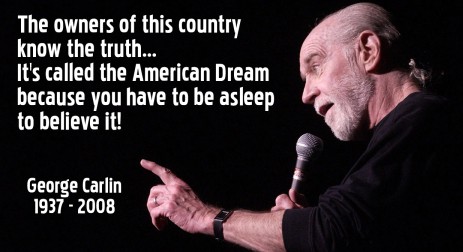
george-carlin-american-dream

By Dustin Meyer

Source: The Evolutionary Mind

To say the American Dream is Dead couldn’t be more true. The American people as a whole are ignorant. They grow up believing that there is a perfect lifestyle in which they will get once they get older and “pay their dues”. Unfortunately this is very far from wrong, the system is corrupt and is against anyone who thinks this way. Simply put, there is no American dream.

What is it? The American Dream, at least as I knew it was where you would live an ideal life, work a 9-5 job, have a house with a white picket fence, a yard, car, and a dog. More in a modern sense, it is getting rich and famous, owning a huge house, fancy car, having all the fanciest clothes and things. This is why it had been dying but not why it is dead. People are greedy, they want more and more, and forget to appreciate the simple life they have. Some people don’t even have their lives anymore, and yet so many people take theirs for granted.

Pop culture can be given much of the credit due to the skewing of the American dream. Since the people are influenced by anything and everything, they will believe any message conveyed to them. Music and film are the main mediums where this is, but a huge culprit is the news and daytime television. Also, unfortunately people are losing their individualism, which is leading to them falling more into this hole in which you cannot escape, you just aren’t you anymore once you’ve given in.

But a big question is why do I say it is dead? Well, the system in general is against us. The gap between rich and poor is expanding exponentially each and every day. The odds are not in the average person’s favor. People are working until they are 60+ years old and barely being able to retire, and with that work, most aren’t in executive type jobs. For the small business owner, you have huge corporations that are destroying your chances to even provide for your family. So why is it dead? Opening you eyes will show you.

People have to stand up, to realize that something is wrong. With this upcoming election (being quite possibly the worst election/selection of candidates’ ever.) we have to fight for the people. No matter who is in office no one will ever fight for you, unless you do. The people are for the people, we have a choice to change. The change must happen!

Why Americans Must Demolish the Political Duopoly and Create a New Progressive Alliance

the-evil-and-corrupt-duopoly

By Thomas Baldwin

Source: Dandelion Salad

A Call to Action!

“Insanity is doing the same thing over and over again and expecting different results.”– Albert Einstein

Duopoly: “preponderant influence or control by two political powers.”

Demolish: “to destroy by breaking apart; to put an end to.”

Corporate fascism (or Corporatism): “the complete merger of corporate and state entities to create a political entity.”

The United States is experiencing a serious crisis and most Americans know it. Our government and the Washington establishment is disintegrating at near breath taking speed. It could well be the most serious situation in at least a hundred years. For years now several authors have described our government in Washington as being “broken” or “dysfunctional”. But these words seem inadequate any longer.

It is much more like a “living” entity which is dying and is in a critical state; all vital signs are poor. Crises are generated in Washington from incompetence and corruption. Little or nothing gets done; few if any serious problems are addressed. Everything is addressed as “partisan.” But that is a delusion because as I will mention later there is really only one party with two different factions serving the corporate fascists. When the two factions finally agree on something, then it is called “bipartisan” because the two political parties appear to be constantly fighting over power and money. What, if anything, is to be done about this evil charade?

Read the full article at  Dandelion Salad.

The Great Ponzi Scheme of the Global Economy

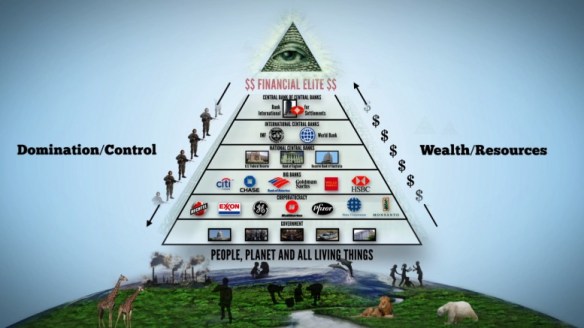
FollowTheMoney-Bank-Pyramid

By Michael Hudson and Chris Hedges

Source: CounterPunch

CHRIS HEDGES: We’re going to be discussing a great Ponzi scheme that not only defines not only the U.S. but the global economy, how we got there and where we’re going. And with me to discuss this issue is the economist Michael Hudson, author of Killing the Host: How Financial Parasites and Debt Destroy the Global Economy. A professor of economics who worked for many years on Wall Street, where you don’t succeed if you don’t grasp Marx’s dictum that capitalism is about exploitation. And he is also, I should mention, the godson of Leon Trotsky.

I want to open this discussion by reading a passage from your book, which I admire very much, which I think gets to the core of what you discuss. You write,

“Adam Smith long ago remarked that profits often are highest in nations going fastest to ruin. There are many ways to create economic suicide on a national level. The major way through history has been through indebting the economy. Debt always expands to reach a point where it cannot be paid by a large swathe of the economy. This is the point where austerity is imposed and ownership of wealth polarizes between the One Percent and the 99 Percent. Today is not the first time this has occurred in history. But it is the first time that running into debt has occurred deliberately.” Applauded. “As if most debtors can get rich by borrowing, not reduced to a condition of debt peonage.”

So let’s start with the classical economists, who certainly understood this. They were reacting of course to feudalism. And what happened to the study of economics so that it became gamed by ideologues?

HUDSON: The essence of classical economics was to reform industrial capitalism, to streamline it, and to free the European economies from the legacy of feudalism. The legacy of feudalism was landlords extracting land-rent, and living as a class that took income without producing anything. Also, banks that were not funding industry. The leading industrialists from James Watt, with his steam engine, to the railroads …

HEDGES: From your book you make the point that banks almost never funded industry.

HUDSON: That’s the point: They never have. By the time you got to Marx later in the 19th century, you had a discussion, largely in Germany, over how to make banks do something they did not do under feudalism. Right now we’re having the economic surplus being drained not by the landlords but also by banks and bondholders.

Adam Smith was very much against colonialism because that lead to wars, and wars led to public debt. He said the solution to prevent this financial class of bondholders burdening the economy by imposing more and more taxes on consumer goods every time they went to war was to finance wars on a pay-as-you-go basis. Instead of borrowing, you’d tax the people. Then, he thought, if everybody felt the burden of war in the form of paying taxes, they’d be against it. Well, it took all of the 19th century to fight for democracy and to extend the vote so that instead of landlords controlling Parliament and its law-making and tax system through the House of Lords, you’d extend the vote to labor, to women and everybody. The theory was that society as a whole would vote in its self-interest. It would vote for the 99 Percent, not for the One Percent.

By the time Marx wrote in the 1870s, he could see what was happening in Germany. German banks were trying to make money in conjunction with the government, by lending to heavy industry, largely to the military-industrial complex.

HEDGES: This was Bismarck’s kind of social – I don’t know what we’d call it. It was a form of capitalist socialism…

HUDSON: They called it State Capitalism. There was a long discussion by Engels, saying, wait a minute. We’re for Socialism. State Capitalism isn’t what we mean by socialism. There are two kinds of state-oriented–.

HEDGES: I’m going to interject that there was a kind of brilliance behind Bismarck’s policy because he created state pensions, he provided health benefits, and he directed banking toward industry, toward the industrialization of Germany which, as you point out, was very different in Britain and the United States.

HUDSON: German banking was so successful that by the time World War I broke out, there were discussions in English economic journals worrying that Germany and the Axis powers were going to win because their banks were more suited to fund industry. Without industry you can’t have really a military. But British banks only lent for foreign trade and for speculation. Their stock market was a hit-and-run operation. They wanted quick in-and-out profits, while German banks didn’t insist that their clients pay as much in dividends. German banks owned stocks as well as bonds, and there was much more of a mutual partnership.

That’s what most of the 19th century imagined was going to happen – that the world was on the way to socializing banking. And toward moving capitalism beyond the feudal level, getting rid of the landlord class, getting rid of the rent, getting rid of interest. It was going to be labor and capital, profits and wages, with profits being reinvested in more capital. You’d have an expansion of technology. By the early twentieth century most futurists imagined that we’d be living in a leisure economy by now.

HEDGES: Including Karl Marx.

HUDSON: That’s right. A ten-hour workweek. To Marx, socialism was to be an outgrowth of the reformed state of capitalism, as seemed likely at the time – if labor organized in its self-interest.

HEDGES: Isn’t what happened in large part because of the defeat of Germany in World War I? But also, because we took the understanding of economists like Adam Smith and maybe Keynes. I don’t know who you would blame for this, whether Ricardo or others, but we created a fictitious economic theory to praise a rentier or rent-derived, interest-derived capitalism that countered productive forces within the economy. Perhaps you can address that.

HUDSON: Here’s what happened. Marx traumatized classical economics by taking the concepts of Adam Smith and John Stuart Mill and others, and pushing them to their logical conclusion. Progressive capitalist advocates – Ricardian socialists such as John Stuart Mill – wanted to tax away the land or nationalize it. Marx wanted governments to take over heavy industry and build infrastructure to provide low-cost and ultimately free basic services. This was traumatizing the landlord class and the One Percent. And they fought back. They wanted to make everything part of “the market,” which functioned on credit supplied by them and paid rent to them.

None of the classical economists imagined how the feudal interests – these great vested interests that had all the land and money – actually would fight back and succeed. They thought that the future was going to belong to capital and labor. But by the late 19th century, certainly in America, people like John Bates Clark came out with a completely different theory, rejecting the classical economics of Adam Smith, the Physiocrats and John Stuart Mill.

HEDGES: Physiocrats are, you’ve tried to explain, the enlightened French economists.

HUDSON: The common denominator among all these classical economists was the distinction between earned income and unearned income. Unearned income was rent and interest. Earned incomes were wages and profits. But John Bates Clark came and said that there’s no such thing as unearned income. He said that the landlord actually earns his rent by taking the effort to provide a house and land to renters, while banks provide credit to earn their interest. Every kind of income is thus “earned,” and everybody earns their income. So everybody who accumulates wealth, by definition, according to his formulas, get rich by adding to what is now called Gross Domestic Product (GDP).

HEDGES: One of the points you make in Killing the Host which I liked was that in almost all cases, those who had the capacity to make money parasitically off interest and rent had either – if you go back to the origins – looted and seized the land by force, or inherited it.

HUDSON: That’s correct. In other words, their income is unearned. The result of this anti-classical revolution you had just before World War I was that today, almost all the economic growth in the last decade has gone to the One Percent. It’s gone to Wall Street, to real estate …

HEDGES: But you blame this on what you call Junk Economics.

HUDSON: Junk Economics is the anti-classical reaction.

HEDGES: Explain a little bit how, in essence, it’s a fictitious form of measuring the economy.

HUDSON: Well, some time ago I went to a bank, a block away from here – a Chase Manhattan bank – and I took out money from the teller. As I turned around and took a few steps, there were two pickpockets. One pushed me over and the other grabbed the money and ran out. The guard stood there and saw it. So I asked for the money back. I said, look, I was robbed in your bank, right inside. And they said, “Well, we don’t arm our guards because if they shot someone, the thief could sue us and we don’t want that.” They gave me an equivalent amount of money back.

Well, imagine if you count all this crime, all the money that’s taken, as an addition to GDP. Because now the crook has provided the service of not stabbing me. Or suppose somebody’s held up at an ATM machine and the robber says, “Your money or your life.” You say, “Okay, here’s my money.” The crook has given you the choice of your life. In a way that’s how the Gross National Product accounts are put up. It’s not so different from how Wall Street extracts money from the economy. Then also you have landlords extracting …

HEDGES: Let’s go back. They’re extracting money from the economy by debt peonage. By raising …

HUDSON: By not playing a productive role, basically.

HEDGES: Right. So it’s credit card interest, mortgage interest, car loans, student loans. That’s how they make their funds.

HUDSON: That’s right. Money is not a factor of production. But in order to have access to credit, in order to get money, in order to get an education, you have to pay the banks. At New York University here, for instance, they have Citibank. I think Citibank people were on the board of directors at NYU. You get the students, when they come here, to start at the local bank. And once you are in a bank and have monthly funds taken out of your account for electric utilities, or whatever, it’s very cumbersome to change.

So basically you have what the classical economists called the rentier class. The class that lives on economic rents. Landlords, monopolists charging more, and the banks. If you have a pharmaceutical company that raises the price of a drug from $12 a shot to $200 all of a sudden, their profits go up. Their increased price for the drug is counted in the national income accounts as if the economy is producing more. So all this presumed economic growth that has all been taken by the One Percent in the last ten years, and people say the economy is growing. But the economy isn’t growing …

HEDGES: Because it’s not reinvested.

HUDSON: That’s right. It’s not production, it’s not consumption. The wealth of the One Percent is obtained essentially by lending money to the 99 Percent and then charging interest on it, and recycling this interest at an exponentially growing rate.

HEDGES: And why is it important, as I think you point out in your book, that economic theory counts this rentier income as productive income? Explain why that’s important.

HUDSON: If you’re a rentier, you want to say that you earned your income by …

HEDGES: We’re talking about Goldman Sachs, by the way.

HUDSON: Yes, Goldman Sachs. The head of Goldman Sachs came out and said that Goldman Sachs workers are the most productive in the world. That’s why they’re paid what they are. The concept of productivity in America is income divided by labor. So if you’re Goldman Sachs and you pay yourself $20 million a year in salary and bonuses, you’re considered to have added $20 million to GDP, and that’s enormously productive. So we’re talking in a tautology. We’re talking with circular reasoning here.

So the issue is whether Goldman Sachs, Wall Street and predatory pharmaceutical firms, actually add “product” or whether they’re just exploiting other people. That’s why I used the word parasitism in my book’s title. People think of a parasite as simply taking money, taking blood out of a host or taking money out of the economy. But in nature it’s much more complicated. The parasite can’t simply come in and take something. First of all, it needs to numb the host. It has an enzyme so that the host doesn’t realize the parasite’s there. And then the parasites have another enzyme that takes over the host’s brain. It makes the host imagine that the parasite is part of its own body, actually part of itself and hence to be protected.

That’s basically what Wall Street has done. It depicts itself as part of the economy. Not as a wrapping around it, not as external to it, but actually the part that’s helping the body grow, and that actually is responsible for most of the growth. But in fact it’s the parasite that is taking over the growth.

The result is an inversion of classical economics. It turns Adam Smith upside down. It says what the classical economists said was unproductive – parasitism – actually is the real economy. And that the parasites are labor and industry that get in the way of what the parasite wants – which is to reproduce itself, not help the host, that is, labor and capital.

HEDGES: And then the classical economists like Adam Smith were quite clear that unless that rentier income, you know, the money made by things like hedge funds, was heavily taxed and put back into the economy, the economy would ultimately go into a kind of tailspin. And I think the example of that, which you point out in your book, is what’s happened in terms of large corporations with stock dividends and buybacks. And maybe you can explain that.

HUDSON: There’s an idea in superficial textbooks and the public media that if companies make a large profit, they make it by being productive. And with …

HEDGES: Which is still in textbooks, isn’t it?

HUDSON: Yes. And also that if a stock price goes up, you’re just capitalizing the profits – and the stock price reflects the productive role of the company. But that’s not what’s been happening in the last ten years. Just in the last two years, 92 percent of corporate profits in America have been spent either on buying back their own stock, or paid out as dividends to raise the price of the stock.

HEDGES: Explain why they do this.

HUDSON: About 15 years ago at Harvard, Professor Jensen said that the way to ensure that corporations are run most efficiently is to make the managers increase the price of the stock. So if you give the managers stock options, and you pay them not according to how much they’re producing or making the company bigger, or expanding production, but the price of the stock, then you’ll have the corporation run efficiently, financial style.

So the corporate managers find there are two ways that they can increase the price of the stock. The first thing is to cut back long-term investment, and use the money instead to buy back their own stock. But when you buy your own stock, that means you’re not putting the money into capital formation. You’re not building new factories. You’re not hiring more labor. You can actually increase the stock price by firing labor.

HEDGES: That strategy only works temporarily.

HUDSON: Temporarily. By using the income from past investments just to buy back stock, fire the labor force if you can, and work it more intensively. Pay it out as dividends. That basically is the corporate raider’s model. You use the money to pay off the junk bond holders at high interest. And of course, this gets the company in trouble after a while, because there is no new investment.

So markets shrink. You then go to the labor unions and say, gee, this company’s near bankruptcy, and we don’t want to have to fire you. The way that you can keep your job is if we downgrade your pensions. Instead of giving you what we promised, the defined benefit pension, we’ll turn it into a defined contribution plan. You know what you pay every month, but you don’t know what’s going to come out. Or, you wipe out the pension fund, push it on to the government’s Pension Benefit Guarantee Corporation, and use the money that you were going to pay for pensions to pay stock dividends. By then the whole economy is turning down. It’s hollowed out. It shrinks and collapses. But by that time the managers will have left the company. They will have taken their bonuses and salaries and run.

HEDGES: I want to read this quote from your book, written by David Harvey, in A Brief History of Neoliberalism, and have you comment on it.

“The main substantive achievement of neoliberalism has been to redistribute rather than to generate wealth and income. [By] ‘accumulation by dispossession’ I mean … the commodification and privatization of land, and the forceful expulsion of peasant populations; conversion of various forms of property rights (common collective state, etc.) into exclusive private property rights; suppression of rights to the commons; … colonial, neocolonial, and the imperial processes of appropriation of assets (including natural resources); … and usury, the national debt and, most devastating at all, the use of the credit system as a radical means of accumulation by dispossession. … To this list of mechanisms, we may now add a raft of techniques such as the extraction of rents from patents, and intellectual property rights (such as the diminution or erasure of various forms of common property rights, such as state pensions, paid vacations, and access to education, health care) one through a generation or more of class struggle. The proposal to privatize all state pension rights, pioneered in Chile under the dictatorship is, for example, one of the cherished objectives of the Republicans in the US.”

This explains the denouement. The final end result you speak about in your book is, in essence, allowing what you call the rentier or the speculative class to cannibalize the entire society until it collapses.

HUDSON: A property right is not a factor of production. Look at what happened in Chicago, the city where I grew up. Chicago didn’t want to raise taxes on real estate, especially on its expensive commercial real estate. So its budget ran a deficit. They needed money to pay the bondholders, so they sold off the parking rights to have meters – you know, along the curbs. The result is that they sold to Goldman Sachs 75 years of the right to put up parking meters. So now the cost of living and doing business in Chicago is raised by having to pay the parking meters. If Chicago is going to have a parade and block off traffic, it has to pay Goldman Sachs what the firm would have made if the streets wouldn’t have been closed off for a parade. All of a sudden it’s much more expensive to live in Chicago because of this.

But this added expense of having to pay parking rights to Goldman Sachs – to pay out interest to its bondholders – is counted as an increase in GDP, because you’ve created more product simply by charging more. If you sell off a road, a government or local road, and you put up a toll booth and make it into a toll road, all of a sudden GDP goes up.

If you go to war abroad, and you spend more money on the military-industrial complex, all this is counted as increased production. None of this is really part of the production system of the capital and labor building more factories and producing more things that people need to live and do business. All of this is overhead. But there’s no distinction between wealth and overhead.

Failing to draw that distinction means that the host doesn’t realize that there is a parasite there. The host economy, the industrial economy, doesn’t realize what the industrialists realized in the 19th century: If you want to be an efficient economy and be low-priced and under-sell competitors, you have to cut your prices by having the public sector provide roads freely. Medical care freely. Education freely.

If you charge for all of these, you get to the point that the U.S. economy is in today. What if American factory workers were to get all of their consumer goods for nothing. All their food, transportation, clothing, furniture, everything for nothing. They still couldn’t compete with Asians or other producers, because they have to pay up to 43% of their income for rent or mortgage interest, 10% or more of their income for student loans, credit card debt. 15% of their paycheck is automatic withholding to pay Social Security, to cut taxes on the rich or to pay for medical care.

So Americans built into the economy all this overhead. There’s no distinction between growth and overhead. It’s all made America so high-priced that we’re priced out of the market, regardless of what trade policy we have.

HEDGES: We should add that under this predatory form of economics, you game the system. So you privatize pension funds, you force them into the stock market, an overinflated stock market. But because of the way companies go public, it’s the hedge fund managers who profit. And it’s those citizens whose retirement savings are tied to the stock market who lose. Maybe we can just conclude by talking about how the system is fixed, not only in terms of burdening the citizen with debt peonage, but by forcing them into the market to fleece them again.

HUDSON: Well, we talk about an innovation economy as if that makes money. Suppose you have an innovation and a company goes public. They go to Goldman Sachs and other Wall Street investment banks to underwrite the stock to issue it at $40 a share. What’s considered a successful float is when, immediately, Goldman and the others will go to their insiders and tell them to buy this stock and make a quick killing. A “successful” flotation doubles the price in one day, so that at the end of the day the stock’s selling for $80.

HEDGES: They have the option to buy it before anyone else, knowing that by the end of the day it’ll be inflated, and then they sell it off.

HUDSON: That’s exactly right.

HEDGES: So the pension funds come in and buy it at an inflated price, and then it goes back down.

HUDSON: It may go back down, or it may be that the company just was shortchanged from the very beginning. The important thing is that the Wall Street underwriting firm, and the speculators it rounds up, get more in a single day than all the years it took to put the company together. The company gets $40. And the banks and their crony speculators also get $40.

So basically you have the financial sector ending up with much more of the gains. The name of the game if you’re on Wall Street isn’t profits. It’s capital gains. And that’s something that wasn’t even part of classical economics. They didn’t anticipate that the price of assets would go up for any other reason than earning more money and capitalizing on income. But what you have had in the last 50 years – really since World War II – has been asset-price inflation. Most middle-class families have gotten the wealth that they’ve got since 1945 not really by saving what they’ve earned by working, but by the price of their house going up. They’ve benefited by the price of the house. And they think that that’s made them rich and the whole economy rich.

The reason the price of housing has gone up is that a house is worth whatever a bank is going to lend against it. If banks made easier and easier credit, lower down payments, then you’re going to have a financial bubble. And now, you have real estate having gone up as high as it can. I don’t think it can take more than 43% of somebody’s income to buy it. But now, imagine if you’re joining the labor force. You’re not going to be able to buy a house at today’s prices, putting down a little bit of your money, and then somehow end up getting rich just on the house investment. All of this money you pay the bank is now going to be subtracted from the amount of money that you have available to spend on goods and services.

So we’ve turned the post-war economy that made America prosperous and rich inside out. Somehow most people believed they could get rich by going into debt to borrow assets that were going to rise in price. But you can’t get rich, ultimately, by going into debt. In the end the creditors always win. That’s why every society since Sumer and Babylonia have had to either cancel the debts, or you come to a society like Rome that didn’t cancel the debts, and then you have a dark age. Everything collapses.


Michael Hudson’s new book, Killing the Host is published in e-format by CounterPunch Books and in print by Islet. He can be reached via his website, mh@michael-hudson.com. Chris Hedges’s latest book is Days of Destruction, Days of Revolt, illustrated by Joe Sacco.

The Rise of the Corporatocracy

‘Stop Drinking the Kool-Aid, America: Political Fiction in an Age of Televised Lies’

20120527040549-stop-drinking-kool-aid

By John W. Whitehead

Source: A Government of Wolves

“We’ve got to face it. Politics have entered a new stage, the television stage. Instead of long-winded public debates, the people want capsule slogans—‘Time for a change’—‘The mess in Washington’—‘More bang for a buck’—punch lines and glamour.”— A Face in the Crowd (1957)

Politics is entertainment.

It is a heavily scripted, tightly choreographed, star-studded, ratings-driven, mass-marketed, costly exercise in how to sell a product—in this case, a presidential candidate—to dazzled consumers who will choose image over substance almost every time.

This year’s presidential election, much like every other election in recent years, is what historian Daniel Boorstin referred to as a “pseudo-event”: manufactured, contrived, confected and devoid of any intrinsic value save the value of being advertised. It is the end result of a culture that is moving away from substance toward sensationalism in an era of mass media.

As author Noam Chomsky rightly observed, “It is important to bear in mind that political campaigns are designed by the same people who sell toothpaste and cars.” In other words, we’re being sold a carefully crafted product by a monied elite who are masters in the art of making the public believe that they need exactly what is being sold to them, whether it’s the latest high-tech gadget, the hottest toy, or the most charismatic politician.

Tune into a political convention and you will find yourself being sucked into an alternate reality so glossy, star-studded, emotionally charged and entertaining as to make you forget that you live in a police state. The elaborate stage show, the costumes, the actors, the screenplay, the lighting, the music, the drama: all carefully calibrated to appeal to the public’s need for bread and circuses, diversion and entertainment, and pomp and circumstance.

Politics is a reality show, America’s favorite form of entertainment, dominated by money and profit, imagery and spin, hype and personality and guaranteed to ensure that nothing in the way of real truth reaches the populace.

After all, who cares about police shootings, drone killings, SWAT team raids, asset forfeiture schemes, private prisons, school-to-prison pipelines, overcriminalization, censorship or any of the other evils that plague our nation when you can listen to the croonings of Paul Simon, laugh along with Sarah Silverman, and get misty-eyed over the First Lady’s vision of progress in America.

But make no mistake: Americans only think they’re choosing the next president.

In truth, however, they’re engaging in the illusion of participation culminating in the reassurance ritual of voting. It’s just another Blue Pill, a manufactured reality conjured up by the matrix in order to keep the populace compliant and convinced that their vote counts and that they still have some influence over the political process.

Stop drinking the Kool-Aid, America.

The nation is drowning in debt, crippled by a slowing economy, overrun by militarized police, swarming with surveillance, besieged by endless wars and a military industrial complex intent on starting new ones, and riddled with corrupt politicians at every level of government. All the while, we’re arguing over which corporate puppet will be given the honor of stealing our money, invading our privacy, abusing our trust, undermining our freedoms, and shackling us with debt and misery for years to come.

Nothing taking place on Election Day will alleviate the suffering of the American people.

The government as we have come to know it—corrupt, bloated and controlled by big-money corporations, lobbyists and special interest groups—will remain unchanged. And “we the people”—overtaxed, overpoliced, overburdened by big government, underrepresented by those who should speak for us and blissfully ignorant of the prison walls closing in on us—will continue to trudge along a path of misery.

With roughly 22 lobbyists per Congressman, corporate greed will continue to call the shots in the nation’s capital, while our elected representatives will grow richer and the people poorer. And elections will continue to be driven by war chests and corporate benefactors rather than such values as honesty, integrity and public service. Just consider: it’s estimated that more than $5 billion will be spent on the elections this year, yet not a dime of that money will actually help the average American in their day-to-day struggles to just get by.

And the military industrial complex will continue to bleed us dry. Since 2001 Americans have spent $10.5 million every hour for numerous foreign military occupations, including in Iraq and Afghanistan. There’s also the $2.2 million spent every hour on maintaining the United States’ nuclear stockpile, and the $35,000 spent every hour to produce and maintain our collection of Tomahawk missiles. And then there’s the money the government exports to other countries to support their arsenals, at the cost of $1.61 million every hour for the American taxpayers.

Then again, when faced with the grim, seemingly hopeless reality of the American police state, it’s understandable why Americans might opt for escapism. “Humankind cannot bear too much reality,” T. S. Eliot once said. Perhaps that is one reason we are so drawn to the unreality of the American political experience: it is spectacle and fiction and farce all rolled up into one glossy dose of escapism.

Frankly, escapism or not, Americans should be mad as hell.

Many of our politicians live like kings. Chauffeured around in limousines, flying in private jets and eating gourmet meals, all paid for by the American taxpayer, they are far removed from those they represent. Such a luxurious lifestyle makes it difficult to identify with the “little guy”—the roofers, plumbers and blue-collar workers who live from paycheck to paycheck and keep the country running with their hard-earned dollars and the sweat of their brows.

Conveniently, politicians only seem to remember their constituents in the months leading up to an election, and yet “we the people” continue to take the abuse, the neglect, the corruption and the lies. We make excuses for the shoddy treatment, we cover up for them when they cheat on us, and we keep hoping that if we just stick with them long enough, eventually they’ll treat us right.

People get the government they deserve.

No matter who wins the presidential election come November, it’s a sure bet that the losers will be the American people.

As political science professor Gene Sharp notes in starker terms, “Dictators are not in the business of allowing elections that could remove them from their thrones.” As I make clear in my book Battlefield America: The War on the American People, the Establishment—the shadow government and its corporate partners that really run the show, pull the strings and dictate the policies, no matter who occupies the Oval Office—are not going to allow anyone to take office who will unravel their power structures. Those who have attempted to do so in the past have been effectively put out of commission.

So what is the solution to this blatant display of imperial elitism disguising itself as a populist exercise in representative government?

Stop playing the game. Stop supporting the system. Stop defending the insanity. Just stop.

Washington thrives on money, so stop giving them your money. Stop throwing your hard-earned dollars away on politicians and Super PACs who view you as nothing more than a means to an end. There are countless worthy grassroots organizations and nonprofits working in your community to address real needs like injustice, poverty, homelessness, etc. Support them and you’ll see change you really can believe in in your own backyard.

Politicians depend on votes, so stop giving them your vote unless they have a proven track record of listening to their constituents, abiding by their wishes and working hard to earn and keep their trust.

Stop buying into the lie that your vote matters. Your vote doesn’t elect a president. Despite the fact that there are 218 million eligible voters in this country (only half of whom actually vote), it is the electoral college, made up of 538 individuals handpicked by the candidates’ respective parties, that actually selects the next president. The only thing you’re accomplishing by taking part in the “reassurance ritual” of voting is sustaining the illusion that we have a democratic republic. What we have is a dictatorship, or as political scientists Martin Gilens and Benjamin Page more accurately term it, we are suffering from an “economic élite domination.”

A healthy, representative government is hard work. It takes a citizenry that is informed about the issues, educated about how the government operates, and willing to make the sacrifices necessary to stay involved, whether that means forgoing Monday night football in order to attend a city council meeting or risking arrest by picketing in front of a politician’s office.

It takes a citizenry willing to do more than grouse and complain. We must act—and act responsibly—keeping in mind that the duties of citizenship extend beyond the act of voting.

Most of all, it takes a citizenry that cares enough to get mad and get active. As Howard Beale declares in the 1976 film Network:

“I want you to get up right now, sit up, go to your windows, open them and stick your head out and yell, ‘I’m as mad as hell and I’m not going to take this anymore.’ Things have got to change. But first, you’ve gotta get mad!…You’ve got to say, ‘I’m as mad as hell, and I’m not going to take this anymore!’ Then we’ll figure out what to do about the depression and the inflation and the oil crisis. But first get up out of your chairs, open the window, stick your head out, and yell, and say it.”