Not News But A Juicy Collection Of Narratives – How The New York Times Failed Its Readers

By Moon of Alabama

The New York Times star reporter Rukmini Callimachi had been widely criticized for her exaggerated reporting about the Islamic State and terrorism. But her editors kept supporting and promoting her stories. That finally ended when Canada recently indicted one Shehroze Chaudhry, also known as Abu Huzaifa, for falsely claiming to have been an ISIS member. Chaudhry had made up his blood dripping stories. He had never been with ISIS and had never been to Syria or Iraq.

But the unverified stories of Abu Huzaifa al-Kanadi had been the central element of the NYT’s ten part Caliphate podcast by Rukmini Callimachi.

The failure of her reporting finally was so evident that the NYT had to allow its media columnist Ben Smith to write about the issue. Remarkably his reporting was published in the Business section of the paper.

An Arrest in Canada Casts a Shadow on a New York Times Star, and The Times

It is a pretty devastating report about the support Callimachi got from her editors even as an ever growing number of her collogues criticized her over-sensationalized reporting. The root cause of the problem is the way in which the Times, as well as other news media, try to change from news providers to narrative creators:

The crisis now surrounding the podcast is as much about The Times as it is about Ms. Callimachi. She is, in many ways, the new model of a New York Times reporter. She combines the old school bravado of the parachuting, big foot reporter of the past, with a more modern savvy for surfing Twitter’s narrative waves and spotting the sorts of stories that will explode on the internet.

Ms. Callimachi’s approach and her stories won her the support of some of the most powerful figures at The Times: early on, from Joe Kahn, who was foreign editor when Ms. Callimachi arrived and is now managing editor and viewed internally as the likely successor to the executive editor, Dean Baquet; and later, an assistant managing editor, Sam Dolnick, who oversees the paper’s successful audio team and is a member of the family that controls The Times.

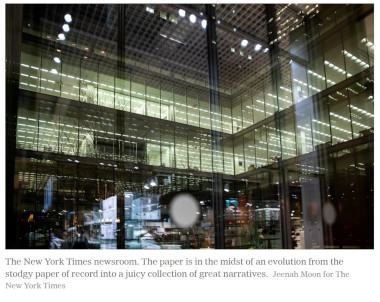
Ms. Callimachi’s approach to storytelling aligned with a more profound shift underway at The Times. The paper is in the midst of an evolution from the stodgy paper of record into a juicy collection of great narratives, on the web and streaming services. And Ms. Callimachi’s success has been due, in part, to her ability to turn distant conflicts in Africa and the Middle East into irresistibly accessible stories.

The highlighted sentence is the essence of the piece. It was even repeated in the caption of a picture accompanying it.
The striving for ‘juicy narratives’ is the biggest mistake of current news media. Their attempt to copy the success of Hollywood dramas by creating narratives has destroyed their credibility. It has put incentives on the wrong aspect of a reporter’s work. Instead of requiring well checked facts the editors are now asking for confirmations of preconceived tales:

What is clear is that The Times should have been alert to the possibility that, in its signature audio documentary, it was listening too hard for the story it wanted to hear — “rooting for the story,” as The Post’s Erik Wemple put it on Friday.

Callimachi is far from the only one guilty of creating fake news to fulfill her editors demand of narratives. The four year long coverage of ‘Russiagate’, the fairytale collection of made up connections between Donald Trump and Russia, was full of such. The editorial push towards narratives is rooted in the desire to create clickbait and to generate a social media echo around the reporting. That may be profitable in the short term but it is also a guarantee for a long term failure.

False of hyped narratives will over time get debunked. People then lose trust in the media that provided them with the fake news. That again will cause a long term loss of readership.

A similar case of falling for ‘narratives’ happened to German magazine Der Spiegel. Its star author Claas Relotius wrote fake stories on a large scale. Whether he wrote about Trump voters in Arizona or about a little girl in Syria, Relotius invented the witnesses to the ‘news’ he provided. He made up ‘facts’ and described himself visiting places he had never been to. For years there had been warnings that many of the detail Relotius provided were wrong. But his editors promoted him because the slick ‘narratives’ he delivered were exactly what they wanted. Der Spiegel, a once universally trusted source of news, is now joked about as ‘the former news magazine’.

The media trend towards providing narratives instead of verified facts also increases the danger of falling for manipulation. Governments as well as political marketing campaigns love to provide ready made tales. It is easier and cheaper for media to pick these up and repeat them instead of digging into the facts and their logic. We thus get false tales about chemical weapon use in Syria and a Skripal poisoning ‘narrative’ that does not stand up to the slightest scrutiny.

Can we please have real news? Just the new facts, with no ‘narrative’ or moral tales attached to them? Facts that are verified and described in the context of the issue they relate to? Do they fit the logic of already known ones? Do they make sense? How may they influence further developments?

To provide the above can easily fill a reporter’s day of work. It is usually enough material to write an 800 words report. Its sufficient for the reader to create his own narrative from it.

Dear news media. Please go back to providing real news. If you do so you will eventually regain my trust. That will be, in the long run, a much more valuable asset than the social media chatter you are currently trying to generate.
NYT Propaganda War on Syria

By Stephen Lendman

Source: StephenLendman.com

On major issues mattering most, especially geopolitical ones, the NYT is a lying machine, a propaganda machine, an anti-truth telling operation, a virtual state-sponsored ministry of deception, masquerading as real news, information and opinion.

Whenever the US wages preemptive wars of aggression on nonbelligerent states threatening no one, or in their run-up, the Times cheerleads high crimes of war and against humanity instead of denouncing them.

It consistently and repeatedly blames victims of US aggression for high crimes committed against them — Syria one of numerous examples of its abandonment of journalism the way it should be for disinformation, Big Lies and fake news.

The Times falsely accused Syrian forces of attacking hospitals numerous times, a Pentagon terror-bombing specialty it ignores.

An earlier report turned truth on its head, claiming Syrian President “Assad attacks medical facilities to break the will of the people — and to destroy evidence of his war crimes” — a bald-faced Big Lie.

The Times calls US aggression on Syria “civil war.” There’s nothing remotely “civil” about it. US-supported cutthroat killer jihadists are referred to as “rebels.”

Most of their fighters are imported from scores of foreign countries, including Western ones — armed, funded and directed by the US and its imperial partners.

In its latest edition, the Times reported on what it called “a journey through shattered Syria” — ignoring mass slaughter, vast destruction, and widespread human misery caused by US-led aggression, along with using ISIS and other terrorists as proxy foot soldiers.

What’s vital to report, the Times consistently suppresses, substituting managed new misinformation and disinformation instead.

Why Assad’s government granted permission to the Times lying machine to visit the war-torn country was unexplained.

In the Damascus countryside, “there were few young men,” it reported.

Most youths are likely involved in defending their country against US-led aggression and jihadists it supports — what the self-styled newspaper of record suppresses.

Instead it claimed they “died in the war, (were) thrown in prison or scattered far beyond Syria’s borders.”

Many indeed died at the hands of US-supported jihadists or Pentagon terror-bombing. Claiming they were thrown in prison is a bald-faced Big Lie, a Times specialty about the war and all others the US wages.

Three Times propagandists visited Syria to see the devastation firsthand. Saying “infrastructure needs rebuilding” failed to explain its destruction by Pentagon-led terror-bombing and attacks by US-supported jihadists.

The Times lied claiming Assad “presided over the destruction.” It complained about not getting permission “to roam freely,” expressed angst as well that most Syrians met and spoken to expressed support for Assad.

In June 2014, he was overwhelmingly reelected president with an 89% majority — independent international monitors calling the process open, free and fair.

The Times and other Western media falsely claimed otherwise. Syrians want no one else leading them. They’re clearly hostile to the US, other Western, and Israeli interests.

The Jewish state is responsible for terror-bombing the country hundreds of times by its own admission — on the phony pretext of combatting an Iranian threat that doesn’t exist.

Syria and its people are struggling for the country’s soul, victimized by US-led aggression.

War in its 9th year continues with no end of it in prospect because both extremist right wings of the US war party oppose restoration of peace and stability to the country.

Instead of reporting accurately on what’s gone on and continues endlessly, including illegal US occupation of northern and southern Syrian territory — the Times falsely blames Assad for US high crimes committed against the country and its people.

Why is the New York Times still trying to sweep the Epstein case under the rug?

By Patrick Martin

Source: WSWS.org

A prominent article published in the Washington Post Thursday exposes the systematic violation of prison rules governing the detention of multimillionaire sex trafficker Jeffrey Epstein during the period immediately preceding his death on August 10.

Reporter Devlin Barrett writes: “At least eight Bureau of Prisons staffers knew that strict instructions had been given not to leave multimillionaire sex offender Jeffrey Epstein alone in his cell, yet the order was apparently ignored in the 24 hours leading up to his death, according to people familiar with the matter.”

His report continues: “The fact that so many prison officials were aware of the directive—not just low-level correctional officers, but supervisors and managers—has alarmed investigators assessing what so far appears to be a stunning failure to follow instructions, these people said.”

This language is quite extraordinary, suggesting that Post reporters have reason to believe that the security failure has no legitimate explanation, and may have been the result of concerted action to leave Epstein exposed and vulnerable.

The report continues, “Investigators suspect that at least some of these individuals also knew Epstein had been left alone in a cell before he died, and they are working to determine the extent of such knowledge …”

In other words, numerous prison officials, including some in authority, were aware that Epstein—on suicide watch from July 23 to July 29—was alone in a cell, in violation of rules governing at-risk prisoners. (Other press accounts claim that his cellmate was granted bail on Friday, August 9, and released from custody, leaving Epstein by himself.)

Epstein was found dead in his cell the following morning, at 6:30 a.m. on Saturday, August 10. During that night, the two guards assigned to check in on him every 30 minutes did not do so. Both were said to have been asleep for some or all of that night, rather than standing watch.

The two guards reportedly falsified the logs to show that they had checked on Epstein as required, but these logs were contradicted by video evidence from a surveillance camera monitoring the hallway outside his cell.

Investigators from the FBI and the inspector-general of the Department of Justice have taken possession of the videotapes, but have released no information about what they show, including whether there were any unauthorized visitors to Epstein’s cell the night he died.

The Post report suggests misconduct on a scale so staggering that it leaves little doubt that Epstein was either murdered or allowed to commit suicide, with the former far more likely. It defies belief that so many Bureau of Prisons employees, including managers and supervisors, could have each independently decided to ignore the rules for handling the most notorious prisoner then in federal custody.

Epstein had been arrested July 6 at Teterboro Airport in New Jersey, and was being held on sex-trafficking charges that carried a possible sentence of 45 years in prison. The nature of the charges, combined with his vast wealth and his connections in high places—including to Donald Trump, Bill Clinton, Prince Andrew of England, and Saudi Crown Prince Mohammed bin Salman—ensured maximum television and tabloid publicity for the case.

Many powerful people feared exposure if Epstein were brought to trial, and there is ample evidence that he was preparing an aggressive and highly publicized defense rather than attempting a plea bargain that would have swept the case under the rug. Epstein was meeting with his lawyers for as many as 12 hours a day, and they have described his demeanor as anything but downcast or suicidal. (Epstein denied that he had attempted suicide July 23, claiming he was the victim of an assault by a cellmate).

Under these circumstances, the real question is why the bulk of the American media, spearheaded by the New York Times, has chosen to swallow the claim of “suicide” and denounced any questioning of the official verdict as a “conspiracy theory.” Epstein was killed in downtown Manhattan, only a few miles from Times Square. But most of the reports exposing new evidence in the case have come in the pages of the Washington Post, while the Times has published lengthy reports—such as a front-page account in its edition of Sunday, August 19—which could be summed up as “nothing to see here, move along please.”

It is worth recalling that when Epstein was first arrested, the Times editorialized against making a political issue out of his kid-glove treatment during his first sex-crimes prosecution in 2008. The editorial urged congressional Democrats to stay away from Epstein, although the US Attorney who had recommended a token 13-month sentence in 2008—with six days out of seven on work-release to run his financial empire—was Alex Acosta, chosen by Trump as his secretary of labor.

While the Times warned Democrats that they would be making a martyr of Acosta by examining his conduct in the Epstein case, Acosta was actually forced to resign only a week after the publication of the editorial. Far from fearing that targeting Acosta was too ambitious, the Times editorial board seems rather to have feared that Epstein, followed by Acosta, would become the first two dominoes in a chain that would implicate others perhaps too close for comfort.


Related Articles:

Why is the media dismissing questions about Jeffrey Epstein’s death as “conspiracy theories”?
[13 August 2019]

The case of Jeffrey Epstein and the depravity of America’s financial elite
[13 July 2019]

Did the NY Times Violate Its Own Code of Ethics to Feature Child of Venezuelan Coup Plotter?

After the New York Times was slammed for obscuring comedian Joanna Hausmann’s family ties to the Guaido shadow regime, her coup-plotting father appeared online to defend her with a stream of insults.

By Anya Parampil

Source: The Grayzone

When the New York Times approached me seeking permission to use video I recorded of the Washington DC “Hands Off Venezuela” protest on March 16, I hoped that somebody at the paper was seeking to atone for the Gray Lady’s demonstrably one-sided coverage of the US coup attempt against the internationally recognized Maduro government. Maybe, just maybe, the editors had had a rare bout of self-reflection and decided to produce something that gave voice to the many Americans who rejected the Trump administration’s brazen regime change operation against Venezuela.

But on April 1, I woke up to learn that my footage had been used to demonize the protesters as useful idiots by a YouTube comedian born to one of the family dynasties of Venezuela’s opposition.

The comedian in question was Joanna Hausmann, and her appearance in the supposed newspaper of record was far from funny. How could the paper justify selecting Hausmann as an authoritative voice on the situation in Venezuela when she was so closely connected to central players in the Trump administration’s coup attempt? The answer is that it couldn’t, so it simply neglected to mention her glaring conflict of interest.

I took a deep dive into Hausmann’s family history in a March 10th article for MintPress, highlighting the role Joanna’s father, Ricardo Hausmann, played in the neoliberalization of Venezuela’s economy throughout the 1980s and ’90s as an academic and eventual member of the repressive Carlos Andrés Pérez administration.

The piece was inspired by Joanna Hausmann’s Youtube harangue, “What’s Happening in Venezuela.” Despite promising “a video dedicated to ‘just the facts,’” Hausmann failed to mention that her father was serving as a top advisor to Venezuelan opposition leader Juan Guaidó while she argued in support of his self-declared “presidency.”

Ricardo Hausmann’s function within the coup government crystalized shortly following the release of Joanna’s Youtube explainer, when Guaidó selected the Harvard professor to represent his shadow regime at the Inter-American Development Bank. The Times took no issue with the fact Hausmann’s family stood to benefit from the same coup she was urging viewers to support, and like Joanna herself, neglected to disclose this ostensibly relevant information.

The Times appeared to have underestimated the intelligence of its viewers, and was subsequently bombarded with criticism for its decision to obscure Hausmann’s background.

One reader who described himself as “a Venezuelan, [who agrees] with everything [Hausmann] has to say,” complained in the comments section of the Hausmann video that the omission amounted to “an ethical error,” arguing “it should be noted that her father has a lot to gain politically and professionally should regime change happen.” The comment forced a response from the segment’s executive producer, Adam Ellick, who claimed that, while the Times was “aware of her father’s biography before publication,” it opted not to acknowledge it because “Ms. Hausmann is an independent adult woman who has built a popular following on her own.”

Ellick’s response failed to satisfy the commenter, who emphasized that “the issue here isn’t one of independence, it’s one of shared outcomes.” According to Ellick’s logic, it would be journalistically ethical to ignore Ivanka Trump’s relation to the President on the basis she is “an independent adult woman” with a fashion line of her own. Does the Times actually think we are stupid?

The backlash against Joanna’s NYT debut grew so intense, it eventually compelled her father to respond to the controversy. Following the video’s release, I tweeted criticism of the paper for its failure to disclose that “Hausmann is the daughter of Guaidó advisor Ricardo Hausmann,” linking to my article which explained that he “was instrumental in neoliberalizing and destroying Venezuela’s economy in the 90s and wants to do it again.”

The factual statement apparently outraged Professor Hausmann, who charged that my “tweet surely deserves at least an honorary mention among the year’s most sexist comments,” adding, “since Joanna is my daughter, she is not entitled to her own opinion. She must be speaking on behalf of some male figure that tells her what to say. Seriously?”

Yes, seriously! Joanna does not appear to have her “own opinion” — she has precisely the same opinion as her father, who happens to be participating in the very coup for which she was advocating. Yet even if we accept the notion that Joanna formed opinions independent from her father’s influence, the Times still had an ethical obligation to disclose her family ties – especially considering that Professor Hausmann is not her only relative actively working to achieve regime change in Caracas.

Joanna’s mother, Ana Julia Jatar, has worked for the US-funded Súmate organization, which in 2004 tried and failed to oust President Hugo Chávez via popular referendum. As I reported for MintPress, Jatar hails from a political family herself.

Jatar’s father, Braulio Jatar Dotti, was once described by an independent Chilean news site “as having been ‘in charge of eliminating the leftist groups’ in Venezuela” in the 1960s, as the government sought to violently repress the armed Revolutionary Left Movement. Jatar Dotti even published a manual called, “Disabling the Extreme Left” in 1963. With her grandfather’s history in mind, it’s no wonder that Joanna now spends her time attacking the US left for organizing to oppose war on Venezuela. Apparently, the family that attacks the left and fails to overthrow governments together stays together.

While it is important to understand the full extent to which regime change and resentment of “the left” runs through Joanna Hausmann’s veins, her father’s participation in the current coup alone should have disqualified her to pose as a neutral voice on Venezuela. The Times’ decision to ignore her background is not only offensive to viewers, but may have also violated the paper’s own ethics code. According to that code, “staff members must be sensitive that perfectly proper political activity by their spouses, family or companions may nevertheless create conflicts of interest or the appearance of conflict.” The Hausmann scandal undeniably created such a scenario for the paper.

Joanna has largely kept quiet amid the deluge of criticism, and is quick to block those who question her. (She blocked me on Twitter after I noted her father’s prominent role in the Guaidó shadow regime.) Why a grown woman professing her total independence needed her father to come to her defense should be a mystery, as RT Español reporter Helena Villar observed.

One Twitter user named Vanessa Salas, who describes herself as “a personal friend” of Joanna, recommended that I “get to know” the comedian before making “unfounded statements.” Salas insistedthat her pal was “SMART, THOUGHTFUL, and FEARLESS.” Indeed, Joanna Hausmann was so fearless that she had to rely on her friends, family, and an army of trolls to deflect from her wanton journalistic malpractice.

Joanna did eventually muster up one non-answer to critics. When a Twitter user named @unnaband asked why she neglected to mention that her “father was personally appointed by the very opposition leader” she promoted in her video, the Youtube comedian hit back: “I am proud of my dad.”

He is surely proud of her too. And among the Times editors who presided over her ethically dubious video rant, there appears to be no shame.


Related Video:

NYT: Don’t Be Progressive, Be a ‘Liberal’

By Jim Naureckas

Source: FAIR

A New York Times op-ed by political scientist (and former Bob Kerrey aide) Greg Weiner (7/13/18) may well be the New York Times–iest op-ed ever.

Its ostensible subject is why Democrats should call themselves “liberals” and not “progressives.” But in making that case, it hits most of the main points of the New York Times‘ ideology—one that has guided the paper since the late 19th century.

First and foremost, it’s a defense of the status quo. “The basic premise of liberal politics,” Weiner writes, “is the capacity of government to do good, especially in ameliorating economic ills.” But not too much good, mind you:  “A liberal can believe that government can do more good or less,” he stresses. Weiner draws a contrast with progressives: “Where liberalism seeks to ameliorate economic ills, progressivism’s goal is to eradicate them.”

So Lyndon Johnson’s Great Society is cited negatively as an example of “a progressive effort to remake society by eradicating poverty’s causes”—in the process supporting  “community action” and  financing the “political activism”—presented without explanation as a self-evident evil.  The explanation, presumably, is that the poor should remain passive as they remain poor, gratefully accepting the handouts that “alleviate” their plight, as “cutting checks,” as Weiner puts it, is “something government does competently.”

Coupled with this anxiety about “eradicating poverty’s causes” is the confident assurance that the truth is always somewhere in the middle. “Unlike liberalism, progressivism is intrinsically opposed to conservation,” Weiner warns:

Nothing structurally impedes compromise between conservatives, who hold that the accumulated wisdom of tradition is a better guide than the hypercharged rationality of the present, and liberals, because both philosophies exist on a spectrum.

Conservatives make better partners for liberals than progressives, because “one can debate how much to conserve.” But you can’t debate how much to progress, apparently: “Progressivism is inherently hostile to moderation because progress is an unmitigated good.”

In other words: Equality and justice, sure, but let’s not rush into things, is the “liberal’s” advice. He endorses “policies [that] develop gradually and command wide consensus—at least under normal circumstances.” (Progressives have an unnerving desire to “depress the accelerator.”)

Something that doesn’t change is the right wing of the left’s attraction to redbaiting. Weiner praises “the Cold War liberal who stood for social amelioration and against Soviet Communism,” a figure who “was often maligned by progressives.” Without coming out and accusing progressives of Stalinism, he describes progressives’ response to critics as “a passive-aggressive form of re-education,” one that “supersedes the rights of its opponents.” The example he gives of this is the “progressive indifference to the rights of those who oppose progressive policies in areas like sexual liberation”—an odd arena to cite, since the main “rights” that opponents of “sexual liberation” have demanded in recent years are the “right” of small businesses to discriminate against gay customers and the “right” to check the chromosome status of people who use public restrooms.


You can send a message to the New York Times at letters@nytimes.com  (Twitter:@NYTimes). Please remember that respectful communication is the most effective.

Mainstream Media: The Evil Empire

By Anthony Freda

Source: Medium

As it becomes increasingly clear that yesterday’s conspiracy theories are today’s real news, the call to kill the messengers just gets more shrill and hysterical.

The attacks on free speech with high-tech censorship campaigns and old-fashioned hit pieces in the “War on Fake News” are massive and concerted.

The book burners are starting so many fires it’s impossible to stamp them all out.

What are the horrible thought crimes committed by the alternative press?

The new media has consistently exposed the lies and crimes of our corrupt and broken institutions.

Pioneers of alt media have passionately and convincingly made the case that The Patriot Act literally reversed the gains to human liberty codified in The Bill of Rights.

Independent media dismantled the lies that were presented as the pretexts to the invasion of Iraq. The same lies aggressively promoted by Bush, Hillary Clinton, CNN and The New York Times and that resulted in the death of a million people and global chaos. By contrast, how many people have died as a result of alternative media reports? The answer is zero.

The independent press interviewed NSA whistle-blowers who accurately described how the U.S. government was illegally spying on its citizens and retaining our data, and how these whistle-blowers were being persecuted by their own government for coming forward and refusing to break the law.

This was years before anyone heard of Edward Snowden.

Amazingly, there was very little interest in these bombshell allegations in the mainstream press.

It’s hard to believe now, but in those days, people who claimed the government was spying on innocent citizens were dismissed as paranoid by the self-proclaimed arbiters of truth at the NYT and CNN.

Grassroots media detailed a decade ago how police forces all over America were becoming militarized and predicted that this dangerous trend would lead to racially charged conflict on the streets of the nation. What kooks!

We have also railed against; torture, needless wars, police brutality, government corruption, the two-party duopoly, the criminality of the banksters and the end of privacy.

Now the very same mainstream media hacks who promoted the lies that lead to war in Iraq and Libya and mindlessly regurgitate whichever talking point is uploaded onto their teleprompter are gleefully assassinating what they call “fake news” using edited tape and misleading hit-pieces.

While these discredited war cheerleaders lie about why our sons and daughters are sent to die, we are bravely exposing the fraudulent casus belli they traitorously and disgracefully promote.

While these corporate spokespeople work for the interests of the oil and drug companies and political forces that pay their salaries, we risk everything to expose the crimes and scams of these same broken institutions.

We have done a great public service by exposing the deceptive, psychological methods used by the ruling elite to warp historical narratives, manipulate patriotism and manufacture consent.

By helping people to recognize and suspend their belief in propaganda and therefore their own complicity in it, the alternative media is helping to create a public awareness to the tactics our enemies use to keep us divided, steal our rights and slaughter countless innocents all over the world.

I know it’s fun and easy to call us tin-foil-hat wearers, or whatever pejorative has been chosen for you today, but let’s be clear about whose dirty work some are doing. Ironically, many are using talking-points written by deep-state operatives to ridicule the idea that the deep-state exists at all!!

Alternative media is in direct competition with the mainstream media for revenue and the MSM want to control the information we are exposed to.

The MSM is waging a concerted demonization campaign aimed at destroying some of the dominant platforms exposing the lies and crimes of their corporate and deep-state masters and many are helping them do it.

The MSM is an enemy of the truth and of the people. Friends of mine have been accused of being Russian agents in The NYT because they simply told the truth about Clinton during the campaign.

The corporate press has gone from lying to the American people to lying about the American people.

Do we have the will and power to destroy our common enemy?

The U.S. Deep State Rules – On Behalf of the Ruling Class

By Glen Ford

Source: Black Agenda Report

“The U.S. Deep State is unlike any other, in that there is no other global superpower bent on world domination.”

The Deep State is busy denying that it exists, even as it savages a sitting president and brutally bitch-slaps its host society, demanding the nation embrace its role as global psycho thug and kick some Russian ass. The New York Times, always available to divert attention from the essential facts of who rules America, points to Egypt, Turkey and Pakistan as the natural habitats of Deep States. Apparently, Deep State-infected countries tend to be nations with majority Muslim populations, whose military-intelligence apparatus hovers over society and periodically seizes control of the civil government.

The Times quoted high-ranking operatives of the Deep State to prove that such structures are alien to the U.S. Michael V. Hayden, who ran the CIA under Democratic President Obama and Republican George Bush, recoiled at the term. He “would never use” the words Deep State in connection with his own country. “That’s a phrase we’ve used for Turkey and other countries like that, but not the American republic.”

Loren DeJonge Schulman, a former Obama National Security Council official, claimed to be repelled by the very idea of an American Deep State. “A deep state, when you’re talking about Turkey or Egypt or other countries, that’s part of government or people outside of government that are literally controlling the direction of the country no matter who’s actually in charge, and probably engaging in murder and other corrupt practices,” she said.

Apparently, Ms. Schulman did not consider it murder when Obama and his top national security advisors met every Tuesday at the White House to decide who would be assassinated by drone or other means. But she is “shocked” to hear “that kind of [Deep State-phobic] thinking from” President Trump “or the people closest to him.”

Once the Times had located the nexus of Deep Statism in the Muslim world, the lesser lights at The New Yorker endorsed the corporate media consensus that the U.S. is Deep State-free. Staff writer David Remnick admits that U.S. presidents “have felt resistance, or worse, from elements in the federal bureaucracies,” citing Eisenhower’s warnings against the military-industrial complex, Lyndon Johnson’s “pressure from the Pentagon,” and the “rebuke” of Obama’s Syria policy through the State Department’s “dissent channel.” However, he denies that any “subterranean web of common and nefarious purpose” threatens the orderly and transparent processes of the U.S. political system.

In reality, the U.S. Deep State is by far the world’s biggest and most dangerous version of the phenomenon; a monstrous and not-so subterranean “web of common and nefarious purpose” that is, by definition, truly global, since its goal is to rule the planet. Indeed, the Deep States of Turkey, Egypt and Pakistan — all nominal U.S. allies – are midgets in comparison and must operate in a global environment dominated by Washington’s Deep State apparatus. So vast is the imperial Deep State, that its counterparts in other nations exist largely to collaborate with, resist, or keep tabs on the U.S. behemoth, the predator that seeks to devour all the rest.

What is a Deep State? The U.S. Deep State is unlike any other, in that there is no other global superpower bent on world domination. (Washington’s political posture is also unique; no other nation claims to be “exceptional” and “indispensable” and thus not subject to the constraints of international law and custom.) Indeed, the U.S. is so proudly and publicly imperialist that much of what should be secret information about U.S. military and other capabilities is routinely fed to the world press, such as the 2011 announcement that the U.S. now has a missile that can hit any target on the planet in 30 minutes, part of the Army’s “Prompt Global Strike” program. Frightening the rest of the world into submission — a form of global terrorism — is U.S. public policy.

However, arming and training Islamic jihadist terrorists to subvert internationally recognized governments targeted by the U.S. for regime change is more than your usual variety of covert warfare: It is a policy that must forever be kept secret, because U.S. society would suffer a political breakdown if the facts of U.S. and Saudi nurturing of the international jihadist network were ever fully exposed. This is Deep State stuff of the highest order. The true nature of U.S. foreign policy in the 21st century, and the real character of the current wars in Syria and Iraq, must be hidden from the U.S. public at all cost. An alternative reality must be presented, through daily collaboration between corporate media, corporate universities, and the public and covert organs of the U.S. State.

What part of the New York Times coverage of the war against Syria is a lie? Damn near all of it. What role does the Deep State play in crafting the lies dutifully promulgated by the corporate media? That’s impossible to answer, because the Deep State is a network of relationships, not a clearly delineated zone or space or set of organizations. The best way to describe the imperial Deep State is: those individuals and institutions that are tasked with establishing the global supremacy of the corporate ruling class. Such activities must be masked, since they clash with the ideological position of the ruling class, which is that the bourgeois electoral system of the United States is the world’s freest and fairest. The official line is that the U.S. State is a work of near-perfection, with checks and balances that prevent any class, group or section from domination over the other. The truth is that an oligarchy rules, and makes war on whomever it chooses — internationally and domestically — for the benefit of corporate capital.

The Deep State and its corporate imperatives manifestly exists when corporate lobbyists and lawyers are allowed to draw up the Trans Pacific Partnership global “trade” agreement, but the contents are kept secret from the Congresspersons whose duty is to vote on the measure. The Deep State is where corporate power achieves its class aims outside the public processes of government. It’s where the most vicious class warfare takes place, whether on a foreign killing field, or in the corporate newsroom that erases or misrepresents what happened on that battlefield.

At this stage of capitalism, the U.S. ruling class has less and less use for the conventional operations of the bourgeois state. It cannot govern in the old way. More and more, it seeks to shape events through the levers of the collaborating networks of the Deep State. It’s number one global priority is to continue the military offensive begun in 2011, and to break Russia’s resolve to resist that offensive. The ruling class and its War Party, now consolidated within the Democratic Party and regrouping among Republicans, have effectively neutralized a sitting president whose party controls both Houses of Congress, less than two months into his term.

Only a Deep State could pull that off.


BAR executive editor Glen Ford can be contacted at Glen.Ford@BlackAgendaReport.com.

Glen Ford’s blog

Mainstream Media’s ‘Victimhood’

aa-corporate-media-very-good-poster

By Robert Parry

Source: Consortium News

It’s heartwarming that The New York Times and The Washington Post are troubled that President Trump is loosely throwing around accusations of “fake news.” It’s nice and that they now realize that truth does not reliably come from the mouth of every senior government official or from every official report.

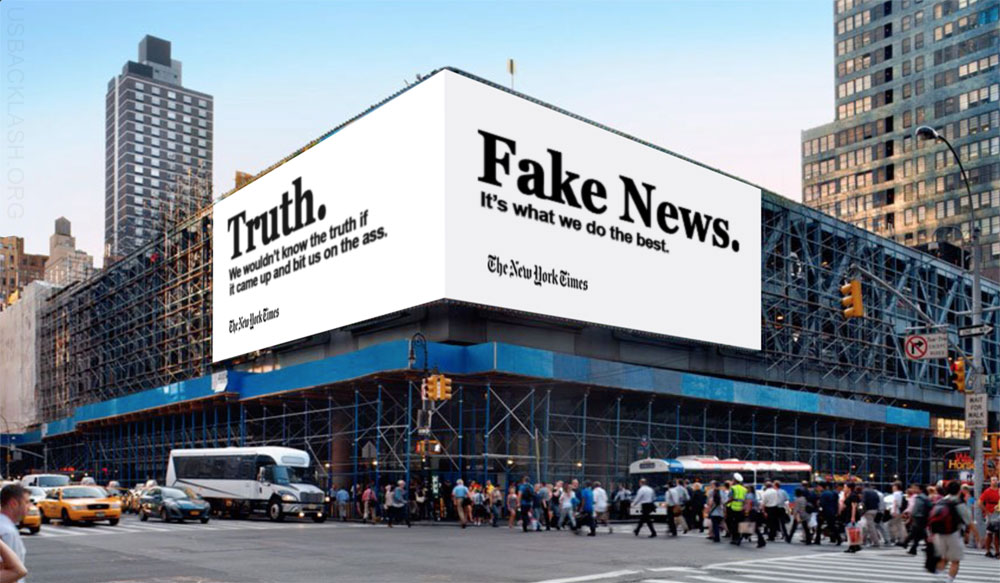
The Times is even taking out full-page ads in its own pages to offer truisms about truth: “The truth is hard. The truth is hidden. The truth must be pursued. The truth is hard to hear. The truth is rarely simple. The truth isn’t so obvious. …”  On Sunday, those truth truisms ran opposite an alarmist column by Jim Rutenberg entitled, “Will the Real Democracy Lovers Please Stand Up?” Meanwhile, The Washington Post launched its own melodramatic slogan, “Democracy Dies in Darkness.”

Yet, it was only weeks ago when the Post and Times were eagerly promoting plans for silencing or blacklisting independent news sites that didn’t toe the line on what the U.S. government and its allies were claiming was true.

On Nov. 20, the Times published a lead editorial calling on Facebook and other technology giants to devise algorithms that could eliminate stories that the Times deemed to be “fake.” The Times and other mainstream news outlets – along with a few favored Internet sites – joined a special Google-sponsored task force, called the First Draft Coalition, to decide what is true and what is not. If the Times’ editorial recommendations were followed, the disfavored stories and the sites publishing them would no longer be accessible through popular search engines and platforms, essentially blocking the public’s access to them. [See Consortiumnews.com’s “What to Do About ‘Fake News.’”]

On Thanksgiving Day, the Post ran a front-page story citing an anonymous group, called PropOrNot, blacklisting 200 Web sites, including Consortiumnews.com and other important sources of independent journalism, because we supposedly promoted “Russian propaganda.”

Although PropOrNot and the Post didn’t bother to cite any actual examples or to ask the accused for comment, the point was clear: If you didn’t march in lockstep behind the Official Narrative on, say, the Ukraine crisis or the war in Syria, you were to be isolated, demonized and effectively silenced. In the article, the Post blurred the lines between “fake news” – stories that are simply made up – and what was deemed “propaganda,” in effect, information that didn’t jibe with what the U.S. State Department was saying.

Back then, in November, the big newspapers believed that the truth was easy, simple, obvious, requiring only access to some well-placed government official or a quick reading of the executive summary from some official report. Over the last quarter century or so, the Times, in particular, has made a fetish out of embracing pretty much whatever Officialdom declared to be true. After all, such well-dressed folks with those important-sounding titles couldn’t possibly be lying.

That gullibility went from the serious, such as rejecting overwhelming evidence that Ronald Reagan’s Nicaraguan Contra rebels were deeply involved in drug trafficking, to the silly, trusting the NFL’s absurd Deflategate allegations against Tom Brady. In those “old” days, which apparently ended a few weeks ago, the Times could have run full-page ads, saying “Truth is whatever those in authority say it is.”

In 2002, when the George W. Bush administration was vouching for a motley crew of Iraqi “defectors” describing Saddam Hussein’s hidden WMDs, Iraq’s purchase of some “aluminum tubes” must have been for building nuclear bombs. In 2003, when Secretary of State Colin Powell showed some artist drawings of “mobile chemical weapons labs,” they must really exist – and anyone who doubted Powell’s “slam-dunk” testimony deserved only contempt and ridicule.

When the Obama administration issued a “government assessment” blaming the Syrian military for the sarin gas attack outside Damascus on Aug. 21, 2013, there was no need to scrutinize its dubious assertions or ask for actual proof. To do so made you an “Assad apologist.”

When a bunch of U.S. allies under the effective control of Ukraine’s unsavory SBU intelligence service presented some videos with computer-generated graphics showing Russians supplying the Buk missile that shot down Malaysia Airlines Flight 17 over eastern Ukraine on July 17, 2014, there was no need to examine the holes in the evidence or note that the realistic-looking graphics were fictional and based on dubious assumptions. To do so made you a “Moscow stooge.”

In other words, when the U.S. government was gluing black hats on an “enemy” and white hats on a U.S. “ally,” the Times never seemed to object. Nor did pretty much anyone else in the mainstream media. No one seemed to note that both sides usually deserved gray hats. With very few exceptions – when the State Department or other U.S. agencies were making the charges – the Times and its cohorts simply stopped applying responsible journalistic skepticism.

Of course, there is a problem with “fake news,” i.e., stories that are consciously made up for the purpose of making money from lots of clicks. There are also fact-free conspiracy theories that operate without evidence or in defiance of it. No one hates such bogus stories more than I do — and they have long been a bane of serious journalism, dating back centuries, not just to the last election.

But what the Times, the Post and the rest of the mainstream media have typically ignored is that there are many situations in which the facts are not clear or when there are alternative explanations that could reasonably explain a set of facts. There are even times when the evidence goes firmly against what the U.S. government is claiming. At those moments, skepticism and courage are necessary to challenge false or dubious Official Narratives. You might even say, “The truth is rarely simple. The truth isn’t so obvious…”

A Tough Transition

During the transition from the Obama administration to the Trump team, the Times, the Post and other mainstream media outlets got caught in their own transition from trusting whatever the outgoing officials said to distrusting whatever the incoming officials said. In those final days, big media accepted what President Obama’s intelligence agencies asserted about Russia supposedly interfering in the U.S. election despite the lack of publicly available evidence that could be scrutinized and tested.

Even something as squirrelly as the attack on Trump’s National Security Adviser Michael Flynn – with Obama holdovers citing the never-prosecuted Logan Act from 1799 as the pretext for ginning up some kind of criminal-sounding case that scared Trump into firing Flynn – was treated as legitimate, without serious questions asked. Since Obama officials were doing the feeding, the no-skepticism rule applied to the eating. But whatever statements came from Trump, even his few lucid moments explaining why war with nuclear-armed Russia wasn’t such a great idea, were treated as dangerous nonsense.

When Trump scolded the mainstream press for engaging in “fake news” and then applied the phrase “enemy of the people,” the Times, the Post and the rest went into full victimization-mode. When a few news companies were excluded from a White House news briefing, they all rushed to the barricades to defend freedom of the press. Then, Trump went even further – he rejected his invitation to the White House Correspondents Dinner, the black-tie/evening-gown event where mainstream media stars compete to attract the hottest celebrity guests and hobnob with important government officials, a walking-talking conflict-of-interest-filled evening, an orgy of self-importance.

So, the Times, the Post and their mainstream-media friends now feel under attack. Whereas just weeks ago they were demanding that Google, Facebook and other powerful information platforms throttle those of us who showed professional skepticism toward dubious claims from the U.S. government, now the Times, the Post and the others are insisting that we all rally around them, to defend their journalistic freedom. In another full-page ad on Sunday, the Times wrote: “Truth. It’s more important now than ever.”

I would argue that truth is always important, but especially so when government officials are leading countries toward war, when lives are at stake, whether in Iraq or Syria or Ukraine or the many other global hotspots. At those moments in the recent past, the Times did not treat truth – in all its subtlety and nuance – as important at all.

I would argue, too, that the stakes are raised even higher when propagandists and ideologues are risking the prospect of nuclear war that could kill billions and effectively end human civilization. However, in that case, the American people have seen little truly professional journalism nor a real commitment to the truth. Instead, it’s been much more fun to demonize Russian President Vladimir Putin and paint black-and-white pictures of the evil Russians.

At such moments, those New York Times’ truisms about truth are forgotten: “The truth is rarely simple. The truth isn’t so obvious. …”

Investigative reporter Robert Parry broke many of the Iran-Contra stories for The Associated Press and Newsweek in the 1980s. You can buy his latest book, America’s Stolen Narrative, either in print here or as an e-book (from Amazon and barnesandnoble.com).