Saturday Matinee: Threads

“Threads” (1984) is an apocalyptic cautionary tale written by Barry Hines, directed by Mick Jackson, and originally aired on BBC  2. It’s a docudrama depiction of nuclear war and its devastating effect on society and in particular two families in Sheffield England. Various news media reports describe the events leading up to the war (precipitated by aggressive US movements against Iran). With unflinching realism, the film depicts the sudden nuclear attack and devastating aftermath including medical, economic, social and environmental consequences. Should be required viewing for all chickenhawk neoliberals, though some may be too psychopathic to rethink their pro-war convictions.

US, allies risk Russian retaliation in Syrian attack

By Editorial Board

Source: Global Times

US President Donald Trump announced on Friday he ordered strikes on the Syrian regime in response to a chemical attack last weekend. He said the strikes were in coordination with France and the United Kingdom. Syrian President Bashar al-Assad said his country is being “invaded” by the three countries. The Russian Embassy in the USA said in a statement that “insulting the President of Russia is unacceptable and inadmissible.”

In a sensational statement, Trump asserted the Bashar Assad government used chemical weapons on civilians. He said “The evil and the despicable attack left mothers and fathers, infants and children thrashing in pain and gasping for air. These are not the actions of a man. They are crimes of a monster instead.”Trump also warned “Russia must decide if it will continue down this dark path or if it will join with civilized nations as a force for stability and peace.”

The facts cannot be distorted. This military strike was not authorized by the UN, and the strikes targeted a legal government of a UN member state. The US and its European allies launched strikes to punish President Bashar al-Assad for a suspected chemical attack in Duma last weekend. However, it has not been confirmed if the chemical weapons attack happened or if it did, whether government forces or opposition forces launched it. International organizations have not carried out any authoritative investigation.

The Syrian government has repeatedly stressed that there is no need for it to use chemical weapons to capture the opposition-controlled Duma city and the use of chemical weapons has provided an excuse for Western intervention. The Syrian government’s argument or Trump’s accusations against the “evil” Assad regime, which one is in line with basic logic? The answer is quite obvious.

The US has a record of launching wars on deceptive grounds. The Bush government asserted the Saddam regime held chemical weapons before the US-British coalition troops invaded Iraq in 2003. However, the coalition forces didn’t find what they called weapons of mass destruction after overthrowing the Saddam regime. Both Washington and London admitted later that their intelligence was false.

Washington’s attack on Syria where Russian troops are stationed constitute serious contempt for Russia’s military capabilities and political dignity. Trump, like scolding a pupil, called on Moscow, one of the world’s leading nuclear powers, to abandon its “dark path.” Disturbingly, Washington seems to have become addicted to mocking Russia in this way. Russia is capable of launching a destructive retaliatory attack on the West. Russia’s weak economy is plagued by Western sanctions and squeezing of its strategic space. That the West provokes Russia in such a manner is irresponsible for world peace.

The situation is still fomenting. The Trump administration said it will sustain the strikes. But how long will the military action continue and whether Russia will fight back as it claimed previously remain uncertain. Western countries continue bullying Russia but are seemingly not afraid of its possible counterattack. Their arrogance breeds risk and danger.

Saturday Matinee: Testament

Cover Your Eyes: Lynne Littman’s ‘Testament’, 1983

By Richard McKenna

Source: We Are the Mutants

Testament
Directed by Lynne Littman
Paramount Pictures, 1983

1983 was a pretty fertile year for fictional nuclear apocalypses in Western popular culture. 2019: After the Fall of New York, Endgame, Exterminators of the Year 3000, Stryker, and Le Dernier Combat were released in cinemas, while ABC’s The Day After and Britain’s BBC2 adaptation of 1961 dystopian novel The Old Men at the Zoo, updated to feature a nuclear attack on London, appeared on television. Publishers released a slew of books with atomic mushrooms on their covers, including The Aftermath: The Human and Ecological Consequences of Nuclear War (edited by Jeannie Peterson), Luke Rhinehart’s Long Voyage Back, William Prochnau’s Trinity’s Child, and Dean Ing’s Pulling Through, as well as The Web, that year’s installment in Jerry Ahern’s Survivalist series. All of them attempted, seriously or otherwise—and it was generally otherwise—to examine the effects of a seemingly imminent nuclear war. The Doomsday Clock stood at four minutes to midnight (the closest it had been since 1960, though it was about to move even closer) and two events that year—the NATO military exercise Able Archer 83 and a nuclear attack false alarm in the Soviet Union—almost prompted a catastrophic escalation from fiction to reality.

The BBC’s optimism-annihilating Threads was still a year away, but the cultural momentum was building up to a psychological discharge whose blast radius would, for some, obliterate their ability to think about or plan for the future: what was the point, when they would be spending it eking out a life in the radioactive ruins of our civilization (or, if the Italians were right, driving customized cars and dressing like members of Krokus). That momentum surged dramatically with the release of Testament, the high water mark of the class of ’83. British sci-fi and horror magazine Starburst published a short yet positive review of it alongside a single publicity still showing a mother huddled up in bed with her children, fearfully pointing a torch into the darkness—an image that summarized perfectly the fear that it would be in our own homes that we would be killed, if not by the bomb itself then by the stone-age appetites and economics its detonation unleashed.

Despite containing no mushroom clouds, no heroics, no fallout shelters, no special effects, no geiger counters, and no enormous doors slamming in the depths of hellTestament is absolutely devastating: nothing except average people gradually realizing that the rest of their already abbreviated lives is destined to be a grim slog through even more illness, death, and loss than they’ve already experienced.

The film, produced by PBS and directed by National Education Television documentarian Lynne Littman, deals with the effects of a nuclear attack on a family who live in an idyllic small town (so idyllic that a young Kevin Costner and Rebecca De Mornay have settled there) somewhere within driving distance of San Francisco, and the first ten minutes is an artfully contrived little précis of their privileged lives: we see mom Carol (the great Jane Alexander) unenthusiastically acting out the instructions on her workout tape from bed while husband Tom (the also great William Devane) blithely takes their reluctant older son Brad cycling, leaving mom to get teenage daughter Mary (Roxana Zal) and little son Scotty (Lukas Haas) ready for school.

This initial section of the film highlights the reassuring frivolities and ephemera of Western life—toys, games, sports, exercise, E.T. t-shirts, He-Man figures and Sesame Street, and, in a way, Testament plays peculiarly like some kind of anti-E.T., or at least some nightmarish re-edit of its homely, chaotic, childish motifs, the intruder into the suburban calm not a kindly alien botanist but something native and altogether less friendly.

There is almost no buildup to the nuclear attack—no news reports about the mobilization of the armed forces, no preparations for shelter. The only indication that an attack is coming at all is that the nature of the film indicates that it must be, and the lack of narrative preparation makes the viewer’s stomach sink even more violently when the cartoon the family children are watching in their sunny lounge is suddenly replaced by static, which is then replaced by an emergency warning transmission. When the attack itself comes, it’s not even a noise, just a silent flash of blinding light. There are none of the typical signifiers: no models are destroyed, there is no colorized stock footage of shacks being blown away by 1,000 mph winds, no flesh drooping from bones, no radiation sickness makeup—only confusion, then coffins, and then funeral pyres. As the broadcasters who exchange news with the town’s chipper old radio ham start to vanish one by one, awareness grows that this might really be it—there might really be no hope.

The locals pull together and, unable to believe that the wider world won’t rally, seem determined to struggle through, organizing mutual assistance and continuing with their little world of school plays and piano lessons. But it gradually becomes more and more obvious that there is going to be no struggling through this one. Things are not going to return to normal—they are just going to keep getting worse, and there won’t be any school plays when all the children have died and all the adults are busy building bonfires to burn their corpses on.

The delicacy of touch with which the proceedings are handled—director Littman got the rights to the source material, a 1981 short story by Carol Amen, after reading it with her son—means that Testament makes its point all the more forcefully. Yes, very occasionally the tone does get slightly preachy, but considering the point the film wants to make—the stupidity of slowly and agonizingly killing half of the population of the planet—it’s a forgivable blip. In any event, Testament never feels smug or self-righteous: there are a few things that jar, and others that produce the odd smirk (a display of priestly affection very unlike that in Thorn Birds, a TV miniseries that caused a scandal the same year that Testament was released), but, most of the time, the viewer is simply staring at the screen in dread.

With its calm tonal palette and inoffensive James Horner score, suggestive of TV movies about domestic tragedy on the scale of divorce or alcoholism, one can imagine a grandparent of any political persuasion sitting down to watch it. In terms of production values, Testament sits somewhere between that well-made TV movie and a feature film proper, and its artlessness and lack of pretension, make it, if anything, even more upsetting and disorientating when things start to get really awful. Handled with a little less sensitivity and compassion, it could easily have been mawkish; but it isn’t, and Testament refuses to underline any particular aspect of the situation. There is simply the grind of life getting worse and worse until it is intolerably awful and you cannot survive. The economy with which the characters are sketched lends them a blank credibility, and the absence of any of the iconography of nuclear war (not even a single radioactive symbol) only adds to the film’s power.

Throughout the film, motifs of recording and repetition recur: family super-8 movies, nursery rhymes, the exercise cassette that mom is playing at the beginning, the answering machine, the pre-recorded warning message, the journal that Carol starts writing at the beginning of the film, even the roles of priest, mom, and policeman. It is when the graves turn to funeral pyres that the gravity of the situation becomes obvious, and perhaps the point is that the repetition and formalization of daily life is life. Deprived of the batteries and security and hope that allow us make those repetitions, the life we know ends as the recordings wind down. One very touching moment, when mom and son dance together to a (not very good) cover of the Beatles’ “All My Loving” played on a battery powered recorder, underlines perfectly the finite nature of the technologies we use to remember who we are.

The film is dotted with such lovely little scenes, like the one where Brad takes his late dad’s bike from the garage after his own has been stolen, and another when Mary asks Carol what it’s like to make love. Nobody is blamed for the war, and there’s no mention of politics, or enemy countries, or presidents. By definition it is probably a left-wing film (Amen’s original story appeared in feminist magazine Ms.), at least in as much as it aims to affect the opinion of the viewer as regards the effectiveness of a nuclear deterrent, and it is conceivable that to some particularly ideologically-driven idiots at the time it may have looked like liberal hand-wringing.

Testament isn’t perfect, but it is a powerful and economic piece of drama about personal loss and mass death that eschews all spectacle and seems to have no particular axe to grind other than to ask: What is the conceivable purpose of all this misery? It’s a point that bears repeating.

Watch the full film here.

The most perilous time in world history got worse

By Stephen Lendman

Source: Intrepid Report

Events ongoing should terrify everyone—things likely heading for greater war than already.

Most Americans, Brits, and others in NATO countries are unaware of the danger posed by hardline Western extremists in charge of policymaking—notably in Washington, London and Israel, the Jewish state an alliance Mediterranean Dialogue member.

Businessman Trump was co-opted to be a warrior president—neocon generals in charge of geopolitical policies, their agenda hardened by Mike Pompeo replacing Rex Tillerson at State, along with torturer-in-chief Gina Haspel appointed new CIA director.

An unholy alliance of US extremist policymakers allied with likeminded ones in partner countries risks war winds reaching gale force, a terrifying prospect if confrontation with Russia, Iran or North Korea occurs—the possibility increased by recent events.

Earlier this week, US Defense Secretary Mattis and UN envoy Haley threatened Russia and Damascus.

Russia vowed to retaliate against US attacks on Syrian forces in East Ghouta or elsewhere endangering its personnel in the country.

Anti-Russia hysteria in Britain over the Sergey Skripal poisoning affair, most certainly Moscow had nothing to do with, soured bilateral relations more than already.

In response to British PM Theresa May demanding swift Russian answers to questions posed about the incident, Russian Foreign Ministry spokeswoman (speaking for her government) replied sharply saying, “One does not give 24 hours notice to a nuclear power,” adding the “Skripal poisoning was not an incident but a colossal international provocation,” addin, not a “single international legal mechanism [exists] to probe the Skripal case.”

Russia’s embassy in London said “Moscow will not respond to London’s ultimatum until it receives samples of the chemical substance to which the UK investigators are referring.”

“Britain must comply with the Chemical Weapons Convention which stipulates joint investigation into the incident, for which Moscow is ready.”

“Without that, there can be no sense in any statements from London. The incident appears to be yet another crooked attempt by the UK authorities to discredit Russia.”

“Any threat to take ‘punitive’ measures against Russia will meet with a response. The British side should be aware of that.”

“Not only is Russia groundlessly and provocatively accused of the Salisbury incident, but apparently, plans are being developed in the UK to strike Russia with cyber weapons.”

“Judging by the statements of the prime minister, such a decision can be taken at tomorrow’s meeting of the National Security Council.”

Given the gravity of the situation, the above comments by Russian diplomats were uncharacteristically strong.

Sergey Lavrov warned Washington that “[i]f a new [US] strike . . . takes place [against Syrian forces], the consequences will be very serious,” adding, “I simply don’t have any normal terms left to describe all this.”

What’s coming remains to be seen. Hostile rhetoric from US and UK officials, along with hawkish extremists Pompeo in charge at State and Haspel appointed new CIA chief likely signal more war, not less.

What’s ongoing assures no possibility of improving dismal bilateral relations with Russia, China, Iran and other sovereign independent countries.

Talks with North Korea could either be scuttled or confrontational if they take place.

Given very disturbing ongoing events, the perilous state of world conditions reached a new low.

Be scared about what may follow—be very scared!


Stephen Lendman lives in Chicago. He can be reached at lendmanstephen@sbcglobal.net. His new book as editor and contributor is titled “Flashpoint in Ukraine: How the US Drive for Hegemony Risks WW III.” Listen to cutting-edge discussions with distinguished guests on the Progressive Radio News Hour on the Progressive Radio Network.

On Track for Extinction: Can Humanity Survive?

By Robert J. Burrowes

Anyone reading the scientific literature (or the progressive news outlets that truthfully report this literature) knows that homo sapiens sapiens is on the fast track to extinction, most likely some time between 2025 and 2040.

For a taste of the evidence in this regard focusing on the climate, see ‘Climate Collapse and Near Term Human Extinction’, ‘What They Won’t Tell You About Climate Catastrophe’, ‘Release of Arctic Methane “May Be Apocalyptic,” Study Warns’ and ‘7,000 underground [methane] gas bubbles poised to “explode” in Arctic’.

Unfortunately, of course, the climate is not the only imminent threat to human survival. With an insane leadership in the White House in the United States – see ‘Resisting Donald Trump’s Violence Strategically’ – we are faced with the prospect of nuclear war. And even if the climate and nuclear threats to our survival are removed, there is still a substantial range of environmental threats – including rainforest destruction, the ongoing dumping of Fukushima radiation into the Pacific Ocean, extensive contamination from military violence… – that need to be addressed too, given the synergistic impacts of these multiple and interrelated threats.

Can these extinction-threatening problems be effectively addressed?

Well the reality is that most (but not all) of them can be tackled effectively if we are courageous enough to make powerful personal and organizational decisions and then implement them. But we are not even close to doing that yet. And time is obviously running out fast.

Given the evidence, scientific and otherwise, documenting the cause and nature of many of these problems and what is required to fix them, why aren’t these strategies to address the problems implemented?

At the political and economic level, it is usually explained structurally – for example, as an outcome of capitalism, patriarchy and/or the states-system – or, more simply, as an outcome of the powerful vested interests that control governments and the corporate imperative to make profits despite exacerbating the current perilous state of the Earth’s biosphere and its many exploited populations (human and otherwise) by doing so.

But the reality is that these political and economic explanations mask the deeper psychological drivers that generate and maintain these dysfunctional structures and behaviours.

Let me explain why and how this happens using the climate catastrophe to illustrate the process.

While scientific concern about the increase in carbon dioxide in the Earth’s atmosphere had been raised more than a century ago – see ‘The Discovery of Global Warming’ – it wasn’t until the 1980s that this concern started to gain significant traction in public awareness. And despite ongoing agitation by some scientists as well as climate and environment groups, corporate-funded climate deniers were able to stall widespread recognition of, and the start of serious official action on, the climate catastrophe for more than two more decades.

However, as the truth of the climate catastrophe was finally being accepted by most people and the climate deniers were finally forced into full-scale retreat on the issue of whether or not the climate catastrophe was, in fact, so serious that it threatened human extinction, the climate deniers implemented their back-up strategy: they used their corporate media to persuade people that action wasn’t necessary ‘until the end of the [21st] century’ and to exaggerate the argument about the ‘acceptable’ increase above the pre-industrial norm – 2 degrees? 3 degrees? 1.5 degrees? – to obscure the truth that 0.5 degrees was, in fact, the climate science consensus back in 2007.

But, you might ask: ‘Why would anyone prefer to ignore the evidence, given the extinction-threatening nature of this problem?’

Or, to put the question more fully: ‘Why would anyone – whether an “ordinary” worker, academic, lawyer, doctor, businessperson, corporate executive, government leader or anyone else – prefer to live in delusion and believe the mainstream narrative about “the end of the century” (or 1.5 degrees) rather than simply consider the evidence and respond powerfully to it?’

And what is so unattractive about the truth that so many people run from it rather than embrace it?

Obviously, these questions go to the heart of the human (psychological) condition so let me explain why most humans now live in a delusional state whether in relation to the climate, environment issues generally, the ongoing wars and other military violence, the highly exploitative global economy or anything else.

People do not choose to live in delusion nor do they choose their delusion consciously. A delusion is generated by a person’s unconscious mind; that is, the part of their own mind of which the individual is normally unaware. So why does a person’s unconscious mind generate a delusion? What is the purpose of it?

A person’s unconscious mind generates a delusion when the individual is simply too terrified to contemplate and grapple with reality. Instead, the person unconsciously generates a delusion and then lives in accord with that delusion for the (obvious) reason that the delusion does not frighten them.

This unconscious delusional state is the fundamental outcome of the socialization, which I call ‘terrorization’, of the typical child during their childhood.

Endlessly and violently coerced (by a variety of threatened and actual punishments) to obey the will of parents, teachers and religious figures in denial of their own self-will, while simultaneously denied the opportunity to feel the fear, anger, sadness and other feelings that this violence causes, the child has no choice but to suppress their awareness of how they feel and the reality that caused these feelings. As a result, this leaves virtually all children feeling terrified, full of self-hatred and powerless. For brief explanations of how this happens, see ‘Understanding Self-Hatred in World Affairs’ and ‘Why Are Most Human Beings So Powerless?’

However, and this point is important, each of these feelings is extraordinarily unpleasant to feel consciously and the child never gets the listening they need to focus on feeling them. See ‘Nisteling: The Art of Deep Listening’.

As a result, these feelings are suppressed below conscious awareness and this fear, self-hatred and powerlessness become the primary but unconscious psychological drivers of their behaviour and, significantly, results in them participating mindlessly in the widespread ‘socially acceptable’ delusions generated by elites and endlessly promulgated through elite channels such as education systems, the corporate media and entertainment industries.

Hence, as a result of being terrorized during childhood, delusion is the most common state of human individuals, irrespective of their role in society. For a full explanation of why this happens, see ‘Why Violence?’ and ‘Fearless Psychology and Fearful Psychology: Principles and Practice’.

And, as one part of their delusional state, most people must engage in the denial of reality whenever reality (unconsciously) frightens them (or threatens to bring their unconscious self-hatred or powerlessness into their awareness). See ‘The Psychology of Denial’. This, of course, means that they are frightened to take action in response to reality but also deny it is even necessary.

So what can we do about all of this? Well, as always, I would tackle the problem at various levels.

If you are one of those rare people who prefers to research the evidence and to act intelligently and powerfully in response to the truth that emerges from this evidence, I encourage you to do so. One option you have if you find the evidence of near-term human extinction compelling in light of the lacklustre official responses so far, is to join those participating in ‘The Flame Tree Project to Save Life on Earth’.

Obviously, tokenism on your part – such as rejecting plastic bags or collecting rubbish from public places – is not enough in the face of the profound changes needed.

Of course, if you are self-aware enough to know that you are inclined to avoid unpleasant realities and to take the action that this requires, then perhaps you could tackle this problem at its source by ‘Putting Feelings First’.

If you want intelligent, compassionate and powerful children who do not grow up living in delusion and denial, consider making ‘My Promise to Children’.

If you want to campaign on the climate, war, rainforest destruction or any other issue that brings us closer to extinction, consider developing a comprehensive nonviolent strategy to do so. See Nonviolent Campaign Strategy.

And if you want to participate in the worldwide effort to end violence in all of its manifestations, you are welcome to consider signing the online pledge of ‘The People’s Charter to Create a Nonviolent World’.

In summary, the primary threat faced by humanity is not the synergistic multitude of complex social, political, economic and technological forces that are precipitating our rush to extinction.

The fundamental threat to our survival is our psychological incapacity (particularly because of our fear, self-hatred and powerlessness) to perceive reality and respond powerfully to it by formulating and implementing appropriate social, political, economic and technological measures that address our multifaceted crisis systematically.

Unless we include addressing this dysfunctional individual and collective psychological state in our strategy to avert human extinction, we will ultimately fail and extinction will indeed be our fate.


Biodata: Robert J. Burrowes has a lifetime commitment to understanding and ending human violence. He has done extensive research since 1966 in an effort to understand why human beings are violent and has been a nonviolent activist since 1981. He is the author of ‘Why Violence?’ His email address is flametree@riseup.net and his website is here.

Robert J. Burrowes
P.O. Box 68
Daylesford, Victoria 3460
Australia

Email: flametree@riseup.net

Websites:
Nonviolence Charter
Flame Tree Project to Save Life on Earth
‘Why Violence?’
Feelings First
Nonviolent Campaign Strategy
Nonviolent Defense/Liberation Strategy
Anita: Songs of Nonviolence
Robert Burrowes
Global Nonviolence Network

The Fear Driving US Nuclear Strategy

By Robert J. Burrowes

The United States Department of Defense released its latest ‘Nuclear Posture Review 2018’ (NPR) on 2 February, updating the last one issued in 2010 during the previous administration. See ‘Nuclear Posture Review 2018’.

The Executive Summary of the NPR is also available, if you prefer. See ‘Nuclear Posture Review 2018 Executive Summary’.

Several authors have already thoughtfully exposed a phenomenal variety of obvious lies, invented threats, strategic misconceptions and flaws – such as the fallacious thinking behind ‘deterrence’ and significantly increased risk of nuclear war given the delusional ‘thinking’ in the document – as well as the political fear-mongering in the NPR. For example, eminent scholar Professor Paul Rogers has pointed out: ‘The risk now is that we are on a slippery slope towards “small nuclear wars in far-off places”, which themselves could either escalate or at the very least break the 70+ year taboo on treating nuclear weapons as useable.’ See ‘Nuclear Posture Review: Sliding Towards Nuclear War?’

Stephen Lendman has reminded us that US ‘defense spending far exceeds what Russia, China, Iran and other independent countries spend combined’ and that the US ‘nuclear arsenal and delivery systems can destroy planet earth multiple times over’ with the document suggesting ‘preparation for nuclear war’. Moreover, the NPR ‘falsely claims the nation must address “an unprecedented range and mix of threats” posed by Russia, China, North Korea, Iran and other countries’ and this despite the incontrovertible fact that no nation has threatened US security since World War II and none threatens it now.

He further points out that the NPR’s claim that there is ‘an unprecedented range and mix of threats, including major conventional, chemical, biological, nuclear, space, and cyber threats, and violent nonstate actors’ is ‘utter rubbish’ and that ‘America’s rage for endless wars of aggression, along with its rogue allies, poses the only serious threat to world peace and stability.’ See ‘Trump’s Nuclear Posture Review’.

Even Andrew C. Weber, an assistant defense secretary during the Obama administration, has warned that

‘Almost everything about this radical new policy will blur the line between nuclear and conventional’ and ‘will make nuclear war a lot more likely.’ See ‘Pentagon Suggests Countering Devastating Cyberattacks With Nuclear Arms’.

Despite the obvious belligerence in the document, we are supposed to believe, according to words in the NPR, that ‘The United States remains committed to its efforts in support of the ultimate global elimination of nuclear, biological, and chemical weapons’ despite the US denunciation of the ‘UN Treaty on the Prohibition of Nuclear Weapons’ negotiated by 122 countries just a few months ago in mid-2017. See ‘U.S., UK and France Denounce Nuclear Ban Treaty’.

Presumably, we are supposed to have shorter memories than members of the US administration or to be even more terrified and unintelligent than are they. This would be difficult.

Rather than further critique the document, which several authors have done admirably, I would like to explain my observation immediately above.

Let me start by explaining why those who formulated the current US nuclear strategy, wrote the Nuclear Posture Review, now promote it and are responsible for implementing it, are utterly terrified and quite delusional, and constitute a threat to human civilization.

The NPR is full of language such as this: ‘There now exists an unprecedented range and mix of threats, including major conventional, chemical, biological, nuclear, space, and cyber threats, and violent nonstate actors. These developments have produced increased uncertainty and risk.’

Are these individuals, notably including Donald Trump, Secretary of Defense General Jim ‘Mad Dog’ Mattis, Chief of Staff Marine General John Kelly and National Security Adviser General H. R. McMaster, really frightened of countries such as Iran (with its non-existent nuclear arsenal) or North Korea (with its handful of ‘primitive’ nuclear weapons and inadequate delivery systems)? Or are they really frightened of countries such as Russia and China, whose nuclear arsenals pale in comparison to that of the United States and whose strategic posture in any case is decidedly non-aggressive (particularly towards the United States) despite its ongoing provocations of them?

Are US government leaders really so terrified of possible conventional, chemical, biological, space and cyber attacks that they need to threaten nuclear annihilation should it occur?

Well, the answer to each of these questions is that Trump, Mattis, Kelly, McMaster and other US political and military leaders are, indeed, terrified.

However, they are projecting their obvious terror away from its original source and onto a ‘safe’ and ‘approved’ target so that they can behave in accordance with their terror. They do this because the original cause of their terror – their parents and/or other significant adults in their childhood – never allowed them to feel their terror and to direct and express it safely and appropriately. For a full explanation of why this happens, see Why Violence?’ and Fearless Psychology and Fearful Psychology: Principles and Practice.

Unfortunately, and in this case potentially catastrophically, this dysfunctional behavioural response to deeply suppressed terror cannot ‘work’ either personally or politically for the individuals concerned. Let me explain why.

Evolution devised an extraordinarily powerful response to threats: it gave many organisms, including human beings, the emotion of fear to detect threats as well as other tools that can be used in conjunction with fear to respond powerfully to threats. Hence, in response to a threat, humans are meant to feel their fear and, while doing so, engage other feelings, conscience and intelligence so that the source of the threat can be accurately identified and the most powerful and effective behavioural response to that threat can be devised and implemented. In simple language: We need our fear to tell us we are under threat and to play a part in defending ourselves. In evolutionary terms, this was highly functional.

If, however, during childhood, the fear is suppressed because the individual is too frightened to feel it (usually because their parents deny them a safe opportunity to do so), then they will be unconsciously compelled to project their fear onto those who pose no threat (precisely because these people do not immobilize them with terror) and to endlessly seek to control these people (during childhood this usually means their younger siblings and/or friends, and during adulthood it usually means people of another sex, race, class, religion or nation) so that they can gain relief from experiencing their suppressed (childhood) fear.

The relief, of course, is delusionary. But once someone is terrified, it is not possible for them to behave functionally or powerfully. They will live in a world of delusion and projection, endlessly blaming those who they (unconsciously) project to be a threat precisely because these people are not frightening and not a threat and seem more likely to be able to be ‘controlled’.

This projection and behaviour happen all of the time, both in personal interactions and geopolitically, but it doesn’t usually threaten imminent annihilation, even if, to choose another example, it endlessly and perhaps disastrously impedes efforts to tackle the environmental and other assaults on our biosphere.

It is because parents are frightened to feel and experience their own fear that they also fear their child’s fear and they act (consciously or unconsciously, depending on the context) to prevent the child from feeling this fear, perhaps by doing something as simple as reassuring them.

However, parents also use a variety of methods to distract their child from feeling their feelings. They might offer the child a toy or food to distract them. But another important way in which fear is suppressed is by teaching children to use play as a distraction from having their feelings. This fear might then remanifest in the form of the child wanting others to play with them but particularly by doing so in a game of their choosing and over which they have control (so that they can ensure that their fear is not raised).

Once the child has learned to use gaining control over play to distract themselves from their terror, it might well become a lifetime addiction, subsequently manifesting as a dysfunctional desire for control within a family or perhaps even economically, politically or militarily.

Unfortunately, as some of these children grow up and the nature of their ‘game’ changes, the outcome can have deadly consequences. This is simply because there is never any guarantee that others will submit willingly to control by others. And, if they do not, this can trigger the original person’s (unconscious) terror ‘necessitating’ action – a higher-risk strategy in an attempt to secure this higher degree of control over others – to resuppress their terror.

However, for example, even if the terrified person ends up owning a major corporation and exercising a great degree of control over employees, markets and possibly countries, the terror driving their delusional need for control can never be satisfied. See ‘Love Denied: The Psychology of Materialism, Violence and War’. But the same principle applies in other domains as well, including the political and military.

And in the most dangerous collective manifestation of this major psychological disorder, the current US political/military leadership, which has been effectively merged by Trump’s appointment of military generals to his political staff, we now have the situation where a collection of individuals who are terrified and also project their dysfunctional desire for control onto other nations, are willing to threaten (and use) nuclear weapons in a delusionary attempt to feel (personally) ‘in control’.

It is little wonder that the Bulletin of the Atomic Scientists has moved the Doomsday Clock to two minutes to midnight! See It is now two minutes to midnight: 2018 Doomsday Clock Statement.

So what can we do?

Well, I would tackle the problem at several levels and I invite you to consider participating in one or more of these.

To help prevent this problem from emerging at its source, you are welcome to consider making ‘My Promise to Children’. This will play a vital role in ensuring that children do not grow up suppressing their fear.

Given the extraordinary emotional and other damage inflicted by school, you might consider educational opportunities for your child(ren) outside that framework. See ‘Do We Want School or Education?’

If you suspect that you are not as powerful as you would like, you might consider ‘Putting Feelings First’ so that you can learn to behave with awareness – a synthesis of all of the feedback that your various mental functions give you and the judgments that arise, in an integrated way, from this feedback. This will enable you to love yourself truly and always courageously act out your own self-will, whatever the consequences.

If you wish to work against the many threats, including military threats, to our environment simultaneously, you are welcome to join those participating in ‘The Flame Tree Project to Save Life on Earth’.

And if you wish to be part of efforts to end violence and war, including the threat of nuclear annihilation, you are welcome to consider signing the online pledge of ‘The People’s Charter to Create a Nonviolent World’ and/or using sound nonviolent strategy for your campaign or liberation struggle. See Nonviolent Campaign Strategy or Nonviolent Defense/Liberation Strategy.

Our world is poised perilously on the brink of catastrophic nuclear war. This has happened because we have given responsibility for holding the nuclear trigger to a handful of men who, emotionally speaking, are terrified little boys cowering from the imaginary threat of the bogeyman under their bed.

There is no easy way back from this brink. But you can help, both now and in the future, by doing one or more of the suggestions above.

Biodata: Robert J. Burrowes has a lifetime commitment to understanding and ending human violence. He has done extensive research since 1966 in an effort to understand why human beings are violent and has been a nonviolent activist since 1981. He is the author of Why Violence? His email address is flametree@riseup.net and his website is here.


Robert J. Burrowes
P.O. Box 68
Daylesford
Victoria 3460
Australia
Email: flametree@riseup.net

Websites:
Nonviolence Charter
Flame Tree Project to Save Life on Earth
‘Why Violence?’
Feelings First
Nonviolent Campaign Strategy
Nonviolent Defense/Liberation Strategy
Anita: Songs of Nonviolence
Robert Burrowes
Global Nonviolence Network

Saturday Matinee: There Will Come Soft Rains

“If Mankind Perished Utterly”: Nazim Tulyahodzhaev’s ‘There Will Come Soft Rains’, 1984

Source: We Are the Mutants

Object NameThere Will Come Soft Rains
Maker and Year: Nazim Tulyahodzhaev (Director), UzbekFilm, 1984
Object Type: Film
Description: (Steve Toyoshima)

There Will Come Soft Rains (Будет ласковый дождь) is an animated film produced in the former Soviet Union, based on the Ray Bradbury short story of the same name. Though obscure in the rest of the world during the Cold War, it has gained a cult following in recent years. A VHS-quality copy of the film has been uploaded to YouTube, and appears to be the only version available at this time.

Originally printed in 1950, Bradbury’s story follows the last day of an automated house in the wake of a nuclear apocalypse. The title is from a poem by Sarah Teasdale, written after she witnessed the horrors of the First World War. It described a world that nature reclaims after humanity has ceased to be. Bradbury adopts this poem’s tone and features it in his story.

Written just a few years after the bombings of Hiroshima and Nagasaki, and a few months before the start of the Korean War, There Will Come Soft Rains and the UzbekFilm adaptation reflect the fears of their respective eras. During the years between the original story and the 1984 version, the Cold War had broadened, touching off violence around the world as the two superpowers supported smaller proxy conflicts. In 1983, Soviet jets shot down a Korean airliner that they believed was on an espionage mission, provoking condemnation from the United States. The militant stance of new American President Ronald Reagan, his announcement of a US Strategic Defense Initiative (SDI, nicknamed “Star Wars” by the media), and plans to install missiles in Europe set nuclear tensions at an all-time high. In fact, much of the world felt that a nuclear war was inevitable. The invasion of Grenada and NATO war games exercises that simulated pre-nuclear attack communications put Soviet leadership at high alert for a first strike by their Western foes; the Kremlin wanted to avoid making the same mistake that Stalin had in 1941—ignoring Hitler’s aggression until it was nearly too late.

It was in this tense political environment that UzbekFilm‘s There Will Come Soft Rains was released. A studio in current day Uzbekistan that was originally founded in the 1920s, UzbekFilm expanded from art cinema to producing children’s fantasy films and animated features in the 1980s. There is a marionette show-like sense of playfulness and movement to the cartoons they produced, with a heavy emphasis on colors and textures. There Will Come Soft Rains was directed by Nazim Tulyahodzhaev, a prolific director and actor who had graduated from the Moscow State Institute of the Theatrical Arts in the 1970s and is still working today.

Tulyahodzhaev adapted Bradbury’s story for the 1980s, creating the character of the robot caretaker of the house, which didn’t exist in Bradbury’s original story. (The unsettling design of Robot was based on Lou Cameron’s Classics Illustrated cover for H.G. Wells’ War of the Worlds.) Where the automated house in the original story gradually fell apart after its owners were vaporized while playing outside, it’s the paranoia of Robot that leads to the destruction of the home in Tulyahodzhaev’s version.

When the film opens, it’s December 31st, 2026, in Allendale, California. It’s not entirely clear how long ago the nuclear war happened, or how long the McClellan family lived in a post-apocalyptic world. The McClellan home has been fortified for a nuclear war, with radiation suits hiding behind sliding cabinet doors for daily use by the family. Everything in the home is automated. The preparation of food, movement through the house, even religion is administered by the omnipresent Robot. During the time of prayer, a small crucifix slides out of a small door on the wall of the elder Mrs. McClellan’s room as a somber organ tune plays.

The McClellans themselves can no longer benefit from any of these conveniences, as we find out they were vaporized sometime before the events of the film. Somehow, the nuclear attack was able to breach the windows of the bunker, and the family has been reduced to ash. In a horrifying scene, Robot attempts to wake his charges by swiveling their beds upwards, spilling the remains of the family to the floor. Likely this is meant to invoke the neutron bomb, an atomic weapon designed to maximize radiation damage to humans caught within the radius and minimize damage to nearby structures. Its development became a focal point of the anti-nuke movement in the United States, with President Jimmy Carter only finding out about the program in the newspaper. Though Carter shelved the project, Reagan would become its champion. As he said in the late 1970s:

Very simply, it is the dreamed of death ray weapon of science fiction. It kills enemy soldiers but doesn’t blow up the surrounding countryside or destroy villages, towns and cities…..Here is a deterrent weapon available to us at much lower cost than trying to match the enemy gun for gun, tank for tank, plane for plane.

The fate of the McClellans is a visceral reminder of what it would mean to use such a weapon. Though they have been destroyed, their possessions are intact, with even small toys in the children’s room still walking around on battery power.

In the end, it is the intrusion of a curious bird through one of the broken windows of the home that sends Robot into a frenzy. The robotic arm sprouts sharp steel talons and attempts to smash the bird, which it sees as an intruder and danger to the family. The furniture, Mrs. McClellan’s wheelchair, and the crucifix are demolished during the rampage. Blinded after colliding with a wall, the final target of Robot is its own power source. It destroys itself and the house in a final blow.

The machine created to protect humans was engineered too well, a fear that has only become closer to reality in our modern age of militarized robotic drones. Though intended for peaceful purposes, Robot loses control after its owners are gone and only bits are left behind. The film closes with the poignant moment of the bird, unharmed, trying to fly into a peaceful scene on a video screen while one of Mrs. McClellan’s songs plays on the phonograph. Over the ending, Sarah Teasdale’s haunting poem is read.

This somber short and several more, including the light-hearted Contact (directed by Vladimir Tarasov), represent a wealth of animated films from the former Soviet Union that show the world through a lens that many of us who grew up in the West haven’t yet seen, but whose universal appeal carries the message past the boundaries of culture and language.

Saturday Matinee: A Short Vision

The Night Ed Sullivan Scared a Nation with the Apocalyptic Animated Short, A Short Vision (1956)

Source: Open Culture

On May 27, 1956, millions of Americans tuned in to The Ed Sullivan Show, expecting the usual variety of comedians, talents and musical guests. What they weren’t prepared for was a short animated film that Sullivan introduced thusly:

Just last week you read about the H-bomb being dropped. Now two great English writers, two very imaginative writers — I’m gonna tell you if you have youngsters in the living room tell them not to be alarmed at this ‘cause it’s a fantasy, the whole thing is animated — but two English writers, Joan and Peter Foldes, wrote a thing which they called “A Short Vision” in which they wondered what might happen to the animal population of the world if an H-bomb were dropped. It’s produced by George K. Arthur and I’d like you to see it. It is grim, but I think we can all stand it to realize that in war there is no winner.

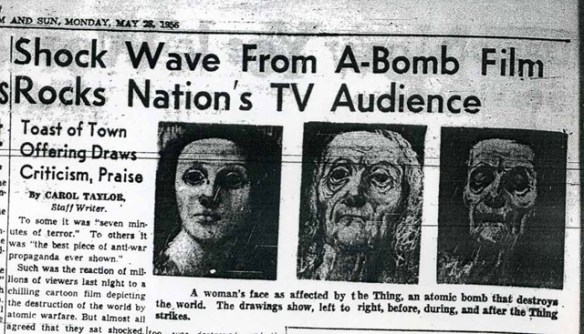
And with that, he screened the horrific bit of animation you can watch above. At the height of the atomic age, this film was a short sharp shock. Its vision of a nuclear holocaust is told in the style of a fable or storybook, with both animals and humans witnessing their last moments on earth, and ending with the extinguishing of a tiny flame. The mostly static art work is all the more effective when faces melt into skulls.

Many children didn’t leave the room of course, and the website Conelrad has a wonderful in-depth history of that night and collected memories from people who were traumatized by the short as a child. One child’s hair–or rather a small section of his hair–turned white from fright.

It was as formative a moment as The Day After would be to children of the ‘80s. The papers the next day reported on the short in salacious detail (“Shock Wave From A-Bomb Film Rocks Nation’s TV Audience”) and Sullivan not only defended his decision, but showed the film again on June 10.

The film was created by married couple Peter and Joan Foldes, and shot for little money in their kitchen on a makeshift animation table. Peter was a Hungarian immigrant who had studied at the Slade School of Art and the Courtlaud Institute and apprenticed with John Halas where he learned animation.

(Halas is best known for the animated feature version of Orwell’s Animal Farm.)

A Short Vision would go on in September of that year to win best experimental film at the 17th Venice Film Festival. (Peter Foldes would later make another disturbing and award-winning short called Hunger.)

Once so shocking, A Short Vision fell out of circulation. But a generation grew up remembering that they had seen something horrific on television that night (in black and white, not the color version above.) For a time, it was hard to find a mention of the film on IMDB and a damaged educational print was one of the few copies circulating around. Fortunately the British Film Institute has made a pristine copy available of this important Cold War document.