Grooming Students for A Lifetime of Surveillance

index

The same technologists who protest against the NSA’s metadata collection programs are the ones profiting the most from the widespread surveillance of students.

By Jessy Irwin

Source: Model View Culture

Since 2011, billions of dollars of venture capital investment have poured into public education through private, for-profit technologies that promise to revolutionize education. Designed for the “21st century” classroom, these tools promise to remedy the many, many societal ills facing public education with artificial intelligence, machine learning, data mining, and other technological advancements.

They are also being used to track and record every move students make in the classroom, grooming students for a lifetime of surveillance and turning education into one of the most data-intensive industries on the face of the earth. The NSA has nothing on the monitoring tools that education technologists have developed in to “personalize” and “adapt” learning for students in public school districts across the United States.

(Mega)data Collection + Analysis

“Adaptive”, “personalized” learning platforms are one of the most heavily-funded verticals in education technology. By breaking down learning into a series of tasks, and further distilling those tasks down to a series of clicks that can be measured and analyzed, companies like Knewton (which has raised $105 million in venture capital), or the recently shuttered inBloom (which raised over $100 million from the Gates Foundation) gather immense amounts of information about students into a lengthy profile containing personal information, socioeconomic status and other data that is mined for patterns and insights to improve performance. For students, these clickstreams and data trails begin when they are 5 years old, barely able to read much less type in usernames and passwords required to access their online learning portals.

Data collection and number crunching aren’t the only technologies being explored to revolutionize education– technology billionaire and philanthropist Bill Gates funded a $1.1 million project to fit middle-school students with biometric sensors to monitor their response and engagement levels during lessons, and advocated a $5 billion program to install video cameras in every classroom to record teachers for evaluation.

The Family Educational Rights and Privacy Act, a law put in place in 1974 to protect student academic records, does nothing to protect student data when it is in the hands of education technology companies. Instead, FERPA threatens to take federal funding away from schools who are found to have breached student privacy while it fails to mandate bare minimum security standards for the storage and transmission of student data. In fact, a recent revision of FERPA increased the power that companies have to collect and mine student data.  Though lawmakers and privacy advocates are regularly outraged at the immense volume of student data freely floating through the web, the repeated failure to create legislation that protects student data from being used for profit is astounding.

One thing is clear: those who have the power to protect student privacy will not do so as long as they can continue to subsidize the cost of public education with student data.

Internet Censorship in Schools

In most educational institutions, the vast majority of IT operations are focused on monitoring, filtering and blocking web traffic instead of building secure networks that safeguard student records and sensitive behavioral data. Nowhere is this more apparent than in the widespread adoption of web filtering software tools in K-12 schools. Usage of these technologies is required for compliance with programs like E-Rate, which grant federal money to schools to fund internet access for their students.

To be eligible for funding from the E-Rate program, schools are required to comply with federal regulations that ban access to websites displaying pornography, graphic material, or any other that could otherwise be judged as immoral, improper or lewd. More often than not, this subjective criteria is determined by the opinions and belief systems of school administrators under political pressure to deny students access to content on controversial issues about topics like evolution, birth control and sex education. These decisions disproportionately affect young girls and LGBTQ students by denying them access to sites that provide important information about their rights, their developing bodies, their sexuality and their access to contraceptives. In the case of Securly, the first filtering tool designed for schools, the controls set by IT and administration for web access can extend far beyond the walls of the school and determine what content students can access while using school- issued machines from their home internet connections.

Despite the many positive contributions of the internet in the distribution and dissemination of knowledge across the planet, students are regularly denied access to valuable information that could positively impact their learning… all to safeguard a small percentage of federal budget money granted to their schools. The implications of this are particularly severe for low-income students who do not have access to the Internet at home; without the ability to freely access the web on their own terms, their digital literacy skills lag behind those of their affluent peers. Though teachers request better and broader internet access for students in their classrooms, administrator-imposed blocks and filters on school internet leave most students woefully unprepared to navigate the realities of the web. When students do find a way around the tools used to limit their access to the outside world (this happened with a group of students who were given iPads in the Los Angeles United School district last year), they’re labelled as “hackers” or miscreants, and disciplined for using Tor, a tool popular among students for anonymous web browsing and circumventing blacklists that ban websites from school networks.

Social Media Surveillance

Schools are adopting many other surveillance technologies with unprecedented reach into the private communications and lives of students and their families. In Lower Merion, PA, a suburb outside of Philadelphia, educators engaged remote administration tools on students’ laptops to regularly spy on their activities while at home. In a case that made its way into federal courts, one student was punished by administrators who mistook candy pictured through his laptop’s camera for drugs. While the full extent of the spying was never exposed, parents and students have expressed concern about educators having the ability to watch young girls undress in the privacy of their homes, unaware that they were being watched through their school-issued computers.

In 2013, the Glendale Unified School District in Glendale, CA took a move straight from the NSA surveillance handbook by seeking out a $40,000 contract with Geo Listening, a social media monitoring company that charges schools to eavesdrop on student social media chatter. While the company claims to only access posts that are public in the school districts they work with, and says it works closely with school districts to tailor their monitoring programs to prevent cyberbullying, suicide and active shooter incidents, it is very easy— too easy, in fact— to use such technologies to identify and target students who have been labeled deviant or delinquent within their communities, or who are otherwise outspoken and critical of their teachers and schools.

Schools are also demanding access to students’ social media communications in ways that severely harm their constitutionally protected rights to free speech. In Minnewaska, MN, a female student who complained about a hall monitor’s behavior in a Facebook post was questioned and given in-school suspension. Later, when a parent reported the student for “sexting” over Facebook with a classmate, she was removed from class again as a group of educators and a police officer armed with a taser demanded that the student hand over her password. They then read private communications that took place outside of school through her Facebook account. After being pulled from class multiple times, suspended from school, and barred from attending a school field trip (the same punishment was not doled out to the male student involved in the messaging), the ACLU stepped in to defend the student’s right to privacy and free speech in communications outside of school property. Though the ruling in the case upheld students’ protection under the 1st and 4th amendments, school districts around the country continue to demand access to students’ social media accounts and threaten to mark students’ academic records to make it difficult to get into a desired university or to seek other avenues for continued education.

Physical Surveillance

In addition to the online monitoring taking place in schools, there are many surveillance mechanisms in place to enforce physical security in public schools. Since the shootings that took place at Virginia Tech in 2007, and again after those that took place in Sandy Hook, CT in 2012, technology companies have launched myriad tools designed to minimize the potential loss of life in the next active shooting incident at a school. Some of these technologies include:

By preying on the absolute worst fears of administrators and parents across the country, technology companies are earning millions of dollars selling security “solutions” that do not accurately address the threat model these tools claim to dispel. School districts that purchase these systems further perpetuate the farce of security theater and infringe on students’ rights to privacy and individual freedom.

A Lifetime of Surveillance

When we develop and use educational technologies that monitor a student’s every moment in school and online, we groom that student for a lifetime of surveillance from the NSA, from data brokers, from advertisers, marketers, and even CCTV cameras. By watching every move that students make while learning, we model to students that we do not trust them– that ultimately, their every move will be under scrutiny from others. When students recognize that they are being watched, they begin to act differently– and from that very moment they begin to cede one small bit of freedom at a time.

Though the education technology revolution continually promises a silver bullet that will be a great democratizing force for all of society’s ills, it categorically disregards the patriarchal power structures and biases that both legitimate and perpetuate discrimination against minorities and marginalized groups. Despite it being well within the scope of educational technology tools to track, identify and expose biases towards groups of students, technologists avoid implementing small changes that monitor educator performance and correct for unconscious biases that negatively affect student learning. Because the surveillance taking place in schools is typically based on qualitative criteria like morality, appropriateness and good behavior, these technologies extend current practices and prejudices that perpetuate injustices against marginalized groups.

There are few to no safeguards built into the online and offline monitoring systems to protect students from the abuse of these tools. Young female students who are active on social media can be unfairly targeted, slut-shamed and disciplined for suggestive language that takes place outside of school, while their male counterparts are not held equally accountable for participating in sexually charged online conversations. Youth of color, a group that is disproportionately stereotyped as angry, aggressive, and unpredictable by educators, can easily be monitored, disciplined, and entered into the juvenile justice system for any outburst that could vaguely be misinterpreted as a threat to a homogeneous caucasian school culture. Any student grappling with issues of abuse, depression, disability, gender identity or sexuality could easily be discovered by online surveillance tools, stigmatized and outed to their teachers, parents and wider community.

Education technologists also continue to widen the digital divide between affluent and economically oppressed. Despite an industry-wide insistence that technology is not being developed to replace educators in the classroom, many poor school districts faced with massive budget cuts are implementing experimental blended learning programs reliant on “adaptive” and “personalized” software as a way to mitigate the effect of large class sizes on student learning. This means that students who attend costly private schools or live within rich school districts that can afford to employ more educators and maintain smaller class sizes receive much more personalized instruction from their teachers. Instead of receiving much-needed interaction and personalized learning directly from educators, poor students living in disadvantaged communities receive instruction from educational software that collects their data (which is likely to be sold), and have less individual instruction time from teachers than their affluent counterparts.

By developing technologies that collect, track, record, analyze every move a student makes both online and off, technologists and investors and educators are ensuring that today’s students will have less privacy than any other generation that came before them, threatening to make privacy and anonymity unattainable for future generations. Though the surveillance mechanisms at play in education technologies affect the privacy of millions of students who pass through the education system each year, this system is a profound, persistent threat to the privacy and individual liberty of LGBTQ students, low-income students, and students of color who have already been so severely failed by the status quo.

Ironically, the same technologists and investors who protest against the NSA’s metadata collection programs are the ones profiting the most from the widespread surveillance of students across the country, by building educational tools with the same function.


The Global Money Matrix: The Forces behind America’s Economic Destruction

money-globe

By Dr. Gary Null

Source: GlobalResearch.ca

On the Brink of Economic Calamity

We are witnessing unprecedented low points in American economic history as 50 million Americans—17 million of them children—are living below the poverty line[i],[ii] while 47 million citizens rely on food stamps[iii].  All told, the 2008 economic collapse cost over $20 trillion globally[iv]. Millions of people lost their homes and jobs, while many of our nation’s children fell deeper into hunger. According to some figures, 53 million people entered the poverty ranks.[v] In the US and other developed nations, suicide rates skyrocketed due to financial stress and disruption of families. The Bureau of Labor Statistics has listed unemployment at 7.5% — a rate that is irreconcilable with reality. The more reliable figure, calculated by economist John Williams from Shadow Government Statistics, places unemployment at 22%. If we are to believe the analyses of Tyler Cowen at the Mercatus Center at George Mason University, we might be looking at an unemployment rate as high as 41%, since 33% of Americans are not working and no longer have the desire to find jobs.[vi]  This group is categorically removed from the government’s labor radar and is absent from the Bureau of Labor Statistics’ fudged data. 

 The Global Money Matrix

In the midst of this economic turmoil there is one group that still manages to flourish: the global elite. With more than $32 trillion stashed in offshore banks around the world, the wealth of the so-called “1%” is staggeringly obscene and grows by the day.[vii]  Their aggregate wealth, larger than the US GDP and national debt combined, is a testament to the tremendous influence and lobbying power held by a coterie of private interests that dominate nearly every sector of society.

Instead of reining in the inordinate control exercised by the elite, most of our elected officials have become little more than shills for these corporate overlords, creating policies that favor their campaign donors instead of the American people. Hundreds of millions of dollars were funneled into Barack Obama’s 2012 presidential campaign by donors whose business affiliations run the gamut from real estate and finance to media and law firms. According to Opensecrets.org, “Together, 769 elites are directing at least $186,500,000 for Obama’s re-election efforts — money that has gone into the coffers of his campaign as well as the Democratic National Committee.”[viii] This figure doesn’t even account for the massive contributions to Obama’s reelection by corporate-driven SuperPACs. Obama is just one example of how our politicians are beholden to the elite agenda. A quick glance at the campaign donation figures presented at Opensecrets.org reveals just how much special interests control Washington’s policymakers.

Given the corporatist influence that infects our halls of power, it is little wonder that our tax dollars continue to fund unconstitutional spying, perpetual war, and neoliberal policies that extend the powers of the world’s richest individuals and organizations. As Americans struggle financially, our social safety nets are increasingly losing priority to military and security expenditures that are historically unmatched anywhere in the world. Increasingly, the actions taken by the world’s most powerful corporations and governments seem to be at odds with public perception and wellbeing. Here are a few examples of how this combined influence has increased at the expense of the average American:

ALEC – This conservative group, funded by donors like the Koch brothers and Exxon Mobil and fueled by politicians including Ohio Governor John Kasich and Wisconsin Governor Scott Walker,[ix] writes model legislation calling to “privatize education, break unions, deregulate major industries, pass voter ID laws, and more.”[x] They do so with the stated aim to “form formal internal Task Forces to develop policy covering virtually every responsibility of state government.”[xi] ALEC’s website claims, “Each year, close to 1,000 bills, based at least in part on ALEC Model Legislation, are introduced in the states. Of these, an average of 20% become law.”[xii]

Federal Taxes and Expenditures – In 2014, President Obama plans to spend 57% of his discretionary budget on military, with 6% going to education, 3% to science, and 1% to food and agriculture.[xiii] And while the federal corporate tax rate is 35% in America, a variety of loopholes means that the average rate paid by corporations is 25%, with some companies paying as low as 10%.[xiv]

Citizens United – This US Supreme Court case set the legal precedent for unlimited campaign donations in US elections, qualifying corporate donations as a form a free speech. Since this case concluded, campaign expenditures have tripled.[xv]

TARP, or “the Bailout” – Following the economic crisis of 2008, US taxpayers handed $700 billion to major players in the automotive, financial, and insurance industries[xvi]. According to The New York Times, “Treasury…provided the money to banks with no effective policy or effort to compel the extension of credit. There were no strings attached: no requirement or even incentive to increase lending to home buyers, and…not even a request that banks report how they used TARP funds.”[xvii]  The Huffington Post reports, “Twenty-five top recipients of government bailout funds spent more than $71 million on lobbying in the year since they were rescued.”

In the Name of Security

The most concerning imbalance of power, however, may lie in the ‘security state’. In 2010, there were over 1900 private corporations with government contracts working for Homeland Security and NSA intelligence projects. Just one of these firms, Booz Allen Hamilton, where Edward Snowden was employed, has over 25,000 employees, nearly half of whom have security clearance of “top secret or higher”.[xviii]  Overall, there are an estimated half million individuals in private firms with access to intelligence secrets.[xix]  The federal intelligence agencies only employ 107,000 individuals; therefore, the bulk of intelligence and surveillance operations are conducted by private workforces.[xx] For fiscal year 2013, the country’s budget for intelligence, across 16 agencies, was approximately $52.6 billion, with 70% going to private contractors.[xxi]

Recent revelations by Edward Snowden unearthed the breadth and scope of this surveillance network. The National Security Agency has collected vast amounts of data to spy upon American citizens, elected legislators in Congress, leaders and populations of other nations, multilateral and international administrations, non profit organizations, and a variety of public and environmental advocacy groups. This defines the current trajectory of the US as a failed republic degenerating into a fascist regime.  For both corporate Republicans and Democrats, the rise of surreptitious surveillance on citizens, in direct violation of the Constitution, is perceived as a matter of national security to protect both the country’s domestic and foreign interests.

NSA Director Gen. Keith Alexander claimed publicly that intelligence surveillance of the American public “foiled” 54 terrorist attacks by extremists. Independent research confirmed that in fact only one, and a possible second attack, could be directly associated with the war on terrorism.  Speaking on the matter, Vermont Senator Patrick J. Leahy stated,

“There is no evidence that [bulk] phone records collection helped to thwart dozens or even several terrorist plots….These weren’t all plots and they weren’t all foiled.”.[xxii]

The Washington Times reported that “Keith B. Alexander admitted that the number of terrorist plots foiled by the NSA’s huge database of every phone call made in or to America was only one or perhaps two—far smaller than the 54 originally claimed by the administration.” General Alexander, under the questioning of Senator Leahy, also admitted that only 13 of the 54 cases were in any way connected to the U.S.  As the Washington Times clarifies,

“The [NSA phone records] database contains so-called metadata—the numbers dialing and dialed, time and duration of call—for every phone call made in or to the U.S.”[xxiii] 

This is but one example highlighting how the consolidation of corporate and political power comes at the cost of human rights and personal liberties for the average citizen.

 Obama has lied to the American people repeatedly about the extent of the security state and its infiltration into the lives of average citizens, including massive data collection of private phone calls, emails, and internet activity. The NSA revelations of Edward Snowden provide documented proof that intelligence surveillance is far more extensive than ever believed. The activities of the FBI, CIA, Pentagon, FISA courts, USDA and FDA, and the Justice Department contribute to the deterioration of citizens’ privacy and freedom. And a recent report by Essential Information entitled Spooky Business describes how some of America’s largest corporations have engaged in corporate espionage to spy on non-profit organizations. Ralph Nader writes, “In effect, big corporations have been able to hire portions of the national security apparatus, and train their tools of spycraft on the citizen groups of our country.”[xxiv] Thus, the powers of government and corporations are fostered and increased by one another, while those of the average American continue to dwindle

Groupthink and the 15%

It is unrealistic to frame the problem of control and socio-economic manipulation as a war between the 1 and the 99.  The 1 percent cannot achieve its goals without support from armies of technocrats and workforces willing to sacrifice moral values to secure careers in corporations and political parties, regardless of the inhumane ruthlessness behind their undemocratic agendas. The private industrial complexes of Too Big to Fail corporations require minions of technocrats and employees—as well as a large network of contracted small businesses, advisors, and consultants—to exert control over the population.  Therefore, we should realistically be speaking of a 15 versus 85 percent in the war on inequality, control, and power.

 When this additional 45 million people, or 15 percent of the population, are added to the formula for who controls the major stakes of power, wealth, influence and policymaking today, we can more easily understand how the psychology of “group think” creates a protective shield around the power brokers calling the shots.  When the psychologist Irving Janis first used the term “groupthink”, he referred to a collective weakening of individuals’ “mental efficiency, reality testing and moral judgment” through pressure to stick with the corporate plan.[xxv]  Among the characteristics common to groupthink, which enables the privileged elite to exert compliance to their mission without dissent, is a false belief in the inherent morality of their jobs. For example, the neoliberal free-market ideology posits that trickle down economics from the top will create more jobs and raise families’ personal income—a persistent myth that has no historical example to prove it as fact.  

The actual facts, according to the 2012 Global Wealth Data Book, show that since the implementation of neoliberal economics in the late 1970s and early 1980s, the financial health of America’s middle class has fallen to 27th globally, behind Qatar, Taiwan, Cyprus and Kuwait. Simultaneously, the US has the most millionaires and billionaires of any other nation.[xxvi]  Groupthink also generates an “illusion of invulnerability,” an insincere and narrow confidence that enables workers to take extreme risks and a distorted group rationalization to deny facts to the contrary of their optimism.  Other characteristics include stereotyping enemies, managerial pressure on nonconformists, and self-censorship of doubts within the organization.  An illusion of unanimity is sustained whereby the image is created and perpetuated that the majority agree with organization’s purpose and mission.[xxvii]

Without the possibility of groupthink and this additional 15 percent passively serving the most powerful 1 percent’s destructive acts, life in the US would be far more democratic, just, and free today. Unfortunately, our society currently necessitates profit for both legitimacy and survival. This unprecedented economic and political atmosphere is giving birth to a new face of fascism.

 The Dominant Culture

When considering the human element in our societal structure, the question arises as to how human beings can act with such blatant disregard for damage incurred. There are varying figures assessing the percent of psychopathology among high level financial and corporate executives. In the general population, approximately 1% can be clinically diagnosed with sociopathic and psychopathic disorders[xxviii]. However, for the wealthy and power elite, estimates are higher.

Canadian psychiatrist Dr. Robert Hare estimates that 4 percent of corporate executives are clinically sociopathic.[xxix] Sherree DeCovny, a former high-powered investment banker now with CFA Financial Magazine, believes it is as high as 10 percent.[xxx] Figures from psychological surveys in the UK place estimates even higher. Psychologist Clive Boddy has argued that the psychopathological behavior of financial executives was a major cause for the 2007 economic collapse. He also notes that individuals with the strongest psychopathic tendencies are those who tend to be promoted fastest.[xxxi]

Research supports this claim. In a survey of 500 senior executives in the US and UK, 26 percent observed firsthand wrongdoing in the workplace and 24 percent believed that it was necessary for professionals in the financial sector to engage in unethical and even illegal conduct in order to be successful. Sixteen percent said they would commit insider trading if they were certain they could get away with it, and 30 percent said that the pressures of compensation plans were an incentive to break the law.[xxxii]

Today, this banking elite owns the lives of millions of Americans by imprisoning them in debt. In the third quarter of 2013, consumer indebtedness reached $11.28 trillion.[xxxiii]  2014 and every year thereafter will see household debt increase. The majority of this debt, in the form of mortgages and outstanding home equity, student loans, auto loans, and credit cards, is money owed to the banking industry. It is by keeping the masses indebted, securing government allegiance and protection to extract money from citizens, that bankers are able to control the economy.

In a letter to Federal Reserve Chairman Ben Bernanke, Representative Alan Grayson and three of his Congressional colleagues raised their concern over large investment banks taking over the real economy.  According to their investment relations reports, both banks are engaged in the “production, storage, transportation, marketing and trading of numerous commodities.”[xxxiv] These include crude oil and oil products, natural gas, coal, electric power, agricultural and food products, and precious and rare metals. Additionally, JP Morgan markets electric power and “owns electricity generating facilities in the US and Europe.”[xxxv] Goldman Sachs has entered the uranium mining market.  According to Rep. Grayson, none of these activities have anything to do with the business of banking, and there is no indication that the Fed or any other agency is regulating these irregular business undertakings.[xxxvi]

In early 2013, the Swiss Federal Institute of Technology in Zurich conducted the most thorough analysis of the financial ties between over 43,000 transnational banks and corporations. This was the first empirical study to identify a network where global power and wealth is most heavily concentrated. Their startling results observed that a small faction of 147 super companies controls over 40 percent of the entire transnational network, with an additional 36 million companies below them. 

Predictably, almost all of the 147 super companies were financial institutions, with Barclays, Capital Group, the Vanguard Group, Deutsche Bank, JP Morgan, Goldman Sachs, Credit Suisse, and Bank of New York among the top of the list.[xxxvii]  With financial instruments of speculative trade insufficient to satisfy greed, such companies have every incentive to move into new territory, particularly resources and services that are essential to life. This includes fuel, water, food and minerals. As it stands, at least twenty-five major US companies have more wealth than entire countries.[xxxviii]

The prediction can be suggested that with current trends, the largest global banks will become the world’s most powerful “nations,” acting with complete autonomy outside of international laws that apply to sovereign states.  As corporate groupthink increases and infiltrates the larger civilian community, the transnationalist mind will persist as a breeding ground for psychopathology.

Conclusion

The consequences of today’s cowboy free market culture have sent the US middle class and economic mobility spiraling downward. Laid off workers have nowhere to use their skills to earn a livelihood for themselves and their families. Consequently, the worker is unable to meet expenditures and falls into a lower income bracket or poverty.  Mortgage defaults, credit card payments, and loans drag him further into debt. Without work and hence unable to pay taxes, the state, county and town suffer. In turn, local entities are forced to reduce their workforce and public services. The final result is the decline in the national quality of life, and the gradual deterioration of the US.  The inequality gap widens as the wealthy get richer and more powerful, while growing numbers of families become destitute.

A clear conflict exists between the values that we promote in the home and those values that are rewarded in the workplace. Unless we apply the same moral requirements to governments and corporations as we do to ourselves, friends, and families, the revolving door at the top of society will continue to consolidate power and wealth at any cost.

Notes

[i] Fessler, Pam. “How Many Americans Live In Poverty?” NPR. http://www.npr.org/blogs/money/2013/11/06/243498168/how-many-americans-live-in-poverty (accessed December 2, 2013).

[ii] National Center for Children in Poverty. “Child Poverty.” NCCP. http://www.nccp.org/topics/childpoverty.html (accessed December 1, 2013).

[iii] Plumer, Brad. “Why are 47 million Americans on food stamps? It’s the recession — mostly.” WashingtonPost.com. http://www.washingtonpost.com/blogs/wonkblog/wp/2013/09/23/why-are-47-million-americans-on-food-stamps-its-the-recession-mostly/ (accessed December 3, 2013).

[iv] Melendez, Eleazar. “Financial Crisis Cost Tops $22 Trillion, GAO Says.” The Huffington Post. http://www.huffingtonpost.com/2013/02/14/financial-crisis-cost-gao_n_2687553.html (accessed December 3, 2013).

 [v] Moench, Brian. “Death by Corporation, Part II: Companies as Cancer Cells.” Truthout. http://www.truth-out.org/news/item/17705-death-by-corporation-part-ii-companies-as-cancer-cells (accessed December 3, 2013).

 [vi]  “The real jobs numbers: 41% of America unemployed, 1 in 3 doesn’t want work at all – RT USA.” RT.com. http://rt.com/usa/jobs-us-employment-welfare-749/ (accessed December 3, 2013).

 [vii] Vellacott, Chris. “Super Rich Hold $32 Trillion in Offshore Havens.” Reuters.com. http://www.reuters.com/article/2012/07/22/us-offshore-wealth-idUSBRE86L03U20120722 (accessed December 13, 2003).

 [viii] “Barack Obama’s Bundlers.” Opensecrets RSS. http://www.opensecrets.org/pres12/bundlers.php

[ix] “What is ALEC?.” ALEC Exposed. http://www.alecexposed.org/wiki/What_is_ALEC%3F#Who_funds_ALEC.3F (accessed December 3, 2013).

[x] Nichols, John. “ALEC Exposed.” The Nation. http://www.thenation.com/article/161978/alec-exposed# (accessed December 3, 2013).

[xi] “History.” ALEC American Legislative Exchange Council. http://www.alec.org/about-alec/history/ (accessed December 3, 2013).

[xii] Ibid.

[xiii] “Where Does the Money Go? Federal Budget 101.” National Priorities Project. http://nationalpriorities.org/budget-basics/federal-budget-101/spending/ (accessed December 2, 2013).

[xiv] The Economist Newspaper. “The Trouble with Tax Reform.” The Economist. http://www.economist.com/blogs/democracyinamerica/2011/02/corporate-tax_reform (accessed December 3, 2013).

[xv] “Daily Kos.” : Buying Elections: Campaign Spending TRIPLES Since Citizens United. If You Can’t Win, Cheat + News!. http://www.dailykos.com/story/2013/03/11/1193246/-Buying-Elections-Campaign-Spending-TRIPLES-Since-Citizens-United-If-You-Can-t-Win-Cheat# (accessed December 3, 2013).

[xvi] Stein, Sam. “Top Bailout Recipients Spent $71 Million On Lobbying In Year Since Bailout.” The Huffington Post. http://www.huffingtonpost.com/2009/11/05/top-bailout-recipients-sp_n_346877.html (accessed December 3, 2013).

[xvii] Barofski, Neil. “Where the Bank Bailout Went Wrong.” NYTimes.com. http://www.nytimes.com/2011/03/30/opinion/30barofsky.html (accessed March 12, 2013).

[xviii] Murphy, Dan. “Booz Allen Hamilton, federal contractor.” Christian Science Monitor. http://www.csmonitor.com/World/Security-Watch/Backchannels/2013/0610/Booz-Allen-Hamilton-federal-contractor (accessed December 4, 2013).

[xix] Jonathan Fahey, Adam Goldman. “NSA Leak Highlights Key Role of Private Contractors,”  Huffington Post. June 10, 2013  http://www.huffingtonpost.com/2013/06/10/nsa-leak-contractors_n_3418876.html

[xx] Barton Gellman, Greg Miller.  “US Spy Network’s Successes, Failures and Objectives Detailed in ‘Black Budget’ Summary,”  Washington Post. August 29. 2013  http://articles.washingtonpost.com/2013-08-29/world/41709796_1_intelligence-community-intelligence-spending-national-intelligence-program

[xxi] Aubrey Bloomfield. “Booz Allen Hamilton: 70% of the US Intelligence Budget Goes to Private Contractors,”  Policymic.  http://www.policymic.com/articles/48845/booz-allen-hamilton-70-of-the-u-s-intelligence-budget-goes-to-private-contractors

[xxii] Waterman, Shaun. “NSA chief’s admission of misleading numbers adds to Obama administration blunders.” Washington Times. http://www.washingtontimes.com/news/2013/oct/2/nsa-chief-figures-foiled-terror-plots-misleading/ (accessed December 3, 2013).

 [xxiii] Ibid.

[xxiv] Nader, Ralph. “Corporate espionage undermines democracy.” The Great Debate RSS. http://blogs.reuters.com/great-debate/2013/11/26/corporate-espionage-undermines-democracy/ (accessed December 2, 2013).

[xxv] “Groupthink in Service of Government.” BATR. http://www.batr.org/wrack/080413.html (accessed December 3, 2013).

 [xxvi] “How Does America’s Middle Class Rank Globally?.” A Lightning War for Liberty. http://libertyblitzkrieg.com/2013/07/23/how-does-americas-middle-class-rank-globally-27/ (accessed December 3, 2013).

[xxvii] BATR.  Ibid.

[xxviii] Hare, Robert. “Focus on Psychopathy.” FBI. http://www.fbi.gov/stats-services/publications/law-enforcement-bulletin/july-2012/focus-on-psychopathy (accessed December 1, 2013).

 [xxix] Bercovici, Jeff. “Why (Some) Psychopaths Make Great CEOs.” Forbes. http://www.forbes.com/sites/jeffbercovici/2011/06/14/why-some-psychopaths-make-great-ceos/ (accessed December 2, 2013).

[xxx] Decovny, Sherree. “The Financial Psychopath Next Door.” CFA Magazine, Mar. – Apr. 2012. http://www.cfapubs.org/doi/pdf/10.2469/cfm.v23.n2.20 (accessed December 3, 2013).

 [xxxi] Boddy, Clive R.. “The Corporate Psychopaths Theory Of The Global Financial Crisis.” Journal of Business Ethics 102, no. 2 (2011): 255-259.

  [xxxii] LaCapra, Lauren Tara, and Leslie Adler. “Many Wall Street Executives Say Wrongdoing is Necessary: Survey.” Reuters. http://uk.reuters.com/article/2012/07/10/business-us-wallstreet-survey-idUKBRE86906G20120710 (accessed December 3, 2013).

[xxxiii] Salas Gage, Caroline. “Household Debt in US Climbed 1.1% in Third Quarter, Fed Says.” Bloomberg.com. http://www.bloomberg.com/news/2013-11-14/household-debt-in-u-s-climbed-1-1-in-third-quarter-fed-says.html (Accessed December 4, 2013.)

 [xxxiv]“Giant Banks Take Over Real Economy As Well As Financial System … Enabling Manipulation On a Vast Scale.” Washingtons Blog. http://www.washingtonsblog.com/2013/07/giant-banks-take-over-real-economy-as-well-as-financial-system-enabling-manipulation-on-a-vast-scale.html (accessed December 3, 2013).

  [xxxv] Hopkins, Cheyenne. “Fed Said to Review Commodities at Goldman, Morgan Stanley.” Bloomberg.com. http://www.bloomberg.com/news/2013-10-01/fed-said-to-review-commodities-at-goldman-morgan-stanley.html (accessed December 3, 2013). 

[xxxvi] “Giant Banks Take Over Real Economy As Well As Financial System … Enabling Manipulation On a Vast Scale.” Washingtons Blog. http://www.washingtonsblog.com/2013/07/giant-banks-take-over-real-economy-as-well-as-financial-system-enabling-manipulation-on-a-vast-scale.html (accessed December 3, 2013).

 [xxxvii] Upbin, Bruce. “The 147 Companies That Control Everything.” Forbes. http://www.forbes.com/sites/bruceupbin/2011/10/22/the-147-companies-that-control-everything/ (accessed December 3, 2013).

Remember, Remember, the 5th of November

v-for-vendetta-5-11-10-kc

In honor of Guy Fawkes Day I’d like to bring attention to a few intriguing statements from Alan Moore (writer of the graphic novel V for Vendetta) on the connections between his fictions and reality from an interview he did shortly after the start of the Occupy Movement.

Via The Guardian:

I suppose I’ve gotten used to the fact that some of my fictions percolate out into the material world.

…I suppose when I was writing V for Vendetta I would in my secret heart of hearts have thought: wouldn’t it be great if these ideas actually made an impact? So when you start to see that idle fantasy intrude on the regular world… It’s peculiar. It feels like a character I created 30 years ago has somehow escaped the realm of fiction.

…And when you’ve got a sea of V masks, I suppose it makes the protesters appear to be almost a single organism – this “99%” we hear so much about. That in itself is formidable. I can see why the protesters have taken to it. It turns protests into performances.

The mask is very operatic; it creates a sense of romance and drama. I mean, protesting, protest marches, they can be very demanding, very grueling. They can be quite dismal. They’re things that have to be done, but that doesn’t necessarily mean that they’re tremendously enjoyable – whereas actually, they should be.

I think it’s appropriate that this generation of protesters have made their rebellion into something the public at large can engage with more readily than with half-hearted chants, with that traditional, downtrodden sort of British protest. These people look like they’re having a good time. And that sends out a tremendous message.

The reason V’s fictional crusade against the state is ultimately successful is that the state, in V for Vendetta, relies upon a centralised computer network which he has been able to hack. Not an obvious idea in 1981, but it struck me as the sort of thing that might be down the line. This was just something I made up because I thought it would make an interesting adventure story. Thirty years go by and you find yourself living it.

I have no particular connection or claim to what [the protesters] are doing, nor am I suggesting that these people are fans of mine, or of V for Vendetta…So there’s always… Now I didn’t feel responsible, but…at the moment, the demonstrators seem to me to be making clearly moral moves, protesting against the ridiculous state that our banks and corporations and political leaders have brought us to.

…It would probably be better if the authorities accepted this is a new situation, that this is history happening. History is a thing that happens in waves. Generally it is best to go with these waves, not try to make them turn back – the Canute option. I’m hoping that the world’s leaders will realise this.

Vox populi, Voice of the people. And I think that if the mask stands for anything, in the current context, that is what it stands for. This is the people. That mysterious entity that is evoked so often – this is the people.

Read the full article here: http://www.theguardian.com/books/2011/nov/27/alan-moore-v-vendetta-mask-protest

Last July Moore was interviewed by Salon.com to talk about his new Kickstarter project, Jimmy’s End, but he also shared the following relevant observations about emerging NSA revelations, the surveillance state and technology:

There seems to be something going on, even from the briefest appraisal of the news, with the amount of events transpiring. This is such a connected world, it’s useless to isolate any part of it as a discrete phenomenon. You can’t really talk about the problems in Syria, because its problems are global. The waves of discontent and outrage — whether in the Arab countries, or in Brazil, or in America and Europe over the degrees to which its citizens are being monitored — are not separate phenomena. They are phenomena of an emergent world, and the existence of the Internet is one of its major drivers. We have got no idea how it’s going to turn out, because the nature of our society is such that if anything can be invented, then we will invent it. Sooner or later, if it is possible.

So the Internet is changing everything, but I wouldn’t yet want to say for good or ill. I suspect, as ever, that it will be an admixture of both. But we are all along for the ride, even those people like me who do not have Internet connections, mobile phones or even functioning televisions. I’m slowly disconnecting myself. Basically, it’s a feeling that if we are going to subject our entire culture to what is an unpredictable experiment, then I’d like to try to remain outside the petri dish. [Laughs] It’s only sensible to have somebody as a control.

To me, one of the biggest surprises of these recent surveillance revelations is how surprised people are. The level of surveillance we’ve had over here for the past 20 years now is ridiculous — and useless, I would add. Eerily enough, the security cameras on every street corner of Britain was instigated by the incoming Blair government in 1997, which was when I decided, back in 1982 or so, to set the first episode of “V for Vendetta,” which had cameras on every street corner. So yeah, we’ve had those for awhile; they’ve proliferated and multiplied for decades. More recently, there have been troops of police who have said that all these things are useful for is alienating the public. [Laughs] They are not actually useful in the prevention of crimes, or even actually apprehending their suspects.

Here’s the thing: If you’re monitoring every single thing that goes on in a given culture, if you have all the information that is there to be had, then that is the equivalent of having none of it. [Laughs] How are you going to process that amount of information? That’s when you get all these wonderful emerging paradoxes. Recently over here, there was a case where it was suspected that the people who monitor security screens were taking unnecessary toilet breaks and gossiping when they should be watching us. So it was decided that the only sensible thing to do was to put a security camera in the monitor room. [Laughs] This is answering the question that Juvenal asked so succinctly all those years ago: Who watches the watchmen? The answer is more watchmen! And yet more watchmen watch them, and of course it will eventually occur to them to ask: Can those people who are watching the people doing the watching really be trusted? Much better if they were under surveillance.

That’s the level of absurdity these Orwellian solutions bring to our increasingly complex world. George Orwell’s vision was 1947. Yes, the world was more complex than it had been, but nowhere near as complex as it was going to get. We currently have in Northampton — and I think we might be the first to have it — security cameras in some places that actually talk to you. “Pick that cigarette end up! Yes, you!” [Laughs] Which is so much like Patrick McGoohan’s vision for the Village in “The Prisoner,” all those years ago.

…Technology is always a two-edged sword. It will bring in many benefits, but also many disasters. Because of the complexity of our situation, we cannot predict what things will be until they happen. It’s just part of our responsibility as people in the modern world to do our very, very best to deal with them, and think them through, as they occur. While I’m remote from most technology to the point that I’m kind of Amish, I have played a couple of computer games — until I realized I was being bloodied with adrenalin over something that wasn’t real. At the end of a couple of hours of very addictive play, I may have procured the necessary amount of mushrooms to save a princess, but I also wasted hours of my life that I’ll never be able to get back. This is the reason I am not on the Internet. I am aware of its power as a distraction, and I don’t have the time for that.

Despite the constant clamor for attention from the modern world, I do believe we need to procure a psychological space for ourselves. I apparently know some people who try to achieve this by logging off, or going without their Twitter or Facebook for a limited period. Which I suppose is encouraging, although it doesn’t seem that remarkable from my perspective. I think that people need to establish their own psychological territory in face of the encroaching world.

Read the full interview here: http://www.salon.com/2013/07/07/alan_moore_the_revolution_will_be_crowd_funded/

Despite the fact that Moore said he disowned all Hollywood adaptations of his works, in my opinion the quality of his writing can transcend limitations inherent in such attempts, retaining power and resonance even in “watered down” form. Though I was disappointed by the film version of V for Vendetta overall, many who would not have otherwise been exposed to Moore’s work were able to absorb important aspects of his message through it and viral clips such as this:

The Real Reason U.S. Government Targets Whistleblowers

BHO Prosecutes Whistleblowers_thumb[1]

I’ve mentioned in past posts such as this my thoughts on reasons behind the government’s war on whistleblowers, and it has nothing to do with protecting national security (except in the sense of protecting criminals working within the national security state). Recently, Washington’s Blog supported this view in greater detail with an abundance of documentation and the following commentary:

…Indeed, the worse the acts by officials, the more they say we it must be covered up … for “the good of the country”.

…Obviously, the government wants to stop whistleblowers because they interfere with the government’s ability to act in an unaccountable manner. As Glenn Greenwald writes:

It should not be difficult to understand why the Obama administration is so fixated on intimidating whistleblowers and going far beyond any prior administration – including those of the secrecy-obsessed Richard Nixon and George W Bush – to plug all leaks. It’s because those methods are the only ones preventing the US government from doing whatever it wants in complete secrecy and without any accountability of any kind.

But whistleblowers also interfere with the government’s ability to get away with hypocrisy. As two political science professors from George Washington University (Henry Farrell and Martha Finnemore) show, the government is so hell-bent to punish Manning and Snowden because their leaks are putting an end to the ability of the US to use hypocrisy as a weapon:

The U.S. establishment has often struggled to explain exactly why these leakers [Manning, Snowden, etc.] pose such an enormous threat.

The deeper threat that leakers such as Manning and Snowden pose is more subtle than a direct assault on U.S. national security: they undermine Washington’s ability to act hypocritically and get away with it. Their danger lies not in the new information that they reveal but in the documented confirmation they provide of what the United States is actually doing and why. When these deeds turn out to clash with the government’s public rhetoric, as they so often do, it becomes harder for U.S. allies to overlook Washington’s covert behavior and easier for U.S. adversaries to justify their own.

As the United States finds itself less able to deny the gaps between its actions and its words, it will face increasingly difficult choices — and may ultimately be compelled to start practicing what it preaches. Hypocrisy is central to Washington’s soft power — its ability to get other countries to accept the legitimacy of its actions — yet few Americans appreciate its role.

Manning’s and Snowden’s leaks mark the beginning of a new era in which the U.S. government can no longer count on keeping its secret behavior secret. Hundreds of thousands of Americans today have access to classified documents that would embarrass the country if they were publicly circulated. As the recent revelations show, in the age of the cell-phone camera and the flash drive, even the most draconian laws and reprisals will not prevent this information from leaking out. As a result, Washington faces what can be described as an accelerating hypocrisy collapse — a dramatic narrowing of the country’s room to maneuver between its stated aspirations and its sometimes sordid pursuit of self-interest. The U.S. government, its friends, and its foes can no longer plausibly deny the dark side of U.S. foreign policy and will have to address it head-on.

The era of easy hypocrisy is over.

Professors Farrell and Finnemore note that the government has several options for dealing with ongoing leaks. They conclude that the best would be for the government to actually do what it says.

What a novel idea …

As examples of the hypocrisy Farrell and Finnemore were talking about, Washington’s Blog listed the following:

  • Labeled indiscriminate killing of civilians as terrorism. Yet the American military indiscriminately kills innocent civilians (and see this), calling it “carefully targeted strikes”. For example, when Al Qaeda, Syrians or others target people attending funerals of those killed – or those attempting to rescue people who have been injured by – previous attacks, we rightfully label it terrorism. But the U.S. government does exactly the same thing (more), pretending that it is all okay
  • Scolded tyrants who launch aggressive wars to grab power or plunder resources. But we ourselves have launched a series of wars for oil (and here) and gas

Read the complete article here: http://www.washingtonsblog.com/2013/10/the-real-reason-u-s-targets-whistleblowers.html

NSA Under Fire

(PHOTO by Nemo, 21WIRE/GMN)

(PHOTO by Nemo, 21WIRE/GMN)

The past few days have been especially turbulent ones for the NSA and its Director Keith Alexander. On Friday afternoon the NSA website experienced a shutdown which was widely reported as a denial of service attack, possibly involving members of hacker collective Anonymous. The NSA later claimed the problem was due to an “internal error” during a scheduled update. It goes without saying that we should take what the NSA says with an industrial-sized carton of salt.

On Friday night Foreign Policy magazine reported a multinational coalition has formed in the U.N. to draft a General Resolution to curb the power of the NSA’s surveillance network. The delegations involved include Brazil, Germany, France, Mexico, Cuba, Venezuela, Argentina, Austria, Bolivia, Ecuador, Guyana, Hungary,
India, Indonesia, Liechtenstein, Norway, Paraguay, South Africa,
Sweden, Switzerland, and Uruguay. This action follows the political upheaval caused by Thursday’s release of Snowden documents which revealed at least 35 world leaders were spied on by the NSA. Since it’s doubtful they were under suspicion of terrorism, what’s a more likely explanation for the spying? Blackmail.

Just yesterday a massive “Stop Watching Us” rally demonstrated near the White House demanding an investigation, regulatory reform and accountability for those found to be responsible for unconstitutional surveillance. Twelve large boxes of 575,000 petition signatures were shown to the crowd at the foot of the US Capitol. According to a Reuters report:

The march attracted protesters from both ends of the political spectrum as liberal privacy advocates walked alongside members of the conservative Tea Party movement in opposition to what they say is unlawful government spying on Americans.

The event was organized by a coalition known as “Stop Watching Us” that consists of some 100 public advocacy groups and companies, including the American Civil Liberties Union, privacy group Electronic Frontier Foundation, Occupy Wall Street NYC and the Libertarian Party.

As damaging as the NSA has been to our privacy, they may prove to be more damaging to the government itself. The first steps towards ending an abusive relationship are to snap out of denial, seek support, and address the underlying root of the problem. A positive aspect of the NSA spying scandal is that it’s helping the world wake up to the previously hidden (to many) evil behind the friendly facade. It’s truly a hopeful development to see countries around the world and groups of different political stripes in solidarity organizing around the issue of NSA criminality. We need more of this type of focus and cooperation if we are to confront the sources of our biggest problems and make positive changes in this arena and others.

Why ‘I Have Nothing to Hide’ Is the Wrong Way to Think About Surveillance

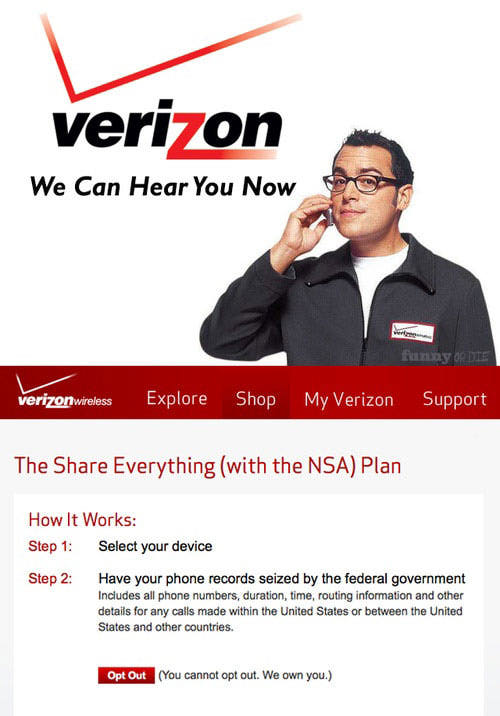
verizon-we-can-hear-you-now

A common defense of mass surveillance used by apologists is “if you have nothing to hide, why worry?” Nevermind that there’s many things that are perfectly legal that we might not “hide” but choose not to reveal indiscriminately (ie. credit card numbers, medical records, nakedness, etc.), we may in fact have something to hide but not even know it. As noted by Moxie Marlinspike of Wired.com:

If the federal government can’t even count how many laws there are, what chance does an individual have of being certain that they are not acting in violation of one of them?

For instance, did you know that it is a federal crime to be in possession of a lobster under a certain size? It doesn’t matter if you bought it at a grocery store, if someone else gave it to you, if it’s dead or alive, if you found it after it died of natural causes, or even if you killed it while acting in self defense. You can go to jail because of a lobster.

If the federal government had access to every email you’ve ever written and every phone call you’ve ever made, it’s almost certain that they could find something you’ve done which violates a provision in the 27,000 pages of federal statues or 10,000 administrative regulations. You probably do have something to hide, you just don’t know it yet.

He also makes a compelling argument for why we should have something to hide:

Over the past year, there have been a number of headline-grabbing legal changes in the U.S., such as the legalization of marijuana in Colorado and Washington, as well as the legalization of same-sex marriage in a growing number of U.S. states.

As a majority of people in these states apparently favor these changes, advocates for the U.S. democratic process cite these legal victories as examples of how the system can provide real freedoms to those who engage with it through lawful means. And it’s true, the bills did pass.

What’s often overlooked, however, is that these legal victories would probably not have been possible without the ability to break the law.

The state of Minnesota, for instance, legalized same-sex marriage this year, but sodomy laws had effectively made homosexuality itself completely illegal in that state until 2001. Likewise, before the recent changes making marijuana legal for personal use in Washington and Colorado, it was obviously not legal for personal use.

Imagine if there were an alternate dystopian reality where law enforcement was 100% effective, such that any potential law offenders knew they would be immediately identified, apprehended, and jailed. If perfect law enforcement had been a reality in Minnesota, Colorado, and Washington since their founding in the 1850s, it seems quite unlikely that these recent changes would have ever come to pass. How could people have decided that marijuana should be legal, if nobody had ever used it? How could states decide that same sex marriage should be permitted, if nobody had ever seen or participated in a same sex relationship?

…We can only desire based on what we know. It is our present experience of what we are and are not able to do that largely determines our sense for what is possible. This is why same sex relationships, in violation of sodomy laws, were a necessary precondition for the legalization of same sex marriage. This is also why those maintaining positions of power will always encourage the freedom to talk about ideas, but never to act.

Read the full article here: http://www.wired.com/opinion/2013/06/why-i-have-nothing-to-hide-is-the-wrong-way-to-think-about-surveillance/

The East German STASI regime also put their citizens under mass surveillance allegedly for their own good. The information collected was used as leverage by authorities to force informants to betray friends, neighbors and family members.  Trust throughout the society crumbled and eventually the government itself crumbled.

Building Bridges: Top 10 Issues That 99% Can Agree On

building_bridges

On a recent episode of PBS Newshour, Jeffrey Brown hosted a roundtable discussion exploring the dangers of polarized politics for American Governance. The guests were Eric Liu, Steven Hayward and Beverly Gage. Most of the discussion was an analysis of the recent government shutdown from a typical left vs. right perspective, but I thought their view of reactions of average citizens was interesting:

JEFFREY BROWN: And so, Eric Liu, let me ask you, because I know you’re very — you’re trying to engage people in the act of citizenship. What do you see the effect of all of this? Are they more engaged? Are they just more disgusted and turned off?

ERIC LIU: Well, I don’t think those are mutually exclusive. There is disgust.

(LAUGHTER)

ERIC LIU: But, because of the disgust, there’s actually more engagement.

And that’s true on both the left and the right. Look, I think the reality is, when Steven was speaking a moment ago about the kind of encroachment of ever-growing and ever-larger government, we can have reasonable debates in this country about what the proper size and scope of government ought to be, but we ought to regard those debates not as “on/off, yes/no, my way or we shut the whole thing down” kind of debates.

…so people from both left and right watching these last two weeks are ready for something different.

They’re ready to actually hear each other and see one another and not the caricatures of one another, and try to figure out, well, where is it that we can manage to agree on the role of government, and where we can’t agree, how can we recognize that to be a citizen isn’t just a single-shot sudden death game. It’s infinite repeat play, and you’re going to win some, and I’m going to win some.

JEFFREY BROWN: All right, let me ask Steven Hayward to respond to this.

Do you see the result of this as people ready to work together or more divisions that ever more polarizes?

STEVEN HAYWARD: Well, I think there’s two things to think about here.

One is, is we have divided government once again. The voters, God bless them, have a lot of cognitive dissonance. Right? In the last week, what you saw is people say, I don’t like Obamacare, but I don’t want the government shut down. I don’t want it to be a matter of a budget fight the way it’s become. And that’s why Republicans lost this proximate battle.

But if you look at some of the poll numbers right now, I think they ought to be very worrying for everybody, but I think more worrying ultimately for liberals, for this reason. You have seen record high numbers of people who now say — I think 65 percent in one poll — that government is a threat to their rights.

You have seen a long-term trend going back really to the 1960s of the number of people saying they have confidence that the federal government will do the right thing down in 15 percent, 20 percent, when it used to be in the ’50s up around 60 to 70 percent. And to the extent that if you’re liberal and that you believe in political solutions to our social problems or government engagement with our problems, you want the public to have confidence in the federal government’s capacities.

And so it seems to me that, as much as this might have been a train wreck for Republicans, the long-term effect of this might not necessarily play out that way.

JEFFREY BROWN: Well, Beverly, when you look back at political — what could be called political crises of the past, what does it — what happens in terms of public response to those?

BEVERLY GAGE: Well, I think to some degree, Steven’s quite right, in that I would kind of like to subscribe to Eric’s view that we’re going to have a much more serious conversation, a much more bipartisan conversation.

But I think it’s equally possible that you’re actually going to see people throw their hands up and say, oh, it’s all such a mess. I don’t really want to make sense of it. I don’t want to deal with it. And, in that way, it sort of serves an anti-government message, and in some ways, even serves sort of the Tea Party message in ways that maybe were intended and maybe weren’t.

But I think there’s also a danger for the Republican Party in all of this, which is to say that these divisions that we’re seeing right now within the Republican Party between moderates and Tea Party conservatives and also between a sort of establishment business class, which is very, very alarmed about what’s happening, and this more right-wing part of the party, that actually may in fact spell destruction for the Republican Party.

Those are divisions that have been there for a long time. They have often been papered over. But when you’re on the brink of financial catastrophe in the way that we were, we may not see them be papered over, and we may in fact see some sort of political realignment coming out of this.

You can read the complete transcript here: http://www.pbs.org/newshour/bb/politics/july-dec13/governing_10-17.html

All three guests made good points, though the views of conservatives and liberals are typically generalized in such discussions and I think issues of most concern to citizens on a grassroots level are often not the ones being debated enough in Washington D.C. There definitely needs to be more political discussion between left and right not just within government but among the general public. Increased communication and education is the best defense against “divide and conquer” tactics but of course this is easier said than done because politics has become a taboo subject for many, mainly due to fear of getting into heated arguments. But perhaps this fear is unwarranted because there’s many issues that the left and right can agree on (though motives and priorities may differ). These are just some of the more topical examples:

  1. End the Wars – As demonstrated by widespread negative reaction to war threats against Syria, people are perhaps becoming more aware of political trickery thus becoming harder to persuade. Also, as living standards drop for more people, the connection between costly foreign policy and the nation’s declining economy and infrastructure has never been more obvious.
  2. Stop the Surveillance State – Privacy is a universal human need. Mass spying on citizens is illegal and unethical whether online or through drones and informants.
  3. End Unjust Trade Agreements – Agreements such as NAFTA and the Trans-Pacific Partnership (TPP) hurt working people and endangers health and safety, the environment, and national sovereignty.
  4. End the Fed – We’ve endured 100 years of a “Federal” Reserve run by private bankers and all we have to show for it is a debt of tens of trillions of dollars. It will never be paid off as long as we continue to use interest-bearing federal reserve notes as currency.
  5. Create Affordable Health Care – It can be argued that Obamacare is an incremental improvement but everyone knows it’s not enough and is far more beneficial for greedy insurance companies than the poor.
  6. End the Drug War – We can all agree the Drug War is a colossal failure (when it comes to the stated purpose of reducing drug addiction). It has only increased incarceration rates while enriching the prison-industrial complex and drug cartels. We need to adopt policies that have proven to be effective such as legalization, decriminalization and harm-reduction.
  7. Stop GMOs – GMOs are unnecessary, physically and economically harmful to farmers, may have potentially catastrophic effects on the ecosystem, and only serves to increase profits for companies like Monsanto.
  8. End Obscene Economic Inequality – Complete economic equality might not be possible, but when economic inequality reaches absurd and unsustainable levels as they have today, obviously something needs to change.
  9. Protect Internet Freedom – Legislation such as the NDAA, SOPA and PIPA indicate that government and corporations are threatened by the internet. Attacks against internet freedom are attacks against freedom of speech, freedom of information and cognitive liberty.
  10. Ignore Corporate News – Another point of agreement between right and left is the corporate news media’s increasing irrelevancy and bias. Today it is not so much a liberal or conservative bias as it is a neoliberal and neoconservative bias.

Does the Government Only Label Bad Guys As Terrorists?

Perhaps, if one’s definition of a “bad guy” is so broad it becomes meaningless.

Among the findings in this must-read article recently posted at Washington’s Blog, Does the Government Only Label Bad Guys As Terrorists?, the following characteristics could get you labeled as a terrorist by the  government:

As you can see the list is pretty long, but sure to get longer as the government becomes even more corrupt, ineffectual, and fearful of revolt. Having such a loose definition of “terrorist” will do nothing to make anyone any safer (except perhaps the wealthy elite). In fact, it will only discourage dissent and encourage obedience to the corporate state which ultimately endangers the health of society.

fusion-center