From Burkina Faso to Niger to Gabon, Western Hegemony Dying in Africa

By Harun Elbinawi

Source: Covert Geopolitics

Berlin Conference of 1884-1885 was undeniably one of the biggest evil summits in modern history. Greedy and racist European colonialists sat down in the German city and divided Africans as if they were sharing bread on a breakfast table.

The conference was organized by Otto von Bismarck, the first chancellor of Germany at the request of King Leopold II of Belgium, the Western genocidal barbarian that murdered more than 10 million innocent Africans in Congo.

Most Africans are not even aware of this genocide in Congo perpetrated by the Belgium colonialists because it is not in our history books written by the white colonialists.

European colonialism in Africa lasted more than a century with only the ancient Kingdom of Ethiopia spared because they defeated the Italian colonialists on the battlefield.

Trillions and trillions of dollars were stolen from Africa, millions of Africans were murdered by the European colonialists and Africans were massively brainwashed that they had no history before European colonialism.

The wave of ‘independence’ in Africa from the 1950s and 1960s did not represent true independence. What actually happened was that colonialism was cleverly replaced with neocolonialism by the genocidal imperialist barbarians of the West.

The massive looting of rich resources in Africa continued under Western puppet leadership. The courageous African leaders who refused to dance to the tune of the European colonialists were eliminated.

This was what happened to African heroes, Patrick Lumumba of Congo and Thomas Sankara of Burkina Faso. Congo has all mineral resources except for crude oil.

The uranium used by the US regime to make the atomic bombs unleashed on Hiroshima and Nagasaki was mined in Congo.

French greed in Africa

Among the European colonialists, French colonialism was more brutal and exploitative.

France killed more than 1.5 million civilians in Algeria alone. They murdered tens of thousands of civilians in other African countries.

One of the Modus Operandi of the French colonialists was to assemble Islamic scholars in a hall and exterminate all of them. They did this in Algeria, Chad, Mali and Senegal.

And the greed of their neocolonialism is extreme. Even after independence, France is still controlling the wealth of its former colonies in Africa.

The rich resources of French nations are still controlled by France and they continue to pay colonial tax to France.

French goods and services dominate their markets. The domineering presence of France in these countries has been excruciating and devastating for local populations.

Niger Republic does not know the quantity of uranium France was taking from there, which is worst than slavery.

No evil lasts forever

There is a popular saying that “No evil lasts forever”.

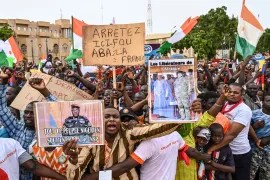
France’s neocolonialism in Africa will not last forever. Popular military coups against puppets of France imperialism have started and are gathering momentum.

The recent military coup in the West African state of Niger Republic does not stand in isolation but follows similar upheavals in the neighboring countries of Mali, Burkina Faso, and Guinea in recent years.

Mali is facing insurgency that is backed by Western hegemony. Mali expelled French troops because they were actively aiding the insurgents to justify its military presence in the African country.

Now, on Wednesday, we woke up with the news of another puppet of the Western hegemonic barbarians in Gabon overthrown by the military. Ali Bango inherited the Gabon presidency from his corrupt Father, Omar Bongo.

Early on Wednesday, some military personnel appeared on state TV and announced that they were seizing power and dislodging a family that has ruled the country for 56 years.

The military officers introduced themselves as members of the Committee of Transition and the Restoration of Institutions.

“Today the country is undergoing a severe institutional, political, economic, and social crisis,” the officers said in a statement, dubbing the recent election illegitimate.

“In the name of the Gabonese people … we have decided to defend the peace by putting an end to the current regime.”

Pertinently, Gabon’s former president had 70 bank accounts, 39 apartments, 2 Ferraris, 6 Mercedes Benz cars, 3 Porsches and a Bugatti in France. He ruled for 42 years (from 1967 to 2009). French leaders loved Bongo because he was loyal to them.

His son, Ali Bongo has been the president for 14 years (2009 – 2023). He has just been overthrown in a  coup.

Failure of Western liberal democracy

The fact is that the Western liberal democracy has not only failed in Africa but has failed woefully.

Democracy in Africa has become a tool for the corrupt ruling elites to steal the wealth of their respective countries and transfer it to Western financial institutions while the populations remain in abject poverty and hunger.

Democracy is just another system of government hijacked by the Western hegemonic barbarians, the biggest enemies of the human race. Democracy is now an imperialist tool of Western hegemony in Africa. This is a bitter and undeniable fact.

The people of Gabon will definitely celebrate this military coup as it marks the end of French interference and looting in their country. Another setback for the French leaders.

Africa must rise again

The most noticeable current in Mali, Burkina Faso, Guinea, Niger Republic and Gabon is that the change of governments all have popular support as the people of those countries are tired of France’s imperialism, arrogance and terrorism.

Today France has the 4th largest gold reserves in the world and there is no single gold mine in France.

These gold mines are all in Mali, Niger Republic and other African countries. The France neocolonialism in Africa must end. Its time has come.

Revolutionary Terror: Mark Steven’s ‘Splatter Capital’

By Michael Grasso

Source: We Are the Mutants

Splatter Capital: The Political Economy of Gore Films
By Mark Steven
Repeater Books, 2017

“Splatter confirms and redoubles our very worst fears. It reminds us of what capital is doing to all of us, all of the time—of how predators are consuming our life-substances; of how we are gravely vulnerable against the machinery of production and the matrices of exchange; and of how, as participants of an internecine conflict, our lives are always already precarious.”

—from the Introduction to Splatter Capital

Political readings or interpretations of horror films are nothing new. But in Mark Steven’s 2017 study, Splatter Capital, an explicit connection is made between the bloody gore of what Steven terms “splatter” horror films and the dehumanizing, mutilative forces of global capitalism. Moreover, Steven posits the artistic motivation behind splatter horror as an explicit repudiation of this system: “It is politically committed and its commitment tends toward the anti-capitalist left.” In splatter films, Steven tells us, the images of gory dismemberment do double duty. They both offer a clear metaphor for capitalism’s cruelty, and act as a cathartic revenge in which the bloody legacy of capitalist exploitation is often visited upon its perpetrators and profiteers among the bourgeoisie.

Some definitions are in order here, given that Steven’s schema of genres—“splatter,” “slasher,” “extreme horror”—draws distinctions that might not be apparent even to horror fans. Splatter horror, according to Steven, is all about the violence that can be visited upon the human body and all the abjection that follows. It is machinery tearing apart flesh, blood, and guts: the moment a human body becomes meat. It differs from the personalized and often sexualized “hunt” of the slasher flick. The protagonist in a slasher movie is an individual (often female) resisting violent death at the hands of another individual (often male). In victory against Jason, Freddy, or Michael Myers, this protagonist, in Steven’s words, “restores a social order, which is all too regularly white, middle-class, and suburban.” Splatter horror not only expands the horizons of mutilation and violence allowable in a horror film but systematizes it. The splatter enemy is an implacable, impersonal force, full of shock and awe; its grudge is not personal, but instead overwhelming, inescapable, and, most importantly, class-based.

The language of violence and horror has been with Marxist thought from the beginning. Steven gives us a good précis of Marx’s use of explicitly Gothic (along with bloody and cannibalistic) imagery throughout his works, as well as a splatter-tastic explanation of the exploitation behind surplus value, using an imaginary case study in the manufacturing of chainsaws and knives. The October Revolution in Russia is viewed as a reaction to the inhuman mechanized slaughter of the first World War; Eisenstein’s early filmic paeans to the necessity of revolution such as Strike (1925) demonstrate, thanks to Eisenstein’s pioneering use of montage, capitalism’s role as butcher. Steven also discusses avowed leftist filmmakers from outside the Soviet Union such as Godard, Makavejev, and Pasolini—specifically their use of gore to embody the cruelty of the ruling classes.

As we enter the world of Hollywood film in Chapter Three, Steven examines splatter film as a specifically American reaction to the constant churning crisis of capitalism. Specifically, Steven looks at the two peaks of gore-flecked horror—the mid ’60s through the early ’80s, and the post-Cold War “torture porn” trend of the early ’00s—as expressions of two very important economic and political shifts. The first splatter peak in the ’70s is seen as a clear reaction to the slow, inexorable widening of neoliberal and globalist postindustrial economics and its impact on the American industrial worker. (The aftermath of this trend continues into the 1980s with the evaporation of industry and the establishment of a new information-and-finance-based economy.) The splatter/torture porn trend of the ’00s and beyond is a reaction to the crises of capitalism under a new world order of neocolonialist conflict: the War on Terror, the final disestablishment of the Western industrial base in favor of cheap labor in the developing world, and the new interconnected, networked world’s rulership by speculative capital in the form of the finance sector.

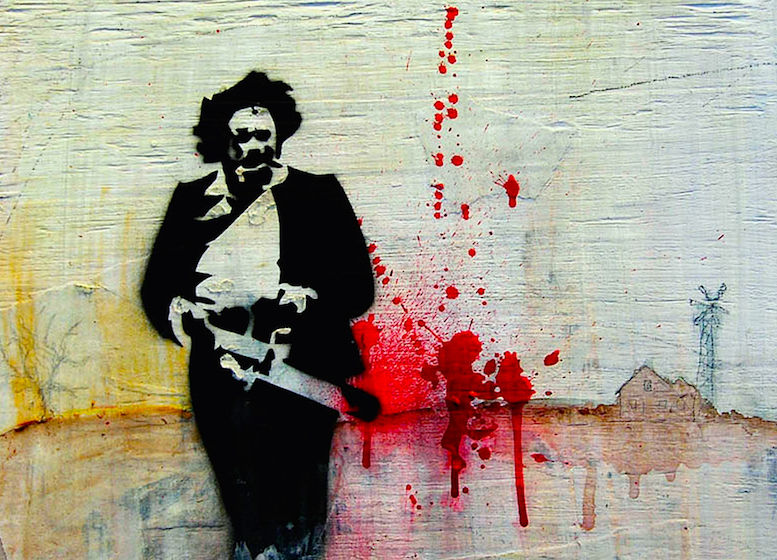
Steven cites too many splatter movies to cover in this review, but central to his thesis is the seminal 1974 Tobe Hooper film, The Texas Chain Saw Massacre. The death of local industry leads Leatherface and family to keep their slaughterhouse traditions alive by carving up and eating young people. These young people, Steven is quick to point out, are only here at all because they were unable to get gas for their car (thanks to the first of two 1970s oil crises). American decline is everywhere; betrayal by global economic forces are central to the trap that’s being laid by the cannibals. (Of course, the carnage of the Vietnam War can’t be overlooked here either, given the visual language of ambush, capture, and torture; Hooper himself has cited this in subsequent interviews.) Steven notes that the victims in The Texas Chain Saw Massacre are representative of a bourgeoisie who don’t know how the sausage is made. It’s important and vital, Steven says, that the cannibalistic side of splatter involves the bourgeoisie being forced to eat members of their own class. It’s Burroughs’s famous “naked lunch“: “the frozen moment when everyone sees what is at the end of every fork.”

As the neoliberal takeover of the world economy begins in earnest in the 1980s, as complex and largely ephemeral systems of mass media and finance take the place of the visceral, grinding monomania of industrial capitalism, splatter horror follows suit. Steven’s analysis of David Cronenberg’s Videodrome (1983) is especially sharp, examining the links between the body horror of the film and the Deleuzian body without organs. Max Renn’s body becomes an endlessly modular media node, able to accommodate video cassettes, to generate and fuse with phallic weapons (used to assassinate and destroy the media forces who’ve made him this way), to mesh and mold and mix with the hard plastic edges of media technology. By the end of the film, Renn is a weapon reprogrammed and re-trained on the very media-industrial complex that made him. More body horror: the cult classic Society (1989) and its shocking conclusion posits the ruling class as a cancerous monster, an amorphous leviathan straight out of a Gilded Age political cartoon, eating and fucking and vomiting, red in tooth and claw and pseudopod. Barriers between bodies break down; the system begins swallowing up all alternate possibilities.

By the time the Cold War is finished, the era of post-9/11 eternal war, of Abu Ghraib and Guantanamo, led to the popular new splatter sub-genre of “torture porn.” Steven identifies the genre’s distinguishing aesthetic feature: the indisputable, systematic, and worldwide victory of capitalism and the hypnotic Spectacle that accompanies it. In this era, there are no longer any alternatives. Everyone, rich and poor, is trapped in the system, and the system reintegrates torture into a worldwide video spectacle. This is embodied in both the global conspiracies of the wealthy in Roth’s Hostel series and in the Jigsaw Killer’s industrially-themed Rube Goldberg devices in the Saw franchise—devices of dismemberment explicitly linked to moral quandaries reminiscent of capitalism’s impossible everyday Hobson’s choices for the working class. The system will go on consuming you, whether you’re unlucky enough to be a splatter film’s victim, or “lucky” enough to wield the power to splatter (for example, Hostel: Part II‘s reversal of fate on the ultra-wealthy hunters, or the Jigsaw Killer’s death from cancer in Saw III—ultimately due to… a lack of health insurance).

Possibly the most intriguing aspect of this already very good book is Steven’s interspersing of personal anecdotes on when and where he discovered some of his favorite horror and genre films. By placing his personal and psychological experience of splatter films front and center, and linking it to his personal growth and increasing political maturity, he demonstrates the personal impact of the political, and the necessity of personal epiphany, mediated by culture, to achieve political awareness. Splatter Capital ultimately is not a book for the already-convinced and committed leftist, the Marxian thinker already well-versed in theory. (Another of Splatter Capital‘s very strong points is how Steven largely eschews jargon and obscurantism for an approachable tone and topic that laypeople can dive into easily.) It is for the fans of these films who’ve always wondered about the ineluctable appeal of visceral, shocking violence on screen, and perhaps why it all feels so strangely familiar.

Financialization, precarity and reactionary authoritarianism

By increasing global competition, the precariousness wrought by financialization has laid the foundations for reactionary authoritarianism around the world.

By Max Haiven

Source: ROAR

Financialization: Fictitious Capital in Popular Culture and Everyday Life, released last month in paperback from Palgrave Macmillan. The book argues that financialization is not just the increasing power and authority of speculative capital over the global economy, but also the way the it seems into and is reflected in politics, social institutions and the realm of cultural meaning.

This section comes at the end of a chapter on the ways financialization both drives onward and depends on the increasing precariousness of workers, putting us into global competition with one another and also infecting our sense of value and success. Haiven argues that this situation produces a tendency towards reactionary authoritarianism based on a “forgetting” and a loathing of our shared human condition of precariousness. He concludes by asking us to consider other models for thinking about debt and precarity that stress radical interdependence.

It is followed by a brief authors’ note reflecting on the piece four years since it was first penned in 2013.


Precarious fear and loathing

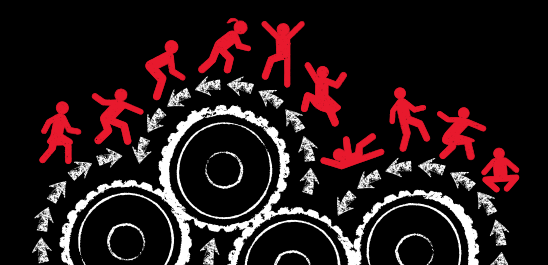
Today precariousness is the norm, not the exception. Our current precarious moment, one dominated by market and financial forces and manifesting itself as a violent form of hyper-neoliberal austerity (which is producing ever more and deeper economic precariousness), is only one particularly pernicious manifestation of an underlying ontological condition. It is worse than many such manifestations precisely because it is so successful in privatizing precariousness through the logic of individualism and competition.

We come to blame ourselves, rather than the system, for our precariousness, in part because, unlike some rigid caste-based system or a slave society, we are (most of us) legally and technically free to escape precariousness (though, ironically, to escape by embracing precarity, by using every skill, talent and asset we might possess to leverage ourselves into fabled prosperity). It is a system that works by promising that we can, each of us, alone, escape our existential condition of precariousness by getting rich, by obeying the system’s axiomatic dictates and playing our role.

The constant barrage of images and tales of the lifestyles of the rich and famous, of celebrities and of others who have “made it” do not exist (as they did in a previous era) to show us the right social order and the natural superiority of certain sorts of people. Rather, these ubiquitous dream-images promise each of us a life without precariousness or, more accurately (if we think about the cinematic depictions of the Wall Street predator) a life where precariousness is mastered and leveraged.

This helps explain the virulent disdain that grows and grows towards the poor, the refugee, the  (almost always racialized) populations deemed to be “at risk.” To the extent that we succeed in leveraging ourselves out of the total liquidation of our lives by building up a life of financial prosperity and (the illusion of) security, we are compelled to close ourselves off to what Judith Butler, drawing on the work of Emmanuel Levinas, calls the “face” of the other: the empathetic image of existential suffering. In fact, to the extent participation in financialization has come afford us the privilege of forgetting our inherent shared condition of precariousness, we come to loathe the face of precarity, loathe the way it calls us back into a fellow precarious human body.

The colors of risk

As a result, we should not expect that the almost universal adoption of the free market will lead to any sort of peace or cosmopolitanism in the world, as neoliberal thinkers like Fredrich Hayek or Francis Fukayama believed. Nor should we assume that the financialized age of austerity will prompt such a wave of popular discontent that radical social transformation is inevitable. To the extent that we are made more and more precarious, we brew an existential anger, a self-loathing that can easily be displaced onto convenient others.

Ironically, it is not easily displaced onto the architects and beneficiaries of financialized capitalism, but instead gravitates towards the more precarious, the more abject: they who call us back into the shared precarious what Marx called our “species being,” our shared precarious condition as imaginative cooperative animals dependent on one another for joy and survival. While this may or may not manifest itself in the form of new nationalisms, it will manifest itself in the form of hatred towards the homeless, towards refugees, towards welfare recipients and towards others.

It is vital to note that, in North America and Europe, and in different ways elsewhere, this precarious vitriol cannot be separated from the history of race and racism. Older modes of racial enslavement, apartheid and segregation served the same function, similarly allowing those read as “white” to posit a superior form of humanity which both occluded a shared precariousness and elevated the material wealth and security of whites at the expense of immiserated, exploited and impoverished non-whites (in different ways, in different times and places).

Indeed, earlier moments of capitalism explicitly mobilized whiteness and its real and perceived benefits vis-a-vis precariousness to divide workers along color lines, a condition that fed, and was fed by, the existential precariousness of non-whites who, as second-class citizens, slaves, migrant laborers or perpetual “outsiders,” were not afforded the same personal safety or security (neither de jure nor de facto).

The current reigning assumption is that we have entered a “post-racial” moment, that racism is merely a marginal anachronism, and that racialized people face no systemic barriers to achieving a non-precarious life like “everyone else” — in other words, they are as free to enter the market as anyone else, and the market does not “see” race. The opposite is, in fact, the case: racism and racial inequality towards non-white people persist and, in some ways, are even worse thanks to the mechanisms of financialized market which also works to make those inequalities functionally invisible.

Banking on resentment

On another level, we might speculate that precariousness, in both image and concept, is already racialized, that our understandings of what it means to be precarious, and the negative associations with which this term resonates, are already coded as non-white and call up a legacy and a present of racialized images of abjection, destitution, subservience and shiftlessness. Indeed, we might ask to what extent political systems in the West base their legitimacy on the invisiblized darkness of precariousness. The politically expedient citation of the disappearance of “hard-working Americans” and “the middle class” (both of which are imagined as white) into a dark miasma of economic depression is indelibly associated with popular depictions of ghettos and menial racialized workers.

Suffice it for now to say that we can certainly see these trends as played out in largely white backlash movements which have arisen to confront non-white peoples’ or groups’ claims to social and economic justice. From anti-Muslim organizing in Western Europe (framed in terms of defending a white national heritage and white workers), to anti-Black “whitelash” in the United States (from the Detroit Riots to Rodney King to Trevon Martin), to the anti-Indigenous vitriol in my home country of Canada, these seemingly spontaneous “social movements” speak not only to the politics of ignorance and fear, but also to the socio-economic conditions of precariousness, as well as the perceived failure of the state to live up to its promises to prevent precariousness for white people, all coupled with a history that locates precariousness along the axes of race and racialization.

This deeper existential and ontological crisis and anger is joined by another: the crisis of the middle class. Those professional or semi-professional workers who have been taught to expect middle-class incomes and job security are quickly finding themselves disposable in a vast pool of precarious workers, leading highly indebted, precarious lives with little hope for reprieve. In the coming years, increasingly fascistic political powers will gain ground by offering hollow promises to rebuild the middle class and to end precarity, through neocolonial geopolitical adventure or by creating or maintaining localized under-classes of hyper-precarious migrant or abject workers.

The cult of risk management

What would a politics look like that promised not to end but to embrace precariousness, not as an inescapable economic “reality” (which is what our current system of financialized austerity pledges) but as a socio-ontological sine qua non?

The answer is yet to be determined. But, ironically, an answer may be emerging out of the financialized paradigm that has driven precariousness to a new level of universality and acuity. The speculative ethos that animates financialization is one intimately and irreducibly acquainted with the ontological realities of precariousness. “Risk” and “risk management” are, underneath all their trappings of quantitative and scientistic rigour, mythological constructs for engaging with, navigating through and manipulating the cultural fabric of precariousness. Investments are, at a certain abstract level, attempts to leverage precarious life into more advantageous out- comes.

Finance, as a broad sphere of activities, is a mechanism by which individuals and society at-large seek to gain agency over the precariousness and contingency of the future. It is a particularly perverse mechanism, and one whose logic and mechanisms are either occluded from sight, or so complex, rapid or vast to be fully grasped, even by their primary engineers and agents in hedge funds and investment banks. Yet finance reproduces itself by cultivating and mobilizing the energies, creativity and hope of almost everyone in their attempts to thwart or diminish precarity, and aggregates all these individual and institutional actions into a system which, tragically, only drives greater and greater precariousness.

Generative debts?

The silver lining is perhaps this: what financialization reveals is the inherent futurity of precariousness. The word itself derives from the Latin prex or prayer, with strong connotations of begging or soliciting: yearning for future outcomes, throwing oneself on the mercy of fate or divine provenance. What our financialized moment might reveal is that our shared precariousness, which is the condition both of disastrous authoritarianism (including the disorganized and diffuse totalitarianism of finance capital itself) and of solidarity, does not only emerge from our shared material and ontological conditions; it is also a horizon of shared futurity. That is, precariousness carries encrypted within it a shared relationship with the future.

In this sense, nascent anti-debt organizing in the United States and elsewhere bears a great deal of potential. As Richard Dienst, David Graeber and Andrew Ross all affirm, the politics of debt, if they are to be a radical challenge to the financialized empire, cannot simply be a demand for some libertarian fantasy of complete individual freedom. Rather, they must embrace a broader, more capacious concept of the ontological wealth of social bonds that make life possible, that render all of us precariously reliant on one another. In this sense, they, each in their own way, encourage us to envision an expanded notion of (non-monetary) debt beyond as a grounds for crafting and building common futures through the entanglement of our social relationships.

Likewise, Angela Mitropoulos insists on the importance of moving beyond the limited concepts of financial debt and “debt servitude,” which depend upon and exalt the ideal of the individuated (white, masculine) self, the esteemed, contract-making personage at the heart of Western liberal political and economic philosophy and law. She notes that behind today’s politics of debt there reside the unacknowledged debts germane to the worlds of social reproduction and affective labor on which we all rely, which today are increasingly commodified in the so-called service sector. Indeed, the growth of precarious, feminized service-based labor over the past few decades cannot be separated from the rise of debt as a means to discipline workers and extract surplus value. Beyond the hollow promise of an ideal state of freedom from all obligations, radical potentialities might emerge from the affirmation and recognition of shared interdependency, of the shared need for what today is misrecognized as “service.” As she puts it:

The question it seems to me is not whether our debts can be erased, but what the lines of indebtedness are, how debt is defined, whether it takes the form of a financial obligation or some other consideration of relational inter-dependence, of the forms of life that the routine accounting of debts lets flourish or those that it obscures behind propositions of a seemingly more natural order of individuation, dependence, and obligation.

Beyond the colonial bond?

Glen Coulthard articulates a radical Indigenous reenvisioning of obligation that goes well beyond the Western philosophical canon:

Consider the following example from my people, the Dene Nations of what is now the Northwest Territories, Canada. In the Yellowknives Dene (or Weledeh) dialect of Dogrib, land (or dè) is translated in relational terms as that which encompasses not only the land (understood here as material), but also people and ani- mals, rocks and trees, lakes and rivers, and so on. Seen in this light, we are as much a part of the land as any other element. Furthermore, within this system of relations human beings are not the only constituent believed to embody spirit or agency. Ethically, this meant that humans held certain obligations to the land, animals, plants, and lakes in much the same way that we hold obligations to other people. And if these obligations were met, then the land, animals, plants and lakes would reciprocate and meet their obligations to humans, thus ensuring the survival and well-being of all over time.

Coulthard’s articulation of a broader field of grounded land-based obligation, reciprocity and care demonstrates the radical potentialities that might emerge from a reconsideration of the bonds of debt and the conditions of shared precarity, were we open to re-envision their meanings beyond the hollow promises of security proffered by capital and the state.


Since the publication of Cultures of Financialization I have felt unhappily vindicated in my suspicion that financialization would give right to revanchist authoritarianism. But were I to approach the topic of this excerpt again, I would take more care to locate the origins of the loathing of precariousness within the specific histories of anti-Black racism. I would approach this by making more explicit the origins of finance capital in the trans-Atlantic slave trade and slave economies in the Americas. I would follow this tendency through to the present-day ways that anti-Black racism and white-supremacy, as the template and operating condition of all forms of modern racism, is manifested again and again in the machinations of the financial empire, from the continued neocolonial pillage of Africa to the racialized dimension of the sub-prime loan crisis which led to the single largest theft of Black family wealth since Reconstruction.

Were I to approach this topic again I would also stress more centrally the ways in which settler colonialism destroys and denigrates a cooperative relationship with land, most horrifically by seeking the systematic elimination of autonomous Indigenous presence and power on land. I would seek to understand (as I have elsewhere) how settler colonialism has always been a financialized project, and how financialization has, historically and in the present, been enabled by settler colonialism.

I think that only with these in mind can we seek to understand how financialization has given rise not only to new forms of authoritarianism that promise (white people) respite from the precarity financialization has created, but which are fundamentally based on the acceleration and intensification of white supremacy and settler colonialism.

Finally, were I to approach this chapter again I would caution myself against a conclusion that could appear to call for a kind of new universalist embrace of shared precarity. I would have concerned myself with the way such a universalism, while noble in a certain abstract sense, can work to erase precisely the continued centrality of (anti-Black) racism and settler colonialism. Instead, I would have stressed that overcoming financialized precarity and these systems of oppression and exploitation will be based not only on high-minded virtues but meaningful relationships of militant solidarity and the collective invention of new forms of power, new institutions of care and new frames and practices of revolutionary thought and action.

The Choice: Traitor to Empire, or Traitor to Mankind

By John Rohn Hall

Source: Dissident Voice

I envy you. You North Americans are very lucky. You are fighting the most important fight of all. You live in the belly of the beast.

— Dr. Ernesto “Che” Guevara

A birth certificate from somewhere between the beast’s belly and its beating heartland condemns me to the dubious distinction of being among the privileged 5% of humans who claim United States Citizenship. A population which demands the right to consume 25% of earth’s resources while billions of our fellow-humans go hungry. A shame it was wasted on me, for I’ve never been one to make my country proud. Basically, I’ve always been a bad American. Cases in point: I never stand for The Star-Spangled Banner, nor do I Pledge Allegiance to the Flag of Retroperistalsis. I no longer believe in, nor vote in sham, mockery-of-democracy U.S. elections. I make no investments in Wall Street, for fear of inadvertently supporting The Military-Industrial Complex. If I happen to turn on the evening so-called news, I can’t resist calling Lester Holt “America’s House Negro”, for Holt’s Nightly Lies loudly confirm what Chris Hedges tells us: “No real journalist makes $5 million a year…Those in power fear and dislike real journalists.” And I pray regularly to whatever gods may be that Empire dies with a whimper, rather than a bang…and soon. There is little doubt that I am, and have for many years, been a traitor to Empire and its agendas of Neo-colonialism and wars for profit.

Fifty years ago, while Che Guevara was being summarily executed by the C.I.A. and its Bolivian Military stooges, my lifelong battle against Empire was just beginning. Che’s last words were some of the most prophetic ever spoken, as he looked his assassin in the eyes and said: “Shoot coward. You are only going to kill a man.” Only the good die young, they say. It is said that Che is much more powerful in death than he was in life, as a half century later, his legacy lives on and grows. Two years after his demise, he’d lit fire of discontent beneath a whole generation of Americans, and stood posthumously by my side as I gave the U.S. Army my very best middle-fingered salute, thereby refusing induction into the most over-funded, offensive, aggressive, killing force the world has ever known.

My neighbors and acquaintances are not evil or bad people. They’re simply oblivious to what George Carlin lovingly called “the big red, white, and blue dick” being shoved up their asses by the likes of Lester Holt and his cadres in criminal propaganda on a nightly basis. Americans are to be pitied for their willful ignorance. If I were a Christian, I’d ask God to forgive them, for they’re a bunch of clueless jackasses who know not what they do. But not being a believer in the imaginary bearded man in the stratosphere, I write. Not that I have any delusions of being omniscient, but my moderate level of enlightenment has been reached, one step at a time, one book or article at a time, and Che’s sword is now my pen. Che’s rifle, my Hewlett-Packard. The pen (in certain circumstances) is mightier than the sword. If Che had fought the Revolution, in the belly of the beast, with bullets, he would have been eliminated long before 1967. Lucky for me, thus far, Empire only executes the highest-level truth-talkers and traitors to the Military-Industrial agenda.

NBC demoted Brian Williams for the high crime of telling his own personal lies, instead of just the official ones, then replaced him with Mr. Holt. I’d seriously doubt whether either of these corporate whores, or any of their collaborating competitors give a rat’s ass whether their thousand-dollar-a-sentence blather bears any resemblance to the truth. Truth is the enemy of the overlords they serve, and has no place in the nightly news agenda, nor in any facet of Empire’s Disinformation Network. Truthful coverage of Empire’s latest wars for profit: Forbidden. Questioning the basic good intentions of our exceptional government: Not allowed. Tow the line, learn and regurgitate the fabrications du jour, read all recent directives from the C.I.A., keep your nose clean, your Armani Suit pressed, and God Bless America.

My insouciant neighbors and acquaintances have never heard of Noam Chomsky, and know nothing of Manufactured Consent. They have never seen a copy of Howard Zinn’s A People’s History of The United States. They have no idea that “War (really) is a Racket” (Brigadier General Smedley D. Butler). They’d likely not even blink an eye at the atrocities wrought against the Southern half of The Western Hemisphere by the U.S.A. and its European counterparts, as artfully reported by Eduardo Galeano in Open Veins of Latin America. Hugo Chavez gave a copy to Barack Obama shortly before his mysterious and suspicious demise. Too bad Barack never read it. Not that he would have cared, being well programmed by the C.I.A.

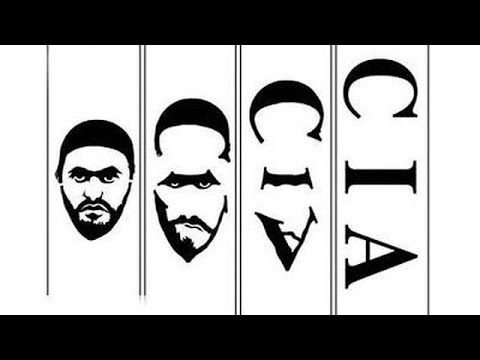
When I’ve tried to explain to mainstream Americans the dastardly scheming of the C.I.A. in foreign countries; its economic hit men and jackals, bribery, coup d ‘etat, assassination, and finally bombs and bullets…as exposed by ex-C.I.A. Operative John Perkins in Confessions of an Economic Hit Man, the responses are glazed, dazed expressions. I might as well be talking to four-year-olds when explaining that 9-11 was an inside job, as proven beyond a shadow of a doubt by such sources as Michael C. Ruppert’s Crossing the Rubicon, or that the C.I.A. and other branches of our government eliminated J.F.K. for choosing the path of peace, as explained by James W. Douglass in his masterpiece, J.F.K. and the Unspeakable. The subtitle of the J.F.K. volume is “Why He Died and Why it Matters”, but what really matters to my adult four-year-olds is whatever professional gladiator games happen to be in season.

Americans don’t want to hear that “terrorism” is nothing but the direct result of Empire’s overreach and military incursions into every little resource-rich, under-militarized country on earth. Who, outside a few conspiracy theorists like me could give a shit about Chalmers Johnson’s trilogy, which includes “Blowback”, and exposes The U.S. Military’s Empire of Bases and aspirations for complete world domination? If I happen to mention The Great American Holocaust (the most deadly in earth’s history), as graphically illuminated in Roxanne Dunbar-Ortiz’s An Indigenous Peoples’ History of The United States, in oblivious company, white faces gaze at me in wonder…wondering why I’d care about the slaughter of a few tens of millions of inferior beings. One of the biggest secrets in the U.S.A. is the mystery of the most enduring, morally upstanding, and advanced civilization in earth’s history; a story expertly told by my friend Jeff J. Brown in China Rising: Capitalist Roads, Socialist Destinations. After 100 years under the heavy hand of Empire, the sleeping dragon is once again rising. Empire knows it…thus the so-called Pivot to Asia Strategy, and another $60 billion gift for The Pentagon.

The few of us who’ve come to understand the intrinsic evil, and violence on every level, of the United States of America, reach a point where a choice must be made. As U.S. Citizens, we can choose denial and ignore our own enlightenment, thus remaining part of the problem. Or we can cross The Rubicon, as Caesar did, and by doing so becoming traitors to Empire, enemies of the state, and strangers in our own land. If we choose the latter, alea iacta est; the die is cast, and there is no going back. Ignorance may be bliss, but the truth shall set ye free.

Empire is on a collision course with destiny. It’s a runaway train, carrying enough Weapons of Mass Destruction to turn our fading blue planet into shades of smoldering gray, and end life on earth as we know it. Never underestimate the blind, ignorant greed and mindless dreams of dominance of the sociopaths in the cab of Empire’s Engine. You know it. I know it. We are soldiers in Empire’s Underground Army, armed only with words, ideas, brilliance, open eyes, and hope. Those bearing arms need not apply. The battlefield of this war is for the minds of the insouciant. Somehow we must awaken an entire population which only pretends to sleep, and has no interest in buying what we’re selling. Always remember how lucky we are. We’re fighting the most important fight of all. Here in the belly of the beast.

Hasta la victoria siempre!

War on Terror: Greatest Covert Op

(Editor’s Note: The following commentary is drawn from a speech delivered by Douglas Valentine at a 2010 peace conference. In expanded version is included as the final chapter of his book “The CIA as Organized Crime: How Illegal Operations Corrupt America and the World”.)

By Douglas Valentine

Source: Consortium News

The politics of terror are the greatest covert operation ever.

In explaining why, I’ll begin by defining some terms, because, when discussing the covert op called “the politics of terror,” words and their management are all important.

How are politics and terror actually defined: how are these meanings manipulated; for what purposes, and by whom?

Terrorism is defined as “violence against civilians intended to obtain a political purpose.”

This is an ambiguous phrase, which begs the questions: what are politics and violence?

Politics is defined as “the process by which groups of people make collective decisions.” And violence in this context is the use of force to compel a person or group to do or think something against their will. That includes the violence of words – of threatening to hurt – and of social structures, as well as the violence of deeds.

So, by definition, terrorism is political violence – hurting people, or threatening to hurt them, in order to make them govern themselves (or acquiesce to an external force) against their will.

In America, terrorism is always condemned by the government, and, accordingly, America is never a perpetrator of terrorism, but always the victims of it.

The U.S. war on terror is the ultimate expression of this principle: it is a military response to terrorism; violence in self-defense, not (ostensibly) violence for a political purpose.

That’s the official story – the assumption. But I’m going to show that America does engage in terrorism – violence against civilians for political purposes. This “state” terrorism, however, is covert, in so far as it is equated with national security, and thanks to that built-in ambiguity, it has both stated and unstated purpose.

The State and Unstated Policy in America 

Politics is a process by which groups of people make collective decisions. But who really makes the overarching political decisions in America? Who governs us?

The two political parties represent the people and they compete for control of the government. Historically, Republicans have generally favored business and Democrats have favored labor. The political division is, generally, class based.

Now, the government can be controlled by either political party; but the state endures –  “the state” being the nation’s indispensable industries and infrastructure (banking, auto industry, insurance, Microsoft), and the institutions which defend the nation’s enduring interests: the military, law enforcement, the intelligence and security services.

In Europe they often, cynically, refer to the state as “industry” or Big Business. In America we tend to call “the state” the Establishment – an ambiguous word that needs to be defined.

The dictionary defines Establishment as, “An exclusive group of powerful people who rule a government or society by means of private agreements and decisions.”

I would venture to say that the interests of the state and the Establishment are the same, and that the definition of Establishment with a capital E is the pivotal phrase in discussing “state” terrorism.

Consider this: there is the politics of the two parties vying for control of the government, and there is the Establishment, the state, making the covert (ostensibly non-political) decisions that effectively govern America.

Many of those covert decisions concern national security: they are unstated policy.

Moreover, these covert policy decisions about national security are made by people who control the military, law enforcement, and intelligence and security services. These guardians of “the state” are collectively called the National Security Establishment.

Like the Establishment that secretly rules the “state,” the National Security Establishment is an exclusive group that is not accountable to the political whims of the people.

These professional guardians of the state – the Establishment – are assumed to be above partisan politics. Their loyalty is assumed to be to the law or national security. And that assumption is the Big Lie upon which state terrorism is based.

Yes, it is true that the National Security Establishment is not accountable to the people: and, in fact, it has built a series of ever-larger, concentric moats around itself called the National Security State, precisely to keep the people out of its business.

The National Security Establishment rules the National Security State, with an iron fist, but it is pure propaganda that the National Security Establishment and State are not political.

In order to get inside the National Security Establishment, and rise to a position of authority within it, one must be born there (like Bush or make billions like Bill Gates), or submit to years of right-wing political indoctrination calibrated to a series of increasingly restrictive security clearances.

Political indoctrination – adopting the correct right-wing ideology – and security clearances represent the drawbridge across the moats.

The National Security State is the covert social structure of the Establishment, and it has as its job not just defending the Establishment from foreign enemies, but also expanding the Establishment’s economic and military influence abroad, while preserving its class prerogatives at home.

By “class prerogatives,” I mean the National Security State is designed to keep the lower class from exerting any political control over the state; especially, redistributing the Establishment’s private wealth.

To these unstated ends – imperialism abroad and repression at home – the National Security State engages in terrorism – i.e. political violence – on behalf of the Establishment.

Indeed, the National Security State is political violence, terrorism, in its purest form.

The Establishment and its National Security State as Terrorism

The lower classes in America have little voice in making government or state policy. Some members of the lower classes have given up hope, others are content: but in either case, voter turnout is a mere 54 percent.

Whether hopeless or content, they know they cannot fight conventional thinking. For example, when the Establishment exerts its influence, it is not considered politics; it is simply the status quo. The rich create jobs and must be accommodated with trillion-dollar bailouts, paid for by workers taking furloughs.

That’s just the way it is. Politicians in the service of the Establishment, for over-arching reasons of national security, have to keep the capitalist financial system afloat.

It is the same thing with the National Security Establishment: America invaded Iraq, and there was nothing the people could do about it. The decision was made for them. Peace activists, least of all, had no voice in the decision, because they are assumed to have no stake in national security.

You will not find peace activists in the National Security Establishment; and that political repression is part of covert state terrorism.

Likewise, if labor seeks to exercise influence, its efforts are described as exploiting the state for more than it deserves, because it does not have an enduring stake in the state.

It is a fact: only Establishment wealth – ownership – is equated with national security.

Consider the immortal words of Leona Helmsley: “Only the little people pay taxes.”

That injustice in the tax code is political repression and, in so far as it makes the people fearful, it is state terrorism. The Establishment fears losing its loopholes, while workers and the poor fear losing their homes: two types of fear, one for each class, one stated, one unstated.

The Establishment engages imperialism and political repression through propaganda (word management violence) and social structures. This state terrorism also is unstated, covert.

Only when the people rebel and challenge the Establishment is the word terrorism applied.

Likewise, the military, police or intelligence actions that provoke rebellion, or the responses to rebellion, are never called terrorism: they are national security.

And that’s how the management of words helps to repress the lower classes.

Language and the Psychology of State Terror

America’s industrial-sized war machine was never said to terrorize Iraq; the invasion was not political because the war machine is owned by the Establishment.

The Establishment profiting from war is not politics; it is ideological neutral “profits.”

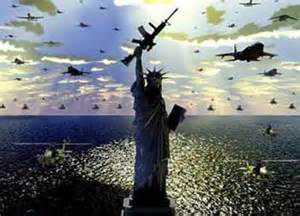
In fact, America exerts its unwanted political influence overseas, through the state terror of aircraft carrier fleets, bombers, nuclear subs, shock and awe invasions, pacification programs, the overthrow of governments, and support of repressive puppet regimes.

This state terrorism, which you never hear about, is the biggest covert psychological warfare operation of all time.

This psywar operation depends on narrowly defining terrorism as a suicide bomber, a hijacked plane, the decapitated body of a collaborator: the “selective terrorism” of rebels and nationalists who, outgunned and outlawed in their own country, have no other options, other than submission.

The purpose of this “selective terrorism” by rebels is psychological: to isolate collaborators, while demonstrating to the people the ability of the rebels to strike at their oppressors. Brutal pacification cam­paigns – state terrorism – prevent people from making a living. Selective terrorism does not.

That’s a big, meaningful “class” difference.

The National Security Establishment understands that selective terror achieves political and psychological goals that state terror does not – that it rallies people to revolutionary ideals.  So the National Security Establishment engages in selective terror, too, by targeting the rebel, his family and friends in their homes.

This is the selective terror con­ducted by counter-terrorists. But don’t be confused: it is terrorism. All terrorism is psychological and political; state terror seeks to immobilize people and make them submissive, apathetic and/or ostensibly “content.”

The National Security Establishment fully understands that once people have been terrorized, they have been politically defeated, without necessarily receiving bullets.

As former Director of Central Intelligence William Colby once said: “The implication or latent threat of terror was sufficient to insure that the people would comply.”

This principle of the psychological use of “the implication or latent threat of terror” is what brings us back to America and the business of terror.

The Business of Terror

State terror – colonization abroad and political repression at home – is a key means of extracting profits and maintaining ownership of property. Ask the American Indian.

In its colonies abroad, the U.S. engages in state terrorism by removing all legal protections for rebels; detention, torture, and summary execution are the price for rebellion against U.S. policy.

State terrorism overseas, imperialism, is never acknowledged by the U.S. media, because the media is a big business closely affiliated with the National Security Establishment; indeed, two of the major networks are owned by defense contractors.

And state terrorism applied domestically to ensure “internal” security is never acknowledged. But the National Security State is well thought out, by professionals in language management, and political and psychological warfare, aimed at you.

“Personal violence is for the amateur in dominance,” says Johan Galtung, a founder of the disciipline of peace and conflict studies. But he adds “structural violence is the tool of the professional. The amateur who wants to dominate uses guns; the professional uses social structure. The legal criminality of the social system and its institutions, of government…is tacit violence. Structural violence is a structure of exploitation and social injustice.”

As Colby said:The implication or latent threat is enough to insure people will comply.”

The war on terror and its domestic version “homeland security” are the law of the land – America’s new legally criminal social structure based on administrative detention, enshrined in The Patriot Act and a number of executive orders, some secret.

This lack of due process comes on top of a justice system already skewed to protect the propertied elite and pack the prisons with the poor, through “structural violence,” mainly the drug wars.

The Establishment’s new anti-terror and anti-drug laws make the National Security State the most fearsome covert political and psywar machine the world has ever seen. And the National Security State is growing: the “Top Secret America” series in the Washington Post put it at 750,000 cadres.

This secret state within a state extends into the homeland’s critical infrastructure and beyond. For example, the arms industry provides good jobs, making American imperial aggression seem a positive value.

And this is how the psyched-out people become one of the moats.

As it is modeled on the totalitarian corporate paradigm, the National Security State in all its manifestations fits the classic definition of a fascist dictatorship. And we know what its intentions are. They have been stated.

In the days after 9/11, right-wing Republican stalwart Kenneth W. Starr, the Clinton inquisitor, said the danger of terrorism requires “deference to the judgments of the political branches with respect to matters of national security.”

But is there an on-going emergency that requires deference to the political branches, meaning the right-wing ideologues who rule the National Security State? And what does it mean for Establishment opponents if due process is completely abandoned at home, and subjected to politics?

Michael Ledeen, a former counter-terror expert on Reagan’s National Security Council, blamed 9/11 on President Bill Clinton “for failing to properly organize our nation’s security apparatus.”

Ledeen’s solution to the problem of those who sneered at security was “to stamp out” the “corrupt habits of mind.” By which he means Liberalism.

In other words, the reactionary right-wing that owns the National Security State wants to impose its total rule on the people in order to create a security conscious, uniform citizenry – marching in lock step, flags waving – that is necessary to win the war on terror.

This is how the National Security professionals are incrementally creating the requisite fascist social structure – through terror, the best organizing principle ever.

“This is time for the old motto, ‘kill them all, let God sort ’em out.’ New times require new people with new standards,” Ledeen asserted. “The entire political world will understand it and applaud it. And it will give us a chance to prevail.”

When Ledeen says “political” world he means the “owners of the business” of state terror, the right-wing ideologues who pack the National Security State and the capitalist Establishment they serve.

And they have won the propaganda war, folks.

Why Okinawa Should Matter

2015051815015274208

By Richard Falk

Source: Foreign Policy Journal

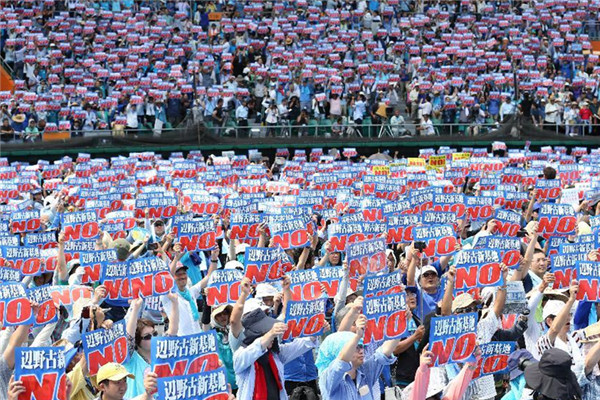
Okinawa has been a mostly unhappy host of American military bases, and the issue has been prominent at times on the agenda of the Japanese peace movement.

When President Barack Obama visited Hiroshima in May of 2016, there was an effort to persuade him to put Okinawa on his travel itinerary, but as has happened frequently throughout the long tortured history of Okinawa, the request was ignored, and the people of the island were once more disappointed. In an important sense, Okinawa is the most shameful legacy of Japan’s defeat in World War II, exceeding even the sites of the atomic attacks by its daily reminders of a continued colonialist encroachment on Okinawan national dignity and wellbeing.

Actually, Okinawa is being victimized by overlapping exploitations with that of the United States reinforced and legitimized by mainland Japan. For the United States, Okinawa serves as a hub for its strategic military operations throughout the Pacific, with at least 14 separate military bases occupying about 20% of the island. Kadena Air Base was used for B-29 bombing missions during the Korean War more than a half century ago, and the island was used as a major staging area throughout the Vietnam War. It has also been used as a secret site for the deployment of as many as 1,000 nuclear warheads in defiance of Japanese declared no-nukes policy. Actually, in recent years Okinawa rarely receives global news coverage except when there occurs a sex crime by American servicemen that provokes local outrage and peaceful mass demonstrations followed by the strained apologies of local American military commanders.

Japan’s role in the misfortunes of Okinawa is more than one of a passive acceptance of the enduring side effects of its defeat and humiliation in World War II. After a series of military incursions, Japan finally conquered Okinawa and the Ryukyu island chain of which it is a part in 1879, and then imposed its rule in ways that suppressed the culture, traditions, and even the language of the native populations of the islands. What is virtually unknown in the West is that Okinawa was the scene of the culminating catastrophic land battle between the United States and Japan in the spring of 1945 that resulted in the death of an astounding one-third of the island’s civilian population of then 300,000 and its subsequent harsh military administration by the United States for the next 27 years until the island was finally turned back to Japan in 1972. Despite an estimated 60-80% of Okinawans being opposed to the U.S. bases, confirmed by the recent election of an anti-bases governor of prefecture, the government in Tokyo, currently headed by a dangerous militarist, Shinzo Abe, is comfortable with the status quo, which allows most of the unpopular continuing American military presence to be centered outside of mainland Japan, and hence no longer a serious political irritant within the country.

What the plight of Okinawans exemplifies is the tragic ordeal of a small island society, which because of its small population and size, entrapment within Japan, and geopolitical significance, failed to be included in the decolonizing agenda that was pursued around the world with such success in the last half of the 20th century. This tragic fate that has befallen Okinawa and its people results from being a ‘colony’ in a post-colonial era. Its smallness of current population (1.4 million) combined with its enclosure within Japanese sovereign statehood and its role in pursuing the Asian strategic interests of the United States, as well as joint military operations with Japan make it captive of a militarized world order that refuses to acknowledge the supposedly inalienable right of self-determination, an entitlement of all peoples according to common Article 1 of both human rights covenants. In this respect, Okinawa, from a global perspective, is a forgotten remnant of the colonial past, which means it is subjugated and irrelevant from the perspective of a state-centric world order. In this respect, it bears a kinship with such other forgotten peoples as those living in Kashmir, Chechnya, Xinjiang, Tibet, Hawaii, Puerto Rico, Palau, Marianas Islands, among many others.

There are other ways of being forgotten. I have for many years been concerned about the Palestinian ordeal, another geopolitical and historical casualty of Euro-American priorities and the colonialist legacy. Here, too, the indigenous population of Palestine has endured decades of suffering, denials of basic rights, and a dynamic of victimization initiated a century ago when the British Foreign Office issued the Balfour Declaration pledging support to the world Zionist movement for the establishment of a Jewish Homeland in historic Palestine, later placed under the tutorial role of the United Kingdom with the formal blessings of the League of Nations until the end of World War II. Instead of Japan playing the intermediate role as in Okinawa, it is Israel that pursues its own interests and teams with the United States and Europe as a strategic partner to carry forward its shared geopolitical goals throughout the Middle East and North Africa. Of course, there are crucial differences. Japan is constrained as a partner by its postwar peace constitution, which Abe is keen to circumvent and dilute, while Israel has become a military powerhouse in the region, enjoying a special relationship with the United States that includes the incredible assurance by Washington of a military capability capable of defeating any foreseeable combination of Arab adversaries. Also, unlike Okinawa, there are no American military bases in Israel. There is no need for them. Israel acts as an American surrogate, and sometimes even vice versa. Yet the result is the same—force projection unconnected with self-defense, but vital for upholding regional strategic interests that involve maintaining a visible military presence and offering allies in the region credible promises of protection.

When we raise questions about the future of Okinawa, we come face to face with the role and responsibility of global civil society. The Palestinian goals appear to remain more ambitious than those of the Okinawans, although such an impression could be misleading. The Palestinian movement is centered upon realizing the right of self-determination, which means at the very least an end to occupation and a diplomacy that achieves a comprehensive, sustainable, and just peace. For Okinawans, long integrated into the Japanese state, earlier dreams of independence seem to have faded, and the focus of political energy is currently devoted to the anti-bases campaign. Taking moral globalization seriously means conceiving of citizenship as borderless with respect to space and time, an overall identity I have described elsewhere under the label ‘citizen pilgrim,’ someone on a life journey to build a better future by addressing the injustices of the present wherever encountered.

In this respect, acting as citizen pilgrims means giving attention to injustices that the world as a whole treats as invisible except when an awkward incident of lethal abuse occurs. Okinawa has been effectively swept under the dual rugs of statism (Okinawa is part of the sovereign state of Japan) and geopolitics (Okinawa offers the United States indispensable military bases), and even the mainly Japanese peace movement may have grown fatigued and distracted, being currently preoccupied with its opposition to the revival of Japanese militarism under Abe’s leadership. Whether attention to the plight of Okinawa will give rise to false hopes is a concern, but the aspiration is to produce an empowering recognition throughout the world that for some peoples the struggle against colonialism remains a present reality rather than a heroic memory that can be annually celebrated as an independence day holiday. Until we in the United States stand in active solidarity with such victims of colonialist governance we will never know whether more can be done to improve prospects of their emancipation. This awareness and allegiance is the very least that we can do if we are to act in the spirit of a citizen pilgrimage.


This article was originally published at RichardFalk.Wordpress.com. An earlier version first appeared in the Japanese publication Ryukyu Shimpo.


How Does Corporate Media Manufacture False Narratives?

aa-corporate-media-very-good-poster

By Nauman Sadiq

Source: RINF

What bothers me is not that we are unable to find the solution to our problems, what bothers me more is the fact that neoliberals are so utterly unaware of the real structural issues that their attempts to sort out the tangential issues will further exacerbate the main issues. Religious extremism, militancy and terrorism are not the cause but the effect of poverty, backwardness and disenfranchisement.

Empirically speaking, if we take all the other aggravating factors out: like poverty, backwardness, illiteracy, social injustice, disenfranchisement, conflict, instability, deliberate training and arming of certain militant groups by the regional and global players, and more importantly grievances against the duplicitous Western foreign policy, I don’t think that Islamic State, al-Qaeda and the likes would get the abundant supply of foot soldiers that they are getting now in the troubled regions of Middle East, North Africa and South Asia.

Moreover, I do concede that the rallying cry of “Jihad in the way of God” might have been one reason for the abundant supply of foot soldiers to the jihadists’ cause, but on an emotional level it is the self-serving and hypocritical Western interventionist policy in the energy-rich Middle East that adds fuel to the fire. When Muslims all over the Islamic countries see that their brothers-in-faith are dying in Palestine, Syria, Iraq, Libya, Yemen and Afghanistan, on an emotional level they feel outraged and seek vengeance and justice.

This emotional outrage, in my opinion, is a far more potent factor than the sterile rational argument of God’s supposed command to fight holy wars against the infidels. If we take all the other contributing factors, that I have mentioned in the second paragraph out of the equation, I don’t think that Muslims are some “exceptional” variety of human beings who are hell-bent on killing the heretics all over the world.

Notwithstanding, it’s very easy to distinguish between the victims of structural injustices and the beneficiaries of the existing neocolonial economic order all over the world. But instead of using words that can be interpreted subjectively I’ll let the figures do the talking. Pakistan’s total GDP is only $270 billion and with a population of 200 million it amounts to a per capita income of only $1400. While the US’ GDP is $18 trillion and per capita income is in excess of $50,000. Similarly the per capita income of most countries in the Western Europe is also around $40,000. That’s a difference of 40 to 50 TIMES between the incomes of Third World countries and the beneficiaries of neocolonialism, i.e. the Western powers.

Only the defense budget of the Pentagon is $600 billion, which is three times the size of Pakistan’s total GDP. A single multi-national corporation based in the Wall Street and other financial districts of the Western world owns assets in excess of $200 billion which is more than the total GDP of many developing economies. Examples of such business conglomerates are: Investment banks – JP Morgan, Goldman Sachs, Barclays, HSBC, BNP Paribas; Oil majors – Exxon Mobil, Chevron, BP, RDS, Total, Vitol; Manufacturers – Apple, Microsoft and Google.

On top of that, semi-legit wealth from all over the world flows into the Western commercial and investment banks: last year there was a report that the Russian oligarchs have deposited $800 billion in the Western banks, while the Chinese entrepreneurs have deposited $1.5 trillion in the Western financial institutions.

Moreover, in April this year the Saudi finance minister threatened that the Saudi kingdom would sell up to $750 billion in Treasury securities and other assets if Congress passed a bill that would allow the Saudi government to be held responsible for any role in the September 11, 2001 terror attacks. And $750 billion is only the Saudi investment in the US, if we add up Saudi investment in Western Europe, and the investments of UAE, Kuwait and Qatar in the Western economies, the sum total would amount to trillions of dollars of Gulf’s investment in the US and Western Europe.

The first and foremost priority of the Western powers is to save their Corporate Empire, and especially their financial institutions, from collapsing; everything else like eliminating terrorism, promoting democracy and “responsibility to protect” are merely arranged side shows to justify their interventionist foreign policy, especially in the energy-rich Middle East.

Additionally, the irony is that the neoliberal dupes of the mainstream media justify and validate the unfair practices of the neocolonial powers and hold the victims of structural injustices responsible for their misfortunes. If a Third World’s laborer has been forced to live on less than $5 a day and a corporate executive sits in the Wall Street on top of $18 trillion business empire, neoliberals are okay with this travesty.

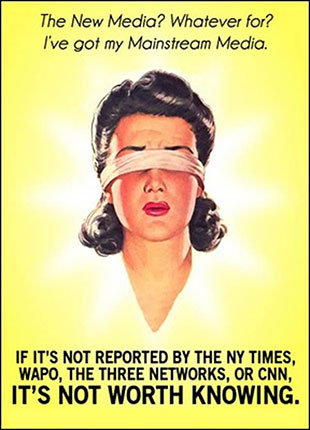
However, we need to understand that how does a neoliberal mindset is structured? As we know that mass education programs and mass media engender mass ideologies. We like to believe that we are free to think, but we aren’t. Our narratives aren’t really “our” narratives. These narratives of injustice and inequality have been constructed for the public consumption by the corporate media, which is nothing more than the mouthpiece of the Western political establishments and the business interests.

Media is our eyes and ears through which we get all the inputs and it is also our brain through which we interpret raw data. If media keeps mum over some vital structural injustices and blows out of proportion some isolated incidents of injustice and violence, we are likely to forget all about the former and focus all of our energies on the tangential issues which the media portrays as the “real” ones.

Monopoly capitalism and the global neocolonial economic order are the real issues while Islamic radicalism and terrorism are the secondary issues and itself an adverse reaction to the former. That’s how the mainstream media constructs artificial narratives and dupes its audience into believing the absurd: during the Cold War it created the “Red Scare” and told us that communism is an existential threat to the free world and the Western way of life. We bought this narrative.

Then the West and its Saudi and Pakistani collaborators financed, trained and armed the Afghan so-called “freedom fighters” and used them as their proxies against the Soviets. After the collapse of the Soviet Union they declared the former “freedom fighters” to be terrorists and another existential threat to the “free world” and the Western way of life. We again bought this narrative.

And finally, during the Libyan and Syrian proxy wars the former terrorists once again became freedom fighters – albeit in a more nuanced manner, this time around the corporate media sells them as “moderate rebels.” And the lobotomized neoliberal audience of the mainstream media is once again willing to buy this narrative, how ironic?


Nauman Sadiq is an Islamabad-based attorney, columnist and geopolitical analyst focused on the politics of Af-Pak and MENA regions, neocolonialism and Petroimperialism.

Yes, Hillary Clinton Is a Neocon

shutterstock_405351559

By Robert Parry

Source: Consortium News

If there were any doubts that Hillary Clinton favors a neoconservative foreign policy, her performance at Thursday’s debate should have laid them to rest. In every meaningful sense, she is a neocon and – if she becomes President – Americans should expect more global tensions and conflicts in pursuit of the neocons’ signature goal of “regime change” in countries that get in their way.

Beyond sharing this neocon “regime change” obsession, former Secretary of State Clinton also talks like a neocon. One of their trademark skills is to use propaganda or “perception management” to demonize their targets and to romanticize their allies, what is called “gluing white hats” on their side and “gluing black hats” on the other.

So, in defending her role in the Libyan “regime change,” Clinton called the slain Libyan leader Muammar Gaddafi “genocidal” though that is a gross exaggeration of Gaddafi’s efforts to beat back Islamic militants in 2011. But her approach fits with what the neocons do. They realize that almost no one will dare challenge such a characterization because to do so opens you to accusations of being a “Gaddafi apologist.”

Similarly, before the Iraq War, the neocons knew that they could level pretty much any charge against Saddam Hussein no matter how false or absurd, knowing that it would go uncontested in mainstream political and media circles. No one wanted to be a “Saddam apologist.”

Clinton, like the neocons, also shows selective humanitarian outrage. For instance, she laments the suffering of Israelis under crude (almost never lethal) rocket fire from Gaza but shows next to no sympathy for Palestinians being slaughtered by sophisticated (highly lethal) Israeli missiles and bombs.

She talks about the need for “safe zones” or “no-fly zones” for Syrians opposed to another demonized enemy, Syria’s President Bashar al-Assad, but not for the people of Gaza who face the wrath of Israeli Prime Minister Benjamin Netanyahu.

“Yes, I do still support a no-fly zone [in Syria] because I think we need to put in safe havens for those poor Syrians who are fleeing both Assad and ISIS and have some place that they can be safe,” Clinton said. But she showed no such empathy for Palestinians defenseless against Israel’s “mowing the grass” operations against men, women and children trapped in Gaza.

In Clinton’s (and the neocons’) worldview, the Israelis are the aggrieved victims and the Palestinians the heartless aggressors. Referring to the Gaza rocket fire, she said: “I can tell you right now I have been there with Israeli officials going back more than 25 years that they do not seek this kind of attacks. They do not invite the rockets raining down on their towns and villages. They do not believe that there should be a constant incitement by Hamas aided and abetted by Iran against Israel. …

“So, I don’t know how you run a country when you are under constant threat, terrorist attack, rockets coming at you. You have a right to defend yourself.”

Ignoring History

Clinton ignored the history of the Israeli-Palestinian conflict, which dates back to the 1940s when Israeli terrorist organizations engaged in massacres to drive Palestinians from their ancestral lands and murdered British officials who were responsible for governing the territory. Israeli encroachment on Palestinian lands has continued to the present day.

But Clinton framed the conflict entirely along the propaganda lines of the Israeli government: “Remember, Israel left Gaza. They took out all the Israelis. They turned the keys over to the Palestinian people. And what happened? Hamas took over Gaza. So instead of having a thriving economy with the kind of opportunities that the children of the Palestinians deserve, we have a terrorist haven that is getting more and more rockets shipped in from Iran and elsewhere.”

So, Clinton made clear – both at the debate and in her recent AIPAC speech – that she is fully in line with the neocon reverence for Israel and eager to take out any government or group that Israel puts on its enemies list. While waxing rhapsodic about the U.S.-Israeli relationship – promising to take it “to the next level” – Clinton vows to challenge Syria, Iran, Russia and other countries that have resisted or obstructed the neocon/Israeli “wish list” for “regime change.”

In response to Clinton’s Israel-pandering, Sen. Bernie Sanders, who once worked on an Israeli kibbutz as a young man, did the unthinkable in American politics. He called out Clinton for her double standards on Israel-Palestine and suggested that Netanyahu may not be the greatest man on earth.

“You gave a major speech to AIPAC,” Sanders said, “and you barely mentioned the Palestinians. … All that I am saying is we cannot continue to be one-sided. There are two sides to the issue. … There comes a time when if we pursue justice and peace, we are going to have to say that Netanyahu is not right all of the time.”

But in Hillary Clinton’s mind, the Israeli-Palestinian dispute is essentially one-sided. During her speech to the American Israel Public Affairs Committee last month, she depicted Israel as entirely an innocent victim in the Mideast conflicts.

“As we gather here, three evolving threats — Iran’s continued aggression, a rising tide of extremism across a wide arc of instability, and the growing effort to de-legitimize Israel on the world stage — are converging to make the U.S.-Israel alliance more indispensable than ever,” she declared.

“The United States and Israel must be closer than ever, stronger than ever and more determined than ever to prevail against our common adversaries and to advance our shared values. … This is especially true at a time when Israel faces brutal terrorist stabbings, shootings and vehicle attacks at home. Parents worry about letting their children walk down the street. Families live in fear.”

Yet, Clinton made no reference to Palestinian parents who worry about their children walking down the street or playing on a beach and facing the possibility of sudden death from an Israeli drone or warplane. Instead, she scolded Palestinian adults. “Palestinian leaders need to stop inciting violence, stop celebrating terrorists as martyrs and stop paying rewards to their families,” she said.

Then, Clinton promised to put her future administration at the service of the Israeli government. Clinton said, “One of the first things I’ll do in office is invite the Israeli prime minister to visit the White House. And I will send a delegation from the Pentagon and the Joint Chiefs to Israel for early consultations. Let’s also expand our collaboration beyond security.”

Pleasing Phrases

In selling her neocon policies to the American public, Clinton puts the military aspects in pleasing phrases, like “safe zones” and “no-fly zones.” Yet, what she means by that is that as President she will invade Syria and push “regime change,” following much the same course that she used to persuade a reluctant President Obama to invade Libya in 2011.

The Libyan operation was sold as a “humanitarian” mission to protect innocent civilians though Gaddafi was targeting Islamic militants much as he claimed at the time and was not engaging in any mass slaughter of civilians. Clinton also knew that the European allies, such as France, had less than noble motives in wanting to take out Gaddafi.

As Clinton confidant Sidney Blumenthal explained to her, the French were concerned that Gaddafi was working to develop a pan-African currency which would have given Francophone African countries greater freedom from their former colonial master and would undermine French economic dominance of those ex-colonies.

In an April 2, 2011 email, Blumenthal informed Clinton that sources close to one of Gaddafi sons reported that Gaddafi’s government had accumulated 143 tons of gold and a similar amount of silver that “was intended to be used to establish a pan-African currency” that would be an alternative to the French franc.

Blumenthal added that “this was one of the factors that influenced President Nicolas Sarkozy’s decision to commit France to the attack on Libya.” Sarkozy also wanted a greater share of Libya’s oil production and to increase French influence in North Africa, Blumenthal wrote.

But few Americans would rally to a war fought to keep North Africa under France’s thumb. So, the winning approach was to demonize Gaddafi with salacious rumors about him giving Viagra to his troops so they could rape more, a ludicrous allegation that was raised by then-U.S. Ambassador to the United Nations Susan Rice, who also claimed that Gaddafi’s snipers were intentionally shooting children.

With Americans fed a steady diet of such crude propaganda, there was little serious debate about the wisdom of Clinton’s Libyan “regime change.” Meanwhile, other emails show that Clinton’s advisers were contemplating how to exploit Gaddafi’s overthrow as the dramatic moment to declare a “Clinton Doctrine” built on using “smart power.”

On Oct. 20, 2011, when U.S.-backed rebels captured Gaddafi, sodomized him with a knife and then murdered him, Secretary of State Clinton couldn’t contain her glee. Paraphrasing a famous Julius Caesar quote, she declared about Gaddafi, “we came, we saw, he died.”

But this U.S.-organized “regime change” quickly turned sour as old tribal rivalries, which Gaddafi had contained, were unleashed. Plus, it turned out that Gaddafi’s warnings that many of the rebels were Islamic militants turned out to be true. On Sept. 11, 2012, one extremist militia overran the U.S. consulate in Benghazi killing U.S. Ambassador Christopher Stevens and three other Americans.

Soon, Libya slid into anarchy and Western nations abandoned their embassies in Tripoli. President Obama now terms the Libyan fiasco the biggest mistake of his presidency. But Clinton refuses to be chastened by the debacle, much as she appeared to learn nothing from her support for the Iraq invasion in 2003.

The Libyan Mirage

During Thursday’s debate – instead of joining Obama in recognition of the Libyan failure – Clinton acted as if she had overseen some glowing success:Well, let me say I think we did a great deal to help the Libyan people after Gaddafi’s demise. … We helped them hold two successful elections, something that is not easy, which they did very well because they had a pent-up desire to try to chart their own future after 42 years of dictatorship. I was very proud of that. …

“We also worked to help them set up their government. We sent a lot of American experts there. We offered to help them secure their borders, to train a new military. They, at the end, when it came to security issues, … did not want troops from any other country, not just us, European or other countries, in Libya.

“And so we were caught in a very difficult position. They could not provide security on their own, which we could see and we told them that, but they didn’t want to have others helping to provide that security. And the result has been a clash between different parts of the country, terrorists taking up some locations in the country.”

But that is exactly the point. Like the earlier neocon-driven “regime change” in Iraq, the “regime change” obsession blinds the neocons from recognizing that not only are these operations violations of basic international law regarding sovereignty of other nations but the invasions unleash powerful internal rivalries that neocons, who know little about the inner workings of these countries, soon find they can’t control.

Yet, America’s neocons are so arrogant and so influential that they simply move from one catastrophe to the next like a swarm of locust spreading chaos and death around the globe. They also adapt readily to changes in the political climate.

That’s why some savvy neocons, such as the Brookings Institution’s Robert Kagan, have endorsed Clinton, who The New York Times reported has become “the vessel into which many interventionists are pouring their hopes.”

Kagan told the Times, “I feel comfortable with her on foreign policy. If she pursues a policy which we think she will pursue it’s something that might have been called neocon, but clearly her supporters are not going to call it that; they are going to call it something else.”

Now with Clinton’s election seemingly within reach, the neocons are even more excited about how they can get back to work achieving Syrian “regime change,” overturning Obama’s nuclear deal with Iran, and – what is becoming their ultimate goal – destabilizing nuclear-armed Russia and seeking “regime change” in Moscow.

After all, by helping Assad bring some stability to Syria and assisting Obama in securing the Iranian nuclear deal, Russian President Vladimir Putin has become what the neocons view as the linchpin of resistance to their “regime change” goals. Pull Putin down, the thinking goes, and the neocons can resume checking off their to-do list of Israel’s adversaries: Syria, Iran, Hezbollah, Hamas, etc.

And what could possibly go wrong by destabilizing nuclear-armed Russia and forcing some disruptive “regime change”?

By making Russia’s economy scream and instigating a Maidan-style revolt in Moscow’s Red Square, the neocons see their geopolitical path being cleared, but what they don’t take into account is that the likely successor to Putin would not be some malleable drunk like the late Russian President Boris Yeltsin but, far more likely, a hardline nationalist who might be a lot more careless with the nuclear codes than Putin.

But, hey, when has a neocon “regime change” scheme veered off into a dangerous and unanticipated direction?

A Neocon True-Believer

In Thursday’s debate, Hillary Clinton showed how much she has become a neocon true-believer. Despite the catastrophic “regime changes” in Iraq and Libya, she vowed to invade Syria, although she dresses up that reality in pretty phrases like “safe zones” and “no-fly zones.” She also revived the idea of increasing the flow of weapons to “moderate” rebels although they, in reality, mostly fight under the command umbrella of Al Qaeda’s Nusra Front.

Clinton also suggested that the Syria mess can be blamed on President Obama’s rejection of her recommendations in 2011 to authorize a more direct U.S. military intervention.Nobody stood up to Assad and removed him,” Clinton said, “and we have had a far greater disaster in Syria than we are currently dealing with right now in Libya.”

In other words, Clinton still harbors the “regime change” goal in Syria. But the problem always was that the anti-Assad forces were penetrated by Al Qaeda and what is now called the Islamic State. The more likely result from Clinton’s goal of removing Assad would be the collapse of the Syrian security forces and a victory for Al Qaeda’s Nusra Front and/or the Islamic State.

If that were to happen, the horrific situation in Syria would become cataclysmic. Millions of Syrians – Alawites, Shiites, Christians, secularists and other “infidels” – would have to flee the beheading swords of these terror groups. That might well force a full-scale U.S. and European invasion of Syria with the bloody outcome probably similar to the disastrous Iraq War.

The only reasonable hope for Syria is for the Assad regime and the less radical Sunni oppositionists to work out some power-sharing agreement, stabilize most of the country, neutralize to some degree the jihadists, and then hold elections, letting the Syrian people decide whether “Assad must go!” – not the U.S. government. But that’s not what Clinton wants.

Perhaps even more dangerous, Clinton’s bellicose rhetoric suggests that she would eagerly move into a dangerous Cold War confrontation with Russia under the upside-down propaganda theme blaming tensions in Eastern Europe on “Russian aggression,” not NATO’s expansion up to Russia’s borders and the U.S.-backed coup in Ukraine in 2014 which ousted an elected president and touched off a civil war.

That coup, which followed neocon fury at Putin for his helping Obama avert U.S. bombing campaigns against Syria and Iran, was largely orchestrated by neocons associated with the U.S. government, including Assistant Secretary of State for European Affairs Victoria Nuland (Robert Kagan’s wife), Sen. John McCain and National Endowment for Democracy President Carl Gershman.

After the violent coup, when the people of Crimea voted by 96 percent to secede from Ukraine and rejoin Russia, the U.S. government and Western media deemed that a “Russian invasion” and when ethnic Russians in eastern Ukraine rose up in resistance to the new authorities in Kiev that became “Russian aggression.”

NATO on the Move

Though President Obama should know better – and I’m told that he does know better – he has succumbed this time to pressure to go along with what he calls the Washington “playbook” of saber-rattling and militarism. NATO is moving more and more combat troops up to the Russian border while Washington has organized punishing economic sanctions aimed at disrupting the Russian economy.

Hillary Clinton appears fully onboard with the neocon goal of grabbing the Big Enchilada, “regime change” in Moscow. Rather than seeing the world as it is, she continues to look through the wrong end of the telescope in line with all the anti-Russian propaganda and the demonization of Putin, whom Clinton has compared to Hitler.

Supporting NATO’s military buildup on Russia’s border, Clinton said, “With Russia being more aggressive, making all kinds of intimidating moves toward the Baltic countries, we’ve seen what they’ve done in eastern Ukraine, we know how they want to rewrite the map of Europe, it is not in our interests [to reduce U.S. support for NATO]. Think of how much it would cost if Russia’s aggression were not deterred because NATO was there on the front lines making it clear they could not move forward.”

Though Clinton’s anti-Russian delusions are shared by many powerful people in Official Washington, they are no more accurate than the other claims about Iraq’s WMD, Gaddafi passing out Viagra to his troops, the humanitarian need to invade Syria, the craziness about Iran being the principal source of terrorism (when it is the Saudis, the Qataris, the Turks and other Sunni powers that have bred Al Qaeda and the Islamic State), and the notion that the Palestinians are the ones picking on the Israelis, not the other way around.

However, Clinton’s buying into the neocon propaganda about Russia may be the most dangerous – arguably existential – threat that a Clinton presidency would present to the world. Yes, she may launch U.S. military strikes against the Syrian government (which could open the gates of Damascus to Al Qaeda and the Islamic State); yes, she might push Iran into renouncing the nuclear agreement (and putting the Israeli/neocon goal to bomb-bomb-bomb-Iran back on the table); yes, she might make Obama’s progressive critics long for his more temperate presidency.

But Clinton’s potential escalation of the new Cold War with Russia could be both the most costly and conceivably the most suicidal feature of a Clinton-45 presidency. Unlike her times as Secretary of State, when Obama could block her militaristic schemes, there will be no one to stop her if she is elected President, surrounded by likeminded neocon advisers.


[For more on this topic, see Consortiumnews.com’s “Would a Clinton Win Mean More Wars?’]

Investigative reporter Robert Parry broke many of the Iran-Contra stories for The Associated Press and Newsweek in the 1980s. You can buy his latest book, America’s Stolen Narrative, either in print here or as an e-book (from Amazon and barnesandnoble.com).


Related Video: