Ireland: Thoughts on Wildness and Domestication

By Renzo Connors

Source: Anarchists Worldwide

“If I decide to break the chains of domestication, I can only do so because I feel the chains and suffer the effects of domestication on my own skin.” – Alfredo Bonanno

I

While out walking or cycling at night, foxes can always be seen roaming the housing estate. The glow of their eyes in darkness, appearing from dark alleyways suddenly visible under the street lights, they move around without a sound, hardly noticed. These lovely magnificent creatures are the embodiment of wildness. Leviathan towers all around but yet these wild beings live on freely from domestication. The foxes at times live off the scraps and waste that civilization throws away, but long after civilization crumbles these creatures will live on.

These wild beings will live on long after civilization kills itself because they are not dependent on civilization to provide the means of life. They remain wild and undomesticated, still equipped with the knowledge and skills to find food, build shelter, and survive independently for themselves.

The vast majority of humans on the other hand are totally domesticated and dependent on civilization and the vast majority would not be able to survive without shops and machines. Only a tiny percentage of humans that inhabit the earth still live wild, free, and living autonomously. The rest are imprisoned within the concrete and metal structures of techno-industrial society.

Domestication begins from birth, straight away an individual is given a birth certificate and social security number. These will be needed throughout life, to be recognised by whatever state an individual happens to be born into, to go to school, to work, to open a bank account and from there to get loans to buy shit, to get a passport, to register to vote, so the state knows who you are, what taxes you have paid or owe, your credit history: to be controlled and exploited. From birth, through childhood, into adulthood,an individual is moulded and taught how to behave, what is acceptable and what is not; through force and blackmail of collective and religious moralities created by the systems and institutions that make up civilization. The end result: a domesticated and a functional obedient citizen and wage slave.

Everything within the civilized culture is geared towards this. Education, children’s stories, TV shows, movies, books, games, and even songs are all exposure to the social norms and control of civilization. The soul purpose of the individual in civilization is to produce and reproduce the social structures, authoritarian institutions and daily subservience to civilized society. There is little room for escape from behind the computer screens and consumerism.

II

Tenalach
Irish – Used to describe a relationship one has with the land, air and water, a deep connection that one literally hears the Earth sing.

I’ve always felt an affinity and closeness with wild spaces. From childhood, playing in the fields and woodlands, fishing in the lake and swimming in the rivers that were close to the housing estate I grew up in. As a kid taking day trips to the Wicklow mountains seeing all the views, beauty of the trees and plants, rugged valleys, and at times what seems like inhospitable landscape of bog land and cliff drops.

Being in such spaces conjures up and stores feelings within me I wouldnt be able to adequately describe with words. Perhaps they could be described as something spiritual.

The landscape has been left scarred by civilization. Roads built long ago by the British colonists to flush out any hiding rebels, shells and ruins of buildings left over from the dawn of industrialism scattered across the landscape, electrical dams blocking up rivers, TV and radio transmitter masts, bog land robbed and left mutilated to feed industrial “progress”, forests cut down and replaced by animal agriculture and monocrop Sitka tree plantations poisoning the land, and the mass graves from pogroms and genocide of the religious and imperalist conquerers. There isn’t a place left on this island that civilization hasn’t left its mark.

******

In my early 20’s locked up in prison for taking part in the anti-imperialist struggle, I felt these feelings for the wild more intensely.

Not seeing any plants or trees, except the ones I could see from my cell window on the horizon. The urge to walk in grass and sand in my bare feet, wanting to roam in woodland to look up at the sky through the canopy.

For the years spent incarcerated I daydreamed about being in nature, being in the mountains, being by the sea.

After four years with eight months left I was granted temporary release for Christmas.

For the first time outside the concrete walls, iron bars and razor wire of prison there was only one thing I really wanted to do and that was to go to the ocean.

The beach was a short walk from where I was staying. To get there I’d first have to walk through a park. As I walked, even though it was winter there was still a lot of colour. A lot of the big tall trees in the park are evergreen trees so they still had their colour. Going through the park my head and eyes were darting around taking in the landscape, walking under the tall trees, their canopy blocking out the sky. It was an amazing feeling being hit in the face with so many different colours, different shades of green.

Sensory stimulation from the sounds of flowing water making its way down streams, birds chirping and singing, the wind blowing long grass and branches, colors of the landscape and the various shades of browns and greens of foliage was almost overwhelming to the senses.

When I reached the beach I walked for a little bit and then sat on a sand dune for about two hours looking out into the vast ocean of green, reflecting in my thoughts and finding some solace in my mind.

Are these feelings that rush around my mind and body urging me wildness, the inner primal anarchic instinct buried by years of domestication?

Or are they an individual desire and love within me for the wild?

Epistemological divide: How we live in two different worlds of understanding

By Kurt Cobb

Source: Resilience

Epistemology is the study of how we know things. All of us cycle between two main ways of knowing in our modern culture: 1) the rational, reductionist way and 2) the holistic, relational, intuitive way. By far the most dominant way is the rational, reductionist way and our institutions, scientific, economic, financial and organizational are governed by this way of thinking.

For the reductionist thinker, everything in the universe is made up of parts. If we can understand the parts, we can understand the whole. Depending on the field, the physical world is nothing but atoms and molecules and the social world is nothing but self-maximizing, rational actors. The reductionist view is very powerful and filled with “nothing but” statements. It never occurs to the thoroughgoing reductionist that the idea of “parts” is merely a mental construct.

In our everyday relationships with friends and family, in our nonrational pursuits in music and the arts, in our religious lives, we tend toward the second way of thinking, holistic, relational and intuitive.

We cycle back and forth between these ways of knowing almost effortlessly and for the most part unconsciously. That seems to work well for us as individuals—except when we miscalculate or misperceive a situation and bad consequences follow. Mostly, we regroup and recover and go on, adjusting for what we have learned.

Can the same be said of society as a whole? Yes and no. Global human society can be likened to a superorganism that has its own logic and modes of action. Each of us is strongly influenced by its trajectory and constrained in our actions. We may wish fervently to address income inequality or hunger or climate change. But the complex interactions and power arrangements in our global society make it difficult to do anything but make a small dent. Even our personal destinies seem to be caught up in a flow of events which we cannot control, but rather must react to.

The reductionist way suggests mastery through manipulation of carefully measured forces: mass, temperature, vectors of force, energy gradients (both physical and chemical). We build machines that use energy to build yet more machines. We erect great public works, dams, bridges and roads that create the arteries through which commerce and people flow. We douse the land with chemical fertilizers boosting farm yields to feed hungry billions.

The holistic way suggests mastery through alignment with natural and social forces. We say that it is best to “go with the flow” in both the physical and social dimensions of our lives. Such words imply an intuitive apprehension of an entire pattern. Recognition of patterns becomes the master key to understand the world. But what is a pattern? It is certainly something that repeats, but not always exactly.

Mark Twain is often quoted as saying,”History never repeats itself but it does rhyme.” The mystery of comparison is the engine of perception, cognition and our resulting cultural outputs of literature, art and music.

The holistic way tries to see the entire picture including all the messy consequences. Knowing that those consequences ramify infinitely, it can only intuit the extent and significance of any pattern. The holistic way knows ahead of time that it will never see the whole, only “feel” its meaning.

Both ways are general approaches to modeling the world we see. We create mental models of how the world works and fits together. When we mistake those models for “the truth,” we can get stuck, failing to adjust to new information and experience. We begin to dismiss information contrary to our model rather than embracing such information as a new insight for our process of adjustment. You can hear the dismissal happening when people say, “That can’t be” or “Everybody knows that…”

Heraclitus says, “Nothing endures but change.” The global superorganism—described by Nate Hagens in the piece cited above entitled, “Economics for the future – Beyond the superorganism”—keeps changing but in a direction that constantly undermines the survivability of humankind (and many other organisms and animals). That organism perceives the world as parts to be controlled and exploited, not just partially and temporarily, but completely and permanently. The perception that the universe is a seamless whole where a victory of mastery in one place means a perilous defeat in another, never occurs to this superorganism.

As Hagens describes it, the global human superorganism does not understand that there is a future in which the consequences of its actions will be manifested in a colossal systemic collapse. There is only the hungry maw of now, of immediate control and mastery, of immediate gratification, of immediate power.

The point is not to banish the reductionist way of thinking. Rather, it is to recognize it for what it is, but one model of perception that has its limitations and will never embrace the entire universe—a model that is as prone to error as any other model and one that will never get close to “the truth” because as Heraclitus tells us, “the truth” of the universe is always changing.

A New Aesthetic

By Damaris Zehner

Source: Resilience

There are all these good ideas – intensive agriculture, organic farming, permaculture, the local food movement. But why is most food still not grown this way, if it really is better? Why don’t farmers switch to sustainable land use methods? It seems to me there are at least four reasons.

First is the conservative nature of farming. Any activity that involves a large and long investment for an uncertain outcome is going to be conservative; no one wants to experiment when a year’s income is riding on the results. Farmers tend to stick to what has seemed to work. The psychology of previous investment plays a part in their choices as well. Once you’ve bought the huge combine, well, you have to use it.

Even when things don’t work so well, farmers will keep doing them if there are financial incentives to do so. This is the second reason. Government programs have tended to encourage big agribusinesses and have been less friendly to smaller, more varied farms.

Third, farmers love their machines. All Americans do. We fall every time for the promise that new technology will make our lives easier, more fun, more productive, and more sophisticated, and people with outdated technology, whether cell phones or tractors, get made fun of. Many people don’t have the time or the patience for more manual ways of working. I knew of a horse farmer who recently complained that he wouldn’t hire young men on his farm because they got impatient with the horses and, as he put it, just wanted to be roaring off with an internal combustion engine. (His workers were young women). These young men have become habituated to the speed and power made possible by fossil fuels and get rattled when asked to move more slowly.

Finally, there is an unconscious but still powerful motivation why farmers don’t want to stop spraying and switch to more natural methods of food production. It is a mistaken aesthetic that dictates how people see and judge the land around them, that tells us what looks beautiful and productive and “American” – that is, efficient, high-tech, and gleaming with the promise of the future. Perfect, undisturbed expanses of commodity crops, synchronized lines of combines churning through thousand-acre wheat fields, shiny factories, and brightly colored grocery stores are our proof that we are not a third-world nation, or Amish, or hippies – that we are still orthodox worshipers of the god of progress.

I don’t dispute the attraction of the aesthetic. Honestly, the land around here looks pretty good. Or at least it looks pretty. But the cost of those perfect fields and vast expanses of monoculture may be more than we can pay. Our aesthetics are as damaging to the environment as our greed or carelessness. So we need to move toward a new aesthetic.

Before we can do so, we need to ask ourselves: how much of the world are we responsible for tidying up? Nature is messy by our standards. A patch of disturbed earth becomes populated with a swirling mob of what we’d call weeds – dock, plantain, dandelion, mulberry, crabgrass, lamb’s quarters, and a hundred plants I don’t have a name for. And that bothers us. We spray, mow, and weed, in the process disturbing the natural succession of plants. We say that keeping our lawns, gardens, and fields as pure monoculture is more efficient and attractive. I drove with farmers past fields of soybeans shortly after the introduction of Round-Up herbicide, and they talked about how beautiful the thick carpet of identical plants is. They’re not wrong. The lush uniformity is beautiful. But I’m not sure we have the right to expect the same sort of beauty from nature that we can create within our houses. Should a farm field look like wall-to-wall carpeting? Should every molehill be leveled, every fence row scorched, whatever t cost, just because we think it looks nicer?

We have neighbors down the road whose property has been described as a doll’s house because of its detailed perfection. It’s a good description – they treat their two acres as if it were as entirely under their control as a doll’s house. The fences have lines of brown under them where the mower can’t reach and herbicide has been sprayed. Their lawn is grass only, no violets or dandelions. Their mature hardwood trees are all pollarded to be a matching height. It’s pretty, I suppose. It’s also horrifying as an illustration of their attitude toward natural beauty. To speak in hyperbolic terms, those friendly neighbors are conducting an all-out war on nature, with policies of scorched earth and ethnic cleansing, and the result is extreme totalitarianism. This stands in striking contrast to the permaculture sites I’ve visited, which look like a hodgepodge of annuals, perennials, weeds, and small creatures and don’t involve any mowing. I suspect that everyone’s first reaction to seeing permaculture in action is, in fact, “Why don’t they mow?” They have their reasons, and they have a different aesthetic.

I admit I like the cleanliness and order that humans impose. I’m all right with keeping my house clean, but I have to decide how far my household extends. If I find insects on my kitchen counter, I kill them. But should I kill the insects in my yard? All the insects in the world? Because if farmers adopt a policy of insect genocide, as most do, it’s going to have costs to the surroundings – which include me. When the summer crop-dusting airplanes fly overhead carpet-bombing bugs and weeds, I have to run to bring the laundry inside and shut the windows if it’s windy, which it usually is, because – call me a crazy tree-hugger – I prefer my sheets and towels to smell of fresh air and not the toxin du jour. That’s where my aesthetic differs from the farmers’.

Farmers around here will tell you that they are aiming for efficiency, and I do appreciate that harvesting crops is easier when the equipment is not clogged with morning glory vines and ragweed stalks. I also understand that weeds and other plants compete with the crops and lower farmers’ yields, so there is a financial as well as an aesthetic motivation for them to keep their fields clean. But there’s no question that these farmers are also driven by the false aesthetic of human-imposed purity. I watch while they grub out a small patch of trees that they had no problem maneuvering around, just so the field looks “clean.”

It’s a competitive aesthetic, too. People in this small community will gossip about and criticize landowners whose fields aren’t clean – I hear them every year talking about whose land isn’t yet sprayed, tilled, or ditched. People from out of our area have asked me when they’ve come over to visit, “Whose land is that down the road? It looks bad.” What they mean when they say that farmers are not keeping their land “clean” is that farmers are not leaving a toe-hold for nature on their property. Rabbits and deer have no right to a corridor of shelter; killdeer and quail have to keep packing up and moving as their surroundings are cut down; coyotes are shot. And once we’ve expunged the aborigines, we can live the mindless imperialist lifestyle we like.

I have some sympathy, I guess. I don’t want coyotes eating my goats or rabbits ruining my garden. But I have to ask the question again: how much of the natural world do we have the right to control at the same level that we control our houses and yards? If we are going to live in a better balance with nature than we do now, we have to change not only our acquisitiveness and our focus on profit and exploitation; we also have to learn to see beauty in what we now consider messiness.

Essential Taoist Wisdom for Living in Politically Charged and Chaotic Times

By Dylan Charles

Source: Waking Times

There’s an old saying, rumored to be an ancient Chinese curse, but it’s been a favorite in the West for some time now.

“May you live in interesting times.” 

Political figures like to use it when they want to emphasize just how screwed up things are. For example, Robert Kennedy is quoted here from a speech in 1966:

“There is a Chinese curse which says “May he live in interesting times.” Like it or not, we live in interesting times. They are times of danger and uncertainty; but they are also the most creative of any time in the history of mankind.” [Source]

Sounds pretty much like today, as the times are indeed interesting. Shocking and unbelievable things are happening all around us, and with information technologies we can choose to internalize struggles, tragedies and disasters that are far outside of our sphere of personal experience or control. It’s easier than ever to take on the weight of the world.

The burden of doing so is quite heavy, though, manifesting as stress, anxiety, depression, self-abuse or the abuse of nature, conflict big and small, anger, disease, uneasiness, unhappiness, and most insidious of all, fear. In short, absorbing the world’s problems is self-destructive. To resolve this within ourselves, however, it most often only takes a shift in perspective.

Lao-Tzu, the Old Master of Taoism, condensed the human struggle into the prose of the Tao Te Ching. It’s not a religious text, as it doesn’t hail a deity or command you to construct a belief system on its behalf. It’s a simple book of observations about the nature of nature, something that after 2500+ years still manages to serve as a salient guide to living well. For those who understand it, it offers a way of being that helps keep the madness of change at bay.

In times such as these, when uncertainty and chaos seem to be rising against the established order, and when so much discourse is focused on politics and untouchable events and circumstances, it really is up to the individual to create peace, harmony and balance within themselves.

But as humans, we have a tendency to try to control that which is beyond our control, in turn contributing evermore to the development of chaos and disorder. In truth, it is far easier to navigate such discord than we believe, and the way is far simpler than we imagine it to be. Consider for a moment the Taoist view regarding such interesting times.

From verse 16:

When society changes
from its natural state of flux,
to that which seems like chaos,
the inner world of the superior man
remains uncluttered and at peace.
By remaining still, his self detached,
he aids society in its return
to the way of nature and of peace.
The value of his insight may be clearly seen
when chaos ceases.

Here we are informed of the value of tending to the inner world first, which requires the gumption to detach and allow things to be as they are. We are encouraged to let go of personal expectations in order for muddled waters to clear.

From verse 17:

The sage does not expect that others
use his criteria as their own.

It is virtuous to allow others to hold whatever insane beliefs and ideas they choose to, and disengage from the struggle to enforce our opinions and values onto others.

From verse 18:

When intellectualism arises,
hypocrisy is close behind…

When the country falls into chaos,
politicians talk about ‘patriotism’.

From verse 57:

Govern your country with integrity,
Weapons of war can be used with great cunning,
but loyalty is only won by not-doing.
How do I know the way things are?

By these:

The more prohibitions you make,
the poorer people will be.
The more weapons you possess,
the greater the chaos in your country.
The more knowledge that is acquired,
the stranger the world will become.
The more laws that you make,
the greater the number of criminals.

Therefore the Master says:

I do nothing,
and people become good by themselves.
I seek peace,
and people take care of their own problems.
I do not meddle in their personal lives,
and the people become prosperous.
I let go of all my desires,
and the people return to the Uncarved Block.

Doing nothing, as advised in the Tao Te Ching, runs in opposition to the cultural zeitgeist, but just imagine how quickly things would change if more people chose to withdraw and not participate in the insanity all around us.

Final Thoughts

As individuals we face the same challenges as all of those who’ve come before us. We’ve always had to survive and procreate while striving for progress. That’s the human journey in nutshell, and while it isn’t always pretty, it’s always the same story, no matter how complex things become.

Our role, then, is the role of the sage, which is to act in accordance with nature rather than to resist nature.

Unsouling From the Wilderness

By Kingsley L. Dennis

Source: Waking Times

“Crazy Horse dreamed and went into the world where there is nothing but the spirits of all things. That is the real world that is behind this one, and everything we see here is something like a shadow from that one.” ~Black Elk, Black Elk Speaks

“Modern man, I dutifully noted, is in search of a soul, and the age is an age of longing.” ~Theodore Roszak, Where the Wasteland Ends

Perhaps the reason some of us are feeling a sense of loss and longing is that we are, as Black Elk informs us, living in the shadow world. Our reality on this side may only be the fleeting ghosts of a place that is more real somewhere else. On this side we have broken our commitment to the earth and have unsouled ourselves from the wilderness. By the first century CE, the essayist Plutarch was asking, “Why is it that the gods are no longer speaking to us?”

For a long time now, we have been trying to create a new and different image of ourselves. It is an image where modern humanity is placed at the center of its own universe. We learn by observing, probing, experimenting, and finally dissecting and destroying the dynamic world we live within. From this, the modern mind started to develop a new reality for itself.

The collective reality in which we now reside does not take kindly to opposing perspectives. We have inherited an alienated consciousness that views the world as an outside entity – a world of objects that move in mechanical motion. This alienated consciousness has substituted the enchantment and mystery of living within a dynamic and animated world with a dream of the artificial, and ultimately the unreal. The modern landscape is now more scattered with administration than adventure. The central image of our modern age has been that of consumerism: the ability of the average person to buy the material goods they require in order to have a decent standard of living. A standard of living albeit promoted to us through our mainstream media and glamorous propaganda.

Only recently have some of us come to realize that consumerism has now become a contemporary form of crash therapy for unsatisfied people wanting to buy their way into happiness to escape from the very system they are simultaneously supporting. The easy acquisition of things has become more about trying to cover up anxiety as a substitute for contentment. Modern life, especially in the highly-developed West, is now rife with people parading their false selves in place of authenticity.

The modern history of the West has been about the removal of mystery, mind, and magic from the world around us. In the past there were realms of wilderness that existed outside of the social order, and each culture had these ‘wild zones’ where people danced with the little folk in the woods, undertook initiations in caves, circles, and hard-to-find corners. There were pagan rituals, crazy ecstasies, and unknown zones where primal energies were released. These were the places of wilderness, where dreamtime reigned, and clock-time was banned. And now these wild places are fewer and fewer as a new ‘reality order’ becomes the manifesto of the day. Now it is many of us who are feeling haunted. We have lost the presence of the ‘transcendent’ within our modern societies.

We must now recognize that something has happened – a break, a mutation, has occurred that has placed us in an ‘intermediate’ stage between eras. Modern life is being not so much rewritten as reconfigured. We are seeing odd things occurring in relation to time, speed, and distance. It’s as if right now the clock, and our sense of timing, is malfunctioning. This ahistorical period is out of time, until it resets itself. And here, the possibility of transcendence lingers like a phantasma.

We are in a time of carnivalesque distortion where ‘fast food’ is a parody of our normal food preparation and consumption; mediatized sport is a spectacle of its original form; and the music industry is one huge commercial carnival that mocks genuine creativity. In the pop music industry, the spectacle, the live show – the ‘carnival performance’ – is often more important than the actual merit of the song (even when the performer mimes, as they often do). We are in a different world right now – or at least a seemingly different reality.

In this new world of different relations, symbols, and meanings we have become unmoored from our harbors. We are talking about the fractal, the quantum, the molecular, the nano, the bots, artificial intelligence, and the singularity – yet we find we have no soulful connection with any of these terms or their significances. Perhaps we have entered a void-time.

The Sense of the Void

With human life having lost its reference to transcendence and the notion of the sacred, there is the ever-present danger that we may descend to a form of human morality that lacks any real meaning or higher principles. It is not hard to believe that a degree of inertia has crept into our modern societies. The result is that many of us may now be finding ourselves with a hollow space inside. This space becomes the perfect seedbed for the consuming desires, distractions, and attractions of modernity’s excesses. Within such an environment we wonder whether we may find ourselves waking up to a world where the dream is still dreaming itself and we can no longer distinguish what is real.

An age of the quantifiable has been ushered in and everyone, and everything, gets given a mark or a measurement. Ever since the industrial age brought in the points system – the marking scores – into mass education we’ve been carrying numbers around with us. Before then, students were known as apprentices and they spent time embedded in their discipline learning its skills. They either learnt great skills or they didn’t; now they get an 85, a 78, a 66, or a 45. Now all modern institutions think in numbers and our social status is quantified by such numbers, or grades, that allow us into other specialized zones – such as the members clubs, the elite institutions, or even into the ‘good credit’ rating books. The organic nature and capacity of a person has been stripped down to the quantifiable, and this measures the worth of an individual according to such grades. These associated numbers then follow the person around for the rest of their lives, influencing their careers, associations, and social freedoms. Society is now painting-by-numbers.

The mesmerizing void that is modern life tries to appease us with simulated pleasures. Through our unsouling from the greater transcendent wilderness we have become all too easily appeased by seeking inadequate answers to life’s meaning. By not seeking for the essential, we cannot hope to be anything other than temporary. Within the past century millions of people in developed parts of the world have distanced and divorced themselves from nature. We are negotiating how to adapt to a world structured within an increasingly artificial environment. The mutational shift is well underway, and new arrangements will need to be sought.

A potential lack of understanding can disconnect us from a world that is at the same time becoming increasingly connected. For thousands of years our ancestors lived alongside natural forces, learning from environmental cycles, and reading the world around them. This uncoupling from the wilderness is not only in favor of urban settings but eventually artificially constructed settings that will soon be made ‘smart.’ The profusion of what are called ‘mega-cities’ are set to implement ‘smart’ technologies which will be a combination of connected information and communication infrastructures.

A Moment of Reflection

We are, it is said, the most highly-developed and articulate species on planet Earth, and yet we live in a world of reflections. We are doomed never to be able to see directly our own faces. Our face, as well as our ‘true face’ as they say, is non-visible to us; and so we are guided by reflections and their appearances.

There is a short-story from Argentinean writer Jorge Luis Borges entitled ‘Fauna of Mirrors’ that tells of a time during the reign of the Yellow Emperor when the world of mirrors and the world of men were not, like today, cut off from one another.[i] Both kingdoms lived in harmony and each could come and go through the mirrors. Yet one night the mirror people invaded the earth and a mighty battle ensued until finally the magic arts of the Yellow Emperor prevailed. The mirror people were pushed back and imprisoned into their mirrors, and punished by being forced to repeat, as if in a dream, all the actions of the world of men. They were stripped of their power and their forms and reduced to mere reflections. A day will come, however, when the magic spell will be broken and little by little these reflections will awaken and will slowly differ from us. Then they will stop imitating the world of humans and eventually they will break through the glass once again to enter the earth.

They say that life imitates art far more than art imitates life. Upon reflection, every culture and society claim a portion of our private psyche as its own. With the narrowing of our sensibilities comes not only a much-diminished reality but also a contracted perspective whereby this condensed form of perception and visibility becomes as hyperreality to us. If it’s true that modern life has muffled the call of transcendental mystery, then it is equally true that it has made transcendence both a more needed and yet more difficult promise. The cry for the ‘death of the soul’ and the unsouling from the wilderness has helped to pave the slippery path toward a simplified hyperreality that is now stealing the show. Fasten seatbelts…

A Bardo Chat with: Aranyani, Hindu Goddess of the Forests 

Author (A): Hello Aranyani. Are you there?

Aranyani (Ai): (short pause) Hello…hello!

A: Hello Aranyani. How are you today?

Ai: Today? Why today? I don’t have days like you do.

A: Ah yes, sorry. I was thinking in my own terms of time. It’s a frequent trap!

Ai: That’s okay, we understand. Traps are there to break out of. I am good, thank you. I am well.

A: That is good to hear. I am glad to know you are well amidst all this disconnection going on right now.

Ai: Disconnection? I am gently strolling through my forests. There is no disconnection (another short pause). All is well here.

A: Sorry, I should have been more specific. I meant disconnection between us, humans, and the natural world. It seems that we’ve done a terrible job of respecting Nature and our environment.

Ai: Mmm, yes, that is so. I am not fond of strolling too near to your civilizations. But why do you call it a job? You see, already you show a wrong way to look at things. Your way of words shows how your mind thinks. Looking after the natural world, as you put it, is not a ‘job.’ It is a recognition of respect, or mutual interdependence, and of compassion and love.

A: Sorry again. I know that I use my words too loosely. It is the way we use phrases here.

Ai: Yes, I know how your species is. For one thing, you don’t listen at all very well. You consider yourselves as a separate species. My dear, nothing is separate. You see space between bodies and you label this as separation. You think and behave like children, and Nature is your forgiving mother.

A: I know, we’ve got a lot of things back-to-front. Would you care to explain more on this relationship?

Ai: (a soft sigh) Maybe a little. Everything communicates here, it always has. You don’t necessarily need a mouth or words or letters to communicate. It all communicates energetically, and you humans are also attuned to this. Every part was supposed to work together. You are strange in that you forgot how to properly listen. And now you build devices outside of yourselves to wrap around the earth – but you don’t need them. And there will be a time when you shall know this, and learn to communicate correctly, as you were always meant to – and not with your machine things. All of nature is alive, don’t you know that?

A: Yes, some of us do; but not enough, unfortunately.

Ai: You knew better before, a long time ago.

A: Yes, I have a feeling we did. Yet we now need to learn how to know in a different way.

Ai: Well….. (long pause)

A: Hello, are you there Aranyani?

Ai: Oh yes, sorry, I was dancing. I have a tune in my head. It’s been given to me from the trees.

A: Wonderful! I was saying that we need to learn how to know in a different way.

Ai: That’s not really how it is. Learning, knowing, and all these things – it’s all head stuff. You live too much in your heads. You always think you need to grab onto something – to know better, and the like. I would say you have to open up more, and to remember everything that was placed inside you. You are coming to a different place now…

A: Yes, thank you. And what do you mean by ‘coming to a different place’?

Ai: I mean you are not in your little tribal units anymore. You are now all over the earth. You grew and connected as you should, and now you are coming to a time when you can really be of help to the earth.

A: You mean as a global species?

Ai: (laughs) You and your fancy words. Yes, you are connecting more strongly with the body of Gaia now. Soon you will find your minds being changed for you. That should be fun!

A: Ah, and what do you mean by that?

Ai: (hums to herself) I don’t feel I should reveal too much just now. Not too many of you have realized that your minds are attuned to Gaia, your planet consciousness. Consciousness is not only those thoughts in your head, silly! (laughs). This is the true language, the natural language, and it is everywhere. This language flows through the trees, the plants, the animals, and through all of Gaia. There is a language that connects, and the humans are disconnected from this. Yes, that is the true disconnection. You talk about disconnect from Nature, but really it is disconnection from your shared language. You speak in tongues but only babble silly words.

A: Yes, true – we do babble a lot.

Ai: Babble, babble, yes you do! Like that story you tell yourselves. You call it the Tower of Babel, right?

A: Yes, that’s true. And it’s a perfect analogy. We tried to build a tower to our Creator and we ended up being divided in languages through our ignorance.

Ai: Yes, that’s it right there. You were disconnected through your ignorance.

A: Mm…yes (sighs)

Ai: Don’t worry, dear. You still have it all inside of you. Your connection to Origin and the universal language is still there. And you are not disconnected from us either. You are always with us, and you always have been.

A: Okay, sure. And thanks. But by being with you always are we not making the balance of Nature worse?

Ai: Oh, dear ones – it’s always about you, isn’t it!? Let me tell you that Nature is far more capable of taking care of herself than you are. Things change, yes. And you are making a mess and not clearing up your mess, like children. This is true too. Yet so many more things come to pass that are not in your hands – that is Nature. She is so far beyond your comprehension of her. You think of these separate things within Nature, like the trees and the forests, and the rivers. But you cannot yet see them as being all together as a wondrous Being. She is a Being far beyond your little minds. And she cares for you. Little children, wake up!

A: Yes, yes.

Ai: Be more joyful and love the things you have, and which surround you. The disconnection you speak of is less from Nature and more from yourselves (starts to sing)

A: That is so true – thank you.

Ai: I have to go now…byeee (voice fades into distance)

A: Yes, thank you Aranyani – bye!


About the Author

Kingsley L. Dennis is the author of The Phoenix Generation: A New Era of Connection, Compassion, and Consciousnessand The Sacred Revival: Magic, Mind & Meaning in a Technological Age, available at Amazon. Visit him on the web at http://www.kingsleydennis.com/.

References:

[i] See his short-story collection The Book of Imaginary Beings.

I think therefore I am capital

ea35012b67112d2997cf0b42c21e2b928e14e6e4

By Jamie Goldrick

Source: Adbusters

In the worldview of the Cree, life is lived along a trail of experiences. Sharing experience with others is a result of the crossing of two life trails. Life is experienced as a tangled pattern of all beings. In this way, beings do not occupy one world, as in the Western sense: they inhabit their own relational field.

To the Cree, even the wind is alive. It interacts and has agency, and it has the capacity to come into contact with other beings and be affective. In this respect the wind too has the capacity to be alive as it can give shape to the world. For the Yukaghir in Siberia, Elk have the capacity to enter into personhood depending upon which relational field they enter.

In animist cosmology, objects can be ascribed personhood simply by the fact that they have potential to enter into relations with the environment and other living beings. According to Anthropologist Tim Ingold, “different creatures have different points of view of the world, because of different capabilities and perception they attend to the world in different ways”. Thus to the animist, life is lived through the relational field that objects enter into with each other. Regarding all beings and objects, we exist, therefore we are.

Edward Tylor coined the term animism in 1871. He used it to describe the idea that inanimate beings and objects were attributed with spirits. To Tylor, an evolutionist, this was just an aberration on the part of the animists, a “magical philosophy grounded in error” and nothing more than the simple mistake of a basic society on the path to modernity.

Steeped in the western philosophical tradition, Tylor naturally found focus in rational inquiry and scientific progress. He is a product of the Enlightenment, espousing such values as the natural rights of humans to life, liberty and property. Roy Porter, describing Immanuel Kant, observes:

For Kant enlightenment was man’s final coming of age, the emancipation of human consciousness from an immature state of ignorance and error. He believed that this process of mental liberation was actively at work in his own lifetime. The advancement of knowledge – understanding of nature, but human self-knowledge no less -would propel this giant leap forward.

Yet even to this day Enlightenment values have yet to break free from the shackles of Christianity, perhaps even the Classical Period that came before it as well. There are blind spots and limitations to rational inquiry and scientific progress. Our thinking is infected by it.

One such blind spot presumes a nature-culture divide, the notion that we are different than other sentient beings. In this worldview, animals exist as mere automata. They are machines without consciousness, all body and no mind, or to use Descartes’ famous cogito ergo sum, the definitive difference between us and all other beings on this planet is consciousness: I think, therefore I am.

Thus the environment, the humans who had yet to achieve enlightenment and the animals alike who inhabited it were objects to be manipulated and used by us, the subjects. This is the ontological basis that the West is built upon. It is the foundation that provides the philosophical conditions for capitalism to flourish. The gulf between what is theorized in the minds of men and what is a lived environmental reality was alluded to by one of the foundational thinkers of the Enlightenment, Adam Smith in The Wealth of Nations:

The same division that caused the social organism to grow also causes the individual worker to become impoverished …the man whose life is spent in performing a few simple operations generally becomes as stupid and ignorant as it is possible for a human creature to become.

The Wealth of Nations relied upon the bodily suffering of the disempowered to function at the expense of an abstract social body and to those in possession of the means of production. Written in 1776, things have somewhat changed in the past 240 years.

Briefly, it has been a long, arduous, and somewhat brutal journey for capital to the present day. Capital, in its search for surplus value, has penetrated through domestic markets, foreign markets, future markets, even now to our very sociality via the technological advances that have allowed for online social networking to occur. The collapse of the Bretton Woods agreement, which eliminated the gold standard, allowed the dollar to become symbolic and abstract, facilitating a new definition of economic worth, as evinced by the liberalization of capital markets, the emergence of futures markets, and the notorious derivatives. Economic value has become anthropocentric, a closed human based value system, abstracted from the material environment.

Take for example Google’s $66 billion turnover in 2014, Facebook’s 1.3 billion users, or Twitter’s initial stock market flotation of 23 billion. This value is located in the climate cooled data centers of financial institutions, abstracted from reality. This descent into the digital ether compounds as these abstract value systems begin to play a greater and more influential role in our lives. At a time when our relationship to nature urgently needs to be re-­examined, the gulf between nature and culture grows exponentially. Nature – earth’s ‘free gifts’ – becomes further objectified, commodified and excluded from our sense of being-in-the-world.

Maurizio Lazzarato notes that Neoliberalism relies on the individuality of its users, which has a profound effect upon our understanding of the new digital labor. To Lazzarato, digital labor functions by uniting and bringing together extreme individualization and dividuation (the collection of individuals’ idiosyncrasies into data banks) of individuals. The appendages of digital labor feed off our subjectivity and thus enslave us. As Marx argued, machinery enslaves and is manifested as a form of fixed capital. Today these machinic processes have invaded the daily. Lazzarato observes that we are currently enslaved by the mega-machine. Once our individual identity is stripped, a process called machinic enslavement, the individual is rendered as “a gear, a cog, a component part of business and financial assemblages”.

Today the circulation of capital is now the principal means of generating profit. Capital is reliant on human activity to function and flow. Immaterial capital flows are reliant on dividuals to •connect the circuits• between entities. This modern machinic enslavement does not subscribe to traditional categories of subject/object or human/machine binaries. The dividual does not stand by an external machine, for as Lazzarato notes “together they constitute a human machine apparatus in which humans are but recurrent and interchangeable parts of production and consumption. The individual is part of the machine: part-mineral, part-mind and integral to the functioning of modern day capitalism. By habitually updating a status, Googling a mundane thought, or checking into any given establishment, the bodily language of non-engagement now screams: I think, therefore I am capital.

Technology, paced by notions of progress and modernity, has always had an ambivalent place in Western discourse. The obsession with progress obfuscates the objective effects of technology. Technology once demarcated the distinction between work time and leisure time. According to E.P. Thompson: “Before the industrial revolution, time was task based, with the introduction of the machine to the factory floor, this brought the time-keeper, the informer and the fines.” Capital intensive machines had to be attended to round the clock to function. With the advent of the steam engine, the shift from organic to carbon power, a new proletariat was born. Today technology is once again blurring the boundaries by creating a social factory from out of our leisure and private time. History repeats itself, first as tragedy, second as farce. Innovation within the dominant paradigm of capitalism serves to innovate existing forms of domination. In this case, those who control the visions of the future control the present.

The predominant discourse of think therefore I am, and our obsession with progress blinds us to the realities of the day. We are within its apparatus when we work, or when we play, when reaching out to others, or solitarily in our own homes. What if we could see the true effects of this mega-machine? Strip away Cartesian subjectivity and take on the oft forgotten worldview of the animist. Proclaim “what manner are these things, part mineral, part mind that serve the few and enslave the many, while fouling the land, the water and the air! “We can no longer see objects as they truly exist in the world. To use Descartes’ term, now we are the automata, cogs and gears, the circuitry of the mega­ machine, assembled on the false logic of a nature/culture divide.

Set to the backdrop of species collapse, the disappearance of the rainforests, the acidification of the oceans, the mega-machine operates faster than ever before. The creatures outside look in, from person to machine, and then from human to person, and from person to machine again; but already it is impossible to say which is which….


-Jamie Goldrick is a filmmaker and contributing editor to Rabble magazine in Ireland.

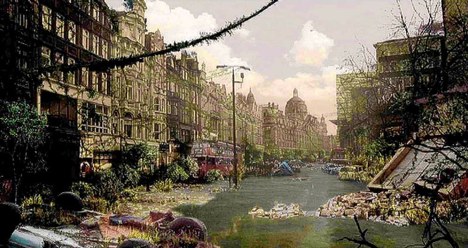
Out of the Wild

london20after20people-jj-001

At Orion Magazine, authors William Cronon and Michael Pollan share a stimulating conversation about how language shapes our world. They cover questions such as “what is wild?”, “what is cultivated?”, and “what can these ideas teach us about our relationship to landscape?”. What I found most compelling was the last part of the conversation where they talk about the power and importance of storytelling:

Bill:  Right. Ecology, storytelling, history—they all render connections visible. We make that which is invisible visible through story, and thereby reveal people’s relationships to other living things.

Michael:  Stories establish canons of beauty, too. There is a role for art in changing cultural norms about what’s worth valuing. One hundred fifty years ago, certain people looked at a farm and saw what you might see if you look today at a nuclear power plant or some other degraded landscape. Part of the reason we tell stories is to create fresh value for certain landscapes, certain relationships.

Bill:  And stories make possible acts of moral recognition that we might not otherwise experience. They help us see our own complicity in things we don’t ordinarily see as connected to ourselves.

Michael:  Yes, exactly. That recognition can help remove the condescension in so much environmental writing by showing us that, look, these things we abhor are done in our name, and we are complicit in them, and we need to take account of them. It was Wendell Berry’s idea that the environmental crisis is a crisis of character. The big problem is the result of all the little problems in our everyday lives. That can be a guilt trip, but it doesn’t have to be. You can tell that story in ways that empower people.

Storytelling can also help us find hopeful solutions. For example, when I was writing Omnivore’s Dilemma and I went to Joel Salatin’s farm in Virginia, I learned how his grazing worked—intensive rotational grazing—and he explained to me what happens under the surface, how every time the ruminants come through and shear that pasture and reduce that leaf mass, a roughly equivalent amount of root mass is broken down and turned into soil. I learned that he takes vast amounts of food off this pastureland, without subtracting anything. To the contrary, the sun is feeding the grass, and the grass is feeding the ruminants; the ruminants are feeding us, and they’re also feeding the soil.

I suddenly saw a whole other way of conceiving our relationship to nature, that there are systems that exist, and could exist, that are non zero sum. There is a free lunch in nature: it’s solar energy, which means it isn’t necessarily true that for us to feed ourselves we have to diminish the world.

When you tell an audience that story, it fills them with hope and a sense of possibility, and that’s a function of storytelling. But, of course, it isn’t always so neat. There are questions of scale, and if you eat meat, there are problems with cattle. But I’m always looking for stories that refresh this narrative about nature that we’re so stuck in.

Bill:  Messy stories invite us into politics. They also invite us to laugh at ourselves. And those things together—the ability to laugh, to experience hope, to be inspired toward action at the personal and political levels—these strike me as the work of engaged storytelling in a world we’re trying to change for the better.

Michael:  I do have a lot of faith in the power of stories to do things. My greatest thrill as a writer is when I see people changed by the work, when people tell me that they’ve changed their behavior in some way because of something they’ve read.

One of the things I’ve fought very hard to do with my editors is to talk about alternatives when I talk about problems. For example, if I’m writing an incredibly dark story about industrial meat production and following a cow through the feedlot and slaughterhouse, I really want three paragraphs on the alternative to this system, which is to say, grass-finished beef. Those three paragraphs have more impact than anything else in the piece. And I still hear from ranchers that it was on the day that an article on that topic came out that we began to see the stirrings of a new market for grass-finished beef. “We no longer send them to the auction barn right away,” they tell me. “We’re finishing on grass now.”

Bill:  That’s a good story about storytelling.

Michael:  You have to pass through the dark wilderness of the feedlot before you can get there, but I think that there’s an appetite for hope that journalists don’t often satisfy.

I’ve met people, in their twenties especially, who really hate the model of the investigative article that tells them how messed up things are and doesn’t point to some alternative. True, the alternative you’re proposing can seem tacked on, and it can be incommensurate with the scale of the evils—but I think people want hope, a course of action they can take. This is something many journalists are missing right now. I think if our writing doesn’t include that dimension in some way, we lose people.

Bill:  It strikes me that you’re pointing to a great tradition in the environmental movement, which is the power of good storytelling, going back to Rachel Carson.

Michael:  She was incredibly effective rhetorically. Silent Spring is a very sophisticated piece of work.

Bill:  It’s stunningly done.

Michael:  It’s stunningly done. And it speaks to the power of fictional ideas like wilderness. Carson understood that, even if you’re writing about science, narrative is important. The trick I learned from her is never to talk about “neurotoxins”; instead, you tell the story of the molecule in the cell. Because there’s a narrative everywhere, even at the level of molecules.

Bill:  Maybe that’s a good note for us to end on, don’t you think? The poet Muriel Rukeyser once said that “the world is made of stories, not of atoms.” When we lose track of the narratives that human beings need to suffuse their lives and the world with meaning, we forget what makes the world worth saving. Telling stories is how we remember.

Read the complete transcript here: http://www.orionmagazine.org/index.php/articles/article/7811