Chance Encounters as the Walls Close In

By Edward Curtin

Source: Behind the Curtain

“A treasure stumbled upon, suddenly; not gradually accumulated, by adding one to one. The accumulation of learning, ‘adding to the sum-total of human knowledge’; lay that burden down, that baggage, that impediment. Take nothing for your journey; travel light.”   – Norman O. Brown, Love’s Body

These are “heavy” times, colloquially speaking.  Forebodings everywhere.  Everything broken.  People on edge, nervous, filled with anxiety about they know not what since it seems to be everything. The economy, politics, elections, endless propaganda, the war in Ukraine, censorship, the environment, nuclear war, Covid/vaccines, a massive world-wide collapse, the death of democratic possibilities, the loss of all innocence as a very weird and dangerous future creeps upon us, etc. Only the most anesthetized don’t feel it.

The anxiety has increased even as access to staggering amounts of knowledge – and falsehoods – has become available with the click of a button into the digital encyclopedia.  The CIA’s MK-Ultra mind control program has gone digital.  The more information, the more insubstantial the world seems, but it is not an insubstantiality that connects to hope or faith but to despair.  Across the world people are holding their breath.  What’s next?

Roberto Calasso, the late great Italian writer, wrote that we live in “the unnamable present,” which seems accurate.  Information technology, with its easily available marriage of accurate and fraudulent information, affects people at the fathomless depths of the mind and spirit.  Yet it is taken-for-granted that the more such technological information there is available, as well as the ease with which one can add one’s two-cents to it, is a good thing, even as those powerful deep-state forces that control the Internet pump out an endless stream of purposely dissembling and contradictory messages.  Delusions of omnipotence and chaos everywhere, but not in the service of humanity.  Such chaos plays in chords D and C – Depressing and Controlling.

In the midst of this unnamable present, all of us need to dream of beauty and liberation even as we temporarily rely on digital technology for news of the wider world.  For the local news we can step outside and walk and talk to people, but we can’t endlessly travel everywhere, so we rely on the Internet for reports from elsewhere.  Even as we exercise great effort to discern facts from fictions through digital’s magic emanations, we hunger for some deeper experiences than the ephemerality of this unnamable world.  Without it we are lost in a forest of abstractions.

While recently dawdling on a walk, I stopped to browse through tables of free books on the lawn of my local library.  I was looking for nothing but found something that startled me: a few descriptive words of a child’s experience.  I chanced to pick up an old (1942), small autobiography by the English historian, A. L. Rowse – A Cornish Childhood.  The flyleaf informed me that it was the story of his pre-World War I childhood in a little Cornish village in southwestern England.  The son of a china-clay worker and mother of very modest means, Rowse later went on to study at Oxford and became a well-known scholar and author of about a hundred books.  In other words, a man whose capacious mind was encyclopedic long before the Internet offered its wares of information about everything from A to Z.

Since my grandfather, the son of an Irish immigrant father and English mother, had spent his early years working in a bobbin factory in Bradford, England, a polluted mill town in the north, before sailing at age 11 from Liverpool to New York City aboard the Celtic with his four younger siblings sans parents, I had an interest in what life was like for poor children in England during that era.  How circumstances influenced them: two working-class boys, one who became an Oxford graduate and well-known author; the other who became a NYC policeman known only to family and friends.  The words Rowse wrote and I read echoed experiences that I had had when young; I wondered if my grandfather had experienced something similar.  Rowse writes this on pages 16-17 where I randomly opened the book:

A little group of thatched cottages in the middle of the village had a small orchard attached; and I remember well the peculiar purity of the blue sky seen through the white clusters of apple-blossom in spring. I remember being moon-struck looking at it one morning early on my way to school. It meant something for me; what I couldn’t say. It gave me an unease at heart, some reaching outwards toward perfection such as impels men into religion, some sense of the transcendence of things, of the fragility of our hold upon life . . . . I could not know then that it was an early taste of aesthetic sensation, a kind of revelation which has since become a secret touchstone of experience for me, an inner resource and consolation. . . . In time it became my creed – if that word can be used of a religion which has no dogma, no need of dogma; for which this ultimate aesthetic experience, this apprehension of the world and life as having value essentially in the moment of being apprehended qua beauty, I had no need of religion. . . . in that very moment it seemed that time stood still, that for a moment time was held up and one saw experience as through a rift across the flow of it, a shaft into the universe. But what gave such poignancy to the experience was that, in the very same moment that one felt time standing still, one knew at the back of the mind, or with another part of it, that it was moving inexorably on, carrying oneself and life with it. So that the acuity of the experience, the reason why it moved one so profoundly, was that at bottom it was a protest of the personality against the realization of its final extinction. Perhaps, therefore, it was bound up with, a reflex action from, the struggle for survival. I could get no further than that; and in fact have remained content with that.

I quote so many of Rowse’s words because they seem to contain two revelations that pertain to our current predicament. One a revelation that opens onto hope; the other a revelation of hopelessness. On the one hand, Rowse writes beautifully about how a patch of blue sky through apple blossoms (and his reading Wordsworth’s Intimations of Immortality) could open his heart and soul to deep aesthetic consolation.  Calasso, in discussing “absolute literature” and the Bhagavad Gita in Literature and the Gods, refers to this experience with the word ramaharsa or horripilation, the happiness of the hairs.  It is that feeling one has when one experiences a thrill so profound that a shiver goes down one’s spine and one experiences an epiphany.  Your hairs and other body parts stand up, whether it’s from a patch of blue, a certain spiritual or erotic/love encounter, or a line of poetry that takes your breath away.  Such a thrill often happens through a serendipitous stumbling.

For Rowse, the epiphany was bounded, like a beautiful bird with its wings clipped; it was an “aesthetic experience” that seemed to exclude something genuinely transcendent in the experiential and theological sense. Maybe it was more than that when he was young, but when this scholar described it in his 39th year, this intellectual could only say it was aesthetic.

C. S. Lewis, in the opening pages of The Abolition of Man, echoing Coleridge’s comment about two tourists at a waterfall, one who calls the waterfall pretty and the other who calls it sublime (Coleridge endorsing the later and dismissing the former with disgust), writes, “The feelings which make a man call an object sublime are not sublime feelings but feelings of veneration.” In other words, the sublime nature of a patch of blue sky through apple blossoms in the early morn cannot be reduced to a person’s subjective feelings but is objectively true and a crack into the mystery of transcendence. To see it as a protest against one’s personal extinction and to be content to “get no further than that” is to foreclose the possibility that what the boy felt was not what the man thought; or to quote Wordsworth about what seems to have happened to Rowse: “Shades of the prison house begin to close/Upon the growing boy,” and that is that.

But we are even a longer way gone from when Rowse wrote his remembrances.  In our secular Internet age, first society and now its technology, not aesthetics or the religion of art, have replaced God for many people, who, like Rowse, have lost the ability to experience the divine.  It embarrasses them.  Something – an addiction to pseudo-knowledge? – blocks their willingness to be open to surpassing the reasoning mind.  We think we are too sophisticated to bend that low even when looking up. “The pseudomorphism between religion and society” has passed unobserved, as Calasso puts it:

It all came together not so much in Durkheim’s [French sociologist 1858-1917] claim that “the religious is the social,’ but in the fact that suddenly such a claim sounded natural. What was left in the end was naked society, but invested now with all the powers inherited, or rather burgled, from religion. The twentieth century would see its triumph. The theology of society severed every tie, renounced all dependence, and flaunted the distinguishing feature: the tautological, the self-advertising. The power and impact of totalitarian regimes cannot be explained unless we accept that the very notion of society has appropriated an unprecedented power, one previously the preserve of religion. . . . Being anti-social would become the equivalent of sinning against the Holy Ghost. . . . Society became the subject above all subjects, for whose sake everything is justified.

For someone like Rowse, the Oxford scholar and bibliophile, writing in the midst of WW II about his childhood before WW I, an exquisite aesthetic explanation suffices to explain his experience, one that he concludes was perhaps part of an evolutionary reflex action connected to the struggle for survival.  Thus this epiphany of beauty is immured in sadness rather than opening out into possible hope.  Lovely as his description is, it is caged in inevitability, as if to say: Here is your bit of beauty on your way to dusty death.  It is a denial of freedom, of spiritual reality, of what Lewis refers to for brevity’s sake as ‘the Tao,’ what the Chinese have long meant as the great thing, the correspondence between the outer and the inner, a reality beyond causality and the controlling mind.

Now even beauty has been banned behind machine experiences.  But the question of beauty is secondary to the nature of reality and our connection to it.  The fate of the world depends upon it.  When the world is too much with us and doom and gloom are everywhere, where can we turn to find a way forward to find a place to stand to fight the evils of nuclear weapons, poverty, endless propaganda, and all the other assorted demons marauding through our world?

It will not be to machines or more information, for they are the essence of too-muchness.  It will not come from concepts or knowledge, which Nietzsche said made it possible to avoid pain.  I believe it will only come from what he suggested: “To make an experiment of one’s very life – this alone is freedom of the spirit, this then became for me my philosophy.”  And before you might think, “Look where it got him, stark raving mad,” let me briefly explain.  Nietzsche may seem like an odd choice to suggest as insightful when it comes to openness to a spiritual dimension to experience since he is usually but erroneously seen as someone who “killed God.”  Someone like Gandhi might seem more appropriate with his “experiments with truth.”  And of course Gandhi is very appropriate.  But so too are Emerson, Thoreau, Jung, and many others, at least in my limited sense of what I mean by experiment.  I mean experimenting-experiencing (both derived from the same Latin word, expereri, to try or test) by assuming through an act of faith or suspension of disbelief that if we stop trying to control everything and open ourselves to serendipitous stumbling, what may seem like simply beautiful aesthetic experiences may be apertures into a spiritual energy we were unaware of.  James W. Douglass explores this possibility in his tantalizing book, Lightning East to West: Jesus, Gandhi, and the Nuclear Age, when he asks and then explores this question: “Is there a spiritual reality, inconceivable to us today, which corresponds in history to the physical reality which Einstein discovered and which led to the atomic bomb?”

I like to think that my grandfather, although a man not very keen on things spiritual, might have, in his young years amidst the grime and fetid air of Bradford, chanced to look up and saw a patch of blue sky through the rising smoke and felt the “happiness of the hairs” that opened a crack in his reality to let the light in.

Roberto Calasso quotes this from Nietzsche:

That huge scaffolding and structure of concepts to which the man who must clings in order to save himself in the course of life, for the liberated intellect is merely a support and a toy for his daring devices. And should he break it, he shuffles it around and ironically reassembles it once more, connecting what is least related and separating what is closest. By doing so he shows that those needful ploys are of no use to him and that he is no longer guided by concepts but by intuitions.

I have an intuition that there are hierophanies everywhere, treasures to be stumbled upon – by chance.  If we let them be.

My eyes already touch the sunny hill,
going far ahead of the road I have begun.
So we are grasped by what we cannot grasp;
It has its inner light, even from a distance –

And changes us, even if we do not reach it,
Into something else, which, hardly sensing it, we already are;
A gesture waves us on, answering our own wave. . .
But what we feel is the wind in our faces.

– Rainer Maria Rilke, “A Walk”

Restoring A World Out of Balance

Is our expansive evolution in technological advancement a wrong turn for humanity? Or has it evolved without our consciousness keeping up to steward it effectively?

By Tom Bunzel

Source: The Pulse

One of my first really disquieting insights about the planet and the pace of change came when I saw the film “World Out of Balance” or “Koyaanisqatsi” in the 1980’s.

The concept behind the film was that Nature has an exquisite balance between various forces, and that’s when I first thought about the likelihood of the existence of a higher intelligence.

The film was jarring because it showed dramatically, now 40 plus years ago, the havoc that was wreaked by technology not just on the environment, but how human technology was literally putting the world out of balance – a harmony that was naturally sustained prior to human intervention.

Computers Introduced Me to Rapid Change

At that time, I just getting interested in computer graphics and I encountered “Moore’s Law”, which refers to the observation made by Intel co-founder Gordon Moore in 1965 that the number of transistors on integrated circuits doubles approximately every two years.

That meant that processing power doubled in the same span of time, allowing graphics, for example, to go from color, to 3D, to 3D with texture mapping and other effects, and on and on.

One example of this was the original movie Jurassic Park, which was made with 3D models of dinosaurs having their wire frames “texture mapped” – covered with skin and then animated on a Silicon Graphics work station.  The processing power required to render these images quickly enough for a 30 frames per second film was staggering.

I just Googled the company.  As I suspected they are extinct like the dinosaurs; and the process I described above now happens on a phone, or on a website, and films are using artificial intelligence to fool audiences.

As I began writing about digital video and animation, and attended conferences, I found myself on a carousel of a continual need to adapt to change, and “upgrade” my system to keep up with the latest advancements.

It worked for me for a while and I enjoyed integrating solutions based on a creative understanding of what was coming out, but eventually, I realized that I could no longer keep up.

I had to take a break from the relentless pressure, which I did, and ended my tech writing career.

It was around that time I was reading Eckhart Tolle, and learning how the Ego, the voice in my head, always wants MORE.

The Continued Acceleration of Change

Moore’s law for integrated circuits was only the beginning, of course.  We now have the promise of quantum computing and the reality of artificial intelligence, which both have the potential to put the world as we knew it even more out of balance.

When we consider our human conditioning, the wider the gap between one’s childhood where one “learns the ropes” and perhaps conforms for one’s safety and one’s adulthood — when everything has changed creates intense discomfort relative to the gap in years.

For a dinosaur like me the continual need to “download the app” is stressful.  For my friends’ grandchildren it’s just part of being alive.

Peter Russell, in his new book “Forgiving Humanity” uses a sobering term – Exponential Change – as he describes how rapid changes in technology first affected agrarian culture, increased dramatically with the industrial revolution and accelerated again with the advent of computer technology and integrated circuits.

It’s Not You, It’s Exponential Change

He reaches a conclusion that is both profound and daunting:

“This doesn’t mean humankind has taken a wrong turn. Spiraling rates of development, with all their consequences, positive and negative, are the inevitable destiny of any intelligent, technologically-empowered species.”

So the fact that we have knocked the world out of its natural harmony is something that is part of evolution?  In essence, we are a part of nature that keeps pushing the envelope, but it can have dire consequences for a species that goes too far?

That is certainly what we are up against with respect to artificial intelligence, where the notion of exponential change in terms of brute intellectual capacity, is making many experts wary of consequences of an “intelligence” that vastly dwarfs human capabilities.

Consider the difference between exponential change versus simple, let us say, incremental change.  Exponential means that is multiplied by its current value, or the power of 2.  Anyone who has played with relationships like that in math knows how rapidly it can spin out of control.

Calculations of this order of magnitude quickly go beyond what the human brain can process.

And how does this expansion of potential knowledge affect consciousness today?

Peter Russell takes one of the driving forces of exponential change – AI – and discusses his new book by interviewing “his clone” in a fascinating video.

There is the possibility that with enough shocks or consequences that humanity may begin to glean that a purely intellectual approach to reality is the reason for our imbalance, and that knowledge itself, without wisdom or “being”, is fraught with peril.  Blind intellect alone creates conflict with a higher, natural intelligence which it ignores.

Russell uses the analogy of how a wheel that spins faster and faster will eventually come apart.

Taking a Cosmic Perspective – Collectively and Individually

In the video Russell’s “clone” suggests that a way for humanity to adapt, and actually align with the natural forces that have brought it to this point, is to begin to take a truly “cosmic perspective” and see our species in true proportion to the vast universe in which we now find ourselves.

Advances like the Webb Telescope have opened humanity’s eyes to a more accurate understanding of the vast scale of the universe we inhabit.  We now know that galaxies move in clusters of unimaginable proportions.

Russell points out that there are trillions of stars and life might have evolved to an intelligent level on some of these, and that perhaps such life has found itself at the point where we are many times in eternity.

We have to confront the stark reality that from such a perspective within the vastness of Nature, we are here for only a brief interval both as individuals – and indeed perhaps as a species.  

Russell suggests that such a perspective can make us more aware and grateful for our higher capabilities in areas beyond the intellect, such as art, culture, and probably philosophy.  Humanity needs to become more deeply human once again rather than purely mental, as the computers we use are just brute intellect.

A Shift Beyond Copernican Proportions

Such a “renaissance” would be like a new Copernican revolution.  Most of us have a perspective (in consciousness) that WE are the center of all existence. 

But from a “cosmic” perspective we must recognize that cannot be true; it must be an illusion.  We can begin by sensing the truth through our bodies that we are organic beings within dimensions of a vast organism (maybe like the microscopic organisms that exist in our gut and make our “lives” possible are organic beings within us) – and this recognition could serve to dampen both our hubris as a species as to how important we are (dominant on this planet), but also make this a cornerstone of a viable personal philosophy.

I don’t know if I will be here to witness it, but I sense that this shift is very much in line with current trends toward a more dramatic “Disclosure” of our place in the universe – revealing that several other interplanetary or interdimensional species have been here, communicated with humans and are still monitoring human affairs.

Harvard astronomer Avi Loeb, who gained prominence when he speculated that “Oumamoua” – the interstellar object spotted entering and leaving our solar system recently, showed that it was intelligently controlled.  He has since begun Galileo project to search for evidence of extraterrestrial intelligence.

All of this is finally putting to rest the misgivings of the famous Brookings memo that greatly contributed to the secrecy around UFOs – the memo speculated that if extraterrestrial life were a proven reality many social structures, religions and institutions would collapse.  Better to hush it up.

But of course, we are now witnessing the dissolution of many conditioned beliefs and the institutions that these flawed beliefs supported; among them our belief in our dominance as a species and our self-importance as individuals.

It would give me hope to see the shift completed with a deep comprehension of our connection to the universe both epigenetically and spiritually.

From Survival To Moments of Stillness

Are we consistently in survival mode? Does our societal design chronically invite us into this state?

By Tom Bunzel

Source: The Pulse

I thought I would contribute to the discussion by Joe Martino that “We’re Not Living in Ordinary Times.”

Many of the issues Joe mentioned dovetail with the work of trauma specialists like Dr. Gabor Mate, who recently wrote “The Myth of Normal” which describes how chronic illness and stress are actually “normal” responses to a traumatizing world.

So many of us are in survival mode.  I thought it was just me after COVID and having some other personal issues, but even now when I go to the market, it seems like many people are living with activated nervous systems.

A good friend also refers to a “fear machine” in the media.  Joe Martino calls it fear porn.  News has always been a beat down at times but with cable news it’s a 24/7 assault on the senses.

The format is deadly:  they don’t just tell you what HAS happened. They scare the crap out of you with what might happen, hasn’t happened, will never happen but might come knocking at your door. It is an onslaught of what ifs.

Why do we watch it?  We want to know “what’s going on”. 

What about what is happening all around us before we turn on the media?  What about trees growing, birds eating from a feeder or our cat coming up to snuggle?  We have all but forgotten our connection to the natural world into which we were born, and which apparently was here before we arrived.

How do we reconnect with what is beyond what we believe might be? I think there may be a “portal”.

We have been so conditioned by digital media that many of us never completely experience silence.

Quiet is hard to find these days.

The Noise of Consumerism

Besides just the news, there is the onslaught of commercials, now also on our phones and seemingly everywhere one goes.  I remember in 1980 when some people were appalled by the sudden commercialization of the Los Angeles Olympics, with corporate logos suddenly everywhere.

That was just the beginning.

Now every stadium is named after a corporate sponsor, and many of us wear branded attire proclaiming our attachment to a sports team or even a brand of sneakers or workout clothes.

The philosopher and mystic Gurdjieff wrote and spoke about how “Impressions” are taken in by our senses – essentially how the environment affects our bodily functions, mind and alas, spirit.

Getting bombarded with messages about our inadequacy on social media and advertising has already been noted as taking a psychological toll on teenagers in particular.

When I recognized that my brain had mostly healed from my concussion, but that I was still frequently uncomfortable in my body, I encountered the work of Dr. Mate and did some introspection on what sorts of “wounds” my body might be holding.

I found it helpful to consider this issue in the context of the impressions I received from an early age – and actually even before birth in the womb of a mother who had just survived the holocaust.

I began to see how the feelings of inadequacy and “less than” were programmed into me by trying to please first my parents, then my fellow students and ultimately potential friends in an attempt to secure connection and self-worth.

But it also became obvious that I was far from alone with having accumulated these “impressions” and now projecting the results onto the world – often shaping my experiences in negative ways that I attributed to “circumstances.”  I tried to get in touch with the anger and shame reflecting on these experiences, often of rejection, would trigger after years of probably ignoring those feelings entirely.

Conditioned Resistance to Resting

One thing that helped me begin to heal was noticing my intense resistance to resting – which I needed to do after my concussion but which the mind would not tolerate without admonishing me to “do something.”

The work of several spiritual teachers helped me address this issue.

Jeff Foster talks about being ’de-pressed’ and getting deep rest.

Jac O’Keefe and Eckhart Tolle both mention the need to stop “the movie in your head” and Eckhart often speaks of finding and making space – using a few conscious breaths to stop the voice in the head even just temporarily.

Mooji is a proponent of rest and contemplation around one’s conditioned beliefs.

And Adyashanti also advises “deep rest” in Stillness, without trying to control anything.

Jon Kabat-Zinn, a pioneer in mediation says it’s really just about letting things be the way they are.

And on and on.

Of course, it’s easy to tell people working multiple jobs or trying to balance work and family to just rest.  As mentioned earlier, the whole impetus of the culture is to push through, do more, and keep going.

The Compulsion to Move with Loud Music

It’s interesting and a bit troubling to me that almost every advertisement shows young people dancing, whether they have taken a miracle pill or used the right deodorant.  It shows they have overcome their inadequacy.

I happen to think dancing is wonderful, but this continuous emphasis has made it almost impossible to find quiet.

It’s no secret that now so many people are constantly connected, by phone or other device, to the Internet, constantly intruding on any moment of stillness.

Unfortunately, like many of our own nervous systems, the Internet never rests.  And now with AI the prospect of a continual activity of neural stimulation now done also by machine portends the sort of chronic illness and stress that Dr. Mate talks about — getting even worse?

In his writing, Joe Martino mentions a “full bodied sensemaking” where one goes beyond the constant chatter of the mind and connects with the wisdom of the body – wisdom that Eckhart Tolle describes also as an Intelligence far greater than the (relatively smaller human) mind.

For me, that is essentially what led me to seek interludes of stillness, which I am fortunate enough to be able to find living in a senior community.

Connecting to What Receives Impressions

The mind and the body need a break from impressions.  In stillness it is possible to both allow the chatter of the mind and still not get caught up in any particular story; instead taking a series of deep conscious abdominal breaths we can “clear the cache” in memory and relax.

In relaxation, we can then allow the sensations in the body to be felt rather than suppressed, and even welcomed.

We can become open to the world as it is before it gets analyzed and judged by the mind.

Can this sort of practice and understanding be proliferated on a planetary level?

In reality, this is truly an economic issue, because this experience of stillness cannot occur in survival mode.

Corporations Have Their Own Agenda

The problem, of course, is the stiff resistance from the corporations — which have in many ways become the dominant species on the planet, comprised of seemingly independent humans the way our guts are made up of billions of “independent” microorganisms. 

But perhaps like reality itself, the corporation is a digital “living” organism in the sense that it seeks to survive, grow and often devour both competitors and its human workers.

Once again, this issue has been exacerbated by artificial intelligence which threatens to further separate the technologically privileged from an ever-increasing mass of human serfs.

As that chasm grows both separating portions of humanity will inevitably become even more separated from Source — what is and was always here.

As Joe suggests, the transformation here must come on an individual level first, but ultimately lead to a recognition of inter-connectedness and “wholeness” where humanity recognizes how it has separated from the very Nature of which it is an expression.

Imagine if during any large musical concert, where the audience is dancing and in tune, the artists brought the volume and tempo down, and then had a few minutes of community silence.

Imagine if that concert was under the Milky Way, and the light could be suppressed for that brief time to allow a real look at ‘where’ we are.

This is reminiscent of some of the indigenous ceremonies, if only we could begin to go in that direction.

It’s now part of my own practice – to find stillness both externally and internally – and begin to embody a sense of alignment with how things are – rather than how the mind thinks they should be.

IN THE CULTURE OF HUNGRY GHOSTS

By Dylan Charles

Source: Waking Times

“No society can understand itself without looking at its shadow side.” ― Gabor Maté, In the Realm of Hungry Ghosts: Close Encounters with Addiction

Something wicked bubbles just beneath the surface of the collective conscience. Our society is rife with corruption, predation, perversion, over-consumption, violence, addiction and so much more. Somehow enough is never enough, as if the driving force behind human existence is pure want.

This is not true, though, for we know that spiritually well beings are content beings, looking no further than the present moment’s blessings for satisfaction. We don’t have an inherent need for want. Want is a symptom, not the condition. It’s something that enters when the spirit is untended to.

It must then be a spiritual illness which plagues society. Something secretly driving so many of us mad with insatiable desire for sensation and objects. Unforgiving cravings that manifest in any way imaginable, from sex, to money, to food, to power and even in the need to be perfect. It’s a war against the self, waged unconsciously by the self. A below subconscious campaign of self-annihilation.

There are no contemporary metaphors to understand this kind of emptiness. The void just is. And since the void is so rarely acknowledged and so rarely looked at deeply, it sits in the shadows driving us mad, steering with impulse.

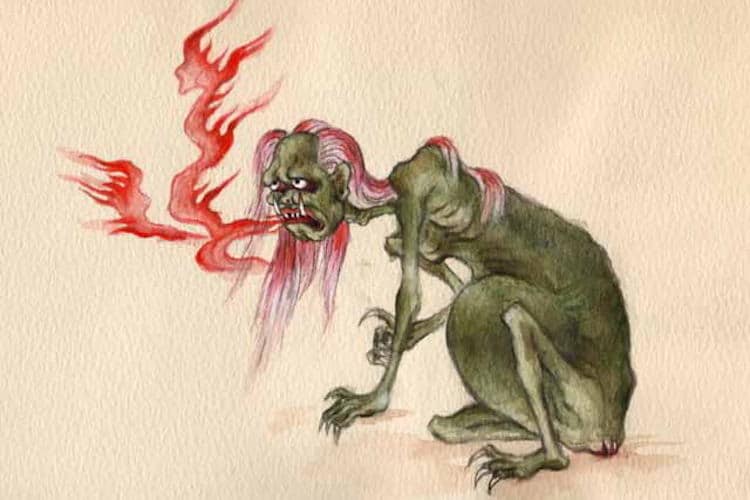
In Chinese Buddhist philosophy, though, there is a story that fits. The hungry ghost.

“In Chinese Buddhist teachings, “hungry ghosts are unable to take in or assimilate what they desperately need. The problem lies in their constricted throats — which cannot open for nourishment. They wander aimlessly in search of relief that is not forthcoming.”” [Source]

Interestingly, according to some of its origin myths, the hungry ghost was born out an act of cruelty. In many of the stories, it is a wealthy man’s wife who did some terrible thing to a monk, and when she eventually dies her spirit takes the form of the hungry ghost, forever lurking in purgatory, unable to ever fill its distorted belly and therefore always needing and wanting more.

The hungry ghost, then, is an expression of karma.

Hungry ghosts are the demon-like creatures described in Buddhist, Taoist, Hindu, Sikh, and Jain texts as the remnants of the dead who are afflicted with insatiable desire, hunger or thirst as a result of bad deeds or evil intent carried out in their life times. [Source]

In the realm of hungry ghosts, a deep drama between the ego and the ghost plays out ad infinitum. It’s an interplay that feeds the ego just enough for it to survive, so that in turn the ego can feed the hungry ghost. A dead-end cul-de-sac of sorts. A looping projection of one of our worst human vulnerabilities.

“The work of the ghost does not want to completely destroy its prey. Having fed off the other through dissociative trajectories of turbulence, the ego again becomes more robust. The hungry ghost now has, as companion and source of nurture, a replenished ego on which internal feeding may resume inside the space of erasure until the plenitude of the ghost-within again permeates the intersubjective.” ~  Nick Totton, Psychoanalysis and the Paranormal: Lands of Darkness

Spiritually healthy people understand their cravings for what they, expressions of innumerable forms of pain. Manifestations of the suffering caused by disconnection from the self, and from nature. And the self is nature. There really is no distinction between the two. The illusion is of separateness.

The ghosts are there to remind us that our real work is transmuting our suffering and cruelty into resilience and compassion. It’s not enough to numb the pain, it must be used to our advantage, for our growth, to serve as a catalyst for transformation, and to provide a chrysalis in which the transformation can take place.

“We are social beings. When we feel disconnected or alienated, we experience pain. Addiction, depression, anger, and violence are different ways we react to pain. To heal our society we must heal the emotional wounds.” ~Chris Agnos

Few understand this more clearly than Dr. Gabor Maté, whose work with drug addicts has transformed our understanding of what it means to be stuck in the realm of hungry ghosts.

The end of childhood play

By Brian Kaller

Source: resilience

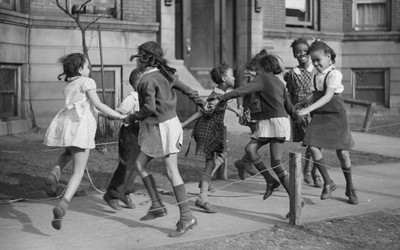
Recorded history is the history of adults–generals, statesmen, explorers and scientists–but all of those adults began their path as children. And running beneath this official history is the unofficial history of childhood games and rituals, many of which were passed down for generations; children inhabited a separate universe of traditions, contests, solemn rituals and codes of honour, like a Viking horde living in your house unnoticed. It was in this world that every future general first learned to lead, every future scientist first turned over logs to delight in the tiny nightmares underneath, and every future explorer first plucked up the courage to enter the haunted woods. Elderly people here in Ireland, who grew up without electricity or many cars, still remember the feral exploration and creative play that was once the birthright of every child.

“Children today don’t have to think much about games given to them – we made up our own,” said one elder. “We played spin the top, marbles, hoop the hoop, hop scotch, conkers, kick the can, scut the whip, jackstones, and box the fox. Hop scotch has survived to some extent, but only among girls … Even when the dark evenings closed in we played ‘Battle In, Battle Out,’ and ‘Jack jack show the light.’”

The games varied widely from person to person; villages only a few miles away could apparently have very different game-traditions. City streets, perhaps because they drew families from so many rural villages, seem to have been a vast melting pot of such games; when British novelist Norman Douglas published his whimsical overview of the children’s games of London in 1916, he spent dozens of pages–most of the book–just listing games. Not dozens of games, mind you–dozens of pages of lists of games, any of which could be as complex as any video game today and most of which were known to most children.

The games, rhymes, and rituals children invented were so ubiquitous, and so often out of sight of adults, that they were little remarked upon or recorded, and only now, when they have almost disappeared, can we look back and see how remarkable they were. In the 1950s the husband-and-wife team of Peter and Iona Opie interviewed children on playgrounds around the UK and found that, instead of being silly and spontaneous, children’s rhymes and stories actually preserved historical traditions their parents had lost.

“Boys continue to crack jokes that Swift collected from his friends in Queen Anne’s time,” Opie wrote. “They ask riddles which were posed when Henry VIII was a boy. . . . They learn to cure warts . . . after the manner which Francis Bacon learned when he was young. . . . They rebuke one of their number who seeks back a gift with a couplet known in Shakespeare’s day. . . . and they are [perpetuating stories] which were gossip in Elizabethan times.” They re-discovered the observation of Queen Anne’s physician John Arbuthnot, who said that “nowhere was tradition preserved pure and uncorrupt but amongst school-boys, whose games and plays are delivered down invariably from one generation to another.”

This is especially remarkable since most of these rituals were not taught by parents or grandparents, who might have learned them decades earlier, but by other children who could only have known them for a few years. Since they were re-transmitted over years rather than decades, their transmission signal should have decayed more quickly. Instead, the children proved stronger at retaining historical knowledge than most adults–not in the sense of reciting facts, but in treasuring their past.

Some of their superstitions, like a blister as proof of lying, date back at least to the 1500s, and they chanted a rhyme that apparently dates back to the era of France’s Henry IV in 1610. Most interestingly, country children still wore oak leaves or an acorn in their button-holes on 29 May to remember the return of Charles II in 1651–and could explain why they did so–at a time when few adults remembered the date.

Keep in mind, also, that few people were writing in the 1500s, most writing was not about children’s games, and much of what was written then has been lost–so if a ritual was first recorded in the 1500s, it could well be much older. Oral traditions can endure for thousands or even tens of thousands of years; Australian Aborigines have traditions about the sea level changing that seem to date from the last Ice Age. No one knows if any children’s rhymes and games date back so far, but Douglas believed that one chant stretched back to the time of Nero, and the Opies seemed to agree.

Their games and rituals were still very local, even in the 1950s when mass media was already washing away the local cultures of villages and neighbourhoods. “While some children roll eggs at Easter,” the Opies wrote, “or nettle the legs of classmates on the 29th of May, or leave little gifts on people’s doorsteps on St. Valentine’s Day, or act under the delusion that they are above the law on a night in November, other children, sometimes living only the other side of a hill, will have no knowledge of these activities.”

Here, too, Ireland held onto this heritage later than most countries, and a radio documentary of children playing in a Dublin school-yard in 1977 showed them using their own complicated musical chants. They weren’t all local traditions–one chant cited Shirley Temple, “the girl with the curly hair”–but even that showed the staying power of these songs, as this was two generations after she had been famous.

The Opies also noted that children spontaneously adopted a “code of oral legislation”–cultural institutions for testing truthfulness, swearing affirmation, making bets and bargains, and determining the ownership of property–the adult legal code in miniature. These codes universally included a practice absent from adult law, however–that of asking for respite, what we recognize as “calling time out,” and what today’s children reportedly call “pause,” a usage imported from video games.

“Throughout history, bands of children gathered and roamed city streets and countrysides, forming their own societies each with its own customs, legal rules and procedures, parodies, politics, beliefs, and art,” the blog Carcinisation pointed out. “With their rhymes, songs, and symbols, they created and elaborated the meaning of their local landscape and culture, practicing for the adult work of the same nature. We are left with only remnants and echoes of a once-magnificent network of children’s cultures, capable of impressive feats of coordination.”

This seems to have been true of all human cultures–anthropologists report it in hunter-gather tribes, and Zechariah 8:5 said that “the streets of the city shall be full of boys and girls playing.” Certainly it was true among people I knew in Ireland or the USA in living memory. To see how recently outdoor play was assumed, look at a map of most American cities; anything built before World War II is typically a grid for easy transport, but post-war suburban streets curl like tossed spaghetti and end in cul-de-sacs in order to do the opposite, to slow and discourage traffic to be “safe for families.” The sprawl that covers much of America looks the way it does because it was made to be safe for children to play in the street–which in 1945 was exactly what they would be doing.

If the returning GIs who first moved into these homes could be transported to the present day, however, they would be puzzled. Aside from the fact that the future never happened–no flying cars or robot butlers–the most glaring difference would be the absence of any children. To a time traveler it would seem like the beginning of a Twilight Zone episode, and they’d would demand to know what happened–was there a plague? An alien invasion? Are the children grown from pods now? Are they marched to an altar and sacrificed to a dark god? Or is this some horrific science-fiction future where children grow up staring at glowing rectangles, and are drugged when they get restless?

“Even the idea of a children’s game seems to be slipping from our grasp,” Neil Postman wrote in 1982. “A children’s game, as we used to think of it, requires no instructors or umpires or spectators; it uses whatever space and equipment are at hand; it is played for no other reason than pleasure. . . . Who has seen anyone over the age of nine playing Jacks, Johnny on the Pony, Blindman’s Buff, or ball-bouncing rhymes? . . . Even Hide-and-Seek, which was played in Periclean Athens more than two thousand years ago, has now almost completely disappeared from the repertoire of self-organized children’s amusements. Children’s games, in a phrase, are an endangered species.”

The decline began a few generations ago, when television steamrolled over children’s cultural traditions, and that screen has now multiplied into a billion hand-held ones. When children everywhere carry all the world’s pornography in their pocket, as well as electronic games psychologically designed to addict people as powerfully as heroin, few future leaders will organise their mates, and few budding scientists will turn over any logs. Moreover, children today grow up under effective house arrest, as local ordinances, paranoid neighbours and police conspire to prohibit children from venturing far outside. They grow up learning no lessons, organising no peers, and exploring no territory, unless it be shifting electrons around a screen, and the screen becomes their world.

This unnatural state takes all the power of modern society to maintain, and it does not have to be inevitable or permanent; even now some parents keep their children unplugged and gather with other parents who do the same. If they don’t live near the country themselves, they might visit family who do. They teach small children some games from old books, and let the children take it from there. How this guerrilla action proceeds will depend on the situation, but it needs to be done. Otherwise, today’s children will live in a country filled with the most dependent and least self-sufficient humans who ever lived, polarised and paralysed by their screens, and facing a difficult future. We will need a new generation of people who can strategise, negotiate, and work together again, and to do that we need children to experience childhood once more.

WE ARE ALL BEING COOKED IN THE SOUP TOGETHER

By Paul Levy

Source: Waking Times

One of the recurring thought-forms that I hear repeated everywhere during these apocalyptic times is, “We are all in this together.” It is ironic that “we are all in this together,” and yet, our world feels anything but together, as it is in an incredibly polarized and dissociated state. Our species is suffering from what Jung calls a “sickness of dissociation,” which is a state of fragmentation deep within the unconscious itself that has seemingly spilled outside of our skulls and, through psychic forces beyond our conscious awareness, has taken the form of polarizing collective events playing themselves out en masse on the world stage. Our dissociation is not solely pathological, however, but is an expression of a deeper holistic process that is in the act of revealing itself. To quote Jung, “the sickness of dissociation in our world is at the same time a process of recovery, or rather, the climax of a period of pregnancy which heralds the throes of birth. A time of dissociation … is simultaneously an age of rebirth.”[1]

Whenever I hear “We are all in this together,” it reminds me of an amazing paragraph that Jung wrote in the late 1950’s that is as relevant today as it was then. Here is an excerpt: “We are in the soup that is going to be cooked for us, whether we claim to have invented it or not…. We are threatened with universal genocide if we cannot work out the way of salvation by a symbolic death.”[2] In other words, we are fated to suffer an unconscious “literal” death if we don’t consciously go through a “symbolic” death. What does Jung mean by this?

We are all in the soup together, yet we are suffering from a sickness of dissociation, and we are needing to go through a symbolic death experience, while another part of us is being reborn! What is going on here? Is what’s happening in our world meaningless chaos, or is there “something deeper” going on? The short answer: Our species has gotten drafted into an archetypal death/rebirth experience – in symbolically dying to a part of ourselves that is no longer serving us, another part of us is being reborn. As Jung points out, “there are times [and ours seems to be one of them] when the spirit is completely darkened because it needs to be reborn.”[3]

We can deepen our understanding of the archetypal process of death and rebirth that we are living out by shedding light on a prototypical example of death and rebirth – i.e., The Incarnation. Contemplating the West’s prevailing myth of the birth of God as a human being—the Christ event—psychologically, which is to say symbolically (i.e., as if it is a dream of our species) can help us gain some crucial insights into the deeper archetypal process that we are collectively enacting unconsciously on the world stage during these truly apocalyptic times.

The word “apocalypse,” etymologically speaking, refers to something previously hidden being unveiled and brought to light – in other words, something is being revealed to us during these apocalyptic times. Whereas in religious language, the apocalypse has to do with the Incarnation of God and the coming of the Messiah, psychologically speaking, the “apocalypse” means the momentous, world-shattering event of the coming of what Jung calls “the Self” (the wholeness of our personality, i.e., the God within) into conscious realization. Instead of incarnating through one man, however, like God did over two thousand years ago through the individual person of Jesus, the divine is now incarnating through the unconscious psyche of all of humanity. “God,” Jung writes, “wants to become man,” and instead of choosing a pure, guiltless vessel, God has chosen, in Jung’s words, “the creaturely man filled with darkness—the natural man who is tainted with original sin.”[4]

In that same amazing paragraph Jung writes, “Through his further incarnation God becomes a fearful task for man, who must now find ways and means to unite the divine opposites in himself. He is summoned…. Christ has shown how everybody will be crucified upon his destiny, i.e., upon his self, as he was. He did not carry his cross and suffer crucifixion so that we could escape.”[5] In other words, regardless of our outer religious orientation, everyone of us is fated (whether we like it or not) to carry our cross—to consciously bear our shadow and suffer the tension of the opposites within us—just as Christ did. And yet, something that we could not have created via the efforts of our own ego can potentially emerge as a result of consciously bearing this creative tension.

In being “summoned,” like a healer, shaman or artist who is being called by their inner voice and sacred vocation, we are being subpoenaed by a higher power. Whenever the archetype of the Self is constellated, due to the opposites intrinsic to the nature of this experience, we invariably feel a state of extreme conflict within us that is epitomized by the Christian symbol of the cross. Viewed symbolically, Christ on the cross reveals to us that the development and differentiation of consciousness leads to an ever-increasing awareness of a primordial conflict within our soul which necessarily involves a crucifixion of the ego. To understand this conflict psychologically, we could say that the unconscious longs to reach the light of consciousness, while at the same time continually recoils against it, because it would rather remain unconscious. In theological terms, to quote Jung, “God wants to become man, but not quite.”[6]

The Self is made manifest—i.e., real in space and time—through consciously suffering the conflict between the opposites to the point where we begin to experience their synthesis and complementarity. Jung comments, “This condition of the crucifixion, then, is a symbolic expression for the state of extreme conflict, where one simply has to give up, where one no longer knows, where one almost loses one’s mind. Out of that condition grows the thing which is really fought for … the birth of the self.”[7] It is by going through an internal experience of what the historical crucifixion symbolizes that the divine holy and whole-making spirit gets born through us.

Jung comments, “One shouldn’t evade this conflict by escaping into a premature and anticipated state of redemption, otherwise one provokes it in the outside world. And that is of the devil.”[8] If we don’t deal with the source of the divine conflict within us, it will get projected outside of ourselves and dreamed up in the external world. In other words, in our avoidance of dealing with the conflict within us, we are unwittingly colluding with the darker forces of death and destruction that are playing out in the outer world.

Nature herself does not come to a permanent standstill when confronted with opposites – rather, she uses them to create, out of their very opposition, a synthesis, a new birth. When Christ is nailed to the cross during the crucifixion, it symbolically represents that it is through the experience of being bound and severely limited in the space/time continuum that itself becomes the doorway through which we become introduced to the transcendent part of us that is beyond the physical, i.e., our spiritual nature. In other words, it is in experiencing our finite limitations to the max that becomes a doorway to the infinite part of ourselves.

Nothing so promotes the growth of consciousness as confronting the opposites within ourselves. Holding the tension of the opposites that is inherent in the crucifixion experience invariably liberates us from holding and identifying with our fixed and cherished perspectives. Helping us transcend the notion of a privileged and correct point of view, we become aperspectival in our viewpoint, as we see the relativity of all viewpoints – a way of seeing which coincides with the meta-perspective of the Self.

The essence of the Christian gnosis—the Incarnation of God through humanity—can be best understood as humanity’s creative confrontation with the opposites and their synthesis in the Self. The Self—which Jung equates with Christ—is present in everyone, but typically in an unconscious and unrealized condition. Once we withdraw our projections and fixations upon an external historical or metaphysical figure, however, we can realize that the Self/Christ (or whatever name we call it) lives within us – in Jung’s words, we then “wake up the Christ within.”[9]

Nature herself does not come to a permanent standstill when confronted with opposites – rather, she uses them to create, out of their very opposition, a synthesis, a new birth. When Christ is nailed to the cross during the crucifixion, it symbolically represents that it is through the experience of being bound and severely limited in the space/time continuum that itself becomes the doorway through which we become introduced to the transcendent part of us that is beyond the physical, i.e., our spiritual nature. In other words, it is in experiencing our finite limitations to the max that becomes a doorway to the infinite part of ourselves.

Nothing so promotes the growth of consciousness as confronting the opposites within ourselves. Holding the tension of the opposites that is inherent in the crucifixion experience invariably liberates us from holding and identifying with our fixed and cherished perspectives. Helping us transcend the notion of a privileged and correct point of view, we become aperspectival in our viewpoint, as we see the relativity of all viewpoints – a way of seeing which coincides with the meta-perspective of the Self.

The essence of the Christian gnosis—the Incarnation of God through humanity—can be best understood as humanity’s creative confrontation with the opposites and their synthesis in the Self. The Self—which Jung equates with Christ—is present in everyone, but typically in an unconscious and unrealized condition. Once we withdraw our projections and fixations upon an external historical or metaphysical figure, however, we can realize that the Self/Christ (or whatever name we call it) lives within us – in Jung’s words, we then “wake up the Christ within.”[9]

The cross is the symbol of the suffering Godhead that redeems humanity. This suffering would not have occurred without darker forces seemingly opposed to God. This is to say that the powers of evil play a crucial, mysterious and essential role in the redemption of humanity. Jung continues, “Christ is the model for the human answers and his symbol is the cross, the union of the opposites. This will be the fate of man, and this he must understand if he is to survive at all.”[11]

To quote Trappist monk and author Thomas Merton, “every man is Christ on the Cross, whether he realizes it or not. But we, if we are Christians [and in the deeper symbolic sense we are all “Christians”], must learn to realize it.”[12] Realizing we are Christ on the Cross re-contextualizes our suffering, transforming it from a deeply problematic personal situation to a more universal process in which we have all gotten enlisted. It is important to distinguish our neurotic suffering—which is a result of our unconscious clinging and is totally unproductive—from the suffering which is “sent by God” (as Christian mystics would say) in order to purify us of our obscurations. Our neurotic suffering blocks us from experiencing the divine, while the suffering that is a result of our participation in the archetypal process of crucifixion, through connecting us to the deeper passion that Christ went through, is the doorway introducing us to something beyond ourselves.

Russian philosopher Nicolas Berdyaev writes, “But there was a tendency to forget that the cross had a universal significance and application. The Crucifixion awaits not only the individual man but also society as a whole, a State or a civilization.”[13] In other words, it is not just individuals who are symbolically going through a crucifixion experience, but our global civilization as a whole. The microcosm (the individual) and the macrocosm (the collective), like iterations of the same fractal, are mirrored reflections of each other. The Self (or whatever name we call it) is incarnating through us—both individually and as a species—and it makes all the difference in the world whether we consciously realize this or not.[14]

If we remain unconscious when a living archetypal process is activated within us, this inner process will physically manifest itself externally in the outside world, where, as if by fate, it will get unconsciously dreamed up and acted out in a “literal,” concrete and oftentimes destructive way. Instead of going through an inner symbolic death, for example, we then literally kill each other, as well as, ultimately, ourselves. If we recognize, however, that we are being cast to play a role in a deeper cosmic process, instead of being destined to enact it unconsciously, and hence, destructively, we are able to consciously and creatively “incarnate” this archetypal process as individuation.

We, as a species, to quote Jung, have been “drawn into the cycle of the death and rebirth of the gods.”[15] In other words, having become part of a deeper mythic, archetypal and alchemical process of transformation, we are going through a cosmic death-rebirth experience of a higher order. Jung describes “how the divine process of change manifests itself to our human understanding and how man experiences it – as punishment, torment, death, and transfiguration.”[16] This divinely-sponsored process is subjectively experienced by the human ego as torture.[17] However, if we don’t personalize the experience, identify with it or get stuck in its nightmarish aspect—a great danger—but allow this deeper process to refine us as it needs to, it can lead to a transfiguration of our very being.

Whether consciously or not, we are all in a state of grieving – the world we have known is dying. In addition, our sense of who we think we are—imagining we exist as a separate self, alien to and apart from other separate selves as well as the rest of the universe—is an illusion whose expiration date has now been reached. This illusion is like a non-existent mirage that, if not recognized as illusory, can become reified and thereby become a lethal mirage. Either our illusion expires, or we do. As the poet Rumi would say, we need to “die before we die.”

To step out of the illusion of thinking we exist as a separate self is to recognize—and be born into—our greater identity (whether we call it the Self, Christ, Buddha, etc.), that includes and embraces everything under the sun. The Self—who we actually are—is simultaneously the source and fruit of life itself, enhancing life beyond measure. Connecting with the Self is not only our only hope in these dark times, it’s what everything that is happening in our world is potentially helping us to realize. And yet, the way to ascend to the light of the Higher Self (in Christian terminology, to attain The Resurrected Body)—as Christ himself indicates via his descent to the underworld after his death on the cross—is by journeying through the darkness.

To quote Jung, “God really wants to become man, even if he rends him asunder[18] … because he wants to become man, the uniting of his antinomy must take place in man.”[19] Where else, after all, could the opposites intrinsic to God’s nature (e.g., light and dark, good and evil) attain unity except in the very vessel—humanity—that God has prepared just for this very purpose? Being cooked in the soup together, we are being immersed and baptized into a deeper cosmic process. We are playing a crucial role in the divine drama of incarnation, an insight that renders meaning to our suffering and assists us in discovering our place in the world as well as helping us to find our very selves.

Nature Is Not a Machine—We Treat It So at Our Peril

By Jeremy Lent

Source: resilience

From genetic engineering to geoengineering, we treat nature as though it’s a machine. This view of nature is deeply embedded in Western thought, but it’s a fundamental misconception with potentially disastrous consequences.

Climate change, avers Rex Tillerson, ex-CEO of ExxonMobil and erstwhile US Secretary of State,  “is an engineering problem, and it has engineering solutions.” This brief statement encapsulates how the metaphor of the machine underlies the way our mainstream culture views the natural world. It also hints at the grievous dangers involved in perceiving nature in this way.

This mechanistic worldview has deep roots in Western thought. The great pioneers of the Scientific Revolution, such as Galileo, Kepler, and Newton, believed they were decoding “God’s book,” which was written in the language of mathematics. God was conceived as a great clockmaker, the “artificer” who constructed the intricate machine of nature so flawlessly that, once it was set in motion, there was nothing more to do (bar the occasional miracle) than let it run its course. “What is the heart, but a spring,” wrote Thomas Hobbes, “and the nerves but so many strings?” Descartes flatly declared: “I do not recognize any difference between the machines made by craftsmen and the various bodies that nature alone composes.”

In recent decades, the mechanistic conception of nature has been updated for the computer age, with popularizers of science such as Richard Dawkins arguing that “life is just bytes and bytes and bytes of digital information” and as a result, an animal such as a bat “is a machine, whose internal electronics are so wired up that its wing muscles cause it to home in on insects, as an unconscious guided missile homes in on an aeroplane.” This digital metaphor of nature pervades our culture and is used unreflectively by those in a position to direct our society’s future. According to Larry Page, co-founder of Google, for example, human DNA is just “600 megabytes compressed, so it’s smaller than any modern operating system . . .  So your program algorithms probably aren’t that complicated.”

But nature is not in fact a machine nor a computer—and it can’t be engineered or programmed like one. Thinking of it as such is a category error with ramifications that are both deluded and dangerous.

A four-billion-year reversal of entropy

Ultimately, this machine metaphor is based on a simplifying assumption, known as reductionism, which approaches nature as a collection of tiny parts to investigate. This methodology has been resoundingly effective in many fields of inquiry, leading to some of our greatest advances in science and technology. Without it, most of the benefits of our modern world would not exist—no electrical grids, no airplanes, no antibiotics, no internet. However, over the centuries, many scientists and engineers have been so swept up by the success of their enterprise that they have frequently mistaken this assumption for reality—even when advances in scientific research uncover its limitations.

When James Watson and Francis Crick discovered the shape of the DNA molecule in 1953, they used metaphors from the burgeoning information revolution to describe their findings. The genotype was a “program” that determined the exact specifications of an organism, just like a computer program. DNA sequences formed the “master code” of a “blueprint” that contained a detailed set of “instructions” for building an individual. Prominent geneticist Walter Gilbert would begin his public lectures by pulling out a compact disk and proclaiming “This is you!”

Since then, however, further scientific research has revealed fundamental defects in this model. The “central dogma” of molecular biology, as coined by Crick and Watson, was that information could only flow one way: from the gene to the rest of the cell. Biologists now know that proteins act directly on the DNA of the cell, specifying which genes in the DNA should be activated. DNA can’t do anything by itself—it only functions when certain parts of it get switched on or off by the activities of different combinations of proteins, which were themselves formed by the instructions of DNA. This process is a vibrant, dynamic circular flow of interactivity.

This leads to a classic chicken-and-egg problem: if a cell is not determined solely by its genes, what ultimately causes it to “decide” what to do? Biologists who have researched this issue generally agree that the emergence of life on Earth was most likely a self-organized process known as autopoiesis—from the Greek words meaning self-generation—performed originally by non-living molecular structures.

These protocells essentially staged a temporary, local reversal of the Second Law of Thermodynamics which describes how the universe is undergoing an irreversible process of entropy: order inevitably becomes disordered and heat always flows from hot regions to colder regions. We see entropy in our daily lives every time we stir cream into our coffee, or break an egg for an omelet. Once the egg is scrambled, no amount of work will ever get the yolk back together again. It’s a depressing law, especially when applied to the entire universe which, according to most physicists, will eventually dissipate into a bleak expanse of cold, dark nothingness. Those first protocells, however, learned to turn entropy into order by ingesting it in the form of energy and matter, breaking it apart, and reorganizing it into forms beneficial for their continued existence—the process we know as metabolism.

Ever since then, for roughly four billion years, the defining quality of life has been its purposive self-organization. There is no programmer writing a program; no architect drawing up a blueprint. The organism is the weaver of its own fabric, using DNA as an instrument of transmission. It sculpts itself according to its own inner sense of purpose, which it inherited ultimately—like all of us—from those first autocatalytic cells: the drive to resist entropy and generate a temporary vortex of self-created order in the universe. In the words of philosopher of biology Andreas Weber,

“Everything that lives wants more of life. Organisms are beings whose own existence means something to them.”

This implies that, rather than being an aggregation of unconscious machines, life is intrinsically purposive. In recent decades, carefully designed scientific studies have revealed the deep intelligence throughout the natural world employed by organisms as they fulfil their purpose of self-generation. The inner life of a plant, biologists have discovered, is a rich plethora of complex experience. Plants have their own versions of our five senses, as well as up to fifteen other ways of sensing their environment for which we don’t have analogues. Plants act intentionally and purposefully: they have memories and learn, they communicate with each other, and can even allocate resources as a community through what biologist Suzanne Simard calls the “wood-wide web” of mycorrhizal fungi linking their roots together underground.

Extensive studies now point to the profound realization that every animal with a nervous system is likely to have some sort of subjective experience driven by feelings that, at the deepest level, are shared by all of us. Bees have been shown to feel anxious when their hives are shaken. Fish will make trade-offs between hunger and pain, avoiding part of an aquarium where they’re likely to get an electric shock, even if that’s where the food is—until they get so hungry that they’re willing to take a risk. Octopuses, one of the earliest groups to evolve separately from other animals about 600 million years ago, live predominantly solitary lives, but just like humans, get cozy with others when given a dose of the “love-drug” MDMA.

The ideology of human supremacy

As we confront the existential crises of the twenty-first century, the mechanistic thinking that brought us to this place may be driving us headlong toward catastrophe. As each new global problem appears, attention gets focused on short-term, mechanistic solutions, rather than probing deeper systemic causation. In response to the worldwide collapse of butterfly and bee populations, for example, some researchers have designed tiny airborne drones to pollinate trees as artificial substitutes for their disappearing natural pollinators.

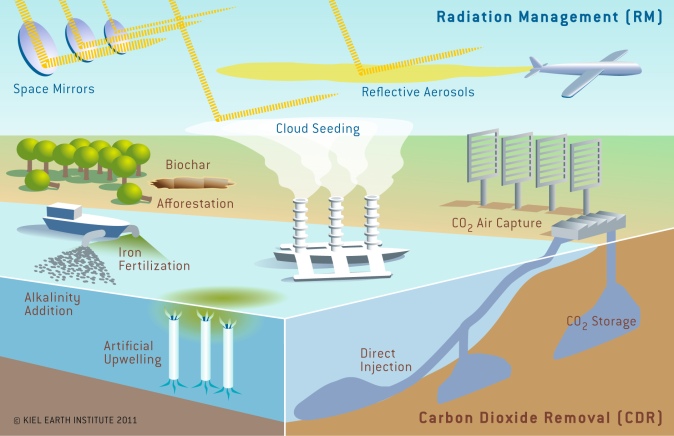
As the stakes get higher through this century, the dangers arising from this mechanistic metaphor of nature will only become more harrowing. Already, in response to the acceleration of climate breakdown, the techno-dystopian idea of geoengineering is becoming increasingly acceptable. Following Tillerson’s misconceived logic, rather than disrupt the fossil fuel-based growth economy, policymakers are beginning to seriously countenance treating the Earth as a gigantic machine that needs fixing, and developing massive engineering projects to tinker with the global climate.

Given the innumerable nonlinear feedback loops that generate our planet’s complex living systems, the law of unintended consequences looms menacingly large. The eerily named field of “solar radiation management”, for example, which has received significant financing from Bill Gates, envisages spraying particles into the stratosphere to cool the Earth by reflecting the Sun’s rays back into space. The risks are enormous, such as causing extreme shifts in precipitation around the world and exacerbating damage we’ve already done to the ozone layer. Additionally, once begun, it could never be stopped without immediate catastrophic rebound heating; it would further increase ocean acidification; and would likely turn the blue sky into a perpetual white haze. These types of feedback effects, arising from the innumerable nonlinear dynamic interdependencies of Earth’s complex systems, get marginalized by a worldview that ultimately sees our planet as a machine requiring a quick fix.

Further, there are deep moral issues that arise from confronting the inherent subjectivity of the natural world. Ever since the Scientific Revolution, the root metaphor of nature as a machine has infiltrated Western culture, inducing people to view the living Earth as a resource for humans to exploit without regard for its intrinsic value. Ecological philosopher Eileen Crist describes this as human supremacy, pointing out that seeing nature as a “resource” permits anything to be done to the Earth with no moral misgivings. Fish get reclassified as “fisheries,” and farm animals as “livestock”—living creatures become mere assets to be exploited for profit. Ultimately, it is the ideology of human supremacy that allows us to blow up mountaintops for coal, turn vibrant rainforest into monocropped wastelands, and trawl millions of miles of ocean floor with nets that scoop up everything that moves.

Once we recognize that other animals with a nervous system are not machines, as Descartes proposed, but likely experience subjective feelings similar to humans, we must also reckon with the unsettling moral implications of factory farming. The stark reality is that around the world, cows, chicken, and pigs are enslaved, tortured, and mercilessly slaughtered merely for human convenience. This systematic torment administered in the name of humanity to over 70 billion animals a year—each one a sentient creature with a nervous system as capable of registering excruciating pain as you or I—quite possibly represents the greatest cataclysm of suffering that life on Earth has ever experienced.

The “quantum jazz” of life

What, then, are metaphors of life that more accurately reflect the findings of biology—and might have the adaptive consequence of influencing our civilization to behave with more reverence toward our nonliving relatives on this beleaguered planet which is our only home?

Frequently, when cell biologists describe the mind-boggling complexity of their subject, they turn to music as a core metaphor. Denis Noble entitled his book on cellular biology The Music of Life, depicting it as “a symphony.” Ursula Goodenough describes patterns of gene expression as “melodies and harmonies.” While this metaphor rings truer than nature as a machine, it has its own limitations: a symphony is, after all, a piece of music written by a composer, with a conductor directing how each note should be played. The awesome quality of nature’s music arises from the fact that it is self-organized. There is no outside agent telling each cell what to do.

Perhaps a more illustrative metaphor would be a dance. Cell biologists increasingly refer to their findings in terms of “choreography,” and philosopher of biology Evan Thompson writes vividly how an organism and its environment relate to each other “like two partners in a dance who bring forth each other’s movements.”

Another compelling metaphor is an improvisational jazz ensemble, where a self-organized group of musicians spontaneously creates fresh melodies from a core harmonic theme, riffing off each other’s creativity in a similar way to how evolution generates complex ecosystems. Geneticist Mae-Wan Ho captures this idea with her portrayal of life as “quantum jazz,” describing it as “an incredible hive of activity at every level of magnification in the organism . . . locally appearing as though completely chaotic, and yet perfectly coordinated as a whole.”

What might our world look if we saw ourselves as participating in a coherent ensemble with all sentient beings interweaving together to collectively reverse entropy on Earth? Perhaps we might begin to see humanity’s role, not to re-engineer a broken planet for further exploitation, but to attune with the rest of life’s abundance, and ensure that our own actions harmonize with the Earth’s ecological rhythms. In the profound words of 20th century humanitarian Albert Schweitzer, “I am life that wills to live, in the midst of life that wills to live.” How, we may ask, might our future trajectory change if we were to reconstruct our civilization on this basis?

RETURN OF THE WARRIOR

By Elva Thompson

Source: Waking Times

“It may be that some little root of the sacred tree still lives.
Nourish it then
That it may leaf
And bloom
And fill with singing birds!

Hear me, that the people may once again
Find the good road
And the shielding tree.”  – Black Elk

Dystopic reality

Are you wondering what the HELL is going on in this shit show reality? The sheer insanity of world events and the palpable madness of our spiritually unplugged leaders is spectacularly obvious even though the masses cannot see it. Floods and fires ravage the planet leaving disaster in their wake. Seventy percent of wildlife has been destroyed in the last decade. Hundreds of thousands of birds are dropping lifeless from the sky, dead fish line many coast lines and whales are beaching and dying.

So what is going on?

The end of a grand cycle

We are men and our lot in life is to learn and to be hurled into inconceivable new worlds.”― Carlos Castaneda,

Planetary cycles within cycles are all ending in crescendo. December 21st 2012 was the marker for the end of the twenty six thousand year period known as the Grand Cosmic Year. And, the Old Year has to die before the New Year can begin. Everything is about to change…. and we will be literally hurled into an inconceivable new world. The signs are already here for those who can see beyond the narrative pedaled by the matrix hive mind.

As we speak, there is a magnetic pole reversal in event mode. Two north poles battling it out and playing havoc with the jet stream. The magnetosphere is weakening and as cosmic rays increase we can expect many challenges in the days and years to come. Catastrophe is served up not only by the evil that runs this world but the cosmos in its cycles of creation and destruction. It is time to choose our path amid the chaos that is erupting all around us. We can either ride the mental fear train into oblivion or we can return to the wisdom of our ancestral way of life and find inner peace.

Becoming brave

“We don’t need anyone to teach us sorcery, because there is really nothing to learn. What we need is a teacher to convince us that there is incalculable power at our fingertips. What a strange paradox!”― Carlos Castaneda

Strange paradox, indeed! For we do have incalculable power at our fingertips. The question is how do we find it?

There is much truth in the old adages: “Knock and the door will open.” “Ask and you will receive.” Visualise and knock on the spiritual door. The gate that leads to a re-connection with archetypal aspects of Self. Our eagle nature, wolf nature, bear nature, fox nature, hare nature, deer nature, etc. – our natures both predator and prey. Shaman’s of the older days understood that all things in the outer world were One in inner space and everything that exists is contactable.

All tribal once

Do not forget that we were all tribal once before evil overtook us. It is no accident that our shamans and healers were taken by the government to lunatic asylums many in a ball and chain and later murdered. No accident that sonic language – the language of the spirits was banned along with sacred ceremonies and spirit calling. Indigenous children all over the world were brutalized by the bible toting invaders for speaking their native language.

What was the invading evil so afraid of?

Could it be our spiritual power and the realities attached to them?

The spirit realm

Shamans know that man is two beings. One is physical flesh and earth bound, and the other is his energetic or non physical counterpart…a realm of unlimited possibility. Man also has two minds: the physical rational thinking mind called intellect which constantly talks and argues with itself – and the quiet mind that is connected to the spiritual reality of Source – the mysterious force that vitalises all living things with the energy that we call ‘life’.

I live with Native People. My husband is a ‘medicine man’ in the Sundance way of life. I have had the honour of being taught many things and to become cognizant that all physical life is energetic in essence.

“In the life of the Indian there was only one inevitable duty, – the duty of prayer – the daily recognition of the Unseen and Eternal. His daily devotions were more necessary to him than daily food. He wakes at day break, puts on his moccasins and steps down to the water’s edge. Here he throws handfuls of clear, cold water into his face, or plunges in bodily. After the bath, he stands erect before the advancing dawn, facing the sun as it dances upon the horizon, and offers his unspoken orison. His mate may precede or follow him in his devotions, but never accompanies him. Each soul must meet the morning sun, the new sweet earth and the Great Silence alone!” – Ohiyesa

Indigenous shamans knew that reality consisted of two parallel worlds that in the Yaqui tradition are known as the tonal(physical) and the nagual(the non physical). Because their spiritual power points were not atrophied as ours are today, the shamans of old knew that all life was infused with the spiritual power of Source, and that this invisible realm penetrated every aspect of our being. And, that under certain conditions this power could be contacted and even become visible.

Spirit helpers or allies

To focus power, a shaman needs allies in spiritual reality – this helper can be an animal, bird, reptile, insect, a wanagi (ghost) or any inanimate object such as stones or power infused objects. The allies being non physical beings can in fact take any form they like.The mystical mind of the shaman can fuse with all of life and become it. He can shapeshift into a crow, a wolf  or start a fire with his fingers! See my article https://www.heartstarbooks.com/a-thunder-being-nation/

Making contact

If you are reading these words, the chances are you will have already experienced magic moments of connection. A space where time, the I and the world disappears and, for a brief moment we are in the joyous state of connection to Source. This can happen during a walk in the forest surrounded by the beautiful, patient energy of the trees. Earthing with bare feet on the ground. Drumming to the heartbeat of the planet. Working with plants in the garden is a wonderful opportunity to commune with the standing nations.

For me, sun gazing is the ultimate spiritual experience. A practice that allows me through visualisation to intentionally connect the little sun in my solar plexus to the outside sun in the sky… and the inner sun at the centre of the earth. One sun is positive, the other negative and we are the third estate. The children of the two suns and the apex of the triangle. The tetrahedron of the third dimension

Touching base

Research the old religion of your ancestors and even though you might not know how to proceed with ceremonies of your own, if you open your heart and are ready to commit to Source with no agenda, no strings attached, then synchronicity will guide you. Do not be afraid to sail uncharted seas for when we restore our natural energetic balance magic happens. You will soon become aware that everything in the natural world is listening. When we ask questions of spiritual reality the answer can suddenly appear within our mind. This response can be immediate or may take days and even weeks but reply they will.

The obstacle

Have no doubt, there is a spiritual war raging on this planet, and we need to get up to speed. The first obstacle we have to overcome on the road to freedom is our thinking mind, the little ‘I’ that primps and postulates. Somehow we have to shut it up!

I recommend ritual, a reptilian trait that we can use to our advantage. Ritual is ceremonial repetition or mantra and can help us stop the infernal chattering of the ego’s frightened mind. We need a ceremonial direction in our lives as a stepping stone to mastery of ourselves.

Contact

If human beings and nature are a holistic living whole, then we should be able to contact planetary intelligence and awareness directly, and furthermore, we should have the spiritual ability to make changes in physical reality by the use of focused spiritual attention. This is the Art of causing change to occur in conformity with will, and births the sacred magician in ourselves.

This reality we call life, is an all pervading matrix of electromagnetic charge and no matter where we are, whether it be in our front room, prison cell, hospital bed, or high rise block of flats in the middle of the city, our thoughts can with intent, affect the energetic reality of Earth, i.e. physical events can take place ‘outside of ourselves’ without us actually being present. A directed loving spiritual action can have a physical response at any point on the planet. Long distance doctoring and absent healings work on the same principle.

If we are the planet, and everything that exists, think of the energy that would be available to us, if we can overcome the deliberately designed and re-enforced illusion of separation. If we focused our spiritual attention and intent without emotion, on a polluted site or waterway, a politician, or an individual that holds the purse strings of the world…think what might be possible.

This is a very exciting time to be alive. The Rainbow Warriors have returned and like a silent wave waits for the appointed time to rise above the third world and wield the spiritual power so long denied us.

Get together with like minded people, find each other and pray for this world. All you need is love in your heart and the desire to be of service to the planet. You will get your answers and you will intuitively know how to proceed.

Be sure to listen to Wolf Totem by the Mongolian band The Hu.

Until next time, stay strong in spiritual reality.