Our age of horror

In this febrile cultural moment filled with fear of the Other, horror has achieved the status of true art

By M M Owen

Source: aeon

In Ray Bradbury’s horror short story, ‘The Next in Line’ (1955), a woman visits the catacombs in Guanajuato, Mexico. Mummified bodies line the walls. Lying awake the next night, haunted by her macabre tour, she finds that her heart ‘was a bellows forever blowing upon a little coal of fear … an ingrown light which her inner eyes stared upon with unwanting fascination’.

Our present era is one in which the heart of culture is blowing hard upon a coal of fear, and the fascination is everywhere. By popular consent, horror has been experiencing what critics feel obliged to label a ‘golden age’. In terms of ticket sales, 2017 was the biggest year in the history of horror cinema, and in 2018, Hereditary and A Quiet Place have been record-breaking successes. In both the United States and the United Kingdom, sales of horror literature are up year over year – an uptick that industry folk partly attribute to the wild popularity of Netflix’s Stranger Things (2016-). And the success isn’t merely commercial. Traditionally a rather maligned genre, these days horror is basking in the glow of critical respectability. As The New York Times remarked this June, horror ‘has never been more bankable and celebrated than it is right now’.

As any historian of the genre will tell you, horror has had previous golden ages. Perhaps ours is just a random quirk of popular taste. But perhaps not. Perhaps we are intoxicated by horror today because the genre is serving a function that others aren’t. Can’t. Horror’s roots run deep, but they twist themselves into forms very modern. The imagination’s conversion of fear into art offers a dark and piercing mirror.

My earliest horror memory is Stay Out of the Basement (1992), one of R L Stine’s Goosebumps series of young adult novels. In the story, a botanist accidently creates a hybrid plant clone of himself. When the clone comes to life, he tries to steal his humanoid self’s life. The botanist’s children unmask the imposter, and in a mess of green blood and plant mush, the clone is felled with an axe. The rescued father disposes of the rest of the mutating plant matter, and the family is all set to live happily ever after. But at the very end, the daughter is standing in the garden and feels a small plant nudging her ankle. The plant whispers to her: ‘Please – help me. I’m your father.’ Stay Out of the Basement is no masterpiece, but I was young, and it struck me cold.

Horror is what anthropologists call biocultural. It is about fears we carry because we are primates with a certain evolved biology: the corruption of the flesh, the loss of our offspring. It is also about fears unique to our sociocultural moment: the potential danger of genetically modifying plants. The first type of fear is universal; the second is more flexible and contextual. Their cold currents meet where all great art does its work, down among the bottomless caves on the seabed of consciousness. Lurking here, a vision of myself paralysed in the dirt, invisible to those I love.

Horror has always been with us. Prehistoric cave paintings are rife with the animal-human hybrids that remain a motif of horror to this day. Every folktale tradition on Earth contains tales of malevolent creatures, petrifying ghosts and graphic violence. The classics are frequently horrifying: in Homer’s Odyssey, when the Cyclops encounters Odysseus’ men, the monster eats them, ‘entrails, flesh and the marrowy bones alike’.

We have always told horror stories, and we always will. Because horror is an artistic expression of an ontological truth: we are creatures formed in no small part by the things to which we are averse. Fear is a base ingredient of consciousness, partaking of brain circuits that are so ancient humans share them with all vertebrate lifeforms. As the neuroscientist Antonio Damasio has described, the whole weird soup of human feeling emerged as a result of our beginning to process whether to ‘approach or avoid … certain places or things or creatures’. Our cognition absorbs reality as a vast spectrum of potential encounters, and horror alchemises the dark end into art.

Thus, evolutionary analyses of horror mention monsters as the genre’s most defining feature. As the philosopher Stephen T Asma puts it, ‘during the formation of the human brain, the fear of being grabbed by sharp claws, dragged into a dark hole and eaten alive was not an abstraction’. For a quarter of a million years – the vast majority of Homo sapiens’ existence as a species – we lived outdoors, with giant hyenas, saber-toothed cats and other carnivores representing a real threat to life. That other ancient health risk, the biological pathogen, manifests itself in the tendency of monsters to be not only violent but also disgusting – feral, oozing blood and saliva, bearing their infectious teeth. From the evolutionary perspective, horror’s vast monstrous menagerie echoes with Paleolithic peril.

Historically, horror’s willingness to play directly to our evolved physiology has seen it earn a low reputation. Western culture was built on a vision of ourselves as above the beasts, above the beastliness of acquiescing helplessly to the demands of the body. But horror can bypass all intellect, extract from us an embarrassingly animalistic response. The skittish physicality of the ‘jump scare’ is a manipulation of what biologists call the startle response, present in all mammals. And cruder horror always contains that other ghastly reminder of our physicality: gore. Gore disgusts us, and the way that gore can be darkly compelling to us disgusts us. Whenever horror is criticised, it is criticised for staging a dark carnival of physicality. Perhaps the only sort of media we moralise more than we do horror is that other mainliner of bodily response, pornography.

Horror’s historical ghettoisation has meant that weightier, smarter horror reliably gets labelled as something else. The finest films of our current golden age have been dubbed ‘elevated horror’ and ‘post-horror’. In literary circles, works of horror seen as sufficiently cerebral get relabelled ‘Gothic’. It’s certainly true that great horror is always about more than gore. But we should be careful not to gentrify the genre by cleansing it of everything but the philosophy.

There are always beings that want to bite us, scratch us, puncture our fragile flesh. There is the terrible old coercion of brute, muscular force, the lethal threat of contagion and infection. There is darkness, disorientation. And looming explicitly or symbolically in all horror is that vast shadow that the anthropologist Ernest Becker said ‘haunts the human animal like nothing else’: death.

‘And he that sat on the cloud thrust in his sickle on the Earth; and the Earth was reaped’. Witness the machinations of that famous slasher, God (Revelation 14:16). Horror encodes the story of our long primate journey, but these biological foundations support the towering edifice of culture. And for millennia, horror merged with our oldest cultural phenomena: religion and folklore. In fact, for most of its history, horror wasn’t really art, as we tend to understand that term today. It certainly wasn’t fiction. Prior to about 1750, in our pivot toward the Enlightenment, the best horror stories can all be found within theology and lore. In Europe, for generations Satan was every bit as petrifying as Pennywise, the murderous clown of Stephen King’s It (1986). Demonic forces were terrifyingly real; in the Bible, Jesus spends almost as much time performing exorcisms as he does healing people. There were widespread societal panics about the threat of werewolves and vampires, and tens of thousands of women were murdered as witches.

This isn’t to judge the credulity of bygone peoples. But the reason that horror – unlike say tragedy, or comedy, or the epic – didn’t exist as an artistic genre until relatively recently is that its deep history is fundamentally pre-scientific. Nothing in the annals of art is as scary as what you’ll find in bygone worldviews. Who needs make-believe scares when everyone you know is awaiting the day of judgment, at which point an angel will sweep a sickle across the Earth and make the blood run for hundreds of miles? It is no coincidence that the Gothic – horror’s regal antecedent – emerged precisely at the moment when lots of people began to believe that God really might be dead. Modern horror is in part the story of what happens when our threatened minds shed a theology. Once holy texts can no longer entirely encode the terrors of being, horror enters fully the arena of art.

However, the old ways cast a long shadow. In the pantheon of genres, horror remains an adolescent, and it has a sort of adolescent relationship with its past: half rebellion, half dependency. On the one hand, more than any other genre, horror loves to thematise the coldest sorts of atheism. ‘All my tales,’ said horror grandee H P Lovecraft, ‘are based on the fundamental premise that common human laws and interests and emotions have no validity or significance in the vast cosmos-at-large.’ In The Silence of the Lambs(1988), amused by what he sees as clear evidence for the absence of any benevolent deity, the charmingly evil Hannibal Lecter ‘collects church collapses, recreationally’.

On the other hand, horror is marked everywhere by the centuries it spent wedded to otherworldly belief systems. In 2018’s biggest horror movie, Hereditary, an obscure figure from demonology possesses a teenage boy and wreaks death upon his family. Much Japanese horror features yūrei, tormented and enraged spirits denied a smooth passage to the afterlife. Horror was a dark, mutant child of the Enlightenment, and yet it can’t shake its pre-scientific genes. Its penchant for lurid supernaturalism is a big reason why, when it fails, it can so easily seem puerile. The modern, skeptical mind whispers: This is just silly. Haven’t we outgrown all this? On Halloween – a celebration of horror’s pre-artistic forms – children are meant to have the most fun.

Why does horror have this double-edged relationship with its religious and spiritual heritage? Perhaps because, for all its modernity, the sheer scale of theological enquiry still reflects the genre’s ambition. As leading horror author Joe Hill told me, horror is what we turn to when we want to explore ‘the biggest and darkest questions’. And even demoted from dogma to metaphor, the old myths offer a fine way to channel those grand subjects of which horror is so fond: good versus evil, the tribulations of the soul, the end of days. Even though it requires our suspension of disbelief, the paranormal presents us with the very real prospect of brittle reason splintering against the mystery of reality.

‘There’s a sense of uncertainty and potential wrongness underlying most of human existence,’ the Canadian author Gemma Files told me. All of humankind’s great mythic narratives know this, and horror doesn’t let us forget it. At the core of the numinous impulse – that oceanic feeling in which horror was submerged for so many centuries – is the strange certainty that reality is unpredictable and inscrutable, that certain things will forever resist the reach of the human mind. Horror will always share in this sense. It may have fallen from heaven, but it still isn’t entirely of this Earth. Cormac McCarthy’s The Road(2006) centres on a father and son as they wander across a blasted, post-apocalyptic America. The horrors are everywhere: they discover, chained in a basement, ‘a man with his legs gone to the hip and the stumps of them blackened and burnt’. The man is being harvested by cannibals, piece by piece. It is a bleak, fallen world, where the memory of a time when trout swam in the streams shimmers with celestial grace. When the father meets an elderly man, he tells him: ‘There is no God and we are his prophets.’

And so what of today? Horror reverberates with fears Paleolithic and God-fearing, but it is also always reacting to its present moment. And it seems reasonable to perceive any swell in the production and popularity of horror – any dawning of a new golden age – as the expression of a culture that is afraid. ‘In anxious times,’ David Bruckner, director of The Ritual (2017) and other horror movies, told me, ‘people are more likely to turn to horror. If you have an uneasy night at the movie theatre, you are sort of answering the call of your times.’

‘I think we’re living in a nightmare, basically.’ So said horror legend Ramsey Campbell, when I asked him why he thinks horror is flourishing right now. This is one of those things that cooler heads will say is your mind deceiving you. By many objective measures, for many people, life today is better than ever. But horror has never been too worried about culture’s long-term trajectory; it is always fixated on how it could all go badly wrong, any minute now. Horror is steeped in worry; its narratives frequently open with the calm before a terrible storm. And every person connected with horror that I interviewed smelled doom on the breeze.

Horror has always made good use of our deep aversion to what Lovecraft called ‘the oldest and strongest kind of fear’: the unknown. This is one of the ways in which horror (like the folktale) can display a sort of archetypal conservatism. In general terms, the best way to survive a horror setting is to be supremely, boringly sensible: don’t talk to strangers, don’t stay the night in a foreign town, don’t go to the aid of anyone who looks sick, don’t go into that crumbling old building. If a very attractive stranger tries to seduce you, it is almost definitely a trap. Respect tradition, do not commit sacrilege, listen to the advice of elderly locals. At the heart of a lot of horror is a conservative craving for the predictable and the known. The unpleasant atonal dissonance you’ll hear in every horror score reflects, through the collapse of harmony, the disintegration of familiar and comforting patterns out there in the world.

Horror, then, thrives on discombobulation. And today, the discombobulation is everywhere. The causes of the anxiety are scattershot, and you already know them. There are those scientific breakthroughs of the sort that get Silicon Valley execs psyched, but which many others find deeply, opaquely perturbing. Take artificial intelligence, whose rise has seen more and more science fiction turn horrific: ‘One day the AIs are going to look back on us the same way we look at fossil skeletons on the plains of Africa,’ says Nathan, a central character in Ex Machina (2015). And even if the robots don’t vanquish poor old Homo sapiens, other sorts of scientific experimentation might. One of the great horror trends of the 21st century has been the zombie, and in all of the best works of zombie fiction, the immediate cause of the outbreak is the same: biological experimentation gone horribly wrong. The zombie is the gnashing, lunging embodiment of that modern terror, the global pandemic. People might not fear Satan anymore, but they sure as hell fear Ebola.

Outside of the lab, there is that slower method of planetary destruction: climate change. ‘Horror,’ the author Jeff VanderMeer told me, ‘is the beauty of the natural world juxtaposed against the way we destroy those natural systems without understanding them.’ VanderMeer’s Southern Reach trilogy (2014), some of my favourite horror novels of all time, diluted my enjoyment of the UK’s recent heatwave and refused to let me forget that what I was basking in were the convulsions of an aching planet. A biosphere cast brutally off-balance forms the setting for M R Carey’s The Girl With All the Gifts(2014), where humanity has been devastated by a fungal infection. Where horror once worried about the weather gods, it now just worries about the weather. Climate change, meanwhile, is a major cause of mass migrations, potent fuel for what leading critic Leslie Klinger described to me as horror’s historical trend of feeding off ‘the invasion of foreigners into previously stable populations’. At a base level, we are in-groupish creatures. I’ve spent time with rural, paganish communities who enjoy a singsong and are sexually unrepressed; none of them tried to burn me alive in a giant wicker man. But horror says: you never knowStick to your own.

If all these fears sound selfish, parochial, insular – don’t get the wrong idea. Horror offers a map of the psyche and, like fear itself, is inherently apolitical. It can easily offset its archetypal conservatism with a radical sort of anarchism. Horror might thematise our fear of the unknown – but it also warns about clinging too stubbornly to the familiar. In a lot of horror, survival is predicated on a capacity to quickly adapt to brutal change. Horror has little time for the conservative sentimentality that swirls around ideas such as institutions and tradition, and even something like the nation-state is often revealed as a sort of frilly, doomed illusion. The protections of social hierarchy or private property are never of any use, and horror loves to punish characters who arrogantly believe that wealth will shield them. In horror, the consolations of the past melt in contact with the white-hot heart of present fear. Conservatism fails because it is revealed that at bottom there is nothing to conserve. As the author Michael Marshall Smith put it to me, great horror often declares: ‘It’s just you versus the monster. Always has been. Always will be.’

In this, lots of horror is intensely universalising. Frequently, a scenario comes down to a simple contest between humankind and something else. Splitting up is a suicidal move in horror; survival often follows an impulse toward communal effort. Similarly universalising is the way that, at extreme moments of threat or fear, a given character’s skin colour or gender or nationality will often be effaced. At horror’s pitch, we perceive a simple human, doing what we all do every day of our lives: struggling to live, to persist, to overcome. In The Babadook(2014), a widowed mother is stalked by an amorphous, black-hatted monster that embodies her grief at losing her husband. The monster – her terrible, life-sucking trauma – threatens to claim her son, and destroy what is left of her family. Late in the film, bloodied and exhausted, the mother faces down the Babadook, yelling: ‘If you touch my son again, I’ll fucking kill you.’ The monster is tamed. It is a show of furious bravery that could be any mother, anywhere; courageous love in the face of total disorder.

It’s easy to romanticise horror, but there are also unsexy, funcitonal reasons why it’s having its moment right now. The streaming revolution has given creators a reliable and direct way to reach a dedicated, self-selecting audience. Trusting this audience, distributors like A24 and Blumhouse have put a great amount of both creative wherewithal and cold hard dollars into horror cinema. The genre has always been reliably profit-turning, but it has also always been prone to the lazy recycling of ideas and tropes. Today, even experimental horror can be profitable. In literature, meanwhile, a revival of interest in horror greats like Shirley Jackson, as well as a slew of Stephen King adaptations, has been a boost for the genre at large.

Yet on their own, these tantalising products would never suffice to make horror soar. Horror has been with us since the dawn of storytelling. It manifests the fears of the human animal, and even today echoes the slippery spiritual suspicion that reality isn’t what it seems. Our world is ripe for upending, and horror expresses that best. Horror can thrive today because ours is a strange and febrile cultural moment. It seems every civilisation has believed they are on the brink of cataclysmic change; such an idea has a weird narcissistic appeal. But today there is everywhere a deep feeling that the horses of disaster are about to plunge in the heavy clay. There is a sort of great loop being completed here: as horror has morphed from theology to art, the ruinous power has moved from the judgment of God to the hand of humans. The end of days in one programmer’s idle tinkering, in one laboratory’s overlooked quarantine protocols. Robert Louis Stevenson, author of The Strange Case of Dr Jekyll and Mr Hyde (1886), wrote, ‘Sooner or later, everyone sits down to a banquet of consequences.’ As a genre, horror is forever pulling up a chair, licking its lips at the feast to come.

Breathing this nervous air, current horror – like the theology that provided its former home – is animated by the full spectrum of human psychology. It is driven by our desire to stop all the clocks, shrink into a bubble of the familiar and the known, reject all things foreign. Equally, current horror is shot through with the bone-deep knowledge that if we can’t adapt, we will perish. Its narratives warn us not to cling to outdated consolations, to recognise that we all face the same monsters, in the end. The world has always been dark and full of terrors, and horror has always known it. The dark pleasure of enjoying horror is all about countenancing this awful truth from within a little bubble of safety. It is about the doppelgängered headspace of loathing the real thing but craving its imaginative facsimile. If the genre of horror has a master virtue, a single human quality that it consistently exalts, it is an old one: bravery. We are certain to need that, wherever we are headed.


With thanks to all the horror authors, editors, screenwriters, directors and critics who generously gave me their time to explore horror: Nick Antosca, Stephen T Asma, David Bruckner, Ramsey Campbell, Noël Carroll, Ellen Datlow, Gemma Files, Steven Gerrard, Joe Hill, Carole Johnstone, Leslie Klinger, John Langan, Lisa Morton, Andy Nyman, Jami O’Brien, Xavier Aldana Reyes, Priya Sharma, David J Skal, Michael Marshall Smith, Eugene Thacker, Paul Tremblay, and Jeff VanderMeer. 
How To Recognize When Your Society Is Suffering A Dramatic Decline


By Brandon Smith

Source: Alt-Market.com

When historians and analysts look at the factors surrounding the collapse of a society, they often focus on the larger events and indicators — the moments of infamy. However, I think it’s important to consider the reality that large scale societal decline is built upon a mixture of elements, prominent as well as small. Collapse is a process, not a singular event. It happens over time, not overnight. It is a spectrum of moments and terrible choices, set in motion in most cases by people in positions of power, but helped along by useful idiots among the masses. The decline of a nation or civilization requires the complicity of a host of saboteurs.

So, instead of focusing on the top down approach, which is rather common, let’s start from the foundations of our culture to better understand why there is clear and definable destabilization.

Declining Moral Compass

There is always a conflict between personal gain and personal conscience — this is the nature of being human. But in a stable society, these two things tend to balance out. Not so during societal decline, as personal gain (and even personal comfort and gratification) tends to greatly outweigh the checks and balances of moral principles.

People often mistake the term “morality” to be a religious creation, but this is not what I am necessarily referring to. The concepts of “good” and “evil” are archetypal — that is to say they are psychologically inherent in most human beings from the moment of birth. This is not a matter of faith, but a matter of fact, observed by those in the field of psychology and anthropology over the course of a century of study.  How we relate to these concepts can be affected by our environment and upbringing, but for the most part, our moral compass is psychologically ingrained. It is up to us to either follow it or not follow it.

Watching how people handle this choice is a bit of hobby of mine, and I do take notes. You can learn a lot about the state of your environment by observing what people around you tend to do when faced with the conflict of personal gain versus personal conscience. It is saddening to admit that even though I live in rural America, where you are more likely to find self-reliance and cultural stability, I can still see a faltering nation bleeding through.

I have seen supposedly good people act dishonestly in business agreements. I have seen local institutions scam hardworking citizens. I have seen a court system rife with bias and a “good old boy” attitude of favoritism. I have seen local companies pretend to be benevolent contributors to the community while at the same time running constant frauds and rackets. I have even seen a few people within the liberty movement itself put the movement at risk with their own avarice, gluttony, narcissism and sociopathy.

Again, it is important to make a note of such people and institutions, for as the system continues its downward spiral it is these people that will present the greatest threat to the innocent.

As Carl Jung notes in his book The Undiscovered Self, there is always a contingent of latent sociopaths and psychopaths within any culture; usually about 10% of the population. In normal times, they, at least most of them, are forced into moral acclimation by the rest of the populace. But in times of decline, they seem to leak out of the woodwork like a slimy fungus. During heightened collapse, they no longer have to pretend to be upstanding and they show their true colors.

Most dangerous is when latent sociopaths or full blown sociopaths assume roles of leadership or power during the worst of times. With everyone distracted by their own plight, these people can become a cancer, infecting everything with their narcissistic pursuits and causing destruction in their wake.

Disinterest In Rewarding Conscience

During wider cultural collapse, it can become “fashionable” to see acts of principle as something to be scoffed at or ridiculed or to even see them as threats to the status quo. The concept of “going along to get along” takes precedence over doing what is right even when it is hard; this attitude is not relegated to the less honest people within society.

As a system collapses, a fog of apathy can result. Good people can become passive, scrambling to their individual corner of the world and hoping evil times will simply pass them by. The phrase “I just want to put all this behind me” is spoken regularly; but as we ignore the trespasses of terrible men and women, we also enable them. How? Because by doing nothing we allow them to continue their criminality, and we subject future persons and generations to victimization.

When doing the right thing is treated as laughable or “crazy” by what seems like a majority in the midst of widespread corruption, you are truly in the middle of a great decline.

In Christian circles, the idea of “the remnant” is sometimes spoken of. In Christian terms, this usually represents a minority of true believers surviving a tumultuous and immoral era. I see “the remnant” not so much as a contingent of Christians alone, but as a contingent of people that continue to maintain their principles and conscience when faced with unprecedented adversity. In the worst of times, these people remain stalwart, even if they are ridiculed for it.

Disinterest In Independent Effort

It is said that in this world there are two kinds of people — leaders and followers.  I’m not so sure about that, but I can see why this philosophy is promoted; it helps evil people in power stay in power by encouraging passive acceptance.

I would say that there are in fact two kinds of people in this world — people who want to control others and the people that just want to be left alone. In life sometimes we are both leaders and followers; we just have to be sure that when we lead we lead by example and not by force, and when we follow, we follow someone worth a damn.

In any case, passivity is not a solution to determining our roles in society. In most situations, independent action is required by every person to make the world a better place. Yet, in an era of systemic crisis, it is usually independent effort that is the first thing to go out the window. Millions upon millions of people wait around for someone, anyone, to tell them what they should be doing and how they should be doing it. In this way, society finds itself in stasis, frozen in a position of inaction.  Poisonous collectivism wins through mass aggression, but also through mass passivity.

In fact, when individualists do take action they can be admonished for it during times of societal breakdown, even if their actions have the potential to solve a problem. The idea that one man or woman (or a small group of people) could do anything about anything is sneered at as “fantasy” or “delusion.”  But mass movements of citizens working towards a practical goal are rare, and even more rare is when these movements are not controlled or manipulated to benefit the established order. It is not mass movements that change the world for the better, but individual people and small organizations of the dedicated, acting without permission and without administration.

It is these individuals and small groups that, over time and through relentless effort, inspire a majority to do what is necessary and right. It is these people that inspire others to finally take leadership in their own lives.

Individual Self-Isolation

I write often on the plight of the individual and individual rights within society, and I continue to see the factor of the individual as the most important element in any culture. A culture based on protecting and nurturing individualism and voluntarism is the only culture, in my view, that will ever be successful at avoiding full spectrum collapse. That said, the downside to overt individualism is the danger of self isolation. That is to say, when true individuals only concern themselves with their personal circumstances and ignore the circumstances of the rest of the world, they eventually set themselves up to be crushed by that world.

Organization on a voluntary basis is not only healthy but vital in the longevity of a society. The more people turn in on themselves and only care about their own general conditions, the easier it is for evil people to do evil things unnoticed. Also, self isolation in the wake of collapse sets individuals up for failure, as no one is capable of surviving without at least some help from a wider pool of knowledge and talents.

In a system based on corruption, the establishment will encourage self isolation as a means to control the populace. Or, they will offer a false choice, between self isolation versus mindless collectivism. The truth is there is always a middle ground. Voluntary organization and individualism are not mutually exclusive. I call this the “difference between community and collectivism.” A community does not supplant the individual, while a collective requires the complete erasure of individual pursuits and thought.

If you find yourself surrounded by people who refuse any organization, even practical and voluntary organization in the face of instability, then your society may be in the latter stages of a collapse.

Disaster Denial

Even as a crisis or collapse unfolds, if a society actually reels or reacts to it and takes note of the problem, there is hope for that society. If, however, that society willfully ignores the danger and denies it exists when presented with overwhelming evidence, then that society will likely suffer complete disintegration and will probably have to start all over from scratch — hopefully with a set of principles and ideals based on conscience and honor.

The strength of a culture can be measured by its willingness to self reflect. Its survival can be determined by its willingness to accept its flaws when they arise and its willingness to repair the damage done. Self-aware societies are difficult to corrupt or control. Only in denial can people be easily manipulated and enslaved.

If you cannot accept the reality of the abyss, you cannot move to avoid it or prepare yourself to survive the fall. I see this issue as perhaps the single most important element in the fight to save the portions of our society worth saving. Educating people on the blatant facts behind our own national decline can dissolve the wall of denial, and perhaps we will find when disaster strikes that there are far more awake and aware individuals ready to act than we originally thought.

Live Free or Die: The Psychology of Rebellion & Dissent

By Gary ‘Z’ McGee

Source: Waking Times

“I rebel—therefore we exist.” ~Albert Camus, The Rebel

Dissent is a tricky subject. The need to rebel against atrocity is deeply ingrained in the human condition. Even if most of us don’t act on it, the impulse is still there, churning our guts with disgust, getting our hearts pumping, moving us to spit curse words in lathered fury and shout in angry defiance. The problem is that most of us don’t know what to do with this powerful and sometimes overwhelming energy.

Most of us were raised in violent societies that use violence to keep the culture churning in a diabolical conquer-control-consume-repeat cycle. So, most of us tend to use violence to channel our deep and powerful need for dissent, thus perpetuating more violence. When the culture is jamming violence down our throat as a solution to its problems, are we really that surprised when our acts of rebellion turn out to be violent? Something’s got to give if we want to break this cycle of violence deeply imbedded in our culture.

In his book, The Rebel: An Essay on Man in Revolt, Albert Camus wrote about the “true rebel.”The true rebel is in revolt against oppression, violence, slavery and tyranny for the sake of others through constructive and life-affirming action. The true rebel protests out of love, so that others may be free. Intent is everything. True rebellion, Camus argues, is an act motivated but concerned with the common good rather than by self-interest. The rebel in revolt out of selfishness, greed, or need for power, eventually becomes a tyrant. The rebel in revolt for the sake of others, becomes a hero.

Whether you are alt-right or alt-left, republican’t or democan’t, voluntarist or anarchist, if you are seeking power over others for your own selfish and greedy ends, your revolution means fuck-all. You’re just another would-be-tyrant getting churned out of the meat-mill of violence begetting violence. It doesn’t matter how noble or important you think your cause is; if you need to use violence to persuade others to follow it, your cause is fundamentally flawed and immoral. Acting violently in a violent culture only perpetuates violence. Similarly, acting immorally in an immoral society just perpetuates immorality. Unhealthy acts beget unhealthy acts. Like Gandhi said, “An eye for an eye makes the whole world blind.”

Lest we all go blind, we must rebel so that others may freely exist. This requires our dissent to be based in freedom for everyone, even those we don’t agree with. A kind of metamorality arises from this kind of thinking, like Joshua Greene writes about in his book, Moral Tribes. But, and here’s the rub, any freedom which seeks to violate the nonaggression principle must not be tolerated. Violence is where the line must be drawn. As someone once said, “Your freedom to swing your fist ends an inch from my nose” (unknown). In such cases, self-defense is paramount. As Gandhi also advised, “When there is only a choice between cowardice and violence, I would advise violence.”

A true rebel doesn’t seek out rebellion for the sake of rebellion, or just as an excuse to act out violently. No. A true rebel passionately seeks a healthy environment (physically, culturally, and psychologically) and they rebel against anything that stands in the way of that healthy environment. As Camus said, “Rebellion, though apparently negative, since it creates nothing, is profoundly positive in that it reveals the part of man which must always be defended.” And that’s what it comes down to: self-defense, self-preservation, and survival. Not just personal survival, but the survival of the species.

That’s where life-affirming action comes in. When our rebellion is life-affirming, freedom-affirming, and based on nonviolence, it is healthy (heroic). When our rebellion is life-denying, freedom-denying, and based on violence, it is unhealthy (tyrannical). The hero is free, and uses that freedom with the soul intent to free others. The tyrant (or would be tyrant) is also free, but uses that freedom with the soul intent to rule others. We escape tyranny when we seek to free others through our own freedom. Liberty coincides with heroism when we’re able to go from asking, ‘free from what?’ to asking, ‘free for what?’

At the end of the day, the history of our culture of violence is only fruitful through a vigilant rebellion against it. This means a vigilant rebellion against oppression, hate, violence, and slavery of all kinds. Those who dedicate themselves to this culture of violence dedicate themselves to nothing and, in turn, are nothing. But those who dedicate themselves to life, freedom, and health, despite the culture of violence, dedicate themselves to survival and reap from it the harvest that sows its seed in the progressive evolution of our species.

A species hellbent on violence against itself is unhealthy and eventually destroys itself. A species determined to be healthy only ever uses violence as a last resort in self-defense and for the preservation of the species itself. From the former, the defiant tyrant juts his ugly head, declaring himself free at the expense of the freedom of others. From the latter, the defiant hero rises up, denying the tyrant’s violent oppression, and affirming freedom through the freedom of us all. That’s what Camus meant when he wrote: “I rebel –therefore we exist.”

Don’t Just Give Thanks. Pay It Forward One Act of Kindness at a Time

By John W. Whitehead

Source: The Rutherford Institute

“As we express our gratitude, we must never forget that the highest appreciation is not to utter words, but to live by them.”—John F. Kennedy

It’s been a hard, heart-wrenching, stomach-churning kind of year filled with violence and ill will.

It’s been a year of hotheads and blowhards and killing sprees and bloodshed and takedowns.

It’s been a year in which tyranny took a step forward and freedom got knocked down a few notches.

It’s been a year with an abundance of bad news and a shortage of good news.

It’s been a year of too much hate and too little kindness.

Now we find ourselves approaching that time of year when, as George Washington and Abraham Lincoln proclaimed, we’re supposed to give thanks as a nation and as individuals for our safety and our freedoms.

It’s not an easy undertaking.

How do you give thanks for freedoms that are constantly being eroded? How do you express gratitude for one’s safety when the perils posed by the American police state grow more treacherous by the day? How do you come together as a nation in thanksgiving when the powers-that-be continue to polarize and divide us into warring factions?

It’s not going to happen overnight. Or with one turkey dinner. Or with one day of thanksgiving.

Thinking good thoughts, being grateful, counting your blessings and adopting a glass-half-full mindset are fine and good, but don’t stop there.

This world requires doers, men and women (and children) who will put those good thoughts into action.

It says a lot (and nothing good) about the state of our world and the meanness that seems to have taken center stage that we now have a day (World Kindness Day) devoted to making the world more collectively human in thoughts and actions. The idea for the day started after a college president in Japan was mugged in a public place and nobody helped him.

Unfortunately, you hear about these kinds of incidents too often.

A 15-year-old girl was gang raped in a schoolyard during a homecoming dance. As many as 20 people witnessed the assault over the course of two and a half hours. No one intervened to stop it.

A 28-year-old woman was stabbed, raped and murdered outside her apartment early in the morning. Thirty-eight bystanders witnessed the attack and failed to intervene. The woman, Kitty Genovese, died from her wounds at the locked doorway to her apartment building.

A 58-year-old man waded into chest-deep water in the San Francisco Bay in an apparent suicide attempt. For an hour, Raymond Zack stood in the shallow water while 75 onlookers watched. Police and firefighters were called in but failed to intervene, citing budget cuts, a lack of training in water rescue, fear for their safety and a lack of proper equipment. The man eventually passed out and later died of hypothermia. Eventually, an onlooker volunteered to bring the body back to the beach.

A homeless man intervened to save a woman from a knife-wielding attacker. He saved the woman but was stabbed repeatedly in the process. As The Guardian reports, “For more than an hour he lay dying in a pool of his own blood as dozens walked by. Some paused to stare, others leaned in close. One even shook his body and then left, while someone else recorded a video of the entire proceeding.”

This is how evil prevails: when good men and women do nothing.

By doing nothing, the onlookers become as guilty as the perpetrator.

“If I were to remain silent, I’d be guilty of complicity,” declared Albert Einstein.

It works the same whether you’re talking about kids watching bullies torment a fellow student on a playground, bystanders watching someone dying on a sidewalk, or citizens remaining silent in the face of government atrocities.

There’s a term for this phenomenon where people stand by, watch and do nothing—even when there is no risk to their safety—while some horrific act takes place (someone is mugged or raped or bullied or left to die): it’s called the bystander effect.

Psychological researchers John Darley and Bibb Latane mounted a series of experiments to discover why people respond with apathy or indifference instead of intervening.

Their findings speak volumes about the state of our nation and why “we the people” continue to suffer such blatant abuses by the police state.

According to Darley and Latane, there are two critical factors that contribute to this moral lassitude.

First, there’s the problem of pluralistic ignorance in which individuals in a group look to others to determine how to respond. As Melissa Burkley explains in Psychology Today, “Pluralistic ignorance describes a situation where a majority of group members privately believe one thing, but assume (incorrectly) that most others believe the opposite.”

Second, there’s the problem of “diffusion of responsibility,” which is compounded by pluralistic ignorance. Basically, this means that the more people who witness a catastrophic event, the less likely any one person will do anything because each thinks someone else will take responsibility. In other words, no one acts to intervene or help because each person is waiting for someone else to do so.

Now the temptation is to label the bystanders as terrible people, monsters even.

Yet as Mahzarin Banaji, professor of psychology at Harvard University points out, “These are not monsters. These are us. This is all of us. This is not about a few monsters. This is about everybody. It says something very difficult to us. It says that perhaps had we been standing there, we ourselves, if we were not better educated about this particular effect and what it does to us, we may fall prey to it ourselves.”

Historically, this bystander syndrome in which people remain silent and disengaged—mere onlookers—in the face of abject horrors and injustice has resulted in whole populations being conditioned to tolerate unspoken cruelty toward their fellow human beings: the crucifixion and slaughter of innocents by the Romans, the torture of the Inquisition, the atrocities of the Nazis, the butchery of the Fascists, the bloodshed by the Communists, and the cold-blooded war machines run by the military industrial complex.

So what can you do about this bystander effect?

Be a hero, suggests psychologist Philip Zimbardo.

Each of us has an inner hero we can draw upon in an emergency,” Zimbardo concluded. “If you think there is even a possibility that someone needs help, act on it. You may save a life. You are the modern version of the Good Samaritan that makes the world a better place for all of us.”

Zimbardo is the psychologist who carried out the Stanford Prison Experiment which studied the impact of perceived power and authority on middleclass students who were assigned to act as prisoners and prison guards. The experiment revealed that power does indeed corrupt (the appointed guards became increasingly abusive), and those who were relegated to being prisoners acted increasingly “submissive and depersonalized, taking the abuse and saying little in protest.”

What is the antidote to group think and the bystander effect?

Be an individual. Listen to your inner voice. Take responsibility.

“If you find yourself in an ambiguous situation, resist the urge to look to others and go with your gut instinct,” says Burkley. “If you think there is even a possibility that someone is in need, act on it. At worst, you will embarrass yourself for a few minutes, but at best, you will save a life.”

“Even if people recognize that they are witnessing a crime, they may still fail to intervene if they do not take personal responsibility for helping the victim,” writes Burkley. “The problem is that the more bystanders there are, the less responsible each individual feels.”

In other words, recognize injustice. Don’t turn away from suffering.

Refuse to remain silent. Take a stand. Speak up. Speak out.

This is what Zimbardo refers to as “the power of one.” All it takes is one person breaking away from the fold to change the dynamics of a situation. “Once any one helps, then in seconds others will join in because a new social norm emerges: Do Something Helpful.”

“I swore never to be silent whenever and wherever human beings endure suffering and humiliation,” stated Holocaust Elie Wiesel in his Nobel Peace Prize acceptance speech in 1986. “We must always take sides. Neutrality helps the oppressor, never the victim. Silence encourages the tormentor, never the tormented. Sometimes we must interfere. When human lives are endangered, when human dignity is in jeopardy, national borders and sensitivities become irrelevant. Wherever men or women are persecuted because of their race, religion, or political views, that place must – at that moment – become the center of the universe.”

Unfortunately, as I make clear in my book Battlefield America: The War on the American People, too many Americans have opted to remain silent when it really matters while instead taking a stand over politics rather than human suffering.

That needs to change.

I don’t believe we’re inherently monsters. We just need to be more conscientious and engaged and helpful.

The Good Samaritans of this world don’t always get recognized, but they’re doing their part to push back against the darkness.

For instance, earlier this year in Florida, a family of six—four adults and two young boys—were swept out to sea by a powerful rip current in Panama City Beach. There was no lifeguard on duty. The police were standing by, waiting for a rescue boat. And the few people who had tried to help ended up stranded, as well.

Those on shore grouped together and formed a human chain. What started with five volunteers grew to 15, then 80 people, some of whom couldn’t swim.

One by one, they linked hands and stretched as far as their chain would go. The strongest of the volunteers swam out beyond the chain and began passing the stranded victims of the rip current down the chain.

One by one, they rescued those in trouble and pulled each other in.

There’s a moral here for what needs to happen in this country if we only can band together and prevail against the riptides that threaten to overwhelm us.

Here’s what I suggest.

Instead of just giving thanks this holiday season with words that are too soon forgotten, why not put your gratitude into action with deeds that spread a little kindness, lighten someone’s burden, and brighten some dark corner?

I’m not just talking about volunteering at a soup kitchen or making a donation to a charity that does good work, although those are fine things, too.

What I’m suggesting is something that everyone can do no matter how tight our budgets or how crowded our schedules.

Pay your blessings forward.

Engage in acts of kindness. Smile more. Fight less.

Focus on the things that unite instead of that which divides. Be a hero, whether or not anyone ever notices.

Do your part to push back against the meanness of our culture with conscious compassion and humanity. Moods are contagious, the good and the bad. They can be passed from person to person. So can the actions associated with those moods, the good and the bad.

Even holding the door for someone or giving up your seat on a crowded train are acts of benevolence that, magnified by other such acts, can spark a movement.

Imagine a world in which we all lived in peace.

John Lennon tried to imagine such a world in which there was nothing to kill or die for, no greed or hunger. He was a beautiful dreamer whose life ended with an assassin’s bullet on December 8, 1980.

Still, that doesn’t mean the dream has to die, too.

There’s something to be said for working to make that dream a reality. As Lennon reminded his listeners, “War is over, if you want it.”

The choice is ours, if we want it.

Profit Maximization is Easy: Invest in Violence

By Robert J. Burrowes

For those of us committed to systematically reducing and, one day, ending human violence, it is vital to understand what is causing and driving it so that effective strategies can be developed for dealing with violence in its myriad contexts. For an understanding of the fundamental cause of violence, see ‘Why Violence?’

However, while we can tackle violence at its source by each of us making and implementing ‘My Promise to Children’, the widespread violence in our world is driven by just one factor: fear or, more accurately, terror. And I am not talking about jihadist terror or even the terror caused by US warmaking. Let me explain, starting from the beginning.

The person who is fearless has no use for violence and has no trouble achieving their goals, including their own defence, without it. But fearlessness is a state that few humans would claim. Hence violence is rampant.

Moreover, once someone is afraid, they will be less likely to perceive the truth behind the delusions with which they are presented. They will also be less able to access and rely on other mental functions, such as conscience and intelligence, to decide their course of action in any context. Worse still, the range of their possible responses to perceived threats will be extremely limited. And they will be more easily mobilised to support or even participate in violence, in the delusional belief that this will make them safe.

For reasons such as these, it is useful for political and corporate elites to keep us in a state of fear: social control is much easier in this context. But so is profit maximization. And the most profitable enterprise on the planet is violence. In essence then: more violence leads to more fear making it easier to gain greater social control to inflict more violence…. And starting early, by terrorizing children, is the most efficient way to initiate and maintain this cycle. See ‘Why Violence?’ and ‘Fearless Psychology and Fearful Psychology: Principles and Practice’.

So, for example, if you think the massive number of police killings of innocent civilians in the United States – see ‘Killed by Police’ and ‘The Counted: People killed by police in the US’ – is a problem, you are not considering it from the perspective of maintaining elite social control and maximizing corporate profit. Police killings of innocent civilians is just one (necessary) part of the formula for maintaining control and maximising profit.

This is because if you want to make a lot of money in this world, then killing or exploiting fellow human beings and destroying the natural world are the three most lucrative business enterprises on the planet. And we are now very good at it, as the record shows, with the planetary death toll from violence and exploitation now well over 100,000 human beings each day, 200 species driven to extinction each day and ecological destruction so advanced that the end of all life (not just human life) on Earth is postulated to occur within decades, if not sooner, depending on the scenario. See, for example, ‘The End of Being: Abrupt Climate Change One of Many Ecological Crises Threatening to Collapse the Biosphere’.

So what forms does this violence take? Here is a daily accounting.

Corporate capitalist control of national economies, held in place by military violence, kills vast numbers of people (nearly one million each week) by starving them to death in Africa, Asia and Central/South America. This is because this ‘economic’ system is designed and managed to allocate resources for military weapons and corporate profits for the wealthy, instead of resources for living.

Wars kill, wound and incapacitate a substantial number of civilians, mostly women and children, as do genocidal assaults, on a daily basis, in countries all over the planet. Wars also kill some soldiers and mercenaries.

Apart from those people we kill every day, we sell many women and children into sexual slavery, we kidnap children to terrorise them into becoming child soldiers and force men, women and children to work as slave labourers, in horrific conditions, in fields and factories (and buy the cheap products of their exploited labour as our latest ‘bargain’).

We condemn millions of people to live in poverty, homelessness and misery, even in industrialized countries where the refugees of western-instigated wars and climate-destroying policies are often treated with contempt. We cause many children to be born with grotesque genetic deformities because we use horrific weapons, like those with depleted uranium, on their parents. We also inflict violence on women and children in many other forms, ranging from ‘ordinary’ domestic violence to genital mutilation.

We ensnare and imprison vast numbers of people in the police-legal-prison complex. See ‘The Rule of Law: Unjust and Violent’. We pay the pharmaceutical industry and its handmaiden, psychiatry, to destroy our minds with drugs and electro-shocking. See ‘Defeating the Violence of Psychiatry’. We imprison vast numbers of children in school in the delusional belief that this is good for them. See ‘Do We Want School or Education?’ And we kill or otherwise exploit animals, mostly for human consumption, in numbers so vast the death toll is probably beyond calculation.

We also engage in an endless assault on the Earth’s biosphere. Apart from the phenomenal damage done to the environment and climate by military violence: we emit gases and pollutants to heat and destroy the atmosphere and destroy its oxygen content. We cut down and burn rainforests. We cut down mangroves and woodlands and pave grasslands. We poison the soil with herbicides and pesticides. We pollute the waterways and oceans with everything from carbon and nitrogenous fertilizers to plastic, as well as the radioactive contamination from Fukushima. And delude ourselves that our token gestures to remedy this destruction constitutes ‘conservation’.

So if you are seeking work, whether as a recent graduate or long-term unemployed person, then the most readily available form of work, where you will undoubtedly be exploited as well, is a government bureaucracy or large corporation that inflicts violence on life itself. Whether it is the military, the police, legal or prison system, a weapons, fossil fuel, banking, pharmaceutical, media, mining, agricultural, logging, food or water corporation, a farm that exploits animals or even a retail outlet that sells poisonous, processed and often genetically-mutilated substances under the label ‘food’ – see ‘Defeating the Violence in Our Food and Medicine’ – you will have many options to help add to the profits of those corporations and government ‘services’ that exist to inflict violence on you, your family and every other living being that shares this biosphere.

Tragically, genuinely ethical employment is a rarity because most industries, even those that seem benign like the education, finance, information technology and electronics industries, usually end up providing skilled personnel, finance, services or components that are used to inflict violence. And other industries such as those in insurance and superannuation, like the corporate banks, usually invest in violence (such as the military and fossil fuel industries): it is the most profitable.

So while many government bureaucracies and corporate industries exist to inflict violence, in one form or another, they can only do so because we are too scared to insist on seeking out ethical employment. In the end, we will take a job as a teacher, corporate journalist or pharmaceutical drug pusher, serve junk food, work in a bank, join the police or military, work in the legal system, assemble a weapons component… rather than ask ourselves the frightening questions ‘Is this nonviolent? Is this ethical? Does it enhance life?’

And yes, I know about structural violence and the way it limits options and opportunities for those of particular classes, races, genders…. But if ordinary people like us don’t consider moral issues and make moral choices, why should governments and corporations?

Moral choices? you might ask in confusion. In this day and age? Well, it might seem old-fashioned but, in fact, while most of us have been drawn along by the events in our life to make choices based on such considerations as self-interest, personal gain and ‘financial security’, there is a deeper path. Remember Gandhi? ‘True morality consists not in following the beaten track, but in finding the true path for ourselves, and fearlessly following it.’

Strange words they no doubt sound in this world where our attention is endlessly taken by all of those high-tech devices. But Gandhi’s words remind us that there is something deeper in life that the violence we have suffered throughout our lives has taken from us. The courage to be ourselves and to seek our own unique destiny.

Do you have this courage? To be yourself, rather than a cog in someone else’s machine? To refuse to submit to the violence that surrounds and overwhelms us on a daily basis?

If you are inclined to ponder these questions, you might also consider making moral choices that work systematically to end the violence in our world: consider participating in ‘The Flame Tree Project to Save Life on Earth’, signing the online pledge of ‘The People’s Charter to Create a Nonviolent World’ and/or helping to develop and implement an effective strategy to resist one or the other of the many threats to our survival using the strategic framework explained in Nonviolent Campaign Strategy.

Of course, these choices aren’t for everyone. As Gandhi observed: ‘Cowards can never be moral.’


Biodata: Robert J. Burrowes has a lifetime commitment to understanding and ending human violence. He has done extensive research since 1966 in an effort to understand why human beings are violent and has been a nonviolent activist since 1981. He is the author of ‘Why Violence?’ His email address is flametree@riseup.net and his website is here.

Robert J. Burrowes P.O. Box 68 Daylesford Victoria 3460 Australia

Email: flametree@riseup.net

Websites:
http://thepeoplesnonviolencecharter.wordpress.com (Nonviolence Charter)
http://tinyurl.com/flametree (Flame Tree Project to Save Life on Earth)
http://tinyurl.com/whyviolence (‘Why Violence?’)
https://nonviolentstrategy.wordpress.com/ (Nonviolent Campaign Strategy)
https://nonviolentliberationstrategy.wordpress.com/ (Nonviolent Defense/Liberation Strategy)
http://anitamckone.wordpress.com (Anita: Songs of Nonviolence)
http://robertjburrowes.wordpress.com (Robert)
https://globalnonviolencenetwork.wordpress.com/ (Global Nonviolence Network)

4 Ways to Throw a Monkey Wrench into the War Machine

By Gary ‘Z’ McGee

Source: Waking Times

“When a public is stressed and confused, a big lie told repeatedly and unchallenged can become accepted truth.” ~George Orwell

One of the biggest lies told is the false notion that in order to maintain peace, we must have war. Orwellian logic.

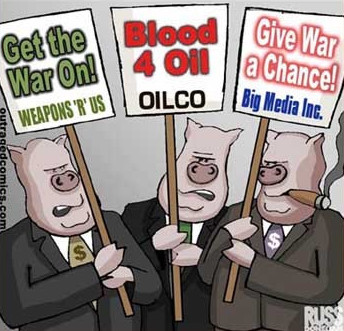
As ridiculous as it sounds, the majority of naïve statists believe this notion to be true. This is due, in no small part, to statist conditioning and state-driven propaganda that capitalizes on a blind, patriotic whimsy. And so the war machine continues to rage on, destroying lives, while fattening the pockets of the fat cats at Lockheed Martin and Boeing, not to mention all the other companies which directly and indirectly profit from war. It’s an all-too-common tragedy. But what can you expect when living within an oligarchic plutocracy disguised as a democratic republic? Rhetorical questions aside, there must be ways in which we can, as courageous individuals, throw a monkey wrench into the war machine and thus stop it in its violent tracks.

Here are four ways to do precisely that.

1. Teach Military Members to Disobey Immoral Orders

“The surest way to corrupt a youth is to instruct him to hold in higher esteem those who think alike than those who think differently.” ~Friedrich Nietzsche

The military chain of command is an antiquated system of leadership that is, unfortunately still in use today. It’s the epitome of a human centipede. Everything just rolls downhill. Like lemmings hell-bent on going over whatever cliff the “higher ranking” lemmings tell them to, the military chain of command is a blatant case of “the blind leading the blind.” Leadership is nothing more than ad hoc authoritarianism disguising a greedy race to the next rank or pay raise. They are not trained to be true leaders who think for themselves; they are brainwashed to be obedient followers that follow orders without question. The entire system is set upon blind obedience.

One way to toss a wrench into the war machine is to teach its members how to courageously and strategically disobey orders, especially immoral ones. Teach them how to put their foot down, how to be a real leader who leads by example, which may, at times, seem like a “bad” example according to the corrupt chain of command, but a “good” example according to health, sustainability, morality, justice, liberty, and truth. Teach them how to be self-empowered human beings first and military members second. Teach them how all things are relative to the observer, especially regarding truth and power. Like Nietzsche said, “All things are subject to interpretation; whichever interpretation prevails at a given time is a function of power and not truth.”

2. Question the Statist Chain of Obedience

“Our scientific power has outrun our spiritual power. We have guided missiles and misguided men.” ~Martin Luther King, Jr. 

In today’s day and age, wars exist because of disagreeable nation states, when they could probably be resolved by reasonable men. The problem is most men are made unreasonable by being unwitting, prideful statists with nationalism and patriotism muddying their logic. As Nietzsche said, “In individuals, insanity is rare; but in groups, parties, and epochs, it is the rule.”

In order not to get caught up in the insanity that ends up leading to war, we must, as individuals, question the state-driven chain of obedience being shoved down our throats by the system. The problem is too many people blindly obey, even at the expense of their own freedom and liberty. There’s too much apathy and indifference and not enough logic and reasoning. We’re a nation of misguided statists propagandized and brainwashed to no end. It’s time to upset the rotten-apple cart. It’s time to turn the tables on insanity. It’s time to put the horse of spiritual power (morality), back in front of the cart of scientific power (military). In short: It’s time to disobey.

3. Transform Statist Patriotism into Worldly Patriotism

“Every transformation demands as it’s pre-condition the ending of a world-the collapse of an old philosophy of life.” ~Carl Jung

Patriotism is a tricky thing. It pulls at our heartstrings. It tugs at our pride like puppet strings. And before we know it, we’re a blind patriot, knee-jerk reacting to the prideful boasts of other blind patriots. And suddenly we’re at war. But there is a way out of this unthinking emotional bias: redefine patriotism itself by becoming an interdependent worldly patriot instead of a codependent statist patriot. All it takes is a little imagination, a little logic and reasoning toward the way everything is connected. Then we rise above the statist condition, think outside the statist box, and embrace the world-as-self/self-as-world dynamic as our patriotic start.

Becoming a worldly patriot is perhaps the most effective way to toss a wrench into the war machine, because the war machine feeds upon the statist patriotic whimsy of the masses; but it chokes on a worldly patriotism, which understands – war anywhere, is a war against ourselves as an interdependent whole.

4. Become An Anti-War Warrior

“The most useful piece of learning for the uses of life is to unlearn what is untrue.” ~Antisthenes

An anti-war warrior has unlearned what is untrue, and has become an anti-war activist par excellence. Anti-war warriors are peaceful warriors who know when to go Tiananman Square on the war machine. They have made an art form out of civil disobedience, strategic and intelligent with their anti-war activism. When the war machine rears it’s ugly head, anti-war warriors know how to ninjaneer inside and outside the belly of the beast, using the pen just as mightily as the sword to strategically transform statist mindsets and dismantle the machine itself.

At the end of the day, the war machine is still a very real menace that cannot be ignored. We can no longer remain silent to the atrocities of the corrupt nation states that “govern” us. Their wicked war machines have been running rampant over our precious planet for far too long. It’s time we challenged it. It’s time we countered it with logic, reasoning, and thinking outside the statist box. We do this by disobeying all immoral orders passed down from both the chain of command and the chain of obedience. We do it by becoming worldly patriots and anti-war activists with the courage it takes to change the world.

“The greatest threat to our planet is the belief that someone else will save it.” -Unknown

Understanding Evil: From Globalism To Pizzagate

2350633195_d69a16ab76

By Brandon Smith

Source: Alt-Market.com

I have spent the better part of the last 10 years working diligently to investigate and relate information on economics and geopolitical discourse for the liberty movement. However, long before I delved into these subjects my primary interests of study were the human mind and the human “soul” (yes, I’m using a spiritual term).

My fascination with economics and sociopolitical events has always been rooted in the human element. That is to say, while economics is often treated as a mathematical and statistical field, it is also driven by psychology. To know the behavior of man is to know the future of all his endeavors, good or evil.

Evil is what we are specifically here to discuss. I have touched on the issue in various articles in the past including Are Globalists Evil Or Just Misunderstood, but with extreme tensions taking shape this year in light of the U.S. election as well as the exploding online community investigation of “Pizzagate,” I am compelled to examine it once again.

I will not be grappling with this issue from a particularly religious perspective. Evil applies to everyone regardless of their belief system, or even their lack of belief. Evil is secular in its influence.

The first and most important thing to understand is this — evil is NOT simply a social or religious construct, it is an inherent element of the human psyche. Carl Gustav Jung was one of the few psychologists in history to dare write extensively on the issue of evil from a scientific perspective as well as a metaphysical perspective.  I highly recommend a book of his collected works on this subject titled ‘Jung On Evil’, edited by Murray Stein, for those who are interested in a deeper view.

To summarize, Jung found that much of the foundations of human behavior are rooted in inborn psychological contents or “archetypes.”  Contrary to the position of Sigmund Freud, Jung argued that while our environment may affect our behavior to a certain extent, it does not make us who we are. Rather, we are born with our own individual personality and grow into our inherent characteristics over time. Jung also found that there are universally present elements of human psychology. That is to say, almost every human being on the planet shares certain truths and certain natural predilections.

The concepts of good and evil, moral and immoral, are present in us from birth and are mostly the same regardless of where we are born, what time in history we are born and to what culture we are born. Good and evil are shared subjective experiences.  It is this observable psychological fact (among others) that leads me to believe in the idea of a creative design — a god.  Again, though, elaborating on god is beyond the scope of this article.

To me, this should be rather comforting to people, even atheists.  For if there is observable evidence of creative design, then it would follow that there may very well be a reason for all the trials and horrors that we experience as a species.  Our lives, our failures and our accomplishments are not random and meaningless.  We are striving toward something, whether we recognize it or not.  It may be beyond our comprehension at this time, but it is there.

Evil does not exist in a vacuum; with evil there is always good, if one looks for it in the right places.

Most people are readily equipped to recognize evil when they see it directly.  What they are not equipped for and must learn from environment is how to recognize evil disguised as righteousness.  The most heinous acts in history are almost always presented as a moral obligation — a path towards some “greater good.”  Inherent conscience, though, IS the greater good, and any ideology that steps away from the boundaries of conscience will inevitably lead to disaster.

The concept of globalism is one of these ideologies that crosses the line of conscience and pontificates to us about a “superior method” of living.  It relies on taboo, rather than moral compass, and there is a big difference between the two.

When we pursue a “greater good” as individuals or as a society, the means are just as vital as the ends.  The ends NEVER justify the means.  Never.  For if we abandon our core principles and commit atrocities in the name of “peace,” safety or survival, then we have forsaken the very things which make us worthy of peace and safety and survival.  A monster that devours in the name of peace is still a monster.

Globalism tells us that the collective is more important than the individual, that the individual owes society a debt and that fealty to society in every respect is the payment for that debt.  But inherent archetypes and conscience tell us differently.  They tell us that society is only ever as healthy as the individuals within it, that society is only as free and vibrant as the participants.  As the individual is demeaned and enslaved, the collective crumbles into mediocrity.

Globalism also tells us that humanity’s greatest potential cannot be reached without collectivism and centralization.  The assertion is that the more single-minded a society is in its pursuits the more likely it is to effectively achieve its goals.  To this end, globalism seeks to erase all sovereignty. For now its proponents claim they only wish to remove nations and borders from the social equation, but such collectivism never stops there.  Eventually, they will tell us that individualism represents another nefarious “border” that prevents the group from becoming fully realized.

At the heart of collectivism is the idea that human beings are “blank slates;” that we are born empty and are completely dependent on our environment in order to learn what is right and wrong and how to be good people or good citizens.  The environment becomes the arbiter of decency, rather than conscience, and whoever controls the environment, by extension, becomes god.

If the masses are convinced of this narrative then moral relativity is only a short step away. It is the abandonment of inborn conscience that ultimately results in evil. In my view, this is exactly why the so called “elites” are pressing for globalism in the first place. Their end game is not just centralization of all power into a one world edifice, but the suppression and eradication of conscience, and thus, all that is good.

To see where this leads we must look at the behaviors of the elites themselves, which brings us to “Pizzagate.”

The exposure by Wikileaks during the election cycle of what appear to be coded emails sent between John Podesta and friends has created a burning undercurrent in the alternative media. The emails consistently use odd and out of context “pizza” references, and independent investigations have discovered a wide array connections between political elites like Hillary Clinton and John Podesta to James Alefantis, the owner of a pizza parlor in Washington D.C. called Comet Ping Pong. Alefantis, for reasons that make little sense to me, is listed as number 49 on GQ’s Most Powerful People In Washington list.

The assertion according to circumstantial evidence including the disturbing child and cannibalism artwork collections of the Podestas has been that Comet Ping Pong is somehow at the center of a child pedophilia network serving the politically connected. Both Comet Ping Pong and a pizza establishment two doors down called Besta Pizza use symbols in their logos and menus that are listed on the FBI’s unclassified documentation on pedophilia symbolism, which does not help matters.

Some of the best documentation of the Pizzagate scandal that I have seen so far has been done by David Seaman, a former mainstream journalist gone rogue. Here is his YouTube page.

I do recommend everyone at least look at the evidence he and others present. I went into the issue rather skeptical, but was surprised by the sheer amount of weirdness and evidence regarding Comet Pizza.  There is a problem with Pizzagate that is difficult to overcome, however; namely the fact that to my knowledge no victims have come forward.  This is not to say there has been no crime, but anyone hoping to convince the general public of wrong-doing in this kind of scenario is going to have a very hard time without a victim to reference.

The problem is doubly difficult now that an armed man was arrested on the premises of Comet Ping Pong while “researching” the claims of child trafficking.  Undoubtedly, the mainstream media will declare the very investigation “dangerous conspiracy theory.”  Whether this will persuade the public to ignore it, or compel them to look into it, remains to be seen.

I fully realize the amount of confusion surrounding Pizzagate and the assertions by some that it is a “pysop” designed to undermine the alternative media.  This is a foolish notion, in my view.  The mainstream media is dying, this is unavoidable.  The alternative media is a network of sources based on the power of choice and cemented in the concept of investigative research.  The reader participates in the alternative media by learning all available information and positions and deciding for himself what is the most valid conclusion, if there is any conclusion to be had.  The mainstream media simply tells its readers what to think and feel based on cherry picked data.

The elites will never be able to deconstruct that kind of movement with something like a faked “pizzagate”; rather, they would be more inclined to try to co-opt and direct the alternative media as they do most institutions.  And, if elitists are using Pizzagate as fodder to trick the alternative media into looking ridiculous, then why allow elitist run social media outlets like Facebook and Reddit to shut down discussion on the issue?

The reason I am more convinced than skeptical at this stage is because this has happened before; and in past scandals of pedophilia in Washington and other political hotbeds, some victims DID come forward.

I would first reference the events of the Franklin Scandal between 1988 and 1991. The Discovery Channel even produced a documentary on it complete with interviews of alleged child victims peddled to Washington elites for the purpose of favors and blackmail.  Meant to air in 1994, the documentary was quashed before it was ever shown to the public. The only reason it can now be found is because an original copy was released without permission by parties unknown.

I would also reference the highly evidenced Westminster Pedophile Ring in the U.K., in which the U.K. government lost or destroyed at least 114 files related to the investigation.

Finally, it is disconcerting to me that the criminal enterprises of former Bear Sterns financier and convicted pedophile Jeffrey Epstein and his “Lolita Express” are mainstream knowledge, yet the public remains largely oblivious.  Bill Clinton is shown on flight logs to have flown on Epstein’s private jet at least a 26 times; the same jet that he used to procure child victims as young as 12 to entertain celebrities and billionaires on his 72 acre island called “Little Saint James”.  The fact that Donald Trump was also close friends with Epstein should raise some eyebrows – funny how the mainstream media attacked Trump on every cosmetic issue under the sun but for some reason backed away from pursuing the Epstein angle.

Where is the vast federal investigation into the people who frequented Epstein’s wretched parties?  There is none, and Epstein, though convicted of molesting a 14 year old girl and selling her into prostitution, was only slapped on the wrist with a 13 month sentence.

Accusations of pedophilia seem to follow the globalists and elitist politicians wherever they go. This does not surprise me. They often exhibit characteristics of narcissism and psychopathy, but their ideology of moral relativity is what would lead to such horrible crimes.

Evil often stems from people who are empty. When one abandons conscience, one also in many respects abandons empathy and love.  Without these elements of our psyche there is no happiness. Without them, there is nothing left but desire and gluttony.

Narcissists in particular are prone to use other people as forms of entertainment and fulfillment without concern for their humanity.  They can be vicious in nature, and when taken to the level of psychopathy, they are prone to target and abuse the most helpless of victims in order to generate a feeling of personal power.

Add in sexual addiction and aggression and narcissists become predatory in the extreme. Nothing ever truly satisfies them. When they grow tired of the normal, they quickly turn to the abnormal and eventually the criminal.  I would say that pedophilia is a natural progression of the elitist mindset; for children are the easiest and most innocent victim source, not to mention the most aberrant and forbidden, and thus the most desirable for a psychopathic deviant embracing evil impulses.

Beyond this is the even more disturbing prospect of cultism. It is not that the globalists are simply evil as individuals; if that were the case then they would present far less of a threat. The greater terror is that they are also organized. When one confronts the problem of evil head on, one quickly realizes that evil is within us all. There will always be an internal battle in every individual. Organized evil, though, is in fact the ultimate danger, and it is organized evil that must be eradicated.

For organized evil to be defeated, there must be organized good. I believe the liberty movement in particular is that good; existing in early stages, not yet complete, but good none the less.  Our championing of the non-aggression principle and individual liberty is conducive to respect for privacy, property and life.  Conscience is a core tenet of the liberty ideal, and the exact counter to organized elitism based on moral relativity.

Recognize and take solace that though we live in dark times, and evil men roam free, we are also here. We are the proper response to evil, and we have been placed here at this time for a reason. Call it fate, call it destiny, call it coincidence, call it god, call it whatever you want, but the answer to evil is us.

The Desire to Fit In is the Root of Almost All Wrongdoing

226816_20150205_092434_mddtpdg

By Christopher Freiman

Source: aeon

Imagine that one morning you discover a ring that grants you magic powers. With this ring on your finger, you can seize the presidency, rob Fort Knox and instantly become the most famous person on the planet. So, would you do it?

Readers of Plato’s Republic will find this thought experiment familiar. For Plato, one of the central problems of ethics is explaining why we should prioritise moral virtue over power or money. If the price of exploiting the mythical ‘Ring of Gyges’ – acting wrongly – isn’t worth the material rewards, then morality is vindicated.

Notice that Plato assumes that we stray from the moral path through being tempted by personal gain – that’s why he tries to show that virtue is more valuable than the gold we can get through vice. He isn’t alone in making this assumption. In Leviathan (1651), Thomas Hobbes worries about justifying morality to the ‘fool’ who says that ‘there is no such thing as justice’ and breaks his word when it works to his advantage. And when thinking about our reasons to prefer virtue to vice, in his Enquiry Concerning the Principles of Morals (1751) David Hume confronts the ‘sensible knave’, a person tempted to do wrong when he imagines ‘that an act of iniquity or infidelity will make a considerable addition to his fortune’.

Some of history’s greatest philosophers, then, agree that wrongdoing tends to be motivated by self-interest. Alas, I’m not one of history’s greatest philosophers. Although most assume that an immoral person is one who’s ready to defy law and convention to get what they want, I think the inverse is often true. Immorality is frequently motivated by a readiness to conform to law and convention in opposition to our own values. In these cases, it’s not that we care too little about others; it’s that we care too much. More specifically, we care too much about how we stack up in the eyes of others.

Doing the wrong thing is, for most of us, pretty mundane. It’s not usurping political power or stealing millions of dollars. It’s nervously joining in the chorus of laughs for your co-worker’s bigoted joke or lying about your politics to appease your family at Thanksgiving dinner. We ‘go along to get along’ in defiance of what we really value or believe because we don’t want any trouble. Immanuel Kant calls this sort of excessively deferential attitude servility. Rather than downgrading the values and commitments of others, servility involves downgrading your own values and commitments relative to those of others. The servile person is thus the mirror image of the conventional, self-interested immoralist found in Plato, Hobbes and Hume. Instead of stepping on whomever is in his way to get what he wants, the servile person is, in Kant’s words, someone who ‘makes himself a worm’ and thus ‘cannot complain afterwards if people step on him’.

Kant thinks that your basic moral obligation is to not treat humanity as a mere means. When you make a lying promise that you’ll pay back a loan or threaten someone unless he hands over his wallet, you’re treating your victim as a mere means. You’re using him like a tool that exists only to serve your purposes, not respecting him as a person who has value in himself.

But Kant also says that you shouldn’t treat yourself as a mere means. This part of his categorical imperative gets less publicity than his injunction against mistreating others, but it’s no less important. Thomas Hill, a philosopher at the University of North Carolina, Chapel Hill, notes in Autonomy and Self-Respect (1991) that servility involves a mistaken assessment of your moral status. Crucially, the servile person is guilty of the same root error as the person who deceives or threatens others – namely, denying the basic moral equality of all persons. It’s just that the person you’re degrading is you. But servile behaviour neglects the fact that you’re entitled to the same respect as anyone else.

Now, maybe you’re thinking that lying about your opinion of Donald Drumpf [or Shillary Clinton] to placate your parents so you can eat your cranberry sauce in peace is no big deal. Fair enough. But servility can cause much graver moral transgressions.

Take the most famous psychological study of the 20th century: Stanley Milgram’s obedience experiments. Milgram discovered that most of his subjects would deliver excruciating – and sometimes apparently debilitating or lethal – electric shocks to innocent victims when an experimenter told them to do so. In ‘The Perils of Obedience’ (1973), Milgram explained that one reason why the typical subject goes along with malevolent authority is because he ‘fears that he will appear arrogant, untoward, and rude if he breaks off’. The subjects’ commitment to politeness overwhelmed their commitment to basic moral decency. And a lot of us are more like Milgram’s subjects than we’d care to admit: we don’t want to appear arrogant, untoward or rude at the dinner table, the classroom, the business meeting. So we swallow our objections and allow ourselves – and others – to be stepped on.

The pernicious consequences of servility aren’t confined to the lab, either. Indeed, Milgram’s experiment was motivated partly by his desire to understand how so many ordinary-seeming people could have participated in the moral horrors of the Holocaust. More recently, the military violence at Abu Ghraib has been explained in part by the soldiers’ socialisation into conformity. These examples and reflections on our own lives reveal an underappreciated moral lesson. It’s not always, or even usually, the case that we do wrong because we lack respect for others. Often it’s because we lack respect for ourselves.