Pouring Poison and Planting Seeds of Dependency

By Colin Todhunter

Source: Off-Guardian

Do you remember the iconic Union Carbide image from the 1950s or early 1960s? The one with the giant hand coming from the sky, pouring pesticides onto Indian soil.

The blurb below the image includes the following:

Science helps build a new India – India has developed bold new plans to build its economy and bring the promise of a bright future to its more than 400 million people. But India needs the technical knowledge of the western world. For example working with Indian engineers and technicians, Union Carbide recently made available its fast scientific resource to help build a chemicals and plastics plant near Bombay. Throughout the free world, Union Carbide has been actively engaged in building plants for the manufacture of chemicals, plastics, carbons, gases and metals.”

In the bottom corner is the Union Carbide logo and the statement ‘A HAND IN THINGS TO COME’.

This ‘hand of god’ image has become infamous. Union Carbide’s ‘hand in things to come’ includes the gas leak at its pesticides plant in Bhopal in 1984. It resulted in around 560,000 injured (respiratory problems, eye irritation, etc), 4,000 severely disabled and 20,000 dead.

As for the chemical-intensive agriculture it promoted, we can now see the impacts: degraded soils, polluted water, illness, farmer debt and suicides (by drinking pesticides!), nutrient-dense crops/varieties being side-lined, a narrower range of crops, no increase in food production per capita (in India at least), the corporate commodification of knowledge and seeds, the erosion of farmers’ environmental learning, the undermining of traditional knowledge systems and farmers’ dependency on corporations.

Whether it involves the type of ecological devastation activist-farmer Bhaskar Save outlined for policy makers in his 2006 open letter or the social upheaval documented by Vandana Shiva in the book The Violence of the Green Revolution, the consequences have been far-reaching.

And yet – whether it involves new genetic engineering techniques or more pesticides –  there is a relentless drive by the agritech conglomerates to further entrench their model of agriculture by destroying traditional farming practices with the aim of placing more farmers on corporate seed and chemical treadmills.

These corporations have been pushing for the European Commission to remove any labelling and safety checks for new genomic techniques. The European Court of Justice ruled in 2018 that organisms obtained with new genetic modification techniques must be regulated under the EU’s existing GMO laws. However, there has been intense lobbying from the agriculture biotech industry to weaken the legislation, aided financially by the Gates Foundation.

Since 2018, top agribusiness and biotech corporations have spent almost €37 million lobbying the European Union. They have had 182 meetings with European Commissioners, their cabinets and director generals. More than one meeting a week.

In recent weeks, Syngenta (a subsidiary of ChemChina) CEO Erik Fyrwald has come to the fore to cynically lobby for these techniques.

But before discussing Fyrwald, let us turn to another key agribusiness figure who has been in the news. Former Monsanto chairman and CEO Hugh Grant recently appeared in court to be questioned by lawyers on behalf of a cancer patient in the case of Allan Shelton v Monsanto.

Shelton has non-Hodgkin lymphoma and is one of the 100,000-plus people in the US claiming in lawsuits that exposure to Monsanto’s Roundup weedkiller and its other brands containing the chemical glyphosate caused their cancer.

His lawyers argued that Grant was an active participant and decision-maker in the company’s Roundup business and should be made to testify at the trial.

Why not? After all, he did make a financial killing from peddling poison.

Bayer acquired Monsanto in 2018 and Grant received an estimated $77 million post-sale payoff. Bloomberg reported in 2017 that Monsanto had increased Grant’s salary to $19.5 million.

By 2009, Roundup-related products, which include genetically modified seeds developed to withstand glyphosate-based applications, represented about half of Monsanto’s gross margin.

Roundup was integral to Monsanto’s business model and Grant’s enormous income and final payoff.

Consider the following quote from a piece that appeared on the Bloomberg website in 2014:

Chairman and Chief Executive Officer Hugh Grant is focused on selling more genetically modified seeds in Latin America to drive earnings growth outside the core US market. Sales of soybean seeds and genetic licenses climbed 16%, and revenue in the unit that makes glyphosate weed killer, sold as Roundup, rose 24%.”

In the same piece, Chris Shaw, a New York-based analyst at Monness Crespi Hardt & Co, is reported as saying “Glyphosate really crushed it” – meaning the sales of glyphosate were a major boost.

All fine for Grant and Monsanto. But this has had devastating effects on human health. ‘The Human Cost of Agrotoxins. How Glyphosate is killing Argentina’, which appeared on the Lifegate website in November 2015, serves as a damning indictment of the drive for “earnings growth” by Monsanto. Moreover, in the same year, some 30,000 doctors in that country demanded a ban on glyphosate.

The bottom line for Grant was sales and profit maximisation and the unflinching defence of glyphosate, no matter how carcinogenic to humans it is and, more to the point, how much Monsanto knew it was.

Noam Chomsky underlines the commercial imperative:

… the CEO of a corporation has actually a legal obligation to maximize profit and market share. Beyond that legal obligation, if the CEO doesn’t do it, and, let’s say, decides to do something that will, say, benefit the population and not increase profit, he or she is not going to be CEO much longer –  they’ll be replaced by somebody who does do it.”

Syngenta’s CEO is cut from the same cloth as Grant. While Monsanto’s crimes are well documented, Syngenta’s transgressions are less well publicised.

In 2006, writer and campaigner Dr Brian John claimed:

GM Free Cymru has discovered that Syngenta, in its promotion of GM crops and foods, has been involved in a web of lies, deceptions and obstructive corporate behaviour that would have done credit to its competitor Monsanto.”

Some weeks ago, Fyrwald called for organic farming to be abandoned. In view of the food crisis, brought on by the war in Ukraine, he claimed rich countries had to increase their crop production – but organic farming led to lower yields. Fyrwald also called for gene editing to be at the heart of the food agenda in order to increase food production.

He stated:

“The indirect consequence is that people are starving in Africa because we are eating more and more organic products.”

In response, Kilian Baumann, a Bernese organic farmer and president of the Swiss Small Farmers’ Association, called Fyrwald’s arguments “grotesque”. He claimed Fyrwald was “fighting for sales”.

Writing on the GMWatch website, Jonathan Matthews says the Russian invasion of Ukraine seems to have emboldened Fyrwald’s scaremongering.

Matthews states:

Fyrwald’s comments reflect the industry’s determination to undermine the European Union’s Farm to Fork strategy, which aims by 2030 not just to slash pesticide use by 50% and fertilizer use by 20% but to more than triple the percentage of EU farmland under organic management (from 8.1% to 25%), as part of the transition towards a ‘more sustainable food system’ within the EU’s Green Deal.”

He adds:

Syngenta view[s] these goals as an almost existential threat. This has led to a carefully orchestrated attack on the EU strategy.”

The details of this PR offensive have been laid out in a report by the Brussels-based lobby watchdog Corporate Europe Observatory (CEO): A loud lobby for a silent spring: The pesticide industry’s toxic lobbying tactics against Farm to Fork.

Mathews quotes research that shows GM crops have no yield benefit. He also refers to a newly published report that draws together research clearly showing GM crops have driven substantial increases – not decreases – in pesticide use. The newer and much-hyped gene-edited crops look set to do the same.

Syngenta is among the corporations criticised by a report from the UN for “systematic denial of harms” and “unethical marketing tactics”. Matthews notes that selling highly hazardous pesticides is actually at the core of Syngenta’s business model.

According to Matthews, even with the logistical disruptions to maize and wheat crops caused by the war in Ukraine, there is still enough grain available to the world market to meet existing needs. He says the current price crisis (not food crisis) is a product of fear and speculation.

Matthews concludes:

If Erik Fyrwald is really so concerned about hunger, why isn’t he attacking the boondoggle that is biofuels, rather than going after organic farming? The obvious answer is that the farmers being subsidised to grow biofuels are big consumers of agrichemicals and, in the US case, GMO seeds – unlike organic farmers, who buy neither.”

Fyrwald has a financial imperative to lobby for particular strategies and technologies. He is far from an objective observer. And he is far from honest in his appraisal – using fear of a food crisis to push his agenda.

Meanwhile, the sustained attacks on organic agriculture have become an industry mainstay, despite numerous high-level reports and projects indicating it could feed the world, mitigate climate change, improve farmers’ situations, lead to better soil, create employment and provide healthier and more diverse diets.

There is a food crisis but not the one alluded to by Fyrwald –  denutrified food and unhealthy diets that are at the centre of a major public health crisis, a loss of biodiversity which threatens food security, degraded soils, polluted and depleted water sources and smallholder farmers, so vital to global food production (especially in the Global South), squeezed off their land and out of farming.

Transnational agribusiness has lobbied for, directed and profited from policies that have caused much of the above. And what we now see is these corporations and their lobbyists espousing (fake) concern (a cynical lobbying tactic) for the plight of the poor and hungry while attempting to purchase EU democracy to the tune of €37 million. Cheap at the price considering the financial bonanza that its new patented genetic engineering technologies and seeds could reap.

Various scientific publications show these new techniques allow developers to make significant genetic changes, which can be very different from those that happen in nature. These new GMOs pose similar or greater risks than older-style GMOs.

By attempting to dodge regulation as well as avoid economic, social, environmental and health impact assessments, it is clear were the industry’s priorities lie.

Unfortunately, Fyrwald, Bill Gates, Hugh Grant and their ilk are unwilling and too often incapable of viewing the world beyond their reductionist mindsets that merely regard seed/chemical sales, output-yield and corporate profit as the measuring stick of success.

What is required is an approach that sustains indigenous knowledge, local food security, better nutrition per acre, clean and stable water tables and good soil structure. An approach that places food sovereignty, local ownership, rural communities and rural economies at the centre of policy and which nurtures biodiversity, boosts human health and works with nature rather than destroying these.

Fyrwald’s scaremongering is par for the course – the world will starve without corporate chemicals and (GM) seeds, especially if organics takes hold. This type of stuff has been standard fare from the industry and its lobbyists and bought career scientists for many years.

It flies in the face of reality, not least how certain agribusiness concerns have been part of a US geopolitical strategy that undermines food security in regions across the world. These concerns have thrived on the creation of dependency and profited from conflict. Moreover, there is the success of agroecological approaches to farming that have no need for what Fyrwald is hawking.

Instead, the industry continues to promote itself as the saviour of humanity – a hand of god powered by a brave new techno-utopian world of corporate science, pouring poison and planting seeds of corporate dependency with the missionary zeal of Western saviourism.
Why Don’t People “Trust The Science?” Because Scientists Are Often Caught Lying

By Brandon Smith

Source: Alt-Market.us

There has been an unfortunate shift in Western educational practices in the past few decades away from what we used to call “critical thinking.” In fact, critical thinking was once a fundamental staple of US colleges and now it seems as though the concept doesn’t exist anymore; at least not in the way it used to. Instead, another form of learning has arisen which promotes “right thinking”; a form of indoctrination which encourages and rewards a particular response from students that falls in line with ideology and not necessarily in line with reality.

It’s not that schools directly enforce a collectivist or corporatist ideology (sometimes they do), it’s more that they filter out alternative viewpoints as well as facts and evidence they do not like until all that is left is a single path and a single conclusion to any given problem. They teach students how to NOT think by presenting thought experiments and then controlling the acceptable outcomes.

For example, a common and manipulative thought experiment used in schools is to ask students to write an “analysis” on why people do not trust science or scientists these days. The trick is that the question is always presented with a built-in conclusion – That scientists should be trusted, and some people are refusing to listen, so let’s figure out why these people are so stupid.

I have seen this experiment numerous times, always presented in the same way. Not once have I ever seen a college professor or public school teacher ask students: “Should scientists today be trusted?”

Not once.

This is NOT analysis, this is controlled hypothesis. If you already have a conclusion in mind before you enter into a thought experiment, then you will naturally try to adjust the outcome of the experiment to fit your preconceived notions. Schools today present this foolishness as a form of thinking game when it is actually propaganda. Students are being taught to think inside the box, not outside the box. This is not science, it is anti-science.

Educational programming like this is now a mainstay while actual science has taken a backseat. Millions of kids are exiting public schools and universities with no understanding of actual scientific method or science in general. Ask them what the equations for Density or Acceleration are, and they’ll have no clue what your are talking about. Ask them about issues surrounding vaccination or “climate change”, and they will regurgitate a litany of pre-programmed responses as to why the science cannot be questioned in any way.

In the alternative media we often refer to this as being “trapped in the Matrix,” and it’s hard to think of a better analogy. People have been rewarded for so long for accepting the mainstream narrative and blindly dismissing any other information that when they are presented with reality they either laugh at it arrogantly or recoil in horror. The Matrix is so much more comfortable and safe, and look at all the good grades you get when you say the right things and avoid the hard questions and agree with the teacher.

Given the sad state of science in the West these days surrounding the response to covid as well as the insane and unscientific push for forced vaccinations, I thought it would be interesting to try out this thought exercise, but from an angle that is never allowed in today’s schools:

Why don’t people trust the science and scientists anymore?

This is simple: Because many scientists have been caught lying and misrepresenting their data to fit the conclusions they want rather than the facts at hand. Science is often politicized to serve an agenda. This is not conspiracy theory, this is provable fact.

That’s not to say that all science is to be mistrusted. The point is, no science should be blindly accepted without independent examination of ALL the available facts. This is the whole point of science, after all. Yes, there are idiotic conspiracy theories out there when it comes to scientific analysis, but there are a number of scams in the world of science as well.

The usual false claim is that the average person is ignorant and that they don’t have the capacity to understand scientific data. I do find it interesting that this is the general message of the trust-science thought experiment. It fits right in line with the mainstream and government narrative that THEIR scientists, the scientists they pay for and that corporations pay for, are implicitly correct and should not be questioned. They are the high priests of the modern era, delving into great magics that we dirty peasants cannot possibly grasp. It is not for us to question “the science”, it our job to simply embrace it like a religion and bow down in reverence.

Most people have the capacity to sift through scientific data as long as it’s transparent. When the facts are obscured or spun or omitted this causes confusion, and of course only the establishment scientists can untangle the mess because they are the ones that created it. Let’s look at a couple of examples directly related to human health…

GMO Crops And The Corporate Money Train

The propaganda surrounding Genetically Modified Organisms is relentless and pervasive, with the overall thrust being that they are perfectly safe and that anyone who says otherwise is a tinfoil hat crackpot. And certainly, there a hundreds if not thousands of studies which readily confirm this conclusion. So, case closed, right?

Not quite. Here is where critical thinking is so useful and where reality escapes the indoctrinated – Who paid for these studies, and do they have a vested interest in censoring negative data on GMOs?

Well, in the vast majority of cases GMO studies are funded by two sources – GMO industry giants like Monsanto, Dupont and Syngenta, or, government agencies like the FDA and EPA. Very few studies are truly independent, and this is the problem. Both the government and corporations like Monsanto have a vested interest in preventing any critical studies from being released on GMO’s.

Monsanto has been caught on numerous occasions hiding the dangerous health effects of its products, from Agent Orange to the RGBH growth hormone used in dairy cows. They have been caught compiling illegal dossiers on their critics. The industry has been caught multiple times paying off academics and scientists to produce studies on GMOs with a positive spin and even to attack other scientists that are involved in experiments that are critical of GMOs. Research shows that at least half of all GMO studies are funded by the GMO industry, while the majority of the other half are funded by governments.

There has also long been a revolving door between GMO industry insiders and the FDA and EPA; officials often work for Monsanto and then get jobs with the government, then go back to Monsanto again. The back scratching is so egregious that the government even created special legal protections for GMO companies like Monsanto under what is now known as the Monsanto Protection Act (Section 735 of Agricultural Appropriations Bill HR 993) under the Obama Administration in 2013. This essentially makes GMO companies immune to litigation over GMOs, and the same protections have been renewed in different bills ever since.

Beyond the revolving door, the government has approved many GMO products with little to no critical data to confirm their safety. Not only that, but in most cases the government has sovereign immunity from litigation, even if they’ve been negligent. Meaning, if any of these products is proven to cause long term health damage the government cannot be sued for approving them unless there are special circumstances.

If they could be held liable, you would be damn sure the FDA would be running every conceivable test imaginable to make sure GMOs are definitively safe without any bias attached, but this is not the case. Instead, the government actively propagandizes for GMO companies and uses hired hatchet men to derail any public criticism.

I, for one, would certainly like to know for sure if GMOs are harmful to the human body in the long term, and there is certainly science to suggest that this might be the case. There have been many situations in which specific GMO foods were removed from the market because of potentially harmful side effects. Endogenous toxins of plants with modified metabolites are a concern, along with “plant incorporated protectants” (plants designed to produce toxins which act as a pesticides).

There is data that tells us to be wary, but nothing conclusive. Why? Because billions of dollars are being invested by corporations into research designed to “debunk” any notion of side effects. If the same amount of funding was put into independent studies with no bias, then we might hear a different story about the risks of GMOs. All the money is in dismissing the risks of GMOs; there’s almost no money in studying them honestly.

The science appears to be rigged to a particular outcome or narrative, and that is lying. Science is supposed to remain as objective as possible, but how can it be objective when it is being paid for by people with an agenda? The temptation to sell out is extreme.

Covid Vaccines And The Death Of Science

I bring up the example of GMO’s because I think it is representative of how science can be controlled to produce only one message while excluding all other analysis. We don’t really know for sure how dangerous GMOs are because the majority of data is dictated by the people that profit from them and by their friends in government. The lack of knowing is upheld as proof of safety – But this is not scientific. Science and medicine would demand that we err on the side of caution until we know for sure.

The same dynamic exists in the world of covid vaccines. Big Pharma has a vested interest in ensuring NO negative information is released about the mRNA vaccines because there is a perpetual river of money to be made as long as the vax remains approved for emergency use by the FDA. It may be important to note that the FDA has said it will take at least 55 YEARS to release all the data it has on the Pfizer covid vaccines, which suggests again that there is a beneficial collusion between the government and corporate behemoths.

In the meantime, anyone that questions the efficacy or safety of the vax is immediately set upon by attack dogs in the media, most of them paid with advertising dollars from Big Pharma. These attacks are not limited to the alternative media; the establishment has also gone after any scientist or doctor with questions about vaccine safety.

There are clear and openly admitted ideological agendas surrounding covid science which have nothing to do with public health safety and everything to do with political control. When you have the head of the World Economic Forum applauding the covid pandemic as a perfect “opportunity” to push forward global socialist centralization and erase the last vestiges of free markets and individual liberty, any rational person would have to question if the covid science is also being rigged to support special interests.

Luckily, the covid issue is so massive that it is impossible for them to control every study. Instead, the establishment ignores the studies and data they don’t like.

The virus is being hyped as a threat to the majority of the public and as a rationale for 100% vaccination rates, by force if needed. Yet, the median Infection Fatality Rate of covid is only 0.27%. This means that on average 99.7% of the population at any given time has nothing to fear from the virus. This is confirmed by dozens of independent medical studies, but when was the last time you heard that number discussed by mainstream government scientists like Anthony Fauci?

I’ve never heard them talk about it. But how is it scientific to ignore data just because it doesn’t fit your political aims? Again, deliberate omission of data is a form of lying.

What about the multiple studies indicating that natural immunity is far superior in protection to the mRNA vaccines? What about the fact that the countries with the highest vaccination rates also have the highest rates of infections and their hospitalizations have actually increased? What about the fact that the states and countries with the harshest lockdown and mask mandates also have the highest infection rates? What about the fact that the average vaccine is tested for 10-15 years before being approved for human use, while the covid mRNA vaccines were put into production within months? That is to say, there is NO long term data to prove the safety of the covid vax.

These are easily observable scientific facts, but we never hear about them from corporate scientists or government scientists like Fauci? Instead, Fauci argues that criticism of his policies is an attack on him, and attacking him is the same as “attacking science.” In other words, Fauci believes HE IS the science.

And doesn’t that just illustrate how far science has fallen in the new millennium. Real scientists like Kary Mullis, the inventor of the PCR test, call Fauci a fraud, but they are ignored while Fauci is worshiped. I can’t even get into climate change “science” here, I would have to write an entire separate article about the fallacies perpetrated by global warming academics (did you know that global temperatures have only increased by 1 degree Celsius in the past century? Yep, just 1 degree according to the NOAA’s own data, yet, institutions like the NOAA continue to claim the end of the world is nigh because of global warming).

The stringent bottleneck on science today reminds me of the Catholic church under Pope Innocent III when church authorities forbade common people from owning or reading a bible. These laws remained in effect well into the 13th century. Instead, the peasants were to go to church and have the texts read to them by specific clergy. Often the bible readings were done in Latin which most people did not speak, and interpreted however the church wished.

It was only the invention of the printing press in the 1400s that changed the power dynamic and allowed bibles to be widely distributed and information to spread without church oversight. Much like the creation of the internet allows the public to access mountains of scientific data and methodologies at their fingertips. The free flow of information is an anathema according to the establishment; they argue that only they have the right to process information for public consumption.

Cultism requires excessive control of data and the complete restriction of outside interpretations. As information becomes openly available the public is then able to learn the whole truth, not just approved establishment narratives.

Science is quickly becoming a political religion rather than a bastion of critical thought. Conflicting data is ignored as “non-science” or even censored as “dangerous.” Government and corporate paid studies are treated as sacrosanct. Is it any wonder that so many people now distrust the science? Any reasonable person would have questions and suspicions. Those who do not have been indoctrinated into a cult they don’t even know they are a part of.

Orwellian Lockstep and a Loaded Syringe

By Colin Todhunter

Source: Dissident Voice

Some years ago, the then vice-president of Monsanto Robert T Fraley asked, “Why do people doubt science”. He posed the question partly because he had difficulty in believing that some people had valid concerns about the use of genetically modified organisms (GMOs) in agriculture.

Critics were questioning the science behind GM technology and the impacts of GMOs because they could see how science is used, corrupted and manipulated by powerful corporations to serve their own ends. And it was also because they regard these conglomerates as largely unaccountable and unregulated.

We need look no further than the current coronavirus issue to understand how vested interests are set to profit by spinning the crisis a certain way and how questionable science is being used to pursue policies that are essentially illogical or ‘unscientific’. Politicians refer to ‘science’ and expect the public to defer to the authority of science without questioning the legitimacy of scientific modelling or data.

Although this legitimacy is being questioned on various levels, arguments challenging the official line are being sidelined. Governments, the police and the corporate media have become the arbiters of truth even if ‘the truth’ does not correspond with expert opinion or rational thought which challenges the mainstream narrative.

For instance, testing for coronavirus could be flawed (producing a majority of ‘false positives’) and the processes involved in determining death rates could be inflating the numbers: for example, dying ‘with’ coronavirus’ is different to dying ‘due to’ coronavirus: a serious distinction given that up to 98 per cent of people (according to official sources) who may be dying with it have at least one serious life-threatening condition. Moreover, the case-fatality ratio could be so low as to make the lockdown response appear wholly disproportionate. Yet we are asked to accept statistics at face value – and by implication, the policies based on them.

Indeed, documentary maker and author David Cayley addresses this last point by saying that modern society is hyper-scientific but radically unscientific as it has no standard against which it can measure or assess what it has done: that we must at all costs ‘save lives’ is not questioned, but this makes it very easy to start a stampede. Making an entire country go home and stay home has immense, incalculable costs in terms of well-being and livelihoods. Cayley argues that this itself has created a pervasive sense of panic and crisis and is largely a result of the measures taken against the pandemic and not of the pandemic itself.

He argues that the declaration by the World Health Organization that a pandemic (at the time based on a suspected 150 deaths globally) was now officially in progress did not change anyone’s health status, but it dramatically changed the public atmosphere. Moreover, the measures mandated have involved a remarkable curtailing of civil liberty.

One of the hallmarks of the current situation, he stresses, is that some think that ‘science’ knows more than it does and therefore they – especially politicians – know more than they do. Although certain epidemiologists may say frankly that there is very little sturdy evidence to base policies on, this has not prevented politicians from acting as if everything they say or do is based on solid science.

The current paradigm – with its rhetoric of physical distancing, flattening the curve and saving lives – could be difficult to escape from. Cayley says either we call it off soon and face the possibility that it was all misguided (referring to the policies adopted in Sweden to make his point), or we extend it and create harms that may be worse than the casualties we may have averted.

The lockdown may not be merited if we were to genuinely adopt a knowledge-based approach. For instance, if we look at early projections by Neil Ferguson of Imperial College in the UK, he had grossly overstated the number of possible deaths resulting from the coronavirus and has now backtracked substantially. Ferguson has a chequered track record, which led UK newspaper The Telegraph to run a piece entitled ‘How accurate was the science that led to lockdown?’ The article outlines Ferguson’s previous flawed predictions about infectious diseases and a number of experts raise serious questions about the modelling that led to lockdown in the UK.

It is worth noting that the lockdown policies we now see are remarkably similar to the disturbing Orwellian ‘Lock Step’ future scenario that was set out in 2010 by the Rockefeller Foundation report ‘Scenarios for the Future of Technology and International Development’. The report foresaw a future situation where freedoms are curtailed and draconian high-tech surveillance measures are rolled out under the ongoing pretexts of impending pandemics. Is this the type of technology use we can expect to see as hundreds of millions are marginalized and pushed into joblessness?

Instead of encouraging more diverse, informed and objective opinions in the mainstream, we too often see money and power forcing the issue, not least in the form of Bill Gates who tells the world ‘normality’ may not return for another 18 months – until he and his close associates in the pharmaceuticals industry find a vaccine and we are all vaccinated.

US attorney Robert F Kennedy Jr says that top Trump advisor Stephen Fauci has made the reckless choice to fast track vaccines, partially funded by Gates, without critical animal studies. Gates is so worried about the danger of adverse events that he says vaccines shouldn’t be distributed until governments agree to indemnity against lawsuits.

But this should come as little surprise. Kennedy notes that the Gates Foundation and its global vaccine agenda already has much to answer for. For example, Indian doctors blame the Gates Foundation for paralysing 490,000 children. And in 2009, the Gates Foundation funded tests of experimental vaccines, developed by Glaxo Smith Kline (GSK) and Merck, on 23,000 girls. About 1,200 suffered severe side effects and seven died. Indian government investigations charged that Gates-funded researchers committed pervasive ethical violations.

Kennedy adds that in 2010 the Gates Foundation funded a trial of GSK’s experimental malaria vaccine, killing 151 African infants and causing serious adverse effects to 1,048 of the 5,949 children. In 2002, Gates’ operatives forcibly vaccinated thousands of African children against meningitis. Approximately 50 of the 500 children vaccinated developed paralysis.

Bill Gates committed $10 billion to the WHO in 2010. In 2014, Kenya’s Catholic Doctors Association accused the WHO of chemically sterilising millions of unwilling Kenyan women with a  ‘tetanus’ vaccine campaign. Independent labs found a sterility formula in every vaccine tested.

Instead of prioritising projects that are proven to curb infectious diseases and improve health — clean water, hygiene, nutrition and economic development — the Gates Foundation spends only about $650 million of its $5 billion budget on these areas.

Despite all of this, Gates appears on prime-time TV news shows in the US and the UK pushing his undemocratic and unaccountable pro-big pharma vaccination and surveillance agendas and is afforded deference by presenters who dare not mention any of what Kennedy outlines. Quite the opposite – he is treated like royalty.

In the meantime, an open Letter from Dr. Sucharit Bhakdi, emeritus professor of medical microbiology at the Johannes Gutenberg University Mainz, to Angela Merkel has called for an urgent reassessment of Germany’s lockdown. Dr Ioannidis, a professor of medicine and professor of epidemiology and population health at Stanford University, argues that we have made such decisions on the basis of unreliable data. In addition, numerous articles have recently appeared online which present the views of dozens of experts who question policies and the data being cited about the coronavirus.

While it is not the intention to dismiss the dangers of Covid-19, responses to those dangers must be proportionate to actual risks. And perspective is everything.

Millions die each year due to unnecessary conflicts, malnutrition and hunger, a range of preventative diseases (often far outweighing the apparent impact of Covid-19), environmental pollution and economic plunder which deprives poor countries of their natural wealth. Neoliberal reforms have pushed millions of farmers and poor people in India and elsewhere to the brink of joblessness and despair, while our food is being contaminated with toxic chemicals and the global ecosystem faces an apocalyptic breakdown.

Much of the above is being driven by an inherently predatory economic system and facilitated by those who now say they want to ‘save lives’ by implementing devastating lockdowns. Yet, for the media and the political class, the public’s attention should not be allowed to dwell on such things.

And that has easily been taken care of.

In the UK, the population is constantly subjected via their TV screens to clap for NHS workers, support the NHS and to stay home and save lives on the basis of questionable data and policies. It’s emotive stuff taking place under a ruling Conservative Party that has cut thousands of hospital beds, frozen staff pay and demonised junior doctors.

As people passively accept the stripping of their fundamental rights, Lionel Shriver, writing in The Spectator, says that the supine capitulation to a de facto police state has been one of the most depressing spectacles he has ever witnessed.

It’s a point of view that will resonate with many.

In the meantime, Bill Gates awaits as the saviour of humanity — with a loaded syringe.

Offering Choice but Delivering Tyranny: The Corporate Capture of Agriculture

By Colin Todhunter

Source: Off-Guardian

Many lobbyists talk a lot about critics of genetic engineering technology denying choice to farmers. They say that farmers should have access to a range of tools and technologies to maximise choice and options.

At the same time, somewhat ironically, they decry organic agriculture and proven agroecological approaches, presumably because these practices have no need for the proprietary inputs of the global agrochemical/agritech corporations they are in bed with.

And presumably because agroecology represents liberation from the tyranny of these profiteering, environment-damaging global conglomerates.

It is fine to talk about ‘choice’ but we do not want to end up offering a false choice (rolling out technologies that have little value and only serve to benefit those who control the technology), to unleash an innovation that has an adverse impact on others or to manipulate a situation whereby only one option is available because other options have been deliberately removed. And we would certainly not wish to roll out a technology that traps farmers on a treadmill that they find difficult to get off.

Surely, a responsible approach for rolling out important (potentially transformative) technologies would have to consider associated risks, including social, economic and health impacts.

Take the impact of the Green Revolution in India, for instance. Sold on the promise that hybrid seeds and associated chemical inputs would enhance food security on the basis of higher productivity, agriculture was transformed, especially in Punjab. But to gain access to seeds and chemicals many farmers had to take out loans and debt became (and remains) a constant worry.

Many became impoverished and social relations within rural communities were radically altered: previously, farmers would save and exchange seeds but now they became dependent on unscrupulous money lenders, banks and seed manufacturers and suppliers. Vandana Shiva in The Violence of the Green Revolution (1989) describes the social marginalisation and violence that accompanied the process.

On a macro level, the Green Revolution conveniently became tied to an international (neo-colonial) system of trade based on chemical-dependent agro-export mono-cropping linked to loans, sovereign debt repayment and World Bank/IMF structural adjustment (privatisation/deregulation) directives.

Many countries in the Global South were deliberately turned into food deficit regions, dependent on (US) agricultural imports and strings-attached aid.

The process led to the massive displacement of the peasantry and, according to the academics Eric Holt-Giménez et al, (Food rebellions: Crisis and the hunger for Justice, 2009), the consolidation of the global agri-food oligopolies and a shift in the global flow of food: developing countries produced a billion-dollar yearly surplus in the 1970s; they were importing $11 billion a year by 2004.

And it’s not as though the Green Revolution delivered on its promises.

In India, it merely led to more wheat in the diet, while food productivity per capita showed no increased or even actually decreased (see New Histories of the Green Revolution by Glenn Stone). And, as described by Bhaskar Save in his open letter (2006) to officials, it had dire consequences for diets, the environment, farming, health and rural communities.

The ethics of the Green Revolution – at least it was rolled out with little consideration for these impacts – leave much to be desired.

As the push to drive GM crops into India’s fields continues (the second coming of the green revolution – the gene revolution), we should therefore take heed. To date, the track record of GMOs is unimpressive, but the adverse effects on many smallholder farmers are already apparent (see Hybrid Bt cotton: a stranglehold on subsistence farmers in India by A P Gutierrez).

Aside from looking at the consequences of technology roll outs, we should, when discussing choice, also account for the procedures and decisions that were made which resulted in technologies coming to market in the first place.

Steven Druker, in his book Altered Genes, Twisted Truth, argues that the decision to commercialise GM seeds and food in the US amounted to a subversion of processes put in place to serve the public interest.

The result has been a technology roll out which could result (is resulting) in fundamental changes to the genetic core of the world’s food. This decision ultimately benefited Monsanto’s bottom line and helped the US gain further leverage over global agriculture.

We must therefore put glib talk of the denial of technology by critics to one side if we are to engage in a proper discussion of choice. Any such discussion would account for the nature of the global food system and the dynamics and policies that shape it. This would include looking at how global corporations have captured the policy agenda for agriculture, including key national and international policy-making bodies, and the role of the WTO and World Bank.

Choice is also about the options that could be made available, but which have been closed off or are not even considered. In Ethiopia, for example, agroecology has been scaled up across the entire Tigray region, partly due to enlightened political leaders and the commitment of key institutions.

However, in places where global agribusiness/agritech corporations have leveraged themselves into strategic positions, their interests prevail. From the false narrative that industrial agriculture is necessary to feed the world to providing lavish research grants and the capture of important policy-making institutions, these firms have secured a thick legitimacy within policymakers’ mindsets and mainstream discourse.

As a result, agroecological approaches are marginalised and receive scant attention and support.

Monsanto had a leading role in drafting the WTO Agreement on Trade-Related Aspects of Intellectual Property Rights to create seed monopolies. The global food processing industry wrote the WTO Agreement on the Application of Sanitary and Phytosanitary Measures.

Whether it involves Codex or the US-India Knowledge Initiative on Agriculture aimed at restructuring (destroying) Indian agriculture, the powerful agribusiness/food lobby has secured privileged access to policy makers and sets the policy agenda.

From the World Bank’s ‘enabling the business of agriculture’ to the Gates Foundation’s role in opening up African agriculture to global food and agribusiness oligopolies, democratic procedures at sovereign state levels are being bypassed to impose seed monopolies and proprietary inputs on farmers and to incorporate them into a global supply chain dominated by powerful corporations.

We have the destruction of indigenous farming in Africa as well as the ongoing dismantling of Indian agriculture and the deliberate impoverishment of Indian farmers at the behest of transnational agribusiness. Where is the democratic ‘choice’?

It has been usurped by corporate-driven Word Bank bondage (India is its biggest debtor in the bank’s history) and by a trade deal with the US that sacrificed Indian farmers for the sake of developing its nuclear sector.

Similarly, ‘aid’ packages for Ukraine – on the back of a US-supported coup – are contingent on Western corporations taking over strategic aspects of the economy. And agribusiness interests are at the forefront. Something which neoliberal apologists are silent on as they propagandise about choice, and democracy.

Ukraine’s agriculture sector is being opened up to Monsanto/Bayer. Iraq’s seed laws were changed to facilitate the entry of Monsanto.

India’s edible oils sector was undermined to facilitate the entry of Cargill. And Bayer’s hand is possibly behind the ongoing strategy to commercialise GM mustard in India. Whether on the back of militarism, secretive trade deals or strings-attached loans, global food and agribusiness conglomerates secure their interests and have scant regard for choice or democracy.

The ongoing aim is to displace localised, indigenous methods of food production and allow transnational companies to take over, tying farmers and regions to a system of globalised production and supply chains dominated by large agribusiness and retail interests. Global corporations with the backing of their host states, are taking over food and agriculture nation by nation.

Many government officials, the media and opinion leaders take this process as a given. They also accept that (corrupt) profit-driven transnational corporations have a legitimate claim to be owners and custodians of natural assets (the ‘commons’).

There is the premise that water, seeds, food, soil and agriculture should be handed over to these conglomerates to milk for profit, under the pretence these entities are somehow serving the needs of humanity.

Ripping land from peasants and displacing highly diverse and productive smallholder agriculture, rolling out very profitable but damaging technologies, externalising the huge social, environmental and health costs of the prevailing neoliberal food system and entire nations being subjected to the policies outlined above: how is any of it serving the needs of humanity?

It is not. Food is becoming denutrified, unhealthy and poisoned with chemicals and diets are becoming less diverse. There is a loss of plant and insect diversity, which threatens food security, soils are being degraded, water tables polluted and depleted and millions of smallholder farmers, so vital to global food production, are being pushed into debt in places like India and squeezed off their land and out of farming.

It is time to place natural assets under local ownership and to develop them in the public interest according to agroecological principles. This involves looking beyond the industrial yield-output paradigm and adopting a systems approach to food and agriculture that accounts for local food security and sovereignty, cropping patterns to ensure diverse nutrition production per acre, water table stability and good soil structure. It also involves pushing back against the large corporations that hold sway over the global food system and more generally challenging the leverage that private capital has over all our lives.

That’s how you ensure liberation from tyranny and support genuine choice.


Colin Todhunter is an independent journalist who writes on development, environmental issues, politics, food and agriculture. He was named in August 2018 by Transcend Media Services as one of 400 Living Peace and Justice Leaders and Models in recognition of his journalism. 

How GMO Seeds and Monsanto/Bayer’s “RoundUp” are Driving US Policy in Venezuela

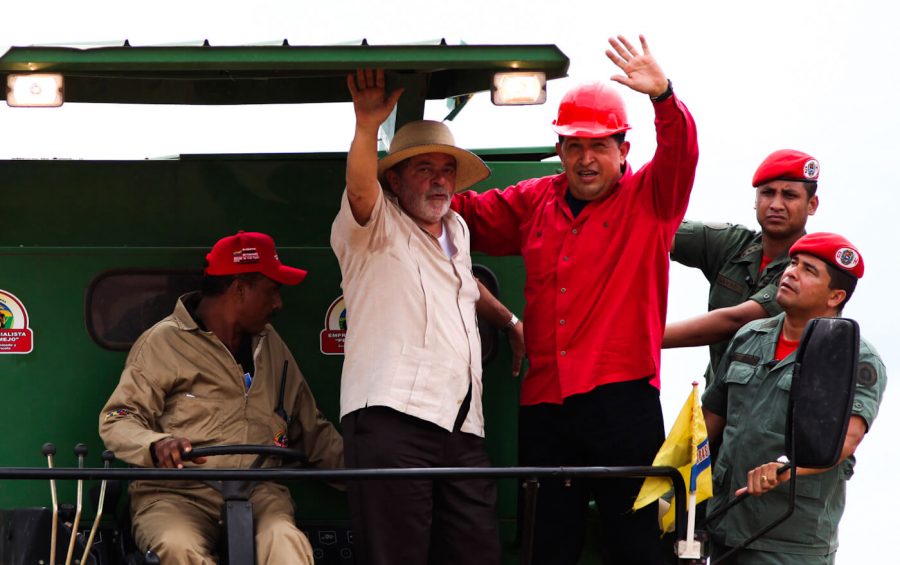
Hugo Chavez and Luiz Inacio Lula da Silva visit a soy farm in El Tigre in Venezuela’s Anzoategui state, Oct. 30, 2009. Ariana Cubillos | AP

With Juan Guaidó’s parallel government attempting to take power with the backing of the U.S., it is telling that the top political donors of those in the U.S. most fervently pushing regime change in Venezuela have close ties to Monsanto and major financial stakes in Bayer.

By Whitney Webb

Source: MintPress News

As the political crisis in Venezuela has unfolded, much has been said about the Trump administration’s clear interest in the privatization and exploitation of Venezuela’s oil reserves, the largest in the world, by American oil giants like Chevron and ExxonMobil.

Yet the influence of another notorious American company, Monsanto — now a subsidiary of Bayer — has gone largely unmentioned.

While numerous other Latin American nations have become a “free for all” for the biotech company and its affiliates, Venezuela has been one of the few countries to fight Monsanto and other international agrochemical giants and win. However, since that victory — which was won under Chavista rule — the U.S.-backed Venezuelan opposition has been working to undo it.

Now, with Juan Guaidó’s parallel government attempting to take power with the backing of the U.S., it is telling that the top political donors of those in the U.S. most fervently pushing regime change in Venezuela have close ties to Monsanto and major financial stakes in Bayer.

In recent months, Monsanto’s most controversial and notorious product — the pesticide glyphosate, branded as Roundup, and linked to cancer in recent U.S. court rulings — has threatened Bayer’s financial future as never before, with a litany of new court cases barking at Bayer’s door. It appears that many of the forces in the U.S. now seeking to overthrow the Venezuelan government are hoping that a new Guaidó-led government will provide Bayer with a fresh, much-needed market for its agrochemicals and transgenic seeds, particularly those products that now face bans in countries all over the world, including once-defoliated and still-poisoned Vietnam.


U.S.-Backed Venezuelan opposition seeks to reverse Chavista seed law and GMO ban

In 2004, then-president of Venezuela, Hugo Chávez, surprised many when he announced the cancellation of Monsanto’s plans to plant 500,000 acres of Venezuelan agricultural land in genetically modified (GM) soybeans. The cancellation of Monsanto’s Venezuela contract led to what became an ad hoc ban on all GM seeds in the entire country, a move that was praised by local farmer groups and environmental activists. In contrast to anti-GM movements that have sprung up in other countries, Venezuela’s resistance to GM crops was based more on concerns about the country’s food sovereignty and protecting the livelihoods of farmers.

Although the ban has failed to keep GM products out of Venezuela — as Venezuela has long imported a majority of its food, much of it originating in countries that are among the world’s largest producers of genetically modified foods — one clear effect has been preventing companies like Monsanto and other major agrochemical and seed companies from gaining any significant foothold in the Venezuelan market.

In 2013, a new seed law was nearly passed that would have allowed GM seeds to be sold in Venezuela through a legal loophole. That law, which was authored by a member of the Chavista United Socialist Party of Venezuela (PSUV), was widely protested by farmers, indigenous activists, environmentalists, and eco-socialist groups, which led to the law’s transformation into what has been nicknamed the “People’s Seed Law.” That law, passed in 2015, went even farther than the original 2004 ban by banning not just GM seeds but several toxic agrochemicals, while also strengthening heirloom seed varieties through the creation of the National Seed Institute.

Soon after the new seed law was passed in 2015, the U.S.-backed Venezuelan opposition led by the Roundtable of Democratic Unity (MUD) — a group comprised of numerous U.S.-funded political parties, including Guaidó’s Popular Will — took control of the country’s National Assembly. Until Venezuela’s Supreme Court dissolved the assembly in 2017, the MUD-legislature attempted to repeal the seed law on several occasions. Those in favor of the repeal called the seed bill “anti-scientific” and damaging to the economy.

Despite the 2017 Supreme Court decision, the National Assembly has continued to meet, but the body holds no real power in the current Venezuelan government. However, if the current government is overthrown and Guaidó  — the “interim president” who is also president of the dissolved National Assembly — comes to power, it seems almost certain that the “People’s Seed Law” will be one of the first pieces of legislation on the chopping block.


The AEI axis

Some of the key figures and loudest voices supporting the efforts of the Trump administration to overthrow the Venezuelan government in the United States are well-connected to one particular think-tank, the American Enterprise Institute (AEI). For instance, John Bolton — now Trump’s national security advisor and a major player in the administration’s aggressive Venezuela policy — was a senior fellow at AEI until he became Trump’s top national security official. As national security adviser, Bolton advises the president on foreign policy and issues of national security while also advising both the Secretary of State and the Secretary of Defense. As of late, he has been pushing for military action in Venezuela, according to media reports.

Another key figure in Trump’s Venezuela policy — Elliott Abrams, the State Department’s Special Representative for Venezuela — has been regularly featured at AEI summits and as a guest on its panels and podcasts. According to Secretary of State Mike Pompeo, Abrams’ current role gives him the “responsibility for all things related to our efforts to restore democracy” in Venezuela. Other top figures in the administration, including Vice President Mike Pence and Secretary of State Mike Pompeo, were featured guests at the AEI’s “secretive” gathering in early March. As MintPress and other outlets have reported, Guaidó declared himself “interim president” of Venezuela at Pence’s behest. Pompeo is also intimately involved in directing Trump’s Venezuela policy as the president’s main adviser on foreign affairs.

Other connections to the Trump administration include Secretary of Education Betsy DeVos who was previously on AEI’s board of trustees.

AEI has long been a key part of the “neoconservative” establishment and employs well-known neoconservatives such as Fred Kagan — the architect of the Iraq “troop surge” — and Paul Wolfowitz, the architect of the Iraq War. Its connections to the George W. Bush administration were particularly notable and controversial, as more than 20 AEI employees were given top positions under Bush. Several of them, such as Bolton, have enjoyed new prominence in Trump’s administration.

Other key Bush officials joined the AEI soon after leaving their posts in the administration. One such was Roger Noriega, who was the U.S. representative to the Organization of American States (OAS) during the failed, U.S.-backed 2002 coup and went on to be assistant secretary of state for Western Hemisphere affairs from 2003 to 2005, where he was extremely influential in the administration’s policies towards Venezuela and Cuba.

Since leaving the Bush administration and promptly joining the AEI, Noriega has been instrumental in pushing claims that lack evidence but aim to paint Venezuela’s current President Nicolas Maduro-led government as a national security threat, such as claiming that Venezuela is helping Iran acquire nuclear weapons and hosts soldiers from Lebanon’s Hezbollah. He also lobbied Congress to support Venezuelan opposition leader Leopoldo López, Guaidó’s political mentor and leader of his political party, Popular Will.

Not only that, but Noreiga teamed up with Martin Rodil, a Venezuelan exile formerly employed by the IMF, and José Cardenas, who served in the Bush administration, to found Visión Américas, a private risk-assessment and lobbying firm that was hired to “support the efforts of the Honduran private sector to help consolidate the democratic transition in their country” after the U.S.-backed Honduran coup in 2009. In recent months, Noriega and his associates have been very focused on Venezuela, with Cardenas offering Trump public advice about how “to hasten Maduro’s exit,” while Rodil has publicly offered “to get you a deal” if you have dirt on Venezuela’s government.

While the AEI is best known for its hawkishness, it is also a promoter of big agricultural interests. Since 2000, It has hosted several conferences on the promise of “biotechnology” and genetically modified seeds and has heavily promoted the work of former Monsanto lobbyist Jon Entine, who was an AEI visiting fellow for several years. The AEI also has long-time connections to Dow Chemical.

The most likely reason for the AEI’s interest in promoting biotech, however, can be found in its links to Monsanto. In 2013, The Nation acquired a 2009 AEI document, obtained through a filing error and not intended for public disclosure, that revealed the think tank’s top donors. The form, known as the “schedule of contributors,” revealed that the AEI’s top two donors at the time were the Donors Capital Fund and billionaire Paul Singer.

The Donors Capital Fund, which remains a major contributor to the AEI, is linked to Monsanto interests through the vice chairman of its board, Kimberly O. Dennis, who is also currently a member of the AEI’s National Council. According to AEI, the National Council is composed of “business and community leaders from across the country who are committed to AEI’s success and serve as ambassadors for AEI, providing us with advice, insight, and guidance.”

Dennis is the long-time executive chairwoman of the Searle Freedom Trust, which was founded in 1988 by Daniel Searle after he oversaw the sale of his family pharmaceutical company — G.D. Searle and Company — to Monsanto in 1985 for $2.7 billion. The money Searle had made from that merger was used to fund the trust that now funds the AEI and other right-wing think tanks. Searle was also close to Donald Rumsfeld, who led G.D. Searle and Co. for years and was Secretary of Defense under Gerald Ford and George W. Bush. Searle was also a trustee of the Hudson Institute, which once employed Elliott Abrams.

After the family company — which gained notoriety for faking research about the safety of its sweetener, aspartame or NutraSweet — was sold to Monsanto, G.D. Searle executives close to Daniel Searle rose to prominence within the company. Robert Shapiro, who was G.D. Searle’s long-time attorney and head of its NutraSweet division, would go on to become Monsanto’s vice president, president and later CEO. Notably, Daniel Searle’s grandson, D. Gideon Searle, was an AEI trustee until relatively recently.


Why is a top to Marco Rubio increasing his stake in Bayer while others flee?

Yet, it is AEI’s top individual donor noted in the accidental “schedule of contributors” disclosure who is most telling about the private biotech interests guiding the Trump administration’s Venezuela policy. Paul Singer, the controversial billionaire hedge fund manager, has long been a major donor to neoconservative and Zionist causes — helping fund the Foreign Policy Initiative (FPI), the successor to the Project for a New American Century (PNAC); and the neoconservative and islamophobic Foundation for the Defense of Democracies (FDD), in addition to the AEI.

Singer is notably one of the top political donors to Senator Marco Rubio (R-FL) and has been intimately involved in the recent chaos in Venezuela. He has been called one of the architects of the administration’s current regime-change policy, and was the top donor to Rubio’s presidential campaign, as well as a key figure behind the controversial “dossier” on Donald Trump that was compiled by Fusion GPS. Indeed, Singer had been the first person to hire Fusion GPS to do “opposition research” on Trump. However, Singer has largely since evaded much scrutiny for his role in the dossier’s creation, likely because he became a key donor to Trump following his election win in 2016, giving $1 million to Trump’s inauguration fund.

Singer has a storied history in South America, though he has been relatively quiet about Venezuela. However, a long-time manager of Singer’s hedge fund, Jay Newman, recently told Bloomberg that a Guaidó-led government would recognize that foreign creditors “aren’t the enemy,” and hinted that Newman himself was weighing whether to join a growing “list of bond veterans [that have] already begun staking out positions, anticipating a $60 billion debt restructuring once the U.S.-backed Guaidó manages to oust President Nicolas Maduro and take control.” In addition, the Washington Free Beacon, which is largely funded by Singer, has been a vocal advocate for the Trump administration’s regime-change policy in Venezuela.

Beyond that, Singer’s Elliott Management Corporation gave Roger Noriega, the former assistant secretary of state for Western Hemisphere affairs under Bush, $60,000 in 2007 to lobby on the issue of sovereign debt and for “federal advocacy on behalf of U.S. investors in Latin America.” During the time Noriega was on Singer’s payroll, he wrote articles linking Argentina and Venezuela to Iran’s nonexistent nuclear program. At the time, Singer was aggressively pursuing the government of Argentina in an effort to obtain more money from the country’s prior default on its sovereign debt.

While Singer has been mum himself on Venezuela, he has been making business decisions that have raised eyebrows, such as significantly increasing his stake in Bayer. This move seems at odds with Bayer’s financial troubles, a direct result of the slew of court cases regarding the link between Monsanto’s glyphosate and cancer. The first ruling that signaled trouble for Monsanto and its new parent company Bayer took place last August, but Singer increased his stake in the company starting last December, even though it was already clear by then that Bayer’s financial troubles in relation to the glyphosate court cases were only beginning.

Since the year began, Bayer’s problems with the Monsanto merger have only worsened, with Bayer’s CEO recently stating that the lawsuits had “massively affected” the company’s stock prices and financial performance.


Forcing open a new market for RoundUp

Part of Singer’s interest in Bayer may relate to Venezuela, given that Juan Guaido’s “Plan País” to “rescue” the Venezuelan economy includes a focus on the country’s agricultural sector. Notably, prior to and under Chavismo, agricultural productivity and investment in the agricultural sector took a backseat to oil production, resulting in under 25 percent of Venezuelan land being used for agricultural purposes despite the fact that the nation has a wealth of arable land. The result has been that Venezuela needs to import much of its food from abroad, most of which originate in Colombia or the United States.

Under Chávez and his successor, Maduro, there has been a renewed focus on small-scale farming, food sovereignty and organic agriculture. However, if Maduro is ousted and Guaidó moves to implement his “Plan País,” the opposition’s coziness with foreign corporations, the interests of U.S. coup architects in Bayer/Monsanto, and the opposition’s past efforts to overturn the GM seed ban all suggest that a new market for Bayer/Monsanto products — particularly glyphosate — will open up.

South America has long been a key market for Monsanto and — as the company’s problems began to mount prior to the merger with Bayer — it became a lifeline for the company due to less stringent environmental and consumer regulations that many Western countries. In recent years, when South American governments have opened their countries to more “market-friendly” policies in their agricultural sectors, Monsanto has made millions.

For instance, when Brazil sought to expand biotechnology (i.e. GM seed) investment in 2012, Monsanto saw a 21% increase in its sales of GM corn seed alone, generating an additional $1 billion in profits for the company. A similar comeback scenario is needed more than every by Bayer/Monsanto, as Monsanto’s legal troubles saw the company’s profits plunge late last year.

With countries around the world now weighing glyphosate bans as a result of increased litigation over the chemical’s links to cancer, Bayer needs a new market for the chemical to avoid financial ruin. As Singer now has a significant stake in the company, he — along with the politicians and think tanks he funds — may see promise in the end of the anti-GM seed ban that a Guaidó-led government would bring.

Furthermore, given that Guaidó’s top adviser wants the Trump administration to have a direct role in governing Venezuela if Maduro is ousted, it seems likely that Singer would leverage his connections to keep Bayer/Monsanto afloat amid the growing controversy surrounding glyphosate. Such behavior on the part of Singer would hardly be surprising in light of the fact that international financial media have characterized him as a “ruthless opportunist” and “overly aggressive.”

Such an outcome would be in keeping with the increased profit margins for Monsanto and related companies that have followed its expansion into countries following U.S.-backed coups. For instance, after the U.S.-backed coup in Ukraine in 2014, the loans given to Ukraine by the International Monetary Fund and the World Bank forced the country to open up and expand the use of “biotechnology” and GM crops in its agricultural sector, and Monsanto, in particular, made millions as the prior government’s ban on GM seeds and their associated agrochemicals was reversed. If Maduro is ousted, a similar scenario is likely to play out in Venezuela, given that the Guaidó-led government made known its intention to borrow heavily from these institutions just days after Guaidó declared himself “interim president.”


Whitney Webb is a MintPress News journalist based in Chile. She has contributed to several independent media outlets including Global Research, EcoWatch, the Ron Paul Institute and 21st Century Wire, among others. She has made several radio and television appearances and is the 2019 winner of the Serena Shim Award for Uncompromised Integrity in Journalism.

Kieran Barr contributed to the research used in this report.

The Stomach-Churning Violence of the Agrochemical Oligopoly

By Colin Todhunter

Source: OffGuardian

As humans, we have evolved with the natural environment over millennia. We have learned what to eat and what not to eat, what to grow and how to grow it and our diets have developed accordingly. We have hunted, gathered, planted and harvested. Our overall survival as a species has been based on gradual, emerging relationships with the seasons, insects, soil, animals, trees and seeds. And out of these relationships, we have seen the development of communities whose rituals and bonds have a deep connection with food production and the natural environment.

However, over the last couple generations, agriculture and food production has changed more than it had done over previous millennia. These changes have involved massive social upheaval as communities and traditions have been uprooted and have entailed modifying what we eat, how we grow our food and what we apply to it. All of this has been driven by geopolitical concerns and powerful commercial interests with their proprietary chemicals and patented seeds. The process of neoliberal globalisation is accelerating the process as farmers are encouraged to produce for global supply chains dominated by transnational agribusiness.

Certain crops are now genetically engineered, the range of crops we grow has become less diverse, synthetic biocides have been poured on crops and soil and our bodies have been subjected to a chemical bombardment. We have arrived at a point where we have lost touch with our deep-rooted microbiological and social connection with nature and have developed an arrogance that has placed ‘man’ above the environment and all other species. One of the consequences is that we have paid an enormous price in terms of the consequent social, environmental and health-related devastation.

Despite the promise and potential of science, it has too often in modern society become a tool of vested interests, an ideology wrapped in the vestiges of authority and the ‘superstition’ that its corporate-appointed priesthood should not be challenged nor questioned. Instead of liberating humankind, it has now too often become a tool of deception in the hands of agribusiness conglomerates which make up the oligopoly that controls what is an increasingly globalised system of modern food and agriculture.

These corporations have successfully instituted the notion that the mass application of biocides, monocropping and industrial agriculture are necessary and desirable. They are not. However, these companies have used their science and propaganda to project certainty in order to hide the fact that they have no real idea what their products and practices are doing to human health or the environment (and in cases when they do know, they do their best to cover it up or hide behind the notion of ‘commercial confidentiality’).

Based on their limited, tainted studies and co-opted version of science, they say with certainty that, for example, genetically engineered food and glyphosate are ‘safe’. And when inconvenient truths do emerge, they will mobilise their massive lobbying resources to evade regulations, they will seek to hide the dangers of their products or they will set out to destroy scientists whose findings challenge their commercial bottom line.

Soil microbiologists are still trying to fully comprehend soil microbes and how they function as anintegrated network in relation to plants. The agrochemical sector has little idea of how their biocides have affected soils. It merely churns out public relations spin that their inputs are harmless for soil, plants and human health. Such claims are not based on proper, in-depth, long-term studies. They are based on a don’t look, don’t find approach or a manipulation of standards and procedures that ensure their products make it on to the commercial market and stay there.

And what are these biocides doing to us as humans? Numerous studies have linked the increase in pesticide us with spiralling rates of ill health. Kat Carrol of the National Health Federation is concerned about the impacts on human gut bacteria that play a big role in how organs function and our neurological health. The gut microbiome can contain up to six pounds of bacteria and is what Carroll calls ‘human soil’. She says that with their agrochemicals and food additives, powerful companies are attacking this ‘soil’ and with it the sanctity of the human body.

And her concerns seem valid. Many important neurotransmitters are located in the gut. Aside from affecting the functioning of major organs, these transmitters affect our moods and thinking. Feed gut bacteria a cocktail of biocides and is it any surprise that many diseases are increasing?

For instance, findings published in the journal ‘Translational Psychiatry’ provide strong evidence that gut bacteria can have a direct physical impact on the brain. Alterations in the composition of the gut microbiome have been implicated in a wide range of neurological and psychiatric conditions, including autism, chronic pain, depression, and Parkinson’s Disease.

Environmental campaigner Dr Rosemary Mason has written extensively on the impacts of agrochemicals (especially glyphosate) on humans, not least during child and adolescent development. In her numerous documents and papers, she cites a plethora of data and studies that link the use of agrochemicals with various diseases and ailments. She has also noted the impact of these chemicals on the human gut microbiome.

The science writer Mo Costandi discusses the importance of gut bacteria and their balance. In adolescence the brain undergoes a protracted period of heightened neural plasticity, during which large numbers of synapses are eliminated in the prefrontal cortex and a wave of ‘myelination’ sweeps across this part of the brain. These processes refine the circuitry in the prefrontal cortex and increase its connectivity to other brain regions. Myelination is also critical for normal, everyday functioning of the brain. Myelin increases a nerve fibre’s conduction velocity by up to a hundred times, and so when it breaks down, the consequences can be devastating.

Other recent work shows that gut microbes control the maturation and function of microglia, the immune cells that eliminate unwanted synapses in the brain; age-related changes to gut microbe composition might regulate myelination and synaptic pruning in adolescence and could, therefore, contribute to cognitive development. Upset those changes, and, As Mason argues, there are going to be serious implications for children and adolescents. Mason places glyphosate at the core of the ailments and disorders currently affecting young people in Wales and the UK in general.

Yet we are still being subjected to an unregulated cocktail of agrochemicals which end up interacting with each other in the gut. Regulatory agencies and governments appear to work hand in glove with the agrochemical sector.

Carol Van Strum has released documents indicating collusion between the manufacturers of dangerous chemicals and regulatory bodies. Evaggelos Vallianatos has highlighted the massive fraud surrounding the regulation of biocides and the wide scale corruption at laboratories that were supposed to test these chemicals for safety. Many of these substances were not subjected to what was deemed proper testing in the first place yet they remain on the market. The late Shiv Chopra also highlighted how various dangerous products were allowed on the commercial market and into the food chain due to collusion between these companies and public officials.

Powerful transnational corporations are using humanity as their collective guinea pig. But those who question them, or their corporate science, are automatically labelled anti-science and accused of committing crimes against humanity because they are preventing their products from being commercialised ‘to help the poor or hungry’. Such attacks on critics by company mouthpieces who masquerade as public officials, independent scientists or independent journalists are mere spin. They are, moreover, based on the sheer hypocrisy that these companies (owned and controlled by elite interests) have humanity’s and the environment’s best interests at heart.

Many of these companies have historically profited from violence. Unfortunately, that character of persists. They directly profit on the back of militarism, whether as a result of the US-backed ‘regime change’ in Ukraine or the US invasion of Iraq. They also believe they can cajole (poison) nature by means of chemicals and bully governments and attack critics, while rolling out propaganda campaigns for public consumption.

Whether it involves neocolonialism and the destruction of indigenous practices and culturesunder the guise of ‘development’, the impoverishment of farmers in India, the twisting and writing of national and international laws, the destruction of rural communities, the globalisation of bad food and illness, the deleterious impacts on health and soil, the hollowing out of public institutions and the range of human rights abuses we saw documented during The Monsanto Tribunal, what we are witnessing is structural violence in many forms.

Pesticides are in fact “a global human rights concern” and are in no way vital to ensuring food security. Ultimately, what we see is ignorance, arrogance and corruption masquerading as certainty and science.

…when we wound the planet grievously by excavating its treasures – the gold, mineral and oil, destroy its ability to breathe by converting forests into urban wastelands, poison its waters with toxic wastes and exterminate other living organisms – we are in fact doing all this to our own bodies… all other species are to be enslaved or driven to extinction if need be in the interests of human ‘progress’… we are part of the same web of life –where every difference we construct artificially between ‘them’ and ‘us’ adds only one more brick to the tombstone of humankind itself.”
from Micobes of the World Unite! by Satya Sager

4 SIGNS WE LIVE IN A PROFOUNDLY SICK SOCIETY

By Gary Z McGee

Source: Waking Times

“It is no measure of health to be well adjusted to a profoundly sick society.” ~Jiddu Krishnamurti

What makes our society so sick? How do we know for sure that our society is unhealthy? Is there a way to reason our way into a clear explanation for why our society is unfit for healthy human beings attempting to evolve in a healthier way?

It really comes down to answering one critical question: Do you want to live, or do you want to die? As Albert Camus famously stated, “There is but one truly serious philosophical problem, and that is suicide. Judging whether life is or is not worth living amounts to answering the fundamental question of philosophy.” It seems extreme, but in order to get down to the crux of the issue, we need to ask extreme questions.

If your answer is ‘life,’ then it stands to reason that you want that life to be as healthy as possible. If your answer is suicide, then obviously all other questions of survival are irrelevant, and you fall under the null hypothesis.

Let’s assume that your answer is ‘life.’ What is the next logical question? It stands to reason that all subsequent questions would be: What do I need to do in order to continue my survival? The first answer to that question must be: I need to breathe clean air. After that? I need to drink clean water. Then, I need to eat healthy food. And then, I need to find healthy human relations. So on, and so forth.

This gives us a four-fold foundation to begin to see why the system is so unhealthy, while possibly shedding some light on how we can heal our profoundly sick society. Let’s break it down…

1. Our Society Pollutes the Air

“A thing is right when it tends to preserve the integrity, stability, and beauty of the biotic community. It is wrong when it tends otherwise.” ~Aldo Leopold

So, you want to live? Well you’ve got to breathe air. And if you want to live healthy, you must breathe clean air. The first fundamental reason how we know we live in a profoundly sick society is when it becomes evident that our society is directly affecting the quality of the air in a negative and unhealthy way.

Forget the ongoing debate about climate change and global warming. Some people’s cognitive dissonance is so powerful that no amount of arguing will convince them. It will only solidify their hardheaded stance.

Focus instead on the real problem; something we can all agree on: pollution. There is no denying that our society’s excessive use of fossil fuels is a dangerous air pollutant. Just look at the horizon in almost every single major city on the planet. If it’s harming the air quality there, then it’s harming the air quality everywhere. The planet is an interconnected system. Everything is connected to everything else. Especially when it comes to the flow of air.

It’s simple: when our waste output exceeds the planet’s ability to absorb it in a healthy way –that is to say, in a way that preserves the integrity, stability, and beauty of the biotic community– then we know, without a doubt, that it’s unhealthy and that we must scale back. Otherwise, our health and the planet’s health, is compromised.

A society that continues to output more waste into the air than the atmosphere can absorb in a healthy way is a profoundly sick society.

2. Our Society Pollutes the Water

“We forget that the water cycle and the life cycle are one.” ~Jacques Yves Cousteau

So, you’ve decided you want to live and you’ve taken care of breathing air. The next step, if you wish to continue your survival, is to find clean water. This is no easy task in a sick society.

As predicted, the Keystone Pipeline has leaked. Twice! Once on May 4, 2017 (84,000 gallons of oil) and on November 16, 2017 (210,000 gallons). Then there was the Iowa Pipeline (140,000 gallons) on January 31, 2017, the Rover Pipeline in Ohio on May 10, 2017, and the Texas Pipeline (over 50,000 gallons of crude oil) on July 13, 2017. Then there was the Gulf of Mexico oil spill (400,000 gallons of oil). And these were just a few of the larger spills in 2017 alone.

The real war being fought on this planet is between water protectors (healthy people) and oil mongers (unhealthy people). Water represents life, and oil represents entropy. But, it’s not quite so simple. There is a kind of yin-yang dynamic going on here. The white dot on the oil side of the yin-yang represents energy and progress. The black dot on the water side of the yin-yang represents pollution. We use oil for energy to propel our civilizations progressively forward but at a great cost –rampant, poisonous pollution.

The problem is that the black dot on the water side is getting out of control, leading to environmental collapse at best and ecocide at worst. If we’re not careful, the yin-yang of our world is going to be a black mass of oily entropy spinning through space –a burnt-out husk of a planet. Something’s got to give.

Oil has been an industrious boon for our species. No doubt. It helped us achieve many technological marvels. But we were naïve to its pollutant power. At this point, the pollution is so bad that it supersedes the gain. Burning oil, coal, and gas is simply too toxic for us and our environment. We cannot, in good conscience, continue to burn through this now outdated mode of energy use. If we would be a healthy society, we must switch to solar, wind, electric, tide, and especially hemp, or we will burn ourselves out.

A society that continues to use outdated energy-producing methods which cannot be absorbed by their environment in a healthy way, is a profoundly sick society.

3. Our Society Pollutes Our Food

“I screamed at god for the starving child, until I realized that God was the child screaming at me.” ~Unknown

So, you still want to live, and you’ve managed to breathe air and drink water. The next step is to consume clean and healthy food. Again, this is no easy task in a sick society.

From Agent Orange to Roundup, from Nestle to Monsanto, from DDT to GMO, from Fukushima to overfished waters, from hoarding to unnecessary starvation, and everything in between, the range of ways our society has managed to destroy our food supply is laughable.

Do you know why so many fish products are mislabeled? Because corporations don’t have the guts to tell you that the fish you like are practically gone. Yes, 70%of the world’s fisheries are either completely exploited, overexploited or collapsed as a result of overfishing and warmer waters. This should come as a wake-up call of the highest order.

Again, human pollution is the biggest part of the problem. Especially plastic pollution. But another big part of the problem is how we farm, how we distribute (or lack thereof), and how we waste our food. The utter failure of our distribution system undermines the health of our species. It prevents people from thriving because they are expending all their vital energy on merely surviving.

On one end of the spectrum, we have wealthy people hoarding and/or wasting enough food to feed an entire third-world country; on the other end, we have the poor pinching pennies to eat the unhealthiest (but cheapest) “food” ever created: fast food.

One way to fix at least part of this daunting problem is through polyculture farming. Where monoculture is about industry, polyculture is about diversity. Monoculture suffers from a lack of biodiversity and nutrients in soil. Polyculture thrives with biodiversity and replenishes soil. Monoculture requires pesticides. Polyculture is a function of biological pest control. Monoculture is unnatural. Polyculture is natural. Monoculture leads to disease and famine. Polyculture leads to abundance and permaculture. Monoculture is about money over people. Polyculture is about people and healthy food over money.

A society that continues to pollute, mismanage, hoard, poison, and poorly distribute its own food supply is a profoundly sick society.

4. Our Society Creates Unhealthy Individuals

“The system cannot be fixed by the system.” ~Tom Morello

So, you’ve managed to breathe air, drink water, and eat food. But is it healthy? The question ‘do we live in a profoundly sick society’ comes down to this critical question: is the air, the water, and the food we are consuming healthy? If not, is it because of something our society is doing to the air, the water, and the food that is causing it to be unhealthy? If so, what are you, as a member of society, going to do about it?

Are you just going to ignore it and hope it works itself out? Are you going to wait for technology to bail us out somehow? Are you waiting for a hero to save the day?

The main reason we live in a profoundly sick society is because most people do nothing about the unhealthy system that props it up. As a result, we live in a sick society that creates unhealthy individuals which creates more unhealthy individuals. The unhealthy cycle will continue to repeat itself until healthy-minded individuals rise-up to change it. This is an arduously Herculean task, but no task is more important. The very health, indeed the very evolution, of our species is at stake.

When it comes down to it, a society that breathes dirty air, drinks polluted water, eats poisoned food and then continues to do all the things that cause dirty air, polluted water and poisoned food is a profoundly sick society.