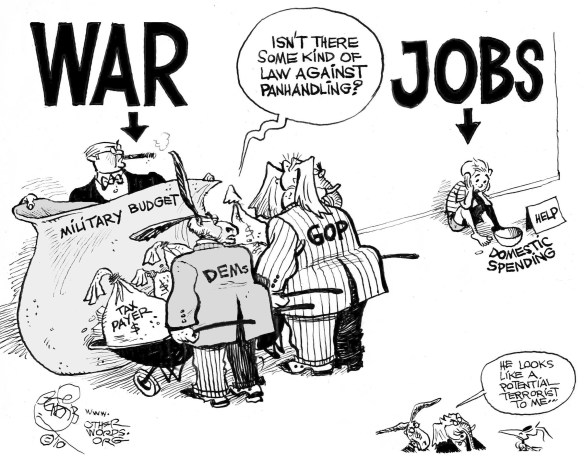
$21 Trillion of Unauthorized Spending by US Govt Discovered by Economics Professor

Source: Covert Geopolitics

he US government may have misspent $21 trillion, a professor at Michigan State University has found. Papers supporting the study briefly went missing just as an audit was announced.

Two departments of the US federal government may have spent as much as $21 trillion on things they can’t account for between 1998 and 2015. At least that’s what Mark Skidmore, a Professor of Economics at MSU specializing in public finance, and his team have found.

They came up with the figure after digging the websites of departments of Defense (DoD) and Housing and Urban Development (HUD) as well as repots of the Office of the Inspector General (OIG) over summer.

The research was triggered by Skidmore hearing Catherine Austin Fitts, a former Assistant Secretary in the HUD in the first Bush administration, saying the Inspector General found $6.5 trillion worth of military spending that the DoD couldn’t account for. She was referring to a July 2016 report by the OIG, but Skidmore thought she must be mistaking billion for trillion. Based on his previous experience with public finances, he thought the figure was too big even for an organization as large as the US military.

“Sometimes you have an adjustment just because you don’t have adequate transactions… so an auditor would just recede. Usually it’s just a small portion of authorized spending, maybe one percent at most. So for the Army one percent would be $1.2 billion of transactions that you just can’t account for,” he explained in an interview with USAWatchdog.com earlier this month.

After discovering that the figure was accurate, he and Fitts collaborated with a pair of graduate students to comb through thousands of reports of the OIG dating back to 1998, when new rules of public accountability for the federal government were set and all the way to 2015, the time of the latest reports available at the time. The research was only for the DoD and the HUD.

“This is incomplete, but we have found $21 trillion in adjustments over that period. The biggest chunk is for the Army. We were able to find 13 of the 17 years and we found about $11.5 trillion just for the Army,” Skidmore said.

The professor would not suggest whether the missing trillions went to some legitimate undisclosed projects, wasted or misappropriated, but believes his find indicates that there is something profoundly wrong with the budgeting process in the US federal government. Such lack of transparency goes against the due process of authorizing federal spending through the US Congress, he said.

Skidmore also co-authored a column on Forbes, explaining his research.

The same week the interview took place the DoD announced that it will conduct its first-ever audit. “It is important that the Congress and the American people have confidence in DoD’s management of every taxpayer dollar,” Comptroller David Norquist told reporters as he explained that the OIG has hired independent auditors to dig through the military finances.

“While we can’t know for sure what role our efforts to compile original government documents and share them with the public has played, we believe it may have made a difference,” Skidmore commented.

Interestingly, in early December the authors of the research discovered that the links to key document they used, including the 2016 report, had been disabled. Days later the documents were reposted under different addresses, they say.

This is probably where the Deep State government called CIA and State Department took their extra fund to topple uncooperative governments around the world. The bulk, of course, may have gone to the military industrial complex.

The United States has double the military budget of the combined military spending of Russia, China and G7 countries. Said military spending remains unauditable due to “widespread material internal control weaknesses, significant uncertainties, and other limitations” according to a GAO report in 2010.

So, how can a government spread its wings beyond its own borders, and demand democratic ideals elsewhere when it is not practicing the same values at home?

The Pentagon’s New Wonder Weapons for World Dominion

Or Buck Rogers in the 21st Century

By Alfred McCoy

Source: The Unz Review

[This piece has been adapted and expanded from Alfred W. McCoy’s new book, In the Shadows of the American Century: The Rise and Decline of U.S. Global Power.]

Not quite a century ago, on January 7, 1929, newspaper readers across America were captivated by a brand-new comic strip, Buck Rogers in the 25th Century. It offered the country its first images of space-age death rays, atomic explosions, and inter-planetary travel.

“I was twenty years old,” World War I veteran Anthony “Buck” Rogers told readers in the very first strip, “surveying the lower levels of an abandoned mine near Pittsburgh… when suddenly… gas knocked me out. But I didn’t die. The peculiar gas… preserved me in suspended animation. Finally, another shifting of strata admitted fresh air and I revived.”

Staggering out of that mine, he finds himself in the 25th century surrounded by flying warriors shooting ray guns at each other. A Mongol spaceship overhead promptly spots him on its “television view plate” and fires its “disintegrator ray” at him. He’s saved from certain death by a flying woman warrior named Wilma who explains to him how this all came to be.

“Many years ago,” she says, “the Mongol Reds from the Gobi Desert conquered Asia from their great airships held aloft by gravity Repellor Rays. They destroyed Europe, then turned toward peace-loving America.” As their disintegrator beams boiled the oceans, annihilated the U.S. Navy, and demolished Washington, D.C. in just three hours, “government ceased to exist, and mobs, reduced to savagery, fought their way out of the cities to scatter and hide in the country. It was the death of a nation.” While the Mongols rebuilt 15 cities as centers of “super scientific magnificence” under their evil emperor, Americans led “hunted lives in the forests” until their “undying flame of freedom” led them to recapture “lost science” and “once more strike for freedom.”

After a year of such cartoons filled with the worst of early-twentieth-century Asian stereotypes, just as Wilma is clinging to the airship of the Mongol Viceroy as it speeds across the Pacific , a mysterious metallic orb appears high in the sky and fires death rays, sending the Mongol ship “hissing into the sea.” With her anti-gravity “inertron” belt, the intrepid Wilma dives safely into the waves only to have a giant metal arm shoot out from the mysterious orb and pull her on board to reveal — “Horrors! What strange beings!” — Martians!

With that strip, Buck Rogers in the 25th Century moved from Earth-bound combat against racialized Asians into space wars against monsters from other planets that, over the next 70 years, would take the strip into comic books, radio broadcasts, feature films, television serials, video games, and the country’s collective conscious. It would offer defining visions of space warfare for generations of Americans.

Back in the 21st Century

Now imagine us back in the 21st century. It’s 2030 and an American “triple canopy” of pervasive surveillance systems and armed drones already fills the heavens from the lower stratosphere to the exo-atmosphere. It can deliver its weaponry anywhere on the planet with staggering speed, knock out enemy satellite communications at a moment’s notice, or follow individuals biometrically for great distances. It’s a wonder of the modern age. Along with the country’s advanced cyberwar capacity, it’s also the most sophisticated military information system ever created and an insurance policy for global dominion deep into the twenty-first century.

That is, in fact, the future as the Pentagon imagines it and it’s actually under development, even though most Americans know little or nothing about it. They are still operating in another age, as was Mitt Romney during the 2012 presidential debates when he complained that “our Navy is smaller now than at any time since 1917.”

With words of withering mockery, President Obama shot back: “Well, Governor, we also have fewer horses and bayonets, because the nature of our military’s changed… the question is not a game of Battleship, where we’re counting ships. It’s what are our capabilities.” Obama then offered just a hint of what those capabilities might be: “We need to be thinking about cyber security. We need to be talking about space.”

Indeed, working in secrecy, the Obama administration was presiding over a revolution in defense planning, moving the nation far beyond bayonets and battleships to cyberwarfare and the future full-scale weaponization of space. From stratosphere to exosphere, the Pentagon is now producing an armada of fantastical new aerospace weapons worthy of Buck Rogers.

In 2009, building on advances in digital surveillance under the Bush administration, Obama launched the U.S. Cyber Command. Its headquarters were set up inside the National Security Agency (NSA) at Fort Meade, Maryland, and a cyberwar center staffed by 7,000 Air Force employees was established at Lackland Air Base in Texas. Two years later, the Pentagon moved beyond conventional combat on air, land, or sea to declare cyberspace both an offensive and defensive “operational domain.” In August, despite his wide-ranging attempt to purge the government of anything connected to Barack Obama’s “legacy,” President Trump implemented his predecessor’s long-delayed plan to separate that cyber command from the NSA in a bid to “strengthen our cyberspace operations.”

And what is all this technology being prepared for? In study after study, the intelligence community, the Pentagon, and related think tanks have been unanimous in identifying the main threat to future U.S. global hegemony as a rival power with an expanding economy, a strengthening military, and global ambitions: China, the home of those denizens of the Gobi Desert who would, in that old Buck Rogers fable, destroy Washington four centuries from now. Given that America’s economic preeminence is fading fast, breakthroughs in “information warfare” might indeed prove Washington’s best bet for extending its global hegemony further into this century — but don’t count on it, given the history of techno-weaponry in past wars.

Techno-Triumph in Vietnam

Ever since the Pentagon with its 17 miles of corridors was completed in 1943, that massive bureaucratic maze has presided over a creative fusion of science and industry that President Dwight Eisenhower would dub “the military-industrial complex” in his farewell address to the nation in 1961. “We can no longer risk emergency improvisation of national defense,” he told the American people. “We have been compelled to create a permanent armaments industry of vast proportions” sustained by a “technological revolution” that is “complex and costly.” As part of his own contribution to that complex, Eisenhower had overseen the creation of both the National Aeronautics and Space Administration, or NASA, and a “high-risk, high-gain” research unit called the Advanced Research Projects Agency, or ARPA, that later added the word “Defense” to its name and became DARPA.

For 70 years, this close alliance between the Pentagon and major defense contractors has produced an unbroken succession of “wonder weapons” that at least theoretically gave it a critical edge in all major military domains. Even when defeated or fought to a draw, as in Vietnam, Iraq, and Afghanistan, the Pentagon’s research matrix has demonstrated a recurring resilience that could turn disaster into further technological advance.

The Vietnam War, for example, was a thoroughgoing tactical failure, yet it would also prove a technological triumph for the military-industrial complex. Although most Americans remember only the Army’s soul-destroying ground combat in the villages of South Vietnam, the Air Force fought the biggest air war in military history there and, while it too failed dismally and destructively, it turned out to be a crucial testing ground for a revolution in robotic weaponry.

To stop truck convoys that the North Vietnamese were sending through southern Laos into South Vietnam, the Pentagon’s techno-wizards combined a network of sensors, computers, and aircraft in a coordinated electronic bombing campaign that, from 1968 to 1973, dropped more than a million tons of munitions — equal to the total tonnage for the whole Korean War — in that limited area. At a cost of $800 million a year, Operation Igloo White laced that narrow mountain corridor with 20,000 acoustic, seismic, and thermal sensors that sent signals to four EC-121 communications aircraft circling ceaselessly overhead.

At a U.S. air base just across the Mekong River in Thailand, Task Force Alpha deployed two powerful IBM 360/65 mainframe computers, equipped with history’s first visual display monitors, to translate all those sensor signals into “an illuminated line of light” and so launch jet fighters over the Ho Chi Minh Trail where computers discharged laser-guided bombs automatically. Bristling with antennae and filled with the latest computers, its massive concrete bunker seemed, at the time, a futuristic marvel to a visiting Pentagon official who spoke rapturously about “being swept up in the beauty and majesty of the Task Force Alpha temple.”

However, after more than 100,000 North Vietnamese troops with tanks, trucks, and artillery somehow moved through that sensor field undetected for a massive offensive in 1972, the Air Force had to admit that its $6 billion “electronic battlefield” was an unqualified failure. Yet that same bombing campaign would prove to be the first crude step toward a future electronic battlefield for unmanned robotic warfare.

In the pressure cooker of history’s largest air war, the Air Force also transformed an old weapon, the “Firebee” target drone, into a new technology that would rise to significance three decades later. By 1972, the Air Force could send an “SC/TV” drone, equipped with a camera in its nose, up to 2,400 miles across communist China or North Vietnam while controlling it via a low-resolution television image. The Air Force also made aviation history by test firing the first missile from one of those drones.

The air war in Vietnam was also an impetus for the development of the Pentagon’s global telecommunications satellite system, another important first. After the Initial Defense Satellite Communications System launched seven orbital satellites in 1966, ground terminals in Vietnam started transmitting high-resolution aerial surveillance photos to Washington — something NASA called a “revolutionary development.” Those images proved so useful that the Pentagon quickly launched an additional 21 satellites and soon had the first system that could communicate from anywhere on the globe. Today, according to an Air Force website, the third phase of that system provides secure command, control, and communications for “the Army’s ground mobile forces, the Air Force’s airborne terminals, Navy ships at sea, the White House Communications Agency, the State Department, and special users” like the CIA and NSA.

At great cost, the Vietnam War marked a watershed in Washington’s global information architecture. Turning defeat into innovation, the Air Force had developed the key components — satellite communications, remote sensing, computer-triggered bombing, and unmanned aircraft — that would merge 40 years later into a new system of robotic warfare.

The War on Terror

Facing another set of defeats in Afghanistan and Iraq, the twenty-first-century Pentagon again accelerated the development of new military technologies. After six years of failing counterinsurgency campaigns in both countries, the Pentagon discovered the power of biometric identification and electronic surveillance to help pacify sprawling urban areas. And when President Obama later conducted his troop “surge” in Afghanistan, that country became a frontier for testing and perfecting drone warfare.

Launched as an experimental aircraft in 1994, the Predator drone was deployed in the Balkans that very year for photo-reconnaissance. In 2000, it was adapted for real-time surveillance under the CIA’s Operation Afghan Eyes. It would be armed with the tank-killing Hellfire missile for the agency’s first lethal strike in Kandahar, Afghanistan, in October 2001. Seven years later, the Air Force introduced the larger MQ-9 “Reaper” drone with a flying range of 1,150 miles when fully loaded with Hellfire missiles and GBU-30 bombs, allowing it to strike targets almost anywhere in Europe, Africa, or Asia. To fulfill its expanding mission as Washington’s global assassin, the Air Force plans to have 346 Reapers in service by 2021, including 80 for the CIA.

Between 2004 and 2010, total flying time for all unmanned aerial vehicles rose sharply from just 71 hours to 250,000 hours. By 2011, there were already 7,000 drones in a growing U.S. armada of unmanned aircraft. So central had they become to its military power that the Pentagon was planning to spend $40 billion to expand their numbers by 35% over the following decade. To service all this growth, the Air Force was training 350 drone pilots, more than all its bomber and fighter pilots combined.

Miniature or monstrous, hand-held or runway-launched, drones were becoming so commonplace and so critical for so many military missions that they emerged from the war on terror as one of America’s wonder weapons for preserving its global power. Yet the striking innovations in drone warfare are, in the long run, likely to be overshadowed by stunning aerospace advances in the stratosphere and exosphere.

The Pentagon’s Triple Canopy

As in Vietnam, despite bitter reverses on the ground in Iraq and Afghanistan, Washington’s recent wars have been catalysts for the fusion of aerospace, cyberspace, and artificial intelligence into a new military regime of robotic warfare.

To effect this technological transformation, starting in 2009 the Pentagon planned to spend $55 billion annually to develop robotics for a data-dense interface of space, cyberspace, and terrestrial battle space. Through an annual allocation for new technologies reaching $18 billion in 2016, the Pentagon had, according to the New York Times, “put artificial intelligence at the center of its strategy to maintain the United States’ position as the world’s dominant military power,” exemplified by future drones that will be capable of identifying and eliminating enemy targets without recourse to human overseers. By 2025, the United States will likely deploy advanced aerospace and cyberwarfare to envelop the planet in a robotic matrix theoretically capable of blinding entire armies or atomizing an individual insurgent.

During 15 years of nearly limitless military budgets for the war on terror, DARPA has spent billions of dollars trying to develop new weapons systems worthy of Buck Rogers that usually die on the drawing board or end in spectacular crashes. Through this astronomically costly process of trial and error, Pentagon planners seem to have come to the slow realization that established systems, particularly drones and satellites, could in combination create an effective aerospace architecture.

Within a decade, the Pentagon apparently hopes to patrol the entire planet ceaselessly via a triple-canopy aerospace shield that would reach from sky to space and be secured by an armada of drones with lethal missiles and Argus-eyed sensors, monitored through an electronic matrix and controlled by robotic systems. It’s even possible to take you on a tour of the super-secret realm where future space wars will be fought, if the Pentagon’s dreams become reality, by exploring both DARPA websites and those of its various defense contractors.

Drones in the Lower Stratosphere

At the bottom tier of this emerging aerospace shield in the lower stratosphere (about 30,000 to 60,000 feet high), the Pentagon is working with defense contractors to develop high-altitude drones that will replace manned aircraft. To supersede the manned U-2 surveillance aircraft, for instance, the Pentagon has been preparing a projected armada of 99 Global Hawk drones at a mind-boggling cost of $223 million each, seven times the price of the current Reaper model. Its extended 116-foot wingspan (bigger than that of a Boeing 737) is geared to operating at 60,000 feet. Each Global Hawk is equipped with high-resolution cameras, advanced electronic sensors, and efficient engines for a continuous 32-hour flight, which means that it can potentially survey up to 40,000 square miles of the planet’s surface daily. With its enormous bandwidth needed to bounce a torrent of audio-visual data between satellites and ground stations, however, the Global Hawk, like other long-distance drones in America’s armada, may prove vulnerable to a hostile hack attack in some future conflict.

The sophistication, and limitations, of this developing aerospace technology were exposed in December 2011 when an advanced RQ-170 Sentinel drone suddenly landed in Iran, whose officials then released photos of its dart-shaped, 65-foot wingspan meant for flights up to 50,000 feet. Under a highly classified “black” contract, Lockheed Martin had built 20 of these espionage drones at a cost of about $200 million with radar-evading stealth and advanced optics that were meant to provide “surveillance support to forward-deployed combat forces.”

So what was this super-secret drone doing in hostile Iran? By simply jamming its GPS navigation system, whose signals are notoriously susceptible to hacking, Iranian engineers took control of the drone and landed it at a local base of theirs with the same elevation as its home field in neighboring Afghanistan. Although Washington first denied the capture, the event sent shock waves down the Pentagon’s endless corridors.

In the aftermath of this debacle, the Defense Department worked with one of its top contractors, Northrop Grumman, to accelerate development of its super-stealth RQ-180 drone with an enormous 130-foot wingspan, an extended range of 1,200 miles, and 24 hours of flying time. Its record cost, $300 million a plane, could be thought of as inaugurating a new era of lavishly expensive war-fighting drones.

Simultaneously, the Navy’s dart-shaped X-47B surveillance and strike drone has proven capable both of in-flight refueling and of carrying up to 4,000 pounds of bombs or missiles. Three years after it passed its most crucial test by a joy-stick landing on the deck of an aircraft carrier, the USS George H.W. Bush in July 2013, the Navy announced that this experimental drone would enter service sometime after 2020 as the “MQ-25 Stingray” aircraft.

Dominating the Upper Stratosphere

To dominate the higher altitudes of the upper stratosphere (about 70,000 to 160,000 feet), the Pentagon has pushed its contractors to the technological edge, spending billions of dollars on experimentation with fanciful, futuristic aircraft.

For more than 20 years, DARPA pursued the dream of a globe-girding armada of solar-powered drones that could fly ceaselessly at 90,000 feet and would serve as the equivalent of low-flying satellites, that is, as platforms for surveillance intercepts or signals transmission. With an arching 250-foot wingspan covered with ultra-light solar panels, the “Helios” drone achieved a world-record altitude of 98,000 feet in 2001 before breaking up in a spectacular crash two years later. Nonetheless, DARPA launched the ambitious “Vulture” project in 2008 to build solar-powered aircraft with hugewingspans of 300 to 500 feet capable of ceaseless flight at 90,000 feet for five years at a time. After DARPA abandoned the project as impractical in 2012, Google and Facebook took over the technology with the goal of building future platforms for their customers’ Internet connections.

Since 2003, both DARPA and the Air Force have struggled to shatter the barrier for suborbital speeds by developing the dart-shaped Falcon Hypersonic Cruise Vehicle. Flying at an altitude of 100,000 feet, it was expected to “deliver 12,000 pounds of payload at a distance of 9,000 nautical miles from the continental United States in less than two hours.” Although the first test launches in 2010 and 2011 crashed in midflight, they did briefly reach an amazing 13,000 miles per hour, 22 times the speed of sound.

As often happens, failure produced progress. In the wake of the Falcon’s crashes, DARPA has applied its hypersonics to develop a missile capable of penetrating China’s air-defenses at an altitude of 70,000 feet and a speed of Mach 5 (about 3,300 miles per hour).

Simultaneously, Lockheed’s secret “Skunk Works” experimental unit is using the hypersonic technology to develop the SR-72 unmanned surveillance aircraft as a successor to its SR-71 Blackbird, the world’s fastest manned aircraft. When operational by 2030, the SR-72 is supposed to fly at about 4,500 mph, double the speed of its manned predecessor, with an extreme stealth fuselage making it undetectable as it crosses any continent in an hour at 80,000 feet scooping up electronic intelligence.

Space Wars in the Exosphere

In the exosphere, 200 miles above Earth, the age of space warfare dawned in April 2010 when the Defense Department launched the robotic X-37B spacecraft, just 29 feet long, into orbit for a seven-month mission. By removing pilots and their costly life-support systems, the Air Force’s secretive Rapid Capabilities Office had created a miniaturized, militarized space drone with thrusters to elude missile attacks and a cargo bay for possible air-to-air missiles. By the time the second X-37B prototype landed in June 2012, its flawless 15-month flight had established the viability of “robotically controlled reusable spacecraft.”

In the exosphere where these space drones will someday roam, orbital satellites will be the prime targets in any future world war. The vulnerability of U.S. satellite systems became obvious in 2007 when China used a ground-to-air missile to shoot down one of its own satellites in orbit 500 miles above the Earth. A year later, the Pentagon accomplished the same feat, firing an SM-3 missile from a Navy cruiser to score a direct hit on a U.S. satellite 150 miles high.

Unsuccessful in developing an advanced F-6 satellite, despite spending over $200 million in an attempt to split the module into more resilient microwave-linked components, the Pentagon has opted instead to upgrade its more conventional single-module satellites, such as the Navy’s five interconnected Mobile User Objective Systems (MUOS) satellites. These were launched between 2013 and 2016 into geostationary orbits for communications with aircraft, ships, and motorized infantry.

Reflecting its role as a player in the preparation for future and futuristic wars, the Joint Functional Component Command for Space, established in 2006, operates the Space Surveillance Network. To prevent a high-altitude attack on America, this worldwide system of radar and telescopes in 29 remote locations like Ascension Island and Kwajalein Atoll makes about 400,000 observations daily, monitoring every object in the skies.

The Future of Wonder Weapons

By the mid-2020s, if the military’s dreams are realized, the Pentagon’s triple-canopy shield should be able to atomize a single “terrorist” with a missile strike or, with equal ease, blind an entire army by knocking out all of its ground communications, avionics, and naval navigation. It’s a system that, were it to work as imagined, just might allow the United States a diplomatic veto of global lethality, an equalizer for any further loss of international influence.

But as in Vietnam, where aerospace wonders could not prevent a searing defeat, history offers some harsh lessons when it comes to technology trumping insurgencies, no less the fusion of forces (diplomatic, economic, and military) whose sum is geopolitical power. After all, the Third Reich failed to win World War II even though it had amazingly advanced “wonder weapons,” including the devastating V-2 missile, the unstoppable Me-262 jet fighter, and the ship-killing Hs-293 guided missile.

Washington’s dogged reliance on and faith in military technology to maintain its hegemony will certainly guarantee endless combat operations with uncertain outcomes in the forever war against terrorists along the ragged edge of Asia and Africa and incessant future low-level aggression in space and cyberspace. Someday, it may even lead to armed conflict with rivals China and Russia.

Whether the Pentagon’s robotic weapon systems will offer the U.S. an extended lease on global hegemony or prove a fantasy plucked from the frames of a Buck Rogers comic book, only the future can tell. Whether, in that moment to come, America will play the role of the indomitable Buck Rogers or the Martians he eventually defeated is another question worth asking. One thing is likely, however: that future is coming far more quickly and possibly far more painfully than any of us might imagine.

The End of Empire

The brutality abroad is matched by a growing brutality at home.

By

The American empire is coming to an end. The U.S. economy is being drained by wars in the Middle East and vast military expansion around the globe. It is burdened by growing deficits, along with the devastating effects of deindustrialization and global trade agreements. Our democracy has been captured and destroyed by corporations that steadily demand more tax cuts, more deregulation and impunity from prosecution for massive acts of financial fraud, all the while looting trillions from the U.S. treasury in the form of bailouts. The nation has lost the power and respect needed to induce allies in Europe, Latin America, Asia and Africa to do its bidding. Add to this the mounting destruction caused by climate change and you have a recipe for an emerging dystopia. Overseeing this descent at the highest levels of the federal and state governments is a motley collection of imbeciles, con artists, thieves, opportunists and warmongering generals. And to be clear, I am speaking about Democrats, too.

The empire will limp along, steadily losing influence until the dollar is dropped as the world’s reserve currency, plunging the United States into a crippling depression and instantly forcing a massive contraction of its military machine.

Short of a sudden and widespread popular revolt, which does not seem likely, the death spiral appears unstoppable, meaning the United States as we know it will no longer exist within a decade or, at most, two. The global vacuum we leave behind will be filled by China, already establishing itself as an economic and military juggernaut, or perhaps there will be a multipolar world carved up among Russia, China, India, Brazil, Turkey, South Africa and a few other states. Or maybe the void will be filled, as the historian Alfred W. McCoy writes in his book “In the Shadows of the American Century: The Rise and Decline of US Global Power,” by “a coalition of transnational corporations, multilateral military forces like NATO, and an international financial leadership self-selected at Davos and Bilderberg” that will “forge a supranational nexus to supersede any nation or empire.”

Under every measurement, from financial growth and infrastructure investment to advanced technology, including supercomputers, space weaponry and cyberwarfare, we are being rapidly overtaken by the Chinese. “In April 2015 the U.S. Department of Agriculture suggested that the American economy would grow by nearly 50 percent over the next 15 years, while China’s would triple and come close to surpassing America’s in 2030,” McCoy noted. China became the world’s second largest economy in 2010, the same year it became the world’s leading manufacturing nation, pushing aside a United States that had dominated the world’s manufacturing for a century. The Department of Defense issued a sober report titled “At Our Own Peril: DoD Risk Assessment in a Post-Primacy World.” It found that the U.S. military “no longer enjoys an unassailable position versus state competitors,” and “it no longer can … automatically generate consistent and sustained local military superiority at range.” McCoy predicts the collapse will come by 2030.

Empires in decay embrace an almost willful suicide. Blinded by their hubris and unable to face the reality of their diminishing power, they retreat into a fantasy world where hard and unpleasant facts no longer intrude. They replace diplomacy, multilateralism and politics with unilateral threats and the blunt instrument of war.

This collective self-delusion saw the United States make the greatest strategic blunder in its history, one that sounded the death knell of the empire—the invasion of Afghanistan and Iraq. The architects of the war in the George W. Bush White House, and the array of useful idiots in the press and academia who were cheerleaders for it, knew very little about the countries being invaded, were stunningly naive about the effects of industrial warfare and were blindsided by the ferocious blowback. They stated, and probably believed, that Saddam Hussein had weapons of mass destruction, although they had no valid evidence to support this claim. They insisted that democracy would be implanted in Baghdad and spread across the Middle East. They assured the public that U.S. troops would be greeted by grateful Iraqis and Afghans as liberators. They promised that oil revenues would cover the cost of reconstruction. They insisted that the bold and quick military strike—“shock and awe”—would restore American hegemony in the region and dominance in the world. It did the opposite. As Zbigniew Brzezinski noted, this “unilateral war of choice against Iraq precipitated a widespread delegitimation of U.S. foreign policy.”

Historians of empire call these military fiascos, a feature of all late empires, examples of “micro-militarism.” The Athenians engaged in micro-militarism when during the Peloponnesian War (431-404 B.C.) they invaded Sicily, suffering the loss of 200 ships and thousands of soldiers and triggering revolts throughout the empire. Britain did so in 1956 when it attacked Egypt in a dispute over the nationalization of the Suez Canal and then quickly had to withdraw in humiliation, empowering a string of Arab nationalist leaders such as Egypt’s Gamal Abdel Nasser and dooming British rule over the nation’s few remaining colonies. Neither of these empires recovered.

“While rising empires are often judicious, even rational in their application of armed force for conquest and control of overseas dominions, fading empires are inclined to ill-considered displays of power, dreaming of bold military masterstrokes that would somehow recoup lost prestige and power,” McCoy writes. “Often irrational even from an imperial point of view, these micromilitary operations can yield hemorrhaging expenditures or humiliating defeats that only accelerate the process already under way.”

Empires need more than force to dominate other nations. They need a mystique. This mystique—a mask for imperial plunder, repression and exploitation—seduces some native elites, who become willing to do the bidding of the imperial power or at least remain passive. And it provides a patina of civility and even nobility to justify to those at home the costs in blood and money needed to maintain empire. The parliamentary system of government that Britain replicated in appearance in the colonies, and the introduction of British sports such as polo, cricket and horse racing, along with elaborately uniformed viceroys and the pageantry of royalty, were buttressed by what the colonialists said was the invincibility of their navy and army. England was able to hold its empire together from 1815 to 1914 before being forced into a steady retreat. America’s high-blown rhetoric about democracy, liberty and equality, along with basketball, baseball and Hollywood, as well as our own deification of the military, entranced and cowed much of the globe in the wake of World War II. Behind the scenes, of course, the CIA used its bag of dirty tricks to orchestrate coups, fix elections and carry out assassinations, black propaganda campaigns, bribery, blackmail, intimidation and torture. But none of this works anymore.

The loss of the mystique is crippling. It makes it hard to find pliant surrogates to administer the empire, as we have seen in Iraq and Afghanistan. The photographs of physical abuse and sexual humiliation imposed on Arab prisoners at Abu Ghraib inflamed the Muslim world and fed al-Qaida and later Islamic State with new recruits. The assassination of Osama bin Laden and a host of other jihadist leaders, including the U.S. citizen Anwar al-Awlaki, openly mocked the concept of the rule of law. The hundreds of thousands of dead and millions of refugees fleeing our debacles in the Middle East, along with the near-constant threat from militarized aerial drones, exposed us as state terrorists. We have exercised in the Middle East the U.S. military’s penchant for widespread atrocities, indiscriminate violence, lies and blundering miscalculations, actions that led to our defeat in Vietnam.

The brutality abroad is matched by a growing brutality at home. Militarized police gun down mostly unarmed, poor people of color and fill a system of penitentiaries and jails that hold a staggering 25 percent of the world’s prisoners although Americans represent only 5 percent of global population. Many of our cities are in ruins. Our public transportation system is a shambles. Our educational system is in steep decline and being privatized. Opioid addiction, suicide, mass shootings, depression and morbid obesity plague a population that has fallen into profound despair. The deep disillusionment and anger that led to Donald Trump’s election—a reaction to the corporate coup d’état and the poverty afflicting at least half of the country—have destroyed the myth of a functioning democracy. Presidential tweets and rhetoric celebrate hate, racism and bigotry and taunt the weak and the vulnerable. The president in an address before the United Nations threatened to obliterate another nation in an act of genocide. We are worldwide objects of ridicule and hatred. The foreboding for the future is expressed in the rash of dystopian films, motion pictures that no longer perpetuate American virtue and exceptionalism or the myth of human progress.

“The demise of the United States as the preeminent global power could come far more quickly than anyone imagines,” McCoy writes. “Despite the aura of omnipotence empires often project, most are surprisingly fragile, lacking the inherent strength of even a modest nation-state. Indeed, a glance at their history should remind us that the greatest of them are susceptible to collapse from diverse causes, with fiscal pressures usually a prime factor. For the better part of two centuries, the security and prosperity of the homeland has been the main objective for most stable states, making foreign or imperial adventures an expendable option, usually allocated no more than 5 percent of the domestic budget. Without the financing that arises almost organically inside a sovereign nation, empires are famously predatory in their relentless hunt for plunder or profit—witness the Atlantic slave trade, Belgium’s rubber lust in the Congo, British India’s opium commerce, the Third Reich’s rape of Europe, or the Soviet exploitation of Eastern Europe.”

When revenues shrink or collapse, McCoy points out, “empires become brittle.”

“So delicate is their ecology of power that, when things start to go truly wrong, empires regularly unravel with unholy speed: just a year for Portugal, two years for the Soviet Union, eight years for France, eleven years for the Ottomans, seventeen for Great Britain, and, in all likelihood, just twenty-seven years for the United States, counting from the crucial year 2003 [when the U.S. invaded Iraq],” he writes.

Many of the estimated 69 empires that have existed throughout history lacked competent leadership in their decline, having ceded power to monstrosities such as the Roman emperors Caligula and Nero. In the United States, the reins of authority may be in the grasp of the first in a line of depraved demagogues.

“For the majority of Americans, the 2020s will likely be remembered as a demoralizing decade of rising prices, stagnant wages, and fading international competitiveness,” McCoy writes. The loss of the dollar as the global reserve currency will see the U.S. unable to pay for its huge deficits by selling Treasury bonds, which will be drastically devalued at that point. There will be a massive rise in the cost of imports. Unemployment will explode. Domestic clashes over what McCoy calls “insubstantial issues” will fuel a dangerous hypernationalism that could morph into an American fascism.

A discredited elite, suspicious and even paranoid in an age of decline, will see enemies everywhere. The array of instruments created for global dominance—wholesale surveillance, the evisceration of civil liberties, sophisticated torture techniques, militarized police, the massive prison system, the thousands of militarized drones and satellites—will be employed in the homeland. The empire will collapse and the nation will consume itself within our lifetimes if we do not wrest power from those who rule the corporate state.

The Danger Of Patriotism

By Bob Livingston

Source: Alt-Market.com

My friends, it is frightening how simple we are and how easily we are manipulated simply because we are intellectually lazy.

The U.S. establishment has confused cause and effect by and through a flag-waving mania in America. “Patriotism” throughout history has covered a multitude of mischief. We are seeing it now!

Phony patriotism is strong leverage against a population ignorant of the ways of treason by its own government. I also have no doubt that U.S. history is full of wars “for democracy” killing millions under the propaganda of patriotism with the majority support of the people and the full support of all but a small cadre of “elected representatives” — who are paid by the federal government, incidentally. In addition the millions of foreign dead, these wars have left hundreds of thousands of American military members dead or maimed physically and/or emotionally.

The whole world knows about the U.S. military industrial complex war machine and its pursuit of profits. But Americans tend to turn a blind eye.

When George Washington said “government is force,” he meant that government is force against its own people.

Since by definition government is force, then it follows that government will use any ruse imaginable to increase its power. Increased use of government force or power could backfire unless skillfully handled and justified in the public mind. Therefore governments rarely take action unless accompanied by skillful propaganda.

The brouhaha over certain NFL players’ refusal to stand for the playing of the Star Spangled Banner has erupted anew. The reaction of most Americans — who claim to believe in the Constitution and Bill of Rights — is that this expression cannot be tolerated… it is un-American… it is “unpatriotic.”

But is it? Or is it not the most American of all things to resist and rebel against what we perceive as tyranny and its symbols?

If we deny one — whether through intimidation and threats, monetary sanctions or government force — his rights, are we not creating a situation where rights are just privileges that can be denied on a whim? If we support police power to invade our homes and wallets and steal our property just because government has made it “legal,” are we not again conceding that rights are merely privileges?

You cannot say, “I believe in the 1st Amendment, but…; I believe in the 2nd Amendment, but…; I believe in the 4th Amendment, but…” There is no but.

And if that government making “legal” the assaults on our liberty is represented by a symbol, shouldn’t we conclude that that symbol is a symbol of tyranny? I wrote about the phony patriotism of flag worship when the Colin Kaepernick stir occurred last year. In light of the new kerfuffle over NFL players refusing to stand, and comments to some of our columns on preserving liberty of late, I felt it was time to run it again. Here it is:

The American golden calf

As a young boy, I enjoyed my family’s bantam chickens that laid very small eggs and hatched very small chicks. Theirs was a small and miniature world.

One day one of my bantams started sitting on eggs to hatch its chicks. Something happened to her eggs but she continued to sit, so I decided to put a duck egg under her. Duck eggs are at least three times bigger than bantam eggs and take a few days longer to hatch, but she dutifully sat on the egg several days longer. She hatched the duckling and, as you can imagine, it thought that his world was normal and that the bantam hen was his mother.

The duckling eventually grew into a full sized mallard duck, probably five or six times the size of its bantam mother. The full-grown duck would follow its hen mother around as would normal chicks. It was a funny sight to watch.

But I remember thinking, even as a small boy, that the duck’s entire reality was that the bantam hen was his mother and that was the way the world worked. He had no need to consider anything else.

This is the world of the American people today. Their perceptions of reality control them and they who control their perceptions control the American people.

Our perception of America has always been that she is the mother country and ordained by God, good and just and a beacon of freedom. This is hammered into our psyches from our early days.

From pre-school up, we are taught to worship the state. I don’t know if it is still done, but in the public (non)education system, for many years, schoolchildren across the South — and elsewhere, I suppose — recited the Pledge of Allegiance each morning. Political rallies and government meetings are still often begun with a recitation of the pledge.

People say it with patriotic fervor, with their hands placed dutifully on their hearts.

Sporting events, political rallies and other public venues are often kicked off with the playing and/or singing of the Star Spangled Banner. Before the song begins, people are instructed to rise, men to remove their hats,and people place their hands over their hearts. They don’t realize its value as a propaganda tool.

We have come to equate the flag, the pledge and the national anthem with patriotism, and patriotism with government, country and support for government, support for foreign wars and veterans. Anything less is “un-American.”

Beyond its patriot fervor is the almost religious fervor and religious symbolism of the American people’s actions when the pledge and the national anthem begin: the ritual standing, removal of hats, placing of hands and rote recitation. In the book of Daniel, Israelites Hananiah, Mishael and Azariah (Shadrach, Meshach and Abednego) refused to worship the golden image of Nebuchadnezzar contrary to the king’s decree. The king ordered them to be thrown into the furnace after it was turned up to seven times its normal temperature.

NFL player Colin Kaepernick created a stir last week when he refused to stand for the national anthem. He was not subsequently ordered into the furnace by the king, but he was burned symbolically by many football fans who torched their jerseys. Americans fumed that he should “leave” America if he can’t support the flag and that he had disrespected the flag, the nation and veterans.

What are we saying when we say that someone “disrespected the flag,”  “disrespected the country,” “disrespected the veterans” if he chooses to not stand for the national anthem? What is the flag but a piece of cloth? By the reaction to Kaepernick, it seems it has become more of a golden calf to represent mother country or the god of government.

Our mother has become a witch. Yes, same symbols, same flag, same pledge of allegiance, but a decadent spirit controlling the perceptions of the American people, keeping them on the animal farm (controlling their perceptions) long enough to impoverish and enslave them.

Time and gradualism can change a system all the way from human liberty to slavery (the animal farm) over a few generations without anyone being aware except a very few, those who ask questions.

“America, love it or leave it,” is a tired canard. One cannot leave it except at great cost. Recall that in 1860-1861 11 states attempted to “leave it” in order to preserve their liberty and rights as sovereign states. They were branded as “insurrectionists” and attacked by the War Party and the result was their economic and social destruction, subjugation and the deaths of some 850,000 people (the equivalent of about 8.5 million people today). When one talks of secession today he’s branded as a racist, crazy or a radical and told secession is “illegal.”

One can love his country but hate his government and its actions. I love America but not the people who control America and its government. I love America, but its rulers are alien to individual freedom, its government now anathema to liberty.

If the flag is symbolic of government and that government lies at every turn, enslaves its people, steals from their labor, passes laws that are an execration to their Christian faith, takes from them their liberty, mandates the murder of 1 million babies a year, imports tens of thousands of immigrants to replace American workers and drive down wages, and that makes war on other countries that have not threatened us, why should any acknowledge its presence with more than a sneer?

Wars are not for patriotism and “democracy,” as we are propagandized. And our freedom has not been threatened by outside forces in 200 years. Wars are to kill; i.e., mass ritual murder. Additionally, big business and globalist banksters in league with Satan reap massive profits for the killing and sacrifice of young men (lambs) on all sides of combat.

If the flag is symbolic of the Constitution, that Constitution died long ago — destroyed by a crony railroad lawyer and mercantilist who made war on a sovereign people to benefit monied interests.

If the flag is symbolic of freedom, that freedom no longer exists — stolen long ago by crony corporations and globalist banksters and unaccountable oligarchical black-robed satanists and idol worshippers who usurped their authority created laws out of thin air under the guise of “interpreting the Constitution” a dictate not granted them under the original document.

The phony form of patriotism instilled within the population is strong leverage against independent thinking, keeping people ignorant of the treason by our own government.

America today is a more advanced state of fascism than World War II Germany and Italy. Fascism never identifies itself as totalitarianism. It always calls itself democracy.

Democracy is the politically correct word and cover term for modern American fascism.

American fascism has all the attributes and trappings of benevolent totalitarianism. No, benevolent totalitarianism is not an oxymoron.

The word benevolent in this instance means that the general perception of the population of the American system is that it is benevolent. This is only to say that modern America is full-blown fascism with a pretty face. It is every bit as deadly to human liberty as any tyranny in history and I would add far more sinister because of its propaganda sophistication.

Any regime that can spin tons of fiat paper money with printing presses or electronically is a slave system regardless of what it calls itself or regardless of the general population’s perception of it.

Our mother has been transformed into a witch no matter how much we love her.

U.S. WARS AND HOSTILE ACTIONS: A LIST

By David Swanson

Source: Let’s Try Democracy

There is a reason that most countries polled in December 2013 by Gallup called the United States the greatest threat to peace in the world, and why Pew found that viewpoint increased in 2017.

But it is a reason that eludes that strain of U.S. academia that first defines war as something that nations and groups other than the United States do, and then concludes that war has nearly vanished from the earth.

Since World War II, during a supposed golden age of peace, the United States military has killed some 20 million people, overthrown at least 36 governments, interfered in at least 82 foreign elections, attempted to assassinate over 50 foreign leaders, and dropped bombs on people in over 30 countries. The United States is responsible for the deaths of 5 million people in Vietnam, Laos, and Cambodia, and over 1 million just since 2003 in Iraq.

For the past almost 16 years, the United States has been systematically destroying a region of the globe, bombing Afghanistan, Iraq, Pakistan, Libya, Somalia, Yemen, and Syria, not to mention the Philippines. The United States has “special forces” operating in two-thirds of the world’s countries and non-special forces in three-quarters of them.

In an attempt to quantify U.S. warmaking, I’ve copied below lists from these sources:

>> William Blum: America’s Deadliest Export: Democracy
>> Dr. Zoltan Grossman: A Century of U.S. Military Interventions
>> 
James Lucas: U.S. Has Killed More Than 20 Million People

The supreme international crime according to 2017 U.S. media reporting is interferring nonviolently in a democratic election — at least if Russia does it. William Blum, in his book Rogue State, lists over 30 times that the United States has done that. Another study, however, says 81 elections in 47 countries. France 2017 makes that total at least 82.

In a reality-based assessment of U.S. crimes, the serious offenses begin beyond that threshold. Here’s Blum’s list of over 50 foreign leaders whom the United States has attempted to assassinate:

  • 1949 – Kim Koo, Korean opposition leader
  • 1950s – CIA/Neo-Nazi hit list of more than 200 political figures in West Germany to be “put out of the way” in the event of a Soviet invasion
  • 1950s – Chou En-lai, Prime minister of China, several attempts on his life
  • 1950s, 1962 – Sukarno, President of Indonesia
  • 1951 – Kim Il Sung, Premier of North Korea
  • 1953 – Mohammed Mossadegh, Prime Minister of Iran
  • 1950s (mid) – Claro M. Recto, Philippines opposition leader
  • 1955 – Jawaharlal Nehru, Prime Minister of India
  • 1957 – Gamal Abdul Nasser, President of Egypt
  • 1959, 1963, 1969 – Norodom Sihanouk, leader of Cambodia
  • 1960 – Brig. Gen. Abdul Karim Kassem, leader of Iraq
  • 1950s-70s – José Figueres, President of Costa Rica, two attempts on his life
  • 1961 – Francois “Papa Doc” Duvalier, leader of Haiti
  • 1961 – Patrice Lumumba, Prime Minister of the Congo (Zaire)
  • 1961 – Gen. Rafael Trujillo, leader of Dominican Republic
  • 1963 – Ngo Dinh Diem, President of South Vietnam
  • 1960s-70s – Fidel Castro, President of Cuba, many attempts on his life
  • 1960s – Raúl Castro, high official in government of Cuba
  • 1965 – Francisco Caamaño, Dominican Republic opposition leader
  • 1965-6 – Charles de Gaulle, President of France
  • 1967 – Che Guevara, Cuban leader
  • 1970 – Salvador Allende, President of Chile
  • 1970 – Gen. Rene Schneider, Commander-in-Chief of Army, Chile
  • 1970s, 1981 – General Omar Torrijos, leader of Panama
  • 1972 – General Manuel Noriega, Chief of Panama Intelligence
  • 1975 – Mobutu Sese Seko, President of Zaire
  • 1976 – Michael Manley, Prime Minister of Jamaica
  • 1980-1986 – Muammar Qaddafi, leader of Libya, several plots and attempts upon his life
  • 1982 – Ayatollah Khomeini, leader of Iran
  • 1983 – Gen. Ahmed Dlimi, Moroccan Army commander
  • 1983 – Miguel d’Escoto, Foreign Minister of Nicaragua
  • 1984 – The nine comandantes of the Sandinista National Directorate
  • 1985 – Sheikh Mohammed Hussein Fadlallah, Lebanese Shiite leader (80 people killed in the attempt)
  • 1991 – Saddam Hussein, leader of Iraq
  • 1993 – Mohamed Farah Aideed, prominent clan leader of Somalia
  • 1998, 2001-2 – Osama bin Laden, leading Islamic militant
  • 1999 – Slobodan Milosevic, President of Yugoslavia
  • 2002 – Gulbuddin Hekmatyar, Afghan Islamic leader and warlord
  • 2003 – Saddam Hussein and his two sons
  • 2011 – Muammar Qaddafi, leader of Libya

Let me know of any updates or corrections, and I’ll add them.
Thanks to Said Zulficar for pointing out the need to add Jaime Roldos, President of Ecuador, assassinated May 1981.

Here is Blum’s list of U.S. attempts to overthrow governments (* indicates success):

  • China 1949 to early 1960s
  • Albania 1949-53
  • East Germany 1950s
  • Iran 1953 *
  • Guatemala 1954 *
  • Costa Rica mid-1950s
  • Syria 1956-7
  • Egypt 1957
  • Indonesia 1957-8
  • British Guiana 1953-64 *
  • Iraq 1963 *
  • North Vietnam 1945-73
  • Cambodia 1955-70 *
  • Laos 1958 *, 1959 *, 1960 *
  • Ecuador 1960-63 *
  • Congo 1960 *
  • France 1965
  • Brazil 1962-64 *
  • Dominican Republic 1963 *
  • Cuba 1959 to present
  • Bolivia 1964 *
  • Indonesia 1965 *
  • Ghana 1966 *
  • Chile 1964-73 *
  • Greece 1967 *
  • Costa Rica 1970-71
  • Bolivia 1971 *
  • Australia 1973-75 *
  • Angola 1975, 1980s
  • Zaire 1975
  • Portugal 1974-76 *
  • Jamaica 1976-80 *
  • Seychelles 1979-81
  • Chad 1981-82 *
  • Grenada 1983 *
  • South Yemen 1982-84
  • Suriname 1982-84
  • Fiji 1987 *
  • Libya 1980s
  • Nicaragua 1981-90 *
  • Panama 1989 *
  • Bulgaria 1990 *
  • Albania 1991 *
  • Iraq 1991
  • Afghanistan 1980s *
  • Somalia 1993
  • Yugoslavia 1999-2000 *
  • Ecuador 2000 *
  • Afghanistan 2001 *
  • Venezuela 2002 *
  • Iraq 2003 *
  • Haiti 2004 *
  • Somalia 2007 to present
  • Honduras 2009
  • Libya 2011 *
  • Syria 2012
  • Ukraine 2014 *
    [arguably, Syria 1949 needs to be added to this list. –DS]

The above list does not include numerous coups by U.S.-trained fighters, such as (other than Honduras) those discussed here: “from Isaac Zida of Burkina Faso, Haiti’s Philippe Biamby, and Yahya Jammeh of The Gambia to Egypt’s Abdel-Fattah el-Sisi, Mohammad Zia-ul-Haq of Pakistan, and the IMET-educated leaders of the 2009 coup in Honduras, not to mention Mali’s Amadou Sanogo.” These are just in very recent years, by no means a complete list, though the Haiti coup referenced here was earlier than the one included in the list above.

Here is Blum’s list of nations bombed by the United States:

  • Korea and China 1950-53 (Korean War)
  • Guatemala 1954
  • Indonesia 1958
  • Cuba 1959-1961
  • Guatemala 1960
  • Congo 1964
  • Laos 1964-73
  • Vietnam 1961-73
  • Cambodia 1969-70
  • Guatemala 1967-69
  • Grenada 1983
  • Lebanon 1983, 1984 (both Lebanese and Syrian targets)
  • Libya 1986
  • El Salvador 1980s
  • Nicaragua 1980s
  • Iran 1987
  • Panama 1989
  • Iraq 1991 (Persian Gulf War)
  • Kuwait 1991
  • Somalia 1993
  • Bosnia 1994, 1995
  • Sudan 1998
  • Afghanistan 1998
  • Yugoslavia 1999
  • Yemen 2002
  • Iraq 1991-2003 (US/UK on regular basis)
  • Iraq 2003-2015
  • Afghanistan 2001-2015
  • Pakistan 2007-2015
  • Somalia 2007-8, 2011
  • Yemen 2009, 2011
  • Libya 2011, 2015
  • Syria 2014-2016

[Drone strikes in the Philippines should be added to this list. As perhaps should be all the islands and territories destroyed by test bombings. –DS]

Blum adds these further bombings:

Iran, April 2003 – hit by US missiles during bombing of Iraq, killing at least one person

Pakistan, 2002-03 – bombed by US planes several times as part of combat against the Taliban and other opponents of the US occupation of Afghanistan

China, 1999 – its heavily bombed embassy in Belgrade is legally Chinese territory, and it appears rather certain that the bombing was no accident (see chapter 25 of Rogue State)

France, 1986 – After the French government refused the use of its air space to US warplanes headed for a bombing raid on Libya, the planes were forced to take another, longer route; when they reached Libya they bombed so close to the French embassy that the building was damaged and all communication links knocked out.

Philadelphia, Pennsylvania, May 13, 1985 – A bomb dropped by a police helicopter burned down an entire block, some 60 homes destroyed, 11 dead, including several small children. The police, the mayor’s office, and the FBI were all involved in this effort to evict a black organization called MOVE from the house they lived in.

If we add in other missing instances and go back to and prior to WWII the list starts to look like this:

Dominican Republic 1915 – 1935
Haiti 1915 – 1934
Logan County, West Virginia 1921
Tulsa, Oklahoma 1921
Honduras 1924, 1925
Nicaragua 1927 – 1933
Algeria, Austria, Belgium, Bulgaria, China, Crete, Czechoslovakia, France, Germany, Greece, Guam, Hungary, Indonesia, Italy, Japan, Libya, Luxembourg, Morocco, Myanmar (Burma), Netherlands, New Guinea and the Solomon Islands, Okinawa, Philippines, Poland, Romania, Saipan, Taiwan (Formosa), Thailand, Tinian, Tunisia, Vietnam (French Indochina), Yugoslavia 1941 – 1945
Marshall Islands, Republic of Kiribati, Alaska, Nevada, Colorado, Mississippi, New Mexico nuclear testing 1945 – 1962
Korea and China 1950 – 1953
Guatemala 1954
Indonesia 1958
Cuba 1959 – 1961
Guatemala 1960
Congo 1964
Laos 1964 – 1973
Vietnam 1961 – 1973
Cambodia 1969 – 1970
Guatemala 1967 – 1969
El Salvador 1980s
Nicaragua 1980s
Grenada 1983
Lebanon 1983, 1984
Libya 1986
Philadelphia, Pennsylvania 1985
Iran 1987
Panama 1989
Kuwait 1991
Iraq 1991 – 2017
Somalia 1993
Bosnia 1994, 1995
Sudan 1998
Afghanistan 1998
Yugoslavia 1999
Afghanistan 2001 – 2017
Yemen 2002
Pakistan 2002 – 2003
Iran 2003
Pakistan 2007 – 2017
Somalia 2007 – 2008, 2011
Yemen 2009, 2011, 2016-2017
Libya 2011, 2015 – 2017
Philippines 2012
Syria 2014 – 2017

Then there’s Blum’s list of instances of the United States attempting to suppress a populist or nationalist movement (* indicates success):

  • China – 1945-49
  • France – 1947 *
  • Italy – 1947-1970s *
  • Greece – 1947-49 *
  • Philippines – 1945-53 *
  • Korea – 1945-53 *
  • Haiti – 1959 *
  • Laos – 1957-73
  • Vietnam – 1961-73
  • Thailand – 1965-73 *
  • Peru – 1965 *
  • Dominican Republic – 1965 *
  • Uruguay – 1969-72 *
  • South Africa – 1960s-1980s
  • East Timor – 1975-1999 *
  • Philippines – 1970s-1990s *
  • El Salvador – 1980-92 *
  • Colombia – 1990s to early 2000s *
  • Peru – 1997 *
  • Iraq – 2003 to present *

Zoltan Grossman provides the following list of all variety of hostile actions:

IRAN 1946, Nuclear threat, Soviet troops told to leave north.
YUGOSLAVIA 1946, Nuclear threat, naval Response to shoot-down of U.S. plane.
URUGUAY 1947, Nuclear threat, Bombers deployed as show of strength.
GREECE 1947-49, Command operation, U.S. directs extreme-right in civil war.
GERMANY 1948, Nuclear Threat, Atomic-capable bombers guard Berlin Airlift.
CHINA 1948-49, Troops/Marines evacuate Americans before Communist victory.
PHILIPPINES 1948-54, Command operation, CIA directs war against Huk Rebellion.
PUERTO RICO 1950, Command operation, Independence rebellion crushed in Ponce.
KOREA 1951-53 (-?), Troops, naval, bombing , nuclear threats, U.S./So. Korea fights China/No. Korea to stalemate; A-bomb threat in 1950, and against China in 1953. Still have bases.
IRAN 1953, Command Operation, CIA overthrows democracy, installs Shah.
VIETNAM 1954, Nuclear threat, French offered bombs to use against seige.
GUATEMALA 1954, Command operation, bombing, nuclear threat CIA directs exile invasion after new gov’t nationalized U.S. company lands; bombers based in Nicaragua.
EGYPT 1956, Nuclear threat, troops Soviets told to keep out of Suez crisis; Marines evacuate foreigners.
LEBANON l958, Troops, naval Army & Marine occupation against rebels.
IRAQ 1958, Nuclear threat, Iraq warned against invading Kuwait.
CHINA l958 Nuclear threat, China told not to move on Taiwan isles.
PANAMA 1958 Troops, Flag protests erupt into confrontation.
VIETNAM l960-75 Troops, naval, bombing, nuclear threats Fought South Vietnam revolt & North Vietnam, one million killed in longest U.S. war; atomic bomb threats in l968 and l969.
CUBA l961 Command operation, CIA-directed exile invasion fails.
GERMANY l961 Nuclear threat, Alert during Berlin Wall crisis.
LAOS 1962 Command operation, Military buildup during guerrilla war.
CUBA l962 Nuclear threat, naval Blockade during missile crisis; near-war with Soviet Union.
IRAQ 1963 Command operation, CIA organizes coup that killed president, brings Ba’ath Party to power, and Saddam Hussein back from exile to be head of the secret service.
PANAMA l964, Troops Panamanians shot for urging canal’s return.
INDONESIA l965, Command operation, Million killed in CIA-assisted army coup.
DOMINICAN REPUBLIC 1965-66, Troops, bombing Army & Marines land during election campaign.
GUATEMALA l966-67, Command operation, Green Berets intervene against rebels.
DETROIT l967, Troops, Army battles African Americans, 43 killed.
UNITED STATES l968 Troops After King is shot; over 21,000 soldiers in cities.
CAMBODIA l969-75, Bombing, troops, naval Up to 2 million killed in decade of bombing, starvation, and political chaos.
OMAN l970, Command operation, U.S. directs Iranian marine invasion.
LAOS l971-73, Command operation, bombing U.S. directs South Vietnamese invasion; “carpet-bombs” countryside.
SOUTH DAKOTA,  l973 Command operation, Army directs Wounded Knee siege of Lakotas.
MIDEAST 1973, Nuclear threat, World-wide alert during Mideast War.
CHILE 1973, Command operation, CIA-backed coup ousts elected marxist president.
CAMBODIA l975, Troops, bombing Gassing of captured ship Mayagüez, 28 troops die when copter shot down.
ANGOLA l976-9,2 Command operation, CIA assists South African-backed rebels.
IRAN l980 Troops, nuclear threat, aborted bombing Raid to rescue Embassy hostages; 8 troops die in copter-plane crash. Soviets warned not to get involved in revolution.
LIBYA l981, Naval jets Two Libyan jets shot down in maneuvers.
EL SALVADOR l981-92 , Command operation, troops Advisors, overflights aid anti-rebel war, soldiers briefly involved in hostage clash.
NICARAGUA l981-90, Command operation, naval CIA directs exile (Contra) invasions, plants harbor mines against revolution.
LEBANON l982-84, Naval, bombing, troops Marines expel PLO and back Phalangists, Navy bombs and shells Muslim positions. 241 Marines killed when Shi’a rebel bombs barracks.
GRENADA l983-84, Troops, bombing Invasion four years after revolution.
HONDURAS, l983-89, Troops, Maneuvers help build bases near borders.
IRAN, l984 Jets, Two Iranian jets shot down over Persian Gulf.
LIBYA l986 Bombing, naval Air strikes to topple Qaddafi gov’t.
BOLIVIA 1986 Troops, Army assists raids on cocaine region.
IRAN l987-88 Naval bombing, US intervenes on side of Iraq in war, defending reflagged tankers and shooting down civilian jet.
LIBYA 1989, Naval jets, Two Libyan jets shot down.
VIRGIN ISLANDS 1989, Troops, St. Croix Black unrest after storm.
PHILIPPINES 1989, Jets Air, cover provided for government against coup.
PANAMA 1989, Troops, bombing,  Nationalist government ousted by 27,000 soldiers, leaders arrested, 2000+ killed.
LIBERIA 1990, Troops, Foreigners evacuated during civil war.
SAUDI ARABIA, 1990-91, Troops, jets Iraq countered after invading Kuwait. 540,000 troops also stationed in Oman, Qatar, Bahrain, UAE, Israel.
IRAQ 1990-91 Bombing, troops, naval Blockade of Iraqi and Jordanian ports, air strikes; 200,000+ killed in invasion of Iraq and Kuwait; large-scale destruction of Iraqi military.
KUWAIT 1991 Naval, bombing, troops Kuwait royal family returned to throne.
IRAQ 1991-2003 Bombing, naval No-fly zone over Kurdish north, Shiite south; constant air strikes and naval-enforced economic sanctions
LOS ANGELES 1992 Troops Army, Marines deployed against anti-police uprising.
SOMALIA 1992-94 Troops, naval, bombing U.S.-led United Nations occupation during civil war; raids against one Mogadishu faction.
YUGOSLAVIA 1992-94 Naval NATO blockade of Serbia and Montenegro.
BOSNIA 1993-? Jets, bombing No-fly zone patrolled in civil war; downed jets, bombed Serbs.
HAITI 1994 Troops, naval Blockade against military government; troops restore President Aristide to office three years after coup.
ZAIRE (CONGO) 1996-97 Troops Troops at Rwandan Hutu refugee camps, in area where Congo revolution begins.
LIBERIA 1997 Troops Soldiers under fire during evacuation of foreigners.
ALBANIA 1997 Troops Soldiers under fire during evacuation of foreigners.
SUDAN 1998 Missiles Attack on pharmaceutical plant alleged to be “terrorist” nerve gas plant.
AFGHANISTAN 1998 Missiles Attack on former CIA training camps used by Islamic fundamentalist groups alleged to have attacked embassies.
IRAQ 1998 Bombing, Missiles Four days of intensive air strikes after weapons inspectors allege Iraqi obstructions.
YUGOSLAVIA 1999 Bombing, Missiles Heavy NATO air strikes after Serbia declines to withdraw from Kosovo. NATO occupation of Kosovo.
YEMEN 2000 Naval USS Cole, docked in Aden, bombed.
MACEDONIA 2001 Troops NATO forces deployed to move and disarm Albanian rebels.
UNITED STATES 2001 Jets, naval Reaction to hijacker attacks on New York, DC
AFGHANISTAN 2001-? Troops, bombing, missiles Massive U.S. mobilization to overthrow Taliban, hunt Al Qaeda fighters, install Karzai regime, and battle Taliban insurgency. More than 30,000 U.S. troops and numerous private security contractors carry our occupation.
YEMEN 2002 Missiles Predator drone missile attack on Al Qaeda, including a US citizen.
PHILIPPINES 2002-? Troops, naval Training mission for Philippine military fighting Abu Sayyaf rebels evolves into combat missions in Sulu Archipelago, west of Mindanao.
COLOMBIA 2003-? Troops US special forces sent to rebel zone to back up Colombian military protecting oil pipeline.
IRAQ 2003-11 Troops, naval, bombing, missiles Saddam regime toppled in Baghdad. More than 250,000 U.S. personnel participate in invasion. US and UK forces occupy country and battle Sunni and Shi’ite insurgencies. More than 160,000 troops and numerous private contractors carry out occupation and build large permanent bases.
LIBERIA 2003 Troops Brief involvement in peacekeeping force as rebels drove out leader.
HAITI 2004-05 Troops, naval Marines & Army land after right-wing rebels oust elected President Aristide, who was advised to leave by Washington.
PAKISTAN 2005-? Missiles, bombing, covert operation CIA missile and air strikes and Special Forces raids on alleged Al Qaeda and Taliban refuge villages kill multiple civilians. Drone attacks also on Pakistani Mehsud network.
SOMALIA 2006-? Missiles, naval, troops, command operation Special Forces advise Ethiopian invasion that topples Islamist government; AC-130 strikes, Cruise missile attacks and helicopter raids against Islamist rebels; naval blockade against “pirates” and insurgents.
SYRIA 2008 Troops Special Forces in helicopter raid 5 miles from Iraq kill 8 Syrian civilians
YEMEN 2009-? Missiles, command operation Cruise missile attack on Al Qaeda kills 49 civilians; Yemeni military assaults on rebels
LIBYA 2011-? Bombing, missiles, troops, command operation NATO coordinates air strikes and missile attacks against Qaddafi government during uprising by rebel army. Periodic Special Forces raids against Islamist insurgents.
IRAQ 2014-? Bombing, missiles, troops, command operation

Air strikes and Special Forces intervene against Islamic State insurgents; training Iraqi and Kurdish troops.
SYRIA 2014-? Bombing, missiles, troops, command operation

Air strikes and Special Forces intervene against Islamic State insurgents; training other Syrian insurgents. Missile strikes against Syrian military begin April 2017.


Now, here’s James Lucas’ list of victims of U.S. wars
(His footnotes are here.)

37 VICTIM NATIONS

Afghanistan

The U.S. is responsible for between 1 and 1.8 million deaths during the war between the Soviet Union and Afghanistan, by luring the Soviet Union into invading that nation. (1,2,3,4)

The Soviet Union had friendly relations its neighbor, Afghanistan, which had a secular government. The Soviets feared that if that government became fundamentalist this change could spill over into the Soviet Union.

In 1998, in an interview with the Parisian publication Le Novel Observateur, Zbigniew Brzezinski, adviser to President Carter, admitted that he had been responsible for instigating aid to the Mujahadeen in Afghanistan which caused the Soviets to invade. In his own words:

According to the official version of history, CIA aid to the Mujahadeen began during 1980, that is to say, after the Soviet army invaded Afghanistan on 24 December 1979. But the reality, secretly guarded until now, is completely otherwise. Indeed, it was July 3, 1979 that President Carter signed the first directive for secret aid to the opponents of the pro-Soviet regime in Kabul. And that very day, I wrote a note to the President in which I explained to him that in my opinion this aid was going to induce a Soviet military intervention. (5,1,6)

Brzezinski justified laying this trap, since he said it gave the Soviet Union its Vietnam and caused the breakup of the Soviet Union. “Regret what?” he said. “That secret operation was an excellent idea. It had the effect of drawing the Russians into the Afghan trap and you want me to regret it?” (7)

The CIA spent 5 to 6 billion dollars on its operation in Afghanistan in order to bleed the Soviet Union. (1,2,3) When that 10-year war ended over a million people were dead and Afghan heroin had captured 60% of the U.S. market. (4)

The U.S. has been responsible directly for about 12,000 deaths in Afghanistan many of which resulted from bombing in retaliation for the attacks on U.S. property on September 11, 2001. Subsequently U.S. troops invaded that country. (4)

Angola

An indigenous armed struggle against Portuguese rule in Angola began in 1961. In 1977 an Angolan government was recognized by the U.N., although the U.S. was one of the few nations that opposed this action. In 1986 Uncle Sam approved material assistance to UNITA, a group that was trying to overthrow the government. Even today this struggle, which has involved many nations at times, continues.

U.S. intervention was justified to the U.S. public as a reaction to the intervention of 50,000 Cuban troops in Angola. However, according to Piero Gleijeses, a history professor at Johns Hopkins University the reverse was true. The Cuban intervention came as a result of a CIA – financed covert invasion via neighboring Zaire and a drive on the Angolan capital by the U.S. ally, South Africa1,2,3). (Three estimates of deaths range from 300,000 to 750,000 (4,5,6)

Argentina: See South America: Operation Condor

Bangladesh: See Pakistan

Bolivia

Hugo Banzer was the leader of a repressive regime in Bolivia in the 1970s. The U.S. had been disturbed when a previous leader nationalized the tin mines and distributed land to Indian peasants. Later that action to benefit the poor was reversed.

Banzer, who was trained at the U.S.-operated School of the Americas in Panama and later at Fort Hood, Texas, came back from exile frequently to confer with U.S. Air Force Major Robert Lundin. In 1971 he staged a successful coup with the help of the U.S. Air Force radio system. In the first years of his dictatorship he received twice as military assistance from the U.S. as in the previous dozen years together.

A few years later the Catholic Church denounced an army massacre of striking tin workers in 1975, Banzer, assisted by information provided by the CIA, was able to target and locate leftist priests and nuns. His anti-clergy strategy, known as the Banzer Plan, was adopted by nine other Latin American dictatorships in 1977. (2) He has been accused of being responsible for 400 deaths during his tenure. (1)

Also see: See South America: Operation Condor

Brazil: See South America: Operation Condor

Cambodia

U.S. bombing of Cambodia had already been underway for several years in secret under the Johnson and Nixon administrations, but when President Nixon openly began bombing in preparation for a land assault on Cambodia it caused major protests in the U.S. against the Vietnam War.

There is little awareness today of the scope of these bombings and the human suffering involved.

Immense damage was done to the villages and cities of Cambodia, causing refugees and internal displacement of the population. This unstable situation enabled the Khmer Rouge, a small political party led by Pol Pot, to assume power. Over the years we have repeatedly heard about the Khmer Rouge’s role in the deaths of millions in Cambodia without any acknowledgement being made this mass killing was made possible by the the U.S. bombing of that nation which destabilized it by death , injuries, hunger and dislocation of its people.

So the U.S. bears responsibility not only for the deaths from the bombings but also for those resulting from the activities of the Khmer Rouge – a total of about 2.5 million people. Even when Vietnam latrer invaded Cambodia in 1979 the CIA was still supporting the Khmer Rouge. (1,2,3)

Also see Vietnam

Chad

An estimated 40,000 people in Chad were killed and as many as 200,000 tortured by a government, headed by Hissen Habre who was brought to power in June, 1982 with the help of CIA money and arms. He remained in power for eight years. (1,2)

Human Rights Watch claimed that Habre was responsible for thousands of killings. In 2001, while living in Senegal, he was almost tried for crimes committed by him in Chad. However, a court there blocked these proceedings. Then human rights people decided to pursue the case in Belgium, because some of Habre’s torture victims lived there. The U.S., in June 2003, told Belgium that it risked losing its status as host to NATO’s headquarters if it allowed such a legal proceeding to happen. So the result was that the law that allowed victims to file complaints in Belgium for atrocities committed abroad was repealed. However, two months later a new law was passed which made special provision for the continuation of the case against Habre.

Chile

The CIA intervened in Chile’s 1958 and 1964 elections. In 1970 a socialist candidate, Salvador Allende, was elected president. The CIA wanted to incite a military coup to prevent his inauguration, but the Chilean army’s chief of staff, General Rene Schneider, opposed this action. The CIA then planned, along with some people in the Chilean military, to assassinate Schneider. This plot failed and Allende took office. President Nixon was not to be dissuaded and he ordered the CIA to create a coup climate: “Make the economy scream,” he said.

What followed were guerilla warfare, arson, bombing, sabotage and terror. ITT and other U.S. corporations with Chilean holdings sponsored demonstrations and strikes. Finally, on September 11, 1973 Allende died either by suicide or by assassination. At that time Henry Kissinger, U.S. Secretary of State, said the following regarding Chile: “I don’t see why we need to stand by and watch a country go communist because of the irresponsibility of its own people.” (1)

During 17 years of terror under Allende’s successor, General Augusto Pinochet, an estimated 3,000 Chileans were killed and many others were tortured or “disappeared.” (2,3,4,5)

Also see South America: Operation Condor

China An estimated 900,000 Chinese died during the Korean War.

For more information, See: Korea.

Colombia

One estimate is that 67,000 deaths have occurred from the 1960s to recent years due to support by the U.S. of Colombian state terrorism. (1)

According to a 1994 Amnesty International report, more than 20,000 people were killed for political reasons in Colombia since 1986, mainly by the military and its paramilitary allies. Amnesty alleged that “U.S.- supplied military equipment, ostensibly delivered for use against narcotics traffickers, was being used by the Colombian military to commit abuses in the name of “counter-insurgency.” (2) In 2002 another estimate was made that 3,500 people die each year in a U.S. funded civilian war in Colombia. (3)

In 1996 Human Rights Watch issued a report “Assassination Squads in Colombia” which revealed that CIA agents went to Colombia in 1991 to help the military to train undercover agents in anti-subversive activity. (4,5)

In recent years the U.S. government has provided assistance under Plan Colombia. The Colombian government has been charged with using most of the funds for destruction of crops and support of the paramilitary group.

Cuba

In the Bay of Pigs invasion of Cuba on April 18, 1961 which ended after 3 days, 114 of the invading force were killed, 1,189 were taken prisoners and a few escaped to waiting U.S. ships. (1) The captured exiles were quickly tried, a few executed and the rest sentenced to thirty years in prison for treason. These exiles were released after 20 months in exchange for $53 million in food and medicine.

Some people estimate that the number of Cuban forces killed range from 2,000, to 4,000. Another estimate is that 1,800 Cuban forces were killed on an open highway by napalm. This appears to have been a precursor of the Highway of Death in Iraq in 1991 when U.S. forces mercilessly annihilated large numbers of Iraqis on a highway. (2)

Democratic Republic of Congo (formerly Zaire)

The beginning of massive violence was instigated in this country in 1879 by its colonizer King Leopold of Belgium. The Congo’s population was reduced by 10 million people over a period of 20 years which some have referred to as “Leopold’s Genocide.” (1) The U.S. has been responsible for about a third of that many deaths in that nation in the more recent past. (2)

In 1960 the Congo became an independent state with Patrice Lumumba being its first prime minister. He was assassinated with the CIA being implicated, although some say that his murder was actually the responsibility of Belgium. (3) But nevertheless, the CIA was planning to kill him. (4) Before his assassination the CIA sent one of its scientists, Dr. Sidney Gottlieb, to the Congo carrying “lethal biological material” intended for use in Lumumba’s assassination. This virus would have been able to produce a fatal disease indigenous to the Congo area of Africa and was transported in a diplomatic pouch.

Much of the time in recent years there has been a civil war within the Democratic Republic of Congo, fomented often by the U.S. and other nations, including neighboring nations. (5)

In April 1977, Newsday reported that the CIA was secretly supporting efforts to recruit several hundred mercenaries in the U.S. and Great Britain to serve alongside Zaire’s army. In that same year the U.S. provided $15 million of military supplies to the Zairian President Mobutu to fend off an invasion by a rival group operating in Angola. (6)

In May 1979, the U.S. sent several million dollars of aid to Mobutu who had been condemned 3 months earlier by the U.S. State Department for human rights violations. (7) During the Cold War the U.S. funneled over 300 million dollars in weapons into Zaire (8,9) $100 million in military training was provided to him. (2) In 2001 it was reported to a U.S. congressional committee that American companies, including one linked to former President George Bush Sr., were stoking the Congo for monetary gains. There is an international battle over resources in that country with over 125 companies and individuals being implicated. One of these substances is coltan, which is used in the manufacture of cell phones. (2)

Dominican Republic

In 1962, Juan Bosch became president of the Dominican Republic. He advocated such programs as land reform and public works programs. This did not bode well for his future relationship with the U.S., and after only 7 months in office, he was deposed by a CIA coup. In 1965 when a group was trying to reinstall him to his office President Johnson said, “This Bosch is no good.” Assistant Secretary of State Thomas Mann replied “He’s no good at all. If we don’t get a decent government in there, Mr. President, we get another Bosch. It’s just going to be another sinkhole.” Two days later a U.S. invasion started and 22,000 soldiers and marines entered the Dominican Republic and about 3,000 Dominicans died during the fighting. The cover excuse for doing this was that this was done to protect foreigners there. (1,2,3,4)

East Timor

In December 1975, Indonesia invaded East Timor. This incursion was launched the day after U.S. President Gerald Ford and Secretary of State Henry Kissinger had left Indonesia where they had given President Suharto permission to use American arms, which under U.S. law, could not be used for aggression. Daniel Moynihan, U.S. ambassador to the UN. said that the U.S. wanted “things to turn out as they did.” (1,2) The result was an estimated 200,000 dead out of a population of 700,000. (1,2)

Sixteen years later, on November 12, 1991, two hundred and seventeen East Timorese protesters in Dili, many of them children, marching from a memorial service, were gunned down by Indonesian Kopassus shock troops who were headed by U.S.- trained commanders Prabowo Subianto (son in law of General Suharto) and Kiki Syahnakri. Trucks were seen dumping bodies into the sea. (5)

El Salvador

The civil war from 1981 to1992 in El Salvador was financed by $6 billion in U.S. aid given to support the government in its efforts to crush a movement to bring social justice to the people in that nation of about 8 million people. (1)
During that time U.S. military advisers demonstrated methods of torture on teenage prisoners, according to an interview with a deserter from the Salvadoran army published in the New York Times. This former member of the Salvadoran National Guard testified that he was a member of a squad of twelve who found people who they were told were guerillas and tortured them. Part of the training he received was in torture at a U.S. location somewhere in Panama. (2)

About 900 villagers were massacred in the village of El Mozote in 1981. Ten of the twelve El Salvadoran government soldiers cited as participating in this act were graduates of the School of the Americas operated by the U.S. (2) They were only a small part of about 75,000 people killed during that civil war. (1)

According to a 1993 United Nations’ Truth Commission report, over 96 % of the human rights violations carried out during the war were committed by the Salvadoran army or the paramilitary deaths squads associated with the Salvadoran army. (3)

That commission linked graduates of the School of the Americas to many notorious killings. The New York Times and the Washington Post followed with scathing articles. In 1996, the White House Oversight Board issued a report that supported many of the charges against that school made by Rev. Roy Bourgeois, head of the School of the Americas Watch. That same year the Pentagon released formerly classified reports indicating that graduates were trained in killing, extortion, and physical abuse for interrogations, false imprisonment and other methods of control. (4)

Grenada

The CIA began to destabilize Grenada in 1979 after Maurice Bishop became president, partially because he refused to join the quarantine of Cuba. The campaign against him resulted in his overthrow and the invasion by the U.S. of Grenada on October 25, 1983, with about 277 people dying. (1,2) It was fallaciously charged that an airport was being built in Grenada that could be used to attack the U.S. and it was also erroneously claimed that the lives of American medical students on that island were in danger.

Guatemala

In 1951 Jacobo Arbenz was elected president of Guatemala. He appropriated some unused land operated by the United Fruit Company and compensated the company. (1,2) That company then started a campaign to paint Arbenz as a tool of an international conspiracy and hired about 300 mercenaries who sabotaged oil supplies and trains. (3) In 1954 a CIA-orchestrated coup put him out of office and he left the country. During the next 40 years various regimes killed thousands of people.

In 1999 the Washington Post reported that an Historical Clarification Commission concluded that over 200,000 people had been killed during the civil war and that there had been 42,000 individual human rights violations, 29,000 of them fatal, 92% of which were committed by the army. The commission further reported that the U.S. government and the CIA had pressured the Guatemalan government into suppressing the guerilla movement by ruthless means. (4,5)

According to the Commission between 1981 and 1983 the military government of Guatemala – financed and supported by the U.S. government – destroyed some four hundred Mayan villages in a campaign of genocide. (4)
One of the documents made available to the commission was a 1966 memo from a U.S. State Department official, which described how a “safe house” was set up in the palace for use by Guatemalan security agents and their U.S. contacts. This was the headquarters for the Guatemalan “dirty war” against leftist insurgents and suspected allies. (2)

Haiti

From 1957 to 1986 Haiti was ruled by Papa Doc Duvalier and later by his son. During that time their private terrorist force killed between 30,000 and 100,000 people. (1) Millions of dollars in CIA subsidies flowed into Haiti during that time, mainly to suppress popular movements, (2) although most American military aid to the country, according to William Blum, was covertly channeled through Israel.

Reportedly, governments after the second Duvalier reign were responsible for an even larger number of fatalities, and the influence on Haiti by the U.S., particularly through the CIA, has continued. The U.S. later forced out of the presidential office a black Catholic priest, Jean Bertrand Aristide, even though he was elected with 67% of the vote in the early 1990s. The wealthy white class in Haiti opposed him in this predominantly black nation, because of his social programs designed to help the poor and end corruption. (3) Later he returned to office, but that did not last long. He was forced by the U.S. to leave office and now lives in South Africa.

Honduras

In the 1980s the CIA supported Battalion 316 in Honduras, which kidnapped, tortured and killed hundreds of its citizens. Torture equipment and manuals were provided by CIA Argentinean personnel who worked with U.S. agents in the training of the Hondurans. Approximately 400 people lost their lives. (1,2) This is another instance of torture in the world sponsored by the U.S. (3)

Battalion 316 used shock and suffocation devices in interrogations in the 1980s. Prisoners often were kept naked and, when no longer useful, killed and buried in unmarked graves. Declassified documents and other sources show that the CIA and the U.S. Embassy knew of numerous crimes, including murder and torture, yet continued to support Battalion 316 and collaborate with its leaders.” (4)

Honduras was a staging ground in the early 1980s for the Contras who were trying to overthrow the socialist Sandinista government in Nicaragua. John D. Negroponte, currently Deputy Secretary of State, was our embassador when our military aid to Honduras rose from $4 million to $77.4 million per year. Negroponte denies having had any knowledge of these atrocities during his tenure. However, his predecessor in that position, Jack R. Binns, had reported in 1981 that he was deeply concerned at increasing evidence of officially sponsored/sanctioned assassinations. (5)

Hungary

In 1956 Hungary, a Soviet satellite nation, revolted against the Soviet Union. During the uprising broadcasts by the U.S. Radio Free Europe into Hungary sometimes took on an aggressive tone, encouraging the rebels to believe that Western support was imminent, and even giving tactical advice on how to fight the Soviets. Their hopes were raised then dashed by these broadcasts which cast an even darker shadow over the Hungarian tragedy.“ (1) The Hungarian and Soviet death toll was about 3,000 and the revolution was crushed. (2)

Indonesia

In 1965, in Indonesia, a coup replaced General Sukarno with General Suharto as leader. The U.S. played a role in that change of government. Robert Martens,a former officer in the U.S. embassy in Indonesia, described how U.S. diplomats and CIA officers provided up to 5,000 names to Indonesian Army death squads in 1965 and checked them off as they were killed or captured. Martens admitted that “I probably have a lot of blood on my hands, but that’s not all bad. There’s a time when you have to strike hard at a decisive moment.” (1,2,3) Estimates of the number of deaths range from 500,000 to 3 million. (4,5,6)
From 1993 to 1997 the U.S. provided Jakarta with almost $400 million in economic aid and sold tens of million of dollars of weaponry to that nation. U.S. Green Berets provided training for the Indonesia’s elite force which was responsible for many of atrocities in East Timor. (3)

Iran

Iran lost about 262,000 people in the war against Iraq from 1980 to 1988. (1) See Iraq for more information about that war.

On July 3, 1988 the U.S. Navy ship, the Vincennes, was operating withing Iranian waters providing military support for Iraq during the Iran-Iraq war. During a battle against Iranian gunboats it fired two missiles at an Iranian Airbus, which was on a routine civilian flight. All 290 civilian on board were killed. (2,3)

Iraq

A. The Iraq-Iran War lasted from 1980 to 1988 and during that time there were about 105,000 Iraqi deaths according to the Washington Post. (1,2)

According to Howard Teicher, a former National Security Council official, the U.S. provided the Iraqis with billions of dollars in credits and helped Iraq in other ways such as making sure that Iraq had military equipment including biological agents This surge of help for Iraq came as Iran seemed to be winning the war and was close to Basra. (1) The U.S. was not adverse to both countries weakening themselves as a result of the war, but it did not appear to want either side to win.

B: The U.S.-Iraq War and the Sanctions Against Iraq extended from 1990 to 2003.

Iraq invaded Kuwait on August 2, 1990 and the U.S. responded by demanding that Iraq withdraw, and four days later the U.N. levied international sanctions.

Iraq had reason to believe that the U.S. would not object to its invasion of Kuwait, since U.S. Ambassador to Iraq, April Glaspie, had told Saddam Hussein that the U.S. had no position on the dispute that his country had with Kuwait. So the green light was given, but it seemed to be more of a trap.

As a part of the public relations strategy to energize the American public into supporting an attack against Iraq the daughter of the Kuwaiti ambassador to the U.S. falsely testified before Congress that Iraqi troops were pulling the plugs on incubators in Iraqi hospitals. (1) This contributed to a war frenzy in the U.S.

The U.S. air assault started on January 17, 1991 and it lasted for 42 days. On February 23 President H.W. Bush ordered the U.S. ground assault to begin. The invasion took place with much needless killing of Iraqi military personnel. Only about 150 American military personnel died compared to about 200,000 Iraqis. Some of the Iraqis were mercilessly killed on the Highway of Death and about 400 tons of depleted uranium were left in that nation by the U.S. (2,3)

Other deaths later were from delayed deaths due to wounds, civilians killed, those killed by effects of damage of the Iraqi water treatment facilities and other aspects of its damaged infrastructure and by the sanctions.

In 1995 the Food and Agriculture Organization of the U.N. reported that U.N sanctions against on Iraq had been responsible for the deaths of more than 560,000 children since 1990. (5)

Leslie Stahl on the TV Program 60 Minutes in 1996 mentioned to Madeleine Albright, U.S. Ambassador to the U.N. “We have heard that a half million children have died. I mean, that’s more children than died in Hiroshima. And – and you know, is the price worth it?” Albright replied “I think this is a very hard choice, but the price – we think is worth it.” (4)

In 1999 UNICEF reported that 5,000 children died each month as a result of the sanction and the War with the U.S. (6)

Richard Garfield later estimated that the more likely number of excess deaths among children under five years of age from 1990 through March 1998 to be 227,000 – double those of the previous decade. Garfield estimated that the numbers to be 350,000 through 2000 (based in part on result of another study). (7)

However, there are limitations to his study. His figures were not updated for the remaining three years of the sanctions. Also, two other somewhat vulnerable age groups were not studied: young children above the age of five and the elderly.

All of these reports were considerable indicators of massive numbers of deaths which the U.S. was aware of and which was a part of its strategy to cause enough pain and terror among Iraqis to cause them to revolt against their government.

C: Iraq-U.S. War started in 2003 and has not been concluded

Just as the end of the Cold War emboldened the U.S. to attack Iraq in 1991 so the attacks of September 11, 2001 laid the groundwork for the U.S. to launch the current war against Iraq. While in some other wars we learned much later about the lies that were used to deceive us, some of the deceptions that were used to get us into this war became known almost as soon as they were uttered. There were no weapons of mass destruction, we were not trying to promote democracy, we were not trying to save the Iraqi people from a dictator.

The total number of Iraqi deaths that are a result of our current Iraq against Iraq War is 654,000, of which 600,000 are attributed to acts of violence, according to Johns Hopkins researchers. (1,2)

Since these deaths are a result of the U.S. invasion, our leaders must accept responsibility for them.

[For a more up-to-date look at studies of deaths in Iraq, see http://davidswanson.org/iraq      –DS]

Israeli-Palestinian War

About 100,000 to 200,000 Israelis and Palestinians, but mostly the latter, have been killed in the struggle between those two groups. The U.S. has been a strong supporter of Israel, providing billions of dollars in aid and supporting its possession of nuclear weapons. (1,2)

Korea, North and South

The Korean War started in 1950 when, according to the Truman administration, North Korea invaded South Korea on June 25th. However, since then another explanation has emerged which maintains that the attack by North Korea came during a time of many border incursions by both sides. South Korea initiated most of the border clashes with North Korea beginning in 1948. The North Korea government claimed that by 1949 the South Korean army committed 2,617 armed incursions. It was a myth that the Soviet Union ordered North Korea to attack South Korea. (1,2)

The U.S. started its attack before a U.N. resolution was passed supporting our nation’s intervention, and our military forces added to the mayhem in the war by introducing the use of napalm. (1)

During the war the bulk of the deaths were South Koreans, North Koreans and Chinese. Four sources give deaths counts ranging from 1.8 to 4.5 million. (3,4,5,6) Another source gives a total of 4 million but does not identify to which nation they belonged. (7)

John H. Kim, a U.S. Army veteran and the Chair of the Korea Committee of Veterans for Peace, stated in an article that during the Korean War “the U.S. Army, Air Force and Navy were directly involved in the killing of about three million civilians – both South and North Koreans – at many locations throughout Korea…It is reported that the U.S. dropped some 650,000 tons of bombs, including 43,000 tons of napalm bombs, during the Korean War.” It is presumed that this total does not include Chinese casualties.

Another source states a total of about 500,000 who were Koreans and presumably only military. (8,9)

Laos

From 1965 to 1973 during the Vietnam War the U.S. dropped over two million tons of bombs on Laos – more than was dropped in WWII by both sides. Over a quarter of the population became refugees. This was later called a “secret war,” since it occurred at the same time as the Vietnam War, but got little press. Hundreds of thousands were killed. Branfman make the only estimate that I am aware of , stating that hundreds of thousands died. This can be interpeted to mean that at least 200,000 died. (1,2,3)

U.S. military intervention in Laos actually began much earlier. A civil war started in the 1950s when the U.S. recruited a force of 40,000 Laotians to oppose the Pathet Lao, a leftist political party that ultimately took power in 1975.

Also See Vietnam

Nepal

Between 8,000 and 12,000 Nepalese have died since a civil war broke out in 1996. The death rate, according to Foreign Policy in Focus, sharply increased with the arrival of almost 8,400 American M-16 submachine guns (950 rpm) and U.S. advisers. Nepal is 85 percent rural and badly in need of land reform. Not surprisingly 42 % of its people live below the poverty level. (1,2)

In 2002, after another civil war erupted, President George W. Bush pushed a bill through Congress authorizing $20 million in military aid to the Nepalese government. (3)

Nicaragua

In 1981 the Sandinistas overthrew the Somoza government in Nicaragua, (1) and until 1990 about 25,000 Nicaraguans were killed in an armed struggle between the Sandinista government and Contra rebels who were formed from the remnants of Somoza’s national government. The use of assassination manuals by the Contras surfaced in 1984. (2,3)

The U.S. supported the victorious government regime by providing covert military aid to the Contras (anti-communist guerillas) starting in November, 1981. But when Congress discovered that the CIA had supervised acts of sabotage in Nicaragua without notifying Congress, it passed the Boland Amendment in 1983 which prohibited the CIA, Defense Department and any other government agency from providing any further covert military assistance. (4)

But ways were found to get around this prohibition. The National Security Council, which was not explicitly covered by the law, raised private and foreign funds for the Contras. In addition, arms were sold to Iran and the proceeds were diverted from those sales to the Contras engaged in the insurgency against the Sandinista government. (5) Finally, the Sandinistas were voted out of office in 1990 by voters who thought that a change in leadership would placate the U.S., which was causing misery to Nicaragua’s citizenry by it support of the Contras.

Pakistan

In 1971 West Pakistan, an authoritarian state supported by the U.S., brutally invaded East Pakistan. The war ended after India, whose economy was staggering after admitting about 10 million refugees, invaded East Pakistan (now Bangladesh) and defeated the West Pakistani forces. (1)

Millions of people died during that brutal struggle, referred to by some as genocide committed by West Pakistan. That country had long been an ally of the U.S., starting with $411 million provided to establish its armed forces which spent 80% of its budget on its military. $15 million in arms flowed into W. Pakistan during the war. (2,3,4)

Three sources estimate that 3 million people died and (5,2,6) one source estimates 1.5 million. (3)

Panama

In December, 1989 U.S. troops invaded Panama, ostensibly to arrest Manuel Noriega, that nation’s president. This was an example of the U.S. view that it is the master of the world and can arrest anyone it wants to. For a number of years before that he had worked for the CIA, but fell out of favor partially because he was not an opponent of the Sandinistas in Nicaragua. (1) It has been estimated that between 500 and 4,000 people died. (2,3,4)

Paraguay: See South America: Operation Condor

Philippines

The Philippines were under the control of the U.S. for over a hundred years. In about the last 50 to 60 years the U.S. has funded and otherwise helped various Philippine governments which sought to suppress the activities of groups working for the welfare of its people. In 1969 the Symington Committee in the U.S. Congress revealed how war material was sent there for a counter-insurgency campaign. U.S. Special Forces and Marines were active in some combat operations. The estimated number of persons that were executed and disappeared under President Fernando Marcos was over 100,000. (1,2)

South America: Operation Condor

This was a joint operation of 6 despotic South American governments (Argentina, Bolivia, Brazil, Chile, Paraguay and Uruguay) to share information about their political opponents. An estimated 13,000 people were killed under this plan. (1)

It was established on November 25, 1975 in Chile by an act of the Interamerican Reunion on Military Intelligence. According to U.S. embassy political officer, John Tipton, the CIA and the Chilean Secret Police were working together, although the CIA did not set up the operation to make this collaboration work. Reportedly, it ended in 1983. (2)

On March 6, 2001 the New York Times reported the existence of a recently declassified State Department document revealing that the United States facilitated communications for Operation Condor. (3)

Sudan

Since 1955, when it gained its independence, Sudan has been involved most of the time in a civil war. Until about 2003 approximately 2 million people had been killed. It not known if the death toll in Darfur is part of that total.

Human rights groups have complained that U.S. policies have helped to prolong the Sudanese civil war by supporting efforts to overthrow the central government in Khartoum. In 1999 U.S. Secretary of State Madeleine Albright met with the leader of the Sudan People’s Liberation Army (SPLA) who said that she offered him food supplies if he would reject a peace plan sponsored by Egypt and Libya.

In 1978 the vastness of Sudan’s oil reservers was discovered and within two years it became the sixth largest recipient of U.S, military aid. It’s reasonable to assume that if the U.S. aid a government to come to power it will feel obligated to give the U.S. part of the oil pie.

A British group, Christian Aid, has accused foreign oil companies of complicity in the depopulation of villages. These companies – not American – receive government protection and in turn allow the government use of its airstrips and roads.

In August 1998 the U.S. bombed Khartoum, Sudan with 75 cruise míssiles. Our government said that the target was a chemical weapons factory owned by Osama bin Laden. Actually, bin Laden was no longer the owner, and the plant had been the sole supplier of pharmaceutical supplies for that poor nation. As a result of the bombing tens of thousands may have died because of the lack of medicines to treat malaria, tuberculosis and other diseases. The U.S. settled a lawsuit filed by the factory’s owner. (1,2)

Uruguay: See South America: Operation Condor

Vietnam

In Vietnam, under an agreement several decades ago, there was supposed to be an election for a unified North and South Vietnam. The U.S. opposed this and supported the Diem government in South Vietnam. In August, 1964 the CIA and others helped fabricate a phony Vietnamese attack on a U.S. ship in the Gulf of Tonkin and this was used as a pretext for greater U.S. involvement in Vietnam. (1)

During that war an American assassination operation,called Operation Phoenix, terrorized the South Vietnamese people, and during the war American troops were responsible in 1968 for the mass slaughter of the people in the village of My Lai.

According to a Vietnamese government statement in 1995 the number of deaths of civilians and military personnel during the Vietnam War was 5.1 million. (2)

Since deaths in Cambodia and Laos were about 2.7 million (See Cambodia and Laos) the estimated total for the Vietnam War is 7.8 million.

The Virtual Truth Commission provides a total for the war of 5 million, (3) and Robert McNamara, former Secretary Defense, according to the New York Times Magazine says that the number of Vietnamese dead is 3.4 million. (4,5)

[I would add that the latest study from Harvard puts deaths in Vietnam at 3.8 million, which Nick Turse argues in Kill Anything That Movesis a significant understatement. –DS]

Yugoslavia

Yugoslavia was a socialist federation of several republics. Since it refused to be closely tied to the Soviet Union during the Cold War, it gained some suport from the U.S. But when the Soviet Union dissolved, Yugoslavia’s usefulness to the U.S. ended, and the U.S and Germany worked to convert its socialist economy to a capitalist one by a process primarily of dividing and conquering. There were ethnic and religious differences between various parts of Yugoslavia which were manipulated by the U.S. to cause several wars which resulted in the dissolution of that country.

From the early 1990s until now Yugoslavia split into several independent nations whose lowered income, along with CIA connivance, has made it a pawn in the hands of capitalist countries. (1) The dissolution of Yugoslavia was caused primarily by the U.S. (2)

Here are estimates of some, if not all, of the internal wars in Yugoslavia. All wars: 107,000; (3,4)

Bosnia and Krajina: 250,000; (5) Bosnia: 20,000 to 30,000; (5) Croatia: 15,000; (6) and

Kosovo: 500 to 5,000. (7)

##

Thanks to David Vine’s book and other sources, I’ve started making a list of instances of the United States conquering territory:

During World War II the U.S. Navy seized the small Hawaiian island of Koho’alawe for a weapons testing range and ordered its inhabitants to leave. The island has been devastated. In 1942, the U.S. Navy displaced Aleutian Islanders. Those practices did not end in 1928 or in 1945. President Harry Truman made up his mind that the 170 native inhabitants of Bikini Atoll had no right to their island in 1946. He had them evicted in February and March of 1946, and dumped as refugees on other islands without means of support or a social structure in place. In the coming years, the United States would remove 147 people from Enewetak Atoll and all the people on Lib Island. U.S. atomic and hydrogen bomb testing rendered various depopulated and still-populated islands uninhabitable, leading to further displacements. Up through the 1960s, the U.S. military displaced hundreds of people from Kwajalein Atoll. A super-densely populated ghetto was created on Ebeye.

On Vieques, off Puerto Rico, the U.S. Navy displaced thousands of inhabitants between 1941 and 1947, announced plans to evict the remaining 8,000 in 1961, but was forced to back off and — in 2003 — to stop bombing the island. On nearby Culebra, the Navy displaced thousands between 1948 and 1950 and attempted to remove those remaining up through the 1970s. The Navy is right now looking at the island of Pagan as a possible replacement for Vieques, the population already having been removed by a volcanic eruption. Of course, any possibility of return would be greatly diminished.

Beginning during World War II but continuing right through the 1950s, the U.S. military displaced a quarter million Okinawans, or half the population, from their land, forcing people into refugee camps and shipping thousands of them off to Bolivia — where land and money were promised but not delivered.

In 1953, the United States made a deal with Denmark to remove 150 Inughuit people from Thule, Greenland, giving them four days to get out or face bulldozers. They are being denied the right to return.

Between 1968 and 1973, the United States and Great Britain exiled all 1,500 to 2,000 inhabitants of Diego Garcia, rounding people up and forcing them onto boats while killing their dogs in a gas chamber and seizing possession of their entire homeland for the use of the U.S. military.

The South Korean government, which evicted people for U.S. base expansion on the mainland in 2006, has, at the behest of the U.S. Navy, in recent years been devastating a village, its coast, and 130 acres of farmland on Jeju Island in order to provide the United States with another massive military base.


Use of U.S. Military Within U.S.

See “Internal Military Intervention in the United States,” by David Adams in Journal of Peace Research, Vol. 32, No. 2 (May, 1995), pp. 197-211, Published by: Sage Publications, Ltd.


One final list.

Here is a complete list of those actions compiled from all the lists above that have been successful and made the world a better place:


##

The Superpower That Fought Itself — And Lost

By William Astore and TomDispatch

Source: TomDispatch.com

After 19 al-Qaeda militants armed only with box-cutters and knives hijacked four American commercial airliners, the U.S. military moved with remarkable efficiency to rectify the problem. In the years since, in its global war on terror, the Pentagon has ensured that America’s enemies in Afghanistan, Iraq, Syria, and elsewhere have regularly been able to arm themselves with… well, not to beat around the bush, a remarkable range of U.S. weaponry.  The latest such story: a report that in recent fighting around the city of Tal Afar, the Iraqi military recovered a U.S.-produced FGM-148 Javelin anti-tank missile and launcher from an Islamic State weapons cache. That’s a weapon capable of taking out an M1 Abrams tank. And this is hardly the first time U.S. anti-tank missiles meant either for the Iraqi military or Syrian rebels backed by the CIA have turned up in the hands of ISIS militants. In 2015, that group released photos of its fighters using U.S.-made BGM-71 TOW anti-tank missiles.

Of course, when the American-trained, funded, and armed Iraqi army collapsed in the summer of 2014 in the face of relatively small numbers of ISIS fighters, that group took vast stores of U.S. weaponry and vehicles that they’ve used ever since. But that was hardly the end of it.  The U.S. soon began retraining and rearming its Iraqi allies to the tune of $1.6 billion for “tens of thousands of assault rifles, hundreds of armored vehicles, hundreds of mortar rounds, nearly 200 sniper rifles, and other gear,” much of which, a government audit found, the Pentagon simply lost track of. The weaponry, you might say, went missing in action. No one knew whose hands much of it ended up in and this wasn’t a new story, either.  For example, in 2007 the Government Accountability Office found that “the United States could not account for nearly 30% of the weapons it had distributed in Iraq since 2004 — about 200,000 guns.”

Similar stories could be told about Afghanistan, another country where U.S. weaponry has disappeared in remarkable quantities. (The Taliban, for instance, recently released a video of their fighters sporting weaponry normally used only by U.S. Special Operations personnel.) In short, the Pentagon has been arming itself, its allies, and its enemies in a profligate fashion for years now in its never-ending conflicts across the Greater Middle East and Africa. As TomDispatch regular and retired Air Force Lieutenant Colonel William Astore suggests today, since 9/11 the U.S. military has in some sense been fighting itself — and losing. Someday, when historians look back on this bizarre tale, they will have to explain one thing above all: Why, year after year, in the face of obvious and repetitive failure in such conflicts, was no one in Washington capable of imagining another course of action? Tom

The American Military Uncontained

Out Everywhere and Winning Nowhere

By William Astore

When it comes to the “world’s greatest military,” the news has been shocking. Two fast U.S. Navy ships colliding with slow-moving commercial vessels with tragic loss of life.  An Air Force that has been in the air continuously for years and yet doesn’t have enough pilots to fly its combat jets.  Ground troops who find themselves fighting “rebels” in Syria previously armed and trained by the CIA.  Already overstretched Special Operations forces facing growing demands as their rates of mental distress and suicide rise.  Proxy armies in Iraq and Afghanistan that are unreliable, often delivering American-provided weaponry to black markets and into the hands of various enemies.  All of this and more coming at a time when defense spending is once again soaring and the national security state is awash in funds to the tune of nearly a trillion dollars a year.

What gives?  Why are highly maneuverable and sophisticated naval ships colliding with lumbering cargo vessels?  Why is an Air Force that exists to fly and fight short 1,200 pilots?  Why are U.S. Special Operations forces deployed everywhere and winning nowhere?  Why, in short, is the U.S. military fighting itself — and losing?

It’s the Ops Tempo, Stupid

After 16 years of a never-ending, ever-spreading global war on terror, alarms are going off in Asia from the Koreas and Afghanistan to the Philippines, while across the Greater Middle East and Africa the globe’s “last superpower” is in a never-ending set of conflicts with a range of minor enemies few can even keep straight.  As a result, America’s can-do military, committed piecemeal to a bewildering array of missions, has increasingly become a can’t-do one.

Too few ships are being deployed for too long.  Too few pilots are being worn out by incessant patrols and mushrooming drone and bombing missions.  Special Operations forces (the “commandos of everywhere,” as Nick Turse calls them) are being deployed to far too many countries — more than two-thirds of the nations on the planet already this year — and are involved in conflicts that hold little promise of ending on terms favorable to Washington.  Meanwhile, insiders like retired General David Petraeus speak calmly about “generational struggles” that will essentially never end.  To paraphrase an old slogan from ABC’s “Wide World of Sports,” as the U.S. military spans the globe, it’s regularly experiencing the agony of defeat rather than the thrill of victory.

To President Donald Trump (and so many other politicians in Washington), this unsavory reality suggests an obvious solution: boost military funding; build more navy ships; train more pilots and give them more incentive pay to stay in the military; rely more on drones and other technological “force multipliers” to compensate for tired troops; cajole allies like the Germans and Japanese to spend more on their militaries; and pressure proxy armies like the Iraqi and Afghan security forces to cut corruption and improve combat performance.

One option — the most logical — is never seriously considered in Washington: to make deep cuts in the military’s operational tempo by decreasing defense spending and downsizing the global mission, by bringing troops home and keeping them there.  This is not an isolationist plea.  The United States certainly faces challenges, notably from Russia (still a major nuclear power) and China (a global economic power bolstering its regional militarily strength).  North Korea is, as ever, posturing with missile and nuclear tests in provocative ways.  Terrorist organizations strive to destabilize American allies and cause trouble even in “the homeland.”

Such challenges require vigilance.  What they don’t require is more ships in the sea-lanes, pilots in the air, and boots on the ground.  Indeed, 16 years after the 9/11 attacks it should be obvious that more of the same is likely to produce yet more of what we’ve grown all too accustomed to: increasing instability across significant swaths of the planet, as well as the rise of new terror groups or new iterations of older ones, which means yet more opportunities for failed U.S. military interventions.

Once upon a time, when there were still two superpowers on Planet Earth, Washington’s worldwide military posture had a clear rationale: the containment of communism.  Soon after the Soviet Union imploded in 1991 to much triumphalist self-congratulation in Washington, the scholar and former CIA consultant Chalmers Johnson had an epiphany.  What he would come to call “the American Raj,” a global imperial structure ostensibly built to corral the menace of communism, wasn’t going away just because that menace had evaporated, leaving not a superpower nor even a major power as an opponent anywhere on the horizon.  Quite the opposite, Washington — and its globe-spanning “empire” of military bases — was only digging in deeper and for the long haul.  At that moment, with a certain shock, Johnson realized that the U.S. was itself an empire and, with its mirror-image-enemy gone, risked turning on itself and becoming its own nemesis.

The U.S., it turned out, hadn’t just contained the Soviets; they had contained us, too.  Once their empire collapsed, our leaders imbibed the old dream of Woodrow Wilson, even if in a newly militarized fashion: to remake the world in one’s own image (if need be at the point of a sword).

Since the early 1990s, largely unconstrained by peer rivals, America’s leaders have acted as if there were nothing to stop them from doing as they pleased on the planet, which, as it turned out, meant there was nothing to stop them from their own folly.  We witness the results today.  Prolonged and disastrous wars in Iraq and Afghanistan.  Interventions throughout the Greater Middle East (Libya, Syria, Yemen, and beyond) that spread chaos and destruction.  Attacks against terrorism that have given new impetus to jihadists everywhere.  And recently calls to arm Ukraine against Russia.  All of this is consistent with a hubristic strategic vision that, in these years, has spoken in an all-encompassing fashion and without irony of global reach, global power, and full-spectrum dominance.

In this context, it’s worth reminding ourselves of the full scope of America’s military power.  All the world is a stage — or a staging area — for U.S. troops.  There are still approximately 800 U.S. military bases in foreign lands.  America’s commandos deploy to more than 130 countries yearly.  And even the world is not enough for the Pentagon as it seeks to dominate not just land, sea, and air but outer space, cyberspace, and even inner space, if you count efforts to achieve “total information awareness” through 17 intelligence agencies dedicated — at a cost of $80 billion a year — to sweeping up all data on Planet Earth.

In short, America’s troops are out everywhere and winning nowhere, a problem America’s “winningest” president, Donald Trump, is only exacerbating.  Surrounded by “his” generals, Trump has — against his own instincts, he claimed recently — recommitted American troops and prestige to the Afghan War.  He’s also significantly expanded U.S. drone strikes and bombing throughout the Greater Middle East, and threatened to bring fire and fury to North Korea, while pushing a program to boost military spending.

At a Pentagon awash in money, with promises of more to come, missions are rarely downsized.  Meanwhile, what passes for original thinking in the Trump White House is the suggestion of Erik Prince, the founder of Blackwater, to privatize America’s war in Afghanistan (and possibly elsewhere).  Mercenaries are the answer to Washington’s military problems, suggests Prince.  And mercs, of course, have the added benefit of not being constrained by the rules of engagement that apply to America’s uniformed service members.

Indeed, Prince’s idea, though opposed by Trump’s generals, is compelling in one sense: If you accept the notion that America’s wars in these years have been fought largely for the corporate agendas of the military-industrial complex, why not turn warfighting itself over to the warrior corporations that now regularly accompany the military into battle, cutting out the middleman, that very military?

Hammering a Cloud of Gnats

Erik Prince’s mercenaries will, however, have to bide their time as the military high command continues to launch kinetic strikes against elusive foes around the globe.  By its own admission, the force recent U.S. presidents have touted as the “finest” in history faces remarkably “asymmetrical” and protean enemies, including the roughly 20 terrorist organizations in the Afghanistan-Pakistan theater of operations.  In striking at such relatively puny foes, the U.S. reminds me of the mighty Thor of superhero fame swinging his hammer violently against a cloud of gnats. In the process, some of those gnats will naturally die, but the result will still be an exhausted superhero and ever more gnats attracted by the heat and commotion of battle.

I first came across the phrase “using a sledgehammer to kill gnats” while looking at the history of U.S. airpower during the Vietnam War.  B-52 “Arc Light” raids dropped record tons of bombs on parts of South Vietnam and Laos in largely failed efforts to kill dispersed guerrillas and interdict supply routes from North Vietnam.  Half a century later, with its laser- and GPS-guided bombs, the Air Force regularly touts the far greater precision of American airpower.  Yet in one country after another, using just that weaponry, the U.S. has engaged in serial acts of overkill.  In Afghanistan, it was the recent use of MOAB, the “mother of all bombs,” the largest non-nuclear weapon the U.S. has ever used in combat, against a small concentration of ISIS fighters.  In similar fashion, the U.S. air war in Syria has outpaced the Russians and even the Assad regime in its murderous effects on civilians, especially around Raqqa, the “capital” of the Islamic State.  Such overkill is evident on the ground as well where special ops raids have, this year, left civilians dead from Yemen to Somalia.  In other words, across the Greater Middle East, Washington’s profligate killing machine is also creating a desire for vengeance among civilian populations, staggering numbers of whom, when not killed, have been displaced or sent fleeing across borders as refugees in these wars. It has played a significant role in unsettling whole regions, creating failed states, and providing yet more recruits for terror groups.

Leaving aside technological advances, little has changed since Vietnam. The U.S. military is still relying on enormous firepower to kill elusive enemies as a way of limiting (American) casualties.  As an instrument of victory, it didn’t work in Vietnam, nor has it worked in Iraq or Afghanistan.

But never mind the history lessons.  President Trump asserts that his “new” Afghan strategy — the details of which, according to a military spokesman, are “not there yet” — will lead to more terrorists (that is, gnats) being killed.

Since 9/11, America’s leaders, Trump included, have rarely sought ways to avoid those gnats, while efforts to “drain the swamp” in which the gnats thrive have served mainly to enlarge their breeding grounds.  At the same time, efforts to enlist indigenous “gnats” — local proxy armies — to take over the fight have gone poorly indeed.  As in Vietnam, the main U.S. focus has invariably been on developing better, more technologically advanced (which means more expensive) sledgehammers, while continuing to whale away at that cloud of gnats — a process as hopeless as it is counterproductive.

The Greatest Self-Defeating Force in History?

Incessant warfare represents the end of democracy.  I didn’t say that, James Madison did.

I firmly believe, though, in words borrowed from President Dwight D. Eisenhower, that “only Americans can hurt America.”  So how can we lessen the hurt?  By beginning to rein in the military.  A standing military exists — or rather should exist — to support and defend the Constitution and our country against immediate threats to our survival.  Endless attacks against inchoate foes in the backlands of the planet hardly promote that mission.  Indeed, the more such attacks wear on the military, the more they imperil national security.

A friend of mine, a captain in the Air Force, once quipped to me: you study long, you study wrong.  It’s a sentiment that’s especially cutting when applied to war: you wage war long, you wage it wrong.  Yet as debilitating as they may be to militaries, long wars are even more devastating to democracies.  The longer our military wages war, the more our country is militarized, shedding its democratic values and ideals.

Back in the Cold War era, the regions in which the U.S. military is now slogging it out were once largely considered “the shadows” where John le Carré-style secret agents from the two superpowers matched wits in a set of shadowy conflicts.  Post-9/11, “taking the gloves off” and seeking knockout blows, the U.S. military entered those same shadows in a big way and there, not surprisingly, it often couldn’t sort friend from foe.

A new strategy for America should involve getting out of those shadowy regions of no-win war.  Instead, an expanding U.S. military establishment continues to compound the strategic mistakes of the last 16 years.  Seeking to dominate everywhere but winning decisively nowhere, it may yet go down as the greatest self-defeating force in history.

Assumption of US Dominance Has ended; Imperial Decline is Looming

By Danielle Ryan

Source: Covert Geopolitics

Iran, China, and Russia are challenging the US in the seas and skies. It’s a symptom of America’s declining global influence.

In his new book about the decline of US global power, historian Alfred McCoy writes, that faced with a fading superpower, incapable of paying its bills, other powers will begin to “provocatively challenge US dominion” in the seas and skies.

This is happening already with what appears to be increasing regularity, although perhaps “provocative” is not the right adjective to describe it.

The American military has been the chief provocateur in the seas and skies for decades, entering foreign airspace and territorial waters with impunity, expecting no retaliation. Now, powers like China, Iran and Russia are more actively challenging the US’s unchecked behavior.

In January, Iran detained ten American sailors overnight after two US Navy boats entered Iranian territorial waters. American exceptionalists were dismayed at Iran’s apparent show of disregard for US power, many blaming the incident on Obama’s “weakness.”

In May, US officials accused Beijing of an “unsafe intercept” when Chinese planes buzzed an American spy plane flying off the coast of China. Later that month, two US nuke ‘sniffer’ aircraft were intercepted by Chinese planes in the East China Sea. In July, Chinese jets again drove off an American spy plane flying over the Yellow Sea. Just last week, a US ship fired warning shots at an Iranian boat in the Persian Gulf after the craft approached within 150 yards and ignored American warnings to stay away.

Those are just a few examples from a spate of recent incidents that have seen US boats and planes intercepted or harassed. Not to mention, Russian and American jets are always buzzing and chasing each other off over the Baltic and the Black Sea.

This willingness to confront the US military may be indicative of the wider, aforementioned problem for Washington: Its global influence is waning, the country and its military are enjoying less respect and clout internationally, and rising powers are beginning to assert their own national interests more forcefully.

The assumption of US dominance in regions like the Western Pacific and South China Sea has ended. In Europe, Russia has not been shy about challenging the seemingly endless eastward expansion of NATO. In the Middle East, too, Russia has come to be seen as an equal to the US in terms of clout, influence and the ability to arbitrate in regional conflicts. Despite its archipelago of more than 800 bases across the world, the US can no longer dictate to the world in the way it once could.

All these powers, that the US has worked so hard to keep in check, are continuously being pushed toward each other by a common goal: to end US domination and build a more multipolar world.

Most often, these developments are portrayed as “muscle flexing” and “aggressive” by Western media, while American efforts to maintain global hegemony are seen almost exclusively as benign and crucially important for democracy and world peace.

Among American politicians and pundits, there’s a temptation to pick someone to blame for this diminishing power. Republicans often want to blame “weak” Obama, while Democrats prefer to blame George W. Bush. In future years, the focus of their blame will undoubtedly shift to Donald Trump for compounding the image of the once-superpower now in the midst of a flailing and embarrassing decline from within.

If we had to pinpoint the most significant turning point or catalyst, it would probably be the invasion of Iraq under Bush. But it’s not about one president or policy. What sets an empire on a path toward decline is rot from within the system. That system does not change with elections, no matter how radical the candidates.

It is the system Dwight D. Eisenhower warned about in a 1953 speech, two months into his presidency. Despite his military background, the former Supreme Commander of Allied Expeditionary Force in Europe warned against “a burden of arms draining the wealth and the labor of all peoples; a wasting of strength that defies the American system or the Soviet system or any system to achieve true abundance and happiness for the peoples of this earth.

Every gun that is made, every warship launched, every rocket fired signifies, in the final sense, a theft from those who hunger and are not fed, those who are cold and are not clothed,” he said.

In his farewell address eight years later, Eisenhower warned again: “We must guard against the acquisition of unwarranted influence, whether sought or unsought, by the military-industrial complex.”

But it’s not just the overuse of the military causing the problem. There are other trends which will eventually affect America’s global decline.

US infrastructure is crumbling. About 56,000 bridges across the country are marked as “structurally deficient.” The country cannot boast a single airport which ranks among the top 20 in the world. More than two-thirds of American roads are “in dire need of repair or upgrades” — and the American Society of Civil Engineers has given the overall condition of the country’s infrastructure a “D+” grade.

Recent OECD literacy, science and math tests have seen students from Singapore, Hong Kong and Japan come out on top, while the US trails 20 or 30 places behind. Over the long run, trends like this may contribute to the US losing its reputation for cutting edge technology and innovation. All of these factors contribute to imperial decline.

Like any declining empire in denial, the top priority becomes to preserve its status at any cost. A desperate attempt to preserve that dominance can be seen in Washington’s haphazard, erratic and nonsensical foreign policies. This is not at all president-specific. Each of the last four presidents has been foreign policy failures.

When speaking of the decline of American empire, people often assume it will happen in one big bang. We wake up one day, and the empire has suddenly fallen. Empires don’t rise or fall in a day. In reality, it can be so slow you barely notice it until it’s no longer possible to correct the course.

The US has, in the past 17 years, invaded Afghanistan, invaded Iraq, launched a “humanitarian” intervention in Libya which destroyed the country, fueled a proxy war in Syria and aided Saudi Arabia’s slaughter of Yemen. Now, the Trump administration appears to be angling for a war with Iran.

Contrary to the official narrative, none of this has been to do with democracy or fighting for human rights. It has been a scramble to maintain America’s status as the world’s top-decider and go-between.

China, which is forecast to have a bigger economy than the US by 2030, has managed to quietly expand its influence and strengthen its military without deploying it abroad or starting pointless wars. Meanwhile, the US has overextended itself around the globe to little avail. It has alienated powers like Russia and Iran by constantly saber rattling in their directions, slapping sanctions on any nation which fails to do its bidding — ultimately encouraging its so-called enemies to unite against it.

The growing willingness of other countries to outwardly challenge US power on the seas and in the skies may just be a visible example of the results.

Since 1991, we have lost our global preeminence, quadrupled our national debt, and gotten ourselves mired in five Mideast wars, with the neocons clamoring for a sixth, with Iran,” wrote Pat Buchanan in a recent piece for The American Conservative.

Americans concerned at the direction their country is taking should ask themselves whether continuing on the current course will be worth it.

History would argue it is not.

There are some sectors in the alternative media who are laughing at the efforts of the Eastern Alliance towards a multipolar world. Yet, they could not present a more viable alternative. They can describe the problem so eloquently, yet they seem to dwell more on the “hopelessness of the situation.”

We consider them part of the problem, and you are the solution.

New York Times Propagates Russia Hacking Conspiracy Theory

The New York Times reports as fact that Russia hacked the 2016 US presidential election despite failing to present any evidence to support this claim.

By Jeremy R. Hammond

Source: Foreign Policy Journal

In late 2002 and early 2003, those of us who were warning that the US government was lying, that there was no evidence that Iraq still possessed stockpiles of weapons of mass destruction (WMD), much less active WMD manufacturing programs, were frequently dismissed as “conspiracy theorists”.

Of course, in reality, it was the US mainstream media that was propagating the government’s unfounded conspiracy theory that Saddam Hussein had such weapons and, further, had a cooperative relationship with Al-Qaeda, the terrorist organization held responsible for the attacks of September 11, 2001.

The New York Times served the government in its campaign of deception by spearheading the media’s dissemination of the lies out to the public, thus manufacturing Americans’ consent for this illegal war of aggression.

Spreading government propaganda is a function the Times never ceases to serve well — the lesson from its own reporting during the run-up to the Iraq war, and from the mainstream media’s reporting in general, having been dutifully disregarded.

One of the latest government conspiracy theories the Times is helping to propagate, by serving effectively as the political establishment’s very own public relations firm, is the claim that the government of Russia was responsible for hacking into computers of the Democratic National Committee (DNC) and email accounts of John Podesta, who was then chairman of Hillary Clinton’s presidential campaign.

In a report published September 1, 2017, the Times elaborated on this conspiracy theory under the headline “Russian Election Hacking Efforts, Wider Than Previously Known, Draw Little Scrutiny”.

In it, the Times reports as fact that Russia was responsible not only for hacking the DNC and Podesta’s email account, but also for hacking directly into the US election system itself. All that’s old news, however, so the Times‘ new spin is that Russia’s efforts to hack state electoral systems were much more extensive than previously thought.

However, the Times presents not one shred of evidence to support the underlying claim that Russia hacked these systems, much less that this alleged hacking was much more widespread than previously reported.

To the scrutinous reader who is familiar with the propaganda techniques mainstream media use in order to manufacture consent for various government policies, the total lack of evidence is apparent. In fact, the Times actually acknowledges that there is no evidence to support the claim it is making in the headline. Yet, through obfuscation, use of deceptive language, and various other techniques, the Times leads the general reader to believe that its headline is true.

An examination of the article is useful to see just how the Times manages to lead readers to the conclusion the Russia hacking is a demonstrated fact when, in reality, it remains just another conspiracy theory originating from the government that the Times is all too happy to help propagate.

The Alleged Russian Hacking of US Electoral Systems

The first thing to note about this New York Times piece is its title. The headline makes two claims: 1) it’s a fact that Russia tried to hack the US election, and this fact has been known publicly for some time; and 2) the Times has new information showing not only that US election systems were hacked and that Russia was responsible, but also that Russia’s hacking efforts even more widespread than previously known.

The story begins with the case of Durham county, North Carolina, where, we learn, various irregularities occurred at polling stations on election day last November (bold emphasis added throughout):

Dozens were told they were ineligible to vote and were turned away at the polls, even when they displayed current registration cards. Others were sent from one polling place to another, only to be rejected. Scores of voters were incorrectly told they had cast ballots days earlier. In one precinct, voting halted for two hours.

Susan Greenhalgh, a troubleshooter at a nonpartisan election monitoring group, was alarmed. Most of the complaints came from Durham, a blue-leaning county in a swing state [North Carolina]. The problems involved electronic poll books — tablets and laptops, loaded with check-in software, that have increasingly replaced the thick binders of paper used to verify voters’ identities and registration status. She knew that the company that provided Durham’s software, VR Systems, had been penetrated by Russian hackers months before.

“It felt like tampering, or some kind of cyberattack,” Ms. Greenhalgh said about the voting troubles in Durham.

Note that the Times does not say that Ms. Greenhalgh “believed” or “had heard” that Russian hackers were responsible for earlier hacking VR Systems, but that she “knew” this was so. With this verb choice, the Times is asserting that this claim is a proven fact.

The purpose of this assertion is to establish credibility in the mind of the reader that its headline is true, that the evidence shows that Russian hacking efforts were more widespread than previously known. If it is a fact that Russia hacked US election systems, then it is not hard to believe that its hacking was more extensive than previously thought.

But what evidence does the Times present to support its assertion that this earlier Russian hacking of VR Systems occurred?

Well, to answer that question, let’s first look at how Ms. Greenhalgh “knew” that Russians had hacked VR Systems. Much further into the article, more than halfway through, the Times tells us:

As the problems mounted, The Charlotte Observer reported that Durham’s e-poll book vendor was Florida-based VR Systems, which Ms. Greenhalgh knew from a CNN report had been hacked earlier by Russians. “Chills went through my spine,” she recalled.

So there were irregularities at the Durham county polling stations, and Durham county used VR Systems for its polling system, which Ms. Greenhalgh “knew” Russians had hacked because she’d heard it on CNN.

Mid-article, however, the Times also quotes Ms. Greenhalgh acknowledging, with respect to the specific case of Durham county, “We still don’t know if Russian hackers did this.”

If we don’t know whether Russian hacking was responsible for the supposed irregularities in Durham county’s polling station, why is the Times using it as an example to support the claim made in its headline that this hacking was more extensive than previously thought? If there are cases where there is evidence, why not feature one of those, instead?

The answer is that no such evidence exists; the Times has no evidence to support that claim in its headline. In fact, it acknowledges this in several other places in the article. What the Times is trying to do is to build the case that we can safely assume that what happened in Durham county was a consequence of Russian hacking. After all, if Russia hacked VR Systems, that certainly could explain those election-day irregularities, right?

But how solid is the Times‘ premise that Russia hacked VR Systems in the first place?

The Times doesn’t attempt to support this premise solely with hearsay about something CNN reported. It exerts slightly greater effort to convince the reader. Nine paragraphs into the article, we read:

Beyond VR Systems, hackers breached at least two other providers of critical election services well ahead of the 2016 voting, said current and former intelligence officials, speaking on condition of anonymity because the information is classified. The officials would not disclose the names of the companies.

Note here that the Times is once again acknowledging that it doesn’t actually have any evidence to support the claim that Russia hacked other companies in addition to VR Systems, which it is using to support the claim made in its headline that the Russian hacking was more widespread than previously thought. The Times is simply parroting government officials who’ve made this claim.

The Times‘ case crumbles even further the deeper one reads into the article. With respect to the Durham county irregularities, the Times next notes:

There are plenty of other reasons for such breakdowns — local officials blamed human error and software malfunctions — and no clear-cut evidence of digital sabotage has emerged, much less a Russian role in it. Despite the disruptions, a record number of votes were cast in Durham, following a pattern there of overwhelming support for Democratic presidential candidates, this time Hillary Clinton.

But months later, for Ms. Greenhalgh, other election security experts and some state officials, questions still linger about what happened that day in Durham as well as other counties in North Carolina, Virginia, Georgia and Arizona.

So keep in mind as we proceed that the Times is here once again acknowledging that no evidence exists to support the suspicion that the Durham county irregularities were due to Russian hacking. Yet it attempts to lead readers to that conclusion by suggesting that Russians did hack states’ electoral systems:

After a presidential campaign scarred by Russian meddling, local, state and federal agencies have conducted little of the type of digital forensic investigation required to assess the impact, if any, on voting in at least 21 states whose election systems were targeted by Russian hackers, according to interviews with nearly two dozen national security and state officials and election technology specialists.

Note that here the Times is attributing the claim that Russia hacked into states’ electoral systems to various sources. In its next paragraph, however, the Times does away with attribution and transforms this claiminto an ostensibly verified fact:

The assaults on the vast back-end election apparatus — voter-registration operations, state and local election databases, e-poll books and other equipment — have received far less attention than other aspects of the Russian interference, such as the hacking of Democratic emails and spreading of false or damaging information about Mrs. Clinton. Yet the hacking of electoral systems was more extensive than previously disclosed, The New York Times found.

Here we see that the Times is back to asserting as fact that the Russian hacking was more extensive than previously reported, even though it has admittedly not yet provided even a single piece of supporting evidence! How can it do that? Well, transparently, what is important to the Times is that its readers believe that its headline is true, not to actually demonstrate it. Whether it is actually true does not matter; it is just the belief that the Times is aiming to instill.

This is the nature of propaganda.

Turning to the premise, note that the Times is here claiming as fact that, one, US electoral systems were extensively hacked, and, two, Russia was responsible.

It continues:

Intelligence officials in January reassured Americans that there was no indication that Russian hackers had altered the vote count on Election Day, the bottom-line outcome. But the assurances stopped there.

Government officials said that they intentionally did not address the security of the back-end election systems, whose disruption could prevent voters from even casting ballots.

That’s partly because states control elections; they have fewer resources than the federal government but have long been loath to allow even cursory federal intrusions into the voting process.

That, along with legal constraints on intelligence agencies’ involvement in domestic issues, has hobbled any broad examination of Russian efforts to compromise American election systems. Those attempts include combing through voter databases, scanning for vulnerabilities or seeking to alter data, which have been identified in multiple states. Current congressional inquiries and the special counsel’s Russia investigation have not focused on the matter.

Note here how the Times is explaining that the federal government has not really focused much on investigating US election systems irregularities even while continuing to assert as fact that there were Russian efforts to compromise those systems! Further:

“We don’t know if any of the problems were an accident, or the random problems you get with computer systems, or whether it was a local hacker, or actual malfeasance by a sovereign nation-state,” said Michael Daniel, who served as the cybersecurity coordinator in the Obama White House. “If you really want to know what happened, you’d have to do a lot of forensics, a lot of research and investigation, and you may not find out even then.”

In interviews, academic and private election security experts acknowledged the challenges of such diagnostics but argued that the effort is necessary. They warned about what could come, perhaps as soon as next year’s midterm elections, if the existing mix of outdated voting equipment, haphazard election-verification procedures and array of outside vendors is not improved to build an effective defense against Russian or other hackers.

So, again, the Times is acknowledging that the kind of forensic investigation that would be required to determine whether US election systems were hacked have not actually been conducted. How, therefore, can the Times report as fact not only that such hacking occurred, but that Russia was responsible?

It gets worse. The Times at this point in the article has already acknowledged that there could be perfectly benign explanations for what happened in Durham county. As we continue reading, we learn that the those supposedly alarming irregularities the Times opened the article with were not actually all that irregular (and hence not all that alarming). To the contrary:

Still, some of the incidents reported in North Carolina occur in every election, said Charles Stewart III, a political scientist at the Massachusetts Institute of Technology and an expert on election administration.

“Election officials and advocates and reporters who were watching most closely came away saying this was an amazingly quiet election,” he said, playing down the notion of tampering.

The Times next quotes Ms. Greenhalgh’s admission that there’s no evidence hackers got into Durham county’s system (much less that Russia was responsible).

Keep in mind that the claim the government and media have been making is that Russia interfered in the US election to throw the vote to Donald Trump. Yet, in the case of Durham county, the result was that, as the Times informs, “Hillary Clinton won 78 percent of the 156,000 votes”. This is a strange outcome if we are to assume that Russia hacked the system to tamper with the election!

But the Times is not unskilled in the art of propaganda, so it has an explanation ready for us: Russia tried to hack the system there, but was just unsuccessful! It continues:

Details of the breach did not emerge until June, in a classified National Security Agency [NSA] report leaked to The Intercept, a national security news site. That report found that hackers from Russia’s military intelligence agency, the G.R.U., had penetrated the company’s computer systems as early as August 2016, then sent “spear-phishing” emails from a fake VR Systems account to 122 state and local election jurisdictions. The emails sought to trick election officials into downloading malicious software to take over their computers.

The N.S.A. analysis did not say whether the hackers had sabotaged voter data. “It is unknown,” the agency concluded, whether Russian phishing “successfully compromised the intended victims, and what potential data could have been accessed.”

VR Systems’ chief operating officer, Ben Martin, said he did not believe Russian hackers were successful. He acknowledged that the vendor was a “juicy target,” given that its systems are used in battleground states including North Carolina, Florida and Virginia. But he said that the company blocked access from its systems to local databases, and employs security protocols to bar intruders and digital triggers that sound alerts if its software is manipulated.

Take note again of the Times choice of verb: the NSA report “found” that hackers working for Russian intelligence had penetrated VR Systems’ computer systems. Through this choice of verb, the Times is communicating that it is a verified fact that Russia hacked VR Systems. But is it? To answer that, let’s turn to the Times‘ source.

The Intercept reported on this alleged hack much earlier, on June 5, 2017. Unlike the Times, however, The Intercept provided the following important caveat:

While the document provides a rare window into the NSA’s understanding of the mechanics of Russian hacking, it does not show the underlying “raw” intelligence on which the analysis is based. A U.S. intelligence officer who declined to be identified cautioned against drawing too big a conclusion from the document because a single analysis is not necessarily definitive.

To reiterate, the supposed evidence that exists proving that Russia hacked VR Systems is classified and still unknown to either the public or the media, including The Intercept and New York Times.

As The Intercept notes, the NSA report “states unequivocally in its summary statement that it was Russian military intelligence, specifically the Russian General Staff Main Intelligence Directorate, or GRU, that conducted the cyber attacks described in the document.”

But upon what actual evidence is that unequivocal statement based?

The Intercept, like the Times, proceeds to accept this unequivocal summary statement as fact despite its acknowledged lack of access to the evidence supposedly supporting this claim:

The NSA has now learned, however, that Russian government hackers, part of a team with a “cyber espionage mandate specifically directed at U.S. and foreign elections,” focused on parts of the system directly connected to the voter registration process, including a private sector manufacturer of devices that maintain and verify the voter rolls.

Here The Intercept is being as disingenuous with its readers as the Times. Note again the deceptive verb choice. The NSA had not actually “learned” that Russia tried to hack US electoral systems; it had rather assessed that this was so. As the manufactured “intelligence” about Iraq’s WMDs should have taught us, those are far from the same thing.

Conveniently, The Intercept provides a graphic image from the NSA report illustrating the point:

The key element of this chart to note is in the left column, where it identifies the “Operators” responsible sending Phishing emails — emails designed to trick the recipient into giving away login credentials for whatever system the hackers were trying to get into. Note that, according to the NSA, these “Operators” were “Probably within” the GRU.

“Probably”.

So, does the NSA know that the Russian government was responsible for these Phishing emails?

No.

The NSA is claiming this is so. But the supposed evidence it is basing this claim upon has not been shown to even exist.

Now, perhaps the NSA has solid reasoning to arrive at this conclusion. Perhaps it has solid, though not definitive, evidence to back this up.

But the New York Times ought to be properly informing its readers that the Russian hacking of VR Systems is an allegation. It ought to be including the caveat with this information that this is according to the government, but that it has not yet been proven. Moreover, the Times ought to be informing its readers that the evidence supposedly supporting this conclusion has not been made public, and, further, that nobody at the Times has been able to verify it even exists.

But continuing in its propaganda effort, the Times reminds us that, “In an assessment of Russian cyberattacks released in January, intelligence agencies said Kremlin spy services had been collecting information on election processes, technology and equipment in the United States since early 2014.”

But that was just another example of the government making a claim for which no evidence has actually been provided. Each of these claims simply builds upon those that preceded it. In the next manifestation, the New York Times claim that Russia’s supposed hacking was even more extensive than previously known will likewise be presented as fact, and the acknowledgments about the lack of supporting evidence will be omitted, just as the Times omitted that important caveat from The Intercept.

Of course, to write and publish this kind of story requires extreme cognitive dissonance on the part of journalists and editors at the Times. This psychological phenomenon of holding two fundamentally contradictory beliefs at the same time is palpable throughout the piece. Once more, even while reporting its headlined claim as fact, the Times acknowledges that it has no evidence to support it:

Beginning in 2015, the American officials said, Russian hackers focused instead on other internet-accessible targets: computers at the Democratic National Committee, state and local voter databases, election websites, e-poll book vendors and other back-end election services.

Apart from the Russian influence campaign intended to undermine Mrs. Clinton and other Democratic officials, the impact of the quieter Russian hacking efforts at the state and county level has not been widely studied. Federal officials have been so tight-lipped that not even many election officials in the 21 states the hackers assaulted know whether their systems were compromised, in part because they have not been granted security clearances to examine the classified evidence.

Of course, nobody at the New York Times has seen that evidence, either, to be able to verify that it even exists.

The Times closes by noting that, unlike Ms. Greenhalgh, Durham county officials “have rejected any notion that an intruder sought to alter the election outcome.” Nevertheless, the county has turned over computers to the North Carolina State Board of Elections and Ethics Enforcement in order for the matter to be investigated.

Of course, the Times‘ purpose with this piece, rather than being to properly inform the public, is to lead readers into the belief that, regardless of whether it happened in Durham county, there were extensive efforts by the government of Russia to hack into state electoral systems.

Never mind that the Times presents not one shred of actual evidence to support either of the two claims it makes in its headline.

Conclusion

We can again recall how the media, including the New York Times, piled lie upon lie in order to manufacture consent for the US’s war of aggression against Iraq.

Here, again, the political establishment has an agenda. Donald Trump campaigned on a platform of seeking improved relations with Russia, a deescalation of tensions, and greater cooperation with Moscow. The so-called “Deep State” was upset by Hillary Clinton’s loss. In order for the national security state to retain the authoritarian powers it has assumed supposedly in order to keep Americans safe, it needs to convince Americans that they need protecting. Russia has been selected to serve as a useful “enemy” to that end.

Framing Russia as an enemy of the United States also serves the interests of the military/security complex and the goal of maintaining and expanding US hegemony across the globe. This narrative has been used, for example, to prevent Trump from deescalating in Syria and increasing cooperation with Russia there. Trump had indicated that he would shift US policy away from the Obama administration’s goal of seeking regime change in Syria and only focus on combating the so-called “Islamic State” (a.k.a., ISIS, ISIL, or Daesh). The national security state has maneuvered rather to ensure that relations between the US and Russia remain tense and that US policy remains effectively to prolong the violence.

Whatever the motives for the propaganda campaign, we can observe that this propaganda campaign is occurring. Members of the establishment media have not only failed to learn the relevant lesson from their reporting about Iraqi WMD, but refusing to do so almost seems a job prerequisite.

News consumers should not make the same mistake.

Scrutinize. Question. Think.

If we want the mainstream media to change its behavior and actually do its job of properly informing the public, then news consumers need to change their behavior. Ever news consumers knows the old adage that you can’t believe everything you read in the newspaper. Nevertheless, all too habitually, that is precisely what they do — just as the journalists and editors they are relying on for information all too habitually accept claims from government officials as fact.

It is supposed to be the job of news media to analyze information, assess the veracity of sources, question government claims, and reveal the truth. Yet the establishment media not only fail to do so, but actively serve to propagate conspiracy theories originating from the government, and thus to manufacture consent for various government policies and the private agendas of the politically and financially powerful.

In light of how the mainstream media serve this function, it is critical for the consumers to develop the analytic skills necessary to determine the truth for themselves and be able to identify state propaganda when they see it.

Hopefully, this exercise has provided some useful insights into how to do just that.