How Empires Die

By Charles Hugh Smith

Source: Of Two Minds

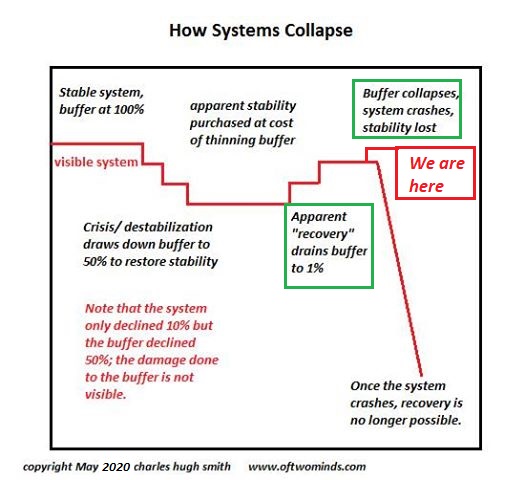
From a systems perspective, nation-states and empires arise when they are superior solutions to security compared to whatever arrangement they replace: feudalism, warlords, tribal confederations, etc.

States and empires fail when they are no longer the solution, they are the problem. As the book The Upside of Down: Catastrophe, Creativity, and the Renewal of Civilization explains, when the dissolution of the state / empire becomes the pain-reducing solution, the inhabitants withdraw their support and the empire loses its grip and expires.

As I explain in my new book, Global Crisis, National Renewal, states and markets are problem-solving structures. These structures solve problems by optimizing adaptability and beneficial synergies that reinforce one another as evolutionary advances.

The rise of the middle class is an example of beneficial synergies: as this new class gains access to credit, expertise, trade, enterprise and pricing power for their labor, they have the means to transform their labor into capital by saving earnings and investing the capital in assets, new enterprises, etc. which then generate income from capital which fuels synergistic increases in credit, expertise, assets and income from investments.

States / empires fail and expire when they elevate the fatal synergies created by self-serving elites. Rather than encourage the dynamics of adaptation–competition, transparency, accountability, experimentation and dissent– the elites suppresses these forces as threats to their monopolies, cartels and wealth.

Stripped of adaptability and beneficial synergies, the state / empire is no longer able to solve problems. It becomes the problem which cannot be resolved.

A key dynamic fueling fatal synergies is the hubristic confidence that low-cost abundance is a birthright bestowed by the state /empire, so resources can be endlessly squandered on excess and extremes of consumption and waste. The state / empire no longer focuses on securing the material sources of security (food, energy, etc.) or the accountability, competition, dissent and transparency required to solve systemic problems.

Instead, the state / empire dissolves into divisive camps seeking to protect their petty fiefdoms and expanding their wealth at the expense of the populace. The super-wealthy build $500 million yachts and palaces, politicians trade on their positions to accumulate fortunes, and corruption replaces governance.

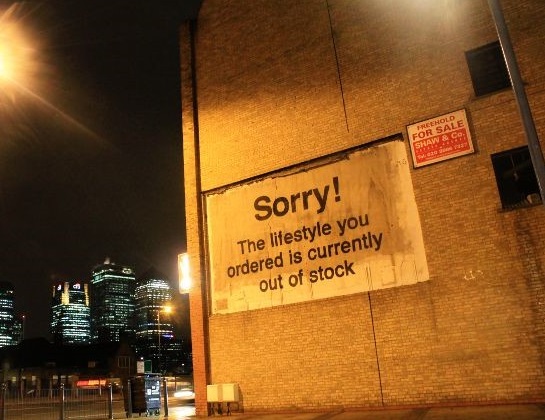
Markets spiral into fatal synergies as low quality products and services, speculative excess, extremes of grotesque consumption and blood-soaked entertainment become “growth industries” while blackouts dim electrical grids and store shelves empty of essentials.

The market solution to everyone already owning everything is to engineer planned obsolescence into every product and form service-sector cartels that then strip services to the bone to juice profits, a.k.a. the crapification of all goods and services.

The state / empire also fails to maintain basic security and functions such as tax collection and a fair enforcement. Petty crimes are exploited by those in power (civil forfeiture) while resistance to the state is severely punished. There are two legal systems, one for the commoners and another for the elite.

The state / empire protects those profiting from the status quo and then calls this profiteering a “solution.” But this profiteering doesn’t solve any problems; it is the problem, as self-serving profiteering protects its privileges by corrupting the state, finance and the economy.

For its part, the market seeks to maximize profits in excesses of consumption, predatory lending (student loans), the wholesale destruction of quality by monopolies and cartels and extremes of speculation.Maximizing profits by any means available has no moral foundation; predatory student loans are profitable, obscure medical billing is profitable, selling products designed to fail is profitable, declaring software outdated is profitable, deceiving consumers is profitable, and so on, in an endless array of shoddy, unhealthy products, rapacious services, fraudulent overcharges, etc.

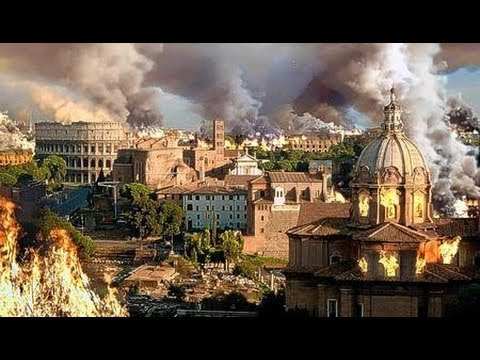
Since problems go unresolved, things fall apart and the masses veer into extremes of derangement and magical thinking: fanaticism is substituted for friendship, cults abound, common ground vanishes and all the failures of the system are papered over with Bread and Circuses, free money, gaudy entertainments and lifeless displays of conspicuous consumption that reveal the decay and degradation.

Protecting the few stripmining the system at the expense of the many is not problem-solving. It adds a layer of problems that the state /empire is incapable of resolving. Ossified, sclerotic, self-serving, corrupt, focused on virtue-signaling and the appearance of tackling problems rather than actually solving problems because some sacred cow would lose its privileges and income stream, the state / empire is the problem, not the solution.

When the state / empire loses the ability to recognize and solve core problems of security and fairness, it will be replaced by another arrangement that is more adaptable and adept at solving problems. Artifice, fantasy, magical thinking, excuses and absurd cover stories are not part of problem-solving. Problems can only be solved if reality is faced directly.

When reality is unacceptable because it negatively impacts those stripmining the system for private gain, the state / empire is already on its fatal spiral to collapse.

What “Normal” Are We Returning To? The Depression Nobody Dares Acknowledge

By Charles Hugh Smith

Source: Of Two Minds

Perhaps we need an honest national dialog about declining expectations, rising inequality, social depression and the failure of the status quo.

Even as the chirpy happy-talk of a return to normal floods the airwaves, what nobody dares acknowledge is that “normal” for a rising number of Americans is the social depression of downward mobility and social defeat.

Downward mobility is not a new trend–it’s simply accelerating. As this RAND Corporation report documents, ( Trends in Income From 1975 to 2018) $50 trillion in earnings has been transferred to the Financial Aristocracy from the bottom 90% of American households over the past 45 years.

Time magazine’s article on the report is remarkably direct: The Top 1% of Americans Have Taken $50 Trillion From the Bottom 90% — And That’s Made the U.S. Less Secure.

“The $50 trillion transfer of wealth the RAND report documents has occurred entirely within the American economy, not between it and its trading partners. No, this upward redistribution of income, wealth, and power wasn’t inevitable; it was a choice–a direct result of the trickle-down policies we chose to implement since 1975.

We chose to cut taxes on billionaires and to deregulate the financial industry. We chose to allow CEOs to manipulate share prices through stock buybacks, and to lavishly reward themselves with the proceeds. We chose to permit giant corporations, through mergers and acquisitions, to accumulate the vast monopoly power necessary to dictate both prices charged and wages paid. We chose to erode the minimum wage and the overtime threshold and the bargaining power of labor. For four decades, we chose to elect political leaders who put the material interests of the rich and powerful above those of the American people.”

I’ve been digging into downward mobility and social depression for years: Are You Really Middle Class?

The reality is that the middle class has been reduced to the sliver just below the top 5%–if we use the standards of the prosperous 1960s as a baseline.

The downward mobility isn’t just financial–it’s a decline in political power, control of one’s work and ownership of income-producing assets. This article reminds us of what the middle class once represented: What Middle Class? How bourgeois America is getting recast as a proletariat.

This reappraisal of the American Dream is also triggering a reappraisal of the middle class in the decades of widespread prosperity: The Myth of the Middle Class: Have Most Americans Always Been Poor?

Downward mobility excels in creating and distributing what I term social defeat: In my lexicon, social defeat is the spectrum of anxiety, insecurity, chronic stress, fear and powerlessness that accompanies declining financial security and social status.

Downward mobility and social defeat lead to social depression. Here are the conditions that characterize social depression:

1. High expectations of endlessly rising prosperity instilled as a birthright no longer align with economy reality.

2. Part-time and unemployed people are marginalized, not just financially but socially.

3. Widening income/wealth disparity as those in the top 10% pull away from the bottom 90%.

4. A systemic decline in social/economic mobility as it becomes increasingly difficult to move from dependence on the state or one’s parents to financial independence.

5. A widening disconnect between higher education and employment: a college/university degree no longer guarantees a stable, good-paying job.

6. A failure in the Status Quo institutions and mainstream media to recognize social depression as a reality.

7. A systemic failure of imagination within state and private-sector institutions on how to address social depression issues.

8. The abandonment of middle class aspirations: young people no longer aspire to (or cannot afford) consumerist status symbols such as luxury autos or conventional homeownership.

9. A generational abandonment of marriage, families and independent households as these are no longer affordable to those with part-time or unstable employment.

10. A loss of hope in the young generations as a result of the above conditions.

The rising tide of collective anger arising from social depression is visible in many places: road rage, violent street clashes between groups seething for a fight, the destruction of friendships for holding “incorrect” ideological views, and so on.

A coarsening of the entire social order is increasingly visible: The Age of Rudeness.

Depressive thoughts (and the emotions they generate) tend to be self-reinforcing, and this is why it’s so difficult to break out of depression once in its grip.

One part of the healing process is to expose the sources of anger that we are repressing. As psychiatrist Karen Horney explained in her 1950 masterwork, Neurosis and Human Growth: The Struggle Towards Self-Realization, anger at ourselves sometimes arises from our failure to live up to the many “shoulds” we’ve internalized, and the idealized track we’ve laid out for ourselves and our lives.

The article The American Dream Is Killing Us does a good job of explaining how our failure to obtain the expected rewards of “doing all the right things” (getting a college degree, working hard, etc.) breeds resentment and despair.

Since we did the “right things,” the system “should” deliver the financial rewards and security we expected. This systemic failure to deliver the promised rewards is eroding the social contract and social cohesion. Fewer and fewer people have a stake in the system.

We are increasingly angry at the system, but we reserve some anger for ourselves, because the mass-media trumpets how well the economy is doing and how some people are doing extremely well. Naturally, we wonder, why them and not us? The failure is thus internalized.

One response to this sense that the system no longer works as advertised is to seek the relative comfort of echo chambers–places we can go to hear confirmation that this systemic stagnation is the opposing ideological camp’s fault.

Part of the American Exceptionalism we hear so much about is a can-do optimism: set your mind to it and everything is possible.

The failure to prosper as anticipated is generating a range of negative emotions that are “un-American”: complaining that you didn’t get a high-paying secure job despite having a college degree (or advanced degree) sounds like sour-grapes: the message is you didn’t work hard enough, you didn’t get the right diploma, etc.

It can’t be the system that’s failed, right? I discuss this in my book Why Our Status Quo Failed and Is Beyond Reform: the top 10% who are benefiting mightily dominate politics and the media, and their assumption is: the system is working great for me, so it must be working great for everyone. This implicit narrative carries an implicit accusation that any failure is the fault of the individual, not the system.

The inability to express our despair and anger generates depression. Some people will redouble their efforts, others will seek to lay the blame on “the other” (some external group) and others will give up. What few people will do is look at the sources of systemic injustice and inequality.

Perhaps we need an honest national dialog about declining expectations, rising inequality and the failure of the status quo that avoids polarization and the internalization trap (i.e. it’s your own fault you’re not well-off).

We need to value honesty above fake happy-talk. Once we can speak honestly, there will be a foundation for optimism.

Sacrifice for Thee But None For Me

By Charles Hugh Smith

Source: Of Two Minds

The banquet of consequences for the Fed, the elites and their armies of parasitic flunkies and factotums is being laid out, and there won’t be much choice in the seating.

Words can be debased just like currencies. Take the word sacrifice. The value of the original has been debased by trite, weepy overuse to the point of cliche. Like other manifestations of derealization and denormalization, this debasement is invisible, profound and ultimately devastating.

Consider the overworked slogan of implied shared sacrifice: we’re all in this together. Pardon my cynicism, but doesn’t this sound like what the first class passengers in the lifeboats shouted to the doomed steerage passengers on the sinking Titanic?

Here is the ice-cold reality of America in 2020: Sacrifice for Thee But None For Me. This isn’t a new trend, of course. Any measurable sacrifices shared by all the socio-economic classes ended with World War II in 1945, and since then it’s been one long slide to Sacrifice for Thee But None For Me.

We’ve seen this slide to decay and collapse many times in history. The elites who once gained social status and political power by making real sacrifices on behalf of the nation / empire become entirely self-serving, accumulating ever greater wealth and power by transferring all the sacrifices and risks onto the lower classes.

Peter Turchin, author of War and Peace and War: The Rise and Fall of Empires, describes how civic virtue is gradually replaced by personal greed and self-interest.

This excerpt perfectly captures the current zeitgeist:

“Virtus included the ability to distinguish between good and evil and to act in ways that promoted good, and especially the common good. Unlike Greeks, Romans did not stress individual prowess, as exhibited by Homeric heroes or Olympic champions. The ideal of hero was one whose courage, wisdom, and self-sacrifice saved his country in time of peril.

Unlike the selfish elites of the later periods, the aristocracy of the early Republic did not spare its blood or treasure in the service of the common interest. When 50,000 Romans, a staggering one fifth of Rome’s total manpower, perished in the battle of Cannae, as mentioned previously, the senate lost almost one third of its membership. This suggests that the senatorial aristocracy was more likely to be killed in wars than the average citizen….

The wealthy classes were also the first to volunteer extra taxes when they were needed… A graduated scale was used in which the senators paid the most, followed by the knights, and then other citizens. In addition, officers and centurions (but not common soldiers!) served without pay, saving the state 20 percent of the legion’s payroll….

The richest 1 percent of the Romans during the early Republic was only 10 to 20 times as wealthy as an average Roman citizen.”

Now compare that to the situation in Late Antiquity when

“An average Roman noble of senatorial class had property valued in the neighborhood of 20,000 Roman pounds of gold. There was no ‘middle class’ comparable to the small landholders of the third century B.C.; the huge majority of the population was made up of landless peasants working land that belonged to nobles. These peasants had hardly any property at all, but if we estimate it (very generously) at one tenth of a pound of gold, the wealth differential would be 200,000! Inequality grew both as a result of the rich getting richer (late imperial senators were 100 times wealthier than their Republican predecessors) and those of the middling wealth becoming poor.”

Compare this to the America of World War II and the America of today. Wealthy, politically influential families such as the Kennedys could only retain their influence if their sons served in positions of combat leadership, and Joe Kennedy was killed in the European theater after volunteering for a highly risky air mission. John F. Kennedy very nearly lost his life in the South Pacific.

And how do our era’s crop of presidents and presidential contenders fare by comparison? The idea that flesh and blood should ever be at risk in defense of the nation /empire–perish the thought.

As Turchin sagely observed, it’s not just the limitless greed and avoidance of sacrifice of the elite that generates destabilizing inequality–it’s the eradication of the middle class as all the risks and sacrifices were shifted from the self-serving top to the middle and lower classes.

As I’ve often noted, risk cannot be made to disappear, it can only be transferred to others. In the grand scheme of things, the inherent risks of globalization and financialization have all been transferred to the middle and working classes (however you define them). The elite class enjoys the near-infinite support of the Federal Reserve and it’s ability to print near-infinite sums of currency to bail out the greediest, most self-serving scum of parasites and speculators.

Meanwhile, all the sacrifices required to support this unfair, corrupt, predatory system have been transferred to the middle and working classes via sleight of hand. The sacrifices weren’t transparent and up front; they were cloaked in the decline of job security, in ever-higher costs, in the decline of social mobility and the erosion of the purchasing power of wages.

The elites’ economist flunkies and factotums claimed that bailing out the freeloaders, parasites and speculators would benefit “the little people” because the grand trade-off delivered by the Federal Reserve (as correspondent R.J. pointed out to me) was: no more financial panics, which caused much misery in the working class due to business failures causing layoffs and unemployment.

But globalization, financialization and the rise of cartel-state monopolies have eviscerated the middle and working classes far more effectively and permanently than any brief financial panic, while greatly enriching the elite class–a rise in wealth that is backstopped by the Federal Reserve: profits are the elites to keep while their losses are socialized, i.e. transferred to the lower classes.

Job security, the purchasing power of wages and social mobility–nothing vital to the middle or working classes is backstopped by the Fed; the Fed’s one and only job is backstopping the wealth of our parasitic, predatory elite.

Sacrifice for Thee But None For Me. The banquet of consequences for the Fed, the elites and their armies of parasitic flunkies and factotums is being laid out, and there won’t be much choice in the seating.

The Erosion of the Middle Class — Why Americans Are Working Harder and Earning Less

By John Liberty

Source: The Mind Unleashed

“I don’t have to tell you things are bad. Everybody knows things are bad. It’s a depression. Everybody’s out of work or scared of losing their job. The dollar buys a nickel’s worth, banks are going bust, shopkeepers keep a gun under the counter. Punks are running wild in the street and there’s nobody anywhere who seems to know what to do, and there’s no end to it.” — Howard Beale

Howard Beale, the main character in the 1976 film Network, became a part of cinematic history when he uttered the line “I’m mad as hell and I’m not gonna take it anymore.” That one line expressed a growing rage among America’s shrinking middle class at a time when Americans were reeling from years of war, political scandals and economic downturn.

In the four decades that have followed, little has improved for the average American. We’re still ‘mad as hell’ and the middle class is being eroded right in front of our eyes. When adjusted for inflation, many Americans are working longer hours and earning less than they did in 1976. So, how have we gone from vibrant middle class to the working poor in a matter of decades?

Median Incomes Are Stagnant

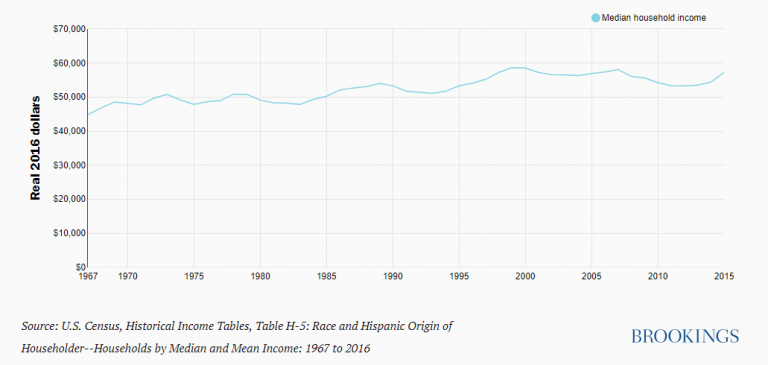
Despite increases in the national income over the past fifty years, middle class families have experienced little income growth over the past few decades. According to U.S. Census datamiddle class incomes have grown by only 28 percent from 1979 – 2014. Meanwhile, a report from the Congressional Budget Office (CBO) shows that the top 20 percent of earners has seen their incomes rise by 95 percent over that same period of time.

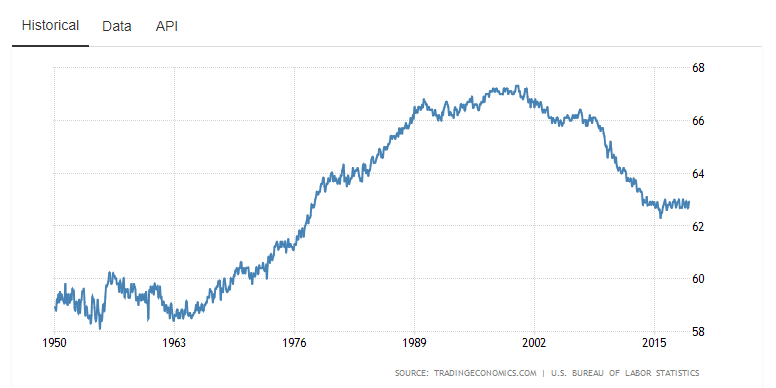
Contributing to the stagnation of wages is a notable decrease in the workforce participation rate. According to the Brookings institute, “One reason for these declines in employment and labor force participation is that work is less rewarding. Wages for those at the bottom and middle of the skill and wage distribution have declined or stagnated.” Historical data from the Bureau of Labor Statistics backs up these findings, showing a steady decrease in workforce participation over the last two decades.

The Erosion of the Minimum Wage & America’s Purchasing Power

Anyone who has read a comment thread on the internet about minimum wage laws knows the debate is currently one of the most highly contentious political topics in America. In the halls of Congress, the debate has turned into a nearly decade long impasse. As a result, workers at the low end of the wage scale have watched the purchasing power of their wages decrease from $7.25 in 2009, to $6.19 in 2018 due to inflation. In 2018, you need to perform 47 hours of minimum wage work to achieve the same amount of purchasing power as 40 hours of work in 2009.

The inflation-adjusted minimum wage value has been in steady decline since 1968, when the $1.60 minimum wage was equal to $11.39 (in 2018 dollars). Since then, lawmakers have reduced minimum wage increases relative to the rate of inflation. As Christopher Ingraham reports:

“Recent research shows that the reason politicians — Democrats and Republicans alike — are dragging their feet on popular policies such as the minimum wage is that they pay a lot more attention to the needs and desires of deep-pocketed business groups than they do to regular voters. Those groups tend to oppose minimum wage increases for the simple reason that they eat into their profit margins.”

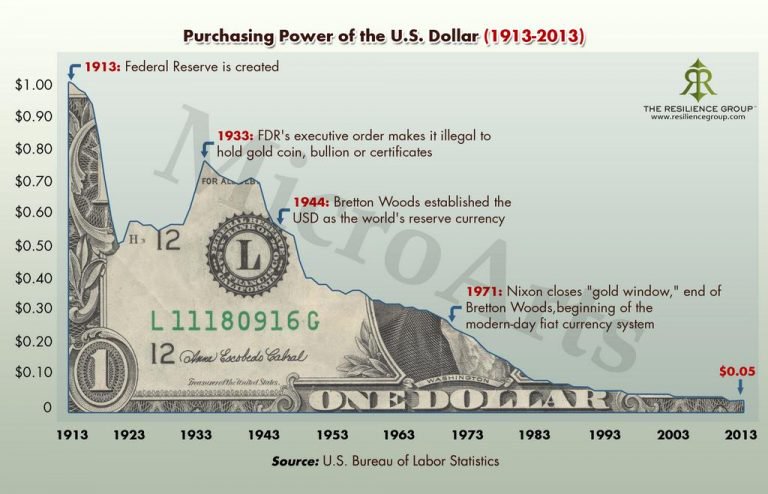
To be clear, the erosion of the purchasing power of everyday Americans is hardly a new phenomenon. According to data from the U.S. Bureau of Labor Statistics, the purchasing power of the U.S. Dollar has plummeted by over 95 percent since 1913, the year the Federal Reserve was created. The Bureau’s Consumer Price Index indicates that prices in 2018 are 2,436.33% higher than prices in 1913 and that the dollar has experienced an average inflation rate of 3.13% per year during this period.

The Rich Get Richer

While the outlook may be grim for low-wage workers, this is fantastic news for large corporations. Data from the U.S. Bureau of Economics shows that corporate profits are approaching all-time highs. But it’s not just workers who are feeling the effect of growing income inequality. The contrast is also being felt on Main Street. An analysis of the S & P 500 and the Russell 1,000 & 2,000 indexes by Bloomberg revealed a growing gap between America’s largest employers and smaller businesses.

A report from the Institute for Policy Studies entitled Billionaire Bonanza: The Forbes 400 and the Rest of Us echoed these findings when it revealed that America’s 20 wealthiest people — a group that could fit comfortably in one single Gulfstream G650 luxury jet –­ now own more wealth than the bottom half of the American population combined.

Although the Trump administration continues to tout stock market and labor force increases as signs of economic prosperity, numbers show that the wealthiest 10 percent of Americans own 84 percent of all stock. A study conducted by the Economic Policy Institute found that wage growth remains too weak to consider the economy at full employment and that stagnant wage growth has contributed to the growing level of income inequality in America. The study noted that while wages have recovered from the 2008 recession, the gap between those at the top and those at the middle and bottom has continued to increase since 2000. As the study’s author, Elise Gould writes:

“We’re looking at nominal wage growth that is still slower than you would expect in a full employment economy, slower than you would expect if you thought there were any sort of inflation pressures from wage growth.”

The Decimation of the American Dream

Comedian George Carlin once said, “The reason they call it the American Dream is because you have to be asleep to believe it.” For millions of middle class Americans Carlin’s statement has proven eerily accurate. Stagnant wages and decreased purchasing power has put the prospects for middle class children in a tailspin as upward mobility trends have reportedly fallen by over 40 percent since 1950.

A poll conducted by the Pew Research Institute corroborates this claim. According to Pew, only 37 percent of Americans believe that today’s children will grow up to be better off financially than their parents. That means more Americans think that today’s children will be financially worse off than their parents than those who believe they will be better off.

The sentiments expressed by millions of middle class Americans appear to be wholly justified due to the fact that middle class families are becoming more fragile and dependent on two incomes. A report from the Council of Economic Advisors found the majority of the income gains made by the middle class from 1979 to 2013 were a result of increased participation in the workplace by women. The report also noted the fragility of two income families amidst a decline in marriage and a drastic rise in single parent homes in recent years.

As a result of the slow growth in wages, over half of Americans now receive more in Government transfer payments (Medicare, Medicaid, food stamps, Social Security) than they pay in federal taxes. An analysis of all 50 states also found that in 42 states the cost of living is higher than the median income.

The rising cost of healthcare is also putting the pinch on the wallets of many Americans. As Jeffrey Pfeffer noted in his book Dying for a Paycheck, healthcare spending—per capita—has increased 29 fold over the past 40 years, outpacing the growth of the American economy.

While many Americans continue to look to the government to fix problems like wage stagnation, income inequality and rising healthcare costs, the sad truth is that we live in a time when 1 in 3 households has trouble paying energy bills and 40 percent of Americans face poverty in retirement at the exact same time the Federal Government has admitted that they lost $21 trillion. Not only did they lose $21 trillion (yes that’s TRILLION with a T), but the Department of Defense indicated in a press conference that they “never expected to pass” the audit to locate the missing taxpayer money.

John Emerich Edward Dalberg Acton famously proclaimed in 1887:

“Power tends to corrupt, and absolute power corrupts absolutely. Great men are almost always bad men.”

Perhaps it’s time for the millions of Americans who are quietly ‘mad as hell’ to start expressing their rage at the corrupt institutions of power that are decimating their livelihoods rather than expecting those very same institutions to fix the problems they created.


America’s Social Depression Is Accelerating

By Charles Hugh Smith

Source: Of Two Minds

We need to value honesty above optimism. Once we can speak honestly, there is a foundation for optimism.

Beneath the rah-rah statistics of “the greatest economy ever,” the social depression is accelerating. The mainstream is reluctantly waking up to the future of the American Dream: downward mobility for all but the top 10% of households. A 2015 Atlantic article fleshed out the zeitgeist with survey data that suggests the Great Middle Class/Nouveau Proletariat is also waking up to a future of downward mobility: The Downsizing of the American DreamPeople used to believe they would someday move on up in the world. Now they’re more concerned with just holding on to what they have.

I have been digging into the financial and social realities of what it takes to be middle class in today’s economy for years: Are You Really Middle Class?

The reality is that the middle class has been reduced to the sliver just below the top 5%–if we use the standards of the prosperous 1960s as a baseline.

The downward mobility isn’t just financial–it’s a decline in political power, control of one’s work and income-producing assets. This article reminds us of what the middle class once represented: What Middle Class? How bourgeois America is getting recast as a proletariat.

The costs of trying to maintain a toehold in the upper-middle class are illuminated in these recent articles on health and healthcare–both part of the downward mobility:

Health Care Slavery and Overwork

How a toxic workplace could, literally, destroy your health

We’re afraid our work is killing us, and we are right

This reappraisal of the American Dream is also triggering a reappraisal of the middle class in the decades of widespread prosperity: The Myth of the Middle Class: Have Most Americans Always Been Poor?

Downward mobility excels in creating and distributing what I term social defeat: In my lexicon, social defeat is a spectrum of anxiety, insecurity, chronic stress, powerlessness, and fear of declining social status.

Downward mobility and social defeat lead to social depression. Here are the conditions that characterize social depression:

1. High expectations of endless rising prosperity have been instilled in generations of citizens as a birthright.

2. Part-time and unemployed people are marginalized, not just financially but socially.

3. Widening income/wealth disparity as those in the top 10% pull away from the shrinking middle class.

4. A systemic decline in social/economic mobility as it becomes increasingly difficult to move from dependence on the state (welfare) or one’s parents to financial independence.

5. A widening disconnect between higher education and employment: a college/university degree no longer guarantees a stable, good-paying job.

6. A failure in the Status Quo institutions and mainstream media to recognize social recession as a reality.

7. A systemic failure of imagination within state and private-sector institutions on how to address social recession issues.

8. The abandonment of middle class aspirations by the generations ensnared by the social recession: young people no longer aspire to (or cannot afford) consumerist status symbols such as luxury autos or homeownership.

9. A generational abandonment of marriage, families and independent households as these are no longer affordable to those with part-time or unstable employment, i.e. what I have termed (following Jeremy Rifkin) the end of work.

10. A loss of hope in the young generations as a result of the above conditions.

The rising tide of collective anger arising from social depression is visible in many places: road rage, violent street clashes between groups seething for a fight, the destruction of friendships for holding the “incorrect” ideological views, and so on. I Think We Can Safely Say The American Culture War Has Been Taken As Far As It Can Go.

A coarsening of the entire social order is increasingly visible: The Age of Rudeness.

Depressive thoughts (and the emotions they generate) tend to be self-reinforcing, and this is why it’s so difficult to break out of depression once in its grip.

One part of the healing process is to expose the sources of anger that we are repressing. As psychiatrist Karen Horney explained in her 1950 masterwork, Neurosis and Human Growth: The Struggle Towards Self-Realization, anger at ourselves sometimes arises from our failure to live up to the many “shoulds” we’ve internalized, and the idealized track we’ve laid out for ourselves and our lives.

The recent article, The American Dream Is Killing Us does a good job of explaining how our failure to obtain the expected rewards of “doing all the right things”(getting a college degree, working hard, etc.) breeds resentment and despair.

Since we did the “right things,” the system “should” deliver the financial rewards and security we expected. This systemic failure to deliver the promised rewards is eroding social mobility and the social contract while generating frustration, anger, etc.

We are increasingly angry at the system, but we reserve some anger for ourselves, because the mass-media trumpets how well the economy is doing and how some people are doing extremely well. Naturally, we wonder, why them and not us? The failure is thus internalized.

One response to this sense that the system no longer works as advertised is to seek the relative comfort of echo chambers–places we can go to hear confirmation that this systemic stagnation is the opposing political party’s fault.

We don’t just self-sort ourselves into political “tribes” online– we are congregating in increasingly segregated communities and states:.

Americans are moving to communities that align more with their politics. Liberals are moving to liberal areas, and conservatives are moving to conservative communities. It’s been going on for decades. When Jimmy Carter was elected in 1976, 26.8% of Americans lived in landslide counties; that is counties where the president won or lost by 20% of the vote.

By 2004, 48.3% of the population lived in these counties. This trend continues to worsen. As Americans move to their preferred geographic bubbles, they face less exposure to opposing viewpoints, and their own opinions become more extreme. This trend is at the heart of why politics have become so polarizing in America.

We’re self-sorting at every level. Because of this, Americans are only going to grow more extreme in their beliefs, and see people on the other side of the political spectrum as more alien.”

Part of the American Exceptionalism we hear so much about is a can-do optimism: set your mind to it and everything is possible.

The failure to prosper as anticipated is generating a range of negative emotions that are “un-American”: complaining that you didn’t get a high-paying secure job despite having a college degree (or advanced degree) sounds like sour-grapes: the message is you didn’t work hard enough, you didn’t get the right diploma, etc.

It can’t be the system that’s failed, right? I discuss this in my book Why Our Status Quo Failed and Is Beyond Reform: the top 10% who are benefiting mightily dominate politics and the media, and their assumption is: the system is working great for me, so it must be working for everyone. That’s the implicit narrative parroted by status quo mouthpieces.

The inability to express our despair and anger generates depression. Some people will redouble their efforts, others will seek to lay the blame on “the other” (some external group) and others will give up. What few people will do is look at the sources of systemic injustice.

Perhaps we need a national dialog about declining expectations, rising inequality and the failure of the status quo that avoids the blame-game and the internalization trap (i.e. it’s your own fault you’re not well-off).

We need ways to express our resentment, anger, despair, etc. that are directed at the source, the complex system we inhabit, not “the other.” We need to value honesty above optimism. Once we can speak honestly, there is a foundation for optimism.

Reimagining the Middle Class

In her new book, Alissa Quart chronicles what happens when capitalism and families collide

By Ann Neumann

Source: The Baffler

AS THE ECONOMIC STATUS OF MANY in the United States has declined over the past several decades, journalists have often focused on the challenges faced by the working poor. In her new book, Squeezed: Why Our Families Can’t Afford America, Alissa Quart writes about how economic inequality has also drastically changed the middle class, destabilizing what was once considered a secure class and sending families into the tailspin of debt, overwork, underemployment, and precarious financial states. Squeezed demonstrates that inequality is not just a problem of those left behind in the lowest financial brackets, but a feature of our current economic system characterized by working professionals who are unable to pay for child care, declining job salaries, shifting work hours, and unaffordable housing. Families too often wrestle with “penalizing” factors, like women’s depressed salaries and unaffordable health care, making success unattainable for a formerly comfortable, educated, and skilled demographic of society.

The book challenges us to reimagine our prior understanding of what it means to be middle class, even as legislators champion “traditional values” that contradict the needs and responsibilities of families—and erode a safety net that once supported U.S. workers. Some of the factors that have upended the middle class are obvious—declining salaries, for instance—but others remain masked by corporate and social portrayal of them as a benefit to today’s workers. The gig economy, which, we’re told, gives workers young and old more flexibility and independence, turns out to be a contributor to what Quart calls the forever clock, a twenty-four-hour schedule that has usurped family and free time by keeping workers on constant call. Squeezed recounts the lives of the teachers who work second jobs, the professional mothers who struggle to pay for day care, the paralegals and adjuncts who have to moonlight to pay the rent, the well educated who never found a job in their intended profession that provides a livable salary. And the book causes us to ask why so many suffer in isolation, too ashamed to acknowledge their economic plight and too belabored to politically address it.

Quart is executive editor of the Economic Hardship Reporting Project, a nonprofit organization founded by Barbara Ehrenreich (a contributing editor for The Baffler) that supports journalism examining economic inequality, its causes and solutions (EHRP has funded my own work and that of others published at The Baffler). Quart is the author of four previous books: BrandedRepublic of OutsidersHothouse Kids, and the poetry book Monetized. She also co-writes, with Maia Szalavitz, a column for The Guardian titled “Outclassed.”

This month, Quart stopped by The Baffler office to talk to me about Squeezed. We’ve known each other for several years and I read the book in manuscript, so our conversation was casual, touching on individuals in the book, our own squeezed lives, how we can counter economic decline, and a necessary new definition of self-help.

Ann NeumannSqueezed straddles the Trump election and very often people on the left—and the right, to be honest—are using this as a clear demarcation. I think one of the things the book does really well is point out that the mechanisms in place that harm working class families have been long in coming.

Alissa Quart: The reason Sanders and Trump could tap into anger are the numbers of those economically squeezed; it’s what I was seeing anecdotally. And you can feel that. You can feel when you go sit in people’s living rooms, when you talk to them on the phone. I went to a conference called iRelaunch that was all about helping people to start their careers over and the room just rippled with shame and fear. And acidic humor.

AN: How did the election change this book project?

AQ: I think it gave it new urgency for me. Just as it gave urgency to the Economic Hardship Reporting Project, the organization I run. I think everyone in journalism felt like we have to tell these stories. The Trump effect has made me feel like I have to keep a laser focus on the things people are ignoring and try to find a way for readers to pay attention to them. We’re all focusing on Ivanka and whether she’s the c-word or not, which is fine, there are all kinds of things happening around us and in our own lives politically that have nothing directly to do with what Trump is tweeting, but the effects of his administration and long-term trends are real and we just need to keep looking.

We just published an article at EHRP about a journalist who lives in a $17 a night Airbnb, places below what you usually scroll to. But this person was a working journalist who was getting six-figure advances fifteen or twenty years ago. There are all these human examples that constantly show this decline. Fine, maybe the job numbers are up, but how many jobs are people working and are they jobs in the professions? Are they jobs that pay enough for people to live in cities? Or they’re working three different jobs which leads us to things like, as in this book, twenty-four-hour day care.

AN: Day care centers that are open twenty-four hours to accommodate parents with nontraditional work hours or multiple jobs.

AQ: And they are growing in number. I wrote a piece on this; I called it the dystopian social net. I feel like that’s part of my life’s work. I love dystopian fiction and science fiction, probably because it seems a few clicks away from the life we’re leading. It’s a markedly different life and childhood than the one you and I had. It may be horrible, or maybe not, but we’re seeing a palpable transformation in what childhood can be in the course of twenty years.

AN: And that’s really just the decline of income?

AQ: It’s people working different hours, it’s corporations using algorithms to find out what times of day are most profitable—when they’ll have the most foot traffic in retail, for instance—and demanding that employees work those times. It’s increasing nightwork. Nontraditional could mean 11 to 3 or it could mean working in the evening, or working in different jobs, hither and thither. That alone points to a huge transformation in things like time. A lot of the issues I address in the book are really about time, how we spend it. In the twenty-four-hour day care section I use the term the forever clock. But that’s true of the upper middle class too, they feel squeezed because they’re also on a forever clock. They’re working in IT, for instance, and they’re working unusual hours and they have the expectation that they should be better paid for it. 

AN: Your work has been focused on economic inequality for a long time.

AQ: Every single one of my books is in some way about economic inequality. I used to teach at Columbia J-school and I always told my students that every writer has a central question they spend their career trying to answer and your job is to find out what your question is. It’s like a parlor game. So I think mine is: what happens when the family—or childhood—hits capitalism? What are the deformations and the formations? I read so many nineteenth-century novels as a kid that I’m fascinated by that intersection. Naturalism is ascetically but also politically and intellectually appealing to me. I think I just like the texture of family, love, money, and how they all meet.

AN: That comes out in the writing of the book because, I’ll tell you, there are economics books that I have no interest in reading because they’re a slog, a data dump. You also coin terms that give us a way to think about worker’s plights. You just mentioned the forever clock but there’s also the middle precariat.

AQ: I was trying to explain the shift in the middle class as an imaginative category. The middle class used to equal solid, fixed, stable. Temporally it was about gratification later, but your life wasn’t miserable while you were waiting for it. It wasn’t like OK, total slog, but you’re going to get that pension. We have to now think of it as a shaken category, an unstable category, and that’s a big shift. When we visualize the middle class, we’re visualizing the white picket fence, like the blue sky on the cover of the book. But it’s really this truck being squeezed between two houses.

It’s an unsettled identity, and you can fall out of it, you can barely get into it, you certainly can’t rise above it very easily. Guy Standing coined the term precariat in 2011 to describe the proletariat, which is a Marxist way of understanding the working class, crossed with precariousness. And people get that. Every time they ride an Uber or they have a gig economy Task Rabbit person come to their house they’re like, OK, that’s the precariat. But I was seeing the same thing among paralegals or those who have law degrees but were still doing temporary work.

AN: Getting a law degree can be like selling your soul to the banks.

AQ: All these people are in debt. Some of it is because they went to for-profit colleges and those colleges were really expensive and they didn’t have a good rate of placement. Which can be traced to for-profit colleges and grad schools that have very little oversight—and are sometimes indeed federally funded. It can also be traced to fewer law jobs overall and too many people imagining that law is a secure profession. This is about reimagining. Once you can reimagine a profession, even if you choose to do it—you choose to be a journalist, you choose be a lawyer—we should understand that we’re choosing something unstable. Awareness is a huge part of survival and I guess part of what I want with this book is to increase awareness. This is your self-help: Don’t blame yourself. We have to come alive to this recognition. You can still do what you love, so long as you know what it can mean.

This is a personal journey for me too. When I was younger, as a freelancer, I had some recognition that journalism was starting to fragment. It was around 2006 or 2007—but it was before that too, the’90s. The word rates used to be consistent and for freelance writers those rates became lower or stayed the same while inflation rose. I remember talking to someone and they said, “just think about us as post modern.” Now you do lots of things, it’s a hustle here and a hustle there. That person was a boomer who had a steady job, who would get social security. I remember feeling an incredible resentment.

AN: So precarious employment has been described to us as a beautiful thing. We’re not chained to a factory job, we get to think and move around, but it doesn’t pan out.

AQ: I personally came from a middle class background. As I describe in the book, my parents were college professors, originally community college professors, and they could afford to send me to a private school. They didn’t have any inheritance or anything. That’s the sort of the world I thought I’d be living in. All of us, our generation, Generation X, had an idea of the world we thought we’d be living in. The generation after us has come to understand some of these things.

AN: That they’re fucked? So do you think this is a moment in capitalism, as we watch continued market decline over the next years, when we either do something about it or devolve into a disordered society?

AQ: Yes, I think so. But this book isn’t depressing because it points to some solutions—not in a pat way, but things that will work. It’s a way to think about what kind of family safety net, federal and local, we need to make sure people aren’t falling through. For instance, a few of the people I write about in the book are on food stamps and other kinds of support, but many of them are a little above that in terms of earning power and they can’t get help. There’s a labor organizer I spoke with who tries to lower her salary to be able to get some sort of subsidized day care, some sort of health insurance program. It’s that edge: people who are middle class in terms of education, but working class in terms of earning. They’re on the edge of being working poor and not being able to access any of those services. That’s most of the people in this book. Once we understand that they’re precarious we need to find a safety net for them.

AN: What this book does is lay out the many ways that people are hurting at the moment and it kind of gives a blueprint as to how precariousness could be addressed. Subsidized day care, for instance. I had no idea about how expensive child care is.

AQ: Child care can be 30 percent of many salaries. Or more. I think for us it was 30 percent of our take-home pay.

AN: How do people do it? In the book you show us. We spend a lot of time with individuals, we get a look at their lives and there’s a revelation for a reader to think, Oh, it’s not just me. There are things that I go without, there are resources that I don’t have access to, there are crises that I lose sleep over or pray will never come my way. There’s something about this book that brings this issue to light and I wonder if that was what you thought you’d get out of the stories? Is that why you used a storytelling approach?

AQ: That’s the chick lit, soap operatic part of me. And there is something of that in these stories. You think, What’s going to happen next? Sometimes I was surprised because they did have the messy amplitude of ordinary life. The people I write about aren’t just symbolic though. Some of them I followed for years.

AN: I think of the co-parenting section where you spend time with families who are trying to come up with creative solutions. In some cases, over time, things were better; in some cases they were worse. But readers still get the sense that nothing is fixed, no one really knows what’s working.

AQ: Or like the nanny who was separated from her son when I first met her and it was one kind of story. It became a story about them reunited, but then it became a story about school choice, and then it became a story about a mixed outcome at the end. She was actually happy, but I think the reader would want her to have a more middle class life given how hard she’s worked and all the effort she’s made to make the right choices.

AN: The anxiety of her life stayed with me. There are so many things that thwart her from getting ahead. She just needs the smallest break, trying to bring her son here, trying to find an affordable place to live. She’s doing everything right and she doesn’t deserve to go through this. That’s what comes out in the story. So when you were doing this reporting, did you get a sense of relief that we’re all going through this at the same time?

AQ: I definitely did. I felt relief. I say that this book is self-help because it makes you realize that it’s not your fault. And that’s how I see self-help. I see it as awareness, really granularly understanding all the ways that systems have made it impossible for you personally to overcome financial challenges—so that you’re no longer blaming yourself.

AN: Thank God someone’s redefining self-help.

AQ: [Laughs] But that’s it. How do you not feel stigmatized, how do you not feel isolated? So many of my friends feel ashamed that they can’t figure out the school system, can’t figure out how to own their home.

AN: The various penalties—for being a woman, for having children, for having debt—stack up. Shaming has abetted this erosion of rights and financial stability.

AQ: Time, day care scheduling, and other demands mean people can’t organize. They’re ashamed of where they are and so that becomes another debilitating factor. The adjunct in one chapter feels ashamed even though she knows politically she shouldn’t. There are people like the teachers who drive for Uber, who feel ashamed even though they know they shouldn’t. And it goes on and on. I don’t want to put it back on individuals, but the personal thing that people can do is start talking openly about their monetary situation. People are startled when you do that. It can erode social norms in a weird way, but I also think it’s important that people stop fronting with one another.

I write in one chapter about the 1 percent media, about the social media where people pretend to live in more expensive places than they do. I call them wealthies, not selfies. So it’s not your imagination when you’re in any of these circumstances and you see people in a sun dappled villa. People are representing themselves in this inflated way and then you feel terrible and isolated. There are so many ways in which the stigma, the isolation, around your class position gets underlined.

AN: Has it always been shameful to be poor?

AQ: Probably.

AN: It’s not a fair question!

AQ: But let’s be clear. A lot of these people are not poor. Most of the people in this book are earning between $45,000 and $125,000. Working class is $35,000. They’re not at the poverty level.

AN: So the shame then comes from not being able to make ends meet.

AQ: The shame comes from having debt for the education that you got in order to be middle class. The shame comes from not doing as well as your peers. The shame comes from not living up to your potential. The shame comes from not owning your home, defaulting on your mortgage. Not giving your kids as good a life as you had. I’m not writing about the working poor. I’m writing about the middle poor.

AN: We still operate under the myth that as a society we can continue to lift people into middle class and lift middle class into other class brackets. We no longer have any of that upward mobility. We cannot anticipate that our children will be better off.

AQ: No, we cannot anticipate that.

AN: But that’s still the American dream, isn’t it? And that American dream has been tied to, say, home ownership or a vehicle or not having debt.

AQ: In New York it’s like what school your kid goes to. What college your kid goes to.

AN: You use the word reimagining; it’s a word that I don’t hear often enough in politics, particularly not applied to class.

AQ: I mean reimagining what it means to be successful, reimagining what it means to be middle class. In a dream scape kind of way, like, This is what we would like to see in this country. But also reimagining middle class in its truth, what it actually means now? Let’s tear the veil and not just say, Oh, it means stability or security. It doesn’t.

The US Middle Class is Shrinking and Moving Towards a “Dual Economy”

MIT Economist Peter Temin, the author of “The Vanishing Middle Class,” explains how the US is moving towards two economies, one for the lower 80% and one for the upper 20%

By Gregory Wilpert and Peter Temin

Source: Real News Network

GREGORY WILPERT: Welcome to The Real News Network. I’m Gregory Wilpert, coming to you from Quito, Ecuador. Inequality in the world, and specifically in the United States, has been gaining more and more attention recently. Last week, the Pew Research Center, released a new study on the size of the middle class in the U.S. and in ten European countries. The study found that the middle class shrank significantly in the U.S. in the last two decades from 1991 to 2010. While it also shrank in several other Western European countries, it shrank far more in the U.S. than anywhere else. Meanwhile, another study also released last week, and published in the journal “Science”, shows that class mobility in the U.S. declined dramatically in the 1980s, relative to the generation before that. Finally, a book released last March by MIT economist Peter Temin argues that the U.S. is increasingly becoming what economists call a “dual economy”; that is, where there are two economies in effect, and one of the populations lives in an economy that is prosperous and secure, and the other part of the population lives in an economy that resembles those of some third world countries. Joining us to talk about all of this from Cambridge, Massachusetts, is Professor Temin, the author of the book, “The Vanishing Middle Class: Prejudice and Power in a Dual Economy”. He is Professor Emeritus of Economics at the Massachusetts Institute of Technology. Thanks, Professor Temin, for making the time to talk about your book today.

PETER TEMIN: Okay. Thank you. Glad to be here.

GREGORY WILPERT: You begin your book with an analysis of the middle class, kind of like what the Pew study does that I mentioned in my introduction. You show that the middle class’s income, as a percentage of all incomes, has been shrinking between 1970 and 2014. At the same time, the upper class income grew significantly. I want to ask first, how do you define the middle class, and what conclusions did you draw from the shrinking income of the middle class?

PETER TEMIN: Okay. I’ve taken my definition from the Pew Research Service. In a slightly earlier episode, they showed that the middle class was losing out. That’s the first figure in my book. And it’s defined to be from two-thirds of the median earning to twice the median earning. The median earning are the earnings of a person who is mid-way among all the incomes received by people in the United States. And so that’s kind of the middle person there, and that’s why this is called the middle class, deviating up and down around that middle person. And then… okay. The new study uses after-tax disposable income, whereas the previous study that I did used before-tax income; and so that that makes a little difference in the numbers, but the effects are exactly the same. The middle class is shrinking in the United States; and I argue in my book that this is an effect of both the advance of technology, and American policies. That is shown dramatically in the new study, because the United States is compared with many European countries; and in some of them, the middle class is expanding in the last two decades, and in others it’s decreasing. And while technology crosses national borders, national policies affect things within the country. I argue that, in the United States, our policies have divided us into two groups. Above the median income – above the middle class – is what I call the FTE sector, Finance, Technology and Electronics sector, of people who are doing well, and whose incomes are rising as our national product is growing. The middle class and below are losing shares of income, and their incomes are shrinking as the Pew studies, both of them, show. And I argue… Oh, okay. Go ahead.

GREGORY WILPERT: Yeah. No, I was just going to say, before we go into the issue of the dual economy, I just wanted to look at some of the explanations for what has been happening. That is, you show another interesting graph which shows the relationship between the average wages and productivity between 1945 and I think it was 2014; and it clearly shows that while the two lines – productivity and average wages – grew in parallel from 1945 to the 1970s, after the 1970s they began to diverge very strongly; and wages remained stagnant while productivity continued to increase at the same rate as before. What is the significance of this divergence and why do you… why would you say that these two lines have begun to diverge?

PETER TEMIN: Okay. They diverged in the 1970s by policies that were the result of a backlash against the civil rights revolution of the 1960s. And so the policies were against unions; were a reorganization of industry and a variety of things on that side. They were also the result of decontrol of the national economy. It started under President Nixon, and then were expanded greatly under President Reagan in the early 1980s. But the wage divergence from the overall productivity began almost immediately. And the progress that came was partly electronics and the things that we know about communication, that allowed businesses to control the activities of people, and allowed, then, large firms to spin off a variety of their activities; So that instead of making a wage decision about their ordinary, less-skilled workers, they made a purchasing decision to hire a company that supervised these people. And that was good for the company, because it emphasized their core value, and was reflected in their share price and in the stock market. But it was bad for consumers, because… or workers, because there was an ethical… an equity consideration on wage decision, where wages of the less-skilled workers were to keep up with the wages of the highly-skilled ones; but a purchasing decision, or a sub-contracting decision; and none of these equities avail.

GREGORY WILPERT: I just wanted to turn to now the question about the dual economy. I mean, it was established… or you’ve established that the middle class is definitely shrinking across… according to these other studies. But how do you reach the conclusion that there are two economies in the U.S., that is, a dual economy? I mean, after all, why not talk about perhaps a triple economy: one for the poor, one for the middle class, and one for the upper class? Why a dual economy?

PETER TEMIN: Well, I used that model because the model – which is an old model from the 1950s – shows that the FTE sector makes policy for itself, and really does not consider how well the low wage sector is doing. In fact, it wants to keep wages and earnings low in the low wage sector, to provide cheap labour for the industrial employment. But the people in the United States, in the FTE sector, are largely ignorant of what’s going on in the low wage sector. For example, about this time also started an increase in criminal employment, resulting now in the United States having more people in prison, relative to its population, than any other advanced country in the world. And most people in the FTE sector are not aware of this. Prisons are located in rural areas; the judicial processes take place there; and people are not conscious of this at all. But having a lot of people in prison then rebounds badly on public education in the neighborhoods that the people come from. And the discussion of urban education never refers to mass incarceration. It doesn’t really provide any extra resources to compensate the kids who are involved – who are affected by having so many adults in prison. And so the dual economy helps to take these disparate things about mass incarceration, and education, and see the connections between them.And the connections, I argue, are because the dual economy – they are in their own dual economy – and they make rules, and laws, and so on, for their own benefit, and are punitive or neglectful of things going on in the low wage sector.

GREGORY WILPERT: Well, unfortunately, we need to stop here for the end of the first part of our interview with Professor Temin, the author of the book, “The Vanishing Middle Class: Prejudice and Power in the Dual Economy”. We will return for the second part. We’ll also explore some of the reasons for how this was possible; also particularly that this 20% – or the upper part of the dual economy – is able control the economy to such a large extent, and the politics. So make sure you watch the second part of our interview here on The Real News. Thanks, Professor Temin, and we’ll connect again in a couple of minutes for the second part.

PETER TEMIN: Okay. Thank you.

GREGORY WILPERT: And thank you for watching The Real News Network.

GREGORY WILPERT: Welcome to The Real News Network. I’m Gregory Wilpert, coming to you from Quito, Ecuador. This is Part 2 of our interview with Professor Temin, the author of the book, “The Vanishing Middle Class: Prejudice and Power in a Dual Economy”. Thanks again for being here, Professor. P

ETER TEMIN: Okay. Thank you.

GREGORY WILPERT: You developed the rather provocative thesis that we started talking about in the first part of this interview; about that the bottom 80%, more or less, are beginning to live in very separate and different conditions from the other, the top 20%; and that this bottom 80% lives in conditions that begin to resemble more those of a third world country, than those of a first world country. Explain that a little bit more. How is it that… I mean, what makes this lower 80%’s living conditions resemble those of a developing country more than a developed country, such as we usually think of?

PETER TEMIN: Okay. I thank you. Well, I mentioned in the first part that urban public education was in crisis. And so that’s one way you can see this; that where the rich people live in the suburbs around public schools are fine – you know, they have their problems, but they’re good schools – but in the inner cities, they are starved of funds and having problems. This results, in part, from the great migration, where African-Americans moved out of the South – and the New Jim Crow that they were subject to in there – into the North. And court decisions, Supreme Court decisions in the 1970s, deprived the inner cities of funds. Now, in addition to education, if we take infrastructure, and think about public transportation in the cities; that the rail systems that served the larger cities – you know, the ones … Boston, New York, Washington – are aging, and they are beginning to break down. And yet nothing is being done to really help them. The American Society of Civil Engineers gave the United States a D-minus – that is, almost failing – grade for its infrastructure. Going up from subways and things; if we think of rail tunnels, Governor Christie, some years back, halted a program to build another tunnel under the Hudson River from New Jersey to New York, to enable cars and trains to go from where people could afford to live with where they were working; and so that results in much congestion and delays and problems in getting there. On the roads, also in urban roads, there are lots of potholes and so you have to drive carefully. Very much, I had better roads in Guatemala when I was there some years ago, it seems to me. Although there were some problems there, so I don’t want to say they were great roads. But of course there wasn’t as much traffic on the roads, so it was easy to avoid…

GREGORY WILPERT: Sorry. One thing that I’m wondering about, though, is… I mean, you kind of mentioned this, or alluded to it, in the first part; which is this kind of strange phenomenon where… I mean, 80% make up a vast majority of the population, yet they’re suffering from the policies that are determined by the top 20%. Supposedly — or presumably — the United States is a democracy. How is it possible, then, that we live in such a dual economy, in which the 80% don’t get a chance to change the policies that are contributing to this, so to speak, the dualization, if you will, of the economy?

PETER TEMIN: Yes. That is the big question. But another Supreme Court decision decided that money was speech; and therefore the constitutional grant that there should be freedom of speech, meant that there should be freedom of people to spend money to support political candidates. And that has resulted in a tremendous increase in the amount of money going into politics. And so the influence of this money has pushed the representatives who make the decisions toward being responsive to the upper… the FTE sector, rather than the desires of the voters. And many political scientists have found that congressional decisions — the policies that come out of congressional action — are in fact responsive more toward the moneyed group of people than they are toward the majority. And so this is coupled with another Supreme Court decision that gutted the part of the Voting Rights Act from the 1960s – that’s in the civil rights revolution – that allowed the federal government to suspend state actions, mainly in the South where the Confederacy was, but some in the North too. That was eliminated, and so voter suppression has increased. And the way… after the civil rights movement, we can’t talk about whites versus blacks as they did earlier; but you have code words that you say; for example, that several states are flirting at the moment with requiring a photo ID in order to vote. And I heard on the radio, when this was being discussed, that one of the commentators said, “Oh, yes, well, that’s no problem. Everybody has a photo ID.” Everybody in the upper sector has a photo ID, because that person has a driver’s license, or a passport, or something else related to their employment. But in the lower sector, a lot of poor people do not have photo ID; because they don’t have cars; because they use the subways, that I say are now in trouble; or they’re rural; or all kinds of reasons why poor people don’t have photo ID. But that’s a coded word for keeping African-Americans from voting. And the policies are directed towards all poor people, so they keep Latinos from voting, and they keep poor whites from voting.

GREGORY WILPERT: Sorry – just before we finish up – I just want to quickly touch on the issue of the policy recommendations that you develop in your book. In order to get the U.S. out of the dual economy, what kinds of measures could be taken – just very briefly?

PETER TEMIN: Well, the most important one, and the one I listed first, was to improve public education.That is to say, in the model that I’m using, the transition – which you say is getting harder in the United States because of the growing inequality of income –- the primary way of getting from the low wage sector into the higher sector is through education. But education requires a lot of commitment on the part of the families being educated, and a lot of support from the government, which it is not getting at this point. Support should start really with early education — the mayor of New York is trying to have early education start at three years old, and that is a very good measure; I don’t know how successful he will be; but it’s a move in the right direction – to compensate for the fact that in the upper sector children grow up with books all around them. In the lower sector, children have often not even seen books until they get to school. And so there is a whole question of acculturation to academic study for these poorer people. That is to say, that urban public schools need to have more resources than suburban schools – which serve the higher people in the higher sector – but in fact now they get fewer resources per student. And this education needs to be continued through schools; through primary school, secondary school; and then to get into the higher sector, you really need to go on to college. And college, a generation ago, let’s say before the 1970s, was open, because every state had a state university with essentially free tuition. Now, the states have withdrawn from supporting the state university, and so most of the revenue of the state universities comes from private sources; and they need to raise tuition on the student to keep the college operating. Now, when poor people try to go to college, they don’t have the money, and there are none of these free colleges available for them. They need to borrow money. And the amount of educational loans has skyrocketed in the last several decades; and so the problem of student debt is second only to the problem of mortgage debt in the United States.And the oppression of having large student debts keeps people – youngsters – from trying this effort… well, they keep trying, and that’s why they get into debt. But it keeps more of them from getting… well, more of them from trying to get into the higher sector; and those who try often find themselves so burdened by debt that they can’t get there at all.

GREGORY WILPERT: Right. Well, unfortunately we’ve run out of time. But thanks so much, Professor Temin, for having joined us today to talk about your book, “The Vanishing Middle Class”.

PETER TEMIN: Okay. Thank you very much for having me.

GREGORY WILPERT: And thank you for watching The Real News Network.

Disposable Americans: The Numbers are Growing

middle-class

By Paul Buchheit

Source: Information Clearing House

As often noted in the passionate writings of Henry Giroux, poor Americans are becoming increasingly ‘disposable’ in our winner-take-all society. After 35 years of wealth distribution to the super-rich, inequality has forced much of the middle class towards the bottom, to near-poverty levels, and to a state of helplessness in which they find themselves being blamed for their own misfortunes.

The evidence keeps accumulating: income and wealth — and health — are declining for middle-class America. As wealth at the top grows, the super-rich feel they have little need for the rest of society.

Income Plummets for the Middle Class

According to Pew Research, in 1970 three of every ten income dollars went to upper-income households. Now five of every ten dollars goes to them.

The Social Security Administration reports that over half of Americans make less than $30,000 per year. That’s less than an appropriate average living wage of $16.87 per hour, as calculated by Alliance for a Just Society.

Wealth Collapses for Half of Us

Numerous sources report that half or more of American families have virtually no savings, and would have to borrow money or sell possessions to cover an emergency expense. Between half and two-thirds of Americans have less than $1,000.

For every $100 owned by a middle-class household in 2001, that household now has just $72.

Not surprisingly, race plays a role in the diminishing of middle America. According to Pew Research, the typical black family has only enough liquid savings to last five days, compared to 12 days for the typical Hispanic household, and 30 days for a white household.

Our Deteriorating Health

In a disgraceful display of high-level disregard for vital health issues, House Republicans are attempting to cut back on lunches for over 3 million kids.

The evidence for the health-related disposability of poor Americans comes from a new study that finds nearly a 15 year difference in life expectancy for 40-year-olds among the richest 1% and poorest 1% (10 years for women). Much of the disparity has arisen in just the past 15 years.

It’s not hard to understand the dramatic decline in life expectancy, as numerous studies have documented the health problems resulting from the inequality-driven levels of stress and worry and anger that make Americans much less optimistic about the future. The growing disparities mean that our children will likely see less opportunities for their own futures.

It May Be Getting Worse

The sense derived from all this is that half of America is severely financially burdened, at risk of falling deeper into debt.

It may be more than half. The Wall Street Journal recently reported on a JP Morgan study’s conclusion that “the bottom 80% of households by income lack sufficient savings to cover the type of volatility observed in income and spending.” Fewer than one in three 25- to 34-year-olds live in their own homes, a 20 percent drop in just the past 15 years.

It may be even worse for renters. The number of families spending more than half their incomes on rent — the ‘severely’ cost-burdened renters — has increased by a stunning 50 percent in just ten years. Billionaire Steve Schwarzman, whose company Blackstone has been buying up tens of thousands of homes at rock-bottom prices and then renting them back while waiting out the housing market, finds the growing anger among voters “astonishing.”

What’s astonishing is the disregard that many of the super-rich have for struggling Americans.


Paul Buchheit is a college teacher, an active member of US Uncut Chicago, founder and developer of social justice and educational websites (UsAgainstGreed.org, PayUpNow.org, RappingHistory.org), and the editor and main author of “American Wars: Illusions and Realities” (Clarity Press). He can be reached at paul@UsAgainstGreed.org.