Get ready for the next phase of the government’s war on thought crimes: mental health round-ups and involuntary detentions.
Under the guise of public health and safety, the government could use mental health care as a pretext for targeting and locking up dissidents, activists and anyone unfortunate enough to be placed on a government watch list.
In New York City, for example, you could find yourself forcibly hospitalized for suspected mental illness if you carry “firmly held beliefs not congruent with cultural ideas,” exhibit a “willingness to engage in meaningful discussion,” have “excessive fears of specific stimuli,” or refuse “voluntary treatment recommendations.”
While these programs are ostensibly aimed at getting the homeless off the streets, when combined with advances in mass surveillance technologies, artificial intelligence-powered programs that can track people by their biometrics and behavior, mental health sensor data (tracked by wearable data and monitored by government agencies such as HARPA), threat assessments, behavioral sensing warnings, precrime initiatives, red flag gun laws, and mental health first-aid programs aimed at training gatekeepers to identify who might pose a threat to public safety, they could well signal a tipping point in the government’s efforts to penalize those engaging in so-called “thought crimes.”
As the AP reports, federal officials are already looking into how to add “‘identifiable patient data,’ such as mental health, substance use and behavioral health information from group homes, shelters, jails, detox facilities and schools,” to its surveillance toolkit.
Make no mistake: these are the building blocks for an American gulag no less sinister than that of the gulags of the Cold War-era Soviet Union.
The word “gulag” refers to a labor or concentration camp where prisoners (oftentimes political prisoners or so-called “enemies of the state,” real or imagined) were imprisoned as punishment for their crimes against the state.
Totalitarian regimes such as the Soviet Union also declared dissidents mentally ill and consigned political prisoners to prisons disguised as psychiatric hospitals, where they could be isolated from the rest of society, their ideas discredited, and subjected to electric shocks, drugs and various medical procedures to break them physically and mentally.
In addition to declaring political dissidents mentally unsound, government officials in the Cold War-era Soviet Union also made use of an administrative process for dealing with individuals who were considered a bad influence on others or troublemakers. Author George Kennan describes a process in which:
The obnoxious person may not be guilty of any crime . . . but if, in the opinion of the local authorities, his presence in a particular place is “prejudicial to public order” or “incompatible with public tranquility,” he may be arrested without warrant, may be held from two weeks to two years in prison, and may then be removed by force to any other place within the limits of the empire and there be put under police surveillance for a period of from one to ten years.
The age-old practice by which despotic regimes eliminate their critics or potential adversaries by making them disappear—or forcing them to flee—or exiling them literally or figuratively or virtually from their fellow citizens—is happening with increasing frequency in America.
Now, through the use of red flag laws, behavioral threat assessments, and pre-crime policing prevention programs, the groundwork is being laid that would allow the government to weaponize the label of mental illness as a means of exiling those whistleblowers, dissidents and freedom fighters who refuse to march in lockstep with its dictates.
That the government is using the charge of mental illness as the means by which to immobilize (and disarm) its critics is diabolical. With one stroke of a magistrate’s pen, these individuals are declared mentally ill, locked away against their will, and stripped of their constitutional rights.
These developments are merely the realization of various U.S. government initiatives dating back to 2009, including one dubbed Operation Vigilant Eagle which calls for surveillance of military veterans returning from Iraq and Afghanistan, characterizing them as extremists and potential domestic terrorist threats because they may be “disgruntled, disillusioned or suffering from the psychological effects of war.”
Coupled with the report on “Rightwing Extremism: Current Economic and Political Climate Fueling Resurgence in Radicalization and Recruitment” issued by the Department of Homeland Security (curiously enough, a Soviet term), which broadly defines rightwing extremists as individuals and groups “that are mainly antigovernment, rejecting federal authority in favor of state or local authority, or rejecting government authority entirely,” these tactics bode ill for anyone seen as opposing the government.
Thus, what began as a blueprint under the Bush administration has since become an operation manual for exiling those who challenge the government’s authority.
An important point to consider, however, is that the government is not merely targeting individuals who are voicing their discontent so much as it is locking up individuals trained in military warfare who are voicing feelings of discontent.
Under the guise of mental health treatment and with the complicity of government psychiatrists and law enforcement officials, these veterans are increasingly being portrayed as ticking time bombs in need of intervention.
For instance, the Justice Department launched a pilot program aimed at training SWAT teams to deal with confrontations involving highly trained and often heavily armed combat veterans.
One tactic being used to deal with so-called “mentally ill suspects who also happen to be trained in modern warfare” is through the use of civil commitment laws, found in all states and employed throughout American history to not only silence but cause dissidents to disappear.
For example, NSA officials attempted to label former employee Russ Tice, who was willing to testify in Congress about the NSA’s warrantless wiretapping program, as “mentally unbalanced” based upon two psychiatric evaluations ordered by his superiors.
NYPD Officer Adrian Schoolcraft had his home raided, and he was handcuffed to a gurney and taken into emergency custody for an alleged psychiatric episode. It was later discovered by way of an internal investigation that his superiors were retaliating against him for reporting police misconduct. Schoolcraft spent six days in the mental facility, and as a further indignity, was presented with a bill for $7,185 upon his release.
Marine Brandon Raub—a 9/11 truther—was arrested and detained in a psychiatric ward under Virginia’s civil commitment law based on posts he had made on his Facebook page that were critical of the government.
Each state has its own set of civil, or involuntary, commitment laws. These laws are extensions of two legal principles: parens patriae Parens patriae (Latin for “parent of the country”), which allows the government to intervene on behalf of citizens who cannot act in their own best interest, and police power, which requires a state to protect the interests of its citizens.
The fusion of these two principles, coupled with a shift towards a dangerousness standard, has resulted in a Nanny State mindset carried out with the militant force of the Police State.
The problem, of course, is that the diagnosis of mental illness, while a legitimate concern for some Americans, has over time become a convenient means by which the government and its corporate partners can penalize certain “unacceptable” social behaviors.
In fact, in recent years, we have witnessed the pathologizing of individuals who resist authority as suffering from oppositional defiant disorder (ODD), defined as “a pattern of disobedient, hostile, and defiant behavior toward authority figures.” Under such a definition, every activist of note throughout our history—from Mahatma Gandhi to Martin Luther King Jr.—could be classified as suffering from an ODD mental disorder.
Of course, this is all part of a larger trend in American governance whereby dissent is criminalized and pathologized, and dissenters are censored, silenced, declared unfit for society, labelled dangerous or extremist, or turned into outcasts and exiled.
Red flag gun laws (which authorize government officials to seize guns from individuals viewed as a danger to themselves or others), are a perfect example of this mindset at work and the ramifications of where this could lead.
As The Washington Post reports, these red flag gun laws “allow a family member, roommate, beau, law enforcement officer or any type of medical professional to file a petition [with a court] asking that a person’s home be temporarily cleared of firearms. It doesn’t require a mental-health diagnosis or an arrest.”
While in theory it appears perfectly reasonable to want to disarm individuals who are clearly suicidal and/or pose an “immediate danger” to themselves or others, where the problem arises is when you put the power to determine who is a potential danger in the hands of government agencies, the courts and the police.
Remember, this is the same government that uses the words “anti-government,” “extremist” and “terrorist” interchangeably.
This is the same government whose agents are spinning a sticky spider-web of threat assessments, behavioral sensing warnings, flagged “words,” and “suspicious” activity reports using automated eyes and ears, social media, behavior sensing software, and citizen spies to identify potential threats.
This is the same government that keeps re-upping the National Defense Authorization Act (NDAA), which allows the military to detain American citizens with no access to friends, family or the courts if the government believes them to be a threat.
This is the same government that has a growing list—shared with fusion centers and law enforcement agencies—of ideologies, behaviors, affiliations and other characteristics that could flag someone as suspicious and result in their being labeled potential enemies of the state.
For instance, if you believe in and exercise your rights under the Constitution (namely, your right to speak freely, worship freely, associate with like-minded individuals who share your political views, criticize the government, own a weapon, demand a warrant before being questioned or searched, or any other activity viewed as potentially anti-government, racist, bigoted, anarchic or sovereign), you could be at the top of the government’s terrorism watch list.
Now consider the ramifications of giving police that kind of authority in order to preemptively neutralize a potential threat, and you’ll understand why some might view these mental health round-ups with trepidation.
No matter how well-meaning the politicians make these encroachments on our rights appear, in the right (or wrong) hands, benevolent plans can easily be put to malevolent purposes.
Even the most well-intentioned government law or program can be—and has been—perverted, corrupted and used to advance illegitimate purposes once profit and power are added to the equation.
The war on terror, the war on drugs, the war on illegal immigration, the war on COVID-19: all of these programs started out as legitimate responses to pressing concerns and have since become weapons of compliance and control in the government’s hands. For instance, the very same mass surveillance technologies that were supposedly so necessary to fight the spread of COVID-19 are now being used to stifle dissent, persecute activists, harass marginalized communities, and link people’s health information to other surveillance and law enforcement tools.
As I make clear in my book Battlefield America: The War on the American People and in its fictional counterpart The Erik Blair Diaries, we are moving fast down that slippery slope to an authoritarian society in which the only opinions, ideas and speech expressed are the ones permitted by the government and its corporate cohorts.
We stand at a crossroads.
As author Erich Fromm warned, “At this point in history, the capacity to doubt, to criticize and to disobey may be all that stands between a future for mankind and the end of civilization.”
Presence is the powerful practice of being in the moment.
It is created through an acute awareness of one’s thoughts, feelings, and emotions, and in our modern day society, being present doesn’t always come easily. The overstimulation and distraction that come from technology, social media, work, family life, social engagements, and the never-ending “to-do” lists regularly take us out of the now and into a memory from the past or a fear about the future.
Cultivating the power of presence comes from creating the space to observe one’s mind and one’s self. This skill of observation allows us to look at our own lives and the lives of others without attaching judgment or analysis. Using this awareness, we become mindfully attuned to all that is around us through our five senses (smell, touch, taste, sight, and sound) as well as our physical sensations — you know, those signs from our bodies that we often tend to ignore.
Our bodies are equipped with a natural mechanism called the “stress response,” also known as the “fight-or-flight” response, which was first described by Walter Cannon at Harvard. When we encounter something that feels like a threat, the amygdala in the brain experiences the emotion fear. The brain then communicates to the hypothalamus, which communicates to the nervous system, which signals to the adrenal glands to release the stress hormones cortisol, adrenaline, and noradrenaline. This assembly-line-like process of the sympathetic nervous system is a crucial part of our body’s internal self-protection mechanism. The only problem is that we are not physiologically designed to be frightened often.
In today’s world, many of us live in overdrive and operate in a constant state of “flight or flight.” This state can be a result of feeling the fear of imagined threats: financial security, societal achievement, the steadiness or demise of a relationship, a perceived health threat, the loss of a loved one, etc. Operating from this place, it is no wonder that many of us feel the perils of stress and anxiety on a daily basis. We struggle with migraines, digestive issues, difficulty breathing, lack of concentration, fatigue, depression, and innumerable other physical ailments because our body is actually attempting to flee the scene of a real threat (car crash, lion chase, assault, etc.) that simply isn’t there.
The opposite is also true. When we practice deep breathing and mindfulness, we encourage our body to employ the “relaxation response,” our body’s counterbalance to the stress response as defined by Harvard professor Herbert Benson. Being in a state of relaxation, your body will experience physiological symptoms of ease, openness, and balance.
A few days ago, I unintentionally experimented with the topic of presence when I accidentally left my phone at home. Even though I am generally good about creating intentional space to be phone free, something felt different. Normally, I choose to not bring it on a walk, I choose to keep it in my purse during dinner with a friend, and I choose to put it on airplane mode when I am writing or working during the day. Yesterday was the middle of the work week and if I had been asked whether or not I wanted to bring my phone along for the day, my answer would have unquestionably been “yes.”
Climbing up the stairs to the train platform, my hand impulsively reached into my bag in search of my phone. I was subconsciously looking for a meditative distraction during my morning commute. Remembering that it wasn’t there, I closed my eyes, took five deep breaths, and boarded the train car upon its arrival. Within moments of taking my seat, three street performers made an announcement, turned up their boom box, and had at it with their superfly dance moves. I was engrossed and totally present: wide eyes, big smile, heart beating in my chest.
Over the course of the rest of the day, I made note of a few other observations that I could have missed if I was in the phone zone:
A gathering of beautiful purple flowers on the sidewalk that had fallen off a tree
The smile from a saxophone player on the street
A little girl selling brownies in front of her house (although there weren’t many left because she was eating them when she thought no one was looking!)
The way the breeze felt on my skin between the high-rises
Upon noticing each of these observations I felt the tension in my body dissipate, I smiled effortlessly, and my body felt calm and at ease. Being fully involved in the present moment, I didn’t have the time to become entrenched in thoughts about the past or fears about the future. I was simply aware of what was going on in the now.
Now let’s be realistic. I know that we live in a technology-focused era and that our phones and our computers are significant tools for work, connectivity, and enjoyment.
They serve a purpose, and an important one at that. We also live in an age where anxiety disorders are the most common mental illness in the U.S., affecting 40 million adults in the United States age 18 and older, or 18% of the population. Countless studies have begun to explore the effects of mindfulness on reducing anxiety and depression, with many of the results from these studies suggesting that mindfulness-based therapy is a promising intervention for treating anxiety and mood problems in clinical populations. If pills, therapies, and medical advice aren’t curing our ailments, it seems foolish not to give mindfulness a shot.
If nothing else, maybe we will get the opportunity to notice small and simple details throughout the day that put a smile on our face.
Mass psychosis is defined as “an epidemic of madness” that occurs when a “large portion of society loses touch with reality and descends into delusions.” The witch trials of the 16th and 17th centuries are a classic example. We’re now in the middle of another mass psychosis, induced by relentless fearmongering coupled with data suppression and intimidation tactics of all kinds.
Fearmongering Breeds Insanity
A number of mental health experts have expressed concern over the blatant panic mongering during the COVID-19 pandemic, warning it can have serious psychiatric effects. For example, in a December 22, 2020, article2 in Evie Magazine, S.G. Cheah discussed the emergence of mass insanity caused by “delusional fear of COVID-19.”
“Even when the statistics point to the extremely low fatality rate among children and young adults (measuring 0.002% at age 10 and 0.01% at 25), the young and the healthy are still terrorized by the chokehold of irrational fear when faced with the coronavirus,” Cheah wrote, adding:3
“Instead of facing reality, the delusional person would rather live in their world of make-believe. But in order to keep faking reality, they’ll have to make sure that everyone else around them also pretends to live in their imaginary world.
In simpler words, the delusional person rejects reality. And in this rejection of reality, others have to play along with how they view the world, otherwise, their world will not make sense to them. It’s why the delusional person will get angry when they face someone who doesn’t conform to their world view …
It’s one of the reasons why you’re seeing so many people who’d happily approve the silencing of any medical experts whose views contradict the WHO or CDC guidelines. ‘Obey the rules!’ becomes more important than questioning if the rules were legitimate to begin with.”
In a December 2020 interview (below), psychiatrist and medical legal expert Dr. Mark McDonald4 also went on record stating “the true public health crisis lies in the widespread fear which morphed and evolved into a form of mass delusional psychosis.”We are now well beyond the first profound shocks of this crisis, and it’s deeply concerning that the number of [mental health] referrals remains so high. ~ Brian Dow, Deputy chief executive of Rethink Mental Illness
He went so far as to refer to the outside of his home or office as the “outdoor insane asylum,” where he must assume “that any person that I run into is insane” unless they prove otherwise.5
Reports of Psychotic Episodes Soar in Great Britain
Now, after some 19 months of abnormal “pandemic life,” the data are starting to reflect McDonald’s fears. For example, in the U.K., psychiatric referrals for first-time psychotic episodes have skyrocketed. As reported by The Guardian, October 17, 2021:6
“Cases of psychosis have soared over the past two years in England as an increasing number of people experience hallucinations and delusional thinking amid the stresses of the Covid-19 pandemic.
There was a 29% increase in the number of people referred to mental health services for their first suspected episode of psychosis between April 2019 and April 2021, NHS data7shows. The rise continued throughout the spring, with 9,460 referred in May 2021, up 26% from 7,520 in May 2019.
The charity Rethink Mental Illness is urging the government to invest more in early intervention for psychosis to prevent further deterioration in people’s mental health from which it could take them years to recover.
It says the statistics provide some of the first concrete evidence to indicate the significant levels of distress experienced across the population during the pandemic.”
Psychosis Takes a Heavy Toll on a Person’s Life
Deputy chief executive of Rethink Mental Illness, Brian Dow, commented on the findings:8
“Psychosis can have a devastating impact on people’s lives. Swift access to treatment is vital to prevent further deterioration in people’s mental health which could take them years to recover from. These soaring numbers of suspected first episodes of psychosis are cause for alarm.
We are now well beyond the first profound shocks of this crisis, and it’s deeply concerning that the number of referrals remains so high. As first presentations of psychosis typically occur in young adults, this steep rise raises additional concerns about the pressures the younger generation have faced during the pandemic.
The pandemic has had a game changing effect on our mental health and it requires a revolutionary response. Dedicated additional funding for mental health and social care must go to frontline services to help meet the new demand, otherwise thousands of people could bear a catastrophic cost.”
According to a spokesperson for the British Department of Health and Social Care, the agency will expand the NHS mental health services budget by £2.3 billion ($3.1 billion) per year by 2023/2024. They’ve also added £500 million ($691 million) to the 2021 budget to provide services to those hit hardest by pandemic measures.9
Anxiety and Depression Have Increased Dramatically Worldwide
Another study,10,11 looking at the rates of anxiety and depression worldwide, found both conditions increased dramatically in 2020. The researchers estimate the COVID pandemic resulted in an additional 76 million cases of anxiety and 53 million cases of major depressive disorder, over and above annual norms, with women and younger individuals being disproportionally affected. According to The Guardian:12
“… the team estimate there were 246m cases of major depressive disorder and 374m cases of anxiety disorders worldwide in 2020, with the figure for the former 28% higher, and for the latter 26% higher, than would have been expected had the crisis not happened.
About two-thirds of these extra cases of major depressive disorder and 68% of the extra cases of anxiety disorders were among women, while younger people were affected more than older adults, with extra cases greatest among people aged 20-24.”
Lead author Damian Santomauro, Ph.D., of the University of Queensland told The Guardian:13
“We believe [that] is because women are more likely to be affected by the social and economic consequences of the pandemic. Women are more likely to take on additional carer and household responsibilities due to school closures or family members becoming unwell.
Women also tend to have lower salaries, less savings, and less secure employment than men, and so are more likely to be financially disadvantaged during the pandemic. Youth have been impacted by the closures of schools and higher education facilities, and wider restrictions inhibiting young people from peer interactions.”
Increased prevalence of domestic violence may also be a contributing factor that places women at increased risk of mental problems, while young adults are more likely to become unemployed.
Massive Rise in Mental Health Problems in Children
Children are bearing a particularly heavy burden as adults succumb to irrational fears. It’s not surprising then that mental health referrals for children have nearly doubled in the U.K. since the start of the pandemic.14 According to British authorities, 16% of children between the ages of 5 and 16 were diagnosed with a mental disorder in 2020, compared to 10.8% in 2017.15 As noted in a September 23, 2021, press release by the Royal College of Psychiatrists:16
“Eighteen months after the first lockdown and after warnings from the mental health sector about the long-lasting mental health impact of the pandemic, the Royal College of Psychiatrists’ analysis of NHS Digital data found that:
190,271 0–18-year-olds were referred to children and young people’s mental health services between April and June this year, up 134% on the same period last year (81,170) and 96% on 2019 (97,342).
8,552 children and young people were referred for urgent or emergency crisis care between April and June this year, up 80% on the same period last year (4,741) and up 64% on 2019 (5,219).
340,694 children in contact with children and young people’s mental health services at the end of June, up 25% on the same month last year (272,529) and up 51% on June 2019 (225,480).”
Eating disorders are also more prevalent than ever, and the rapid increase has left many children waiting months for treatment — delays that could have life-threatening consequences — as facilities are at capacity. The press release quotes a mother whose teenage daughter relapsed into anorexia during the pandemic:17
“The pandemic has been devastating for my daughter and for our family. She has anorexia and was discharged from an inpatient unit last year, but the disruption to her normal routines and socializing really affected her recovery. She was spending a lot less time doing the things she enjoys and a lot more time alone with her thoughts.
Unfortunately, she relapsed, becoming so unwell she was admitted to hospital and sectioned. After 72 days in hospital with no specialist eating disorder bed becoming available, we brought her home where I had to tube feed her for 10 weeks.
My daughter urgently needed specialist help for this life-threatening illness, but services are completely overwhelmed because so many young people need help. It’s a terrifying situation for patients and families to be in.”
Mass Delusional Psychosis Traumatizes Children
Indeed, the widespread insanity on display among adults can have severe and lasting effects on children as they grow up. According to McDonald (see interview above), the mental states of the children he’s treated during this pandemic are far worse than he’s used to seeing in these age groups. This tells us the trauma inflicted by pandemic measures is very serious.
One of the worst traumas inflicted on children has been the ridiculous idea that they might kill their parents or grandparents simply by being around them. They’re also being taught to feel guilty about behaviors that would normally be completely normal — as just one example: hysterical adults calling a toddler who refuses to wear a mask a “brat,” when resisting having a restrictive mask put across your face is perfectly normal at that age.
It’s extremely abnormal for children to grow up thinking that they’re a danger to people around them, and that everyone around them is a danger to them. It’s completely abnormal to grow up thinking that facemasks, gloves and physical separation are required to stay alive.
Adults have also twisted irrational fear into a virtue, which is doubly tragic and wrong. Wearing a mask has become a way to demonstrate that you’re a “good person,” someone who cares about others, whereas not wearing a mask brands you as an inconsiderate lout, if not a prospective mass murderer, simply by breathing.
What’s more, by encouraging us to remain in fear and allow it to control and constrain our lives, the fear has become so entrenched that anyone who says we need to be fearless and fight for our freedoms is attacked for being both stupid and dangerous.
Adults Must Be Healed to Save the Children
It’s adults who are mindlessly inflicting this emotional trauma on an entire generation. As noted by McDonald in his interview, a primary cause of depression among children is feeling disconnected from family and friends.
Everyone, but children in particular, needs face-to-face contact, physical contact, and emotional intimacy. We need these things to feel safe around others and within our own selves. Digital interactions cannot replace these most basic human needs, and are inherently separating.
McDonald cites U.S. Centers for Disease Control and Prevention statistics showing there was a 400% increase in adolescent depression during 2020 compared to the year before, and in 25% of cases, they contemplated suicide. These are unheard of statistics, he says. Never before have so many teenagers considered committing suicide.
According to McDonald, parents and adults in general are to blame, because they are the ones scaring children to the point they don’t feel life is worth living anymore. This is why we can’t just treat the children. We must also address the psychosis of the adult population that is causing all this trauma.
Mass Delusion Is Leading Us Into Slavery
The mass delusion must also be addressed because it’s driving us all, sane and insane alike, toward a society devoid of all previous freedoms and civil liberties, and the corrupt individuals in charge will not voluntarily relinquish power once we’ve given it to them.
Clearly, many of our political leaders know COVID-19 isn’t the deadly plague it’s been made out to be. They issue stay-at-home orders from their vacation homes in the Caribbean and repeatedly break their own mask and lockdown mandates.
They ride their bikes, stroll through the park, have family gatherings and dine out without a care. They’re simply playing along, following the narrative coming from technocratic strongholds like the World Health Organization, because it benefits them.
You could say the ruling class suffers from a different kind of psychosis. As explained in “Mass Psychosis — How an Entire Population Becomes Mentally Ill,” totalitarianism actually begins as psychosis within the ruling class, as the individuals within this class are easily enamored with delusions that augment their power. And no delusion is greater than the delusion that they can, and should control and dominate others.
Whether the totalitarian mindset takes the form of communism, fascism or technocracy, a ruling elite that has succumbed to their own delusions of grandeur then sets about to indoctrinate the masses into their own twisted worldview. All that’s needed to accomplish that reorganization of society is the manipulation of collective feelings.
Sadly, many citizens are unwittingly aiding and abetting the global power grab that will result in our enslavement. Fear fueled hysteria, which led to mass delusional psychosis and group control where citizens themselves support and press for the elimination of basic freedoms.
There’s no doubt at this point that a totalitarian society is the ultimate end of this societal psychosis unless we do something about it. The truth is, we’re as safe now as we ever were. We must not allow our freedoms to be taken from us due to delusional fears. As noted by Cheah in her article:18
“It’s not unthinkable that the final outcome would be total societal control on every aspect of your life. Consider this — the endpoint of a mentally ill person is for them to be put under a controlled environment (institutionalized like an asylum) where all freedoms are restricted. And it’s looking more and more like that’s the endpoint of where this mass psychosis is heading.”
We Must Restore Sanity
Once a society is firmly in the grip of mass psychosis, totalitarians are free to take the last, decisive step: They can offer a way out, a return to order. The price is your freedom. You must cede control of all aspects of your life to the rulers, because unless they are granted total control, they won’t be able to create the order everyone craves.
This order, however, is a pathological one, devoid of all humanity. It eliminates the spontaneity that brings joy and creativity to one’s life by demanding strict conformity and blind obedience. And despite the promise of safety, a totalitarian society is inherently fearful. It is built on fear, and is maintained by it too. So, giving up your freedom for safety and a sense of order will only lead to more of the same fear and anxiety that allowed the totalitarians to gain control in the first place.
Knowing this, we must remember to embrace courage, truth, honesty and freedom as we move forward — not just in our thoughts and words but also in our actions. People cannot think logically when in a state of delusional psychosis, which is why sharing information, facts, data and evidence tends to be ineffective except in cases where the person was acting out of peer pressure rather than a delusional belief.
Typically, the best you can do is stand firm and act in alignment with truth and objective reality, much like you would if you were a first responder faced with an accident victim who is responding hysterically to what you know is only a minor injury.
In short, to help return sanity to an insane world, you first need to center yourself and live in such a way as to provide inspiration for others to follow — speak and act in such a way as to demonstrate that you are not afraid to live life and return to normalcy.
Hallucination (huh-loo-suh–ney-shuh n) : a sensory experience of something that does not exist outside the mind, caused by various physical and mental disorders, or by reaction to certain toxic substances, and usually manifested as visual or auditory images.
Psychiatry has built an entire infrastructure around the definition of normal.
In my training, I learned clinical, diagnostic terms like “magical thinking” to pedantically dismiss any flourishes of wonderment, “delusions of reference” to coldly malign any experience of meaning or synchronicity, and even “grandiosity” if you might deign to think too much of yourself.
When human behavior is medicalized, the foundation of a shared belief system is set up. Some behaviors are unacceptable, some are not. And conforming to these expectations – even through force and involuntary submission, retention, and medication – is essential to reinforcing what is considered normal. Those who are not performing their expected part in the machinery of this system are deemed less or non-functional (the quantification of which, psychiatry assigns a numerical value based on the Global Assessment of Functioning metric scale). But what if it is, as Krishnamurti warned, “no measure of health to be well-adapted to a profoundly sick society”? What if being “functional” requires buying into an entire matrix of illusions, many of which require a total divorce from one’s own soul?
Mental Illness as an indicator of sensitivity
It’s my belief that those who are mentally ill are the canaries in this coal mine. Whose bodies, minds, and spirits are exquisitely sensitive to all that is off, amiss, misaligned, and divergent from truth. What if these illnesses are a special invitation to wake up, to embody, and to move through a dark night, a tight passage, shedding one more artificial skin, revealing a layer closer to an unfettered experience of being, of freedom, and of joy. A sometimes loud reminder to stop eating chemical food, stop participating in the poisoning of this planet, stop working just to work, and start making room for whatever it takes to awaken.
In this case, those hallucinating are those who still believe, despite all of the evidence to the contrary, that we are, as my favorite philosopher, Alan Watts says, flesh robots on a dead rock, spinning out in the middle of nowhere. That the natural world is an indifferent backdrop subject to random forces that we must shield ourselves from. Those who still believe, despite the grossly exposed limitations of the model, that Newtonian physics – linear cause and effect, what you get out is what you put in, push-pull hydraulics – reigns over subtler, nonlinear quantum processes. Quantum physics introduces all manner of uncomfortable concepts to those firmly fixated on the delusional belief that there is an objective, quantifiable, measurable reality of known variables that predictably govern a non-sentient universe.
What if this is a collectively held delusion? Those who have had mystical experiences know that it is but an illusion that our selfness is between our ears and behind our eyes, and that the natural world needs to be managed and controlled. We know that we emerge from the complexity of beingness on this planet and that there is no objective good and bad, and perhaps no objective anything at all.
Alan Watts, puts it this way:
I wonder what you mean when you use the word I.
I’ve been very interested in this problem for a long, long time. And I’ve come to the conclusion that what most civilized people mean by that word is a hallucination—that is to say a false sense of personal identity that is at complete variance with the facts of nature.
And as a result of having a false sense of identity, we act in a way that is inappropriate to our natural environment. And when that inappropriate way of action is magnified by a very powerful technology, we swiftly begin to see the results of a profound discord between man and nature.
As is well known, we are now in the process of destroying our environment as a result of an attempt to conquer it and master it. And we have not realized therefore that our environment is not something other than ourselves.
In assuming that it is, we have made a great mistake and are now paying the price for it.
Resolving the hallucinations of the dominant narrative
The thing is, that a hallucination that becomes aware of itself, dissolves, if it is, indeed a hallucination. In the case of the dominant belief system – the most collectively shared hallucination – this is called awakening and it has everything to do with generating an awareness of the story that we have been telling ourselves.
We have been telling ourselves that we control our lives – or we wouldn’t experience anxiety.
We have been telling ourselves that we are supposed to simply feel ok with what is happening on this planet – or we wouldn’t feel depressed.
We have been telling ourselves that the world is unsafe – or we wouldn’t feel paranoid.
We have been telling ourselves to stay in line, punch the clock, and behave – or we wouldn’t get manic.
So what if we simply turn the light on and wake up to the story and recognize it as such.
Here’s how to wake up and dissolve the illusion:
1. Feel better
Information, in and of itself, changes nothing. We have to experience the truth, viscerally, for our bodies, minds, and spirits to shift and open. In order to generate the conditions of a reunion with the natural world, and a felt sense of having emerged from it, it becomes critical to experience the environment as an inextricable part of oneself. This means that nature is rendered sacred again. The human organism is seen as a miracle before which your consciousness bows. In this light, the only proper comportment is to strip away chemicals and the participation in a chemical free lifestyle, eat whole organic food, and begin the process of healing from many years of desecration. It is my belief that these simple behaviors – being in nature, cleaning up your consumerism, your eating, and beginning to detox – not only result in feeling better but in feeling apart, feeling held, and feeling a deep sense of ok-ness that stands in sharp contrast to the feeling of discord generated by the modern lifestyle.
2. Know better
Once you feel better, you are ready to learn about why. This is a good time to explore the wisdom of our forefathers and mothers, of indigenous cultures, and of modern visionaries. If you’re attracted to science as a means of narrating our shared perceptions, then begin to enjoy a growing body of science that tells a totally different story about the natural world, healing, and the wonder of this planet. Continue to look at the places where you may still be asleep, delusional, or hallucinating!
Part of this process is claiming radical responsibility for your journey, your decisions, and your experience. If you can reclaim all of the energy you are putting towards blaming, resenting, hating, and otherwise feeling victimized, you will be amazed at the experience of empowerment that results. Deeper change, reflexive self-examination, and compassion towards others comes from this shift in perspective.
3. Do better
Once you feel better and you know better, then you are ready to live differently – to do better. But here’s the surprising news. There’s no pilgrimage required, no major planning or strategy, no big decisions. Doing better, in an awakened state, involves simply caring for yourself – kneeling at the altar of your body and getting clear enough to see the programs of fear and control when they creep back into your consciousness. Getting clear involves pausing, every day.
This is how you keep the “I” illusion at bay. You resist the temptation to do, fix, better yourself and your life circumstances endlessly. You let it be. You say yes, I accept. And you work with the flow. You give to others even when you feel most in need. In short, you burn your stories and you have faith. Watts says,
“To have faith is like when you trust yourself to the water. You don’t grab hold of the water when you swim, because if you do you will become stiff and tight in the water, and sink. You have to relax, and the attitude of faith is the very opposite of clinging, and holding on. In other words, a person who is fanatic in matters of religion, and clings to certain ideas about the nature of God and the universe becomes a person who has no faith at all. Instead they are holding tight. But the attitude of faith is to let go, and become open to truth, whatever it might turn out to be.”
Call it living in the Matrix, call it hallucinating, call it Biopolitic, or Maya, if you live life according to what mainstream media, government, and appointed authorities say is, there will come a time when you crack. Freak out. Or choose to opt out. Or when you simply leave the premises. You’ll be labeled with ADHD, Generalized Anxiety, Major Depression, Schizophrenia, or Bipolar Disorder. You will be told you are the sick one, that something is wrong with your inbuilt hardware. The figurative bone will be pointed at you and the collective will support your containment, restraint, and oppression to keep the infrastructure of the illusion intact.
But the mortar is cracking. Too many of us who have felt the truth that is spirituality. To be infused with spirit. To feel your own soul. To stop and inspire, breathe, and understand that without the entire ecosystem of beingness on this planet, you yourself are nothing. And once you have felt the fearlessness of this faith, you can never be controlled again, and you are finally free.
Transcript:
I wonder what you mean when you use the word I.
I’ve been very interested in this problem for a long, long time. And I’ve come to the conclusion that what most civilized people mean by that word is a hallucination—that is to say a false sense of personal identity that is at complete variance with the facts of nature.
And as a result of having a false sense of identity, we act in a way that is inappropriate to our natural environment. And when that inappropriate way of action is magnified by a very powerful technology, we swiftly begin to see the results of a profound discord between man and nature.
As is well known, we are now in the process of destroying our environment as a result of an attempt to conquer it and master it. And we have not realized therefore that our environment is not something other than ourselves.
In assuming that it is, we have made a great mistake and are now paying the price for it.
But most people would agree with the lines of the poet who said “I, a stranger and afraid. In a world I never made” because we have the strong sensation that our own being inside our skin is extremely different from the world outside our skin, that while there may be intelligence inside human skins, and while there may be values and loving feelings, outside the skin is a world of mechanical process which does not give a damn about any individual and which is basically unintelligent, being gyrations of blind force, and so far as the merely biological world is concerned, gyrations of libido, which is Freud’s word for “blind lust.”
It should be obvious that the human being goes with the rest of the universe even though we say in popular speech “I came into this world.”
Now, it is not true that you came into this world. You came out of it in the same way as a flower comes out of a plant or a fruit comes out of a tree. And as an apple tree apples, the solar system in which we live, and therefore the galaxy in which we live, and therefore the system of galaxies in which we live, that system peoples. And therefore, people are an expression of its energy and of its nature.
If people are intelligent—and I suppose we have to grant that if—then the energy which people express must also be intelligent because one does not gather figs from thistles and grapes from thorns. But it does not occur, you see, to the ordinary civilized person to regard himself or herself as an expression of the whole universe. It should be obvious that we cannot exist except in an environment of earth, air, water, and solar temperature, that all these things go with us and are as important to us, albeit outside our skins, as our internal organs, heart, stomach, brain, and so forth.
Now, if then we cannot describe the behavior of organisms without at the same time describing the behavior of their environments, we should realize that we have a new entity of description—not the individual organism alone, but what would now be called a field of behavior, which we must call rather clumsily the “organism environment.” You go with your environment in the same way as your head goes with the rest of your body. You do not find in nature faces arriving in the world sui generis; they go with a body.
But also, bodies do not arrive in a world which would be, for example, a plane, ball of scrubbed rock floating without an atmosphere far away from a star. That will not grow bodies. There is no soil for bodies. There is no complexity of environment which is body-producing.
So, bodies go with a very complicated natural environment. And if the head goes with the body, and the body goes with the environment, the body is as much an integral part of the environment as the head is part of the body.
It is deceptive of course because the human being is not rooted to the ground like a tree. A human being moves about and therefore can shift from one environment to another. But these shifts are superficial. The basic environment of the planet remains a constant. And if the human being leaves the planet, he has to take with him a canned version of the planetary environment.
Now, we are not really aware of this. Upon taking thought and due consideration, it does occur to us, yes, indeed, we do need that environment. But in the ordinary way, we don’t feel it, that is to say we don’t have a vivid sensation of belonging to our environment in the same way that we have a vivid sensation of being an ego inside a bag of skin located mostly in the skull about halfway between the ears and a little way behind the eyes. And it issues in these disastrous results of the ego which, according to 19th century common sense, feels that it is a fluke in nature, and that if it does not fight nature, it will not be able to maintain its status as intelligent fluke.
So, the geneticists are now saying, and many others are now saying, that man must take the course of his evolution into his own hands. He can no longer trust the wiggly, random, and unintelligible processes of nature to develop him any further, but he must interfere with his own intelligence, and through genetic alterations, breed the kind of people who will be viable for human society and that sort of thing.
Now, this I submit is a ghastly error because human intelligence has a very serious limitation. That limitation is that it is a scanning system of conscious attention which is linear—that is to say it examines the world in lines rather as he would pass the beam of a flashlight across a room (or a spotlight).
That’s why our education takes so long. It takes so long because we have to scan miles of lines of print. And we regard that, you see, as basic information.
Now, the universe does not come at us in lines. It comes at us in a multi-dimensional continuum in which everything is happening all together everywhere at once. And it comes at us much too quickly to be translated into lines of print or of other information however fast they may be scanned. And that is our limitation so far as the intellectual life and the scientific life is concerned.
The computer will greatly speed up linear scanning, but it’s still linear scanning. And so long as we are stuck with that form of wisdom, we cannot deal with more than a few variables at once.
Now, what do I mean by that? What is a variable? A variable is any one linear process. Let’s take music. When you play a Bach fugue, and there are four parts to it, you have four variables. You have four moving lines, and you can take care of that with two hands. An organist using two feet can put in two more variables and have six going. And you may realize, if you’ve ever tried to play the organ, that it’s quite difficult to make six independent motions go at once. The average person cannot do that without training. The average person cannot deal with more than three variables at once without using a pencil.
Now, when we study physics, we are dealing with processes in which there are millions of variables. This, however, we handle by statistics in the same way as insurance companies use actuarial tables to predict when most people will die. If the average age of death is 65, however, this prediction does not apply to any given individual. Any given individual will live through plus or minus 65 years. And the range of difference may be very wide indeed of course. But this is alright. The 65 guess is alright when you’re doing large-scale gambling. And that’s the way the physicists works in predicting the behavior of nuclear wavicles.
But the practical problems of human life deal with variables in the hundreds of thousands. Here, statistical methods are very poor. And thinking it out by linear consideration is impossible.
With that equipment then we are proposing to interfere with our genes. And with that equipment also, be it said, we are trying to solve our political, economic, and social problems. And naturally, everybody has the sense of total frustration. And the individual fears “Well, what on earth can I do?”
We do not seem to know a way of calling upon our brains because our brains can handle an enormous number of variables that are not accessible to the process of conscious attention. Your brain is now handling your total nervous system, to be more accurate, your blood chemistry, the secretions from your glands, the behavior of millions of cells. It is doing all that without thinking about it—that is to say without translating the processes it is handling into consciously reviewed words, symbols, or numbers.
Now, when I use the word “thinking,” I mean precisely that process, translating what is going on in nature into words, symbols or numbers—of course, both words and numbers are kinds of symbols.
Symbols bear the same relation to the real world that money bears to wealth. You cannot quench anybody’s thirst with the word “water,” just as you cannot eat a dollar bill and derive nutrition from it.
But using symbols and using conscious intelligence—scanning—has proved very useful to us. It has given us such technology as we have.
But at the same time, it has proved too much of a good thing. At the same time, we’ve become so fascinated with it that we confuse the world as it is with the world as it is thought about, talked about, and figured about—that is to say with the world as it is described. And the difference between these two is vast.
And when we are not aware of ourselves except in a symbolic way, we are not related to ourselves at all. We are like people eating menus instead of dinners. And that’s why we all feel psychologically frustrated.
So then we get back to the question of what do we mean by I?
Well, first of all, obviously, we mean our symbol of ourselves. Now, our ourselves in this case is the whole psychophysical organism, conscious and unconscious, plus its environment. That’s your real self.
Your real self, in other words, is the universe as centered on your organism. That’s you.
Let me just clarify that a little for one reason. What you do is also a doing of your environment. Your behavior is its behavior as much as its behavior is your behavior; it’s mutual. We could say it is transactional. You are not a puppet which your environment pushes around, nor is the environment a puppet which you push around. They go together, they act together.
In the same way, for example, if I have a wheel, one side of it going down is the same as the other side of it going up. When you handle the steering wheel of a car, are you pulling it or are you pushing it? No, you’re doing both, aren’t you? When you pull it down this side, you are pushing it up that side. It’s all one.
So, there’s a push-pull between organism and environment. We are only rarely aware of this as when in curious alterations of consciousness, which we call “mystical experience,” “cosmic consciousness,” an individual gets the feeling that everything that is happening is his own doing, or the opposite of that feeling that he isn’t doing anything, but that all his doings, his decisions, and so forth, are happenings of nature.
You can feel it either way. You can describe it in these two completely opposite ways, but you’re talking about the same experience. You’re talking about experiencing your own activity and the activity of nature as one single process. And you can describe it as if you were omnipotent like God or as if it were completely deterministic and you hardly existed at all.
But remember, both points of view are right. And we’ll see where that gets us.
But we don’t feel that, do we, ordinarily? What we feel instead is an identification of ourselves with our idea of ourselves, or I would rather say, with our “image” of ourselves. And that’s the person or the ego.
You play a role, you identify with that role. I play a role. It’s called Alan Watts. And I know very well that that’s a big act. I can play some other roles besides Alan Watts if necessary. But I find this one is better for making a living.
But I assure you, it’s a mask, and I don’t take it seriously. The idea of my being a kind of messiah or guru or savior of the world just breaks me up because I know me. It’s very difficult to be holy in the ordinary sense.
So, I know I’m not that. But most of us are taught to think that we are whom we are called. And when you’re a little child, and you begin to learn a role, and your parents and your peers approve of your being that, they know who you are. You’re predictable, so you can be controlled.
But when you act out of role, and you imitate some other child’s behavior, everybody points the finger and says, “You’re not being true to yourself.” “Johnny, that’s not you. That’s Peter.” And so you learn to stay Peter or to stay Johnny.
But of course, you’re not either… because this is just the image of you. It’s as much of you as you can get into your conscious attention which is precious little.
Your image of yourself contains no information about how you structure your nervous system. It contains no information about your blood chemistry. It contains almost no information about the subtle influences of society upon your behavior. It does not include the basic assumptions of your culture, which are all taken for granted and unconscious. You can’t find them out unless you study other cultures to see how their basic assumptions differ.
It includes all kinds of illusions that you’re completely unaware of as, for example, that time is real and that there is such a thing as a past which is pure hokum. But nevertheless, all these things are unconscious in us and they are not included in our image of ourselves, nor of course included in our image of ourselves. Is there any information about our inseparable relationships with the whole natural universe?
So, this is a very impoverished image. When you ask a person, “What did you do yesterday?” they’ll give you a historical account of a certain number of events in which they participated and a certain number of things which they saw, used, or were clobbered by. But realize at once that this history leaves out most of what happened.
I, in trying to describe what happens to me this evening, will never be able to describe it because there are so many people here that if I were to talk about everyone whom I’ve seen, what they were wearing, what color their hair was, what sort of expressions they had on their faces, I would have to talk through doomsday.
So, instead of this rich physical experience—which is very rich indeed—I have to attenuate it in memory in description to saying, “Oh, I met a lot of people in Philadelphia. There were men, and there were women. Lots of them were young, and some of them were old.” It’s a most utterly impoverished account of what went on.
So, therefore, in thinking of ourselves in this way, what I did yesterday, what I did the day before, in terms of this stringy, mangy account, all I have is a caricature of myself. And you know the caricaturist doesn’t draw you all in; he just put certain salient features whereby people will recognize you. It’s all a skeleton.
So, we are, as it were, conceiving ourselves as a bunch of skeletons. And they’ve got no flesh on them, just a bunch of bones. And no wonder we all feel inadequate!
We’re all looking for something—to the future to bring us the goodie that we know we ought to have. There’s a golden goodie at the end of the line somewhere. There’s a good time coming be it ever so far away, that one far-off divine event which all creation moves… we hope.
And therefore, we say of something that’s no good, it has no future. I would say it has no present, but everybody says it has no future.
Now, here we are, as it were, psychically starved and always therefore looking—seeking, seeking, seeking. And this confused seeking is going on everywhere. We don’t know what we want. Nobody knows what they want. We say, yes, we think of what we want in vague terms—pleasure, money, wealth, love, fulfillment, personal development. But we don’t know what we mean by all that.
If a person really sits down to figure out, write a long essay, 20 pages, on your idea of heaven, it’ll be a sorry production.
You could see it already in medieval art whether it be depictions of heaven and hell. Hell is always much better than heaven—although it’s uncomfortable. It’s a sadomasochistic orgy. Wowie! Hell is really rip-roaring. Whereas all the saints in heaven are sitting very, very smug and demure like they were in church.
And you’ll see also the multitudes of the saved. Instead of this writhing wormy thing, you can see all their heads which the artist has drawn to abbreviate them, just the tops of their heads in masses. They look like cobblestone street flattened out.
So, what has happened then is this, that our eye is an illusion. It’s an image. And it is no more our self than an idol is the godhead.
But we say, “It can’t be so because I feel I really exist. It isn’t just an idea in my head. It’s a feeling. I feel me!” Well, what is it that you feel when you feel I?
Well, what is it that you feel when you feel I, I’ll tell you.
What do you do when somebody says, “Pay attention”? What is the difference between looking at something and taking a hard look at it, or between hearing something and listening intently? What’s the difference? What’s the difference between waiting while something goes on and enduring it?
Why, the difference is this.
When you pay attention instead of just looking, you screw up your face. You frown and stare. That is a muscular activity around here. When you will, you grit your teeth or clench your fists. When you endure or control yourself, you pull yourself together physically, and therefore, you get uptight. You hold your breath. You do all kinds of muscular things to control the functioning of your nervous system. And none of them have the slightest effect on the proper operation of the nervous system.
If you stare at things, you will rather fuzz the image than see them clearly. If you listen intently by concentrating on muscles around the ears, you will be so much attending to muscles here that you won’t hear things properly. And you may get singing in the ears. If you tighten up with your body to pull yourself together, all you do is constrict yourself.
I remember in school, I sat next to a boy who had great difficulty in learning to read. And what they always say to children is, “Try! If you can’t do something, you must try!” So the boy tries. And what has he done? When he’s trying to get out words, he grunts and groans as if he were lifting weights. And the teacher is impressed. The boy is really trying and gives him a B for effort.
It has nothing to do with it.
Now, we all make this muscular straining with the thought that it’s achieving psychological results, the sort of psychological results it’s intended to achieve. Now all this amounts to is this. You’re taking off in a jet plane, you’re a mile down the runway. The thing isn’t up in the air yet, you get nervous, so you start pulling at your seatbelt. That’s what it is now.
Now, that is a chronic feeling. We have it in us all the time. And it corresponds to the word I. That’s what you feel when you say I. You feel that chronic tension. When an organ is working properly, you don’t feel it.
If you see your eye, you’ve got cataract. If you hear your ears, you’ve got singing in your ears. You’re getting in the way of hearing. When you are fully functioning, you are unaware of the organ.
When you’re thinking clearly, your brain isn’t getting in your way. Actually, of course, you are seeing your eyes in the sense that everything you see out in front of you is a condition in the optic nerves at the back of the skull. That’s where you’re aware of all this. But you’re not aware of the eye as the eye. I’m talking about the optical eye.
So, when we are aware of the ego I, we are aware of this chronic tension inside ourselves. And that’s not us. It’s a futile tension. So when we get the illusion, the image of ourselves, married to a futile tension, you’ve got an illusion married to a futility. And then, you wonder “why I can’t do anything, why I feel, in the face of all the problems of the world, impotent, and why I somehow cannot manage to transform I.”
Now, here we get to the real problem. We’re always telling each other that we should be different. I’m not going to tell you that tonight. Why not? Because I know you can’t be. I’m not going to. That may sound depressing, but I’ll show you it isn’t. It’s very heartening.
Everybody you see who is at all sensitive and awake to their own problems and human problems is trying to change themselves. We know we can’t change the world unless we change ourselves. If we’re all individually selfish, we’re going to be collectively selfish. If we don’t really love people, and only pretend to, somehow we’ve got to find a way to love. After all, it’s said in the Bible, “Thou shalt love the Lord, thy God, and your neighbor as yourself.” You must love. Yeah, we all agree. Sure! But we don’t.
In fact, one psychologist very smartly asked a patient, “With whom are you in love against?” And this particularly becomes appalling when we enter into the realm of higher things, by which I mean spiritual development.
Everybody these days is interested in spiritual development—and wisely because we want to change our consciousness. Many people are well aware that this egocentric consciousness is a hallucination. And that they presume it’s the function of religion to change it because that’s what the Zen Buddhists and yogis and all these people in the Orient are doing, they are changing their state of consciousness to get something called satori or mystical experience or nirvana or moksha or what-have-you.
And everybody around here is really enthused about that because you don’t get that in church. I mean, there has been Christian mystics, but the church has been very quiet about them.
In the average church, all you get is talk. There’s no meditation, no spiritual discipline. They tell God what to do interminably as if He didn’t know. And then, they tell the people what to do as if they could or even wanted to. And then, they sing religious nursery rhymes.
And then, to cap it all, the Roman Catholic Church, which did at least have an unintelligible service, which was real mysterious and suggested vast magic going on, they wouldn’t put the thing into bad English. They took away incense, and they took away… they became a bunch of Protestants. The thing was just terrible!
So now, all these Catholics are at loose ends. As Claire Boothe Luce put it—not to be a pun, but she said, “It’s no longer possible to practice contemplative prayer at mass” because you’re being advised, exhorted, edified all the time. That becomes a bore. Think of God listening to all those prayers. I mean, talking about grieving the Holy Spirit. It’s just awful! People have no consideration for God at all.
But in pursuing these spiritual disciplines—yoga and Zen and so forth, and also psychotherapy—there comes up a big difficulty. And the big difficulty is this: I want to find a method whereby I can change my consciousness, therefore to improve myself. But the self that needs to be improved is the one that is doing the improving. And so I’m rather stuck.
I find out the reason that I think I believe say in God is that I sure hope that, somehow, God will rescue me. In other words, I want to hang on to my own existence. I feel rather shaky about doing that for myself, but I just hope there’s a god who’ll take care of it. Or if I could be loving, I would have a better opinion of myself. I’d feel better about it. “I could face myself,” as people say, “if I were more loving.”
So, the unloving me, somehow, by some gimmickry, has to turn itself into a loving me. And this is just like trying to lift yourself off the ground with your own bootstraps. It can’t be done!
And that’s why religion, in practice, mainly produces hypocrisy and guilt because of the constant failure of these enterprises.
People go and study Zen. They come back and say, “Wow! Getting rid of your ego is a superhuman task.” I assure you, it’s going to be very, very difficult to get rid of your ego. You’re going to have to sit for a long time and you’re going to get the sorest legs. It’s hard work! All you wretched kids who think you’re getting rid of your ego or something or another, easy yoga, you don’t know what you’re in for.
When it really comes down to the nitty-gritty, you know, the biggest ego trip going is getting rid of your ego.
And the joke of it all is our ego doesn’t exist! There’s nothing to get rid of. It’s an illusion as I tried to explain. But you still want to ask how to stop the illusion. Well, who’s asking?
In the ordinary sense in which you use the word I, how can I stop identifying myself with the wrong me? But the answer is simply you can’t.
Now, the Christians put this in their way when they say that mystical experience is a gift of divine grace. Man, as such, cannot achieve this experience. It is a gift of God. And if God doesn’t give it to you, there’s no way of getting it. Now, that is solidly true. You can’t do anything about it because you don’t exist.
Well, you say, “That’s pretty depressing news.” But the whole point is it isn’t depressing news. It is the joyous news. There’s a Zen poem which puts it like this. Talking about it, it means the mystical experience, Satori, the realization that you are the eternal energy of the universe like Jesus did. It like this:
“You cannot catch hold of it, nor can you get rid of it. In not being able to get it, you get it! When you speak, it’s silent. When you’re silent, it speaks.”
Now, in not being able to get it, you get it, because this whole feeling, what Krishnamurti is trying to explain to people, for example, when he says, “Why do you ask for a method? There is no method. All methods are simply gimmicks for strengthening your ego.”
So, how do we not do that? He says, “You’re still asking for a method.” There is no method. If you really understand what your I is, you will see there is no method.
Is it just so sad? But it’s not. This is the gospel, the good news, because if you cannot achieve it, if you cannot transform yourself, that means that the main obstacle to mystical vision has collapsed. That was you.
What happens? You can’t do anything about it. You’re at your wit’s end. What would you do? Commit suicide. But supposing you just put that off for a little while, wait and see what happens.
You can’t control your thoughts, you can’t control your feelings because there is no controller. You are your thoughts and your feelings. They’re running along, running along, running along. Just sit and watch them. There they go!
You’re still breathing, aren’t you? Still growing your hair? Still seeing and hearing? Are you doing that? I mean is breathing something that you do? Do you see, I mean do you organize the operations of your eyes? You know exactly how to work those rods and cones in the retina? Do you do that? It’s a happening. It happens.
So, you couldn’t feel all this happening. Your breathing is happening. Your thinking is happening. Your feeling is happening—your hearing, your seeing. The clouds are happening across the sky. The sky is happening blue. The Sun is happening shining.
There it is, all that’s happening. And may I introduce to you… this is yourself.
This begins to be a vision of who you really are. And that’s the way you function. You function by happening, that is to say, by spontaneous occurrence.
And this is not a state of affairs that you should realize. I cannot possibly preach it to you because the minute you start thinking, “I should understand that,” this is the stupid notion again of “I should bring it about” when there is no you to bring it about. So that’s why I’m not preaching. You can only preach to egos. All I can do is to talk about what is. It amuses me to talk about what is because it’s wonderful. I love it. And therefore, I like to talk. If I get paid for it, then I make my living. And sensible people get paid for doing what they enjoy doing.
So, you see, the whole approach here is not to convert you, not to improve you, but for you to discover that if you really knew the way you are, things would be sane. But you see, you can’t do that. You can’t make that discovery because you’re in your own way, so long as you think “I’m I,” so long as that hallucination blocks it.
And the hallucination disappears only in the realization of its own futility, when at last you see you can’t do it. You cannot make yourself over. You cannot really control your own mind.
See, when we try to control the mind, a lot of yoga teachers try to get you to control your own mind mainly to prove to you that you can’t do it. There’s nothing, you know, a fool who persists in his folly will become wise. So what they do is they speed up the folly.
And so, you get concentrating. And you can have a certain amount of superficial and initial success by a process commonly called self-hypnosis. You can think you’re making progress, and a good teacher will let you go along that way for a while until he really throws you with one. Why are you concentrating?
See, Buddhism works this way. The Buddha said, “If you suffer, you suffer because you desire, and your desires are either unattainable. You’re always being disappointed or something. So cut out desire.” So, those disciples went away, and they stamped on desire, jumped on desire, cut the throat of desire, and threw out desire. But then they came back and Buddha said, “But you are still desiring not to desire.” Now they want to know how to get rid of that.
So when you see that that’s nonsense, there naturally comes over you a quietness. And seeing that you cannot control your mind, you realize there is no controller. What you took to be the thinker of thoughts is just one of the thoughts. What you took to be the feeler of the feelings, which was that chronic muscular strain, was just one of the feelings. What you took to be the experience of experience is just by the experience.
So, there isn’t any thinker of thoughts, feeler of feelings. We get into that bind because we have a grammatical rule that verbs have to have subjects. And the funny thing about that is that verbs are processes and subjects are nouns which is supposed to be things. How does a noun start a verb? How does a thing put a process into action? Obviously, it can’t.
But we always insist that there is this subject called the “knower.” And without a knower, there can’t be knowing. Well, that’s just a grammatical rule. It isn’t a rule of nature. In nature, there’s just knowing like you’re feeling it.
I have to say you are feeling it as if you were somehow different from the feeling. When I say, “I am feeling,” what I mean is there is feeling here. When I say you are feeling, I mean there is feeling there. I have to say even “there is feeling.” What a cumbersome language we have. Chinese is easier. You don’t have to put all that in. And you say things twice as fast in Chinese as you can in any other language.
Well, anyway, when you come to see that you can do nothing, that the play of thought, of feeling, et cetera, just goes on by itself as a happening, then you are in a state which we will call meditation. And slowly, without being pushed, your thoughts will come to silence—that is to say all the verbal symbolic chatter going on in the skull.
Don’t try and get rid of it because that will again produce the illusion that there’s a controller. It goes on, it goes on, it goes on. Finally, it gets tired of itself and bored and stops. And so then there’s a silence. And this is a deeper level of meditation.
And in that silence, you suddenly begin to see the world as it is. You don’t see any past. You don’t see any future. You don’t see any difference between yourself and the rest of it. That’s just an idea. You can’t put your hand on the difference between myself and you. You can’t blow it. You can’t bounce it. You can’t pull it. It’s just an idea. You can’t find any material body because material body is an idea; so is spiritual body. This is somebody’s philosophical notions.
So, reality isn’t material. That’s an idea. Reality isn’t spiritual. That’s an idea. Reality is {claps}.
So, we find, if I’ve got to put it back into words, that we live in an eternal now. You’ve got all the time in the world because you’ve got all the time there is which is now.
And you are this universe. You feel the strange feeling when—ideas don’t define the differences. You feel that other people’s doings are your doings. And that makes it very difficult to blame other people. If you’re not sophisticated theologically, you may of course run screaming in the streets and say that you’re God.
In a way, that’s what happened to Jesus because he wasn’t sophisticated theologically. He only had Old Testament biblical theology behind him. If he’d had Hindu theology, he could have put it more subtly. But it was only that rather primitive theology of the Old Testament. And that was a conception of God as a monarchical boss. And you can’t go around and say, “I’m the boss’ son.” If you’re going to say, “I’m God,” you must allow it for everyone else too.
But this was a heretical idea from the point of view of Hebrew theology. So what they did with Jesus was they pedestalized him. That means “kicked him upstairs,” so that he wouldn’t be able to influence anyone else. And only you may be God. That stopped the gospel cold right at the beginning. It couldn’t spread.
Well, anyway, this is therefore to say that the transformation of human consciousness through meditation is frustrated. So long as we think of it in terms of something that I, myself, can bring about by some kind of wangle, by some sort of gimmick.
Because you see, that leads to endless games of spiritual one-upmanship and of guru competitions. “My guru is more effective than your guru. My yoga is faster than your yoga. I’m more aware of myself than you are. I’m humbler than you are. I’m sorrier for my sins than you are. I love you more than you love me.” There is interminable goings-on about which people fight and wonder whether they are a little bit more evolved than somebody else and so on. All that can just fall away.
And then, we get this strange feeling that we have never had in our lives except occasionally by accident. Some people get a glimpse that we are no longer this poor little stranger and afraid in the world it never made, but that you are this universe and you are creating it at every month.
Because, you see, it starts now. It didn’t begin in the past. There was no past. So if the universe began in the past, when that happened, it was now, see? But it’s still now.
And the universe is still beginning now and it’s trailing off like the wake of a ship from now. When the wake of the ship fades out, so does the past. You can look back there to explain things, but the explanation disappears. You’ll never find it there. Things are not explained by the past. They’re explained by what happens now that creates the past. It begins here.
That’s the birth of responsibility because, otherwise, you can always look over your shoulder and say, “Well, I’m the way I am because my mother dropped me. And she dropped me because she was neurotic because her mother dropped her” and away we go back to Adam and Eve or to a disappearing monkey or something. We’ll never get at it.
But in this way, you’re faced with… you’re doing all this. And that’s an extraordinary thought.
So, cheer up! You can’t blame anyone else for the kind of world you’re in. And if you know, you’ll see that I, in the sense of the person, the front, the ego, it really doesn’t exist, then it won’t go to your head too badly if you wake up and discover that you’re God.
They say that 10 million Americans seriously consider committing suicide every year. In 1984, when I was 20, I was one of them.
Most people who kill themselves feel hopeless. They are miserable and distraught and can’t imagine how or if their lives will ever improve. That’s how I felt. Within a few months I got expelled from college, dumped by a girlfriend I foolishly believed I would marry, fired from my job and evicted from my apartment. I was homeless, bereft, broke. I didn’t have enough money for more than a day of cheap food. And I had no prospects.
I tried in vain to summon up the guts to jump off the roof of my dorm. I went down to the subway but couldn’t make myself jump in front of a train. I wanted to. But I couldn’t.
Obviously things got better. I’m writing this.
Things got better because my luck changed. But — why did it have to? Isn’t there something wrong with a society in which life or death turns on luck?
I wish I could tell my 20-year-old self that suicide isn’t necessary, that there is another way, that there will be plenty of time to be dead in the end. I’ve seen those other ways when I’ve traveled overseas.
In Thailand and Central Asia and the Caribbean and all over the world you will find Americans whose American lives ran hard against the shoals of bankruptcy, lost love, addiction or social shame. Rather than off themselves, they gathered their last dollars and headed to the airport and went somewhere else to start over. They showed up at some dusty ex-pat bar in the middle of nowhere with few skills other than speaking English and asked if they could crash in the back room in between washing dishes. Eventually they scraped together enough money to conduct tours for Western tourists, maybe working as a divemaster or taking rich vacationers deep-sea fishing. They weren’t rich themselves; they were OK and that was more than enough.
You really can start over. But maybe not in this uptight, stuck-up, class-stratified country.
I remembered that in 2015 when I suffered another setback. Unbeknownst to me, the Los Angeles Times — where I had worked as a cartoonist since 2009 – had gotten itself into a corrupt business deal with the LAPD, which I routinely criticized in my cartoons. A piece-of-work police chief leveraged his department’s financial influence on the newspaper by demanding that the idiot ingénue publisher, his political ally, fire me as a favor. But mere firing wasn’t enough for these two goons. They published not one, but two articles, lying about me in an outrageous attempt to destroy my journalistic credibility. I’m suing but the court system is slower than molasses in the pre-climate change Arctic.
Suicide crossed my mind many times during those dark weeks and months. Although I had done nothing wrong the Times’ smears made me feel ashamed. I was angry: at the Times editors who should have quit rather than carry out such shameful orders, at the media outlets who refused to cover my story, at the friends and colleagues who didn’t support me. Though many people stood by me, I felt alone. I couldn’t imagine salvaging my reputation — as a journalist, your reputation for truthtelling and integrity are your most valuable asset and essential to do your job and to get new ones.
As my LA Times nightmare unfolded, however, I remembered the Texas-born bartender who had reinvented himself in Belize after his wife left him and a family court judge ordered him to pay 90% of his salary in alimony. I thought about the divemaster in Cozumel running away from legal trouble back in the States that he refused to describe. If my career were to crumble away, I could split.
You can opt out of BS without having to opt out of life.
Up 30% since 1999, suicide has become an accelerating national epidemic — 1.4 million Americans tried to kill themselves in a single year, 2015 — but the only times the media focuses on suicide is when it claims the lives of celebrities like Kate Spade and Anthony Bourdain. While the media has made inroads by trying to cover high-profile suicides discreetly so as to minimize suicidal ideation and inspiring others to follow their example, it’s frustrating that no one seems to want to identify societal and political factors so that this trend might be reversed.
Experts believe that roughly half of men who commit suicide suffer from undiagnosed mental illness such as a severe personality disorder or clinical depression. Men commit suicide in substantially higher numbers than women. The healthcare insurance business isn’t much help. One in five Americans is mentally ill but 60% get no treatment at all.
Then there’s stress. Journalistic outlets and politicians don’t target the issue of stress in any meaningful way other than to foolishly, insipidly advise people to avoid it. If you subject millions of people to inordinate stress, some of them, the fragile ones, will take their own lives. We should be working to create a society that minimizes rather than increases stress.
It doesn’t require a lot of heavy lifting to come up with major sources of stress in American society. People are working longer hours but earning lower pay. Even people with jobs are terrified of getting laid off without a second’s notice. The American healthcare system, designed to fatten for-profit healthcare corporations, is a sick joke. When you lose your job or get sick, that shouldn’t be your problem alone. We’re social creatures. We must help each other personally, locally and through strong safety-net social programs.
Loneliness and isolation are likely leading causes of suicide; technology is alienating us from one another even from those who live in our own homes. This is a national emergency. We have to discuss it, then act.
Life in the United States has become vicious and brutal, too much to take even for this nation founded upon the individualistic principles of rugged libertarian pioneers. Children are pressured to exhibit fake joy and success on social media. Young adults are burdened with gigantic student loans they strongly suspect they will never be able to repay. The middle-aged are divorced, outsourced, downsized and repeatedly told they are no longer relevant. And the elderly are thrown away or warehoused, discarded and forgotten by the children they raised.
We don’t have to live this way. It’s a choice. Like the American ex-pats I run into overseas, American society can opt out of crazy-making capitalism without having to opt out.
America is the only nation brought forth by a set of beliefs, and those beliefs, captured so eloquently in our founding documents, are some of the most powerful and inspiring ever conceived. We consider this to be the land of the free, where the individual is supreme and nothing prevents us from going as far as our talents can take us. That image of America – that “brand” – is incredibly strong.
However, there’s a very large gap between that long-held image and the reality of America today. What was once a government built for the people is now a government run for the rich and powerful, one that throws the people under the bus whenever their interests differ from those of the corporate and political leaders who run the show.
And living in one world (the corrupt) while stubbornly believing you live in another (the ideal), despite mounds of evidence, causes a distinct kind of stress, often called cognitive dissonance.
Psychologists suggest that when people are in a state of cognitive dissonance, they’ll search for a way to resolve it, either by rejecting one view or the other as either wrong or unimportant. If you’re a smoker looking at the link between smoking and cancer, for example, you’ll either quit smoking or decide that the research is biased, wrong, or doesn’t apply (in other words, that you’re smart enough to quit before the long-term damage is done).
But what happens if you can’t resolve the two?
For most of us Americans, resolving our cognitive dissonance would mean either accepting that we’re impotent and living futile (and feudal) lives, or rejecting our lifestyles and actively fighting the rot in the system. If we’re not willing to do either of those, the dissonance stays – and eats at us.
People carrying this kind of ongoing, underlying stress find ways of coping with it; in America we’re doing it with self-medication, compulsive behaviors and distractions. Consider the following examples of the way we cope with the ever-present stress in our lives:
Drugs – Our country is awash in drugs, both legal and illegal, that keep us numb. In 2014, there were 245 million prescriptions filled for opioid pain relievers. The number of deaths from drug overdoses has risen from around 30,000 in 2005 to 64,000 in 2016. And communities across the country are being devastated by the opioid epidemic, as explained in this in-depth reporting by Cincinnati.com.
Drinking – People don’t only use drugs to self-medicate; drinking does the trick as well, and we’re doing a lot more of it than we used to. According to a new study in JAMA Psychiatry, overall drinking in the US increased by 11% between 2002-13, while high-risk and problem drinking rose even higher: high-risk drinking rose by 29.9%, while problem drinking rose by 50%.
Mental Illness – In 2015, 17.9% of adults held a diagnosis for a mental disorder, while a 2010 study found that 46.3% of children ages 13-18 had a mental disorder at some point in their young lives, and the majority of those adults and children are given prescriptions. This includes a dramatic increase in ADHD diagnoses for children: According to SharpBrains, “Among children aged 5 to 18, between 1991-92 and 2008-09, rates of ADHD diagnosis increased nearly 4-fold among boys – from 39.5 to 144.6 per 1000 – and nearly 6-fold for girls – from 12.3 and 68.5 per 1000 visits.”
Obesity – If drinking and drugs aren’t your thing – or even if they are – more of us are coping with stress by overeating, and it’s showing up on our waistlines. From 1990 to 2016, the average percentage of obese adults increased from 11.1% to 29.8%; when you add in the number of people who are overweight but not obese, it rises to more than two in three adults.
Sleeping problems – Sleep has a significant impact on our physical and mental health, and in America we’re not getting enough of it: The CDC states that 50-70 million American adults have a sleep or wakefulness disorder.
Media Usage – Is there any better distraction from life’s problems than media? We certainly spend a lot of our time being passively entertained: In 2016, Americans consumed an average of 10 hours of media per day, compared with 7.5 hours per day globally. Nielson reports that lower income adults spend much more time with media than do affluent adults, with adults in households with include under $25,000 watching 211 hours/month of television, versus 113 hours/month for adults in households earning $75,000 or more. (The trend is similar across other media as well.)
The Disease of Debt – According to the New York Fed, household debt reached a new peak in the third quarter of 2017, at $12.8 trillion. Part of our debt problem comes from the compulsive shopping we do as a distraction; the other results from denying the reality that our wages aren’t keeping up with the increase in the cost of living, meaning that we use debt to plug the gap rather than reducing our living standards to align with our reality.
We’re collectively doing so much damage to ourselves, solely to protect our psyches from the reality that the America that used to be is no longer the America we have. And who does that help? As you can see from the points above, it doesn’t help us: Instead, it helps the rich and powerful who are subverting the system. They’re corrupting everything this country once was, and by willfully refusing to acknowledge that reality, we’re inadvertently helping them to do it.
The best thing we can do – for our mental and physical health, as well as for our country – is to open our eyes to what America has become, not what we wish it still was. It’s time to face reality and take action.
In yet another eruption of savage impersonal violence, at least 59 people were killed and 527 people wounded as an outdoor music festival on the Las Vegas Strip, attended by more than 20,000, was suddenly converted into a war zone.
The alleged gunman, Stephen Paddock, used multiple semi-automatic weapons that had been converted to fully automatic use, through an attachment known as a bump-stock device—available for a mere $40 per weapon—as he opened fire on the helpless crowd from his vantage point on the 32nd floor of the Mandalay Bay hotel and casino. He took his own life after the rampage.
Paddock could lay down a field of fire on a military scale, nearly 100 rounds per minute. He was found in possession of about 20 weapons, many of them high-powered semi-automatics, along with additional ammunition. The first minutes of gunfire triggered a smoke alarm that allowed police to locate Paddock far more quickly than through a search of the huge 3,300-room hotel, a fact that suggests that the toll of death and injury could have been much higher.
The gunman’s motives are unknown, and his identity sheds little light on what drove him on this murderous course. Paddock was 64 years old, shared a comfortable home with his female companion, and was, according to some reports, financially well-off. One of his brothers described Paddock as a real estate multi-millionaire. He had a pilot’s license and owned two small planes. He had no known associations with any political or religious group.
There is a family history of mental illness—Paddock’s father, Richard Hoskins Paddock, was a bank robber and diagnosed as a psychopath. He was on the FBI’s 10 Most Wanted List for nearly a decade. But Stephen Paddock had no contact with his father after he was seven years old, and there are no reports that he exhibited mental illness or received any treatment for it.
As in virtually all such shootings, the gunman knew none of the wounded and killed. They did not exist for him as individuals. Paddock saw the concert-goers packed below him in a parking lot not as fellow human beings, but as objects to be destroyed. The victims were the random targets of the uncontrolled and impersonal hatred of a gunman indifferent to their fate and the lifelong suffering that awaits their surviving family and friends.
Clearly, this was not the act of a normal person. Some form of mental illness, even if not previously diagnosed, must be involved in Paddock’s crime. But there is certainly a socially induced element in this terrible event. The frequency of these occurrences cannot be explained in purely individual and personal terms. The Las Vegas massacre is a peculiarly American crime, arising out of the social pathology of a deeply troubled society.
What is the social context of this latest episode of domestic mass killing? The United States has been at war more or less continuously for the past 27 years. The US government has treated tens of millions of people in the Middle East, Afghanistan, and Africa as targets for extermination through bombs, bullets, and drone-fired missiles. These wars have penetrated deeply into American culture, celebrated endlessly in film, television, music and even sport.
Social relations within the United States, characterized by the growth of economic inequality on a scale that exceeds any previous era in American history, fuel a culture of indifference, and even outright contempt for human life.
One telling detail: on the day that the media was filled with reports about the worst mass shooting in American history, the stock market continued its relentless march upwards, with new records for the Dow-Jones Industrial Average and other indexes. Wall Street is celebrating in anticipation of the Trump administration pushing through the biggest tax cut for corporate America and the super-rich in history.
The damage inflicted on American society by constant war and deepening social inequality has found expression in an endless series of events like the mass shooting in Las Vegas. With only 5 percent of the world’s population, the US accounts for 30 percent of the mass shootings. And the scale of such horrors is increasing: the four worst mass shootings, in terms of casualty toll, and six of the seven worst, have taken place since 2007.
Corporate media pundits and government officials are incapable of more than perfunctory expressions of shock and dismay over such atrocities, which recur with appalling frequency in the United States. Even uttering such rote statements seems to be too much to ask of President Trump, whose remarks Monday morning were both banal and palpably insincere. How can anyone take seriously a foul-mouthed misogynist and pathological liar as he begins a sentence with the words, “Scripture teaches us”?
As for his moronic statement that the killings in Las Vegas were “pure evil,” such a characterization explains nothing. It doesn’t even explain Trump himself, who gave a speech two weeks ago at the United Nations where he threatened to use nuclear weapons to incinerate the 27 million inhabitants of North Korea. Yet CNN, ever the sycophant, described his televised remarks on Las Vegas as “pitch perfect.”
Trump is to visit Las Vegas Wednesday, one day after an equally stage-managed and bogus display of compassion set for Puerto Rico. There he will view the devastation inflicted by Hurricane Maria, while pursuing his Twitter feud with local government officials who have dared to criticize the poorly executed federal response to the catastrophe.
During the 16 years since the 9/11 attacks, during which the US government has been supposedly engaged in a “war on terror,” an average of one American per year has been killed by a foreign terrorist. During the same period, at least 10,000 Americans have been killed every year by other Americans. Mass shootings like Virginia Tech, Newtown, Orlando and now Las Vegas have killed six times as many Americans as all the terrorist attacks in that period.
Further investigation into the circumstances of the Las Vegas tragedy is vital. But one conclusion can surely be drawn: what happened late Sunday night outside the Mandalay Bay hotel was a manifestation of a deep sickness in American society.
The following is excerpted from Psychedelic Marine: A Transformational Journey from Afghanistan to the Amazon by Alex Seymour, published by Inner Traditions. This book follows Royal Marine Commando Alex Seymour as he copes with the extremes he’s experienced in the war through ayahuasca ceremonies in the Amazon.
Force is temporary, consumes energy, moves from one location to another. Power is self-sustaining, permanent, stationery and invincible. David R. Hawkins
We boarded the large motorized canoe that would take us all to where the riverbank met the jungle. The moon shone overhead, the water reflecting its brilliance like a mirror. The air temperature was a comfortable 75˚F. Ten minutes later the boatman killed the motor, and the canoe began to drift toward the riverbank. Waiting on shore to greet us was Alfredo, who prepared the ayahuasca, and his crew of four men, who had already cleared a space in the jungle for the ceremony and would act as a safety team.
We stepped ashore. Torches flicked on, and everyone trod off in single file into the jungle, each person walking quickly and staying close to the person in front. No one wanted to get left behind or stray off the freshly beaten path. We came to the clearing. A quick flick of the torch revealed it to be about twenty meters wide. Standing in the middle were eight tiny Shipibo women. None of these medicine or holy women was taller than five feet and most appeared to be quite old. None flinched as our torchlights passed over their faces, their eyes shining brightly in the swathes of light.
Torchlight was the only light. Insects buzzing, and occasional whispers from group members were the only sounds apart from the gentle footfall of people as they moved around, choosing a place to sit. Twenty thin mattresses had been laid out around the edge of the clearing. The Shipibo shamanas—all trained ayahuasqueros—sat in a row in the middle. César, an elderly man with a wide, beatific smile—the Shipibo master ayahuasquero—was seated on the ground at one end of the line of women. He nodded a welcome to each of us as we settled in.
The mood was somber. We all attended to our own needs, making ourselves comfortable as best we could, aware of the implications of where we were and what we were about to do. Most checked to ensure their torch, water, and other comfort items were close to hand.
Andreas called us all to rise from our mattresses and move toward the middle of the clearing and form a circle. He said “Argonauts . . . happiness is a choice! And know this: it’s also a skill, and with intention you can commit to making that choice and learning that skill.”
He instructed us to face north and hold our arms up toward the sky with hands outstretched. He began an incantation, his voice booming into the darkness: “To the eagle of the north, soar above us. Look out for us and guide us as we journey inside.”
He shuffled his bulk a quarter to the left, and we followed suit. “To the hummingbirds in the west, fly near and protect us, let your wings beat softly over us as we make this journey inside to peace.”
We turned south. “To the spirit of the Anaconda, encircle us with your protective strength as we seek love from the Divine Mother of the forest.”
Facing east. “To the spirit of the jaguar, give us your courage, your agility as we seek a connection to you and the spirit of the forest and of the Earth and the mighty river.”
Turning for the last time back to the center of the clearing, we lowered our arms, completing the calling in of the directions with a loud ho. This ritual would start the ceremony each night.
César began to sing very softly. Andreas called out names in groups of four, and we crept forward to receive a cup from one of the female ayahuasqueros. Each person stoically drank the foul-tasting brew, a few shuddered in disgust as the thick brown gloop made its way from mouth to throat to stomach. We crept back to our mattresses and prepared to journey. Andreas admonished us to remain sitting upright for the next twenty minutes to ensure the ayahuasca sank deep into our stomachs. César stopped singing, and we sat in silence, waiting for the brew to take effect.
Out of nowhere a long swathe of light snaked into my peripheral vision. OK, here we go . . . Within minutes phantasmagorical visions erupted volcanically in cataclysmic sensory overload. I watched multicolored geometrical shapes morph into organic sentient forms. As the visions came on in full force, I steadied myself. You’re grounded, you are sane.Despite the attempt to self-soothe, the sensations escalated to the completely otherworldly.
The eight tiny Shipibo women singing icaros were unbelievable! Their voices harmonized beautifully in layer upon layer of exquisite choral vibration. Each of them was singing an entirely different song, but it was woven into an aural tapestry, a giant sound-shawl gently laid over us. Alien, yet soothing. Pure South American genius.
The singing was the cue for us to lie down flat on our mats. A few people had already started purging into their buckets. I glanced up at the sky and the jungle canopy above. Wow! I could only see a chunk of sky filling one-third of my visual field. The rest was a mass of dark foliage. The jungle was dancing! This was my first session outdoors, and everywhere the branches, shrubs, and vines were bathed in neon light and were in motion in a primordial dance. Through the dancing canopy, stars were shining like I’d never seen light shine before. Luminescence from a thousand fireflies flickered on and off. Seeing them burst here and there, flashing one second, dark the next, it seemed Peter Pan’s Tinkerbell and her friends had come to visit. I extended my arms trying to grab them, like a child reaching for bubbles. Then I lay still, and they landed on my outstretched forearms, lights flickering on and off in concert. This couldn’t be happening! It was too magical!
The visual fireworks began to settle down, and I focused on my intention: show me how to trust. Overwhelmingly the thoughts were of my friend JJ. Over the next hour there wasn’t a minute that went by when I didn’t think of him. Here was that sense of the divine once again. I was feeling interconnected to everything, sensing how life on Earth was about us, the collective, not the individual. It’s our separation that’s causing our dis-ease and war. We are connected! My sense of ego diminished to something infinitesimally insignificant—to practically nothing—and it felt so good. For the first time in my life, I actually felt sensations emanating from my heart—emotions literally becoming heartfelt. Much of this energy was directed toward JJ. I sensed the pain from the catastrophe he had suffered in a way that was far more than empathy. JJ, I feel you—all the way from the Amazon. My God, our God, dear God, I feel you in my soul, brother. I felt comparable to a disciple and sensed that JJ was a true holy man. These were the extraordinarily peculiar thoughts that looped over and over for an hour. I got a sense that JJ had been born before and had been revered. It sounds insane, of course, but if you met him, you would know this was not an entirely insane thought.
My hands moved involuntarily, forming into a prayer position. An energy was controlling the actual physical position of my hands, so much so that when my hands moved away from one another, within a minute they mysteriously drew back together again in the prayer position, fingertips extended, touching lightly. Why did this always happen? I’m not religious but had an overwhelming sense that ayahuasca was teaching me something. JJ is a schoolteacher. I thought that he should come to the Amazon and drink. It was such a natural fit: the plant teacher and the schoolteacher. Together a formidable force for good. JJ come to the Amazon and drink ayahuasca. I recommend it 100 percent. I recommend it 1,000 percent. How ridiculous does that sound? But the same thought spilled over and over and over. I recommend it 1,000 percent. The words refused to go away.
The reverie was disturbed by queer noises coming from the people lying nearby. Until now everyone had remained disciplined and quiet. Occasionally, someone called out for Andreas, and he strode into the middle of the circle, his huge bulk silhouetted against ambient light from the moon and asked, “Who called me?”
When the person identified him- or herself, he went over and solved the problem. During the briefing on the ship, Andreas had told us that if someone appeared to be troubled or in need of assistance, we were to ignore them. He and his team would be on hand immediately to lend any assistance. He asked us to be selfish, to focus only on ourselves, to pay attention only to our intention. Hard as it might be, if someone needed assistance, we should not concern ourselves or take action—no matter how anguished the person seemed to be. “Do not help anyone!” he had explicitly commanded. Taking that instruction to heart had amplified the anticipation of what was to come.
But now exceptionally unusual noises were coming from a woman lying a few mattresses away. She was making a weirdahhh sound, more than a sigh, lasting as it did for five to ten seconds at a time. It started at a low pitch and rose higher and higher, or sometimes the reverse. Initially, rather than a woman in ecstasy, it sounded eerie. But it developed into much more than that—as if she were encountering an entity that possessed majesty so astounding that she was awed to a state where mere words were useless to express its magnificence. It was unnerving, the feeling you’d get from a wolf howling in the wild. She uttered occasional gasps of wonder, although she sounded simultaneously fearful and humbled in her rapture. At times it seemed as if she were on the cusp of either a scream or an uncontrollable laugh. I’d never heard anything like it. The noise must have been involuntary, because Andreas had instructed us to remain silent throughout the ceremony unless we needed his assistance. But as the ceremonies unfolded over the coming nights, this woman continued to make the same sounds.
In between my own intermittent gasps of wonder, introspection reigned. Understanding the significance of being able to detach my self from the ego was as insightful as learning the magnitude of the golden rule as a child. If only I could have parked my ego before now. It was infuriating that the solution to much of life’s angst had always been hidden in plain sight if only the veil could have been lifted. The fights I could have sidestepped, the conflicts and squabbles, the overwhelming enormity of self-inflicted suffering that could have been avoided didn’t bear thinking about. And with new comprehension I realized that it is entirely possible to cruise through life, from birth to death, and never even get out of the third gear of consciousness: asleep, awake, occasionally drunk. Repeat for eighty years. Die. There are men I know who will do this, of that there is no doubt. The unholy triumvirate of laws, beliefs, and culture will tragically exclude them from the psychedelic experience. A psychedelic encounter for many men would be like food to an anorexic—what could nourish them is denied, and denied by their own volition.
When the ceremony ended I lay there for a couple of minutes and watched the scene unfold as people rose up, shook themselves out of their introspection, and began talking. Robert, the heart surgeon, was near the foot of my mattress with Andreas, and I watched them embrace, two giants hugging. They held each other for a long while, an intimate moment. Andreas whispered in Robert’s ear. He listened intently for what seemed like an eternity, then slowly nodded and embraced Andreas again, only this time they placed their hands on each other’s upper arms and stared at each other in deep affection. Then they parted. I smiled, noticing a queue had formed behind Robert of other people who also wanted to thank Andreas. He asked us to thank César and the shamanas. We all clapped appreciatively, and they smiled rather shyly and nodded their heads in acknowledgment.
Back on board the ship, there was a celebratory atmosphere. Everyone seemed relieved that they’d gotten through the ceremony and were safe, sanity intact. Everyone I talked to was still very much feeling the aftereffects of the brew. People laughed, hugged, and kissed, inquiring, “So, how was it for you?”
I sat up on the top deck and shared a cigarette with Josh and Julian, the two young Americans. We were still feeling spaced out and woozy. I was thirsty and went to the dining room to grab a fruit juice. Glancing through the dining-room window, I saw Andreas sitting at the head of the long dining table on a high-backed chair reminiscent of a throne. He held a huge staff in his hand—a silent monarch. Two Australians—Phil and Trey—flanked him, sitting on each side, eyes closed, perhaps meditating. It was comically theatrical. I crashed into the room, breaking their trance. Andreas looked over, unfazed.
“Alex, how are you?” he asked, smiling warmly.
“Feeling supergood!” I gushed.
I got the juice, we said good night, and I trotted off to my cabin. Panos was still not back, and so I went over to the full-length mirror and stared at my reflection. My pupils were dilated. The beard—my first—longer than ever. Stripped to the waist, I could see ribs poking through. A pendulous crystal wrapped in a cross-section of ayahuasca vine hung on a leather cord around my neck. A castaway stared back at me—a grown-up Lord of the Flies survivor.
Panos returned, and we greeted each other like old friends. He looked deeply vulnerable as he described how he had developed what he referred to as a dark energy, a shadow, in his stomach area. He even had a specific name for this darkness—an Erebus, a kind of entity living in him. One of the reasons he had come on this trip was to try to manage his relationship with this Erebus. I surmised that Erebus were common to his part of Europe, a kind of ghoul that took up residence in certain unlucky people. He asked earnestly, “Do you have the same kind of thing where you come from?”
“I really don’t think so.”
Every night when he went to bed, he would liberally sprinkle Agua de Florida around him and tap his stomach with an eagle feather. While waiting to join the group back in Iquitos, he’d purchased the enormous feather, which was two feet long and six inches at its widest. He loved it, so much so that, before going to sleep each night, he gently waved it up and down, tapping the tip of the feather on his midriff, where the Erebus resided, furnishing himself the comfort he needed. The Agua de Florida is a sweet perfume often used by shamans and ayahuasqueros in ceremony to cleanse a person or environment of dark energy. It made our room stink.
Now, with this story of the Erebus, I understood that ritual—and that Panos was very superstitious. Sweet and gentle but plagued with doubts and conflicts exacerbated not only by his inability to see without glasses—to see things as they really are—but also by archaic beliefs about energies that could only be managed with rituals and potions. Then again, the shamans believed in and did the same thing. At the quantum level who really knows exactly what is happening?
In all the time we shared a room, Panos never once inquired about my life outside the Mythic Voyage: where I came from, who I was, if I had a family. I think he just enjoyed using his imagination.
I lay down and began to think about the war and the unorthodox possibility of how ayahuasca could help military men prepare for war and heal from war. If we could give modern combatants a sense of the possibility of an afterlife, as I had had with my very first experience with DMT, based on their own direct mystical experience and not something that was merely taught or dependent on faith, then this had to be worth exploring and a potential source of comfort. I lay there thinking that so much pain is endured by emotionally wounded troops. On returning to the US, more troops were committing suicide each year than were actually killed in Afghanistan. There are many men I know who have returned from serving in Iraq and Afghanistan who have suffered greatly, who are, at the very least, disillusioned. A friend of mine has serious post-traumatic stress disorder, is addicted to nicotine, and has been prescribed strong antidepressant medication for the last three years. Veterans like these are denied legal access to natural substances that can induce mystical states. Many feel misunderstood. Some go rogue and postal. Suicides are rife. Everyone loses. Surely, if a natural psychedelic could inspire me with such renewed optimism and faith in the value of life, then it could conceivably be of benefit to other veterans, too.
A totally unexpected gateway had opened in me to compassion, empathy, and a sense of everlasting life after death. The time for being culturally nudged into the seemingly blunt binary choice of being a religious believer or an atheist was over. This was a new alternative: spiritual. A new third way.
I drifted off to sleep feeling a genuine sense of forgiveness for my father and stepfathers. Once and for all, I had to just let that shit go.
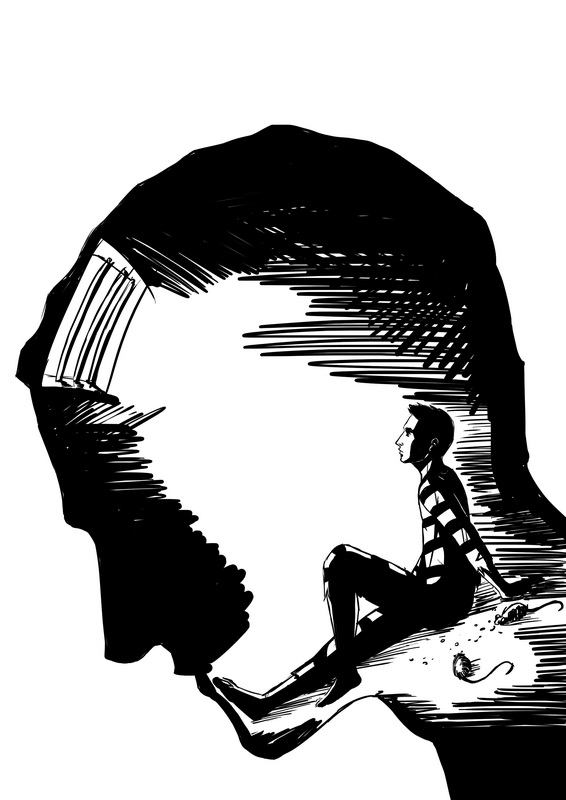




 After the Crash