Why the Drug War Has Been a Forty-Year Lynching

nixon-war-on-drugs-quote

By Bob Fitrakis and Harvey Wasserman

Source: FreePress.org

The Drug War has been a forty-year lynching….
…the corporate/GOP response to the peace and civil rights movements.

It’s used the Drug Enforcement Administration and other policing operations as a high-tech Ku Klux Klan, meant to gut America’s communities of youth and color.

It has never been about suppressing drugs. Quite the opposite.

And now that it may be winding down, the focus on suppressing minority votes will shift even stronger to electronic election theft.

The Drug War was officially born June 17, 1971, (http://www.drugpolicy.org/new-solutions-drug-policy/brief-history-drug-war) when Richard Nixon pronounced drugs to be “Public Enemy Number One.” In a nation wracked by poverty, racial tension, injustice, civil strife, ecological disaster, corporate domination, a hated Vietnam War and much more, drugs seemed an odd choice.
In fact, the Drug War’s primary target was black and young voters.

It was the second, secret leg of Nixon’s “Southern Strategy” meant to bring the former Confederacy into the Republican Party.

Part One was about the white vote.

America’s original party of race and slavery (https://zinnedproject.org/materials/a-peoples-history-of-the-united-states-updated-and-expanded-edition/)was Andrew Jackson’s Democrats (born 1828).

After the Civil War the Party’s terror wing, the KKK, made sure former slaves and their descendants “stayed in their place.”

A century of lynchings (at least 3200 of them) (http://www.yale.edu/ynhti/curriculum/units/1979/2/79.02.04.x.html)efficiently suppressed the southern black community.

In the 1930s Franklin Roosevelt’s New Deal social programs began to attract black voters to the Democratic Party. John Kennedy and Lyndon Johnson’s support for civil and voting rights legislation, plus the 24th Amendment ending the poll tax, sealed the deal. Today blacks, who once largely supported the Party of Lincoln,  vote 90% or more Democrat (http://blackdemographics.com/culture/black-politics/).

But the Democrats’ lean to civil rights angered southern whites. Though overt racist language was no longer acceptable in the 1970s, Nixon’s Republicans clearly signaled an open door to the former Confederacy (https://www.thenation.com/article/why-todays-gop-crackup-is-the-final-unraveling-of-nixons-southern-strategy/).

But recruiting angry southern whites would not be enough for the Republicans to take the south. In many southern states more than 40% of potential voters were black. If they were allowed to vote, and if their votes were actually counted, all the reconstructed Democrat Party would need to hold the south would be a sliver of moderate white support.

That’s where the Drug War came in.

Reliable exact national arrest numbers from 1970 through 1979 are hard to come by.

But according to Michelle Alexander’s superb, transformative The New Jim Crow, and according to research by Marc Mauer and Ryan King of the Sentencing Project, more than 31,000,000 Americans were arrested for drugs between 1980 and 2007 (http://newjimcrow.com).

Further federal uniform crime report statistics compiled by www.freepress.org indicate that, between 2008 and 2014, another 9,166,000 were arrested for drug possession.
Taken together, than means well over 40,000,000 American citizens have been arrested for drugs in the four decades since Nixon’s announcement.
It is a staggering number: more than 10% of the entire United States, nearly four times the current population of Ohio, far in excess of more than 100 countries worldwide.
A number that has gutted the African-American community.  A national terror campaign far beyond the reach of even the old KKK.
Justice Department statistics indicate than half of those arrests have been for simple possession of marijuana.
According to US Bureau of Justice statistics, between 1980 and 2013, while blacks were 12% of the population, blacks constituted 30% of those arrested for drug law violations and nearly 40% of those incarcerated in all U.S. prisons.  Thus some 20,000,000 African-American men have been sent to prison for non-violent “crimes” in the past forty years.
If the Hispanic population is added in, as much as 60% of drug arrests are of racial or ethnic minorities.
On the 40th anniversary of the Drug War in 2010, the Associated Press used public records to calculate that the taxpayer cost of arresting and imprisoning all these human beings has been in excess of $1,000,000,000.
Sending them all to college would have been far cheaper.  It also would have allowed them to enhance and transform their communities.
Instead, they were taken from their families.  Their children were robbed of their parents.  They were assaulted by the prison culture, stripped of their right to vote and stopped from leading the kind of lives that might have moved the nation in a very different direction.
Nixon also hated hippies and the peace movement. So in addition to disenfranchising 20,000,000 African-Americans, the Drug War has imprisoned additional millions of young white and Hispanic pot smokers.
Thus the DEA has been the ultra-violent vanguard of the corporate culture war.
In 1983 Ronald Reagan took the Drug War to a new level.  Using profits from his illegal arms sales to Iran, he illegally funded the Contra thugs who were fighting Nicaragua’s duly elected Sandinista government.
The Contras were drug dealers who shipped large quantities of cocaine into the US—-primarily in the Los Angeles area—-where it was mostly converted to crack.
That served a double function for the GOP.
First, it decimated the inner city.
Then Reagan’s “Just Say No” assault—-based on the drugs his Contra allies were injecting into our body politic—-imposed penalties on crack far more severe than those aimed at the powdered cocaine used in the white community.
In 1970 the US prison population was roughly 300,000 people.  Today it’s more than 2.2 million, the largest in world history by both absolute number and percentage of the general population.  There are more people in prison in the US than in China, which has five times the population (http://www.bjs.gov/index.cfm?ty=tp&tid=11).

According to the Sentencing Project, one in seventeen white males has been incarcerated, one in six Latinos, and one in three blacks.
By all accounts the Drug War has had little impact on drug consumption in the US, except to make it more profitable for drug dealers (http://www.bjs.gov/index.cfm?ty=tp&tid=11).  It’s spawned a multi-billion-dollar industry in prison construction, policing, prison guards, lawyers, judges and more, all of them invested in prolonging the drug war despite its negative impacts on public health.

For them, the stream of ruined lives of non-violent offenders is just another form of cash flow.
Like the Klan since the Civil War, the Drug War has accomplished its primary political goal of suppressing the black vote and assaulting the African-American community.
It’s shifted control of the South from the Democrats back to the Republican Party. By slashing voter eligibility and suppressing black turnout, the Drug War crusade has helped the GOP take full control of both houses of the US Congress and a majority of state governments across the US.
But the repressive impacts hit everyone, and ultimately enhance the power of the corporate state.
Toward that end, the southern corporate Democrat Bill Clinton’s two terms as a Drug Warrior further broadened the official attack on grassroots America. Clinton was determined to make sure nobody appeared tougher on “crime.”  He escalated the decimation of our democracy far beyond mere party politics, deepening the assault on the black community, and the basic rights of all Americans for the benefit of his Wall Street funders.  Obama has been barely marginally better.
In political terms, the Nixon-Reagan GOP remains the Drug War’s prime beneficiary. Today’s Republicans are poised to continue dominating our electoral process through the use of rigged electronic registration rolls and voting machines. That’s a core reality we all must face.
But no matter which party controls the White House or Congress, by prosecuting a behavior engaged in by tens of millions of Americans, the Drug War lets the corporate state arrest (and seize assets from) virtually anyone it wants at any time. It has empowered a de facto corporate police state beyond public control.

Regardless of race, we all suffer from the fear, repression and random assaults of a drug-fueled repressive police force with no real accountability.
In the interim, the Drug War is not now and never has been about drugs.
Legalizing pot is just the beginning of our recovery process.
Until we end the Drug War as a whole, America will never know democracy, peace or justice.
____________________
THE SIXTH JIM CROW: ELECTRONIC ELECTION THEFT & THE 2016 SELECTION will be released by Bob Fitrakis & Harvey Wasserman by January, 2016. Their CITIZEN KASICH will follow soon thereafter. Bob’s FITRAKIS FILES are at www.freepress.org; Harvey’s ORGANIC SPIRAL OF US HISTORY will appear in 2016.

Related video:
Govt Denies Hungry Families Thanksgiving Food Because a Pro-Cannabis Group Donated It

Govt-Denies-Hungry-Families-Food-on-Thanksgiving-Because-a-Pro-Cannabis-Group-Donated-It

By John Vibes

Source: TheFreeThoughtProject.com

In the state of Oregon, where marijuana was recently legalized, a government agency has rejected food donations for the holidays because the donations came on the behalf of a marijuana-related organization. A group called Women Leaders in Cannabis was able to raise considerable food donations for people in need and initially their contributions were accepted by Oregon’s Department of Human Services.

However, the agency later changed their mind and decided that they did not want to accept the donations because they did not want to be associated with a substance that is now legal in the state.

Lindsey Jacobsen, the executive director of Women Leaders in Cannabis in Eugene, told KATU that the agency actually gave them a different excuse at first.

“The first place I reached out to was the Department of Human Services because when I was in high school I was in Future Business Leaders of America and we did the same type of program and that’s who we worked with. We discussed in detail how we would make it happen, and a few days later we got a phone call back stating that they wouldn’t be able to work with us due to too much time being spent on it,” she said.

It’s disheartening. We have lives just like everybody else, families, jobs. We’re just happy to be able to give back now that we have the opportunity to,” she added.

Gene Evans, a DHS spokesman later admitted in a statement to KATU that the donations would be an embarrassment for the government.

“Their decision not to accept the donations was based on discomfort with the connection of a marijuana organization to DHS human services. … The Eugene office felt that baskets sponsored by this organization could create the impression that we endorsed cannabis,” the statement said.

“I don’t see how being involved in a positive way could do any harm. We’ll keep finding people that want to work with us and I think in the future people will be reaching out to us, hopefully,” Jacobsen said after hearing the reason why their donations were rejected.


Public School Students Are the New Inmates in the American Police State

school_is_prison_by_twarrior-d4atw5g

By John W. Whitehead

Source: The Rutherford Institute

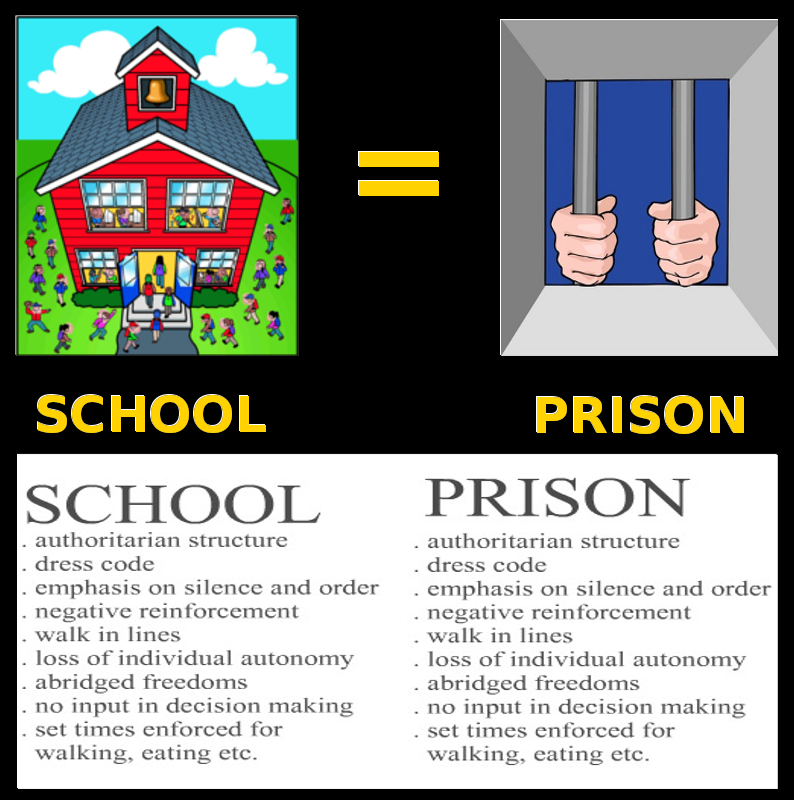
In the American police state, you’re either a prisoner (shackled, controlled, monitored, ordered about, limited in what you can do and say, your life not your own) or a prison bureaucrat (police officer, judge, jailer, spy, profiteer, etc.).

When you’re a child in the American police state, life is that much worse.

Microcosms of the police state, America’s public schools contain almost every aspect of the militarized, intolerant, senseless, overcriminalized, legalistic, surveillance-riddled, totalitarian landscape that plagues those of us on the “outside.”

From the moment a child enters one of the nation’s 98,000 public schools to the moment she graduates, she will be exposed to a steady diet of draconian zero tolerance policies that criminalize childish behavior, overreaching anti-bullying statutes that criminalize speech, school resource officers (police) tasked with disciplining and/or arresting so-called “disorderly” students, standardized testing that emphasizes rote answers over critical thinking, politically correct mindsets that teach young people to censor themselves and those around them, and extensive biometric and surveillance systems that, coupled with the rest, acclimate young people to a world in which they have no freedom of thought, speech or movement.

If your child is fortunate enough to survive his encounter with the public schools, you should count yourself fortunate.

Most students are not so lucky.

By the time the average young person in America finishes their public school education, nearly one out of every three of them will have been arrested.

More than 3 million students are suspended or expelled from schools every year, often for minor misbehavior, such as “disruptive behavior” or “insubordination.”

For instance, a Virginia sixth grader, the son of two school teachers and a member of the school’s gifted program, was suspended for a year after school officials found a leaf (likely a maple leaf) in his backpack that they suspected was marijuana. Despite the fact that the leaf in question was not marijuana (a fact that officials knew almost immediately), the 11-year-old was still kicked out of school, charged with marijuana possession in juvenile court, enrolled in an alternative school away from his friends, subjected to twice-daily searches for drugs, and forced to be evaluated for substance abuse problems.

Under similarly misguided school zero tolerance policies, students have been suspended for bringing to school household spices such as oregano, breath mints, birth control pills and powdered sugar. Look-alike weapons (toy guns—even Lego-sized ones, hand-drawn pictures of guns, pencils twirled in a “threatening” manner, imaginary bows and arrows, even fingers positioned like guns) can also get a student kicked out.

Acts of kindness, concern or basic manners can also result in suspensions. One 13-year-old was given detention for exposing the school to “liability” by sharing his lunch with a hungry friend. A third grader was suspended for shaving her head in sympathy for a friend who had lost her hair to chemotherapy. And then there was the high school senior who was suspended for saying “bless you” after a fellow classmate sneezed.

Unfortunately, these incidents are indicative of a nationwide phenomenon in which children are treated like suspects and criminals, especially within the public schools.

When you bring the police into the picture, after-school detention and visits to the principal’s office are transformed into punishments such as misdemeanor tickets, juvenile court, handcuffs, tasers and even prison terms.

More and more, police are “stepping in to deal with minor rulebreaking—sagging pants, disrespectful comments, brief physical skirmishes. What previously might have resulted in a detention or a visit to the principal’s office was replaced with excruciating pain and temporary blindness, often followed by a trip to the courthouse.”

Thanks to a combination of media hype, political pandering and financial incentives, the use of armed police officers to patrol school hallways has risen dramatically in the years since the Columbine school shooting.

Funded by government grants, these school resource officers have become de facto wardens in the elementary, middle and high schools, doling out their own brand of justice to the so-called “criminals” in their midst with the help of tasers, pepperspray, batons and brute force.

Now advocates for such harsh police tactics and weaponry will tell you that school safety should be our first priority lest we find ourselves with another Sandy Hook. What they will not tell you is that such shootings are rare. As one congressional report found, the schools are, generally speaking, safe places for children.

In their zeal to crack down on guns and lock down the schools, these cheerleaders for police state tactics in the schools might also fail to mention the lucrative, multi-million dollar deals being cut with military contractors such as Taser International to equip these school cops with tasers, tanks, rifles and $100,000 shooting detection systems.

Indeed, the transformation of hometown police departments into extensions of the military has been mirrored in the public schools, where school police have been gifted with high-powered M16 rifles, MRAP armored vehicles, grenade launchers, and other military gear. One Texas school district even boasts its own 12-member SWAT team.

As if it weren’t bad enough that the nation’s schools have come to resemble prisons—complete with surveillance cameras, metal detectors, drug-sniffing dogs, random locker searches and active shooter drills—the government is also contracting with private prisons to lock up young people for behavior that once would have merited a stern lecture. Nearly 40 percent of those young people who are arrested will serve time in a private prison, where the emphasis is on making profits for large megacorporations above all else.

Young people have become easy targets for the private prison industry. For instance, two Pennsylvania judges made headlines when it was revealed that they had been conspiring with two businessmen in a $2.6 million “kids for cash” scandal that resulted in more than 2500 children being found guilty and jailed in for-profit private prisons.

It has been said that America’s schools are the training ground for future generations. Yet as I point out in my book Battlefield America: The War on the American People, instead of raising up a generation of freedom fighters, however, we seem to be busy churning out newly minted citizens of the American police state who are being taught the hard way what it means to comply, fear and march in lockstep with the government’s dictates.

The lesson is this: you not only get what you pay for, but you reap what you sow.

If you want a nation of criminals, treat the citizenry like criminals.

If you want young people who grow up seeing themselves as prisoners, run the schools like prisons.

But if you want to raise up a generation of freedom fighters, who will actually operate with justice, fairness, accountability and equality towards each other and their government, then run the schools like freedom forums. Remove the metal detectors and surveillance cameras, re-assign the cops elsewhere, and start treating our nation’s young people like citizens of a republic and not inmates in a police state.


Legalizing Marijuana Now More Popular Than All Political Candidates

yes-we-cannabis-marijuana-poster

By John Vibes

Source: TheAntiMedia.org

It is no secret that Americans are losing faith in the US political system. With the potential of a choice between a Clinton and a Bush in 2016, it is likely that even more people will stop participating.

Now that there have been states where people have been allowed to vote for the legalization of marijuana, that topic has actually become more popular than the candidates themselves.

According to a Quinnipiac University poll conducted in March, in the key swing states of Ohio, Pennsylvania and Florida, marijuana is far more popular than all the major political candidates. The survey found that over 80% of people in all states supported medical marijuana, with over 50% also supporting full legalized recreational marijuana.

Meanwhile, all of the major political candidates have the approval of less than 50% of the people polled.

In some ways marijuana policy is the perfect issue for a presidential campaign. It has far reaching consequences that both parties have reason to engage,” John Hudak of the Brookings Institution told the Washington Post, in response to the poll.

Prohibition of any kind should be opposed for the reasons I have laid out in the past. However, marijuana is of specific immediate importance because of its ability to heal sick people and create environmentally friendly industrial products. It is also one of the safest drugs known to our species.

A recent Gallup poll found that major political parties in the United States are seeing their lowest popularity levels in recent memory.

Both the Democrats and the Republicans fall well below 50% in terms of approval, with 39% viewing the Democratic party favorable and 37% viewing the Republican party favorable.


John Vibes is an author, researcher and investigative journalist who takes a special interest in the counter culture and the drug war. In addition to his writing and activist work he organizes a number of large events including the Free Your Mind Conference, which features top caliber speakers and whistle-blowers from all over the world. You can contact him and stay connected to his work at his Facebook page. You can find his 65 chapter Book entitled “Alchemy of the Timeless Renaissance” at bookpatch.com.


Cannabis Wars: Lebanese Pot Growers Arm-Up Against ISIS Invaders

cannabis-syria

Source: 21st Century Wire

Ask any hippie or smuggler from 1950 onwards – tales of Lebanese hashish are legendary. Today, ISIS is providing the latest twist along the Silk Road…

As the saying goes, “A breeze in Syria becomes a storm in Lebanon”.

Lebanon’s pot growers have found themselves on the frontline in their country’s defense against an ISIS surge over their eastern border.

Farmers say they are armed and ready to fight off any ISIS encroachment into the Bekaa Valley.

Already in Syria, near Aleppo, ISIS gangs have been torching cannabis fields, labeling the plant as haram, or ‘forbidden’ in their version of Islam. ISIS militants in northern Syria posted their anti-drug exploits on YouTube in late August.

Watch their propaganda video below:

(If only ISIS stood downwind and could inhale some of the smoke – they might adopt a mellower approach to jihad):

The cannabis industry has always been an integral part of the Lebanese farming economy.

Dating all the way back to the Ottoman era, for centuries Lebanon’s fertile Bekaa Valley, just 40 kilometers from the Syrian border, has produced one of the world’s finest cannabis products, Lebanese Red and Blonde hashish and ‘pollen’.

The late 20th century episode of Lebanon’s hashish empire is as complicated as it is colourful. Syria occupied a large portion of the Bekaa, during and after the Lebanese Civil War, from 1976 – 2005, with an estimated half of all available agricultural land being used to grow both cannabis (processed into hashish) and opium poppy (processed into heroin). Once the civil war ended in 1990, Syria, Lebanon and the UN went through the motions of eradicating the cannabis crops the Bekaa. According to Sensi Seeds:

“Between 1991 and 1994, around 30,000 hectares of cannabis was destroyed, leaving 250,000 people and 23,000 family farms bereft of a primary source of income. It is alleged that (while thousands of small-scale farmers were left impoverished) the largest smuggling organisations were compensated with seats in the government.”

In 2001, Hezbollah took a more assertive role in lobbying in Beirut to preserve the Bekaa Valley’s local Shia farmers’ cannabis crop livelihoods, but critics also point out that their role wasn’t purely altruistic, but also had a profit motive through a type of protection racket.

“Control of the volatile region is an ongoing challenge. Violent clashes between rival gangs and with the armed forces have increased since 2005; Hezbollah has generally left it to the army to deal with the unrest, and has been slow to enact decisive policies regarding the future of the region.”

Whatever it is, it seems to be working, and an added bonus has been that because of the destablization and ‘ISIS crisis’ in Syria next door, Lebanese Security Services patrols have become over-stretched along the porous border, leaving cannabis growers and distributors with record profits in 2014.

Fiercely independent residents of the Bekaa know the economic power of their crops, and see them as a national asset, rather than a hazard. Pot kingpin Noah Zaiter, of the Zaiter Clan, once stated publicly that, “Make Marijuana and hashish legal for six months and I’ll pay down all government debt ($36 billion)”.

SBS.au spoke to one grower, 65-year-old farmer Abo Hamoudi, about the current situation, reporting, “In the past, the Lebanese army would descend yearly on this area to destroy the illicit crop, leading to heavy clashes with cannabis farmers. Mr Hamoudi says for the last two years, the army has looked the other way.”

“They’re distracted with Islamic State and are fighting on the border. And we also fight with the army. In two days my turn to fight will come on the border between here and Syria. We fight them on the border so they don’t come inside here.”

Meanwhile, the trade is expanding. Farmer Ali Nasri Shamas, explains, “Every year we are increasing the areas we are planting. We are doing what we have said we would do. Three years ago, we told them [the Lebanese authorities] we will plant double. We did, and we will confront them. The next year, we promised them we would plant five times that amount. We did and we confronted them. And we will increase it every year.”

“Either they provide an alternative, they legalize it or it will be a confrontation between us and them.”

Contributors to this report were 21WIRE senior researcher Peter Sterry, sub editor Jason Smith and writer Patrick Henningsen.


10 Things You Didn’t Know About the History of Marijuana

Cannabis_sativa_Koehler_drawing

By Keri Blakinger

Source: Waking Times

Fancy yourself a connoisseur of all things weed? Then see whether this trip from ancient China to modern Alaska takes you anywhere unexpected.

What do Sarah Palin, Barack Obama, Justin Bieber, Maya Angelou and well over 100 million Americans all have in common? They’ve all smoked pot. Throughout its history, marijuana has attracted plenty of unexpected users and proponents. And much of the history of greenery is now familiar to us—thanks to History Channel specials, the burgeoning legalization movement and the popularity of anti-pot propaganda films like Reefer Madness. But even if you’re intimately familiar with the plant in all its forms, we’re willing to wager that some of these facts will surprise you.

1. The first known potheads lived in ancient China, circa 2,727 BC. Emperor Shen Nung helpfully compiled an encyclopedic list of drugs and their uses, which includes “ma,” or cannabis. But ancient Chinese weed consumption is indicated by more than just written records: Six years ago, archaeologists on a dig in the Gobi Desert found the world’s oldest pot stash in the grave of a shaman of the Gushi tribe. The purpose of the cannabis was easily identified because the male plant parts, which are less psychoactive, had been removed.

The Chinese certainly weren’t the only ancient culture to enjoy toking. The Greeks and Romans used marijuana, as did the citizens of the Islamic empires. In 1545, Spanish conquistadors introduced it to the New World when they began planting cannabis seed in Chile to be used for fiber.

2. You probably heard that a bunch of the Founding Fathers grew weed, but did you know the details? Technically, you can’t really classify them as pot farmers because they were growing hemp, which is not the same cannabis variety that you’ll find in a joint. Hemp and pot are the same species—cannabis sativa—but the hemp variety has a lower THC content and was useful instead as a source of fiber for those distinguished dudes’ duds.

But debate continues about whether the Founding Fathers actually smoked cannabis in addition to growing it. While many traditional sources say there’s no evidence of it, other, less buttoned-down ones—including, predictably, High Times—contend that there is.

One factor that muddies the water and the Internet is an oft-repeated Thomas Jefferson “quote” that experts agree is not legit. Although he was a hemp farmer, Thomas Jefferson never said: “Some of my finest hours have been spent sitting on my back veranda, smoking hemp and observing as far as my eye can see.”

Admittedly, that’s a pretty difficult image to forget.

3. Hashish, which is a compressed or purified form of pot resin, became faddish in the mid-1800s, as a result of its prominence in popular novels of the era, including two classics: The Count of Monte Cristo and Arabian Nights, an early English translation of One Thousand and One Nights.

In one scene fit to make any DARE instructor shudder, the Count of Monte Cristo virtually coerces another character into a mind-bending hashish adventure, urging, “Taste the hashish, guest, taste the hashish!”

Arabian Nights meanwhile contains multiple references to hashish, including the story “The Tale of the Hashish Eater.” Both Monte Cristo and Arabian Nights found wide audiences due to their exotic settings, foreign cultures and adventure plots that heightened the allure of the drug described on the pages. Contemporary readers who would never had the opportunity to go Persia could at least cop a little bit of Persia off seafaring vessels from foreign ports.

4. Pot’s reputation began to go south when the first English-language newspaper started in Mexico in the 1890sSensationalized stories of marijuana-induced violence gave the drug a bad rap, although pot didn’t really hit the US until after the Mexican Revolution in 1910, when a flood of Mexican immigrants moved north, bringing their favorite weed.

US groups began spreading stories of violence induced by the drug, playing on anti-immigrant sentiment, and referring to the drug by the Mexican-sounding name “marijuana.” This highly racialized propaganda led to widespread fear of the drug, which grew into a panic in the early 1930s when government research “determined” that marijuana-induced criminal acts were “primarily committed by ‘racially inferior’ or underclass communities.”

Interestingly, some of the accounts of violence and crime may not have been entirely fabricated. Just as the myth of the unicorn may have been based on early and inaccurate descriptions of the rhinoceros, the tales may have partly been the result of some confusion regarding plant names. Some media stories of the era conflated marijuana with locoweed, a type of poisonous plant. So it’s just possible that some of the horror stories held a grain of truth—relating to a completely different plant.

5. There is no consensus about where the word “marijuana” came from. The word sounds like a Spanish language cognate, but some etymologists trace its origins to China or India. The plant itself originated in Central Asia, and China and India were the first two regions to begin cultivating it.

One theory is that Chinese immigrants brought the phrase ma ren hua—which translates more or less as “hemp seed flowers”—to Mexico, where it became Spanishized into “marijuana.” Another theory is that Angolan slaves brought the Bantu word for cannabis—ma’kaña—to the Americas via Brazil and Spanish-speakers later adapted it. Yet another theory traces the word back to the Semitic root mrr.

Whatever its origins, there is some agreement that the first recorded use of a similar term was in a feature called “The American Congo” published in Scribner’s Magazine in 1894. In the article, author John G. Burke used the word “mariguan” to refer to a species of plant included in his description of the flora on the banks of the Rio Grande River between Texas and Mexico.

6.  But we do know that the term “pot” entered the lexicon in the 1930s as a shortened form of the Spanish potiguaya, an alcoholic drink in which cannabis buds have been steeped. A literal translation of potiguaya or potacion de guaya is “the drink of grief.”

Other terms are also far easier than “marijuana” to trace. “Ganja,” for example, likely entered the English lexicon in the 1800s when it was borrowed from a similar Hindi word. While words like pot and ganja endured, other terms for cannabis—such as “gage” (17th-century word for a pipe)  and “muggles” (used in the 1920s by the New Orleans jazz crowd)—have sadly fallen by the wayside.

7. Henry Ford experimented with the invention of a car that was possibly partially made of hemp. Some pro-pot sites claim that Ford actually developed a hemp-based automobile, but the evidence suggests that they are blowing smoke.

In the early 1940s, Ford developed a plastic car intended to be a lighter, stronger and more affordable alternative to traditional metal vehicles. Newspaper articles stated that the new car was a combination of resin binder and cellulose fiber supposedly drawn from pine fiber, hemp, soybean and ramie. However, The Henry Ford, a museum in Michigan, says that the exact ingredients for the car’s recipe have been lost, so they can’t confirm that hemp was in the mix.

Whether or not Ford’s car contained hemp, current scientists have apparently drawn inspiration from the concept as they work to develop cars made of plant fibers such as hemp and elephant grass.

8. Marijuana was initially criminalized by the federal government in an indirect, de facto way: a 1937 tax act. The act set such high taxes on the purchase of weed that it discouraged people from going through the proper legal channels. And because arrest was the penalty for non-compliance, the tax act essentially criminalized marijuana possession.

In 1969, the act was ruled unconstitutional because paying the federal tax required admitting to the possession of something already made illegal by some state laws—and thus violated the right against self-incrimination spelled out in the Fifth Amendment. The following year the law was repealed and replaced with a measure that fully criminalized marijuana. Prior to the federal bans, though, many states had adopted the Uniform Narcotics Drug Act in the early 1930s, which made pot and other drugs illegal under state law.

Today, in a reversal of that situation, marijuana remains illegal on a federal level but two states—Colorado and Washington—legalized recreational use in 2012. More are likely to follow soon.

9. Popular urban legend has it that the term “420” is a reference to a 1970s police code, but in fact a group of high school kids coined the term. In 1971, five California high school students heard about a plot of pot plants whose owner could no longer tend them. Eager to find the green, sticky treasure, the students agreed to meet outside the school at 4:20 pm to look for the plants until they found them. They never did, even after weeks of hunting.

But their fruitless search would be immortalized. Because their school was in Marin County, a counterculture hotspot, and because the treasure hunters had an indirect contact with Grateful Dead member Phil Lesh, the term 420 gradually became a part of drug culture throughout California and then the country.

10. Alaska effectively legalized marijuana 39 years ago. You might have thought otherwise—especially considering the viral video of Alaskan reporter Charlo Greene quitting on-air last month in order to campaign for marijuana legalization. And policy wonks would insist that pot is technically decriminalized, rather than legalized, in the state. But marijuana in Alaska occupies an interesting legal gray area.

In 1975, the Alaska Supreme Court decided that the state’s constitutional right to privacy protects the right of adults to use and possess small amounts of marijuana in their own homes. However, Alaskan criminal law currently bans the possession of even small amounts of pot. As a result, Alaskans can be charged with possession for having pot in their homes—but technically courts should throw out the charges for amounts under four ounces.

This confusing state of affairs may be cleared up very soon, though: Next month, Alaskans go to the polls to vote on an initiative to officially legalize marijuana for recreational use.

How Colorado Disrupted the Drug War

barack-obama-colorado-marijuana-majority

David Sirota reports on the successful political strategy used by activist Mason Tvert to help decriminalize recreational marijuana use in Colorado. It demonstrates how a slight shift in the public discourse can lead to large and rapid changes in attitudes towards an issue, and hopefully this strategy will be used in other states and countries currently prohibiting recreational cannabis use. Excerpts from Pando Daily:

“Marijuana has been illegal because of the perception of harm surrounding it — that’s how they made it illegal, that’s how it is illegal currently,” Tvert tells me in the shop’s bustling lobby. “Our opponents’ goal has been to maintain a perception of harm. So our idea has been to get people to understand that marijuana is not as harmful as they’ve been led to believe, and not as harmful as a product like alcohol that is already legal.”

Despite increasingly absurd attempts by the government’s drug-war apparatus to obscure the obvious truth, decades of medical and social science research on everything from physiological toxicity, to domestic violence to addiction has proven Tvert’s point that cannabis is less harmful than alcohol. But it was only a few years ago that Tvert’s colleague and future mentor at MPP, Steve Fox, happened upon a key political revelation in the reams of survey data about drug policy.

“He was looking at the polling and discovered that of those who think marijuana is safer than alcohol, 75 percent think it should be legal,” Tvert recounts as we wait behind a customer who is interrogating one of the shop’s staff members about THC and CBD content. “In other words, the number one indicator of whether or not you support marijuana being legal is whether you recognize it is safer than alcohol.”

From that revelation came the creation of the group headed by Tvert that was entirely focused on drawing the alcohol-marijuana comparison. Aptly named Safer Alternative For Enjoyable Recreation (aka SAFER), it was predicated on a two-step strategy.

“Rather than trying to increase the percentage of people who think marijuana should be legal, we simply tried to increase the percentage of people who understand marijuana is less harmful than alcohol, which would naturally produce an increase in the percentage of people who support legalization,” he says.

…In their view, this script-flipping tactic has worked better than any other strategy before it. Not only has it resulted in Colorado legalized weed, but national polls seem to support the larger theory. Indeed, as surveys show more Americans are now viewing marijuana as less harmful than alcohol, they are simultaneously showing a majority now support legalization across the country.

…But even beyond lessons about cannabis is an even larger lesson about how assumptions and frames of reference so often determine the difference between status quo and disruption.

In drug policy, the assumption had long been that prohibition is pro-safety and that legalization is a dangerous experiment. So instead of only amplifying old messages about legalization (it will raise tax revenue, it will end criminal justice iniquities, etc.) Tvert, SAFER and MPP creatively changed the fulcrum of the entire conversation. Rather than portray their fight as one for a brand new, wholly unknown and therefore frightening reality, they used alcohol – a product that most are already comfortable with – to recast their push as one designed to create a new version of current reality. And not just a new version, but a safer reality that doesn’t statutorily encourage people who want to use a mind-altering substance to only use one that is more harmful than cannabis.

…With the rise of social media and the slow-motion fall of a monopoly media that once had complete control over the public policy conversation, there is clearly more opportunity than ever to change the terms of the debate, even on issues that seem utterly intractable.

Read the full article here: http://pando.com/2014/01/07/how-colorado-disrupted-the-drug-war/

A must-see take down of cannabis legalization opponents/media pundits David Brooks and Ruth Marcus from The Colbert Report:

http://www.colbertnation.com/the-colbert-report-videos/431861/january-06-2014/recreational-pot-sales-in-colorado

A Green Beacon of Hope

0

Aesliip shares some of his adventures at the first Seattle Cannabis Cup at the Weedist. The event is organized by High Times magazine and is sort of a trade show for cannabis growers and medical dispensaries as well as a competition awarding a prestigious prize for growers. The Cup is traditionally held in Amsterdam, but since the passing of legislation in Colorado and Washington that legalizes recreational cannabis use, it is now being brought to the U.S. Here’s a sampling of what Aesliip observed:

The various booths had every kind of marijuana in every form you could think of. It was like a candy store; and there were tons of free samples. As I mentioned before, you could get dab samples at almost every booth, but there were also bong samples, tincture samples, and edible samples. I wanted to sample everything but I was also trying to not fall asleep on the sidewalk.

Cannabis Cup Seattle - WeedistI sampled a fair bit, though, especially when 4:20 came around. The California Finest booth was tossing out free individually wrapped joints, brownies, and random apparel into the crowd.

I caught one of the joints with my index finger and thumb which was awesome because one, I was stoked that I caught one and two, that’s how you hold a joint. I promptly opened it and lit up, as did many others who had caught the flying joints. Within a few minutes there had to be like 10 or more joints being passed around the small crowd, which I thought was hilarious.

Read the full story here: http://www.weedist.com/2013/09/adventures-seattle-cannabis-cup-2013/

I never would have thought such an event would be possible on U.S. soil. It shows just how relatively quickly public perception can change, how decades of propaganda are no match for genuine education and experience, and how in some cases even the feds are powerless to stop social/cultural movements. Mass cannabis legalization has the potential to help heal the nation physically, psychologically, economically and spiritually, as long as it isn’t co-opted, monopolized, chemically processed, genetically modified, etc.

Guy Evans and Cuban wrestler and rapper Konnan talk about the drug war at the Smells Like Human Spirit podcast. It’s an interesting conversation that connects the issue to Mexican gang wars, the corrupt political system and the prison-industrial complex before going on related tangents such as the military-industrial complex, foreign wars, the Occupy movement and the surveillance state.

Show link: http://www.smellslikehumanspirit.com/2013/09/konnanmlw.html