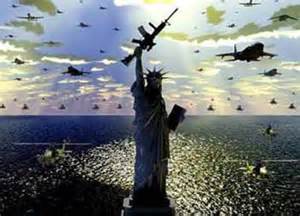
US plotting coups in Venezuela, Cuba and Nicaragua?

By Stephen Lendman

Source: Intrepid Report

The US wants all nations worldwide colonized, their resources looted, their people exploited as serfs, including ordinary Americans.

Sovereign independent governments everywhere are targeted for regime change—by coups d’état or wars.

That’s what imperialism is all about, a diabolical plot for unchallenged global dominance by whatever it takes for the US to achieve its aims, Republicans and undemocratic Dems allied for the same geopolitical objectives.

Humanitarian intervention, responsibility to protect, and democracy building are code words by both right wings of America’s war party for wanting fascist tyranny replacing governance of, by, and for everyone equitably everywhere—legitimate governments replaced by US-controlled puppet ones.

Post-9/11 alone, the US orchestrated coups in Haiti, Honduras, Paraguay, Brazil, Ukraine, Egypt, and elsewhere in the Middle East.

The so-called Arab spring was made in the USA. Uprisings were orchestrated. Nothing was spontaneous. CIA dirty hands were involved in replacing unpopular regimes with despotic ones considered more reliable.

Spring never bloomed, just the illusion of change for the better. It was pure deception. Everything changed in targeted countries but stayed the same.

In Egypt, Yemen and elsewhere things worsened, notably in Occupied Palestine. No spring bloomed there or anywhere else in the Middle East.

Plan Colombia was and remains all about Washington’s aim to control Latin America, eliminating opposition to regimes it controls, plotting coups against ruling authorities unwilling to bend to its will, along with pursuing anti-Sino/Russian regional policies.

Since Soviet Russia’s dissolution, the US escalated wars on humanity, using NATO as a killing machine. Republicans and Dems colluded to thirdworldize America, banana republicanize it, wrecking the economy, handing its wealth to Wall Street, war-profiteers and other corporate predators.

Both right wings of duopoly governance mock democratic values and rule of law principles they abhor, governing under a police state apparatus, hardened over time, risking global war to achieve its aims.

Venezuela, Cuba, Nicaragua, and Bolivia are the remaining sovereign independent Latin and Central American nations.

Trump regime hardliners want fascist tyranny replacing their legitimate governments. In early January, State Department deputy spokesman Robert Palladino turned truth on its head, saying the US “support[s] the people of Venezuela, Cuba and Nicaragua in restoring democratic governance and their human rights”—notions Washington abhors.

Venezuelan Bolivarian social democracy is the Trump regime’s top Latin American target for regime change. Pompeo made US intentions clear.

He turned truth on its head, saying President Nicolas Maduro is “illegitimate and the United States will continue . . . to work diligently to restore a real democracy to that country,” adding, “We are very hopeful that we can be a force for good to allow the region to come together to deliver that.”

Fact: Last May, Maduro was overwhelmingly re-elected by a two-thirds majority.

Fact: Scores of international observers from 30 countries monitored the election, judging it open, free and fair.

Fact: Venezuela’s political process is the world’s best.

Fact: It’s polar opposite America’s money-controlled system, one-party rule with two right wings, ordinary people having no say over how they’re governed.

Fact: US democracy is pure fantasy. Venezuelans have the real thing, why Republicans and Dems want its government toppled, their eyes on the prize—the world’s largest oil reserves they want handed to Big Oil.

On January 10, Maduro was inaugurated for a second six-year term, saying he’s committed to continue “fight[ing] for social and economic prosperity and to build 21st century socialism”—despite relentless US political, economic, financial, and propaganda war against the country’s social democracy.

Despite the Trump regime’s all-out efforts to mobilize international opposition to his legitimate rule, delegations from over 90 countries attended the inaugural ceremonies—including from Russia, China, Cuba, Nicaragua, Bolivia, Mexico, El Salvador, Iran, Turkey, and Ireland’s Sinn Fein.

Representatives from US colonized EU nations were absent, a spokeswoman for foreign policy chief Federica Mogherini lied saying that “the presidential elections were not free nor fair”—a falsified statement, serving US imperial interests.

Representatives from the African Union, CARICOM, the Arab League, the ALBA Bolivarian Alliance for the Peoples of Our Americas, OPEC, and the UN also attended.

In his inaugural address, Maduro said, “I tell the people. This presidential sash is yours. This power is yours. It does not belong to the oligarchy or to imperialism. It belongs to the sovereign people of Venezuela.”

He denounced the diabolical aims of “the most powerful empire in history,” urging dialogue to serve Venezuelan interests, including UN support for “peace, mutual recognition, harmony, (and) coexistence of different political visions,” adding: “I would like to sit down with the opposition, stop the sterile, useless, unnecessary conflict, talk about economic issues; with the experience of the UN we can achieve it.”

Trump regime hardliners falsely call genuine democracies dictatorships, how neocon John Bolton reacted to Maduro’s inauguration, saying the US “will not recognize” his legitimacy to rule.

The US-controlled Organization of American States (OAS), headquartered in Washington, reacted the same way. Most of its member states support longstanding US plans for regime change.

The US-controlled 13-nation Lima Group issued a statement, refusing to recognize Maduro’s legitimacy.

Caracas slammed what it called a “humiliating subordination” to US imperial interests—applying to all nations allied with Washington against Venezuela’s social democracy and sovereign independence.

On January 12, State Department deputy spokesman Palladino openly called for regime change, saying, “It is time to begin the orderly transition to a new government.”

Previous US orchestrated coup attempts failed—against Hugo Chavez and Maduro. Will the Trump regime try again in the new year?

If unable to succeed by coup d’etat, will an attempt be made to assassinate Maduro? If economic, financial, political, and other tactics fail, will military intervention be the Trump regime’s fallback option?

Will Iran be targeted the same way in the new year? Imperialism isn’t pretty.

Endless US belligerence and state-sponsored terrorism is virtually certain ahead, the way hardliners in Washington always operate—hostile to peace, stability, equity and justice at home and abroad.

The Troika of Tyranny: The Imperialist Project in Latin America and Its Epigones

By Roger Harris

Source: CounterPunch

Cuba, Nicaragua, and Venezuela are today threatened by US imperialism. The first salvo of the modern Age of Imperialism started back in 1898 when the US seized Cuba along with Puerto Rico and the Philippines in the Spanish-American War.

The Age of Imperialism, as Lenin observed, is characterized by the competition of the various imperial powers for dominance. That inter-imperialist rivalry led to World War I. Lenin called those putative socialists who supported their own national imperialist projects “social imperialists.” Social imperialism is a tendency that is socialist in name and imperialist in deed. Imperialism and its social imperialist minions are still with us today.

US Emerges as the World’s Hegemon

The United States emerged after World War II as the leading imperialist power. With the implosion of the Socialist Bloc around 1991, US hegemony became even more consolidated. Today the US is the undisputed world’s hegemon.

Hegemony means to rule but even more so to dominate. As the world’s hegemon, the US will not tolerate neutral parties, let alone hostile ones. As articulated in the Bush Doctrine, the US will try to asphyxiate any nascent counter-hegemonic project, no matter how insignificant.

In the Caribbean, for instance, the US snuffed out the leftist government of Grenada in 1983 in what was code named Operation Urgent Fury. Grenada has a population smaller than Vacaville, California.

The only powers that the world’s hegemon will tolerate are junior partners such as Colombia in Latin America. The junior partner must accept a neoliberal economic regime designed to serve the interests of capital. Structural adjustment of the economy is demanded such that the neoliberal “reforms” become irreversible; so that you can’t put the toothpaste back in the tube.

Colombia recently joined NATO, putting that junior partner’s military under direct interaction with the Pentagon bypassing its civilian government. The US has seven military bases in Colombia in order to project – in the words of the US government – “full spectrum” military dominance in the Latin American theatre.

Needless-to-say, no Colombian military bases are in the US. Nor does any other country have military bases on US soil. The world’s hegemon has some 1000 foreign military bases. Even the most sycophantic of the US’s junior partners, Great Britain, is militarily occupied by 10,000 US troops.

The US is clear on its enemies list. On November 1, US National Security Advisor John Bolton, speaking in Miami, labelled Venezuela, Nicaragua, and Cuba the “troika of tyranny.” He described a “triangle of terror stretching from Havana to Caracas to Managua.”

Venezuela, Nicaragua, and Cuba are targeted by US imperialism because they pose what might be called the “threat of a good example;” that is, an alternative to the neoliberal world order.

These countries are suffering attacks from the imperialists because of the things they have done right, not for their flaws. They are attempting to make a more inclusive society for women, people of color, and the poor; to have a state that, instead of serving the rich and powerful, has a special option for working people, because these are the people most in need of social assistance.

Sanctions: The Economic War against Venezuela, Nicaragua, and Cuba

The US imperialist rhetoric is backed with action. In 2015, US President Obama declared Venezuela an “extraordinary threat to US security” and imposed sanctions. These sanctions have been extended and deepened by the Trump administration. The US has likewise subjected Cuba to sanctions in a seamless bipartisan policy of both Republicans and Democrats for over half a century. Now the US is the process of imposing sanctions on Nicaragua.

Unilateral sanctions, such as those imposed by the US, are illegal under the charters of both the UN and the Organization of American States, because they are a form of collective punishment targeting the people.

The US sanctions are designed to make life so miserable for the masses of people that they will reject their democratically elected government. Yet in Venezuela, those most adversely affected by the sanctions are the most militantly in support of their President Nicolás Maduro.

Consequently, the Trump administration is also floating the option of military intervention against Venezuela. The recently elected rightwing leaders Bolsonaro in Brazil and Duque in Colombia, representing the two powerful states on the western and southern borders of Venezuela, are colluding with the hegemon of the north.

The inside-the-beltway human rights organizations, such as Human Rights Watch, fail to condemn these illegal and immoral sanctions. They lament the human suffering caused by the sanctions, all the while supporting the imposition of the sanctions. Nor do they raise their voices against military intervention, perhaps the gravest of all crimes against humanity.

Liberal establishments such as the advocacy group Washington Office on Latin America (WOLA) try to distinguish themselves from hardline imperialists by opposing a military invasion in Venezuela while calling for yet more effective and punishing sanctions. In effect, they play the role of the good cop, providing a liberal cover for interference in the internal affairs of Latin American nations.

These billionaire-funded NGOs have a revolving-door staffing arrangement with the US government. So it is not surprising that they will reflect Washington’s foreign policies initiatives.

But why do some organizations claiming to be leftist so unerringly echo the imperialists, taking such umbrage over Venezuela, Cuba, and Nicaragua while ignoring far greater problems in, say, Mexico, Colombia, and Honduras, which are US client states?

Most Progressive Country in Central America Targeted

Let’s take Nicaragua. A year ago, the polling organization Latinobarómetro, found the approval rating of Nicaraguans for their democracy to be the highest in Central America and second highest in Latin America.

Daniel Ortega had won the Nicaraguan presidency in 2006 with a 38% plurality, in 2011 with 63%, and 72.5% in 2016. The Organization of American States officially observed and certified the vote. Polls indicated Ortega was perhaps the most popular head of state in the entire western hemisphere. As longtime Nicaraguan solidarity activist Chuck Kaufman noted, “Dictators don’t win fair elections by growing margins.”

Nicaragua is a member of theanti-imperialist Bolivarian Alliance for the Peoples of Our America with Cuba, Venezuela, Bolivia, and some Caribbean states. Speaking at the UN, the Nicaraguan foreign minister had the temerity to catalogue the many transgressions of what Martin Luther King called “the greatest purveyor of violence in the world” and express Nicaragua’s opposition.

These are reasons enough for a progressive alternative such as Nicaragua to curry the enmity of the US. The enigma is why those claiming to be leftists would target a country that had:

+ Second highest economic growth rates and the most stable economy in Central America.

+ Only country in the region producing 90% of the food it consumes.

+ Poverty and extreme poverty halved; country with the greatest reduction of extreme poverty.

+ Reached the UN Millennium Development Goal of cutting malnutrition by half.

+ Nicaraguans enjoyed free basic healthcare and education.

+ Illiteracy had been virtually eliminated, down from 36% in 2006 when Ortega took office.

+ Average economic growth of 5.2% for the past 5 years (IMF and the World Bank).

+ Safest country in Central America (UN Development Program) with one of the lowest crime rates in Latin America.

+ Highest level of gender equality in the Americas (World Economic Forum Global Gender Gap Report 2017).

+ Did not contribute to the migrant exodus to the US, unlike neighboring Honduras, El Salvador, and Guatemala.

+ Unlike its neighbors, kept out the drug cartels and pioneered community policing.

In April of this year, all of this was threatened. The US had poured millions of dollars into “democracy promotion” programs, a euphemism for regime change operations. Suddenly and unexpectedly, a cabal of the reactionary Catholic Church hierarchy, conservative business associations, remnants of the US-sponsored Contras, and students from private universities attempted a coup.

Former members of Ortega’s Sandinista Party, who had long ago splintered off into political oblivion and drifted to the right, became effective propogandists for the opposition. Through inciting violence and the skillful use of disinformation in a concerted social media barrage, they attempted to achieve by extra-legal means what they could not achieve democratically.

Imperialism with a Happy Face

We who live in the “belly of the beast” are constantly bombarded by the corporate media, framing the issues (e.g., “humanitarian bombing). Some leftish groups and individuals pick up these signals, amplify, and rebroadcast them. While they may genuinely believe what they are promulgating, there are also rewards such as funding,media coverage, hobnobbing with prominent US politicians, and winning awards for abhorring the excesses of imperialism while accepting its premises.

Today’s organizations that are socialist in name and imperialist in deed echo the imperial demand that the state leaders of the progressive movements in Latin America “must go” and legitimize the rationale that such leaders must be “dictators.”

They try to differentiate their position from the imperialists by proffering a mythic movement, which will create a triumphant socialist alternative that fits their particular sect’s line: chavismo without Maduro in Venezuela, sandinismo without Ortega in Nicaragua, and the Cuban Revolution without the Cuban Communist Party in Cuba.

The political reality in Latin America is that a rightwing offensive is attacking standing left-leaning governments. President George W. Bush was right: “Either you are with us, or you are with the terrorists.” There is no utopian third way. Each of us has to determine who are the real terrorists, as the juggernaut of US imperialism rolls out a neoliberal world order.

Chaos: The New Imperialist Game Plan

For now, the coup in Nicaragua has been averted. Had it succeeded, chaos would have reigned. As even the most ardent apologists for the opposition admit, the only organized force in the opposition was the US-sponsored rightwing which would have instigated a reign of terror against the Sandinista base.

The US would prefer to install stable rightwing client states or even military dictatorships. But if neither can be achieved, chaos is the preferred alternative. Libya, where rival warlords contest for power and slaves are openly bartered on the street, is the model coming to Latin America.

Chaos is the new imperialist game plan, especially for Bolton’s so-called troika of tyranny. The imperialists understand that the progressive social movements in Venezuela, Nicaragua, and Cuba are too popular and entrenched to be eradicated by a mere change of personnel in the presidential palace. Much more drastic means are envisioned; means that would make the bloody aftermath of the US-backed Pinochet coup in 1973 in Chile pale by comparison.

In Venezuela, for example, the opposition might well have won the May 2018 presidential election given the dire economic situation caused in large part by the US sanctions. The opposition split between a moderate wing that was willing to engage in electoral struggle and a hard-right wing that advocated a violent takeover and jailing the chavistas.

When Venezuelan President Maduro rejected the US demand to call off the elections and resign, he was labelled a dictator by Washington. And when moderate Henri Falcon ran in the Venezuelan presidential race on a platform of a complete neoliberal transition, Washington, instead of rejoicing, threatened sanctions against him for running. The US belligerently floated a military option for Venezuela, stiffened the suffocating sanctions, and tipped the balance within the Venezuelan opposition to the radical right.

The US is not about to allow Venezuela a soft landing. Their intent is to exterminate the contagion of progressive social programs and international policy that has been the legacy of nearly two decades chavismo. Likewise, for Cuba and Nicaragua. We should also add Bolivia in the crosshairs of the empire.

We’ve seen what Pax Americana has meant for the Middle East. The same imperial playbook is being implemented in Latin America. Solidarity with the progressive social movements and their governments in Latin America is needed, especially when their defeat would mean chaos.

The West Is Becoming Irrelevant, The World Is Laughing

By Andre Vltchek

Source: TruePublica

I was recently told by an Asian friend of mine who is working in Paris: “Lately I stopped following almost all that is happening politically in the United States, in the UK and even here in France. It all feels suddenly so irrelevant, a waste of time.”

Statements like this would be unimaginable only one decade ago. In the past, what came from Washington and (to a smaller extent) from London was monitored with great attentiveness and fear, all over the world.

But all of a sudden, things have begun to change, rapidly. Despite the extremely violent nature of the Western-designed-and-manufactured global regime, which has been over-imposed on so many parts of the world for decades and centuries, increasing amounts of people in Asia, Latin America and Africa stopped worrying and went leisurely to the ‘barricades’, beginning to rebel against the perverseness of the ‘world order’.

Did it all really happen ‘all of a sudden’?

Or were there various catalysts at work, for already quite a substantial period of time?

It is a well-known fact that any deep-seated, chronic anxiety cannot disappear in just a short moment. People who are enslaved, humiliated, scared into obedience, people who are forced to feel uncertain and constantly frightened, cannot reverse their state of mind without some important external factor or set of factors.

It became obvious to me, as I have been working continuously on all continents and in almost all conflict zones of our Planet, that the renewed pride and courage which is now inspiring millions of oppressed human beings, actually came from the decisive and determined stand of just several brave and determined nations, big and small.

The myth about the omnipotence of the Empire has received a few significant blows.

The fable of invincibility has not completely disappeared yet, but at least it has got fractured and gravely injured.

The gate of the terrible prison began cracking. It has not collapsed, but the fractures were wide enough for at least some sunlight to enter the dark and dreadful cavities inhabited by billions of unfortunate and shattered beings.

Some victims stood up immediately; not many but at least some did. Others raised their heads in feeble hope, still lying down on the dirty ground, still chained, and still shaking. That weak light alone entering the dungeon was actually much brighter than what most people ever experienced in their entire life. It has been strong enough to provoke wonderful, brilliant sparks of hope

Except for some temporary setbacks (like in Brazil and Argentina), the anti-imperialist coalition is now steadier than ever; it is determined and constantly expanding.

And it is clearly winning!

It is truly a ‘rainbow coalition’ of countries, big and small, ‘red’ and ‘pink’, even ‘green’.

The only unifying factor is the shared determination not to be controlled by Western imperialism and neo-colonialism.

For decades, Cuba stood against the Empire, even after the Soviet block was broken to bits, even when all mutual agreements ceased to be honored by the criminal Yeltsin administration. The Cuban people never surrendered. It is because most of them always believed, from the bottom of their hearts, in socialism and internationalism. And also because they have been convinced that the Western Empire is a morally corrupt and illegitimate entity and therefore has to be resisted.

A small and relatively poor country – Cuba – demonstrated to the entire world that while the Empire is mighty, sadistic and brutal, it is not omnipotent, and it is possible to defy it. There is no reason why one should not dare, or one should not dream about a much better world, why one shouldn’t fight for true freedom, attempting to win.

Cuba inspired the world. Its daring Revolution took place just a few miles from the shores of the United States. Soon after, its teachers and doctors went to all parts of the earth, spreading optimism, solidarity and kindness. Its heroic revolutionaries went to fight against the most dreadful forms of colonialism, which were torturing people, is such places as Congo, Angola and Namibia.

After Obama’s attempts to water down the determination of the Cuban citizens, many enemies began to predict, cynically: “Now Cuba will compromise and sell its Revolution.”

It never did! I travelled to the Island last year, driving through the countryside, and speaking to people in Havana, Guantanamo and Santiago de Cuba. Almost no one was ready to compromise. A greatly educated nation, Cuba saw through the Empire’s tricks and deceptions.

Now almost nobody speaks about the “Cuban compromise”, anymore, simply because there isn’t any on the table.

China, one of the oldest and greatest civilizations on Earth, went through the terrible period of ‘humiliation’. Divided, occupied and plundered by the West, it has never forgotten nor forgiven.

Now the Chinese Communist state and its mixed economy are helping countries in virtually all parts of the world, from Oceania and Latin America, to the Middle East and especially Africa, to survive and to finally stand on their own feet. Despite all the vitriolic propaganda regurgitated by the West (those people in Europe or North America who know close to zero about Africa or China, habitually passing ‘confident’ and highly cynical ‘judgments’ about China’s involvement in the poor world; judgments based exclusively on the lies and fabrications produced by the Western media), China has been gaining great respect and trust in virtually all corners of the globe.

The Chinese people and their government are now standing firmly against Western imperialism. They will not allow any recurrence of the disgraceful and dreary past.

The West is provoking this mighty and optimistic nation, pushing it into a terrible confrontation. China doesn’t want any military conflict. It is the most peaceful, the most non-confrontational large nation on Earth. But it is becoming clear that if pushed against the wall, this time it will not compromise: it will fight.

In the last years I have spoken to many Chinese people, as I travelled to all corners of the country, and I’m convinced that by now the nation is ready to meet strength with strength.

Such determination gives hope to many other countries on our Planet. The message is clear: the West cannot do whatever it wants, anymore. If it tries, it will be stopped. By reason or by force!

Russia is ready again, too. It is standing next to China, enormous and indignant.

Go to Novosibirsk or Tomsk, to Khabarovsk, Vladivostok or Petropavlovsk in Kamchatka. Talk to Russian people and you will soon understand: almost nobody there believes or respects the West, anymore. Throughout history, Russia was attacked and ransacked from the West. Millions, tens of millions of its people were murdered, literally exterminated. And now, the nation is facing what some consider to be yet another imminent attack.

Like the Chinese people, Russians are unwilling to compromise, anymore. The old Russian forecast is once again alive, that very one professed by Alexander Nevsky:

Go tell all in foreign lands that Russia lives! Those who come to us in peace will be welcome as a guest. But those who come to us sword in hand will die by the sword! On that Russia stands and forever will we stand!

In Russia, as in China, and as in so many other nations that were devastated by the Western plunderers, nothing is forgotten and no one is forgotten. It only appeared for a while that the memory had fainted. It never does. You cannot burn down an entire land, ruin the cities, burn the fields, and still pose as one with the moral mandate. Or as we say in Chile: “Justice takes time, but it always comes!”

And the world is watching. It is suddenly clearly registering this determined and brave, epic stand of morally strong nations. Many of those who are watching are deeply impressed with what they are seeing. Perhaps not in London or in Paris, but go and ask those in Johannesburg or Beirut, or even in Calcutta, Cairo or Buenos Aires. Perhaps you suspect what answers you’d receive there!

Throughout modern history, not once has Iran invaded a foreign country. Yet its secular, progressive and democratic government (under the leadership of Mohammad Mosaddegh) was overthrown in 1953, in a CIA-backed coup. What followed was the monstrosity of the ‘pro-Western Shah’, and then a horrendous war, an invasion by Iraq, which was also fully backed by the West and which took hundreds of thousands of human lives. Since then, Iran has been suffering from targeted killings of its scientists (by the West and Israel), as well as terrorist attacks also backed from abroad.

Instead of falling on its knees and begging for mercy, Iran defied the West. On several occasions and when provoked, it sent its battleships to the neutral waters near the US coast, and it pledged to defend its land, in case it was to be attacked.

Iran also showed great solidarity towards Latin America, working closely with virtually all of the revolutionary governments there. It stood firmly by Venezuela in a time of great crises, building social housing in Caracas and supporting the Process by all other means.

In Latin America, no one will ever forget how former Iranian President Mahmoud Ahmadinejad came to Caracas to attend the funeral of Venezuelan leader Hugo Chavez, his dear friend. During the memorial, the aged mother of Chavez suddenly approached Ahmadinejad, in tears. Breaking all religious protocol of a Shi’a country that he was representing, the Iranian President embraced her, and held her against his heart, until she calmed down.

This moment was expressing one simple and powerful reality: all of us, the internationalists and anti-imperialists, are fighting for the survival of humanity and this planet. There is more that unites us than what is tearing us apart. Once we win, and we will win, the world will be able to find a common language. The West wants to divide us, by spreading hostilities and distrust, all through ‘false news’ and fabrications. But we understand its game. We will not break our ranks, anymore.

The West is clearly losing. It knows it. It is in panic.

Its nihilism, its propaganda and indoctrination tactics will soon be defeated.

I wrote a lot about the DPRK and how it joined the list of the ‘most hated nations on Earth’. It is a well known fact that North Korea was, for years and decades, much richer and more democratic than South Korea (ROK). But it embarked on one tremendous humanist ‘project’, and together with Cuba, the Soviet Union and to some extent China, it liberated almost the entire African continent, at great cost and sacrifice. And not only that: it sent its top educators and doctors to all corners of the most devastated continent on Earth. Its pilots also flew Egyptian MIGs against Israel, during the 1967 war. These facts have been silenced by Western propaganda, but they clearly explain why the DPRK has been ostracized, pushed to the corner, hit by senseless embargos, and forced to react the way it has been reacting for at least the last two decades.

North Korea has never surrendered either, and it never will.

Neither has Venezuela, for many years the great sentinel and engine of the Bolivarian Revolution, as well as of Latin Internationalism and solidarity. Surviving coups, embargos, plots and propaganda campaigns, surviving attacks, even terror, of the foreign-backed ‘opposition’, Venezuela has been injured but it is alive. Just a few days ago I spoke to an Italian Parliamentary delegation, consisting of  the“5-Star-Movement” MPs, which recently returned from Caracas. Their conclusion was simple: “The worst is over”.

The world knows it! Venezuela, DPRK, Cuba – they never fell. No matter how many knives penetrated their bodies, despite so much pain caused by the sanctions, coup attempts and direct acts of terrorism administered by the West and its monstrous Empire.

It is becoming clear and obvious: the West is helpless against determination, true courage and patriotic love. It is powerless when confronted with humanist ideologies, and with true loyalty!

And the world keeps watching, drawing its conclusions.

I wrote about Syria, comparing Aleppo to the 20th Century Stalingrad. This is where racism, terrorism, and the lowest forms of Western imperialism were decisively stopped. The price was terrible, but the message to the world extremely clear: The people who love their country with their entire hearts can fight and win against all odds, especially if by their side stand truly great and reliable friends and comrades!

One day the world will thank the Syrian people, profusely and properly. One day, everything will be understood. One day, perhaps soon.

This is one of the greatest moments in human history, perhaps the greatest.

It has arrived without big salvos announcing monumental revolutions.

Everything is happening fast, in an organized and determined manner.

The greatest minds of Russia, China, Latin America and the rest of the world, are feverishly, day and night, trying to determine what really brought our world, our civilization, to this ludicrous downfall.

The simplified and stripped-down answer is this: Western imperialism (military, economic and ‘intellectual’/ ’cultural’), colonialism and neo-colonialism, as well as that dreadful by-product of all the above combined – a set of unchecked and savage form of capitalism.

Simultaneously, new forms of government, of economy and social systems are being, once again, planned.

The military strategists of the countries that are refusing to kneel in front of the barbaric terror of the West, responsible for hundreds of millions of murders and billions of ruined lives, are planning how to defend their countries and the world.

Once again, the world is at work! It is building trenches, educating people, preparing them for the final showdown with the culture that has been tormenting our Planet for centuries.

It is the moment of great hope and renewed enthusiasm.

Of course, if seen from Western capitals, everything is bleak and depressing. There is no ‘hope’ at all.

I agree fully: there is no hope ‘for them’.

The logic, the ‘philosophy’ with which the Europeans and the North Americans have become accustomed to analyze the world, has arrived at a dead end.

Yes, it is ‘the end of philosophy’, or as they say, ‘the end of history’. I fully agree: it is the end of their philosophy and of their history.

That’s why, reading about their elections or statements produced by their politicians, is nothing less than a waste of time. The world realizes it, more and more.

Their ‘new tricks’ are actually very old. Their entire system is outdated. It should have been retired at least one hundred years ago. It survived only because of its savagery and cruelty. It will go soon, anyway.

These days, encountering people inhabiting the West is like encountering those zombies who were living in Nazi Germany during WWII. After the war was over, they were streetwalking for years, at least many of them, repeating the same refrains: “We didn’t know!” “We never realized”. The Nazi propaganda and the one, which has been used in the West and in the colonies (as Noam Chomsky and I defined in our book “On Western Terrorism”), are based on precisely the same roots, foundations and methods. Both are extremely effective, when it comes to the total brainwashing of the population.

To follow up the last chapter of the imperialist and turbo capitalist morass of the West is embarrassing and useless.

Both Europe and the United States are suffering from a series of devastating mental illnesses, as was defined by the great Swiss psychologist Carl Gustav Jung, right after WWII.

Getting too much involved in pathological behavior, constantly studying and analyzing it, could only break and deeply depress any healthy person’s mind.

There is nothing more to understand. Hundreds of millions of victims in all parts of the world are speaking for themselves.

The only rational issue here is this: how to stop this horror, as soon as possible? How to allow humanity to return to its natural development and evolution patterns?

I don’t believe in ‘punishments’ and ‘trials’ and other vehicles of intimidation and of spreading fear. I don’t care whether the West will ‘pay’ for all that it has done to the world. I only want it to be stopped, once and for all.

I work very hard for it to be stopped.

So are others.

And the world is watching, and all of a sudden enjoying what it sees.

Suddenly more and more people are daring to laugh at the global regime. Of course not in Paris, London or New York (here they are scared and obedient, even more than before). But outside, yes!

People on all continents want to see and hear about what ‘others do’, what ‘we do’, not what the Empire and its mental conditions are producing.

They are laughing and waiting impatiently for what a new day, a new year will bring. They are waiting for the true new beginning to arrive.


Andre Vltchek is a philosopher, novelist, filmmaker and investigative journalist. He has covered wars and conflicts in dozens of countries. Three of his latest books are revolutionary novel “Aurora” and two bestselling works of political non-fiction: “Exposing Lies Of The Empire” and  “Fighting Against Western Imperialism. View his other books here. Andre is making films for teleSUR and Al-Mayadeen. Watch Rwanda Gambit, his groundbreaking documentary about Rwanda and DRCongo. After having lived in Latin America, Africa and Oceania, Vltchek presently resides in East Asia and the Middle East, and continues to work around the world. He can be reached through his website and his Twitter

Neoliberalism and The Globalization of War: America’s Hegemonic Project

aa-American-Empire-statue-of-liberty-and-military

By Prof Michel Chossudovsky

Source: GlobalResearch.ca

The world is at a dangerous crossroads.  The United States and its allies have launched a military adventure which threatens the future of humanity. Major military and covert intelligence operations are being undertaken simultaneously in the Middle East, Eastern Europe, sub-Saharan Africa, Central Asia and the Far East. The US-NATO military agenda combines both major theater operations as well as covert actions geared towards destabilizing sovereign states.

America’s hegemonic project is to destabilize and destroy countries through acts of war, covert operations in support of terrorist organizations, regime change and economic warfare. The latter includes the imposition of deadly macro-economic reforms on indebted countries as well the manipulation of financial markets, the engineered  collapse of national currencies, the privatization of State property, the imposition of economic sanctions, the triggering of inflation and black markets.

The economic dimensions of  this military agenda must be clearly understood. War and Globalization are intimately related. These military and intelligence operations are implemented alongside a process of economic and political destabilization targeting specific countries in all major regions of World.

Neoliberalism is an integral part of this foreign policy agenda. It constitutes an all encompassing mechanism of  economic destabilization. Since the 1997 Asian crisis, the IMF-World Bank structural adjustment program (SAP) has evolved towards a broader framework which consists in ultimately undermining national governments’ ability to formulate and implement national economic and social policies.

In turn, the demise of national sovereignty was also facilitated by the instatement of the World Trade Organization (WTO) in 1995, evolving towards the global trading agreements (TTIP and TPP) which (if adopted) would essentially transfer state policy entirely into the hands of corporations. In recent years, neoliberalism has extend its grip from the so-called developing countries to the developed countries of both Eastern and Western Europe. Bankruptcy programs have been set in motion. Island, Portugal, Greece, Ireland, etc, have been the target of  sweeping austerity measures coupled with the privatization of key sectors of the national economy.

The global economic crisis is intimately related to America’s hegemonic agenda. In the US and the EU, a  spiralling defense budget backlashes on the civilian sectors of economic activity. “War is Good for Business”: the powerful financial groups which routinely manipulate stock markets, currency and commodity markets, are also promoting the continuation and escalation of the Middle East war. A worldwide process of impoverishment is an integral part of the New World Order agenda.

Beyond the Globalization of Poverty 

Historically, impoverishment of large sectors of the World population has been engineered through the imposition of IMF-style macro-economic reforms. Yet, in the course of the last 15 years, a new destructive phase has been set in motion. The World has moved beyond the “globalization of poverty”: countries are transformed in open territories,

State institutions collapse, schools and hospitals are closed down, the legal system disintegrates, borders are redefined, broad sectors of economic activity including agriculture and manufacturing are precipitated into bankruptcy,  all of which ultimately leads to a process of social collapse, exclusion and destruction of human life including the outbreak of famines, the displacement of entire populations (refugee crisis).

This “second stage” goes beyond the process of impoverishment instigated in the early 1980s by creditors and international financial institutions. In this regard, mass poverty resulting from macro-economic reform sets the stage of  a process of outright destruction of human life.

In turn, under conditions of widespread unemployment, the costs of labor in developing countries has plummeted. The driving force of the global economy is luxury consumption and the weapons industry.

The New World Order

Broadly speaking, the main corporate actors of the New World Order are

• Wall Street and the Western banking conglomerates including its offshore money laundering facilities, tax havens, hedge funds and secret accounts,

• the Military Industrial Complex regrouping major “defense contractors”, security and mercenary companies, intelligence outfits, on contract to the Pentagon;

• the Anglo-American Oil and Energy Giants,

• The Biotech Conglomerates, which increasingly control agriculture and the food chain;

• Big Pharma,

• The Communication Giants  and Media conglomerates, which constitute the propaganda arm of the New World Order.

There is of course overlap, between Big Pharma and the Weapons industry, the oil conglomerates and Wall Street, etc.

These various corporate entities interact with government bodies, international financial institutions, US intelligence.  The state structure has evolved towards what Peter Dale Scott calls the “Deep State”, integrated by covert intelligence bodies, think tanks, secret councils and consultative bodies, where important New World Order decisions are ultimately reached on behalf of powerful corporate interests.

In turn, intelligence operatives increasingly permeate the United Nations including its specialized agencies, nongovernmental organizations, trade unions, political parties.

What this means is that the executive and legislature constitute a smokescreen, a mechanism for providing political legitimacy to decisions taken by the corporate establishment behind closed doors.

Media Propaganda

The corporate  media, which constitutes the propaganda arm of the New World Order, has a long history whereby intelligence ops oversee the news chain. In turn, the corporate media serves the useful purpose of obfuscating war crimes, of presenting a humanitarian narrative which upholds the legitimacy of politicians in high office.

Acts of war and economic destabilization are granted legitimacy. War is presented as a peace-keeping undertaking.

Both the global economy as well as the political fabric of Western capitalism have become criminalized. The judicial apparatus at a national level as well the various international human rights tribunals and criminal courts serve the useful function of upholding the legitimacy of US-NATO led wars and human rights violations.

Destabilizing Competing Poles of Capitalist Development

There are of course significant divisions and capitalist rivalry within the corporate establishment. In the post Cold War era, the US hegemonic project consists in destabilizing competing poles of capitalist development including China, Russia and Iran as well as countries such as India, Brazil and Argentina.

In recent developments, the US has also exerted pressure on the capitalist structures of the member states of the European Union. Washington exerts influence in the election of heads of State including Germany and France, which are increasingly aligned with Washington.

The monetary dimensions are crucial. The international financial system established under Bretton Woods prevails. The global financial apparatus is dollarized. The powers of money creation are used as a mechanism to appropriate real economy assets. Speculative financial trade has become an instrument of enrichment at the expense of the real economy. Excess corporate profits and multibillion dollar speculative earnings (deposited in tax free corporate charities) are also recycled towards the corporate control of politicians, civil society organizations, not to mention scientists and intellectuals. It’s called corruption, co-optation, fraud.

Latin America: The Transition towards a “Democratic Dictatorship”

In Latin America, the military dictatorships of the 1960s and 1970s have in large part been replaced by US proxy regimes, i.e. a democratic dictatorship has been installed which ensures continuity. At the same time the ruling elites in Latin America have remoulded. They have become increasingly integrated into the logic of global capitalism, requiring an acceptance of the US hegemonic project.

Macro-economic reform has been conducive to the impoverishment of  the entire Latin america region.

In the course of the last 40 years, impoverishment has been triggered by hyperinflation, starting with the 1973 military coup in Chile and the devastating reforms of the 1980s and early 1990s.

The implementation of these deadly economic reforms including sweeping privatization, trade deregulation, etc. is coordinated in liaison with US intelligence ops, including the “Dirty war” and Operation Condor, the Contra insurrection in Nicaragua, etc.

The development of a new and privileged elite integrated into the structures of Western investment and consumerism has emerged. Regime change has been launched against a number of Latin American countries.

Any attempt to introduce reforms which departs from the neoliberal consensus is the object of “dirty tricks” including acts of infiltration, smear campaigns, political assassinations, interference in national elections and covert operations to foment social divisions. This process inevitably requires corruption and cooptation at the highest levels of government as well as within the corporate and financial establishment. In some countries of the region it hinges on the criminalization of the state, the legitimacy of money laundering and the protection of the drug trade.


The above text is an English summary of Prof. Michel Chossudovsky’s Presentation, National Autonomous University of Nicaragua, May 17, 2016. This presentation took place following the granting of a Doctor Honoris Causa in Humanities to Professor Chossudovsky by the National Autonomous University of Nicaragua (UNAN)

Oligarchs, Bankers, and Swindlers

us-imperialism-latin-america-racism12

Washington’s “New Managers” in Latin America

By James Petras

Source: Dissident Voice

Amid raging corruption, social pathologies and outright political thuggery, a new gang of vassal regimes has taken-over Latin America. The new rulers are strictly recruited as the protégé’s of US financial and banking institutions. Hence the financial press refers to them as the “new managers” – of Wall Street.

The US financial media has once again provided a political cover for the vilest crimes committed by the ‘new managers’ as they launch their offensive against labor and in favor of the foreign and domestic financiers.

To understand the dynamics of the empire’s new vassal managers we will proceed by identifying (1) the illicit power grab (2) the neo-liberal policies they have pursued (3) the impact of their program on the class structure (4) their economic performance and future socio-political perspectives.

Vassals as Managers of Empire

Latin America’s current vassalage elite is of longer and shorter duration.

The regimes of longer duration with a historical legacy of submission, corruption and criminality include Mexico and Colombia where oligarchs , government officials and death squads cohabitate in close association with the US military, business and banking elites.

Over the past decades 100,000 citizens were murdered in Mexico and over 4 million peasants were dispossessed in Colombia. In both regimes over ten million acres of farmland and mining terrain were transferred to US and EU multinationals.

Hundreds of billions of illicit narco earnings were laundered by the Colombian and Mexican oligarchy to their US accounts via private banks.

The current political managers, Peña in Mexico and Santos in Colombia are rapidly de-nationalizing strategic oil and energy sectors, while savaging dynamic social movements – hundreds of students and teachers in Mexico and thousands of peasants and human rights activists in Colombia have been murdered.

The new wave of imperial vassals has seized power throughout most of Latin America with the direct and indirect intervention of the US. In 2009, Honduras President Manuel Zelaya was ousted by a military coup backed by Secretary of State Hillary Clinton. Zelaya’s program of agrarian reform, regional integration (with Venezuela) and constitutional elections was abolished. Zelaya was replaced by a US vassal, Roberto Micheletti who proceeded to murder several hundred landless rural workers and indigenous activists.

Washington moved to organize a constitutional cover by promoting a highly malleable landowner, Porfirio Lobo Sosa to the presidency.

The State Department next ousted Paraguyan President Francisco Lugo who governed between 2008-2012. Lugo promoted a moderate agrarian reform and a centrist regional integration agenda.

With the backing of Secretary of State Clinton, the Paraguayan oligarchy in Congress seized power, fabricated an impeachment decree and ousted President Lugo. He was briefly replaced by Vice President Federico Franco (2012-2013).

In 2013, Washington backed the capital Asuncion’s, notorious crime boss for President, one Horacio Castes – convicted for currency fraud in 1989, drug running in 1990, and most recently (2010) money laundering.

The Honduras and Paraguayan coups established (in miniature) the precedent for a new wave of ‘big country’ political vassals. The State Department moved toward the acceleration of banking takeovers in Brazil, Argentina and Peru.

In rapid succession, between December 2015 and April 2016 vassal managers seized power in Argentina and Brazil. In Argentina millionaire Mauricio Macri ruled by decree, by-passing constitutional legality. Macri fired scores of thousands of public service workers, closed social agencies and appointed judges and prosecutors without Congressional vote. He arbitrarily arrested social movement leaders – violating democratic procedures.

Macri’s Economic and Finance Ministers gained millions of dollars by ‘buying into’ multinational oil companies just prior to handing over private options on public enterprises.

The all-encompassing swindles and fraud carried out by the ‘new managers’ were covered up by the US media,who praised Macri’s professional team.

Moreover, Macri’s economic performance was a disaster. Exorbitant user fees on utilities and transport for consumers and business enterprises, increased three to ten-fold, forcing bankruptcy rates to soar and households to suffer light and gas closures.

Wall Street vulture funds received seven billion dollar payment from Macri’s managers, for defaulted loans purchased for pennies over a dollar, twenty-fold greater then the original lenders.

Data based on standard economic indicators,highlights the worst economic performance in a decade and a half.

Price inflation exceeds 40%; public debt increased by twenty percent in six months. Living standards and employment sharply declined. Growth and investment data was negative. Mismanagement, official corruption, and arbitrary governance did not induce confidence among local small and medium size businesses.

The respectable media, led by the New York Times, the Financial Times, the Wall Street Journal, and the Washington Post falsified every aspect of Macri’s regime. Failed economic policies implemented by bankers turned cabinet ministers were dubbed long-term successes; crude ideologically driven policies promoting foreign investor profiteering were re-invented as business incentives.

Political thugs dismantled and replaced civil service agencies were labelled ‘a new management team’ by the vulgar propaganda scribes of the financial press.

In Brazil, a phony political power grab by Congressional opportunists ousted elected President Dilma Rousseff. She was replaced by a Washinton approved serial swindler and notorious bribe taker, Michel Temer.

The new economic managers were predictably controlled by Wall Street, World Bank and IMF bankers. They rushed measures to slash wages, pensions and other social expenditures, to lower business taxes and privatize the most lucrative public enterprises in transport, infrastructure, landholdings, oil and scores of other activities.

Even as the prostitute press lauded Brazil’s new managers’, prosecutors and judges arrested three newly appointed cabinet ministers for fraud and money laundering. ‘President’ Temer is next in line for prosecution for his role in the mega Petrobras oil contracts scandal for bribes and payola.

The economic agenda by the new managers are not designed to attract new productive investments. Most inflows are short-term speculative ventures. Markets, especially in commodities, show no upward growth, much to the chagrin of the free market technocrats. Industry and commerce are depressed as a result of the decline in consumer credit, employment, and public spending induced by ‘the managers’ austerity policies.

Even as the US and Europe embrace free market austerity, it evokes a continent wide revolt. Nevertheless, Latin America’s wave of vassal regimes remain deeply embedded in decimating the welfare state and pillaging public treasuries led by a narrow elite of bankers and serial swindlers.

Conclusion

As Washington and the prostitute press hail their ‘new managers’ in Latin America, the celebration is abruptly given way to mass rage over corruption and demands for a shift to the political left.

In Brazil, “President” Temer rushes to implement big business measures, as his time in office is limited to weeks not months. His time out of jail is nearing a deadline. His cabinet of ‘technocrats’ prepare their luggage to follow.

Maurico Macri may survive a wave of strikes and protests and finish the year in office. But the plunging economy and pillage of the treasury is leading business to bankruptcy, the middle class to empty bank accounts and the dispossessed to spontaneous mass upheavals.

Washington’s new managers in Latin America cannot cope with an unruly citizenry and a failing free market economy.

Coups have been tried and work for grabbing power but do not establish effective rulership. Political shift to the right are gyrating out of Washington’s orbit and find no new counter-balance in the break-up of the European Union.

Vassal capitalist takeovers in Latin America generated publicist anesthesia and Wall Street euphoria; only to be rudely shocked to reality by economic pathologies.

Washington and Wall Street and their Latin America managers sought a false reality of unrestrained profits and pillaged wealth. The reality principle now forces them to recognize that their failures are inducing rage today and uprisings tomorrow.


James Petras is author of The End of the Republic and the Delusion of Empire, Extractive Imperialism in the Americas: Capitalism’s New Frontier (with Henry Veltmeyer), and The Politics of Empire: The US, Israel and the Middle East. Read other articles by James, or visit James’s website.

After Empowering the 1% and Impoverishing Millions, IMF Admits Neoliberalism a Failure

neoliberalizam

By

Source: CounterPunch

Last week a research wing of the International Monetary Fund came out with a report admitting that neoliberalism has been a failure. The report, entitled, “Neoliberalism: Oversold?” is hopefully a sign of the ideology’s death. They were only about 40 years late. As Naomi Klein tweeted about the report, “So all the billionaires it created are going to give back their money, right?”

Many of the report’s findings which strike to the core of the ideology echo what critics and victims of neoliberalism have been saying for decades.

“Instead of delivering growth,” the report explains that neoliberal policies of austerity and lowered regulation for capital movement have in fact “increased inequality.” This inequality “might itself undercut growth…” As a result, the report states that “policymakers should be more open to redistribution than they are.”

However, the report leaves out a few notable items on neoliberalism’s history and impact.

The IMF suggests neoliberalism has been a failure. But it has worked very well for the global 1%, which was always the IMF and World Bank’s intent. As Oxfam reported earlier this year, the wealthiest 1% in the world now has as much wealth as the rest of the planet’s population combined. (Similarly, investigative journalist Dawn Paley has proven in her book Drug War Capitalism that far from being a failure, the Drug War has been a huge success for Washington and multinational corporations.)

The IMF report cites Chile as a case study for neoliberalism, but never mentions once that the economic vision was applied in the country through the US-backed Augusto Pinochet dictatorship – a major omission which was no casual oversight on the part of the researchers. Across Latin America, neoliberalism and state terror typically went hand in hand.

The fearless Argentine journalist Rodolfo Walsh, in a 1977 Open Letter to the Argentine Military Junta, denounced the oppression of that regime, a dictatorship which orchestrated the murder and disappearance of over 30,000 people.

“These events, which stir the conscience of the civilized world, are not, however, the greatest suffering inflicted on the Argentinean people, nor the worst violation for human rights which you have committed,” Walsh wrote of the torture and killing. “It is in the economic policy of this government where one discovers not only the explanation for the crimes, but a greater atrocity which punishes millions of human beings through planned misery. . . . You only have to walk around greater Buenos Aires for a few hours to check the speed with which such a policy transforms the city into a ‘shantytown’ of ten million people.”

This “planned misery,” as Naomi Klein’s Shock Doctrine vividly demonstrates, was the neoliberal agenda the IMF has pushed for decades.

The day after Walsh mailed the letter to the Junta he was captured by the regime, killed, burned, and dumped into a river, one of neoliberalism’s millions of casualties.


Benjamin Dangl has worked as a journalist throughout Latin America, covering social movements and politics in the region for over a decade. He is the author of the books Dancing with Dynamite: Social Movements and States in Latin America, and The Price of Fire: Resource Wars and Social Movements in Bolivia. Dangl is currently a doctoral candidate in Latin American History at McGill University, and edits UpsideDownWorld.org, a website on activism and politics in Latin America, and TowardFreedom.com, a progressive perspective on world events. Twitter: https://twitter.com/bendangl Email: BenDangl(at)gmail(dot)com

Check Mating Washington in its Own Backyard with BRICSIANSE

Vladimir_Putin-6

By Wayne Madsen

Source: Strategic Culture Foundation

The United States and its closest allies have attempted to isolate Russia and President Vladimir Putin from the world stage. As a result of Western support for the Ukrainian regime that came to power through violence in Kiev, actions taken by Western powers against Russia have included expelling Russia from the G-8 of capitalist powers, the freezing of the assets of Russian government officials and Russian banks, and imposing travel bands on Russian citizens.

However, Putin has check-mated U.S. President Barack Obama in the American president’s own backyard. Obama’s defenders fancy their president as a master of «11-dimensional chess». However, what is transpiring in Brazil at the summit of the BRICS nations of Brazil, Russia, India, China, and South Africa has shown the world that it is Putin, not Obama, who is the master of 11-dimensional chess. In fact, Obama could never even make it to the chess board.

Putin is visiting Brazil where he is participating in the 2014 summit in the city of Fortaleza. The BRICS summit comes as members of the Obama administration, including neo-cons like Assistant Secretary of State for European Affairs Victoria Nuland, have instituted plans for increased sanctions against Russia, bringing them to the level as those directed against Iran, Syria, and Cuba.

Putin and his BRICS colleagues will sign an agreement in Fortaleza on establishing a BRICS development bank that will help bypass the neo-cons’ attempt to isolate Russia from international banking networks. Any strengthening of sanctions in the same manner that U.S. sanctions have been imposed by Washington on Iran, Syria, and Cuba runs the risk of punishing Brazilian, Indian, Chinese, and South African banks and other corporations, something that could land the Obama administration in hot water before the World Trade Organization court that rules against trade practices that violate WTO regulations.

The legacy of the Obama administration is that its Cold War-era policies directed against Latin America have permanently ended America’s long-standing political and economic domination of the Western Hemisphere. Obama put the final nail in the arcane Monroe Doctrine that stipulated the United States would bar non-Western Hemisphere nations, including the powers of Europe, from intervention in the Americas. The interventionist policies in countries like Venezuela and Honduras carried out by Nuland’s fellow neocon ideologue Roberta Jacobson, the Assistant Secretary of State for Western Hemisphere Affairs, have resulted in a large contingent of Latin American leaders in joining Putin, Chinese President Xi Jinping, and the other BRICS leaders in Brazil for a summit where the United States will not have a seat at the table. In fact, the United States and its imperialistic policies will be a major subject in Brazil, a country that has seen its telecommunications, including the private calls and e-mail of Brazilian President Dilma Rousseff routinely spied upon by the U.S. National Security Agency.

Putin is making the most of his six-day visit to Latin America. He forgave Cuba’s debt to Russia while visiting Havana and also stopped in Nicaragua and Rio de Janeiro. While in Cuba, Putin met with former Cuban leader Fidel Castro and his brother, Raul Castro, Cuba’s president, two leaders who continue to infuriate the neo-con and right-wing power centers of Washington. Putin also attended the final game of the World Cup in Rio. Russia is the host of 2018 World Cup. Putin also visited Argentina where he signed a deal on nuclear energy.  The interest of Iran, Argentina, Nigeria, Syria, and Egypt in joining BRICS may soon see the group’s acronym become «BRICSIANSE». Such a development would triumph the nations of the world that refuse to take orders from Washington and the presence of Syria would spell ultimate defeat of the Obama doctrine of «R2P», or «Responsibility to Protect» pro-U.S. and Western intelligence agency-financed opposition leaders intent on replacing anti-American governments with pro-U.S. regimes. Syria joining BRICS as a full or associate member would drive a stake through the heart of R2P.

The Obama administration could not convince a single South American leader to avoid the BRICS summit in Brazil. In fact, two of the South American leaders sitting down with Putin, Xi, Rousseff, and the other leaders in Brazil, Venezuela’s President Nicolas Maduro and Suriname’s President Desi Bouterse, have been the subject of CIA- and State Department-linked destabilization efforts and sanctions threats. Also in attendance at BRICS are Argentina’s President Cristina Fernández de Kirchner, Bolivia’s President, Evo Morales Chile’s President Michelle Bachelet, Colombia’s President Juan Manuel Santos, Ecuador’s President Rafael Correa, Guyana’s President Donald Ramotar, Paraguay’s President Horacio Cartes, Peru’s President Ollanta Humala, and Uruguay’s President José Mujica. America’s sanctions against Russia and its saber-rattling against China on behalf of Japan and the Philippines have fallen on deaf ears in South America. The teenager-like antics of Nuland, Jacobson, along with those of U.S. National Security Adviser Susan Rice and U.S. ambassador to the UN Samantha Power, are sure to be discussed in sideline gossip by the leaders gathered in Fortaleza.

The presence of President Santos of Colombia is particularly noteworthy. Santos recently defeated a right-wing candidate supported by the same Obama administration’s interventionists who have helped disrupt the economy of Venezuela. The losing candidate, Oscar Ivan Zuluaga, had the full support of Santos’s right-wing and pro-Israeli/pro-U.S. predecessor Alvaro Uribe. Recent disclosures have shown that Uribe instituted an NSA-like national communications surveillance system aimed at his opponents. Zuluaga’s ties with the same elements who are trying to depose Maduro in Venezuela have not been lost on Santos. He continues to engage in peace negotiations in Havana with left-wing DARC guerrillas and improve ties with Venezuela much to the chagrin of the CIA operatives who live in splendor in the Miami area of Florida.

While in Rio, Putin managed to cast off U.S. efforts to isolate him internationally by meeting with Prime Minister of Trinidad and Tobago Kamla Persad-Bissessar and Antigua and Barbuda Prime Minister Gaston Browne, in addition to Hungary’s Prime Minister Victor Orban, Namibian President Hage Geingob, Gabon’s President Ali Bongo, and Germany’s Chancellor Angela Merkel. Merkel and Rousseff have much in common as both had their personal cell phone conversations monitored by NSA, a fact that Putin, who has provided asylum to NSA whistleblower Edward Snowden, was likely sure to have mentioned in passing.

The only attempt the United States could make to have any Latin American officials criticize contact between Western Hemisphere leaders and Putin was to arrange for Trinidad opposition leader Keith Rowley to condemn his country’s prime minister’s private trip to Brazil. Rowley criticized Persad-Bissessar and her grandson for meeting with Putin and other leaders in Rio because the trip was made during a labor dispute involving Trinidad’s immigration department. The power of Washington to influence events in the Western Hemisphere has truly plummeted to new depths.

The agenda of the BRICS nations is as diversified as that of any G-7 meeting, no longer called G8 after Russia was expelled. On the BRICS summit agenda are trade, development, macroeconomic policy, energy, finance, terrorism, climate change, regional security, drug smuggling and trans-border crime, industrialization of Africa, and, kin what should serve as a wake-up call to Wall Street, the World Bank, European Central Bank, the International Monetary Fund, and other tools of western capitalism, international financial institution (IFI) reform.

The security operations by BRICS in Afghanistan stand to replace those of the United State after the withdrawal of its troops from that country. Russia has led BRICS efforts on dealing with money laundering and cross-border crime and it has drawn the participation of Belarus, India, Kazakhstan, China, Kyrgyzstan, Russia, Tajikistan, Turkmenistan and Uzbekistan in its efforts. Observers from Mongolia and Armenia also joined the talks. In the area of security, synergism is apparent between the BRICS and the Shanghai Cooperation Organization (SCO) that brings Russia and China into a common security policy with central Asian states like Kazakhstan and Uzbekistan. Russia and China appear determined that Ukraine and Georgia will be the «line in the sand» for any further encroachments by George Soros- and CIA-led «R2P» revolutions in the Eurasian space. It is also clear that Putin outsmarted Obama in his own backyard.

The Vindication of Daniel Ortega

0,,4477394_4,00

By toni solo

Source: Axis of Logic

North American and European economies continue to be stuck with intractable, if for the moment moderate, stagflation. Prices for most household purchases steadily increase while majority incomes stagnate. By contrast, corporate incomes increase, subsidized by Western government and Central Bank policy. The resulting increase in inequality is clearly a deliberate policy outcome responding to the weakening of Western economies relative to global counterparts led by China and Russia.

Among those counterparts, Latin America, for long one of the world’s most unequal regions, is playing a leading role demonstrating how to reduce inequality. That is true to some extent in Brazil and Argentina, but it is particularly the case in the bloc of countries grouped in the Bolivarian Alternative for the Americas (ALBA). Western governments and corporate media regularly criticise the governments of ALBA members like Venezuela, Bolivia, Ecuador and Nicaragua while omitting the solidity and consistency of those countries’ economic and social success over the last seven or eight years. Nicaragua is a perfect example of that pattern, having achieved the highest regional decline in inequality along with Bolivia and Ecuador.

A July 2013 World Bank paper “Deconstructing the Decline in Inequality in Latin America” shows that ALBA members Bolivia, Ecuador and Nicaragua are the countries that had most reduced inequality as of 2011. Nicaragua had the highest average GINI coefficient year-on-year fall of  2.6% between 2000 and 2011. The figures for Bolivia and Ecuador are 2.05 and 1.99 respectively. In terms of an overall decline in the GINI coefficient in the region the figures for the period covered by the World Bank report are that Bolivia’s dropped 15.5%, followed by Nicaragua (12.2%), Argentina (10.7%), Peru (8.7%) and Venezuela (8.5%). (The figure for Ecuador is absent because data prior to 2003 were unavailable.)

Nicaragua in macro
Nicaragua is a Central American and Caribbean country with a population now of over 6 million. For decades it was the second poorest country in the Americas. Devastated by a US government contrived war in the 1980s, from 1990 to 2007 the country was governed on neoliberal principles dictated by foreign donor governments and multilateral financial institutions like the World Bank and the International Monetary Fund. In January 2007, President Daniel Ortega took office leading the second democratically elected government of the Frente Sandinista de Liberación Nacional.

2007 was the year in which global economic crisis followed the collapse of the Western financial system. Despite Western propaganda to the contrary, the effects of that crisis clearly persist. Even so, over the last five years, in that highly adverse international economic environment, Nicaragua has maintained better growth than its Central American neighbours, averaging over 5% a year. That success is the result of socialist inspired policies, responsive to the country’s emphatically Christian culture, based on the fundamental principles of solidarity and shared responsibility in all areas of national life.

The 2013 report of the United Nation’s Economic Commission for Latin America and the Caribbean (ECLAC) places Nicaragua among the more successful regional economies on a variety of indicators. For example, between 2010 and 2013, foreign direct investment more than doubled from US$491m to US$1004m, representing a much greater percentage improvement than in Costa Rica (43.5%), Honduras (8.7%) and Guatemala (40.5%). In El Salvador, the same indicator almost doubled, but at a much lower level from US$117m to US$224m.

Nicaragua’s international trade is now well over twice the value of its exports in 2005. In Latin America and the Caribbean in 2013, only Peru had higher fixed capital growth than Nicaragua as a percentage of GDP. Nicaragua’s figure of 29.2% is about 7% greater than Costa Rica and Honduras and over double that of El Salvador or Guatemala. Price inflation has held at around 7% for the last three years. Foreign external debt is around 31% of GDP. Foreign reserves are over twice those of 2006. In August 2013, two years after Nicaragua exited its last IMF programme, the IMF’s deputy director for the western hemisphere declared Nicaragua’s economy to be solid and stable.

Global context
The current crisis in the West suggests similarities with the prolonged economic crisis in North America and Europe from 1873 to 1896. The Western powers resolved that crisis through a virulent burst of imperialist aggression, setting the stage for the global wars of the 20th Century. Since the end of World War 2 in 1945, the appearance of democracy in the West has depended on externalizing onto the majority world the costs of mitigating and managing inequality in Europe and North America.

A key witness to that fact is former French President Jacques Chirac who in the 2008 documentary “10 mai Africaphonie” stated, with uncharacteristic honesty, “We forget one thing…namely that much of the money in our wallets comes precisely from the exploitatation over centuries of Africa. Not completely, but a lot of it comes from the exploitation of Africa. So we have to show a bit of common sense. I won’t say generosity, but common sense, some justice to render to Africans… you might say ….what was taken from them. As much as necessary, if we want to avoid the worst convulsions or difficulties with the political consequences these might bring in the near future.”

As the West’s neocolonial options recede, most clearly in Asia and Latin America, the United States and its European allies embrace more than ever the logic of fascism, the alliance of corporate interests and coercive government. Domestically, their policies protect wealthy elites while cutting back on provision for education, health care and social security. Overseas, to intimidate Iran, destroy Libya and attack Syria, NATO country governments have allied themselves with feudal tyrannies like Saudi Arabia and Qatar and with Al Qaeda and other terrorist groups.

To intimidate Russia, they have funded, trained and supported murderous neonazi groups in Ukraine while deploying military resources including missile systems around Russia’s borders. To intimidate China, they harrass North Korea, encourage Japanese nationalism and increase military deployments in the Pacific. Extensive military deployment is also a key element of Western efforts to reset their countries’ neocolonial control in Africa in response to China’s growing influence there.

The perfidious dollar
Underlying these developments is the end of global dollar hegemony and the steady emergence of multipolar alternatives. China, Russia and various countries in Asia and Latin America are conducting trade more and more in their own currencies or even, in the Latin American and Caribbean ALBA framework, in kind. As Western economic dominance declines, especially relative to Russia and China, the United States and the European Union compensate increasingly overseas with terrorist subversion and outright military aggression. Their corrupt political and economic system staggers like a zombie from one crisis to the next.

The Western powers cling to vestiges of their former global power by continuing to dominate the world’s financial system and through ruthless military barbarism. Their financial dominance persists in large part because commodity prices, especially oil and gas are denominated internationally in dollars. In 1971, the US government floated the dollar in order more freely to fund the Vietnam War and its broader imperialist foreign policy. Since then, in effect, only the United States has been able to use its own credit to fund economic growth and finance deficit spending.

Every other country has needed dollars in order to ensure their people’s economic development, mainly to guarantee energy needs and attract foreign investment. Even the wealthy Eurozone countries and Japan are subject to that dollar hegemony. The US Federal Reserve and its Primary Dealer network manage dollar liquidity in the global financial system. The Primary Dealers are all subsidiaries of crooked, giant North American, European and Japanese global financial corporations, too big to fail and too big to jail. They act in close collusion with the Federal Reserve and the other Western Central Banks, monitoring and managing international financial, currency and commodities markets.

Low wages and deregulation
The various mechanisms of dollar hegemony necessarily promote deep inequality around the world because international competition to earn dollars via exports encourages low wages, restricting domestic demand in the exporting countries. Ever since the 1980s the pernicious low wage effects of dollar hegemony have been progressively compounded by neoliberal propaganda for radical deregulation, urging low taxes, attacking organized labour and dismantling financial and commercial controls, especially of international capital flows. Incomes in the West began to stagnate as the rate of profit for Western corporations slowed and former well paid jobs were outsourced overseas.

The demise of the Soviet Union signalled a deregulation boom. In Europe and North America, mergers and acquisitions increasingly concentrated corporate power, strengthening the drive for deregulation. The resulting fraudulent financial innovation and free transfer of capital across the world lead to the Long Term Capital Management debacle and the Mexican, Russian and Asian currency crises of the 1990s. Despite these disastrous outcomes and the subsequent Enron and Worldcom scandals, deregulation continued to drive asset bubbles and easy credit so as to compensate for stagnant incomes, especially in the United States, leading directly to the crisis of 2007.

Poverty reduction in Nicaragua
This dead hand of decrepit neoliberal corporate capitalism was choking the Central American economies when Daniel Ortega took office as President of Nicaragua’s second democratically elected Sandinista government in January 2007. In such a dismal international economic context, poverty reduction represented a monumental challenge. Even so, President Ortega’s Sandinista government quickly set out in an extremely determined way to reduce poverty with a policy program whose many components are worth listing, if only because they show what can be done by an extremely poor country despite largely adverse international conditions. Extreme poverty in Nicaragua has been cut from over 17%  in 2006 to just over 5% now.

Addressing intractable balance of payments difficulties, the government sought to broaden Nicaragua’s trade with Latin America, the Russian Federation, Asia  and elswhere. Similarly, the government diversified its development cooperation, maintaining links with traditional partners in North America, Europe and Asia but also deepening its relationships with Venezuela, Cuba, Mexico and Brazil. Attracting greater foreign investment was also a key policy objective. Joining the ALBA framework, led by Venezuela and Cuba, freed up around US$500 million a year to invest primarily in production but also in major social programs.

To give Nicaragua’s overwhemingly agricultural economy much needed domestic stimulus, government programmes have prioritized small and medium producers of basic grains, cattle and coffee. The cooperative sector received support and resources to develop existing production cooperatives and form new ones. Small and medium sized businesses benefited from greater access to credit. The government has prioritized tourism, ensuring that it integrates closely with other sectors of the economy, especially small and medium sized businesses.

Economic democracy
This democratization of the Nicaraguan economy has radically transformed the position of women. Flagship programmes like Zero Hunger and Zero Usury, as well as property titling programmes and social housing are all directed at women beneficiaries. President Daniel Ortega’s insistence on genuine democracy and national reconciliation made possible tripartite agreement on a minimum wage framework between government, labour unions and employers organizations. Since 2010, that framework has ensured an annual increase in the minimum wage several percentage points greater than the rate of inflation.

In the last three years, those domestic stimulus measure were accompanied by administrative measures relating to equitable tax and social security reform which have helped significantly increase government revenue and stabilize the social security system for the foreseeable future. As Nicaragua’s economy generates progressively more formal employment, both tax revenue and social security income benefit. ECLAC reports that while formal employment has declined throughout the rest of the region, in Nicaragua it has grown steadily through 2012 and 2013

One key mechanism reducing inequality has been to use subsidies in the most sensitive areas affecting ordinary families’ costs. Apart from free health care and education, the government subsidizes the cost of public transport. Bus companies in the capital Managua receive preferential prices for fuel, oil, tyres and spare parts in exchange for pegging fares at 10 US cents. Taxis in Managua as well as inter-urban and acuatic transport in the rest of the country also receive similar benefits enabling the Transport Ministry and local municipalities to negotiate favourable fare tariffs for transport users.

Low income families benefit from subsidized electricity for consumers using under 150Kw a month. The government also operates a retail network offering basic food stuffs at preferential prices through local general stores. Over 58,000 families have benefited from subsidized or free housing. Low-income families nationwide have benefited from a free construction materials program enabling impoverished families to repair defective roofs.

Other social investment programs include assistance for people, especially children, with disability as well as food support for vulnerable groups such as the elderly. The Amor para los más Chiquitos programme has helped around 32,000 very young children at risk, ensuring they enjoy care, education and attention rather than ending up on the streets. That programme has worked with over 420,000 families providing advice and guidance in the care of young children under 6 years old. The government’s efforts to promote social stability also encompass property titling programs that have issued over 180,000 title deeds bringing security of tenure to over 800,000 people.

Health, education, infrastructure
Health and education are crucial expenses for most families in Nicaragua as everywhere else. The availability of free public health care has made a massive difference to low income families who cannot afford private care. The government is steadily equipping the public health system with the resources it needs to improve its services year by year. Emphasising preventive health care, government vaccination programs applied over 4,100,000 doses in 2013. The Casa Materna programme, almost tripling facilities to assist expectant mothers in rural areas, has helped the government reduce maternal mortality, which fell 35% from 2007 to 50 deaths per 100,000 live births in 2012.

Likewise in education, government expenditure improving infrastructure is accompanied by a range of programmes supporting low income families. The Merienda Escolar programme for adequate nutrition for primary school children, ensures provision of meals for over 1,000,000 pre-school and primary school children. Low income families also get help with schooling inputs. Apart from regular primary and secondary education, the government has invested heavily in vocational technical training for young people and improved access to education in rural areas. Follow up to the successful literacy programs of the government’s early years is consolidating the eradication of illiteracy. Education programmes for children with special needs include the integration of children with slight disability into the regular school system as well as dedicated programmes for children whose disability is more severe.

The transformation of government social and economic policy is physically much more obvious in terms of energy and infrastructure. National road, port and airport infrastructure has been almost completely renovated. Construction is on schedule of the new oil refinery being built near León with the Venezuelan State oil company PDVSA. Dependence on oil fired thermal generating stations has dropped from over 80% to less than 50% of the country’s generating capacity thanks to investment in renewable energy sources. Work on the long delayed Brazilian financed Tumarin hydroelectric project on Nicaragua’s Caribbean Coast should begin later this year. Also by the end of this year the results of the feasibility studies for the Interoceanic Canal will permit work to begin on that epoch making project and its sub-projects. These include an interoceanic rail link and pipeline, new airports and two deep water ports on the country’s Pacific and Caribbean coasts.

Confidence, security, democracy
Domestic and international confidence has been fundamental in making all this transformational social and economic investment happen. Despite a comparative lack of resources, Nicaragua’s police and army are acknowledged to have the best record in the region combating narcotics and other organized crime. Overseas, Nicaragua’s community oriented policing is recognized as a model, largely because the country has prevented the spread of the gang culture prevalent in neighbouring El Salvador and Honduras. While common delinquency remains a persistent problem, enhanced security in rural areas has been crucial in encouraging the small and medium farm production that has transformed Nicaragua’s agricultural economy since 2006.

The success of the Sandinista government’s economic policies has resulted from consensus-building  with private business organizations and labour unions by means of constant consultation with all sectors of the national economy. Similarly, government social policy has been developed in close collaboration with the country’s municipal authorities. Many resources and implementation of much social and economic policy have been channelled through the country’s 153 local authorities. The positive impact of that strategic partnership is most obvious from investment in improved municipal infrastructure, in sports facilities for young people and in support for local small and medium sized businesses.

Another fundamental component in the success of President Ortega’s social and economic strategy  has been the deliberate and active promotion of the role of women. Previously, women in Nicaragua were in effect structurally excluded from both economic and political life, denied their legitimate role in decision making and as economic agents. Nicaragua is now acknowledged among the world leaders in guaranteeing political representation for women. Less well known is the transformational role of women in Nicaragua’s economy through access to resources via government programs like Zero Hunger and Zero Usury and ensuring property titles to families previously without secure tenure. All those programs prioritize women beneficiaries.

More specific to Nicaragua has been the consolidation of the country’s Caribbean Coast into the national economy. That process has been a continuation of the historic autonomy project for Nicaragua’s Caribbean coast initiated under the first Sandinista government in the 1980s. In the next five to ten years, the economy of the Caribbean coast is likely to change radically. It has become an ever more popular tourist destination. The recovery in 2012 of Nicaragua’s maritime territory, usurped for decades by Colombia, has opened up new commercial opportunities. The Interoceanic Canal and its sub-projects will definitively end the area’s historic and geographic separation from Nicaragua’s Pacific coast.

Daniel Ortega – Central America’s leading regional statesman

Based on broad consultation and consensus, President Daniel Ortega has implemented strategic policies through a ministerial team led operationally by Rosario Murillo, successfully managing all the various complex factors in relation to social investment, the macro and domestic aspects of economic policy, infrastructure development and energy policy, fiscal and administrative reform, trade and agricultural renewal and security. He has done so constrained by the continuing international economic crisis and in the face of relentless, vicious national and international disinformation campaigns. But the results speak for themselves and explain why Nicaragua’s political opposition have been unable to muster more than 10% support nationally for well over a year, while support for President Ortega is consistently well over 60%.

Aside from the incomparable figure of Fidel Castro, Daniel Ortega is the most outstanding statesman of Central America and the Caribbean of the last thirty years. Rosario Murillo stands with Dilma Rousseff and Cristina Kirchner among Latin America’s women leaders transforming the region’s societies and economies. Under the leadership of Daniel Ortega and Rosario Murillo, Nicaragua’s government team has proved by any measure to be among the most effective in Latin America and the Caribbean. Many Western government officials will acknowledge that in private. Multilateral organizations have recognized it publicly for years now. It is long past time for the Western corporate and alternative media to recognize it too.