America’s Bottom 50% Have Nowhere To Go But Down

By Charles Hugh Smith

Source: Of Two Minds

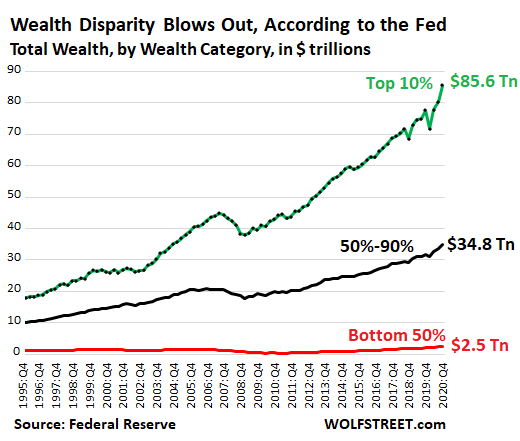
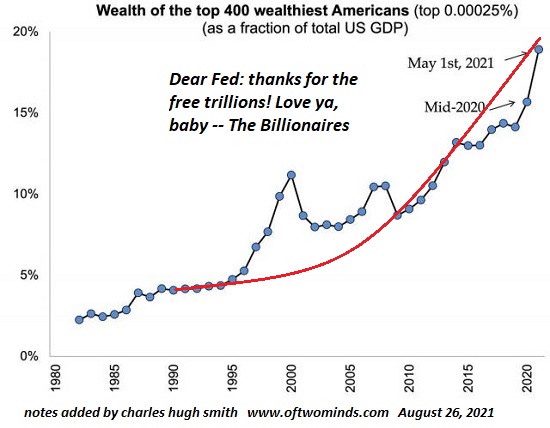
One might anticipate that the bottom 50%’s meager share of the nation’s exploding wealth would have increased as smartly as the wealth of the billionaires, but alas, no.

America’s economy has changed in ways few of the winners seem to notice, as they’re too busy cheerleading their own brilliance and success. In the view of the winners, who just so happen to occupy all the seats at the media-punditry-Federal Reserve, etc. table–the rising tide of stock, bond and real estate bubbles are raising all boats. What’s left unsaid is except for the 50% of boats with gaping holes below the waterline, i.e. stagnant wages and a fast-rising cost of living.

The truth the self-satisfied winners don’t include in their self-congratulatory rah-rah is there’s no place for the bottom 50% of American households to go but down. All the winnings flow to those who already owned assets back when they were affordable– the already-wealthy–whose wealth has soared as assets have shot to the moon while the the burdens of inflation and debt service hit the bottom 50% the hardest.

Meanwhile, the Federal Reserve is whining that inflation isn’t high enough yet for their refined tastes. Boo-hoo, how sad for the Fed–inflation isn’t yet high enough. Oh wait–didn’t they each mint millions by front-running their own policies? No wonder they’re not worried about inflation.

The reality few acknowledge is that globalization and financialization have stripped the American economy of low-skilled jobs that don’t demand much of the employee. The reality is that a great many people don’t have what it takes to learn high-level skills and work at a demanding pace under constant pressure–the description of the average job in America.

There were once millions of low-skill, low-pay jobs for people who for whatever mix of reasons were unable to muster the wherewithal to fulfill the fantasy of working extra hard, going to night school, soaking up high-level skills, moving quickly up the ladder to higher pay, buying the starter home and then moving up the food chain to middle class security from there.

The cost of living was low enough that those working these low-skill, low-pay jobs could still have an independent life. There were still low-cost rentals, often derided by the wealthy, in nooks and crannies of even the costliest cities. (I once lived in a room stuffed with old tax records in a poolside shack in an upscale neighborhood. The room had been cleared for a single bed and a path to the decrepit bathroom. Its most important attribute was that I could afford it on my low earnings.)

Affordable housing has vanished, eliminated by the financialization of America’s economy. Once landlords pay double the price for the property, rents have to double to pay their higher expenses. The apartment didn’t double in size or amenities–the rent doubled without any increase in utility to the renter. You get nothing more for double the price–nice.

Yes, people could make better choices, and some do. The point here is the game is rigged against those in the lower tier of the economy who can no longer afford a house or other stake in the only winning game in town–speculative asset bubbles. Go ahead and work a second job and go to night school–you’ll still be left behind the already-rich.

Globalization opened every job in America to global competition via offshoring or the influx of undocumented workers so desperate to support their families back home that no pay was too low and no working condition too wretched to refuse.

Many overindulged pundits who never worked an honest day in their lives sneer about burger flippers without realizing how hard those burger flippers have to work. I doubt the well-dressed pundits, snobbish about their university degrees and general brilliance, could manage to work a single day in a demanding fast-food job.

As the price of housing and other assets have soared, enriching the already rich, they’re out of reach for the bottom 50% who struggle to pay their bills as wages have stagnated and the costs of essentials have skyrocketed.

The rising cost of parking tickets, junk fees, user fees, utilities and food don’t impact the well-paid top 5% technocrat class, whose stake in the Everything Bubble keeps expanding by tens or hundreds of thousands of dollars. But for the bottom 50%, those incremental increases are, when added to higher rents, absolutely crushing.

As for getting high-quality healthcare that includes mental health support–those are reserved for the rich. But no worries, self-medication is always a “choice.”

Getting a boost in pay from $12 an hour to $15 an hour is welcome, but that doesn’t put the worker any closer to affording a house or equivalent stake in the Everything Bubble.

The new feudalism is masked by the glossy SillyCon Valley PR of a gig economy where (per the PR fantasy) bright, shiny and totally independent workers freely choose to serve the winners in the rigged sweepstakes for low pay and zero benefits.

In the SillyCon Valley PR, serfs freely choose to serve their noble masters for nothing but survival because they love the “freedom” and “choice” of kissing the nobility’s plump derrieres. (After all, there were “choices” even back in the good old days of feudalism–one could join the brigands in the forest, or enlist in a poorly paid mercenary army where the odds of dying were high–you know, “choices” of “gigs.”)

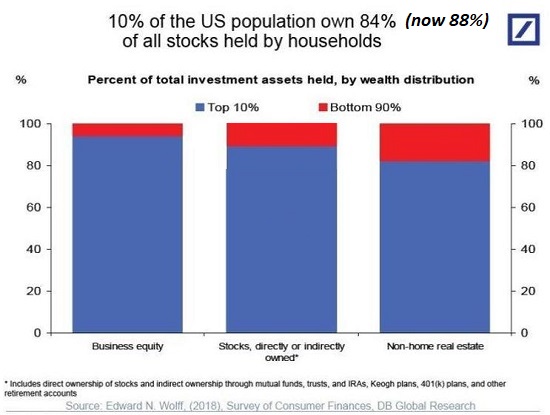
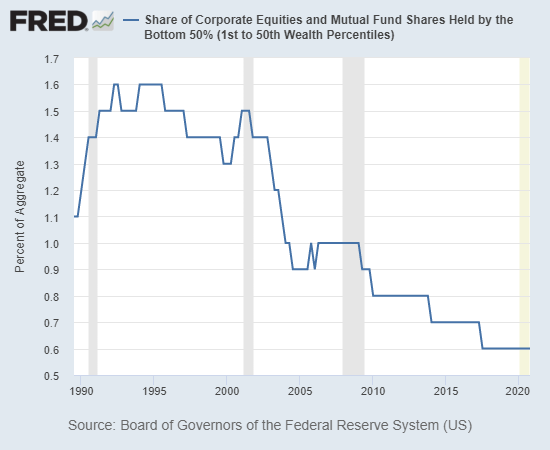
One might anticipate that the bottom 50%’s meager share of the nation’s exploding wealth would have increased as smartly as the wealth of the billionaires, but alas, no–the bottom 50%’s share of stocks (equities) actually plummeted in the the glorious decades of Federal Reserve free money for financiers, stock buy-backs and asset bubbles.

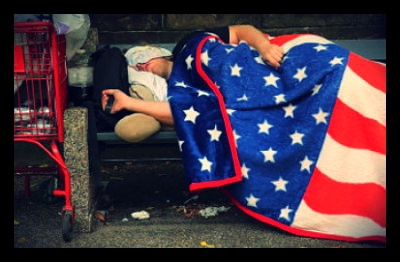
All this suits the billionaires and those collecting the crumbs of the Everything Bubble just fine. So what if the bottom 50% have nowhere to go but down? There’s plenty of room in the homeless encampment for another broken down station wagon or an old camper. There’s lots of “choices.”

And no consequences for the winners, of course, because The Fed has our backs.
America Is Now a Kleptocrapocracy

By Charles Hugh Smith

Source: Of Two Minds

I’ve coined a new portmanteau word to describe America’s descent: kleptocrapocracy, a union of kleptocracy (a nation ruled by kleptocrats) and crapocracy, a nation drowning in a moral sewer of rampant self-interest in which the focus is cloaking all the skims, scams, rackets and bezzles in some virtuous-sounding garb, a nation choking on low-quality junk ceaselessly hawked by robocalls, spam, phishing and Big Tech manipulation.

It’s little wonder trust has collapsed in America: the only thing we can trust is whatever’s being pitched is deceptively packaged to mask the self-interest and profiteering of the perps.

The stench from the decomposing carcasses of once-trusted institutions is everywhere. Insiders and the marketers they pay to cloak their grifting are banking bennies at the expense of hapless debt-serfs who fell for the scam. You need these three costly medications, and then when the side-effects kick in, you need six more to counteract the first three, and so on. But trust us; your “health” (heh) is our only concern. Uh, sure.

Why do state universities need to market themselves like a roto-rooter service? Maybe because they’re both working the sewers: state universities are exploiting the student loan sewers, desperate to recruit another batch of debt-serfs who fell for the 3-card monte game in which a lifetime of debt is exchanged for a credential of dubious value.

The competition for the remaining pool of debt-serfs is heating up, so like everything else in America, the game is now all about marketing, virtue-signaling, exploiting Big Tech manipulation, and so on.

Doing something useful is now for chumps. The opportunities in America are all about getting rich by doing, well, nothing: skimming 20% “guaranteed” returns in DeFi, mining cryptos, trading stablecoins, selling volatility, etc.–getting rich and then living large on the sweat of the chumps who are still working (poor deluded fools!).

The obvious goal here is for everyone to get in on trading stablecoins, buying rentals with DeFi, churning meme stocks, etc. Why should anyone lower themselves to doing something useful anymore? Why bother?

Labor has been degraded for decades in speculative-frenzy America. Why work when the Fed has our backs and all those newly issued trillions are up for grabs? Doing something useful is for chumps.

Nobody seems to ask what happens when we’re all minting fortunes off speculative churn and there’s nobody filling potholes, stocking shelves or carrying bags of QuikCrete to customers’ trucks.

And while we’re on the subject of sewage: if America’s security services and Big Tech oligarchies track everything and everyone, why are we drowning in robocalls, spam, SMS-spam (smishing), etc.? Couldn’t the NSA/CIA track the spammers and robo-callers down and rendition them (warrantlessly, of course) to a hellhole camp in an unnamed country?

Of course they could. But the ruination of everyday life is of no concern to the kleptocrats (fly with me to the stars!) or our dysfunctional government, which has become nothing more than an invitation-only auction of favors that elevates the relentless pursuit of self-interest and profiteering to new kleptocratic heights.

Please don’t make the mistake of expecting anything to work properly in America. The components are garbage, the parts are on back-order, the people who knew how to make the kludgy mess function just quit in disgust, and we’ll have to get back to you about your request, as our service staff just left to launch an OnlyFans site.

I don’t want to work, I’m minting money speculating, but gol-darn it, I want everyone else to wait on me and meet my needs for low, low quality goods and services at not-so-low prices, and if I’m not treated well enough by everyone earning chump-change, then I’ll freak out, and if that doesn’t pan out, I’ll blame it all on my meds. Accountability is like work–only for chumps.

Trust me, everything’s going great and we’re all going to get wealthier and wealthier until we won’t be able to take it any more, it will be so great. I hope everyone here is hungry because the banquet of consequences is being served.

The U.S. Economy In a Nutshell: When Critical Parts Are On “Indefinite Back Order,” the Machine Grinds to a Halt

By Charles Hugh Smith

Source: Of Two Minds

Setting aside the “transitory inflation” parlor game for a moment, let’s look at what happens when critical parts are unavailable for whatever reason, for example, they’re on back order or indefinite back order, i.e. the supplier has no visibility on when the parts will be available.

If the part that blew out is 0.1% of the entire machine, and the other 99.9% still works perfectly, the entire machine is still dead in the water without that critical component. That is a pretty good definition of systemic vulnerability and fragility, a fragility that becomes much, much worse if there are two or three components which are on indefinite back order.

This is the problem with shipping much of your supply chain overseas: you create extreme systemic vulnerability and fragility even as you rake in big profits from reducing costs. Speaking of costs, let’s look at the costs of having a large, costly, complex mechanism sitting idle in a non-functioning state due to some broken element for which there is no substitute available. Whatever productive capacity the mechanism, process, etc. had is now stuck at zero.

Buying a new replacement is extremely costly, and that’s not always available for all the same reasons that parts and components aren’t available. Finding someone to fabricate a new component is not easy due to the wholesale transfer of manufacturing moxie and capability overseas.

You might be able to find someone to weld a replacement strut, but try finding someone to fab a new bicycle derailleur or better yet, a multilayer semiconductor chip. What about 3-D fabrication? Doesn’t that solve this problem? If the part can be “printed,” yes, but there are limits on what can be 3-D fabbed. You can’t 3-D fab a complex thermostat or controller, for example. You can’t 3-D fab a rubber gasket, either, or a great many other bits of petrochemical-based manufacturing.

Scarcities are not limited to parts and components; skilled people can be scarce, too. For example, there is a limited supply of ICU doctors and nurses. The training required to work in an ICU is specialized and experiential; throwing someone with minimal training in is not a substitution that’s going to work. You can’t order an ICU staff from China or print one digitally the way the Federal Reserve creates currency out of thin air. It takes many years to train the staff to function at a high level in ICU.

A great many such labor scarcities exist for skilled workers who cannot be replaced except by someone with the same training and years of experience. This is one reason ICUs can break down: there is no replacement staff available, and no way to “print more.”

It turns out there’s also a scarcity of people willing to do the dirty-work jobs America needs done for wages that haven’t kept up with inflation. As I have explained here, the $1.65 minimum wage I earned in 1970, if factored for real-world inflation, is around $18 per hour, and arguably closer to $20 per hour.

The solution is to raise the pay to levels that attract workers, but then this requires raising prices on the good and services to the point that customers can no longer afford them.

But wait, can’t we automate all work and deliver full-gee-whiz free-money, no-work communism to everyone? I invite everyone who reckons this is in the realm of the do-able to design, program and manufacture an automated robot that can trundle out to the laundry room, pop open a broken clothes dryer, diagnose the problem, manage to find a new controller board, fit it correctly and properly reconnect all the little wiring bits, close it up, test it, lift the dryer back on the washing machine and do all that for the relatively modest cost of a human repairperson. When you accomplish fabricating and programming that robot to do all the work without instruction or oversight, by all means let us all know how much it cost to design, program and manufacture, what the payback of the development and manufacturing process will cost amortized over the (short) life of the robot and how reliable it is in the real world.

The point is, fantasies are nice but reality is far more demanding.

There can also be scarcities of competence. There may be replacements who claim competence, but when reality intrudes on the shuck-and-jive, their competence was illusory, and the net result is the entire institution can be described by President G.W. Bush’s memorable phrase, this sucker’s going down.

There can also be scarcities of institutional infrastructure and capacity. Once the institution, enterprise, state agency, etc. has been stripmined of redundancy, institutional memory and competence, then the first scarcity that cannot be replaced is the first domino that topples all the other dominoes of systemic vulnerability and fragility.

The Federal Reserve can print trillions of dollars and the federal government can borrow and blow trillions of dollars, but neither can print or borrow supply chains, scarce skills, institutional depth or competence. That nice shiny new semiconductor fab you reckon will resolve the chip shortage? You can print the billions of dollars needed in an instant, but the machinery, expertise and time can’t be conjured quite so easily. That fab is years away from completion no matter how many freshly conjured dollars you throw into the air.

When Critical Parts Are On “Indefinite Back Order,” the Machine Grinds to a Halt: that’s the U.S. economy in a nutshell.

A great many essential components in America are on indefinite back order, including the lifestyle of endless globally sourced goodies at low, low prices. That lifestyle is out of stock and cannot be replaced with financialization fakery.

Hey, Federal Reserve, can you conjure up a non-corrupt financial system, a domestic supply chain, and an economy of open competition, transparency, accountability and competence? If not, you are even more worthless than we feared.

Jeff Bezos Embodies the Cruel Autocracy of Neoliberal Capitalism

Amazon CEO and richest-man-in-the-world Jeff Bezos wants you to work as much as he does—for one millionth of the pay

By Branko Marcetic

Source: In These Times

“Is Jeff Bezos a horrible boss and is that good?” That was the question posed by Forbes magazine in 2013, a sentiment that helps explain why Amazon’s founder and CEO is detested by the Left for his oligarchic ambitions, while simultaneously admired by America’s capitalist class for his business success. Ironically, Bezos is also loathed by former President Donald Trump, while celebrated by many liberals for so-called resistance.

But with Bezos and his $115 billion fortune laying claim to the title of richest man on Earth, and with Amazon playing an increasingly influential role in public life, it is worth asking: What does Jeff Bezos stand for?

A gifted child born to a teen mom, Bezos grew up not knowing his biological father, who was once one of the top-rated unicyclists in Albuquerque, N.M. Instead, Bezos was raised by the man his mother soon married: Miguel Bezos, who had fled Cuba and the Communist revolution, which had shuttered the elite private Jesuit school he attended, as well as his family’s lumberyard.

Journalists have speculated whether Bezos’ near-pathological competitiveness is a product of his early abandonment, similar to that of fellow tech overlord Steve Jobs. No doubt equally formative was Bezos’ adoptive father, who told Brad Stone, author of The Everything Store: Jeff Bezos and the Age of Amazon, that their home life was ​“permeated” by complaints about totalitarian governments of both the Right and the Left.

Bezos envisioned the concept of an ​“everything store” while working for a Wall Street hedge fund in the 1990s. He opened Amazon in 1994 as an online bookshop, a pragmatic starting point. Bezos gave the company his own $10,000 cash injection, took out interest-free loans, and received $245,000 from his parents and family trust.

Many of Amazon’s controversial labor practices can be traced to these early years as a plucky start-up. Amazon’s small team ran on tireless ambition to live up to the company’s customer-focused promise — key to its eventual market domination. Stone reports that, to meet Bezos’ ​“get big fast” directive, employees devoted themselves completely, working long, unusual, frenzied hours. One early warehouse worker who biked to work simply forgot about his improperly parked car, eventually discovering it had been ticketed, towed and sold at auction.

Such a relentless pace is one thing for a small group of true believers but is quite another when applied to low-wage workers just making ends meet. By 2011, Amazon’s workplace culture became known through a series of headline-grabbing reports that have come to define its public image: badly paid, ceaselessly surveilled, overworked workers, struggling to maintain a breakneck pace.

Bezos created a culture in which everyone from the lowest peon to the highest-ranking executive is expected to match his own devotion, an approach that resulted in spectacular levels of staff turnover by the early 2000s. A declared enemy of ​“social cohesion,” Bezos pushed his underlings to reject compromise and instead fiercely debate and criticize colleagues when they disagreed. One former employee described it as ​“purposeful Darwinism.” Known for withering put-downs — ​“Are you lazy or just incompetent?” ​“Did I take my stupid pills today?”—Bezos also isn’t above pulling out his phone or, in some cases, simply leaving the room when an employee fails to impress.

The flipside of Bezos’ intellect is a cold, clinical approach to human relations. Bezos described himself as a ​“professional dater” during his Wall Street days, trying to improve what he called his ​“women flow” — a riff on the Wall Street term ​“deal flow.”

“He was not warm,” one person who knew Bezos during his Wall Street days told the East Bay Express in 2014. ​“It was like he could be a Martian for all I knew.”

Bezos’ pitiless leadership style bled out beyond the Amazon boardroom as he used the company’s growing market share to bully book publishers into his terms. The company launched the ​“Gazelle Project”—as in, go after publishers ​“the way a cheetah would pursue a sickly gazelle” — allowing Amazon to undercut its competition at the cost of little to no profit for smaller publishers.

As Amazon inched closer to Bezos’ original vision, it began lobbying efforts in 2000 and became more transparently political by 2011, spending millions to defeat an internet sales tax and playing hardball with state governments, threatening to shutter Amazon facilities if its wishes went unfulfilled. In 2013, Amazon began lobbying Congress to cut corporate taxes.

The same year, Bezos bought the Washington Post, invested in Business Insider and donated to the publisher of the libertarian magazine Reason. Though Bezos argues his purchase of the Post was motivated by ​“a love affair [with] the printed word” and a desire to support American democracy, others suspect Bezos’ interest in media is related to bad press following a scathing Lehman Brothers report in 2000, which sent Amazon’s stock price tumbling.

Leading up to the Post purchase, Bezos was increasingly displaying what early Amazon investor Nick Hanauer called his ​“libertarian politics.” In addition to spending $100,000 in 2010 on a campaign to defeat a proposed Washington state tax on high-income earners, Bezos put hundreds of thousands of dollars toward boosting charter schools and other neoliberal education reforms.

Bezos’ political involvement reached a new apogee in 2019 during the re-election bid of Seattle’s socialist city councilwoman, Kshama Sawant, who called Bezos ​“our enemy” and tried to pass a head tax to fund housing for those displaced by Amazon’s Seattle footprint. Amazon spent $1.5 million against Sawant and other progressive candidates, a record at the local level, with more than a dozen of the company’s executives contributing to Sawant’s opponent. (Sawant won re-election anyway.)

As for Bezos’ endgame? A Trekkie since childhood, he has long dreamed of funding space exploration, a mission pursued by other superrich moguls (such as Elon Musk) in the face of the climate emergency. Opening the doors of his secretive Blue Origin aerospace company to journalists for the first time in 2016, Bezos told the New York Times he envisioned a future of ​“millions of people living and working in space,” exploiting the natural resources of surrounding planets and rezoning Earth ​“as light industrial and residential.”

Ironically, as Bezos pours the wealth he wrung out of exhausted, low-wage Amazon workers into space exploration, Amazon is busy hastening the very planetary collapse Bezos claims he’s trying to prevent — by silencing workers who speak out against Amazon’s assistance to oil and gas companies.

Let’s imagine, however, that Bezos, who accumulates $9 million an hour, lived in a world with Bernie Sanders’ 8% wealth tax (just on fortunes over $10 billion). A single year would see $9 billion flow from Bezos’ treasure trove into government coffers, more than enough to cover the 10-year cost of Elizabeth Warren’s universal child care plan ($1.7 billion) and maintain safe drinking water under Sanders’ plan ($6 billion).

Bezos’ career is a testament to the cruel autocracy and senseless misallocation of resources that our neoliberal capitalist system enables. But his opulence also reveals that the wealth exists to build a fairer and more equitable society — if redistributed. Bezos may loathe social cohesion, but in a world organized around democracy rather than the whims of space-billionaires, it’s something we may well be able to achieve.

Is the American Dream Still Alive? (Infographic)

Source: Strategic Culture Foundation

The post-WWII United States was at the peak of its soft power. One of its pillars was the American Dream. Every American could expect that his children would be better off – better off in every respect: healthier, longer-lived, better educated, happier, richer – than he was. Seventy years later, this dream seems to be blown to bits.

The Top 10% Is Doing Just Fine, The Middle Class Is Dying on the Vine

By Charles Hugh Smith

Source: Of Two Minds

Please study these charts as a means of understanding the inevitability of economic stagnation and a revolt of the decapitalized middle class.

I’ve been covering the decline of America’s middle class for over a decade with charts, data and commentary on the social depression that has accompanied the decline.

While there are many mutually reinforcing dynamics in this 45-year decline–demographics, global energy costs, financialization and globalization, to name a few– one term describes the accelerating erosion of America’s middle class: decapitalization.

To understand decapitalization, we need to start with the fundamentals of any economy between labor (wages) and capital and between investment and speculation. Although it’s tempting to oversimplify and demonize one or the other of these basics (speculators bad! etc.), they each provide an essential role in a healthy economy, one which is in dynamic equilibrium, a state analogous to a healthy ecosystem with constantly changing interactions of numerous species, individuals and inputs (weather, etc.). This variability enables the order of fluctuations (to use Ilya Prigogine’s profound phrase), a dynamic stability / equilibrium.

If labor’s share of the economy drops too low, the workforce cannot consume enough to support their households and the economy as a whole. If capital can no longer earn an attractive return, investment dries up and production stagnates. If speculators are not allowed to take on risk, liquidity dries up and risk crushes investment. But if speculation becomes the foundation of the economy’s “growth,” then the inevitable collapse of speculative bubbles will crash the economy.

In modern social-capitalist systems, the core stabilizer of the system is the wage-earning middle class which provides the stable workforce driving production and the stable pool of consumers needed to borrow money and consume enough to soak up the production of goods and services at a profit to producers.

Without a stable, dominant middle class, capital has few opportunities to invest in productive capacity. Without a stable, dominant middle class, the economy stagnates and is prone to collapse as it is far from equilibrium.

The process of middle class decline is best explained as decapitalization because the middle class is fundamentally a means of transforming labor into capital via savings and investment. The traditional ladder of social mobility from the working class to the middle class is one of capitalizing work: time and savings are invested in higher education, in effect capitalizing future labor by increasing productivity.

Capital isn’t limited to cash, land or tools; in an information economy, knowledge and skills are also capital, as is the social capital of social networking and relationships formed with mentors, suppliers, lenders, colleagues, investors, etc.

The second way to capitalize work is to save earnings and invest the savings in assets that produce income or gain value: a house, land, rental property, small business and income-producing financial assets such as bonds or dividend-paying stocks.

Thrift, investing, long-term planning and deferred consumption are all essential to capitalizing work by turning that labor into income-producing assets. As the household’s ownership of these assets that yield unearned income rises, so does their income and wealth. These increase the financial security of the household and build a nestegg which can be passed down to the next generation, improving their security via inheritance of income-producing assets.

As long as productivity is increasing the value of their labor, the middle class can leverage future earnings into assets by borrowing money to invest in assets: to buy a house, a mortgage is borrowed against future earnings. As long as the mortgage is a fixed-interest loan and income can be expected to rise with productivity, then this is a win-win situation: capital earns a predictable, low-risk return from the mortgage and the middle class household has stake in a family home, an asset which acts as a savings mechanism as the mortgage slowly pays down the debt and increases the household’s home equity–a form of savings.

The processes of decapitalization have upended this entire structure. In the systems context outlined above, our economy is out of balance and far from equilibrium and thus prone to collapse.

For the bottom 90%, which of course includes the middle class however you define it, it’s increasingly difficult to capitalize labor into capital. There are a number of factors driving this decapitalization:

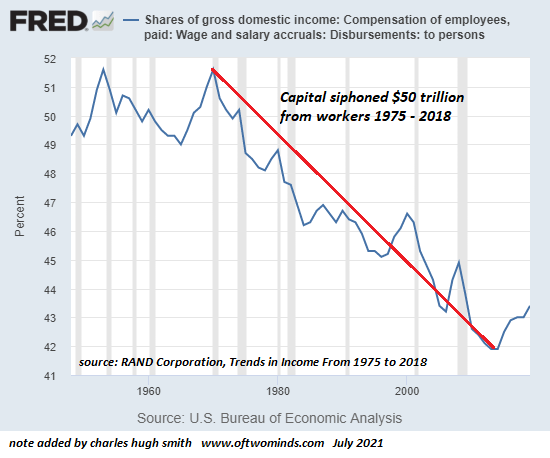
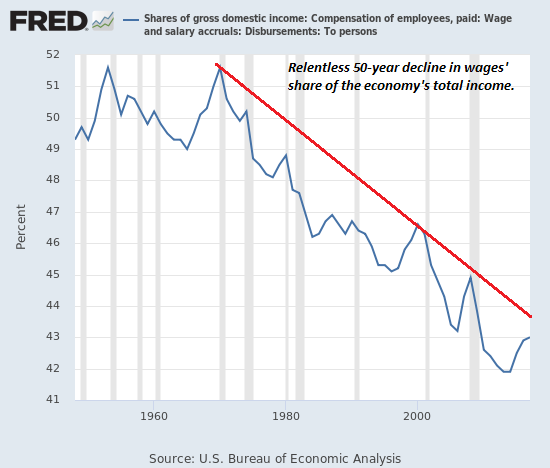
1. Wages’ share of the national income has continued a five-decade downtrend. (See chart below) National income since 1973 has shifted from labor (wages) to capital and more specifically, to debt and speculative gaming of the system, a.k.a. financialization.

Total household income in the U.S. in 2018 was $17.6 trillion. The decline in wages’ share of the national income from 1973 to 2018 is about 8.5%, which equals $1.5 trillion, the sum shifted from labor to capital every year. (See chart below)(source: https://www.statista.com/statistics/216756/us-personal-income/)

No, this is not a typo. As this RAND report documents, $50 trillion has been siphoned from labor (the lower 90% of the workforce) to the Financial Aristocracy and their technocrat lackeys (the top 10%) who own the vast majority of the capital (see charts below): Trends in Income From 1975 to 2018.

2. Within the workforce, wages have shifted to the top 10% who now earn 50% of all taxable income. (See RAND chart below) Financialization and globalization have decapitalized the skills of entire sectors of the workforce as automation and offshoring reduced the human capital of workers’ skills and experience and the value of their social capital. When the entire industry is offshored, skills and professional relationships lose their market value.

In a fully globalized economy, every worker producing tradable goods/services is competing with the entire global workforce, a reality that reduces wages in high-cost developed nations such as the U.S.

Financialization has heavily rewarded workers with specialized gaming the financial system skills and devalued every other skill as only the skills of financialization are highly profitable in a globalized, financialized economy.

3. As the high-wage jobs and capital shifted to coastal urban centers, middle class owners of homes and capital elsewhere saw the value of their assets decline. If a home valued at $100,000 in the late 1990s is now worth $150,000, the owners lost ground even with “official” inflation. In terms of real-world purchasing power, their home actually lost significant value in the past 23 years.

Meanwhile, middle class owners who bought their home in a coastal hot-spot for $100,000 23 years ago are now enjoying home valuations close to $1 million. Homes, along with every other asset, have been shifted into a casino where almost everyone is sorted into winners and losers, less often by skill and more often by luck.

For those who were too young to buy in 1997, sorry–the opportunity to buy a home for three times average middle class income is gone. The lucky generation who bought in the late 1990s in booming coastal magnets for global capital joined the top 10% and their colleagues in less desirable regions lost ground.

4. As capital siphoned off income and appreciation from labor (human and social capital), the gains accruing to capital accelerated. Those who already owned income-producing assets reaped both income and asset appreciation gains as yields on savings collapsed to near-zero as the Federal Reserve and other central banks dropped yields to near-zero in 2009 and kept them low for the following 13 years.

This had two devastating effects on the middle class: hundreds of billions of dollars that once flowed to savers and money markets disappeared, swallowed by the banks as a direct (and intentional) effect of the Fed’s ZIRP (zero-interest rate policy).

Since the Fed destroyed low-risk yields, anyone seeking any real yield (i.e. above inflation) would have to enter the casino and compete with hedge funds, insiders and the Financial Aristocracy. Very few middle class workers have the skills and experience to beat the pros in the casino, and so income and wealth accrued to those who already owned capital.

This is a key reason why the rich got richer and the poor got poorer. Those with capital accrued the majority of gains in income and wealth, leaving the bottom 90% in the dust.

A recent Foreign Affairs essay Monopoly Versus Democracy included these stunning statistics:

Ten percent of Americans now control 97 percent of all capital income in the country. Nearly half of the new income generated since the global financial crisis of 2008 has gone to the wealthiest one percent of U.S. citizens. The richest three Americans collectively have more wealth than the poorest 160 million Americans. (emphasis added.)

The 3% of income from capital collected by the bottom 90%–which includes the middle class– is basically signal noise: the middle class collects inconsequential crumbs of income from capital.

Prior to the Fed’s ZIRP and financialization of the economy, the middle class could both collect income from capital they owned and they could afford to acquire assets that yielded low-risk solid returns. Now they can do neither. Even worse, the puchasing power of their labor continues to decline, leaving them less able to save and buy assets.

This is why The Top 10% Is Doing Just Fine, The Middle Class Is Dying on the Vine. Please study these charts as a means of understanding the inevitability of economic stagnation and a revolt of the decapitalized middle class.


On Capitalism and the Machine

By Megan Sherman

Source: Global Research

In 1935, reflecting on the creed of productivity which prevailed in modern technological societies, Bertrand Russell, philosopher, pacifist and devout humanist wrote that:

I think that there is far too much work done in the world, that immense harm is caused by the belief that work is virtuous, and that what needs to be preached in modern industrial countries is quite different from what always has been preached.”

‘In Praise of Idleness and other essays’ is a collection of striking power and originality. Whereas the receieved wisdom of his era held that virtue consisted in yielding to work, monotony and routine, Russell maintained it was not the sole end of life, that beyond work, people needed leisure and pleasure in order to fully live, that what was sought to truly advance society and fortify the human condition was the “organized diminution of work.”

Through the 1920s and 30s Fordism advocated the exact opposite and the cult of productivity began to exert a strong hold on economic and social organization in Europe, the USA and Soviet Union. In the story Brave New World, Aldous Huxley envisioned a society of tyrannical collectivism which raised hell on Earth. In this dehumanizing, nihilistic oblivion, Henry Ford was worshipped as a deity and the fundamentalism of mass production crept in to all spheres of life, rigidly classifying people whose whole lives were planned out on a callow basis of crude economic worth. It was a study in how powerful forces of sublimation and repression incarnate in the edifice of the modern world mutilate our most vital, human instincts and wrench us from our roots.

Huxley’s main belief was that technological ‘progress’ had empowered the worst bureaucrats to assimilate citizens in to a sophisticated machine of repression and control which blocked and frustrated their freedom. Although, as Russell observes, in truth “with modern technique it would be possible to distribute leisure justly without injury to civilization“, the owners of the means of production in the capitalist economy absorb modern technique in to their arsenal against collective liberation. It is not in their interests to free us from bonds.

Of the proprietary class, Russell says:

their desire for comfortable idleness is historically the source of the whole gospel of work. The last thing they have ever wished is that others should follow their example. “

That is to say that freedom and unfreedom aren’t opposites. The affluence and freedom of the proprietors actively depends on the subjugation of workers who create value.

Throughout his life Bertrand Russell was keenly involved with communities of students, activists and workers who organized against imperialism and the war machine. His belief that people could work less and live more was part of his belief that the economic system could be harnessed to more altruistic ends, justified more reasonably, attuned to satisfy people’s needs and fit to unleash their inherent creative power, instead of conforming to bourgeois imperatives.

Lately Professor Stephen Hawking has weighed in on the question of modern social organization and proffered the view that people need not be scared of machines, but ought to be wary of the systems and people who wield them. Why be scared of the unknown power of machines when what we know about the people who own them is far, far scarier?

Hawking said:

If machines produce everything we need, the outcome will depend on how things are distributed. Everyone can enjoy a life of luxurious leisure if the machine-produced wealth is shared, or most people can end up miserably poor if the machine-owners successfully lobby against wealth redistribution. So far, the trend seems to be toward the second option, with technology driving ever-increasing inequality.”

Hawking’s view is much like Russell’s and would be called post-scarcity economics. The crux of this view is that competition for resources is not a necessary feature of an economy, that material abundance may be universal instead of there being a socially imposed monopoly of access, regulated by money and work. Like trickle-down theory, scarcity economics is not necessarily based in reality. It goes without saying that obviously we need to find a way reach this economy and mode of production in accordance with environmental protection, which models after the Industrial Revolution got disastrously wrong.

The challenge of the future is to make machines our allies and not our jailers.

A Debt Jubilee Is the Only Way to Avoid a Depression

By Michael Hudson

Source: The Unz Review

Even before the coronavirus appeared, many American families were falling behind on student loans, auto loans, credit card balances and other payments. America’s debt overhead was pricing its labor and industry out of world markets. A debt crisis was inevitable eventually, but covid-19 has made it immediate.

Massive social distancing, with its accompanying job losses, stock dives, and huge bailouts to debt-strapped corporations, raises the threat of a depression. But it doesn’t have to be this way. History offers us another alternative in such situations: a debt jubilee. This slate-cleaning, balance-restoring step recognizes the fundamental truth that when debts grow too large to be paid without reducing debtors to poverty, the way to hold society together and restore balance is simply to cancel the bad debts.

The word Jubilee comes from the Hebrew word for trumpet — yobel. In Mosaic Law, it was blown every fifty years to signal the Year of the Lord, in which personal debts were to be cancelled. The alternative, the prophet Isaiah warned, was for smallholders to forfeit their lands to creditors: “Woe to you who add house to house and join field to field till no space is left and you live alone in the land.” When Jesus delivered his first sermon, the Gospel of Luke describes him as unrolling the scroll of Isaiah and announcing that he had come to proclaim the Year of the Lord, the Jubilee Year.

Until recently, historians doubted that such a debt jubilee would have been possible in practice, or that such proclamations could have been enforced. But Assyriologists have found that from the beginning of recorded history in the Near East, it was normal for new rulers to proclaim a debt amnesty upon taking the throne. Instead of blowing a trumpet, the ruler “raised the sacred torch” to signal the amnesty.

It is now understood that these rulers were not being utopian or idealistic in forgiving debts. The alternative would have been for debtors to fall into bondage. Kingdoms would have lost their labor force, since so many would be working off debts to their creditors. Many debtors would have run away (much as Greeks emigrated en masse after their recent debt crisis) and communities would have been prone to attack from without.

The parallels to the current moment are notable. The U.S. economy has polarized sharply since the 2008 financial crisis. For far too many, the debts in place leave little income available for spending on goods and services or in the national interest. In a crashing economy, any demand that newly massive debts be paid to a financial class that has already absorbed most of the wealth gained since 2008 can only further split our society.

This has happened before in modern times — after World War I, the burden of war debts and reparations bankrupted Germany, contributing to the global financial collapse of 1929-31. Most of Germany was insolvent, and its politics polarized between the Nazis and Communists. We all know how that ended.

America’s 2008 bank crash offered a great opportunity to write down the often-fraudulent junk mortgages that burdened many lower-income families, especially minorities. But this was not done, and millions of American families were evicted.

The way to restore normalcy today is a debt writedown. The debts in deepest arrears, and most likely to default, are student debts, medical debts, general consumer debts and purely speculative debts. They block spending on goods and services, shrinking the “real” economy. A debt writedown would be pragmatic, not merely a moral sympathy with the less affluent.

In fact, it could create what the Germans called an “Economic Miracle” — their own modern debt jubilee in 1948, the currency reform administered by the Allied Powers. When the Deutsch Mark was introduced, replacing the Reichsmark, 90 percent of government and private debt was wiped out. Germany emerged as an almost debt-free economy, with low costs of production that jump-started its modern economy.

In the past, the politically powerful financial sector has blocked a writedown. Until now, the basic ethic of most people has been that debts must be repaid. But it is time to recognize that most debts now cannot be paid — through no real fault of the debtors in the face of today’s economic disaster.

The coronavirus outbreak is serving as a mind-expansion exercise, making hitherto unthinkable solutions thinkable. Debts that can’t be paid, won’t be. A debt jubilee may be the best way out.


Michael Hudson, author of “… and forgive them their debts” and “Killing the Host,” is president of the Institute for the Study of Long-Term Economic Trends and is Distinguished Research Professor of Economics at the University of Missouri–Kansas City.