Saturday Matinee: Starman 

The Complete Carpenter: Starman (1984)

By Ryan Harvey

Source: Black Gate

It’s taken me exactly a year to go from Dark Star to Starman in my survey of John Carpenter’s career. At this rate, I’ll be at Escape From L.A. by this time in 2018. The timing works out on this one, however. There’s no “winter holiday” Carpenter movie — no, The Thing doesn’t count, that’s a “winter” movie — but Starman is as cheerful and uplifting a science-fiction tale as Carpenter has ever turned out, so it feels right for December.

Starman has quite the long history behind it. The script was in development at Columbia back in 1980 and went through a round-robin of writers. Columbia had the opportunity to do the Spielberg project that would eventually turn into E.T., but turned it down in favor of Starman — a decision the studio would come to regret when E.T. became the highest-grossing movie in history during the Summer of 1982 (when it squashed a certain other alien visitor movie).

The mega success of E.T. caused director John Badham to abandon Starman because he thought it was too similar to Spielberg’s movie. (Badham went on to direct WarGames, so that worked out.) Many other directors were on the film at one time or another — Adrian Lynne, Mark Rydell, Tony Scott, Peter Hyams — but John Carpenter had the pitch that stood out: film it as a love story/road movie in the classic Hollywood vein. Like It Happened One Night, but with an alien. Carpenter wanted to show he had the directing chops to tackle a different type of material. He was also still wounded over the poor reception of The Thing and wanted to deliver a hit for a big studio.

And thus we have a John Carpenter film for the whole family! Which is odd enough on its own.

The Story

Advanced extraterrestrials discover space probe Voyager II and choose to answer humanity’s invitation to “come and see us sometime,” as inscribed on the probe’s audio-visual disc. An alien observation ship heads to Earth, but the U.S. Air Force knocks it from its planned course so it crashes in rural Wisconsin. The disembodied alien aboard takes on the human shape of Scott Hayden (Jeff Bridges), the recently deceased husband of lonely Jenny Hayden (Karen Allen), by using DNA from a lock of Scott’s hair.

Jenny’s reaction to the physical resurrection of her husband with an extraterrestrial’s mind is… complex. She agrees to drive Starman-Scott to Arizona for a rendezvous with a ship from his homeworld. At first she acts out of fear, but later because she’s genuinely falling in love with the being in Scott’s shape — and she knows his body will die unless he makes the rendezvous. Their cross-country trip must stay ahead of pursuit by the police, a curious SETI scientist (Charles Martin Smith), and an aggressive National Security Agency director (Richard Jaeckel) who isn’t interested in giving the alien the “friendly reception” promised on Voyager 2’s golden disc.

The Positives

Starman is a sweet, lyrical movie that has aged beautifully. It’s Carpenter’s most humanist film, the opposite of the invasion paranoia and frigid horror of The Thing. But Starman isn’t Carpenter attempting to do a karaoke E.T. or imitate Spielberg, even considering the background of the project. No one else could’ve made Starman the way Carpenter did. E.T. is a science-fiction fable about childhood. Starman is a science-fiction fable about adulthood, realized as a road movie. It’s also a beautiful and complex romance about love rediscovered and hope overcoming morbidity and the human tendency to cynicism. Yes, overcoming cynicism in a John Carpenter film!

In short, this is probably the only John Carpenter film you can show to your Great Aunt Betty. Or to any other relatives who just don’t get out to movies that often. It’s a four-quadrant film — the only one in the director’s career.

It’s astonishing/aggravating how the 1980s shrugged off the brilliance of Jeff Bridges. It wasn’t until the late 1990s that the entertainment world stopped taking him for granted as merely a handsome actor who had an almost proverbial trouble landing roles in hit movies. Starman is a perfect case of this: although he was nominated for an Academy Award for Best Actor that year, Bridges not only didn’t win, he didn’t experience a major career boost from the nomination. Starman was only a moderate success in 1984, which didn’t help, and people seem to have forgotten Bridges was even nominated for the movie.

Bridges’s Best Actor nomination is the only time any Carpenter film got an Oscar nod. (“What, The Thing wasn’t nominated for special effects?” you’re shouting. Nope, it wasn’t. Don’t shoot the messenger.) Bridges lost to F. Murray Abraham for Amadeus. I can’t complain much about this because Jeff Bridges eventually won an Oscar for Crazy Heart in 2009, Abraham was superb in Amadeus, and Bridges has never been anything but thankful for the career he’s had. (“I couldn’t of dreamed it being any cooler than it is,” he said in a 2009 interview.) But given all that, if I were an Academy voter in 1984, I’d definitely cast my vote for Jeff Bridges. Because he’s just amazing in Starman.

Bridges as Starman-Scott is immediately impressive for the unusual physicality the actor invests in the part. Viewers are continually reminded through even the smallest gestures (oh, that nutty smile!) that this is an alien creature trying to figure out the most basic workings of the human body and human communication. Just watching Starman attempt to navigate eating Dutch apple pie feels like a full acting course. There’s also tons of great humor from the character quirks, with gags that Terminator 2: Judgment Day would later recycle as Starman-Scott fumbles with colloquialisms and gestures like “Take it easy,” and “Up yours.” My favorite of these comedy bits is when Starman-Scott nearly gets him and Jenny killed on a railroad track because he learned the wrong lesson about driving from watching her: “Red light stop, green light go, yellow light go very fast.”

But what Bridges achieves with the role is bigger than odd tics and a physical sense of the alien. He shows Starman-Scott evolve over a few days from an entity that terrifies Jenny into a person she loves deeply, and not only because he resembles her deceased husband. Starman is an alien moving toward human — but also toward something better than human and better than his species, as he indicates his and Jenny’s son will be. His wordless resurrection of Jenny inside the trailer is a powerhouse moment for Bridges where he shows the key point of alien and human merging. (He never tells Jenny that he brought her back from death, a subtle but wonderful addition to the character.)

It takes two to make a romance story work, of course. Thankfully, Karen Allen delivers her career-best performance as Jenny Hayden. (Sorry, Raiders of the Lost Ark.) Starman-Scott may be the flashiest part, but Jenny is the main character who goes through the change from a woman burnt-out early in life by the loss of a loved one to a woman reborn with hope for the future. The role is an incredibly challenging one, putting the strain of a constant tug-of-war of emotions on Allen as she reacts to the bizarre actions and potential danger from an alien wearing the form of the recently deceased love of her life. That’s plenty for an actor to unpack in each scene, and Allen goes on an incredible emotional road trip along with the physical one. Trying to explain the meaning of love to Starman-Scott in the diner, right as she’s making another plan to escape from him, is one of the tear-jerking highlights. But it’s the scene aboard the train, where Starman-Scott tells her she will have his baby, that contains Allen’s finest moments. It’s also the best scene in the film, lovingly crafted in a way I’d wager most people in Hollywood would never have expected from John Carpenter.

Although still missing photographer Dean Cundey (Donald M. Morgan repeats from Christine), Carpenter lenses some amazing outdoor sequences using the open spaces of Middle America as a canvas. It’s the most visually wide-open film he ever shot. I’m used to complimenting Carpenter and his cinematographers for doing impressive work with the widescreen format in enclosed and dark spaces. Here’s the opposite: Carpenter having the opportunity to shoot a movie like a John Ford epic Western. He even gets to use Monument Valley!

Starman is my pick for the best score to a John Carpenter film not composed or co-composed by John Carpenter. Producer Michael Douglas convinced Carpenter to let Jack Nitzsche score the film, based on Douglas’s previous work with Nitzsche on One Flew Over the Cuckoo’s Nest. Nitzsche’s all-electronic score has some striking similarities to Carpenter’s own work (I think he paid close attention to the director’s musical style) but it develops enough of a separate identity. The main theme, a soaring love piece, is an exemplar of how mid-1980s composers were discovering ways to create vast electronic soundscapes. (See also: Vangelis.)

The only Carpenter Acting Company regular to pop up is Buck Flower, who plays a short-order cook who gives Starman-Scott a ride after the alien feels he’s putting Jenny in too much danger. It’s one of the funniest scenes, as the cook finds its surprisingly easy to chat with Starman-Scott’s odd handling of conversations:

Cook: What’s your line?

Starman-Scott: Line?

Cook: Work. Whaddya do when you’re not hitching rides?

Starman-Scott: Oh, I make maps.

Cook: Make any money?

Starman-Scott: [pause] I make maps.

Cook: Well, you don’t get rich cookin’ either!

At one hour and fifty-five minutes, Starman is John Carpenter’s longest movie. Think about that: nineteen movies on his resumé and none even reached the two-hour mark. That’s incredible, and it says plenty about what an efficient filmmaker and tight storyteller Carpenter is.

The Negatives

I don’t have much to say against Starman. As a gentle science-fiction romance, it’s nearly perfect. Yet … it’s never my first choice when I’m looking to rewatch a John Carpenter film. There’s so much to love about it, but it doesn’t engage me on the same level that even some ostensibly lesser entries in the Carpenter filmography do.

As I talked about above, this isn’t a sell-out movie or Carpenter trying to imitate a recent hit. This is no work-for-hire paycheck gig like Memoirs of an Invisible Man. But it feels like something Carpenter needed to do at least once so he could get back to the suspense, cynicism, and violent weirdness that are his specialty; the films of his that are endlessly rewatchable. Starman is an interesting detour for Carpenter, as well as a good film to share with non-fans and family members who don’t want to watch gang members murder a little girl, an “action adventure comedy Kung-Fu ghost story monster movie,” or a satirical/political allegory about alien invaders that also contains a prolonged wrestling scene. Just writing those descriptions explains a lot about why I love John Carpenter’s movies — and why I feel a touch removed from Starman.

One actual criticism I have is that the government/science sections of the story with scientist Mark Shermin and military blowhard George Fox are less developed than the road trip romance sections. The seamless split between these similar halves of the narrative that Spielberg achieved in Close Encounters of the Third Kind with Roy Neary’s collapsing family on one side and Lacombe’s quest on the other doesn’t occur here. The movie loses a bit of its momentum whenever it shifts away from its central couple.

Charles Martin Smith gives Mark Shermin personality, but there’s not much to the character on the page and his impact on events is minimal. The trimming down of the military, political, and SF aspects of the story to center more on the romance only really inflict damage to the movie in this case: it seems as if Shermin should have a larger role and much more to say about who and what the alien visitor is. His only encounter with Starman-Scott is a short one; I would’ve enjoyed a few additional minutes of exchange between them to learn more about Starman’s view of humanity and what drives Shermin.

The Pessimistic Carpenter Ending

Not applicable! This is as optimistic as Carpenter films come, leaving Jenny Hayden on Earth with her life renewed and the gift of a child from both her husband and the Starman — a child who shall become a teacher. You won’t find as optimistic a quote in the Carpenter canon as Starman’s observation on humanity: “Shall I tell you what I find beautiful about you? You are at your very best when things are worst.”

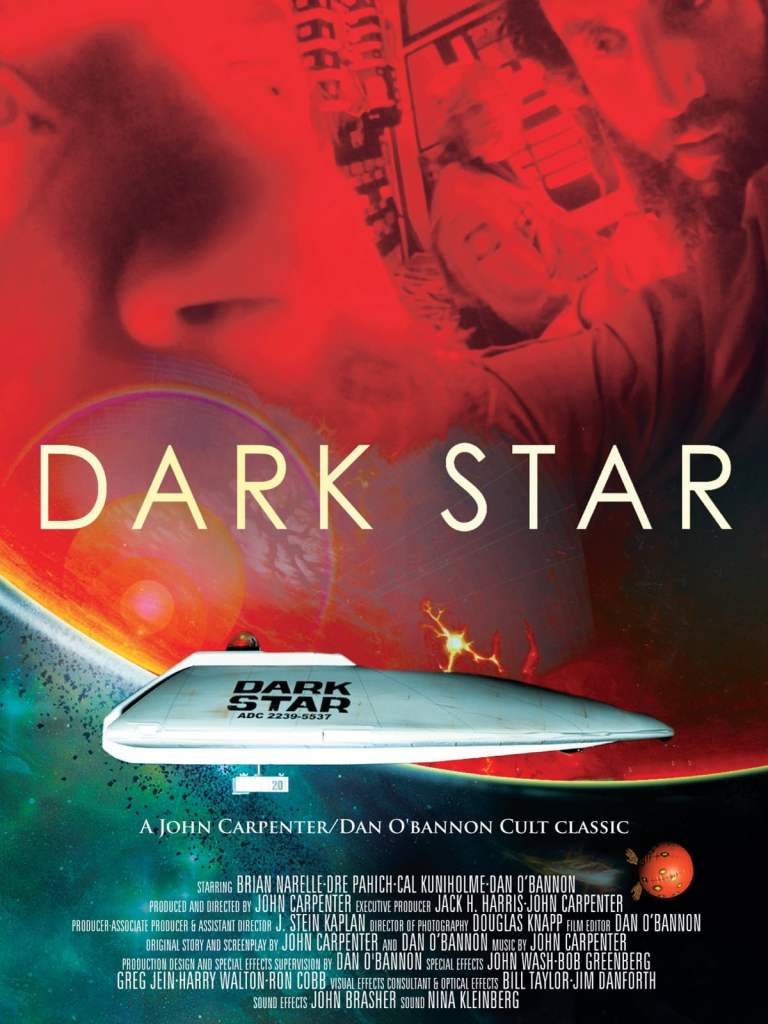
Saturday Matinee: Dark Star

By Roger Ebert

Source: RogerEbert.com

“Dark Star” is one of the damnedest science fiction movies I’ve ever seen, a berserk combination of space opera, intelligent bombs, and beach balls from other worlds. It has a checkered history. It began as a student project by John Carpenter (later to direct “Halloween“) and Dan O’Bannon (later to write “Alien“), and grew over a period of time and expanding budgets into a full-length film.

It was finished some four years ago, before “Star Wars,” and might have had a big success as a cult film if its original distributor hadn’t been so chicken-hearted that he dumped it in a string of Southern California drive-ins and then pulled it out of commercial release. As it is, “Dark Star” has found audiences on the campus and revival circuits, has been a hit here at Facets Multimedia, and, at last, is having its first commercial run at the Three Penny Cinema.

It was finished some four years ago, before “Star Wars,” and might have had a big success as a cult film if its original distributor hadn’t been so chicken-hearted that he dumped it in a string of Southern California drive-ins and then pulled it out of commercial release. As it is, “Dark Star” has found audiences on the campus and revival circuits, has been a hit here at Facets Multimedia, and, at last, is having its first commercial run at the Three Penny Cinema.

The movie’s best sequence centers around the care and feeding of the pet alien they’ve taken on board (a sequence that O’Bannon may have drawn on for the original screenplay of “Alien”). The “Dark Star’s” onboard alien looks like a plastic beach ball with claws, and has a nasty way of sneaking out of sight; a crew member chases it into an elevator shaft and gets himself into a very tight spot. (The elevator sequence looks suspiciously as if it were filmed on the floor of a horizontal hallway photographed to look like a vertical shaft.)

Otherwise, life just sorta drifts past, until a chain of accidents leads to a situation where a bomb does not detach from the ship as planned, and will explode in 24 minutes, blowing the “Dark Star” to smithereens. The bomb cannot be disarmed because, intelligent little devil that it is, it’s convinced that it has a mission to self-destruct.

The movie’s best sequence centers around the care and feeding of the pet alien they’ve taken on board (a sequence that O’Bannon may have drawn on for the original screenplay of “Alien”). The “Dark Star’s” onboard alien looks like a plastic beach ball with claws, and has a nasty way of sneaking out of sight; a crew member chases it into an elevator shaft and gets himself into a very tight spot. (The elevator sequence looks suspiciously as if it were filmed on the floor of a horizontal hallway photographed to look like a vertical shaft.)

Otherwise, life just sorta drifts past, until a chain of accidents leads to a situation where a bomb does not detach from the ship as planned, and will explode in 24 minutes, blowing the “Dark Star” to smithereens. The bomb cannot be disarmed because, intelligent little devil that it is, it’s convinced that it has a mission to self-destruct.

And so, in an incredible and hilarious scene, a crew member floats out into space, confronts the stubborn thinking bomb, and uses pure logic in an attempt to reason it out of exploding. The strategy: If the bomb can be convinced it has no evidence that the universe really exists, then how can its instructions be valid?

This is a fun movie, and a bright and intelligent one. It bears few signs of having been made on a low budget, and the special effects are reasonably slick. And it has a mercifully low-key comic approach; many satiric comedies by young filmmakers are frantic and overwrought, but this one is wry, laid back and fond of its situations. And on the same program is “Hardware Wars,” a short subject starring steam irons, pop-up toasters and other kitchen appliances in outer space.

Evil Walks Among Us: Monsters with Human Faces Wreak Havoc on Our Freedoms

By John & Nisha Whitehead

Source: The Rutherford Institute

“But these weren’t the kind of monsters that had tentacles and rotting skin, the kind a seven-year-old might be able to wrap his mind around—they were monsters with human faces, in crisp uniforms, marching in lockstep, so banal you don’t recognize them for what they are until it’s too late.” ― Ransom Riggs, Miss Peregrine’s Home for Peculiar Children

Enough already.

Enough with the distractions. Enough with the partisan jousting.

Enough with the sniping and name-calling and mud-slinging that do nothing to make this country safer or freer or more just.

We have let the government’s evil-doing, its abuses, power grabs, brutality, meanness, inhumanity, immorality, greed, corruption, debauchery and tyranny go on for too long.

We are approaching a reckoning.

This is the point, as the poet W. B. Yeats warned, when things fall apart and anarchy is loosed upon the world.

We have seen this convergence before in Hitler’s Germany, in Stalin’s Russia, in Mussolini’s Italy, and in Mao’s China: the rise of strongmen and demagogues, the ascendency of profit-driven politics over deep-seated principles, the warring nationalism that seeks to divide and conquer, the callous disregard for basic human rights and dignity, and the silence of people who should know better.

Yet no matter how many times the world has been down this road before, we can’t seem to avoid repeating the deadly mistakes of the past.

This is not just playing out on a national and international scale. It is wreaking havoc at the most immediate level, as well, creating rifts and polarities within families and friends, neighborhoods and communities that keep the populace warring among themselves and incapable of presenting a united front in the face of the government’s goose-stepping despotism.

We labor today under the weight of countless tyrannies, large and small, disguised as “the better good,” marketed as benevolence, enforced with armed police, and carried out by an elite class of government officials who are largely insulated from the ill effects of their actions.

For too long now, the American people have rationalized turning a blind eye to all manner of government wrongdoing—asset forfeiture schemes, corruption, surveillance, endless wars, SWAT team raids, militarized police, profit-driven private prisons, and so on—because they were the so-called lesser of two evils.

Yet the unavoidable truth is that the government—through its acts of power grabs, brutality, meanness, inhumanity, immorality, greed, corruption, debauchery and tyranny—has become almost indistinguishable from the evil it claims to be fighting, whether that evil takes the form of terrorism, torture, drug trafficking, sex trafficking, murder, violence, theft, pornography, scientific experimentations or some other diabolical means of inflicting pain, suffering and servitude on humanity.

At its core, this is not a debate about politics, or constitutionalism, or even tyranny disguised as law-and-order. This is a condemnation of the monsters with human faces who walk among us.

Many of them work for the U.S. government.

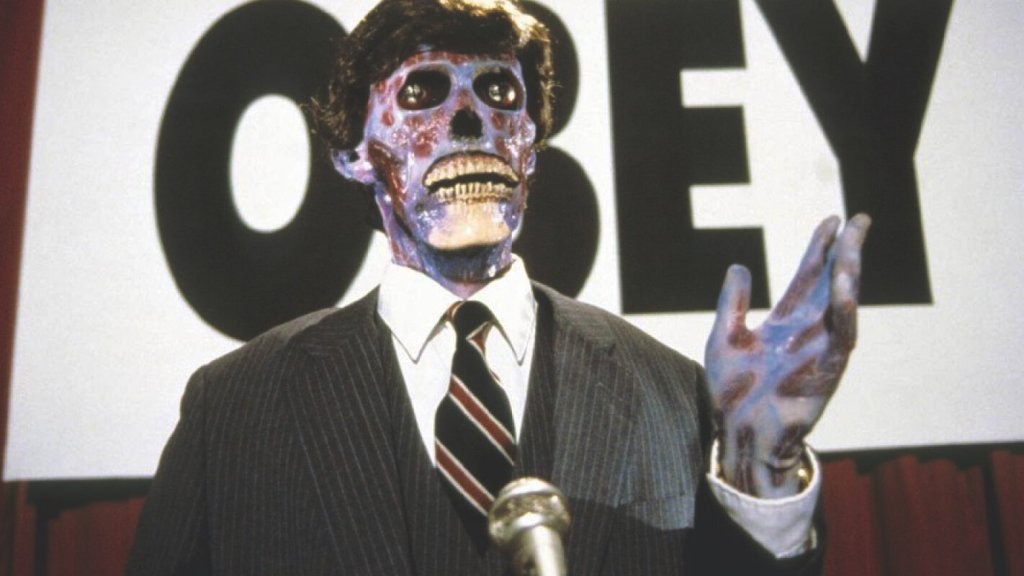
This is the premise of John Carpenter’s film They Live, which was released thirty-five years ago and remains unnervingly, chillingly appropriate for our modern age.

Best known for his horror film Halloween, which assumes that there is a form of evil so dark that it can’t be killed, Carpenter’s larger body of work is infused with a strong anti-authoritarian, anti-establishment, laconic bent that speaks to the filmmaker’s concerns about the unraveling of our society, particularly our government.

Time and again, Carpenter portrays the government working against its own citizens, a populace out of touch with reality, technology run amok, and a future more horrific than any horror film.

In Escape from New York, Carpenter presents fascism as the future of America.

In The Thing, a remake of the 1951 sci-fi classic of the same name, Carpenter presupposes that increasingly we are all becoming dehumanized.

In Christine, the film adaptation of Stephen King’s novel about a demon-possessed car, technology exhibits a will and consciousness of its own and goes on a murderous rampage.

In In the Mouth of Madness, Carpenter notes that evil grows when people lose “the ability to know the difference between reality and fantasy.”

And then there is Carpenter’s They Live, in which two migrant workers discover that the world is not as it seems. In fact, the population is actually being controlled and exploited by aliens working in partnership with an oligarchic elite. All the while, the populace—blissfully unaware of the real agenda at work in their lives—has been lulled into complacency, indoctrinated into compliance, bombarded with media distractions, and hypnotized by subliminal messages beamed out of television and various electronic devices, billboards and the like.

It is only when homeless drifter John Nada (played to the hilt by the late Roddy Piper) discovers a pair of doctored sunglasses—Hoffman lenses—that Nada sees what lies beneath the elite’s fabricated reality: control and bondage.

When viewed through the lens of truth, the elite, who appear human until stripped of their disguises, are shown to be monsters who have enslaved the citizenry in order to prey on them.

Likewise, billboards blare out hidden, authoritative messages: a bikini-clad woman in one ad is actually ordering viewers to “MARRY AND REPRODUCE.” Magazine racks scream “CONSUME” and “OBEY.” A wad of dollar bills in a vendor’s hand proclaims, “THIS IS YOUR GOD.”

When viewed through Nada’s Hoffman lenses, some of the other hidden messages being drummed into the people’s subconscious include: NO INDEPENDENT THOUGHT, CONFORM, SUBMIT, STAY ASLEEP, BUY, WATCH TV, NO IMAGINATION, and DO NOT QUESTION AUTHORITY.

This indoctrination campaign engineered by the elite in They Live is painfully familiar to anyone who has studied the decline of American culture.

A citizenry that does not think for themselves, obeys without question, is submissive, does not challenge authority, does not think outside the box, and is content to sit back and be entertained is a citizenry that can be easily controlled.

In this way, the subtle message of They Live provides an apt analogy of our own distorted vision of life in the American police state, what philosopher Slavoj Žižek refers to as dictatorship in democracy, “the invisible order which sustains your apparent freedom.”

Tune out the government’s attempts to distract, divert and befuddle us and tune into what’s really going on in this country, and you’ll run headlong into an unmistakable, unpalatable truth: what we are dealing with today is an authoritarian beast that has outgrown its chains and will not be restrained.

We’re being fed a series of carefully contrived fictions that bear no resemblance to reality.

Despite the fact that we are 17,600 times more likely to die from heart disease than from a terrorist attack; 11,000 times more likely to die from an airplane accident than from a terrorist plot involving an airplane; 1,048 times more likely to die from a car accident than a terrorist attack, and 8 times more likely to be killed by a police officer than by a terrorist , we have handed over control of our lives to government officials who treat us as a means to an end—the source of money and power.

As the Bearded Man in They Live warns, “They are dismantling the sleeping middle class. More and more people are becoming poor. We are their cattle. We are being bred for slavery.”

We have bought into the illusion and refused to grasp the truth.

From the moment we are born until we die, we are indoctrinated into believing that those who rule us do it for our own good. The truth is far different.

The powers-that-be want us to feel threatened by forces beyond our control (terrorists, pandemics, mass shootings, etc.).

They want us afraid and dependent on the government and its militarized armies for our safety and well-being.

They want us distrustful of each other, divided by our prejudices, and at each other’s throats.

We are little more than expendable resources to be used, abused and discarded.

In fact, a study conducted by Princeton and Northwestern University concluded that the U.S. government does not represent the majority of American citizens. Instead, the study found that the government is ruled by the rich and powerful, or the so-called “economic elite.” Moreover, the researchers concluded that policies enacted by this governmental elite nearly always favor special interests and lobbying groups.

In other words, we are being ruled by an oligarchy disguised as a democracy, and arguably on our way towards fascism—a form of government where private corporate interests rule, money calls the shots, and the people are seen as mere subjects to be controlled.

Rest assured that when and if fascism finally takes hold in America, the basic forms of government will remain: Fascism will appear to be friendly. The legislators will be in session. There will be elections, and the news media will continue to cover the entertainment and political trivia. Consent of the governed, however, will no longer apply. Actual control will have finally passed to the oligarchic elite controlling the government behind the scenes.

Sound familiar?

Clearly, we are now ruled by an oligarchic elite of governmental and corporate interests.

We have moved into “corporatism” (favored by Benito Mussolini), which is a halfway point on the road to full-blown fascism.

Corporatism is where the few moneyed interests—not elected by the citizenry—rule over the many. In this way, it is not a democracy or a republican form of government, which is what the American government was established to be. It is a top-down form of government and one which has a terrifying history typified by the developments that occurred in totalitarian regimes of the past: police states where everyone is watched and spied on, rounded up for minor infractions by government agents, placed under police control, and placed in detention (a.k.a. concentration) camps.

For the final hammer of fascism to fall, it will require the most crucial ingredient: the majority of the people will have to agree that it’s not only expedient but necessary.

But why would a people agree to such an oppressive regime?

The answer is the same in every age: fear.

Fear makes people stupid.

Fear is the method most often used by politicians to increase the power of government. And, as most social commentators recognize, an atmosphere of fear permeates modern America: fear of terrorism, fear of the police, fear of our neighbors and so on.

The propaganda of fear has been used quite effectively by those who want to gain control, and it is transforming the populace into fearful, compliant, pacified zombies content to march in lockstep with the government’s dictates.

This brings me back to They Live, in which the real zombies are not the aliens calling the shots but the populace who are content to remain controlled.

When all is said and done, the world of They Live is not so different from our own. As one of the characters points out, “The poor and the underclass are growing. Racial justice and human rights are nonexistent. They have created a repressive society, and we are their unwitting accomplices. Their intention to rule rests with the annihilation of consciousness. We have been lulled into a trance. They have made us indifferent to ourselves, to others. We are focused only on our own gain.”

We, too, are focused only on our own pleasures, prejudices and gains. Our poor and underclasses are also growing. Injustice is growing. Inequality is growing. A concern for human rights is nearly nonexistent. We too have been lulled into a trance, indifferent to others.

Oblivious to what lies ahead, we’ve been manipulated into believing that if we continue to consume, obey, and have faith, things will work out. But that’s never been true of emerging regimes. And by the time we feel the hammer coming down upon us, it will be too late.

So where does that leave us?

The characters who populate Carpenter’s films provide some insight.

Underneath their machismo, they still believe in the ideals of liberty and equal opportunity. Their beliefs place them in constant opposition with the law and the establishment, but they are nonetheless freedom fighters.

When, for example, John Nada destroys the alien hypno-transmitter in They Live, he delivers a wake-up call for freedom. As Nada memorably declares, “I have come here to chew bubblegum and kick ass. And I’m all out of bubblegum.”

In other words: we need to get active and take a stand for what’s really important.

Stop allowing yourselves to be easily distracted by pointless political spectacles and pay attention to what’s really going on in the country.

As I make clear in my book Battlefield America: The War on the American People and in its fictional counterpart The Erik Blair Diaries, the real battle for control of this nation is taking place on roadsides, in police cars, on witness stands, over phone lines, in government offices, in corporate offices, in public school hallways and classrooms, in parks and city council meetings, and in towns and cities across this country.

All the trappings of the American police state are now in plain sight.

Wake up, America.

If they live (the tyrants, the oppressors, the invaders, the overlords), it is only because “we the people” sleep.

Saturday Matinee: In the Mouth of Madness

That Time John Carpenter Went Meta With ‘In the Mouth of Madness’

As always, Carpenter was light years ahead of his time.

By Nick L.

Source: Collider

One of John Carpenter’s more endearing traits is his aversion to self-effacing clowning. This is not at all to suggest that Carpenter’s films aren’t funny — rather, it’s that the living genre legend often opts to play familiar B-movie scenarios completely straight, whether it be a terse gangland standoff rendered as a modern-day Western showdown (Assault On Precinct 13, one of the most influential films of the 20th century) or a masked killer, bereft of any overwrought psychological motive, terrorizing the inhabitants of a sleepy all-American suburb (Halloween, of course). While Carpenter has dabbled in satire (They Live) and high-concept fantasy (Big Trouble In Little China) over the course of his now decades-spanning career, the grounded nature of his approach is often its own reward. The Escape From New York director has all but perfected an economical, tough-minded creative ethos that has gone on to influence an entire generation of filmmakers dabbling in sci-fi, horror, and beyond.

Going Meta Before It Was Cool

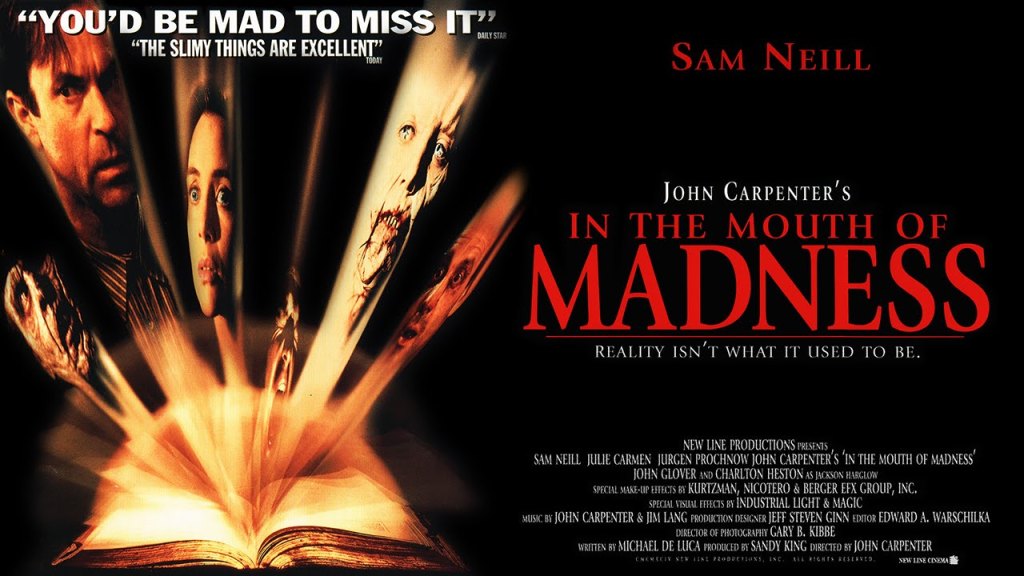
In the Mouth of Madness, Carpenter’s glorious 1994 cult masterpiece, might be the most conspicuous exception to this rule. The story of an insurance investigator who begins losing his grip on reality while probing the mysterious disappearance of a lucratively popular horror author named Sutter Cane, In the Mouth of Madness is an unabashedly meta exploration of the creative act as a form of hypnosis. It is not only a film whose central plot conceit is unique to the moral panic that defined so much of the decade in which it was released (the idea that exposure to certain “corrupt” media could warp one’s brain and possibly even compel one to commit violent acts, etc.), it’s also a cutting cautionary tale about surrendering to artifice and fantasy, and a clever-but-never-obnoxious social lampoon about what it means to be considered the master of a low trade.

Of course, John Carpenter knows a thing or two about being unfairly labeled as the master of a low trade. Carpenter, who is known for his tell-it-like-it-is demeanor, once quipped: “In England, I’m a horror director. In Germany, I’m a filmmaker. In the U.S., I’m a bum.” Films like the Jeff Bridges-starring Starman and the memorably nasty high school bloodbath Christine might be considered totemic cult items today, but many of Carpenter’s more beloved works were initially decried as trash in their time. As such, Carpenter and screenwriter Michael De Luca (yes, that Michael De Luca) turn In the Mouth of Madness’ most important character, Sutter Cane, into the Ernest Hemingway of airport novels. Clearly, the obvious allusion with Cane is Stephen King (or perhaps, to a lesser extent, Clive Barker), right down to the fact that Mouth of Madness eventually makes a narrative detour to Hobb’s End: a kind of bastardized stand-in for King’s own sleepy, creepy fictional borough, Castle Rock.

Third Film of the Apocalypse Trilogy

In The Mouth Of Madness opens with Sam Neil’s John Trent being admitted to a psychiatric hospital. He appears to have gone stark-raving mad, as evidenced by the demented look in his eyes, and the vaguely occult-looking marks he’s scrawled onto his face. In a gesture that feels borrowed from a tale by H.P. Lovecraft (Carpenter’s reverence for Lovecraft is well-documented at this point), Trent begins to recall the tale of how exactly he went mad. We learn that when Trent worked in insurance, his employer (Charlton Heston) tasked him with looking into the matter of Sutter Cane. For all intents and purposes, Cane appears to have vanished off the face of the earth. After its ghoulish prologue, Mouth of Madness settles into a more deliberately routine rhythm, only to disappear further and further down the proverbial rabbit hole as Trent and a colleague, Cane’s editor (memorably played by Julie Carmen), find themselves lost among the otherworldly horrors of Hobb’s End.

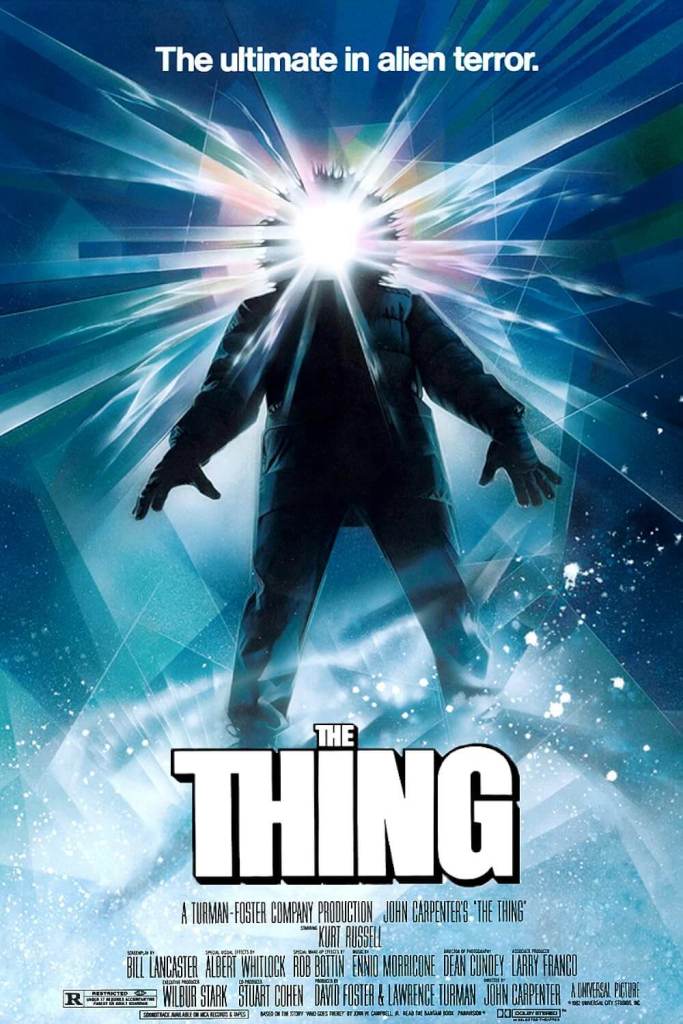
In The Mouth Of Madness is the third and final film in John Carpenter’s “Apocalypse Trilogy,” which also includes The Thing and the criminally underappreciated Prince of Darkness. In all three films, evil manifests as a primarily unseen, invisible force, often contorting familiar things like dogs, books, and human bodies into horrifying and hitherto-unseen new shapes. In The ThingKurt Russell and his motley crew of researchers hole up in icy Arctic seclusion, fending off the malevolent energy of a shapeshifting, violently hostile alien parasite. In Prince Of Darkness, a group of college students occupy an incredibly menacing old church, where they proceed to unearth a tube of neon-green liquid that, if mishandled, could unleash the very literal fury of the devil. Both movies are steeped in Lovecraftian imagery and primordial terror, and both amplify the built-in claustrophobia of their settings to phantasmagoric degrees.

In The Mouth Of Madness is a funnier, sillier, more stylistically gonzo effort than its two predecessors in the trilogy, mostly because it purports to stand outside the nuts and bolts of its superficial narrative, to some degree, and actually comment on the art of what it means to scare people for a living. There is something wickedly ingenious about the idea of a popular novel whose contents are so unholy that reading it would cause one to spiral into a kind of monstrous abyss. If that idea alone were all the movie were interested in, In the Mouth of Madness would still rank as one of Carpenter’s more enjoyable late-career works. And yet, as always, the director is keen to dig deeper into the subtextual resonance of his story, turning what might otherwise be a spooky ’90s chiller — the type of thing you might have caught a rerun of on TBS sometime back in the 2000s — into a cheeky, compelling commentary on the horror pantheon itself, and Carpenter’s place in it.

We live in an era where people willingly and enthusiastically sign themselves over to fictional “universes.” Whether it’s MarvelStar Wars, Game of Thrones, or perhaps something more obscure, we now inhabit an epoch in which individuals willingly give themselves up to elaborate forms of corporate mythology. In some cases, this sort of fanboy devotion can swallow you whole. In the Mouth of Madness is concerned with this very subject. It is no wonder the film was greeted with such indifferent critical notices upon its release: as always, Carpenter was light years ahead of his time. The scariest thing about In the Mouth of Madness is that, in the world Carpenter hath created, Sutter Cane himself isn’t even seen as a mere writer of trash books — when he’s finally revealed, he is tellingly and literally depicted as a prophet.

Dictatorship in Disguise: Authoritarian Monsters Wreak Havoc on Our Freedoms

By John & Nisha Whitehead

Source: The Rutherford Institute

“You see them on the street. You watch them on TV. You might even vote for one this fall. You think they’re people just like you. You’re wrong. Dead wrong.” — They Live 

We’re living in two worlds.

There’s the world we see (or are made to see) and then there’s the one we sense (and occasionally catch a glimpse of), the latter of which is a far cry from the propaganda-driven reality manufactured by the government and its corporate sponsors, including the media.

Indeed, what most Americans perceive as life in America—privileged, progressive and free—is a far cry from reality, where economic inequality is growing, real agendas and real power are buried beneath layers of Orwellian doublespeak and corporate obfuscation, and “freedom,” such that it is, is meted out in small, legalistic doses by militarized police and federal agents armed to the teeth.

All is not as it seems.

Monsters with human faces walk among us. Many of them work for the U.S. government.

This is the premise of John Carpenter’s film They Live, which was released in November 1988 and remains unnervingly, chillingly appropriate for our modern age.

Best known for his horror film Halloween, which assumes that there is a form of evil so dark that it can’t be killed, Carpenter’s larger body of work is infused with a strong anti-authoritarian, anti-establishment, laconic bent that speaks to the filmmaker’s concerns about the unraveling of our society, particularly our government.

Time and again, Carpenter portrays the government working against its own citizens, a populace out of touch with reality, technology run amok, and a future more horrific than any horror film.

In Escape from New York, Carpenter presents fascism as the future of America.

In The Thing, a remake of the 1951 sci-fi classic of the same name, Carpenter presupposes that increasingly we are all becoming dehumanized.

In Christine, the film adaptation of Stephen King’s novel about a demon-possessed car, technology exhibits a will and consciousness of its own and goes on a murderous rampage.

In In the Mouth of Madness, Carpenter notes that evil grows when people lose “the ability to know the difference between reality and fantasy.”

And then there is Carpenter’s They Live, in which two migrant workers discover that the world is not as it seems. In fact, the population is actually being controlled and exploited by aliens working in partnership with an oligarchic elite. All the while, the populace—blissfully unaware of the real agenda at work in their lives—has been lulled into complacency, indoctrinated into compliance, bombarded with media distractions, and hypnotized by subliminal messages beamed out of television and various electronic devices, billboards and the like.

It is only when homeless drifter John Nada (played to the hilt by the late Roddy Piper) discovers a pair of doctored sunglasses—Hoffman lenses—that Nada sees what lies beneath the elite’s fabricated reality: control and bondage.

When viewed through the lens of truth, the elite, who appear human until stripped of their disguises, are shown to be monsters who have enslaved the citizenry in order to prey on them.

Likewise, billboards blare out hidden, authoritative messages: a bikini-clad woman in one ad is actually ordering viewers to “MARRY AND REPRODUCE.” Magazine racks scream “CONSUME” and “OBEY.” A wad of dollar bills in a vendor’s hand proclaims, “THIS IS YOUR GOD.”

When viewed through Nada’s Hoffman lenses, some of the other hidden messages being drummed into the people’s subconscious include: NO INDEPENDENT THOUGHT, CONFORM, SUBMIT, STAY ASLEEP, BUY, WATCH TV, NO IMAGINATION, and DO NOT QUESTION AUTHORITY.

This indoctrination campaign engineered by the elite in They Live is painfully familiar to anyone who has studied the decline of American culture.

A citizenry that does not think for themselves, obeys without question, is submissive, does not challenge authority, does not think outside the box, and is content to sit back and be entertained is a citizenry that can be easily controlled.

In this way, the subtle message of They Live provides an apt analogy of our own distorted vision of life in the American police state, what philosopher Slavoj Žižek refers to as dictatorship in democracy, “the invisible order which sustains your apparent freedom.”

We’re being fed a series of carefully contrived fictions that bear no resemblance to reality.

Tune out the government’s attempts to distract, divert and befuddle us and tune into what’s really going on in this country, and you’ll run headlong into an unmistakable, unpalatable truth: what we are dealing with today is an authoritarian beast that has outgrown its chains and will not be restrained.

Through its acts of power grabs, brutality, meanness, inhumanity, immorality, greed, corruption, debauchery and tyranny, the government has become almost indistinguishable from the evil it claims to be fighting, whether that evil takes the form of terrorism, torture, disease, drug traffickingsex trafficking, murder, violence, theft, pornography, scientific experimentations or some other diabolical means of inflicting pain, suffering and servitude on humanity.

We have let the government’s evil-doing and abuses go on for too long.

We’re being fed a series of carefully contrived fictions that bear no resemblance to reality.

Despite the fact that we are 17,600 times more likely to die from heart disease than from a terrorist attack; 11,000 times more likely to die from an airplane accident than from a terrorist plot involving an airplane; 1,048 times more likely to die from a car accident than a terrorist attack, and 8 times more likely to be killed by a police officer than by a terrorist , we have handed over control of our lives to government officials who treat us as a means to an end—the source of money and power.

As the Bearded Man in They Live warns, “They are dismantling the sleeping middle class. More and more people are becoming poor. We are their cattle. We are being bred for slavery.”

We have bought into the illusion and refused to grasp the truth.

From the moment we are born until we die, we are indoctrinated into believing that those who rule us do it for our own good. The truth is far different.

The powers-that-be want us to feel threatened by forces beyond our control (terrorists, pandemics, mass shootings, etc.).

They want us afraid and dependent on the government and its militarized armies for our safety and well-being.

They want us distrustful of each other, divided by our prejudices, and at each other’s throats.

Most of all, they want us to continue to march in lockstep with their dictates as fearful, controlled, pacified zombies.

This brings me back to They Live, in which the real zombies are not the aliens calling the shots but the populace who are content to remain controlled.

When all is said and done, the world of They Live is not so different from our own. As one of the characters points out, “The poor and the underclass are growing. Racial justice and human rights are nonexistent. They have created a repressive society and we are their unwitting accomplices. Their intention to rule rests with the annihilation of consciousness. We have been lulled into a trance. They have made us indifferent to ourselves, to others. We are focused only on our own gain.”

We, too, are focused only on our own pleasures, prejudices and gains. Our poor and underclasses are also growing. Injustice is growing. Inequality is growing. A concern for human rights is nearly nonexistent. We too have been lulled into a trance, indifferent to others.

Oblivious to what lies ahead, we’ve been manipulated into believing that if we continue to consume, obey, and have faith, things will work out. But that’s never been true of emerging regimes. And by the time we feel the hammer coming down upon us, it will be too late.

So where does that leave us?

The characters who populate Carpenter’s films provide some insight.

Underneath their machismo, they still believe in the ideals of liberty and equal opportunity. Their beliefs place them in constant opposition with the law and the establishment, but they are nonetheless freedom fighters.

When, for example, John Nada destroys the alien hypno-transmitter in They Live, he delivers a wake-up call for freedom. As Nada memorably declares, “I have come here to chew bubblegum and kick ass. And I’m all out of bubblegum.”

In other words: we need to get active and take a stand for what’s really important.

Stop allowing yourselves to be easily distracted by pointless political spectacles and pay attention to what’s really going on in the country.

As I make clear in my book Battlefield America: The War on the American People and in its fictional counterpart The Erik Blair Diaries, the real battle for control of this nation is taking place on roadsides, in police cars, on witness stands, over phone lines, in government offices, in corporate offices, in public school hallways and classrooms, in parks and city council meetings, and in towns and cities across this country.

All the trappings of the American police state are now in plain sight.

Wake up, America.

If they live (the tyrants, the oppressors, the invaders, the overlords), it is only because “we the people” sleep.

Saturday Matinee: Dark Star

“Dark Star” (1974) is a science fiction comedy directed and produced by John Carpenter and co-written with Dan O’Bannon. The film originated as a USC film project from 1970 to 1972 and expanded to a feature length project in 1974. It plot follows the mentally deteriorating crew of the starship Dark Star, twenty years into their mission to destroy unstable planets that might threaten future colonization of other planets.

Dark Star was the feature directorial debut for Carpenter, who also scored and produced the film. It was also the feature debut for O’Bannon, who also served as editor, production designer, visual effects supervisor and actor.

They Live, We Sleep: Beware the Growing Evil in Our Midst

By John W. Whitehead

Source: The Rutherford Institute

“You see them on the street. You watch them on TV. You might even vote for one this fall. You think they’re people just like you. You’re wrong. Dead wrong.” — They Live

We’re living in two worlds, you and I.

There’s the world we see (or are made to see) and then there’s the one we sense (and occasionally catch a glimpse of), the latter of which is a far cry from the propaganda-driven reality manufactured by the government and its corporate sponsors, including the media.

Indeed, what most Americans perceive as life in America—privileged, progressive and free—is a far cry from reality, where economic inequality is growing, real agendas and real power are buried beneath layers of Orwellian doublespeak and corporate obfuscation, and “freedom,” such that it is, is meted out in small, legalistic doses by militarized police armed to the teeth.

All is not as it seems.

This is the premise of John Carpenter’s film They Live, which was released more than 30 years ago, and remains unnervingly, chillingly appropriate for our modern age.

Best known for his horror film Halloween, which assumes that there is a form of evil so dark that it can’t be killed, Carpenter’s larger body of work is infused with a strong anti-authoritarian, anti-establishment, laconic bent that speaks to the filmmaker’s concerns about the unraveling of our society, particularly our government.

Time and again, Carpenter portrays the government working against its own citizens, a populace out of touch with reality, technology run amok, and a future more horrific than any horror film.

In Escape from New York, Carpenter presents fascism as the future of America.

In The Thing, a remake of the 1951 sci-fi classic of the same name, Carpenter presupposes that increasingly we are all becoming dehumanized.

In Christine, the film adaptation of Stephen King’s novel about a demon-possessed car, technology exhibits a will and consciousness of its own and goes on a murderous rampage.

In In the Mouth of Madness, Carpenter notes that evil grows when people lose “the ability to know the difference between reality and fantasy.”

And then there is Carpenter’s They Live, in which two migrant workers discover that the world is not as it seems. In fact, the population is actually being controlled and exploited by aliens working in partnership with an oligarchic elite. All the while, the populace—blissfully unaware of the real agenda at work in their lives—has been lulled into complacency, indoctrinated into compliance, bombarded with media distractions, and hypnotized by subliminal messages beamed out of television and various electronic devices, billboards and the like.

It is only when homeless drifter John Nada (played to the hilt by the late Roddy Piper) discovers a pair of doctored sunglasses—Hoffman lenses—that Nada sees what lies beneath the elite’s fabricated reality: control and bondage.

When viewed through the lens of truth, the elite, who appear human until stripped of their disguises, are shown to be monsters who have enslaved the citizenry in order to prey on them.

Likewise, billboards blare out hidden, authoritative messages: a bikini-clad woman in one ad is actually ordering viewers to “MARRY AND REPRODUCE.” Magazine racks scream “CONSUME” and “OBEY.” A wad of dollar bills in a vendor’s hand proclaims, “THIS IS YOUR GOD.”

When viewed through Nada’s Hoffman lenses, some of the other hidden messages being drummed into the people’s subconscious include: NO INDEPENDENT THOUGHT, CONFORM, SUBMIT, STAY ASLEEP, BUY, WATCH TV, NO IMAGINATION, and DO NOT QUESTION AUTHORITY.

This indoctrination campaign engineered by the elite in They Live is painfully familiar to anyone who has studied the decline of American culture.

A citizenry that does not think for themselves, obeys without question, is submissive, does not challenge authority, does not think outside the box, and is content to sit back and be entertained is a citizenry that can be easily controlled.

In this way, the subtle message of They Live provides an apt analogy of our own distorted vision of life in the American police state, what philosopher Slavoj Žižek refers to as dictatorship in democracy, “the invisible order which sustains your apparent freedom.”

We’re being fed a series of carefully contrived fictions that bear no resemblance to reality.

The powers-that-be want us to feel threatened by forces beyond our control (terrorists, shootersbombers).

They want us afraid and dependent on the government and its militarized armies for our safety and well-being.

They want us distrustful of each other, divided by our prejudices, and at each other’s throats.

Most of all, they want us to continue to march in lockstep with their dictates.

Tune out the government’s attempts to distract, divert and befuddle us and tune into what’s really going on in this country, and you’ll run headlong into an unmistakable, unpalatable truth: the moneyed elite who rule us view us as expendable resources to be used, abused and discarded.

In fact, a study conducted by Princeton and Northwestern University concluded that the U.S. government does not represent the majority of American citizens. Instead, the study found that the government is ruled by the rich and powerful, or the so-called “economic elite.” Moreover, the researchers concluded that policies enacted by this governmental elite nearly always favor special interests and lobbying groups.

In other words, we are being ruled by an oligarchy disguised as a democracy, and arguably on our way towards fascism—a form of government where private corporate interests rule, money calls the shots, and the people are seen as mere subjects to be controlled.

Not only do you have to be rich—or beholden to the rich—to get elected these days, but getting elected is also a surefire way to get rich. As CBS News reports, “Once in office, members of Congress enjoy access to connections and information they can use to increase their wealth, in ways that are unparalleled in the private sector. And once politicians leave office, their connections allow them to profit even further.”

In denouncing this blatant corruption of America’s political system, former president Jimmy Carter blasted the process of getting elected—to the White House, governor’s mansion, Congress or state legislatures—as “unlimited political bribery… a subversion of our political system as a payoff to major contributors, who want and expect, and sometimes get, favors for themselves after the election is over.”

Rest assured that when and if fascism finally takes hold in America, the basic forms of government will remain: Fascism will appear to be friendly. The legislators will be in session. There will be elections, and the news media will continue to cover the entertainment and political trivia. Consent of the governed, however, will no longer apply. Actual control will have finally passed to the oligarchic elite controlling the government behind the scenes.

Sound familiar?

Clearly, we are now ruled by an oligarchic elite of governmental and corporate interests.

We have moved into “corporatism” (favored by Benito Mussolini), which is a halfway point on the road to full-blown fascism.

Corporatism is where the few moneyed interests—not elected by the citizenry—rule over the many. In this way, it is not a democracy or a republican form of government, which is what the American government was established to be. It is a top-down form of government and one which has a terrifying history typified by the developments that occurred in totalitarian regimes of the past: police states where everyone is watched and spied on, rounded up for minor infractions by government agents, placed under police control, and placed in detention (a.k.a. concentration) camps.

For the final hammer of fascism to fall, it will require the most crucial ingredient: the majority of the people will have to agree that it’s not only expedient but necessary.

But why would a people agree to such an oppressive regime?

The answer is the same in every age: fear.

Fear makes people stupid.

Fear is the method most often used by politicians to increase the power of government. And, as most social commentators recognize, an atmosphere of fear permeates modern America: fear of terrorism, fear of the police, fear of our neighbors and so on.

The propaganda of fear has been used quite effectively by those who want to gain control, and it is working on the American populace.

Despite the fact that we are 17,600 times more likely to die from heart disease than from a terrorist attack; 11,000 times more likely to die from an airplane accident than from a terrorist plot involving an airplane; 1,048 times more likely to die from a car accident than a terrorist attack, and 8 times more likely to be killed by a police officer than by a terrorist , we have handed over control of our lives to government officials who treat us as a means to an end—the source of money and power.

As the Bearded Man in They Live warns, “They are dismantling the sleeping middle class. More and more people are becoming poor. We are their cattle. We are being bred for slavery.”

In this regard, we’re not so different from the oppressed citizens in They Live.

From the moment we are born until we die, we are indoctrinated into believing that those who rule us do it for our own good. The truth is far different.

Despite the truth staring us in the face, we have allowed ourselves to become fearful, controlled, pacified zombies.

We live in a perpetual state of denial, insulated from the painful reality of the American police state by wall-to-wall entertainment news and screen devices.

Most everyone keeps their heads down these days while staring zombie-like into an electronic screen, even when they’re crossing the street. Families sit in restaurants with their heads down, separated by their screen devices and unaware of what’s going on around them. Young people especially seem dominated by the devices they hold in their hands, oblivious to the fact that they can simply push a button, turn the thing off and walk away.

Indeed, there is no larger group activity than that connected with those who watch screens—that is, television, lap tops, personal computers, cell phones and so on. In fact, a Nielsen study reports that American screen viewing is at an all-time high. For example, the average American watches approximately 151 hours of television per month.

The question, of course, is what effect does such screen consumption have on one’s mind?

Psychologically it is similar to drug addiction. Researchers found that “almost immediately after turning on the TV, subjects reported feeling more relaxed, and because this occurs so quickly and the tension returns so rapidly after the TV is turned off, people are conditioned to associate TV viewing with a lack of tension.” Research also shows that regardless of the programming, viewers’ brain waves slow down, thus transforming them into a more passive, nonresistant state.

Historically, television has been used by those in authority to quiet discontent and pacify disruptive people. “Faced with severe overcrowding and limited budgets for rehabilitation and counseling, more and more prison officials are using TV to keep inmates quiet,” according to Newsweek.

Given that the majority of what Americans watch on television is provided through channels controlled by six mega corporations, what we watch is now controlled by a corporate elite and, if that elite needs to foster a particular viewpoint or pacify its viewers, it can do so on a large scale.

If we’re watching, we’re not doing.

The powers-that-be understand this. As television journalist Edward R. Murrow warned in a 1958 speech:

We are currently wealthy, fat, comfortable and complacent. We have currently a built-in allergy to unpleasant or disturbing information. Our mass media reflect this. But unless we get up off our fat surpluses and recognize that television in the main is being used to distract, delude, amuse, and insulate us, then television and those who finance it, those who look at it, and those who work at it, may see a totally different picture too late.

This brings me back to They Live, in which the real zombies are not the aliens calling the shots but the populace who are content to remain controlled.

When all is said and done, the world of They Live is not so different from our own. As one of the characters points out, “The poor and the underclass are growing. Racial justice and human rights are nonexistent. They have created a repressive society and we are their unwitting accomplices. Their intention to rule rests with the annihilation of consciousness. We have been lulled into a trance. They have made us indifferent to ourselves, to others. We are focused only on our own gain.”

We, too, are focused only on our own pleasures, prejudices and gains. Our poor and underclasses are also growing. Racial injustice is growing. Human rights is nearly nonexistent. We too have been lulled into a trance, indifferent to others.

Oblivious to what lies ahead, we’ve been manipulated into believing that if we continue to consume, obey, and have faith, things will work out. But that’s never been true of emerging regimes. And by the time we feel the hammer coming down upon us, it will be too late.

So where does that leave us?

The characters who populate Carpenter’s films provide some insight.

Underneath their machismo, they still believe in the ideals of liberty and equal opportunity. Their beliefs place them in constant opposition with the law and the establishment, but they are nonetheless freedom fighters.

When, for example, John Nada destroys the alien hyno-transmitter in They Live, he restores hope by delivering America a wake-up call for freedom.

That’s the key right there: we need to wake up.

Stop allowing yourselves to be easily distracted by pointless political spectacles and pay attention to what’s really going on in the country.

The real battle for control of this nation is not being waged between Republicans and Democrats in the ballot box.

As I make clear in my book Battlefield America: The War on the American People, the real battle for control of this nation is taking place on roadsides, in police cars, on witness stands, over phone lines, in government offices, in corporate offices, in public school hallways and classrooms, in parks and city council meetings, and in towns and cities across this country.

The real battle between freedom and tyranny is taking place right in front of our eyes, if we would only open them.

All the trappings of the American police state are now in plain sight.

Wake up, America.

If they live (the tyrants, the oppressors, the invaders, the overlords), it is only because “we the people” sleep.

Has America Become a Dictatorship Disguised as a Democracy?


By John W. Whitehead

Source: The Rutherford Institute

“The poor and the underclass are growing. Racial justice and human rights are nonexistent. They have created a repressive society and we are their unwitting accomplices. Their intention to rule rests with the annihilation of consciousness. We have been lulled into a trance. They have made us indifferent to ourselves, to others. We are focused only on our own gain.”—They Live, John Carpenter

We’re living in two worlds, you and I.

There’s the world we see (or are made to see) and then there’s the one we sense (and occasionally catch a glimpse of), the latter of which is a far cry from the propaganda-driven reality manufactured by the government and its corporate sponsors, including the media.

Indeed, what most Americans perceive as life in America—privileged, progressive and free—is a far cry from reality, where economic inequality is growing, real agendas and real power are buried beneath layers of Orwellian doublespeak and corporate obfuscation, and “freedom,” such that it is, is meted out in small, legalistic doses by militarized police armed to the teeth.

All is not as it seems.

“You see them on the street. You watch them on TV. You might even vote for one this fall. You think they’re people just like you. You’re wrong. Dead wrong.”

This is the premise of John Carpenter’s film They Live, which was released 30 years ago in November 1988 and remains unnervingly, chillingly appropriate for our modern age.

Best known for his horror film Halloween, which assumes that there is a form of evil so dark that it can’t be killed, Carpenter’s larger body of work is infused with a strong anti-authoritarian, anti-establishment, laconic bent that speaks to the filmmaker’s concerns about the unraveling of our society, particularly our government.

Time and again, Carpenter portrays the government working against its own citizens, a populace out of touch with reality, technology run amok, and a future more horrific than any horror film.

In Escape from New York, Carpenter presents fascism as the future of America.

In The Thing, a remake of the 1951 sci-fi classic of the same name, Carpenter presupposes that increasingly we are all becoming dehumanized.

In Christine, the film adaptation of Stephen King’s novel about a demon-possessed car, technology exhibits a will and consciousness of its own and goes on a murderous rampage.

In In the Mouth of Madness, Carpenter notes that evil grows when people lose “the ability to know the difference between reality and fantasy.”

And then there is Carpenter’s They Live, in which two migrant workers discover that the world is not as it seems. In fact, the population is actually being controlled and exploited by aliens working in partnership with an oligarchic elite. All the while, the populace—blissfully unaware of the real agenda at work in their lives—has been lulled into complacency, indoctrinated into compliance, bombarded with media distractions, and hypnotized by subliminal messages beamed out of television and various electronic devices, billboards and the like.

It is only when homeless drifter John Nada (played to the hilt by the late Roddy Piper) discovers a pair of doctored sunglasses—Hoffman lenses—that Nada sees what lies beneath the elite’s fabricated reality: control and bondage.

When viewed through the lens of truth, the elite, who appear human until stripped of their disguises, are shown to be monsters who have enslaved the citizenry in order to prey on them.

Likewise, billboards blare out hidden, authoritative messages: a bikini-clad woman in one ad is actually ordering viewers to “MARRY AND REPRODUCE.” Magazine racks scream “CONSUME” and “OBEY.” A wad of dollar bills in a vendor’s hand proclaims, “THIS IS YOUR GOD.”

When viewed through Nada’s Hoffman lenses, some of the other hidden messages being drummed into the people’s subconscious include: NO INDEPENDENT THOUGHT, CONFORM, SUBMIT, STAY ASLEEP, BUY, WATCH TV, NO IMAGINATION, and DO NOT QUESTION AUTHORITY.

This indoctrination campaign engineered by the elite in They Live is painfully familiar to anyone who has studied the decline of American culture.

A citizenry that does not think for themselves, obeys without question, is submissive, does not challenge authority, does not think outside the box, and is content to sit back and be entertained is a citizenry that can be easily controlled.

In this way, the subtle message of They Live provides an apt analogy of our own distorted vision of life in the American police state, what philosopher Slavoj Žižek refers to as dictatorship in democracy, “the invisible order which sustains your apparent freedom.”

We’re being fed a series of carefully contrived fictions that bear no resemblance to reality.

The powers-that-be want us to feel threatened by forces beyond our control (terrorists, shootersbombers).

They want us afraid and dependent on the government and its militarized armies for our safety and well-being.

They want us distrustful of each other, divided by our prejudices, and at each other’s throats.

Most of all, they want us to continue to march in lockstep with their dictates.

Tune out the government’s attempts to distract, divert and befuddle us and tune into what’s really going on in this country, and you’ll run headlong into an unmistakable, unpalatable truth: the moneyed elite who rule us view us as expendable resources to be used, abused and discarded.

In fact, a study conducted by Princeton and Northwestern University concluded that the U.S. government does not represent the majority of American citizens. Instead, the study found that the government is ruled by the rich and powerful, or the so-called “economic elite.” Moreover, the researchers concluded that policies enacted by this governmental elite nearly always favor special interests and lobbying groups.

In other words, we are being ruled by an oligarchy disguised as a democracy, and arguably on our way towards fascism—a form of government where private corporate interests rule, money calls the shots, and the people are seen as mere subjects to be controlled.

Not only do you have to be rich—or beholden to the rich—to get elected these days, but getting elected is also a surefire way to get rich. As CBS News reports, “Once in office, members of Congress enjoy access to connections and information they can use to increase their wealth, in ways that are unparalleled in the private sector. And once politicians leave office, their connections allow them to profit even further.”

In denouncing this blatant corruption of America’s political system, former president Jimmy Carter blasted the process of getting elected—to the White House, governor’s mansion, Congress or state legislatures—as “unlimited political bribery… a subversion of our political system as a payoff to major contributors, who want and expect, and sometimes get, favors for themselves after the election is over.”

Rest assured that when and if fascism finally takes hold in America, the basic forms of government will remain: Fascism will appear to be friendly. The legislators will be in session. There will be elections, and the news media will continue to cover the entertainment and political trivia. Consent of the governed, however, will no longer apply. Actual control will have finally passed to the oligarchic elite controlling the government behind the scenes.

Sound familiar?

Clearly, we are now ruled by an oligarchic elite of governmental and corporate interests.

We have moved into “corporatism” (favored by Benito Mussolini), which is a halfway point on the road to full-blown fascism.

Corporatism is where the few moneyed interests—not elected by the citizenry—rule over the many. In this way, it is not a democracy or a republican form of government, which is what the American government was established to be. It is a top-down form of government and one which has a terrifying history typified by the developments that occurred in totalitarian regimes of the past: police states where everyone is watched and spied on, rounded up for minor infractions by government agents, placed under police control, and placed in detention (a.k.a. concentration) camps.

For the final hammer of fascism to fall, it will require the most crucial ingredient: the majority of the people will have to agree that it’s not only expedient but necessary.

But why would a people agree to such an oppressive regime?

The answer is the same in every age: fear.

Fear makes people stupid.

Fear is the method most often used by politicians to increase the power of government. And, as most social commentators recognize, an atmosphere of fear permeates modern America: fear of terrorism, fear of the police, fear of our neighbors and so on.

The propaganda of fear has been used quite effectively by those who want to gain control, and it is working on the American populace.

Despite the fact that we are 17,600 times more likely to die from heart disease than from a terrorist attack; 11,000 times more likely to die from an airplane accident than from a terrorist plot involving an airplane; 1,048 times more likely to die from a car accident than a terrorist attack, and 8 times more likely to be killed by a police officer than by a terrorist , we have handed over control of our lives to government officials who treat us as a means to an end—the source of money and power.

As the Bearded Man in They Live warns, “They are dismantling the sleeping middle class. More and more people are becoming poor. We are their cattle. We are being bred for slavery.”

In this regard, we’re not so different from the oppressed citizens in They Live.

From the moment we are born until we die, we are indoctrinated into believing that those who rule us do it for our own good. The truth is far different.

Despite the truth staring us in the face, we have allowed ourselves to become fearful, controlled, pacified zombies.

We live in a perpetual state of denial, insulated from the painful reality of the American police state by wall-to-wall entertainment news and screen devices.

Most everyone keeps their heads down these days while staring zombie-like into an electronic screen, even when they’re crossing the street. Families sit in restaurants with their heads down, separated by their screen devices and unaware of what’s going on around them. Young people especially seem dominated by the devices they hold in their hands, oblivious to the fact that they can simply push a button, turn the thing off and walk away.

Indeed, there is no larger group activity than that connected with those who watch screens—that is, television, lap tops, personal computers, cell phones and so on. In fact, a Nielsen study reports that American screen viewing is at an all-time high. For example, the average American watches approximately 151 hours of television per month.

The question, of course, is what effect does such screen consumption have on one’s mind?

Psychologically it is similar to drug addiction. Researchers found that “almost immediately after turning on the TV, subjects reported feeling more relaxed, and because this occurs so quickly and the tension returns so rapidly after the TV is turned off, people are conditioned to associate TV viewing with a lack of tension.” Research also shows that regardless of the programming, viewers’ brain waves slow down, thus transforming them into a more passive, nonresistant state.

Historically, television has been used by those in authority to quiet discontent and pacify disruptive people. “Faced with severe overcrowding and limited budgets for rehabilitation and counseling, more and more prison officials are using TV to keep inmates quiet,” according to Newsweek.

Given that the majority of what Americans watch on television is provided through channels controlled by six mega corporations, what we watch is now controlled by a corporate elite and, if that elite needs to foster a particular viewpoint or pacify its viewers, it can do so on a large scale.

If we’re watching, we’re not doing.

The powers-that-be understand this. As television journalist Edward R. Murrow warned in a 1958 speech:

We are currently wealthy, fat, comfortable and complacent. We have currently a built-in allergy to unpleasant or disturbing information. Our mass media reflect this. But unless we get up off our fat surpluses and recognize that television in the main is being used to distract, delude, amuse, and insulate us, then television and those who finance it, those who look at it, and those who work at it, may see a totally different picture too late.

This brings me back to They Live, in which the real zombies are not the aliens calling the shots but the populace who are content to remain controlled.

When all is said and done, the world of They Live is not so different from our own.

We, too, are focused only on our own pleasures, prejudices and gains. Our poor and underclasses are also growing. Racial injustice is growing. Human rights is nearly nonexistent. We too have been lulled into a trance, indifferent to others.

Oblivious to what lies ahead, we’ve been manipulated into believing that if we continue to consume, obey, and have faith, things will work out. But that’s never been true of emerging regimes. And by the time we feel the hammer coming down upon us, it will be too late.

So where does that leave us?

The characters who populate Carpenter’s films provide some insight.

Underneath their machismo, they still believe in the ideals of liberty and equal opportunity. Their beliefs place them in constant opposition with the law and the establishment, but they are nonetheless freedom fighters.

When, for example, John Nada destroys the alien hyno-transmitter in They Live, he restores hope by delivering America a wake-up call for freedom.

That’s the key right there: we need to wake up.

Stop allowing yourselves to be easily distracted by pointless political spectacles and pay attention to what’s really going on in the country.

The real battle for control of this nation is not being waged between Republicans and Democrats in the ballot box.

As I make clear in my book Battlefield America: The War on the American People, the real battle for control of this nation is taking place on roadsides, in police cars, on witness stands, over phone lines, in government offices, in corporate offices, in public school hallways and classrooms, in parks and city council meetings, and in towns and cities across this country.

The real battle between freedom and tyranny is taking place right in front of our eyes, if we would only open them.

All the trappings of the American police state are now in plain sight.

Wake up, America.

If they live (the tyrants, the oppressors, the invaders, the overlords), it is only because “we the people” sleep.