

Technocensorship: The Government’s War on So-Called Dangerous Ideas

By John & Nisha Whitehead

Source: The Rutherford Institute

“There is more than one way to burn a book. And the world is full of people running about with lit matches.”—Ray Bradbury

What we are witnessing is the modern-day equivalent of book burning which involves doing away with dangerous ideas—legitimate or not—and the people who espouse them. Seventy years after Ray Bradbury’s novel Fahrenheit 451 depicted a fictional world in which books are burned in order to suppress dissenting ideas, while televised entertainment is used to anesthetize the populace and render them easily pacified, distracted and controlled, we find ourselves navigating an eerily similar reality.

Welcome to the age of technocensorship.

On paper—under the First Amendment, at least—we are technically free to speak.

In reality, however, we are now only as free to speak as a government official—or corporate entities such as Facebook, Google or YouTube—may allow.

Case in point: internal documents released by the House Judiciary Select Subcommittee on Weaponization of the Federal Government confirmed what we have long suspected: that the government has been working in tandem with social media companies to censor speech.

By “censor,” we’re referring to concerted efforts by the government to muzzle, silence and altogether eradicate any speech that runs afoul of the government’s own approved narrative.

This is political correctness taken to its most chilling and oppressive extreme.

The revelations that Facebook worked in concert with the Biden administration to censor content related to COVID-19, including humorous jokes, credible information and so-called disinformation, followed on the heels of a ruling by a federal court in Louisiana that prohibits executive branch officials from communicating with social media companies about controversial content in their online forums.

Likening the government’s heavy-handed attempts to pressure social media companies to suppress content critical of COVID vaccines or the election to “an almost dystopian scenario,” Judge Terry Doughty warned that “the United States Government seems to have assumed a role similar to an Orwellian ‘Ministry of Truth.’

This is the very definition of technofascism.

Clothed in tyrannical self-righteousness, technofascism is powered by technological behemoths (both corporate and governmental) working in tandem to achieve a common goal.

The government is not protecting us from “dangerous” disinformation campaigns. It is laying the groundwork to insulate us from “dangerous” ideas that might cause us to think for ourselves and, in so doing, challenge the power elite’s stranglehold over our lives.

Thus far, the tech giants have been able to sidestep the First Amendment by virtue of their non-governmental status, but it’s a dubious distinction at best when they are marching in lockstep with the government’s dictates.

As Philip Hamburger and Jenin Younes write for The Wall Street Journal: “The First Amendment prohibits the government from ‘abridging the freedom of speech.’ Supreme Court doctrine makes clear that government can’t constitutionally evade the amendment by working through private companies.”

Nothing good can come from allowing the government to sidestep the Constitution.

The steady, pervasive censorship creep that is being inflicted on us by corporate tech giants with the blessing of the powers-that-be threatens to bring about a restructuring of reality straight out of Orwell’s 1984, where the Ministry of Truth polices speech and ensures that facts conform to whatever version of reality the government propagandists embrace.

Orwell intended 1984 as a warning. Instead, it is being used as a dystopian instruction manual for socially engineering a populace that is compliant, conformist and obedient to Big Brother.

This is the slippery slope that leads to the end of free speech as we once knew it.

In a world increasingly automated and filtered through the lens of artificial intelligence, we are finding ourselves at the mercy of inflexible algorithms that dictate the boundaries of our liberties.

Once artificial intelligence becomes a fully integrated part of the government bureaucracy, there will be little recourse: we will all be subject to the intransigent judgments of techno-rulers.

This is how it starts.

First, the censors went after so-called extremists spouting so-called “hate speech.”

Then they went after so-called extremists spouting so-called “disinformation” about stolen elections, the Holocaust, and Hunter Biden.

By the time so-called extremists found themselves in the crosshairs for spouting so-called “misinformation” about the COVID-19 pandemic and vaccines, the censors had developed a system and strategy for silencing the nonconformists.

Eventually, depending on how the government and its corporate allies define what constitutes “extremism, “we the people” might all be considered guilty of some thought crime or other.

Whatever we tolerate now—whatever we turn a blind eye to—whatever we rationalize when it is inflicted on others, whether in the name of securing racial justice or defending democracy or combatting fascism, will eventually come back to imprison us, one and all.

Watch and learn.

We should all be alarmed when any individual or group—prominent or not—is censored, silenced and made to disappear from Facebook, Twitter, YouTube and Instagram for voicing ideas that are deemed politically incorrect, hateful, dangerous or conspiratorial.

Given what we know about the government’s tendency to define its own reality and attach its own labels to behavior and speech that challenges its authority, this should be cause for alarm across the entire political spectrum.

Here’s the point: you don’t have to like or agree with anyone who has been muzzled or made to disappear online because of their views, but to ignore the long-term ramifications of such censorship is dangerously naïve, because whatever powers you allow the government and its corporate operatives to claim now will eventually be used against you by tyrants of your own making.

As Glenn Greenwald writes for The Intercept:

The glaring fallacy that always lies at the heart of pro-censorship sentiments is the gullible, delusional belief that censorship powers will be deployed only to suppress views one dislikes, but never one’s own views… Facebook is not some benevolent, kind, compassionate parent or a subversive, radical actor who is going to police our discourse in order to protect the weak and marginalized or serve as a noble check on mischief by the powerful. They are almost always going to do exactly the opposite: protect the powerful from those who seek to undermine elite institutions and reject their orthodoxies. Tech giants, like all corporations, are required by law to have one overriding objective: maximizing shareholder value. They are always going to use their power to appease those they perceive wield the greatest political and economic power.

Be warned: it’s a slippery slope from censoring so-called illegitimate ideas to silencing truth.

Eventually, as George Orwell predicted, telling the truth will become a revolutionary act.

If the government can control speech, it can control thought and, in turn, it can control the minds of the citizenry.

It’s happening already.

With every passing day, we’re being moved further down the road towards a totalitarian society characterized by government censorship, violence, corruption, hypocrisy and intolerance, all packaged for our supposed benefit in the Orwellian doublespeak of national security, tolerance and so-called “government speech.”

Little by little, Americans are being conditioned to accept routine incursions on their freedoms.

This is how oppression becomes systemic, what is referred to as creeping normality, or a death by a thousand cuts.

It’s a concept invoked by Pulitzer Prize-winning scientist Jared Diamond to describe how major changes, if implemented slowly in small stages over time, can be accepted as normal without the shock and resistance that might greet a sudden upheaval.

Diamond’s concerns related to Easter Island’s now-vanished civilization and the societal decline and environmental degradation that contributed to it, but it’s a powerful analogy for the steady erosion of our freedoms and decline of our country right under our noses.

As Diamond explains, “In just a few centuries, the people of Easter Island wiped out their forest, drove their plants and animals to extinction, and saw their complex society spiral into chaos and cannibalism… Why didn’t they look around, realize what they were doing, and stop before it was too late? What were they thinking when they cut down the last palm tree?”

His answer: “I suspect that the disaster happened not with a bang but with a whimper.”

Much like America’s own colonists, Easter Island’s early colonists discovered a new world—“a pristine paradise”—teeming with life. Yet almost 2000 years after its first settlers arrived, Easter Island was reduced to a barren graveyard by a populace so focused on their immediate needs that they failed to preserve paradise for future generations.

The same could be said of the America today: it, too, is being reduced to a barren graveyard by a populace so focused on their immediate needs that they are failing to preserve freedom for future generations.

In Easter Island’s case, as Diamond speculates:

The forest…vanished slowly, over decades. Perhaps war interrupted the moving teams; perhaps by the time the carvers had finished their work, the last rope snapped. In the meantime, any islander who tried to warn about the dangers of progressive deforestation would have been overridden by vested interests of carvers, bureaucrats, and chiefs, whose jobs depended on continued deforestation… The changes in forest cover from year to year would have been hard to detect… Only older people, recollecting their childhoods decades earlier, could have recognized a difference. Gradually trees became fewer, smaller, and less important. By the time the last fruit-bearing adult palm tree was cut, palms had long since ceased to be of economic significance. That left only smaller and smaller palm saplings to clear each year, along with other bushes and treelets. No one would have noticed the felling of the last small palm.

Sound painfully familiar yet?

We’ve already torn down the rich forest of liberties established by our founders. It has vanished slowly, over the decades. The erosion of our freedoms has happened so incrementally, no one seems to have noticed. Only the older generations, remembering what true freedom was like, recognize the difference. Gradually, the freedoms enjoyed by the citizenry have become fewer, smaller and less important. By the time the last freedom falls, no one will know the difference.

This is how tyranny rises and freedom falls: with a thousand cuts, each one justified or ignored or shrugged over as inconsequential enough by itself to bother, but they add up.

Each cut, each attempt to undermine our freedoms, each loss of some critical right—to think freely, to assemble, to speak without fear of being shamed or censored, to raise our children as we see fit, to worship or not worship as our conscience dictates, to eat what we want and love who we want, to live as we want—they add up to an immeasurable failure on the part of each and every one of us to stop the descent down that slippery slope.

As I make clear in my book Battlefield America: The War on the American People and in its fictional counterpart The Erik Blair Diaries, we are on that downward slope now.
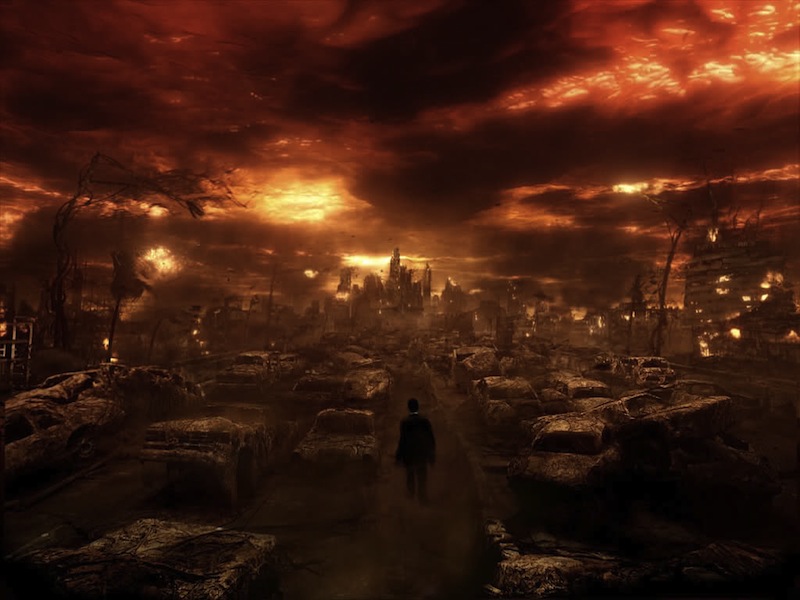
Four Reasons Civilization Won’t Decline: It Will Collapse

By Craig Collins

Source: CounterPunch

As modern civilization’s shelf life expires, more scholars have turned their attention to the decline and fall of civilizations past.  Their studies have generated rival explanations of why societies collapse and civilizations die.  Meanwhile, a lucrative market has emerged for post-apocalyptic novels, movies, TV shows, and video games for those who enjoy the vicarious thrill of dark, futuristic disaster and mayhem from the comfort of their cozy couch.  Of course, surviving the real thing will become a much different story.

The latent fear that civilization is living on borrowed time has also spawned a counter-market of “happily ever after” optimists who desperately cling to their belief in endless progress.  Popular Pollyannas, like cognitive psychologist Steven Pinker, provide this anxious crowd with soothing assurances that the titanic ship of progress is unsinkable.  Pinker’s publications have made him the high priest of progress.[1] While civilization circles the drain, his ardent audiences find comfort in lectures and books brimming with cherry-picked evidence to prove that life is better than ever, and will surely keep improving.  Yet, when questioned, Pinker himself admits, “It’s incorrect to extrapolate that the fact that we’ve made progress is a prediction that we’re guaranteed to make progress.”[2]

Pinker’s rosy statistics cleverly disguise the fatal flaw in his argument.  The progress of the past was built by sacrificing the future—and the future is upon us.  All the happy facts he cites about living standards, life expectancy, and economic growth are the product of an industrial civilization that has pillaged and polluted the planet to produce temporary progress for a growing middle class—and enormous profits and power for a tiny elite.

Not everyone who understands that progress has been purchased at the expense of the future thinks that civilization’s collapse will be abrupt and bitter.  Scholars of ancient societies, like Jared Diamond and John Michael Greer, accurately point out that abrupt collapse is a rare historical phenomenon.  In The Long Descent, Greer assures his readers that, “The same pattern repeats over and over again in history.  Gradual disintegration, not sudden catastrophic collapse, is the way civilizations end.”  Greer estimates that it takes, on average, about 250 years for civilizations to decline and fall, and he finds no reason why modern civilization shouldn’t follow this “usual timeline.”[3]

But Greer’s assumption is built on shaky ground because industrial civilization differs from all past civilizations in four crucial ways.  And every one of them may accelerate and intensify the coming collapse while increasing the difficulty of recovery.

Difference #1:  Unlike all previous civilizations, modern industrial civilization is powered by an exceptionally rich, NON-renewable, and irreplaceable energy source—fossil fuels.  This unique energy base predisposes industrial civilization to a short, meteoric lifespan of unprecedented boom and drastic bust.  Megacities, globalized production, industrial agriculture, and a human population approaching 8 billion are all historically exceptional—and unsustainable—without fossil fuels.  Today, the rich easily exploited oilfields and coalmines of the past are mostly depleted.  And, while there are energy alternatives, there are no realistic replacements that can deliver the abundant net energy fossil fuels once provided.[4]  Our complex, expansive, high-speed civilization owes its brief lifespan to this one-time, rapidly dwindling energy bonanza.

Difference #2:  Unlike past civilizations, the economy of industrial society is capitalist.  Production for profit is its prime directive and driving force.  The unprecedented surplus energy supplied by fossil fuels has generated exceptional growth and enormous profits over the past two centuries.  But in the coming decades, these historic windfalls of abundant energy, constant growth, and rising profits will vanish.

However, unless it is abolished, capitalism will not disappear when boom turns to bust.  Instead, energy-starved, growth-less capitalism will turn catabolic.  Catabolismrefers to the condition whereby a living thing devours itself.  As profitable sources of production dry up, capitalism will be compelled to turn a profit by consuming the social assets it once created.  By cannibalizing itself, the profit motive will exacerbate industrial society’s dramatic decline.

Catabolic capitalism will profit from scarcity, crisis, disaster, and conflict.  Warfare, resource hoarding, ecological disaster, and pandemic diseases will become the big profit makers.  Capital will flow toward lucrative ventures like cybercrime, predatory lending, and financial fraud; bribery, corruption, and racketeering; weapons, drugs, and human trafficking.  Once disintegration and destruction become the primary source of profit, catabolic capitalism will rampage down the road to ruin, gorging itself on one self-inflicted disaster after another.[5]

Difference #3:  Unlike past societies, industrial civilization isn’t Roman, Chinese, Egyptian, Aztec, or Mayan.  Modern civilization is HUMAN, PLANETARY, and ECOCIDAL.  Pre-industrial civilizations depleted their topsoil, felled their forests, and polluted their rivers.  But the harm was far more temporary and geographically limited. Once market incentives harnessed the colossal power of fossil fuels to exploit nature, the dire results were planetary.  Two centuries of fossil fuel combustion have saturated the biosphere with climate-altering carbon that will continue wreaking havoc for generations to come.  The damage to Earth’s living systems—the circulation and chemical composition of the atmosphere and the ocean; the stability of the hydrological and biogeochemical cycles; and the biodiversity of the entire planet—is essentially permanent.

Humans have become the most invasive species ever known.  Although we are a mere .01 percent of the planet’s biomass, our domesticated crops and livestock dominate life on Earth.  In terms of total biomass, 96 percent of all the mammals on Earth are livestock; only 4 percent are wild mammals.  Seventy percent of all birds are domesticated poultry, only 30 percent are wild.  About half the Earth’s wild animals are thought to have been lost in just the last 50 years.[6]  Scientists estimate that half of all remaining species will be extinct by the end of the century.[7] There are no more unspoiled ecosystems or new frontiers where people can escape the damage they’ve caused and recover from collapse.

Difference #4:  Human civilization’s collective capacity to confront its mounting crises is crippled by a fragmented political system of antagonistic nations ruled by corrupt elites who care more about power and wealth than people and the planet.  Humanity faces a perfect storm of converging global calamities.  Intersecting tribulations like climate chaos, rampant extinction, food and freshwater scarcity, poverty, extreme inequality, and the rise of global pandemics are rapidly eroding the foundations of modern life.

Yet, this fractious and fractured political system makes organizing and mounting a cooperative response nearly impossible.  And, the more catabolic industrial capitalism becomes, the greater the danger that hostile rulers will fan the flames of nationalism and go to war over scarce resources.  Of course, warfare is not new.  But modern warfare is so devastating, destructive, and toxic that little would remain in its aftermath.  This would be the final nail in civilization’s coffin.

Rising From the Ruins?

How people respond to the collapse of industrial civilization will determine how bad things get and what will replace it. The challenges are monumental.  They will force us to question our identities, our values, and our loyalties like no other experience in our history.  Who are we?  Are we, first and foremost, human beings struggling to raise our families, strengthen our communities, and coexist with the other inhabitants of Earth?  Or do our primary loyalties belong to our nation, our culture, our race, our ideology, or our religion?  Can we put the survival of our species and our planet first, or will we allow ourselves to become hopelessly divided along national, cultural, racial, religious, or party lines?

The eventual outcome of this great implosion is up for grabs.  Will we overcome denial and despair; kick our addiction to petroleum; and pull together to break the grip of corporate power over our lives?  Can we foster genuine democracy, harness renewable energy, reweave our communities, re-learn forgotten skills, and heal the wounds we’ve inflicted on the Earth?  Or will fear and prejudice drive us into hostile camps, fighting over the dwindling resources of a degraded planet?  The stakes could not be higher.

Notes.

[1] His books include: The Better Angels of Our Nature and Enlightenment Now: The Case for Reason, Science, Humanism, and Progress.

[2] King, Darryn. “Steven Pinker on the Past, Present, and Future of Optimism” (OneZero, Jan 10, 2019) https://onezero.medium.com/steven-pinker-on-the-past-present-and-future-of-optimism-f362398c604b

[3] Greer, John Michael.  The Long Descent (New Society Publishers, 2008): 29.

[4] Heinberg, Richard. The End Of Growth. (New Society, 2011): 117.

[5] For more on catabolic capitalism see: Collins, Craig. “Catabolism: Capitalism’s Frightening Future,”CounterPunch (Nov. 1, 2018). https://www.counterpunch.org/2018/11/01/catabolism-capitalisms-frightening-future/

[6] Carrington, Damian. “New Study: Humans Just 0.01% Of All Life But Have Destroyed 83% Of Wild Mammals,” The Guardian (May 21, 2018). https://www.theguardian.com/environment/2018/may/21/human-race-just-001-of-all-life-but-has-destroyed-over-80-of-wild-mammals-study

[7] Ceballos, Ehrlich, Barnosky, Garcia, Pringle & Palmer. “Accelerated Modern Human-Induced Species Losses: Entering The 6th Mass Extinction,” Science Advances. (June 19, 2015). http://advances.sciencemag.org/content/1/5/e1400253

Soylent Burgers and Cockroach Milk

wICCXTa

Source: The Hipcrime Vocab

“The profitability of production cannot expand indefinitely. Any increase in the quantity of soil, water, minerals, or plants put into a particular production process per unit of time constitutes intensification. It has been the burden of this book to show that intensification inevitably leads to declining efficiencies. That declining efficiencies have adverse effects upon the average standard of living cannot be doubted.’
-MARVIN HARRIS, ‘Cannibals and Kings’

This comment made me chuckle: “The futurology future is starting to look worse than the collapse future.” This was on Reddit in response to an article about cockroaches providing the “milk of the future”:

Scientists think cockroach milk could be the superfood of the future (Science Alert)

This really does seem like The Onion at this point. Someone suggested that Reddit’s collapse and futurology boards should merge at some point. Believe it or not, they aren’t all that far apart.

We’ve already been treated to an endless litany of articles about how insect ranching will provide the protein of the future. Then there’s the meat grown in a petri-dish, and the nutrition shake cheekily named Soylent scarfed down by the Silicon Valley crowd so they can cram in a few more hours of work after popping their Ritalin. Now people are questioning whether the government should step in and force us to eat less meat.

And yet we are still simultaneously told that overpopulation and resource depletion are not a problem, and that more growth is good.

This is progress???

One of the things I’ve written about over the years is this idea that technological innovations are inherently good. But it’s clear what’s really going on: desperately trying to maintain the status quo in the face of increasing population pressure and declining resources. There’s a technical term for this: intensification.

Marvin Harris, whose works serve as a guidepost for this blog, warned us that intensification always leads to lower living standards for the majority of people in the long run, while only benefiting a tiny handful. This is a law of history. Over the years, I’ve tried to point out the difference between true innovation which solves problems or allows us to do things we could not do before, and intensification, which is essentially squeezing blood from a stone. In the former category are things like antibiotics and radio, which solve problems (killer infections) or allow us to do new things (communicate globally). In the latter category are things like electric cars (attempting to keep the unsustainable automobile infrastructure alive) and aquaculture (to make up for stripping the oceans bare of wild fish).

For the majority of people, there is no difference, since both are “growth” and growth is always good, full stop. GDP, the yardstick by which we measure progress in the modern world (which even its creator warned us against) is agnostic as to the source of growth, whether it is producing more food to feed hungry people or asthma inhalers to deal with the lung irritants from air pollution.

People tend to forget we’ve been here before.

Back during the Ice Age (late Pleistocene), we H. sapiens lived primarily off of herds of large fauna, especially reindeer, mammoth and bison. This was supplemented with wild salmon in season. The fattiest parts of the animal were the most prized and sought after. Bones were cracked and boiled to extract the grease. Most calories came from nutrient-dense meat and fat, while plants were consumed for their beneficial vitamins and minerals (plants are less calorie dense).

Then the large fauna started to die off. They died off due to a double-blow of a changing climate and increasing human predation. Scientists debate about which was the primary cause, but it’s pretty clear that whenever humans showed up in a pristine environment, the large animals went extinct shortly thereafter. Many of these animals had survived previous climatic changes, so it’s doubtful that climate change alone was responsible. Skeletons riddled with spear points provide more damning evidence for our species.

In response, we launched a broad spectrum revolution – using our omnivorous diet to exploit a wider variety of foodstuffs, particularly plant foods. This began with acorns and pistachios, but soon moved to grass seeds, sedges and pulses. Meanwhile, the prey animals got smaller and smaller, from reindeer and bison, to gazelles and fallow deer, to hares and waterfowl. Instead of the nutritious and diverse food sources of their ancestors, we became more and more dependent upon eating pulverized grass seeds, obtained at the cost of backbreaking labor for harvesting, threshing and grinding.

The human population became mostly vegetarian by necessity, and remained so for roughly the next 8,000 or so years. The problem is, a vegetarian diet doesn’t provide a lot of necessary vitamins, minerals and nutrients for optimal health. Today’s vegetarians can choose from a plethora of foods year round that simply weren’t available to ancient people. They don’t have to worry about what is in season and have the entire world as their larder. In the past, however, the vast majority of people ended up subsisting on a diet of weak beer and gruel. Regular meat consumption became a privilege restricted to the wealthy upper classes, while everyone else went begging. Hunting, an activity once done by all humans everywhere since time immemorial, became the exclusive provenance of kings and princes – society’s rulers. While it is true that too much meat can be detrimental to health, too little is perhaps even more damaging. Humans are meat-eaters, and a certain level of fat and protein is required for optimal health. The protein in grains and legumes is incomplete (the body needs 22 different types of amino acids to function properly; adults can synthesize 13 of those internally, but the other 9 must be obtained from food), and there are no fats (the human brain is over 60 percent fat). Grains produce an over-abundance of omega-6 fatty acids, poisonous lectins to prevent their consumption, have low nutrient density, and high acidity. They are actually a terrible thing to base a primate diet around. But we had no other choice, thanks to intensification.

And this is dramatically reflected by the skeletons of ancient peoples, who show major signs of malnutrition, disease, and stunted growth. At the same time, arthritis and other signs of wear and tear make their appearance on the bones of people who now have to spend hours a day grinding grain in a saddle quern rather than fishing and chasing after wild animals. This gruel also breaks down into simple sugars in the mouth during digestion, meaning that cavities and premature tooth decay became endemic as well.

As population pressure grew, grains, pulses and sedges, once “unpalatable” dietary supplements cultivated by hunter-gatherers for times of extreme scarcity or fermentation into medicinal beverages, became the chief dietary staple for most people. At the same time, humans found themselves preyed upon by a new class of predator: their own kind, which continues unabated to this day.

In order to keep large herbivores from going totally extinct, we embarked upon what Harris called “the greatest conservation project in history”: animal domestication. Meanwhile, cheap carbohydrates from grain are what kept most of the human population alive from day-to-day for thousands of years, such that “bread” is synonymous in all ancient cultures with “food.”

All this came from attempting to exploit resources more intensively from our environment in the face of increasing population pressure.

This sad tale, memorably spun by Jared Diamond some years ago, reflects Harris’ principle: intensification inevitably leads to benefits for the few; misery and oppression for the many.

During periods of deintensifcation, we actually recovered some of the losses. This was due to either 1.) a reduced population or 2.) new lands and resources opened up for exploitation. For example, signs of health improve after the Black Death in Europe for the survivors, due to the reduced population pressure. There were more resources to go around per head. Also, the opening up of the new lands due to colonization (and the dieoff of the native peoples), brought vast new areas of virgin land under cultivation. This led to more wealth, as well as political freedoms. Serfdom waned after the black death, and the American Revolution put Enlightenment principles of representative democracy and justice into practice. Perhaps the most dramatic result came from the harnessing of millions of years of stored sunlight in fossil fuels, combined with the scientific method. This allowed many more people a higher standard of living, even in the face of increasing population and intensifying resource use. It was during this period that “economics” became the guiding principle of our civilization, and it chalked up all benefits to “institutions”–typically capitalist market institutions–rather than a temporary superabundance of energy and resources.

Thomas Jefferson once noted that the Americans in the room were all a head taller than their European counterparts. That’s what happens when you have plenty for everybody. The first Europeans in North America also noted how much taller the Native Americans were. As this article notes, in the past, Americans ate more meat than today, and were healthier as well:

How Americans Used to Eat (The Atlantic)

Eventually, the Malthusian cycle kicked in again. Population grew, the empty spaces filled up, and the frontier was closed. Increasing competition caused wages and purchasing power to drop. People gradually lost what self-sufficiency they had, allowing the elites to consolidate power. People once again began working longer, harder, for less. Sound familiar?

We intensified again – in order to keep up with the demand for meat, we crowded animals together into feedlots in unsanitary conditions and fed them cheap corn (maize), which they are not adapted to eat. To cope with the inevitable sickness which resulted, we pumped the animals full of antibiotics (which has a side effect of increasing growth). It is these miserable and tortured animals which most of us are forced to eat now, thanks to intensification.

However, domesticated meat is less nutritious than the wild variety. The Omega-3/Omega-6 profile is altered, and there are less antioxidants. Omega-6 fatty acids reduce inflammation, which is increasingly being pinpointed as the root cause of just about every disease you care to name, from autoimmune diseases, to Alzheimer’s, to arthritis, to chronic pain, depression, and cancer. At the same time, it’s been shown that grains actually increase inflammation, and are implicated in a host of metabolic diseases:

This Is Your Brain on Gluten (The Atlantic)

While grass-fed, hormone-free beef is still available, it costs more, meaning it is restricted to those with high incomes, just like in the past. And hunting is still primarily an elite sport for the rich in many places (especially outside North America). Just like in the past, the poor people trapped in “food deserts” feed themselves with cheap carbohydrates, now in the form of processed corn and sugar products made by the industrial food system, while the wealthy can purchase boutique ‘lifestyle” products at Whole Paycheck Foods.Malnutrition now takes the form of obesity as well as starvation, although much of the non-industrialized world still deals with empty bellies, stunted growth and vitamin deficiencies, including many of those who produce export crops for the West. That’s on top of poverty and pollution.

When we scraped the oceans clean of fish and poisoned our air and waterways due to industrial pollutants (e.g. mercury ash is a side effect of coal power generation) we turned to fish farming, (aquaculture) – one of the favorite high-tech “innovations” of the futurist crowd. But farmed fish are nutritionally inferior to wild ones. Wild fish travel widely and get their food from a great variety of sources. This means that they have a much better Omega-3 fatty acid profile (which prevents inflammation and helps brain growth). But farmed fish have to be fed. This means their diet is far more restricted, and hence their meat less nutritious (more Omega-6’s). In fact, salmon needs to be fed a pill in order to turn them pink so that consumers will buy them since their meat does not develop its natural color from their diet. As Spencer Wells notes in Pandora’s Seed, were now doing for fish what we did for ungulates some 8000 years ago: a desperate attempt to preserve what remains. Farmed fish is replacing wild fish in supermarkets. As with grass-fed meat, the wild variety is now sold at a premium affordable only to those with high incomes (sound familiar)?

In each and every case, intensification had led to far more work for ultimately inferior products. This is always the result of intensification in the long run.

We are constantly told we can’t go back to hunting and gathering (even if we wanted to). Why is that? What’s left unsaid is the reason: too many people and too much environmental degradation as the result of 6-8,000 years of intensification, which also brought about disease, governments, wars, taxes, poverty, inequality, and so on. Now we’re told we’ve got to eat less meat (which means more grains), live in small, tightly sealed houses, use less water, take shorter showers, and so forth. In essence, that we will “innovate” our way to success. But all of these are signs of lower living standards. And no wonder: seven billion-plus people, all quarters of the earth occupied and brought under the plow, rain forests being chopped down, the most easily accessible fossil fuels plateauing, toxic pollution of the air, land and water, overpumping of ground water, and the stable climate of the Holocene threatened by carbon levels. Intensification caused all of these things; it is not the solution. The next phase of intensification isn’t going to lead to better living standards any more than the last few rounds. Yet we’ve been tricked into thinking it will, because we don’t realize that fossil fuels are what are ultimately responsible for our current living standards (us Westerners, that is), not intensification. And even then, given the levels of stress, overwork, social dysfunction, health maladies and mental disease in industrialized societies, we might be tempted to wonder if even our living standards are all that great to begin with.

Furthermore, we are told that a healthy diet centered around pastured meat, plants and nuts is just not possible because it’s too damaging to the environment, or too “expensive.” That is, “we” need to “feed the world!” But according to the elites (the ones who benefit from intensification, remember) the answer isn’t less people, or curtailing economic growth. No, instead it’s new “innovations” that are profitable to the parasitical corporate owners of this planet: lab-grown meat, hydroponics, vertical gardens, meal-replacement shakes, protein powder from ground-up crickets, steel-and-glass human anthills. “The futurology future is starting to look worse than the collapse future.” Maybe that’s because the collapse future has more room to grow actual real food, live in a house you built yourself with your friends and family, spend time in nature, work less, play more, and get in touch with what we really are, deep down, instead of what industrial society wants to mold us to be.

Now, for the record, I have no problem with eating bugs. The Permaculturist in me says we should exploit all sources for sustenance in our environment such that they work together in a sustainable, harmonious way in line with the earth’s natural ecosystems. Raising insects, as we now do with bees, makes sense. And, yes, the overconsumption of Americans is grotesque and makes us unhappy, and we’d be better off ditching it (which I already do voluntarily). So to be clear: what I am criticizing is not eating insects or deriving milk from cockroaches per se. Nor am I defending the overconsumption produced by status-driven consumer capitalism. Rather, I am critiquing the idea that these futurology trends are signs of progress rather than collapse. Which is why r/collpase and r/futurology increasingly appear to be turning into the same thing.

P.S This comment nails it.