Airstrikes Without Justice

By John Wight

Source: CounterPunch

To describe the US attack on Syria as a serious development is to be guilty of understatement.

Without any recourse to international law or the United Nations, the Trump administration has embarked on an act of international aggression against yet another sovereign state in the Middle East, confirming that neocons have reasserted their dominance over US foreign policy in Washington. It is an act of aggression that ends any prospect of détente between Washington and Moscow in the foreseeable future, considerably increasing tensions between Russia and the US not only in the Middle East but also in Eastern Europe, where NATO troops have been conducting military exercises for some time in striking distance of Russian territory.

In the wake of the horrific images that emerged from Idlib after the alleged sarin gas attack, the clamour for regime change in Damascus has reached a crescendo in the West, with politicians and media outlets rushing to judgement in ascribing responsibility for the attack to the Syrian government. No one knows with any certainty what happened in Idlib, which is why an independent investigation should have been agreed and undertaken in pursuit of the truth and, with it, justice.

However only the most naïve among us could believe that this US airstrike against Syria was unleashed with justice in mind. How could it be when US bombs have been killing civilians, including children, in Mosul recently? And how could it be given the ineffable suffering of Yemeni children as a result of Saudi Arabia’s brutal military campaign there?

No, this US attack, reportedly involving 59 Tomahawk missiles being launched from ships in the eastern Mediterranean, was carried out with regime change in mind, setting a precedent that can only have serious ramifications for the entire region.

Regarding the attack in Idlib, what we can say with certainty is that a time when pro-government forces in Syria were in the ascendancy on the ground, and when the Syrian government was making significant progress on the diplomatic front, it would have constituted an act of ineffable self-harm to launch a chemical weapons attack of any kind, much less one of this magnitude. In fact it would have conformed to the actions of a government that was intent on bringing about its own demise. What also must be taken into consideration is the fact that the Organisation for the Prohibition of Chemical Weapons (OPCW), an organisation supported by the US, confirmed back in June 2014 that the process to destroy Syria’s entire stock of chemical weapons had been completed.

Moreover, the horrific images and eyewitness testimony that have emanated from Idlib in the wake of the attack have come from pro-opposition sources. No Western journalist or news crew would dare set foot in Idlib, or indeed any other part of opposition-held territory in Syria, knowing that as soon as they did they would be abducted and slaughtered.

Trump has proved with this unilateral military intervention that he can easily be dragged into conflict. Just a few days after his administration confirmed that regime change in Syria was off the table, that its focus was on defeating terrorism, he unleashes an airstrike that will only have emboldened the very forces of terrorism whose defeat he had stressed was the focus of his foreign policy previously.

So what now? Clearly, this military action places Russia in a very difficult position. Since joining the conflict in Syria at the end of September 2015, at the behest of the country’s government, Moscow had been working tirelessly to bring about a negotiated settlement, one involving opposition forces and parties deemed moderate relative to the Salafi-jihadi fanatics of ISIS and Nusra, etc. It is a diplomatic process that has just been dealt a shattering blow, with the opposition now undoubtedly convinced that regime change is in the offing via Washington and therefore encouraged to work towards this end.

Meanwhile, as for Washington’s regional allies – Israel, Saudi Arabia, Qatar, and Turkey (with Erdogan guaranteed to hitch his wagon to whoever appears to be in the driving seat) – they will most likely begin calling for more military action against Damascus now, viewing the US airstrike as the catalyst for open season on the country’s sovereignty.

As for Trump himself, having been under inordinate pressure since assuming office in January from the Washington media, political, and intelligence establishment, this action will earn him some much needed approval and, with it, respite. The signs with regard to his administration had been ominous for some time, starting with the forced resignation of Mike Flynn as his National Security Adviser in February, and continuing recent departure of Steve Bannon from the President’s National Security Council. It comes as further evidence that neocons have reasserted their dominance over the White House after a short and intense power struggle.

On a wider note, the lack of short-term memory in Washington is staggering to behold. Fourteen years after the disastrous US invasion of Iraq, which only succeeded in opening the gates of hell out of which ISIS and other Salfi-jihadi groups emerged, and six years after turning Libya into a failed state, in the process sparking a refugees crisis of biblical proportions, here we have yet another act of aggression against a sovereign state in the Middle East by the US.

Destroying countries in order to save them is the story of every empire there has been. But as history reveals, every empire carries within itself the seeds of its own destruction. Donald Trump is now on course to end up going down in history as a leader who rather than save the US from itself, may only have helped speed it down the path to its ultimate demise.

“Rome has grown since its humble beginning that it is now overwhelmed by its own greateness.” 
John Wight is the author of a politically incorrect and irreverent Hollywood memoir – Dreams That Die – published by Zero Books. He’s also written five novels, which are available as Kindle eBooks. You can follow him on Twitter at @JohnWight1

Syria: New U.S. Air Support On Request Scheme For Al-Qaeda

Source: Moon of Alabama

On this day one hundred years ago the U.S. joined World War I. Last night the U.S. attacked a Syrian government airport in an openly hostile and intentional manner. The strike established a mechanism by which al-Qaeda can “request” U.S. airstrikes on Syrian government targets. It severely damaged the main support base for Syria’s fight against the Islamic State in eastern Syria. The event will possibly lead to a much larger war.

On April 4 Syrian airplanes hit an al-Qaeda headquarter in Khan Sheikoun, Idleb governate. Idleb governate is under al-Qaeda control. After the air strike some chemical agent was released. The symptoms shown in videos from local aid stations point to a nerve-agent. The release probably killed between 50 and 90 people. It is unknown how the release happened.

It is unlikely that the Syrian government did this:

  • In 2013 the Syrian government had given up all its chemical weapons. UN inspectors verified this.
  • The target was militarily and strategically insignificant.
  • There was no immediate pressure on the Syrian military.
  • The international political atmosphere had recently turned positive for Syria.

Even if Syria had stashed away some last-resort weapon this would have been the totally wrong moment and totally wrong target for using it. Over the last six year of war the Syrian government army had followed a political and militarily logical path. It acted consistently. It did not act irrational. It is highly unlikely that it would have now take such an illogical step.

The chemical used, either Sarin or Soman, was not in a clean form. Multiple witnesses reported of a “rotten smell” and greenish color. While the color would point to a mixture with Chlorine the intense smell of Chlorine is easily identifiable, covers up most other odors and would have been recognized by witnesses. Both Sarin and Soman are in pure form colorless, tasteless and odorless. The Syrian government once produced nerve agents on a professional, large scale base. Amateurishly produced nerve-gases are not pure and can smell (example: Tokyo subway incident 1995). It is unlikely that the Syrian government experts would produce a “rotten smelling”, dirty, low quality stuff in an unprofessional and dangerous process.

The nerve agents in Khan Sheikoun, should they be confirmed, came either from stashed ammunition at the place attacked by the Syrian government or it was willfully released by the local ruling terrorist groups -al-Qaeda and Ahrar al-Sham- after the strike to implicate the Syrian government. The relatively low casualty numbers of mostly civilians point to the second variant.

Several reports over the years confirm that Al-Qaeda in Syria has the precursors and capabilities to produce and use Sarin as well as other chemical agents. This would not be their first use of such weapons. Al-Qaeda was under imminent pressure. It was losing the war. It is therefor highly likely that this was an intentional release by al-Qaeda to create public pressure on the Syrian government.

For a release incident of powerful chemical weapons the casualty numbers were low, lower than the casualty numbers of recent conventional U.S. air strikes in Syria and Iraq. Despite that fact a huge international media attack wave, seemingly prepared in advance, against the Syrian government was released. No evidence was presented that the incident was caused by the Syrian government. The only pictures and witness reports from the ground came from or through elements, like the White Helmets, who are known to by embedded with al-Qaeda and ISIS (video) and are acting as their propaganda arm.

Last night U.S. president Trump “responded” to the incident by ordering the launch of 59 cruise missiles on the Syrian military airport Al Syairat (vid). The cruise missiles were launched from sea in a volley designed to overwhelm air defenses. According to the Syrian and Russian military only 23 cruise missiles reached the airport. The others were shut down or failed. Six Syrian soldiers were Killed, nine civilians in a nearby village were killed or wounded and nine Syrian jets were destroyed. The airport infrastructure was severely damaged. The Syrian and Russian governments had been warned before the strikes hit and evacuated most men and critical equipment. (Was the warning part of a deal?) The air attack coincided with an Islamic State ground attack east of the airport.

The Pentagon alleges, without any evidence, that Sarin had been stored at the airport and a chemical attack launched from it. Both seems highly unlikely. The airport was accessible for UN inspectors. It is not as well covered by air defenses as other Syrian airports, for example in Latakia governate. Its ground approaches are not completely secured. Some medium range air defense system near al Syairat was recently used against Israeli planes attacking Syrian forces fighting ISIS near Palmyra.

Al Syairat lies in Homs governate, 150 km south of Khan Sheikoun in Idleb governate. It is the main support and supply airport for the besieged Syrian government enclave in Deir Ezzor which will now again be in even more serious trouble. It was also used to launch attacks on the Islamic State which fights the Syrian government troops in east Homs.

Al-Qaeda and its sidekick Ahra al-Sham welcomed the U.S. strikes and Abu Ivanka al Amriki on their side. The theocratic dictatorship of Saudi Arabia offered its full support as did its British creators.

The U.S. airstrike delivers a message to al-Qaeda. Whenever under military pressure al-Qaeda can now stage or fake a “chemical attack” and the U.S. will act to destroy its enemy, the Syrian government. Acts as the one last night are then direct military support by the U.S. on al-Qaeda’s request.

A similar scheme had earlier been established on the Golan heights. Al-Qaeda, fighting against Syrian government positions, would launch a mortar round that would land within Israeli controlled territory. Israel would then launch artillery strikes against Syrian government positions because “the Syrian government is responsible for what happens in the area”. Al-Qaeda then used the battle field advantage created by the Israeli strike. The scheme and the Israeli military “reasoning” was published several times in Israeli media:

A number of mortars have landed in Israeli territory as a result of spillover fighting over the last several years, raising fears among residents near the border.The IDF often responds to fire that crosses into Israel by striking Syrian army posts.

Israel maintains a policy of holding Damascus responsible for all fire from Syria into Israel regardless of the source of the fire.

The U.S. administration has now established a similar mechanism, on a larger scale, of direct military U.S. support for al-Qaeda and the Islamic State in Syria.

The Trump presidency had been held hostage by unfounded allegation of “Russian interference” in the U.S. elections in support of the Trump candidacy. The air strikes on Syria might have been the ransom that was demanded for the release of the hostage. His opponents are now gushing about him. The allegation of any Trump-Russia connections may now die down.

Yesterday major Democratic leaders in Congress supported strikes on Syria. Despite that they are also likely to attack Trump over them. The strikes are a “strong man” gamble. As Trump said when Obama ordered strikes such are a desperate move. Most parts of the State Department and the NSC were not consulted about them. The chances that these will “blow back” politically as well as strategically are high.

Trump is the third U.S. president in a row who promised less belligerence during his campaign only to deliver more after the election. The “democratic” veil of the U.S. oligarchic rule thus rips further apart.

Open U.S.-Russian cooperation in Syria will now cease. U.S. planes in Syrian airspace are from now on constantly under imminent danger. There will also be some larger revenge against the U.S. for last night’s strikes. Likely not in Syria but in Iraq, Afghanistan or at sea. A “message” will be send. The U.S. reaction to that “message” will be a decision over a much larger war.

Related Articles

US Missiles Strike Syrian Forces Fighting Al Qaeda

Syria’s alleged gas attack: An imperialist provocation

Putin believes US attack on Syria violates international law – spokesman

Top 10 Lies, Damn Lies, and Lies About Syria

Related Video:

Cycle of Insurgency: How the US military is expected to put down an insurrection

Suspect Death

By Justin King

Source: The Fifth Column

One of the overriding questions when discussing an insurgency within the United States has always been the debate over how the military would respond. Those who hope for the military to break ranks and join the resistance will be disappointed. Those who would believe the military will employ surgical strikes to remove dissidents through technology will be surprised. The American people don’t have to guess how the US military would respond any longer. Two respected academics chose to war game a scenario using the United States Operating Concept (2010) as a guide.

The first thing to understand about an insurrection is that it isn’t terrorism. The terms are often used interchangeably by the media, but there is a significant difference.

As pointed out throughout this series, insurgencies that matured through the cycle of insurgency win. Always. There is a reason for this. Insurgencies, though typically weaker militarily, have great advantages over their adversaries. One of the greatest small unit commanders and unconventional warfare experts in modern times, Richard Marcinko, described three things needed to win in combat: speed, surprise, and violence of action. When transferred to the strategic and operational levels, the insurgency possesses these attributes. The greatest advantages of the insurgency are:

Mobility: The refusal to stay in a static location negates technologically advanced weapons systems.
Initiative: The insurgency is able to choose the time and place of most of the battles they fight.
Surprise: Because the insurgents have the ability to choose the time and place of the fight, they can select moments when the opposition is weakest.
Camouflage: The insurgent does not wear a uniform. As the father of modern insurgency, Michael Collins, said: “Our uniform will be that of the man on the street and the peasant in the field.” This makes distinguishing between friend and foe difficult for the opposition.
Unpredictability: A force that is unpredictable on a battlefield is dangerous. Field commanders train to fight conventional wars, in which both sides attempt to take and hold territory, the insurgent seeks destabilization of the opposition’s government, not land. Tactics designed to defeat a conventional army are useless against an enemy that doesn’t seek to hold territory. The value of remaining unpredictable has created an adage in military circles: “Professional soldiers are predictable, but the world is full of amateurs.” The implied meaning is that the amateur is more dangerous.
Factional divides: In a conventional military setting, a force should function like a well-oiled machine and have clear command and control. Insurgencies typically operate with loose alliances between factions who follow a particular commander. Sometimes they work together, sometimes they don’t. Just when the opposition gains a feel for the tactics and strategy of an insurgent commander, a new one arises. This leads to unpredictable actions being taken by the various factions, which increases their overall effectiveness.
Civilian sympathies: Insurgencies typically maintain a great deal of support from the local populace, which means the opposition can’t move without information detailing those moves reaching the insurgents. In a conventional conflict, the lines of battle hinder civilians from collecting intelligence and passing it to the opposing force. It can be done, but it is difficult. Insurgencies have no front lines.

Insurgencies maintain several other key advantages, but they are more nuanced and are beyond the scope of this article.

The US Army has adopted a doctrine of “Full Spectrum Operations”. Loosely it means the combination of offensive, defensive, and either stability operations overseas or civil support operations on U.S. soil. It’s a concept developed for conventional wars, with little application in unconventional conflicts. To produce a desired outcome (a US military win), the scenario has to be carefully crafted. The academics who published Full Spectrum Operations in the Homeland: A “Vision” of the Future were able to accomplish that. The scenario they present is:

The Great Recession of the early twenty-first century lasts far longer than anyone anticipated.  After a change in control of the White House and Congress in 2012, the governing party cuts off all funding that had been dedicated to boosting the economy or toward relief.  The United States economy has flatlined, much like Japan’s in the 1990s, for the better part of a decade.  By 2016, the economy shows signs of reawakening, but the middle and lower-middle classes have yet to experience much in the way of job growth or pay raises.  Unemployment continues to hover perilously close to double digits, small businesses cannot meet bankers’ terms to borrow money, and taxes on the middle class remain relatively high.  A high-profile and vocal minority has directed the public’s fear and frustration at nonwhites and immigrants.  After almost ten years of race-baiting and immigrant-bashing by right-wing demagogues, nearly one in five Americans reports being vehemently opposed to immigration, legal or illegal, and even U.S.-born nonwhites have become occasional targets for mobs of angry whites.

In May 2016 an extremist militia motivated by the goals of the “tea party” movement takes over the government of Darlington, South Carolina, occupying City Hall, disbanding the city council, and placing the mayor under house arrest.  Activists remove the chief of police and either disarm local police and county sheriff departments or discourage them from interfering.  In truth, this is hardly necessary.  Many law enforcement officials already are sympathetic to the tea party’s agenda, know many of the people involved, and have made clear they will not challenge the takeover.  The militia members are organized and have a relatively well thought-out plan of action.

With Darlington under their control, militia members quickly move beyond the city limits to establish “check points” – in reality, something more like choke points — on major transportation lines.  Traffic on I-95, the East Coast’s main north-south artery; I-20; and commercial and passenger rail lines are stopped and searched, allegedly for “illegal aliens.”  Citizens who complain are immediately detained.  Activists also collect “tolls” from drivers, ostensibly to maintain public schools and various city and county programs, but evidence suggests the money is actually going toward quickly increasing stores of heavy weapons and ammunition.  They also take over the town web site and use social media sites to get their message out unrestricted.

The scenario continues with descriptions of the activities of politicians prior to the military being involved, but the actions of the “insurgent” already guarantee a US military victory. In the presented scenario, the insurgents surrender every single advantage they have. They attempt to hold territory, losing the advantages of mobility, surprise, initiative, and unpredictability. Because they are operating openly and in a defined area, they have lost the advantage of camouflage. The battle lines established by the insurgents themselves at the checkpoints negate the benefits of civilian sympathy. They have a unified command structure that reduces unpredictability.

In the scenario, DOD responds to this threat by establishing a “show of force” to demoralize the insurgents. They then mount offensive operations by surprise to take down the checkpoints. Towards the end of the campaign, the military seizes power and radio stations and so on. It then begins mopping up operations once the civilians of Darlington have fled.

When faced with the realities of a modern insurgency, this response is completely fictional. There can be no “show of force” to insurgents who don’t take and hold territory. Because the insurgency would operate in a loosely defined area, it would be the US military setting up checkpoints (as in Iraq) that would be ambushed, not the insurgents. Wise insurgents would use mobile communications to spread their message, not a static radio station. The power stations would have been destroyed to foster a belief in the civilian populace that the government can’t even keep the lights on, much less defeat the insurgency. The civilians that conveniently remove themselves from the battlefield in the scenario will be in the line of fire during an insurgency because there is no front line. There is nowhere to evacuate to.

The academics responsible for this scenario specifically created a simple set of conditions that allowed them to explore the logistical aspects of the doctrine on US soil, without considering the real world applications. The US counterinsurgency doctrine is fundamentally flawed. Even when practiced in a foreign country, away from the intense criticism of the US media and populace, it failed to pacify Iraq or Afghanistan. In the US, the doctrine is worthless.

In the joint publication on counterinsurgency doctrine used by all branches, even before the table of contents, it spells out the expected failure. On page iii it states:

“US counterinsurgency efforts should provide incentives to the host-nation government to undertake reforms that address the root causes of the insurgency.”

In a US-based insurgency, the United States is the “host-nation government”. While the above scenario makes for a fun read, current US doctrine is to meet the demands of domestic insurgents, while protecting as much of its credibility as possible.

The U.S. Deep State Rules – On Behalf of the Ruling Class

By Glen Ford

Source: Black Agenda Report

“The U.S. Deep State is unlike any other, in that there is no other global superpower bent on world domination.”

The Deep State is busy denying that it exists, even as it savages a sitting president and brutally bitch-slaps its host society, demanding the nation embrace its role as global psycho thug and kick some Russian ass. The New York Times, always available to divert attention from the essential facts of who rules America, points to Egypt, Turkey and Pakistan as the natural habitats of Deep States. Apparently, Deep State-infected countries tend to be nations with majority Muslim populations, whose military-intelligence apparatus hovers over society and periodically seizes control of the civil government.

The Times quoted high-ranking operatives of the Deep State to prove that such structures are alien to the U.S. Michael V. Hayden, who ran the CIA under Democratic President Obama and Republican George Bush, recoiled at the term. He “would never use” the words Deep State in connection with his own country. “That’s a phrase we’ve used for Turkey and other countries like that, but not the American republic.”

Loren DeJonge Schulman, a former Obama National Security Council official, claimed to be repelled by the very idea of an American Deep State. “A deep state, when you’re talking about Turkey or Egypt or other countries, that’s part of government or people outside of government that are literally controlling the direction of the country no matter who’s actually in charge, and probably engaging in murder and other corrupt practices,” she said.

Apparently, Ms. Schulman did not consider it murder when Obama and his top national security advisors met every Tuesday at the White House to decide who would be assassinated by drone or other means. But she is “shocked” to hear “that kind of [Deep State-phobic] thinking from” President Trump “or the people closest to him.”

Once the Times had located the nexus of Deep Statism in the Muslim world, the lesser lights at The New Yorker endorsed the corporate media consensus that the U.S. is Deep State-free. Staff writer David Remnick admits that U.S. presidents “have felt resistance, or worse, from elements in the federal bureaucracies,” citing Eisenhower’s warnings against the military-industrial complex, Lyndon Johnson’s “pressure from the Pentagon,” and the “rebuke” of Obama’s Syria policy through the State Department’s “dissent channel.” However, he denies that any “subterranean web of common and nefarious purpose” threatens the orderly and transparent processes of the U.S. political system.

In reality, the U.S. Deep State is by far the world’s biggest and most dangerous version of the phenomenon; a monstrous and not-so subterranean “web of common and nefarious purpose” that is, by definition, truly global, since its goal is to rule the planet. Indeed, the Deep States of Turkey, Egypt and Pakistan — all nominal U.S. allies – are midgets in comparison and must operate in a global environment dominated by Washington’s Deep State apparatus. So vast is the imperial Deep State, that its counterparts in other nations exist largely to collaborate with, resist, or keep tabs on the U.S. behemoth, the predator that seeks to devour all the rest.

What is a Deep State? The U.S. Deep State is unlike any other, in that there is no other global superpower bent on world domination. (Washington’s political posture is also unique; no other nation claims to be “exceptional” and “indispensable” and thus not subject to the constraints of international law and custom.) Indeed, the U.S. is so proudly and publicly imperialist that much of what should be secret information about U.S. military and other capabilities is routinely fed to the world press, such as the 2011 announcement that the U.S. now has a missile that can hit any target on the planet in 30 minutes, part of the Army’s “Prompt Global Strike” program. Frightening the rest of the world into submission — a form of global terrorism — is U.S. public policy.

However, arming and training Islamic jihadist terrorists to subvert internationally recognized governments targeted by the U.S. for regime change is more than your usual variety of covert warfare: It is a policy that must forever be kept secret, because U.S. society would suffer a political breakdown if the facts of U.S. and Saudi nurturing of the international jihadist network were ever fully exposed. This is Deep State stuff of the highest order. The true nature of U.S. foreign policy in the 21st century, and the real character of the current wars in Syria and Iraq, must be hidden from the U.S. public at all cost. An alternative reality must be presented, through daily collaboration between corporate media, corporate universities, and the public and covert organs of the U.S. State.

What part of the New York Times coverage of the war against Syria is a lie? Damn near all of it. What role does the Deep State play in crafting the lies dutifully promulgated by the corporate media? That’s impossible to answer, because the Deep State is a network of relationships, not a clearly delineated zone or space or set of organizations. The best way to describe the imperial Deep State is: those individuals and institutions that are tasked with establishing the global supremacy of the corporate ruling class. Such activities must be masked, since they clash with the ideological position of the ruling class, which is that the bourgeois electoral system of the United States is the world’s freest and fairest. The official line is that the U.S. State is a work of near-perfection, with checks and balances that prevent any class, group or section from domination over the other. The truth is that an oligarchy rules, and makes war on whomever it chooses — internationally and domestically — for the benefit of corporate capital.

The Deep State and its corporate imperatives manifestly exists when corporate lobbyists and lawyers are allowed to draw up the Trans Pacific Partnership global “trade” agreement, but the contents are kept secret from the Congresspersons whose duty is to vote on the measure. The Deep State is where corporate power achieves its class aims outside the public processes of government. It’s where the most vicious class warfare takes place, whether on a foreign killing field, or in the corporate newsroom that erases or misrepresents what happened on that battlefield.

At this stage of capitalism, the U.S. ruling class has less and less use for the conventional operations of the bourgeois state. It cannot govern in the old way. More and more, it seeks to shape events through the levers of the collaborating networks of the Deep State. It’s number one global priority is to continue the military offensive begun in 2011, and to break Russia’s resolve to resist that offensive. The ruling class and its War Party, now consolidated within the Democratic Party and regrouping among Republicans, have effectively neutralized a sitting president whose party controls both Houses of Congress, less than two months into his term.

Only a Deep State could pull that off.


BAR executive editor Glen Ford can be contacted at Glen.Ford@BlackAgendaReport.com.

Glen Ford’s blog

Aristocracy Deceives Public about the Deep State

deep_state_gears_1088x725

By Eric Zuesse

Source: Strategic Culture Foundation

The «deep state» is the aristocracy and its agents. Wikispooks defines it as follows:

The deep state (loosely synonymous with the shadow government or permanent government) is in contrast to the public structures which appear to be directing individual nation states. The deep state is an intensely secretive, informal, fluid network of deep politicians who conspire to amplify their influence over national governments through a variety of deep state milieux. The term «deep state» derives from the Turkish »derin devlet», which emerged after the 1996 Susurluk incident so dramatically unmasked the Turkish deep state.

Their article is so honest that it continues from there, directly to:

Official Narrative

The official narrative of deep states used to be that they simply do not exist. This position was modified in the last few years to the claim that they don’t exist here. In 2013 the New York Times defined the deep state as «a hard-to-perceive level of government or super-control that exists regardless of elections and that may thwart popular movements or radical change. Some have said that Egypt is being manipulated by its deep state». [1] Since the Times (like the rest of the commercially-controlled media) is more or less a under the control of the deep state, such a mention is very interesting.

However, one of the deep state’s many agents, Marc Ambinder, came out with a book in 2013, Deep State: Inside the Government Secrecy Industry, much praised by others of the deep state’s agents, such as Martha Raddatz, Jeremy Scahill, and Peter Bergen; and it pretends that the ‘deep state’ is only within the official government, not above it and controlling it — not what has been called by some «the money power,» and by others «the aristocracy» (or the «oligarchy» as it was termed — though even that, only indirectly — by the only people who have scientifically established that it exists in America and controls this country: to acknowledge publicly that the U.S. is controlled by an «aristocracy» is prohibited in scholarly publications; it’s too ‘radical’ a truth to allow in print; it is samizdat).

On its third page, Ambinder’s piece of propaganda make clear what he means by ‘deep state’:

This book is about government secrets — how they are created, why they get leaked, and what the government is currently hiding. We will delve into the key elements of the American secrecy apparatus, based on research and unprecedented access to lawmakers, intelligence agency heads, White House officials, and program managers. …

That piece of trash failed even to discuss George W. Bush’s lies in which Bush stated during 2002 and 2003 that he possessed conclusive proof that Saddam Hussein was reconstituting his WMD (weapons of mass destruction) program — what America’s aristocratically controlled ‘news’ media attributed instead to ‘failures of intelligence’ by the Bush Administration — which had supposedly caused the Bush regime to invade Iraq in 2003. That was supposedly an enormous ‘failure of intelligence’, but Ambinder’s book ignored it entirely — and yet there are still suckers who buy that and the aristocracy’s other propaganda (and so who misunderstand even such a basic concept as «the deep state» or «the aristocracy»).

One of the biggest indicators that one is reading propaganda from the deep state is that the government’s lies are not being called »lies» (unless the deep state is losing control over the government, which rarely happens). Instead, they are called by such phrases as ‘failures of intelligence’. But what about when the people who control the government misrepresent what their ‘intelligence’ actually shows and doesn’t show? Lying is attributed, in the ‘news’ media, only to the aristocracy’s enemies. After all: the aristocracy’s enemies can be acknowledged to exist, even if the existence of an aristocracy isn’t being acknowledged.

Another mouthpiece of the deep state is (like virtually all magazines) The Nation magazine, which headlined on 17 February 2017, «What Is the Deep State? Even if we assume the concept is valid, surely it’s not useful to think of the competing interests it represents as monolithic.» Their propagandist, Greg Grandin, asked «What is the ‘deep state’?» and he ignored what wikispooks said, and he asserted, instead, «The problem with the phrase ‘deep state’ is that it is used to suggest that dishonorable individuals are subverting the virtuous state for their private ambitions.» Aside from propagandist Grandin’s having merely assumed there ‘the virtuous state’, which might not even exist at all, in this country, or perhaps in any other, he was trying to, as he said, get «beyond the binds of conspiracy theory,» as if any hierarchical social structure, corporate or otherwise, doesn’t necessarily and routinely function by means of conspiracies — some of which are nothing more than entirely acceptable competitive strategies, often entirely legal. He wants to get beyond accepting that reality? Why would anyone wish to read such absurd, anti-factual, writings as that? Why would anyone hire such deceptive writers as that? Perhaps the answer to the latter question (which raises the problem here to being one about the aristocracy, since this is about the ‘news’ media, which in every aristocratically controlled country are controlled by its aristocracy) is that only writers such as that will pump their propaganda, and will hide such realities as are here being discussed (and, via links, documented).

Nothing that’s alleged here is denying that there are divisions within the aristocracy (or «deep state»). Nothing is alleging that the aristocracy are «monolithic.» It’s instead asserting that, to the extent the aristocracy are united around a particular objective, that given objective will likely become instituted, both legally and otherwise, by the government — and that, otherwise, it simply won’t be instituted at all. This is what the only scientific analysis that has ever been done of whether or not the U.S. is controlled by an aristocracy found definitely to be the case in the U.S.

(And, of course, that’s also the reason why this momentous study was ignored by America’s ‘news’ media, except for the first news-report on it, mine at the obscure site Common Dreams, which had 414 reader-comments within just its first four months, and then the UPI’s report on it, which, like mine, was widely distributed to the major ‘news’ media and rejected by them all — UPI’s report was published only by UPI itself, and elicited only two reader-comments there. Then came the New Yorker’s pooh-poohing the study, by alleging «the politicians all know this, and we know it, too. The only debate is about how far this process has gone, and whether we should refer to it as oligarchy or as something else.» Their propagandist ignored the researchers’ having noted, in their paper, that though their findings were extremely inconsistent with America’s being a democracy, the problem was almost certainly being understated in their findings: «The failure of theories of Majoritarian Electoral Democracy is all the more striking because it goes against the likely effects of the limitations of our data,» and, especially, «our ‘affluent’ proxy is admittedly imperfect,» and so, «interest groups and economic elites actually wield more policy influence than our estimates indicate.»

In fact, their «elite» had consisted not of the top 0.1% as compared to the bottom 50%, but instead of the top 10% as compared to the bottom 50%, and all empirical evidence shows that the more narrowly one defines «the aristocracy,» the more lopsidedly dominant is the ‘elite’s relative impact upon public policies. Then, a month after the press-release on their study was issued, the co-authors were so disappointed with the paltry coverage of it that had occurred in America’s ‘news’ media, so that they submitted, to the Washington Post, a reply to their study’s academic critics, «Critics argued with our analysis of U.S. political inequality. Here are 5 ways they’re wrong.» It was promptly published online-only, as obscurely as possible, so that there are also — as of the present date — only two reader-comments to that public exposure. This is typical news-suppression in America: essentially total suppression of samizdat information — not merely suppression of the officially top-secret information, such as propagandists like Ambinder focus upon. It’s deeper than the state: it is the deep state, including far more than just the official government.)

Another matter that America’s press has covered-up is the extreme extent to which the only scientific analysis of whether America is a democracy or instead an aristocracy, had found it to be an aristocracy; so, here in closing will be directly quoted the least-obscurantist statement of this fact, in the study itself:

The picture changes markedly when all three independent variables are included in the multivariate Model 4 and are tested against each other. The estimated impact of average citizens’ preferences drops precipitously, to a non-significant, near-zero level. Clearly the median citizen or «median voter» at the heart of theories of Majoritarian Electoral Democracy does not do well when put up against economic elites and organized interest groups. The chief predictions of pure theories of Majoritarian Electoral Democracy can be decisively rejected. Not only do ordinary citizens not have uniquely substantial power over policy decisions; they have little or no independent influence on policy at all.

By contrast, economic elites are estimated to have a quite substantial, highly significant, independent impact on policy.

They weren’t allowed to say «aristocracy», nor even directly to say «oligarchy», but they were allowed to say this. So: now, you’ve seen it. But the secret is still a secret; what’s samizdat, stays samizdat (so long as the government isn’t overthrown and replaced — and maybe even after the existing regime does become replaced).

Mainstream Media’s ‘Victimhood’

aa-corporate-media-very-good-poster

By Robert Parry

Source: Consortium News

It’s heartwarming that The New York Times and The Washington Post are troubled that President Trump is loosely throwing around accusations of “fake news.” It’s nice and that they now realize that truth does not reliably come from the mouth of every senior government official or from every official report.

The Times is even taking out full-page ads in its own pages to offer truisms about truth: “The truth is hard. The truth is hidden. The truth must be pursued. The truth is hard to hear. The truth is rarely simple. The truth isn’t so obvious. …”  On Sunday, those truth truisms ran opposite an alarmist column by Jim Rutenberg entitled, “Will the Real Democracy Lovers Please Stand Up?” Meanwhile, The Washington Post launched its own melodramatic slogan, “Democracy Dies in Darkness.”

Yet, it was only weeks ago when the Post and Times were eagerly promoting plans for silencing or blacklisting independent news sites that didn’t toe the line on what the U.S. government and its allies were claiming was true.

On Nov. 20, the Times published a lead editorial calling on Facebook and other technology giants to devise algorithms that could eliminate stories that the Times deemed to be “fake.” The Times and other mainstream news outlets – along with a few favored Internet sites – joined a special Google-sponsored task force, called the First Draft Coalition, to decide what is true and what is not. If the Times’ editorial recommendations were followed, the disfavored stories and the sites publishing them would no longer be accessible through popular search engines and platforms, essentially blocking the public’s access to them. [See Consortiumnews.com’s “What to Do About ‘Fake News.’”]

On Thanksgiving Day, the Post ran a front-page story citing an anonymous group, called PropOrNot, blacklisting 200 Web sites, including Consortiumnews.com and other important sources of independent journalism, because we supposedly promoted “Russian propaganda.”

Although PropOrNot and the Post didn’t bother to cite any actual examples or to ask the accused for comment, the point was clear: If you didn’t march in lockstep behind the Official Narrative on, say, the Ukraine crisis or the war in Syria, you were to be isolated, demonized and effectively silenced. In the article, the Post blurred the lines between “fake news” – stories that are simply made up – and what was deemed “propaganda,” in effect, information that didn’t jibe with what the U.S. State Department was saying.

Back then, in November, the big newspapers believed that the truth was easy, simple, obvious, requiring only access to some well-placed government official or a quick reading of the executive summary from some official report. Over the last quarter century or so, the Times, in particular, has made a fetish out of embracing pretty much whatever Officialdom declared to be true. After all, such well-dressed folks with those important-sounding titles couldn’t possibly be lying.

That gullibility went from the serious, such as rejecting overwhelming evidence that Ronald Reagan’s Nicaraguan Contra rebels were deeply involved in drug trafficking, to the silly, trusting the NFL’s absurd Deflategate allegations against Tom Brady. In those “old” days, which apparently ended a few weeks ago, the Times could have run full-page ads, saying “Truth is whatever those in authority say it is.”

In 2002, when the George W. Bush administration was vouching for a motley crew of Iraqi “defectors” describing Saddam Hussein’s hidden WMDs, Iraq’s purchase of some “aluminum tubes” must have been for building nuclear bombs. In 2003, when Secretary of State Colin Powell showed some artist drawings of “mobile chemical weapons labs,” they must really exist – and anyone who doubted Powell’s “slam-dunk” testimony deserved only contempt and ridicule.

When the Obama administration issued a “government assessment” blaming the Syrian military for the sarin gas attack outside Damascus on Aug. 21, 2013, there was no need to scrutinize its dubious assertions or ask for actual proof. To do so made you an “Assad apologist.”

When a bunch of U.S. allies under the effective control of Ukraine’s unsavory SBU intelligence service presented some videos with computer-generated graphics showing Russians supplying the Buk missile that shot down Malaysia Airlines Flight 17 over eastern Ukraine on July 17, 2014, there was no need to examine the holes in the evidence or note that the realistic-looking graphics were fictional and based on dubious assumptions. To do so made you a “Moscow stooge.”

In other words, when the U.S. government was gluing black hats on an “enemy” and white hats on a U.S. “ally,” the Times never seemed to object. Nor did pretty much anyone else in the mainstream media. No one seemed to note that both sides usually deserved gray hats. With very few exceptions – when the State Department or other U.S. agencies were making the charges – the Times and its cohorts simply stopped applying responsible journalistic skepticism.

Of course, there is a problem with “fake news,” i.e., stories that are consciously made up for the purpose of making money from lots of clicks. There are also fact-free conspiracy theories that operate without evidence or in defiance of it. No one hates such bogus stories more than I do — and they have long been a bane of serious journalism, dating back centuries, not just to the last election.

But what the Times, the Post and the rest of the mainstream media have typically ignored is that there are many situations in which the facts are not clear or when there are alternative explanations that could reasonably explain a set of facts. There are even times when the evidence goes firmly against what the U.S. government is claiming. At those moments, skepticism and courage are necessary to challenge false or dubious Official Narratives. You might even say, “The truth is rarely simple. The truth isn’t so obvious…”

A Tough Transition

During the transition from the Obama administration to the Trump team, the Times, the Post and other mainstream media outlets got caught in their own transition from trusting whatever the outgoing officials said to distrusting whatever the incoming officials said. In those final days, big media accepted what President Obama’s intelligence agencies asserted about Russia supposedly interfering in the U.S. election despite the lack of publicly available evidence that could be scrutinized and tested.

Even something as squirrelly as the attack on Trump’s National Security Adviser Michael Flynn – with Obama holdovers citing the never-prosecuted Logan Act from 1799 as the pretext for ginning up some kind of criminal-sounding case that scared Trump into firing Flynn – was treated as legitimate, without serious questions asked. Since Obama officials were doing the feeding, the no-skepticism rule applied to the eating. But whatever statements came from Trump, even his few lucid moments explaining why war with nuclear-armed Russia wasn’t such a great idea, were treated as dangerous nonsense.

When Trump scolded the mainstream press for engaging in “fake news” and then applied the phrase “enemy of the people,” the Times, the Post and the rest went into full victimization-mode. When a few news companies were excluded from a White House news briefing, they all rushed to the barricades to defend freedom of the press. Then, Trump went even further – he rejected his invitation to the White House Correspondents Dinner, the black-tie/evening-gown event where mainstream media stars compete to attract the hottest celebrity guests and hobnob with important government officials, a walking-talking conflict-of-interest-filled evening, an orgy of self-importance.

So, the Times, the Post and their mainstream-media friends now feel under attack. Whereas just weeks ago they were demanding that Google, Facebook and other powerful information platforms throttle those of us who showed professional skepticism toward dubious claims from the U.S. government, now the Times, the Post and the others are insisting that we all rally around them, to defend their journalistic freedom. In another full-page ad on Sunday, the Times wrote: “Truth. It’s more important now than ever.”

I would argue that truth is always important, but especially so when government officials are leading countries toward war, when lives are at stake, whether in Iraq or Syria or Ukraine or the many other global hotspots. At those moments in the recent past, the Times did not treat truth – in all its subtlety and nuance – as important at all.

I would argue, too, that the stakes are raised even higher when propagandists and ideologues are risking the prospect of nuclear war that could kill billions and effectively end human civilization. However, in that case, the American people have seen little truly professional journalism nor a real commitment to the truth. Instead, it’s been much more fun to demonize Russian President Vladimir Putin and paint black-and-white pictures of the evil Russians.

At such moments, those New York Times’ truisms about truth are forgotten: “The truth is rarely simple. The truth isn’t so obvious. …”

Investigative reporter Robert Parry broke many of the Iran-Contra stories for The Associated Press and Newsweek in the 1980s. You can buy his latest book, America’s Stolen Narrative, either in print here or as an e-book (from Amazon and barnesandnoble.com).

Why Do “Progressives” Like War?

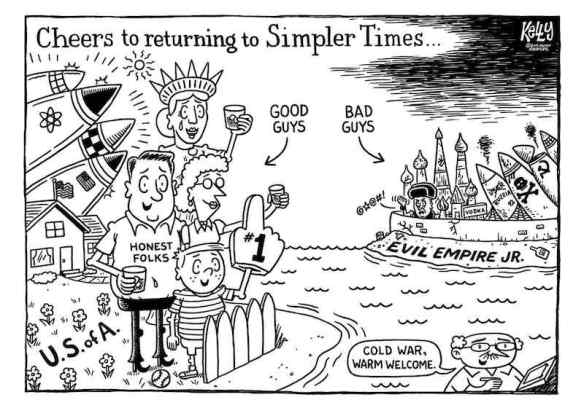
kelly-cold-war

By Philip Giraldi

Source: Unz Review

Liberals are supposed to be antiwar, right? I went to college in the 1960s, when students nationwide were rising up in opposition to the Vietnam War. I was a Young Republican back then and supported the war through sheer ignorance and dislike of the sanctimoniousness of the protesters, some of whom were surely making their way to Canada to live in exile on daddy’s money while I was on a bus going to Fort Leonard Wood for basic combat training. I can’t even claim that I had some grudging respect for the antiwar crowd because I didn’t, but I did believe that at least some of them who were not being motivated by being personally afraid of getting hurt were actually sincere in their opposition to the awful things that were happening in Southeast Asia.

As I look around now, however, I see something quite different. The lefties I knew in college are now part of the Establishment and generally speaking are retired limousine liberals. And they now call themselves progressives, of course, because it sounds more educated and sends a better message, implying as it does that troglodytic conservatives are anti-progress. But they also have done a flip on the issue of war and peace. In its most recent incarnation some of this might be attributed to a desperate desire to relate to the Hillary Clinton campaign with its bellicosity towards Russia, Syria and Iran, but I suspect that the inclination to identify enemies goes much deeper than that, back as far as the Bill Clinton Administration with its sanctions on Iraq and the Balkan adventure, which resulted in hundreds of thousands of deaths and the creation of a terror-narco state in the heart of Europe. And more recently we have seen the Obama meddling in Libya, Yemen and Syria in so called humanitarian interventions which have turned out to be largely fraudulent. Yes, under the Obama Dems it was “responsibility to protect time” (r2p) and all the world trembled as the drones were let loose.

Last Friday I started to read an op-ed in The Washington Post by David Ignatius that blew me away. It began “President Trump confronts complicated problems as the investigation widens into Russia’s attack on our political system.” It then proceeded to lay out the case for an “aggressive Russia” in the terms that have been repeated ad nauseam in the mainstream media. And it was, of course, lacking in any evidence, as if the opinions of coopted journalists and the highly politicized senior officials in the intelligence community should be regarded as sacrosanct. These are, not coincidentally, the same people who have reportedly recently been working together to undercut the White House by leaking and then reporting highly sensitive transcripts of phone calls with Russian officials.

Ignatius is well plugged into the national security community and inclined to be hawkish but he is also a typical Post politically correct progressive on most issues. So here was your typical liberal asserting something in a dangerous fashion that has not been demonstrated and might be completely untrue. Russia is attacking “our political system!” And The Post is not alone in accepting that Russia is trying to subvert and ultimately overthrow our republic. Reporting from The New York Times and on television news makes the same assumption whenever they discuss Russia, leading to what some critics have described as mounting American ‘hysteria’ relating to anything coming out of Moscow.

Rachel Maddow is another favorite of mine when it comes to talking real humanitarian feel good stuff out one side of her mouth while beating the drum for war from the other side. In a bravura performance on January 26th she roundly chastised Russia and its president Vladimir Putin. Rachel, who freaked out completely when Donald Trump was elected, is now keen to demonstrate that Trump has been corrupted by Russia and is now controlled out of the Kremlin. She described Trump’s lord and master Putin as an “intense little man” who murders his opponents before going into the whole “Trump stole the election with the aid of Moscow” saga, supporting sanctions on Russia and multiple investigations to get to the bottom of “Putin’s attacks on our democracy.” Per Maddow, Russia is the heart of darkness and, by way of Trump, has succeeded in exercising control over key elements in the new administration.

Unfortunately, people in the media like Ignatius and Maddow are not alone. Their willingness to sell a specific political line that carries with it a risk of nuclear war as fact, even when they know it is not, has been part of the fear-mongering engaged in by Democratic Party loyalists and many others on the left. Their intention is to “get Trump” whatever it takes, which opens the door to some truly dangerous maneuvering that could have awful consequences if the drumbeat and military buildup against Russia continues, leading Putin to decide that his country is being threatened and backed into a corner. Moscow has indicated that it would not hesitate use nuclear weapons if it is being confronted militarily and facing defeat.

The current wave of Russophobia is much more dangerous than the random depiction of foreigners in negative terms that has long bedeviled a certain type of American know-nothing politics. Apart from the progressive antipathy towards Putin personally, there is a virulent strain of anti-Russian sentiment among some self-styled conservatives in congress, best exemplified by Senators John McCain and Lindsey Graham. Graham has recently said “2017 is going to be a year of kicking Russia in the ass in Congress.”

It is my belief that many in the National Security State have convinced themselves that Russia is indeed a major threat against the United States and not because it is a nuclear armed power that can strike the U.S. That appreciation, should, if anything constitute a good reason to work hard to maintain cordial relations rather than not, but it is seemingly ignored by everyone but Donald Trump.

No, the new brand of Russophobia derives from the belief that Moscow is “interfering” in places like Syria and Ukraine. Plus, it is a friend of Iran. That perception derives from the consensus view among liberals and conservatives alike that the U.S. sphere of influence encompasses the entire globe as well as the particularly progressive conceit that Washington should serve to “protect” anyone threatened at any time by anyone else, which provides a convenient pretext for military interventions that are euphemistically described as “peace missions.”

There might be a certain cynicism in many who hate Russia as having a powerful enemy also keeps the cash flowing from the treasuring into the pockets of the beneficiaries of the military industrial congressional complex, but my real fear is that, having been brainwashed for the past ten years, many government officials are actually sincere in their loathing of Moscow and all its works. Recent opinion polls suggest that that kind of thinking is popular among Americans, but it actually makes no sense. Though involvement by Moscow in the Middle East and Eastern Europe is undeniable, calling it a threat against U.S. vital interests is more than a bit of a stretch as Russia’s actual ability to make trouble is limited. It has exactly one overseas military facility, in Syria, while the U.S. has more than 800, and its economy and military budget are tiny compared to that of the United States. In fact, it is Washington that is most guilty of intervening globally and destabilizing entire regions, not Moscow, and when Donald Trump said in an interview that when it came to killing the U.S. was not so innocent it was a gross understatement.

Ironically, pursuing a reset with Russia is one of the things that Trump actually gets right but the new left won’t give him a break because they reflexively hate him for not embracing the usual progressive bromides that they believe are supposed to go with being antiwar. Other Moscow trashing comes from the John McCain camp which demonizes Russia because warmongers always need an enemy and McCain has never found a war he couldn’t support. It would be a tragedy for the United States if both the left and enough of the right were to join forces to limit Trump’s options on dealing with Moscow, thereby enabling an escalating conflict that could have tragic consequences for all parties.

If Americans Truly Cared About Muslims, They Would Stop Killing Them by the Millions

index

By Glen Ford

Source: Black Agenda Report

In the most dramatic expression of insider opposition to a sitting administration’s policies in generations, over 1,000 U.S. State Department employees signed on to a memo protesting President Donald Trump’s temporary ban on people from seven predominantly Muslim countries setting foot on U.S. soil. Another recent high point in dissent among the State Department’s 18,000 worldwide employees occurred in June of last year, when 51 diplomats called for U.S. air strikes against the Syrian government of President Bashar al Assad.

Neither outburst of dissent was directed against the U.S. wars and economic sanctions that have killed and displaced millions of people in the affected countries: Iran, Iraq, Libya, Somalia, Sudan, Syria and Yemen. Rather, the diplomatic “rebellion” of last summer sought to pressure the Obama administration to join with Hillary Clinton and her “Big Tent” full of war hawks to confront Russia in the skies over Syria, while the memo currently making the rounds of State Department employees claims to uphold “core American and constitutional values,” preserve “good will towards Americans” and prevent “potential damage to the U.S. economy from the loss of revenue from foreign travelers and students.”

In neither memo is there a word of support for world peace, nor a hint of respect for the national sovereignty of other peoples — which is probably appropriate, since these are not, and never have been, “core American and constitutional values.”

Ironically, the State Department “dissent channel” was established during one of those rare moments in U.S. history when “peace” was popular: 1971, when a defeated U.S. war machine was very reluctantly winding down support for its puppet regime in South Vietnam. Back then, lots of Americans, including denizens of the U.S. government, wanted to take credit for the “peace” that was on the verge of being won by the Vietnamese, at a cost of at least four million Southeast Asian dead. But, those days are long gone. Since 2001, war has been normalized in the U.S. — especially war against Muslims, which now ranks at the top of actual “core American values.” Indeed, so much American hatred is directed at Muslims that Democrats and establishment Republicans must struggle to keep the Russians in the “hate zone” of the American popular psyche. The two premiere, officially-sanctioned hatreds are, of course, inter-related, particularly since the Kremlin stands in the way of a U.S. blitzkrieg in Syria, wrecking Washington’s decades-long strategy to deploy Islamic jihadists as foot soldiers of U.S. empire.

The United States has always been a project of empire-building. George Washington called it a “nascent empire,” Thomas Jefferson bought the Louisiana Territory from France in pursuit of an “extensive empire,” and the real Alexander Hamilton, contrary to the Broadway version, considered the U.S. to be the “most interesting empire in the world.” The colonial outpost of two million white settlers (and half a million African slaves) severed ties with Britain in order to forge its own, limitless dominion, to rival the other white European empires of the world. Today, the U.S. is the Mother of All (Neo)Colonialists, under whose armored skirts are gathered all the aged, shriveled, junior imperialists of the previous era.

In order to reconcile the massive contradiction between America’s predatory nature and its mythical self-image, however, the mega-hyper-empire must masquerade as its opposite: a benevolent, “exceptional” and “indispensible” bulwark against global barbarism. Barbarians must, therefore, be invented and nurtured, as did the U.S. and the Saudis in 1980s Afghanistan with their creation of the world’s first international jihadist network, for subsequent deployment against the secular “barbarian” states of Libya and Syria.

In modern American bureaucratese, worrisome barbarian states are referred to as “countries or areas of concern” — the language used to designate the seven nations targeted under the Terrorist Travel Prevention Act of 2015 signed by President Obama. President Donald Trump used the existing legislation as the basis for his executive order banning travelers from those states, while specifically naming only Syria. Thus, the current abomination is a perfect example of the continuity of U.S. imperial policy in the region, and emphatically not something new under the sun (a sun that, as with old Britannia, never sets on U.S. empire).

The empire preserves itself, and strives relentlessly to expand, through force of arms and coercive economic sanctions backed up by the threat of annihilation. It kills people by the millions, while allowing a tiny fraction of its victims to seek sanctuary within U.S. borders, based on their individual value to the empire.

Donald Trump’s racist executive order directly affects about 20,000 people, according to the United Nations High Commissioner on Refugees. President Obama killed an estimated 50,000 Libyans in 2011, although the U.S. officially does not admit it snuffed out the life of a single civilian. The First Black President is responsible for each of the half-million Syrians that have died since he launched his jihadist-based war against that country, the same year. Total casualties inflicted on the populations of the seven targeted nations since the U.S. backed Iraq in its 1980s war against Iran number at least four million — a bigger holocaust than the U.S. inflicted on Southeast Asia, two generations ago — when the U.S. State Department first established its “dissent channel.”

But, where is the peace movement? Instead of demanding a halt to the carnage that creates tidal waves of refugees, self-styled “progressives” join in the macabre ritual of demonizing the “countries of concern” that have been targeted for attack, a process that U.S. history has color-coded with racism and Islamophobia. These imperial citizens then congratulate themselves on being the world’s one and only “exceptional” people, because they deign to accept the presence of a tiny portion of the populations the U.S. has mauled.

The rest of humanity, however, sees the real face of America — and there will be a reckoning.